






中国农业科学 ›› 2026, Vol. 59 ›› Issue (7): 1507-1522.doi: 10.3864/j.issn.0578-1752.2026.07.010
朱琦1( ), 贾振鹏1, Tahir SHAH1, 徐晨晟1, 李芷琦1, 吕会帅1, 朱鹏超1, 韦小敏1, 黄冬琳1, 孙艳妮2, 曹卫东3, 高亚军1,4, 王朝辉1,4,5, 张达斌1,4,5()
收稿日期:2025-05-31
接受日期:2025-06-26
出版日期:2026-04-08
发布日期:2026-04-08
通信作者:
联系方式:
朱琦,E-mail:zhuqi10150052@163.com。
基金资助:
ZHU Qi1(), JIA ZhenPeng1, Tahir SHAH1, XU ChenSheng1, LI ZhiQi1, LÜ HuiShuai1, ZHU PengChao1, WEI XiaoMin1, HUANG DongLin1, SUN YanNi2, CAO WeiDong3, GAO YaJun1,4, WANG ZhaoHui1,4,5, ZHANG DaBin1,4,5()
Received:2025-05-31
Accepted:2025-06-26
Published:2026-04-08
Online:2026-04-08
摘要:
【目的】基于田间试验系统研究绿肥配施增效产品对黄土高原旱地夏绿肥-冬小麦轮作系统中温室气体排放及碳足迹的影响,为充分挖掘绿肥作物减排固碳潜力并评估其在旱地轮作体系中的环境效益提供理论依据和技术参数。【方法】以黑麦豆(Phaseolus vulgaris L.)和油菜(Brassica napus L.)为研究对象,设置9个处理,分别为休闲(对照);黑麦豆单播;黑麦豆+复合生物菌剂(藻益稼1号);黑麦豆+细菌(贝莱斯芽孢杆菌B22);黑麦豆+海泡石;油菜单播;油菜+保水剂(首科保水剂);油菜+放线菌(娄彻氏链霉菌D74);油菜+海泡石。重复3次。监测2023—2024年夏绿肥-冬小麦轮作系统温室气体排放通量及土壤碳库净收支,综合量化及评估系统碳足迹,筛选固碳减排的旱地绿肥+增效产品组合。【结果】(1)黑麦豆+细菌较黑麦豆单播显著降低N2O、CO2排放量和全球增温潜势,平均降幅为29.3%、17.5%和17.8%,温室气体排放强度降低21.6%(P>0.05),小麦籽粒产量增加7.8%(P>0.05);(2)所有黑麦豆处理中,黑麦豆+细菌处理的生物量干重(4 230 kg·hm-2)和碳还田量(1 750 kg·hm-2)最高,并较休闲显著降低43.6%碳足迹;(3)油菜+海泡石较油菜单播显著降低N2O、CO2排放量和全球增温潜势,平均降幅为52.0%、16.9%和17.6%;(4)所有油菜处理中,油菜+海泡石的生物量干重(2 723 kg·hm-2)最高,较休闲处理显著降低27.0%碳足迹。【结论】在黄土高原地区将黑麦豆+细菌和油菜+海泡石的优化配置引入夏绿肥-冬小麦轮作系统中能显著降低因绿肥种植和翻压而导致的温室气体排放量及全球增温潜势,提高农田有机物的碳投入,降低作物生育周期碳足迹,建立提质增效、固碳减排的绿色清洁生产模式,推动旱地农业“生态优先、绿色低碳”的高质量发展。
朱琦, 贾振鹏, Tahir SHAH, 徐晨晟, 李芷琦, 吕会帅, 朱鹏超, 韦小敏, 黄冬琳, 孙艳妮, 曹卫东, 高亚军, 王朝辉, 张达斌. 绿肥配施增效产品降低旱地麦田温室气体排放及碳足迹[J]. 中国农业科学, 2026, 59(7): 1507-1522.
ZHU Qi, JIA ZhenPeng, Tahir SHAH, XU ChenSheng, LI ZhiQi, LÜ HuiShuai, ZHU PengChao, WEI XiaoMin, HUANG DongLin, SUN YanNi, CAO WeiDong, GAO YaJun, WANG ZhaoHui, ZHANG DaBin. Green Manure Crops Combined with Enhanced-Efficiency Products Reduced Greenhouse Gas Emissions and Carbon Footprints in Dryland Wheat Fields[J]. Scientia Agricultura Sinica, 2026, 59(7): 1507-1522.
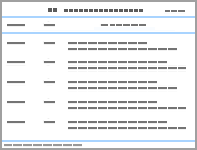
表1
0—10和10—20 cm土层基础理化性质"
| 土层 Soil layer (cm) | pH | 全氮 Total N (g·kg-1) | 全磷 Total P (g·kg-1) | 全钾 Total K (g·kg-1) | 有机质 SOM (g·kg-1) | 有效磷 Available P (mg·kg-1) | 有效钾 Available K (mg·kg-1) | 硝态氮 NO3--N (mg·kg-1) | 铵态氮 NH4+-N (mg·kg-1) |
|---|---|---|---|---|---|---|---|---|---|
| 0-10 | 8.20 | 1.00 | 0.70 | 20.6 | 17.2 | 29.8 | 77.2 | 6.05 | 3.67 |
| 10-20 | 8.18 | 1.01 | 0.69 | 21.1 | 15.9 | 25.3 | 68.0 | 7.58 | 2.85 |
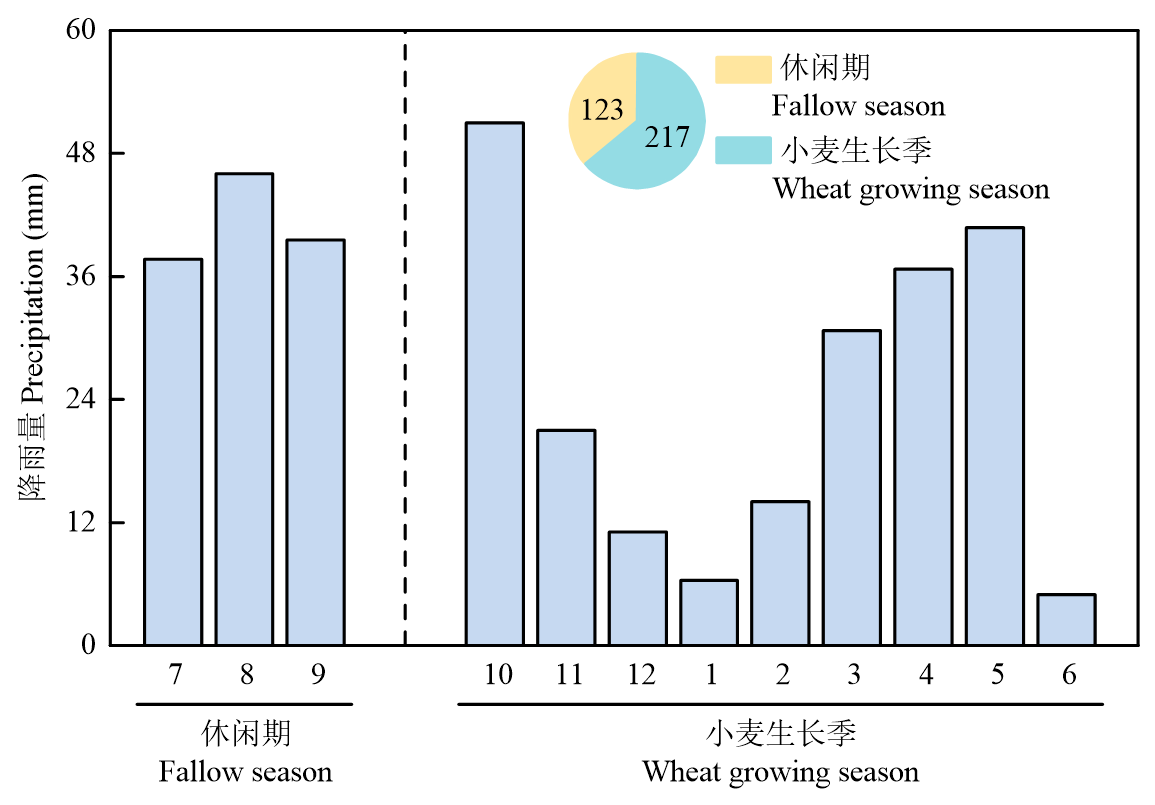
图1
2023—2024年试验地夏休闲期和冬小麦生长季降雨量"
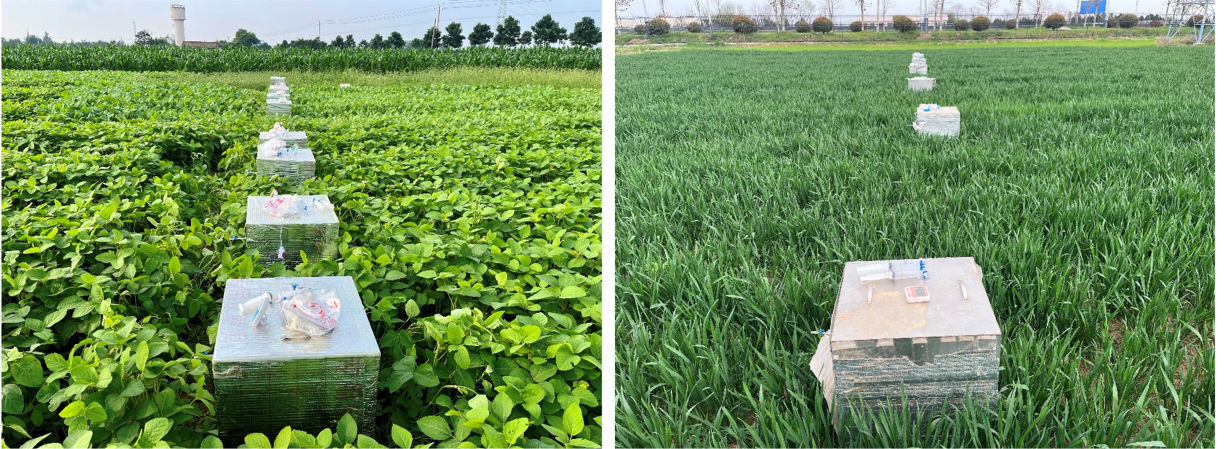
图2
绿肥及冬小麦生长季田间气体采集"
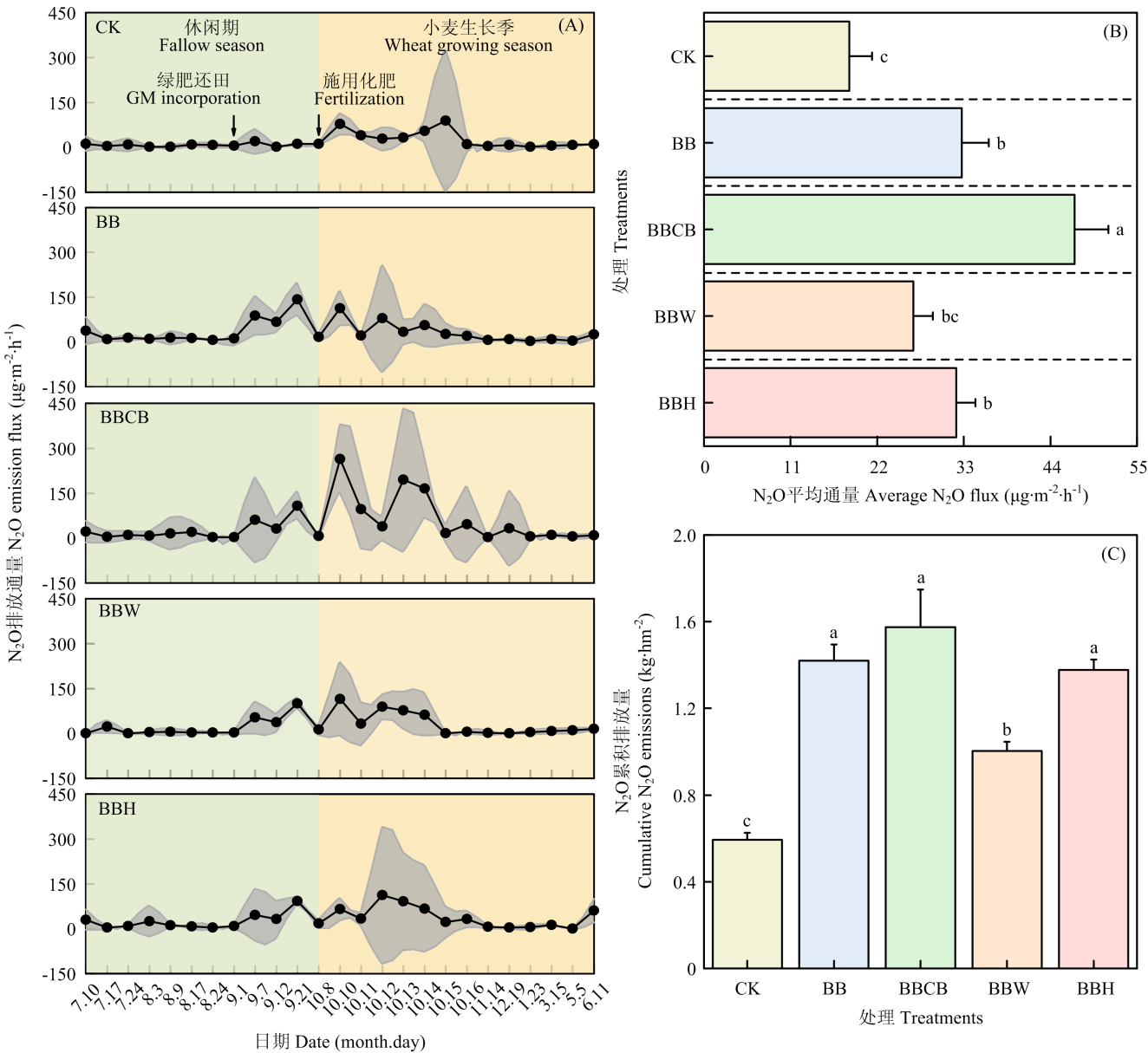
图3
黑麦豆配施不同增效产品N2O排放通量随时间变化(A),N2O平均排放通量(B)及N2O累积排放量(C) 图柱上不同小写字母表示不同处理间差异显著(邓肯检验,P<0.05),图3-A中箭头表示不同田间管理,黑色阴影部分为95%置信区间;CK:休闲,BB:黑麦豆单播,BBCB:黑麦豆+复合生物菌剂,BBW:黑麦豆+细菌,BBH:黑麦豆+海泡石。下同"
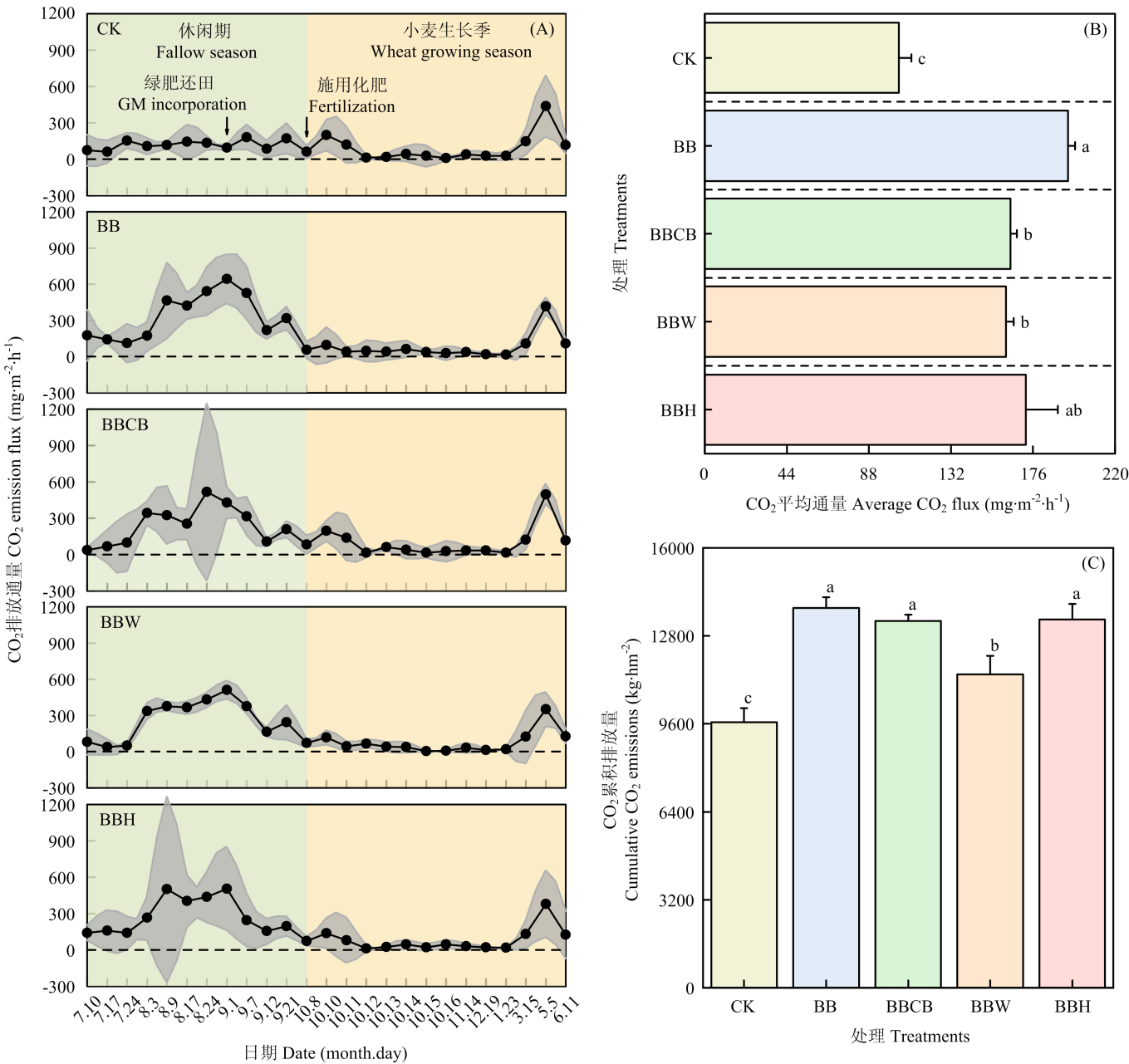
图4
黑麦豆配施不同增效产品CO2排放通量随时间变化(A),CO2平均排放通量(B)及CO2累积排放量(C)"
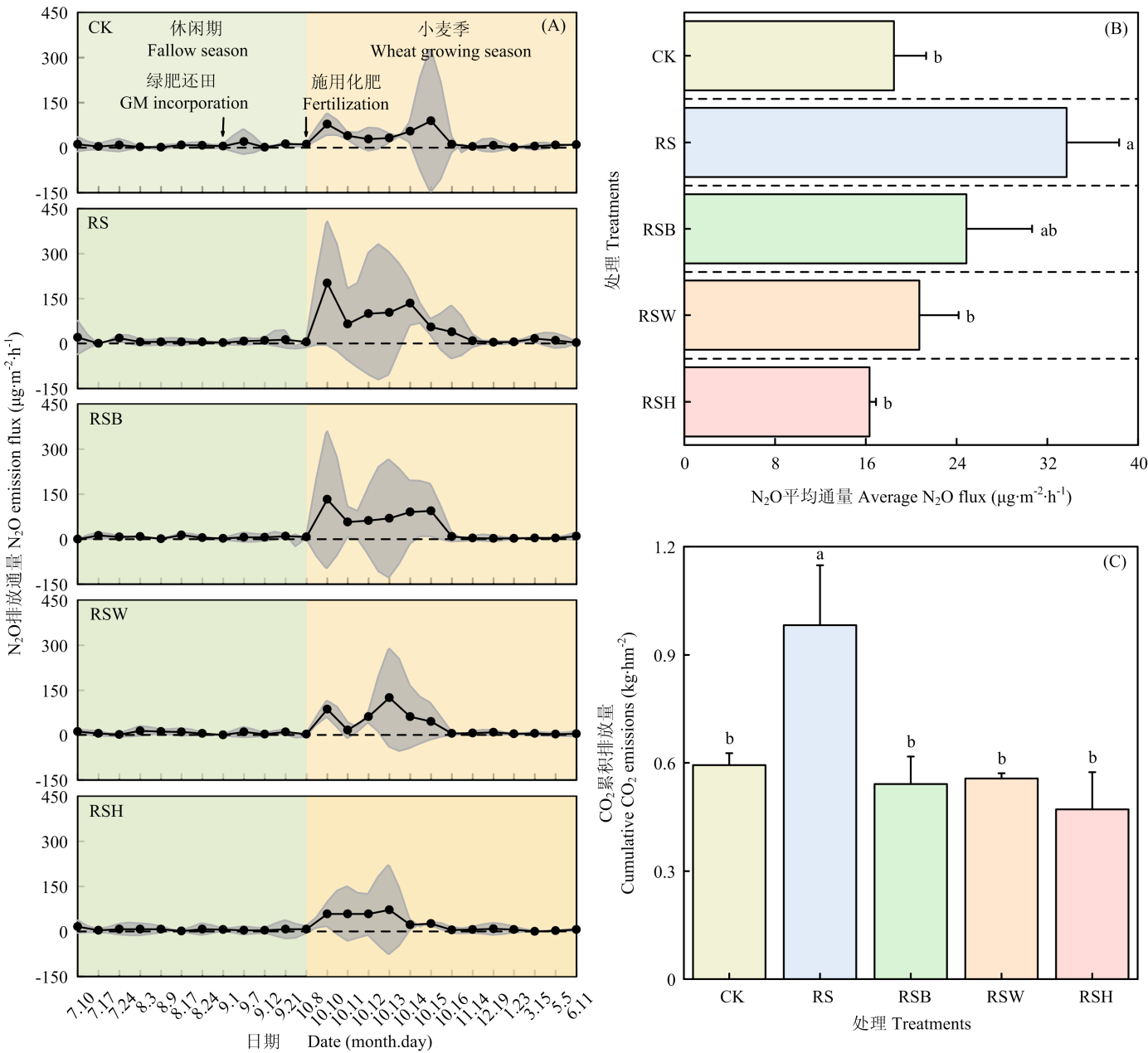
图5
油菜配施不同增效产品N2O排放通量随时间变化(A),N2O平均排放通量(B)及N2O累积排放量(C) 图柱上不同小写字母表示不同处理间差异显著(邓肯检验,P<0.05),图5-A中箭头表示不同田间管理,黑色阴影部分为95%置信区间;CK:休闲,RS:油菜单播,RSB:油菜+保水剂,RSW:油菜+放线菌,RSH:油菜+海泡石。下同"
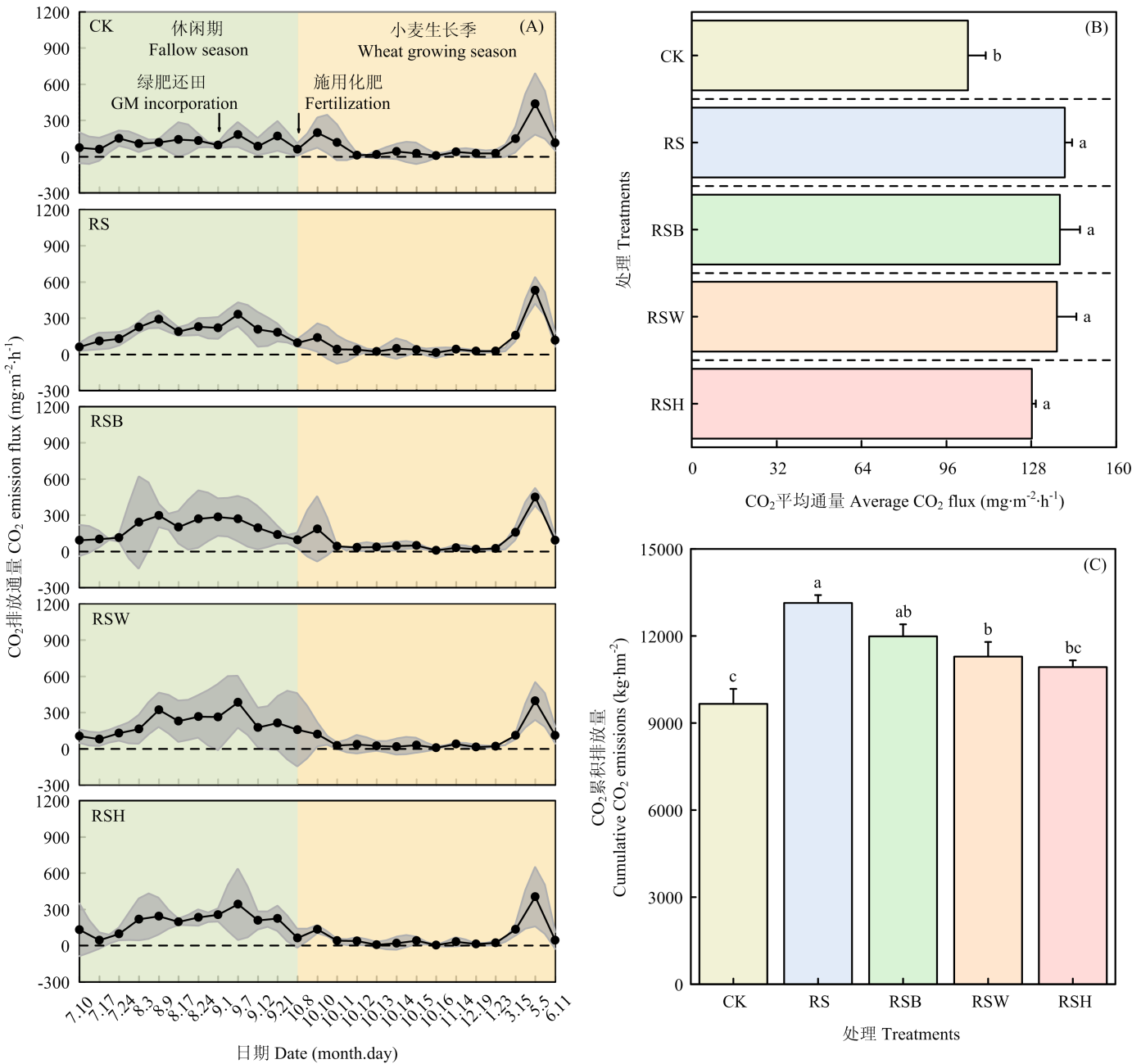
图6
油菜配施不同增效产品CO2排放通量随时间变化(A),CO2平均排放通量(B)及CO2累积排放量(C)"
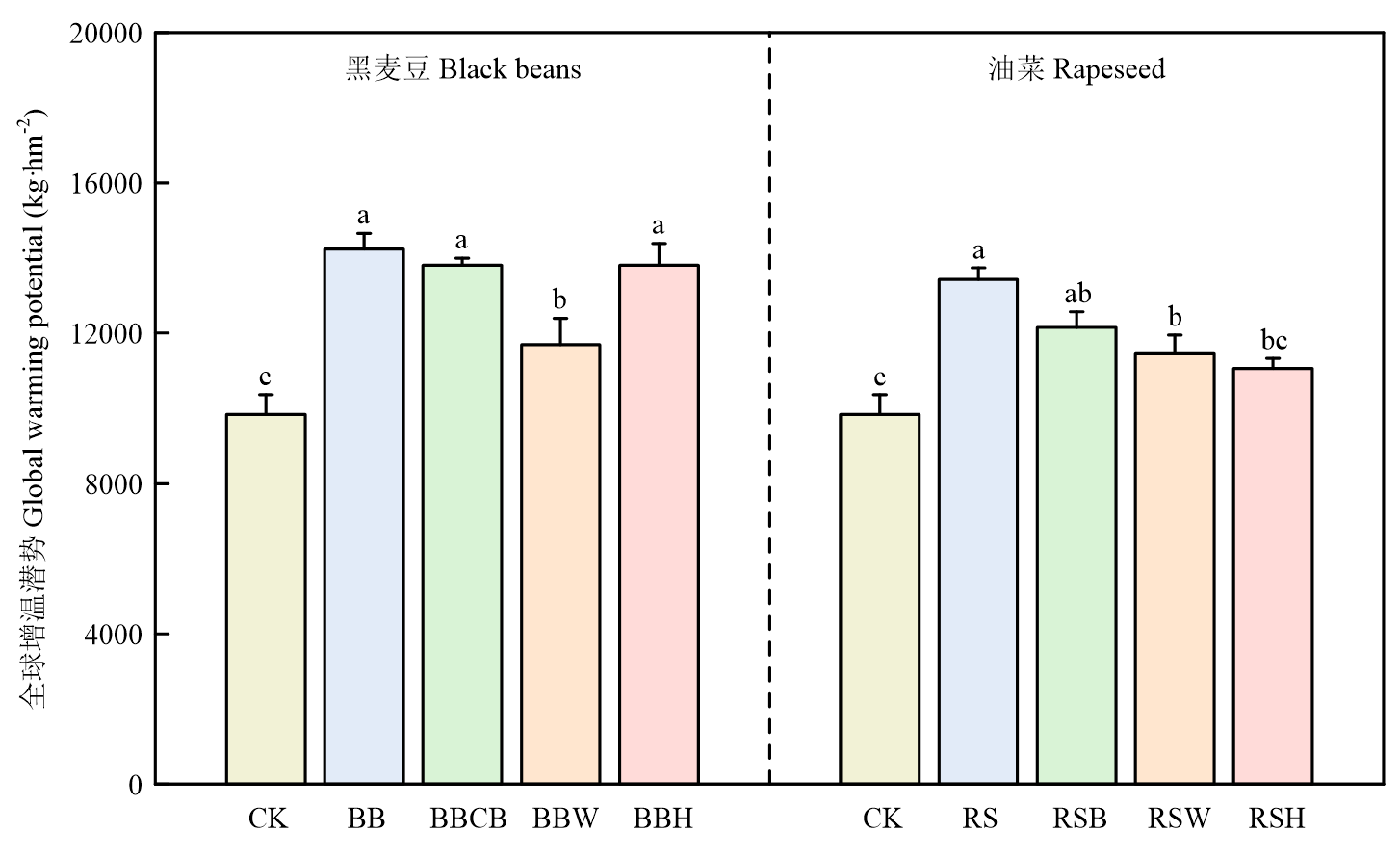
图7
绿肥配施不同增效产品的全球增温潜势 图柱上不同小写字母表示同一绿肥的不同处理间差异显著(邓肯检验,P<0.05)"
表2
绿肥配施不同增效产品下绿肥的生物量干重和碳还田量以及小麦产量和GHGI"
| 处理 Treatment | 绿肥生物量干重 Dry biomass of green manure (kg·hm-2) | 绿肥碳还田量 C accumulation of green manure (kg·hm-2) | 小麦产量 Wheat yield (kg·hm-2) | 温室气体排放强度 GHGI (kg·kg-1) | |
|---|---|---|---|---|---|
| 黑麦豆 Black bean | BB | 3314.8ab | 1202.9b | 3963.9b | 3.65a |
| BBCB | 2634.7b | 1139.1b | 4085.9ab | 3.54a | |
| BBW | 4230.4a | 1750.1a | 4273.3ab | 2.86ab | |
| BBH | 3541.9ab | 1600.2ab | 4845.9ab | 2.87ab | |
| 休闲 Fallow | CK | — | — | 5682.9a | 1.73b |
| 油菜 Rapeseed | RS | 2525.7a | 965.1a | 4596.0a | 2.92a |
| RSB | 2650.0a | 1097.6a | 4718.5a | 2.59a | |
| RSW | 2706.7a | 1063.0a | 4264.0a | 2.86a | |
| RSH | 2722.6a | 1061.0a | 4256.7a | 2.63a | |
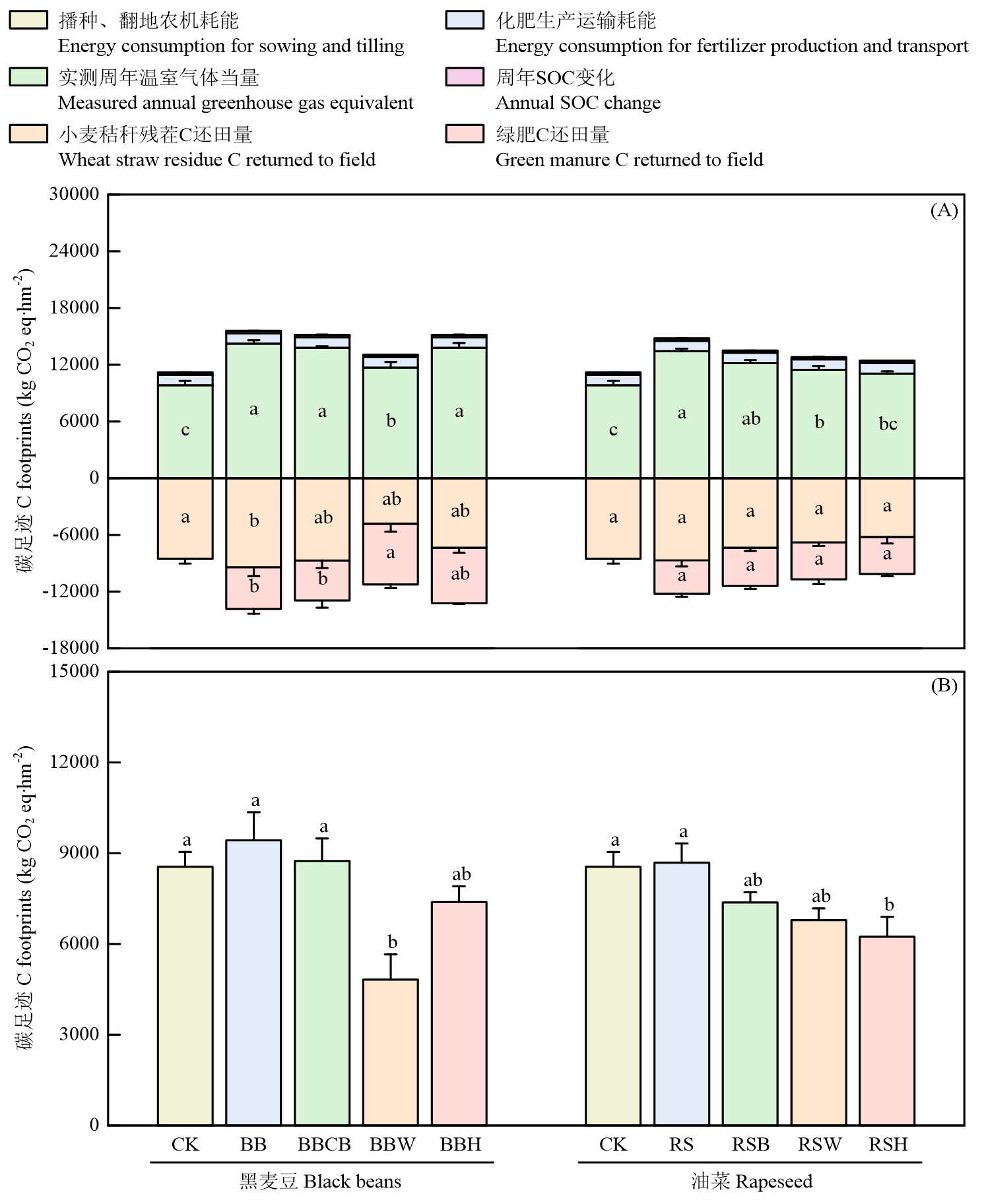
图8
绿肥配施不同增效产品下以CO2当量计算不同来源的碳投入和输出(A)及碳足迹(B) (A)图中每个处理中柱子内不同的颜色表示田间来源不同的C投入和输出量,正值表示C输出,负值表示C投入,不同小写字母表示同一绿肥不同处理间差异显著(邓肯检验,P<0.05)"
| [1] |
巨晓棠, 谷保静. 我国农田氮肥施用现状、问题及趋势. 植物营养与肥料学报, 2014, 20(4): 783-795.
|
|
|
|
| [2] |
张俊伶, 张江周, 申建波, 田静, 金可默, 张福锁. 土壤健康与农业绿色发展: 机遇与对策. 土壤学报, 2020, 57(4): 783-796.
|
|
|
|
| [3] |
doi: 10.1111/gcb.14826 pmid: 31495039 |
| [4] |
刘亚龙, 王鹏飞, 于爱忠, 王玉珑, 尚永盼, 杨学慧, 尹波, 张冬玲, 王凤. 绿肥还田条件下减氮对河西绿洲灌区玉米产量及N2O排放的影响. 作物学报, 2025, 51(3): 771-784.
doi: 10.3724/SP.J.1006.2025.43034 |
|
doi: 10.3724/SP.J.1006.2025.43034 |
|
| [5] |
孙丽惠, 李中强. 北方旱地农田主要温室气体排放研究进展. 辽宁农业科学, 2020(2): 52-56.
|
|
|
|
| [6] |
尚杰, 杨果, 于法稳. 中国农业温室气体排放量测算及影响因素研究. 中国生态农业学报, 2015, 23(3): 354-364.
|
|
|
|
| [7] |
孙丽惠, 李中强, 刘晶, 常程. 交联聚丙烯酰胺(CPA)匹配缓释肥对春玉米产量及农艺指标的影响研究. 辽宁农业科学, 2022(1): 21-24.
|
|
|
|
| [8] |
曹卫东, 高嵩涓. 到2025年中国绿肥发展策略. 中国农业资源与区划, 2023, 44(12): 1-9.
|
|
|
|
| [9] |
doi: 10.1016/j.geoderma.2017.05.027 pmid: 29109589 |
| [10] |
王婷, 杨君林, 李利利, 曾小茹, 吕晓东. 陇东旱塬麦黑豆-冬小麦轮作条件下施氮水平对土壤N2O和CH4排放的影响. 甘肃农业科技, 2022, 53(9): 36-40.
|
|
|
|
| [11] |
殷熙悦, 殷文, 樊志龙, 赵财, 胡发龙, 柴强. 绿肥还田及减施氮肥对绿洲灌区小麦产量和土壤CO2、N2O排放的影响. 甘肃农业大学学报, 2022, 57(1): 48-55.
|
|
|
|
| [12] |
doi: 10.1016/j.envpol.2021.117724 |
| [13] |
doi: 10.1016/j.agee.2012.07.026 |
| [14] |
杨伟, 朱杰, 姚涞, 赵东竹, 聂江文, 蒋梦蝶, 朱波, 易丽霞, 刘章勇. 有机无机配施对稻田不同绿肥腐解特征和养分释放速率的影响. 生态学杂志, 2025, 44(8) : 2640-2647.
|
|
|
|
| [15] |
陈雨露, 王伟宁, 孙丰, 王豹祥, 汪健, 毕庆文, 冯宇阳, 聂晨旭, 叶协锋. 烟田地表CO2和N2O日变化对连续绿肥翻压还田的响应. 华北农学报, 2025, 40(3): 104-113.
doi: 10.7668/hbnxb.20195489 |
|
doi: 10.7668/hbnxb.20195489 |
|
| [16] |
张义宁. 绿肥腐解及其对旱作农田土壤温室气体排放与碳氮组分的影响[D]. 西安: 西北大学, 2021.
|
|
|
|
| [17] |
张巍. 海泡石吸附混合污染物和气态污染物的研究进展. 中国矿业, 2019, 28(2): 126-132.
|
|
|
|
| [18] |
张祥, 梁济, 李接励, 袁宸, 陈明良. 腐殖酸肥料对小麦氮素吸收利用的影响. 化肥工业, 2019, 46(3): 61-66.
|
|
|
|
| [19] |
龙则军. 紫云英应用根瘤菌剂种植技术大田展示. 现代农业科技, 2017(15): 178, 184.
|
|
|
|
| [20] |
doi: 10.1016/j.apsoil.2013.08.002 |
| [21] |
doi: 10.1016/j.soilbio.2010.09.012 |
| [22] |
徐驰, 谢海宽, 丁武汉, 戴震, 张婧, 王立刚, 李虎. 油菜-水稻复种系统一次性施肥对CH4和N2O净排放的影响. 中国农业科学, 2018, 51(20): 3972-3984. doi: 10.3864/j.issn.0578-1752.2018.20.015.
|
|
|
|
| [23] |
doi: 10.1016/j.agee.2011.05.012 |
| [24] |
doi: 10.1016/j.agee.2011.02.025 |
| [25] |
doi: 10.1016/j.still.2009.10.001 |
| [26] |
doi: 10.2134/agronj15.0065 |
| [27] |
杨学慧, 于爱忠, 柴健, 李悦, 王凤, 王鹏飞, 吕汉强, 王玉珑, 尚永盼. 绿肥还田结合减氮对麦田土壤呼吸及其温度敏感性的影响. 中国生态农业学报(中英文), 2024, 32(1): 61-70.
|
|
|
|
| [28] |
doi: 10.1139/cjm-2016-0122 |
| [29] |
doi: 10.1111/gcb.2018.24.issue-6 |
| [30] |
doi: 10.1128/AEM.71.11.6719-6729.2005 pmid: 16269702 |
| [31] |
doi: 10.1016/j.scitotenv.2023.163789 |
| [32] |
doi: 10.1016/j.iswcr.2022.03.003 |
| [33] |
doi: 10.1080/1343943X.2015.1128098 |
| [34] |
doi: 10.17221/110/2022-PSE |
| [35] |
doi: 10.1038/srep04586 |
| [36] |
doi: 10.1016/j.geoderma.2017.07.036 |
| [37] |
doi: 10.1016/j.chemer.2016.04.002 |
| [38] |
doi: 10.1007/s11356-018-1988-0 |
| [39] |
|
| [40] |
doi: 10.1007/s11356-012-1261-x |
| [41] |
doi: 10.1080/02757540.2019.1648441 |
| [42] |
doi: 10.1016/j.geoderma.2016.06.015 |
| [43] |
doi: 10.1180/0009855033830101 |
| [44] |
doi: 10.1038/srep26856 pmid: 27225842 |
| [45] |
doi: 10.1016/j.fcr.2021.108278 |
| [46] |
doi: 10.1016/j.agwat.2016.03.005 |
| [47] |
黄志浩, 张广辉, 王学虎, 李娟茹, 宋小颖, 常苑苑. 微生物菌剂拌种对小麦生长及产量的影响. 中国农技推广, 2025, 41(2): 76-80.
|
|
|
|
| [48] |
doi: 10.1007/s11356-019-04477-8 |
| [49] |
|
| [50] |
doi: 10.1525/bio.2010.60.9.8 |
| [51] |
doi: 10.1016/j.agee.2014.10.024 |
| [1] | 王彩玉, 刘小丽, 李文广, 杨文平, 杨珍平, 高志强. 有机肥不同替代比例对土壤多功能性的影响及微生物驱动机制[J]. 中国农业科学, 2026, 59(8): 1712-1726. |
| [2] | 苏一帆, 杨瞻旭, 王迪, 冒俊呈, 魏萌萌, 陈泽, 白欣冉, 楚天歌, 马昌宁, 乔明菲, 孙权, 胡大刚. 2, 4-表油菜素内酯对苹果果实采后贮藏性能的影响[J]. 中国农业科学, 2026, 59(7): 1536-1551. |
| [3] | 刘海卿, 金姣姣, 孙万仓, 柴鹏, 祁伟亮, 杨刚, 李婵, 骆雪梅, 苏芸芸, 秦雪雪. 甘蓝型冬油菜越冬期矮生长点形态建成及多激素调控机制[J]. 中国农业科学, 2026, 59(5): 951-966. |
| [4] | 钱瑾, 李映雪, 吴芳, 邹晓晨. 集成光谱降维的冬小麦叶片磷含量估算[J]. 中国农业科学, 2026, 59(4): 781-792. |
| [5] | 孔媛, 崔沙沙, 李美, 李健, 杨思雨, 房锋, 刘帅帅, 刘明平, 曾艳, 高兴祥, 柏连阳. 黄淮海冬小麦田多花黑麦草等5种禾本科杂草时空分布变化规律[J]. 中国农业科学, 2026, 59(4): 807-823. |
| [6] | 申丽琼, 何林丽, 刘倪, 陆俊杏, 朱波, 张涛. 钾营养水平对油菜苗期抗湿害能力及内源激素平衡的影响[J]. 中国农业科学, 2026, 59(3): 528-542. |
| [7] | 咸青林, 肖鉴珂, 高阿庆, 郜利闯, 刘杨. 种植方式结合测墒补灌下冬小麦产量及水分利用效率[J]. 中国农业科学, 2026, 59(3): 589-601. |
| [8] | 杨锐, 陈敬东, 黄郢, 谢伶俐, 张学昆, 周登文, 刘清云, 徐劲松, 许本波. 长江上游油菜高产品系遗传改良与构型分析[J]. 中国农业科学, 2026, 59(2): 250-264. |
| [9] | 吕旭东, 孙世媛, 李亚楠, 刘玉龙, 王艳群, 付鑫, 张佳英, 宁鹏, 彭正萍. 智能机械化分层施肥对麦田根-土养分分布和小麦产量的影响[J]. 中国农业科学, 2026, 59(1): 129-146. |
| [10] | 蒲丽霞, 张佳芮, 叶建萍, 黄秀兰, 樊高琼, 杨洪坤. 二氢赤霉素与秸秆覆盖对旱地小麦分蘖成穗与产量的影响[J]. 中国农业科学, 2025, 58(9): 1735-1748. |
| [11] | 王彬, 吴朋浩, 鲁剑巍, 任涛, 丛日环, 陆志峰, 李小坤. 长江中游地区水稻-油菜轮作体系需水特征[J]. 中国农业科学, 2025, 58(7): 1355-1365. |
| [12] | 史帆, 李文广, 易树生, 杨娜, 陈玉萌, 郑伟, 张雪辰, 李紫燕, 翟丙年. 有机无机肥配施下旱地麦田土壤有机碳组分含量的变化特征[J]. 中国农业科学, 2025, 58(4): 719-732. |
| [13] | 郑煜, 陈颐, 遆晋松, 史龙飞, 许校博, 李昱霖, 郭瑞. 烟草不同轮作模式碳足迹及经济效益评价[J]. 中国农业科学, 2025, 58(4): 733-747. |
| [14] | 郭松, 韩磊, 汪源, 王子君, 钱紫慧, 路佳明, 赵灿, 王维领, 许轲, 张洪程, 杨凤萍, 霍中洋. 控释与速效氮肥不同配比一次性侧深施对水稻产量、氮肥利用率和碳减排的影响[J]. 中国农业科学, 2025, 58(24): 5216-5233. |
| [15] | 房康睿, 丁世杰, 陈雨珊, 杨秉庚, 郭腾飞, 徐新朋, 赵士诚, 王秀斌, 黄绍敏, 仇少君, 何萍, 周卫. 有机无机肥配施下典型潮土小麦季有机肥氮磷的当季释放率[J]. 中国农业科学, 2025, 58(24): 5234-5246. |
|
||
