






中国农业科学 ›› 2026, Vol. 59 ›› Issue (5): 951-966.doi: 10.3864/j.issn.0578-1752.2026.05.003
刘海卿1,2( ), 金姣姣1,2, 孙万仓3, 柴鹏4, 祁伟亮1,2, 杨刚3, 李婵1, 骆雪梅1, 苏芸芸1,2, 秦雪雪1
收稿日期:2025-08-19
接受日期:2025-11-12
出版日期:2026-03-01
发布日期:2026-03-06
联系方式:
刘海卿,E-mail:15117162792@163.com
基金资助:
LIU HaiQing1,2(), JIN JiaoJiao1,2, SUN WanCang3, CHAI Peng4, QI WeiLiang1,2, YANG Gang3, LI Chan1, LUO XueMei1, SU YunYun1,2, QIN XueXue1
Received:2025-08-19
Accepted:2025-11-12
Published:2026-03-01
Online:2026-03-06
摘要:
【目的】 分析植物激素对生长点形态发育及响应抗寒性的作用及机制,以期为甘蓝型冬油菜品种的选育、扩大甘蓝型冬油菜的种植面积及提高单产提供一定的理论依据。【方法】 以9份不同冬性甘蓝型冬油菜品种为材料,在甘肃庆阳连续2年(2023—2025)田间统计越冬率,11月中旬采样进行根/冠、生长点高度等表型鉴定,并结合显微观察(采用石蜡切片和台盼蓝/NBT染色观察生长锥及细胞死亡、超氧阴离子)鉴定不同品种的抗寒性;选取抗寒性由强到弱差异明显的NTS309、天油14号、秦早1号的生长点组织同步进行LC-MS/MS靶向激素组测定和转录组分析,以PCA、O2PLS整合代谢与转录数据,系统解析生长点高度差异的生理与分子基础。【结果】 不同品种越冬率、根颈直径、干重、根/冠、生长点高度差异明显,强抗寒品种低温胁迫后ROS积累少、死亡细胞少,受低温伤害细胞比例小,反之亦然。其中,越冬率与生长点高度呈极显著负相关(r=-0.972,P<0.001)。越冬率>70%的强抗寒品种(NTS309等)生长点高度较低(约3 cm),生长锥高度仅161.5 μm,而弱抗寒品种(秦早1号等)生长点凸出于地表(约5 cm),生长锥高度约252.9 μm。经激素组和转录组联合分析,生长点高度受生长素(Auxin/IAA)-细胞分裂素(CKs)-赤霉素(GA)-脱落酸(ABA)-茉莉酸(JA)等多维网络调控,强抗寒品种游离IAA、结合态IAA、JA-Ile、GA19、ABA-GE显著上调,而iP9G、mT9G、BAP9G下调;强、弱抗寒品种之间的差异表达基因富集于“色氨酸代谢”“玉米素合成”“植物激素信号转导”“α-亚麻酸代谢”通路;O2PLS模型揭示IAA-Glu、tZR、JA-Ile等代谢物与转录模块高度共变,构成激素-转录因子-代谢物反馈环,抑制细胞伸长、促进分生组织休眠,降低生长锥和生长点高度,防御低温伤害。【结论】 明确了甘蓝型冬油菜“矮生长点”是越冬存活的关键形态标记,其形成由多激素网络精细调控。
刘海卿, 金姣姣, 孙万仓, 柴鹏, 祁伟亮, 杨刚, 李婵, 骆雪梅, 苏芸芸, 秦雪雪. 甘蓝型冬油菜越冬期矮生长点形态建成及多激素调控机制[J]. 中国农业科学, 2026, 59(5): 951-966.
LIU HaiQing, JIN JiaoJiao, SUN WanCang, CHAI Peng, QI WeiLiang, YANG Gang, LI Chan, LUO XueMei, SU YunYun, QIN XueXue. Morphogenesis of the Low-Growth Point and Its Multi-Hormonal Regulatory Mechanism During Overwintering in Winter Rapeseed (Brassica napus L.)[J]. Scientia Agricultura Sinica, 2026, 59(5): 951-966.
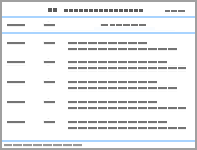
表1
品种特性及来源"
| 序号No | 品种(系)Varieties (Lines) | 冬性Winterness | 选育单位Source |
|---|---|---|---|
| 1 | GAU30 | 强冬性Strong winterness | 甘肃农业大学Gansu Agricultural University |
| 2 | NTS309 | 强冬性Strong winterness | 甘肃农业大学Gansu Agricultural University |
| 3 | GAU24 | 强冬性Strong winterness | 甘肃农业大学Gansu Agricultural University |
| 4 | 16-2444 | 强冬性Strong winterness | 甘肃农业大学Gansu Agricultural University |
| 5 | 天油14号Tianyou 14 | 冬性Winterness | 天水市农业科学研究所Tianshui Agricultural Science Research Institute |
| 6 | 天油2238 Tianyou 2238 | 冬性Winterness | 天水市农业科学研究所Tianshui Agricultural Science Research Institute |
| 7 | 天油2288 Tianyou 2288 | 冬性Winterness | 天水市农业科学研究所Tianshui Agricultural Science Research Institute |
| 8 | 甘杂9号Ganza 9 | 弱冬性Weak winterness | 西北农林科技大学Northwest Agriculture & Forestry University |
| 9 | 秦早1号Qinzao 1 | 弱冬性Weak winterness | 陕西省杂交油菜中心Shaanxi Hybrid Rapeseed Center |
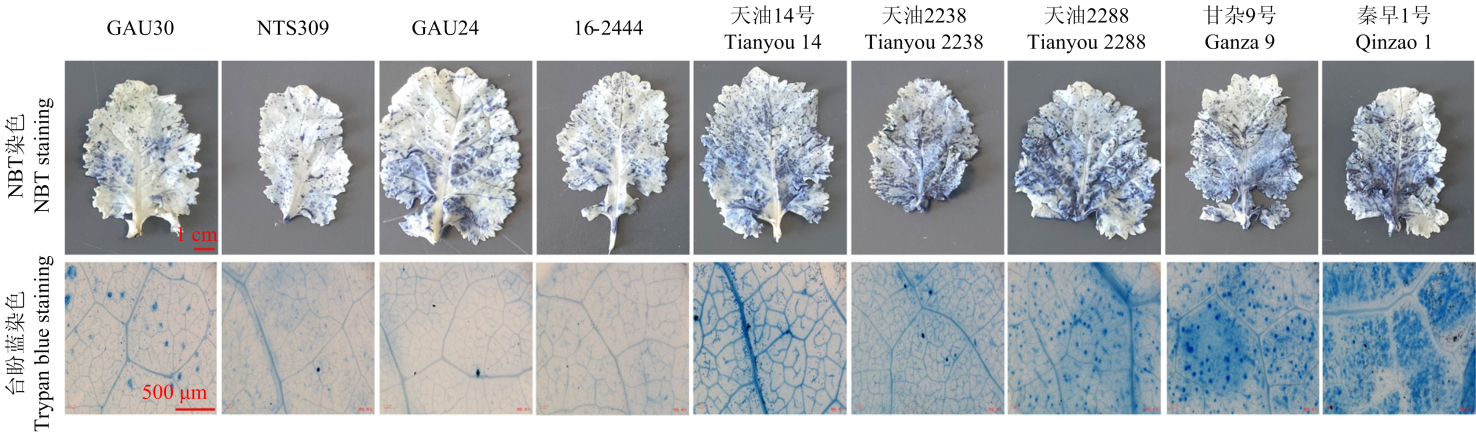
图1
低温胁迫下不同甘蓝型冬油菜叶片细胞化学染色"
表2
不同甘蓝型冬油菜品种抗寒鉴定"
| 品种 Varieties | 越冬率 Overwintering rate (%) | 根颈直径 Collar diameter (mm) | 干重 Dry weight (g) | 根/冠 Root/crown | 生长点高度 The height of growth point (cm) |
|---|---|---|---|---|---|
| GAU30 | 75.00±3.06a | 26.38±0.20ab | 63.84±6.07ab | 0.15±0.02ab | 3.17±0.18de |
| NTS309 | 74.00±2.31a | 27.40±1.49ab | 67.41±8.99ab | 0.15±0.03ab | 3.07±0.25e |
| GAU24 | 73.67±2.33a | 25.63±1.59b | 71.41±2.93ab | 0.14±0.03ab | 3.27±0.14 cde |
| 16-2444 | 74.33±2.19a | 25.61±1.94b | 52.65±6.68b | 0.20±0.03a | 3.13±0.29de |
| 天油14号Tianyou 14 | 65.00±3.21b | 27.01±0.85ab | 80.82±4.53a | 0.16±0.04ab | 4.06±0.12abc |
| 天油2238 Tianyou 2238 | 61.67±2.19b | 23.20±2.06bc | 75.17±10.94ab | 0.12±0.01ab | 3.96±0.06bcd |
| 天油2288 Tianyou 2288 | 64.00±2.08b | 19.04±0.97c | 50.54±8.15b | 0.11±0.01b | 4.14±0.57ab |
| 甘杂9号Ganza 9 | 57.00±2.53bc | 25.77±0.40b | 57.16±4.03ab | 0.14±0.01ab | 4.75±0.17ab |
| 秦旱1号Qinzao 1 | 49.67±2.60c | 30.65±1.96a | 63.80±2.41ab | 0.10±0.000b | 4.89±0.25a |
| 与越冬率的相关性 The correlation with overwintering rate | 1 | -0.191(P=0.622) | 0.012 (P=0.976) | 0.677* (P=0.045) | -0.972** (P<0.001) |

图2
不同甘蓝型冬油菜品种生长锥高度测定 a1—a3:分别为NTS309、天油14号、秦早1号的茎顶端分生组织解剖形态,2条红线之间的距离为生长点高度;b:植物激素调控茎顶端分生组织形态的模式图。AUX:生长素,GA:赤霉素,CK:细胞分裂素,IAA:吲哚-3-乙酸,GA19:赤霉素19,IAA-Glu:吲哚乙酸-谷氨酸,ME-IAA:吲哚-3-乙酸甲酯,IAM:3-吲哚乙酰胺,IAN:吲哚-3-乙腈,mT9G:3-[[(9-BETA-D-吡喃葡萄糖基-9H-嘌呤-6-基)氨基]甲基]苯酚,iP9G:异戊烯腺嘌呤-9-葡糖苷,BAP9G:6-苄氨基-9-(Α-D-吡喃葡萄糖基)呤;c1—c3:分别为NTS309、天油14、秦早1号的生长锥石蜡切片图,红色箭头所指为新分化的生长点组织。Bar=200 μm"

图3
不同甘蓝型冬油菜品种激素组学分析 a:差异代谢物韦恩图;b:差异代谢物聚类热图;c:NTS309 vs天油14号KEGG富集分析;d:NTS309 vs秦早1号KEGG富集分析;e:天油14号vs秦早1号KEGG富集分析"
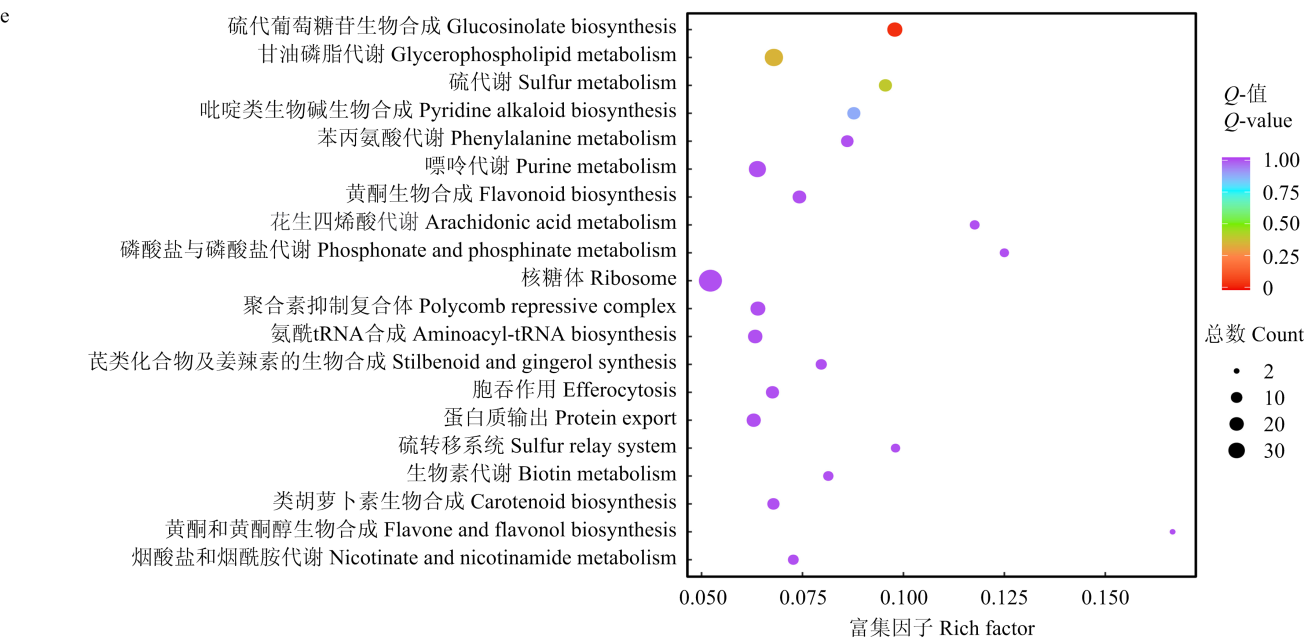
图4
不同甘蓝型冬油菜品种转录组学分析 a:差异基因韦恩图;b:NTS309 vs天油14号差异基因火山图;c:NTS309 vs天油14号GO分析柱形图;d:NTS309 vs天油14 KEGG富集分析;e:天油14号vs秦早1号KEGG富集分析"

图5
不同抗寒性冬油菜品种代谢组学与转录组学联合分析 a:激素组学PCA分析;b:转录组学PCA分析;c:NTS309 vs天油14号KEGG富集分析;d:NTS309 vs秦早1号KEGG富集分析;e:O2PLS分析代谢物loading图,IAA-Phe:吲哚乙酸-苯丙氨酸,IAA-Glu:吲哚乙酸-谷氨酸,ME-IAA:吲哚-3-乙酸甲酯,IAM:3-吲哚乙酰胺,IAN:吲哚-3-乙腈,IPA:吲哚-3-丙酮酸,iP9G:异戊烯腺嘌呤-9-葡糖苷,tZR:反式玉米素,MeSAG:水杨酸甲酯葡萄糖苷,JA-ILE:茉莉酸-异亮氨酸;f:O2PLS分析基因loading图"
表3
不同甘蓝型冬油菜品种激素含量分析"
| 缩略词Index | 化合物 Compounds | 类别 Class | NTS309 | 天油14号 Tianyou 14 | 秦早1号 Qinzao 1 | P值 P value |
|---|---|---|---|---|---|---|
| IAA | 吲哚-3-乙酸Indole-3-acetic acid | 生长素Auxin | 24.37±0.56a | 17.49±0.19b | 28.34±3.34a | 0.021 |
| IAA-Glu | 吲哚乙酸-谷氨酸Indole-3-acetyl glutamic acid | 生长素Auxin | 1.79±0.17a | 0.38±0.04b | 1.58±0.15a | <0.001 |
| MEIAA | 吲哚-3-乙酸甲酯Methyl indole-3-acetate | 生长Auxin | 285.43±30.95a | 82.37±14.75b | 276.44±18.63a | 0.001 |
| IAM | 3-吲哚乙酰胺3-Indole acetamide | 生长素Auxin | 85.23±9.41a | 22.91 ±2.23c | 55.20±5.32b | 0.001 |
| IAN | 吲哚-3-乙腈3-Indoleacetonitrile | 生长素Auxin | 1796.08±69.00a | 611.95±67.05b | 1597.89±93.47a | <0.001 |
| ICA | 吲哚-3-甲酸Indole-3-carboxylic acid | 生长素Auxin | 45.63±2.15a | 22.72±0.56b | 22.11±0.48b | <0.001 |
| ICAld | 吲哚-3-甲醛Indole-3-carboxaldehyde | 生长素Auxin | 156.42±24.31a | 59.26 ±4.07b | 108.93±8.58ab | 0.011 |
| IPA | 3-吲哚丙酸3-Indolepropionic acid | 生长素Auxin | 0.00±0.00b | 0.55±0.03a | 0.00±0.00b | <0.001 |
| tZR | 玉米素核苷Trans-Zeatin riboside | 细胞分裂素CK | 2.27±0.15a | 1.60±0.15b | 0.40±0.03c | <0.001 |
| BAP9G | 6-苄氨基-9-(Α-D-吡喃葡萄糖基)呤 N6-Benzyladenine-9-glucoside | 细胞分裂素CK | 0.00±0.00b | 0.11±0.01a | 0.11±0.01a | <0.001 |
| mT9G | 3-[[(9-BETA-D-吡喃葡萄糖基-9H-嘌呤-6-基)氨基]甲基]苯酚meta-Topolin-9-glucoside | 细胞分裂素CK | 0.00±0.00b | 0.26±0.04a | 0.32±0.05a | 0.002 |
| iP9G | 异戊烯腺嘌呤-9-葡糖苷N6-Isopentenyl-adenine-9-glucoside | 细胞分裂素CK | 0.00±0.00c | 1.71±0.20b | 4.40±0.34a | <0.001 |
| GA19 | 赤霉素19 Gibberellin A19 | 赤霉素GA | 0.73±0.12a | 0.00±0.00b | 0.00±0.00b | <0.001 |
| JA | 茉莉酸Jasmonic acid | 茉莉酸JA | 100.61±8.17a | 37.79±2.67b | 36.24±4.34b | <0.001 |
| OPC-4 | 氧化戊烯基环戊烷丁酸 3-oxo-2-(2-(Z)-Pentenyl) cyclopentane-1-butyric acid | 茉莉酸JA | 45.98±3.93a | 12.21±0.70b | 18.33±1.96b | <0.001 |
| JA-ILE | 茉莉酸-异亮氨酸Jasmonoyl-L-isoleucine | 茉莉酸JA | 8.09±0.71a | 4.56±0.05b | 0.00±0.00c | <0.001 |
| MeJA | 茉莉酸甲酯Methyl jasmonate | 茉莉酸JA | 2.84±0.08a | 0.00±0.00b | 0.00±0.00b | <0.001 |
| JA-Val | 茉莉酸-缬氨酸N-[(-)-Jasmonoyl]-(L)-valine | 茉莉酸JA | 0.11±0.004a | 0.00±0.00b | 0.00±0.00b | <0.001 |
| ABA-GE | 脱落酸葡萄糖酯ABA-glucosyl ester | 脱落酸ABA | 21.61±1.07a | 0.00±0b | 0.00±0b | <0.001 |
| [1] |
孙万仓, 裴新梧, 马骊, 王学芳, 武军艳, 李学才, 蒲媛媛, 刘丽君, 柴鹏, 李孝泽, 等. 我国北方冬季覆盖作物研究进展及发展前景. 中国农业科技导报, 2022, 24(1): 128-136.
doi: 10.13304/j.nykjdb.2020.0689 |
|
doi: 10.13304/j.nykjdb.2020.0689 |
|
| [2] |
王汉中. 中国油料产业发展的现状、问题与对策. 中国油料作物学报, 2005, 27(4): 100-105.
|
|
|
|
| [3] |
傅廷栋. 中国油菜生产和品种改良的现状与前景. 安徽农学通报, 2000, 6(1): 3-10.
|
|
|
|
| [4] |
王瑞元. 2022年我国粮油产销和进出口情况. 中国油脂, 2023, 48(6): 1-7.
|
|
|
|
| [5] |
方振, 李谷成. 我国油菜籽增产潜力与实现路径. 中国油脂, 2025, 50(4): 1-9.
|
|
|
|
| [6] |
冯海棠, 王汉中. 新形势下的我国食用植物油供给安全对策. 中国油料作物学报, 2024, 46(2): 221-227.
doi: 10.19802/j.issn.1007-9084.2024021 |
|
|
|
| [7] |
孙万仓, 武军艳, 方彦, 刘秦, 杨仁义, 马维国, 李学才, 张俊杰, 张鹏飞, 曹建明, 等. 北方旱寒区北移冬油菜生长发育特性. 作物学报, 2010, 36(12): 2124-2134.
doi: 10.3724/SP.J.1006.2010.02124 |
|
doi: 10.3724/SP.J.1006.2010.02124 |
|
| [8] |
刘自刚, 张长生, 孙万仓, 杨宁宁, 王月, 何丽, 赵彩霞, 武军艳, 方彦, 曾秀存. 不同生态区冬前低温下白菜型冬油菜不同抗寒品种(系)的比较. 作物学报, 2014, 40(2): 346-354.
|
|
doi: 10.3724/SP.J.1006.2014.00346 |
|
| [9] |
刘自刚, 孙万仓, 方彦, 李学才, 杨宁宁, 武军艳, 曾秀存, 王月. 夜间低温对白菜型冬油菜光合机构的影响. 中国农业科学, 2015, 48(4): 672-682. doi: 10.3864/j.issn.0578-1752.2015.04.05.
|
|
|
|
| [10] |
doi: 10.3389/fpls.2020.01241 |
| [11] |
doi: 10.3389/fgene.2021.753624 |
| [12] |
姚彦林, 马骊, 刘丽君, 李学才, 李鹏, 王旺田, 蒲媛媛, 牛早霞, 徐芳, 孙万仓, 等. 北方白菜型冬油菜BrFLC家族的全基因组鉴定、克隆及表达分析. 中国油料作物学报, 2023, 45(1): 83-94.
doi: 10.19802/j.issn.1007-9084.2021314 |
|
|
|
| [13] |
许金苗, 孙柏林, 王万鹏, 武军艳, 刘丽君, 李爱国, 缪纯庆, 孙万仓, 马骊. 白菜型油菜WUS基因的克隆与表达分析. 分子植物育种, 2023, 21(19): 6265-6275.
|
|
|
|
| [14] |
刘自刚, 魏家萍, 崔俊美, 武泽峰, 方彦, 董小云, 郑国强. 我国冬油菜北移的现状、问题与对策. 中国农业科学, 2023, 56(15): 2854-2862. doi: 10.3864/j.issn.0578-1752.2023.15.002.
|
|
|
|
| [15] |
doi: 10.1016/j.pbi.2006.07.008 pmid: 16877025 |
| [16] |
李学才, 金姣姣, 马骊, 武军艳, 陈其鲜, 曾瑞, 曾秀存, 崔小茹, 孙万仓. 北方强冬性甘蓝型冬油菜生长锥与抗寒性的关系研究. 中国油料作物学报, 2022, 44(4): 739-750.
doi: 10.19802/j.issn.1007-9084.2022021 |
|
|
|
| [17] |
王跃华, 刘洪明, 刘鑫, 杨淮, 李瑞, 黄鹏. 红景天植物石蜡切片的制作和结构观察研究. 种子, 2018, 37(7): 28-30, 34.
|
|
|
|
| [18] |
曾瑞, 马骊, 武军艳, 杨刚, 张娜, 徐佳, 朱明川, 马敏, 陶肖蕾, 李学才, 等. 低温胁迫下白菜型冬油菜枯叶期早晚与抗寒性的关系. 中国油料作物学报, 2023, 45(4): 766-775.
doi: 10.19802/j.issn.1007-9084.2022164 |
|
doi: 10.19802/j.issn.1007-9084.2022164 |
|
| [19] |
doi: 10.1016/j.agrformet.2024.110297 |
| [20] |
李鹏, 马骊, 徐芳, 刘丽君, 姚彦林, 蒲媛媛, 王旺田, 李学才, 方彦, 孙万仓, 等. 越冬前北方不同类型强冬性冬油菜形态及生理响应研究. 干旱地区农业研究, 2022, 40(5): 42-51.
|
|
|
|
| [21] |
蒲媛媛, 赵玉红, 武军艳, 刘丽君, 白静, 马骊, 牛早霞, 金姣姣, 方彦, 李学才, 等. 北方强冬性甘蓝型冬油菜品种(系)抗寒性评价. 中国农业科学, 2019, 52(19): 3291-3308. doi: 10.3864/j.issn.0578-1752.2019.19.002.
|
|
|
|
| [22] |
刘海卿, 李静, 刘海霞, 王燕琴, 周莹莹, 张忠财, 苏芸芸, 孙于卜, 孙万仓. 北方寒旱区甘蓝型冬油菜的春化特性与抗寒性. 西北农林科技大学学报(自然科学版), 2024, 52(9): 62-71.
|
|
|
|
| [23] |
doi: 10.1016/s0092-8674(03)00924-3 pmid: 14651850 |
| [24] |
doi: 10.1016/s1360-1385(00)01795-7 pmid: 11164356 |
| [25] |
范业赓, 丘立杭, 黄杏, 周慧文, 甘崇琨, 李杨瑞, 杨荣仲, 吴建明, 陈荣发. 甘蔗节间伸长过程赤霉素生物合成关键基因的表达及相关植物激素动态变化. 植物学报, 2019, 54(4): 486-496.
doi: 10.11983/CBB18139 |
|
|
|
| [26] |
doi: 10.1016/j.cub.2010.05.035 |
| [27] |
|
| [28] |
doi: 10.1111/tpj.2010.61.issue-4 |
| [29] |
|
| [30] |
doi: 10.1105/tpc.20.00026 |
| [31] |
洪林, 杨蕾, 杨海健, 王武. AP2/ERF转录因子调控植物非生物胁迫响应研究进展. 植物学报, 2020, 55(4): 481-496.
doi: 10.11983/CBB19243 |
|
|
|
| [32] |
|
| [1] | 王忠妮, 雷月, 李佳丽, 宫彦龙, 朱速松. ABC转运蛋白OsARG1调控水稻抽穗期的功能[J]. 中国农业科学, 2026, 59(1): 1-16. |
| [2] | 李若鸿, 马馼, 赵士强, 毛培胜. 紫花苜蓿老化种子吸胀过程中胚根线粒体抗氧化生理及激素响应规律[J]. 中国农业科学, 2025, 58(19): 4014-4025. |
| [3] | 袁苗, 周娟, 党仕卓, 汤学燊, 张亚红. ‘红地球’葡萄VvARF18功能分析[J]. 中国农业科学, 2024, 57(7): 1363-1376. |
| [4] | 张海青, 张恒涛, 高启明, 姚家龙, 王亚荣, 刘珍珍, 孟祥鹏, 周喆, 阎振立. 转录组分析筛选调控苹果分枝能力的关键基因[J]. 中国农业科学, 2024, 57(10): 1995-2009. |
| [5] | 范军强, 武军艳, 刘丽君, 马骊, 杨刚, 蒲媛媛, 李学才, 孙万仓. 甘蓝型冬油菜气孔特性与抗寒性的关系[J]. 中国农业科学, 2023, 56(4): 599-618. |
| [6] | 刘自刚, 魏家萍, 崔俊美, 武泽峰, 方彦, 董小云, 郑国强. 我国冬油菜北移的现状、问题与对策[J]. 中国农业科学, 2023, 56(15): 2854-2862. |
| [7] | 刘鑫,张亚红,袁苗,党仕卓,周娟. ‘红地球’葡萄花芽分化过程中的转录组分析[J]. 中国农业科学, 2022, 55(20): 4020-4035. |
| [8] | 朱佩佩,罗燚佳,向雯,张明磊,张剑侠. 抗寒无核葡萄杂种胚挽救及分子标记辅助选择[J]. 中国农业科学, 2021, 54(6): 1218-1228. |
| [9] | 曹小东,刘自刚,米文博,徐春梅,邹娅,徐明霞,郑国强,方新玲,崔小茹,董小云,米超,陈其鲜. 甘蓝型冬油菜北移种植的适应性分析[J]. 中国农业科学, 2020, 53(20): 4164-4176. |
| [10] | 蒲媛媛,赵玉红,武军艳,刘丽君,白静,马骊,牛早霞,金姣姣,方彦,李学才,孙万仓. 北方强冬性甘蓝型冬油菜品种(系)抗寒性评价[J]. 中国农业科学, 2019, 52(19): 3291-3308. |
| [11] | 赵雅楠,骆强伟,王跃进. 利用胚挽救技术创制无核抗寒葡萄新种质[J]. 中国农业科学, 2018, 51(21): 4119-4130. |
| [12] | 焦美玲,弓瑞娟,钱稷,张钢. 电阻抗断层成像评价丰花月季抗寒性[J]. 中国农业科学, 2017, 50(7): 1302-1316. |
| [13] | 高梦烛,赵亚林,闫青地,张海丽,王凤茹,董金皋. 拟南芥PMRP基因在叶绿体淀粉粒积累和抗寒性中的作用[J]. 中国农业科学, 2016, 49(5): 832-839. |
| [14] | 刘林波,孙万仓,刘自刚,武军艳,方 彦,李学才,曾秀存,杨 刚,董 云,陈 奇,方 园,袁金海. 白菜型冬油菜抗寒相关性状的遗传分析[J]. 中国农业科学, 2016, 49(21): 4085-4095. |
| [15] | 刘志英,李西良,李峰,陶雅,刘磊,王宗礼,孙启忠. 越冬紫花苜蓿根系性状与秋眠性的关系及其抗寒效应[J]. 中国农业科学, 2015, 48(9): 1689-1701. |
|
||
