






中国农业科学 ›› 2026, Vol. 59 ›› Issue (6): 1157-1171.doi: 10.3864/j.issn.0578-1752.2026.06.002
叶美金1,6( ), 吴雷2(), Lohani Md Nahibuzzaman2, 尹丽2, 胡欣荣2, 刘亚西2, 蒋云峰2, 陈国跃2, 蒲至恩3, 李阳3, 李婷2,4, 邹亚亚2,5, 吴佳怡1, 马建2()
收稿日期:2025-08-17
接受日期:2025-10-02
出版日期:2026-03-16
发布日期:2026-03-24
通信作者:
联系方式:
叶美金,E-mail:091048@cdnu.edu.cn。吴雷,E-mail:2169068493@qq.com。叶美金和吴雷为同等贡献作者。
基金资助:
YE MeJin1,6(), WU Lei2(), MD NAHIBUZZAMAN Lohani2, YIN Li2, HU XinRong2, LIU YaXi2, JIANG YunFeng2, CHEN GuoYue2, PU ZhiEn3, LI Yang3, LI Ting2,4, ZOU YaYa2,5, WU JiaYi1, MA Jian2()
Received:2025-08-17
Accepted:2025-10-02
Published:2026-03-16
Online:2026-03-24
摘要:
【目的】小麦胚是籽粒的重要组成部分,与种子的营养价值、萌发和幼苗建成密切相关。从遗传变异丰富的中国地方小麦中挖掘胚大小位点,并解析其遗传效应,拓展对小麦胚大小遗传基础的认识,为未来育种计划提供有价值的分子靶点。【方法】利用小麦660K SNP芯片对240份不同来源的中国地方小麦进行基因型分析,并结合3个环境的胚大小表型数据,通过混合线性模型进行全基因组关联分析,对检测到的显著性关联位点进行遗传效应分析和候选基因预测。【结果】在3个环境及最佳线性无偏预测值(BLUP)下,胚长、胚宽、胚面积、胚长宽比的范围分别为1.64—3.43 mm、0.93—2.58 mm、1.10—5.71 mm2和1.06—2.08,其广义遗传力分别为0.76、0.47、0.54和0.60。胚长、胚宽、胚面积、胚长宽比、胚长粒长比和胚宽粒宽比之间存在显著的正相关性,相关系数为0.271—0.922。主要胚性状(胚长、胚宽、胚面积)与粒长、千粒重、根干重呈显著正相关。共鉴定到18个在2个环境及BLUP中稳定表达的、与胚长和胚面积显著关联的SNP位点,这些位点被分为4个QTL区段,其中,控制胚长的有3个、控制胚面积的有1个,且胚面积QTL(QEA. sicau.3B)与胚长QTL(QEL.sicau.3B.2)共定位。针对主效胚长位点QEL.sicau.1B,预测了9个候选基因。遗传效应分析表明,QEL.sicau.1B的增效应位点在提高胚长、粒长、粒宽、粒重和缩短开花期方面具有显著作用,对提高幼苗根干重和地上部苗子干重方面具有显著优势,而对分蘖数和小穗数具有一定负效应。比较分析表明,QEL.sicau.1B和QEL.sicau.3B.2可能为新位点。【结论】通过全基因组关联分析检测到4个与胚大小显著相关的稳定QTL,针对胚长位点QEL.sicau.1B,预测了9个可能的候选基因。证实胚大小与籽粒大小呈显著正相关,且与苗期根系活力有一定关联。
叶美金, 吴雷, Lohani Md Nahibuzzaman, 尹丽, 胡欣荣, 刘亚西, 蒋云峰, 陈国跃, 蒲至恩, 李阳, 李婷, 邹亚亚, 吴佳怡, 马建. 基于GWAS的中国地方小麦成熟胚大小位点的鉴定及其遗传效应解析[J]. 中国农业科学, 2026, 59(6): 1157-1171.
YE MeJin, WU Lei, MD NAHIBUZZAMAN Lohani, YIN Li, HU XinRong, LIU YaXi, JIANG YunFeng, CHEN GuoYue, PU ZhiEn, LI Yang, LI Ting, ZOU YaYa, WU JiaYi, MA Jian. Genome-Wide Association Study-Based Identification of Loci Controlling Mature Embryo Size in Chinese Wheat Landraces and Their Genetic Effects Analysis[J]. Scientia Agricultura Sinica, 2026, 59(6): 1157-1171.
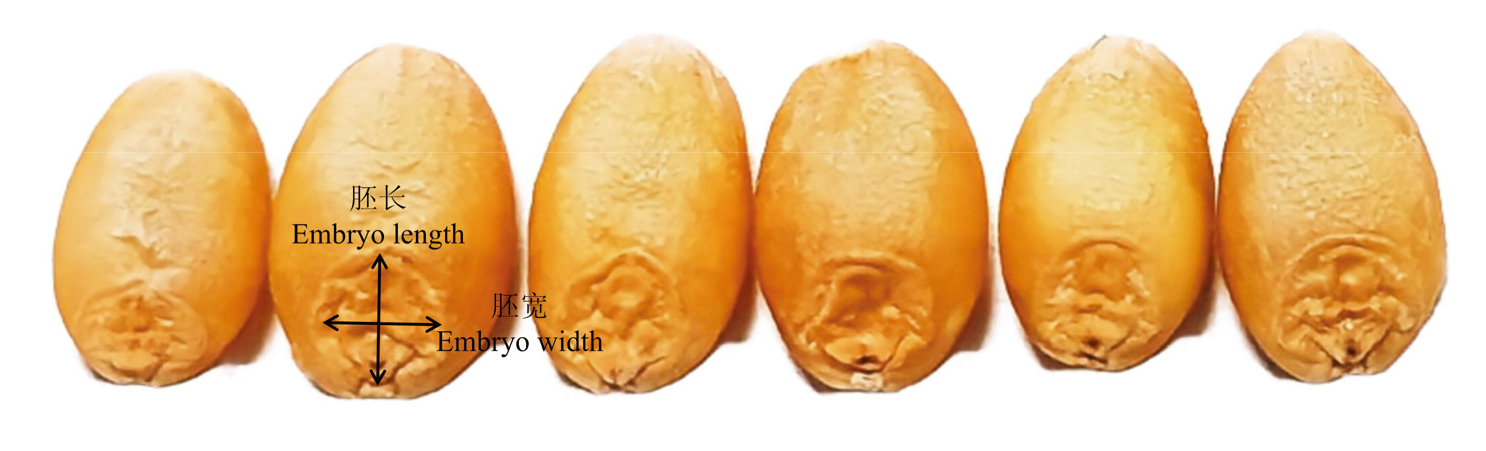
图1
小麦籽粒成熟胚的测量示意图"
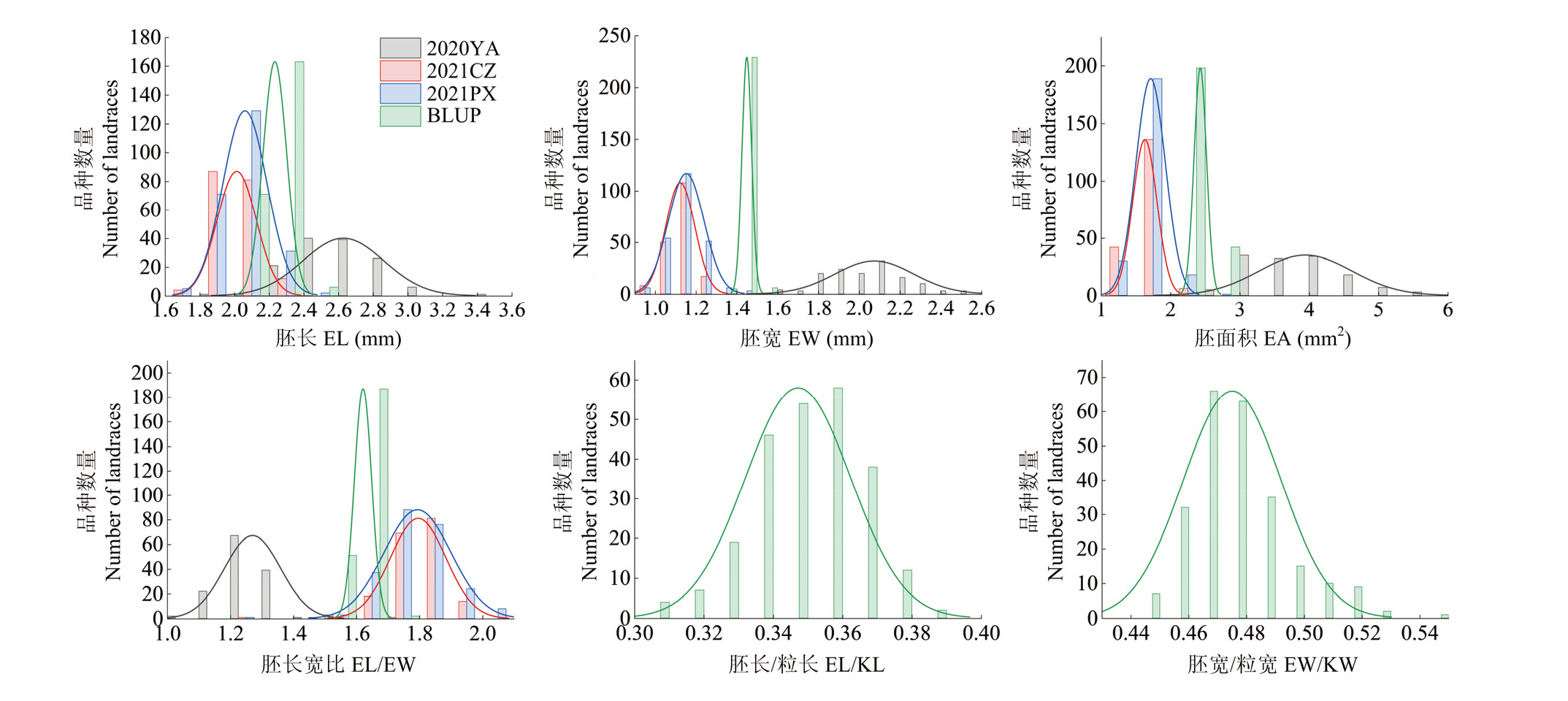
图2
不同环境下不同胚大小性状的频率布 EL:胚长;EW:胚宽;EA:胚面积;EL/EW:胚长宽比;EL/KL:胚长/粒长;EW/KW:胚宽/粒宽。2020YA:2020年雅安;2021CZ:2021年崇州;2021PX:2021年郫县。下同"
表1
自然群体的表型评价"
| 性状 Trait | 环境Environment | 最小值Min | 最大值Max | 平均值Mean | 标准差 Standard deviation | 广义遗传力 H2 |
|---|---|---|---|---|---|---|
| 胚长 EL (mm) | 2020YA | 1.94 | 3.43 | 2.63 | 0.23 | 0.76 |
| 2021CZ | 1.74 | 2.38 | 2.01 | 0.11 | ||
| 2021PX | 1.64 | 2.50 | 2.06 | 0.13 | ||
| BLUP | 2.06 | 2.44 | 2.23 | 0.07 | ||
| 胚宽 EW (mm) | 2020YA | 1.61 | 2.58 | 2.07 | 0.19 | 0.47 |
| 2021CZ | 0.97 | 1.58 | 1.12 | 0.07 | ||
| 2021PX | 0.93 | 1.55 | 1.15 | 0.09 | ||
| BLUP | 1.38 | 1.53 | 1.45 | 0.02 | ||
| 胚面积 EA (mm2) | 2020YA | 2.38 | 5.71 | 3.95 | 0.67 | 0.54 |
| 2021CZ | 1.25 | 2.20 | 1.63 | 0.17 | ||
| 2021PX | 1.10 | 2.79 | 1.71 | 0.21 | ||
| BLUP | 2.18 | 2.76 | 2.43 | 0.09 | ||
| 胚长宽比 EL/EW | 2020YA | 1.06 | 1.71 | 1.27 | 0.09 | 0.60 |
| 2021CZ | 1.22 | 1.95 | 1.80 | 0.09 | ||
| 2021PX | 1.28 | 2.08 | 1.79 | 0.11 | ||
| BLUP | 1.54 | 1.74 | 1.62 | 0.03 |
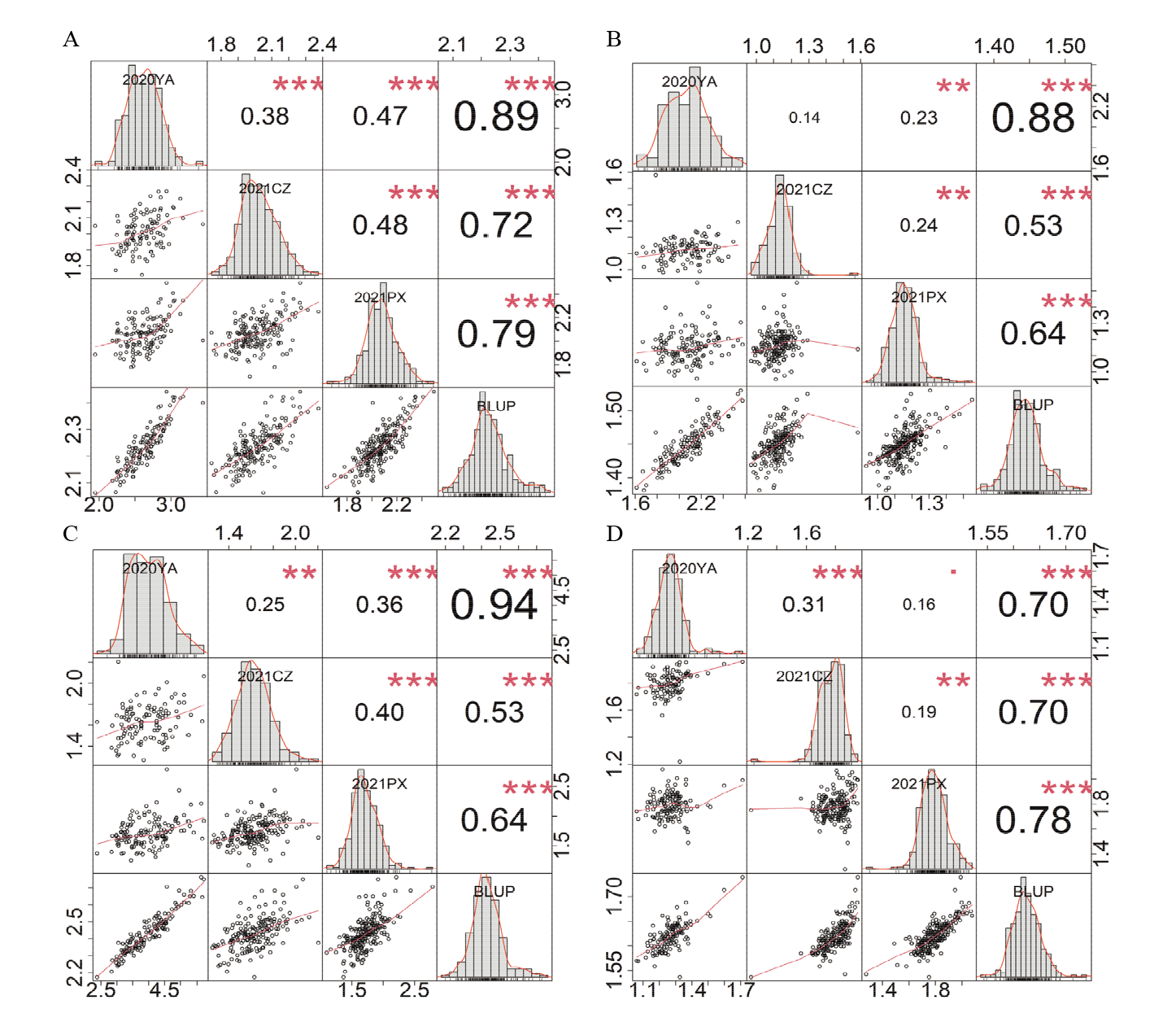
图3
小麦胚长(A)、胚宽(B)、胚面积(C)和胚长宽比(D)在3个环境和BLUP数据间的相关系数 *、**和***分别表示在0.05、0.01和0.001水平上差异显著。下同"
表2
胚大小、农艺性状与幼苗根系性状间的皮尔森相关系数"
| 性状 Traits | 胚长 EL | 胚宽 EW | 胚面积 EA | 胚长宽比 EL/EW | 胚长粒长比 EL/KL | 胚宽粒宽比 EW/KW | |
|---|---|---|---|---|---|---|---|
| 胚相关性状 Embryo-related traits | 胚宽 EW | 0.703** | |||||
| 胚面积 EA | 0.896** | 0.922** | |||||
| 胚长宽比 EL/EW | 0.366** | -0.357** | 0.003 | ||||
| 胚长粒长比 EL/KL | 0.362** | 0.307** | 0.371** | 0.112 | |||
| 胚宽粒宽比 EW/KW | 0.271** | 0.370** | 0.369** | -0.091 | 0.190** | ||
| 农艺性状 Agronomic traits | 有效分蘖数 ETN | -0.168** | -0.241** | -0.203** | 0.135* | 0.128* | 0.237** |
| 小穗数 SNS | -0.06 | -0.123 | -0.086 | 0.113 | 0.245** | 0.160* | |
| 粒长 KL | 0.334** | 0.179** | 0.249** | 0.144* | -0.756** | -0.007 | |
| 粒宽 KW | 0.064 | 0.103 | 0.066 | -0.079 | -0.058 | -0.885** | |
| 千粒重 TKW | 0.256** | 0.243** | 0.239** | -0.023 | -0.378** | -0.522** | |
| 株高 PH | -0.189** | -0.141* | -0.170** | -0.038 | 0.107 | -0.428** | |
| 开花期 AD | -0.134* | -0.236** | -0.172** | 0.227** | 0.187** | 0.251** | |
| 根相关性状 Root-related traits | 根平均直径 RAD | 0.023 | 0.016 | 0.032 | 0.033 | -0.016 | -0.086 |
| 最大根长 MRL | 0.062 | -0.001 | 0.022 | 0.099 | 0.027 | 0.018 | |
| 根干重 RDW | 0.191** | 0.165* | 0.178** | 0.007 | -0.315** | -0.017 | |
| 根表面积 RSA | 0.023 | 0.049 | 0.02 | -0.092 | -0.122 | 0.131* | |
| 根尖数 RTN | 0.052 | 0.099 | 0.053 | -0.106 | 0.037 | -0.028 | |
| 根体积 RV | 0.123 | 0.096 | 0.11 | 0.02 | -0.163* | 0.006 | |
| 地上部干重 SDW | 0.075 | 0.091 | 0.084 | -0.041 | -0.094 | 0.105 | |
| 总根长 TRL | 0.044 | 0.022 | 0.024 | 0.043 | -0.035 | 0.083 | |
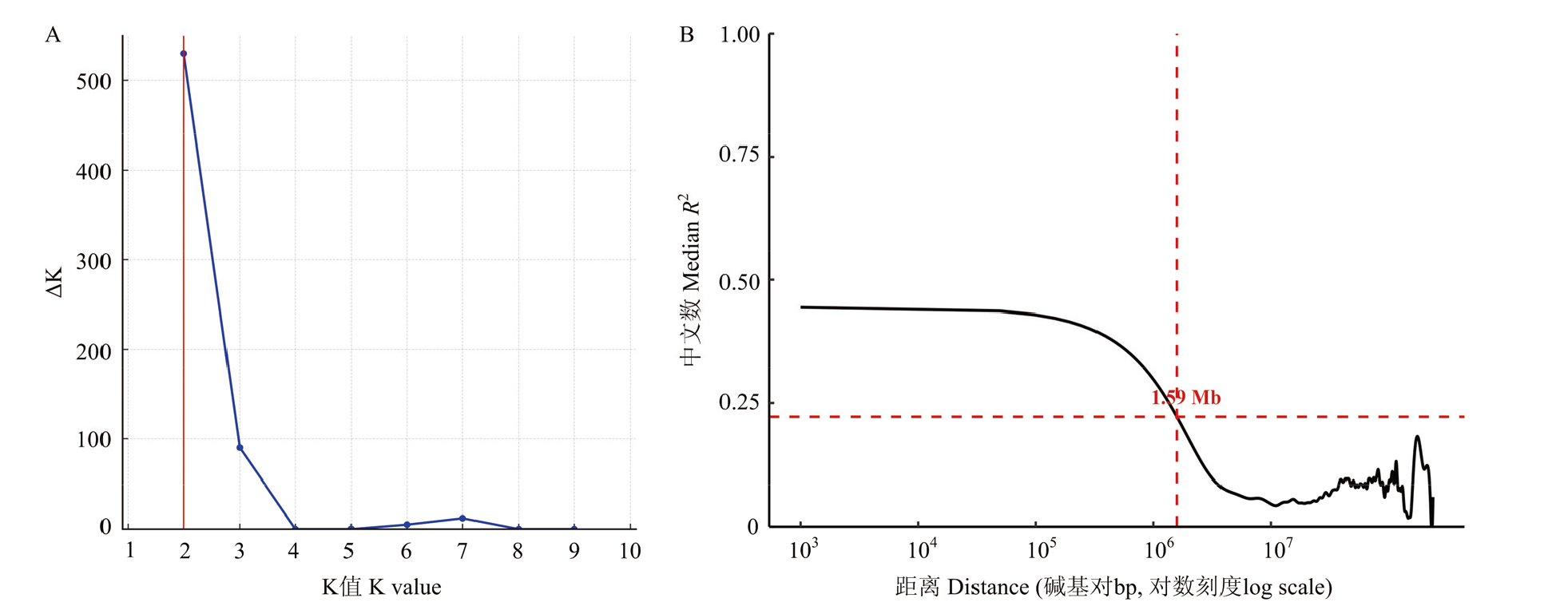
图4
群体结构分析与连锁不平衡衰减分析 A:Delta K值随聚类数(K)的变化趋势;B:连锁不平衡半衰期分析"
表3
GWAS鉴定到的稳定表达的胚大小位点"
| 位点 QTL | 单核苷酸多态性 SNP | 染色体 Chromosome | 物理位置 Position (bp) | 位点 Allele | 显著性阈值 -log10(P) | 贡献率 R2(%) | 环境 Environments |
|---|---|---|---|---|---|---|---|
| QEL.sicau.1B | AX-111181581 | 1B | 141343104 | T/G | 3.10-3.94 | 3.27-4.19 | 2021CZ, 2021PX, BLUP |
| QEL.sicau.3B.1 | AX-111538915 | 3B | 719495993 | T/A | 3.73-4.31 | 1.59-1.85 | 2021CZ, 2021PX, BLUP |
| AX-109479189 | 3B | 718925366 | C/G | 3.42-4.02 | 1.85-2.44 | 2021CZ, 2021PX, BLUP | |
| QEL.sicau.3B.2 | AX-110440810 | 3B | 142585929 | A/G | 3.13-3.62 | 1.24-1.45 | 2021CZ, 2021PX, BLUP |
| AX-109903451 | 3B | 142577728 | C/T | 4.09-4.93 | 2.71-3.04 | 2021CZ, 2021PX, BLUP | |
| AX-108783107 | 3B | 142558781 | A/G | 3.57-4.79 | 1.59-2.02 | 2021CZ, 2021PX, BLUP | |
| AX-111075885 | 3B | 142547414 | T/C | 3.33-3.86 | 1.27-1.60 | 2021CZ, 2021PX, BLUP | |
| AX-110920483 | 3B | 143376780 | G/A | 3.93-5.22 | 1.85-2.31 | 2021CZ, 2021PX, BLUP | |
| AX-109278255 | 3B | 142586814 | T/C | 3.36-5.15 | 1.35-1.96 | 2021CZ, 2021PX, BLUP | |
| AX-111064212 | 3B | 142532066 | G/A | 3.16-4.64 | 1.82-2.63 | 2021CZ, 2021PX, BLUP | |
| AX-111737137 | 3B | 142590393 | A/G | 3.29-4.19 | 1.50-1.79 | 2021CZ, 2021PX, BLUP | |
| AX-109414729 | 3B | 143379652 | T/C | 3.93-5.22 | 1.85-2.31 | 2021CZ, 2021PX, BLUP | |
| AX-109002351 | 3B | 142585807 | A/G | 3.20-3.88 | 1.51-1.68 | 2021CZ, 2021PX, BLUP | |
| QEA.sicau.3B | AX-111064212 | 3B | 142532066 | G/A | 3.22-3.93 | 1.87-2.18 | 2021CZ, 2021PX, BLUP |
| AX-108783107 | 3B | 142558781 | A/G | 3.22-4.35 | 1.40-1.82 | 2021CZ, 2021PX, BLUP | |
| AX-109903451 | 3B | 142577728 | C/T | 3.67-4.43 | 2.15-2.88 | 2021CZ, 2021PX, BLUP | |
| AX-110920483 | 3B | 143376780 | G/A | 3.52-4.32 | 1.63-1.85 | 2021CZ, 2021PX, BLUP | |
| AX-109414729 | 3B | 143379652 | T/C | 3.52-4.32 | 1.63-1.85 | 2021CZ, 2021PX, BLUP |

图5
不同环境下小麦胚长的曼哈顿图与Q-Q图 A:2020年雅安;B:2021年崇州;C:2021年郫县;D:BLUP。红线代表阈值。下同"
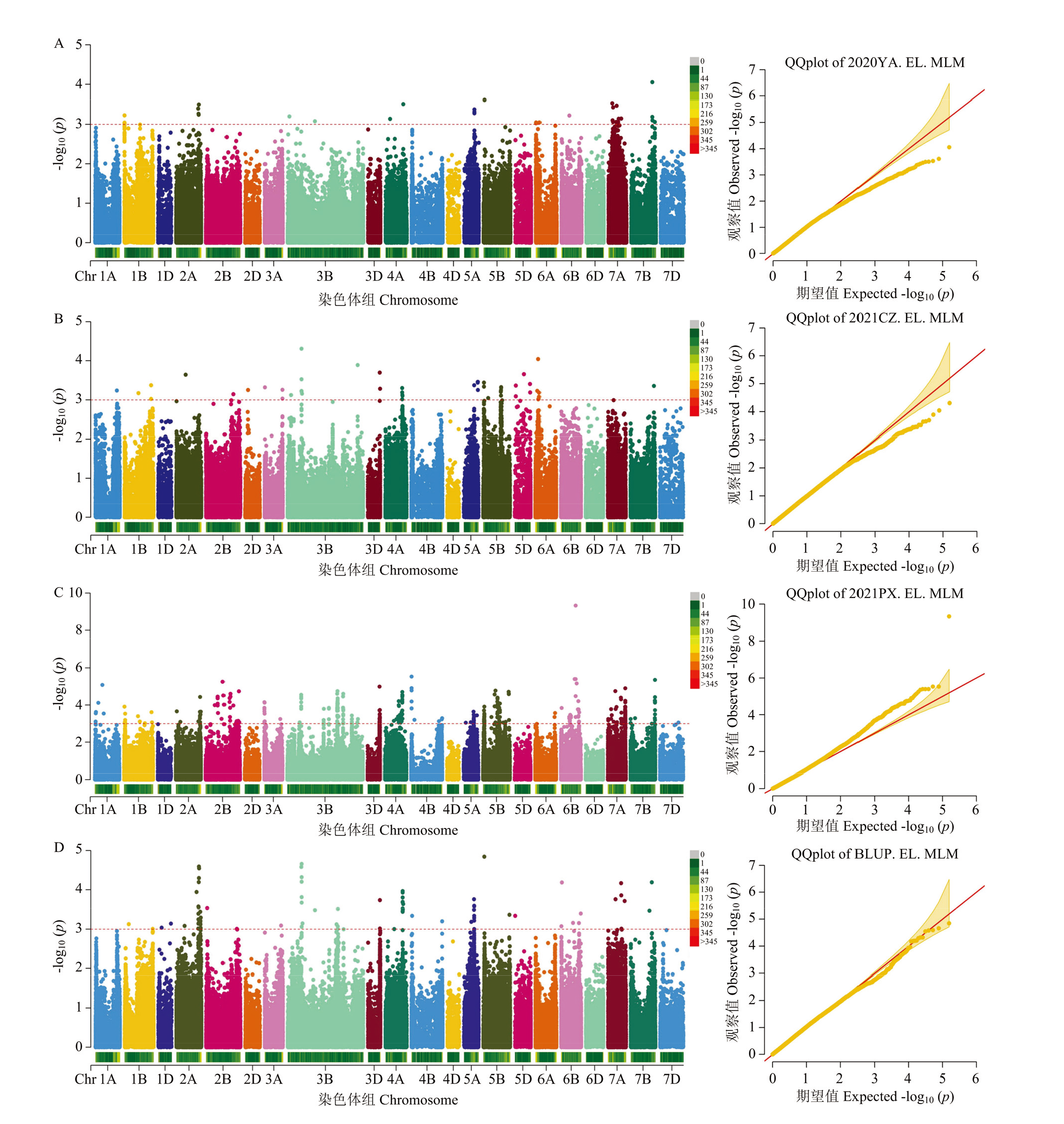
图6
不同环境下小麦胚面积的曼哈顿图与Q-Q图 A:2020年雅安;B:2021年崇州;C:2021年郫县;D:BLUP"
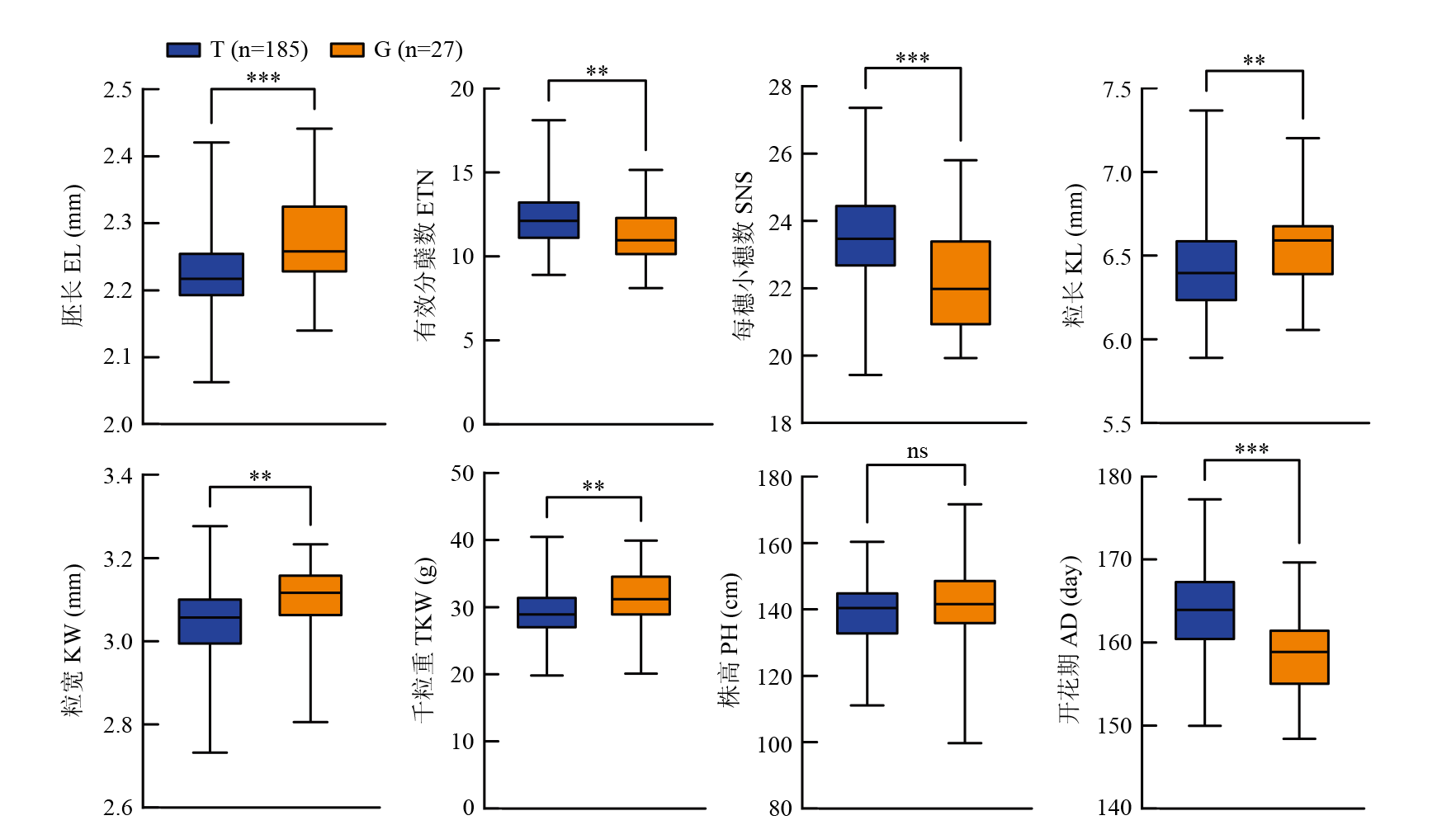
图7
QEL.sicau.1B(AX-111181581)对农艺性状的效应分析 ns:无显著性差异。下同"
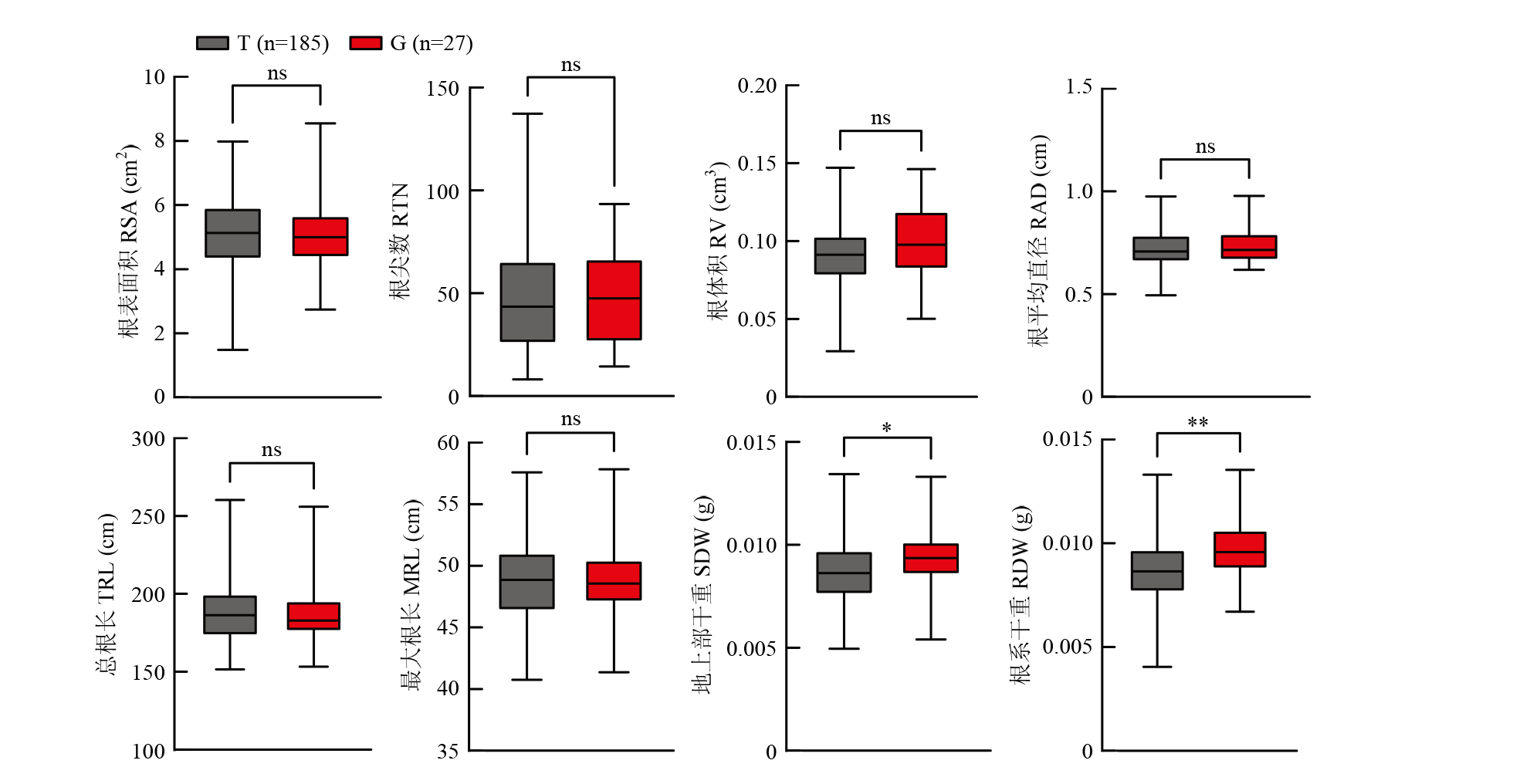
图8
QEL.sicau.1B(AX-111181581)对根系性状的效应分析"
表4
小麦胚长位点QEL.sicau.1B重要候选基因的预测与注释"
| 候选基因 Candidate genes | 基因注释或编码蛋白 Gene annotation or coding proteins | 水稻同源基因 Homologs in rice |
|---|---|---|
| TraesCS1B02G114700 | F-box家族蛋白F-box family protein | OsFbox375, OsFbox376, OsFbox253 |
| TraesCS1B02G114800 | F-box家族蛋白F-box family protein | OsFbox375, OsFbox376 |
| TraesCS1B02G114900 | F-box家族蛋白F-box family protein | OsFbox375 |
| TraesCS1B02G115400 | 细胞凋亡相关蛋白2 Programmed cell death protein 2 | Null |
| TraesCS1B02G115500 | WD重复域蛋白 WD-repeat protein | OsWD40-68, OsWD40-45, WDR5a, MAC3B |
| TraesCS1B02G191700LC | 逆转录病毒相关Pol多聚蛋白LINE-1 Retrovirus-related Pol polyprotein LINE-1 | Null |
| TraesCS1B02G196100LC | 酪氨酰-DNA磷酸二酯酶1 Tyrosyl-DNA phosphodiesterase 1 | Null |
| TraesCS1B02G196200LC | 甘油-3-磷酸脱氢酶[NAD(P)+] Glycerol-3-phosphate dehydrogenase [NAD(P)+] | Null |
| TraesCS1B02G196600LC | HAT家族二聚化域蛋白 HAT family dimerisation domain containing protein | DAYSLEEPER |
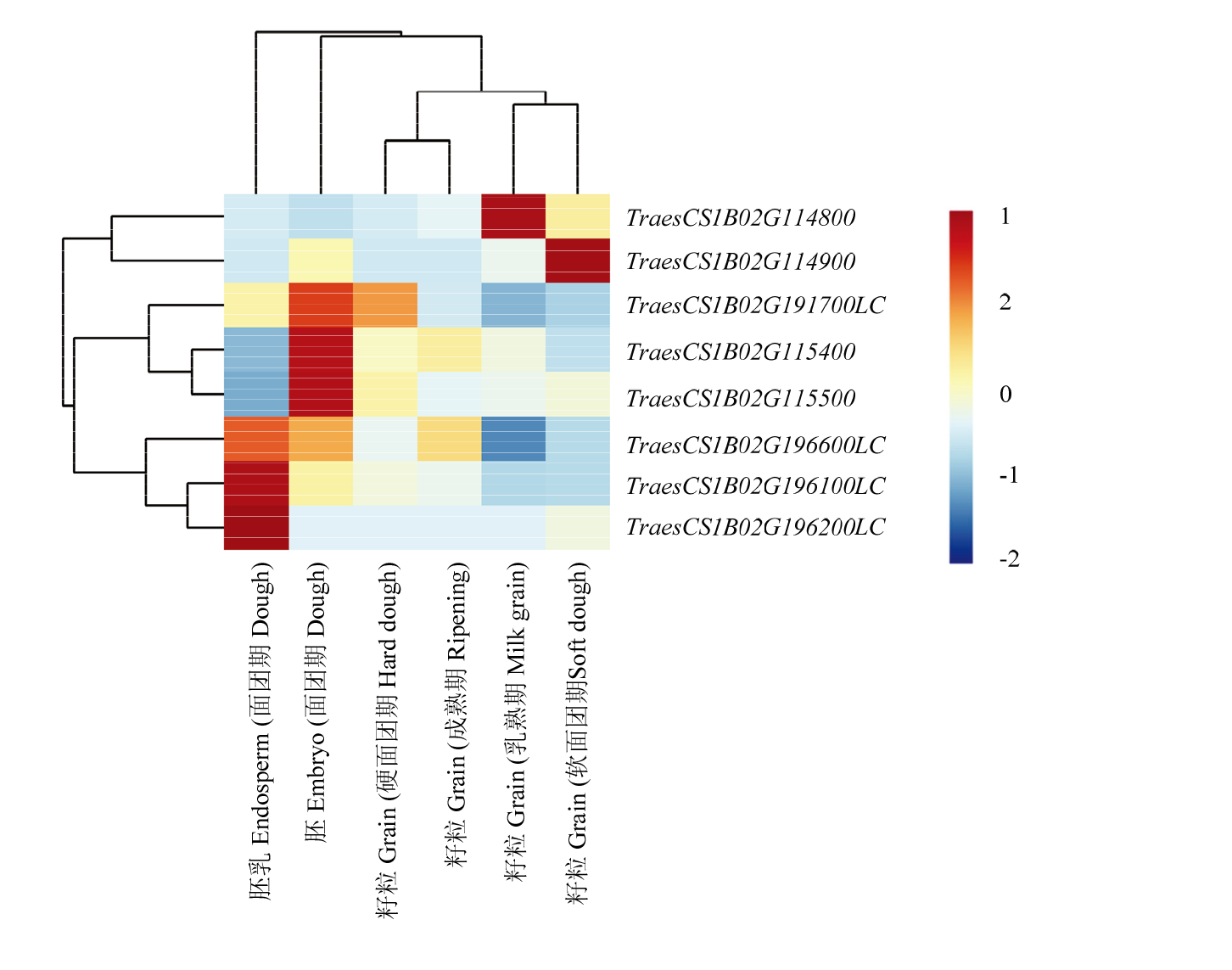
图9
小麦胚长位点QEL.sicau.1B重要候选基因的表达热图"
| [1] |
doi: 10.1016/j.jafr.2023.100677 |
| [2] |
|
| [3] |
doi: 10.3390/agronomy5020152 |
| [4] |
doi: 10.1071/AR00147 |
| [5] |
|
| [6] |
doi: 10.2134/agronj1989.00021962008100020022x |
| [7] |
pmid: 12487343 |
| [8] |
doi: 10.1093/jxb/erz232 pmid: 31089708 |
| [9] |
doi: 10.1007/s00122-022-04183-z |
| [10] |
doi: 10.1016/j.jcs.2007.06.006 |
| [11] |
doi: 10.1111/j.1467-7652.2007.00294.x pmid: 17894785 |
| [12] |
doi: 10.1002/ejlt.v119.7 |
| [13] |
董玉琛, 郑殿升. 中国小麦遗传资源. 北京: 中国农业出版社, 2000: 38-40.
|
|
|
|
| [14] |
doi: 10.2135/cropsci2003.1068 |
| [15] |
doi: 10.1016/j.cj.2021.03.007 |
| [16] |
doi: 10.2135/cropsci1996.0011183X003600050031x |
| [17] |
doi: 10.1007/s00122-025-04817-y pmid: 39843841 |
| [18] |
doi: 10.1093/jxb/erv249 pmid: 26019253 |
| [19] |
陈吉浩, 周界光, 曲翔汝, 王素容, 唐华苹, 蒋云, 唐力为, 兰秀锦, 魏育明, 周景忠, 等. 四倍体小麦胚大小性状QTL定位与分析. 中国农业科学, 2023, 56(2): 203-216. doi: 10.3864/j.issn.0578-1752.2023.02.001.
|
|
|
|
| [20] |
doi: 10.1007/s00122-023-04346-6 pmid: 37000252 |
| [21] |
doi: 10.1007/s00122-025-04944-6 pmid: 40622407 |
| [22] |
doi: 10.1111/tpj.13614 pmid: 28628238 |
| [23] |
doi: 10.3389/fpls.2021.783830 |
| [24] |
唐华苹, 陈黄鑫, 李聪, 苟璐璐, 谭翠, 牟杨, 唐力为, 兰秀锦, 魏育明, 马建. 基于55K SNP芯片的普通小麦穗长非条件和条件QTL分析. 中国农业科学, 2022, 55(8): 1492-1502. doi: 10.3864/j.issn.0578-1752.2022.08.002.
|
|
|
|
| [25] |
姚琦馥, 陈黄鑫, 周界光, 马瑞莹, 邓亮, 谭陈芯雨, 宋靖涵, 吕季娟, 马建. 基于16K SNP芯片的小麦株高QTL鉴定及其遗传分析. 中国农业科学, 2023, 56(12): 2237-2248. doi: 10.3864/j.issn.0578-1752.2023.12.001.
|
|
|
|
| [26] |
姚琦馥, 周界光, 王健, 陈黄鑫, 杨瑶瑶, 刘倩, 闫磊, 王瑛, 周景忠, 崔凤娟, 等. 小麦穗长QTL鉴定及其遗传分析. 中国农业科学, 2023, 56(24): 4814-4825. doi: 10.3864/j.issn.0578-1752.2023.24.002.
|
|
|
|
| [27] |
张智源, 周界光, 刘家君, 王素容, 王同著, 赵聪豪, 尤佳宁, 丁浦洋, 唐华苹, 刘燕林, 等. 基于遗传解析新模式的小麦寡分蘖QTL的鉴定和验证. 作物学报, 2024, 50(6): 1373-1383.
|
|
doi: 10.3724/SP.J.1006.2024.31051 |
|
| [28] |
|
| [29] |
doi: 10.1186/s12870-020-02492-3 pmid: 32660424 |
| [30] |
doi: 10.1139/gen-2019-0116 pmid: 31580743 |
| [31] |
doi: 10.3389/fpls.2022.995183 |
| [32] |
doi: 10.3389/fpls.2022.999414 |
| [33] |
|
| [34] |
doi: 10.1093/genetics/155.2.945 pmid: 10835412 |
| [35] |
doi: 10.1111/men.2018.18.issue-1 |
| [36] |
doi: 10.1186/s12870-019-1764-4 |
| [37] |
|
| [38] |
doi: 10.1038/ng1702 pmid: 16380716 |
| [39] |
doi: 10.1016/j.molp.2021.10.006 pmid: 34715393 |
| [40] |
doi: 10.1007/s00122-019-03415-z pmid: 31435704 |
| [41] |
doi: 10.1017/S0021859602002411 |
| [42] |
doi: 10.1093/jxb/erad397 |
| [43] |
doi: 10.1111/pbi.70180 pmid: 40488633 |
| [44] |
doi: 10.1038/s42003-021-01953-1 pmid: 33785858 |
| [45] |
|
| [46] |
|
| [47] |
doi: 10.1126/science.abg7985 |
| [1] | 朱琦, 贾振鹏, Tahir SHAH, 徐晨晟, 李芷琦, 吕会帅, 朱鹏超, 韦小敏, 黄冬琳, 孙艳妮, 曹卫东, 高亚军, 王朝辉, 张达斌. 绿肥配施增效产品降低旱地麦田温室气体排放及碳足迹[J]. 中国农业科学, 2026, 59(7): 1507-1522. |
| [2] | 杨丽娟, 陈丝雨, 赵薇, 朱玲, 郭磊, 马丽娜, 马瑞敏, 张娟. 全基因组重测序揭示静原鸡羽色的遗传机制[J]. 中国农业科学, 2026, 59(6): 1348-1360. |
| [3] | 李文虎, 礼海风, 杜宇鹏, 丁玉兰, 罗一诺, 李宇珂, 佘文婷, 张丰, 滕宇, 张思琦, 黄翠, 李小涵, 刘金山, 王朝辉. 小麦锌吸收转移对土施锌肥响应的区域差异[J]. 中国农业科学, 2026, 59(5): 1034-1047. |
| [4] | 焦文娟, 何万龙, 耿洪伟, 白斌, 李剑峰, 程宇坤. 155份春小麦品种(系)条锈病抗性评价与抗病基因分子检测[J]. 中国农业科学, 2026, 59(5): 937-950. |
| [5] | 崔士友, 陈澎军, 缪源卿, 韩继军, 沈俊明. EMS诱变抗草甘膦小麦新种质的创制与大田评价[J]. 中国农业科学, 2026, 59(4): 723-733. |
| [6] | 钱瑾, 李映雪, 吴芳, 邹晓晨. 集成光谱降维的冬小麦叶片磷含量估算[J]. 中国农业科学, 2026, 59(4): 781-792. |
| [7] | 孔媛, 崔沙沙, 李美, 李健, 杨思雨, 房锋, 刘帅帅, 刘明平, 曾艳, 高兴祥, 柏连阳. 黄淮海冬小麦田多花黑麦草等5种禾本科杂草时空分布变化规律[J]. 中国农业科学, 2026, 59(4): 807-823. |
| [8] | 王勇胜, 牛丽, 王长杰, 马立花, 廉潇潇, 孟亚雄, 马小乐, 姚立蓉, 张宏, 杨轲, 李葆春, 王化俊, 司二静, 汪军成. 冬小麦千粒重的全基因组关联分析及候选基因预测[J]. 中国农业科学, 2026, 59(3): 499-514. |
| [9] | 李心怡, 李嘉宁, 杨文平, 夏清, 霍滢睿, 郝世航, 黄婷苗, 任永康, 陈杰, 高志强, 杨珍平. 彩粒小麦锌营养对花后叶面喷锌的响应[J]. 中国农业科学, 2026, 59(3): 515-527. |
| [10] | 咸青林, 肖鉴珂, 高阿庆, 郜利闯, 刘杨. 种植方式结合测墒补灌下冬小麦产量及水分利用效率[J]. 中国农业科学, 2026, 59(3): 589-601. |
| [11] | 张志勇, 谭世超, 熊淑萍, 马新明, 韦一昊, 王小纯. 水氮周年优化对豫北灌区小麦玉米轮作系统产量和氮迁移的影响[J]. 中国农业科学, 2026, 59(2): 336-353. |
| [12] | 吕旭东, 孙世媛, 李亚楠, 刘玉龙, 王艳群, 付鑫, 张佳英, 宁鹏, 彭正萍. 智能机械化分层施肥对麦田根-土养分分布和小麦产量的影响[J]. 中国农业科学, 2026, 59(1): 129-146. |
| [13] | 陆浩, 张明龙, 韩梅, 严清彪, 李正鹏, 殷文, 樊志龙, 胡发龙, 柴强. 绿肥过腹还田协同氮肥减施提高小麦产量和土壤质量[J]. 中国农业科学, 2026, 59(1): 147-160. |
| [14] | 叶美金, 陈家婷, 周界光, 尹丽, 胡欣荣, 兰雨昕, 陈斌, 苏龙兴, 刘家君, 刘天超, 李小雨, 马建. 小麦穗密度主效QTL的鉴定、验证及其遗传效应分析[J]. 中国农业科学, 2026, 59(1): 17-28. |
| [15] | 蒲丽霞, 张佳芮, 叶建萍, 黄秀兰, 樊高琼, 杨洪坤. 二氢赤霉素与秸秆覆盖对旱地小麦分蘖成穗与产量的影响[J]. 中国农业科学, 2025, 58(9): 1735-1748. |
|
||
