






中国农业科学 ›› 2026, Vol. 59 ›› Issue (6): 1172-1188.doi: 10.3864/j.issn.0578-1752.2026.06.003
张志林1,2( ), 刘荣2, 宗绪晓2, 郝晓鹏1(), 杨涛2()
收稿日期:2025-08-24
接受日期:2025-10-13
出版日期:2026-03-16
发布日期:2026-03-24
通信作者:
联系方式:
张志林,E-mail:aa18451979903@163.com。
基金资助:
ZHANG ZhiLin1,2(), LIU Rong2, ZONG XuXiao2, HAO XiaoPeng1(), YANG Tao2()
Received:2025-08-24
Accepted:2025-10-13
Published:2026-03-16
Online:2026-03-24
摘要:
【目的】盐胁迫限制了蚕豆(Vicia faba L.)在盐碱地的稳产与增产。通过室内萌发测定与田间观测的综合评价,在早期阶段提高区分不同材料耐盐差异的效率与准确性,并检验外源衣康酸(itaconic acid,IA)在不同剂量与酸性处理下对萌发期盐胁迫的缓解潜力,为早期预测和外源调控提供互补路径。【方法】选择15份蚕豆种质,在100 mmol·L-1 NaCl条件下进行萌发试验,测定相对发芽率(RGR)、相对发芽势(RGE)、相对根长(RRL)、活力指数(VI)、发芽指数(GI)和萌发胁迫指数(GSI),并通过综合隶属函数值μ(Xi)进行综合评价与分型。同时,在盐碱地与非盐碱地设置田间试验,跟踪观察成苗率、现蕾期SPAD值、开花期盐害指数(SI)及17项农艺性状,形成田间耐盐分级。采用分层5折交叉验证评估其对田间分级的判定效果(以F1等指标表征)。对于IA试验,选择3份代表性种质,在100 mmol·L-1 NaCl条件下设置0%—1% IA梯度,同时,与等摩尔醋酸(CH3COOH)和pH7.0处理进行对照,分析IA对盐胁迫的缓解效果。【结果】萌发期不同分型间各指标差异显著,在不同材料间表现出较强的区分度,综合评分呈现从敏感到耐盐的连续梯度,可据此进行分级。田间观测显示,在盐碱地多数材料的成苗率与SPAD值降低,但仍有少数材料保持较好表现;总体上,萌发期分级与田间分级相符,约有七成材料在2个阶段保持一致(≈73%),表明萌发期测定对实际田间耐盐表现具有指示性。基于萌发期核心性状(VI、RGE、RGR、GSI)建立的模型对田间分级具有一定预测能力,在分层5折交叉验证中获得F1=0.50、Precision=0.46、Recall=0.60,可为耐盐种质的前期初筛提供定量参考。低剂量IA(如0.01%)可改善种质的萌发活力与根系生长;但等摩尔的醋酸未见相同效果。当外液调至pH7.0后,IA的促进作用显著减弱或消失,表明其缓解作用不仅与分子结构相关,还与弱酸性环境密切相关,且具有品种特异性(如种质V434表现出较高的响应性)。【结论】室内萌发测定与田间观测的综合评价可在早期阶段区分蚕豆材料的耐盐差异。活力指数(VI)、萌发胁迫指数(GSI)和相对发芽率(RGR)等指标能够有效反映田间等级并提高初筛效率。IA在萌发期表现出低剂量、pH依赖的缓解作用,但其稳定性和适用范围仍需在盐碱复合胁迫和田间条件下进一步验证。
张志林, 刘荣, 宗绪晓, 郝晓鹏, 杨涛. 蚕豆多时期耐盐性综合评价与衣康酸缓解萌发期盐胁迫研究[J]. 中国农业科学, 2026, 59(6): 1172-1188.
ZHANG ZhiLin, LIU Rong, ZONG XuXiao, HAO XiaoPeng, YANG Tao. Integrated Multi-Stage Evaluation of Salt Tolerance in Vicia faba L. and Itaconic Acid-Mediated Alleviation of Germination-Stage Salt Stress[J]. Scientia Agricultura Sinica, 2026, 59(6): 1172-1188.
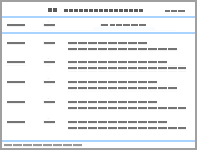
表1
蚕豆萌发期主要指标及其计算公式"
| 发芽率GR | 第10天发芽种子数/供试种子数×100% Number of germinated seeds at 10 d/Total tested seeds×100% |
|---|---|
| 相对发芽率RGR | 处理发芽率/对照发芽率×100% Germination rate of treatment/Germination rate of control×100% |
| 发芽势GE | 第5天的发芽种子数/供试种子数×100% Number of germinated seeds at 5 d/Total tested seeds×100% |
| 相对发芽势RGE | 处理发芽势/对照发芽势×100% Germination energy of treatment/Germination energy of control×100% |
| 相对根长RRL | 处理根长/对照根长×100% Root length of treatment/Root length of control×100% |
| 活力指数VI | 相对根长×相对发芽率×100% Relative root length×Relative germination rate×100% |
| 发芽指数GI | Σ(逐日发芽数/相应发芽天数)Σ(Gt/Dt) |
| 萌发胁迫指数GSI | 处理发芽指数/对照发芽指数×100%GI of treatment/GI of control×100% |
| 隶属函数值U(Xji) | U(Xji)=(Xji-Xjmin)/(Xjmax-Xjmin) Xi=ΣU(Xij)/n |
表2
萌发期耐盐等级划分"
| 等级 Grade | 综合隶属函数值μ(Xi) Comprehensive membership value μ(Xi) |
|---|---|
| 高耐盐HT | μ(Xi)≥0.8 |
| 耐盐T | 0.6≤μ(Xi)<0.8 |
| 中耐盐MT | 0.4≤μ(Xi)<0.6 |
| 弱耐盐S | 0.2≤μ(Xi)<0.4 |
| 不耐盐HS | μ(Xi)<0.2 |
表3
田间耐盐性分级标准"
| 田间分级Field rating | 植株受害状况Plant damage symptoms |
|---|---|
| 1 | 生长基本正常,没有出现盐害症状Normal growth, no salt damage symptoms |
| 2 | 生长基本正常,但少数叶片出现青枯或卷缩Growth is basically normal, but a few leaves have withered or curled |
| 3 | 大部分叶片出现青枯或卷缩,少部分植株死亡Majority of leaves show wilting/curling, with partial plant death |
| 4 | 生长严重受阻,大部分植株死亡严重受害Severely stunted growth, significant plant death |
| 5 | 几乎全部死亡或接近死亡Almost complete plant death or near death |
表4
衣康酸处理试验组设置表"
| 处理编号 Treatment ID | 处理液配方说明 Treatment solution description | 衣康酸浓度 Itaconic acid concentration (mmol·L-1) | 醋酸浓度 Acetic acid concentration (mmol·L-1) | 组别说明 Group description |
|---|---|---|---|---|
| CK | 纯水 Distilled water | 未添加 Not applied | 未添加 Not applied | 对照 Control |
| T1 | 100 mmol·L-1 NaCl | 未添加 Not applied | 未添加 Not applied | 盐胁迫 Salt stress |
| T2 | 100 mmol·L-1 NaCl + 0.01%衣康酸 100 mmol·L-1 NaCl + 0.01% itaconic acid | 0.77 | 未添加 Not applied | 低浓度衣康酸 Low-concentration itaconic acid |
| T3 | 100 mmol·L-1 NaCl + 0.05%衣康酸 100 mmol·L-1 NaCl + 0.05% itaconic acid | 3.84 | 未添加 Not applied | 中浓度衣康酸 Medium-concentration itaconic acid |
| T4 | 100 mmol·L-1 NaCl + 0.1%衣康酸 100 mmol·L-1 NaCl + 0.1% itaconic acid | 7.68 | 未添加 Not applied | 高浓度衣康酸 High-concentration itaconic acid |
| T5 | 100 mmol·L-1 NaCl + 1%衣康酸 100 mmol·L-1 NaCl + 1% itaconic acid | 76.80 | 未添加 Not applied | 超高浓度衣康酸 Ultra-high-concentration itaconic acid |
| T6 | 100 mmol·L-1 NaCl + 0.01%醋酸 100 mmol·L-1 NaCl + 0.01% acetic acid | 未添加 Not applied | 1.67 | 低浓度醋酸对照 Low-concentration acetic acid (control) |
| T7 | 100 mmol·L-1 NaCl + 0.05%醋酸 100 mmol·L-1 NaCl + 0.05% acetic acid | 未添加 Not applied | 8.33 | 中浓度醋酸对照 Medium-concentration acetic acid (control) |
| T8 | 100 mmol·L-1 NaCl + 0.1%醋酸 100 mmol·L-1 NaCl + 0.1% acetic acid | 未添加 Not applied | 16.70 | 高浓度醋酸对照 High-concentration acetic acid (control) |
| T9 | 100 mmol·L-1 NaCl + 1%醋酸 100 mmol·L-1 NaCl + 1% acetic acid | 未添加 Not applied | 167.00 | 超高浓度醋酸对照 Ultra-high-concentration acetic acid (control) |
| T10 | T3 + NaHCO3调节pH至7.0 T3 + NaHCO3 adjusted to pH7.0 | 3.84 | 未添加 Not applied | pH中性验证(衣康酸) pH-neutralized itaconic acid (medium concentration) |
| T11 | T5 + NaHCO3调节pH至7.0 T5 + NaHCO3 adjusted to pH 7.0 | 76.80 | 未添加 Not applied | pH中性验证(衣康酸) pH-neutralized itaconic acid (ultra-high concentration) |
| T12 | T7 + NaHCO3调节pH至7.0 T7 + NaHCO3 adjusted to pH 7.0 | 未添加 Not applied | 8.33 | pH中性验证(醋酸) pH-neutralized acetic acid (medium concentration) |
| T13 | T9 + NaHCO3调节pH至7.0 T9 + NaHCO3 adjusted to pH 7.0 | 未添加 Not applied | 167.00 | pH中性验证(醋酸) pH-neutralized acetic acid (ultra-high concentration) |

图1
100 mmol·L-1 NaCl胁迫下15份蚕豆种质萌发表型"
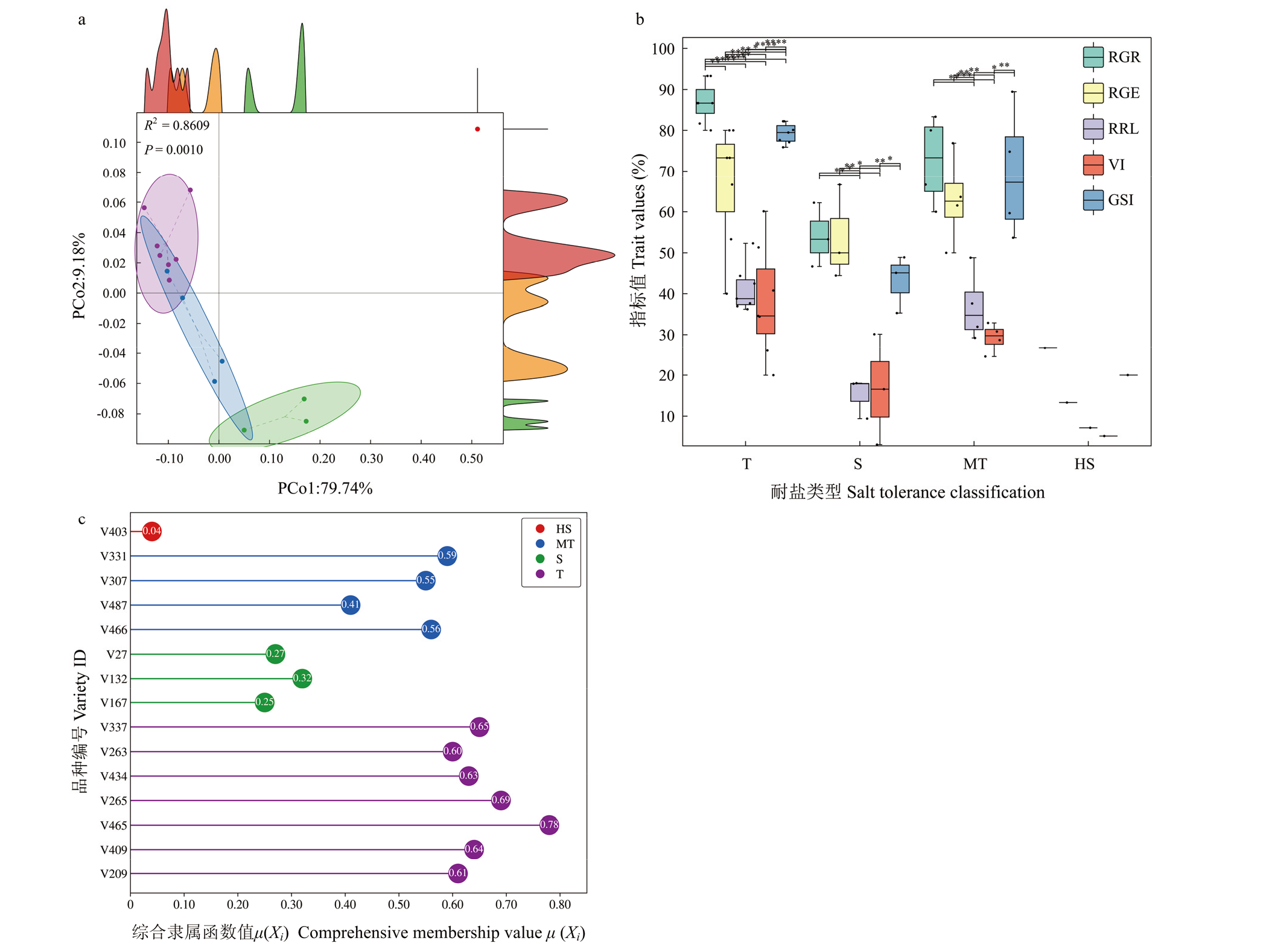
图2
15份蚕豆种质萌发期耐盐性综合分析 a:主坐标分析双标图;b:不同耐盐材料间RGR、RGE、RRL、VI与GSI的差异;c:基于综合隶属函数值μ(Xi)的耐盐等级划分。*、**、***分别表示差异显著(P<0.05、P<0.01和P<0.001)。下同"
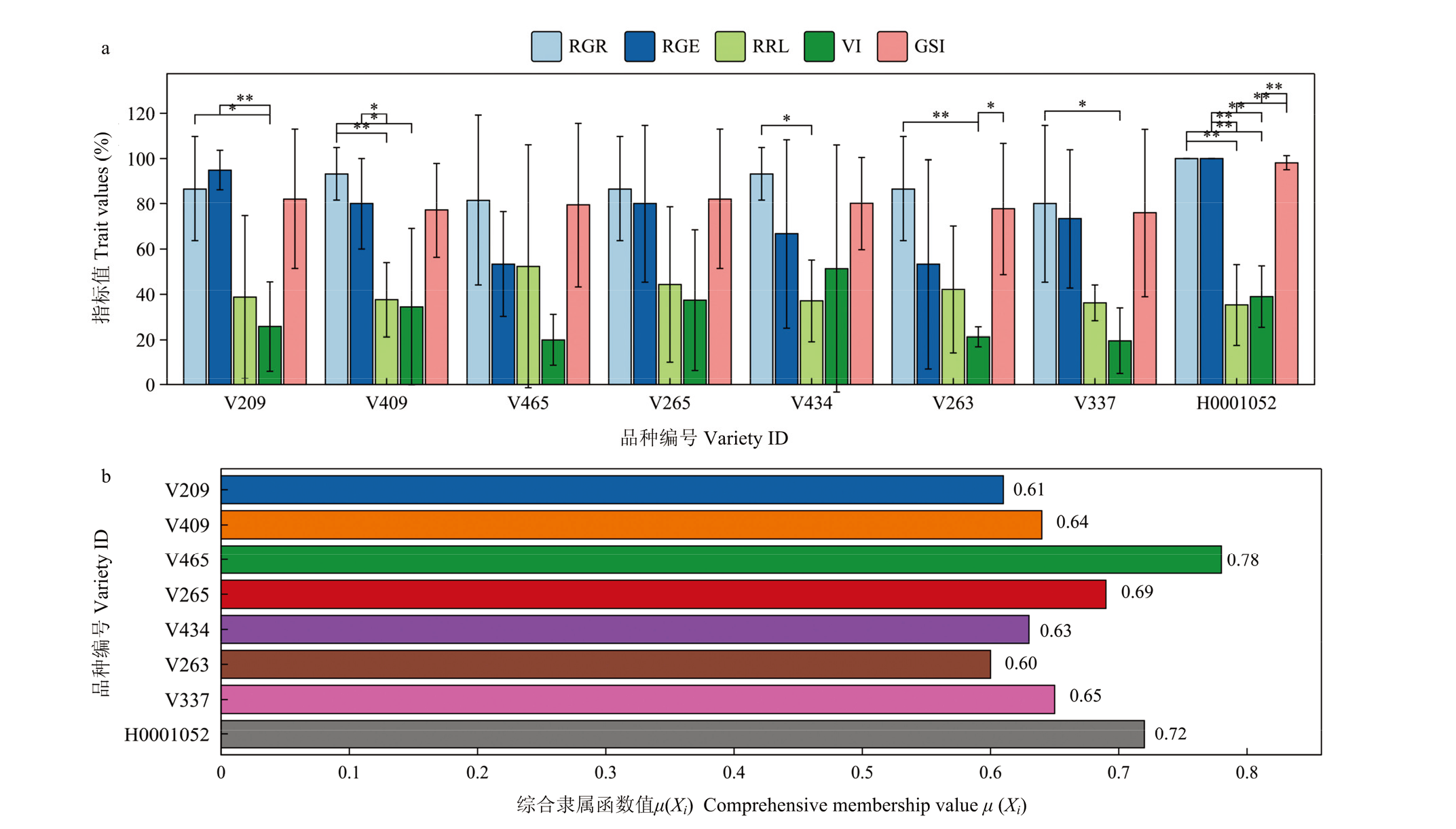
图3
盐胁迫条件下7份筛选种质与对照H0001052的萌发期生理指标表现及综合耐盐性评价 a:盐胁迫条件下7份候选蚕豆种质与对照H0001052在萌发期的核心生理指标表现;b:基于综合隶属函数值μ(Xi)耐盐性评价结果"

图4
盐碱田间环境下蚕豆全生育期耐盐性动态及农艺性状相关性网络 a:15份蚕豆种质在盐碱地与非盐碱地条件下的成苗率比较;b:现蕾期(50 d)展开复叶SPAD值在盐碱处理下的响应;c:开花期盐害指数(SI)与耐盐等级分级;d:17项农艺性状间的Mantel相关性热图。NFB:初花节位;NFI:每花序花数;PH:株高;EBN:有效分枝数;MSN:主茎节数;NFP:始荚节位;TPNP:单株总荚数;EPP:有效荚数;SPPFP:始荚节位单荚粒数;DPL:干荚长;DPW:干荚宽;SNPP:单株粒数;SWP:单株粒重;ST:籽粒厚度;SW:籽粒宽度;SL:籽粒长度;SDW:地上部干重"
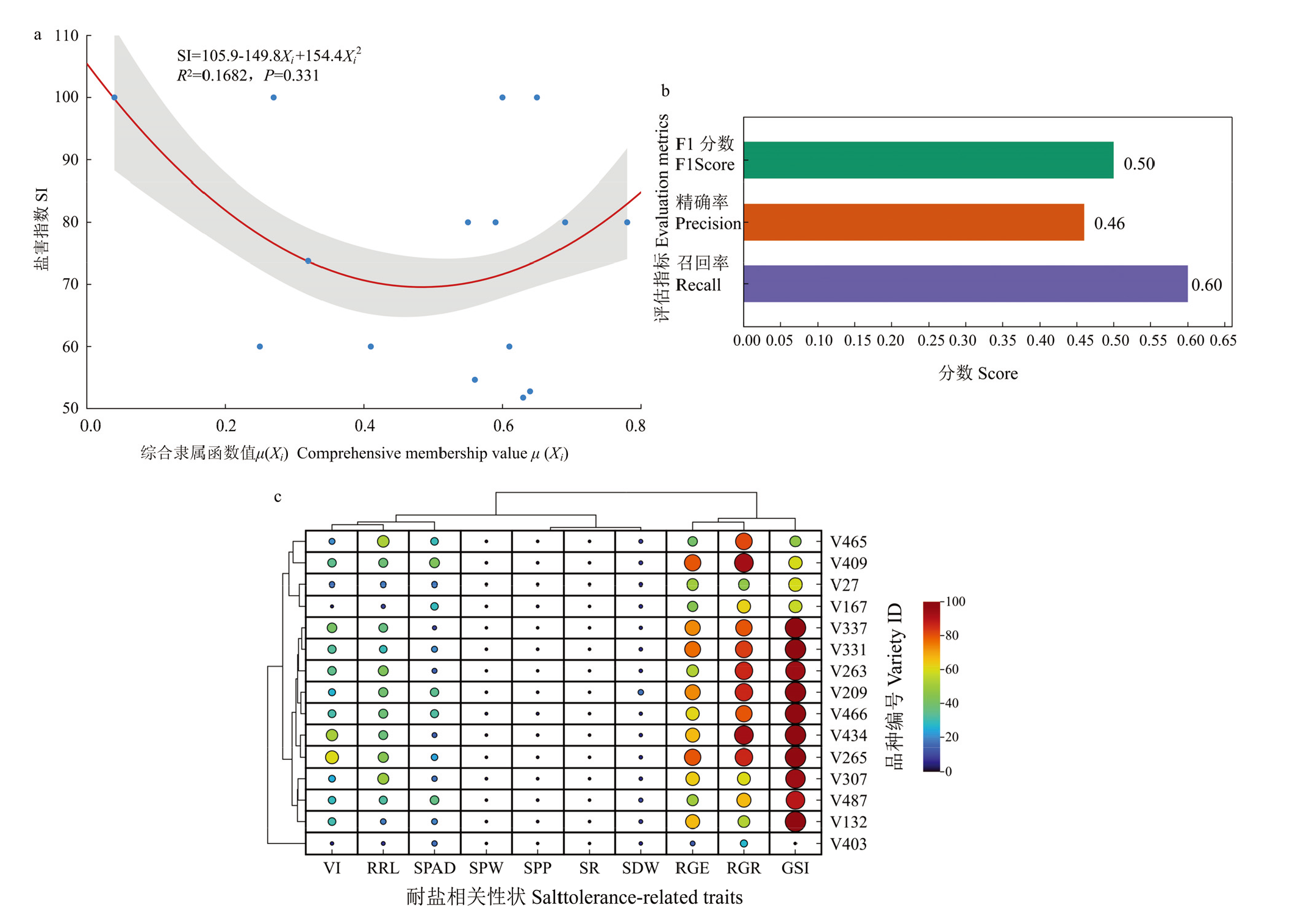
图5
耐盐散点相关性、机器学习分层交叉验证及表型分型 a:萌发期综合隶属函数值μ(Xi)与田间盐害指数SI的散点图及二次多项式拟合曲线;b:机器学习模型的分层交叉验证流程与结果;c:萌发期与田间阶段耐盐等级一致性的热图"
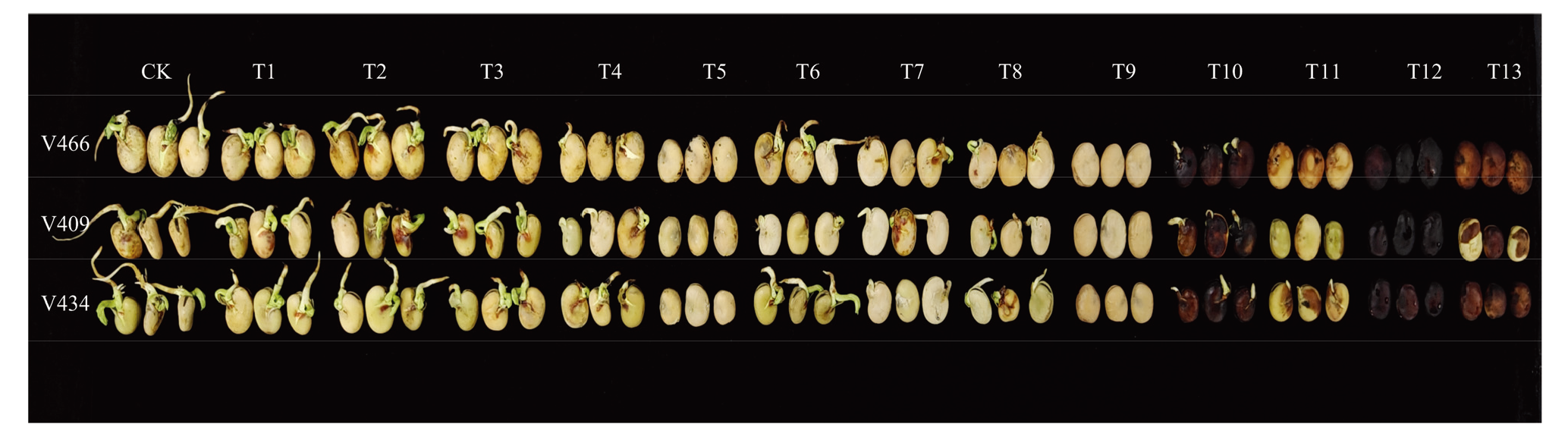
图6
衣康酸(IA)处理对盐胁迫下蚕豆种子萌发的表型调控效应"
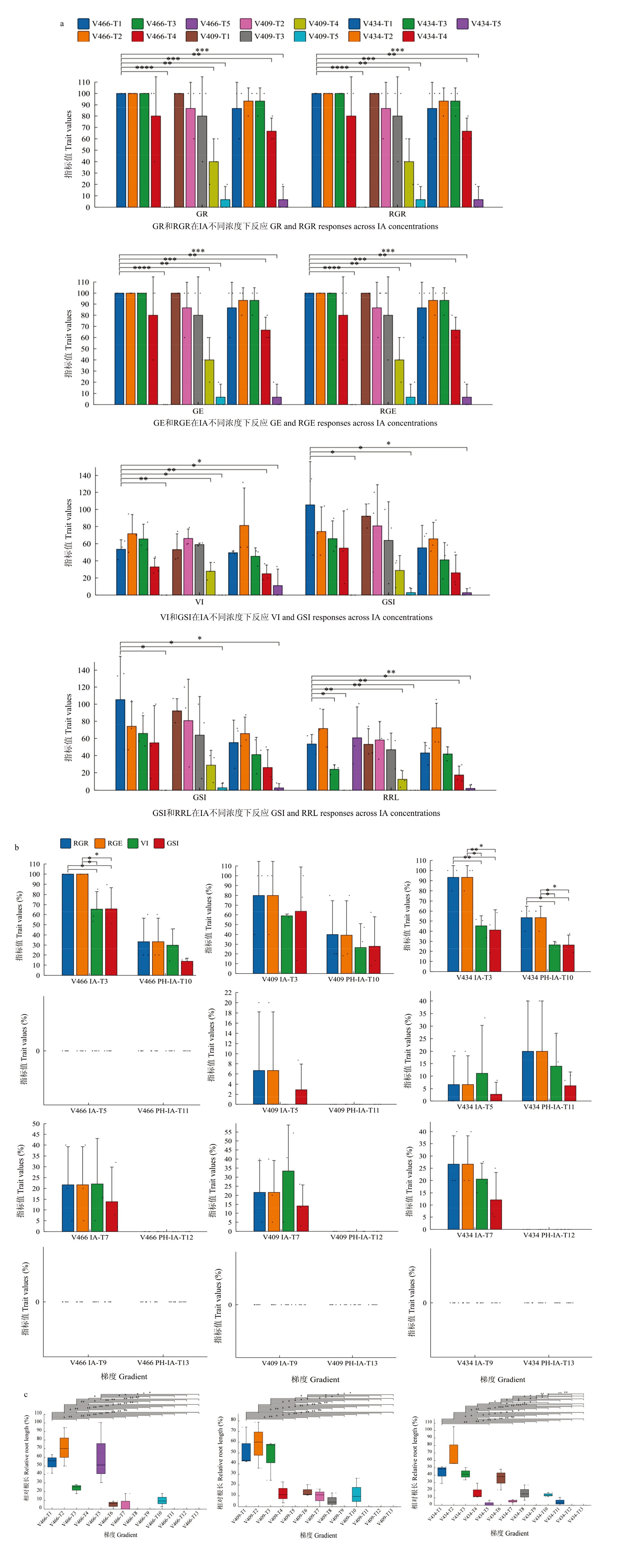
图7
衣康酸缓解盐胁迫的剂量效应、酸性依赖性与种质特异性响应 a:在NaCl条件(100 mmol·L-1)下,不同IA剂量(0%—1%)对3种种质萌发相关指标的影响;b:等摩尔有机酸类型与pH处理的萌发参数对比;c:关键处理下3种种质相对根长(RRL)的箱线图(显示中位数与四分位距)"
| [1] |
Food and Agriculture Organization of the United Nations. Global map of salt-affected soils (GSASmap v1.0). (2021-10-20) [2025-08-24]. https://openknowledge.fao.org/items/be52a217-7c1c-41c9-8e7c-c21751f92874.
|
| [2] |
Food and Agriculture Organization of the United Nations. Global Status of Salt-Affected Soils. Rome: FAO, 2024 [2025-08-24]. https://openknowledge.fao.org/handle/20.500.14283/cd3044en.
|
| [3] |
doi: 10.1146/annurev.arplant.59.032607.092911 pmid: 18444910 |
| [4] |
doi: 10.1186/s12870-017-0994-6 |
| [5] |
张志林, 刘荣, 杨涛, 宗绪晓. 蚕豆种质资源鉴定评价与创新利用研究进展. 植物遗传资源学报, 2025, 26(7): 1243-1255.
|
|
|
|
| [6] |
|
| [7] |
doi: 10.1016/S0378-3774(03)00005-2 |
| [8] |
|
| [9] |
doi: 10.1007/s42976-023-00457-4 |
| [10] |
doi: 10.2135/cropsci2000.404996x |
| [11] |
doi: 10.1016/S0378-3774(02)00088-4 |
| [12] |
doi: 10.1016/j.jssas.2015.10.002 |
| [13] |
doi: 10.1038/s41598-020-64288-7 |
| [14] |
doi: 10.1016/j.cj.2021.02.010 |
| [15] |
doi: 10.1016/j.compag.2019.104872 |
| [16] |
doi: 10.1104/pp.16.00705 pmid: 27342311 |
| [17] |
doi: 10.1007/s10725-014-0013-y |
| [18] |
doi: 10.1016/j.tplants.2018.10.010 |
| [19] |
doi: 10.1111/pce.v39.5 |
| [20] |
doi: 10.3390/ijms20102479 |
| [21] |
|
| [22] |
doi: 10.1038/s41577-019-0128-5 pmid: 30705422 |
| [23] |
doi: 10.1038/nature25986 |
| [24] |
doi: 10.1016/j.xinn.2020.100017 |
| [25] |
doi: 10.1126/sciadv.adt7463 |
| [26] |
宗绪晓, 包世英, 关建平. 蚕豆种质资源描述规范和数据标准. 北京: 中国农业出版社, 2006.
|
|
|
|
| [27] |
樊有存. 蚕豆耐盐种质资源筛选与抗盐基因的克隆及表达分析[D]. 西宁: 青海大学, 2021.
|
|
|
|
| [28] |
李玲, 沈宝宇, 张天静, 杨涛, 刘荣, 宗绪晓. 豌豆种质资源芽期耐旱性评价及耐旱种质筛选. 植物遗传资源学报, 2017, 18(4): 778-785.
doi: 10.13430/j.cnki.jpgr.2017.04.022 |
|
|
|
| [29] |
安永平, 强爱玲, 张媛媛, 张文银, 曹桂兰, 韩龙植. 渗透胁迫下水稻种子萌发特性及抗旱性鉴定指标研究. 植物遗传资源学报, 2006, 7(4): 421-426.
|
|
|
|
| [30] |
王赞, 李源, 吴欣明, 高洪文, 孙桂芝. PEG渗透胁迫下鸭茅种子萌发特性及抗旱性鉴定. 中国草地学报, 2008, 30(1): 50-55.
|
|
|
|
| [31] |
朱珍珍, 陈宏伟, 廖芳丽, 李莉, 刘昌燕, 刘良军, 杨访问, 孙虎, 范如旖, 毛政, 等. 小豆种子萌发期耐旱性评价及耐旱种质资源筛选. 南方农业学报, 2019, 50(6): 1183-1190.
|
|
|
|
| [32] |
王利彬, 刘丽君, 裴宇峰, 董守坤, 孙聪姝, 祖伟, 阮英慧. 大豆种质资源芽期抗旱性鉴定. 东北农业大学学报, 2012, 43(1): 36-43.
|
|
|
|
| [33] |
doi: 10.3389/fpls.2021.667458 |
| [34] |
doi: 10.1016/j.jplph.2024.154373 |
| [35] |
doi: 10.1016/j.jgg.2023.08.007 pmid: 37647984 |
| [36] |
doi: 10.1186/s12870-023-04465-8 pmid: 37736710 |
| [37] |
doi: 10.1007/s10265-003-0110-x |
| [38] |
doi: 10.1104/pp.112.196428 |
| [39] |
doi: 10.1007/s10725-025-01305-7 |
| [40] |
doi: S1360-1385(15)00263-0 pmid: 26651918 |
| [41] |
doi: 10.3390/ijms22137235 |
| [42] |
|
| [43] |
doi: 10.1016/j.jksus.2023.103012 |
| [1] | 鲁雪莉, Syeda Wajeeha Gillani, 孟晨, 李晓彬, 宋奕汝, 柏雨, 王菊英, 冯晓菲, 刘晨晨, 李义强, 徐宗昌. 不同类型盐胁迫对狼尾草种子萌发的影响及钠调控转录组研究[J]. 中国农业科学, 2026, 59(7): 1400-1419. |
| [2] | 陈敏, 焦紫岚, 乔承彬, 许昊, 张碧, 马东花, 孔维儒, 王敬文, 宋佳伟, 罗成科, 李培富, 田蕾. 不同亚种水稻种质资源对盐胁迫的形态生理响应及适应策略[J]. 中国农业科学, 2026, 59(4): 705-722. |
| [3] | 滕梦鑫, 徐亚, 何静, 汪奇, 乔飞, 李敬阳, 李新国. 香蕉Ca2+-ATPase基因家族的鉴定及功能分析[J]. 中国农业科学, 2025, 58(7): 1418-1433. |
| [4] | 张向昆, 李佳莹, 乔如梦, 何静蕾, 王莉, 师校欣, 杜国强. 不同锌水平下GFabV对‘阳光玫瑰’葡萄光合效率及光合相关基因表达的影响[J]. 中国农业科学, 2025, 58(24): 5190-5200. |
| [5] | 王凡, 刘陈玮, 陆红臣, 徐仁超, 卞晓春. 蚕豆响应交链格孢侵染的转录组分析及VfPR4的抗病功能验证[J]. 中国农业科学, 2025, 58(22): 4656-4672. |
| [6] | 吕缓缓, 李如月, 刘青松, 许蕾, 徐嫣然, 于浩洁, 郭长虹, 龙瑞才. 紫花苜蓿MsKTI3基因克隆及耐盐功能分析[J]. 中国农业科学, 2025, 58(21): 4497-4511. |
| [7] | 邓立成, 李程, 赫磊, 安红强, 王才林, 张亚东, 赵长江, 路凯. 耐盐南粳品种苗期盐胁迫应答的生理特性及其耐盐相关基因分析[J]. 中国农业科学, 2025, 58(12): 2275-2290. |
| [8] | 徐秋韵, 周伟迪, 韩成龙, 谷艳杰. 不同磷肥施用量对高寒地区覆膜蚕豆光合特性、产量和水分利用效率的影响[J]. 中国农业科学, 2025, 58(10): 1917-1933. |
| [9] | 裴书瑶, 曹红霞, 张泽宇, 赵方洋, 李志军. 盆栽番茄对NaCl和Na2SO4微咸水灌溉的生理响应[J]. 中国农业科学, 2024, 57(3): 570-583. |
| [10] | 邵嘉朱, 吕雯, 廖鑫琳, 袁歆瑜, 宋振, 蒋冬花. 大豆根际促生菌的分离、鉴定及其耐盐促生作用[J]. 中国农业科学, 2024, 57(21): 4248-4263. |
| [11] | 代瑛姿, 郭宏扬, 杨志峰, 王宪璞, 许丽丽. 葡萄转录因子VvERF2耐盐功能鉴定[J]. 中国农业科学, 2024, 57(2): 336-348. |
| [12] | 尹军良, 李婧怡, 韩硕, 杨培华, 马佳伟, 刘奕清, 胡海骏, 朱永兴. 生姜NHX基因家族成员鉴定及其在硅缓解盐胁迫中的表达特征[J]. 中国农业科学, 2024, 57(19): 3848-3869. |
| [13] | 李慧, 张雨峰, 李晓刚, 王中华, 蔺经, 常有宏. 全基因组DNA甲基化和转录组联合分析鉴定杜梨耐盐相关转录因子[J]. 中国农业科学, 2023, 56(7): 1377-1390. |
| [14] | 梁海文, 兰平秀, 柳勤海, 谭冠林, 陈小姣, 赵雁, 李凡. 侵染花叶青木的病毒种类鉴定及其基因序列分析[J]. 中国农业科学, 2023, 56(10): 1893-1904. |
| [15] | 胡亚丽,聂靖芝,吴霞,潘姣,曹珊,岳娇,罗登杰,王财金,李增强,张辉,吴启境,陈鹏. 水杨酸引发对红麻幼苗耐盐性的影响[J]. 中国农业科学, 2022, 55(14): 2696-2708. |
|
||
