






中国农业科学 ›› 2026, Vol. 59 ›› Issue (6): 1141-1156.doi: 10.3864/j.issn.0578-1752.2026.06.001
赵子杰1( ), 宋豪1, 董小鸥1,2(), 万建民2,3()
收稿日期:2025-08-21
接受日期:2025-12-01
出版日期:2026-03-16
发布日期:2026-03-24
通信作者:
联系方式:
赵子杰,E-mail:zhaozijie@stu.njau.edu.cn。
基金资助:
ZHAO ZiJie1(), SONG Hao1, DONG XiaoOu1,2(), WAN JianMin2,3()
Received:2025-08-21
Accepted:2025-12-01
Published:2026-03-16
Online:2026-03-24
摘要:
随着CRISPR/Cas等基因编辑技术的快速发展,其在动植物育种、微生物改造及基础科学研究中已展现出强大的应用潜力。当前的基因编辑技术可在广泛物种中对指定基因组靶点进行单个或多个核苷酸的插入、删除、替换等操作,而对于DNA大片段的定向插入或替换等编辑类型,仍面临效率及保真性低、供体递送困难等技术瓶颈。这些瓶颈制约了基因编辑技术在包括具有遗传连锁的多基因聚合、优良等位基因精准替换、基因组安全港片段定向导入等重要场景下的应用。转座元件作为广泛存在于生物基因组中的可移动遗传元件,凭借其天然的移动能力与大容量DNA装载特性,为突破上述瓶颈提供了全新路径,有望被工程化改造成为DNA大片段精准编辑的关键分子工具,解决上述难题。本文综述了基于转座元件的大片段DNA定向插入技术的最新研究进展,重点探讨了原核生物来源的CRISPR相关转座子(CAST)和真核生物中的部分DNA转座子及逆转座子的应用现状与前景。原核生物来源的CAST系统表现突出,在原核生物中可介导高效的大片段整合,经优化后也能在真核细胞中实现大片段插入。在真核生物中,DNA转座子mPing/Pong和逆转座子R2与L1相关工具经工程化改造,也被用于动植物中的大片段DNA插入。与此同时,基于转座子的大片段DNA定向插入技术领域面临着挑战。一方面,转座元件的跨物种适配性不足,导致部分转座元件难以被移植到其他物种中发挥功能。另一方面,相关蛋白元件尺寸较大或数量繁多,导致在特定类型的真核细胞中递送效率低。此外,部分系统存在刺激哺乳动物免疫系统并导致炎症反应的安全风险。在未来的研究中,通过新型转座元件挖掘、工程化改造转座酶、开发新型递送载体、深度解析转座机制等,可为建立高效、安全的大片段编辑技术提供关键技术支撑,为作物遗传改良、基因治疗及微生物基因组编辑提供源头技术创新。
赵子杰, 宋豪, 董小鸥, 万建民. 转座元件系统介导的大片段DNA定向插入技术研究进展[J]. 中国农业科学, 2026, 59(6): 1141-1156.
ZHAO ZiJie, SONG Hao, DONG XiaoOu, WAN JianMin. Progress in Transposable Element-Assisted Targeted Insertion of Large DNA Fragments[J]. Scientia Agricultura Sinica, 2026, 59(6): 1141-1156.
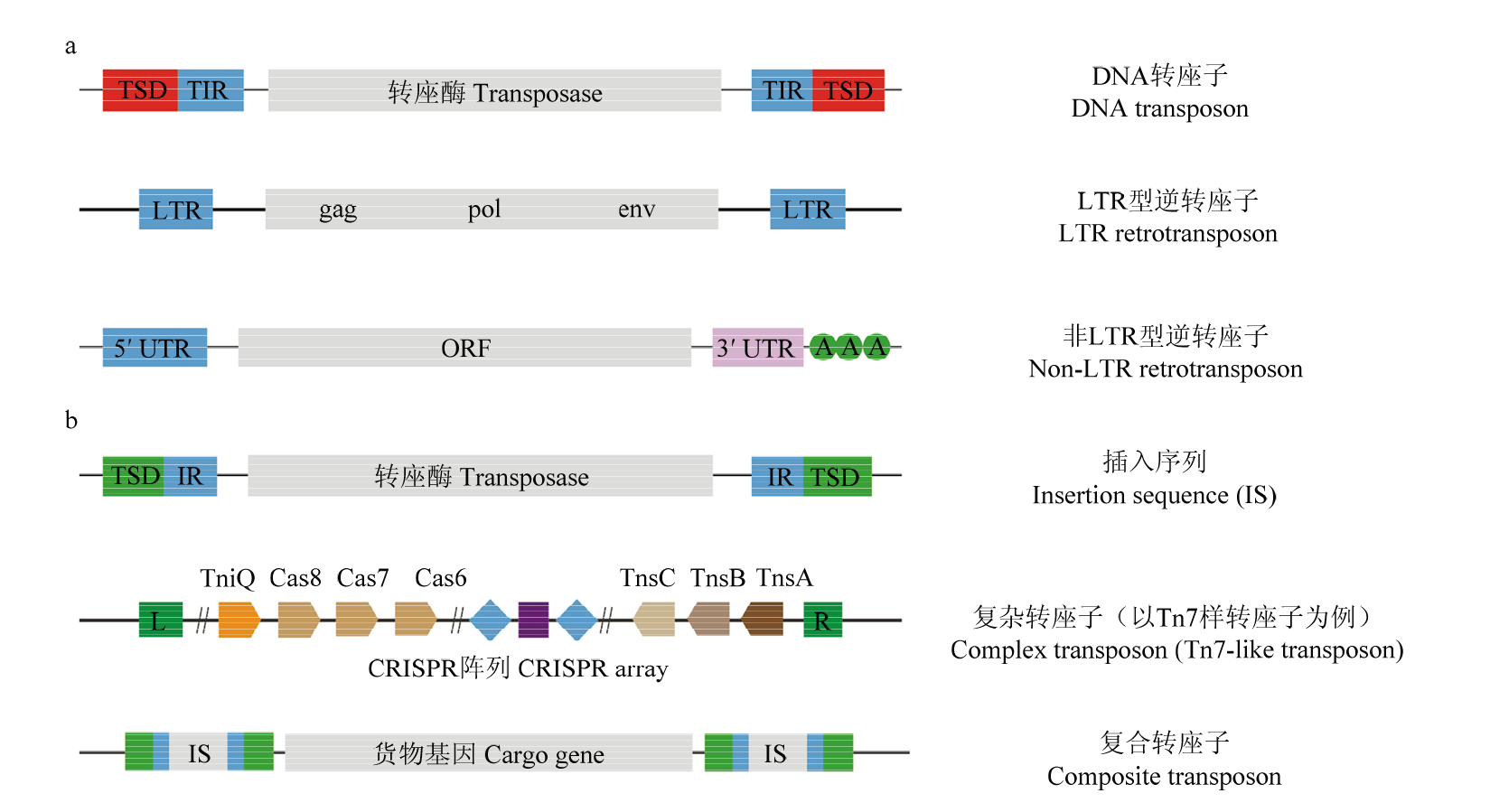
图1
常见类型转座元件示例 a:真核生物中的转座子;b:原核生物中的转座子。TIR:末端反向重复;TSD:靶位点重复;LTR:长末端重复元件;gag:群特异性抗原;pol:多聚蛋白;env:包膜蛋白;IR:反向重复序列;5′UTR:5′非翻译区;3′UTR:3′非翻译区;ORF:开放阅读框;L:转座子左端;R:转座子右端。下同"
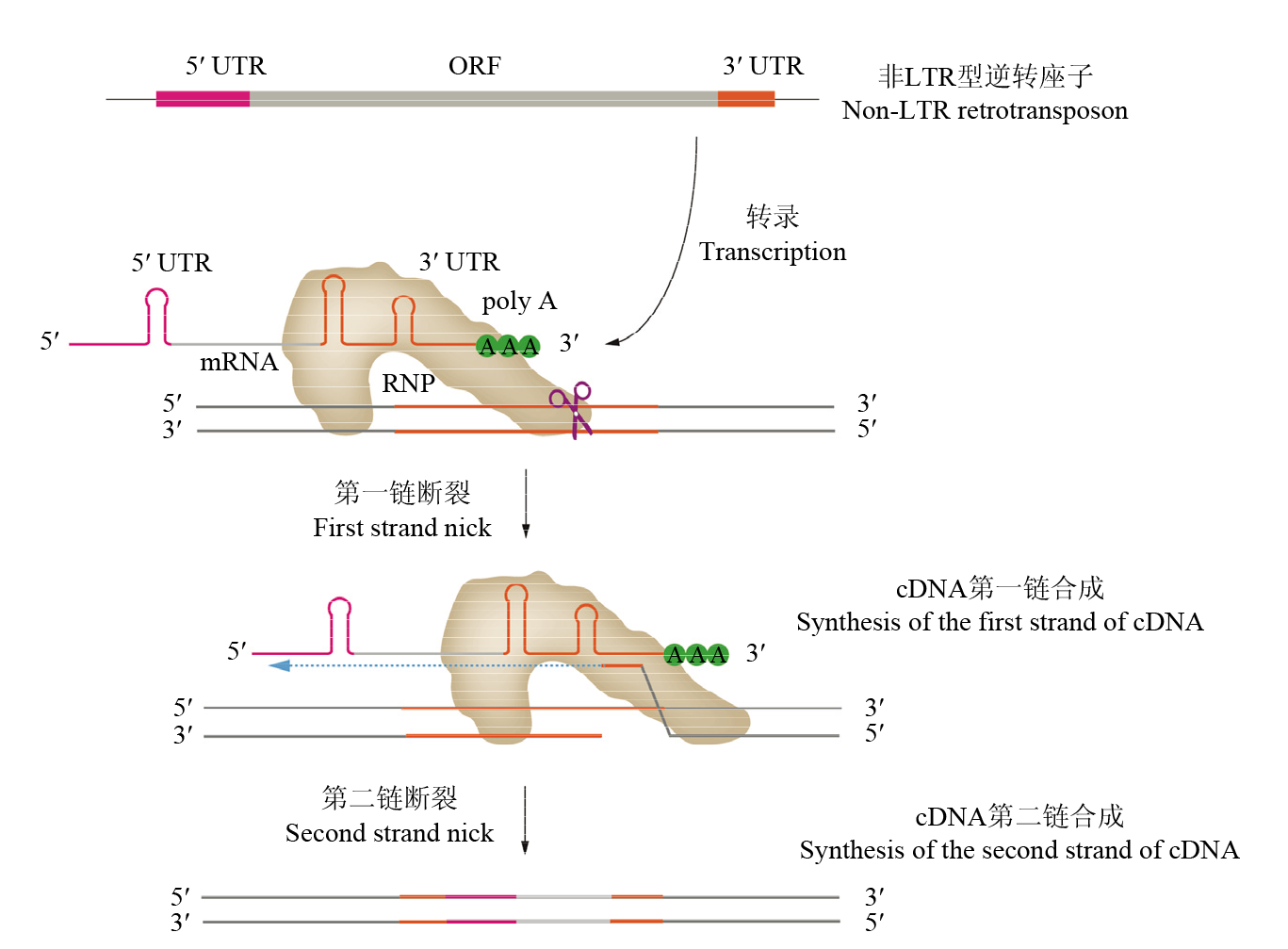
图2
靶点引导的逆转录介导转座示意图 non-LTR型转座子经转录生成mRNA后,转座子编码的蛋白会与mRNA组装形成RNP复合物,随后转座子蛋白的核酸内切酶结构域切割靶位点形成单链切口,并利用切口暴露的3′末端作为引物,以mRNA为模板启动逆转录,依次进行cDNA的第1、2链的合成,成功实现转座。RNP:核糖核蛋白"
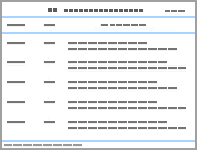
表1
已报道的转座子系统介导的大片段DNA定向插入技术"
| 转座元件名称 Transposable elements | 敲入工具 名称 Knock- in tools | 操作物种 Experimental species | 敲入片段最大长度 Maximum length of knock-in fragment (kb) | 敲入效率 Knock-in efficiency (%) | 敲入原理 Knock-in principle | 参考文献 References |
|---|---|---|---|---|---|---|
| L1 | CREATE | Huh7细胞 Huh7 cells | 1.1 | 1.5 | 设计一对sgRNA引导nCas9切割靶点上下游DNA,释放的末端与L1 mRNA的PBS互补配对,介导搭载外源基因的L1启动TPRT机制,实现片段定点插入 Design dual sgRNAs to guide nCas9 to cleave the DNA upstream and downstream of the target site. The released ends form complementary pairing with the primer binding site (PBS) of L1 mRNA, mediating the L1 carrying the exogenous gene to initiate the target-primed reverse transcription (TPRT) mechanism, thereby achieving targeted insertion of the fragment | [ |
| mPing/Pong | TATSI | 拟南芥 Arabidopsis | 8.6 | 8.3 | CRISPR/Cas系统产生DSB后,Pong转座酶的ORF1/ORF2蛋白将mPing转座子插入靶DNA位点 After the CRISPR/Cas system generates double-strand breaks (DSB), the ORF1/ORF2 proteins of Pong transposase insert the mPing transposon into the target DNA site | [ |
| R2Tg | ARPE-19细胞 ARPE-19 cells | 4.5 | / | R2Tg蛋白通过TPRT机制实现RNA模板在28S rDNA安全港位点实现大片段整合 The R2Tg protein realizes large-fragment integration of the RNA template at the 28S rDNA safe-harbor locus through the TPRT mechanism | [ | |
| R2Tg | en-R2Tg | HEK293T细胞 HEK293T cells | 1.5 | 1.0 | 优化R2Tg蛋白结构与供体RNA模板,实现全RNA递送的安全港位点的大片段定向插入 Optimize the structure of R2Tg protein and the donor RNA template to achieve targeted insertion of large fragments at the safe-harbor locus via all-RNA delivery | [ |
| R2Tg | / | HEK293FT细胞 HEK293FT cells | 3.0 | 1.0 | 通过精简供体UTR序列,大幅减少了供体片段的插入痕迹,并增加化学修饰,实现全RNA递送的安全港位点敲入 By streamlining the donor UTR sequence, the insertion scars of the donor fragment are significantly reduced, and chemical modifications are added to achieve knock-in at the safe-harbor locus via all-RNA delivery | [ |
| R2Tocc | STITCHR | 哺乳动物细胞 Mammalian cells | 12.7 | 9.0 | 通过重新设计供体模板的同源臂序列位置,将nCas9与R2Tocc捆绑,实现非28S rDNA位点的无痕插入 By redesigning the position of the homologous arm sequences of the donor template and fusing nCas9 with R2Tocc, scarless insertion at non-28S rDNA loci is achieved | [ |
| Tn7-like | VchCAST | 大肠杆菌 E. coli | 10.1 | 1.0 | 仅有靶向能力的CRISPR/Cascade引导Tn7样转座子在靶点下游处进行供体的靶向整合 The CRISPR/Cascade with only targeting capability guides the Tn7-like transposon to perform targeted integration of the donor downstream of the target site | [ |
| Tn7-like | ShCAST | 大肠杆菌 E. coli | ≈10.0 | 45.0 | 仅有靶向能力的CRISPR/Cas12k引导Tn7样转座子在靶点下游处进行供体的靶向整合 The CRISPR/Cas12k with only targeting capability guides the Tn7-like transposon to perform targeted integration of the donor downstream of the target site | [ |
| Tn7-like | INTEGRATE | 大肠杆菌 E. coli | 10.0 | 99.0 | 建立单质粒I-F型CAST系统,实现10 kb片段近100%效率的无标记和高精度定向整合 Establish an all-in-one plasmid Type I-F CAST system to achieve marker-free, high-precision targeted integration of 10 kb fragments with nearly 100% efficiency | [ |
| Tn7-like | ShHELIX | 大肠杆菌 E. coli | 9.8 | 70.0 | 融合归巢核酸内切缺刻酶(nHE)与TnsB,提升V-K型CAST的插入效率与精度,并减少质粒骨架共整合的频率 Fuse homing endonuclease nickase (nHE) with TnsB to improve the insertion efficiency and precision of Type V-K CAST, and reduce the frequency of plasmid backbone co-integration | [ |
| Tn7-like | evoCAST | HEK293T细胞 HEK293T cells | 14.8 | 8.0 | 通过连续的噬菌体辅助进化手段,将进化后的TnsB与其余优化的CAST组分结合,实现真核细胞中的大片段定点单向整合 Through continuous phage-assisted continuous evolution (PACE), combine the evolved TnsB with other optimized CAST components to achieve targeted unidirectional integration of large fragments in eukaryotic cells | [ |
| Tn7-like | MetaEdit | 拟杆菌 B. thetaiotaomicron | 7.5 | / | 通过接合型大肠杆菌将可移动CAST元件递送至小鼠肠道菌群 Deliver mobilizable CAST elements to the mouse gut microbiota via conjugative E. coli | [ |
| PiggyBac | FiCAT | HEK293T细胞 HEK293T cells | 8.0 | ≈0.3 | 将PiggyBac与Cas9蛋白融合,通过靶向DSB实现片段整合 Fuse PiggyBac with Cas9 protein to achieve fragment integration through targeted DSB | [ |
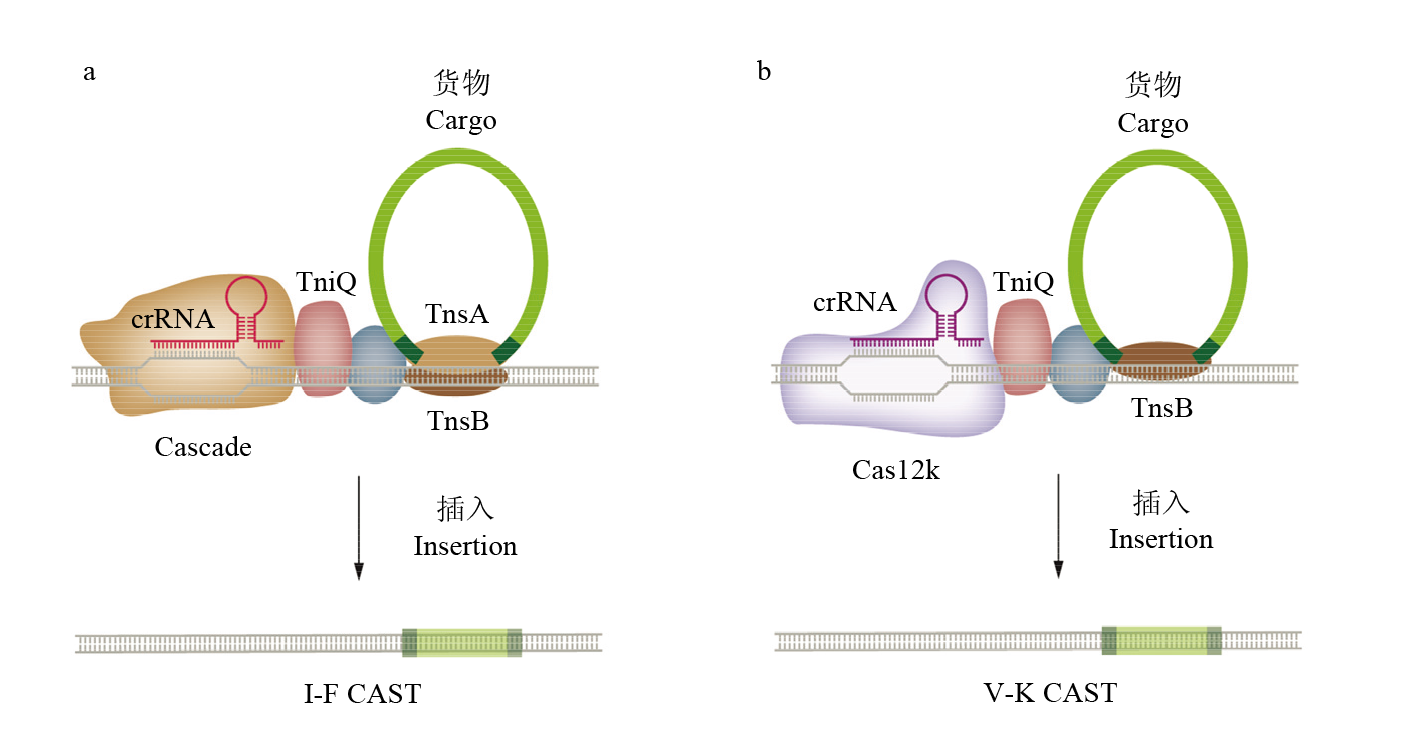
图3
CAST系统介导的转座示意图 a:I-F型CAST的示意图;b:V-K型CAST的示意图"
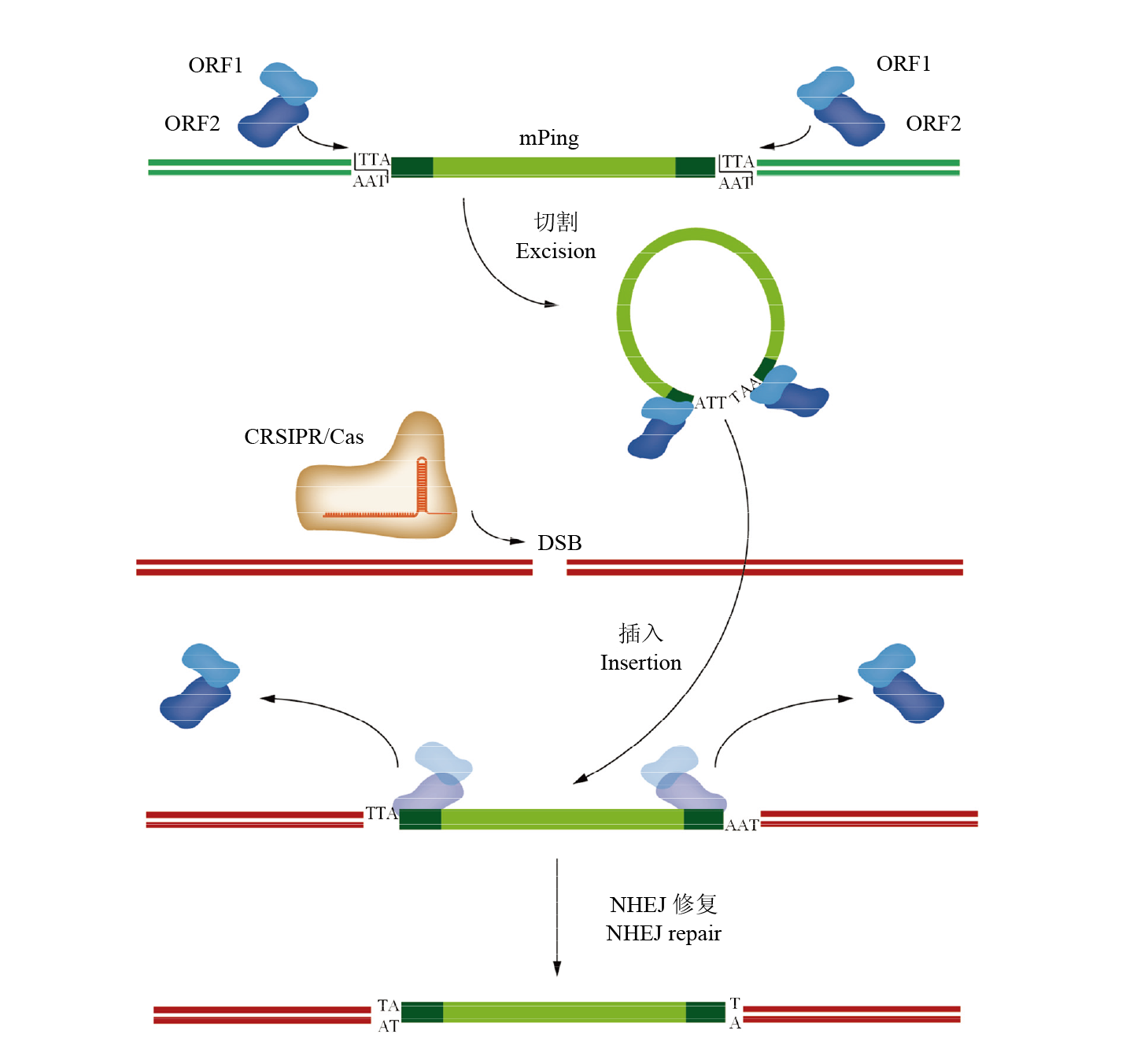
图4
TATSI系统介导的转座示意图 DSB:双链断裂"
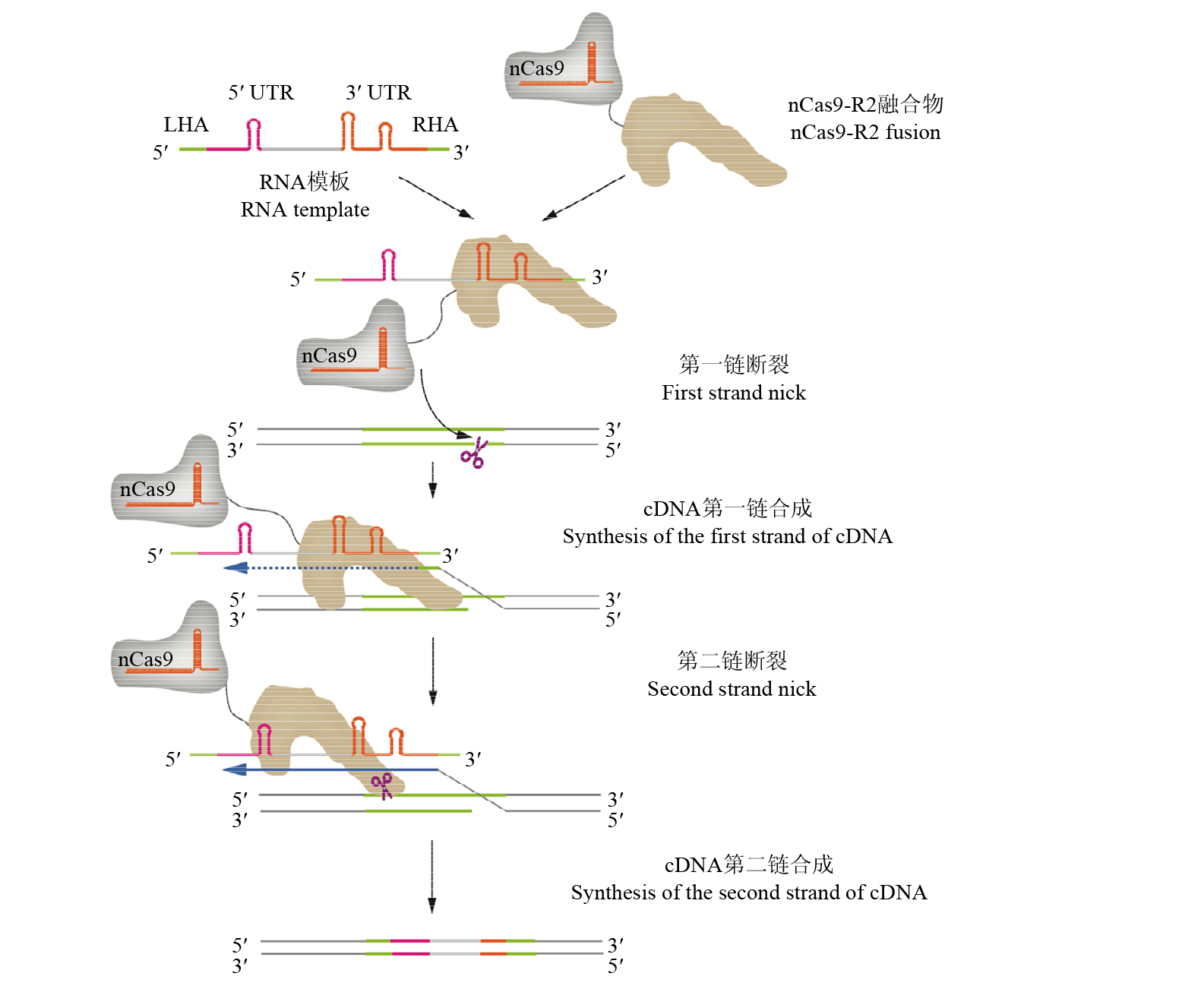
图5
STITCHR系统介导的转座示意图 LHA:左同源臂;RHA:右同源臂"
| [1] |
doi: 10.1038/s41467-018-04416-0 |
| [2] |
doi: 10.1038/s41587-020-0581-5 |
| [3] |
doi: 10.1016/j.molp.2024.03.013 |
| [4] |
doi: 10.1038/s41576-024-00720-2 |
| [5] |
doi: 10.1038/s41587-021-00868-w pmid: 33767395 |
| [6] |
doi: 10.1038/s41587-021-01026-y |
| [7] |
doi: 10.1038/s41587-021-01025-z |
| [8] |
doi: 10.1038/s41589-021-00889-1 |
| [9] |
doi: 10.1038/s41587-021-01133-w |
| [10] |
doi: 10.1038/s41592-022-01399-1 pmid: 35228726 |
| [11] |
doi: 10.1038/s41467-023-39137-6 |
| [12] |
doi: 10.1038/s41587-022-01527-4 |
| [13] |
doi: 10.1038/s41587-023-01769-w |
| [14] |
doi: 10.1038/s41551-024-01227-1 |
| [15] |
doi: 10.1016/j.cell.2025.07.011 pmid: 40763736 |
| [16] |
|
| [17] |
doi: 10.1038/nrg2165 pmid: 17984973 |
| [18] |
doi: 10.3390/v8070193 |
| [19] |
doi: 10.1146/annurev-genet-120213-092412 pmid: 25036377 |
| [20] |
doi: 10.1038/ng1223 pmid: 12897783 |
| [21] |
doi: 10.1016/s0960-9822(06)00112-6 pmid: 9162502 |
| [22] |
|
| [23] |
pmid: 12603728 |
| [24] |
|
| [25] |
doi: 10.1126/science.adh4859 |
| [26] |
doi: 10.1093/emboj/16.22.6835 |
| [27] |
doi: 10.1016/s0960-9822(99)80034-7 pmid: 9889113 |
| [28] |
doi: 10.1146/annurev-biochem-072911-172315 pmid: 23495939 |
| [29] |
doi: 10.1093/nar/gkt157 pmid: 23470997 |
| [30] |
doi: 10.1038/297601a0 |
| [31] |
doi: 10.1186/1759-8753-1-18 pmid: 20653944 |
| [32] |
doi: 10.1016/j.cell.2009.06.011 pmid: 19703395 |
| [33] |
|
| [34] |
doi: 10.1126/science.aax9181 pmid: 31171706 |
| [35] |
doi: 10.1038/s41586-019-1323-z |
| [36] |
|
| [37] |
doi: 10.1093/nar/gkac1216 |
| [38] |
doi: 10.1016/j.molcel.2023.05.013 pmid: 37267947 |
| [39] |
doi: 10.1038/s41587-020-00745-y pmid: 33230293 |
| [40] |
doi: 10.1038/s41587-022-01574-x pmid: 36593413 |
| [41] |
doi: 10.1038/s41587-023-01748-1 |
| [42] |
doi: 10.1126/science.adt5199 |
| [43] |
doi: 10.1126/science.adx7604 |
| [44] |
doi: 10.1016/j.pbi.2004.01.004 pmid: 15003209 |
| [45] |
|
| [46] |
doi: 10.1534/genetics.166.2.971 pmid: 15020481 |
| [47] |
doi: 10.1038/nature01214 |
| [48] |
doi: 10.1186/s13100-023-00289-3 pmid: 36774502 |
| [49] |
doi: 10.1186/1759-8753-1-5 pmid: 20226077 |
| [50] |
|
| [51] |
doi: 10.1038/s41586-024-07613-8 |
| [52] |
doi: 10.1038/s41467-021-27183-x |
| [53] |
doi: 10.1016/j.cell.2024.05.007 pmid: 38843831 |
| [54] |
|
| [55] |
doi: 10.1038/mt.2012.164 pmid: 22990671 |
| [56] |
|
| [57] |
doi: 10.1016/j.cell.2023.05.032 pmid: 37301196 |
| [58] |
doi: 10.1038/s41587-024-02137-y |
| [59] |
doi: 10.1016/j.cell.2024.06.020 pmid: 38981481 |
| [60] |
doi: 10.1038/s41467-025-61321-z |
| [61] |
doi: 10.1126/science.adg7883 pmid: 37023171 |
| [62] |
doi: 10.1038/s41586-025-08877-4 |
| [63] |
doi: 10.1016/j.tig.2025.04.011 |
| [64] |
|
| [65] |
doi: 10.1016/s0092-8674(00)81997-2 pmid: 8945517 |
| [66] |
doi: 10.1016/j.cell.2015.09.025 |
| [67] |
doi: 10.1159/000084956 |
| [68] |
doi: 10.1038/s41586-023-06947-z |
| [69] |
doi: 10.1038/s41586-023-06933-5 |
| [70] |
doi: 10.1126/science.ads8412 |
| [71] |
doi: 10.1126/science.adu3433 |
| [72] |
doi: 10.1038/s41467-022-31322-3 pmid: 35760782 |
| [73] |
doi: 10.1038/s44319-024-00364-7 pmid: 39789389 |
| [74] |
doi: 10.1038/gim.2015.119 |
| [75] |
doi: 10.1038/s41586-021-03542-y |
| [76] |
doi: 10.1016/j.ajpath.2014.01.007 |
| [77] |
doi: 10.1105/tpc.011809 |
| [78] |
|
| [79] |
doi: 10.1016/j.tplants.2025.04.012 |
| [80] |
doi: 10.1007/s42994-024-00147-7 pmid: 38974861 |
| [81] |
|
| [82] |
doi: 10.1038/s41586-025-09298-z |
| [1] | 汪炜檬, 魏云晓, 唐云霓, 刘苗苗, 陈全家, 邓晓娟, 张锐. 棉花发根农杆菌转化体系的建立及生根优化[J]. 中国农业科学, 2025, 58(8): 1479-1493. |
| [2] | 罗刚, 程依依, 杨雯, 肖怡梦, 杨铖熹. CRISPR-Cas12a基因编辑技术及其在农业生产中的应用[J]. 中国农业科学, 2025, 58(7): 1434-1450. |
| [3] | 靳亚茹, 陈斌, 王歆凯, 周田田, 李笑, 邓晶晶, 杨郁文, 郭冬姝, 张保龙. 利用基因编辑产生长片段缺失创制低谷蛋白水稻种质[J]. 中国农业科学, 2025, 58(6): 1052-1064. |
| [4] | 徐以恒. “基因编辑农作物”专利规制的困境及出路[J]. 中国农业科学, 2025, 58(5): 831-839. |
| [5] | 曾跃辉, 邹文广, 赵福铭, 肖长春, 黄建鸿, 马彬林, 杨旺兴, 韦新宇, 许旭明. 一个新的水稻颖花开裂基因OsSG2的图位克隆与功能验证[J]. 中国农业科学, 2025, 58(11): 2062-2080. |
| [6] | 许娜, 唐颖, 徐正进, 孙健, 徐铨. 籼粳杂种不育的遗传分析和候选基因鉴定[J]. 中国农业科学, 2024, 57(8): 1417-1429. |
| [7] | 武玉花, 翟杉杉, 普豪祯, 高鸿飞, 张华, 李俊, 李允静, 肖芳, 吴刚, 徐利群. 农业用植物基因编辑产品检测方法研究进展[J]. 中国农业科学, 2024, 57(17): 3318-3334. |
| [8] | 温一博, 陈淑婷, 徐正进, 孙健, 徐铨. DEP1、Gn1a和qSW5组合应用调控水稻穗部性状[J]. 中国农业科学, 2023, 56(7): 1218-1227. |
| [9] | 吴元龙, 惠凤娇, 潘振远, 尤春源, 林海荣, 李志博, 金双侠, 聂新辉. 后基因组时代发展抗除草剂作物的机遇及挑战[J]. 中国农业科学, 2023, 56(17): 3285-3301. |
| [10] | 杨敏,胥华伟,王翠玲,杨护,魏岳荣. 利用CRISPR/Cas9技术研究玉米ZmFKF1在开花过程中的作用[J]. 中国农业科学, 2021, 54(4): 696-707. |
| [11] | 陈晓军,吴凯伸,惠建,白海波,马斯霜,李靖宇. 基于基因编辑技术创制高亚油酸水稻材料[J]. 中国农业科学, 2021, 54(14): 2931-2940. |
| [12] | 李兆伟,零东兰,孙聪颖,曾慧玲,刘凯基,蓝颖珊,范凯,林文雄. 利用CRISPR/Cas9技术定向编辑水稻OsIAA11[J]. 中国农业科学, 2021, 54(13): 2699-2709. |
| [13] | 张翔,史亚兴,卢柏山,武莹,刘亚,王元东,杨进孝,赵久然. 利用CRISPR/Cas9技术编辑BADH2-1/BADH2-2创制香米味道玉米新种质[J]. 中国农业科学, 2021, 54(10): 2064-2072. |
| [14] | 祁永斌,张礼霞,王林友,宋建,王建军. 利用CRISPR/Cas9技术编辑水稻香味基因Badh2[J]. 中国农业科学, 2020, 53(8): 1501-1509. |
| [15] | 张成,何明亮,汪威,徐芳森. 一种CRISPR-Cas9介导的拟南芥高效基因编辑系统的构建与应用[J]. 中国农业科学, 2020, 53(12): 2340-2348. |
|
||
