






中国农业科学 ›› 2026, Vol. 59 ›› Issue (13): 2802-2814.doi: 10.3864/j.issn.0578-1752.2026.13.004
马鹏龙( ), 王美文, 李星竺, 尚婉婷, 刘丹, 马新柔, 王婧, 蒋春姬, 赵新华, 王晓光()
收稿日期:2025-11-03
接受日期:2026-05-13
出版日期:2026-07-01
发布日期:2026-07-01
通信作者:
联系方式:
马鹏龙,E-mail:3198238980@qq.com。
基金资助:
MA PengLong(), WANG MeiWen, LI XingZhu, SHANG WanTing, LIU Dan, MA XinRou, WANG Jing, JIANG ChunJi, ZHAO XinHua, WANG XiaoGuang()
Received:2025-11-03
Accepted:2026-05-13
Published:2026-07-01
Online:2026-07-01
摘要:
【目的】玉米花生间作可提高资源利用效率和产量,但边行和中间行的花生在花针期后受玉米遮阴影响会导致产量降低,而叶面喷磷酸二氢钾可有效缓解此影响。本研究旨在探明叶面喷施磷酸二氢钾对间作花生膜系统损伤、防御能力及产量的调控效应,为玉米花生间作高产栽培管理提供理论依据。【方法】以玉米品种良玉99和花生品种花育22为试验材料,采用玉米﹕花生2﹕4间作模式,花针期叶面喷施含0.5%磷酸二氢钾水溶液肥,每次喷730 kg·hm-2,喷3次,研究叶面喷施磷酸二氢钾对花生膜系统损伤、渗透调节能力、抗氧化酶活性和产量的影响。【结果】在玉米花生间作模式下,与未喷施磷酸二氢钾相比,叶面喷施磷酸二氢钾能显著降低花生相对电导率值和丙二醛含量,在饱果期喷施磷酸二氢钾的单作、间作中间行和间作边行的相对电导率值分别比未喷施的降低15.56%、35.29%和43.37%,丙二醛含量的变化趋势与相对电导率一致,单作<间作中间行<间作边行;叶面喷施磷酸二氢钾可显著提高花生可溶性蛋白、可溶性糖和游离脯氨酸含量,增强抗氧化酶活性,且间作边行效果显著优于间作中间行及单作。因此,与未喷施磷酸二氢钾相比,叶面喷施磷酸二氢钾显著增加了间作花生的单株饱果数、单株饱果重和百果重,喷施磷酸二氢钾的单作、间作中间行、间作边行的产量分别比未喷施增加7.24%—18.86%、14.48%—20.02%和16.75%—33.13%,间作增产效果显著优于单作。【结论】花针期开始叶面喷施0.5%磷酸二氢钾,有助于减轻玉米对花生遮阴导致的叶片膜系统损伤,增强其渗透调节能力和抗氧化酶活性,增加单株饱果数、单株饱果重和百果重,进而提高玉米花生间作模式下花生产量。
马鹏龙, 王美文, 李星竺, 尚婉婷, 刘丹, 马新柔, 王婧, 蒋春姬, 赵新华, 王晓光. 磷酸二氢钾对玉米花生间作模式下花生膜系统损伤与防御及产量的影响[J]. 中国农业科学, 2026, 59(13): 2802-2814.
MA PengLong, WANG MeiWen, LI XingZhu, SHANG WanTing, LIU Dan, MA XinRou, WANG Jing, JIANG ChunJi, ZHAO XinHua, WANG XiaoGuang. Effects of Potassium Dihydrogen Phosphate on Membrane System Damage, Defense Mechanisms and Yield in Peanut Under Intercropping with Maize[J]. Scientia Agricultura Sinica, 2026, 59(13): 2802-2814.
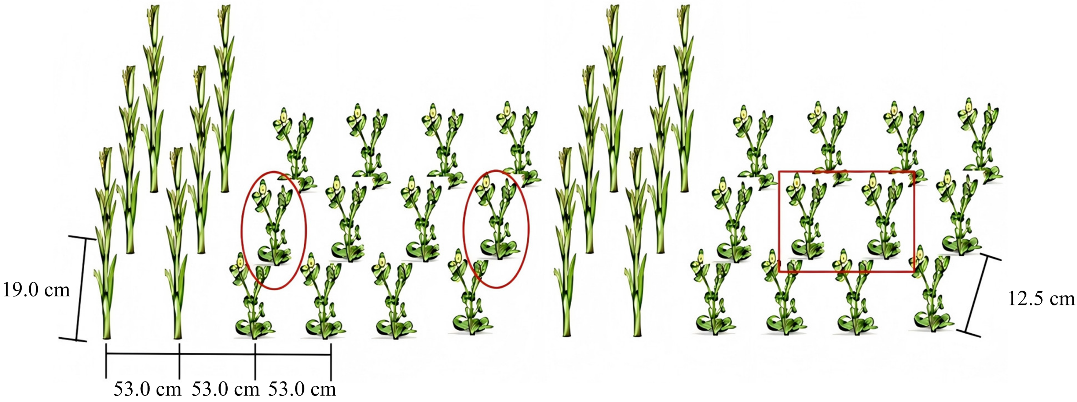
图1
玉米||花生2﹕4田间示意图 图中标红部分为取样位置,圆圈为间作花生边行(L2)取样位置,方框为间作花生中间行(L1)取样位置。下同"
表1
磷酸二氢钾对间作花生叶片相对电导率的影响"
| 处理 Treatment | 生育时期 Growth stage | ||
|---|---|---|---|
| 花针期 Flower-pegging stage | 结荚期 Podding stage | 饱果期 Full-pod stage | |
| L0F0 | 0.29±0.01bc | 0.36±0.08cd | 0.45±0.02c |
| L0F1 | 0.17±0.01c | 0.25±0.03d | 0.38±0.01c |
| L1F0 | 0.40±0.11b | 0.49±0.05bc | 0.68±0.02b |
| L1F1 | 0.24±0.04c | 0.31±0.09d | 0.44±0.06c |
| L2F0 | 0.55±0.08a | 0.77±0.12a | 0.83±0.08a |
| L2F1 | 0.33±0.04bc | 0.54±0.12b | 0.47±0.12c |
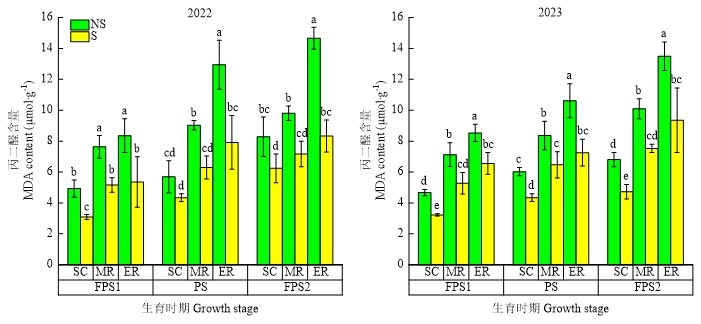
图2
磷酸二氢钾对间作花生叶片丙二醛含量的影响 SC:单作;MR:中间行;ER:边行;FPS1:花针期;PS:结荚期;FPS2:饱果期;NS:未喷施磷酸二氢钾;S:喷施磷酸二氢钾。下同"
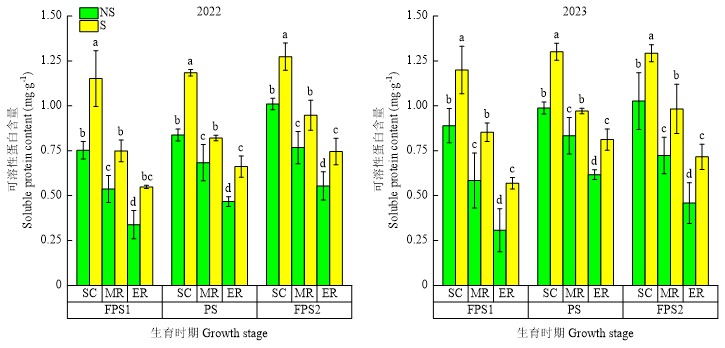
图3
磷酸二氢钾对间作花生叶片可溶性蛋白含量的影响"
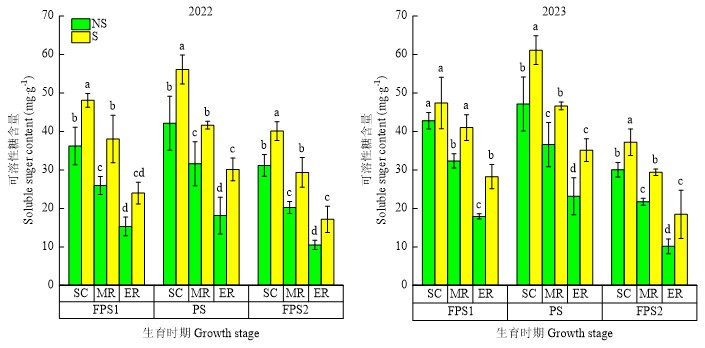
图4
磷酸二氢钾对间作花生叶片可溶性糖含量的影响"
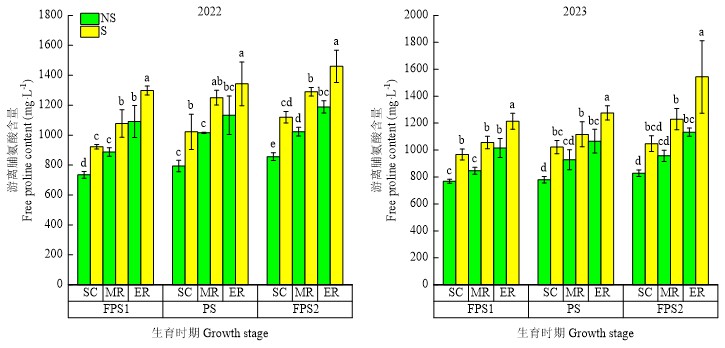
图5
磷酸二氢钾对间作花生叶片游离脯氨酸含量的影响"
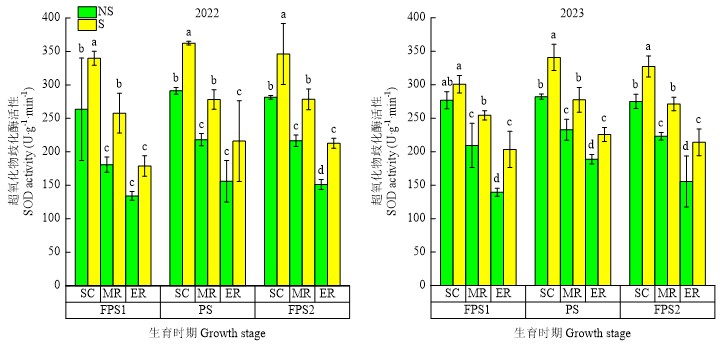
图6
磷酸二氢钾对间作花生叶片超氧化物歧化酶活性的影响"
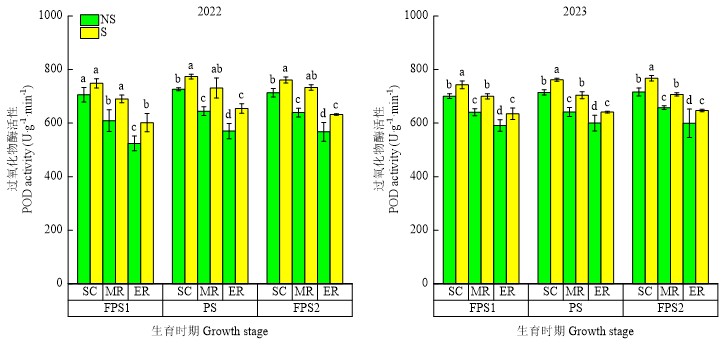
图7
磷酸二氢钾对间作花生叶片过氧化物酶活性的影响"
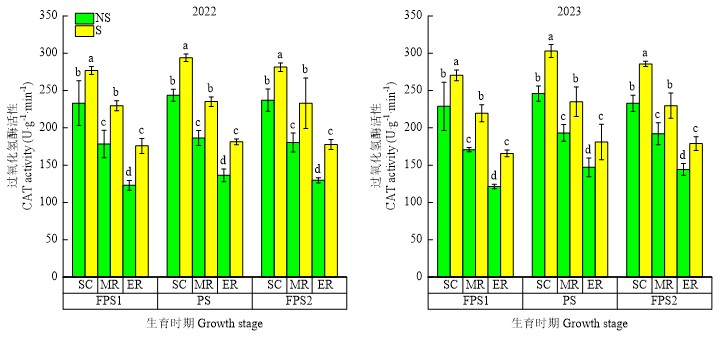
图8
磷酸二氢钾对间作花生叶片过氧化氢酶活性的影响"
表2
磷酸二氢钾对间作花生产量及其构成要素的影响"
| 年份 Year | 处理 Treatment | 单株饱果数 Number of full pods per plant | 单株饱果重 Full pods weight per plant (g) | 百果重 100-pods weight (g) | 产量 Yield (kg·hm-2) |
|---|---|---|---|---|---|
| 2022 | L0F0 | 32.00±0.82b | 34.10±1.48b | 169.16±2.20b | 4318.36±158.19b |
| L0F1 | 36.00±1.41a | 38.11±2.49a | 180.65±4.70a | 4631.16±32.40a | |
| L1F0 | 27.00±1.41c | 29.20±2.03c | 157.23±0.66c | 3545.00±82.32c | |
| L1F1 | 31.00±1.41b | 33.02±1.55b | 166.60±1.058b | 4058.27±81.05b | |
| L2F0 | 23.33±2.05d | 24.08±1.09d | 154.01±2.66c | 2791.50±96.40c | |
| L2F1 | 26.33±0.94c | 28.54±0.68c | 157.71±3.21c | 3259.21±182.08c | |
| 2023 | L0F0 | 26.40±4.08b | 40.19±2.66b | 170.15±4.61c | 4645.70±558.40b |
| L0F1 | 39.60±7.27a | 54.81±8.82a | 202.11±3.69a | 5521.75±208.43a | |
| L1F0 | 18.70±1.59c | 25.83±4.54c | 163.11±5.63c | 3790.38±324.62c | |
| L1F1 | 27.93±2.04b | 38.40±2.69b | 184.64±9.74b | 4549.35±245.63b | |
| L2F0 | 9.53±0.74d | 13.72±0.99d | 145.60±6.12d | 2747.20±91.23d | |
| L2F1 | 18.00±2.41c | 25.20±6.08c | 169.11±2.23c | 3657.30±415.65c | |
| 年份 Year (Y) | ** | NS | ** | ** | |
| 处理 Treatment (T) | ** | ** | ** | ** | |
| Y×T | ** | ** | ** | NS | |
| [1] |
侯旭民. 我国花生生产现状及竞争力分析[J]. 中国种业, 2025(4): 196.
|
|
|
|
| [2] |
周东英, 孙悦馨, 苏慧杰, 李世贤, 董奇琦, 张元春, 张鹤, 王婧, 王晓光, 于海秋, 赵新华. 玉米/花生间作下根系互作强度对土壤钾素活化吸收的影响[J]. 沈阳农业大学学报, 2025, 56(2): 12-21.
|
|
|
|
| [3] |
胡梦婷, 王捧娜, 刘琴, 田佳玉, 赵丰俊, 刘一凡, 陈翔. 磷酸二氢钾提升作物抗逆能力研究进展[J]. 江苏农业科学, 2025, 53(14): 27-32.
|
|
|
|
| [4] |
王美文. 磷酸二氢钾对间作花生生育后期形态生理及产量品质的影响[D]. 沈阳: 沈阳农业大学, 2024.
|
|
|
|
| [5] |
邹声浩, 刘欢, 邵兰军, 贺帅, 魏晓凯, 席飞虎, 罗东升, 景延秋, 张学伟, 喻奇伟. 聚谷氨酸和磷酸二氢钾配施对干旱胁迫下烤烟生理特性及化学成分的影响[J]. 江苏农业科学, 2024, 52(23): 87-93.
|
|
|
|
| [6] |
尹帝. 玉豆间作模式下不同化学物质对大豆生长及产量的影响[D]. 南京: 南京农业大学, 2021.
|
|
|
|
| [7] |
万书波, 张佳蕾, 高华鑫, 王才斌. 中国花生高产栽培研究进展与展望[J]. 作物学报, 2025, 51(7): 1703-1711.
|
|
|
|
| [8] |
王亚菲, 闫鹏, 薛金涛, 董学瑞, 孟凡琦, 郭丽娜, 罗艺, 张娟, 董志强, 卢霖. 乙烯利-甜菜碱-水杨酸合剂对高温胁迫下玉米根系建构、生理功能和产量的影响[J]. 中国农业科学, 2026, 59(7): 1439-1455. DOI:10.3864/j.issn.0578-1752.2026.07.005.
|
|
|
|
| [9] |
林国维, 麦志通, 何书奋, 唐宪, 羊金殿, 洪文君. 4个海南油茶品种早期生长、叶片经济型谱及耐旱生理特性的综合评价[J/OL]. 热带亚热带植物学报, 1-9[2026-06-12].
|
|
|
|
| [10] |
曲艳丽. 间作荫蔽下密度对花生地上部形态生理及产量的影响[D]. 沈阳: 沈阳农业大学, 2025.
|
|
|
|
| [11] |
刘涵, 丁迪, 汪江涛, 郑宾, 王笑笑, 朱晨旭, 刘娟, 刘领, 付国占, 焦念元. 玉米穗型与种植密度对玉米花生间作种间竞争的协调效应[J]. 中国农业科学, 2024, 57(19): 3758-3769. DOI:10.3864/j.issn.0578-1752.2024.19.004.
|
|
|
|
| [12] |
李亚莉, 阮文浩, 高玉红, 王一帆, 剡斌, 吴兵, 韩静, 王海娣, 马幸康, 段谞, 李玥. 施磷量和萘乙酸浓度对胡麻抗旱生理特性及其产量的影响[J]. 中国油料作物学报, 2025, 47(6): 1502-1511.
|
|
|
|
| [13] |
储成才, 王毅, 王二涛. 植物氮磷钾养分高效利用研究现状与展望[J]. 中国科学: 生命科学, 2021, 51(10): 1415-1423.
|
|
|
|
| [14] |
于洋, 雷婧娜, 马鑫磊, 陈晓昱, 李承华, 钟超, 刘喜波, 赵新华, 张鹤, 于海秋. 低温干旱复合胁迫对花生幼苗生长及生理特性的影响[J]. 中国油料作物学报, 2025, 47(5): 1232-1243.
|
|
|
|
| [15] |
杨卫健, 张双全. 超氧化物歧化酶的研究及应用前景[J]. 淮阴师范学院学报(自然科学版), 2002, 1(4): 82-86.
|
|
|
|
| [16] |
刘俊羽, 杨帆, 毛爽, 李书鑫, 林海蛟, 阎秀峰, 蔺吉祥. 植物脂质应答逆境胁迫生理功能的研究进展[J]. 生物工程学报, 2021, 37(8): 2658-2667.
|
|
|
|
| [17] |
|
| [18] |
宿宛玉. 高油酸花生抗逆及生长特性研究[D]. 泰安: 山东农业大学, 2023.
|
|
|
|
| [19] |
王海龙, 卢春梅, 王晓明, 许嘉慧, 高嘉, 杨凌馨, 杨文思, 唐好悦, 曹艳茹. 土壤微/纳米塑料对植物的毒害效应及防治措施研究进展[J]. 环境化学, 2025, 44(6): 2027-2043.
|
|
|
|
| [20] |
王晓宇. 基于代谢组学和机器学习的辣椒品种鉴定及降脂机制研究[D]. 杭州: 浙江科技大学, 2024.
|
|
|
|
| [21] |
郑亚萍, 刘俊华, 李应旺, 孙奎香, 孙学武, 冯昊, 吴正峰. 钾及磷钾配施对黑花生生理特性及产量的影响[J]. 花生学报, 2010, 39(3): 16-20.
|
|
|
|
| [22] |
杨启睿. 夏花生氮磷钾肥效应及专用肥配方优化研究[D]. 郑州: 河南农业大学, 2024.
|
|
|
|
| [23] |
刘欣宇. 烯效唑缓解花生荫蔽胁迫的生理特性及产量研究[D]. 沈阳: 沈阳农业大学, 2025.
|
|
|
|
| [24] |
张筱, 张海芹, 高宇琪, 夏梦洁, 刘军. 不同地被覆盖物对干旱胁迫下银杏生长及抗旱性的影响[J]. 贵州农业科学, 2025, 53(12): 135-144.
|
|
|
|
| [25] |
|
| [26] |
张义, 刘云利, 刘子森, 韩帆, 严攀, 贺锋, 吴振斌. 植物生长调节剂的研究及应用进展[J]. 水生生物学报, 2021, 45(3): 700-708.
|
|
|
|
| [27] |
罗燕燕, 夏静, 姚宇恒, 汪堃, 南丽丽. 不同植物激素对红豆草种子萌发的影响[J/OL]. 草原与草坪, 2025-04-10.
|
|
|
|
| [28] |
陈迪, 潘伟槐, 周哉材, 严旭, 潘建伟. 植物营养元素运输载体的功能及其调控机制研究进展[J]. 浙江大学学报(农业与生命科学版), 2018, 44(3): 283-293.
|
|
|
|
| [29] |
|
| [30] |
李廷轩, 叶代桦, 张锡洲, 郭静怡. 植物对不同形态磷响应特征研究进展[J]. 植物营养与肥料学报, 2017, 23(6): 1536-1546.
|
|
|
|
| [31] |
包婉婷. 不同栽培措施对旱地小麦生长发育及籽粒产量品质的影响[D]. 杨凌: 西北农林科技大学, 2024.
|
|
|
|
| [32] |
杨丽娟. 追施钾肥对甜叶菊生长发育及肥药减施效果的影响[D]. 合肥: 安徽农业大学, 2022.
|
|
|
|
| [33] |
焦镇. 基于花生果腐病防控的微生物肥料研制与应用[D]. 秦皇岛: 河北科技师范学院, 2023.
|
|
Jiao Z. Development and application of microbial fertilizer for prevention and control of peanut pod rot[D]. Qinhuangdao: Hebei Normal University of Science & Technology, 2023. (in Chinese)
|
|
| [34] |
|
| [1] | 白晶晶, 章宇辰, 倪子捷, 高佳勇, 刘伟洋, 盖东升, 王雨行, 何佳庆, 张强, 邵玺文, 吴莹, 耿艳秋, 郭丽颖. 不同灌溉量对东北地区水稻抗倒伏特性及产量的影响[J]. 中国农业科学, 2026, 59(9): 1848-1868. |
| [2] | 蔡巧红, 周甜, 苏明, 洪自强, 李翻过, 李彤, 汪华, 康建宏, 吴宏亮. 宁夏引黄灌区减氮增钾施肥模式对玉米光合荧光特性及光合产物积累的影响[J]. 中国农业科学, 2026, 59(9): 1869-1886. |
| [3] | 祝培, 赵耀, 白岩, 张金盔, 李莓, 龙金佳, 杨龙, 罗丽娅, 许本波, 徐劲松, 张学昆. 氟唑菌酰羟胺对油菜的生理调控作用及其与咪鲜胺的复配效应[J]. 中国农业科学, 2026, 59(9): 1903-1915. |
| [4] | 陈宣伊, 郭星星, 张向前, 路战远, 刘凌悦, 罗方, 李金龙, 张传玲, 张志青, 车曼青. 间作行比对玉米冠层光环境异质性和光合物质生产的影响[J]. 中国农业科学, 2026, 59(8): 1653-1671. |
| [5] | 侯慧芝, 尹嘉德, 马明生, 刘晓伟, 柳燕兰, 雷康宁. 耕作与增施有机肥对陇东马铃薯-玉米一年两熟制作物产量和水分利用的影响[J]. 中国农业科学, 2026, 59(8): 1672-1685. |
| [6] | 彭廷燊, 陆久焱, 吴美林, 严雨欣, 刘宏周, 南文斌, 秦小健, 李明, 龚俊义, 梁永书. 多年生水稻黄糯2号和长白7号产量相关性状的QTL分析[J]. 中国农业科学, 2026, 59(7): 1361-1379. |
| [7] | 王玉萍, 符质, 孙佳莹, 穆晓萌, 刘慧淋, 郭进云, 宋文菁, 侯雷平, 赵海亮. 苗期施用褪黑素对番茄短期低温胁迫的缓解作用与应用效果评价[J]. 中国农业科学, 2026, 59(7): 1523-1535. |
| [8] | 王佳诺, 陈桂平, 李盼, 王丽萍, 南运有, 何蔚, 樊志龙, 胡发龙, 柴强, 殷文, 赵连豪. 免耕地膜两年覆盖提高绿洲灌区玉米产量的灌浆期光合生理机制[J]. 中国农业科学, 2026, 59(6): 1189-1202. |
| [9] | 周新杰, 任昊, 陈应龙, 张吉旺, 赵斌, 任佰朝, 刘鹏, 王洪章. 过氧化钙对渍涝农田夏玉米根系形态及产量形成的影响[J]. 中国农业科学, 2026, 59(6): 1203-1216. |
| [10] | 何继航, 张擎, 吕相月, 薛吉全, 徐淑兔, 刘建超. 不同保绿型玉米杂交种氮效率评价[J]. 中国农业科学, 2026, 59(6): 1217-1230. |
| [11] | 郝琨, 陈洪德, 张威, 钟韵, 党美荣, 朱士江, 黄志坤, 金英. 基于柑橘产量、品质及水氮利用的涌泉根灌水氮综合评价[J]. 中国农业科学, 2026, 59(4): 862-873. |
| [12] | 郭富城, 唐海江, 郝馨怡, 马国林, 杨九菊, 黄霖锋, 田蕾, 王彬, 罗成科. 不同灌溉方式对宁夏盐渍化土壤水盐运移、水稻产量及水分利用效率的影响[J]. 中国农业科学, 2026, 59(4): 750-764. |
| [13] | 延廷霖, 杜娅丹, 胡笑涛, 王贺, 李晓雁, 王玉明, 牛文全, 谷晓博. 加气滴灌下氮肥有机替代对亏缺灌溉棉花产量和水分利用效率的影响[J]. 中国农业科学, 2026, 59(3): 602-618. |
| [14] | 蔡廷阳, 朱玉鹏, 李瑞东, 吴宗声, 徐一帆, 宋雯雯, 徐彩龙, 吴存祥. 苗期叶损伤对黄淮海夏大豆光合特性、荚果分布及产量形成的影响[J]. 中国农业科学, 2026, 59(2): 292-304. |
| [15] | 张志勇, 谭世超, 熊淑萍, 马新明, 韦一昊, 王小纯. 水氮周年优化对豫北灌区小麦玉米轮作系统产量和氮迁移的影响[J]. 中国农业科学, 2026, 59(2): 336-353. |
|
||
