






中国农业科学 ›› 2026, Vol. 59 ›› Issue (9): 1848-1868.doi: 10.3864/j.issn.0578-1752.2026.09.003
白晶晶1( ), 章宇辰1, 倪子捷1, 高佳勇1, 刘伟洋1,3, 盖东升1, 王雨行1, 何佳庆1, 张强1, 邵玺文1,2, 吴莹1, 耿艳秋1(), 郭丽颖1()
收稿日期:2025-08-17
接受日期:2026-04-08
出版日期:2026-05-01
发布日期:2026-05-06
通信作者:
联系方式:
白晶晶,E-mail:baijingjing0088@163.com。
基金资助:
BAI JingJing1(), ZHANG YuChen1, NI ZiJie1, GAO JiaYong1, LIU WeiYang1,3, GAI DongSheng1, WANG YuHang1, HE JiaQing1, ZHANG Qiang1, SHAO XiWen1,2, WU Ying1, GENG YanQiu1(), GUO LiYing1()
Received:2025-08-17
Accepted:2026-04-08
Published:2026-05-01
Online:2026-05-06
摘要:
【目的】研究不同灌溉量对水稻农艺性状、抗倒伏特性及产量形成的影响,探索较适宜的水稻高产稳产绿色栽培水分管理方案,为水稻可持续生产提供理论依据。【方法】以五优稻4号(WYD4)和吉农大667(JND667)为试验材料,进行6个不同灌溉量处理:W1(12 000 m3·hm-2),W2(10 500 m3·hm-2),W3(9 000 m3·hm-2),W4(7 500 m3·hm-2),W5(6 000 m3·hm-2)和W6(天然雨养),通过研究不同灌溉量对水稻株型、抗倒伏能力、光合特性、干物质积累和产量的影响,明确不同灌溉量对其调控效应及机制。【结果】适当地减少灌溉量,提高了水稻最终茎蘖数、茎蘖成穗率、上三叶叶长、叶面积指数,降低了上三叶叶宽、叶基角和株高。W4处理能够优化水稻株型,促进植株生长,形成良好的群体结构。随着灌溉量的减少,水稻基部第二节间茎秆长度降低,节间充实度、抗折力、倒伏指数和茎鞘中木质素、纤维素含量都呈先上升后下降的趋势。适宜的灌溉量有利于水稻茎秆抗倒伏能力的提高;在提高水分利用效率的同时,提高了水稻剑叶的光合性能、茎鞘干物质的积累和运输能力,有利于产量的形成。与W1处理相比,W4处理节约了37.50%的灌溉用水量,产量显著提高了9.07%—12.47%。【结论】在W4(7 500 m3·hm-2)处理下,水稻相较于其他处理有更好的株型、抗倒伏能力、光合性能、干物质积累,在水分利用效率较高的同时拥有了最高的产量,可作为本地区较为适宜的灌溉量。
白晶晶, 章宇辰, 倪子捷, 高佳勇, 刘伟洋, 盖东升, 王雨行, 何佳庆, 张强, 邵玺文, 吴莹, 耿艳秋, 郭丽颖. 不同灌溉量对东北地区水稻抗倒伏特性及产量的影响[J]. 中国农业科学, 2026, 59(9): 1848-1868.
BAI JingJing, ZHANG YuChen, NI ZiJie, GAO JiaYong, LIU WeiYang, GAI DongSheng, WANG YuHang, HE JiaQing, ZHANG Qiang, SHAO XiWen, WU Ying, GENG YanQiu, GUO LiYing. Effects of Different Irrigation Volumes on Lodging Resistance Characteristics and Yield of Rice in Northeast China[J]. Scientia Agricultura Sinica, 2026, 59(9): 1848-1868.
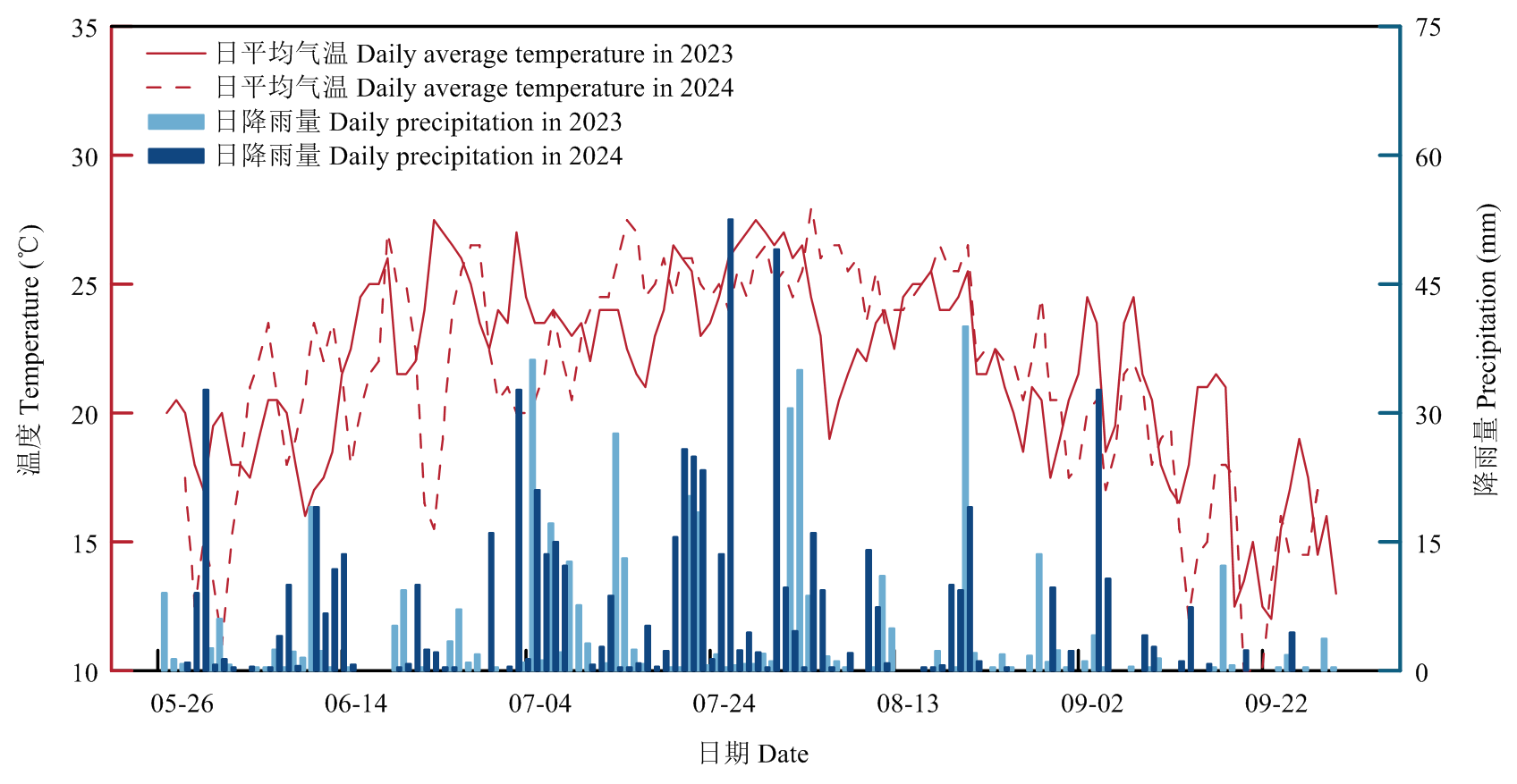
图1
2023—2024年水稻生育期内逐日平均温度和逐日降雨量"

表1
水稻全生育期灌溉方案"
| 处理 Treatment | 总灌溉量 Total irrigation volume (m3·hm-2) | 泡田定额 Field soaking water volume (m3·hm-2) | 返青期 Regreening stage (m3·hm-2) | 分蘖期Tillering stage (m3·hm-2) | 拔节孕穗期 Jointing and booting stage (m3·hm-2) | 抽穗灌浆期 Heading and grain filling stage (m3·hm-2) | 黄熟期 Yellow ripening stage (m3·hm-2) | ||
|---|---|---|---|---|---|---|---|---|---|
| 前期 Early stage | 中期 Middle stage | 后期 Late stage | |||||||
| W1 | 12000 | 1500 | 1050 | 1050 | 2100 | 晒田 Field drying | 3150 | 3150 | 0 |
| W2 | 10500 | 1500 | 900 | 900 | 1800 | 2700 | 2700 | 0 | |
| W3 | 9000 | 1500 | 750 | 750 | 1500 | 2250 | 2250 | 0 | |
| W4 | 7500 | 1500 | 600 | 600 | 1200 | 1800 | 1800 | 0 | |
| W5 | 6000 | 1500 | 450 | 450 | 900 | 1350 | 1350 | 0 | |
| W6 | 1500 | 1500 | 天然雨养 Natural rainfall | ||||||
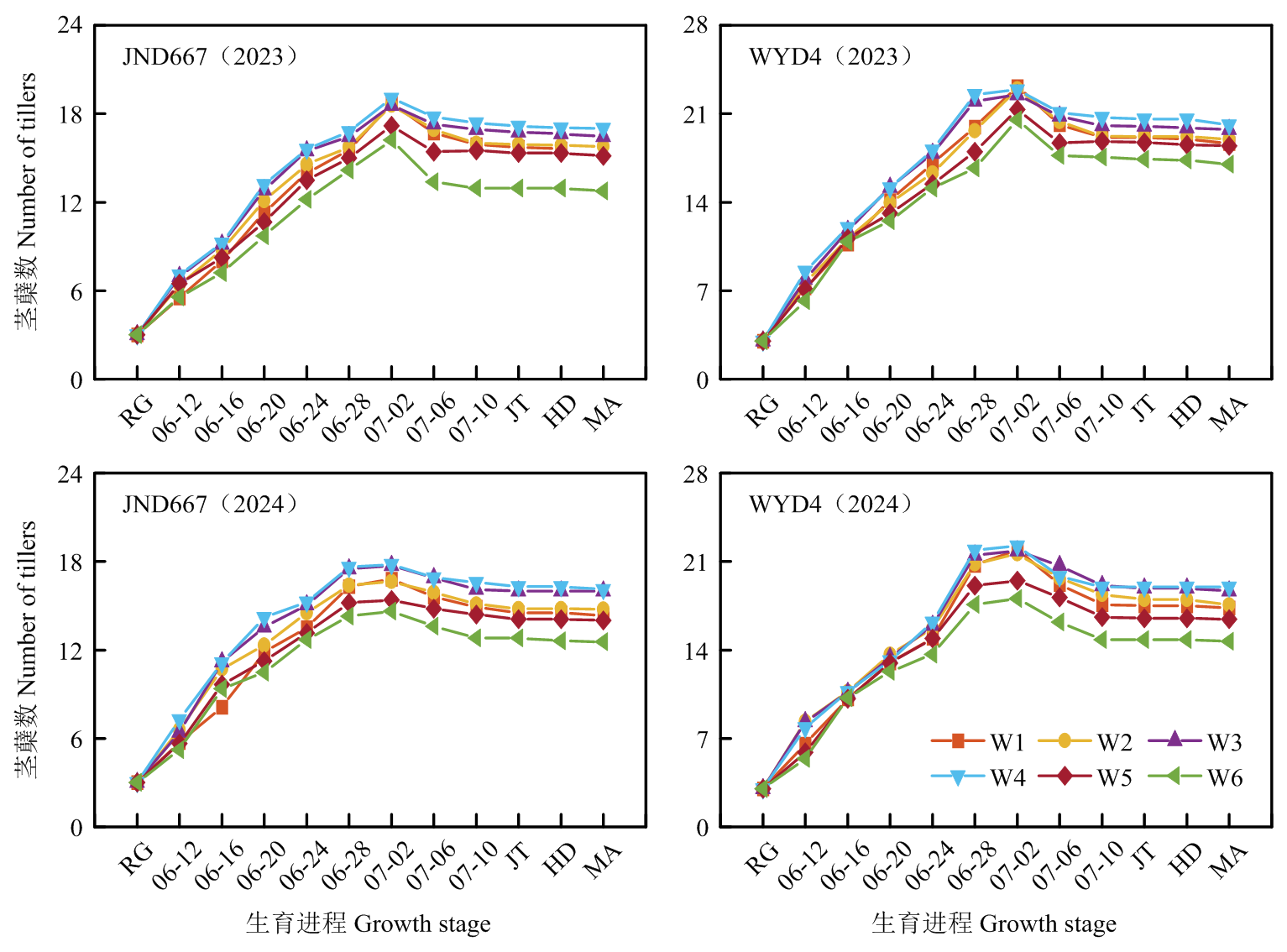
图2
不同灌溉量对水稻茎蘖动态的影响 RG:返青期;JT:拔节期;HD:抽穗期:MA:成熟期。下同"
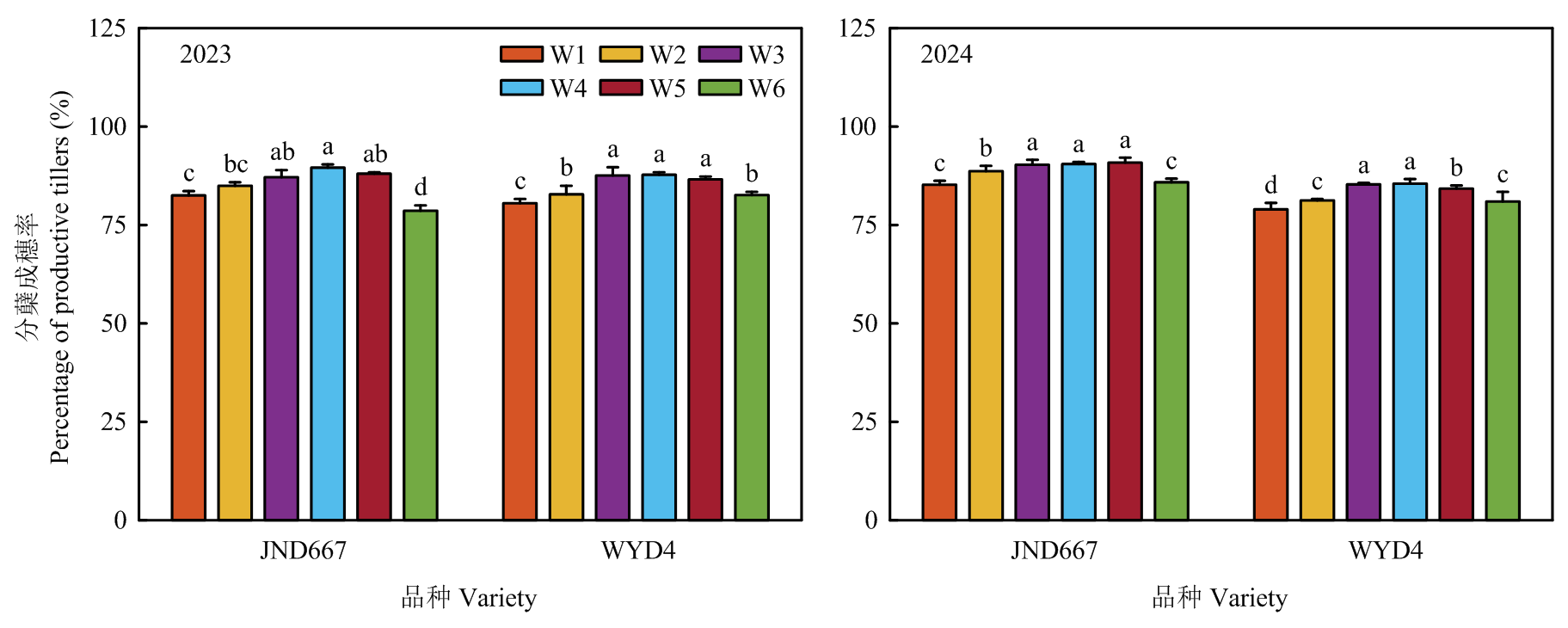
图3
不同灌溉量对水稻分蘖成穗率的影响 不同小写字母表示同一品种不同处理间在0.05水平上差异显著。下同"
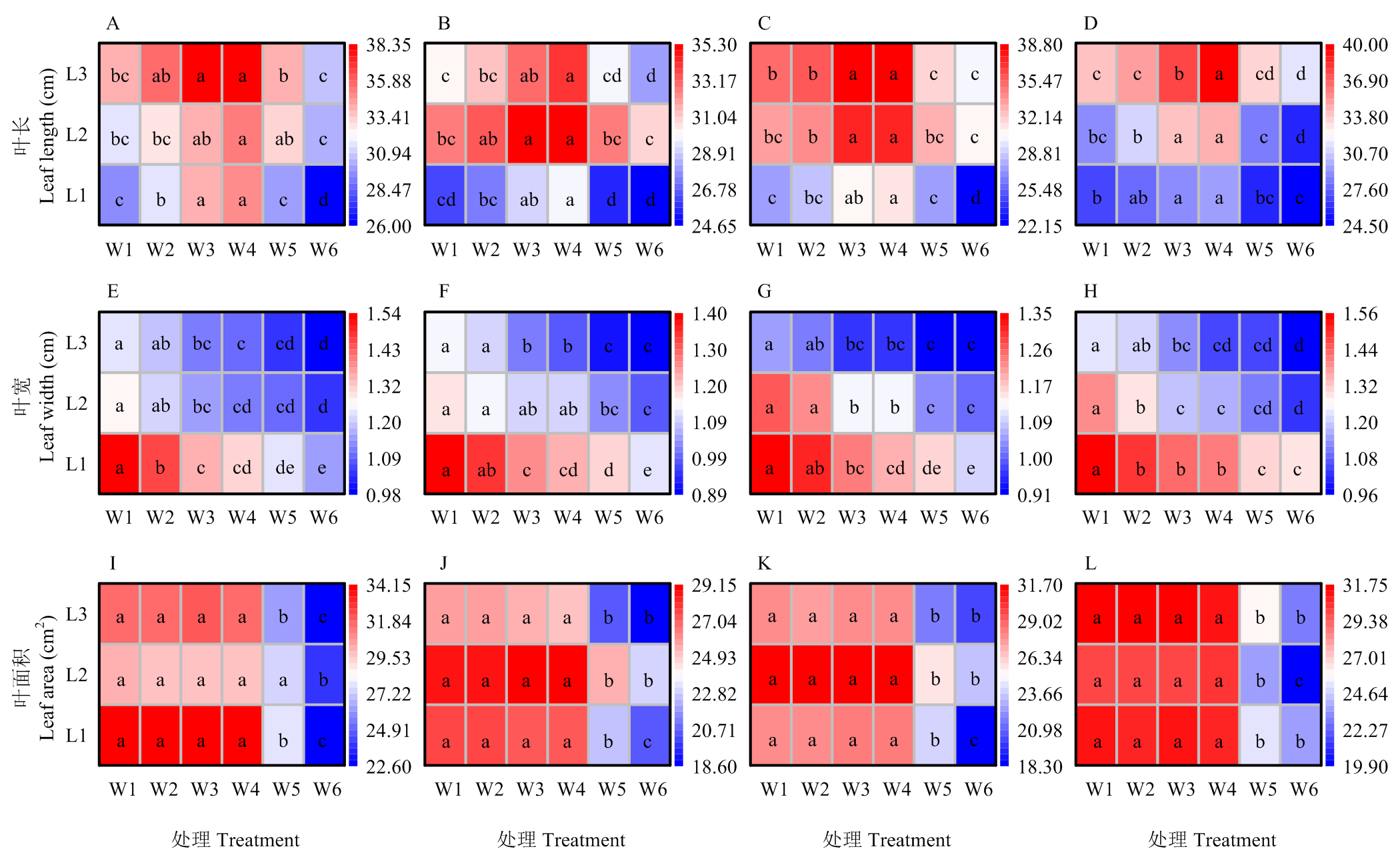
图4
不同灌溉量对水稻上三叶叶长、叶宽及叶面积的影响 A、E、I分别为2023年吉农大667各处理下的叶长、叶宽、叶面积;B、F、J分别为2023年五优稻4号各处理下的叶长、叶宽、叶面积;C、G、K分别为2024年吉农大667各处理下的叶长、叶宽、叶面积;D、H、L分别为2024年五优稻4号各处理下的叶长、叶宽、叶面积。L1:剑叶;L2:倒二叶;L3:倒三叶"
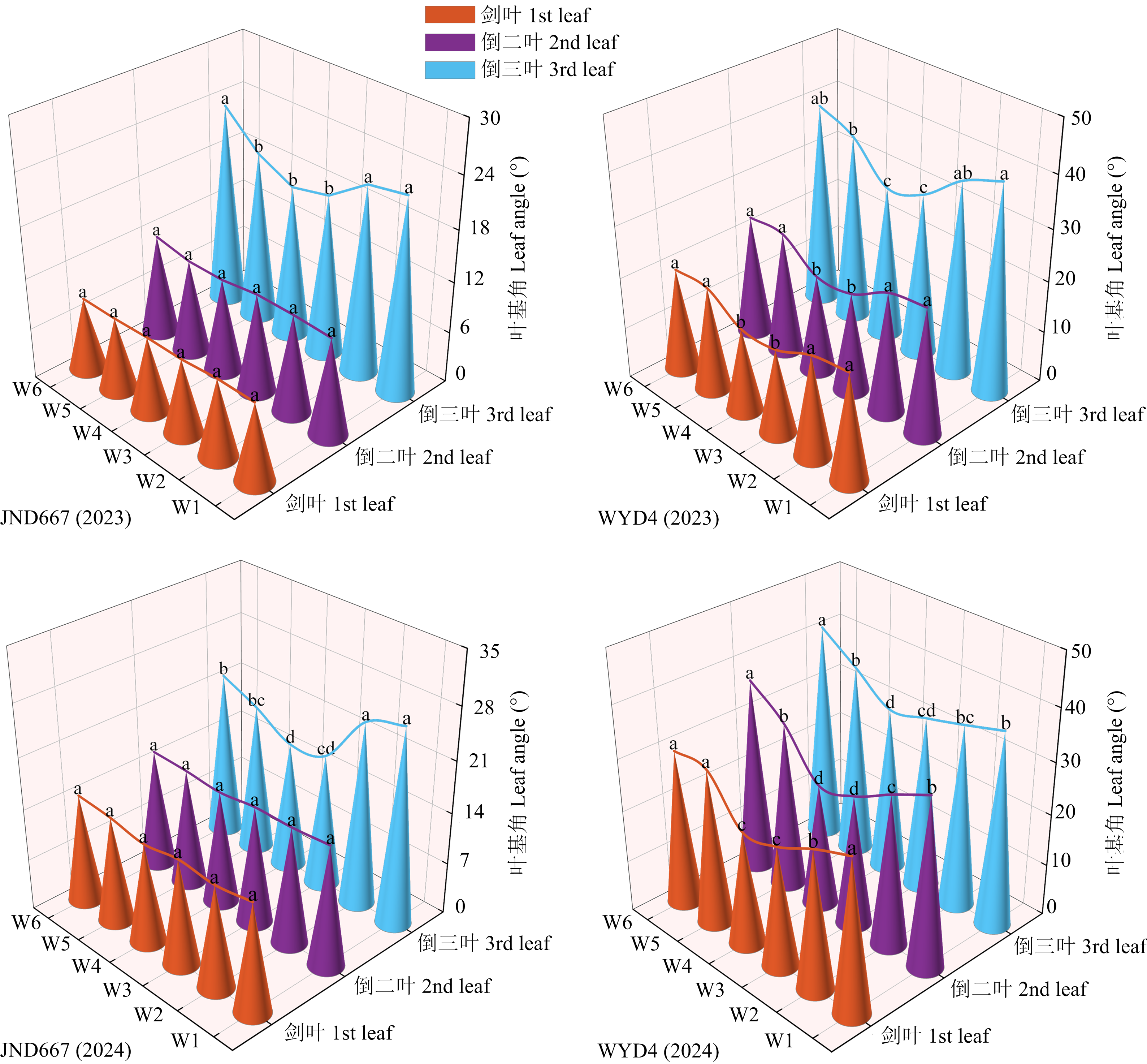
图5
不同灌溉量对水稻上三叶叶基角的影响"
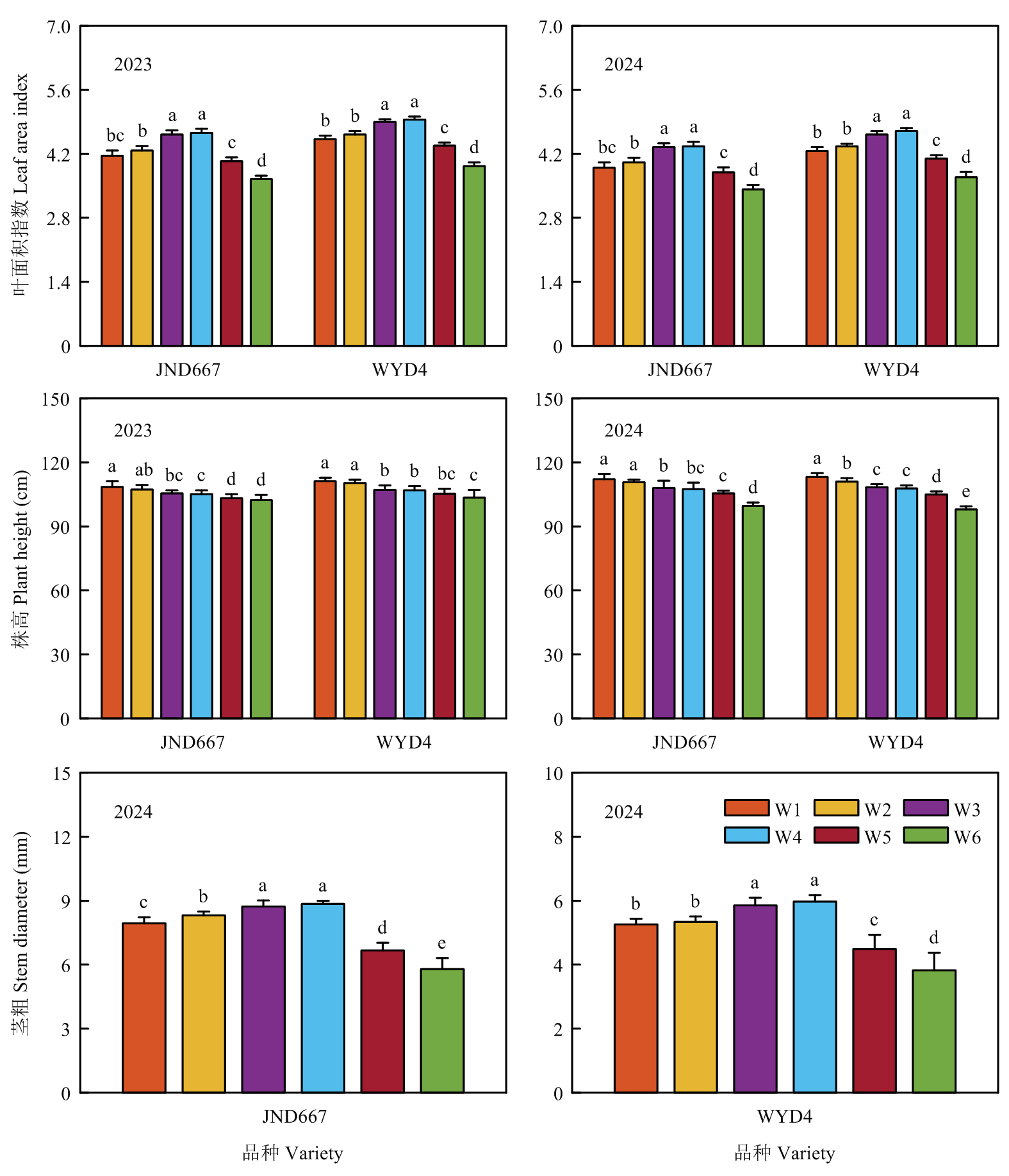
图6
不同灌溉量对水稻叶面积指数、株高、茎粗的影响"
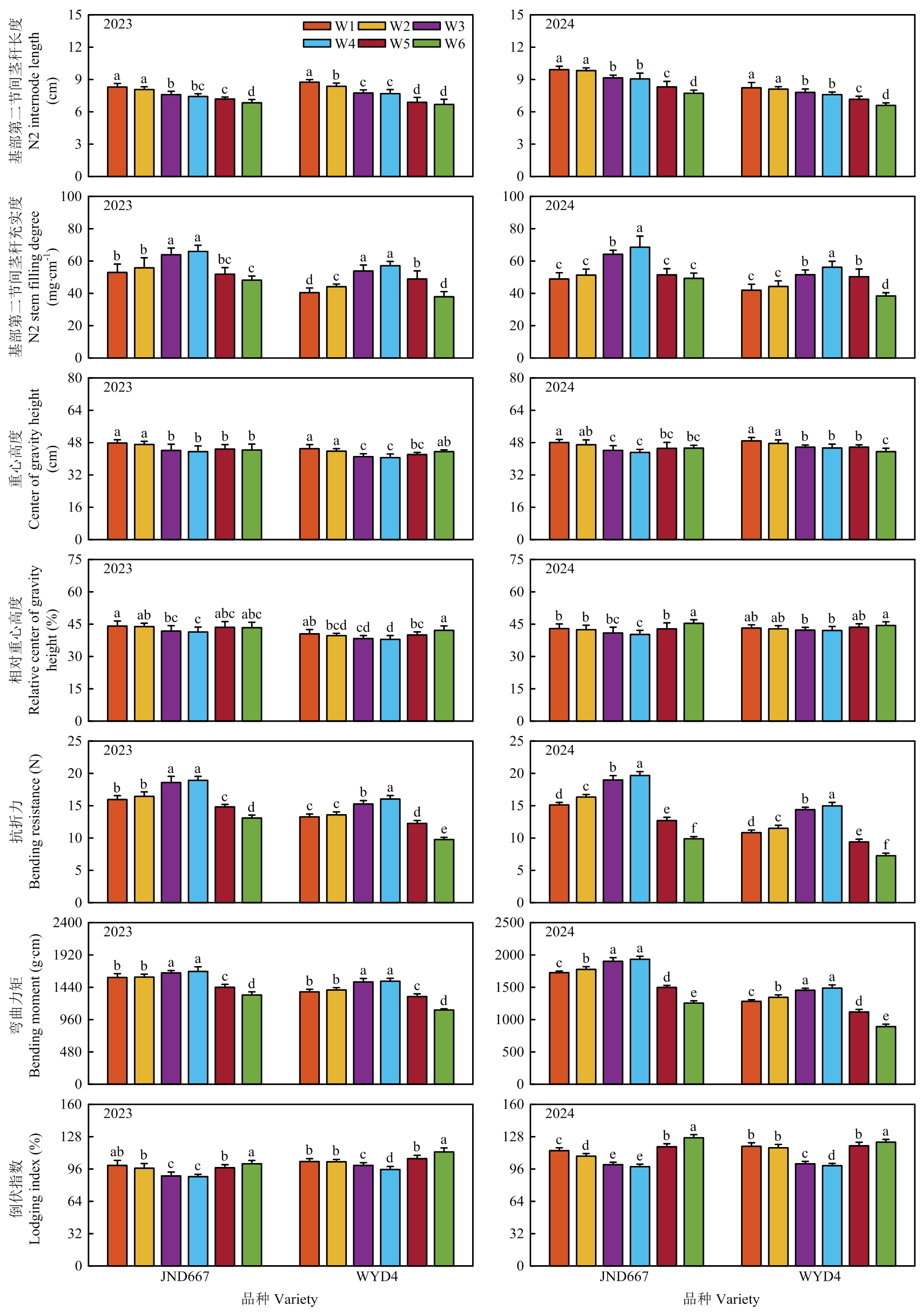
图7
不同灌溉量对茎秆形态及力学指标的影响"
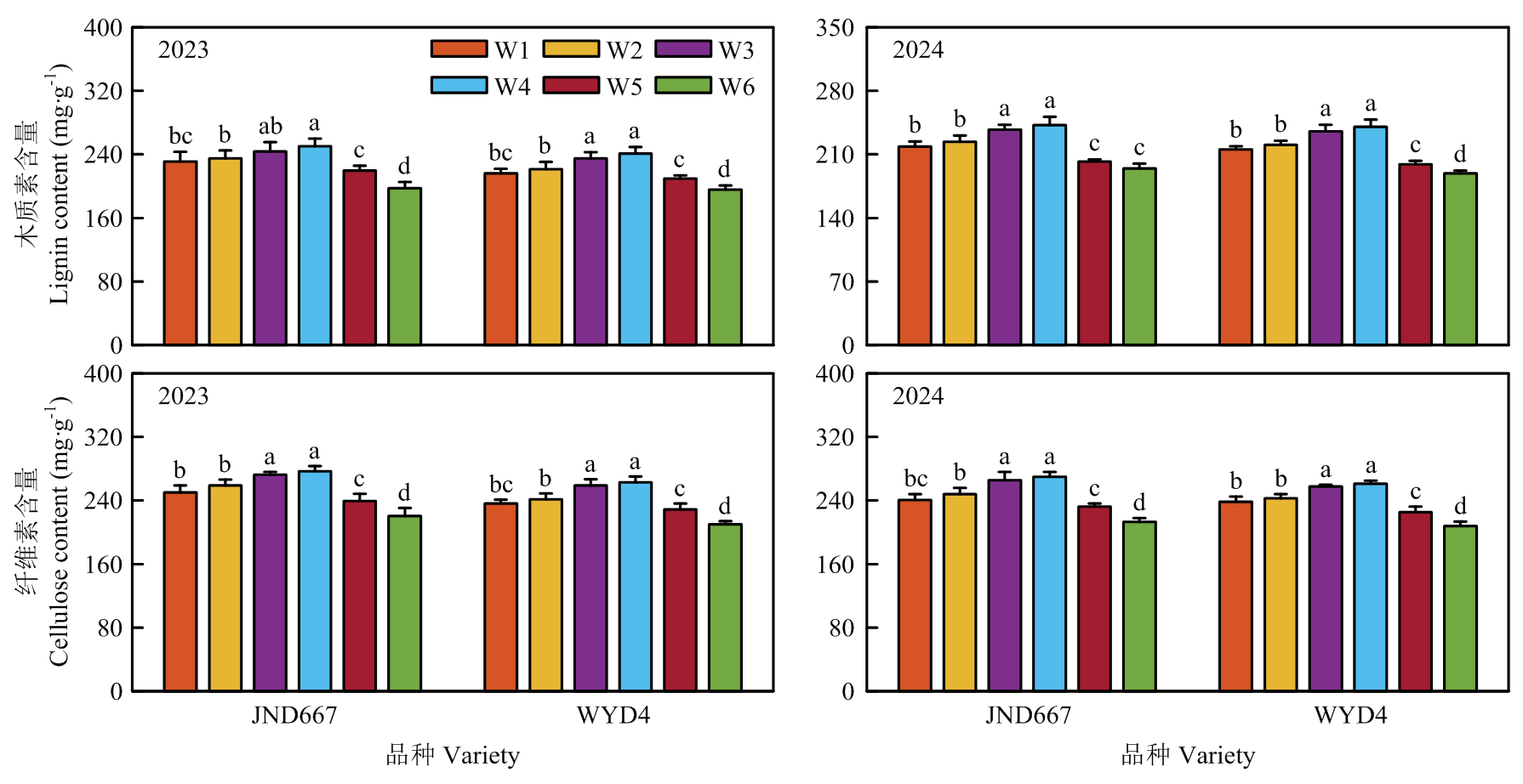
图8
不同灌溉量对水稻基部茎秆第二节间木质素含量和纤维素含量的影响"
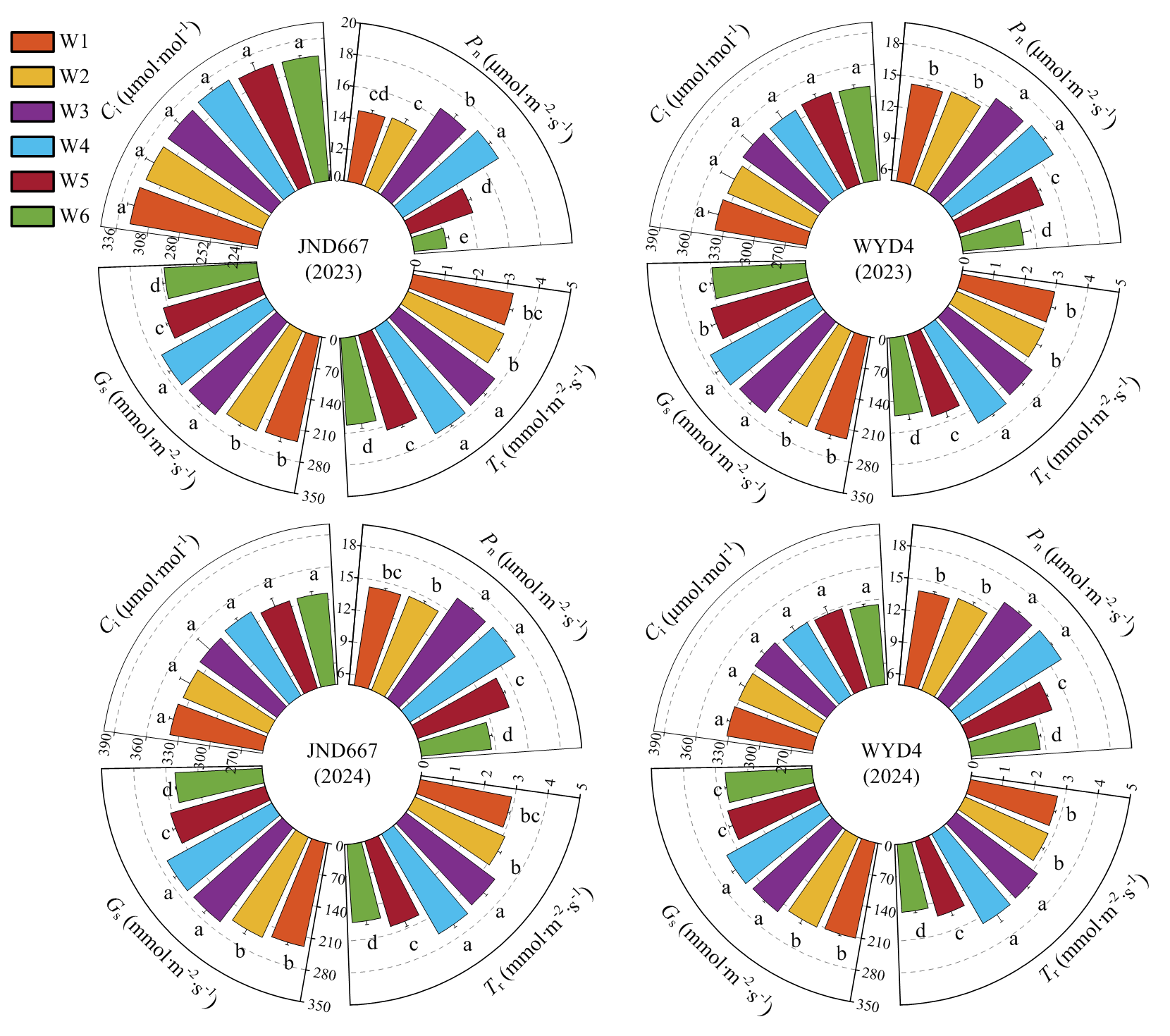
图9
不同灌溉量对水稻齐穗期剑叶光合特性的影响 Pn:净光合速率;Tr:蒸腾速率;Gs:气孔导度;Ci:胞间CO2浓度。下同"
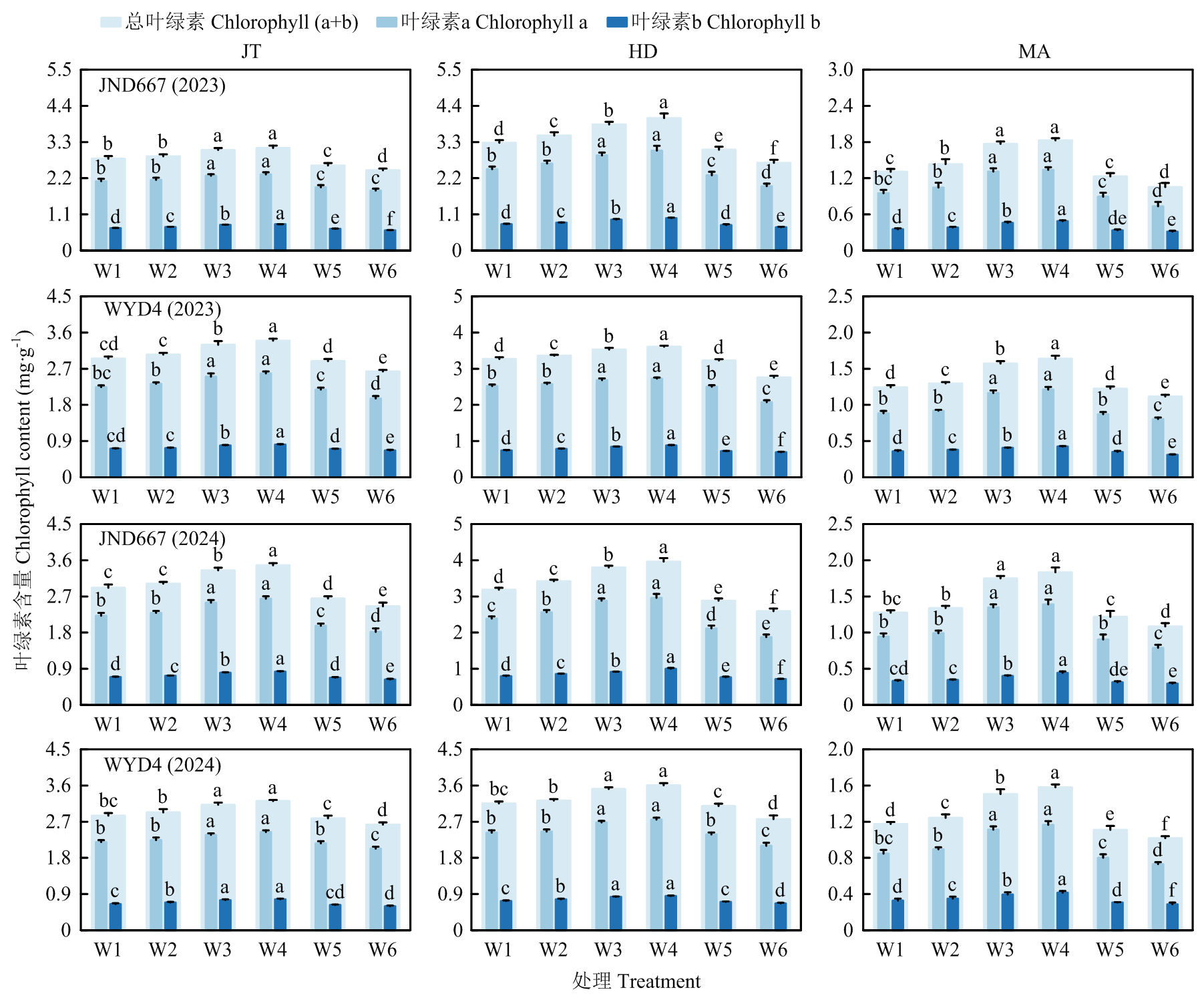
图10
不同灌溉量对水稻主要生育时期剑叶叶绿素含量的影响"
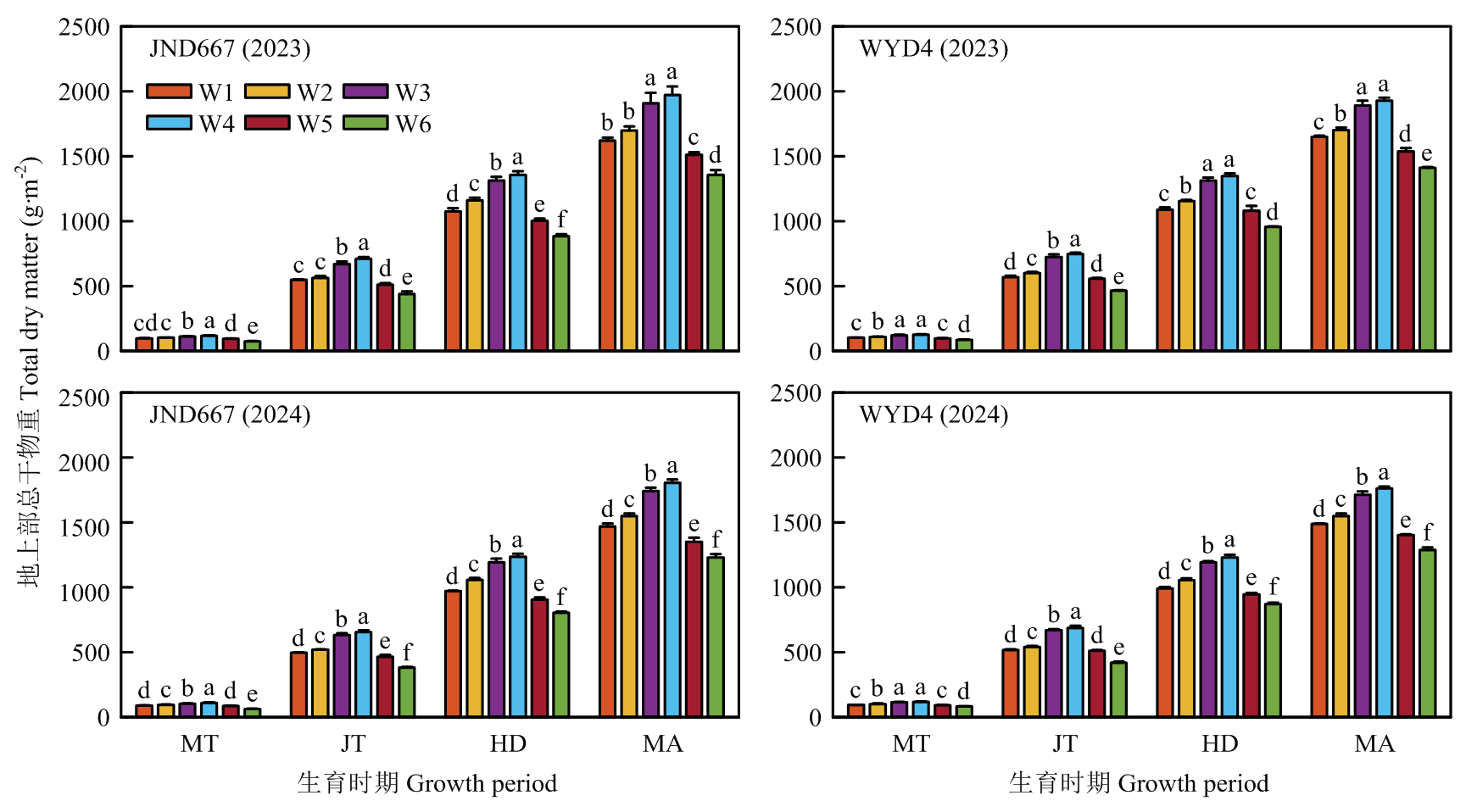
图11
不同灌溉量对水稻主要生育时期地上部总干物重的影响 MT:分蘖期"
表2
不同灌溉量对水稻抽穗期至成熟期茎鞘物质输出量、贡献率及转运率的影响"
| 年份Year | 品种Varieties | 处理Treatment | 输出量Output (g·m-2) | 贡献率Contribution rate (%) | 转运率Transport rate (%) |
|---|---|---|---|---|---|
| 2023 | JND667 | W1 | 68.40±2.33d | 7.46±0.15c | 11.26±0.27c |
| W2 | 75.89±3.55c | 8.14±0.34b | 11.41±0.36c | ||
| W3 | 95.83±4.38b | 9.48±0.25a | 12.44±0.38b | ||
| W4 | 103.59±4.15a | 9.91±0.40a | 12.99±0.26a | ||
| W5 | 56.26±0.84e | 6.50±0.29d | 10.22±0.14d | ||
| W6 | 46.04±1.46f | 6.02±0.04e | 9.19±0.04e | ||
| WYD4 | W1 | 63.37±1.93c | 6.81±0.17d | 10.35±0.25c | |
| W2 | 66.77±2.50c | 7.12±0.22c | 10.31±0.21c | ||
| W3 | 88.57±2.80b | 8.71±0.22b | 11.59±0.23b | ||
| W4 | 93.97±2.05a | 9.07±0.04a | 12.00±0.21a | ||
| W5 | 53.93±1.17d | 6.42±0.06e | 9.13±0.20d | ||
| W6 | 46.93±0.70e | 6.10±0.07f | 8.60±0.24e | ||
| 2024 | JND667 | W1 | 58.93±1.95d | 7.12±0.13c | 10.73±0.22c |
| W2 | 66.57±1.92c | 7.85±0.21b | 11.01±0.07b | ||
| W3 | 89.67±2.29b | 9.66±0.10a | 12.77±0.10a | ||
| W4 | 94.71±1.62a | 9.85±0.07a | 13.05±0.22a | ||
| W5 | 52.00±1.73e | 6.75±0.06d | 10.47±0.17c | ||
| W6 | 44.77±1.07f | 6.45±0.09e | 9.81±0.10d | ||
| WYD4 | W1 | 54.47±2.34d | 6.54±0.19d | 9.78±0.51c | |
| W2 | 60.67±1.55c | 7.07±0.13c | 10.31±0.19b | ||
| W3 | 79.80±0.72b | 8.66±0.02b | 11.52±0.07a | ||
| W4 | 84.93±0.76a | 9.01±0.15a | 11.85±0.20a | ||
| W5 | 49.63±0.55e | 6.45±0.08d | 9.28±0.23d | ||
| W6 | 43.63±0.81f | 6.16±0.17e | 8.87±0.08d |
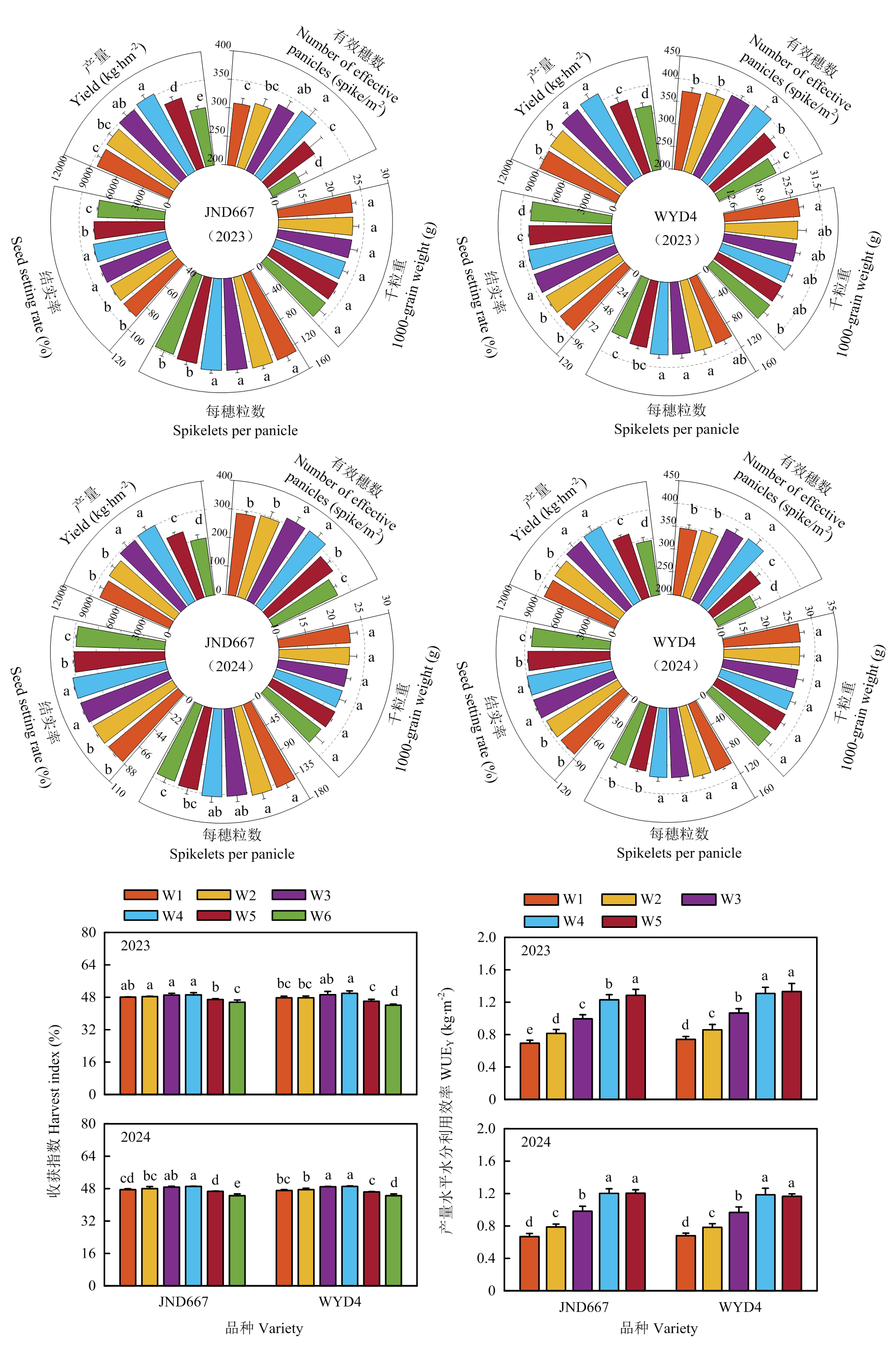
图12
不同灌溉量对水稻产量及其构成因素、收获指数和水分利用效率的影响"
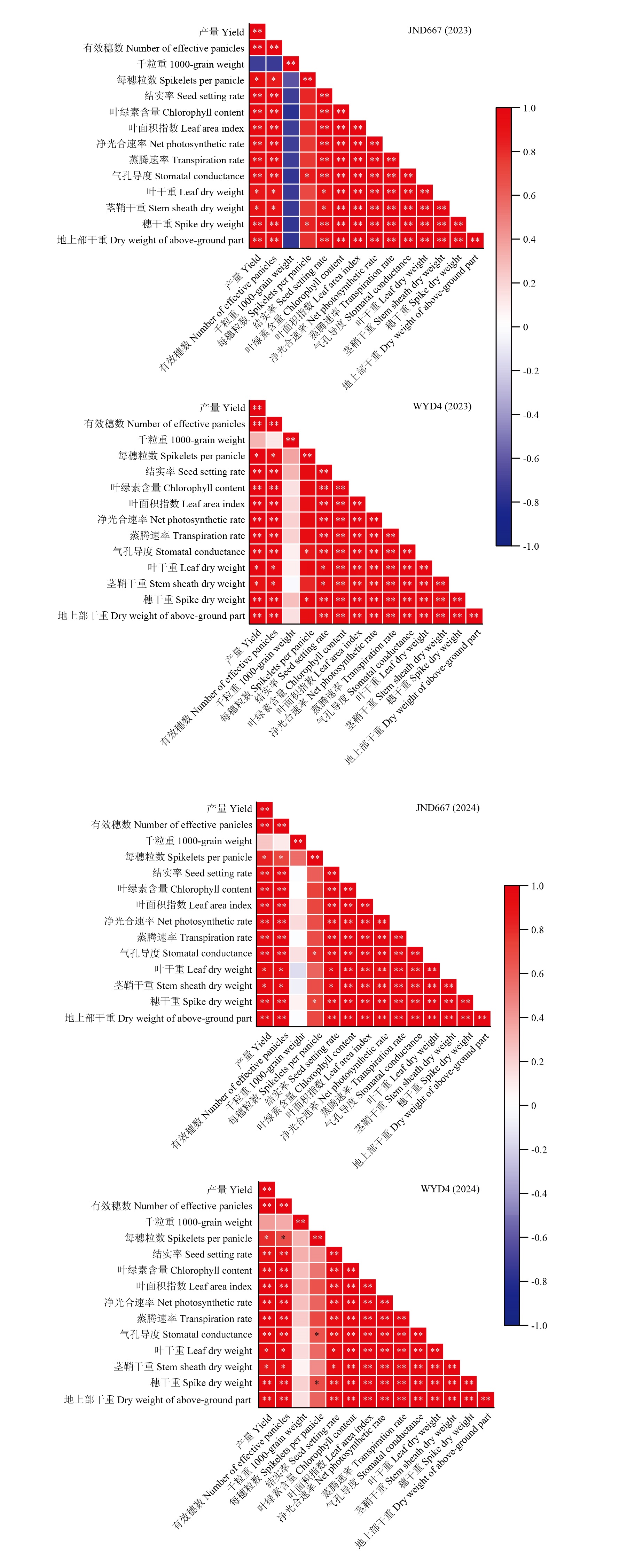
图13
产量及产量构成因素、齐穗期叶片光合参数与成熟期干物质重量的相关性分析"
| [1] |
doi: 10.1016/j.jcs.2021.103400 |
| [2] |
doi: 10.1016/j.scib.2025.04.046 pmid: 40328601 |
| [3] |
|
| [4] |
|
| [5] |
|
| [6] |
黎宇钦, 王平章, 黄必善, 王述斌, 熊威, 何军, 陈真雄. 不同栽培方式和灌溉模式对水稻生长特性、产量和水分利用效率的影响. 节水灌溉, 2024(8): 11-16, 23.
doi: 10.12396/jsgg.2024012 |
|
|
|
| [7] |
doi: 10.1111/j.1672-9072.2007.00555.x |
| [8] |
doi: 10.3390/agronomy14071363 |
| [9] |
|
| [10] |
郭相平, 黄双双, 王振昌, 王甫, 陈斌. 不同灌溉模式对水稻抗倒伏能力影响的试验研究. 灌溉排水学报, 2017, 36(5): 1-5.
|
|
|
|
| [11] |
doi: 10.1016/j.eja.2025.127507 |
| [12] |
doi: 10.1016/j.fcr.2025.109882 |
| [13] |
doi: 10.1016/j.jare.2025.06.079 |
| [14] |
doi: 10.1093/jxb/erad422 |
| [15] |
邵玺文, 刘红丹, 杜震宇, 杨晶, 孟繁霞, 马景勇. 不同时期水分处理对水稻生长及产量的影响. 水土保持学报, 2007, 21(1): 193-196.
|
|
|
|
| [16] |
褚光, 徐冉, 陈松, 徐春梅, 王丹英, 章秀福. 干湿交替灌溉对籼粳杂交稻产量与水分利用效率的影响及其生理基础. 中国农业科学, 2021, 54(7): 1499-1511. doi: 10.3864/j.issn.0578-1752.2021.07.014.
|
|
|
|
| [17] |
doi: 10.3724/SP.J.1006.2016.01026 |
| [18] |
doi: 10.1111/jac.v211.3 |
| [19] |
李娜, 杨志远, 代邹, 孙永健, 徐徽, 何艳, 严田蓉, 蒋明金, 郭长春, 王春雨, 马均. 不同氮效率水稻根系形态和氮素吸收利用与产量的关系. 中国农业科学, 2017, 50(14): 2683-2695. doi: 10.3864/j.issn.0578-1752.2017.14.005.
|
|
|
|
| [20] |
杨建昌, 朱庆森, 曹显祖. 水稻群体冠层结构与光合特性对产量形成作用的研究. 中国农业科学, 1992, 25(4): 7-14.
|
|
|
|
| [21] |
剧成欣, 陶进, 钱希旸, 顾骏飞, 张耗, 赵步洪, 刘立军, 王志琴, 杨建昌. 不同年代中籼水稻品种的叶片光合性状. 作物学报, 2016, 42(3): 415-426.
|
|
doi: 10.3724/SP.J.1006.2016.00415 |
|
| [22] |
李帅. 不同节水灌溉方式对东北黑土稻区水稻产量与品质的影响[D]. 扬州: 扬州大学, 2025.
|
|
|
|
| [23] |
doi: 10.1007/s10681-015-1387-2 |
| [24] |
常硕其, 粟琳, 欧阳翔. 水稻产量提高与光合作用之间的关系. 生命科学, 2024, 36(10): 1305-1310.
|
|
|
|
| [25] |
郝树荣, 潘永春, 董博豪, 吴蕴玉, 王子欣. 灌排模式对超级稻南粳5055抗倒伏能力的影响研究. 灌溉排水学报, 2019, 38(3): 15-21.
|
|
|
|
| [26] |
吴海兵, 刘道红, 钟鸣, 汪友元. 水分管理和钾肥施用对水稻产量和抗倒伏性的影响. 作物杂志, 2019(1): 127-133.
|
|
|
|
| [27] |
doi: 10.1186/1939-8433-5-2 pmid: 24764502 |
| [28] |
杨谦, 李京咏, 戴林秀, 窦志, 高辉. 灌溉方式对水稻产量、品质与抗倒性影响的研究进展. 中国稻米, 2023, 29(5): 13-16.
doi: 10.3969/j.issn.1006-8082.2023.05.003 |
|
doi: 10.3969/j.issn.1006-8082.2023.05.003 |
|
| [29] |
顾汉柱, 王琛, 张瑛, 吴昊, 肖治林, 景文疆, 张耗. 水稻茎秆抗倒伏评价及其生理机制研究进展. 江苏农业科学, 2023, 51(21): 1-7.
|
|
|
|
| [30] |
doi: 10.3389/fpls.2022.1038129 |
| [31] |
覃凤, 汪小飞, 吴臻, 胡一波, 王小琴, 张家伟, 蔡铁. 集雨种植模式下种植密度与行距配置对小麦茎秆糖积累及倒伏性能的影响. 中国农业科学, 2024, 57(1): 65-79. doi: 10.3864/j.issn.0578-1752.2024.01.006.
|
|
|
|
| [32] |
doi: 10.1016/j.agwat.2017.11.021 |
| [33] |
唐文邦, 陈立云, 肖应辉, 蔡义东, 兰海. 水稻功能叶形态及光合速率与产量构成因素的相关研究. 湖南农业科学, 2004(2): 29-31.
|
|
|
|
| [34] |
doi: 10.1626/pps.15.92 |
| [35] |
徐国伟, 赵喜辉, 江孟孟, 陆大克, 陈明灿. 轻度干湿交替灌溉协调水稻根冠生长、提高产量及氮肥利用效率. 植物营养与肥料学报, 2021, 27(8): 1388-1396.
|
|
|
|
| [36] |
刘宇锋, 李伏生. 灌溉方式与施肥水平对超级稻光合生理的影响. 中国生态农业学报, 2013, 21(4): 416-425.
|
|
|
|
| [37] |
贺江, 丁颖, 娄向弟, 姬东玲, 张向向, 王永慧, 张伟杨, 王志琴, 王伟露, 杨建昌. 水稻分蘖期干物质积累对大气CO2浓度升高和氮素营养的综合响应差异及其生理机制. 中国农业科学, 2023, 56(6): 1045-1060. doi: 10.3864/j.issn.0578-1752.2023.06.003.
|
|
|
|
| [38] |
于艳敏, 武洪涛, 张书利, 赵北平, 宋丽娟, 高洪儒, 杨忠良, 李坤. 节水灌溉对寒地水稻群体生长特性的影响. 中国稻米, 2014, 20(4): 69-70, 73.
doi: 10.3969/j.issn.1006-8082.2014.04.018 |
|
|
|
| [39] |
doi: 10.1007/s00344-007-9013-8 |
| [40] |
徐云姬, 许阳东, 李银银, 钱希旸, 王志琴, 杨建昌. 干湿交替灌溉对水稻花后同化物转运和籽粒灌浆的影响. 作物学报, 2018, 44(4): 554-568.
|
|
doi: 10.3724/SP.J.1006.2018.00554 |
|
| [41] |
张自常. 水稻高产优质节水灌溉技术及其生理基础[D]. 扬州: 扬州大学, 2012.
|
|
|
|
| [42] |
徐芬芬, 曾晓春, 石庆华, 李木英, 谭雪明. 不同灌溉方式对水稻生长与产量的影响. 江西农业大学学报, 2005, 27(5): 653-658.
|
|
|
|
| [43] |
doi: 10.2166/ws.2020.371 |
| [44] |
doi: 10.3390/w15101802 |
| [1] | 蔡巧红, 周甜, 苏明, 洪自强, 李翻过, 李彤, 汪华, 康建宏, 吴宏亮. 宁夏引黄灌区减氮增钾施肥模式对玉米光合荧光特性及光合产物积累的影响[J]. 中国农业科学, 2026, 59(9): 1869-1886. |
| [2] | 祝培, 赵耀, 白岩, 张金盔, 李莓, 龙金佳, 杨龙, 罗丽娅, 许本波, 徐劲松, 张学昆. 氟唑菌酰羟胺对油菜的生理调控作用及其与咪鲜胺的复配效应[J]. 中国农业科学, 2026, 59(9): 1903-1915. |
| [3] | 姚治榛, 杨紫洪, 张英楠, 尹昌斌. 中国水稻绿色全要素生产率增长的时空分异与演进规律[J]. 中国农业科学, 2026, 59(9): 1937-1954. |
| [4] | 刘冬丽, 吕魏, 张祥, 戴雄泽, 邹学校, 徐昊. 低磷胁迫对辣椒株型、根系构型及磷利用效率的影响[J]. 中国农业科学, 2026, 59(9): 1955-1974. |
| [5] | 罗海琴, 罗仁林, 刘廷辉, 郭伟龙, 曾子贤, 朱博. 禾本科作物抗倒伏研究进展、瓶颈与应对策略[J]. 中国农业科学, 2026, 59(8): 1587-1607. |
| [6] | 陈宣伊, 郭星星, 张向前, 路战远, 刘凌悦, 罗方, 李金龙, 张传玲, 张志青, 车曼青. 间作行比对玉米冠层光环境异质性和光合物质生产的影响[J]. 中国农业科学, 2026, 59(8): 1653-1671. |
| [7] | 侯慧芝, 尹嘉德, 马明生, 刘晓伟, 柳燕兰, 雷康宁. 耕作与增施有机肥对陇东马铃薯-玉米一年两熟制作物产量和水分利用的影响[J]. 中国农业科学, 2026, 59(8): 1672-1685. |
| [8] | 彭廷燊, 陆久焱, 吴美林, 严雨欣, 刘宏周, 南文斌, 秦小健, 李明, 龚俊义, 梁永书. 多年生水稻黄糯2号和长白7号产量相关性状的QTL分析[J]. 中国农业科学, 2026, 59(7): 1361-1379. |
| [9] | 王玉萍, 符质, 孙佳莹, 穆晓萌, 刘慧淋, 郭进云, 宋文菁, 侯雷平, 赵海亮. 苗期施用褪黑素对番茄短期低温胁迫的缓解作用与应用效果评价[J]. 中国农业科学, 2026, 59(7): 1523-1535. |
| [10] | 王佳诺, 陈桂平, 李盼, 王丽萍, 南运有, 何蔚, 樊志龙, 胡发龙, 柴强, 殷文, 赵连豪. 免耕地膜两年覆盖提高绿洲灌区玉米产量的灌浆期光合生理机制[J]. 中国农业科学, 2026, 59(6): 1189-1202. |
| [11] | 周新杰, 任昊, 陈应龙, 张吉旺, 赵斌, 任佰朝, 刘鹏, 王洪章. 过氧化钙对渍涝农田夏玉米根系形态及产量形成的影响[J]. 中国农业科学, 2026, 59(6): 1203-1216. |
| [12] | 何继航, 张擎, 吕相月, 薛吉全, 徐淑兔, 刘建超. 不同保绿型玉米杂交种氮效率评价[J]. 中国农业科学, 2026, 59(6): 1217-1230. |
| [13] | 陈敏, 焦紫岚, 乔承彬, 许昊, 张碧, 马东花, 孔维儒, 王敬文, 宋佳伟, 罗成科, 李培富, 田蕾. 不同亚种水稻种质资源对盐胁迫的形态生理响应及适应策略[J]. 中国农业科学, 2026, 59(4): 705-722. |
| [14] | 郭富城, 唐海江, 郝馨怡, 马国林, 杨九菊, 黄霖锋, 田蕾, 王彬, 罗成科. 不同灌溉方式对宁夏盐渍化土壤水盐运移、水稻产量及水分利用效率的影响[J]. 中国农业科学, 2026, 59(4): 750-764. |
| [15] | 张卫建, 严圣吉, 尚子吟, 唐志伟, 吴柳格, 李佳锐, 陈浩天, 邓艾兴, 张俊, 张鑫, 郑成岩, 宋振伟. 稻田甲烷不完全源于水稻种植的人为贡献[J]. 中国农业科学, 2026, 59(4): 824-833. |
|
||
