






中国农业科学 ›› 2020, Vol. 53 ›› Issue (24): 5050-5062.doi: 10.3864/j.issn.0578-1752.2020.24.008
邬磊1( ),何志龙2,汤水荣3,吴限2,张文菊1,胡荣桂2()
收稿日期:2020-04-01
接受日期:2020-06-03
出版日期:2020-12-16
发布日期:2020-12-28
联系方式:
邬磊,E-mail: wulei01@caas.cn。
基金资助:
WU Lei1(),HE ZhiLong2,TANG ShuiRong3,WU Xian2,ZHANG WenJu1,HU RongGui2()
Received:2020-04-01
Accepted:2020-06-03
Published:2020-12-16
Online:2020-12-28
摘要:
【目的】近年来,随着我国社会经济的快速发展和人们生活水平的提高及膳食结构的改善,越来越多的稻田被转为蔬菜种植,影响了土壤碳氮转化过程及其引起的温室气体排放。因此有必要探究稻田转为蔬菜种植,特别是该土地利用方式转变初始阶段的温室气体(CH4和N2O)排放特征及其关键影响因素。【方法】试验选取了长期种植水稻的双季稻田,将其中一部分转为蔬菜种植,另一部分继续种植水稻,每个处理设置了3个重复,按照当地常规模式进行管理。采用静态暗箱—气相色谱法连续3年进行田间原位观测,比较分析稻田和由稻田转变的菜地CH4和N2O排放特征及其年际变化差异,明确稻田转为菜地初始阶段CH4和N2O排放的关键影响因素。【结果】稻田是重要的CH4排放源,其第一年的排放强度(183.91 kg CH4-C·hm-2?a-1)明显低于后续两年(241.56—371.50 kg CH4-C·hm-2?a-1),这主要归功于后两年降雨量的增加引起了土壤水分含量的升高。稻田转为菜地显著减少了CH4排放,减少量相当于稻田CH4年累积排放量的83%—100%。菜地第一年的CH4累积排放量(31.22 kg CH4-C·hm-2)显著高于第二年(0.45 kg CH4-C·hm-2)和第三年(0.89 kg CH4-C·hm-2),表明稻田转菜地对CH4排放的影响具有时间滞后效应。稻田是弱的N2O排放源(1.35—3.49 kg N2O-N·hm-2?a-1),其转为菜地显著增强了N2O排放。菜地第一年的N2O累积排放量(95.12 kg N2O-N·hm-2)显著高于第二年(38.28 kg N2O-N?hm-2)和第三年(40.07 kg N2O-N·hm-2)。菜地土壤异养呼吸对N2O排放的影响在第一年明显高于第二、三年,表明稻田转为蔬菜种植的第一年,有机质矿化对N2O排放有重要贡献。在100年尺度CO2当量下,稻田转为蔬菜种植第一和第二年的综合增温潜势(GWP)相对于稻田分别显著增加了390%和98%,主要是由于增加的N2O增温潜势超过了减少的CH4增温潜势。但是,稻田转为菜地的第三年,菜地的GWP((16.72±3.25) Mg CO2-eq·hm-2)与稻田((14.84±1.39) Mg CO2-eq·hm-2)相比无显著差异,主要是由于减少的CH4 增温潜势完全抵消了增加的N2O增温潜势。这些研究结果表明稻田转菜地对GWP的影响主要集中在该土地利用方式转变的第一年。【结论】稻田转为菜地显著减少了CH4排放,增加了N2O排放,增强了菜地第一和第二年的综合增温潜势。有机质矿化过程对新转菜地第一年较高的N2O排放有重要贡献。这些研究结果表明了评价土地利用方式转变初始阶段温室气体排放特征的重要性,便于及时采取有效管理措施缓解温室气体排放,实现环境友好型农业可持续生产。
邬磊,何志龙,汤水荣,吴限,张文菊,胡荣桂. 稻田转为菜地初始阶段温室气体排放特征[J]. 中国农业科学, 2020, 53(24): 5050-5062.
WU Lei,HE ZhiLong,TANG ShuiRong,WU Xian,ZHANG WenJu,HU RongGui. Greenhouse Gas Emission During the Initial Years After Rice Paddy Conversion to Vegetable Cultivation[J]. Scientia Agricultura Sinica, 2020, 53(24): 5050-5062.
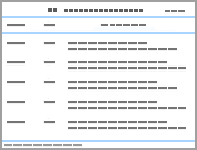
表1
稻田和菜地施肥管理一览表"
| 稻田 Rice paddy | 菜地 Vegetable field | ||||
|---|---|---|---|---|---|
| 施肥时间 Fertilization date | 肥料类型 Fertilizer type | 施肥量 Rate (kg N·hm-2) | 施肥时间 Fertilization date | 肥料类型 Fertilizer types | 施肥量 Rates (kg N·hm-2) |
| 早稻 Early rice | 红菜苔 Red cabbage | ||||
| 3 May 2013 | 尿素 Urea | 60 | 8 Dec 2012 | 复合肥* Compound fertilizer | 120 |
| 27 May 2013 | 尿素 Urea | 36 | 2 Mar 2013 | 尿素 Urea | 80 |
| 1 Jul 2013 | 尿素 Urea | 24 | |||
| 辣椒 Pepper | |||||
| 晚稻 Late rice | 18 Apr 2013 | 复合肥 Compound fertilizer | 90 | ||
| 14 Jul 2013 | 尿素 Urea | 75 | 16 Jun 2013 | 尿素 Urea | 60 |
| 1 Aug 2013 | 尿素 Urea | 45 | |||
| 7 Sep 2013 | 尿素 Urea | 30 | 白萝卜 Radish | ||
| 14 Sep 2013 | 复合肥 Compound fertilizer | 120 | |||
| 早稻Early rice | 11 Nov 2013 | 尿素 Urea | 80 | ||
| 6 May 2014 | 尿素 Urea | 60 | |||
| 17 May 2014 | 尿素 Urea | 36 | 空心菜 Water spinach | ||
| 27 Jun 2014 | 尿素 Urea | 24 | 17 Apr 2014 | 复合肥 Compound fertilizer | 80 |
| 10 May 2014 | 尿素 Urea | 50 | |||
| 晚稻Late rice | 27 Jun 2014 | 尿素 Urea | 50 | ||
| 24 Jul 2014 | 尿素 Urea | 75 | 24 Aug 2014 | 尿素 Urea | 20 |
| 31 Jul 2014 | 尿素 Urea | 45 | |||
| 10 Sep 2014 | 尿素 Urea | 30 | 白萝卜 Radish | ||
| 6 Sep 2014 | 复合肥 Compound fertilizer | 120 | |||
| 早稻Early rice | 30 Oct 2014 | 尿素 Urea | 80 | ||
| 27 Apr 2015 | 尿素 Urea | 60 | |||
| 6 May 2015 | 尿素 Urea | 36 | 辣椒 Pepper | ||
| 25 Jun 2015 | 尿素 Urea | 24 | 16 Apr 2015 | 复合肥 Compound fertilizer | 90 |
| 15 Jul 2015 | 尿素 Urea | 60 | |||
| 晚稻Late rice | |||||
| 20 Jul 2015 | 尿素 Urea | 75 | 白萝卜 Radish | ||
| 28 Jul 2015 | 尿素 Urea | 45 | 2 Oct 2015 | 复合肥 Compound fertilizer | 120 |
| 7 Sep 2015 | 尿素 Urea | 30 | 29 Oct 2015 | 尿素 Urea | 80 |
| 总氮用量 Total amount | 810 | 总氮用量Total amount | 1300 | ||
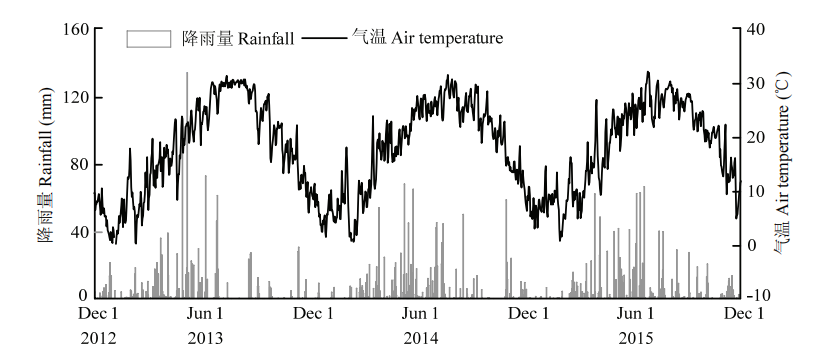
图1
观测期间降水和气温变化"
表2
试验前后稻田和菜地土壤的基本理化性质"
| 土壤有机碳 SOC (g?kg-1) | 土壤有机氮 SON (g?kg-1) | 容重 Bulk density (g?cm-3) | pH | |
|---|---|---|---|---|
| Dec 2012 | ||||
| Rice | 18.7 ± 1.0a | 2.04 ± 0.28a | 1.03 ± 0.09b | 5.48 ± 0.29a |
| Veg | 18.9 ± 1.2a | 2.00 ± 0.36a | 1.01 ± 0.07b | 5.40 ± 0.18a |
| Dec 2015 | ||||
| Rice | 19.1 ± 0.6a | 2.12 ± 0.62a | 1.01 ± 0.02b | 5.39 ± 0.37a |
| Veg | 17.2 ± 0.9b | 1.74 ± 0.51b | 1.39 ± 0.15a | 4.34 ± 0.29b |
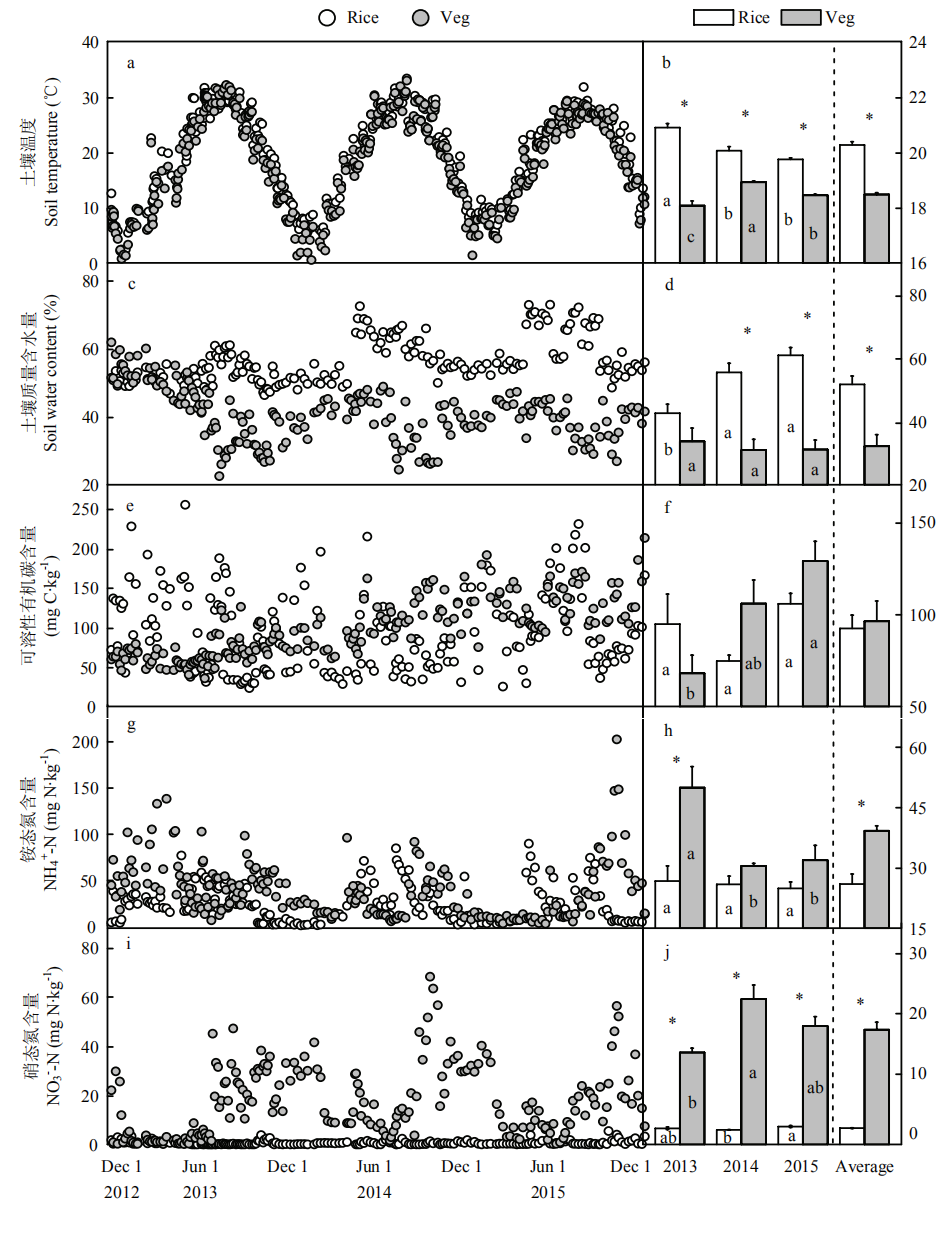
图2
观测期间稻田和菜地土壤性质变化 Rice和Veg分别表示稻田和菜地;数据表示方式为平均值±标准误差;*表示同一年份不同土地利用方式在P<0.05水平上存在显著性差异;不同字母表示同一土地利用方式不同年份间在P<0.05水平上存在显著性差异。图3、图4、图7同"
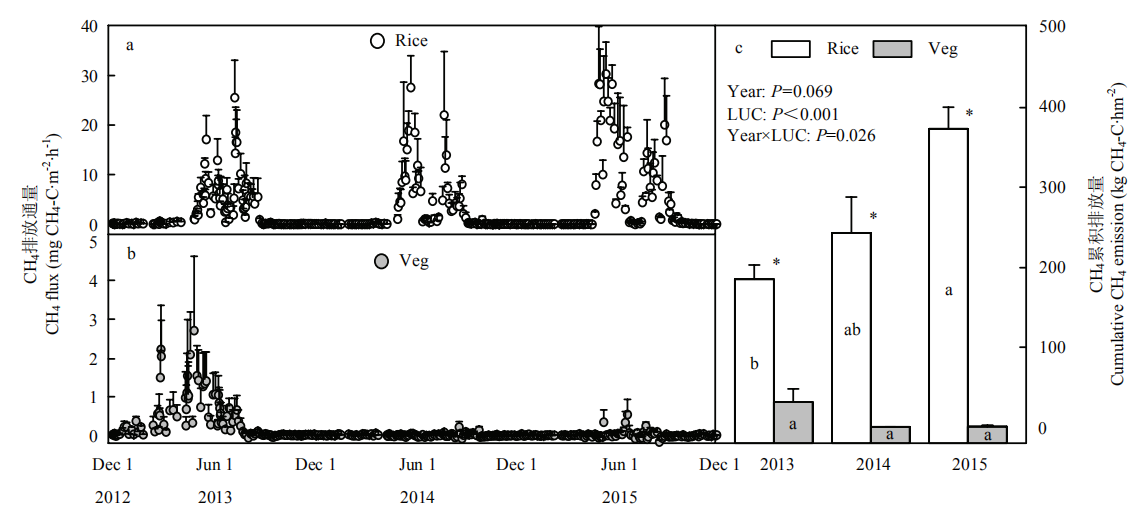
图3
观测期间稻田和菜地CH4排放通量及年累积排放量变化"
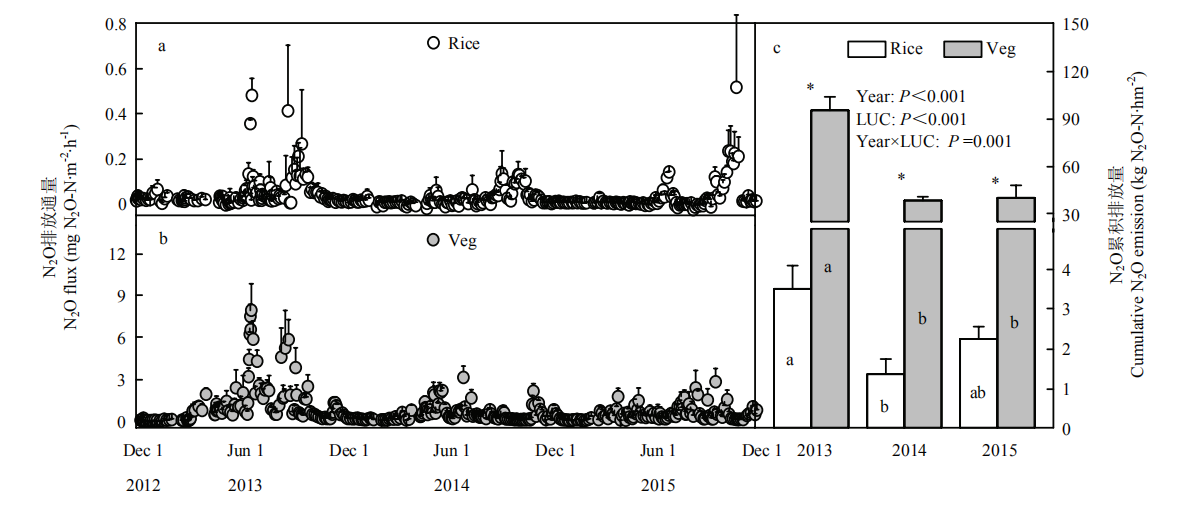
图4
观测期间稻田和菜地N2O排放通量及年累积排放量变化"
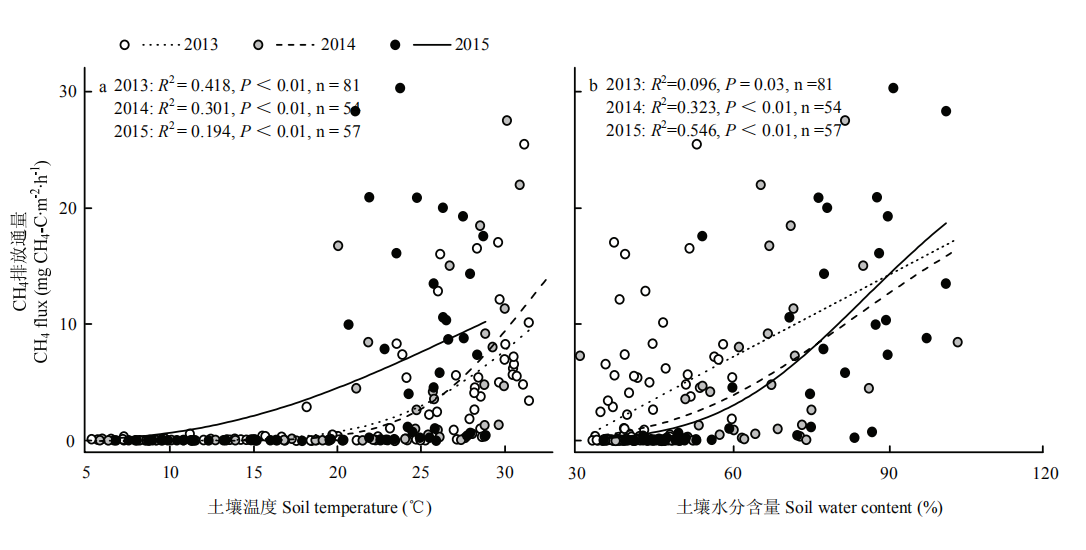
图5
稻田CH4排放通量与土壤温度和水分含量间的关系"
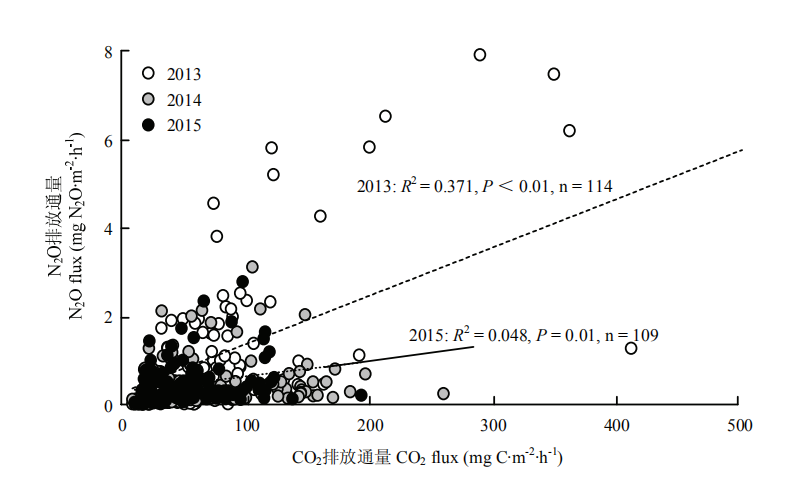
图6
菜地N2O排放通量与土壤异养呼吸(CO2排放通量)间的关系"
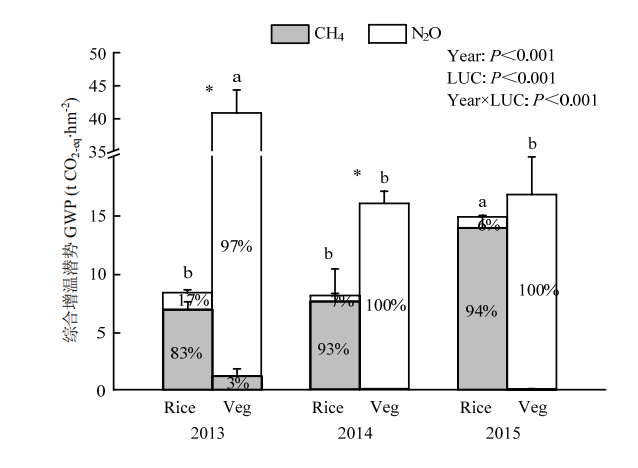
图7
稻田和菜地CH4和N2O年累积排放量及综合增温潜势(GWP)"
| [1] | Climate change 2013: The Physical Science Basis: Contribution of Working Group I to the Fifth Assessment Report of the Intergovernmental Panel on Climate Change. Cambridge: Cambridge University Press, 2013. |
| [2] | YUAN Y, DAI X, WANG H, XU M, FU X, YANG F. Effects of land-use conversion from double rice cropping to vegetables on methane and nitrous oxide fluxes in Southern China. PLoS One, 2015,26(1):147-154. |
| [3] |
LIU H, XING W, LI Z, WANG Q, DAN L, LIU G. Responses of soil methanogens, methanotrophs, and methane fluxes to land-use conversion and fertilization in a hilly red soil region of southern China. Environmental Science and Pollution Research, 2017,24(9):8731-8743.
doi: 10.1007/s11356-017-8628-y pmid: 28213705 |
| [4] | FAO. 2013. http://faostat.fao.org/beta/en/. |
| [5] |
ZHANG W, YU Y, LI T, SUN W, HUANG Y. Net greenhouse gas balance in China’s croplands over the last three decades and its mitigation potential. Environmental Science & Technology, 2014,48(5):2589-2597.
doi: 10.1021/es404352h pmid: 24512240 |
| [6] |
HAO H, SUN B, ZHAO Z. Effect of land use change from paddy to vegetable field on the residues of organochlorine pesticides in soils. Environmental Pollution, 2008,156(3):1046-1052.
doi: 10.1016/j.envpol.2008.04.021 pmid: 18554761 |
| [7] |
LU H, BAI Y, REN H, CAMPBELL DE. Integrated emergy, energy and economic evaluation of rice and vegetable production systems in alluvial paddy fields: implications for agricultural policy in China. Journal of Environmental Management, 2010,91(12):2727-2735.
doi: 10.1016/j.jenvman.2010.07.025 |
| [8] |
KRAUS D, WELLER S, JANZ B, KLATT S, SANTABÁRBARA I, HAAS E, WERNER C, WASSMANN R, KIESE R, BUTTERBACH-BAHL K. How well can we assess impacts of agricultural land management changes on the total greenhouse gas balance (CO2, CH4 and N2O) of tropical rice-cropping systems with biogeochemical models? Agriculture, Ecosystems and Environment, 2016,224:104-115.
doi: 10.1016/j.agee.2016.03.037 |
| [9] |
WELLER S, JANZ B, JÖRG L, KRAUS D, RACELA HSU, WASSMANN R, BUTTERBACH-BAHL K, KIESE R. Greenhouse gas emissions and global warming potential of traditional and diversified tropical rice rotation systems. Global Change Biology, 2016,22(1):432-448.
doi: 10.1111/gcb.13099 pmid: 26386203 |
| [10] |
NISHIMURA S, YONEMURA S, SAWAMOTO T, SHIRATO Y, AKIYAMA H, SUDO S, YAGI K. Effect of land use change from paddy rice cultivation to upland crop cultivation on soil carbon budget of a cropland in Japan. Agriculture, Ecosystems and Environment, 2008,125(1):9-20.
doi: 10.1016/j.agee.2007.11.003 |
| [11] |
JIANG C, WANG Y, ZHENG X, ZHU B, HUANG Y, HAO Q. Methane and nitrous oxide emissions from three paddy rice based cultivation systems in Southwest China. Advances in Atmospheric Sciences, 2006,23(3):415-424.
doi: 10.1007/s00376-006-0415-5 |
| [12] | KONG A Y, FONTE S J, VAN KESSEL C, SIX J. Transitioning from standard to minimum tillage: Trade-offs between soil organic matter stabilization, nitrous oxide emissions, and N availability in irrigated cropping systems. Soil & Tillage Research, 2009,104(2):256-262. |
| [13] |
SHENG R, MENG D, WU M, DI H, QIN H, WEI W. Effect of agricultural land use change on community composition of bacteria and ammonia oxidizers. Journal of Soils and Sediments, 2013,13(7):1246-1256.
doi: 10.1007/s11368-013-0713-3 |
| [14] |
WANG H, GUAN D, ZHANG R, CHEN Y, HU Y, XIAO L. Soil aggregates and organic carbon affected by the land use change from rice paddy to vegetable field. Ecological Engineering, 2014,70:206-211.
doi: 10.1016/j.ecoleng.2014.05.027 |
| [15] |
WANG W, DALAL R C, REEVES S H, BUTTERBACH-BAHL K, KIESE R. Greenhouse gas fluxes from an Australian subtropical cropland under long-term contrasting management regimes. Global Change Biology, 2011,17(10):3089-3101.
doi: 10.1111/j.1365-2486.2011.02458.x |
| [16] | 龚子同, 张甘霖, 陈志诚. 土壤发生与系统分类. 北京: 科学出版社, 2007. |
| GONG Z T, ZHANG G L, CHEN Z C. Pedogenesis and Soil Taxonomy. Beijing: Science Press, 2007. (in Chinese) | |
| [17] | 鲍士旦. 土壤农化分析. 北京: 中国农业出版社, 2005. |
| BAO S D. Soil and Agricultural Chemistry Analysis. Beijing: China Agricultural Press, 2005. (in Chinese) | |
| [18] |
朱晓晴, 安晶, 马玲, 陈松岭, 李嘉琦, 邹洪涛, 张玉龙. 秸秆还田深度对土壤温室气体排放及玉米产量的影响. 中国农业科学, 2020,53(5):977-989.
doi: 10.3864/j.issn.0578-1752.2020.05.010 |
|
ZHU X Q, AN J, MA L, CHEN S L, LI J Q, ZOU H T, ZHANG Y L. Effects of different straw returning depths on soil greenhouse gas emission and maize yield. Scientia Agricultura Sinica, 2020,53(5):977-989. (in Chinese)
doi: 10.3864/j.issn.0578-1752.2020.05.010 |
|
| [19] |
INUBUSHI K, CHENG W, AONUMA S, HOQUE MM, KOBAYASHI K, MIURA S, KIM HY, OKADA M. Effects of free-air CO2 enrichment (FACE) on CH4 emission from a rice paddy field. Global Change Biology, 2003,9(10):1458-1464.
doi: 10.1046/j.1365-2486.2003.00665.x |
| [20] |
BREIDENBACH B, BLASER MB, KLOSE M, CONRAD R. Crop rotation of flooded rice with upland maize impacts the resident and active methanogenic microbial community. Environmental Microbiology, 2015,18(9):2868-2885.
doi: 10.1111/1462-2920.13041 pmid: 26337675 |
| [21] |
LIU D, ISHIKAWA H, NISHIDA M, TSUCHIYA K, TAKAHASHI T, KIMURA M, ASAKAWA S. Effect of paddy-upland rotation on methanogenic archaeal community structure in paddy field soil. Microbial Ecology, 2015,69(1):160-168.
doi: 10.1007/s00248-014-0477-3 pmid: 25113614 |
| [22] | AULAKH M S, WASSMANN R, RENNENBERG H. Methane emissions from rice fields-quantification, mechanisms, role of management, and mitigation options. Advances in Agronomy, 2001,70:193-260. |
| [24] |
WU L, TANG S, HE D, WU X, SHAABAN M, WANG M, ZHAO J, KHAN I, ZHENG X, HU R. Conversion from rice to vegetable production increases N2O emission via increased soil organic matter mineralization. Science of the Total Environment, 2017,583:190-201.
doi: 10.1016/j.scitotenv.2017.01.050 |
| [25] |
REPO M E, SUSILUOTO S, LIND S E, JOKINEN S, ELSAKOV V, BIASI C, VIRTANEN T, MARTIKAINEN P J. Large N2O emissions from cryoturbated peat soil in tundra. Nature Geoscience, 2009,2(3):189-192.
doi: 10.1038/ngeo434 |
| [26] |
SHANG Q, YANG X, GAO C, WU P, LIU J, XU Y, SHEN Q, ZOU J, GUO S. Net annual global warming potential and greenhouse gas intensity in Chinese double rice-cropping systems: A 3-year field measurement in long-term fertilizer experiments. Global Change Biology, 2011,17(6):2196-2210.
doi: 10.1111/j.1365-2486.2010.02374.x |
| [27] |
GRANDY A, ROBERTSON G. Initial cultivation of a temperate- region soil immediately accelerates aggregate turnover and CO2 and N2O fluxes. Global Change Biology, 2006,12(8):1507-1520.
doi: 10.1111/gcb.2006.12.issue-8 |
| [28] |
ZhANG Y, LIN F, JIN Y, WANG X, LIU S, ZOU J. Response of nitric and nitrous oxide fluxes to N fertilizer application in greenhouse vegetable cropping systems in southeast China. Scientific Reports, 2016,6:20700.
doi: 10.1038/srep20700 pmid: 26848094 |
| [29] |
奚雅静, 汪俊玉, 李银坤, 武雪萍, 李晓秀, 王碧胜, 李生平, 宋霄君, 刘彩彩. 滴灌水肥一体化配施有机肥对土壤N2O排放与酶活性的影响. 中国农业科学, 2019,52(20):3611-3624.
doi: 10.3864/j.issn.0578-1752.2019.20.012 |
|
XI Y J, WANG J Y, LI Y K, WU X P, LI X X, WANG B S, LI S P, SONG X J, LIU C C. Effects of drip irrigation water and fertilizer integration combined with organic fertilizers on soil N2O emission and enzyme activity. Scientia Agricultura Sinica, 2019,52(20):3611-3624. (in Chinese)
doi: 10.3864/j.issn.0578-1752.2019.20.012 |
|
| [30] |
GARCIA-MONTIEL D, MELILLO J, STEUDLER P, CERRI C, PICCOLO M. Carbon limitations to nitrous oxide emissions in a humid tropical forest of the Brazilian Amazon. Biology and Fertility of Soils, 2003,38(5):267-272.
doi: 10.1007/s00374-003-0637-y |
| [31] |
PENTON C R, DEENIK J L, POPP B N, BRULAND G L, ENGSTROM P, LOUIS D S, TIEDJE J. Importance of sub-surface rhizosphere-mediated coupled nitrification-denitrification in a flooded agroecosystem in Hawaii. Soil Biology and Biochemistry, 2013,57:362-373.
doi: 10.1016/j.soilbio.2012.10.018 |
| [32] |
DEPPE M, WELL R, GIESEMANN A, SPOTT O, FLESSA H. Soil N2O fluxes and related processes in laboratory incubations simulating ammonium fertilizer depots. Soil Biology and Biochemistry, 2017,104:68-80.
doi: 10.1016/j.soilbio.2016.10.005 |
| [33] |
NIKIÈMA P, ROTHSTEIN D E, MILLER R O. Initial greenhouse gas emissions and nitrogen leaching losses associated with converting pastureland to short-rotation woody bioenergy crops in northern Michigan, USA. Biomass Bioenergy, 2012,39:413-426.
doi: 10.1016/j.biombioe.2012.01.037 |
| [34] |
GRANDY A, ROBERTSON G. Aggregation and organic matter protection following tillage of a previously uncultivated soil. Soil Science Society of America Journal, 2006,70(4):1398-1406.
doi: 10.2136/sssaj2005.0313 |
| [35] |
ZUMFT W G. Cell biology and molecular basis of denitrification. Microbiology and Molecular Biology Reviews, 1997,61(4):533-616.
pmid: 9409151 |
| [36] |
HU H, CHEN D, HE J. Microbial regulation of terrestrial nitrous oxide formation: understanding the biological pathways for prediction of emission rates. FEMS Microbiology Reviews, 2015,39(5):729-749.
doi: 10.1093/femsre/fuv021 pmid: 25934121 |
| [37] |
STANGE C F, SPOTT O, ARRIAGA H, MENÉNDEZ S, ESTAVILLO J M, MERINO P. Use of the inverse abundance approach to identify the sources of NO and N2O release from Spanish forest soils under oxic and hypoxic conditions. Soil Biology and Biochemistry, 2013,57:451-458.
doi: 10.1016/j.soilbio.2012.10.006 |
| [38] |
SPOTT O, RUSSOW R, STANGE C F. Formation of hybrid N2O and hybrid N2 due to codenitrification: First review of a barely considered process of microbially mediated N-nitrosation. Soil Biology and Biochemistry, 2011,43(10):1995-2011.
doi: 10.1016/j.soilbio.2011.06.014 |
| [39] |
VAN CLEEMPUT O. Subsoils: chemo- and biological denitrification, N2O and N2 emissions. Nutrient Cycling in Agroecosystems, 1998,52:187-194.
doi: 10.1023/A:1009728125678 |
| [40] |
QU Z, WANG J, ALMØY T, BAKKEN L R. Excessive use of nitrogen in Chinese agriculture results in high N2O/(N2O+N2) product ratio of denitrification, primarily due to acidification of the soils. Global Change Biology, 2014,20(5):1685-1698.
doi: 10.1111/gcb.12461 |
| [41] |
SIX J, OGLE S M, CONANT R T, MOSIER A R, PAUSTIAN K. The potential to mitigate global warming with no-tillage management is only realized when practised in the long term. Global Change Biology, 2004,10(2):155-160.
doi: 10.1111/gcb.2004.10.issue-2 |
| [42] |
PIVA J T, DIECKOW J, BAYER C, ZANATTA J A, DE MORAES A, PAULETTI V, TOMAZI M, PERGHER M. No-till reduces global warming potential in a subtropical Ferralsol. Plant and Soil, 2012,361(1/2):359-373.
doi: 10.1007/s11104-012-1244-1 |
| [43] | 邬磊. 稻田转菜地对生态系统碳平衡和温室气体排放的影响研究[D]. 湖北: 华中农业大学, 2018. |
| WU L. Effects of land-use conversion from double-rice to vegetable cultivation on net ecosystem carbon budget and greenhouse gas emissions[D]. Hubei: Huazhong Agricultural University, 2018. (in Chinese) |
| [1] | 许杨浩峻, 陈丽明, 杨世奇, 唐奕凡, 谭雪明, 曾勇军, 潘晓华, 曾研华. 长期秸秆还田对双季稻田不同土层有机碳、养分和团聚体的影响[J]. 中国农业科学, 2026, 59(7): 1492-1506. |
| [2] | 李星宇, 黄容, 鲜一鸣, 田娇娇, 马晓瑾, 杨乔茜, 李冰, 王昌全. 稻田土壤不同粒级团聚体有机碳组分及CO2排放对长期施肥的响应[J]. 中国农业科学, 2026, 59(6): 1255-1271. |
| [3] | 张卫建, 严圣吉, 尚子吟, 唐志伟, 吴柳格, 李佳锐, 陈浩天, 邓艾兴, 张俊, 张鑫, 郑成岩, 宋振伟. 稻田甲烷不完全源于水稻种植的人为贡献[J]. 中国农业科学, 2026, 59(4): 824-833. |
| [4] | 杨岩, 江丽华, 李妮, 石璟, 谭德水, 刘玉敏, 赵环宇, 徐钰. 水肥运筹降低设施菜地氮淋失协同增产增效[J]. 中国农业科学, 2026, 59(4): 850-861. |
| [5] | 张昊鑫, 于晟玥, 雷秋良, 杜新忠, 张继宗, 安妙颖, 樊秉乾, 罗加法, 刘宏斌. 基于RothC模型的东北旱地和稻田土壤有机碳动态变化模拟研究[J]. 中国农业科学, 2025, 58(8): 1564-1578. |
| [6] | 吴欣珈, 薛玮, 严翊丹, 聂莹莹, 叶立明, 徐丽君. 呼伦贝尔土壤有机碳时空变异特征及其影响因素[J]. 中国农业科学, 2025, 58(6): 1145-1158. |
| [7] | 牟树佳, 董莉霞, 李广, 燕振刚, 逯玉兰. 基于鲸鱼算法的旱地春小麦农田土壤N2O排放模型参数优化[J]. 中国农业科学, 2025, 58(3): 537-547. |
| [8] | 陈武荣, 肖霜霜, 肖峻, 陈丹. 喀斯特峰丛洼地利用方式对土壤有机碳及其活性组分的影响[J]. 中国农业科学, 2025, 58(10): 1969-1981. |
| [9] | 杜嘉琪, 张紫薇, 王若飞, 黎星, 郭红艳, 杨硕, 冯成, 何堂庆, Giri Bhoopander, 张学林. 有机肥替代化肥与丛枝菌根真菌互作对砂姜黑土和潮土N2O排放的影响[J]. 中国农业科学, 2025, 58(1): 101-116. |
| [10] | 邱海华, 蒯磊鑫, 张璐, 刘立生, 文石林, 蔡泽江. 水田改旱地和菜地后红壤酸度和养分变化特征[J]. 中国农业科学, 2024, 57(3): 525-538. |
| [11] | 鲁科丹, 路远, 王蕊, 党廷辉. 不同氮素管理模式对黄土旱塬春玉米产量及N2O排放的影响[J]. 中国农业科学, 2024, 57(18): 3642-3653. |
| [12] | 冀建华, 吕真真, 刘淑珍, 侯红乾, 刘益仁, 刘秀梅, 李絮花, 蓝贤瑾. 长期施用化肥对南方稻田土壤酸化和盐基离子损失的影响[J]. 中国农业科学, 2024, 57(13): 2599-2611. |
| [13] | 李亚贞, 韩天富, 曲潇琳, 马常宝, 都江雪, 柳开楼, 黄晶, 刘淑军, 刘立生, 申哲, 张会民. 我国水稻的肥料贡献率时空变化及影响因素[J]. 中国农业科学, 2023, 56(4): 674-685. |
| [14] | 陈硕桐, 夏鑫, 丁元君, 冯潇, 刘晓雨, Marios Drosos, 李恋卿, 潘根兴. 不同形态秸秆还田下乌栅土耕层土壤有机质含量与组成变化[J]. 中国农业科学, 2023, 56(13): 2518-2529. |
| [15] | 高佳蕊, 方胜志, 张玉玲, 安晶, 虞娜, 邹洪涛. 东北黑土不同开垦年限稻田土壤有机氮矿化特征[J]. 中国农业科学, 2022, 55(8): 1579-1588. |
|
||
