






中国农业科学 ›› 2026, Vol. 59 ›› Issue (21): 4937-4956.doi: 10.3864/j.issn.0578-1752.2026.21.016
• 园艺 • 上一篇
杨春1,2( ), 梁思慧1,2, 汪安然1,2, 郭燕1,2, 乔大河1,3, 陈娟1, 密孝增1,2, 李燕1,2, 林开勤1,2, 陈正武1,2,3()
收稿日期:2026-06-10
接受日期:2026-07-28
出版日期:2026-11-01
发布日期:2026-11-06
通信作者:
联系方式:
杨春,E-mail:610681998@qq.com。
基金资助:
YANG Chun1,2(), LIANG SiHui1,2, WANG AnRan1,2, GUO Yan1,2, QIAO DaHe1,3, CHEN Juan1, MI XiaoZeng1,2, LI Yan1,2, LIN KaiQin1,2, CHEN ZhengWu1,2,3()
Received:2026-06-10
Accepted:2026-07-28
Published:2026-11-01
Online:2026-11-06
摘要:
【目的】挖掘保存茶树种质利用潜力,选育优良茶树新品种,为贵州茶树新品种选育和茶树种质资源高效鉴定利用提供参考依据。【方法】以资源圃内保存的128份茶树种质为材料,系统测定其6个农艺性状(耐寒性、物候期、芽叶形态等)与14个生化成分(儿茶素类、生物碱类、茶氨酸等),结合遗传多样性分析、相关性分析、聚类分析、主成分分析和灰色关联分析开展综合评价。【结果】128份茶树种质的20个性状指标变异系数为13.33%—114.10%,遗传多样性指数为0.92—2.08,农艺性状平均变异系数(31.66%)与遗传多样性指数(1.63)均低于生化性状(49.80%、1.86)。一芽三叶长、3-没食子酰基奎宁酸、咖啡碱、表没食子儿茶素没食子酸酯(EGCG)、表儿茶素没食子酸酯(ECG)和茶氨酸含量呈正态分布,而没食子儿茶素没食子酸酯(GCG)和1,2,6-三没食子酰葡萄糖(1,2,6-TGGP)分布高度集中。相关性分析显示,冻害指数与芽叶茸毛呈显著正相关(P<0.05),与芽叶颜色、可可碱、咖啡碱和表儿茶素(EC)呈显著或极显著负相关(P<0.05;P<0.01);一芽一叶期与一芽三叶长、芽叶茸毛、咖啡碱和EGCG呈显著或极显著正相关(P<0.05;P<0.01),与3-没食子酰基奎宁酸、没食子酸、EC、ECG、茶氨酸呈极显著负相关(P<0.01)。不同物候期种质差异较大,在芽叶茸毛、咖啡碱、EGCG等8个性状上存在显著差异(P<0.05)。聚类分析将128份种质划分为7个类群,物候期、产量指标等农艺性状和咖啡碱、EGCG、茶氨酸等主要生化成分是区分不同类群种质的关键性状。主成分分析提取7个主成分,累计贡献率为69.35%,EGCG、咖啡碱、表没食子儿茶素(EGC)、EC等生化性状是影响种质综合得分F值的核心指标。以特早生、强耐寒性和高含量茶氨酸为基准构造理想品种开展灰色关联度分析,128份种质与理想品种间的加权关联度为0.51—0.73,GT-GY-05、HJY-F1-55、GT-AS-41、GT-LP-01和JAL1的加权关联度超过0.7。【结论】128份茶树种质表现出丰富的遗传多样性,生化性状的变异水平与多样性指数整体高于农艺性状。咖啡碱、EGCG、ECG等核心组分遗传稳定性较高,甲基化儿茶素、3-没食子酰葡萄糖等稀有次生代谢成分变异丰富,具备较高的特异性选育潜力。高加权关联度种质GT-AS-41(0.71)兼具特早生、强耐寒性和较高茶氨酸含量,有望育成特早生优质茶树品种。
杨春, 梁思慧, 汪安然, 郭燕, 乔大河, 陈娟, 密孝增, 李燕, 林开勤, 陈正武. 128份茶树种质农艺性状和生化成分多样性分析及综合评价[J]. 中国农业科学, 2026, 59(21): 4937-4956.
YANG Chun, LIANG SiHui, WANG AnRan, GUO Yan, QIAO DaHe, CHEN Juan, MI XiaoZeng, LI Yan, LIN KaiQin, CHEN ZhengWu. Diversity Analysis and Comprehensive Evaluation of Agronomic Traits and Biochemical Components in 128 Tea Germplasm[J]. Scientia Agricultura Sinica, 2026, 59(21): 4937-4956.
表1
128份茶种质的6个农艺性状和14个生化性状的统计分析"
| 性状类别 Traits type | 性状 Trait | 极小值Minimum value | 极大值 Maximum value | 平均值 Mean value | 标准差 Standard deviation | 变异系数 Coefficient of variation (%) | 遗传多样性指数H′ Genetic diversity index |
|---|---|---|---|---|---|---|---|
| 农艺性状 Agronomic traits | 冻害指数Freezing injury index | 0.00 | 82.50 | 25.95 | 18.63 | 71.78 | 1.94 |
| 一芽三叶长 Length of one bud with three leaves (cm) | 3.29 | 8.97 | 5.86 | 1.15 | 19.56 | 2.03 | |
| 一芽三叶百芽重 Weight of 100 one bud with three leaves (g) | 12.69 | 68.33 | 35.27 | 10.83 | 30.72 | 1.99 | |
| 芽叶颜色Young shoot colour | 3.00 | 5.00 | 3.69 | 0.62 | 16.93 | 0.92 | |
| 芽叶茸毛Young shoot pubescence | 1.00 | 5.00 | 3.29 | 0.76 | 23.26 | 1.15 | |
| 一芽一叶期One-bud-one-leaf stage (d) | 4.00 | 34.00 | 21.17 | 5.87 | 27.71 | 1.73 | |
| 平均值Mean value | 31.66 | 1.63 | |||||
| 生化性状 Biochemical traits | 3-没食子酰基奎宁酸TH (%) | 0.85 | 2.90 | 1.75 | 0.38 | 21.68 | 2.07 |
| 可可碱TB (%) | 0.07 | 1.18 | 0.46 | 0.23 | 49.97 | 2.01 | |
| 咖啡碱CAF (%) | 2.48 | 5.02 | 3.67 | 0.49 | 13.33 | 2.06 | |
| 没食子酸GA (%) | 0.01 | 0.19 | 0.04 | 0.03 | 77.85 | 1.56 | |
| 没食子儿茶素GC (%) | 0.04 | 1.10 | 0.36 | 0.15 | 42.16 | 1.86 | |
| 表没食子儿茶素EGC (%) | 0.38 | 2.85 | 1.30 | 0.50 | 38.42 | 2.01 | |
| 儿茶素C (%) | 0.03 | 0.79 | 0.18 | 0.11 | 62.63 | 1.86 | |
| 表没食子儿茶素没食子酸酯EGCG (%) | 5.26 | 12.30 | 8.59 | 1.45 | 16.84 | 2.08 | |
| 表儿茶素EC (%) | 0.14 | 1.60 | 0.62 | 0.24 | 38.18 | 1.90 | |
| 没食子儿茶素没食子酸酯GCG (%) | 0.00 | 1.17 | 0.21 | 0.15 | 69.54 | 1.42 | |
| 表儿茶素没食子酸酯ECG (%) | 1.05 | 3.06 | 2.05 | 0.40 | 19.56 | 2.04 | |
| 表没食子儿茶素3-O-(3-O-甲基)没食子酸酯EGCG3"Me (%) | 0.00 | 1.46 | 0.36 | 0.37 | 104.44 | 1.65 | |
| 1,2,6-三没食子酰葡萄糖1,2,6-TGGP (%) | 0.00 | 3.38 | 0.37 | 0.42 | 114.10 | 1.43 | |
| 茶氨酸L-theanine (%) | 0.96 | 4.18 | 2.27 | 0.65 | 28.47 | 2.05 | |
| 平均值Mean value | 49.80 | 1.86 |

图1
128份茶树种质农艺性状和生化性状的分布直方图"
表2
6个农艺性状和14个生化性状的正态性检验"
| 性状 Traits | 偏度 Skewness | 峰度 Kurtosis | 柯尔莫戈洛夫-斯米诺夫检验 Kolmogorov-Smirnova test |
|---|---|---|---|
| 冻害指数Freezing injury index | 0.68 | -0.14 | 0.00 |
| 一芽三叶长Length of one bud with three leaves | 0.33 | 0.03 | 0.20+ |
| 一芽三叶百芽重Weight of 100 one bud with three leaves | 0.75 | 0.81 | 0.00 |
| 芽叶颜色Young shoot colour | 0.34 | -0.65 | 0.00 |
| 芽叶茸毛Young shoot pubescence | -0.01 | 0.10 | 0.00 |
| 一芽一叶期One-bud-one-leaf stage | -0.10 | 1.43 | 0.00 |
| 3-没食子酰基奎宁酸TH | 0.37 | 0.41 | 0.20+ |
| 可可碱TB | 0.85 | 0.80 | 0.02 |
| 咖啡碱CAF | 0.32 | 0.05 | 0.20+ |
| 没食子酸GA | 2.23 | 5.90 | 0.00 |
| 没食子儿茶素GC | 1.96 | 7.13 | 0.00 |
| 表没食子儿茶素EGC | 0.60 | -0.13 | 0.00 |
| 儿茶素C | 1.99 | 6.82 | 0.00 |
| 表没食子儿茶素没食子酸酯EGCG | 0.15 | -0.38 | 0.20+ |
| 表儿茶素EC | 1.32 | 2.98 | 0.00 |
| 没食子儿茶素没食子酸酯GCG | 4.65 | 27.85 | 0.00 |
| 表儿茶素没食子酸酯ECG | 0.27 | -0.01 | 0.20+ |
| 表没食子儿茶素3-O-(3-O-甲基)没食子酸酯EGCG3"Me | 0.89 | -0.07 | 0.00 |
| 1,2,6-三没食子酰葡萄糖1,2,6-TGGP | 4.31 | 23.98 | 0.00 |
| 茶氨酸L-theanine | 0.43 | 0.33 | 0.20+ |
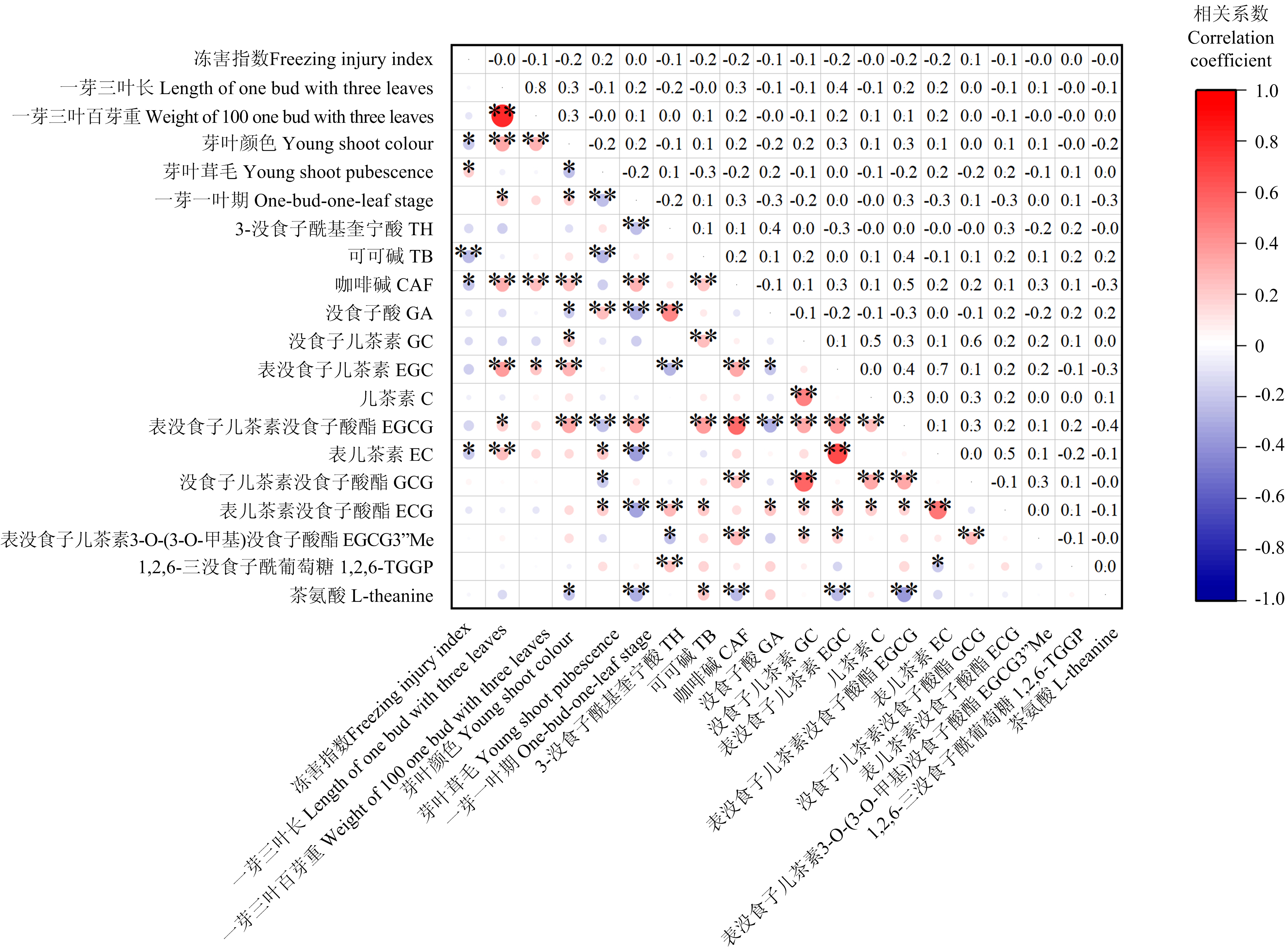
图2
6个农艺性状和14个生化性状的相关性分析 *和**分别表示在0.05和0.01水平呈显著相关"
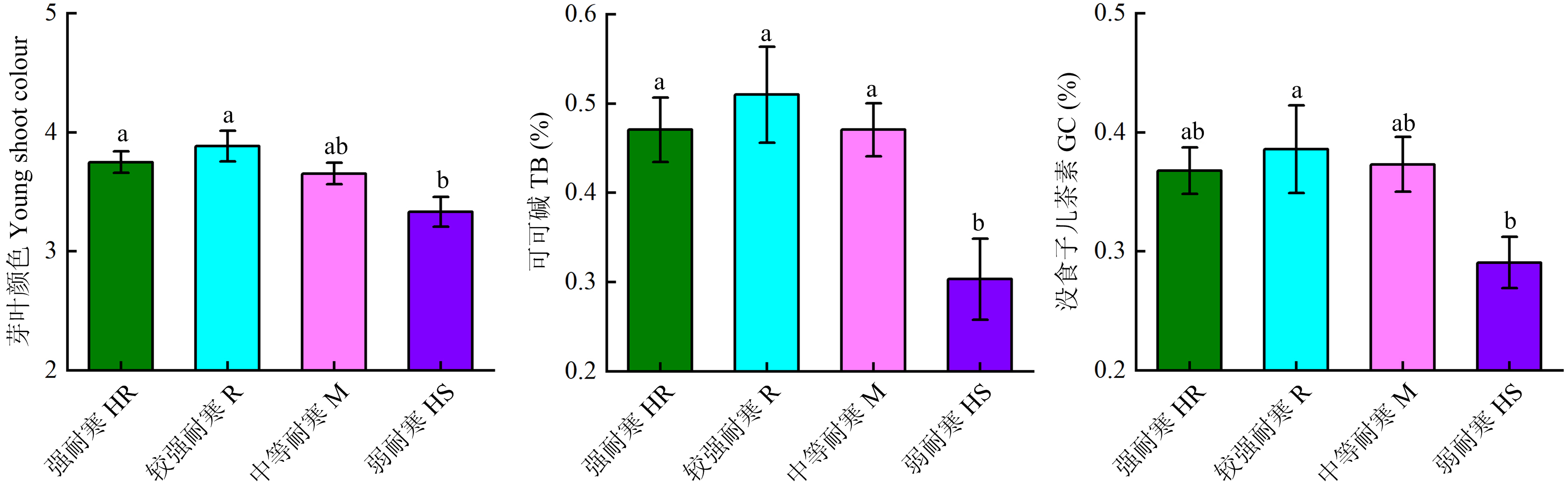
图3
不同耐寒性茶树种质的性状差异 HR:强耐寒;R:较强耐寒;M:中等耐寒;HS:弱耐寒。不同小写字母表示在0.05水平上差异显著。下同"

图4
不同物候期茶树种质的性状差异 EES:特早生;ES:早生;MS:中生;LS:晚生"
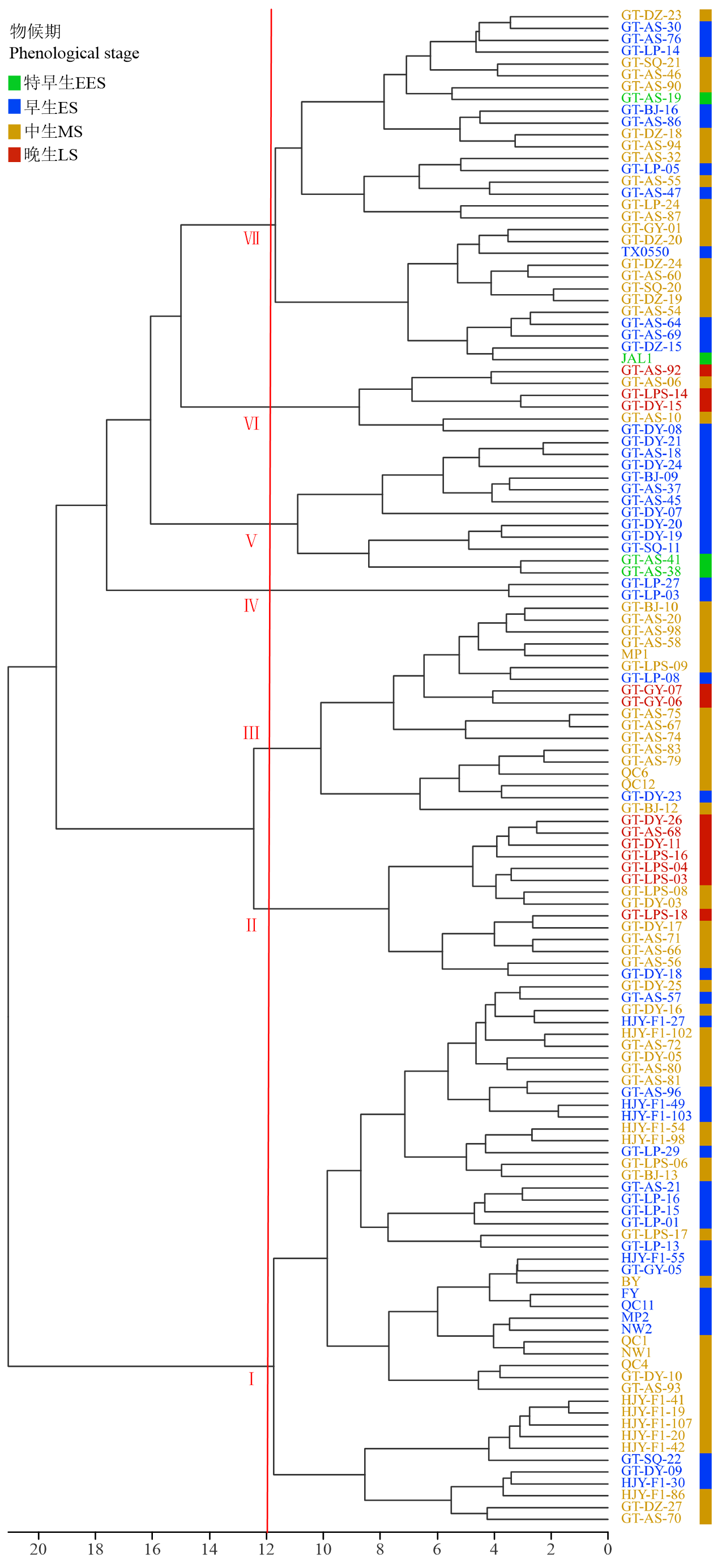
图5
128份茶树种质的聚类树状图"
表3
不同类群茶树种质的关键农艺性状和生化性状"
| 性状 Traits | 类群Group | ||||||
|---|---|---|---|---|---|---|---|
| Ⅰ(n=46) | Ⅱ(n=14) | Ⅲ(n=18) | Ⅳ(n=2) | Ⅴ(n=12) | Ⅵ(n=6) | Ⅶ(n=30) | |
| 冻害指数Freezing injury index | 32.24±20.80a | 18.87±14.67a | 30.26±18.57a | 25.00 | 19.39±12.83a | 29.75±24.05a | 18.96±14.67a |
| 一芽三叶长 Length of one bud with three leaves (cm) | 5.25±0.98c | 6.03±0.63b | 7.49±0.98a | 5.62 | 5.66±1.04bc | 6.29±1.03b | 5.72±0.76bc |
| 一芽三叶百芽重 Weight of 100 one bud with three leaves (g) | 31.25±9.57c | 32.12±3.85bc | 47.58±10.81a | 32.99 | 34.81±11.53bc | 39.39±12.54b | 35.03±9.39bc |
| 芽叶颜色Young shoot colour | 3.30±0.47cd | 3.86±0.36ab | 4.06±0.54ab | 3.50 | 3.25±0.45d | 3.67±0.52bc | 4.17±0.59a |
| 芽叶茸毛Young shoot pubescence | 3.30±0.70b | 2.71±0.73c | 3.22±0.55bc | 2.50 | 4.08±0.90a | 3.67±0.52ab | 3.23±0.73bc |
| 一芽一叶期One-bud-one-leaf stage (d) | 20.22±3.26c | 28.36±5.40a | 24.22±4.48b | 18.00 | 13.92±5.14d | 26.67±6.89ab | 19.47±5.22c |
| 3-没食子酰基奎宁酸TH (%) | 1.68±0.25b | 1.58±0.36b | 1.58±0.31b | 1.50 | 2.10±0.26a | 2.09±0.16a | 1.83±0.51ab |
| 可可碱TB (%) | 0.41±0.22b | 0.50±0.27ab | 0.36±0.17b | 0.49 | 0.50±0.17ab | 0.61±0.07a | 0.53±0.27ab |
| 咖啡碱CAF (%) | 3.44±0.46b | 4.05±0.35a | 3.95±0.46a | 4.23 | 3.54±0.44b | 4.23±0.39a | 3.60±0.39b |
| 没食子酸GA (%) | 0.03±0.02bc | 0.02±0.01c | 0.03±0.01bc | 0.02 | 0.10±0.05a | 0.04±0.02bc | 0.04±0.02b |
| 没食子儿茶素GC (%) | 0.32±0.09bc | 0.27±0.05c | 0.31±0.06bc | 1.09 | 0.31±0.14bc | 0.35±0.10b | 0.49±0.12a |
| 表没食子儿茶素EGC (%) | 0.97±0.32c | 1.33±0.31b | 1.89±0.44a | 1.17 | 1.38±0.47b | 1.33±0.42b | 1.38±0.51b |
| 儿茶素C (%) | 0.17±0.10abc | 0.10±0.05c | 0.16±0.09bc | 0.38 | 0.13±0.03bc | 0.19±0.06ab | 0.25±0.15a |
| 表没食子儿茶素没食子酸酯EGCG (%) | 7.58±0.98c | 9.43±0.88b | 9.38±1.26b | 9.77 | 7.55±1.34c | 10.43±1.35a | 9.23±1.18b |
| 表儿茶素EC (%) | 0.51±0.14c | 0.50±0.13c | 0.75±0.15ab | 0.82 | 0.90±0.38a | 0.46±0.19c | 0.67±0.24b |
| 没食子儿茶素没食子酸酯GCG (%) | 0.18±0.08b | 0.20±0.06ab | 0.23±0.09ab | 1.16 | 0.17±0.05b | 0.25±0.12a | 0.19±0.09ab |
| 表儿茶素没食子酸酯ECG (%) | 1.89±0.39d | 1.83±0.20d | 1.96±0.26cd | 1.57 | 2.47±0.44a | 2.19±0.43bc | 2.26±0.31ab |
| 表没食子儿茶素3-O-(3-O-甲基)没食子酸酯EGCG3"Me (%) | 0.35±0.32b | 0.26±0.23b | 0.64±0.48a | 1.13 | 0.24±0.32b | 0.21±0.36b | 0.27±0.35b |
| 1,2,6-三没食子酰葡萄糖1,2,6-TGGP (%) | 0.32±0.19bc | 0.18±0.12c | 0.20±0.12c | 0.56 | 0.42±0.24b | 1.91±0.86a | 0.31±0.18bc |
| 茶氨酸L-theanine (%) | 2.68±0.63a | 1.61±0.50c | 2.06±0.57b | 2.27 | 2.27±0.57b | 1.91±0.65bc | 2.15±0.40b |
表4
优异茶树种质"
| 优异类别 Excellent category | 鉴选标准 Selection criteria | 数量 Number | 种质名称 Name |
|---|---|---|---|
| 强耐寒性 High cold resistance | 冻害指数≤10 Freezing injury index≤10 | 32 | GT-AS-96、GT-AS-41、GT-AS-47、GT-AS-94、GT-AS-55、GT-AS-60、GT-AS-81、GT-BJ-16、GT-DY-15、GT-DY-17、GT-DY-18、GT-DY-05、GT-DY-19、GT-DY-21、GT-DY-08、GT-DY-26、GT-DZ-15、GT-DZ-24、GT-DZ-19、GT-DZ-23、MP2、FY、GT-GY-05、GT-GY-07、GT-LP-05、GT-LP-16、GT-LP-29、GT-LP-08、GT-LPS-03、GT-LPS-16、HJY-F1-103、HJY-F1-55 |
| 特早生 Extra-early sprouting | 一芽一叶期较福鼎大白茶早10 d One-bud-one-leaf stage was 10 d earlier than Fuding Dabaicha | 4 | GT-AS-19、GT-AS-38、GT-AS-41、JAL1 |
| 高咖啡碱 High CAF | ≥5.0% | 1 | GT-LPS-03 |
| 高茶氨酸 High L-theanine | ≥3.0% | 18 | GT-LP-13、GT-LP-01、GT-BJ-13、GT-LPS-17、GT-LPS-06、GT-DY-24、GT-AS-72、GT-LP-15、GT-BJ-12、NW2、GT-LP-16、MP2、GT-LP-29、GT-DY-07、GT-AS-02、GT-DY-23、GT-LP-14、HJY-F1-54 |
| 高1,2,6-TGGP High 1,2,6-TGGP | ≥3.0% | 1 | GT-AS-10 |
表5
7个主成分的特征值及贡献率"
| 主成分Principal component | 特征值Eigenvalues | 贡献率Contribution rate (%) | 累计贡献率Accumulative contribution rate (%) |
|---|---|---|---|
| 1 | 3.59 | 17.95 | 17.95 |
| 2 | 2.45 | 12.23 | 30.18 |
| 3 | 2.27 | 11.37 | 41.55 |
| 4 | 1.80 | 8.98 | 50.53 |
| 5 | 1.39 | 6.95 | 57.48 |
| 6 | 1.30 | 6.50 | 63.98 |
| 7 | 1.07 | 5.37 | 69.35 |
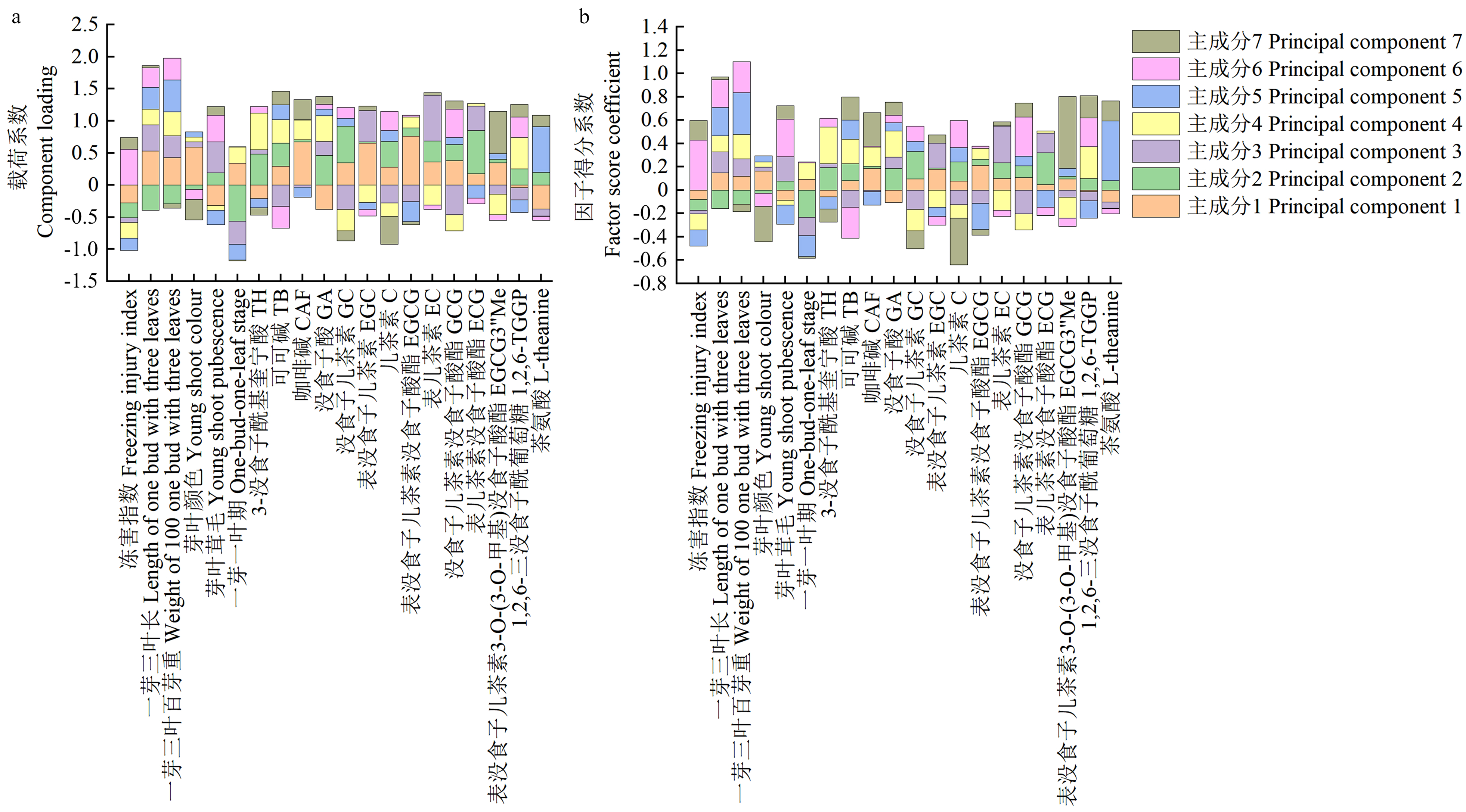
图6
7个主成分的载荷系数(a)及因子得分系数(b)"
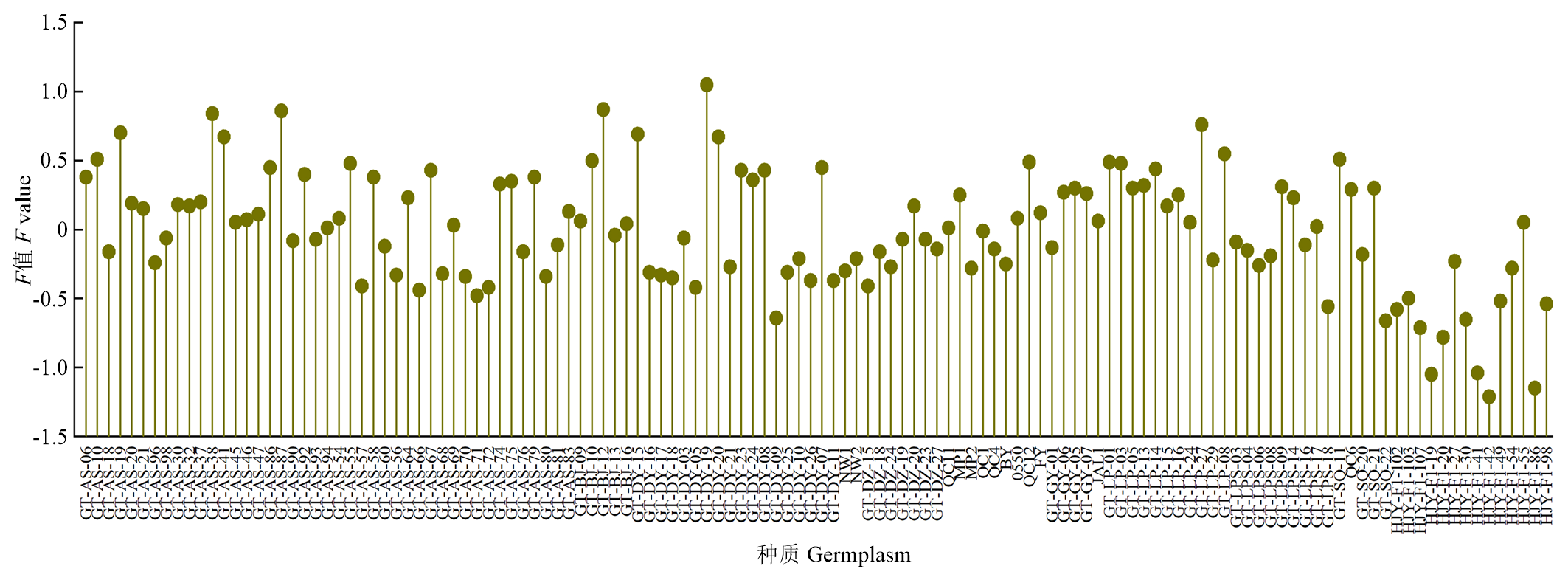
图7
128份茶树种质的主成分分析F值"
表6
灰色关联度L0取值情况"
| 性状Traits | 理想品种L0 Ideal variety L0 |
|---|---|
| 冻害指数Freezing injury index | 0.00 |
| 一芽三叶长Length of one bud with three leaves (cm) Lengthofonebudwiththreeleaves(cm) | 5.86 |
| 一芽三叶百芽重Weight of 100 one bud with three leaves (g) | 35.27 |
| 芽叶颜色Young shoot colour Youngshootcolour | 3.69 |
| 芽叶茸毛Young shoot pubescence Youngshootpubescence | 3.29 |
| 一芽一叶期One-bud-one-leaf stage (d) One-bud-one-leafstage(d) | 4.00 |
| 3-没食子酰基奎宁酸TH (%) | 1.75 |
| 可可碱TB (%) | 0.46 |
| 咖啡碱CAF (%) | 3.67 |
| 没食子酸GA (%) | 0.04 |
| 没食子儿茶素GC (%) | 0.36 |
| 表没食子儿茶素EGC (%) | 1.30 |
| 儿茶素C (%) | 0.18 |
| 表没食子儿茶素没食子酸酯EGCG (%) | 8.59 |
| 表儿茶素EC (%) | 0.62 |
| 没食子儿茶素没食子酸酯GCG (%) | 0.21 |
| 表儿茶素没食子酸酯ECG (%) | 2.05 |
| 表没食子儿茶素3-O-(3-O-甲基)没食子酸酯EGCG3"Me (%) | 0.36 |
| 1,2,6-三没食子酰葡萄糖1,2,6-TGGP (%) | 0.37 |
| 茶氨酸L-theanine (%) | 4.18 |

图8
128份茶树种质的加权关联度值"
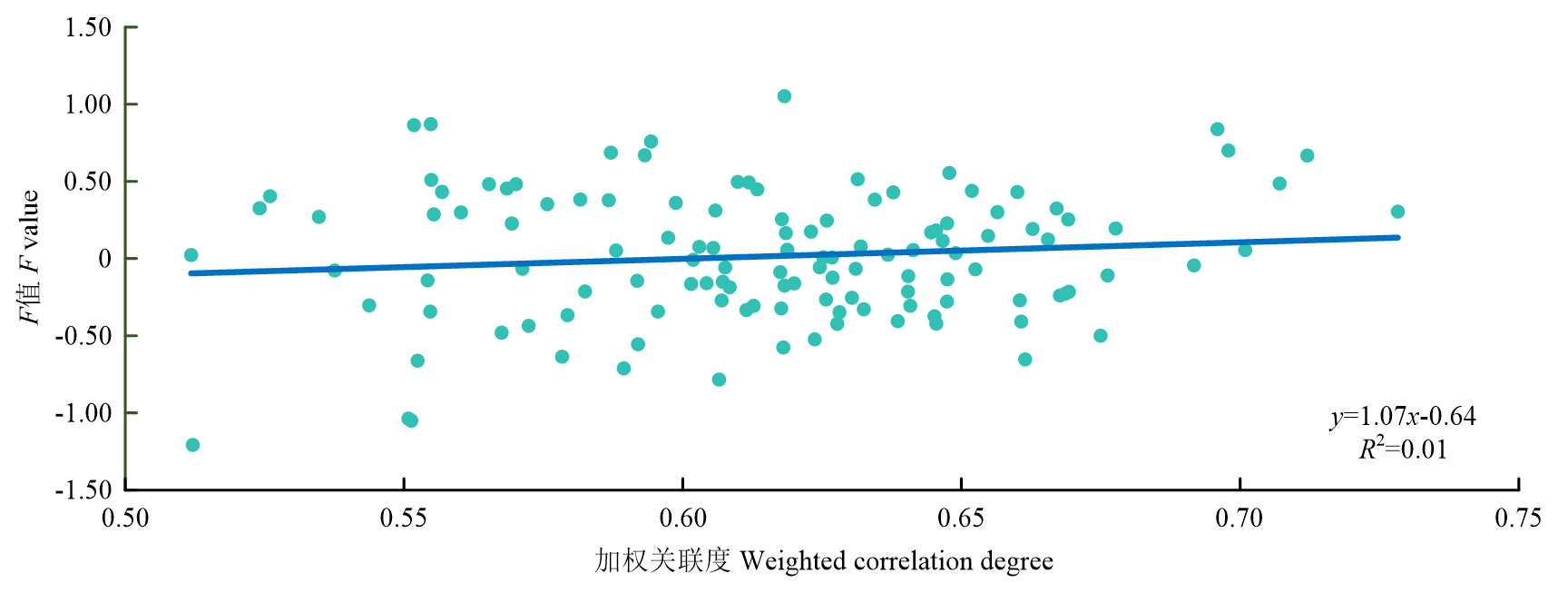
图9
灰色关联分析加权关联度值与主成分分析F值线性回归关系"
| [1] |
吴芹瑶, 杨江帆, 林程, 管曦. 中国茶叶生产布局变迁研究[J]. 茶叶科学, 2022, 42(2): 290-300.
|
|
|
|
| [2] |
李润杰, 赵小风, 王瑾, 王柏源, 戴劲. 耕地 “占补平衡” 新机制下规模化茶产区整治路径[J]. 农业工程学报, 2025, 41(16): 290-298.
|
|
|
|
| [3] |
刘梦月, 孙悦, 韦朝领, 宋博, 陈志丹, 曹士先, 孙威江. 茶树功能性成分的遗传多样性分析及综合评价[J]. 植物资源与环境学报, 2023, 32(5): 28-38.
|
|
|
|
| [4] |
doi: 10.1186/s12870-025-06889-w |
| [5] |
|
| [6] |
|
| [7] |
doi: 10.1016/j.pld.2025.09.002 |
| [8] |
doi: 10.1038/s41588-025-02135-z |
| [9] |
doi: 10.1186/s12870-024-04761-x pmid: 38287242 |
| [10] |
doi: 10.1186/s12864-016-2703-5 |
| [11] |
李赛君, 段继华, 康彦凯, 雷雨, 黄飞毅, 罗意, 丁玎, 陈莹玉, 董丽娟. 特早生抗寒茶树新品种‘玉叶’选育报告[J]. 茶叶通讯, 2023, 50(1): 32-37.
|
|
|
|
| [12] |
任志红, 吴焕焕, 肖文敏, 张虹, 杨圣祥, 孙海伟, 王健, 高文星. 抗寒茶树新品种‘岱鼎御丰’[J]. 园艺学报, 2022, 49(增刊2): 287-288.
|
|
|
|
| [13] |
颜诗语, 方开星, 倪尔冬, 王秋霜, 王青, 潘晨东, 李波, 李红建, 冯韶芳, 田先先, 吴华玲, 秦丹丹. 高表没食子儿茶素没食子酸酯兼苦茶碱茶树品种功能成分叶位分布差异[J]. 食品安全质量检测学报, 2025, 16(24): 306-316.
|
|
|
|
| [14] |
王飞权, 冯花, 罗盛财, 陈荣冰, 杨慧珠, 李少华, 张见明, 张渤, 叶江华. 武夷名丛茶树种质资源农艺性状多样性分析[J]. 中国农业科技导报, 2019, 21(6): 43-54.
doi: 10.13304/j.nykjdb.2018.0665 |
|
doi: 10.13304/j.nykjdb.2018.0665 |
|
| [15] |
牛小军, 包兴伟, 郑旭霞, 秦秀珍, 邱金华, 王小亚, 沈世魁, 辛国田, 赵芸, 黄海涛. 四川九龙古茶树种质资源农艺性状遗传多样性研究[J]. 植物遗传资源学报, 2024, 25(2): 249-258.
doi: 10.13430/j.cnki.jpgr.20230731001 |
|
|
|
| [16] |
李泽楷, 段子旭, 卢秀梅, 黄铭浩,
|
|
|
|
| [17] |
田先先, 冯韶芳, 王青, 潘晨东, 李波, 方开星, 吴华玲, 秦丹丹. 连南大叶茶树种质资源生化特性分析与适制性评价[J]. 中国农业科学, 2025, 58(22): 4797-4812. DOI: 10.3864/j.issn.0578-1752.2025.22.018.
|
|
|
|
| [18] |
郭佳璐, 璩馥榕, 蔡天晨, 赵洋, 杨培迪, 刘勇, 周跃斌, 刘振. 基于农艺性状和SNP分子标记的湖南78份茶树种质资源遗传多样性研究[J]. 茶叶科学, 2025, 45(2): 219-233.
|
|
|
|
| [19] |
刘瑜, 严芳, 邵静娜, 周慧娟, 郑生宏, 何卫中. 浙江丽水市地方茶树种质资源鉴定评价[J]. 南方农业学报, 2022, 53(2): 401-409.
|
|
|
|
| [20] |
翟秀明, 李解, 唐敏, 胡方洁, 张军, 侯渝嘉, 徐泽. 重庆30份茶树种质资源农艺性状与生化成分多样性[J]. 浙江农业学报, 2021, 33(7): 1244-1255.
doi: 10.3969/j.issn.1004-1524.2021.07.10 |
|
|
|
| [21] |
杨春, 梁思慧, 汪安然, 陈娟, 李燕, 林开勤, 密孝增, 乔大河, 陈正武, 郭燕. 五十四份茶树种质的特征性代谢产物含量与耐寒性[J]. 浙江农业学报, 2025, 37(9): 1860-1871.
doi: 10.3969/j.issn.1004-1524.20240563 |
|
doi: 10.3969/j.issn.1004-1524.20240563 |
|
| [22] |
黄政, 李芳, 尹杰, 牛素贞. 贵州低热河谷地方茶树种质资源基于表型性状的遗传多样性分析[J]. 分子植物育种, 2024, 22(4): 1193-1204.
|
|
|
|
| [23] |
李燕, 密孝增, 张小琴, 乔大河, 代新龙, 陈正武. 普安古茶树种质资源茶叶生化成分多样性分析[J]. 江苏农业学报, 2025, 41(5): 984-995.
|
|
|
|
| [24] |
杨春, 郭燕, 乔大河, 梁思慧, 李燕, 李彦福, 密孝增, 杨世雄, 陈正武. 盘州大厂茶(Camellia tachangensis)的生物碱类、儿茶素类及氨基酸类组成特性分析[J]. 西南农业学报, 2025, 38(3): 507-518.
|
|
|
|
| [25] |
NY/T 2943—2016 茶树种质资源描述规范[S]. 2016.
|
|
NY/T 2943—2016 Descriptors for tea germplasm resources[S]. 2016. (in Chinese)
|
|
| [26] |
杨春, 孟泽洪, 李帅, 郭燕, 梁思慧, 乔大河, 陈正武. 贵州茶园茶棍蓟马和小贯小绿叶蝉种群动态及主栽茶树品种寄主抗性[J]. 南方农业学报, 2021, 52(3): 671-681.
|
|
|
|
| [27] |
项丽慧, 林清霞, 王丽丽, 陈林, 余文权. 不同固样方法对茶鲜叶主要品质成分的影响[J]. 福建农业学报, 2018, 33(5): 525-529.
|
|
|
|
| [28] |
乔大河. 鲜叶摊放时间对太平猴魁茶风味品质形成的影响研究[D]. 合肥: 安徽农业大学, 2022.
|
|
|
|
| [29] |
杨春, 梁思慧, 陈正武, 陈娟, 李燕, 乔大河, 郭燕, 张小琴. 黄色芽叶茶树新品种黄金芽自然杂交后代的生化品质分析[J]. 西南农业学报, 2023, 36(9): 1859-1868.
|
|
|
|
| [30] |
罗旭婷, 刘伟, 张群, 王春发, 付复华, 杨明之. 湖南23个桃品种果实品质分析及综合评价[J]. 食品科学, 2025, 46(20): 36-46.
|
|
|
|
| [31] |
doi: 10.1038/s41598-024-81323-z |
| [32] |
唐桂梅, 李卫东, 周宇霞, 孔佑涵, 肖晓玲, 彭颖姝, 张力, 符红艳, 刘洋, 黄国林. 基于表型性状分析蕙兰种质资源遗传多样性[J]. 中国农业科学, 2025, 58(2): 339-354. DOI: 10.3864/j.issn.0578-1752.2025.02.010.
|
|
|
|
| [33] |
NY/T 2031—2011 农作物优异种质资源评价规范茶树[S]. 2011.
|
|
|
|
| [34] |
doi: 10.1016/j.foodchem.2019.05.144 |
| [35] |
荀涵硕, 王留彬, 张睿, 王丽鸳, 韦康. 219份茶树资源1, 2, 6-三没食子酰葡萄糖变异分析[J]. 茶叶通讯, 2023, 50(3): 317-326.
|
|
|
|
| [36] |
丁帅涛, 程晓梅, 张亚, 万斌, 任华江, 江昌俊, 余有本, 纪晓明, 胡歆. 基于表型性状和生化成分的陕西茶树种质资源遗传多样性研究[J]. 西北农业学报, 2019, 28(4): 607-619.
|
|
|
|
| [37] |
doi: 10.1093/plcell/koad229 pmid: 37647532 |
| [38] |
doi: 10.1016/j.xplc.2024.101176 |
| [39] |
|
| [40] |
doi: 10.1016/j.focha.2022.100108 |
| [41] |
doi: 10.3389/fpls.2023.1145609 |
| [42] |
李建波, 邓珂. 作物种质资源常用综合评价方法[J]. 江苏农业科学, 2024, 52(3): 40-46.
|
|
|
|
| [43] |
张琦, 蒲婷婷, 王艺儒, 胡银凤, 李华威, 韩卫娟, 索玉静, 傅建敏. 不同柿种质果实品质多样性评价[J]. 中国农业大学学报, 2025, 30(2): 61-71.
|
|
|
|
| [44] |
陈彩锦, 马琳, 蒋庆雪, 刘金晖, 苗童, 张志鹏, 孟翔, 马晓冉, 周昕越, 张建, 刘文辉, 王学敏. 244份饲用燕麦种质资源表型性状遗传多样性分析[J]. 中国农业科学, 2025, 58(23): 4825-4836. DOI: 10.3864/j.issn.0578-1752.2025.23.002.
|
|
|
|
| [45] |
葛玉彬, 贺春贵, 王宁, 张国琴, 张正英, 吕鑫. 基于表型性状的热带高粱种质资源遗传多样性分析与创新利用[J]. 中国农业科学, 2026, 59(8): 1622-1638. DOI: 10.3864/j.issn.0578-1752.2026.08.003.
|
|
|
|
| [46] |
张悦青, 张玉亭, 薛晨飞, 韩秦宇, 贺一容, 徐紫娟, 范秀梅, 王军娥, 罗丹, 冯雪, 孙胜. 364份樱桃番茄种质资源表型性状的遗传多样性分析及综合评价[J]. 中国农业科学, 2026, 59(11): 2468-2483. DOI: 10.3864/j.issn.0578-1752.2026.11.012.
|
|
|
|
| [47] |
郭晓雨, 王茜, 沈高健, 罗理勇, 袁连玉, 曾亮. 特早生茶树种质资源特征及其早芽调控机理研究进展[J]. 西北林学院学报, 2025, 40(6): 138-147.
|
|
|
|
| [48] |
王培娟, 唐俊贤, 金志凤, 马玉平, 陈惠. 中国茶树春霜冻害研究进展[J]. 应用气象学报, 2021, 32(2): 129-145.
|
|
|
|
| [49] |
邢瑶, 李松, 唐锁海, 杨亦扬, 虞斌, 魏爱华. 茶树品种抗寒性试验[J]. 茶叶, 2022, 48(1): 34-38.
|
|
|
|
| [50] |
doi: 10.1016/j.foodchem.2024.139628 |
| [51] |
|
| [1] | 王小玮, 杜佛力, 闫红财, 郎正东, 党志娟, 李葆春, 汪军成, 马小乐, 王化俊, 张宏, 姚立蓉. 396份春小麦灌浆期和成熟期抗旱性评价[J]. 中国农业科学, 2026, 59(8): 1608-1621. |
| [2] | 姚林, 彭律文, 阳虹, 饶佳怡, 高浩然, 陶芊伊, 谢念祠, 陈莹玉, 李赛君, 刘硕谦, 黄飞毅. 茶树不同亲本及F1子代多酚类成分多样性和基因型分析[J]. 中国农业科学, 2026, 59(8): 1760-1774. |
| [3] | 王玉萍, 符质, 孙佳莹, 穆晓萌, 刘慧淋, 郭进云, 宋文菁, 侯雷平, 赵海亮. 苗期施用褪黑素对番茄短期低温胁迫的缓解作用与应用效果评价[J]. 中国农业科学, 2026, 59(7): 1523-1535. |
| [4] | 沈英姿, 李朵姣, 江丽, 胡新荣, 陈斌, 郑寨生, 袁名安. CsGPDH在茶籽油脂积累中的功能分析[J]. 中国农业科学, 2026, 59(2): 402-412. |
| [5] | 柴智超, 钱肖娜, 于永晨, 李喜旺, 孙晓玲. 融合植物生理学与高光谱多任务协同感知的茶树叶片儿茶素快速预测[J]. 中国农业科学, 2026, 59(18): 4149-4162. |
| [6] | 梁海燕, 苏占明, 宋晓强, 杨芳, 姜超, 张翔宇, 李海. 75个糜子品种根系特性差异及其与抗根倒伏的关联分析[J]. 中国农业科学, 2026, 59(12): 2563-2575. |
| [7] | 许朵朵, 杜倩倩, 赵理想, 栗燕, 黄淦, 李永华, 逯久幸. 牡丹AP2/ERF转录因子的全基因组分析[J]. 中国农业科学, 2025, 58(23): 5031-5045. |
| [8] | 陈彩锦, 马琳, 蒋庆雪, 刘金晖, 苗童, 张志鹏, 孟翔, 马晓冉, 周昕越, 张建, 刘文辉, 王学敏. 244份饲用燕麦种质资源表型性状遗传多样性分析[J]. 中国农业科学, 2025, 58(23): 4825-4836. |
| [9] | 田先先, 冯韶芳, 王青, 潘晨东, 李波, 方开星, 吴华玲, 秦丹丹. 连南大叶茶树种质资源生化特性分析与适制性评价[J]. 中国农业科学, 2025, 58(22): 4797-4812. |
| [10] | 张天宇, 刘丽君, 杨刚, 武军艳, 蒲媛媛, 马骊, 王旺田, 路晓明, 马愿强, 孙万仓. 2006—2022年北方白菜型冬油菜农艺性状遗传增益分析[J]. 中国农业科学, 2025, 58(11): 2081-2095. |
| [11] | 李佳慧, 李悦琦, 周晓芳, 范国元, 李爱华, 陶永胜. 干红葡萄酒单宁质量的多维表征方法分析[J]. 中国农业科学, 2025, 58(10): 2022-2034. |
| [12] | 陈细红, 蔡伟, 虞赟, 李敏, 王念武, 杜振国, 沈建国, 高芳銮. 福建省茶树病毒种类鉴定及多重PCR检测技术的建立[J]. 中国农业科学, 2024, 57(4): 698-710. |
| [13] | 戎亚思, 李丰, 张鹏钰, 王东勇, 苏小雨, 田媛, 高桐梅. 基于主成分-聚类分析芝麻盛花期耐高温评价及品种筛选[J]. 中国农业科学, 2024, 57(20): 3957-3973. |
| [14] | 张毅, 刘颖, 程存刚, 李燕青, 李壮. 牛粪与化肥配施比例对苹果园土壤有机碳库和酶活性的影响[J]. 中国农业科学, 2024, 57(20): 4107-4118. |
| [15] | 杨春, 杨代星, 李燕, 梁思慧, 邓小强, 乔大河, 陈娟, 郭燕, 林开勤, 陈正武. 贵州大树茶形态学特征及生化成分综合分析[J]. 中国农业科学, 2024, 57(19): 3894-3916. |
|
||
