






中国农业科学 ›› 2026, Vol. 59 ›› Issue (12): 2563-2575.doi: 10.3864/j.issn.0578-1752.2026.12.003
梁海燕( ), 苏占明, 宋晓强, 杨芳, 姜超, 张翔宇, 李海()
收稿日期:2025-11-14
接受日期:2026-01-13
出版日期:2026-06-16
发布日期:2026-06-16
通信作者:
联系方式:
梁海燕,E-mail:lianghaiyan125@126.com。
基金资助:
LIANG HaiYan(), SU ZhanMing, SONG XiaoQiang, YANG Fang, JIANG Chao, ZHANG XiangYu, LI Hai()
Received:2025-11-14
Accepted:2026-01-13
Published:2026-06-16
Online:2026-06-16
摘要:
【目的】探究不同糜子品种根系构型、力学特性,以及与抗根倒伏的关联性,明确抗根倒伏品种鉴定的关键指标,为糜子抗根倒伏育种提供理论依据。【方法】以75个糜子品种为试验材料,在山西毛皂试验基地开展田间试验。灌浆初期测定根拔力、根重、根长、根直径和根系最大开张角度等根系力学、形态构型指标,抽穗期后进行田间根倒伏级别鉴定。采用相关性分析与主成分分析,解析糜子根系性状与根倒伏级别的关联性,明确抗根倒伏鉴定的关键指标,结合主成分综合得分排名与田间抗根倒伏鉴定结果,筛选高抗根倒伏品种。【结果】经糜子根系性状与成熟期根倒伏级别相关性分析,得出糜子根倒伏级别与根拔力呈极显著负相关(r=-0.340**),与根系干物质重量呈显著负相关(r=-0.278*);而根拔力与直径2.0—3.0 mm的根系长度、根系表面积、根系体积呈显著正相关(r=0.253*—0.259*),与根系最大开张角度呈显著正相关(r=0.271*)。主成分分析显示,糜子直径2.0—3.0 mm根系特性(中粗根系因子)、根系干物质重量与最大开张角度(整体根重与构型因子)、根拔力(根系力学特性因子)是前3个主成分,单个贡献率分别为58.417%、18.618%和12.314%,累积方差贡献率达到89.349%,是糜子抗根倒伏的三大关键因子。结合主成分综合得分排名和田间抗根倒伏鉴定结果,筛选出宁糜15号、陇糜15号等7个高抗根倒伏品种。【结论】不同糜子品种根系性状有着丰富的遗传多样性。直径2.0—3.0 mm根系特性(中粗根系因子)、根系干物质重量与最大开张角度(整体根重与构型因子)、根拔力(根系力学特性因子)是糜子抗根倒伏主要鉴定指标。其中,根拔力可作为糜子抗倒伏直接筛选指标,直径2.0—3.0 mm根系特性在抗根倒伏育种中需重点关注。筛选出宁糜15号、陇糜15号等7个高抗根倒伏品种,可用于品种的改良及研究应用。
梁海燕, 苏占明, 宋晓强, 杨芳, 姜超, 张翔宇, 李海. 75个糜子品种根系特性差异及其与抗根倒伏的关联分析[J]. 中国农业科学, 2026, 59(12): 2563-2575.
LIANG HaiYan, SU ZhanMing, SONG XiaoQiang, YANG Fang, JIANG Chao, ZHANG XiangYu, LI Hai. Differences in Root Traits Among 75 Broomcorn Millet Varieties and Their Correlation with Root Lodging Resistance[J]. Scientia Agricultura Sinica, 2026, 59(12): 2563-2575.
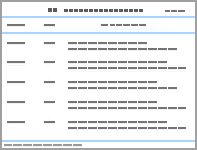
表1
不同糜子品种根系性状描述性统计分析"
| 根系性状 Root traits | 样本数 Sample size | 最小值 Min | 中位数(四分位距) Med (IQR) | 最大值 Max | 异常值数量 No. of outlier | 平均值±标准偏差 Mean±SD | 变异系数 CV (%) |
|---|---|---|---|---|---|---|---|
| 根拔力RPF (N) | 75 | 38.50 | 64.30 (54.05-78.75) | 139.50 | 2 | 67.18±19.34 | 28.79 |
| 根系干物质重量RW (g) | 75 | 0.59 | 1.37 (1.13-1.65) | 2.74 | 1 | 1.43±0.43 | 30.08 |
| 最大开张角度MSA (°) | 75 | 58.33 | 76.67 (70.00-89.17) | 120.00 | 2 | 80.96±14.31 | 17.68 |
| 最长根长MRL (cm) | 75 | 18.00 | 23.33 (21.67-24.67) | 30.00 | 2 | 23.24±2.49 | 10.69 |
| 根系总长TRL (cm) | 75 | 346.71 | 606.81 (477.51-722.52) | 1220.68 | 1 | 609.09±162.54 | 26.69 |
| 根系表面积RSA (cm2) | 75 | 121.84 | 225.18 (188.36-254.64) | 408.26 | 3 | 225.38±59.76 | 26.51 |
| 根系体积RV (cm3) | 75 | 8.26 | 22.96 (16.73-28.37) | 49.84 | 2 | 22.87±8.56 | 37.41 |
| 根系平均直径ARD (mm) | 75 | 0.88 | 1.15 (1.05-1.24) | 1.73 | 1 | 1.15±0.14 | 12.32 |
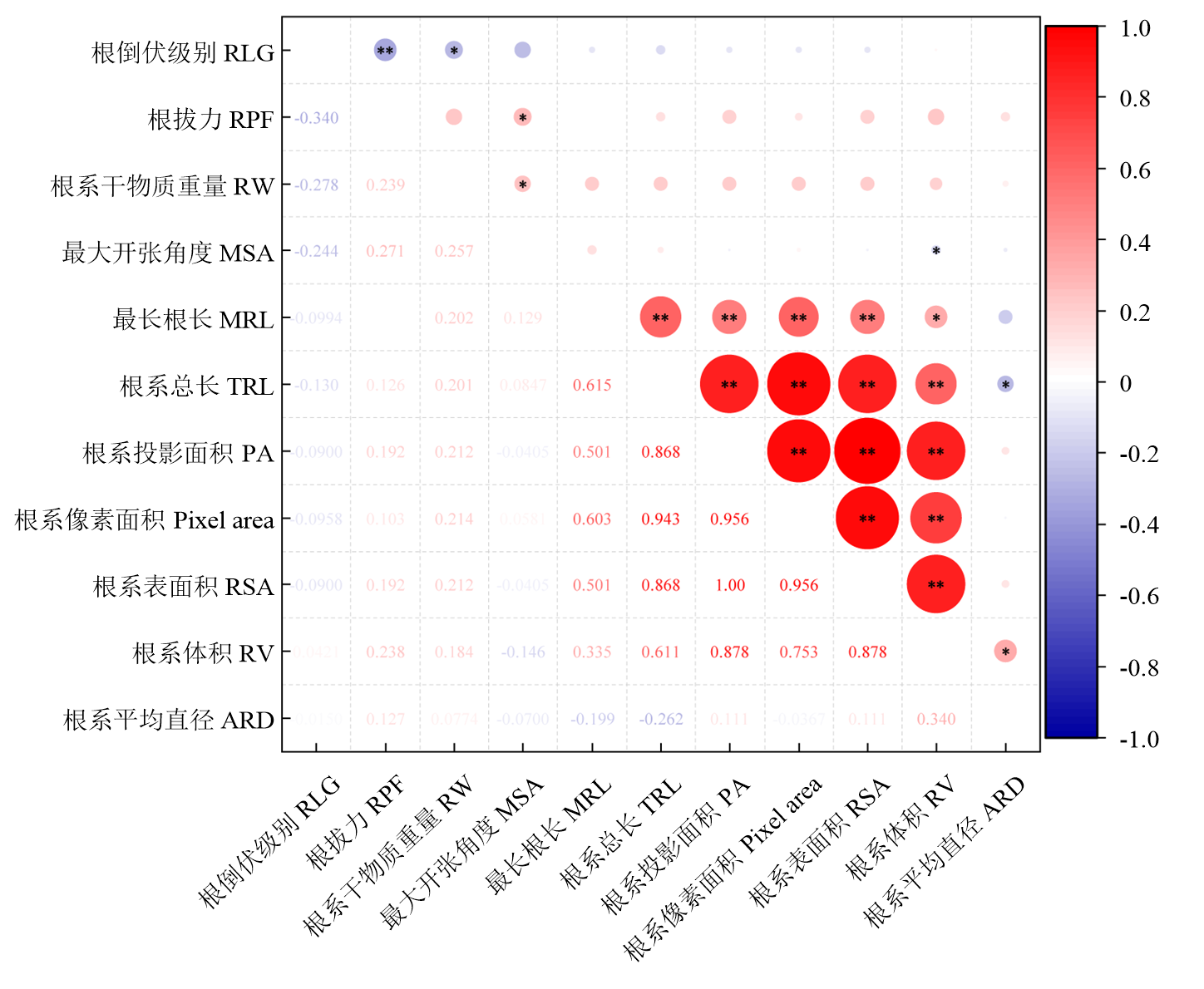
图1
根倒伏级别、根拔力与根系性状的相关性 RLG:根倒伏级别;PA:根系投影面积;Pixel area:根系像素面积。*:P<0.05;**:P<0.01。下同"
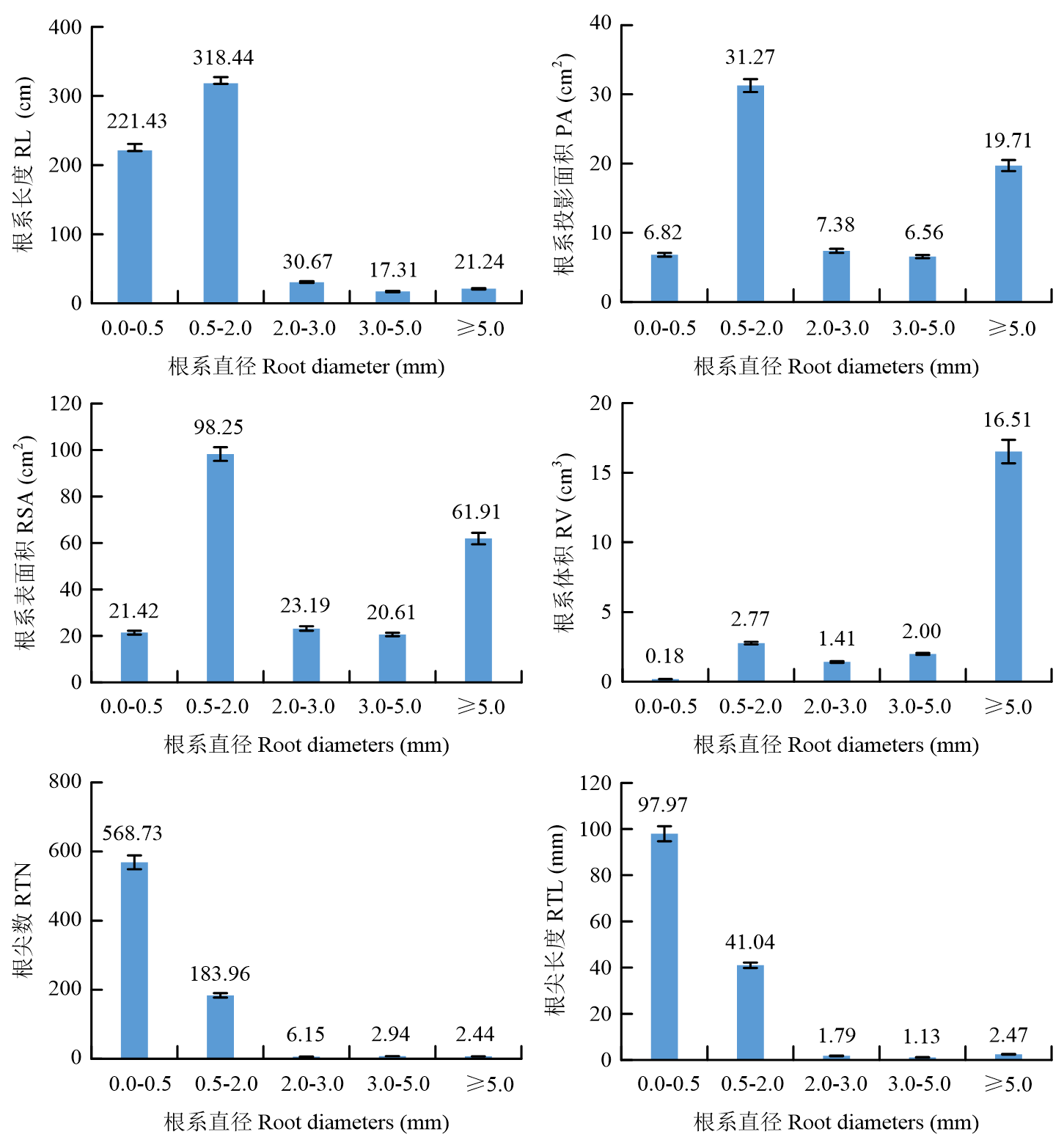
图2
不同糜子品种不同直径根系的性状统计 RL:根系长度;RTN:根尖数;RTL:根尖长度"

图3
根拔力与不同直径范围根系特性的相关性"
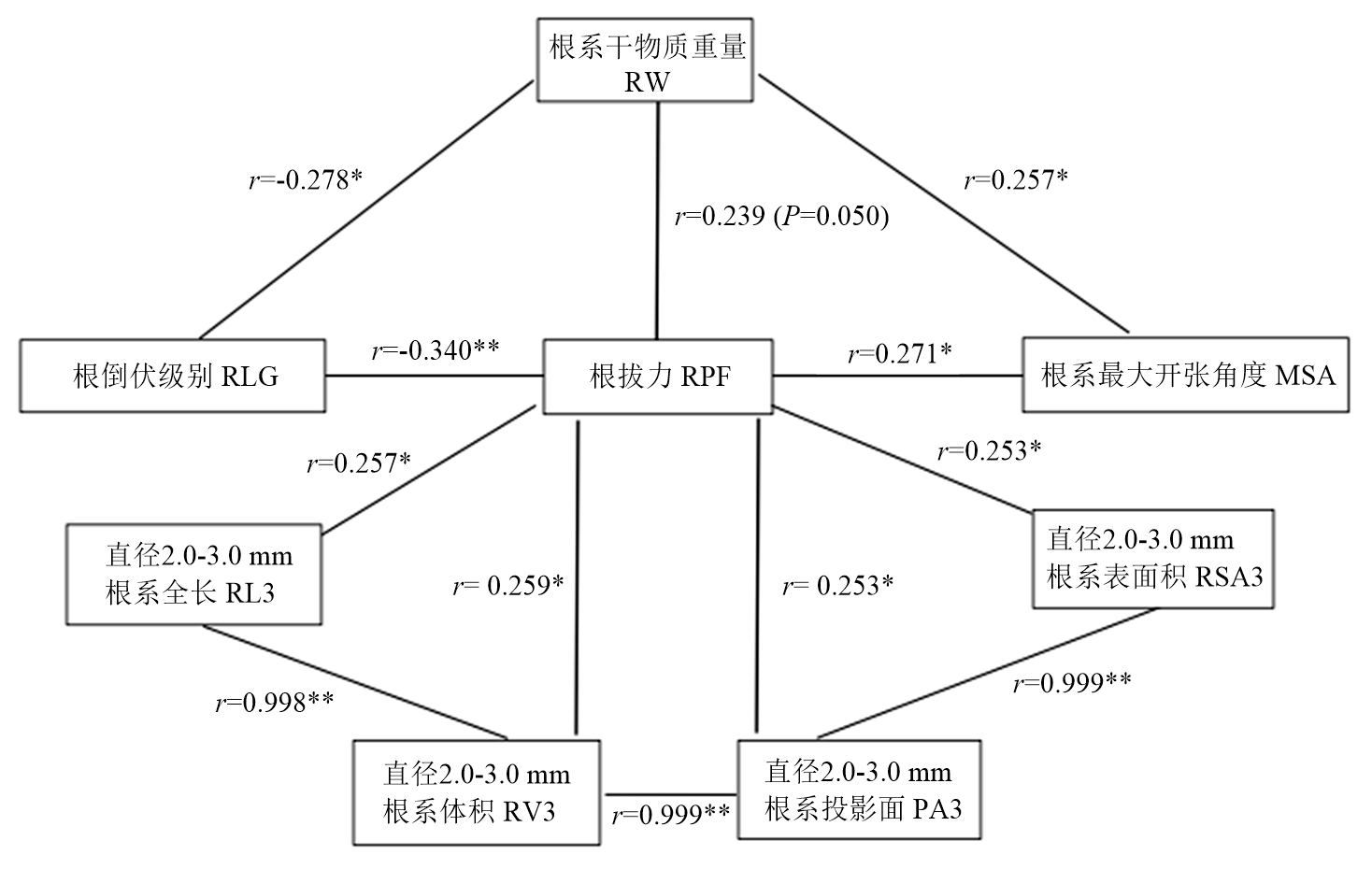
图4
根倒伏级别、根拔力和根系性状间相关性树状图"
表2
糜子根系性状的KMO和Bartlett球形度检验"
| Kaiser-Meyer-Olkin度量值 Kaiser-Meyer-Olkin measurement value | 0.746 | |
|---|---|---|
| Bartlett的球形度检验 Bartlett’s sphericity test | 近似卡方Approximate Chi-squared value | 2134.059 |
| 自由度Degrees freedom | 21 | |
| 显著性Significance | 0.000 | |
表3
不同糜子品种根系性状的主成分特征值与方差贡献率"
| 主成分 Principal component | 初始特征值 Initial eigenvalue | 方差百分比 Percentage of variances (%) | 累积方差贡献率 Cumulative variance contribution rate (%) |
|---|---|---|---|
| PC1 | 4.089 | 58.417 | 58.417 |
| PC2 | 1.303 | 18.618 | 77.035 |
| PC3 | 0.862 | 12.314 | 89.349 |
| PC4 | 0.745 | 10.638 | 99.987 |
| PC5 | 0.001 | 0.013 | 100.000 |
| PC6 | 7.983E-6 | 0.000 | 100.000 |
| PC7 | 5.581E-7 | 7.973E-6 | 100.000 |
表4
不同根系性状旋转后成分矩阵表"
| 指标 Index | 第1主成分 PC1 | 第2主成分 PC2 | 第3主成分 PC3 | |
|---|---|---|---|---|
| 直径2.0—3.0 mm根系 Root system with diameter of 2.0-3.0 mm | 投影面积PA3 | 0.995 | 0.026 | 0.089 |
| 根系长度RL3 | 0.995 | 0.027 | 0.085 | |
| 根系表面积RSA3 | 0.995 | 0.026 | 0.089 | |
| 根系体积RV3 | 0.995 | 0.025 | 0.093 | |
| 根系最大开张角度MRS | -0.058 | 0.729 | 0.251 | |
| 根系干物质重量RW | 0.103 | 0.834 | -0.105 | |
| 根拔力RPF | 0.161 | 0.095 | 0.953 | |
表5
糜子品种主成分分析综合得分前20名排名表"
| 排序 Ranking | 品种名称 Variety name | 主成分得分Principal Component Scores | 综合得分 Comprehensive score | ||
|---|---|---|---|---|---|
| PC1 | PC2 | PC3 | |||
| 1 | 宁糜15号 Ningmi 15 | 4.40569 | 0.00325 | -0.49942 | 2.44640 |
| 2 | 宁糜17号 Ningmi 17 | 2.50732 | 0.49967 | -1.97308 | 1.23584 |
| 3 | 吉12 Ji 12 | 1.34404 | 2.08199 | 0.37008 | 1.19062 |
| 4 | 黄金黍1号 Huangjinshu 1 | 1.46144 | 1.00426 | 0.82297 | 1.13241 |
| 5 | 陇糜10号 Longmi 10 | 1.19357 | 1.26887 | 0.43462 | 0.96993 |
| 6 | 陇糜15号 Longmi 15 | 1.30743 | 0.33771 | 0.51017 | 0.88100 |
| 7 | 晋黍4号 Jinshu 4 | 1.34404 | 0.50280 | -0.67358 | 0.75972 |
| 8 | 晋黍9号 Jinshu 9 | 0.94019 | 1.55866 | -1.05425 | 0.66079 |
| 9 | 育糜3号 Yumi 3 | 0.43641 | 1.56744 | 0.26830 | 0.56596 |
| 10 | 宁糜10号 Ningmi 10 | 1.16508 | -0.39423 | -0.21354 | 0.56516 |
| 11 | 固糜22号 Gumi 22 | 0.49995 | 0.00006 | 1.42456 | 0.49210 |
| 12 | 晋黍2号 Jinshu 2 | 0.38427 | 0.85994 | 0.17174 | 0.39684 |
| 13 | 雁黍8号 Yanshu 8 | 0.58654 | 1.16906 | -1.10467 | 0.38234 |
| 14 | 赤糜3号 Chimi 3 | 0.19081 | -0.06653 | 1.60843 | 0.33024 |
| 15 | 冀黍3号 Jishu 3 | 0.33869 | 0.61354 | 0.03464 | 0.30728 |
| 16 | 内糜9号 Neimi 9 | 0.55334 | 0.74352 | -0.98987 | 0.30461 |
| 17 | 陇糜5号 Longmi5 | -0.22034 | -0.38979 | 3.39136 | 0.29622 |
| 18 | 陇糜4号 Longmi 4 | -0.24806 | 1.45971 | 1.15371 | 0.28389 |
| 19 | 宁糜9号 Ningmi 9 | 0.59021 | -1.62577 | 1.49851 | 0.26640 |
| 20 | 内糜3号 Neimi 3 | -0.54226 | 0.89462 | 2.48224 | 0.20806 |
表6
抽穗后不同糜子品种田间根倒伏情况的调查结果"
| 品种 Variety | 倒伏面积比率/植株与地面夹角 Lodging area ratio/plant-ground angle(%/°) | 根倒伏率Root lodging rate (%) | 根倒伏 级别 RLG | 主成分综合得分排序 Ranking of comprehensive scores | |||||
|---|---|---|---|---|---|---|---|---|---|
| 抽穗期后 After heading stage | 成熟期 Maturity stage | ||||||||
| 08/05 | 08/27 | 08/30 | 09/03 | 09/13 | |||||
| 冀黍3号 Jishu 3 | 0/90 | 0/90 | 0/90 | 0/90 | 0/90 | 0/90 | 0 | 0 | 15 |
| 宁糜15号 Ningmi 15 | 0/90 | 0/90 | 0/90 | 0/90 | 0/90 | 0/90 | 0 | 0 | 1 |
| 赤黍2号 Chishu 2 | 0/90 | 0/90 | 0/90 | 0/90 | 0/90 | 0/90 | 0 | 0 | 41 |
| 宁糜10号 Ningmi 10 | 0/90 | 0/90 | 0/90 | 0/90 | 0/90 | 0/90 | 0 | 0 | 10 |
| 赤糜3号 Chimi 3 | 0/90 | 0/90 | 0/90 | 0/90 | 0/90 | 0/90 | 0 | 0 | 14 |
| 内糜3号 Neimi 3 | 70/45 | 0/90 | 0/90 | 0/90 | 0/90 | 0/90 | 0 | 0 | 20 |
| 固糜22号 Gumi 22 | 0/90 | 0/90 | 0/90 | 0/90 | 0/90 | 0/90 | 0 | 0 | 11 |
| 宁糜14号 Ningmi 14 | 0/90 | 0/90 | 0/90 | 0/90 | 0/90 | 0/90 | 0 | 0 | 42 |
| 陇糜15号 Longmi 15 | 100/60-90 | 0/90 | 0/90 | 0/90 | 0/90 | 0/90 | 0 | 0 | 6 |
| 内糜7号 Neimi 7 | 100/≤30 | 100/≤30 | 100/≤30 | 100/≤30 | 100/≤30 | 100/≤30 | 100 | 5 | 67 |
| 齐黍1号 Qishu 1 | 100/30-60 | 100/≤30 | 100/≤30 | 100/≤30 | 80/≤30 | 80/≤30 | 80 | 5 | 61 |
| 赤黍1号 Chishu 1 | 100/30-60 | 90/≤30 | 80/≤30 | 80/≤30 | 90/≤30 | 80/≤30 | 80 | 5 | 27 |
| 河曲白糜 Hequ Bai Mi | 0/90 | 100/≤30 | 80/45-60 | 80/45-60 | 100/30-45 | 90/45 | 90 | 5 | 55 |
| 粘丰7号 Nianfeng 7 | 100/≤30 | 100/≤30 | 100/>60 | 100/45 | 80/30-45 | 80/30-45 | 80 | 5 | 75 |
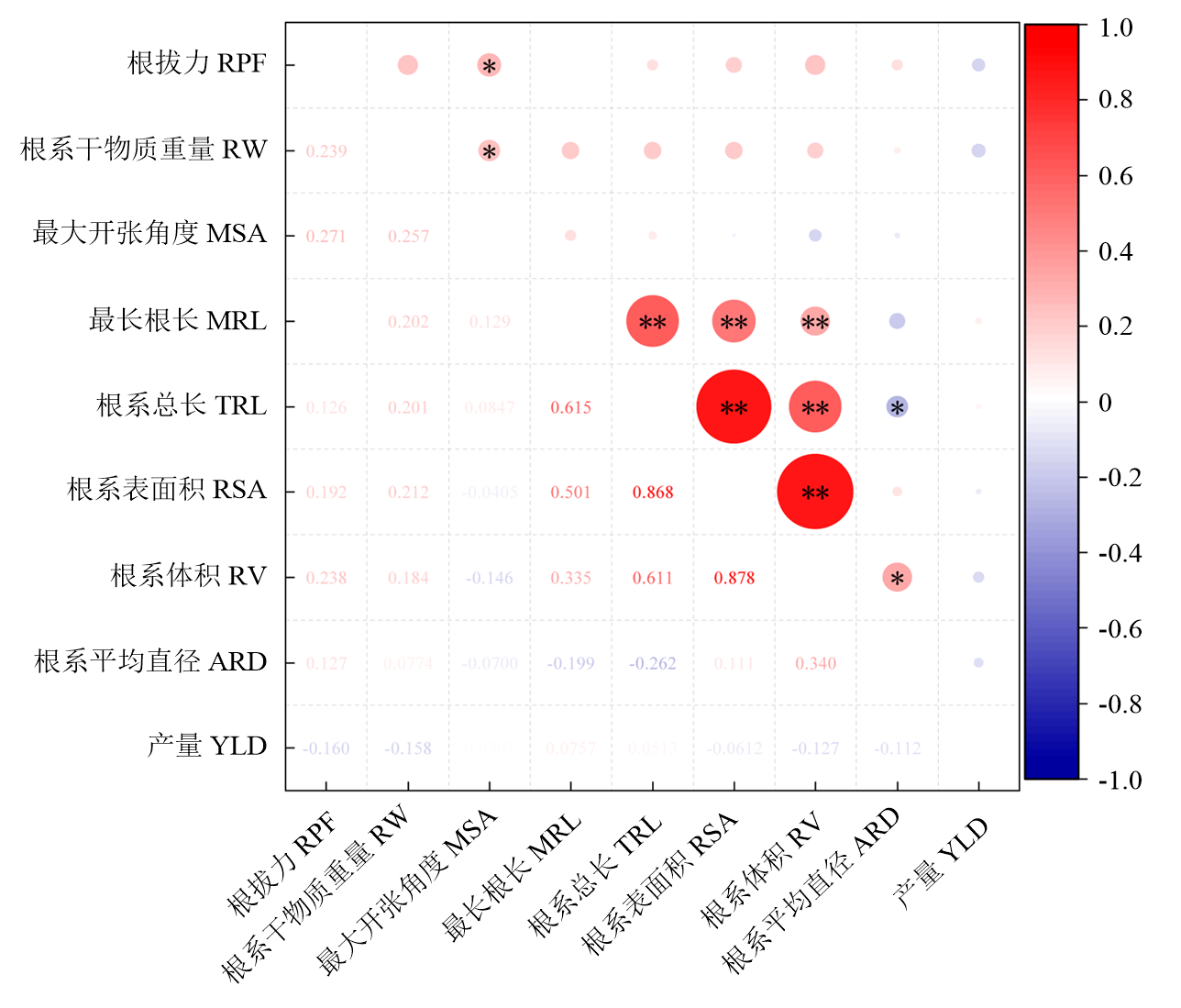
图5
糜子根系性状与产量的相关性热图"
| [1] |
程炳文, 孙玉琴, 杨军学, 张尚沛, 罗世武, 王勇, 张晓娟, 王晓军, 李凯. 糜子产业发展现状调研报告. 宁夏农林科技, 2019, 60(9): 13-15, 48.
|
|
|
|
| [2] |
乔治军. 糜子产业发展现状与思路. 作物杂志, 2013(5): 25-27.
|
|
|
|
| [3] |
杨洪伟, 张丽颖, 唐志强, 于丰华, 许童羽. 杂交粳稻茎秆力学性状与理化特征对抗倒伏能力的影响. 农业工程学报, 2024, 40(14): 44-52.
|
|
|
|
| [4] |
常汇琳, 高世伟, 刘晴, 刘宇强, 马成, 沙汉景, 王婧泽, 聂守军. 水稻茎秆强度遗传研究进展. 中国农学通报, 2025, 41(21): 36-42.
doi: 10.11924/j.issn.1000-6850.casb2025-0504 |
|
doi: 10.11924/j.issn.1000-6850.casb2025-0504 |
|
| [5] |
桑梦祥, 胡文河. 玉米根系对玉米抗倒伏性影响的研究进展. 中国农业文摘-农业工程, 2023, 35(2): 72-76.
|
|
|
|
| [6] |
王静, 王志红, 侯现军, 艾振光, 闫丽慧, 王昌亮, 张国合, 常建智. 玉米自交系气生根性状与抗倒伏相关分析. 作物杂志, 2026(2): 23-29.
|
|
|
|
| [7] |
刘阳, 张培文, 李浩杰, 雍玉东, 张士雅, 肖龙飞, 周文银, 闫素辉. 沿淮地区小麦茎秆基部节间性状与抗倒伏能力的关系. 江苏农业科学, 2025, 53(19): 121-129.
|
|
|
|
| [8] |
罗肖郧, 郑兴飞, 彭宣国, 余启芝, 董华林, 殷得所, 王红波, 胡建林, 薛莲, 胡鹏, 等. 水稻抗倒伏研究:现状挑战与未来方向. 中国水稻科学, 2026, 40(2): 181-195.
doi: 10.16819/j.1001-7216.2026.240905 |
|
|
|
| [9] |
王盛磊, 尚博, 何龙鑫, 邵在胜, 冯兆忠. 臭氧浓度升高下有机无机肥配施对水稻抗倒伏性状的影响. 农业环境科学学报, 2025, 44(9): 2221-2233.
|
|
|
|
| [10] |
张盼, 卢道文, 孙海潮, 董文恒, 李永江, 张莹莹, 史丽丽, 牛永锋. 种植密度对不同玉米品种茎秆力学特性及抗倒伏能力的影响. 玉米科学, 2025, 33(3): 51-57.
|
|
|
|
| [11] |
周钊恩. 不同株行距配置对大田水稻产量及抗倒性的影响[D]. 扬州: 扬州大学, 2025.
|
|
|
|
| [12] |
何绍冬, 甘长波, 康文婧, 罗霄, 孔广超. 矮壮素对硬粒小麦茎秆倒伏抗性及木质素合成影响. 石河子大学学报(自然科学版), 2025, 43(5): 614-629.
doi: 10.13880/j.cnki.65-1174/n.2025.23.014 |
|
|
|
| [13] |
王帅. 玉米抗倒伏相关性状的全基因组关联分析及遗传基础初步解析[D]. 北京: 北京科技大学, 2024.
|
|
|
|
| [14] |
王利锋, 李晶晶, 夏彦, 王森, 蔡齐宗, 马锦霞, 秦子钰, 王浩, 周柯, 杨继伟, 等. 玉米茎秆抗倒伏相关性状全基因组关联分析. 玉米科学, 2025, 33(7): 39-45.
|
|
|
|
| [15] |
doi: 10.1111/jipb.v64.1 |
| [16] |
王宇先, 李清泉, 赵蕾, 刘玉涛, 徐莹莹, 杨慧莹, 高盼. 主要气象因子对半干旱地区糜子倒伏性状指标的影响. 黑龙江农业科学, 2017(11): 13-16.
|
|
|
|
| [17] |
王宇先. 水分条件对糜子倒伏指标及产量的影响. 黑龙江农业科学, 2019(10): 18-21.
|
|
|
|
| [18] |
王云浩. 沟垄集雨模式下种植密度对糜子生长发育及抗倒伏性能的影响[D]. 杨凌: 西北农林科技大学, 2023.
|
|
|
|
| [19] |
文峰, 塔娜, 金晓光, 包雪莲, 张春华, 张桂华, 呼瑞梅, 黄前晶, 齐金全, 白峰, 等. 不同播期对糜子农艺性状、抗倒伏性状及产量的影响. 东北农业科学, 2024, 49(2): 25-29.
|
|
|
|
| [20] |
梁海燕, 李海, 林凤仙, 张翔宇, 张知, 宋晓强. 不同糜子品种抗倒伏性田间鉴定及抗倒评价指标的筛选分析. 作物杂志, 2018(4): 37-41.
|
|
|
|
| [21] |
王宇先. 半干旱地区糜子倒伏系数相关及通径分析. 黑龙江农业科学, 2015(7): 31-34.
|
|
|
|
| [22] |
董孔军, 刘天鹏, 何继红, 任瑞玉, 张磊, 杨天育. 糜子种质材料的抗倒伏性、农艺性状及力学特性. 西北农业学报, 2018, 27(8): 1119-1126.
|
|
|
|
| [23] |
梁海燕, 李海, 丁超, 杨芳, 宋晓强, 邓亚蕊, 刘贵山, 林凤仙, 张翔宇, 苏占明, 等. 钾肥对糜子茎秆形态、力学、生理特性及抗倒伏能力的影响. 作物杂志, 2021(6): 177-181.
|
|
|
|
| [24] |
杨芳, 宋晓强, 赵丽文, 李海, 姜超. 植物生长调节剂对糜黍生长发育的影响及评价. 农药学学报, 2025, 27(3): 492-501.
|
|
|
|
| [25] |
侯晓敏, 闫锋, 董扬, 赵富阳, 李清泉, 卢环, 张金东, 张巩亮. 调环酸钙对糜子茎秆特征及抗倒伏能力的影响. 作物杂志, https://link.cnki.net/urlid/11.1808.s.20250603.1054.004.
|
|
|
|
| [26] |
张静, 王洪章, 任昊, 殷复伟, 吴红燕, 赵斌, 张吉旺, 任佰朝, 戴爱斌, 刘鹏. 夏玉米根系构型与抗根倒性能间的关系. 作物学报, 2023, 49(1): 188-199.
doi: 10.3724/SP.J.1006.2023.23004 |
|
doi: 10.3724/SP.J.1006.2023.23004 |
|
| [27] |
doi: 10.1017/S002185960300354X |
| [28] |
doi: 10.1016/j.proenv.2015.07.269 |
| [29] |
doi: 10.1626/jcs.64.243 |
| [30] |
doi: 10.1626/jcs.63.34 |
| [31] |
|
| [32] |
秦培亮, 杨艳山, 邵金发. 不同耕作方式对小麦根系构型及抗根倒伏能力的影响. 江苏农业科学, 2025, 53(6): 105-110.
|
|
|
|
| [33] |
doi: 10.1007/s12298-018-0629-x pmid: 31168225 |
| [34] |
|
| [35] |
|
| [36] |
李伟, 吴科斌, 陈艳军, 张俊雄, 李建生. 玉米秸秆抗根倒伏强度检测方法. 农业机械学报, 2012, 43(2): 66-69.
|
|
|
| [1] | 王小玮, 杜佛力, 闫红财, 郎正东, 党志娟, 李葆春, 汪军成, 马小乐, 王化俊, 张宏, 姚立蓉. 396份春小麦灌浆期和成熟期抗旱性评价[J]. 中国农业科学, 2026, 59(8): 1608-1621. |
| [2] | 叶美金, 吴雷, Lohani Md Nahibuzzaman, 尹丽, 胡欣荣, 刘亚西, 蒋云峰, 陈国跃, 蒲至恩, 李阳, 李婷, 邹亚亚, 吴佳怡, 马建. 基于GWAS的中国地方小麦成熟胚大小位点的鉴定及其遗传效应解析[J]. 中国农业科学, 2026, 59(6): 1157-1171. |
| [3] | 陈彩锦, 马琳, 蒋庆雪, 刘金晖, 苗童, 张志鹏, 孟翔, 马晓冉, 周昕越, 张建, 刘文辉, 王学敏. 244份饲用燕麦种质资源表型性状遗传多样性分析[J]. 中国农业科学, 2025, 58(23): 4825-4836. |
| [4] | 许朵朵, 杜倩倩, 赵理想, 栗燕, 黄淦, 李永华, 逯久幸. 牡丹AP2/ERF转录因子的全基因组分析[J]. 中国农业科学, 2025, 58(23): 5031-5045. |
| [5] | 王丽媛, 王晖, 王穆穆, 王东建, 李汝玉, 郑永胜, 张晗. 陆地棉DUS测试已知品种DNA指纹数据库构建及应用[J]. 中国农业科学, 2025, 58(22): 4570-4588. |
| [6] | 赵甜甜, 袁剑龙, 卓峰琦, 唐振三, 徐杰, 张峰. 马铃薯全粉品质综合评价及品种筛选[J]. 中国农业科学, 2025, 58(13): 2522-2537. |
| [7] | 张天宇, 刘丽君, 杨刚, 武军艳, 蒲媛媛, 马骊, 王旺田, 路晓明, 马愿强, 孙万仓. 2006—2022年北方白菜型冬油菜农艺性状遗传增益分析[J]. 中国农业科学, 2025, 58(11): 2081-2095. |
| [8] | 李佳慧, 李悦琦, 周晓芳, 范国元, 李爱华, 陶永胜. 干红葡萄酒单宁质量的多维表征方法分析[J]. 中国农业科学, 2025, 58(10): 2022-2034. |
| [9] | 戎亚思, 李丰, 张鹏钰, 王东勇, 苏小雨, 田媛, 高桐梅. 基于主成分-聚类分析芝麻盛花期耐高温评价及品种筛选[J]. 中国农业科学, 2024, 57(20): 3957-3973. |
| [10] | 张毅, 刘颖, 程存刚, 李燕青, 李壮. 牛粪与化肥配施比例对苹果园土壤有机碳库和酶活性的影响[J]. 中国农业科学, 2024, 57(20): 4107-4118. |
| [11] | 杨春, 杨代星, 李燕, 梁思慧, 邓小强, 乔大河, 陈娟, 郭燕, 林开勤, 陈正武. 贵州大树茶形态学特征及生化成分综合分析[J]. 中国农业科学, 2024, 57(19): 3894-3916. |
| [12] | 王脉, 董清峰, 高珅奥, 刘德政, 卢山, 乔朋放, 陈亮, 胡银岗. 小麦苗期根系性状的全基因组关联分析与优异位点挖掘[J]. 中国农业科学, 2023, 56(5): 801-820. |
| [13] | 侯赵玉, 龚亦钊, 钱祎, 程卓雅, 陶俊, 赵大球. 芍药耐热性评价及其鉴定指标筛选[J]. 中国农业科学, 2023, 56(23): 4742-4756. |
| [14] | 王倩, 董孔军, 薛亚鹏, 刘少雄, 王若楠, 杨佳琪, 陆平, 王瑞云, 杨天育, 刘敏轩. 糜子核心种质成株期抗旱性鉴定评价与抗旱种质筛选[J]. 中国农业科学, 2023, 56(21): 4163-4174. |
| [15] | 马智秀, 柴少华, 郭岩, 石兴, 杨清华, 高金锋, 高小丽, 冯佰利, 杨璞. 基于GYT双标图分析对国家糜子区域试验品种的综合评价[J]. 中国农业科学, 2023, 56(16): 3062-3076. |
|
||
