






中国农业科学 ›› 2026, Vol. 59 ›› Issue (14): 3105-3120.doi: 10.3864/j.issn.0578-1752.2026.14.009
刘家璇1( ), 曹红霞1(), 任利宇2, 马丽娜3, 张斌2, 沈佳琪1, 李志军1
收稿日期:2025-09-02
接受日期:2025-10-21
出版日期:2026-07-16
发布日期:2026-07-21
通信作者:
联系方式:
刘家璇,E-mail:liujiaxuan202203@163.com。
基金资助:
LIU JiaXuan1(), CAO HongXia1(), REN LiYu2, MA LiNa3, ZHANG Bin2, SHEN JiaQi1, LI ZhiJun1
Received:2025-09-02
Accepted:2025-10-21
Published:2026-07-16
Online:2026-07-21
摘要:
【目的】明确“四位一体”技术下覆膜微量滴灌条件中不同施肥量和基追比对谷子氮素吸收与地上部生物量累积的影响,构建不同基追比条件下的谷子临界氮稀释曲线,评价贝叶斯分层模型在曲线参数估计中的适用性,并结合氮营养指数与产量响应确定适宜施肥量及基追比,为陕北旱作区谷子水肥一体化条件下精准氮肥管理提供理论依据。【方法】于2023—2024年在陕西榆林开展为期两年的大田滴灌施肥试验,设置B82(基肥﹕追肥=8﹕2)、B64(基肥﹕追肥=6﹕4)和B46(基肥﹕追肥=4﹕6)3个基追比和4个施肥水平(N-P2O5-K2O:0-0-0、90-45-45、120-60-60、150-75-75 kg·hm-2)。研究不同施肥量和基追比对陕北旱作补充灌溉谷子地上部生物量和植株氮浓度的影响,并分别采用经典统计方法和贝叶斯分层模型建立临界氮稀释曲线模型,最终确定最佳的施肥管理策略。【结果】处理B64能够有效促进植株氮素的吸收和地上部生物量的累积,植株地上部生物量和氮浓度总体表现为B64>B82>B46处理。研究发现,不同基追比处理下,临界氮稀释曲线相关参数未表现出统计学显著差异,但降水较少的年份会使曲线稀释曲线参数A2偏大,同时增大了B46处理参数的不确定性。在此基础上,基于贝叶斯统计方法提出2023、2024年不同基追比处理的临界氮稀释曲线B82:Nc=3.58W-0.48、Nc=3.14W-0.36;B64:Nc=3.51W-0.40、Nc=3.65W-0.37;B46:Nc=3.79W-0.62、Nc=2.71W-0.36。基于曲线计算的氮营养指数(NNI)随施肥量增加而升高,NNI在120-60-60 kg·hm-2施肥水平下接近1,此时相对产量(RY)达到最大。综合生物量和产量分析,本试验条件下谷子的最佳施肥量为120-60-60 kg·hm-2,最优基追比为6﹕4。【结论】采用贝叶斯与经典统计构建谷子不同基追比临界氮稀释曲线,贝叶斯估算不确定性更低、精度更优。综合多指标确定当地谷子最佳基追比6﹕4,氮磷钾120-60-60 kg·hm⁻2为适宜施肥量。
刘家璇, 曹红霞, 任利宇, 马丽娜, 张斌, 沈佳琪, 李志军. 覆膜微量滴灌条件下旱地谷子临界氮稀释曲线模型构建与氮营养诊断[J]. 中国农业科学, 2026, 59(14): 3105-3120.
LIU JiaXuan, CAO HongXia, REN LiYu, MA LiNa, ZHANG Bin, SHEN JiaQi, LI ZhiJun. Construction of a Critical Nitrogen Dilution Curve Model and Nitrogen Nutrition Diagnosis for Dryland Foxtail Millet Under Film Mulching with Micro-Drip Irrigation[J]. Scientia Agricultura Sinica, 2026, 59(14): 3105-3120.
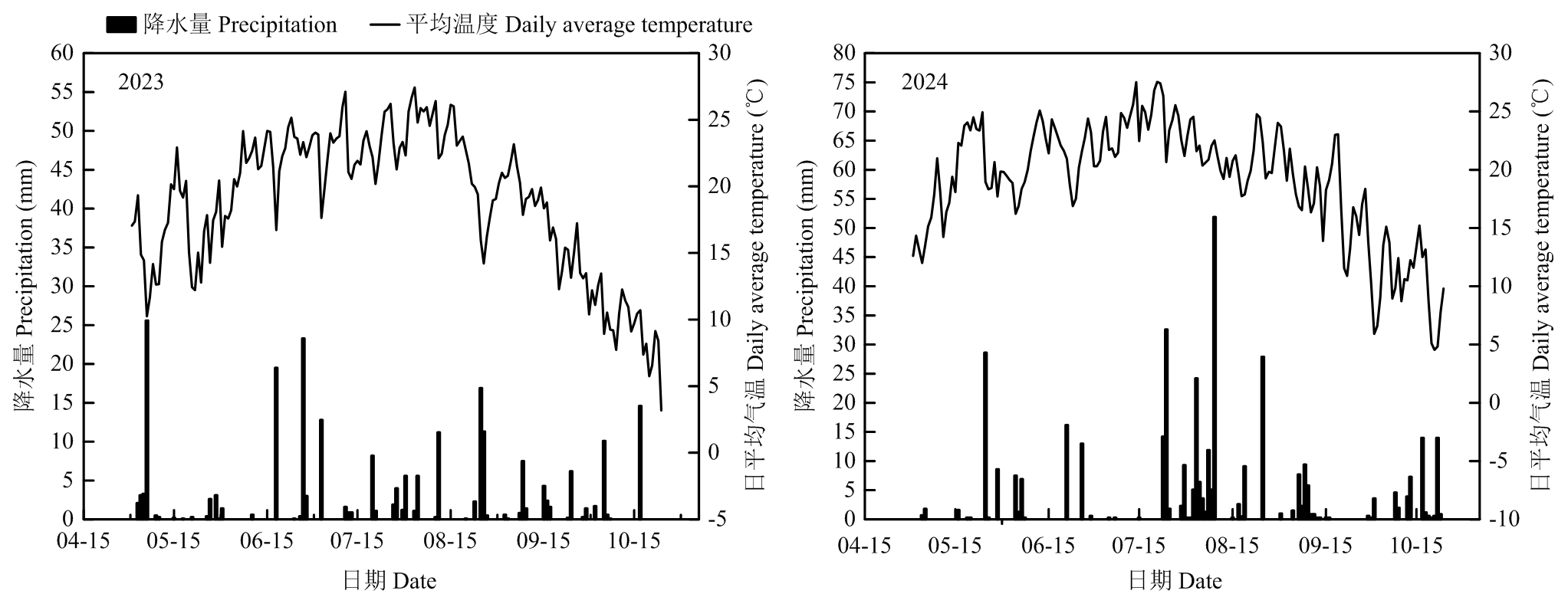
图1
2023和2024年试验地谷子生育期内日平均温度与日降雨量"
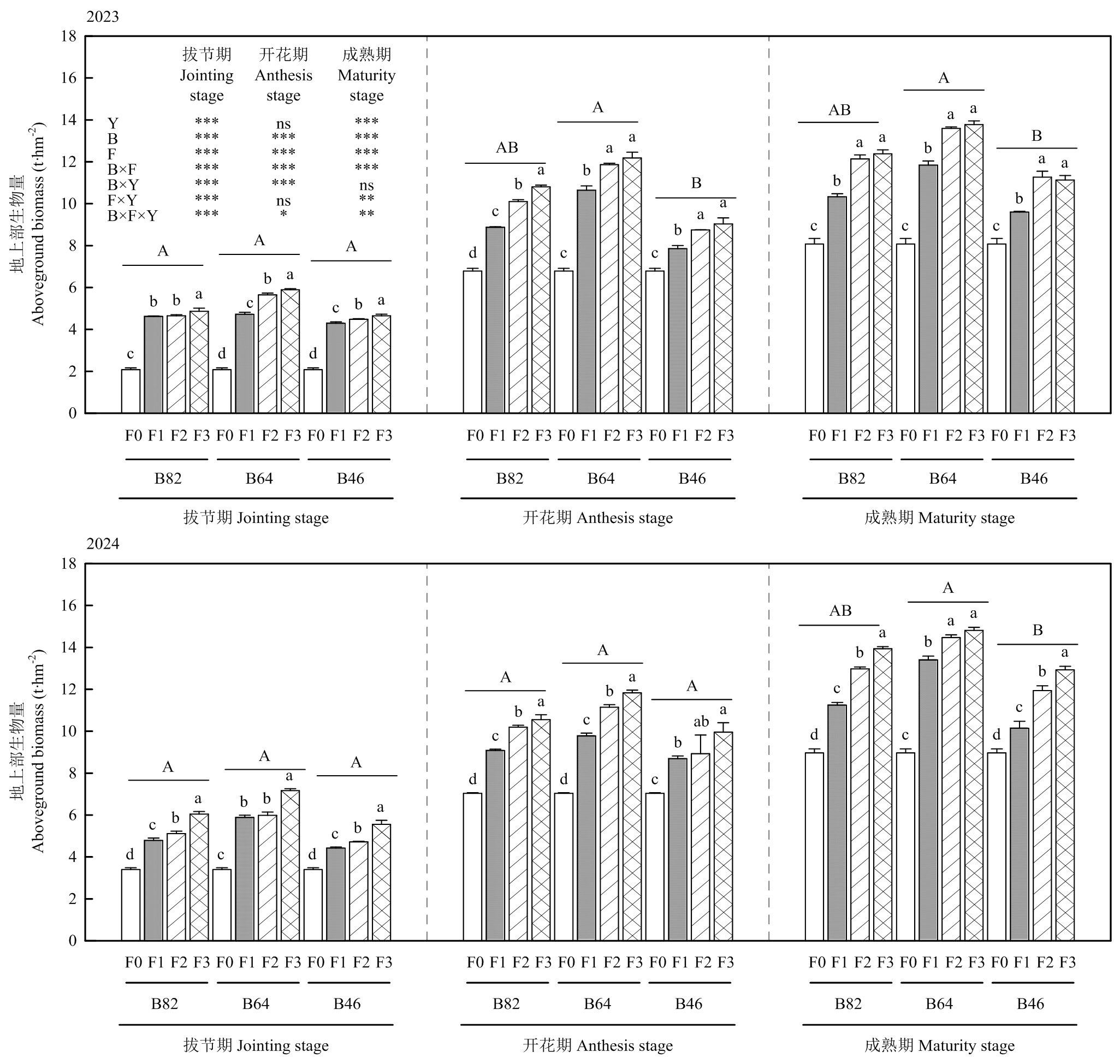
图2
2023和2024年不同基追比条件下氮磷钾施肥量对谷子地上部生物量的影响 柱上不同小写字母表示年内同一基追比不同施肥量间差异显著(P<0.05),大写字母表示年内不同基追比间差异显著(P<0.05)。Y:年份;B:基追比;F:施肥量。*、**和***分别表示在0.05、0.01和0.001水平上差异显著,ns差异不显著。下同"
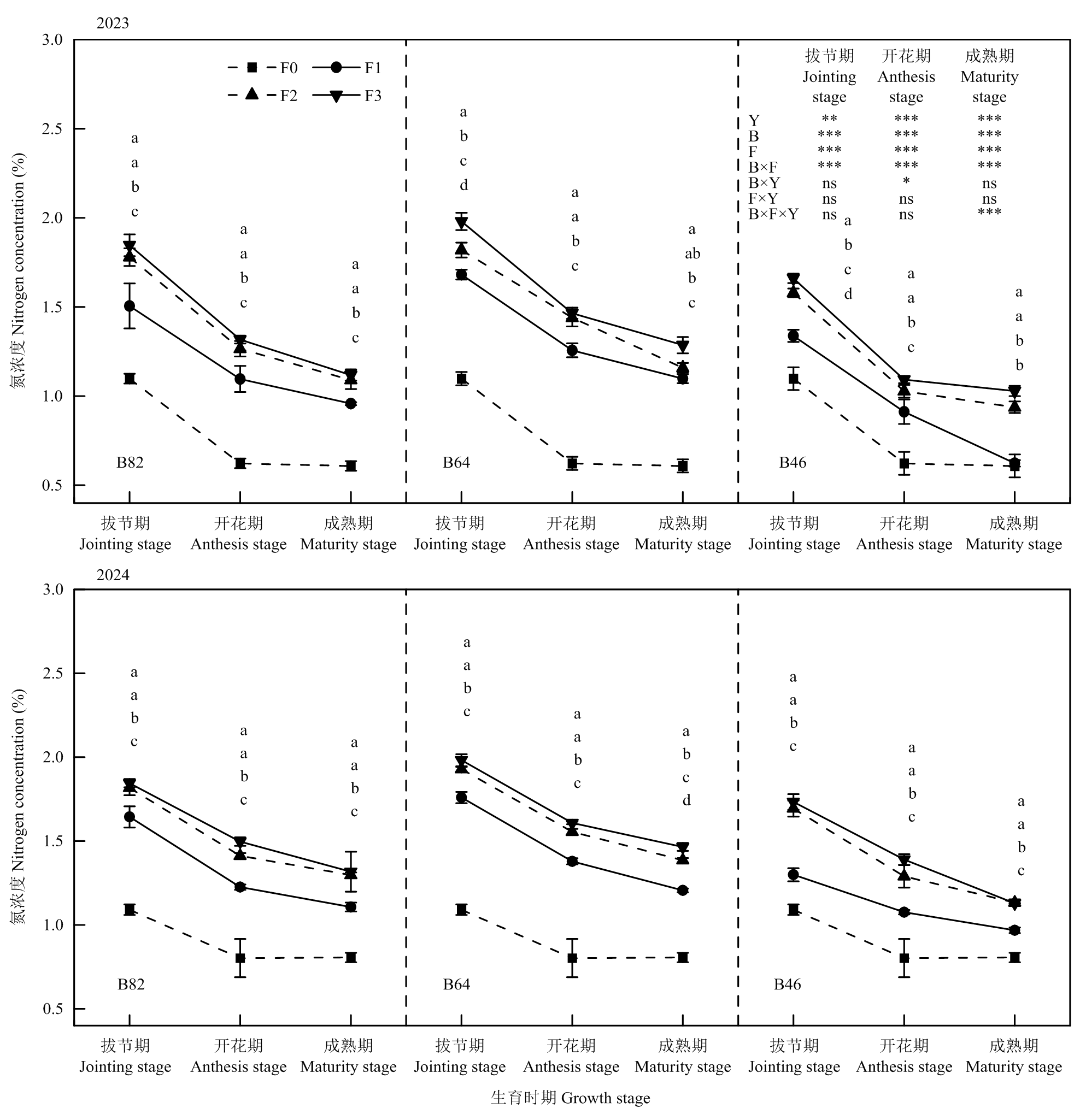
图3
2023和2024年不同基追比条件下不同氮磷钾施肥量对谷子地上部植株氮浓度的影响"
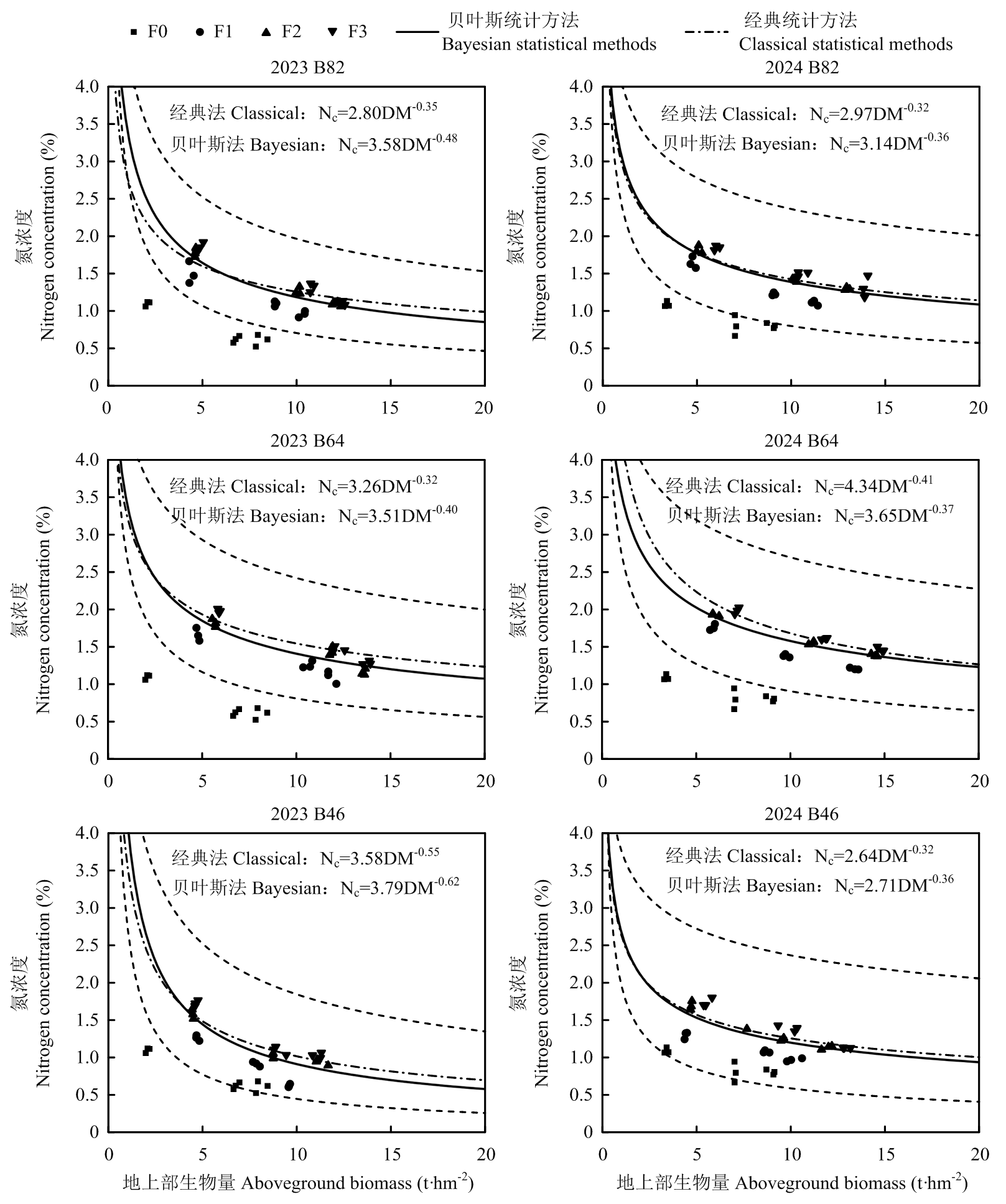
图4
2023和2024年不同基追比条件下基于经典统计方法和贝叶斯统计方法建立谷子临界氮稀释曲线及其95%置信区间"
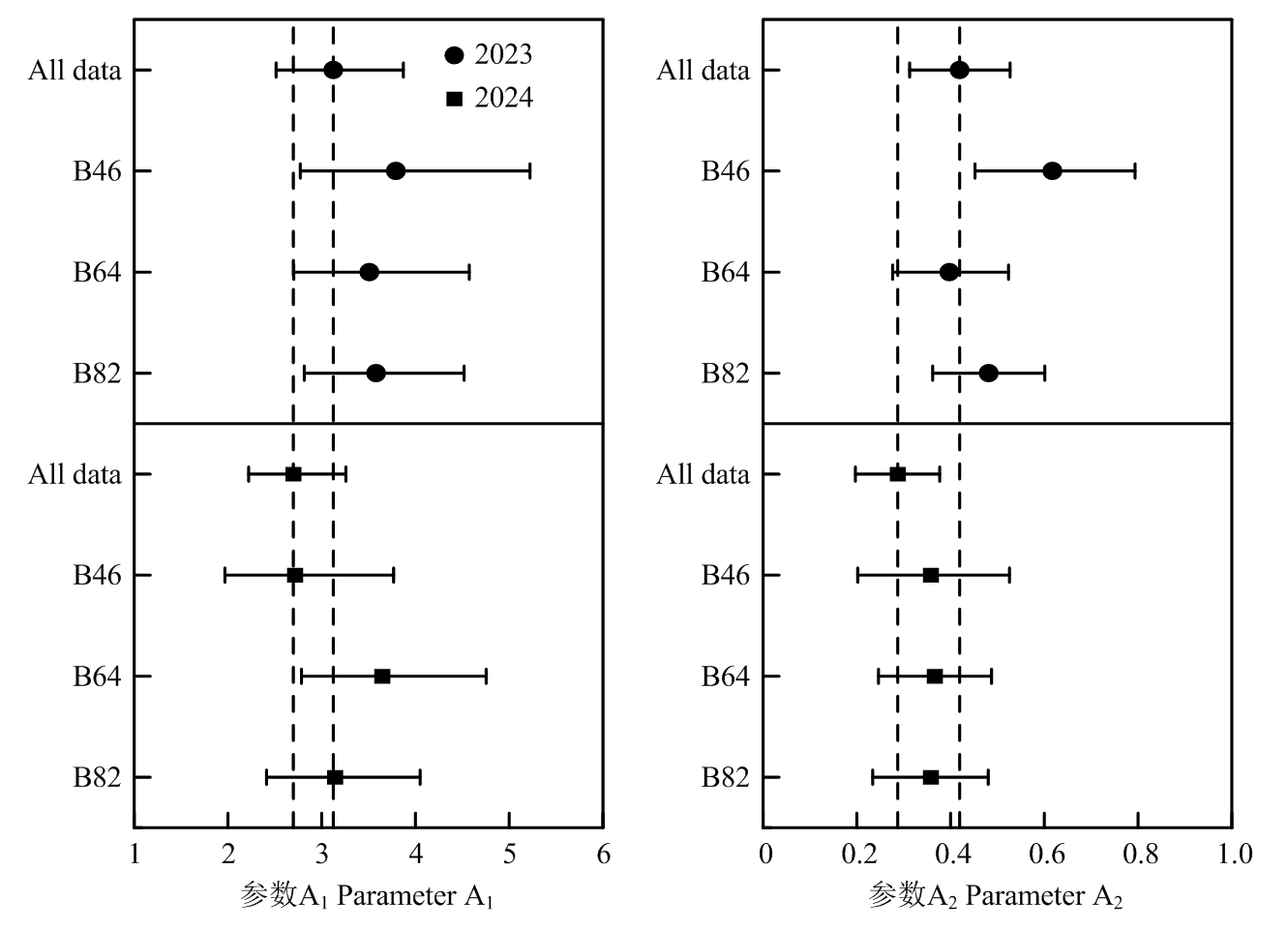
图5
基于贝叶斯方法估计2023和2024年不同处理的参数A1、A2及其95%置信区间"
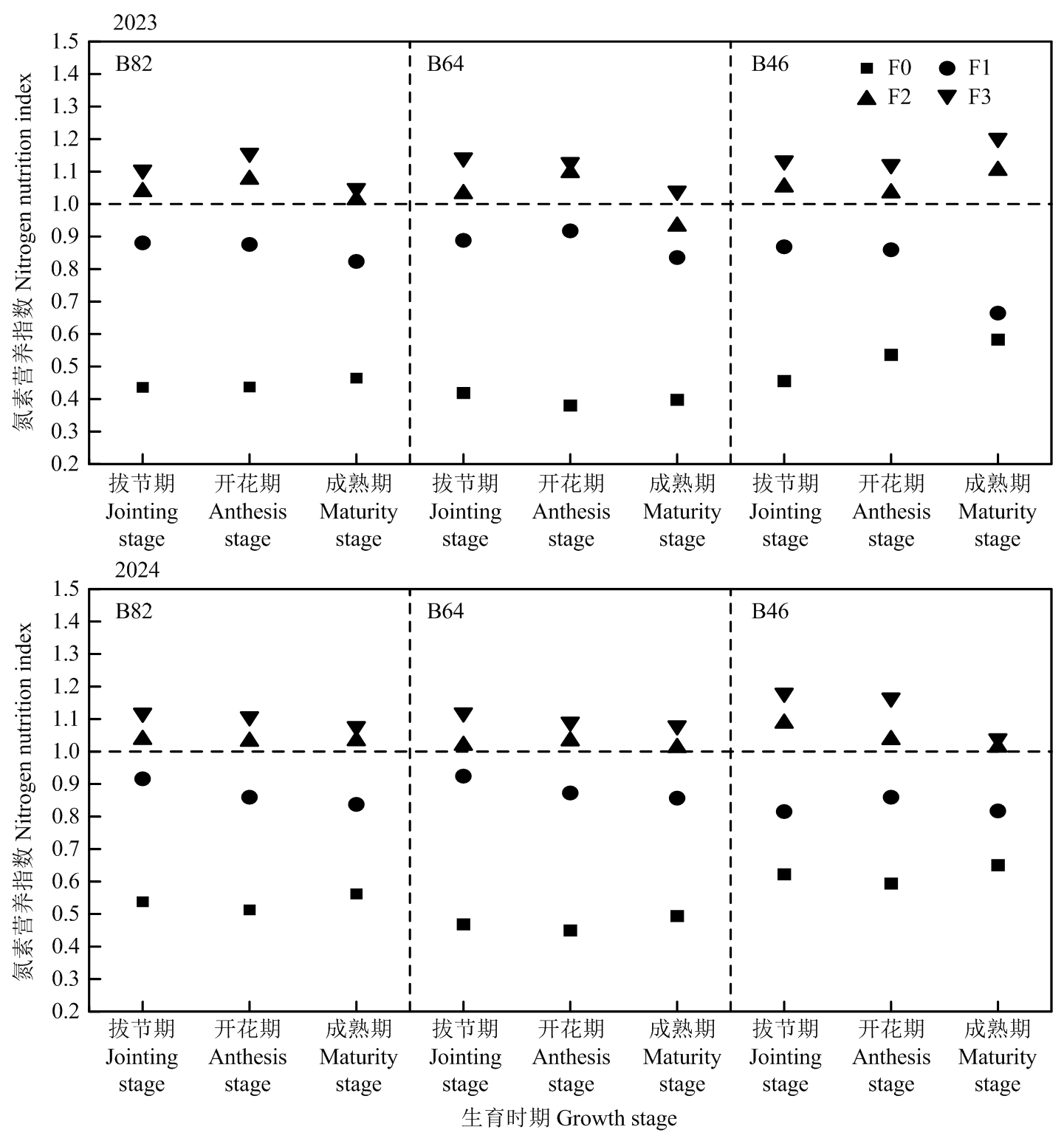
图6
2023和2024年不同基追比条件下谷子各生育时期氮营养指数(NNI)"
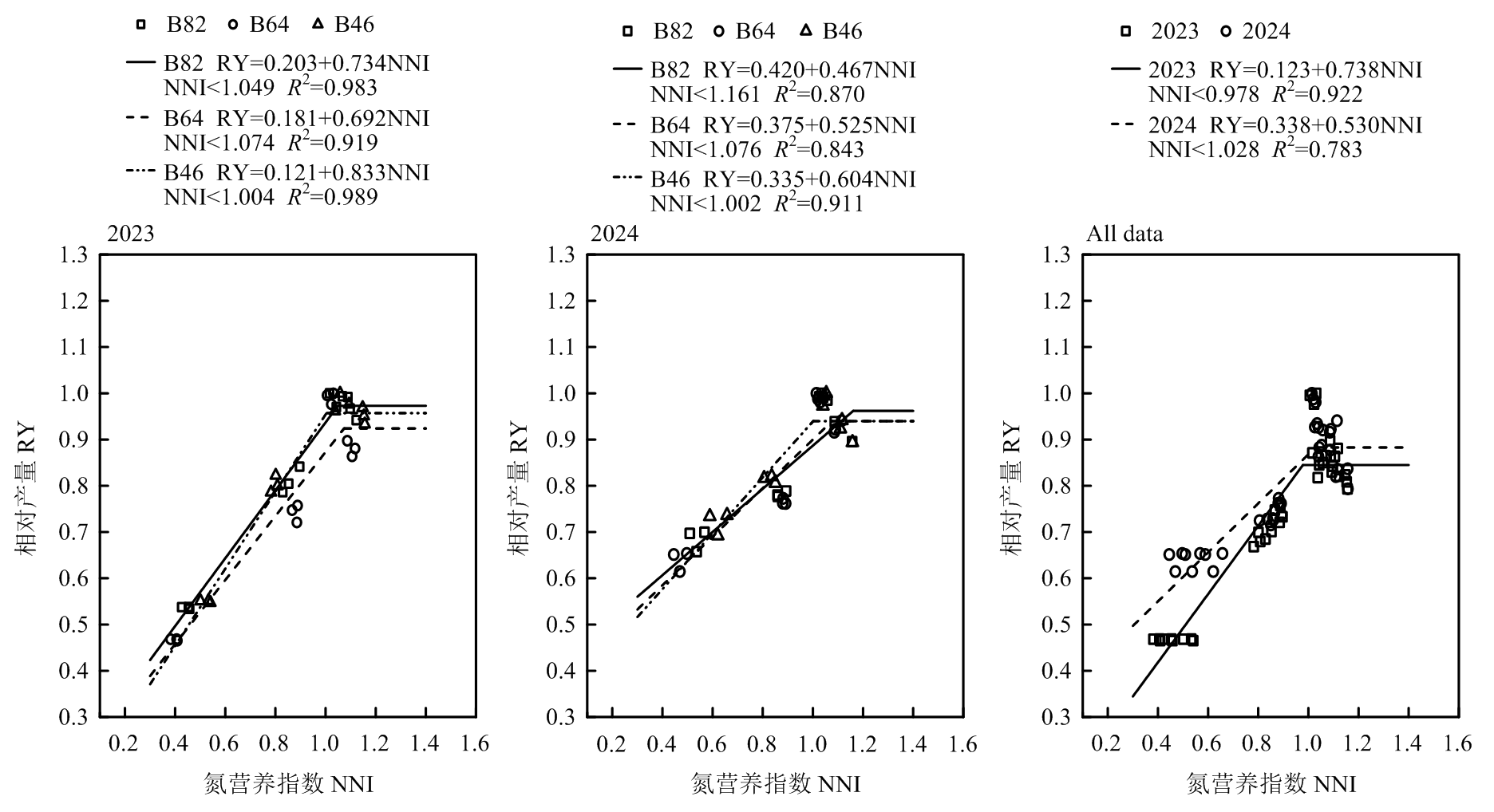
图7
2023和2024年不同基追比条件下以及各年份所有基追比条件下谷子相对产量(RY)与平均氮营养指数(NNI)之间的关系"
| [1] |
doi: 10.3390/foods12132545 |
| [2] |
赵利蓉. 不同生态区谷子品种农艺性状和品质分析[J]. 作物杂志, 2022(2): 44-53.
|
|
|
|
| [3] |
张静怡. 区域水资源优化配置及种植结构研究: 以陕北为例[D]. 杨凌: 西北农林科技大学, 2022.
|
|
|
|
| [4] |
刘朋召, 师祖姣, 宁芳, 王瑞, 王小利, 李军. 不同降雨状况下渭北旱地春玉米临界氮稀释曲线与氮素营养诊断[J]. 作物学报, 2020, 46(8): 1225-1237.
doi: 10.3724/SP.J.1006.2020.03007 |
|
doi: 10.3724/SP.J.1006.2020.03007 |
|
| [5] |
doi: 10.1016/j.eja.2021.126241 |
| [6] |
李源. 肥料类型和施用量对陕北地区玉米干物质积累量、氮素效率及品质的影响[J]. 江苏农业科学, 2024, 52(14): 120-127.
|
|
|
|
| [7] |
doi: 10.1016/j.jia.2023.12.037 |
| [8] |
|
| [9] |
韦开, 邓铭江, 王全九郭毅, 蔺树栋, 穆卫谊, 陶汪海, 苏李君, 张继红. 膜下滴灌微咸水棉花临界氮稀释曲线模型与氮肥用量推荐[J]. 农业工程学报, 2024, 40(7): 124-132.
|
|
|
|
| [10] |
doi: 10.1006/anbo.1994.1133 |
| [11] |
林延荣, 刘朋召, 郭星宇, 张鹏飞, 邓明珠, 陈小莉, 李军. 平水年和欠水年渭北旱地冬小麦临界氮浓度稀释曲线构建[J]. 农业工程学报, 2023, 39(21): 120-129.
|
|
|
|
| [12] |
胡勋涛. 氮钾互作对水稻产量形成影响与养分诊断研究[D]. 南京: 南京农业大学, 2022.
|
|
|
|
| [13] |
杨慧, 曹红霞, 柳美玉, 刘世和. 水氮耦合条件下番茄临界氮浓度模型的建立及氮素营养诊断[J]. 植物营养与肥料学报, 2015, 21(5): 1234-1242.
|
|
|
|
| [14] |
贾彪, 付江鹏. 基于叶面积指数构建滴灌玉米营养生长期临界氮稀释曲线[J]. 农业工程学报, 2020, 36(6): 66-73.
|
|
|
|
| [15] |
doi: 10.1016/j.agrcom.2024.100052 |
| [16] |
doi: 10.1016/j.eja.2023.126770 |
| [17] |
doi: 10.1016/j.eja.2020.126076 |
| [18] |
doi: 10.1016/j.eja.2022.126615 |
| [19] |
doi: 10.1016/j.eja.2023.127026 |
| [20] |
doi: 10.1016/j.fcr.2025.109929 |
| [21] |
doi: 10.1016/j.cj.2025.01.009 |
| [22] |
doi: 10.3390/plants9101309 |
| [23] |
Varinderpal-Singh,
doi: 10.1007/s10705-021-10156-3 |
| [24] |
刘威, 周剑雄, 谢媛圆, 张旭, 熊又升, 徐祥玉, 袁家富, 熊汉锋. 氮肥一次性基施对夏播鲜食甜玉米产量、品质和氮素利用效率的影响[J]. 作物杂志, 2021(5): 134-139.
|
|
|
|
| [25] |
王云奇, 陶洪斌, 杨利华, 祁利潘, 张全国, 陈鹏飞, 王璞. 氮肥管理对夏玉米冠层结构和氮肥吸收利用的影响[J]. 玉米科学, 2013, 21(3): 125-130.
|
|
|
|
| [26] |
曾祥明, 韩宝吉, 徐芳森, 黄见良, 蔡红梅, 石磊. 不同基础地力土壤优化施肥对水稻产量和氮肥利用率的影响[J]. 中国农业科学, 2012, 45(14): 2886-2894. DOI: 10.3864/j.issn.0578-1752.2012.14.011.
|
|
|
|
| [27] |
王海琪, 黄艺华, 蒋桂英, 刘钰婷, 车子强. 氮肥基追比例对滴灌春小麦氮代谢及氮肥利用率的影响[J]. 水土保持学报, 2022, 36(1): 297-306, 315.
|
|
doi: 10.1080/00224561.1981.12436125 |
|
| [28] |
吕冰. 氮磷肥基追比例及叶面喷锌对中麦8号产量及品质的影响[D]. 杨凌: 西北农林科技大学, 2017.
|
|
|
|
| [29] |
doi: 10.1016/j.fcr.2024.109713 |
| [30] |
doi: 10.3390/agronomy10040556 |
| [31] |
doi: 10.1093/oxfordjournals.aob.a087463 |
| [32] |
doi: 10.1016/j.fcr.2018.01.030 |
| [33] |
doi: 10.1016/j.eja.2021.126315 |
| [34] |
刘力玮, 刘洋, 张杨, 聂威, 吴强文, 曲远凯, 闫慧峰. 基于贝叶斯统计的烤烟叶片临界氮稀释曲线构建[J]. 植物营养与肥料学报, 2024, 30(11): 2197-2206.
|
|
|
|
| [35] |
doi: 10.1016/j.fcr.2006.05.009 |
| [36] |
赵晓慧, 张艳艳, 戎亚思, 段剑钊, 贺利, 刘万代, 郭天财, 冯伟. 不同水氮条件下冬小麦穗器官临界氮稀释模型研究[J]. 中国农业科学, 2022, 55(17): 3321-3333. DOI: 10.3864/j.issn.0578-1752.2022.17.005.
|
|
|
|
| [37] |
doi: 10.1016/j.agwat.2017.02.006 |
| [38] |
刘小刚, 张富仓, 杨启良, 李志军. 玉米叶绿素、脯氛酸、根系活力对调亏灌溉和氮肥处理的响应[J]. 华北农学报, 2009, 24(4): 106-111.
doi: 10.7668/hbnxb.2009.04.022 |
|
|
|
| [39] |
刘苗, 刘朋召, 师祖姣, 王小利, 王瑞, 李军. 氮磷配施下夏玉米临界氮浓度稀释曲线的构建与氮营养诊断[J]. 中国农业科学, 2022, 55(5): 932-947. DOI: 10.3864/j.issn.0578-1752.2022.05.008.
|
|
|
|
| [40] |
doi: 10.1016/j.fcr.2021.108301 |
| [41] |
卜明娜, 杨习文, 滕政凯, 胡乃月, 张烁, 王春艳, 杨键, 梁文宪, 马文奇, 贺德先, 周苏玫. 不同灌水条件下分层施肥对土壤养分垂直分布与小麦根系生长和功能的影响[J]. 中国农业科学, 2024, 57(11): 2125-2142. DOI: 10.3864/j.issn.0578-1752.2024.11.007.
|
|
|
|
| [42] |
银敏华, 李援农, 李昊, 徐袁博, 周昌明, 张天乐. 氮肥运筹对夏玉米根系生长与氮素利用的影响[J]. 农业机械学报, 2016, 47(6): 129-138.
|
|
|
|
| [43] |
沈晗, 石俊雄, 杨凯, 朱启法, 汤朝起, 张恒, 徐玮杰, 裴洲洋, 李世金, 朱经伟. 化肥减量条件下水溶性追肥比例对烤烟产质量的影响[J]. 中国土壤与肥料, 2021(5): 89-94.
|
|
|
|
| [44] |
米国华, 陈范骏, 春亮, 郭亚芬, 田秋英, 张福锁. 玉米氮高效品种的生物学特征[J]. 植物营养与肥料学报, 2007, 13(1): 155-159.
|
|
|
|
| [45] |
安志超, 黄玉芳, 汪洋, 赵亚南, 岳松华, 师海斌, 叶优良. 不同氮效率夏玉米临界氮浓度稀释模型与氮营养诊断[J]. 植物营养与肥料学报, 2019, 25(1): 123-133.
|
|
|
|
| [46] |
doi: 10.1016/j.jia.2024.08.027 |
| [47] |
doi: 10.1016/j.jafr.2024.101296 |
| [48] |
李彤瑶. 施氮水平对披碱草属牧草种子生产的影响及临界氮稀释曲线建立[D]. 成都: 西南民族大学, 2023.
|
|
|
|
| [49] |
doi: 10.1093/oxfordjournals.aob.a088044 |
| [50] |
doi: 10.1080/01904167.2012.698354 |
| [51] |
梁效贵, 张经廷, 周丽丽, 李旭辉, 周顺利. 华北地区夏玉米临界氮稀释曲线和氮营养指数研究[J]. 作物学报, 2013, 39(2): 292-299.
|
|
doi: 10.3724/SP.J.1006.2013.00292 |
|
| [52] |
doi: 10.1016/j.eja.2023.127079 |
| [53] |
doi: 10.1016/j.fcr.2016.04.027 |
| [54] |
doi: 10.1016/j.eja.2008.01.005 |
| [55] |
doi: 10.1016/S2095-3119(19)62688-2 |
| [56] |
王新, 董承光, 余渝, 马晓梅, 黄小芳, 田琴, 韦轩, 周小凤. 基于临界氮浓度的南疆滴灌棉花氮营养诊断及产量估算. 应用生态学报, 2023, 34(3): 688-698.
doi: 10.13287/j.1001-9332.202303.010 |
|
doi: 10.13287/j.1001-9332.202303.010 |
|
| [57] |
周浩露, 申朝阳, 罗新宇, 黄英惠, 王可心, 王云浩, 高小丽. 氮肥对垄沟集雨种植谷子氮素利用效率及产量的影响[J]. 中国农业科学, 2024, 57(5): 885-899. DOI: 10.3864/j.issn.0578-1752.2024.05.005.
|
|
|
| [1] | 谢永祥, 潘怡敏, 黄蕊, 秦慧彬, 侯森, 贺强, 凌亮, 穆志新, 王海岗. 山西谷子种质资源耐瘠性鉴定及综合评价[J]. 中国农业科学, 2026, 59(11): 2325-2339. |
| [2] | 张义茹, 韩雪, 姚鑫杰, 冯军, 魏爱丽, 李文超, 张彬, 韩渊怀, 李红英. 基于多组学解析谷子后熟米色变化的分子机制[J]. 中国农业科学, 2025, 58(9): 1702-1718. |
| [3] | 韩林蒲, 马纪龙, 齐勇杰, 高嘉琪, 谢铁娜, 贾彪. 无人机多光谱参数与Shapley分析融合的青贮玉米生物量估算[J]. 中国农业科学, 2025, 58(18): 3632-3647. |
| [4] | 周浩露, 申朝阳, 罗新宇, 黄英惠, 王可心, 王云浩, 高小丽. 氮肥对垄沟集雨种植谷子氮素利用效率及产量的影响[J]. 中国农业科学, 2024, 57(5): 885-899. |
| [5] | 杜艳伟, 阎晓光, 赵晋锋, 贾苏卿, 王高鸿, 余爱丽, 张鹏. 谷子SiCIPK21的克隆及功能分析[J]. 中国农业科学, 2024, 57(22): 4416-4430. |
| [6] | 董二伟, 王媛, 王劲松, 刘秋霞, 黄晓磊, 焦晓燕. 施氮量对谷子产量、氮素利用及小米品质的影响[J]. 中国农业科学, 2024, 57(2): 306-318. |
| [7] | 刘得隆, 李世如, 王传星, 郭淑青, 马智秀, 武泳江, 韩慧冰, 李玉洁, 张盼盼, 杨璞. 谷子不同发育时期株高性状的变化及动态QTL定位[J]. 中国农业科学, 2024, 57(18): 3533-3550. |
| [8] | 刘丹, 安雨丽, 陶笑笑, 王孝忠, 吕典秋, 郭彦军, 陈新平, 张务帅. 西北地区制种玉米产量及氮素吸收对供氮水平的响应[J]. 中国农业科学, 2023, 56(3): 441-452. |
| [9] | 秦娜, 付森杰, 朱灿灿, 代书桃, 宋迎辉, 魏昕, 王春义, 叶珍言, 李君霞. 谷子苗期耐低氮相关性状的QTL分析[J]. 中国农业科学, 2023, 56(20): 3931-3945. |
| [10] | 李少辉, 赵巍, 刘松雁, 李朋亮, 张爱霞, 刘敬科. SDE-GC-MS结合OPLS-DA分析不同生态区谷子品种香气特征[J]. 中国农业科学, 2023, 56(13): 2586-2596. |
| [11] | 刘苗,刘朋召,师祖姣,王小利,王瑞,李军. 氮磷配施下夏玉米临界氮浓度稀释曲线的构建与氮营养诊断[J]. 中国农业科学, 2022, 55(5): 932-947. |
| [12] | 贾冠清, 刁现民. 中国谷子种业创新现状与未来展望[J]. 中国农业科学, 2022, 55(4): 653-665. |
| [13] | 赵晓慧,张艳艳,戎亚思,段剑钊,贺利,刘万代,郭天财,冯伟. 不同水氮条件下冬小麦穗器官临界氮稀释模型研究[J]. 中国农业科学, 2022, 55(17): 3321-3333. |
| [14] | 郭淑青,宋慧,柴少华,郭岩,石兴,杜丽红,邢璐,解慧芳,张扬,李龙,冯佰利,刘金荣,杨璞. 谷子生育期及穗相关性状的QTL定位[J]. 中国农业科学, 2022, 55(15): 2883-2898. |
| [15] | 武翠卿,孙静鑫,郭平毅,王宏富,武新慧. 农艺措施对谷子产量及抗倒伏力学性能的影响[J]. 中国农业科学, 2021, 54(6): 1127-1142. |
|
||
