






中国农业科学 ›› 2026, Vol. 59 ›› Issue (14): 3094-3104.doi: 10.3864/j.issn.0578-1752.2026.14.008
冯振康( ), 于爱忠(), 尹波, 张冬玲, 蔡宏玮, 侯世和, 黄亚丽, 于彦子, 霍建喆, 庞小能
收稿日期:2025-09-16
接受日期:2025-11-13
出版日期:2026-07-16
发布日期:2026-07-21
通信作者:
联系方式:
冯振康,E-mail:zkfeng2024@163.com。
基金资助:
FENG ZhenKang(), YU AiZhong(), YIN Bo, ZHANG DongLing, CAI HongWei, HOU ShiHe, HUANG YaLi, YU YanZi, HUO JianZhe, PANG XiaoNeng
Received:2025-09-16
Accepted:2025-11-13
Published:2026-07-16
Online:2026-07-21
摘要:
【目的】基于定位试验探讨土壤团聚体及其有机碳、全氮的分布特征对绿肥还田结合氮肥减施的响应,旨在为该区域小麦生产中制定合理的培肥制度提供理论依据。【方法】基于始于2018年田间定位试验中的7个处理:N100(无绿肥还田,施氮180 kg∙hm-2),G1N85(15 000 kg∙hm-2绿肥配施氮153 kg∙hm-2),G2N85(22 500 kg∙hm-2绿肥配施氮153 kg∙hm-2),G3N85(30 000 kg∙hm-2绿肥配施氮153 kg∙hm-2),G1N70(15 000 kg∙hm-2绿肥配施氮127 kg∙hm-2),G2N70(22 500 kg∙hm-2绿肥配施氮127 kg∙hm-2)和G3N70(30 000 kg∙hm-2绿肥配施氮127 kg∙hm-2)。利用该定位试验2024、2025年数据,分析其对土壤团聚体组成及碳氮养分的影响。【结果】与N100相比,绿肥还田结合氮肥减施显著增加了0—20和20—40 cm土层大团聚体(>0.25 mm)的含量,并且提高了平均重量直径(MWD)和几何平均直径(GMD),其中G3N85处理效果最优。G3N85较其他处理提高了所有粒级团聚体中有机碳和全氮含量,其中>2 mm、2—0.25 mm、0.25—0.053 mm和<0.053 mm粒级团聚体中有机碳增幅为0.7%—12.9%、1.3%—12.4%、1.2%—15.0%和3.2%—13.4%,全氮增幅为3.1%—11.4%、3.6%—11.1%、2.1—13.1%和4.9%—10.9%,且该处理大团聚体中有机碳和全氮对土壤有机碳和全氮的贡献率显著提高,增量为19.7%、23.3%和19.6%和24.2%;微团聚体和粉黏粒中的有机碳和全氮对土壤有机碳和全氮贡献率则显著降低。【结论】绿肥还田结合氮肥减施在提高0—40 cm土层大团聚体含量和稳定性的同时,还提高了团聚体中有机碳和全氮对土壤有机碳和全氮的贡献率,其中绿肥还田30 000 kg∙hm-2结合施氮153 kg·hm-2处理效果最优,可作为河西绿洲灌区麦田维持土壤结构稳定性、促进碳氮累积的合理施肥制度。
冯振康, 于爱忠, 尹波, 张冬玲, 蔡宏玮, 侯世和, 黄亚丽, 于彦子, 霍建喆, 庞小能. 麦田土壤团聚体及其有机碳、全氮分布特征对绿肥还田结合氮肥减施的响应[J]. 中国农业科学, 2026, 59(14): 3094-3104.
FENG ZhenKang, YU AiZhong, YIN Bo, ZHANG DongLing, CAI HongWei, HOU ShiHe, HUANG YaLi, YU YanZi, HUO JianZhe, PANG XiaoNeng. Soil Aggregates in Wheat Fields and Their Carbon and Nitrogen Distribution Characteristics in Response to Green Manure Application Combined with Reduced Nitrogen Fertilizer Application[J]. Scientia Agricultura Sinica, 2026, 59(14): 3094-3104.
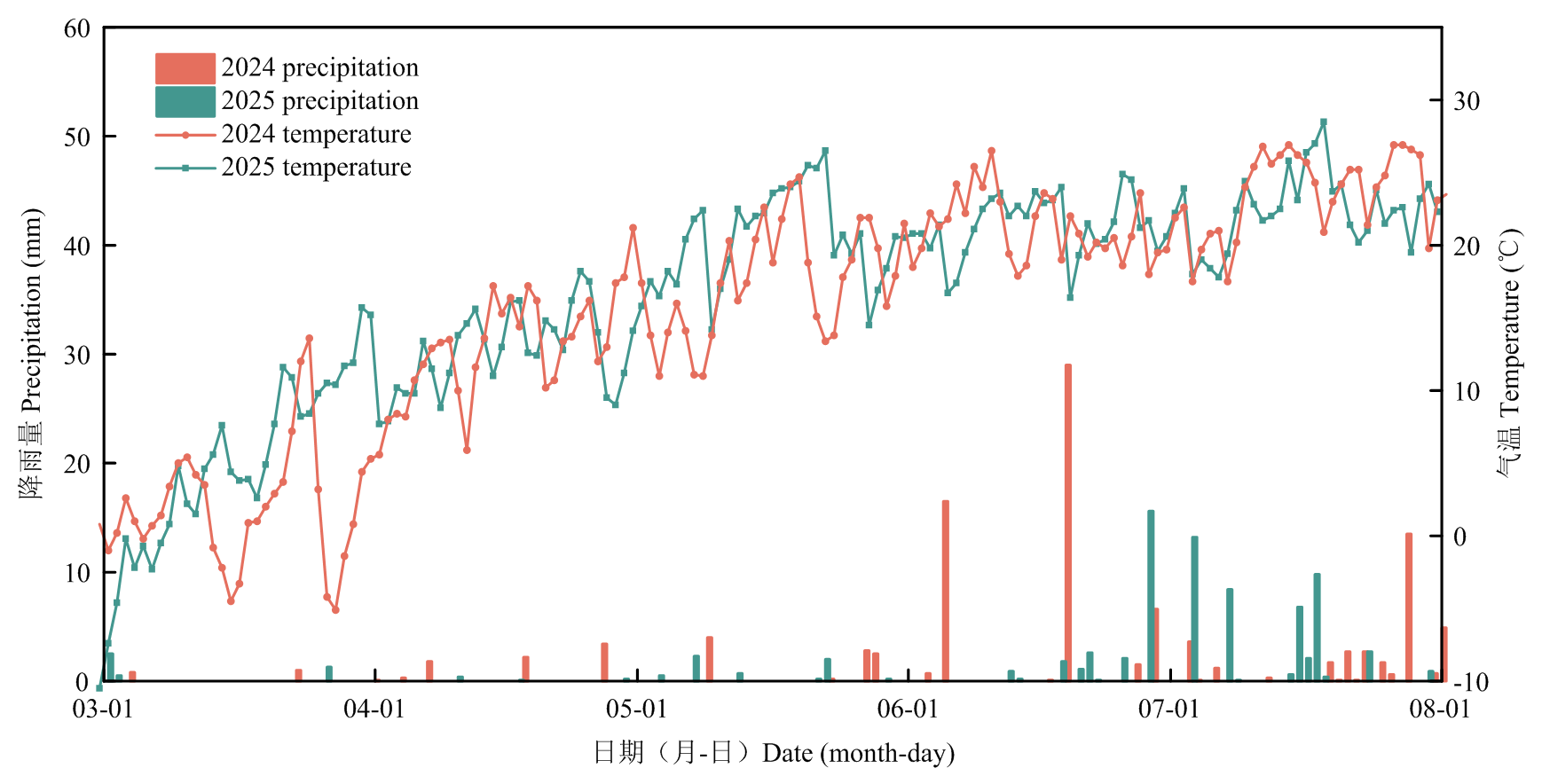
图1
2024、2025年小麦生育期试验区日降水量及日均温"
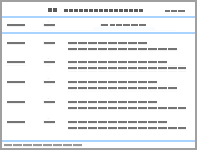
表1
绿肥还田结合氮肥减量试验方案"
| 处理代码 Treatment code | 肥料施用量Fertilizer application rate (kg∙hm-2) | ||
|---|---|---|---|
| 绿肥 Green manure | 磷肥(P2O5) Phosphate fertilizer | 氮肥(N) Nitrogen fertilizer | |
| N100 | 0 | 90 | 180 |
| G1N85 | 15 000 | 90 | 153 |
| G2N85 | 22 500 | 90 | 153 |
| G3N85 | 30 000 | 90 | 153 |
| G1N70 | 15 000 | 90 | 126 |
| G2N70 | 22 500 | 90 | 126 |
| G3N70 | 30 000 | 90 | 126 |
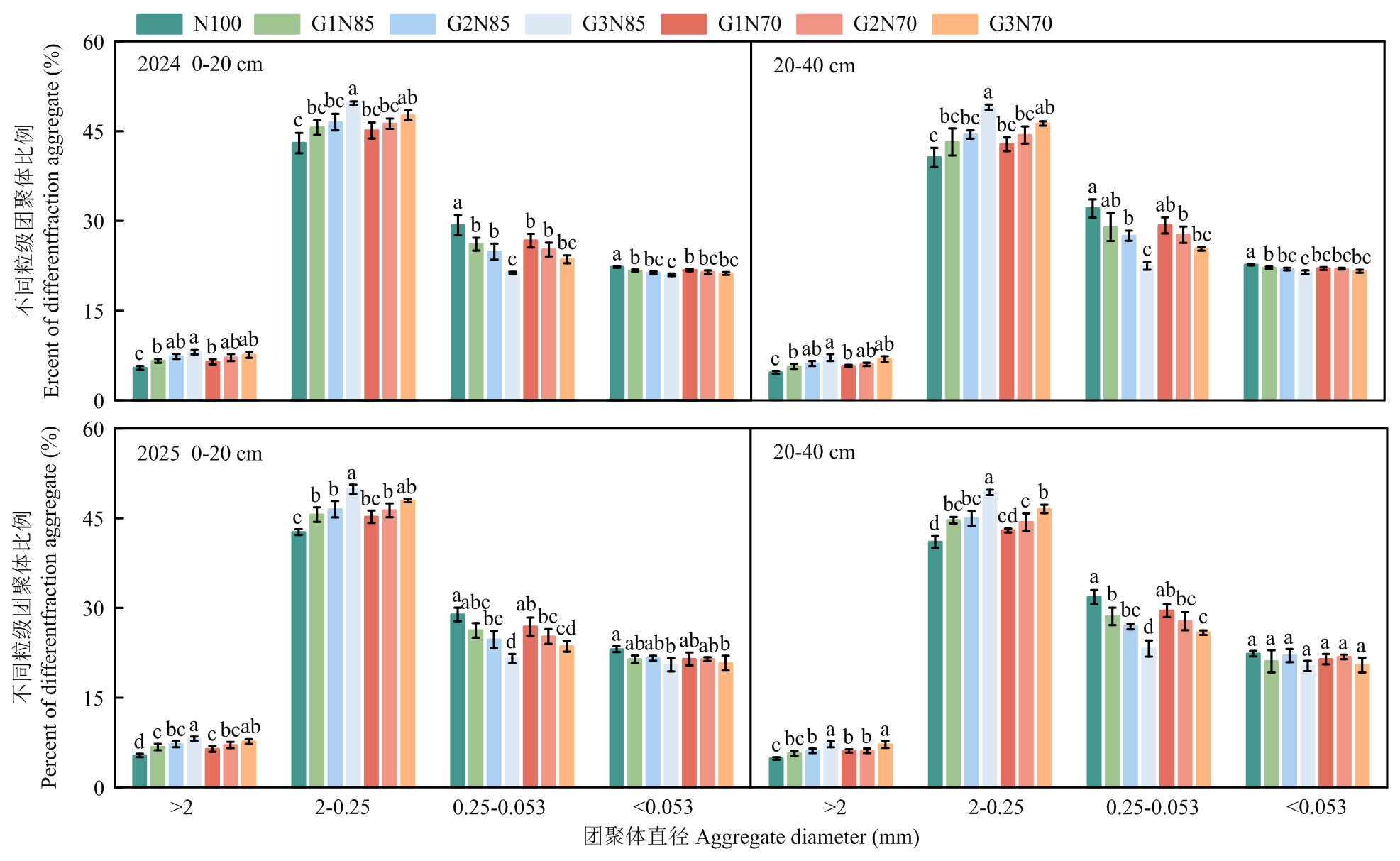
图2
不同处理各粒级团聚体的比例"
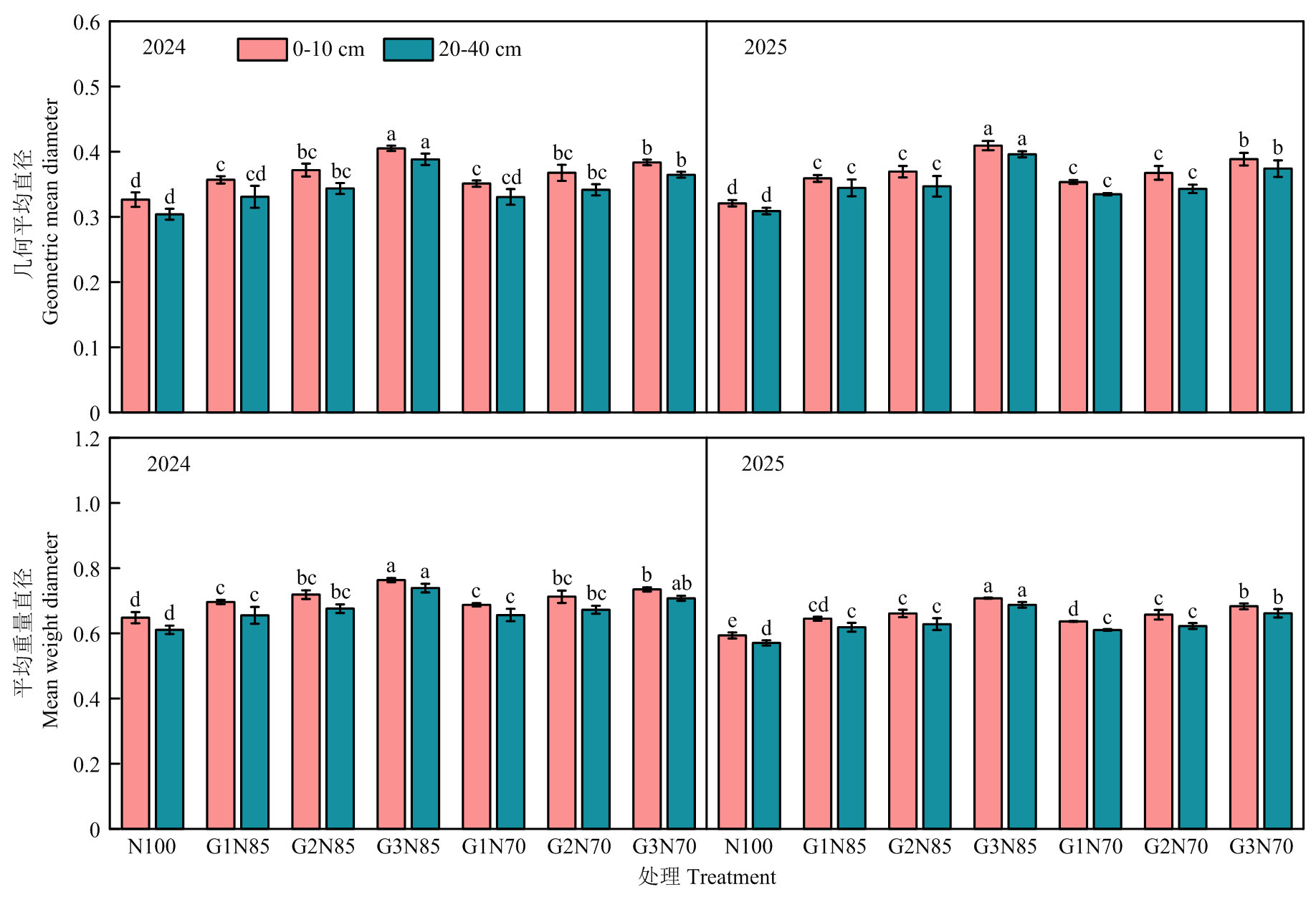
图3
不同处理土壤团聚体的平均重量直径和几何平均直径"
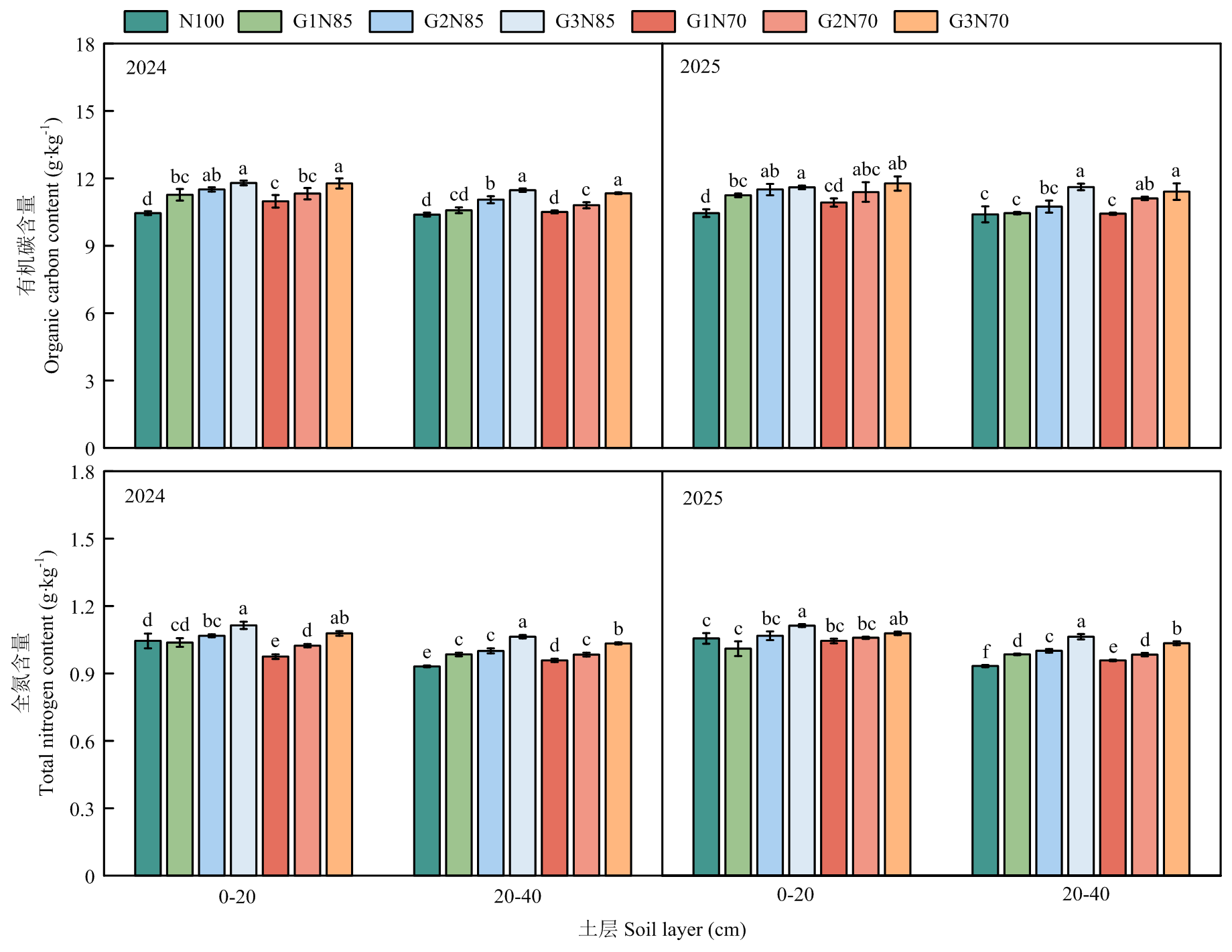
图4
不同处理0—40 cm土层有机碳和全氮含量"
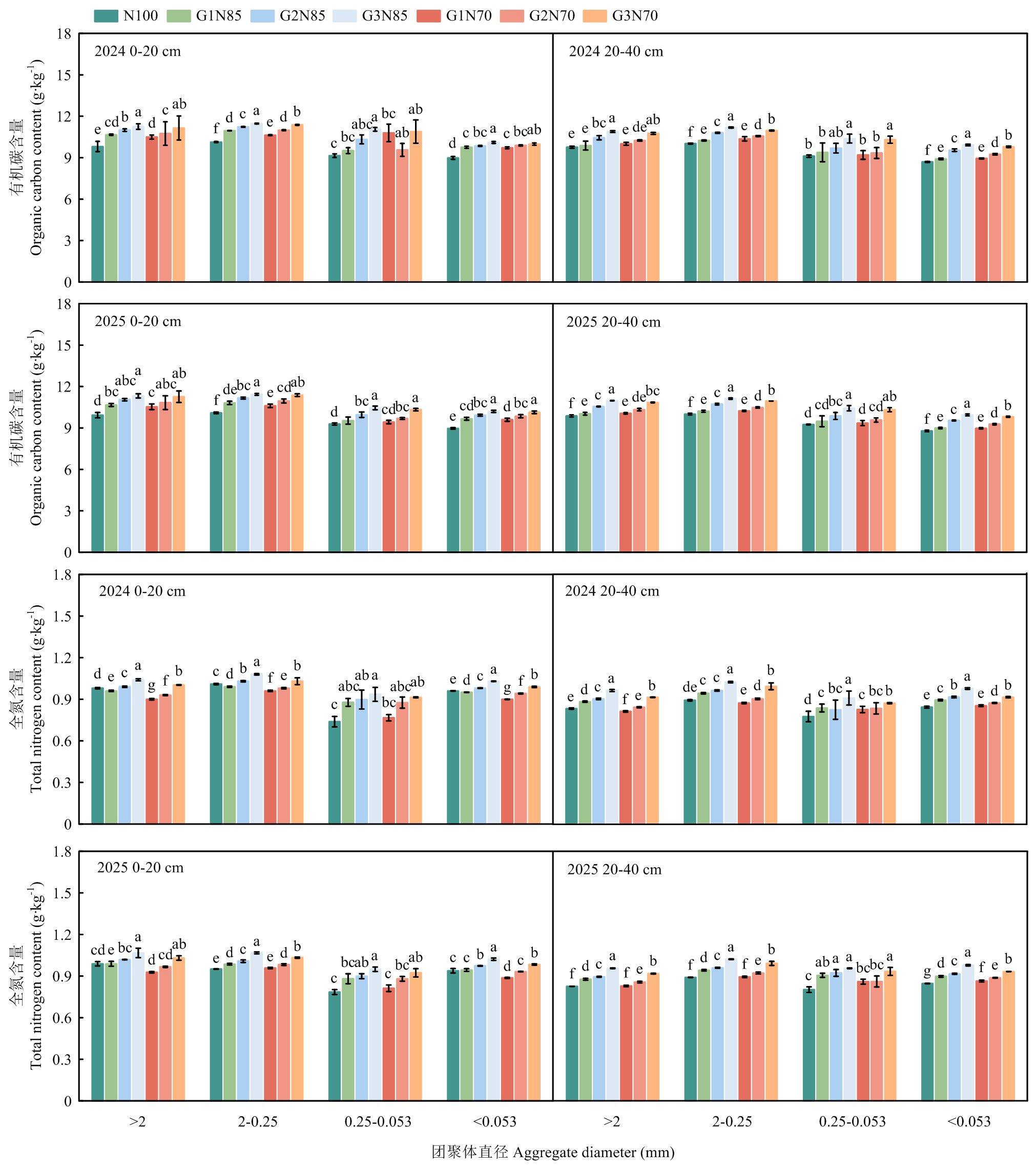
图5
不同处理各粒级团聚体中有机碳和全氮含量"
表2
不同处理各粒级团聚体中有机碳、全氮对土壤有机碳和全氮的贡献率"
| 年份 Years | 土层 Soil layer (cm) | 处理 Treatment | 有机碳贡献率 OC contribution rate (%) | 全氮贡献率 TN contribution rate (%) | |||||||
|---|---|---|---|---|---|---|---|---|---|---|---|
| 2 mm | 2-0.25 mm | 0.25-0.053 mm | <0.053 mm | 2-0.25 mm | 0.25-0.053 mm | <0.053 mm | |||||
| 2024 | 0-20 | N100 | 5.1b | 41.7b | 25.6ab | 19.2a | 5.2c | 42.8b | 21.3a | 21.1a | |
| G1N85 | 6.4b | 45.1ab | 22.4abc | 19.1a | 6.1abc | 43.5ab | 22.0a | 19.9b | |||
| G2N85 | 7.0a | 45.4ab | 22.3bc | 18.3a | 6.8ab | 44.8ab | 20.9a | 19.6b | |||
| G3N85 | 7.7a | 48.3a | 20.0c | 18.0a | 7.5a | 48.5a | 17.9a | 19.4b | |||
| G1N70 | 6.1ab | 43.8b | 26.3a | 19.3a | 5.9bc | 44.4ab | 21.0a | 20.1b | |||
| G2N70 | 6.7a | 44.9ab | 21.3bc | 18.7a | 6.5bc | 44.3ab | 21.6a | 19.7b | |||
| G3N70 | 7.2a | 46.0ab | 21.8c | 18.0a | 7.1b | 45.5ab | 20.0a | 19.4b | |||
| 20-40 | N100 | 4.4d | 39.2c | 28.2a | 19.0a | 4.2d | 38.7c | 26.6ab | 20.4a | ||
| G1N85 | 5.3c | 41.8bc | 25.7ab | 18.7a | 5.1d | 41.2c | 24.5b | 20.0a | |||
| G2N85 | 5.8bc | 43.5c | 24.1abc | 18.9a | 5.5bc | 42.6bc | 22.6b | 20.0a | |||
| G3N85 | 6.8a | 47.7a | 20.3c | 18.5a | 6.4a | 46.9a | 19.1c | 19.6ab | |||
| G1N70 | 5.5c | 42.2bc | 25.6b | 18.8a | 4.8cd | 38.8c | 29.1a | 19.6ab | |||
| G2N70 | 5.7c | 43.4c | 23.9abc | 18.8a | 5.1bcd | 40.5d | 27.0ab | 19.5ab | |||
| G3N70 | 6.5ab | 44.8b | 23.0bc | 18.6a | 6.1b | 44.2ab | 23.9b | 19.0c | |||
| 2025 | 0-20 | N100 | 5.0c | 41.2c | 25.7a | 19.8a | 5.2d | 39.9e | 22.3a | 21.3ab | |
| G1N85 | 6.5b | 44.5c | 22.6bc | 18.7a | 6.6c | 44.6c | 22.9a | 20.1ab | |||
| G2N85 | 6.9ab | 45.2bc | 21.4bcd | 18.7a | 6.9b | 43.9bcd | 20.8ab | 19.7ab | |||
| G3N85 | 7.9a | 49.1a | 19.4d | 18.0a | 7.8a | 47.8a | 18.4b | 18.8b | |||
| G1N70 | 6.2bc | 43.9bc | 23.2b | 18.9a | 5.7cd | 41.5d | 20.9ab | 18.2b | |||
| G2N70 | 6.7ab | 44.6bc | 21.4bcd | 18.6a | 6.5c | 43.0de | 21.0ab | 18.9b | |||
| G3N70 | 7.3ab | 46.4b | 20.7cd | 17.9a | 7.3ab | 45.9ab | 20.2ab | 19.0b | |||
| 20-40 | N100 | 4.6c | 39.6c | 28.3a | 18.9a | 4.3c | 39.2e | 27.3a | 20.2e | ||
| G1N85 | 5.4b | 43.7b | 26.0abc | 18.1a | 5.0c | 42.7bc | 26.3ab | 19.2bc | |||
| G2N85 | 6.0b | 44.9ab | 24.7bc | 19.6a | 5.5b | 43.1bc | 24.8ab | 20.2bc | |||
| G3N85 | 6.8a | 47.2a | 20.9d | 17.4a | 6.5a | 47.3bc | 20.9c | 18.7a | |||
| G1N70 | 5.9b | 42.2c | 26.5b | 18.5a | 5.3b | 40.1e | 26.5ab | 19.3de | |||
| G2N70 | 5.7b | 41.9c | 23.9bc | 18.2a | 5.3b | 41.5cd | 24.4ab | 19.7cd | |||
| G3N70 | 6.8a | 44.7ab | 23.4cd | 17.6a | 6.4a | 44.6b | 23.4bc | 18.4b | |||
| [1] |
doi: 10.1016/0016-7061(93)90123-3 |
| [2] |
|
| [3] |
白懿杭, 侯赛赛, 赵玉璞, 张瑞芳, 张爱军, 李旭光, 王鑫鑫. 农田土壤有机碳积累和团聚体稳定过程及其相互作用关系[J]. 中国土壤与肥料, 2024(7): 208-220.
|
|
|
|
| [4] |
韩潇杰, 任志杰, 李双静, 田培培, 卢素豪, 马耕, 王丽芳, 马冬云, 赵亚南, 王晨阳. 不同施氮量对土壤团聚体碳氮含量及小麦产量的影响[J]. 中国农业科学, 2024, 57(9): 1766-1778. DOI: 10.3864/j.issn.0578-1752.2024.09.011.
|
|
|
|
| [5] |
doi: 10.1016/j.spc.2023.11.022 |
| [6] |
doi: 10.1007/s11368-023-03688-4 |
| [7] |
doi: 10.1016/j.agee.2025.109714 |
| [8] |
doi: 10.1007/s42773-024-00398-z |
| [9] |
doi: 10.1007/s11104-024-06991-2 |
| [10] |
王鹏飞, 于爱忠, 王凤, 王玉珑, 吕汉强, 尚永盼, 尹波, 刘亚龙, 张冬玲, 霍建喆, 姜科强, 庞小能. 干旱地区绿肥还田条件下减氮对玉米农艺性状、产量及籽粒品质的影响[J]. 中国农业科学, 2025, 58(13): 2552-2563. DOI: 10.3864/j.issn.0578-1752.2025.13.005.
|
|
|
|
| [11] |
doi: 10.1016/j.catena.2021.105574 |
| [12] |
doi: 10.2134/jeq2009.0239 pmid: 20400595 |
| [13] |
doi: 10.1016/j.apsoil.2020.103735 |
| [14] |
鲍士旦. 土壤农化分析[M]. 3版. 北京: 中国农业出版社, 2000.
|
|
|
|
| [15] |
刘亚龙, 王萍, 汪景宽. 土壤团聚体的形成和稳定机制: 研究进展与展望[J]. 土壤学报, 2023, 60(3): 627-643.
|
|
|
|
| [16] |
张钦, 于恩江, 林海波, 张爱华, 陈正刚, 朱青, 曹卫东, 姚单君, 魏全全. 连续种植不同绿肥作物的土壤团聚体空间分布及稳定性特征[J]. 热带作物学报, 2018, 39(9): 1708-1717.
|
|
|
|
| [17] |
doi: 10.1016/j.agee.2024.109303 |
| [18] |
王玉珑, 于爱忠, 吕汉强, 吕奕彤, 苏向向, 王鹏飞, 柴健. 绿洲灌区麦后复种绿肥并还田对翌年玉米根系性状及水分利用效率的影响[J]. 作物学报, 2023, 49(5): 1350-1362.
doi: 10.3724/SP.J.1006.2023.23036 |
|
doi: 10.3724/SP.J.1006.2023.23036 |
|
| [19] |
doi: 10.1038/ismej.2017.56 |
| [20] |
doi: 10.1016/j.tplants.2022.04.009 |
| [21] |
谢坤, 耿明建, 聂军, 鲁艳红, 廖育林, 黄丽. 长期紫云英还田与化肥配施下水稻土团聚体中铁氧化物的演变规律[J]. 土壤学报, 2023, 60(6): 1637-1649.
|
|
|
|
| [22] |
doi: 10.1016/j.scitotenv.2024.171827 |
| [23] |
刘哲, 孙增慧, 张瑞庆. 秸秆添加对潮土团聚体及有机碳分布和稳定性的影响[J]. 西南农业学报, 2018, 31(6): 1246-1252.
|
|
|
|
| [24] |
高嵩涓, 周国朋, 曹卫东. 冬种绿肥对水稻土硝化作用的影响[J]. 土壤学报, 2022, 59(1): 263-273.
|
|
|
|
| [25] |
刘春增, 张成兰, 李本银, 吕玉虎, 聂良鹏, 张琳. 紫云英配施化肥对水稻氮素吸收利用和紫云英氮在水稻-土壤体系分配、残留的影响[J]. 应用生态学报, 2021, 32(5): 1791-1798.
doi: 10.1328/j1001-9332.202105.026 |
|
|
|
| [26] |
doi: 10.1002/ldr.v34.18 |
| [27] |
刘晗, 王萍, 孙鲁沅, 秦文婧, 陈晓芬, 陈金, 周国朋, 梁婷, 刘佳, 李燕丽. 种植冬绿肥对红壤幼龄橘园土壤微生物量碳、氮和酶活的影响[J]. 生态环境学报, 2023, 32(9): 1623-1631.
doi: 10.16258/j.cnki.1674-5906.2023.09.009 |
|
|
|
| [28] |
祁琛, 吴林甲, 闫秋艳, 闫双堆, 董飞, 李峰, 程永钢, 黄肖. 夏闲期复播绿肥对旱地麦田土壤团聚体碳氮含量的影响[J]. 水土保持学报, 2023, 37(4): 304-312.
|
|
|
|
| [29] |
doi: 10.1016/j.soilbio.2012.10.020 |
| [30] |
王慧, 韩上, 唐杉, 程文龙, 卜容燕, 李敏, 武际, 王允青, 曹卫东. 紫云英翻压还田对稻田土壤团聚体组成及其碳氮的影响[J]. 土壤学报, 2023, 60(3): 868-880.
|
|
|
|
| [31] |
doi: 10.1111/gcb.v28.3 |
| [32] |
周明星, 代子俊, 樊军, 付威, 郝明德. 免耕结合覆盖措施对渭北旱塬黑垆土结构与团聚体有机碳含量的影响[J]. 中国农业科学, 2023, 56(12): 2329-2340. DOI: 10.3864/j.issn.0578-1752.2023.12.008.
|
|
|
|
| [33] |
doi: 10.2174/1874331520131011003 |
| [1] | 王小玮, 杜佛力, 闫红财, 郎正东, 党志娟, 李葆春, 汪军成, 马小乐, 王化俊, 张宏, 姚立蓉. 396份春小麦灌浆期和成熟期抗旱性评价[J]. 中国农业科学, 2026, 59(8): 1608-1621. |
| [2] | 王彩玉, 刘小丽, 李文广, 杨文平, 杨珍平, 高志强. 有机肥不同替代比例对土壤多功能性的影响及微生物驱动机制[J]. 中国农业科学, 2026, 59(8): 1712-1726. |
| [3] | 朱琦, 贾振鹏, Tahir SHAH, 徐晨晟, 李芷琦, 吕会帅, 朱鹏超, 韦小敏, 黄冬琳, 孙艳妮, 曹卫东, 高亚军, 王朝辉, 张达斌. 绿肥配施增效产品降低旱地麦田温室气体排放及碳足迹[J]. 中国农业科学, 2026, 59(7): 1507-1522. |
| [4] | 叶美金, 吴雷, Lohani Md Nahibuzzaman, 尹丽, 胡欣荣, 刘亚西, 蒋云峰, 陈国跃, 蒲至恩, 李阳, 李婷, 邹亚亚, 吴佳怡, 马建. 基于GWAS的中国地方小麦成熟胚大小位点的鉴定及其遗传效应解析[J]. 中国农业科学, 2026, 59(6): 1157-1171. |
| [5] | 李文虎, 礼海风, 杜宇鹏, 丁玉兰, 罗一诺, 李宇珂, 佘文婷, 张丰, 滕宇, 张思琦, 黄翠, 李小涵, 刘金山, 王朝辉. 小麦锌吸收转移对土施锌肥响应的区域差异[J]. 中国农业科学, 2026, 59(5): 1034-1047. |
| [6] | 焦文娟, 何万龙, 耿洪伟, 白斌, 李剑峰, 程宇坤. 155份春小麦品种(系)条锈病抗性评价与抗病基因分子检测[J]. 中国农业科学, 2026, 59(5): 937-950. |
| [7] | 崔士友, 陈澎军, 缪源卿, 韩继军, 沈俊明. EMS诱变抗草甘膦小麦新种质的创制与大田评价[J]. 中国农业科学, 2026, 59(4): 723-733. |
| [8] | 钱瑾, 李映雪, 吴芳, 邹晓晨. 集成光谱降维的冬小麦叶片磷含量估算[J]. 中国农业科学, 2026, 59(4): 781-792. |
| [9] | 孔媛, 崔沙沙, 李美, 李健, 杨思雨, 房锋, 刘帅帅, 刘明平, 曾艳, 高兴祥, 柏连阳. 黄淮海冬小麦田多花黑麦草等5种禾本科杂草时空分布变化规律[J]. 中国农业科学, 2026, 59(4): 807-823. |
| [10] | 王勇胜, 牛丽, 王长杰, 马立花, 廉潇潇, 孟亚雄, 马小乐, 姚立蓉, 张宏, 杨轲, 李葆春, 王化俊, 司二静, 汪军成. 冬小麦千粒重的全基因组关联分析及候选基因预测[J]. 中国农业科学, 2026, 59(3): 499-514. |
| [11] | 李心怡, 李嘉宁, 杨文平, 夏清, 霍滢睿, 郝世航, 黄婷苗, 任永康, 陈杰, 高志强, 杨珍平. 彩粒小麦锌营养对花后叶面喷锌的响应[J]. 中国农业科学, 2026, 59(3): 515-527. |
| [12] | 咸青林, 肖鉴珂, 高阿庆, 郜利闯, 刘杨. 种植方式结合测墒补灌下冬小麦产量及水分利用效率[J]. 中国农业科学, 2026, 59(3): 589-601. |
| [13] | 张志勇, 谭世超, 熊淑萍, 马新明, 韦一昊, 王小纯. 水氮周年优化对豫北灌区小麦玉米轮作系统产量和氮迁移的影响[J]. 中国农业科学, 2026, 59(2): 336-353. |
| [14] | 毛嘉琦, 武棒棒, 赵佳佳, 郝宇琼, 郑兴卫, 吴建辉, 曾庆东, 刘敏捷, 郑军. 山西小麦品种苗期锈病抗性鉴定及抗病基因检测[J]. 中国农业科学, 2026, 59(14): 3006-3021. |
| [15] | 谭亚宁, 张保龙, 曹爱忠, 任润生. 江苏小麦品种的抗病基因分子检测[J]. 中国农业科学, 2026, 59(13): 2763-2775. |
|
||
