






中国农业科学 ›› 2025, Vol. 58 ›› Issue (24): 5247-5258.doi: 10.3864/j.issn.0578-1752.2025.24.011
褚添硕1,2,3( ), 陈晓安1,2,*(), 朱瑾瑾1,2, 王策3, 娄伟4
收稿日期:2025-06-03
接受日期:2025-08-10
出版日期:2025-12-16
发布日期:2025-12-22
通信作者:
联系方式:
褚添硕,E-mail:cts263745@163.com。
基金资助:
CHU TianShuo1,2,3(), CHEN XiaoAn1,2,*(), ZHU JinJin1,2, WANG Ce3, LOU Wei4
Received:2025-06-03
Accepted:2025-08-10
Published:2025-12-16
Online:2025-12-22
摘要:
【目的】明确不同土壤墒情(以土壤含水率为量化指标)对南方红壤丘陵区脐橙果实生长、产量和品质的影响,为建立赣南脐橙优质高效生产的调亏灌溉制度提供理论依据。【方法】以赣南地区6年生纽荷尔脐橙为试材,基于田间持水率(θf)的不同百分比划定4个水分梯度:调亏灌溉L(75%—85% θf)、M(65%—75% θf)、S(60%—70% θf)与充分灌溉FI(>85% θf),分析果实膨大期(III期)与转色成熟期(IV期)两个关键生育阶段下,不同土壤水分条件对果实膨大、转色过程以及果实产量、水分利用效率和各项品质指标的影响,采用主成分分析法(PCA)构建果实品质综合评价体系,对各处理进行量化评分与排序。【结果】III期果实生长迅速,调亏灌溉显著影响果实生长速率,均值较FI降低10.96%,但III-M处理复水后呈现良好补偿效应,生长速率高于FI。此阶段转色进程缓慢,各处理间果实色泽指数CCI无显著差异。产量与品质分析表明,III期调亏灌溉可显著提升果实综合品质但抑制产量,III-S和III-M处理果实综合品质最优,其可溶性固形物、可溶性糖和VC含量明显提升,而产量分别仅为最高产处理的57.41%和64.19%,证实该阶段重度水分胁迫不具生产可行性。Ⅳ期果实生长速率显著降低并呈现加速下降趋势,至转色末期趋于停滞。各处理果实色泽指数CCI呈现加速上升特征,其中III-S、IV-L和IV-M处理的转色程度较FI最为显著(P<0.05),分别提高20.38%、12.99%和10.57%。IV期调亏灌溉可实现产量、品质与水分利用效率的协同提升,与FI相比,IV-M处理使可溶性固形物与可溶性糖含量分别提高3.37%与1.18%,产量提高23.56%;IV-S处理重度水分胁迫使果实糖分分别下降5.74%与3.15%,产量降低8.05%,证实IV期调亏存在最优土壤水分阈值。【结论】IV-M处理既实现最高单株产量15.05 kg与水分利用效率16.89 kg·m-3,也使综合品质得分排序第3,为权衡高产与优质的最优决策。在果实膨大期维持>85% θf、转色成熟期维持65%—75% θf的土壤墒情,为适宜赣南地区脐橙种植的最优水分管理方案。
褚添硕, 陈晓安, 朱瑾瑾, 王策, 娄伟. 关键生育期调亏灌溉对赣南脐橙果实生长与产量品质的影响[J]. 中国农业科学, 2025, 58(24): 5247-5258.
CHU TianShuo, CHEN XiaoAn, ZHU JinJin, WANG Ce, LOU Wei. Effects of Regulated Deficit Irrigation on Growth, Yield and Quality of Gannan Navel Orange During Critical Fertility Period[J]. Scientia Agricultura Sinica, 2025, 58(24): 5247-5258.

图1
调亏灌溉试验布置图"

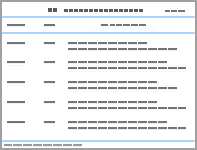
表1
不同处理的土壤墒情"
| 处理Treatment | 果实膨大期Fruit expansion stage | 转色成熟期Color transition and ripening stage | |
|---|---|---|---|
| III期调亏 Regulated in stage III | III-L | 75%-85% θf | >85% θf |
| III-M | 65%-75% θf | >85% θf | |
| III-S | 60%-70% θf | >85% θf | |
| IV期调亏 Regulated in stage IV | IV-L | >85% θf | 75%-85% θf |
| IV-M | >85% θf | 65%-75% θf | |
| IV-S | >85% θf | 60%-70% θf | |
| 充分灌溉Full irrigation | FI | >85% θf | >85% θf |
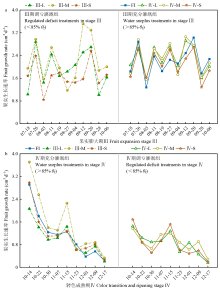
图2
不同处理果实生长速率变化"
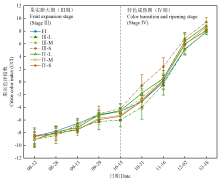
图3
不同处理果实色泽指数变化"

表2
不同处理对果实品质的影响"
| 处理 Treatment | 单果质量 Single fruit weight (g) | 果实体积 Fruit volume (cm3) | 果形指数 Fruit shape index | 果皮硬度 Peel hardness (kg·cm-2) | 色泽指数 CCI | 出汁率 Juicing rate (%) | 可溶性固形物 Soluble solid (%) | 可滴定酸 Titratable acid (%) | VC (mg·100 g-1) | 可溶性糖 Soluble sugar (%) |
|---|---|---|---|---|---|---|---|---|---|---|
| FI | 346.79±14.40ab | 391.49±15.77ab | 1.08±0.03a | 7.66±0.56a | 7.85±0.37d | 35.87±4.40b | 10.98±0.15c | 0.62±0.16ab | 44.61±1.79b | 10.17±0.44c |
| III-L | 328.89±33.35bc | 364.31±38.95bc | 1.08±0.02a | 7.96±0.53a | 7.88±0.38d | 40.89±1.93ab | 10.98±0.31c | 0.52±0.04bc | 46.91±2.26b | 10.45±0.28bc |
| III-M | 387.17±26.59a | 435.73±39.26a | 1.08±0.02a | 7.40±0.39a | 8.17±0.42bcd | 39.02±3.35ab | 11.60±0.52b | 0.65±0.05a | 48.07±4.53b | 11.01±0.14b |
| III-S | 292.99±21.08c | 328.39±29.28c | 1.09±0.03a | 7.33±0.51a | 9.45±0.68a | 41.31±3.15ab | 13.90±0.51a | 0.62±0.05ab | 56.40±3.26a | 13.14±0.61a |
| IV-L | 362.19±48.30ab | 410.59±51.85ab | 1.10±0.03a | 7.49±0.80a | 8.87±0.50ab | 38.46±1.18ab | 10.98±0.43c | 0.47±0.06c | 44.16±2.42b | 10.12±0.37c |
| IV-M | 389.16±10.94a | 443.61±22.68a | 1.10±0.03a | 7.54±0.42a | 8.68±0.66bc | 41.36±2.61a | 11.35±0.31bc | 0.69±0.02a | 44.27±2.51b | 10.29±0.60c |
| IV-S | 354.75±12.36ab | 394.70±25.54ab | 1.11±0.03a | 8.08±0.59a | 8.05±0.13cd | 39.12±4.38ab | 10.35±0.31d | 0.53±0.04bc | 44.86±4.04b | 9.85±0.50c |
| 平均值 Average value | 351.71 | 395.55 | 1.09 | 7.64 | 8.42 | 39.43 | 11.45 | 0.58 | 47.04 | 10.72 |
| 标准差 Standard deviation | 33.59 | 40.11 | 0.01 | 0.28 | 0.60 | 1.97 | 1.15 | 0.08 | 4.38 | 1.13 |
| 变异系数 Variation coefficient (%) | 9.55 | 10.14 | 1.28 | 3.71 | 7.09 | 4.99 | 10.04 | 13.67 | 9.32 | 10.51 |
表3
不同处理的主成分得分以及综合得分"
| 处理 Treatment | 主成分得分Principal component score | 综合得分Comprehensive score | 排序 Ranking | |||
|---|---|---|---|---|---|---|
| F1 | F2 | F3 | F4 | F | ||
| FI | -1.574 | -1.098 | -0.097 | -0.225 | -1.070 | 7 |
| III-L | -0.758 | 0.576 | 0.127 | 0.574 | -0.178 | 5 |
| III-M | 0.383 | -0.428 | 0.257 | -0.578 | 0.075 | 2 |
| III-S | 4.105 | -0.590 | 0.468 | 0.522 | 2.126 | 1 |
| IV-L | -0.481 | 0.929 | -0.686 | 0.112 | -0.153 | 4 |
| IV-M | 0.190 | 0.410 | 0.123 | -1.034 | 0.063 | 3 |
| IV-S | -1.866 | 0.200 | -0.190 | 0.629 | -0.863 | 6 |
表4
不同处理的产量与水分利用效率"
| 处理 Treatment | ET (mm) | 合计 Total (mm) | 平均土壤含水率 Average soil water content (%) | 产量 Yield (kg·hm-2) | 排序 Ranking | WWUE (kg·m-3) | ||
|---|---|---|---|---|---|---|---|---|
| III期 Stage III | IV期 Stage IV | III期 Stage III | IV期 Stage IV | |||||
| FI | 183.02 | 116.15 | 299.17 | 14.9 | 14.8 | 27066.67 | 3 | 9.05 |
| III-L | 144.02 | 109.92 | 253.94 | 13.1 | 14.6 | 22044.44 | 5 | 8.68 |
| III-M | 49.64 | 115.36 | 165.00 | 11.7 | 14.7 | 21466.67 | 6 | 13.01 |
| III-S | 12.92 | 112.71 | 125.63 | 10.4 | 14.7 | 19200.00 | 7 | 15.28 |
| IV-L | 170.38 | 63.30 | 233.68 | 14.7 | 13.1 | 31111.11 | 2 | 13.31 |
| IV-M | 170.09 | 27.94 | 198.03 | 14.8 | 11.7 | 33444.44 | 1 | 16.89 |
| IV-S | 183.17 | 4.56 | 187.73 | 14.7 | 11.1 | 24888.89 | 4 | 13.26 |
| [1] |
蒲应俊, 李澳, 王淑明, 淳长品, 陈子文, 杨明金, 杨玲. 脐橙挤压损伤力学特性及其参数辨识方法. 农业工程学报, 2024, 40(22): 273-282.
|
|
|
|
| [2] |
习建龙, 谢上海, 李航, 胡燕, 黎芳梅, 邓修顺, 卢俊华, 杨忠富, 赖晓桦. 赣南脐橙果实品质现状及分布特征分析. 中国南方果树, 2024, 53(1): 9-13.
|
|
|
|
| [3] |
刘渝辰, 余迎利, 甘思逸, 刘宇鑫, 金汝生, 蔡新送, 叶咏虹, 毛雪金, 王远兴. 联合UPLC-QTOF-MS与HS-SPME-GC-MS测定赣南脐橙果肉化学成分. 食品科学, 2023, 44(14): 216-228.
|
|
|
|
| [4] |
钟韵, 朱士江, 费良军, 代智光, 王亚林, 李虎, 张礼杰. 幼果期调亏对不同覆膜柑橘产量品质及水分利用效率的影响. 农业工程学报, 2023, 39(1): 81-91.
|
|
|
|
| [5] |
|
| [6] |
周平, 高鹏, 陈文彬, 杨明欣, 丁郑, 刘欢, 王卫星. 不同水分处理下柑橘树光合参数对水分及气象因素的响应. 节水灌溉, 2022(6): 90-95.
|
|
|
|
| [7] |
李憑峰, 谭煌, 王嘉航, 杨培岭. 滴灌水肥条件对樱桃产量、品质和土壤理化性质的影响. 农业机械学报, 2017, 48(7): 236-246.
|
|
|
|
| [8] |
|
| [9] |
|
| [10] |
陈昱辛, 贾悦, 崔宁博, 杨永刚, 赵璐, 胡笑涛, 龚道枝. 滴灌水肥一体化对柑橘叶片光合、产量及水分利用效率的影响. 灌溉排水学报, 2018, 37(S2): 50-58.
|
|
|
|
| [11] |
张效星, 樊毅, 贾悦, 崔宁博, 赵璐, 胡笑涛, 龚道枝. 水分亏缺对滴灌柑橘光合和产量及水分利用效率的影响. 农业工程学报, 2018, 34(3): 143-150.
|
|
|
|
| [12] |
|
| [13] |
|
| [14] |
|
| [15] |
强敏敏, 费良军, 刘扬. 调亏灌溉促进涌泉根灌枣树生长提高产量. 农业工程学报, 2015, 31(19): 91-96.
|
|
|
|
| [16] |
夏桂敏, 汪千庆, 张峻霄, 吴奇, 迟道才, 张更元. 生育期连续调亏灌溉对花生光合特性和根冠生长的影响. 农业机械学报, 2021, 52(8): 318-328.
|
|
|
|
| [17] |
周罕觅, 马林爽, 孙旗立, 陈佳庚, 李纪琛, 苏裕民, 陈诚, 吴奇. 基于多目标综合评价的苹果水氮综合调控. 中国农业科学, 2024, 57(18): 3654-3670. doi: 10.3864/j.issn.0578-1752.2024.18.011.
|
|
|
|
| [18] |
|
| [19] |
陈瑛, 邹颖, 杨文, 李就好. 不同调亏处理对脐橙果实生长和品质的影响. 节水灌溉, 2017(9): 38-42.
|
|
|
|
| [20] |
李翔翔, 黄淑娥, 谢远玉, 李迎春, 杨军, 李亚靖, 丁美萍. 果实膨大期高温对赣南脐橙品质影响的评估指数构建. 生态学杂志, 2022, 41(12): 2489-2496.
|
|
|
|
| [21] |
李翔翔, 杨爱萍, 金国花, 丁美萍, 杨军. 赣南脐橙气候品质归一化指数构建. 农业工程学报, 2024, 40(7): 335-342.
|
|
|
|
| [22] |
|
| [23] |
|
| [24] |
|
| [25] |
李鸿平, 陈昱辛, 崔宁博, 高维. 水分亏缺对柑橘果实生长、产量和水分利用效率的影响. 节水灌溉, 2019(12): 6-11.
|
|
|
|
| [26] |
刘小飞, 李彪, 孟兆江, 刘祖贵, 张寄阳. 隔沟调亏灌溉对冬小麦旗叶生理特性与产量形成的影响. 农业机械学报, 2019, 50(9): 320-328.
|
|
|
|
| [27] |
张坤, 王玉安, 郝燕. 转色期葡萄果肉代谢组变化对土壤水分的响应. 灌溉排水学报, 2020, 39(12): 111-119.
|
|
|
|
| [28] |
|
| [29] |
|
| [30] |
钟韵, 费良军, 曾健, 傅渝亮, 代智光. 根域水分亏缺对涌泉灌苹果幼树产量品质和节水的影响. 农业工程学报, 2019, 35(21): 78-87.
|
|
|
|
| [31] |
赵爽, 马子清, 李雪薇, 李文强, 管清美. 不同果实生长期亏缺灌溉对渭北苹果生长、品质及水分利用效率的影响. 西北植物学报, 2024, 44(3): 345-352.
|
|
|
|
| [32] |
|
| [33] |
杨诗雨, 曹红霞, 孙涛, 南学平, 赵凯, 李志军. 地布和生草二元覆盖对关中猕猴桃园土壤水分、果树生长和产量的影响. 干旱地区农业研究, 2023, 41(4): 187-197.
|
|
|
|
| [34] |
李曼宁, 曹红霞, 赵俊城, 彭美龄, 丁邦新, 李志军. 关中地区亏缺灌溉与二元覆盖促进猕猴桃节水增产提质. 农业工程学报, 2025, 41(6): 107-116.
|
|
|
|
| [35] |
谢远玉, 王培娟, 朱凌金, 陈星, 黄莹. 基于气象因子的赣南脐橙气候品质指标评价模型. 生态学杂志, 2019, 38(7): 2265-2274.
|
|
|
|
| [36] |
韩金朝, 冯俊杰, 翟国亮, 徐洪刚, 王明, 宋蕾, 郝萍萍. 生育期连续水分亏缺对秋冬茬辣椒生长特性和品质的影响. 灌溉排水学报, 2024, 43(3): 11-18.
|
|
|
|
| [37] |
樊卫国, 马文涛, 罗燕, 葛会敏, 吴素芳. 洞穴灌溉促进脐橙生长并提高果实品质. 农业工程学报, 2013, 29(18): 90-98.
|
|
|
|
| [38] |
|
| [39] |
陈图强, 徐贵青, 陈家祯, 刘深思, 李金瑶, 虎海防. 不同灌水量对核桃树生理、生长和果实品质的影响. 生态学杂志, 2023, 42(11): 2578-2587.
|
|
|
| [1] | 蒲丽霞, 张佳芮, 叶建萍, 黄秀兰, 樊高琼, 杨洪坤. 二氢赤霉素与秸秆覆盖对旱地小麦分蘖成穗与产量的影响[J]. 中国农业科学, 2025, 58(9): 1735-1748. |
| [2] | 郭晨荔, 刘扬, 陈燕, 胡伟, 王友华, 周治国, 赵文青. 减氮条件下适当磷肥后移对滴灌棉花产量和磷肥利用效率的影响[J]. 中国农业科学, 2025, 58(9): 1749-1766. |
| [3] | 刘劲松, 伍龙梅, 包晓哲, 刘志霞, 张彬, 杨陶陶. 短期减施氮肥对华南地区早晚兼用型水稻产量和稻米品质的影响[J]. 中国农业科学, 2025, 58(8): 1508-1520. |
| [4] | 韦文华, 李盼, 邵冠贵, 樊志龙, 胡发龙, 范虹, 何蔚, 柴强, 殷文, 赵连豪. 西北灌区青贮玉米产量及品质对减量灌水与有机无机肥配施的响应[J]. 中国农业科学, 2025, 58(8): 1521-1534. |
| [5] | 薛钰琦, 赵继玉, 孙旺胜, 任佰朝, 赵斌, 刘鹏, 张吉旺. 不同氮素形态对夏玉米产量和品质的影响[J]. 中国农业科学, 2025, 58(8): 1535-1549. |
| [6] | 李绍兴, 宋稳锋, 魏泽煜, 周玉玲, 宋李霞, 任可, 马群, 王龙昌. 秸秆与紫云英覆盖对土壤肥力及甘薯产量的影响[J]. 中国农业科学, 2025, 58(8): 1591-1603. |
| [7] | 尹波, 于爱忠, 王鹏飞, 杨学慧, 王玉珑, 尚永盼, 张冬玲, 刘亚龙, 李悦, 王凤. 绿肥还田结合氮肥减施对干旱灌区麦田土壤水热特征及小麦产量的影响[J]. 中国农业科学, 2025, 58(7): 1366-1380. |
| [8] | 陈桂平, 李盼, 邵冠贵, 吴霞玉, 殷文, 赵连豪, 樊志龙, 胡发龙. 减量灌水与有机无机肥配施对青贮玉米吐丝期后叶片持绿特性的调控作用[J]. 中国农业科学, 2025, 58(7): 1381-1396. |
| [9] | 张亚封, 董伟进, 李启云, 路杨, 张正坤, 隋丽. 球孢白僵菌与钾元素互作对番茄果实品质的影响[J]. 中国农业科学, 2025, 58(6): 1131-1144. |
| [10] | 张洪程, 邢志鹏, 张瑞宏, 单翔, 奚小波, 程爽, 翁文安, 胡群, 崔培媛, 魏海燕. 小麦整合化无人化丰产栽培的特征与技术途径[J]. 中国农业科学, 2025, 58(5): 864-876. |
| [11] | 张涵, 张玉琪, 黎景来, 徐虹, 李维环, 李涛. LED补光对日光温室基质栽培草莓生产及叶片生理特性的影响[J]. 中国农业科学, 2025, 58(5): 975-990. |
| [12] | 陈鸽, 谷雨, 文炯, 傅岳峰, 何兮, 李薇, 周峻宇, 刘琼峰, 吴海勇. 冬闲杂草还田对水稻光合物质生产和产量的影响[J]. 中国农业科学, 2025, 58(4): 647-659. |
| [13] | 苏明, 李翻过, 洪自强, 周甜, 柳强娟, 班文慧, 吴宏亮, 康建宏. 施氮缓解旱地马铃薯花后高温早衰的抗氧化特性研究[J]. 中国农业科学, 2025, 58(4): 660-675. |
| [14] | 史帆, 李文广, 易树生, 杨娜, 陈玉萌, 郑伟, 张雪辰, 李紫燕, 翟丙年. 有机无机肥配施下旱地麦田土壤有机碳组分含量的变化特征[J]. 中国农业科学, 2025, 58(4): 719-732. |
| [15] | 罗一诺, 李艳霏, 李文虎, 张思琦, 牟文燕, 黄宁, 孙蕊卿, 丁玉兰, 佘文婷, 宋文斌, 李小涵, 石美, 王朝辉. 我国新育成小麦品种(系)籽粒不同部位铁含量及影响因素[J]. 中国农业科学, 2025, 58(3): 416-430. |
|
||
