Scientia Agricultura Sinica ›› 2026, Vol. 59 ›› Issue (19): 4323-4334.doi: 10.3864/j.issn.0578-1752.2026.19.011

• SPECIAL FOCUS: NATURE-BASED SOLUTIONS: RESEARCH PARADIGMS AND CHINESE PRACTICES FOR GREEN AGRICULTURAL TRANSITION • Previous Articles     Next Articles

Evolutionary Trajectory, Driving Mechanisms, and China’s Pathway in Global Nature-Based Solutions for Agricultural Research

LIANG XiaoHe1(), WANG Qi1, LEI Jie1, ZHOU JiaJia2, WU Yu1(), ZHOU AiLian1()   

  1. 1 Agricultural Information Institute, Chinese Academy of Agricultural Sciences/Key Laboratory of Agricultural Blockchain Application, Ministry of Agriculture and Rural Affairs, Beijing 100081
    2 Biotechnology Research Institute, Chinese Academy of Agricultural Sciences, Beijing 100081
  • Received:2026-04-09 Accepted:2026-06-23 Online:2026-10-01 Published:2026-10-10
  • Contact: WU Yu, ZHOU AiLian

Abstract:

Against the backdrop of intensifying global climate changes and multi-faceted challenges to food security, nature-based solutions (NbS) are emerging as a key paradigm driving the green transformation of agriculture. This paper systematically traced the evolutionary logic of international and domestic research on agricultural NbS, identified the driving factors of high-impact outputs, and analyzed the localization dilemmas and institutional bottlenecks faced by China. It aimed to provide a decision-making basis for constructing an agricultural NbS theoretical system with Chinese characteristics and exploring global collaborative pathways. Based on data from the Web of Science and CNKI databases, this study adopted a quantitative analytical framework combining bibliometrics and multiple regression analysis. Scientific knowledge mapping was utilized to extract the core topics and evolutionary patterns of domestic and international research. Meanwhile, a multiple regression model was constructed to quantitatively measure the key mechanisms influencing the academic impact of global agricultural NbS research from four dimensions: collaboration networks, regional geopolitics, resource allocation, and interdisciplinary integration. The findings indicated that international research on agricultural NbS has progressed through three successive stages: Theoretical foundation, application and expansion, and mechanism deepening and model-driven. These stages have coalesced into four core research clusters: synergistic enhancement mechanism of agro-ecosystems, pathways for the ecological transformation of urban agriculture, R&D of intelligent and eco-agricultural facilities, and assessment of benefits in agricultural NbS applications, exhibiting highly empirical and granular characteristics. Regression analysis revealed that funding inputs, transnational collaboration, and interdisciplinary integration significantly elevated academic impact. Europe dominated global rule-making by virtue of its institutional advantages, and the academic spillover effect of Sino-European collaboration was significant, establishing China as a critical hub connecting Western theories with large-scale practical verification. Core funding agencies in the US and Europe effectively translated resources into academic discourse power, whereas the driving effect of China's national-level funding on frontier basic theoretical innovation remains to be strengthened. Furthermore, research within the Chinese context presented a dual-driven feature of macro-level coordination and local-level collaboration, with the research focus gradually shifting from macro-concept discussions to micro-engineering practices. However, the overall research network exhibited fragmentation, and the disciplinary distribution was highly concentrated in environmental science and traditional agricultural and forestry disciplines, lacking a comprehensive modeling paradigm for cross-system coupling. Although China currently ranks among the global leaders in terms of publication volume in agricultural NbS, it still faces challenges, such as a mismatch between publication scale and international impact, an overemphasis on localized technical validation at the expense of systematic integration, a relatively marginalized strategic status of agriculture within the broader NbS agenda, and an incomplete autonomous theoretical system. Moving forward, future research should deepen international cooperation to co-build standardized evaluation metrics, introduce social-ecological-technical system (SETS) analytical frameworks to dissolve disciplinary barriers, and strengthen top-down design to elevate the strategic weight of agricultural NbS. Furthermore, efforts should be dedicated to promoting the deep integration of the international NbS framework with China’s philosophy of a “community of life for mountains, rivers, forests, farmlands, lakes, grasslands, and deserts” thereby constructing an autonomous knowledge system for agricultural NbS that encompasses both Chinese characteristics and a global vision.

Key words: nature-based solutions, agro-ecological transition, multiple regression analysis, ecological civilization, scientific knowledge mapping, agricultural green transformation

Fig. 1

Timeline of keywords in English-language agricultural NbS research"

Fig. 2

Keyword clustering in English-language agricultural NbS research"

Table 1

Regression analysis results of the impact of collaboration, funding, and regional characteristics on the influence of agricultural NbS research"

维度Dimension 变量Variable 回归系数Coefficient 标准误Standard error P值P value
合作特征
Collaborative features
开展国际合作Engage in International Collaboration 0.3697 0.0523 <0.001***
合作国家数量Count of Collaborating Nations 0.1498 0.0138 <0.001***
中欧合作China-Europe Cooperation 0.6138 0.1329 <0.001***
中美合作China-US Cooperation 0.3571 0.1699 0.0356*
区域特征
Regional
feature
亚洲Asia 0.1666 0.0992 0.0931
非洲Africa -0.1478 0.1374 0.2820
美洲Americas -0.0527 0.0688 0.4438
欧洲Europe 0.7281 0.2970 0.0142*
大洋洲Oceania 0.1004 0.1407 0.4757
基金资助特征
(全球TOP10资助机构)
Funding Feature
(Global TOP10 Funding
Organizations)
获得基金资助Grant Funding 0.3022 0.0662 <0.001***
资助机构数量Count of Funding Organizations 0.0673 0.0122 <0.001***
巴西国家科学与技术发展委员会(CNPQ) 0.1602 0.1639 0.3284
欧盟(EU) 0.3033 0.0967 0.0017**
葡萄牙科学技术基金会(FCT) 0.1747 0.1442 0.2257
地平线2020计划(Horizon 2020) 0.2824 0.1379 0.0406*
中国国家重点研发计划(NKRDPC) 0.1759 0.2331 0.4505
中国国家自然科学基金委员会(NSFC) 0.1129 0.0985 0.2517
美国国家科学基金会(NSF) 0.4421 0.1693 0.009**
英国自然环境研究理事会(NERC) 0.2466 0.1806 0.1722
瑞典研究委员会(SRCF) 0.2399 0.1544 0.1203
英国研究与创新署(UKRI) 0.2532 0.1548 0.1019

Table 2

Regression analysis results of the impact of research field on the influence of agricultural NbS research"

序号
Serial Number
变量
Variable
回归系数
Coefficient
标准误
Standard error
P值
P value
1 建筑工程技术Construction & building technology 0.3960 0.2510 0.1146
2 区域与城市规划Regional & urban planning 0.3300 0.1687 0.0505
3 生物保护 Biodiversity conservation 0.3252 0.1316 0.0135*
4 地球科学-跨学科 Geosciences-multidisciplinary 0.2844 0.1477 0.0541
5 气象学与大气科学Meteorology & atmospheric sciences 0.2699 0.1354 0.0462*
6 海洋与淡水生物学 Marine & freshwater biology 0.2605 0.2119 0.219
7 城市研究 Urban studies 0.2509 0.0653 0.0001***
8 环境工程 Engineering environmental 0.2137 0.1000 0.0326*
9 植物科学 Plant sciences 0.2020 0.0615 0.001**
10 地理学 Geography 0.1730 0.1877 0.3566
11 跨学科 Multidisciplinary 0.1589 0.0551 0.0039**
12 环境科学 Environmental sciences 0.1279 0.0523 0.0144*
13 生态学 Ecology 0.1260 0.0718 0.0793
14 渔业 Fisheries 0.1148 0.2470 0.6419
15 能源与燃料 Energy fuels 0.0959 0.3114 0.7581
16 土木工程 Engineering civil 0.0722 0.2027 0.7218
17 环境研究 Environmental studies 0.0679 0.0561 0.2256
18 公共、环境与职业健康Public, environmental & occupational health 0.0662 0.1917 0.7299
19 跨学科科学 Multidisciplinary sciences -0.0015 0.2244 0.9946
20 自然地理学 Geography physical -0.0097 0.2695 0.9714
21 林学 Forestry -0.0285 0.0579 0.622
22 农业工程学 Agricultural engineering -0.0909 0.2547 0.7211
23 水资源 Water resources -0.0965 0.0799 0.2269
24 绿色可持续科学与技术 Green & sustainable science & technology -0.1063 0.0846 0.2092
25 土壤科学 Soil science -0.1189 0.1334 0.3729
26 遥感 Remote sensing -0.1279 0.1673 0.4445
27 农学 Agronomy -0.1630 0.1252 0.1929
28 生物技术与应用微生物学Biotechnology & applied microbiology -0.1803 0.2440 0.46
29 经济学 Economics -0.2363 0.2177 0.2777
30 农业-跨学科 Agriculture, multidisciplinary -0.2430 0.1360 0.0740
31 海洋学 Oceanography -0.4563 0.2215 0.0394*

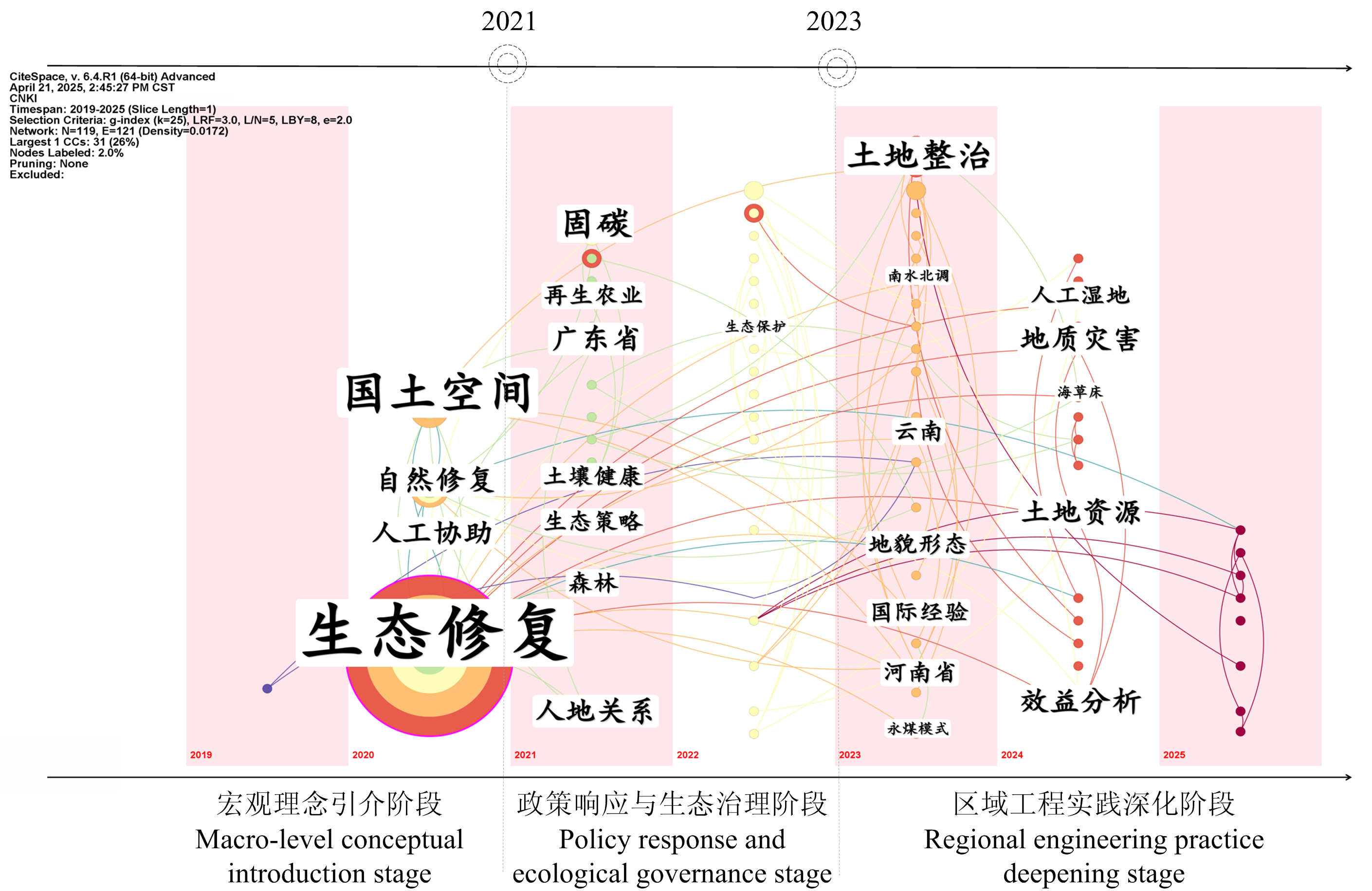
Fig. 3

Timeline of keywords in Chinese-language agricultural NbS research"

Fig. 4

Keyword clustering in Chinese-language agricultural NbS research"

[1]
国家统计局. 2024年全国农业及相关产业增加值占GDP比重为15.29%[EB/OL]. (2025-12-30) [2026-09-21]. https://www.stats.gov.cn/xxgk/sjfb/zxfb2020/202512/t20251230_1962181.html.
National bureau of statistics of China. The added value of agriculture and related industries accounted for 15.29% of GDP in 2024[EB/OL]. (2025-12-30) [2026-09-21]. https://www.stats.gov.cn/xxgk/sjfb/zxfb2020/202512/t20251230_1962181.html. (in Chinese)
[2]
中华人民共和国中央人民政府. 国务院新闻办发布会介绍2023年农业农村经济运行情况[EB/OL]. (2024-01-23)[2025-05-06]. https://www.gov.cn/lianbo/fabu/202401/content_6927911.htm.
The State Council Information Office of the People's Republic of China. Press conference on the performance of agriculture and rural economy in 2023[EB/OL]. (2024-01-23)[2025-05-06]. https://www.gov.cn/lianbo/fabu/202401/content_6927911.htm. (in Chinese)
[3]
郭晓鸣, 陆晓玲, 卢瑛琪. 建设农业强国的时代价值、实现进路与重点任务[J]. 农村经济, 2023(4): 10-18.
Guo X M, Lu X L, Lu Y Q. The value of the times, the way to realize and the key tasks of building an agricultural power[J]. Rural Economy, 2023(4): 10-18. (in Chinese)
[4]
Pagano A, Pluchinotta I, Pengal P, Cokan B, Giordano R. Engaging stakeholders in the assessment of NBS effectiveness in flood risk reduction: A participatory System Dynamics Model for benefits and co-benefits evaluation[J]. Science of the Total Environment, 2019, 690: 543-555.

doi: 10.1016/j.scitotenv.2019.07.059
[5]
Cohen-Shacham E, Walters G, Janzen C, Maginnis S. Nature-based Solutions to Address Global Societal Challenges[M]. IUCN International Union for Conservation of Nature, 2016: 97.
[6]
Song Y N, Kirkwood N, Maksimović Č, Zheng X D, O’Connor D, Jin Y L, Hou D Y. Nature based solutions for contaminated land remediation and brownfield redevelopment in cities: A review[J]. Science of the Total Environment, 2019, 663: 568-579.

doi: 10.1016/j.scitotenv.2019.01.347
[7]
罗明. 依靠自然的力量着眼可持续发展: 透析“基于自然的解决方案”[N]. 中国自然资源报, 2019-11-07(3).
Luo M. Relying on the power of nature to focus on sustainable development[N]. China Natural Resources News, 2019-11-07(3). (in Chinese)
[8]
贾梦旋, 王金满, 李禹凝, 张雅馥, 高亭玉, 吴大为. 基于自然解决方案的矿山生态修复研究进展[J]. 煤炭科学技术, 2024, 52(8): 209-221.
Jia M X, Wang J M, Li Y N, Zhang Y F, Gao T Y, Wu D W. Ecological restoration of mines based on Nature-based Solution: A review[J]. Coal Science and Technology, 2024, 52(8): 209-221. (in Chinese)
[9]
IUCN. Global standard for nature-based solutions[R]. Gland, Switzerland: IUCN, 2020.
[10]
IUCN. Sustainable agriculture and nature-based solutions[R]. Gland, Switzerland: IUCN, 2024.
[11]
Förster A, Hohberg K, Rasche F, Emmerling C. Nematode community structure suggests perennial grain cropping cultivation as a nature- based solution for resilient agriculture[J]. Journal of Sustainable Agriculture and Environment, 2024, 3(3): e12112.

doi: 10.1002/sae2.v3.3
[12]
van der Jagt A P N, Szaraz L R, Delshammar T, Cvejić R, Santos A, Goodness J, Buijs A. Cultivating nature-based solutions: The governance of communal urban gardens in the European Union[J]. Environmental Research, 2017, 159: 264-275.

doi: S0013-9351(17)31574-8 pmid: 28823804
[13]
Nelson D R, Bledsoe B P, Ferreira S, Nibbelink N P. Challenges to realizing the potential of nature-based solutions[J]. Current Opinion in Environmental Sustainability, 2020, 45: 49-55.

doi: 10.1016/j.cosust.2020.09.001
[14]
IUCN WCPA. The IUCN WCPA Bulletin (Issue 6): Area Based Conservation[R]. Gland: IUCN, 2023-12.
[15]
干彬, 李朝林, 张明遥. 面向智慧农业的多维决策支持模型与可视化系统设计[J]. 中国农业资源与区划, 2024, 45(7): 143.
Gan B, Li C L, Zhang M Y. Design of a multidimensional decision support model and visualization system for smart agriculture[J]. Chinese Journal of Agricultural Resources and Regional Planning, 2024, 45(7): 143. (in Chinese)
[16]
周娜, 袁媛, 陈雷, 郑亚松. 基于大模型规则增强与通道注意力的两阶段小麦知识图谱补全[J]. 农业工程学报, 2025, 41(22): 154-161.
Zhou N, Yuan Y, Chen L, Zheng Y S. Two-stage wheat knowledge graph completion method based on large language models rule augmentation and channel attention[J]. Transactions of the Chinese Society of Agricultural Engineering, 2025, 41(22): 154-161. (in Chinese)
[17]
李杰, 陈超美. CiteSpace: 科技文本挖掘及可视化[M]. 北京: 首都经济贸易大学出版社, 2016: 29.
Li J, Chen C M. CiteSpace: Text Mining and Visualization in Scientific Literature[M]. Beijing: Capital University of Economics & Business Press, 2016: 29. (in Chinese)
[18]
Anderson V, Gough W A. Nature-based cooling potential: A multi- type green infrastructure evaluation in Toronto, Ontario, Canada[J]. International Journal of Biometeorology, 2022, 66(2): 397-410.

doi: 10.1007/s00484-021-02100-5
[19]
Kandpal A, Kumara T M K, Pal S. Does conservation agriculture promote sustainable intensification in the rice-wheat system of the indo-gangetic plains in India? empirical evidences from on-farm studies[J]. Current Science, 2023, 124(10): 1188.

doi: 10.18520/cs/v124/i10/1188-1193
[20]
Alshehri K, Gao Z H, Harbottle M, Sapsford D, Cleall P. Life cycle assessment and cost-benefit analysis of nature-based solutions for contaminated land remediation: A mini-review[J]. Heliyon, 2023, 9(10): e20632.

doi: 10.1016/j.heliyon.2023.e20632
[21]
Tang Y J, Qiao Y F, Ma Y Z, Huang W L, Komal K, Miao S J. Quantifying greenhouse gas emissions in agricultural systems: A comparative analysis of process models[J]. Ecological Modelling, 2024, 490: 110646.

doi: 10.1016/j.ecolmodel.2024.110646
[22]
Netti A M, Abdelwahab O M M, Datola G, Ricci G F, Oppio A, Gentile F. Assessment of nature-based solutions for water resource management in agricultural environments: A stakeholders’ perspective in Southern Italy[J]. Scientific Reports, 2024, 14: 24668.

doi: 10.1038/s41598-024-76346-5
[23]
Singh R, Trindade H, Sousa J R. Forest debris-based biochar application in composting process to reduce greenhouse gas emissions: A nature based sustainable solution[J]. Scientific Papers Series E Land Reclamation, Earth Observation & Surveying, Environmental Engineering, 2024, 13: 329-336.
[24]
Pereira P, Wang F, Inacio M, Kalinauskas M, Bogdzevič K, Bogunovic I, Zhao W W, Barcelo D. Nature-based solutions for carbon sequestration in urban environments[J]. Current Opinion in Environmental Science & Health, 2024, 37: 100536.
[25]
Smith A C, Tasnim T, Irfanullah H M, Turner B, Chausson A, Seddon N. Nature-based solutions in Bangladesh: Evidence of effectiveness for addressing climate change and other sustainable development goals[J]. Frontiers in Environmental Science, 2021, 9: 737659.

doi: 10.3389/fenvs.2021.737659
[26]
Lebrun J D, Ayrault S, Drouet A, Bordier L, Fechner L C, Uher E, Chaumont C, Tournebize J. Ecodynamics and bioavailability of metal contaminants in a constructed wetland within an agricultural drained catchment[J]. Ecological Engineering, 2019, 136: 108-117.

doi: 10.1016/j.ecoleng.2019.06.012
[27]
Quaranta E, Arkar C, Branquinho C, Cristiano E, de Carvalho R C, Dohnal M, Gnecco I, Gößner D, Jelinkova V, Maucieri C, Mohri M, Nektarios P A, Ntoulas N, Palermo S A, Palla A, Piro P, Serrano H C, Soulis K X, Turco M, Van Renterghem T, et al. A daily time-step hydrological-energy-biomass model to estimate green roof performances across Europe to support planning and policies[J]. Urban Forestry & Urban Greening, 2024, 93: 128211.
[28]
Zaręba A, Krzemińska A, Kozik R. Urban vertical farming as an example of nature-based solutions supporting a healthy society living in the urban environment[J]. Resources, 2021, 10(11): 109.

doi: 10.3390/resources10110109
[29]
Herbert C, Haya B K, Stephens S L, Butsic V. Managing nature-based solutions in fire-prone ecosystems: competing management objectives in California forests evaluated at a landscape scale[J]. Frontiers in Forests and Global Change, 2022, 5: 957189.

doi: 10.3389/ffgc.2022.957189
[30]
Garibaldi L A, Zermoglio P F, Jobbágy E G, Andreoni L, Ortiz de Urbina A, Grass I, Oddi F J. How to design multifunctional landscapes?[J]. Journal of Applied Ecology, 2023, 60(12): 2521-2527.

doi: 10.1111/jpe.v60.12
[31]
Dong X Y, Ye Y M, Su D, Yi S G, Yang R J, Haase D, Lausch A. Adaptive ranking of specific tree species for targeted green infrastructure intervention in response to urban hazards[J]. Urban Forestry & Urban Greening, 2025, 107: 128776.
[32]
Matiza C, Mutanga O, Peerbhay K, Odindi J, Lottering R. Assessing above-ground biomass in reforested urban landscapes using machine learning and remotely sensed data[J]. Journal of Spatial Science, 2024, 69(3): 1047-1073.

doi: 10.1080/14498596.2024.2343764
[33]
Jaiswal D, Siddique K M, Jayalekshmi T R, Sajitha A S, Kushwaha A, Surendran S. Land-based climate mitigation strategies for achieving net zero emissions in India[J]. Frontiers in Climate, 2025, 7: 1538816.

doi: 10.3389/fclim.2025.1538816
[34]
Toxopeus H, Polzin F. Reviewing financing barriers and strategies for urban nature-based solutions[J]. Journal of Environmental Management, 2021, 289: 112371.

doi: 10.1016/j.jenvman.2021.112371
[35]
Petrova S, Velcheva I, Nikolov B, Angelov N, Hristozova G, Zaprjanova P, Valcheva E, Golubinova I, Marinov-Serafimov P, Petrov P, Stefanova V, Varbanova E, Georgieva D, Stefanova V, Marhova M, Tsankova M, Iliev I. Nature-based solutions for the sustainable management of urban soils and quality of life improvements[J]. Land, 2022, 11(4): 569.

doi: 10.3390/land11040569
[36]
韩明会, 李保国, 张丹, 李颖. 再生农业—基于土地保护性利用的可持续农业[J]. 中国农业科学, 2021, 54(5): 1003-1016. DOI: 10.3864/j.issn.0578-1752.2021.05.012.
Han M H, Li B G, Zhang D, Li Y. Regenerative agriculture-sustainable agriculture based on the conservational land use[J]. Scientia Agricultura Sinica, 2021, 54(5): 1003-1016. DOI: 10.3864/j.issn.0578-1752.2021.05.012. (in Chinese)
[37]
Hale S, Tann Loretta Von Der, Rebelo A, Esler K, Lima Ana Paula Morais De, Rodrigues A, Latawiec A, Ramírezagudelo N, Bosch E, Suleiman L N, Singh N, Oen Amy M P. Evaluating nature-based solutions for water management in peri-urban areas[J]. Water, 2023, 15(5): 893.

doi: 10.3390/w15050893
[38]
张克荣, 张小全, 李潜, 赵铭石, 王龙柱, 张全发. 退化生态系统近自然精准修复: 基于自然的解决方案[J]. 植物科学学报, 2023, 41(6): 751-758.
Zhang K R, Zhang X Q, Li Q, Zhao M S, Wang L Z, Zhang Q F. Near-natural precise restoration of degraded ecosystems: Nature-based solutions[J]. Plant Science Journal, 2023, 41(6): 751-758. (in Chinese)
[39]
叶红, 程露, 何嘉琪, 党政, 曹江, 谭春鸿. “碳中和-新乡村” 视角下广东乡村分布式光伏构建模式探索[J]. 南方建筑, 2021(4): 74-81.

doi: 10.3969/j.issn.1000-0232.2021.04.074
Ye H, Cheng L, He J Q, Dang Z, Cao J, Tan C H. Exploration of Guangdong rural distributed photovoltaic construction model from the perspective of “innovative carbon-neutral rural area”[J]. South Architecture, 2021(4): 74-81. (in Chinese)
[40]
罗明, 周旭, 周妍. “基于自然的解决方案”在中国的本土化实践[J]. 中国土地, 2021(1): 12-15.
Luo M, Zhou X, Zhou Y. Localization practice of “nature-based solution” in China[J]. China Land, 2021(1): 12-15. (in Chinese)
[1] XIAO YunZe, ZHANG Yu, CHENG Gong, LIAN ZiRou, ZHOU HouXi. Exploring Research Paradigms for Agricultural Heritage from the Perspective of Nature-Based Solutions [J]. Scientia Agricultura Sinica, 2026, 59(19): 4374-4390.
[2] NING MingHao, LU XinDan, GAO Fang, XU Shang, JIA XiangPing. Strengthening the Codex Alimentarius System from a Nature-Based Solution Perspective: Governance Models and Practical Approaches [J]. Scientia Agricultura Sinica, 2026, 59(19): 4358-4373.
[3] KONG WeiLi, WANG LiJie, ZHENG JingKang, GAO Fang, LI Tao, ZHANG KeKe, ZHANG YuTing. Key Technologies and Models of Straw Comprehensive Utilization: Grain-Mushroom Rotation in Designated Zones as a Nature-Based Solution [J]. Scientia Agricultura Sinica, 2026, 59(19): 4349-4357.
[4] LUO Ning, LI ZhaoLei, XU CaiLong, NIU Na, WANG Pu, MENG QingFeng. Nature-Based Solutions for Sustainable Transition in High-Yield Cropping Systems [J]. Scientia Agricultura Sinica, 2026, 59(19): 4335-4348.
[5] JIN ShuQin, XING XiaoXu. Trend Analysis, Policy Evaluation, and Recommendations of Agricultural Non-Point Source Pollution [J]. Scientia Agricultura Sinica, 2018, 51(3): 593-600.
Viewed
Full text


Abstract

Cited

  Shared   
  Discussed   
No Suggested Reading articles found!