Scientia Agricultura Sinica ›› 2026, Vol. 59 ›› Issue (19): 4374-4390.doi: 10.3864/j.issn.0578-1752.2026.19.015

• SPECIAL FOCUS: NATURE-BASED SOLUTIONS: RESEARCH PARADIGMS AND CHINESE PRACTICES FOR GREEN AGRICULTURAL TRANSITION • Previous Articles     Next Articles

Exploring Research Paradigms for Agricultural Heritage from the Perspective of Nature-Based Solutions

XIAO YunZe1,2(), ZHANG Yu3, CHENG Gong4(), LIAN ZiRou1, ZHOU HouXi5()   

  1. 1 School of Public Administration, Zhejiang University of Technology, Hangzhou 310023, China
    2 Research Center for Public Opinions of Zhejiang Province, Hangzhou 310023, China
    3 Institute for Minorities Studies in Southwest Border Region, Yunnan University, Kunming 650500, China
    4 U.S.-Asia Partnerships for Environmental Law, Vermont Law School, South Royalton, VT 05068, USA
    5 Agricultural Information Institute, Chinese Academy of Agricultural Sciences, Beijing 100081, China
  • Received:2025-08-27 Accepted:2025-12-31 Online:2026-10-01 Published:2026-10-10
  • Contact: CHENG Gong, ZHOU HouXi

Abstract:

【Background】Agricultural heritage systems are agroecosystems and knowledge systems co-evolved by humans and nature. At a time when global food systems are being challenged by climate change, land degradation, and declining ecosystem service functions, their multifunctional values have attracted growing attention as a key resource for safeguarding food security and advancing sustainable agricultural development. Since 2023, China’s No. 1 Central Documents have incorporated the “conservation and utilization of agricultural cultural heritage” into the national strategy, laying a policy foundation for its institutionalized development. Meanwhile, the International Union for Conservation of Nature (IUCN) has rapidly promoted the concept of nature-based solutions (NbS) in the fields of agriculture and ecological governance, emphasizing the use of ecosystem processes to address societal challenges.【Objective】Using NbS as an analytical framework could enable a deeper, more systematic, and more comprehensive examination of agricultural heritage systems, help establish an interdisciplinary research paradigm, and provide an internationally applicable indicator system for the conservation, monitoring, management, evaluation, utilization, and research of agricultural heritage systems.【Method】Employing conceptual comparative analysis, this paper proposes that agricultural heritage systems constitute a prototypical form of NbS and could effectively address challenges, such as food security, ecosystem degradation, and rural social vulnerability. Drawing on the eight criteria and 28 indicators of the IUCN Global Standard for NbS, an indicator-based evaluation method was applied to conduct a systematic empirical analysis of representative cases selected from Globally Important Agricultural Heritage Systems (GIAHS) and from China’s list of Important Agricultural Cultural Heritage.【Result】Within each category of the eight NbS criteria, three GIAHS cases and three Chinese cases were selected, aiming to cover a wider range of regions, more diverse ecosystems, and more heterogeneous livelihood types, for a total of 16 GIAHS cases and 18 Chinese cases. These cases substantiated all relevant components of the 28 indicators, demonstrating that agricultural heritage systems align closely with the NbS Standard in terms of ecosystem services, biodiversity conservation, farmland governance, climate resilience, community participation, and related dimensions. The NbS indicator system also proved feasible for the evaluation and policy planning of agricultural heritage systems.【Conclusion】In terms of conceptual structure, value objectives, and system attributes, agricultural heritage systems exhibited a high degree of congruence with NbS; agricultural heritage systems could be regarded as a subset of NbS. Accordingly, NbS principles, criteria, and indicators could be adopted to analyze and discuss agricultural heritage systems, providing a globally applicable analytical framework for their conservation, monitoring, management, utilization, and evaluation. This study offers a research paradigm and an empirical pathway for integrating agricultural heritage systems into the global NbS policy architecture and for promoting green transformation in agriculture.

Key words: agricultural heritage, nature-based solutions (NbS), Globally Important Agricultural Heritage Systems (GIAHS), sustainable agriculture, ecosystem services

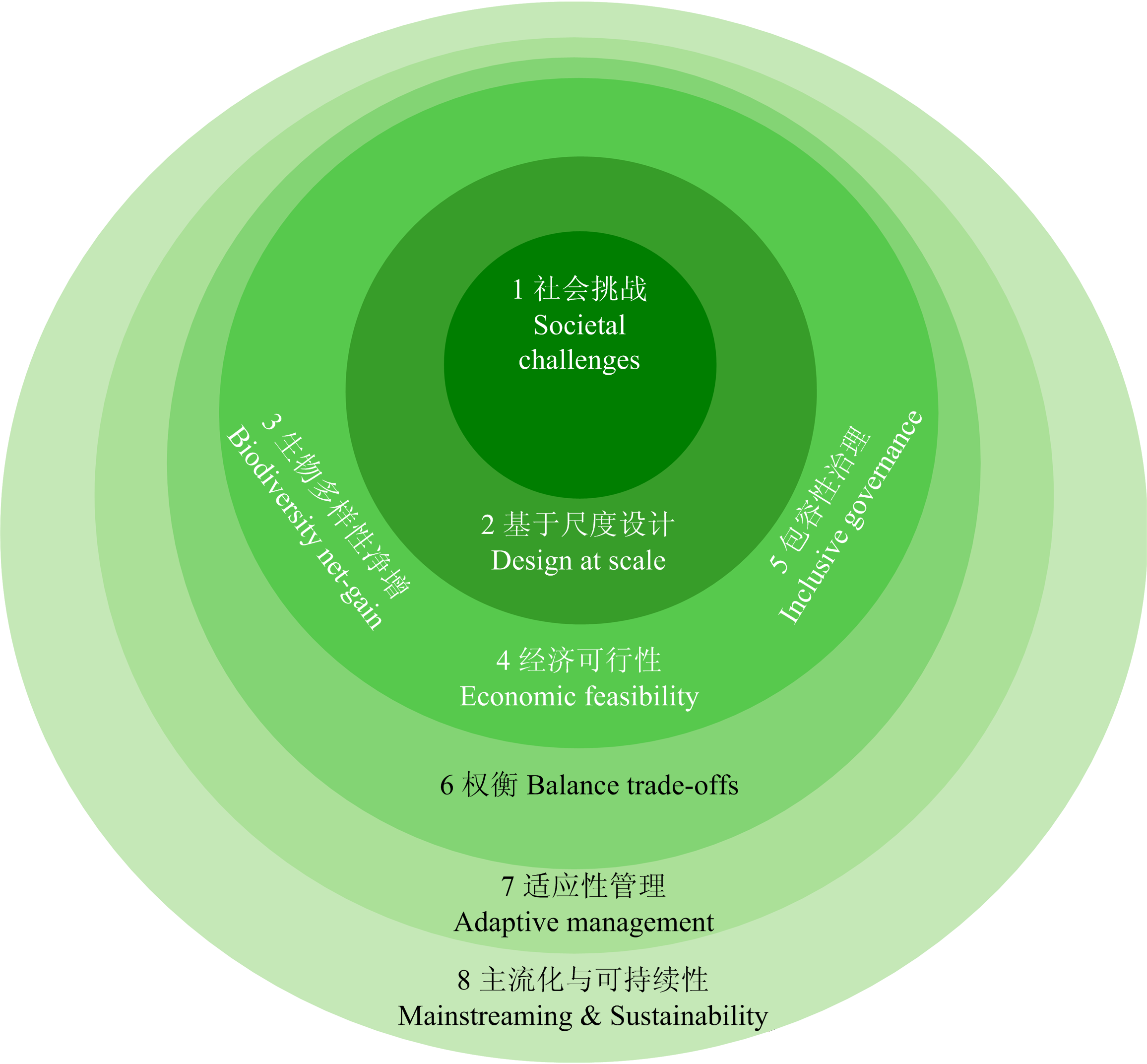
Fig. 1

Diagram of the structural relationships among the eight core criteria of the global standard for NbS (© 2020 IUCN, adapted by the author)[14]"

Table 1

Three specific indicators for nature-based solutions to effectively address human societal challenges"

指标Indicator 国际案例International case 中国案例Chinese case
C-1.1 优先考虑权利持有者和受益者最迫切的社会挑战
Prioritize the most pressing societal challenges faced by rights-holders and beneficiaries
伊朗喀山坎儿井灌溉系统
Qanat irrigated agricultural heritage systems, Kashan,
Iran
云南红河哈尼稻作梯田系统
Honghe Hani Rice Terraces system
C-1.2 清楚地理解和记录所应对的社会挑战
Clearly identify, understand, and document the societal challenges being addressed
伊朗喀山坎儿井灌溉系统;日本能登半岛里山-里海 系统
Qanat irrigated agricultural heritage systems, Kashan, Iran; Noto’s Satoyama and Satoumi, Japan
湖南新化紫鹊界梯田
Xinhua Ziquejie Terraces
C-1.3 识别、设立基准并定期评估NbS所产生的人类福祉
Identify and establish baselines and regularly assess the human well-being outcomes generated by the NbS
日本能登半岛里山-里海系统;葡萄牙巴罗索农林牧
业系统
Noto’s Satoyama and Satoumi, Japan; Barroso Agro- Sylvo-Pastoral system, Portugal
内蒙古敖汉旱作农业系统
Aohan dryland farming system

Table 2

Three specific indicators for designing nature-based solutions at the ecosystem scale"

指标Indicator 国际案例International cases 中国案例Chinese case
C-2.1 NbS的设计应认识到经济、社会和生态系统之间的相互作用并做出响应
The design of NbS should recognize and respond to interactions among economic, social, and ecological systems
菲律宾伊富高水稻梯田
Ifugao Rice Terraces, Philippines
浙江仙居古杨梅群复合种养系统
Xianju Ancient Chinese Waxberry composite system in Zhejiang Province
C-2.2 NbS应与其他相关措施互补,并联合不同部门产生协同作用
The design of NbS should be complementary to other relevant measures and generate cross-sectoral synergies
意大利索阿韦传统葡萄园
Soave traditional vineyards, Italy
福建福鼎白茶文化系统
Fuding White tea culture system in Fujian Province
C-2.3 NbS的设计应纳入干预场地以外区域的风险识别和风险管理
The design of NbS should incorporate risk identification and management for areas beyond the intervention site
摩洛哥菲吉格农牧一体古老绿洲系统
The ksour of Figuig: Oasis and pastoral culture around the social management of water and land, Morocco
浙江吴兴溇港圩田农业系统
Wuxing Lougang Weir field agriculture system

Table 3

Four specific indicators for nature-based solutions to achieve biodiversity net gain and ecosystem integrity"

指标Indicator 国际案例International case 中国案例Chinese case
C-3.1 NbS行动必须基于生态现状和退化驱动力的评估
NbS actions must be based on an assessment of current ecological conditions and the drivers of degradation
摩洛哥的阿尔甘林业农业系统
Argan-based agro-sylvo-pastoral system within the area of Ait Souab-Ait Mansour, Morocco
贵州从江侗乡稻鱼鸭复合系统
Congjiang Dong’s rice-fish-duck system
C-3.2 建立生物多样性保护的可测量目标与阶段性评估
机制
Establish measurable biodiversity conservation targets and mechanisms for periodic evaluation
摩洛哥的阿尔甘林业农业系统;日本新潟县佐渡岛朱鹮共生系统
Argan-based agro-sylvo-pastoral system within the area of Ait Souab-Ait Mansour, Morocco; Sado’s Satoyama in Harmony with the Japanese Crested Ibis, Japan
贵州从江侗乡稻鱼鸭复合系统;浙江青田稻鱼共生系统
Congjiang Dong’s rice-fish-duck system; Qingtian rice-fish culture system
C-3.3 监测潜在负面影响
Monitor potential adverse impacts
日本新潟县佐渡岛朱鹮共生系统
Sado’s Satoyama in Harmony with the Japanese Crested Ibis, Japan
江苏兴化垛田传统农业系统
Xinghua Duotian agrosystem
C-3.4 提升生态连通性并整合相关策略
Enhance ecological connectivity and integrate relevant strategies
韩国济州岛石垣农业系统
Jeju Batdam Agricultural system, Republic of Korea
浙江青田稻鱼共生系统;江苏兴化垛田传统农业系统
Qingtian rice-fish culture system; Xinghua Duotian agrosystem

Table 4

Four specific indicators for nature-based solutions to ensure economic feasibility and adaptability"

指标Indicator 国际案例International case 中国案例Chinese case
C-4.1 确认和记录NbS项目的直接与间接成本及受益群体
Identify and document the direct and indirect costs of NbS projects and their beneficiary groups
墨西哥奇南帕浮园农业系统
Chinampas agricultural system in Mexico City, Mexico
浙江缙云茭白-麻鸭共生系统
Jinyun water bamboo-duck symbiosis system
C-4.2 采用成本-效益研究支撑决策,并分析政策与补贴影响
Use cost-benefit analyses to support decision-making and assess the impacts of relevant policies and subsidies
墨西哥奇南帕浮园农业系统;日本静冈茶草场系统
Chinampas agricultural system in Mexico City, Mexico; traditional tea-grass integrated system in Shizuoka, Japan
浙江云和梯田农业系统
Yunhe Rice Terraces system
C-4.3 评估方案的外部性与可比替代方案
Evaluate the project’s externalities and comparable alternative options
西班牙莱昂山脉农林牧复合系统
Agro-Silvo-Pastoral system Mountains of León, Spain
浙江云和梯田农业系统
Yunhe Rice Terraces system
C-4.4 多元化融资机制确保资金合规使用
Employ diversified financing mechanisms to ensure the compliant use of funds
日本静冈茶草场系统;西班牙莱昂山脉农林牧复合系统
Traditional tea-grass integrated system in Shizuoka, Japan; Agro-Silvo-Pastoral system Mountains of León, Spain
湖南安化黑茶文化系统
Hunan Anhua Dark tea cultural system

Table 5

Five specific indicators for nature-based solutions to ensure inclusive, transparent, and empowering governance processes"

指标Indicator 国际案例International case 中国案例Chinese case
C-5.1 所有利益相关方需就反馈与申诉机制达成共识
Ensure consensus among all stakeholders on feedback and grievance mechanisms
菲律宾伊富高水稻梯田系统
Ifugao rice terraces, Philippines
贵州从江侗乡稻鱼鸭系统
Congjiang Dong’s rice-fish-duck system
C-5.2 保障广泛而平等的参与,特别重视弱势群体与原住民的知情同意权
Guarantee broad and equitable participation, with particular emphasis on the right to informed consent of vulnerable
groups and indigenous peoples
墨西哥奇南帕浮园农业系统
Chinampas agricultural system in Mexico City, Mexico
河北涉县王金庄旱作石堰梯田系统
Shexian dryland stone terraced system
C-5.3 明确识别所有直接和间接受影响群体,并全程参与决策
Clearly identify all directly and indirectly affected groups,
and engage them throughout the decisionmaking process
墨西哥奇南帕浮园农业系统
Chinampas agricultural system in Mexico City, Mexico
贵州从江侗乡稻鱼鸭系统
Congjiang Dong’s rice-fish-duck system
C-5.4 记录决策路径并回应各方诉求
Document decisionmaking pathways and respond to stakeholders’ concerns
菲律宾伊富高水稻梯田系统
Ifugao rice terraces, Philippines
河北涉县王金庄旱作石堰梯田系统
Shexian dryland stone terraced system
C-5.5 跨区域治理中应建立联合决策机制
Establish joint decisionmaking mechanisms in cross-regional governance
意大利阿西西与斯波莱托之间的山坡橄榄园
Olive Groves of the slopes between Assisi and Spoleto, Italy
内蒙古阿鲁科尔沁草原游牧系统
Ar Horqin Grassland Nomadic system in Inner Mongolia

Table 6

Three specific indicators for equitable trade-offs between primary objectives and multiple co-benefits in nature-based solutions"

指标Indicator 国际案例International case 中国案例Chinese case
C-6.1 明确NbS方案中的权衡与潜在外部性影响,并设定保障与补救机制
Clarify the trade-offs and potential externality impacts within the NbS intervention and establish appropriate safeguards and remediation mechanisms
秘鲁安第斯高原农业系统
Andean agriculture, Peru
浙江青田稻鱼共生系统
Qingtian rice-fish culture system
C-6.2 尊重利益相关方的自然资源权利
Respect stakeholders’ rights to natural resources
伊朗喀山坎儿井灌溉系统
Qanat irrigated agricultural heritage systems, Kashan, Iran
湖南安化黑茶文化系统
Hunan Anhua Dark tea cultural system
C-6.3 定期回顾保障机制,避免权衡失衡引发生态或社会损害
Periodically review and update safeguards to prevent imbalanced trade-offs from causing ecological or social harm
突尼斯加夫萨绿洲农业系统
Gafsa Oases, Tunisia
广西龙胜梯田
Longsheng Longji Terraces

Table 7

Three specific indicators for evidence-based adaptive management in nature-based solutions"

指标Indicator 国际案例International case 中国案例Chinese case
C-7.1 制定NbS干预策略并开展监测与评估
Develop NbS intervention strategies and implement monitoring and evaluation
日本能登半岛里山-里海系统;韩国花开传统河东茶农业系统
Noto’s Satoyama and Satoumi, Japan; Traditional Hadong tea agrosystem in Hwagae-myeon, Republic of Korea
云南红河哈尼稻作梯田系统
Honghe Hani Rice Terraces system
C-7.2 建立全过程的评估机制并跟踪调整实施路径
Establish end-to-end evaluation mechanisms and track adjustments to the implementation pathway
日本能登半岛里山-里海系统;摩洛哥阿尔甘林业农业系统
Noto’s Satoyama and Satoumi, Japan; Argan-based agro- sylvo-pastoral system within the area of Ait Souab-Ait Mansour, Morocco
福建安溪铁观音茶文化系统
Anxi Tieguanyin tea culture system
C-7.3 构建迭代学习框架,使实施方案在实践中不断优化
Construct an iterative learning framework to continuously refine and optimize the NbS in practice
摩洛哥阿尔甘林业农业系统;韩国花开传统河东茶农业系统
Argan-based agro-sylvo-pastoral system within the area of Ait Souab-Ait Mansour, Morocco; Traditional Hadong tea agro-system in Hwagae myeon, Republic of Korea
湖南新化紫鹊界梯田
Xinhua Ziquejie Terraces

Table 8

Three specific indicators for nature-based solutions to ensure sustainability and mainstreaming within appropriate jurisdictions"

指标 Indicator 国际案例International case 中国案例Chinese case
C-8.1 总结与分享实施过程的经验教训
Summarize and disseminate lessons learned from the implementation process
韩国花开传统河东茶农业系统;秘鲁安第斯高山农业系统
Traditional Hadong Tea Agro-system in Hwagae myeon, Republic of Korea; Andean agriculture, Peru
浙江湖州桑基鱼塘系统
Zhejiang Huzhou mulberry-dyke & Fish-pond system
C-8.2 倡导并嵌入有利于NbS落地的政策与制度
Advocate for and embed policies and institutional arrangements that facilitate the uptake of NbS
日本新潟县佐渡岛朱鹮共生系统;韩国花开传统河东茶农业系统
Sado’s Satoyama in Harmony with the Japanese Crested Ibis, Japan; Traditional Hadong tea Agro- system in Hwagae myeon, Republic of Korea
绍兴会稽山古香榧群;河北涉县王金庄旱作石堰梯田系统
Kuaijishan ancient Chinese torreya; Shexian dryland stone terraced system
C-8.3 协同实现全球与国家层面在人类福祉、生物多样性、气候韧性与人权保障等方面的目标
Collaborate to align and advance global- and national-level objectives for human wellbeing, biodiversity conservation, climate resilience, and human rights
日本新潟县佐渡岛朱鹮共生系统;秘鲁安第斯高山农业系统
Sado’s Satoyama in Harmony with the Japanese Crested Ibis, Japan; Andean agriculture, Peru
浙江湖州桑基鱼塘系统;河北涉县王金庄旱作石堰梯田系统
Zhejiang Huzhou mulberry-dyke & fish-pond system; Shexian dryland stone terraced system
[1]
Koohafkan P. Forgotten Agricultural Heritage: Reconnecting Food Systems and Sustainable Development[M]. New York: Routledge, 2016.
[2]
焦雯珺, 崔文超, 闵庆文, 张永勋. 农业文化遗产及其保护研究综述[J]. 资源科学, 2021, 43(4): 823-837.

doi: 10.18402/resci.2021.04.16
Jiao W J, Cui W C, Min Q W, Zhang Y X. A review of research on agricultural heritage systems and their conservation[J]. Resources Science, 2021, 43(4): 823-837. (in Chinese)

doi: 10.18402/resci.2021.04.16
[3]
闵庆文, 骆世明, 曹幸穗, 苑利, 成升魁, 杨庆文, 孙庆忠, 李先德, 孙业红, 赵立军, 张红榛, 吴敏芳. 农业文化遗产: 连接过去与未来的桥梁[J]. 农业资源与环境学报, 2022, 39(5): 856-868.
Min Q W, Luo S M, Cao X S, Yuan L, Cheng S K, Yang Q W, Sun Q Z, Li X D, Sun Y H, Zhao L J, Zhang H Z, Wu M F. Agricultural heritage: A bridge between past and the future[J]. Journal of Agricultural Resources and Environment, 2022, 39(5): 856-868. (in Chinese)
[4]
李文华, 刘某承, 闵庆文. 农业文化遗产保护: 生态农业发展的新契机[J]. 中国生态农业学报, 2012, 20(6): 663-667.
Li W H, Liu M C, Min Q W. Agricultural heritage conservation: New opportunity for developing eco-agriculture[J]. Chinese Journal of Eco-Agriculture, 2012, 20(6): 663-667. (in Chinese)

doi: 10.3724/SP.J.1011.2012.00663
[5]
卢成仁. 乡土中国的命运与农业文化遗产的未来[J]. 思想战线, 2023, 49(4): 67-73.
Lu C R. Fate of rural China and future of agricultural heritage[J]. Thinking, 2023, 49(4): 67-73. (in Chinese)
[6]
伽红凯, 卢勇. 农业文化遗产供给侧改革: 矛盾表征、肇因分析与策略选择[J]. 中国农业大学学报(社会科学版), 2023, 40(5): 189-202.
Qie H K, Lu Y. Supply-side reform of agricultural heritage systems: contradictory representation, causative analysis, and strategy selection[J]. Journal of China Agricultural University (Social Sciences Edition), 2023, 40(5): 189-202. (in Chinese)
[7]
王思明, 李明. 中国农业文化遗产-第一卷-中国农业文化遗产研究[M]. 北京: 中国农业科学技术出版社, 2015.
Wang S M, Li M. Agricultural Cultural Heritage in China-Volume I-Research on Agricultural Cultural Heritage in China[M]. China Agricultural Science and Technology Press, 2015. (in Chinese)
[8]
孙庆忠, 张金垚. 农业文化遗产研究的核心议题与保护实践: 孙庆忠教授访谈录[J]. 中国农业大学学报(社会科学版), 2025, 42(2): 95-109.
Sun Q Z, Zhang J Y. Core issues and conservation practices in agricultural heritage research: An interview with professor Sun qingzhong[J]. Journal of China Agricultural University (Social Sciences), 2025, 42(2): 95-109. (in Chinese)
[9]
肖云泽. 农业文化遗产保护作为社会干预: 浙江经验[J]. 中国农业大学学报(社会科学版), 2025, 42(2): 140-154.
Xiao Y Z. Agricultural heritage conservation as a social intervention: The Zhejiang experience[J]. Journal of China Agricultural University (Social Sciences), 2025, 42(2): 140-154. (in Chinese)
[10]
刘某承, 苏伯儒, 闵庆文, 李文华. 农业文化遗产助力乡村振兴: 运行机制与实施路径[J]. 农业现代化研究, 2022, 43(4): 551-558.
Liu M C, Su B R, Min Q W, Li W H. The mechanism and approach of agricultural heritage promoting rural revitalization[J]. Research of Agricultural Modernization, 2022, 43(4): 551-558. (in Chinese)
[11]
IUCN. WCC-2016-Res-069-EN:Defining Nature-based Solutions[EB/OL]. (2016) [2025-02-24]. https://portals.iucn.org/library/sites/library/files/resrecfiles/WCC_2016_RES_069_EN.pdf.
[12]
Arnés García M, Santivañez T. Hand in Hand with Nature-Nature- Based Solutions for Transformative Agriculture. A revision of Nature-Based Solutions for the Europe and Central Asia Region, Supported by globally Important Agricultural Heritage System (GIAHS) examples[M]. Budapest: FAO, 2021.
[13]
何思源, 焦雯珺, 闵庆文. 自然受益目标下食物系统转型研究: 基于全球重要农业文化遗产(GIAHS)的解决方案[J]. 生态与农村环境学报, 2022, 38(10): 1249-1257.
He S Y, Jiao W J, Min Q W. The transition of the food system for a nature-positive world: A GIAHS-based solution[J]. Journal of Ecology and Rural Environment, 2022, 38(10): 1249-1257. (in Chinese)
[14]
IUCN. IUCN Global Standard for Nature-based Solutions: A User-Friendly Framework for the verification, Design and Scaling up of NbS: first edition (Hindi version)[M]. IUCN, International Union for Conservation of Nature, 2024.
[15]
李正元, 张鹏远. 资质、关怀和权利: 农业文化遗产保护中的公正研究[J]. 中国农业大学学报(社会科学版), 2025, 42(2): 110-124.
Li Z Y, Zhang P Y. Qualification, caring and right: Research on justice in important agricultural heritage protection[J]. Journal of China Agricultural University (Social Sciences Edition), 2025, 42(2): 110-124. (in Chinese)
[16]
Jihad-e-Agriculture M O. Proposal: Qanat irrigated agricultural heritage systems of Kashan, Isfahan province, Islamic republic of Iran[R]. Kashan Township, Isfahan Province, Islamic Republic of Iran: Globally Important Agricultural Heritage Systems (GIAHS), 2014.
[17]
Noto Regional Association for GIAHS Promotion and Cooperation. Noto’s Satoyama and Satoumi[EB/OL]. (2011) [2025-05-13]. https://openknowledge.fao.org/server/api/core/bitstreams/b24e1d8c-a63f-46a1-9d45-1f9d21bf00ed/content.
[18]
Jiao W J, Yang X, Min Q W. A review of the progress in globally important agricultural heritage systems (GIAHS) monitoring[J]. Sustainability, 2022, 14(16): 9958.

doi: 10.3390/su14169958
[19]
闵庆文, 田密. 云南红河哈尼稻作梯田系统[M]. 北京: 中国农业出版社, 2015: 23, 56-58.
Min Q W, Tian M. Yunnan Honghe Hani Rice Terrace System[M]. Beijing: China Agriculture Press, 2015: 23, 56-58. (in Chinese)
[20]
白艳莹, 闵庆文, 左志锋. 湖南新化紫鹊界梯田[M]. 北京: 中国农业出版社, 2017: 49-54.
Bai Y Y, Min Q W, Zuo Z F. Ziquejie terrace in Xinhua, Hunan province[M]. Beijing: China Agriculture Press, 2017: 49-54. (in Chinese)
[21]
白艳莹, 闵庆文. 内蒙古敖汉旱作农业系统[M]. 北京: 中国农业出版社, 2015: 105.
Bai Y Y, Min Q W. Dry Farming System in Aohan, Inner Mongolia[M]. Beijing: China Agriculture Press, 2015: 105. (in Chinese)
[22]
麻雪彬, 王井东. 内蒙古敖汉旗旱作高标准农田建设(“坡改梯”)的经验分享[J]. 中国农业综合开发, 2024(9): 30-33.
Ma X B, Wang J D. Experience sharing of high-standard farmland construction in dry farming in Aohan Banner, Inner Mongolia (“changing slope into ladder”)[J]. Agricultural Comprehensive Development in China, 2024(9): 30-33. (in Chinese)
[23]
侯惠珺, 罗丹, 赵鸣. 基于生态恢复和文化回归的梯田景观格局重建: 以菲律宾科迪勒拉高山水稻梯田景观复兴为例[J]. 生态学报, 2016, 36(1): 148-155.
Hou H J, Luo D, Zhao M. Reconstruction of landscape pattern on terraces based on the theory of ecological restoration and culture regression for mountain rice terraces in the Philippines Cordillera region[J]. Acta Ecologica Sinica, 2016, 36(1): 148-155. (in Chinese)
[24]
Acabado S. The Ifugao agricultural landscapes: Agro-cultural complexes and the intensification debate[J]. Journal of Southeast Asian Studies, 2012, 43(3): 500-522.

doi: 10.1017/S0022463412000367
[25]
FAO. Twenty years of Globally Important Agricultural Heritage Systems: Success stories of dynamic conservation for sustainable rural development[R]. Rome: FAO, 2022: 20.
[26]
Agence Nationale pour le Développement des Zones Oasiennes et de l’Arganier. Les ksour de Figuig: Cultures oasiennes et pastorales autour de la gestion sociale de l’eau et des terres: Dossier d’inscription du site Figuig comme Système Ingénieux du Patrimoine Agricole Mondial (SIPAM)[EB/OL]. (2021) [2025-05-24]. https://openknowledge.fao.org/server/api/core/bitstreams/cd882b68-f095-4c64-89b1-c6000747d159/content.
[27]
卢勇, 张凤岐, 冯培. 浙江仙居杨梅栽培系统[M]. 北京: 中国农业出版社, 2019.
Lu Y, Zhang F Q, Feng P. Cultivation system of Myrica rubra in Xianju, Zhejiang Province[M]. Beijing: China Agriculture Press, 2019. (in Chinese)
[28]
朱世桂, 陈兴华. 福建福鼎白茶文化系统[M]. 北京: 中国农业出版社, 2019: 64, 76-77.
Zhu S G, Chen X H. Fujian Fuding White Tea Culture System[M]. Beijing: China Agriculture Press, 2019: 64, 76-77. (in Chinese)
[29]
吴兴区水利局. 吴兴溇港文化史[M]. 上海: 同济大学出版社, 2013.
Wuxing District Water Resources Bureau. Cultural History of Xing wu gang[M]. Shanghai: Tongji University Press, 2013. (in Chinese)
[30]
金瑛迪. 湖州溇港圩田复合空间体系及其对时代需求适应性研究[D]. 杭州: 浙江大学, 2019.
Jin Y D. Study on the spatial complex of Lou-Gang-Wei-Tian in Huzhou and its adaptability in present times[D]. Hangzhou: Zhejiang University, 2019. (in Chinese)
[31]
Santoro A, Venturi M, Bertani R, Agnoletti M. A review of the role of forests and agroforestry systems in the FAO globally important agricultural heritage systems (GIAHS) programme[J]. Forests, 2020, 11(8): 860.

doi: 10.3390/f11080860
[32]
卢勇, 王思明. 引进与重构: 全球农业文化遗产“日本佐渡岛朱鹮-稻田共生系统”的经验与启示[J]. 云南师范大学学报(哲学社会科学版), 2016, 48(2): 132-138.
Lu Y, Wang S M. Introduction and reconstruction: Experience and enlightenment from the Japanese GIAHS “sado island Ibis-paddy symbiotic system”[J]. Journal of Yunnan Normal University (Humanities and Social Sciences), 2016, 48(2): 132-138. (in Chinese)
[33]
伽红凯, 陈晖. GIAHS农业文明互鉴的理论逻辑、实践探索与路径思考[J]. 中国农业大学学报(社会科学版), 2022, 39(3): 88-99.
Qie H K, Chen H. Theoretical logic, practical exploration and path reflection of mutual learning among agricultural civilizations for the globally important agricultural heritage systems[J]. Journal of China Agricultural University (Social Sciences), 2022, 39(3): 88-99. (in Chinese)
[34]
Jeju Special Self-governing Province, Republic of Korea. Jeju Batdam agricultural system. [EB/OL]. (2013) [2025-07-20]. https://openknowledge.fao.org/server/api/core/bitstreams/3befd33a-f103-4788-9552-b32ff69b587e/content.
[35]
张丹, 闵庆文. 贵州从江侗乡稻-鱼-鸭系统[M]. 北京: 中国农业出版社, 2015: 39-57.
Zhang D, Min Q W. Rice-Fish-Duck System in Dongxiang, Congjiang, Guizhou[M]. Beijing: China Agriculture Press, 2015: 39-57. (in Chinese)
[36]
Wang B, Sun Y H, Jiao W J. Ecological benefit evaluation of agricultural heritage system conservation: A case study of the Qingtian rice-fish culture system[J]. Journal of Resources and Ecology, 2021, 12(4): 489-497.
[37]
浙江财政新闻联播, 浙江: 青田稻鱼共生系统修复项目显成效[EB/OL]. (2025-08-07) [2025-05-06]. https://www.mof.gov.cn/zhengwuxinxi/xinwenlianbo/zhejiangcaizhengxinxilianbo/202507/t20250731_3969049.htm.
Zhejiang finance news, Zhejiang: qingtian rice-fish symbiotic system restoration project shows results[EB/OL]. (2025-08-07) [2025-05-06]. https://www.mof.gov.cn/zhengwuxinxi/xinwenlianbo/zhejiangcaizhengxinxilianbo/202507/t20250731_3969049.htm. (in Chinese)
[38]
Bai Y Y, Sun X P, Tian M, Fuller A M. Typical water-land utilization GIAHS in low-lying areas: The Xinghua Duotian agrosystem example in China[J]. Journal of Resources and Ecology, 2014, 5(4): 320-327.

doi: 10.5814/j.issn.1674-764x.2014.04.006
[39]
李禾尧, 何思源, 闵庆文, 朱会林, 吴连勇. 重要农业文化遗产价值体系构建及评估(Ⅱ): 江苏兴化垛田传统农业系统价值评估[J]. 中国生态农业学报(中英文), 2020, 28(9): 1370-1381.
Li H Y, He S Y, Min Q W, Zhu H L, Wu L Y. Evaluation of the Xinghua Duotian traditional agrosystem in Jiangsu Province based on the evaluation methods of the important agricultural heritage systems[J]. Chinese Journal of Eco-Agriculture, 2020, 28(9): 1370-1381. (in Chinese)
[40]
Medina F X, Vázquez-Medina J A, Covarrubias M, Jiménez-Serna A. Gastronomic sustainable tourism and social change in world heritage sites. The enhancement of the local agroecological products in the chinampas of Xochimilco (Mexico city)[J]. Sustainability, 2023, 15(22): 16078.

doi: 10.3390/su152216078
[41]
陶艳红, 张健. 日本静冈茶文化生态式旅游资源的开发及启示[J]. 世界农业, 2017(2): 44-47.
Tao Y H, Zhang J. Development of ecotourism resources related to Shizuoka’S tea culture in Japan and its implications[J]. World Agriculture, 2017(2): 44-47. (in Chinese)
[42]
Diputación de León. Agro-silvo- pastoral system of the León Mountains:GIAHS candidacy, Spain 2022[EB/OL]. (2022) [2025-07-24]. https://openknowledge.fao.org/server/api/core/bitstreams/79fe52fb-f620-44ef-a02b-5ffc3de9036b/content.
[43]
丽水市自然资源和规划局. 缙云县以“茭鸭共生”推动富民产业高质量发展[EB/OL]. (2022-10-24)[2025-08-03]. https://www.lishui.gov.cn/art/2022/10/24/art_1229679470_57339756.html.
Lishui Municipal Bureau of Natural Resources and Planning. Jinyun county promotes high-quality development of prosperity-boosting industries through “Reed-Duck Symbiosis”[EB/OL]. (2022-10-24) [2025-08-03]. https://www.lishui.gov.cn/art/2022/10/24/art_1229679470_57339756.html. (in Chinese)
[44]
丽水市人民政府. 云和梯田创建国家5A级旅游景区工作总结[EB/OL]. (2023-11-14) [2025-08-03]. https://www.lishui.gov.cn/art/2023/11/14/art_1229738350_57351895.html.
Lishui Municipal People’s Government. Summary of efforts to establish yunhe terraces as a national 5a-level tourist attraction[EB/OL]. (2023-11-14) [2025-08-03]. https://www.lishui.gov.cn/art/2023/11/14/art_1229738350_57351895.html. (in Chinese)
[45]
中国经济周刊. 湖南安化: 让黑茶从“隐藏”变“热搜”[EB/OL]. (2024-04-15) [2025-08-03]. https://paper.people.com.cn/zgjjzk/html/2024-04/15/nw.zgjjzk_20240415_7-01.htm.
China Economic Weekly. Anhua, Hunan: turning black tea from an “Underrated” to a “Trending” product[EB/OL]. (2024-04-15) [2025-08-03]. https://paper.people.com.cn/zgjjzk/html/2024-04/15/nw.zgjjzk_20240415_7-01.htm. (in Chinese)
[46]
Acabado S, Martin M. The sacred and the secular: practical applications of water rituals in the ifugao agricultural system[J]. TRaNS: Trans-Regional and -National Studies of Southeast Asia, 2016, 4(2): 307-327.

doi: 10.1017/trn.2016.7
[47]
Government of Mexico City, Authority of the World Natural and Cultural Heritage Zone in Xochimilco, Tláhuac and Milpa Alta. Chinampas system in Mexico: A proposal for designation as Globally Important Agricultural Heritage Systems (GIAHS)[EB/OL]. (2016) [2025-08-03]. https://openknowledge.fao.org/server/api/core/bitstreams/cd882b68-f095-4c64-89b1-c6000747d159/content.
[48]
Arnés García M, Yagüe J L, de Nicolás V L, Díaz-Puente J M. Characterization of globally important agricultural heritage systems (GIAHS) in Europe[J]. Sustainability, 2020, 12(4): 1611.

doi: 10.3390/su12041611
[49]
龙初凡, 孔蓓. 侗族糯禾种植的传统知识研究: 以贵州省从江县高仟侗寨糯禾种植为例[J]. 原生态民族文化学刊, 2012, 4(4): 121-125.
Long C F, Kong B. A research of Dong' s traditional planting of sticky rice: A case study of Gaoqian Village of Congjiang County[J]. Journal of Ethnic Culture, 2012, 4(4): 121-125. (in Chinese)
[50]
孙庆忠. 石街邻里: 河北涉县旱作石堰梯田村落文化志[M]. 上海: 同济大学出版社, 2023: 303-315.
Sun Q Z. Stone street Neighborhood: Cultural Records of Dry-Farming Shiyan Terraced Village in Shexian County, Hebei province[M]. Shanghai: Tongji University Press, 2023: 303-315. (in Chinese)
[51]
The people’s government of ar horqin banner, Inner Mongolia autonomous region. GIAHS Proposal: Ar Horqin Grassland Nomadic System in Inner Mongolial[EB/OL]. (2022) [2025-08-03]. https://openknowledge.fao.org/server/api/core/bitstreams/d1c7cb77-3414-46ff-8aad-30f1b3cd6442/content.
[52]
Profonanpe, Facility G E, Peru I O, FAO. Sustainable management of Agrobiodiversity and Recovery of Vulnerable Ecosystems in the Andean Region of Peru Through the GIAHS Approach: GIAHS Project Systematization Document[M]. 2023.
[53]
Dhahri A. Tunisian National Pilot System: Historic Oasis of Gafsa[C]// Proceedings of the Second International Forum on Globally Important Agricultural Heritage Systems (GIAHS). Buenos Aires, Argentina, 2009.
[54]
最高人民检察院网上发布厅. 检察公益诉讼服务乡村振兴典型案例[EB/OL]. (2025-03-27) [2025-08-03]. https://www.news.cn/20250327/90533fba98c145c4a4e160985623bc88/c.html.
Online Press Center of the Supreme PEOple’s Procuratorate. “Typical cases of procuratorial public interest litigation in support of rural revitalization” [EB/OL]. (2025-03-27) [2025-08-03]. https://www.news.cn/20250327/90533fba98c145c4a4e160985623bc88/c.html. (in Chinese)
[55]
益阳市人民政府. 数智赋能安化黑茶传统产业的“三链融合”跃迁之路[EB/OL]. (2025-06-14) [2025-08-03]. https://www.yiyang.gov.cn/yiyang/2/134/14114/43371/43387/content_2081146.html.
Yiyang Municipal PEople’s Government. The path to “Three-chain integration” transformation in anhua black tea’s traditional industry, empowered by digital intelligence[EB/OL]. (2025-06-14) [2025-08- 03]. https://www.yiyang.gov.cn/yiyang/2/134/14114/43371/43387/content_2081146.html. (in Chinese)
[56]
Zhu G N, Li X D, Zhang Y X. Multi-stakeholder involvement mechanism in tourism management for maintaining terraced landscape in important agricultural heritage systems (IAHS) sites: A case study of dazhai village in Longji Terraces, China[J]. Land, 2021, 10(11): 1146.

doi: 10.3390/land10111146
[57]
Koohafkan P, Dela Cruz M J. Conservation and adaptive management of globally important agricultural heritage systems (GIAHS)[J]. Journal of Resources and Ecology, 2011, 2(1): 22-28.
[58]
杨伦, 闵庆文, 刘某承, 焦雯珺. 韩国农业文化遗产的保护与发展经验[J]. 世界农业, 2017(2): 4-8, 218.
Yang L, Min Q W, Liu M C, Jiao Wenjun. Experiences of the Republic of Korea’s agricultural heritage conservation and development[J]. World Agriculture, 2017(2): 4-8, 218. (in Chinese)
[59]
泉州市农业农村局. 安溪: 做好“三茶”统筹推进茶产业高质量发展[EB/OL]. (2022-09-21) [2025-08-24]. https://www.news.cn/food/20230411/87ef7fcf3dc3407fbcbafd33abfb9778/c.html.
Quanzhou Municipal Bureau of Agriculture and Rural Affairs. Anxi: promoting the high-quality development of the tea industry through the coordinated advancement of the “Three Teas” [EB/OL]. (2022-09-21) [2025-08-24]. https://www.news.cn/food/20230411/87ef7fcf3dc3407fbcbafd33abfb9778/c.html. (in Chinese)
[60]
赵洁, 丁伶俐, 高玥. 南南合作谱新篇共绘农遗新愿景—2024联合国粮农组织-中国南南合作全球重要农业文化遗产高级别能力建设活动一览[N]. 农民日报, 2024-11-12. https://www.farmer.com.cn/2024/11/12/99969629.html.
Zhao J, Ding L L, Gao Y. New chapter in South-South cooperation, new vision for agricultural heritage: Overview of the 2024 FAO-China South-South Cooperation High-Level Capacity Building Activity on Globally Important Agricultural Heritage Systems[N]. Farmers’ Daily, 2024-11-12. https://www.farmer.com.cn/2024/11/12/99969629.html. (in Chinese)
[61]
湖州市人民代表大会常务委员会. 湖州市桑基鱼塘系统保护规定[EB/OL]. (2023-12-25) [2025-10-29]. https://renda.huzhou.gov.cn/lzgk/lfgj/20231225/i3688527.html.
Standing Committee of the Huzhou Municipal People’s Congress. Regulations on the protection of the mulberry-based fish pond system in Huzhou city[EB/OL]. (2023-12-25) [2025-10-29]. https://renda.huzhou.gov.cn/lzgk/lfgj/20231225/i3688527.html. (in Chinese)
[62]
农业部乡镇企业局. 浙江绍兴会稽山古香榧群[EB/OL]. (2013-06- 13) [2025-10-29]. https://www.moa.gov.cn/ztzl/zywhycsl/dypzgzywhyc/201306/t20130613_3490404.htm.
Bureau of Township Enterprises, Ministry of agriculture. Ancient Ginkgo Grove on Mount Kuaiji, Shaoxing, Zhejiang[EB/OL]. (2013-06-13) [2025-10-29]. https://www.moa.gov.cn/ztzl/zywhycsl/dypzgzywhyc/201306/t20130613_3490404.htm. (in Chinese)
[63]
绍兴日报. 解读丨《绍兴会稽山古香榧群保护规定》为市树撑起法律保护伞[EB/OL]. (2018-12-11) [2025-10-29]. https://sxrd.sx.gov.cn/art/2018/12/11/art_1488384_27042992.html.
Shaoxing Daily. Analysis | “Regulations on the protection of the ancient ginkgo grove on mount kuaiji in Shaoxing” provide legal protection for the city tree[EB/OL]. (2018-12-11) [2025-10-29]. https://sxrd.sx.gov.cn/art/2018/12/11/art_1488384_27042992.html. (in Chinese)
[64]
王斌, 闵庆文. 浙江绍兴会稽山古香榧群[M]. 北京: 中国农业出版社, 2015, 10: 127-128.
Wang B, Min Q W. Ancient Torreya Grandis Community in Kuaijishan, Shaoxing, Zhejiang[M]. Beijing: China Agriculture Press, 2015, 10: 127-128. (in Chinese)
[1] ZHANG YanJun, DAI JianLong, DONG HeZhong. On Multi-Objective Collaborative Cultivation in Cotton Production [J]. Scientia Agricultura Sinica, 2025, 58(10): 1908-1916.
[2] ZHANG YuMeng,LI Jing,ZENG Li,YANG XiaoNan,LIU JingYa,ZHOU ZiXiang. Optimal Protected Area Selection: Based on Multiple Attribute Decision Making Method and Ecosystem Service Research ——Illustrated by Guanzhong-Tianshui Economic Region Section of the Weihe River Basin [J]. Scientia Agricultura Sinica, 2019, 52(12): 2114-2127.
[3] LI Ting, LI Jing, WANG YanZe, ZENG Li. The Spatial Flow and Pattern Optimization of Carbon Sequestration Ecosystem Service in Guanzhong-Tianshui Economical Region [J]. Scientia Agricultura Sinica, 2017, 50(20): 3953-3969.
[4] PAN Gen-xing, CHENG Kun, LU Hai-fei, LI Lian-qing, LIU Xiao-yu, BIAN Rong-jun, ZHANG Xu-hui, ZHENG Ju-feng, ZHENG Jin-wei. Sustainable Soil Management: An Emerging Soil Science Challenge for Global Development [J]. Scientia Agricultura Sinica, 2015, 48(23): 4607-4620.
[5] FENG Ting, Shu GENG, WU Hua-nan, SHI Ping. The Influence of Solar Radiation and Water Demand on Microalgae Production [J]. Scientia Agricultura Sinica, 2014, 47(7): 1372-1378.
[6] QIU Long, MA Chong-Lie, LIU Bo-Lin, ZHANG Wang-Gen. Current Situation of Research on Transgenic Crops with Herbicide Tolerance and Development Prospect [J]. Scientia Agricultura Sinica, 2012, 45(12): 2357-2363.
[7] ,,,,,. Soil Conservation Tillage--The Highest Priority for Global Sustainable Agriculture [J]. Scientia Agricultura Sinica, 2006, 39(04): 741-749 .
Viewed
Full text


Abstract

Cited

  Shared   
  Discussed   
No Suggested Reading articles found!