Scientia Agricultura Sinica ›› 2026, Vol. 59 ›› Issue (5): 967-984.doi: 10.3864/j.issn.0578-1752.2026.05.004

• TILLAGE & CULTIVATION·PHYSIOLOGY & BIOCHEMISTRY·AGRICULTURE INFORMATION TECHNOLOGY • Previous Articles     Next Articles

Effects of Density Increase on Dynamic Change of Yield and Agronomic Traits of Maize Cultivars with Different Plant Heights

LI SiYuan1(), LI HongPing1,*(), CHANG HongQing1, ZHANG SenYan1, LI SiJia1, CUI XinFei1, QIAO Po1, ZENG Bo2, LIU GuiZhen3, LIU TianXue1, TANG JiHua1, LI ChaoHai1   

  1. 1 College of Agronomy, Henan Agricultural University/Key Laboratory of Crop Growth and Development Regulation, Ministry of Education, Zhengzhou 450046
    2 National Agro-Tech Extension and Service Center, Beijing 100125
    3 Henan Provincial Seed Industry Development Center, Zhengzhou 450046
  • Received:2025-08-24 Accepted:2026-01-20 Online:2026-03-01 Published:2026-03-11
  • Contact: LI HongPing

Abstract:

【Objective】 The aim of this study was to investigate the differences in the effects of increasing planting density on the dynamic change of agronomic traits, yield and its components among maize cultivars with different plant heights, and to clarify the stable yield mechanism of dwarf maize cultivar under high density for providing a theoretical basis for exploring the high-yield potential of maize and breeding dwarf maize cultivars with high-yield under high planting density.【Method】 A two-factor experiment was conducted during the 2023 and 2024 maize growing seasons. Three maize cultivars with different plant height were used as test materials: tall-stalk variety Xianyu 335 (XY335), medium-stalk variety Zhengdan 958 (ZD958), and dwarf-stalk variety MY73. Nine planting densities were set: 60 000 (D1), 67 500 (D2), 75 000 (D3), 82 500 (D4), 90 000 (D5), 97 500 (D6), 105 000 (D7), 112 500 (D8), and 120 000 plants/hm2. The effects of planting density on agronomic traits related to plants, leaves, ears, kernels, and yield of maize cultivars with different plant height were investigated. Analysis of variance was used to statistically evaluate the significance of differences in each index among different cultivars at the same density and among different densities for the same cultivar. The dynamic changes in leaf area index (LAI) were analyzed using the BiHil model.【Result】 The density ranges for achieving high yields of XY335, ZD958 and MY73 across the two-year experiment were 60 000-67 500, 67 500-82 500, and 82 500-97 500 plants/hm2, respectively. The average of the highest yields of MY73 over two years was 11.1% and 6.8% significantly higher than that of ZD958 and XY335, respectively. There were no significant differences in lodging rate among the three cultivars under the low-density of D1 and D2. Starting from the D3 density, the lodging rate of the dwarf-stalk variety MY73 was significantly lower than that of the tall-stature variety XY335 and the medium-stature variety ZD958 with increasing planting density, and the lodging rates of ZD958 and XY335 increased significantly, with their two-year average lodging rates ranging from 10.4% to 66.6% and from 11.6% to 82.8%, respectively. In contrast, MY73 exhibited no lodging in 2023, and only lodged at the D9 density in 2024 with a lodging rate of 1.1%. Affected by lodging and other factors, the number of effective ears per unit area of dwarf-stalk cultivar MY73 gradually increased with increasing density, while those of tall-stalk XY335 and medium-stalk ZD958 increased firstly and then decreased. Under high planting density, the number of effective ears per unit area of MY73 was significantly higher than that of XY335 and ZD958. With density increasing, the plant height and LAI of all cultivars gradually increased. MY73 had the smallest increase in plant height and the largest increase in LAI, and its plant height was significantly lower than that of XY335 and ZD958 under all densities. The kernel setting rate, harvest index, shelling percentage, and grain bulk density of MY73 were significantly higher than those of XY335 and ZD958 under all densities, with the harvest index of MY73 remaining stable around 0.6 under all densities. After increasing density, the kernel setting rate, kernel weight per ear, and harvest index of all cultivars gradually decreased, and MY73 showed the smallest decrease relative to the other two cultivars. Compared with density D1, the average decreases in kernel setting rate, kernel weight per ear, and harvest index of MY73 across all densities over two years were 44.0% and 30.5%, 39.5% and 29.4%, and 96.3% and 94.6% smaller than those of XY335 and ZD958, respectively.【Conclusion】 The coefficient of variation of the yield and its components, and plant agronomic traits of MY73 was smaller with increasing planting density, and the magnitude of reduction of green leaf area per plant for MY73 was also smaller with growth period progress. MY73 exhibited lower lodging rate, and higher number of effective ears per unit area, kernel-setting rate, grain bulk density, shelling percentage, harvest index, and grain yield, when the density exceeded 97 500 plants/hm2. These characteristics constitute the key mechanism for the high and stable yield of the dwarf-stalk cultivar MY73 under high planting density in this study.

Key words: maize, density increase, dwarf stalk, lodging rate, grain bulk density, shelling percentage

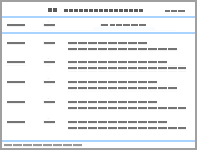
Table 1

Chemical properties of tillage layer in the two experimental sites"

试验地点
Experimental site
土壤质地
Soil texture
pH 有机质
Organic matter (g·kg-1)
全氮
Total N (g·kg-1)
碱解氮
Alkaline-hydrolytic N (mg·kg-1)
速效磷
Olsen-P
(mg·kg-1)
速效钾 NH4OAc-K (mg·kg-1)
许昌市建安区
Jianan district, Xuchang City
黏壤土
Clay loam
7.94 20.00 1.32 138.39 5.90 167.98
鹤壁市淇滨区
Qibin district, Hebi City
黏壤土
Clay loam
8.12 23.15 1.72 146.54 7.83 137.22

Fig. 1

Diurnal variation of main meteorological factors during the growth period in the experimental area for two years"

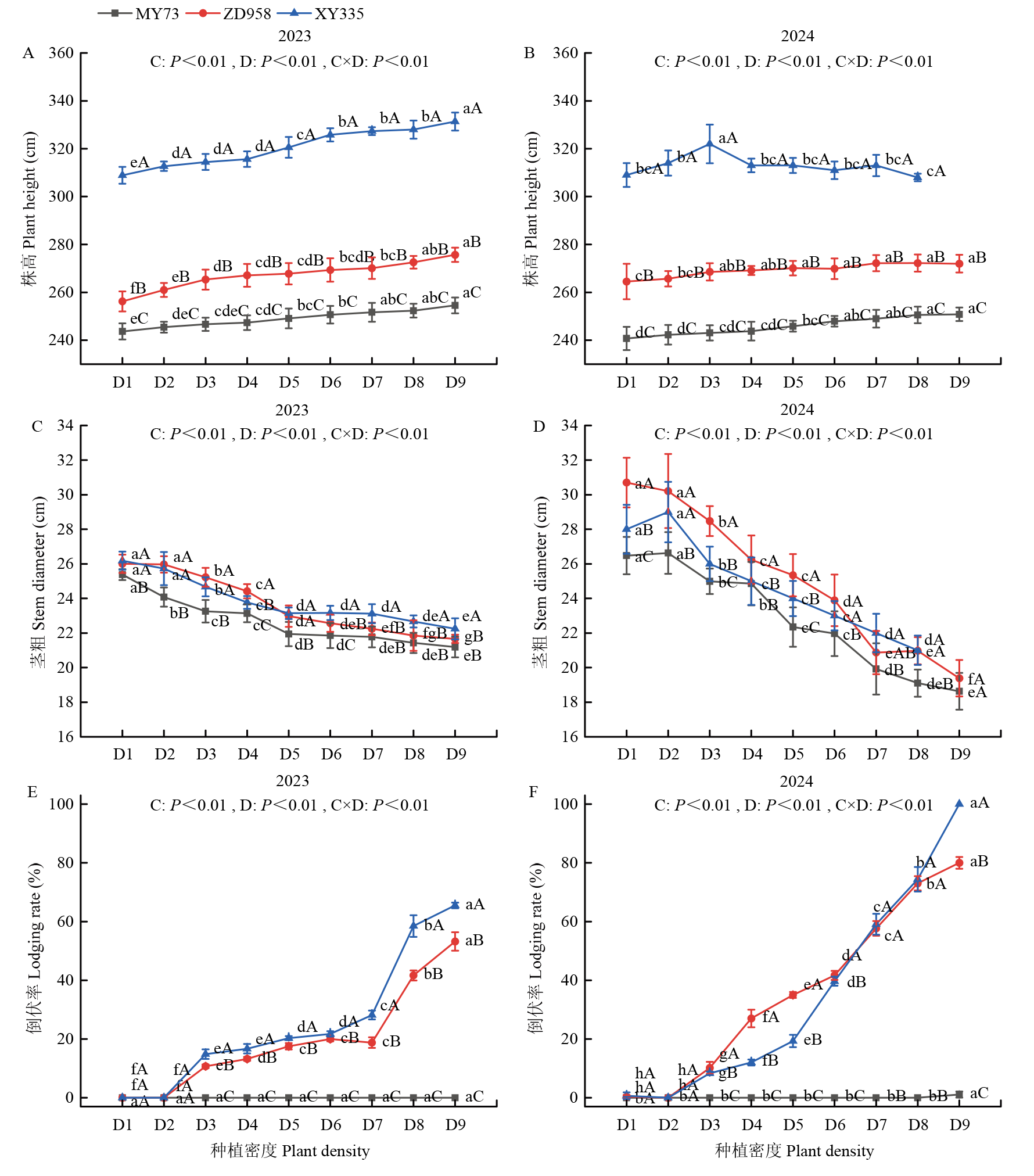
Fig. 2

Variation of plant agronomic traits and lodging rate of maize cultivars with different plant heights under different planting density treatments C, D and C×D represent results of cultivar, density and their interaction through analysis of two-way ANOVA. Different lowercase letters indicate significant difference among different densities of the same cultivar and different cultivars of the same density (P<0.05). Bars represent standard deviation. The same as below"

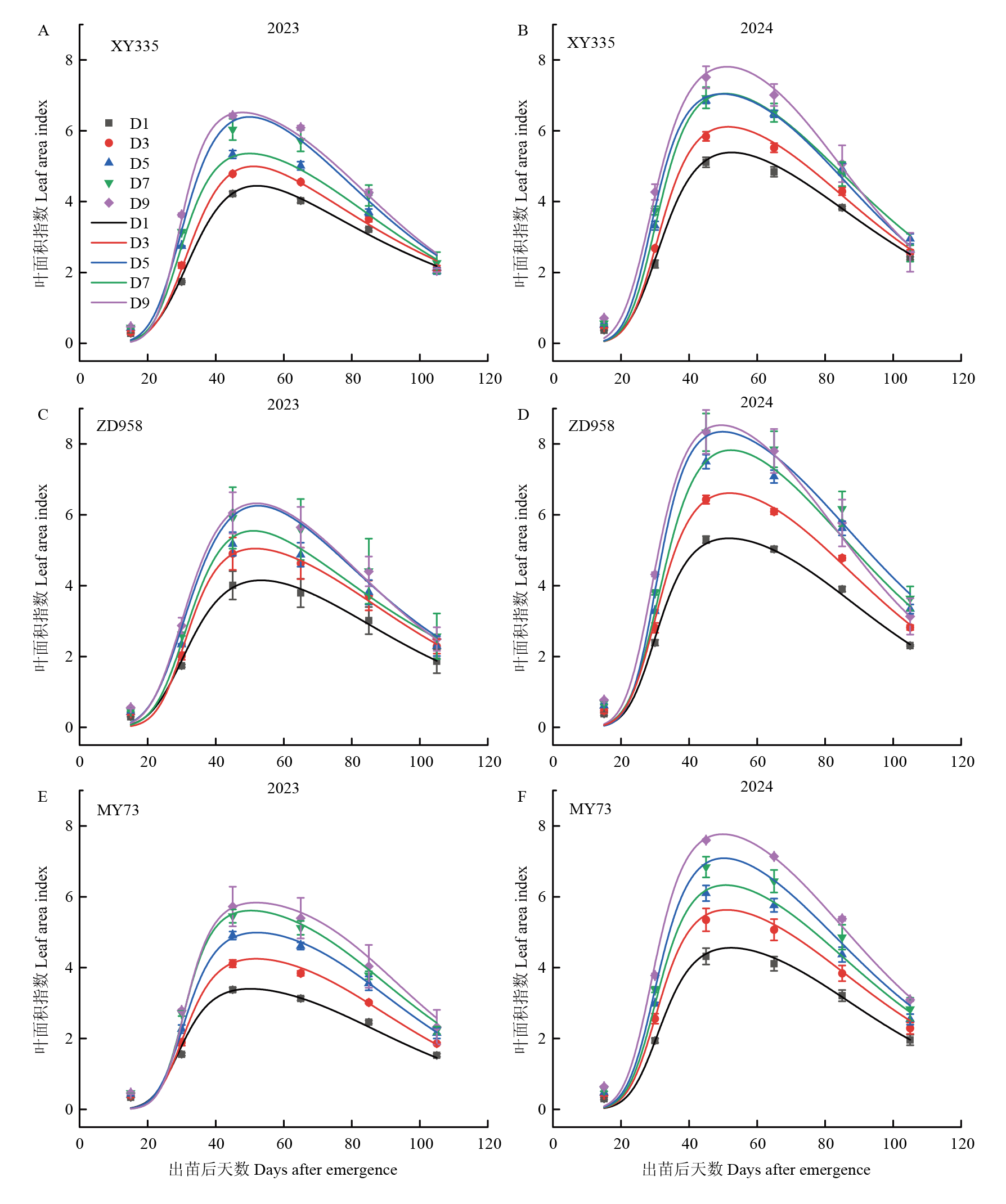
Fig. 3

Dynamics of leaf area index at different growth stages in maize cultivars with different plant heights under various planting densities"

Fig. 4

Variation of specific ear leaf weight of maize cultivars with different plant heights under different planting density treatments"

Table 2

Variation of grain traits of maize cultivars with different plant heights under different planting density treatments"

年份 Year 2023 2024
品种
Cultivar
密度
Density
百粒重
Hundred-grain
weight (g)
百粒体积
Hundred-grain
volume (mL)
籽粒容重
Grain bulk
density (g·L-1)
出籽率
Shelling percentage (%)
百粒重
Hundred-grain
weight (g)
百粒体积
Hundred-grain
volume (mL)
籽粒容重
Grain bulk
density (g·L-1)
出籽率
Shelling percentage (%)
XY335 D1 39.1±0.6aA 31.6±0.4aA 790.1±1.5gB 89.3±0.0aC 39.4±0.4aA 32.6±0.6aA 749.0±1.3hC 86.8±0.2aC
D2 36.9±0.5bA 30.0±0.4bA 794.7±1.7fB 89.3±0.1aC 39.0±0.3bA 31.6±0.3bA 753.6±1.7gC 85.8±0.2bC
D3 36.6±0.3bcA 29.7±0.4bA 795.4±1.2fB 89.0±0.1bC 38.7±0.2bA 31.5±0.3bA 757.3±0.9fC 85.5±0.1bC
D4 36.4±0.1cdA 28.9±0.3cA 798.0±1.5eB 88.6±0.2cC 38.0±0.3cA 31.1±0.2cA 761.0±1.5eC 85.3±0.0bcC
D5 36.1±0.4dA 28.9±0.3cA 799.1±1.3deB 88.4±0.0cdC 37.5±0.4dA 30.5±0.4dA 765.3±1.5dC 85.0±0.1bcC
D6 35.7±0.5eA 27.9±0.5dA 799.7±0.7dB 88.2±0.1dC 37.0±0.4eA 30.4±0.4dA 769.1±1.3cC 84.4±0.3cdC
D7 35.3±0.5fA 27.7±0.4deA 801.7±0.7cB 87.9±0.1eC 36.9±0.2eA 30.2±0.4dA 774.9±2.5bC 83.8±0.3dC
D8 35.1±0.4fA 27.4±0.5eA 803.1±0.7bB 87.3±0.2fC 36.3±0.3fA 29.7±0.4eA 777.6±2.3aC 81.9±1.0eC
D9 34.9±0.4fA 26.7±0.7fA 805.2±1.1aB 86.7±0.3gC 34.6±0.5gA 29.0±0.6fA 739.6±6.0iB 78.0±1.0fC
ZD958 D1 35.5±0.3aB 28.6±0.3aB 781.1±1.9gC 90.5±0.0aB 33.6±0.2aB 27.3±0.25aB 761.6±1.3fB 90.2±0.0aB
D2 34.3±0.2bB 27.9±0.2bB 782.7±1.3fC 90.3±0.1abB 33.4±0.1abB 26.9±0.2bB 770.4±1.9eB 89.8±0.2bB
D3 34.1±0.3bcB 27.8±0.3bcB 783.9±0.9fC 90.2±0.0bB 33.1±0.1bcB 26.7±0.4bcB 771.7±1.3deB 89.5±0.1cB
D4 33.8±0.2cdB 27.5±0.4cB 786.3±1.6eC 89.7±0.2cB 32.8±0.3cdB 26.6±0.4bcB 773.1±2.7dB 89.5±0.0cB
D5 33.5±0.4deB 26.8±0.4dB 789.2±2.2dC 89.5±0.1dB 32.7±0.2cdB 26.3±0.4cdB 775.6±1.3cB 89.3±0.0dB
D6 33.3±0.4efB 26.5±0.4dB 793.0±0.7cC 89.1±0.2eB 32.5±0.3dB 26.2±0.3cdB 778.0±1.5bB 89.2±0.1deB
D7 33.3±0.2efB 26.5±0.4dB 794.7±1.1bC 89.0±0.1eB 32.1±0.3eB 26.5±0.3bcB 780.0±3.0aB 89.0±0.1eB
D8 33.0±0.6fgB 25.8±0.4eB 801.7±1.9aC 88.5±0.2fB 31.0±0.5fB 25.7±0.3eB 780.8±2.0aB 88.1±0.1fB
D9 32.9±0.4gB 25.4±0.4fB 801.6±1.7aC 88.2±0.1gB 23.7±1.2gC 19.7±0.9fC 723.3±2.7gC 87.7±0.2gB
MY73 D1 30.4±0.3aC 23.9±0.2aC 806.7±2.4hA 92.8±0.2aA 30.8±0.2aC 24.1±0.2aC 802.6±1.3gA 91.5±0.0aA
D2 29.9±0.2bC 23.5±0.4bC 809.6±1.0gA 92.6±0.0bA 30.0±0.3bC 23.7±0.4bC 805.2±0.7fA 91.5±0.0aA
D3 29.7±0.3cC 23.0±0.4cC 812.3±1.9fA 92.5±0.1bA 29.6±0.2cC 23.2±0.25cC 805.7±1.0fA 91.4±0.0bA
D4 29.4±0.1dC 22.7±0.4dC 814.1±1.4eA 92.2±0.0cA 29.5±0.2cC 22.9±0.2cdC 807.7±0.9eA 91.2±0.1cA
D5 29.4±0.2dC 22.6±0.3dC 820.3±1.0dA 92.0±0.1cA 29.2±0.2dC 22.8±0.25dC 808.2±0.7eA 91.0±0.1dA
D6 29.2±0.2deC 21.9±0.3eC 822.0±1.1cA 91.5±0.3dA 28.5±0.3eC 22.5±0.4eC 809.4±0.5dA 90.8±0.1eA
D7 29.1±0.2eC 21.9±0.3eC 823.0±1.9cA 91.1±0.1eA 28.5±0.4eC 22.4±0.2eC 810.8±0.7cA 90.6±0.0fA
D8 28.4±0.3fC 21.5±0.4fC 826.8±1.5bA 90.8±0.0fA 28.0±0.4fC 21.9±0.3fC 811.9±1.2bA 90.4±0.0gA
D9 28.3±0.2fC 21.5±0.4fC 832.8±2.4aA 90.1±0.0gA 27.7±0.3gB 21.8±0.4fB 814.6±1.6aA 90.1±0.1hA
变异来源
Variant source
品种 C ** ** ** ** ** ** ** **
密度 D ** ** ** ** ** ** ** **
C×D ** ** ** ** ** ** ** **

Table 3

Variation of grain fertility and harvest index of maize cultivars with different plant heights under different planting density treatments"

年份 Year 2023 2024
品种
Cultivar
密度
Density
有效穗数
Effective ears per unit area (ears/hm2)
结实率
Grain set rate (%)
地上部干物质
Aboveground
dry matter (g/plant)
单穗粒重
Kernel weight
(g/ear)
收获指数
Harvest
index
有效穗数
Ear number (ears/hm2)
结实率
Grain set rate
(%)
地上部干物质
Aboveground
dry matter (g/plant)
单穗粒重
Kernel weight
(g/ear)
收获指数
Harvest
index
XY335 D1 60000±0dA 95.7±2.7aB 379.3±5.8aA 208.4±3.8aA 0.550±0.017aC 56000±1732cB 94.8±2.8aB 384.2±1.7aA 210.5±0.3aA 0.548±0.003aC
D2 67500±0cA 93.4±2.5aB 366.8±8.4abA 189.3±7.6bA 0.516±0.007bC 61875±3155bB 93.1±2.9aB 361.9±6.3bA 191.8±3.6bA 0.530±0.001bC
D3 75000±0bA 82.8±2.6bC 361.8±7.8bA 176.1±2.2cA 0.487±0.006cC 70000±5728abB 79.3±2.8bC 344.2±7.1cA 172.4±2.7cA 0.501±0.003cC
D4 77000±4763abB 78.8±1.6cC 338.5±0.9cA 164.3±4.1dA 0.486±0.013cC 75625±4763aB 78.4±2.9bC 339.0±2.4cA 165.5±2.4dA 0.488±0.004cC
D5 81000±1800aC 74.9±2.4dB 331.2±3.9cA 156.7±1.9eA 0.473±0.003cdC 75000±6874aB 77.4±3.0bB 321.4±1.5dA 150.5±2.2eA 0.468±0.008dC
D6 81250±2815aC 66.5±2.3eC 299.7±8.4dA 140.3±2.9fA 0.468±0.008cdC 78000±8444aB 69.6±4.0cC 307.0±2.5eA 144.8±3.2fA 0.472±0.014dC
D7 73500±3150bcC 64.3±2.1eC 285.4±1.6deA 133.7±3.9fA 0.468±0.015cdC 68250±6500abB 67.1±2.8cB 298.2±0.9fA 138.2±3.0gA 0.464±0.009dC
D8 67500±4500cB 58.0±2.8fC 272.4±1.3efA 124.1±2.4gA 0.456±0.011dC 71250±4592abC 56.2±4.4dC 261.3±7.0gA 102.1±3.1hB 0.391±0.003eC
D9 68000±6928cB 52.1±3.7gB 262.2±12.2fA 106.9±4.2hB 0.408±0.008eC 38000±19287dC 48.9±6.6eC 141.8±7.2hA 40.2±2.6iC 0.284±0.017fC
ZD958 D1 60000±0dA 94.8±3.1aB 286.1±6.1aB 164.3±1.9aB 0.574±0.007aB 60000±0dA 93.5±1.3aB 341.7±2.2aB 195.0±2.5aB 0.571±0.005aB
D2 67500±0cA 92.1±3.3aB 275.2±2.3bB 154.1±2.1bB 0.560±0.012bB 67500±0cA 91.7±1.4aB 327.1±6.3bB 183.4±3.5bB 0.561±0.001bB
D3 75000±0cA 85.8±2.3bB 264.5±2.6cB 144.9±3.9cB 0.548±0.010bB 75000±0cA 87.1±1.9bB 267.6±1.8cB 148.1±1.7cC 0.553±0.010bB
D4 82500±0aA 81.4±2.5cB 263.4±2.8cB 140.3±1.8cC 0.533±0.007cB 81125±2382cA 85.4±3.5bB 261.1±3.7deB 139.0±3.8dC 0.532±0.008cB
D5 87000±5196aB 75.6±2.4dB 259.2±6.3cB 133.8±2.8dC 0.516±0.002dB 87000±3196bA 78.3±2.9cB 250.8±7.9efB 130.9±4.8eC 0.522±0.003dB
D6 87750±975aB 70.9±2.6eB 260.5±10.4cB 127.6±7.4eC 0.490±0.009eB 94250±2815abA 77.0±3.4cB 253.6±3.1deB 127.2±1.1efB 0.502±0.003eB
D7 87500±6062aB 67.5±3.3fB 241.4±0.5dB 116.8±0.9fC 0.484±0.003eB 99750±5093aA 67.6±2.8dB 253.3±3.4deB 124.6±3.6fB 0.492±0.007fB
D8 67500±5625cB 61.9±2.7gB 236.0±4.2dB 113.0±2.4fgC 0.479±0.002efB 103125±6495aB 64.0±3.3eB 243.2±6.3eB 117.7±3.7gA 0.484±0.003fB
D9 68000±6928cB 54.5±4.2hB 231.5±6.9dB 108.2±4.1gB 0.467±0.007fB 75600±5643cB 59.6±4.2fB 184.9±3.4fA 76.8±1.9hB 0.416±0.003gB
MY73 D1 60000±0iA 99.7±0.9aA 265.6±6.1aC 159.7±3.0aC 0.602±0.003aA 60000±0iA 98.6±1.4aA 275.7±6.5aC 166.2±9.3aC 0.603±0.006aA
D2 67500±0hA 97.0±3.5aA 257.9±6.3aC 154.9±2.5aB 0.601±0.006abA 67500±0hA 96.9±2.5aA 264.0±7.8abC 157.9±4.3bC 0.598±0.003abA
D3 75000±0gA 91.8±3.0bA 243.3±9.1bC 146.2±4.7bB 0.601±0.009abA 75000±0gA 93.3±1.5bA 254.3±5.1bC 154.0±3.7bB 0.605±0.005aA
D4 82500±0fA 86.6±2.6cA 243.8±5.8bC 145.7±3.5bB 0.598±0.004abA 82500±0fA 90.7±3.0bcA 236.1±4.8cC 142.8±2.0cB 0.605±0.004aA
D5 90000±0eA 84.6±2.4cdA 232.9±2.2bcC 139.6±0.4cB 0.599±0.007abA 90000±0eA 90.8±3.5bcA 225.6±4.7cdC 135.8±3.3cdB 0.602±0.003aA
D6 97500±0dA 82.2±1.9dA 222.4±2.0cC 133.2±0.4dB 0.599±0.006abA 97500±0dA 87.8±2.8cdA 215.9±4.3dC 128.8±2.8dB 0.597±0.005abA
D7 105000±0cA 79.1±2.2eA 210.0±2.9dC 125.8±0.9eB 0.599±0.006abA 105000±0cA 85.7±2.3dA 181.7±6.9eC 108.9±4.6eC 0.600±0.008abA
D8 112500±0bA 72.2±2.6fA 199.2±5.1dC 117.5±2.5fB 0.590±0.003bA 112500±0bA 79.2±5.4eA 169.6±5.6efC 102.0±3.3efB 0.602±0.002abA
D9 120000±0aA 68.3±5.3gA 199.6±12.5dC 117.9±6.3fA 0.591±0.007abA 118000±3464aA 76.6±5.6eA 166.4±6.6fA 98.6±3.8fA 0.593±0.003bA
变异来源
Variant source
品种 C ** ** ** ** ** ** ** ** ** **
密度 D ** ** ** ** ** ** ** ** ** **
C×D ** ** ** ** ** ** ** ** ** **

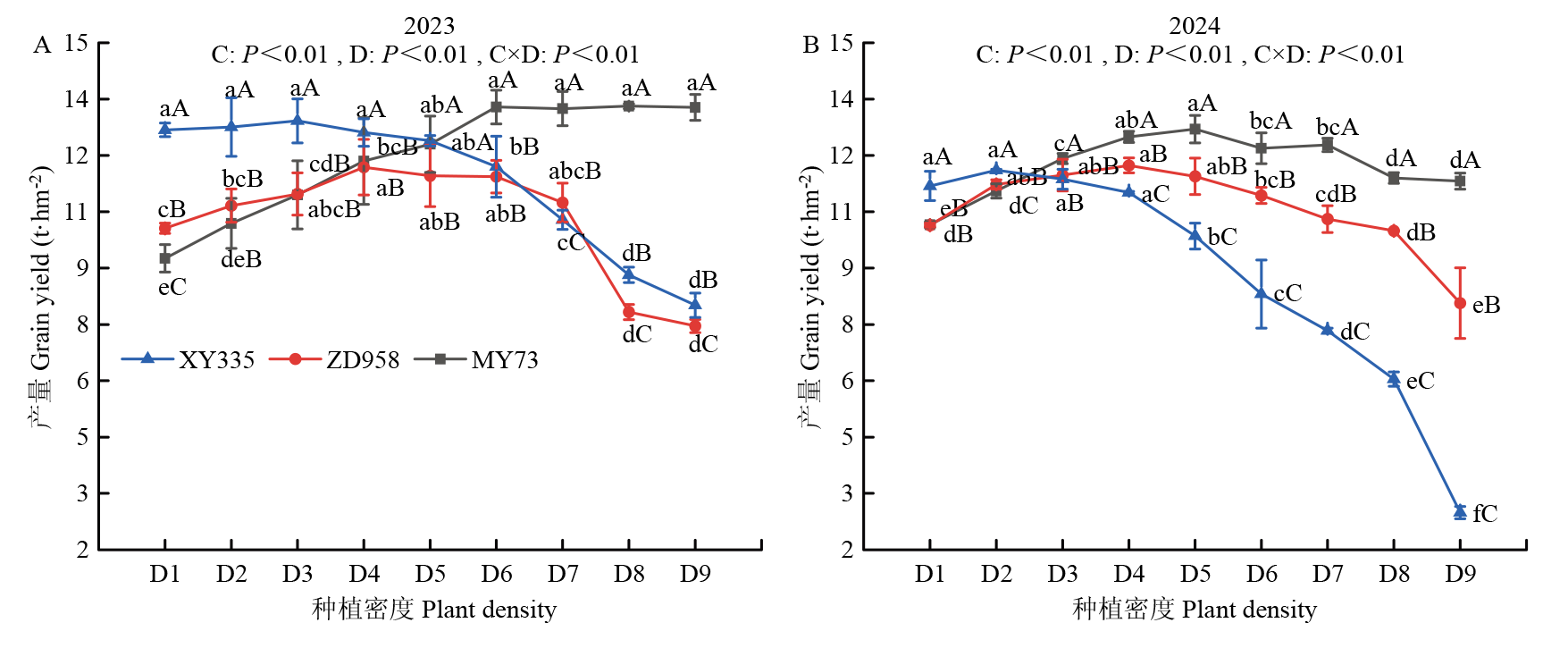
Fig. 5

Variation of grain yield of maize cultivars with different plant heights under different planting density treatments"

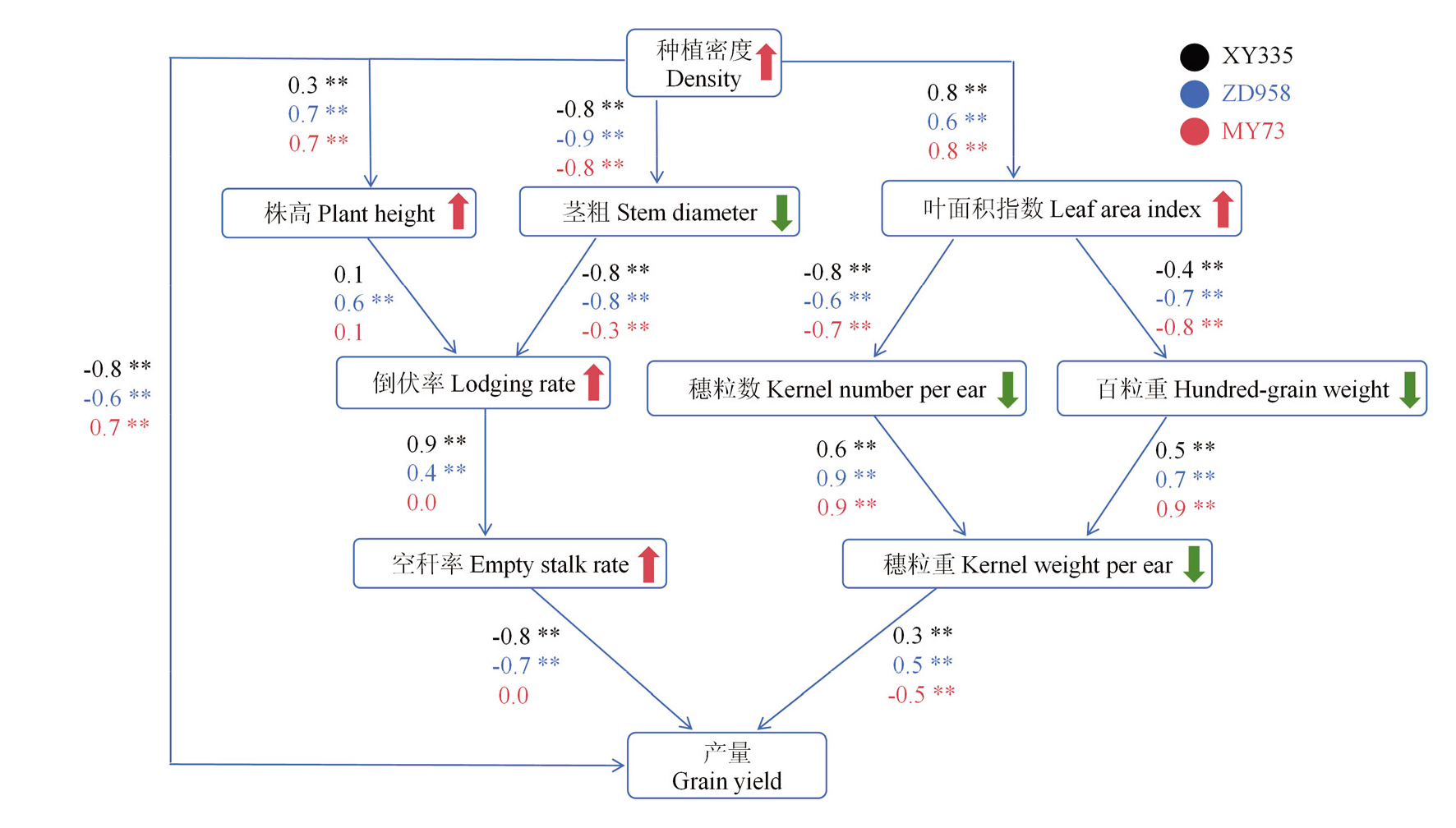
Fig. 6

Correlation analysis of plant, leaf, kernel and ear related agronomic traits of maize cultivars with different plant height D: Plant density; Y: Grain yield; DM: Above ground dry matter; KEW: Kernel weight per ear; HGW: Hundred-grain weight; KNE: Kernel number per ear; HGV: Hundred-grain volume; GBD: Grain bulk density; PH: Plant height; SD: Stem diameter; EH: Ear height; LR: Lodging rate; ESR: Empty stalk rate; EL: Ear length; TBL: Ear tip-barrenness length; ED: Ear diameter; LAI: Leaf area index; LA: Leaf area per plant at the silking stage. The same as below"

Fig. 7

Effects of density on key index related to yield formation of maize cultivars with different plant height"

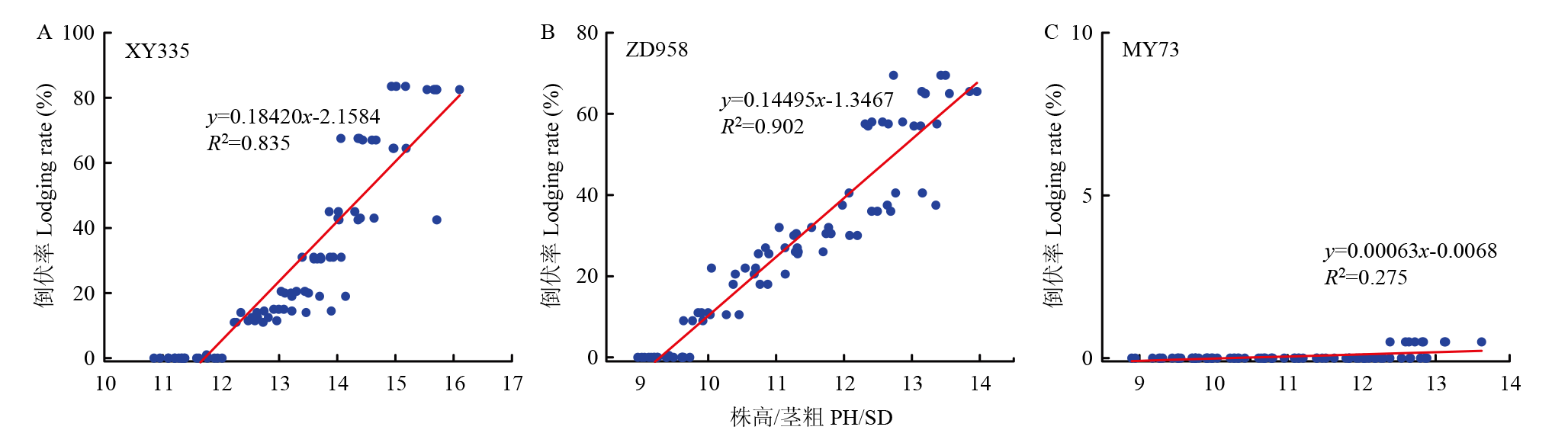
Fig. 8

Regression analysis between lodging rate and ratio of plant height to stem diameter for maize cultivars with different plant height"

[1]
中华人民共和国国家统计局. 中国统计年鉴. 北京: 中国统计出版社, 2024. 12,1-17.
National Bureau of Statistics of China. China Statistical Yearbook. Beijing: China Statistics Press, 2024. 12,1-17. (in Chinese)
[2]
明博, 谢瑞芝, 侯鹏, 李璐璐, 王克如, 李少昆. 2005—2016年中国玉米种植密度变化分析. 中国农业科学, 2017, 50(11): 1960-1972. doi:10.3864/j.issn.0578-1752.2017.11.002.
MING B, XIE R Z, HOU P, LI L L, WANG K R, LI S K. Changes of maize planting density in China. Scientia Agricultura Sinica, 2017, 50(11): 1960-1972. doi:10.3864/j.issn.0578-1752.2017.11.002. (in Chinese)
[3]
严建兵, 赵久然. 密植高产: 我国玉米育种的最核心目标. 生物技术通报, 2023, 39(8): 1-3.
YAN J B, ZHAO J R. Dense planting for high yield-the key goal of maize breeding in China. Biotechnology Bulletin, 2023, 39(8): 1-3. (in Chinese)
[4]
LI T, ZHANG X P, LIU Q, LIU J, CHEN Y Q, SUI P. Yield penalty of maize (Zea mays L.) under heat stress in different growth stages: A review. Journal of Integrative Agriculture, 2022, 21(9): 2465-2476.

doi: 10.1016/j.jia.2022.07.013
[5]
WEI S S, WANG X Y, LI G H, JIANG D, DONG S T. Maize canopy apparent photosynthesis and (13)C-photosynthate reallocation in response to different density and N rate combinations. Frontiers in Plant Science, 2019, 10: 1113.

doi: 10.3389/fpls.2019.01113
[6]
刘晓林, 马晓君, 豆攀, 黄科程, 王兴龙, 张頔, 孔凡磊, 袁继超. 种植密度对川中丘陵夏玉米茎秆性状及产量的影响. 中国生态农业学报, 2017, 25(3): 356-364.
LIU X L, MA X J, DOU P, HUANG K C, WANG X L, ZHANG D, KONG F L, YUAN J C. Effect of planting density on stem characteristics and yield of summer maize in the Hilly Central Sichuan Basin, China. Chinese Journal of Eco-Agriculture, 2017, 25(3): 356-364. (in Chinese)
[7]
徐田军, 吕天放, 陈传永, 刘月娥, 张译天, 刘秀芝, 赵久然, 王荣焕. 种植密度和植物生长调节剂对玉米茎秆性状的影响及调控. 中国农业科学, 2019, 52(4): 629-638. doi:10.3864/j.issn.0578-1752.2019.04.005.
XU T J, T F, CHEN C Y, LIU Y E, ZHANG Y T, LIU X Z, ZHAO J R, WANG R H. Effects of plant density and plant growth regulator on stalk traits of maize and their regulation. Scientia Agricultura Sinica, 2019, 52(4): 629-638. doi:10.3864/j.issn.0578-1752.2019.04.005. (in Chinese)
[8]
ZHAN X X, KONG F L, LIU Q L, LAN T Q, LIU Y Q, XU J Z, OU Q, CHEN L, KESSEL G, KEMPENAAR C, YUAN J C. Maize basal internode development significantly affects stalk lodging resistance. Field Crops Research, 2022, 286: 108611.

doi: 10.1016/j.fcr.2022.108611
[9]
任佰朝, 李利利, 董树亭, 刘鹏, 赵斌, 杨今胜, 王丁波, 张吉旺. 种植密度对不同株高夏玉米品种茎秆性状与抗倒伏能力的影响. 作物学报, 2016, 42(12): 1864-1872.

doi: 10.3724/SP.J.1006.2016.01864
REN B C, LI L L, DONG S T, LIU P, ZHAO B, YANG J S, WANG D B, ZHANG J W. Effects of plant density on stem traits and lodging resistance of summer maize hybrids with different plant heights. Acta Agronomica Sinica, 2016, 42(12): 1864-1872. (in Chinese)

doi: 10.3724/SP.J.1006.2016.01864
[10]
郑迎霞, 陈杜, 魏鹏程, 卢平, 杨锦越, 罗上轲, 叶开梅, 宋碧. 种植密度对贵州春玉米茎秆抗倒伏性能及籽粒产量的影响. 作物学报, 2021, 47(4): 738-751.

doi: 10.3724/SP.J.1006.2021.03044
ZHENG Y X, CHEN D, WEI P C, LU P, YANG J Y, LUO S K, YE K M, SONG B. Effects of planting density on lodging resistance and grain yield of spring maize stalks in Guizhou Province. Acta Agronomica Sinica, 2021, 47(4): 738-751. (in Chinese)

doi: 10.3724/SP.J.1006.2021.03044
[11]
王利青, 于晓芳, 高聚林, 马达灵, 胡树平, 郭怀怀, 刘爱业. 不同年代玉米品种籽粒产量形成对种植密度的响应. 作物学报, 2022, 48(10): 2625-2637.

doi: 10.3724/SP.J.1006.2022.13057
WANG L Q, YU X F, GAO J L, MA D L, HU S P, GUO H H, LIU A Y. Response of grain yield formation to planting density of maize varieties in different eras. Acta Agronomica Sinica, 2022, 48(10): 2625-2637. (in Chinese)

doi: 10.3724/SP.J.1006.2022.13057
[12]
LUO N, WANG X Y, HOU J M, WANG Y Y, WANG P, MENG Q F. Agronomic optimal plant density for yield improvement in the major maize regions of China. Crop Science, 2020, 60(3): 1580-1590.

doi: 10.1002/csc2.v60.3
[13]
毛圆圆, 薛军, 翟娟, 张园梦, 张国强, 明博, 谢瑞芝, 王克如, 侯鹏, 李召锋, 李少昆. 水肥一体化条件下密植高产玉米适宜追氮次数研究. 植物营养与肥料学报, 2022, 28(12): 2227-2238.
MAO Y Y, XUE J, ZHAI J, ZHANG Y M, ZHANG G Q, MING B, XIE R Z, WANG K R, HOU P, LI Z F, LI S K. Optimum times of nitrogen topdressing in high-yield maize under high plant density and fertigation. Journal of Plant Nutrition and Fertilizers, 2022, 28(12): 2227-2238. (in Chinese)
[14]
耿文杰, 李宾, 任佰朝, 赵斌, 刘鹏, 张吉旺. 种植密度和喷施乙烯利对夏玉米木质素代谢和抗倒伏性能的调控. 中国农业科学, 2022, 55(2): 307-319. doi:10.3864/j.issn.0578-1752.2022.02.006.
GENG W J, LI B, REN B Z, ZHAO B, LIU P, ZHANG J W. Regulation mechanism of planting density and spraying ethephon on lignin metabolism and lodging resistance of summer maize. Scientia Agricultura Sinica, 2022, 55(2): 307-319. doi:10.3864/j.issn.0578-1752.2022.02.006. (in Chinese)
[15]
刘笑鸣. 高密种植下黑龙江春玉米对氮素和化控的生理生态响应及温室气体排放的影响[D]. 哈尔滨: 东北农业大学, 2023.
LIU X M. Physiological and ecological responses of spring maize in Heilongjiang Province to nitrogen and chemical control and effects of greenhouse gas emission under high density planting[D]. Harbin: Northeast Agricultural University, 2023. (in Chinese)
[16]
GARDIOL J M, SERIO L A, DELLA MAGGIORA A I. Modelling evapotranspiration of corn (Zea mays) under different plant densities. Journal of Hydrology, 2003, 271(1-4): 188-196.

doi: 10.1016/S0022-1694(02)00347-5
[17]
杨利华, 张丽华, 杨世丽, 马瑞昆, 张全国. 不同株高玉米品种部分群体质量指标对种植密度的反应. 华北农学报, 2007, 22(6): 139-146.

doi: 10.7668/hbnxb.2007.06.029
YANG L H, ZHANG L H, YANG S L, MA R K, ZHANG Q G. Responses of some population quality indices of corn hybrids differing in plant height to planting density. Acta Agriculturae Boreali-Sinica, 2007, 22(6): 139-146. (in Chinese)
[18]
杨今胜, 王永军, 张吉旺, 刘鹏, 李从锋, 朱元刚, 郝梦波, 柳京国, 李登海, 董树亭. 三个超高产夏玉米品种的干物质生产及光合特性. 作物学报, 2011, 37(2): 355-361.
YANG J S, WANG Y J, ZHANG J W, LIU P, LI C F, ZHU Y G, HAO M B, LIU J G, LI D H, DONG S T. Dry matter production and photosynthesis characteristics of three hybrids of maize (Zea mays L.) with super-high-yielding potential. Acta Agronomica Sinica, 2011, 37(2): 355-361. (in Chinese)

doi: 10.3724/SP.J.1006.2011.00355
[19]
孟战赢, 王育红, 郭党, 吴丽娜, 田文仲, 李俊红, 李芳, 吕军杰. 不同种植密度对夏玉米产量及农艺性状的影响. 山西农业科学, 2025, 53(3): 50-57.
MENG Z Y, WANG Y H, GUO D, WU L N, TIAN W Z, LI J H, LI F, J J. Effects of different planting densities on yield and agronomic traits of summer maize. Journal of Shanxi Agricultural Sciences, 2025, 53(3): 50-57. (in Chinese)
[20]
吴希, 王家瑞, 郝淼艺, 张宏军, 张仁和. 种植密度对不同生育期玉米品种光温资源利用率和产量的影响. 作物学报, 2023, 49(4): 1065-1078.

doi: 10.3724/SP.J.1006.2023.23032
WU X, WANG J R, HAO M Y, ZHANG H J, ZHANG R H. Effects of planting density on solar and heat resource utilization and yield of maize varieties at different growth stages. Acta Agronomica Sinica, 2023, 49(4): 1065-1078. (in Chinese)

doi: 10.3724/SP.J.1006.2023.23032
[21]
HERNÁNDEZ F, AMELONG A, BORRÁS L. Genotypic differences among Argentinean maize hybrids in yield response to stand density. Agronomy Journal, 2014, 106(6): 2316-2324.

doi: 10.2134/agronj14.0183
[22]
周文丽, 郝淼艺, 张仁和. 高密种植下氮肥对玉米根系生长及氮代谢的影响. 作物杂志, 2025, 1-9. https://link.cnki.net/urlid/11.1808.S.20250424.0906.002.
ZHOU W L, HAO M Y, ZHANG R H. Effects of nitrogen fertilizer on root growth and nitrogen metabolism of maize under high-density planting. Crops, 2025, 1-9. https://link.cnki.net/urlid/11.1808.S.20250424.0906.002. (in Chinese)
[23]
尹文旭, 刘晨, 白雪冬, 赵海超, 黄智鸿, 刘松涛, 卢海博, 蒋超. 增密增肥对雨养旱作春玉米产量及农艺性状的影响. 安徽农业科学, 2025, 53(2): 22-25.
YIN W X, LIU C, BAI X D, ZHAO H C, HUANG Z H, LIU S T, LU H B, JIANG C. Effects of increasing density and fertilizer on yield and agronomic characters of rain-fed spring corn. Journal of Anhui Agricultural Sciences, 2025, 53(2): 22-25. (in Chinese)
[24]
田龙兵, 沈兆崟, 赵孝天, 张放, 侯文峰, 高强, 王寅. 种植密度与施氮量互作对不同玉米品种产量和水分利用效率的影响. 中国农业科学, 2024, 57(21): 4221-4237. doi:10.3864/j.issn.0578-1752.2024.21.005.
TIAN L B, SHEN Z Y, ZHAO X T, ZHANG F, HOU W F, GAO Q, WANG Y. Interactive effects of planting density and nitrogen application rate on plant grain yield and water use efficiency of two maize cultivars. Scientia Agricultura Sinica, 2024, 57(21): 4221-4237. doi:10.3864/j.issn.0578-1752.2024.21.005. (in Chinese)
[25]
YANG H W, CHAI Q, YIN W, HU F L, QIN A Z, FAN Z L, YU A Z, ZHAO C, FAN H. Yield photosynthesis and leaf anatomy of maize in inter- and mono-cropping systems at varying plant densities. The Crop Journal, 2022, 10(3): 893-903.

doi: 10.1016/j.cj.2021.09.010
[26]
GOU L, XUE J, QI B Q, MA B Y, ZHANG W F. Morphological variation of maize cultivars in response to elevated plant densities. Agronomy Journal, 2017, 109(4): 1443-1453.

doi: 10.2134/agronj2016.11.0675
[27]
LI Y Y, MING B, FAN P P, LIU Y, WANG K R, HOU P, XUE J, LI S K, XIE R Z. Quantifying contributions of leaf area and longevity to leaf area duration under increased planting density and nitrogen input regimens during maize yield improvement. Field Crops Research, 2022, 283: 108551.

doi: 10.1016/j.fcr.2022.108551
[28]
LIU G Z, YANG Y S, GUO X X, LIU W M, XIE R Z, MING B, XUE J, WANG K R, LI S K, HOU P. A global analysis of dry matter accumulation and allocation for maize yield breakthrough from 1.0 to 25.0 Mg Ha-1. Resources, Conservation and Recycling, 2023, 188: 106656.

doi: 10.1016/j.resconrec.2022.106656
[29]
STUBBS C J, KUNDURU B, BOKROS N, VERGES V, PORTER J, COOK D D, DEBOLT S, MCMAHAN C, SEKHON R S, ROBERTSON D J. Moving toward short stature maize: The effect of plant height on maize stalk lodging resistance. Field Crops Research, 2023, 300: 109008.

doi: 10.1016/j.fcr.2023.109008
[30]
张盼, 卢道文, 孙海潮, 董文恒, 李永江, 张莹莹, 史丽丽, 牛永锋. 种植密度对不同玉米品种茎秆力学特性及抗倒伏能力的影响. 玉米科学, 2025, 33(3): 51-57.
ZHANG P, LU D W, SUN H C, DONG W H, LI Y J, ZHANG Y Y, SHI L L, NIU Y F. Effects of planting density on stem mechanical properties and lodging resistance of different maize varieties. Journal of Maize Sciences, 2025, 33(3): 51-57. (in Chinese)
[31]
张冬梅, 杨柯, 姜春霞, 张伟, 黄明镜, 刘化涛, 闫六英, 刘恩科, 翟广谦, 王娟玲. 不同播期春玉米生理成熟后倒伏特征及其影响因素. 中国生态农业学报(中英文), 2021, 29(4): 725-737.
ZHANG D M, YANG K, JIANG C X, ZHANG W, HUANG M J, LIU H T, YAN L Y, LIU E K, ZHAI G Q, WANG J L. Lodging characteristics after physiological maturity of spring maize sowed at different dates and its influencing factors. Chinese Journal of Eco- Agriculture, 2021, 29(4): 725-737. (in Chinese)
[32]
SARLANGUE T, ANDRADE F H, CALVIÑO P A, PURCELL L C. Why do maize hybrids respond differently to variations in plant density? Agronomy Journal, 2007, 99(4): 984-991.

doi: 10.2134/agronj2006.0205
[33]
张召星, 肖春华, 邹楠, 杨文杰, 侯慧杰, 王克如, 王玉华, 杨小霞. 春玉米果穗性状对种植密度的响应研究. 玉米科学, 2018, 26(2): 89-95, 101.
ZHANG Z X, XIAO C H, ZOU N, YANG W J, HOU H J, WANG K R, WANG Y H, YANG X X. Study on the response of ear traits to planting density in spring maize. Journal of Maize Sciences, 2018, 26(2): 89-95, 101. (in Chinese)
[34]
刘武仁, 郑金玉, 冯艳春, 刘凤成, 罗洋, 刘志全, 沈海波, 王兴家, 张希顺. 玉米品种不同密度下的质量效应. 玉米科学, 2005, 13(2): 99-101.
LIU W R, ZHENG J Y, FENG Y C, LIU F C, LUO Y, LIU Z Q, SHEN H B, WANG X J, ZHANG X S. The quality effect of different densities of elite maize variety. Journal of Maize Sciences, 2005, 13(2): 99-101. (in Chinese)
[35]
苌建峰, 张海红, 李鸿萍, 董朋飞, 李潮海. 不同行距配置方式对夏玉米冠层结构和群体抗性的影响. 作物学报, 2016, 42(1): 104-112.
CHANG J F, ZHANG H H, LI H P, DONG P F, LI C H. Effects of different row spaces on canopy structure and resistance of sum-mer maize. Acta Agronomica Sinica, 2016, 42(1): 104-112. (in Chinese)

doi: 10.3724/SP.J.1006.2016.00104
[36]
SHAO H, WU X B, CHI H H, ZHU F B, LIU J H, DUAN J H, SHI W J, XU Y, MI G H. How does increasing planting density affect nitrogen use efficiency of maize: A global meta-analysis. Field Crops Research, 2024, 311: 109369.

doi: 10.1016/j.fcr.2024.109369
[37]
KING K A, ARCHONTOULIS S V, BAUM M E, EDWARDS J W. From a point to a range of optimum estimates for maize plant density and nitrogen rate recommendations. Agronomy Journal, 2024, 116(2): 598-611.

doi: 10.1002/agj2.v116.2
[38]
SANGOI L, GRACIETTI M A, RAMPAZZO C, BIANCHETTI P. Response of Brazilian maize hybrids from different eras to changes in plant density. Field Crops Research, 2002, 79(1): 39-51.

doi: 10.1016/S0378-4290(02)00124-7
[39]
ZHANG P, GU S C, WANG Y Y, XU C C, ZHAO Y T, LIU X L, WANG P, HUANG S B. The relationships between maize (Zea mays L.) lodging resistance and yield formation depend on dry matter allocation to ear and stem. The Crop Journal, 2023, 11(1): 258-268.

doi: 10.1016/j.cj.2022.04.020
[40]
LI X, XIE C, CHENG L, TONG H N, BOCK R, QIAN Q, ZHOU W B. The next Green Revolution: integrating crop architectype and physiotype. Trends in Biotechnology, 2025, 43(10): 2479-2493.

doi: 10.1016/j.tibtech.2025.04.002
[41]
WENG J H, HUANG M Y, YANG Z W. A high yield potential ideotype for irrigated rice: Rice plant types with short culms and long, upright leaves. Field Crops Research, 2025, 322: 109696.

doi: 10.1016/j.fcr.2024.109696
[42]
王宝宝, 王海洋. 理想株型塑造之于玉米耐密改良. 生物技术通报, 2023, 39(8): 11-30.

doi: 10.13560/j.cnki.biotech.bull.1985.2023-0660
WANG B B, WANG H Y. Molecular design of ideal plant architecture for high-density tolerance of maize plant. Biotechnology Bulletin, 2023, 39(8): 11-30. (in Chinese)
[43]
王元东, 段民孝, 邢锦丰, 王继东, 张春原, 张雪原, 赵久然. 玉米理想株型育种的研究进展与展望. 玉米科学, 2008, 16(3): 47-50.
WANG Y D, DUAN M X, XING J F, WANG J D, ZHANG C Y, ZHANG X Y, ZHAO J R. Progress and prospect in ideal plant type breeding in maize. Journal of Maize Sciences, 2008, 16(3): 47-50. (in Chinese)
[44]
XIAO D P, LIU D L, WANG B, FENG P Y, WATERS C. Designing high-yielding maize ideotypes to adapt changing climate in the North China Plain. Agricultural Systems, 2020, 181(C): 102805.
[1] DONG JinLong, ZHAO Ying, YU HaiBing, LÜ JianYe, QIN JiaQi, LIANG Chen, MING Bo, LI ShaoKun. Multi-Model Elucidating of Nutritional Quality Contributions to Maize Kernel Test Weight and Regional Heterogeneity [J]. Scientia Agricultura Sinica, 2026, 59(5): 985-995.
[2] CHEN GuiPing, WEI JinGui, GUO Yao, LI Pan, WANG FeiEr, QIU HaiLong, FENG FuXue, YIN Wen. Synergistic Effects of Wide-Narrow Row and Density Enhancement on the Photosynthetic Characteristics and Resource Utilization of Maize in Oasis Irrigation Areas [J]. Scientia Agricultura Sinica, 2026, 59(2): 278-291.
[3] ZHANG ZhiYong, TAN ShiChao, XIONG ShuPing, MA XinMing, WEI YiHao, WANG XiaoChun. Effects of Annual Water and Nitrogen Optimization on Yield and Nitrogen Migration of Wheat-Maize Rotation System in Irrigation Area of Northern Henan [J]. Scientia Agricultura Sinica, 2026, 59(2): 336-353.
[4] WEI WenHua, LI Pan, SHAO GuanGui, FAN ZhiLong, HU FaLong, FAN Hong, HE Wei, CHAI Qiang, YIN Wen, ZHAO LianHao. Response of Silage Maize Yield and Quality to Reduced Irrigation and Combined Organic-Inorganic Fertilizer in Northwest Irrigation Areas [J]. Scientia Agricultura Sinica, 2025, 58(8): 1521-1534.
[5] XUE YuQi, ZHAO JiYu, SUN WangSheng, REN BaiZhao, ZHAO Bin, LIU Peng, ZHANG JiWang. Effects of Different Nitrogen Forms on Yield and Quality of Summer Maize [J]. Scientia Agricultura Sinica, 2025, 58(8): 1535-1549.
[6] CHEN GuiPing, LI Pan, SHAO GuanGui, WU XiaYu, YIN Wen, ZHAO LianHao, FAN ZhiLong, HU FaLong. The Regulatory Effect of Reduced Irrigation and Combined Organic- Inorganic Fertilizer Application on Stay-Green Characteristics in Silage Maize Leaves After Tasseling Stage [J]. Scientia Agricultura Sinica, 2025, 58(7): 1381-1396.
[7] YUE RunQing, LI WenLan, DING ZhaoHua, MENG ZhaoDong. Molecular Characteristics and Resistance Evaluation of Transgenic Maize LD05 with Stacked Insect and Herbicide Resistance Traits [J]. Scientia Agricultura Sinica, 2025, 58(7): 1269-1283.
[8] ZHAO Yao, CHENG Qian, XU TianJun, LIU Zheng, WANG RongHuan, ZHAO JiuRan, LU DaLei, LI CongFeng. Effects of Plant Type Improvement on Root-Canopy Characteristics and Grain Yield of Spring Maize Under High Density Condition [J]. Scientia Agricultura Sinica, 2025, 58(7): 1296-1310.
[9] ZOU XiaoWei, XIA Lei, ZHU XiaoMin, SUN Hui, ZHOU Qi, QI Ji, ZHANG YaFeng, ZHENG Yan, JIANG ZhaoYuan. Analysis of Disease Resistance Induced by Ustilago maydis Strain with Overexpressed UM01240 Based on Transcriptome Sequencing [J]. Scientia Agricultura Sinica, 2025, 58(6): 1116-1130.
[10] ZHOU GuangFei, MA Liang, MA Lu, ZHANG ShuYu, ZHANG HuiMin, SONG XuDong, ZHANG ZhenLiang, LU HuHua, HAO DeRong, MAO YuXiang, XUE Lin, CHEN GuoQing. Genome-Wide Association Study of Husk Traits in Maize [J]. Scientia Agricultura Sinica, 2025, 58(3): 431-442.
[11] WANG JiaXin, HU JingYi, ZHANG Wei, WEI Qian, WANG Tao, WANG XiaoLin, ZHANG Xiong, ZHANG PanPan. Effects of Different Mulching Methods on the Production of Photosynthetic Substances and Water Use Efficiency of Intercropped Maize [J]. Scientia Agricultura Sinica, 2025, 58(3): 460-477.
[12] ZHANG FangFang, SONG QiLong, GAO Na, BAI Ju, LI Yang, YUE ShanChao, LI ShiQing. Effects of Long-Term Mulching Practices on Maize Yield, Soil Organic Carbon and Nitrogen Fractions and Indexes Related to Carbon and Nitrogen Pool on the Loess Plateau [J]. Scientia Agricultura Sinica, 2025, 58(3): 507-519.
[13] TIAN Lei, SHAO Xin, ZHOU YiMin, MIAO XiuZhen, JI Nan, WANG Hao, SHI MingShuai, ZHANG YueZhong. Selection of Maize Planting Density and Dense-Planting Tolerant and Lodging-Resistant Varieties in the Southern Foothills of the Greater Khingan Mountains under Multi-Factor Management [J]. Scientia Agricultura Sinica, 2025, 58(24): 5143-5155.
[14] WANG TongChao, YU NingNing, CUI Dong, REN BaiZhao, ZHAO Bin, LIU Peng, REN Hao, XIONG Wei, ZHANG JiWang. Regulation of Fertilization and Kernel Set Characteristics in Summer Maize by Planting Density Under Drip Fertigation Conditions [J]. Scientia Agricultura Sinica, 2025, 58(24): 5156-5174.
[15] MA HeXiao, GE GuoLong, ZHANG XiangQian, LU ZhanYuan, WANG ManXiu, RONG MeiRen, SHI JingJing, ZHANG DeJian, SUN XuePing. Effects of Different Crop Rotation Systems on Soil Readily Oxidized Organic Carbon and Carbon Pool Activity Differences [J]. Scientia Agricultura Sinica, 2025, 58(24): 5201-5215.
Viewed
Full text


Abstract

Cited

  Shared   
  Discussed   
No Suggested Reading articles found!