Scientia Agricultura Sinica ›› 2026, Vol. 59 ›› Issue (5): 1087-1100.doi: 10.3864/j.issn.0578-1752.2026.05.013

• FOOD SCIENCE AND ENGINEERING • Previous Articles     Next Articles

Correlation Analysis of Cucumber Fruit Quality Integrating Sensory Evaluation with Nutritional Traits and Flavor Compound Characteristics

ZHANG LiDong1(), GUO YiCong2(), HUANG HongYu1, NIE Jing2, WANG Bing2, LI MengYu2, LI JiaWang1, SUI XiaoLei2(), LI YuHe1()   

  1. 1 State Key Laboratory of Vegetable Biobreeding, Tianjin Academy of Agricultural Sciences, Tianjin 300192
    2 Beijing Key Laboratory of Growth and Developmental Regulation for Protected Vegetable Crops, College of Horticulture, China Agricultural University, Beijing 100193
  • Received:2025-07-21 Accepted:2025-12-25 Online:2026-03-01 Published:2026-03-06
  • Contact: SUI XiaoLei, LI YuHe

Abstract:

【Objective】 This study aimed to establish a scientific framework for cucumber fruit quality evaluation by integrating the analysis of nutritional traits and flavor compound profiles across diverse germplasm resources with human sensory evaluation. 【Method】 Twelve cucumber lines/varieties with significant sensory variation (provided by Tianjin Cucumber Research Institute) were investigated. The measurements included three parts: first, nutritional traits of fruits, such as soluble sugar content (SSC), total soluble solids (TSS), and titratable acidity (TA); second, flavor compound content in fruits, such as total volatiles and key aldehydes [(E, Z)-2, 6-nonadienal, (E)-2-nonenal, (Z)-6-nonenal]; third, sensory evaluation of fruit quality, such as sweetness, juiciness, crispness, aroma, non-astringency, and non-bitterness. An integrated correlation analysis was performed to link sensory attributes with physicochemical profiles. 【Result】 In the sensory evaluation, non-astringency and sweetness had the highest weighting coefficients (27.12% and 25.49%, respectively), while the other four attributes (aroma, crispness, non-bitterness, and juiciness) ranged from 10.59% to 12.51%. Higher scores across these six dimensions indicated superior overall sensory quality. Furthermore, sweetness, juiciness, crispness, aroma, and non-bitterness of cucumber fruit sensory evaluation were (extremely) correlated with the SSC, TSS content and ascorbic acid content. In addition, cucumber flavor compounds (Z)-6-nonenal content showed significant correlation with sweetness, aroma, juiciness, non-bitterness and non-astringency in sensory evaluation, and it also had extremely significant positive correlation with the SSC, TSS and ascorbic acid content, respectively, while the ratio of cucumber flavor compounds (E, Z)-2, 6-nonadienal to (E)-2-nonenal was significantly correlated with non-astringency. Among the different cucumber varieties tested, line L2 generally exhibited higher levels of fruit SSC, TSS and ascorbic acid content, as well as the ratio of soluble solid content to titratable acid compared with the other lines. It also achieved the highest composite score across all those six sensory attributes. Consequently, line L2 demonstrated superior overall fruit quality. 【Conclusion】 The SSC, TSS, ascorbic acid content, (Z)-6-nonenal content, and the ratio of (E, Z)-2, 6-nonadienal to (E)-2-nonenal content of cucumber fruits could serve as effective indicators for the rapid evaluation of sensory and flavor quality.

Key words: cucumber, fruit quality, sensory evaluation, nutritional quality, flavor compounds, correlation

Table 1

Preliminary evaluation on fruit quality of cucumber planted in field in Wuqing area of Tianjin"

品系(种)
Varieties/Lines
果刺
Trichome
节成性
Fructifications at nodes
果柄
Peduncle
表皮
Epidermis
口感
Taste
L1 大刺 Large spines 高 High 果柄短 Short 油亮 Glossy 口感一般 Fair
L2 小密刺 Tiny dense spines 低 Poor 果柄短 Short 油亮 Glossy 口感最好 Excellent
L3 大刺 Large spines 中 Moderate 果柄中等 Medium 油亮 Glossy 口感好 Good
L9 小密刺 Tiny dense spines 低 Poor 果柄中等 Medium 较亮 Waxy bloom 口感好 Good
N8 小密刺 Tiny dense spines 高(全雌) High (Gynoecious line) 果柄中等 Medimu 一般 Matte 口感一般 Fair
N12 小密刺 Tiny dense spines 高(强强雌)
High (Strong subgynoecious line)
果柄长 Long 油亮 Glossy 口感一般 Fair
N18 大刺 Large spines 高 High 果柄短 Short 较亮 Waxy bloom 口感一般 Fair
N20 大刺 Large spines 中 Moderate 果柄短 Short 灰亮 Dull 口感一般 Fair
S6 小密刺 Tiny dense spines 低 Poor 果柄中等 Medium 较亮 Waxy bloom 口感一般 Fair
S10 小密刺 Tiny dense spines 高(强强雌)
High (Strong subgynoecious line)
果柄中等 Medium 较亮 Waxy bloom 口感一般 Fair
S13 小密刺 Tiny dense spines 高(强强雌)
High (Strong subgynoecious line)
果柄短 Short 灰亮 Dull 口感一般 Fair
S17 大刺 Large spines 高 High 果柄短 Short 一般 Matte 口感较差 Poor

Table 2

Commercial quality statistics of different cucumber varieties/lines"

品系(种)
Varieties/
Lines
果把长度
Fruit neck length (cm)
果长
Fruit length (cm)
单果重
Fruit weight
(g)
心腔直径
Placenta diameter (cm)
果肉直径
Fruit diameter (cm)
果把占比
Fruit neck
ratio
心腔占比
Placenta-to-
fruit ratio
外果皮叶绿素含量
Exocarp chlorophyll content (mg·g-1 FW)
L1 4.55±0.26b 35.63±0.6cdef 248.24±13.03bc 1.93±0.25bc 3.13±0.25d 0.13 0.62 2.55 ± 0.40 cd
L2 4.43±0.4b 33.00±0.99ef 271.81±19.9bc 1.57±0.06c 3.50±0.10bc 0.13 0.45 2.96 ± 0.07 abc
L3 5.10±0.36ab 38.00±1.98abc 330.27±32.08bc 2.03±0.15abc 3.60±0.10bc 0.13 0.56 3.65 ± 0.57 a
L9 5.17±1.15ab 39.20±3.3abc 298.05±30.41bc 1.93±0.22bc 3.43±0.26bcd 0.13 0.56 1.90 ± 0.36 d
N8 5.35±0.24ab 36.57±1.48bcde 235.18±44.38c 1.65±0.21c 3.13±0.22cd 0.15 0.53 2.96 ± 0.05 abc
N12 6.50±0.22a 37.30±0.44bcd 277.15±31.76bc 1.93±0.15bc 3.38±0.15bcd 0.17 0.57 2.70 ± 0.06 bc
N18 4.20±0.27b 32.68±0.56ef 231.94±21.11c 1.60±0.08c 3.33±0.10bcd 0.13 0.48 2.87 ± 0.10 bc
N20 4.43±0.92b 32.27±0.21f 259.04±16.01bc 1.83±0.1bc 3.53±0.22bc 0.14 0.52 2.87 ± 0.10 bc
S6 4.90±0.85b 41.60±0.71a 487.89±22.58a 2.30±0.36a 3.70±0.70a 0.12 0.62 3.41 ± 0.10 ab
S10 5.13±0.48ab 40.20±1.04ab 282.11±34.58bc 1.88±0.05bc 3.15±0.29cd 0.13 0.60 2.71 ± 0.22 bc
S13 5.25±0.65ab 35.87±0.78cdef 300.89±24.82bc 1.95±0.21bc 3.55±0.10bc 0.15 0.55 2.92 ± 0.13 bc
S17 3.93±0.57b 33.43±0.9def 279.61±48.96bc 2.30±0.14ab 3.68±0.28ab 0.12 0.63 2.98 ± 0.01 abc

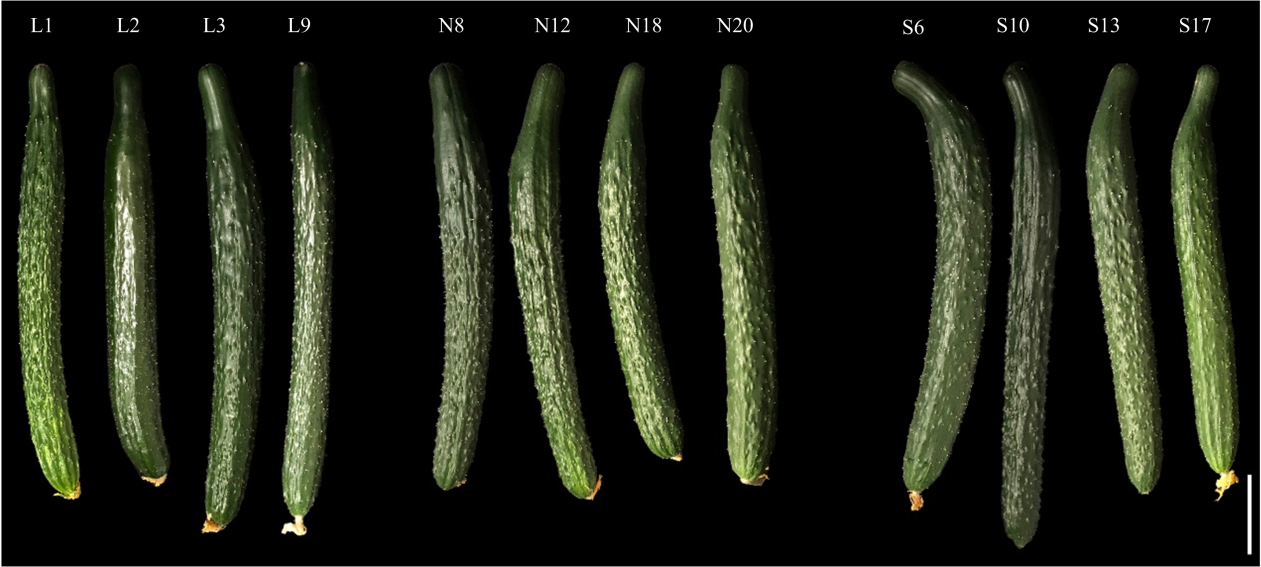
Fig. 1

Fruit appearance of different cucumber varieties/lines L: Superior group; N: Normal group; S: Inferior group; Numbers represent different varieties/lines. Bar=5 cm"

Table 3

Contribution weights of sensory attributes in fruit quality evaluation from different cucumber varieties/lines"

项目
Item
指标变异性
Indicator variability
指标冲突性
Conflict among indicators
信息量
Information content
权重
Weight (%)
甜味 Sweetness 1.531 4.881 7.474 25.49
水分 Juiciness 0.883 4.157 3.669 12.51
脆度 Crispness 0.786 4.522 3.556 12.13
香气 Aroma 0.587 5.289 3.105 10.59
非涩味 Non-astringency 1.119 7.107 7.954 27.12
非苦味 Non-bitterness 0.718 4.964 3.565 12.16

Fig. 2

Sensory evaluation analysis of fruits from different cucumber varieties/lines"

Fig. 3

Analysis of nutritional quality of different cucumber varieties/lines Different lowercase letters indicate significant differences (P<0.05) among cucumber varieties/lines as determined by Tukey’s test. The same as below"

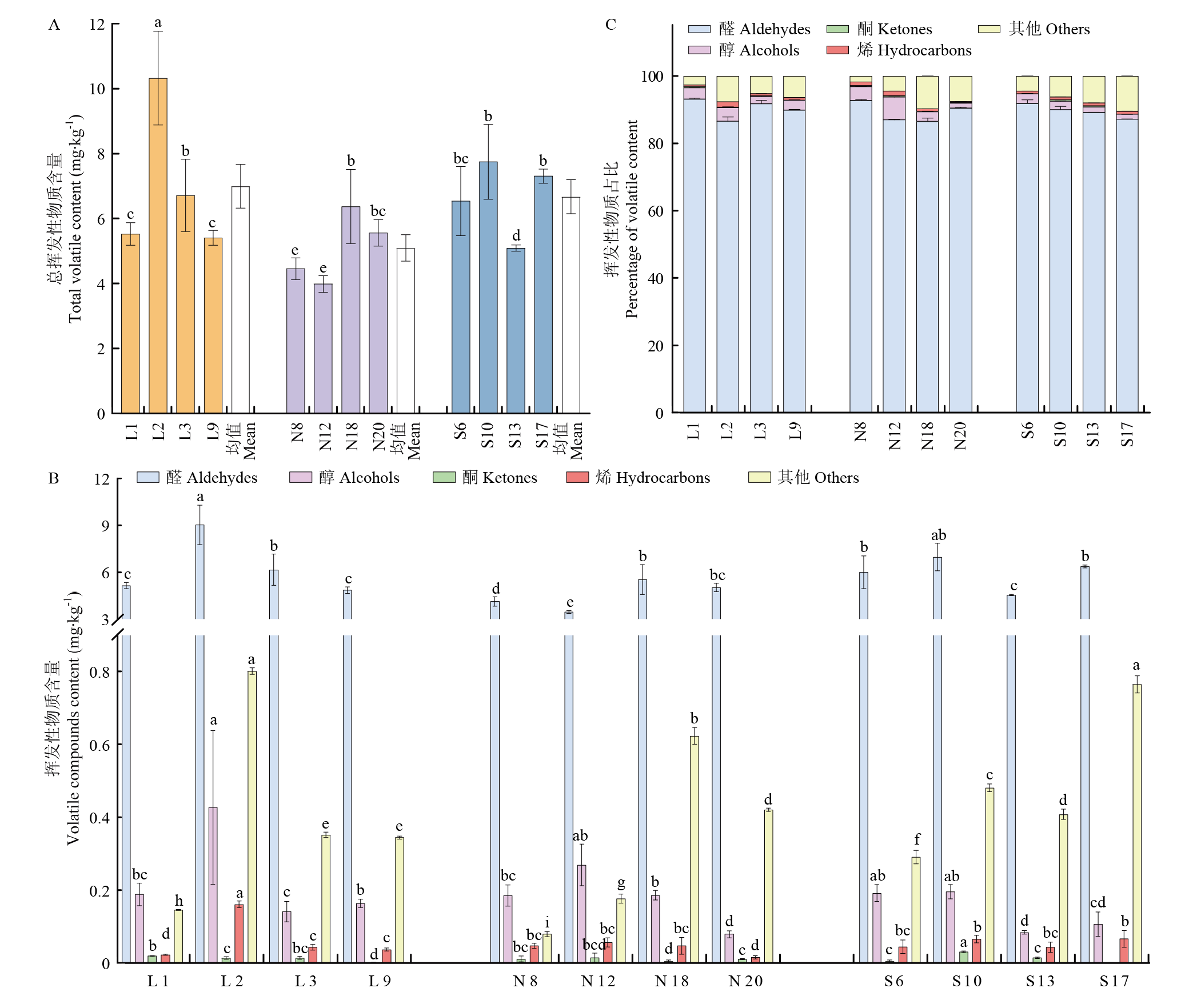
Fig. 4

Analysis of volatile compound content in fruits of different cucumber varieties/lines"

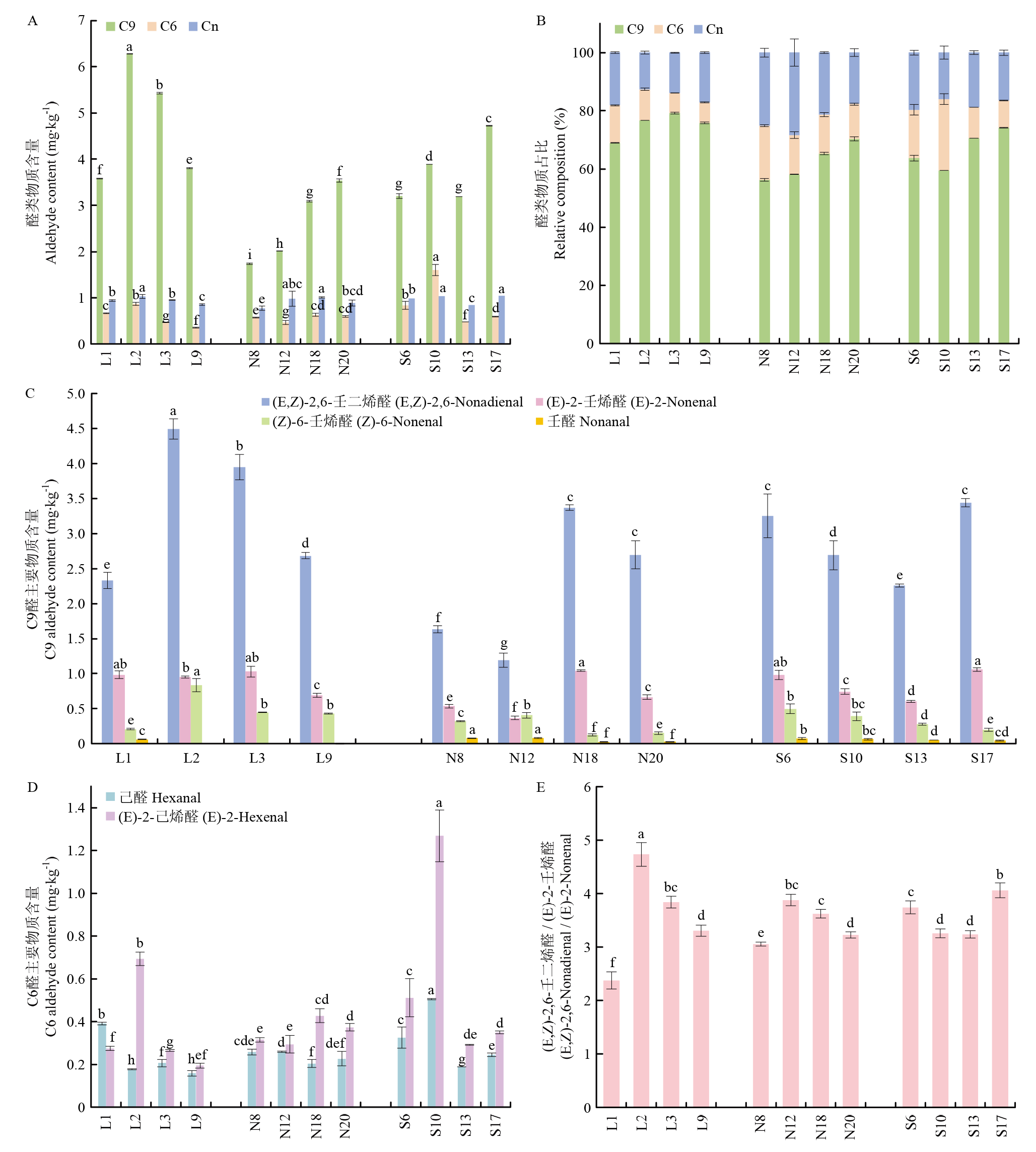
Fig. 5

Analysis of aldehyde flavor-characterizing compounds in fruits of different cucumber varieties/lines A: Content and types of aldehyde compounds in cucumber fruits, classified by carbon number as C9, C6, and other carbon numbers (Cn); B: Individual groups of aldehyde compounds in cucumber fruits; C: Contents of major C9 aldehydes, primarily comprising (E, Z)-2, 6-nonadienal, (E)-2-nonenal, (Z)-6-nonenal, and nonanal; D: Contents of major C6 aldehydes, consisting of hexanal and (E)-2-hexenal; E: Ratio of (E, Z)-2, 6-nonadienal to (E)-2-nonenal"

Fig. 6

Correlation analysis between quality indexes of different cucumber varieties/lines The color and size of the blocks in the figure vary with the degree of correlation between different indicators. Red indicates a positive correlation, while blue indicates a negative correlation"

[1]
农业农村部办公厅关于印发《农业生产“三品一标”提升行动实施方案》的通知.2021-03-18. https://jhs.moa.gov.cn/lsfz/202103/t20210318_6363985.htm.
Notice of the General Office of the Ministry of Agriculture and Rural Affairs on Printing and Distributing the Implementation Plan for the Enhancement Initiative of “Variety Improvement, Quality Upgrade, Brand Establishment and Standardized Production” in Agricultural Production. 2021-03-18. https://jhs.moa.gov.cn/lsfz/202103/t20210318_6363985.htm. (in Chinese)
[2]
张圣平, 苗晗, 薄凯亮, 董邵云, 顾兴芳. “十三五”我国黄瓜遗传育种研究进展. 中国蔬菜, 2021(4): 16-26.
ZHANG S P, MIAO H, BO K L, DONG S Y, GU X F. Research progress on cucumber genetic breeding during “The Thirteenth Five-year Plan” in China. China Vegetables, 2021(4): 16-26. (in Chinese)
[3]
黄国宋, 黄伟康, 郭静依, 刘勇, 罗丰, 符启位, 肖春雷. 19份华北型黄瓜新品种主要农艺性状主成分分析和聚类分析. 现代农业科技, 2021(5): 82-84, 91.
HUANG G S, HUANG W K, GUO J Y, LIU Y, LUO F, FU Q W, XIAO C L. Principal component analysis and cluster analysis on main agronomic traits of 19 new cultivars of North China type cucumber. Xiandai Nongye Keji, 2021(5): 82-84, 91. (in Chinese)
[4]
ZHANG J, GU X C, YAN W J, LOU L N, XU X W, CHEN X H. Characterization of differences in the composition and content of volatile compounds in cucumber fruit. Foods, 2022, 11(8): 1101.
[5]
YANG X Y, JIANG W J, YU H J. The expression profiling of the lipoxygenase (LOX) family genes during fruit development, abiotic stress and hormonal treatments in cucumber (Cucumis sativus L.). International Journal of Molecular Sciences, 2012, 13(2): 2481-2500.

doi: 10.3390/ijms13022481
[6]
郝丽宁, 陈书霞, 王聪颖, 陈巧, 万旭花, 申晓青, 程智慧, 孟焕文. 不同基因型黄瓜果实芳香物质组成及含量差异研究. 西北农林科技大学学报(自然科学版), 2013, 41(6): 139-146.
HAO L N, CHEN S X, WANG C Y, CHEN Q, WAN X H, SHEN X Q, CHENG Z H, MENG H W. Aroma components and their contents in cucumbers from different genotypes. Journal of Northwest A&F University (Natural Science Edition), 2013, 41(6): 139-146. (in Chinese)
[7]
LI X Z, SUN Y H, WANG X W, DONG X Y, ZHANG T T, YANG Y T, CHEN S X. Relationship between key environmental factors and profiling of volatile compounds during cucumber fruit development under protected cultivation. Food Chemistry, 2019, 290: 308-315.

doi: S0308-8146(19)30625-9 pmid: 31000051
[8]
SHAN N, GAN Z Y, NIE J, LIU H, WANG Z Y, SUI X L. Comprehensive characterization of fruit volatiles and nutritional quality of three cucumber (Cucumis sativus L.) genotypes from different geographic groups after bagging treatment. Foods, 2020, 9(3): 294.
[9]
MI S, ZHANG X N, WANG Y H, MA Y D, SANG Y X, WANG X H. Effect of different fertilizers on the physicochemical properties, chemical element and volatile composition of cucumbers. Food Chemistry, 2022, 367: 130667.

doi: 10.1016/j.foodchem.2021.130667
[10]
高俊凤. 植物生理学实验指导. 北京: 高等教育出版社, 2006: 287.
GAO J F. Experimental Guidance for Plant Physiology. Beijing: Higher Education Press, 2006: 287. (in Chinese)
[11]
刘春香, 何启伟, 孟静静. 黄瓜感官检验与主要芳香物质、可溶性糖的相关关系. 中国蔬菜, 2005(1): 8-10.
LIU C X, HE Q W, MENG J J. Correlationship between sensory analysis, major volatile compounds and sugar content in cucumber fruit. China Vegetables, 2005(1): 8-10. (in Chinese)
[12]
CHEN S X, ZHANG R R, HAO L N, CHEN W F, CHENG S Q. Profiling of volatile compounds and associated gene expression and enzyme activity during fruit development in two cucumber cultivars. PLoS ONE, 2015, 10(3): e0119444.
[13]
BAIETTO M, WILSON A D. Electronic-nose applications for fruit identification, ripeness and quality grading. Sensors, 2015, 15(1): 899-931.

doi: 10.3390/s150100899 pmid: 25569761
[14]
李小嫄, 王洪伟, 童华荣. 食品感官评价技术在茶叶品质评价中的? 应用研究进展. 食品安全质量检测学报, 2015, 6(5): 1542-1547.
LI X Y, WANG H W, TONG H R. Progress in research of tea sensory quality assessment by sensory evaluation techniques. Journal of Food Safety & Quality, 2015, 6(5): 1542-1547. (in Chinese)
[15]
YAMAGUCHI S, YOSHIKAWA T, IKEDA S, NINOMIYA T. Studies on the taste of some sweet substances. Agricultural and Biological Chemistry, 1970, 34(2): 181-186.
[16]
陈银根. 黄瓜果实可溶性糖含量遗传效应的初步研究[D]. 扬州: 扬州大学, 2009.
CHEN Y G. Preliminary study of genetic effects of sugar content in cucumber (Cucumis sativus L.) fruit[D]. Yangzhou: Yangzhou University, 2009. (in Chinese)
[17]
高珏晓, 王俊英, 梁增文, 徐蓓蓓, 郭莹, 王仁杰, 李朋, 李美芹. 5种鲜食黄瓜感官与品质评价初探. 蔬菜, 2022(5): 11-16.
GAO J X, WANG J Y, LIANG Z W, XU B B, GUO Y, WANG R J, LI P, LI M Q. Preliminary study on sensory and quality evaluation of five types of fresh cucumber. Vegetables, 2022(5): 11-16. (in Chinese)
[18]
田恒禄. 黄瓜涩味形成与儿茶素类物质代谢的关系及相关分子基础的研究[D]. 扬州: 扬州大学, 2015.
TIAN H L. The relationship between cucumber astrengency form and catechins metabolism, and the study of molecular basis[D]. Yangzhou: Yangzhou University, 2015. (in Chinese)
[19]
XU X W, TIAN H L, HE M, GEBRETSADIK K, QI X H, XU Q, CHEN X H. Changes in catechin contents and expression of catechin biosynthesis-associated genes during early cucumber fruit development. Acta Physiologiae Plantarum, 2019, 41(8): 130.
[20]
任思铃, 朱雪云, 闫立英, 李晓丽. 黄瓜涩味感官评价影响因素及种质资源涩味评价分析. 中国瓜菜, 2023, 36(3): 36-41.
REN S L, ZHU X Y, YAN L Y, LI X L. Establishment of sensory evaluation method for astringency of cucumber and its application in germplasm evaluation. China Cucurbits and Vegetables, 2023, 36(3): 36-41. (in Chinese)
[21]
孙利萍, 高敏丽, 张永民, 靳颖玲, 韩蓉. 口感型番茄品质指标分析及综合评价. 北方农业学报, 2023, 51(5): 67-74.

doi: 10.12190/j.issn.2096-1197.2023.05.07
SUN L P, GAO M L, ZHANG Y M, JIN Y L, HAN R. Taste type tomato quality indexes analysis and comprehensive evaluation. Journal of Northern Agriculture, 2023, 51(5): 67-74. (in Chinese)

doi: 10.12190/j.issn.2096-1197.2023.05.07
[22]
李跃红, 冉茂乾, 徐孟怀, 陈露, 游元丁, 赵阳, 焦彦朝. 不同品种猕猴桃果实品质比较与综合评价. 食品与发酵工业, 2020, 46(23): 162-168.

doi: 10.13995/j.cnki.11-1802/ts.024429
LI Y H, RAN M Q, XU M H, CHEN L, YOU Y D, ZHAO Y, JIAO Y C. Comparison and comprehensive evaluation of fruit quality of different varieties of kiwifruit. Food and Fermentation Industries, 2020, 46(23): 162-168. (in Chinese)

doi: 10.13995/j.cnki.11-1802/ts.024429
[23]
刘丙花, 孙锐, 王开芳, 舒秀阁, 孙蕾. 不同蓝莓品种果实品质比较与综合评价. 食品科学, 2019, 40(1): 70-76.

doi: 10.7506/spkx1002-6630-20170829-338
LIU B H, SUN R, WANG K F, SHU X G, SUN L. Comparison and comprehensive evaluation of fruit quality of different blueberry (Vaccinium spp.) varieties. Food Science, 2019, 40(1): 70-76. (in Chinese)

doi: 10.1111/jfds.1975.40.issue-1
[24]
徐坤范, 王明林, 艾希珍. 日光温室黄瓜发育过程中主要芳香物质和脂肪酸含量的变化. 西北植物学报, 2009, 29(2): 390-396.
XU K F, WANG M L, AI X Z. Changes of main aromatic compounds and fatty acids contents of cucumber fruits during development in solar-greenhouse. Acta Botanica Boreali-Occidentalia Sinica, 2009, 29(2): 390-396. (in Chinese)
[25]
CONTRERAS C, BEAUDRY R. Lipoxygenase-associated apple volatiles and their relationship with aroma perception during ripening. Postharvest Biology and Technology, 2013, 82: 28-38.

doi: 10.1016/j.postharvbio.2013.02.006
[26]
HE Y L, QIN H Y, WEN J L, CAO W Y, YAN Y P, SUN Y N, YUAN P Q, SUN B W, FAN S T, LU W P, LI C Y. Characterization of key compounds of organic acids and aroma volatiles in fruits of different Actinidia argute resources based on high-performance liquid chromatography (HPLC) and headspace gas chromatography-ion mobility spectrometry (HS-GC-IMS). Foods, 2023, 12(19): 3615.
[27]
刘春香, 何启伟, 刘拴桃. 黄瓜果实反, 顺-2, 6-壬二烯醛与反-2-壬烯醛比值的变化. 莱阳农学院学报, 2003(4): 276-278, 281.
LIU C X, HE Q W, LIU S T. Ratio changes of trans-2-cis-6- nonadienal content trans-2-nonenal content on cucumber fruits. Journal of Laiyang Agricultural College, 2003(4): 276-278, 281. (in Chinese)
[28]
王春芳, 毛明, 胡菲菲, 于勇, 和劲松, 朱松明. 超高压和热处理后黄瓜汁感官品质的主观评价和仪器检测对比. 农业工程学报, 2013, 29(10): 278-286.
WANG C F, MAO M, HU F F, YU Y, HE J S, ZHU S M. Comparison of sensory quality between subjective evaluation and instrument detection for cucumber juice with high pressure processing and heat treatment. Transactions of the Chinese Society of Agricultural Engineering, 2013, 29(10): 278-286. (in Chinese)
[29]
EL HADI M A M, ZHANG F J, WU F F, ZHOU C H, TAO J. Advances in fruit aroma volatile research. Molecules, 2013, 18(7): 8200-8229.

doi: 10.3390/molecules18078200 pmid: 23852166
[30]
MATSUI K, KURISHITA S, HISAMITSU A, KAJIWARA T. A lipid-hydrolysing activity involved in hexenal formation. Biochemical Society Transactions, 2000, 28(6): 857-860.

pmid: 11171233
[31]
KEMP T R, KNAVEL D E, STOLTZ L P. Identification of some volatile compounds from cucumber. Journal of Agricultural and Food Chemistry, 1974, 22(4): 717-718.

doi: 10.1021/jf60194a006
[32]
PHILLIPS D R, GALLIARD T. Flavour biogenesis. Partial purification and properties of a fatty acid hydroperoxide cleaving enzyme from fruits of cucumber. Phytochemistry, 1978, 17(3): 355-358.

doi: 10.1016/S0031-9422(00)89315-2
[33]
PHILLIPS D R, MATTHEW J A, REYNOLDS J, FENWICK G R. Partial purification and properties of a cis-3: trans-2-enal isomerase from cucumber fruit. Phytochemistry, 1979, 18(3): 401-404.

doi: 10.1016/S0031-9422(00)81874-9
[34]
王利斌, 李雪晖, 石珍源, 白晋和, 金昌海, 罗海波, 郁志芳. 番茄果实的芳香物质组成及其影响因素研究进展. 食品科学, 2017, 38(17): 291-300.

doi: 10.7506/spkx1002-6630-201717047
WANG L B, LI X H, SHI Z Y, BAI J H, JIN C H, LUO H B, YU Z F. Recent advances in research on volatile aroma compounds in tomatoes and their impacting factors. Food Science, 2017, 38(17): 291-300. (in Chinese)

doi: 10.7506/spkx1002-6630-201717047
[35]
LUO M L, ZHOU X, SUN H J, ZHOU Q, GE W Y, SUN Y Y, YAO M M, JI S J. Insights into profiling of volatile ester and LOX-pathway related gene families accompanying post-harvest ripening of ‘Nanguo’ pears. Food Chemistry, 2021, 335: 127665.

doi: 10.1016/j.foodchem.2020.127665
[36]
GUO J, YUE T L, YUAN Y H, SUN N, LIU P. Characterization of volatile and sensory profiles of apple juices to trace fruit origins and investigation of the relationship between the aroma properties and volatile constituents. Food Science & Technology, 2020, 124: 109203.
[1] YUE LiXin, WANG QingHua, WANG ZhenBao, NIMAQIONGJI, LIU ZeZhou, KONG SuPing, ZHANG LiFeng, GAO LiMin. Widely Targeted Metabolomics-Based Analysis of the Differences in Tibetan Bunching Onion and Chive on Nutritional Quality and Flavonoid Metabolites [J]. Scientia Agricultura Sinica, 2026, 59(5): 1070-1086.
[2] DONG JinLong, ZHAO Ying, YU HaiBing, LÜ JianYe, QIN JiaQi, LIANG Chen, MING Bo, LI ShaoKun. Multi-Model Elucidating of Nutritional Quality Contributions to Maize Kernel Test Weight and Regional Heterogeneity [J]. Scientia Agricultura Sinica, 2026, 59(5): 985-995.
[3] FU Han, YU Yang, AI Niu, ZHANG SiQing, YU LianWei, SUN ShuHao, ZHAO JinZhang, HAN XiaoYu, SHI Yan, YANG Xue. The Photosystem II Protein NbPsbQ1 Inhibits Viral Infection by Promoting Photosynthetic Efficiency [J]. Scientia Agricultura Sinica, 2026, 59(1): 90-100.
[4] JI ShengYang, LU BaiYi, LI PeiWu. Some Reflections on Modern Science of Agricultural Product Quality [J]. Scientia Agricultura Sinica, 2025, 58(9): 1830-1844.
[5] ZHANG YaFeng, DONG WeiJin, LI QiYun, LU Yang, ZHANG ZhengKun, SUI Li. Effect of Interaction Between Beauveria bassiana and Potassium on Tomato Fruit Quality [J]. Scientia Agricultura Sinica, 2025, 58(6): 1131-1144.
[6] JU XiaoJun, ZHANG Ming, LIU YiFan, JI GaiGe, SHAN YanJu, TU YunJie, ZOU JianMin, ZHANG HaiTao, BIAN LiangYong, SHU JingTing. Integration of Intestinal Flora and Small Molecule Metabolite to Analyze the Role of Factors Regulating Feed Conversion in Broiler Chickens [J]. Scientia Agricultura Sinica, 2025, 58(6): 1223-1238.
[7] CHU TianShuo, CHEN XiaoAn, ZHU JinJin, WANG Ce, LOU Wei. Effects of Regulated Deficit Irrigation on Growth, Yield and Quality of Gannan Navel Orange During Critical Fertility Period [J]. Scientia Agricultura Sinica, 2025, 58(24): 5247-5258.
[8] LI MingLi, WEN CaiYun, MA DongHao, LI CunJun, WANG YuWen, KANG Lu, LU Miao. Construction of Salinity Prediction Model Based on Optimal Selection of Soil Hyperspectral Characteristic Bands [J]. Scientia Agricultura Sinica, 2025, 58(20): 4054-4069.
[9] REN JiaHui, SUN JuanJuan, HAO YingLu, WANG FengWu, WANG JingYu, ZHANG MingWei, LI BaoHan, ZHENG ChengZhong, HE ZhuQing, WANG ZhaoLan. Screening of Feed Oat Varieties and Its Evaluation of Silage Quality in Central Inner Mongolia [J]. Scientia Agricultura Sinica, 2025, 58(19): 4026-4038.
[10] WANG Di, HAN ShouAn, ZHANG Wen, WANG Min, SHI HuiDong, ZHU XueHui, BAI ShiJian, LIU XuPeng, TIAN Jia, XIE Hui. Effects of Different Plant Growth Regulators on Fruit and Raisin Quality of Thompson Seedless Grapes [J]. Scientia Agricultura Sinica, 2025, 58(18): 3767-3782.
[11] LI JiaHui, LI YueQi, ZHOU XiaoFang, FAN GuoYuan, LI AiHua, TAO YongSheng. Analysis of Multidimensional Characterization Methods for Tannin Quality in Dry Red Wine [J]. Scientia Agricultura Sinica, 2025, 58(10): 2022-2034.
[12] LIAO Kai, LI Xin, SHI YanXia, XIE XueWen, LI Lei, FAN TengFei, WANG ShaoHui, LI BaoJu, CHAI ALi. Effect of Different Ventilation Methods in Plastic Sheds on the Spread of Cucumber Bacterial Angular Leaf Spot [J]. Scientia Agricultura Sinica, 2025, 58(10): 1934-1946.
[13] DONG Jie, ZHANG Peng, LI WangZe, LI HeFang, ZHOU GuoChao, CHEN KeQin, FANG YuLin, ZHANG KeKun. Effects of Seedlessness and Swelling Treatments Based on GA3 and CPPU on the Fruit Quality of 'Shine Muscat' Grapes [J]. Scientia Agricultura Sinica, 2025, 58(10): 2008-2021.
[14] LÜ JinLing, YOU Ke, WANG XiaoFei, XIAO Qiang, LI WenFeng, MA Jin, YANG Qing, ZHANG JinPing, KONG HaiJiang, CHANG YunHua. Variation Characteristics and Key Influencing Factors of Near-Surface Ambient Ammonia Concentration in Typical Cropland Areas in Henan Province [J]. Scientia Agricultura Sinica, 2025, 58(1): 127-140.
[15] ZHANG SiNing, ZHANG XingRui, WU DongXuan, KANG JingBo, CHEN XiaoLin, GENG LiJun, YIN GuangMin, CHEN JiaJing, GAO JunYan, CAI ZhongHu, LIU Yuan, XU Juan. Aroma Quality Analysis of Guangdongxiangshui Lemon Based on Molecular Sensory Technology [J]. Scientia Agricultura Sinica, 2025, 58(1): 141-155.
Viewed
Full text


Abstract

Cited

  Shared   
  Discussed   
No Suggested Reading articles found!