Scientia Agricultura Sinica ›› 2026, Vol. 59 ›› Issue (22): 5174-5193.doi: 10.3864/j.issn.0578-1752.2026.22.015

• FOOD SCIENCE AND ENGINEERING • Previous Articles     Next Articles

Differential Analysis of Volatile Aroma Components During Coloration Stage of Bayberry Fruit Based on HS-SPME-GC-MS

WANG Yang1,2(), TONG Wei1,2(), LIU ZhenJun1,2, LI HuiXin1, WU XinRan1, ZOU XiuQin3(), LOU YuJing3   

  1. 1 Research Institute of Pomology, Chinese Academy of Agricultural Sciences, Xingcheng 125100, Liaoning
    2 Key Laboratory of Germplasm Resources Utilization of Horticultural Crops, Ministry of Agriculture and Rural Affairs, Xingcheng 125100, Liaoning
    3 Qingtian County Bureau of Agriculture and Rural Affairs, Lishui 323900, Zhejiang
  • Received:2026-04-10 Accepted:2026-05-27 Online:2026-11-16 Published:2026-11-19
  • Contact: TONG Wei, ZOU XiuQin

Abstract:

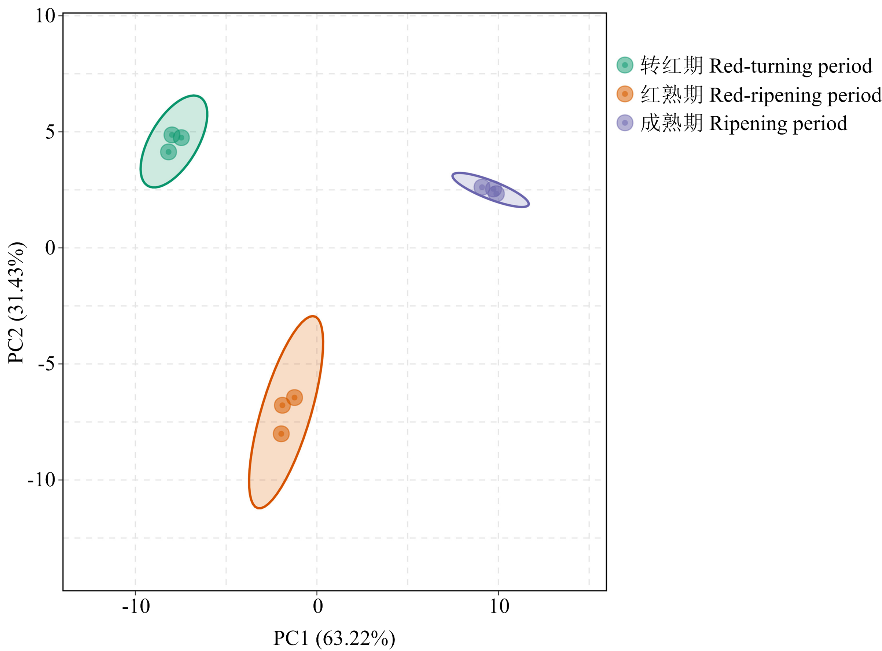
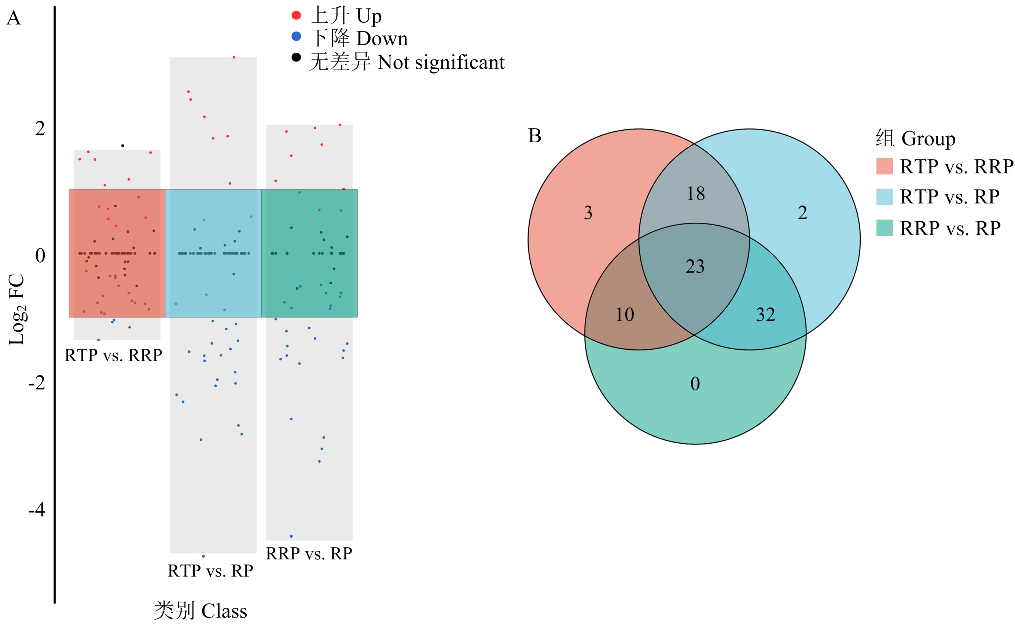
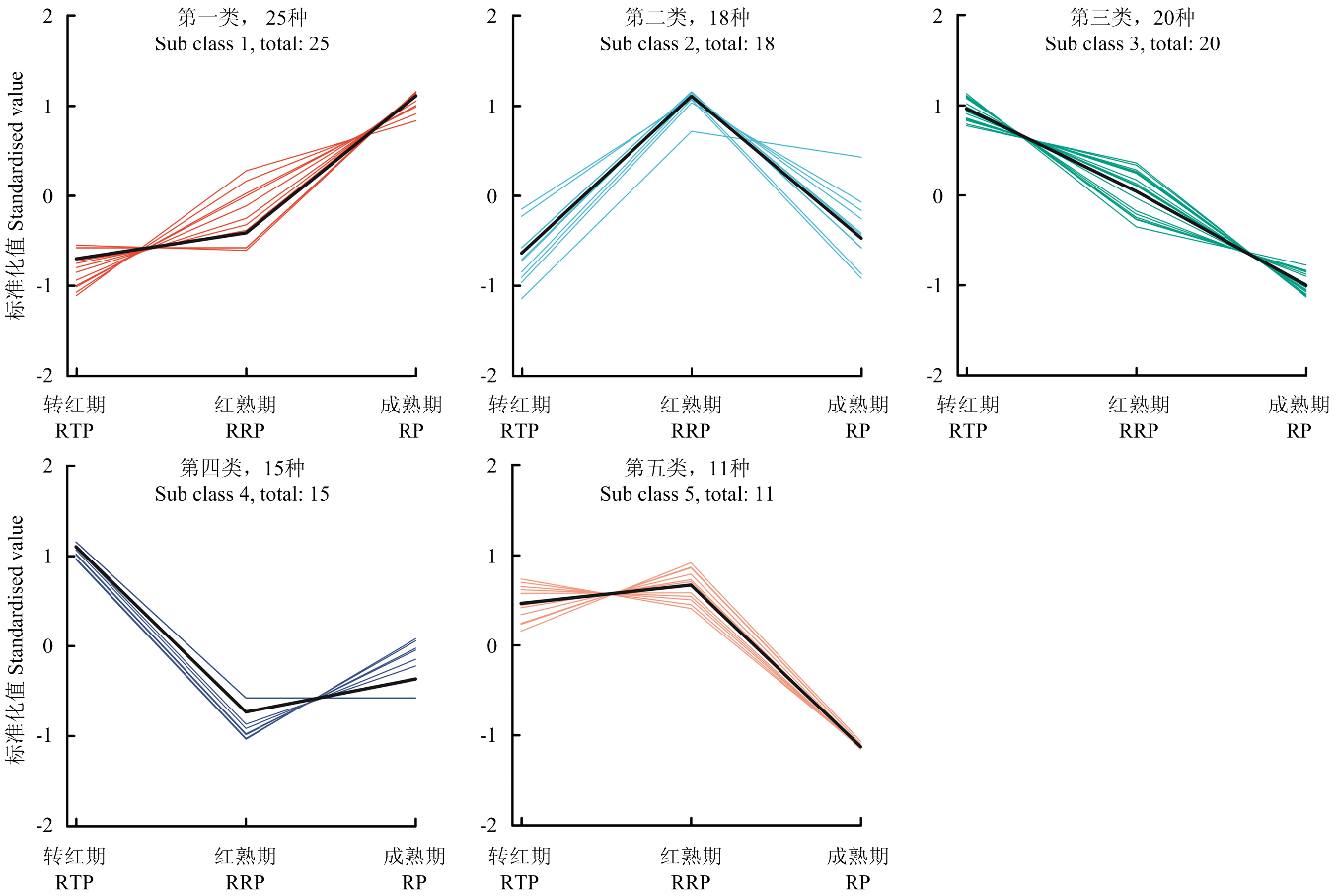
【Objective】 This study aimed to investigate the dynamic changes in volatile aroma compounds (VACs) of bayberry (Myrica rubra) fruit during the three periods of coloration stage, and to identify key and differential VACs of bayberry fruit in these three periods, so as to provide a data basis for further elucidating the aroma formation mechanism of bayberry fruit and a scientific basis for the development and utilization of processing products.【Method】 Taking the bayberry fruits at the three periods of coloration stage (red-turning period, red-ripening period, and ripening period) as experimental materials, the basic fruit quality parameters were measured through sensory evaluation combined with the headspace solid-phase microextraction-gas chromatography-mass spectrometry (HS-SPME-GC-MS) technique, and the qualitative and quantitative analysis of VACs of bayberry in these three periods. Moreover, principal component analysis (PCA), odor activity value (OAV), orthogonal partial least squares discriminant analysis (OPLS-DA), and K-means clustering were applied to elucidate VACs composition characteristics identify the key and differential VACs across the three periods of coloration stage of bayberry fruit. 【Result】As the color transformation process progresses, the basic quality of the fruits changed, but the intensity of the odor weakened. Through HS-SPME-GC-MS analysis, a total of 93 VACs were identified, which were classified into esters, alcohols, aldehydes, ketones, alkenes, aromatic hydrocarbons, alkanes, and other categories. Among these, 60 compounds were detected at the red-turning period, 66 at the red-ripening period, and 61 at the ripening period. Alkenes exhibited the highest proportion of constituents in red-turning period and red-ripening period, whereas esters were the highest proportion in ripening period, nevertheless, alkenes contributed the greatest total content across all three stages. Based on OAV≥1, seven key VACs were identified, including linalool, 2-hexenal, nonanal, (E)-2-decenal, 1-octen-3-one, 5-hepten-2-one, 6-methyl-, and caryophyllene, respectively. PCA revealed that the first two principal components collectively accounted for 94.65% of the total variance. OPLS-DA identified 89 differential VACs among the three groups. K-means clustering further categorized these differential VACs into five distinct clusters. Cluster 1 comprised compounds whose concentrations increased monotonically with advancing maturity, whereas Cluster 3 contained compounds whose concentrations decreased progressively-effectively capturing the negative correlation between red-turning period and ripening period for specific VACs. 【Conclusion】The research results revealed the aroma intensity of bayberry fruit weakened as the maturity progressed, alkenes content decreased, and esters content increased. These findings collectively reflected a dual trend-qualitative transformation (shift in VACs) and quantitative attenuation (reduction in aroma intensity)-at the three periods of coloration stage.

Key words: bayberry fruit, coloration stage, HS-SPME-GC-MS, VACs, identification of constituents, difference analysis

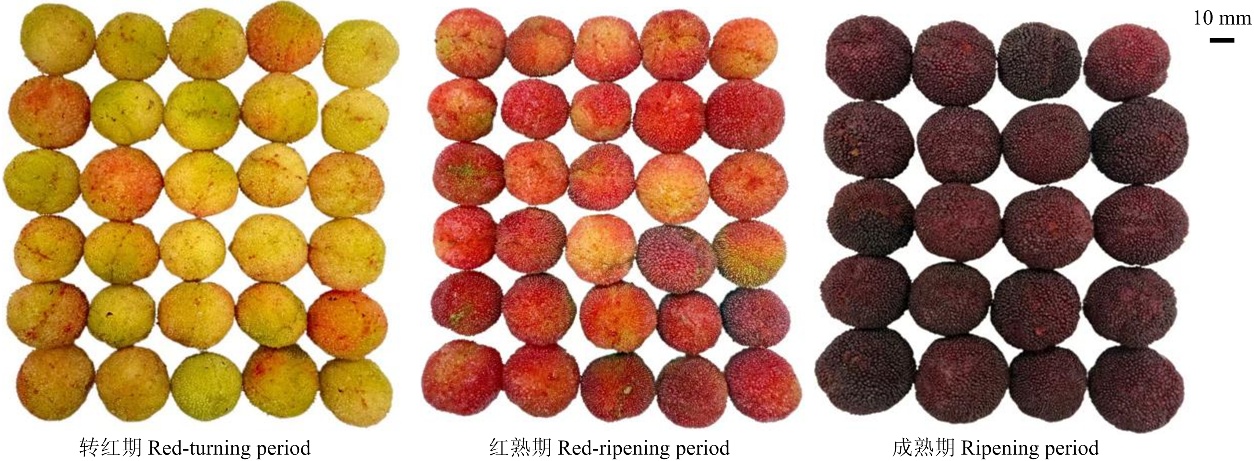
Fig. 1

Sample photos of bayberry at different stages"

Table 1

Odor sensory evaluation of bayberry fruit"

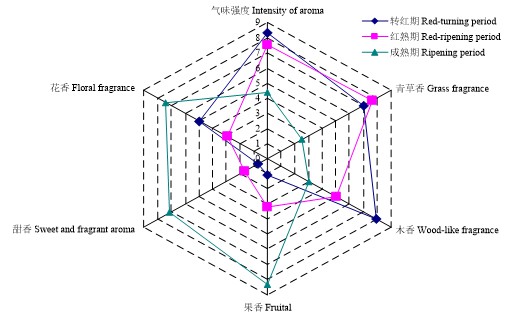
感官评价指标 Sensory evaluation indicators 评价等级 Evaluation grade
青草香 Grass fragrance 0=无;1=极弱;2=很弱;3=较弱;4=稍弱;5=中等;6=稍强;7=较强;8=很强;9=极强
0=None; 1=Very weak; 2=Weak; 3=Moderately weak; 4=Slightly weak; 5=Medium; 6=Slightly strong; 7=Strong; 8=Very strong; 9=Extremely strong
花香 Floral fragrance
果香 Fruital
木香 Wood-like fragrance
甜香 Sweet and fragrant aroma
香气强度 Intensity of aroma

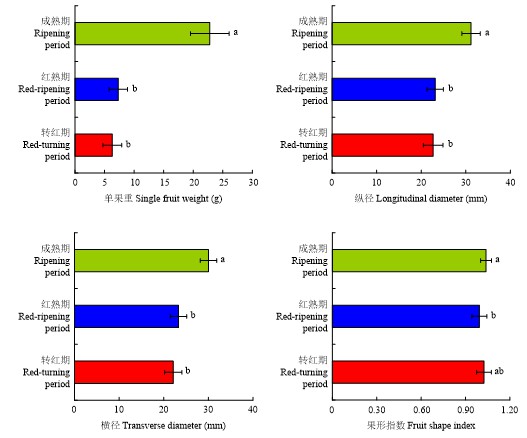
Fig. 2

The single fruit weight, longitudinal diameter, transverse diameter and fruit shape index of bayberry in three periods Different lowercase letters indicate significant differences (P<0.05). The same as below"

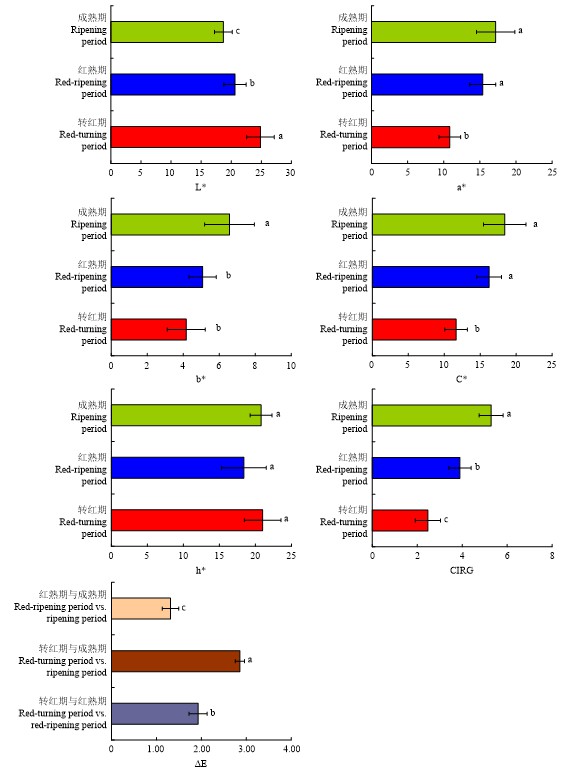
Fig. 3

The color difference value of bayberry in three periods"

Fig. 4

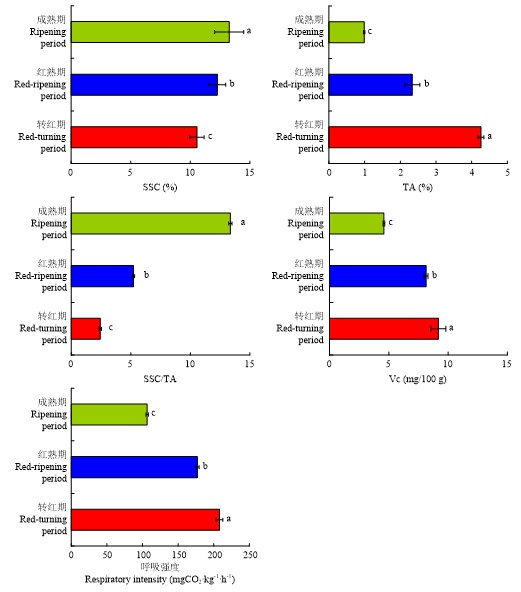
The SSC, TA, SSC/TA, Vc and respiratory intensity of bayberry in three periods"

Fig. 5

Sensory evaluation radar chart of VACs of bayberry in three periods"

Fig. 6

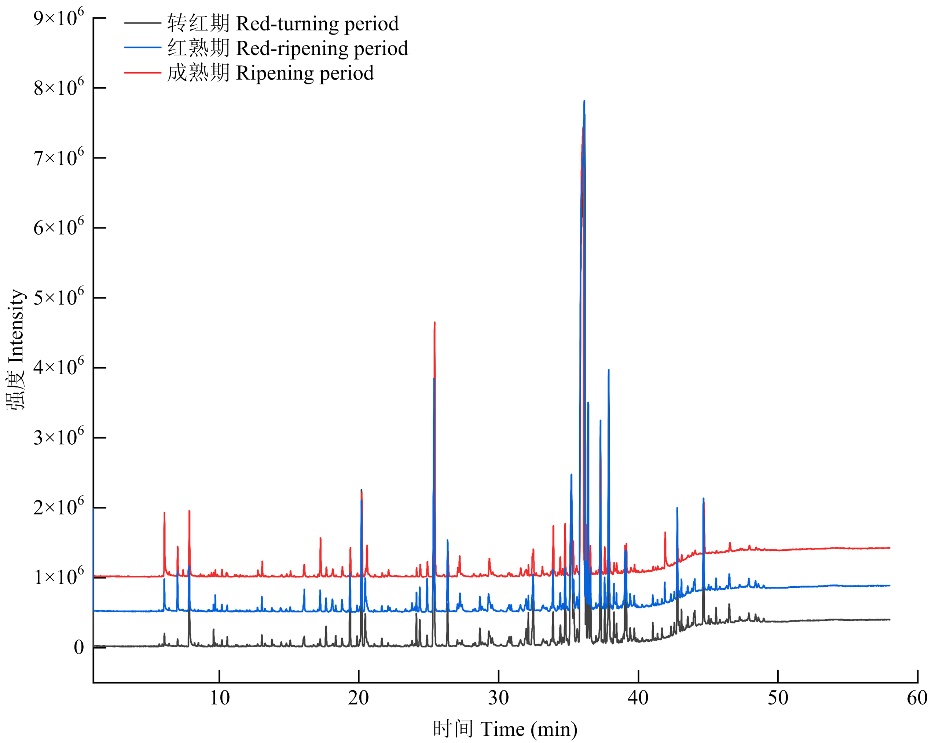
Total ion chromatograms of the VACs of bayberry in three periods"

Table 2

The VACs content of bayberry in three periods"

类别
Classification
名称
Name
含量 Content (μg·kg-1)
转红期
Red-turning period
红熟期
Red-ripening period
成熟期
Ripening period
酯类
Esters
(E)-2-戊烯酸甲酯 2-Pentenoic acid, methyl ester, (E)- ND ND 0.83±0.08
(Z)-3-己烯酸甲酯 3-Hexenoic acid, methyl ester, (Z)- 4.87±0.07c 8.97±1.75b 25.87±5.12a
乙酸甲酯 Acetic acid, methyl ester 7.76±0.76c 23.13±3.17b 44.83±4.05a
2-甲基丁酸乙酯 Butanoic acid, 2-methyl-, ethyl ester ND ND 0.50±0.05
2-甲基丁酸甲酯 Butanoic acid, 2-methyl-, methyl ester ND ND 3.82±0.87
3-羟基-3-甲基丁酸甲酯 Butanoic acid, 3-hydroxy-3-methyl-, methyl ester ND ND 1.52±0.31
3-甲基丁酸乙酯 Butanoic acid, 3-methyl-, ethyl ester ND ND 0.33±0.03
丁酸乙酯 Butanoic acid, ethyl ester ND ND 0.97±0.09
丁酸甲酯 Butanoic acid, methyl ester 0.58±0.05b 0.53±0.06b 2.06±0.27a
2-羟基己酸甲酯 Hexanoic acid, 2-hydroxy-, methyl ester ND ND 10.47±0.14
己酸甲酯 Hexanoic acid, methyl ester 5.62±0.35c 15.55±0.95b 24.73±1.64a
异丁酸甲酯 Methyl isobutyrate ND ND 2.65±0.15
异戊酸甲酯 Methyl isovalerate 0.23±0.03c 0.52±0.06b 1.95±0.22a
丙酸甲酯 Methyl propionate ND 0.67±0.08b 2.72±0.26a
戊酸甲酯 Methyl valerate ND 0.63±0.07b 1.26±0.13a
2-羟基-3-甲基戊酸甲酯 Pentanoic acid, 2-hydroxy-3-methyl-, methyl ester ND ND 4.52±0.24
2-甲基丙酸乙酯 Propanoic acid, 2-methyl-, ethyl ester ND ND 0.68±0.08
丙酸-4-己烯-1-基酯 Propanoic acid, 4-hexen-1-yl ester 1.82±0.04 ND ND
丙酸乙酯 Propanoic acid, ethyl ester ND 0.36±0.07b 1.18±0.04a
3-甲基丁基乙酸酯 1-Butanol, 3-methyl-, acetate ND 2.92±0.83a 0.48±0.09b
(Z)-乙酸-3-己烯酯 3-Hexen-1-ol, acetate, (Z)- ND 1.92±0.25a 0.58±0.15b
醇类
Alcohols
(3R, 6S)-2, 2, 6-三甲基-6-乙烯基四氢-2H-吡喃-3-醇
(3R, 6S)-2, 2, 6-Trimethyl-6-vinyltetrahydro-2H-pyran-3-ol
2.80±0.20a 2.69±0.52a ND
α-松油醇 α-Terpineol 22.64±2.23a 17.77±0.54b 7.06±0.15c
正丁醇 1-Butanol 0.35±0.13b 0.58±0.12a 0.38±0.01b
3-甲基-1-丁醇 1-Butanol, 3-methyl- ND 13.67±1.84 ND
正己醇 1-Hexanol 8.88±0.36c 26.77±3.05a 11.52±1.72b
2-乙基-1-己醇 1-Hexanol, 2-ethyl- ND 7.16±0.91b 8.31±1.20a
正辛醇 1-Octanol 3.78±0.76b 4.84±0.55a 3.02±0.69b
(E)-2-己烯-1-醇 2-Hexen-1-ol, (E)- ND ND 3.19±0.31
4-甲基-2-戊烯-1-醇 2-Penten-1-ol, 4-methyl- ND 0.70±0.07 ND
(E)-3-己烯-1-醇 3-Hexen-1-ol, (E)- 36.67±1.79b 60.98±7.45a 21.25±0.95c
(E)-3-壬烯-1-醇 3-Nonen-1-ol, (E)- 0.72±0.10 ND ND
石竹烯醇 Caryophyllenyl alcohol 90.98±3.99a ND 29.99±2.35b
葎草烷-1,6-二烯-3-醇 Humulane-1,6-dien-3-ol ND 66.05±2.48 ND
葎草烯醇-Ⅱ Humulenol-II 1.56±0.26 ND ND
芳樟醇 Linalool 30.81±1.68b 32.7±1.71b 39.16±9.31a
2-甲基-2-丁醇 Amylene hydrate 4.22±0.36a 3.88±0.16a ND
类别
Classification
名称
Name
含量 Content (μg·kg-1)
转红期
Red-turning period
红熟期
Red-ripening period
成熟期
Ripening period
醛类Aldehydes (E)-2-庚烯醛 2-Heptenal, (E)- 6.40±0.98b 7.49±0.61a 0.90±0.12c
2-己烯醛 2-Hexenal 7.86±0.54b 11.45±1.29a 8.31±1.76b
(E)-2-辛烯醛 2-Octenal, (E)- 3.68±0.6b 4.66±0.49a 0.49±0.11c
2, 4-二甲基苯甲醛 Benzaldehyde, 2, 4-dimethyl- ND ND 3.03±0.41
丁醛 Butanal 0.66±0.07 ND ND
2-甲基丁醛 Butanal, 2-methyl- ND 0.17±0.05 ND
己醛 Hexanal 1.08±0.16b 3.01±0.27a 3.77±0.59a
壬醛 Nonanal ND 6.10±0.47b 9.78±1.61a
(E)-2-癸烯醛 2-Decenal, (E)- 4.98±0.37a 2.92±0.22b ND
辛醛 Octanal 2.53±0.36c 4.09±0.21b 5.41±1.05a
酮类
Ketones
1-辛烯-3-酮 1-Octen-3-one 0.86±0.08b 1.27±0.22a ND
5-乙基-4-甲基-3-庚酮 3-Heptanone, 5-ethyl-4-methyl- 1.52±0.15a 0.91±0.06b ND
6-甲基-5-庚烯-2-酮 5-Hepten-2-one, 6-methyl- 25.01±1.43a 19.23±1.11b 9.42±1.49c
长叶马鞭草酮 Longiverbenone 5.49±1.23a 3.17±0.51b ND
烯烃类Alkenes (-)-β-波旁烯 (-)-.beta.-Bourbonene 13.45±1.58a 6.38±1.43b ND
α-法尼烯α-Farnesene 13.77±1.29a 13.80±1.67a 4.56±0.57b
α-蒎烯α-Pinene 5.51±0.29a 3.87±1.37b 2.65±0.23b
β-长叶蒎烯 β-Longipinene 3.45±1.17 ND ND
β-月桂烯 β-Myrcene 6.25±0.39 ND ND
β-罗勒烯 β-Ocimene 147.30±26.89a 86.23±11.43b 50.73±3.17c
γ-榄香烯 γ-Muurolene 29.36±5.07b 33.46±4.52a 4.54±0.48c
石竹烯 Caryophyllene 2040.97±119.15a 1777.58±124.92b 78.96±6.82c
依兰烯 Ylangene 2.32±0.55a 1.24±0.09b ND
顺式菖蒲烯 cis-Calamenene ND ND 0.99±0.15
顺式-榄香-4(15), 5-二烯 cis-Muurola-4(15), 5-diene 2.86±0.30a 2.36±0.05a ND
D-柠檬烯 D-Limonene 16.98±1.72a 10.7±0.66b 7.48±1.04c
α-愈创木烯α-Guaiene 9.19±0.32a 7.78±1.57b 4.27±0.16c
葎草烯 Humulene 6.50±0.34a 4.57±0.46b ND
表香橙烯环氧化物 Isoaromadendrene epoxide 11.64±1.41a 5.22±0.23b 2.33±0.48c
西芬烯 Silphinene 2.12±0.25 ND ND
苯乙烯 Styrene 36.73±3.60a 28.77±2.27b ND
反式-β-罗勒烯 trans-β-Ocimene 52.12±2.33a 28.45±3.55b 18.48±1.71c
反式菖蒲烯 trans-Calamenene ND 1.43±0.11 ND
[1aS-(1aα, 3aα, 7aβ, 7bα)]-十氢-1, 1, 3a-三甲基-7-亚甲基-1H-环丙并[a]萘 1H-Cyclopropa[a]naphthalene, decahydro-1, 1, 3a-trimethyl-7-methylene-, [1aS-(1aα, 3aα, 7aβ, 7bα)]- ND 32.85±1.69 a 12.35±1.65 b
类别
Classification
名称
Name
含量 Content (μg·kg-1)
转红期
Red-turning period
红熟期
Red-ripening period
成熟期
Ripening period
(-)-α-古巴烯 (-)-α-Panasinsen ND 4.97±0.35a 3.47±0.27b
别香橙烯 Alloaromadendrene ND 1.86±0.22 ND
香橙烯 Aromandendrene 4.93±0.38a 2.60±0.55b ND
三环倍半萜烯-异甜橙烯异构体 (1R, 2S, 6S, 7S, 8S)-8-Isopropyl-1-methyl-3-methylenetricyclo [4.4.0.02,7] decane-rel- ND 1.05±0.04 ND
烷烃类Alkanes 癸烷 Decane 2.46±0.10a ND 0.95±0.14b
环丙烷并薁类饱和萜烷 1H-Cycloprop[e]azulene, 1a, 2,3,4, 4a, 5, 6, 7b-octahydro-1, 1, 4, 7-tetramethyl-, [1aR-(1aα, 4α, 4aβ, 7bα)]- ND 1.62±0.25a 1.37±0.25a
芳香烃类Aromatic hydrocarbons 间二甲苯 Benzene, 1, 3-dimethyl- ND ND 4.21±0.28
间伞花烃 Benzene, 1-methyl-3-(1-methylethyl)- 2.37±0.26a ND 1.28±0.21b
对伞花烃 Benzene, 1-methyl-4-(1-methylethyl)- ND 2.03±0.23 ND
乙苯 Ethylbenzene 3.43±0.22a 1.67±0.08b 0.95±0.06c
甲苯 Toluene 1.06±0.2a 0.55±0.12b 1.21±0.09a
邻伞花烃 o-Cymene ND 1.46±0.25 ND
其他类
Others
氧化石竹烯 Caryophyllene oxide 57.19±7.30a 45.16±2.56b 14.53±2.75c
2-氧化别香橙烯 Alloaromadendrene oxide-(2) 10.89±1.44a 7.08±0.59b 2.59±0.47c
乙酸 Acetic acid 13.62±0.46c 28.51±3.38a 20.28±1.69b
桉叶素 Eucalyptol 0.42±0.02 ND ND
反式-呋喃型芳樟醇氧化物 trans-Linalool oxide (furanoid) 7.32±0.88a 5.63±0.74b 1.79±0.33c
2-乙基呋喃 Furan, 2-ethyl- 1.69±0.14a 0.66±0.07b 0.36±0.07c
2-甲基呋喃 Furan, 2-methyl- 0.26±0.01 ND ND
2-戊基呋喃 Furan, 2-pentyl- 0.65±0.09b 0.88±0.09a 0.94±0.12a
异喇叭烯 Isoledene 0.27±0.02b 0.83±0.43a ND
(1α, 4α, 4aα, 10aα)-八氢化-11, 11-二甲基-1, 4-亚甲基环辛并[d]哒嗪 1,4-Methanocycloocta[d]pyridazine, 1, 4, 4a, 5, 6, 9, 10, 10a-octahydro-11, 11-dimethyl-, (1α, 4α,4aα, 10aα)- 3.82±0.38 ND ND

Fig. 7

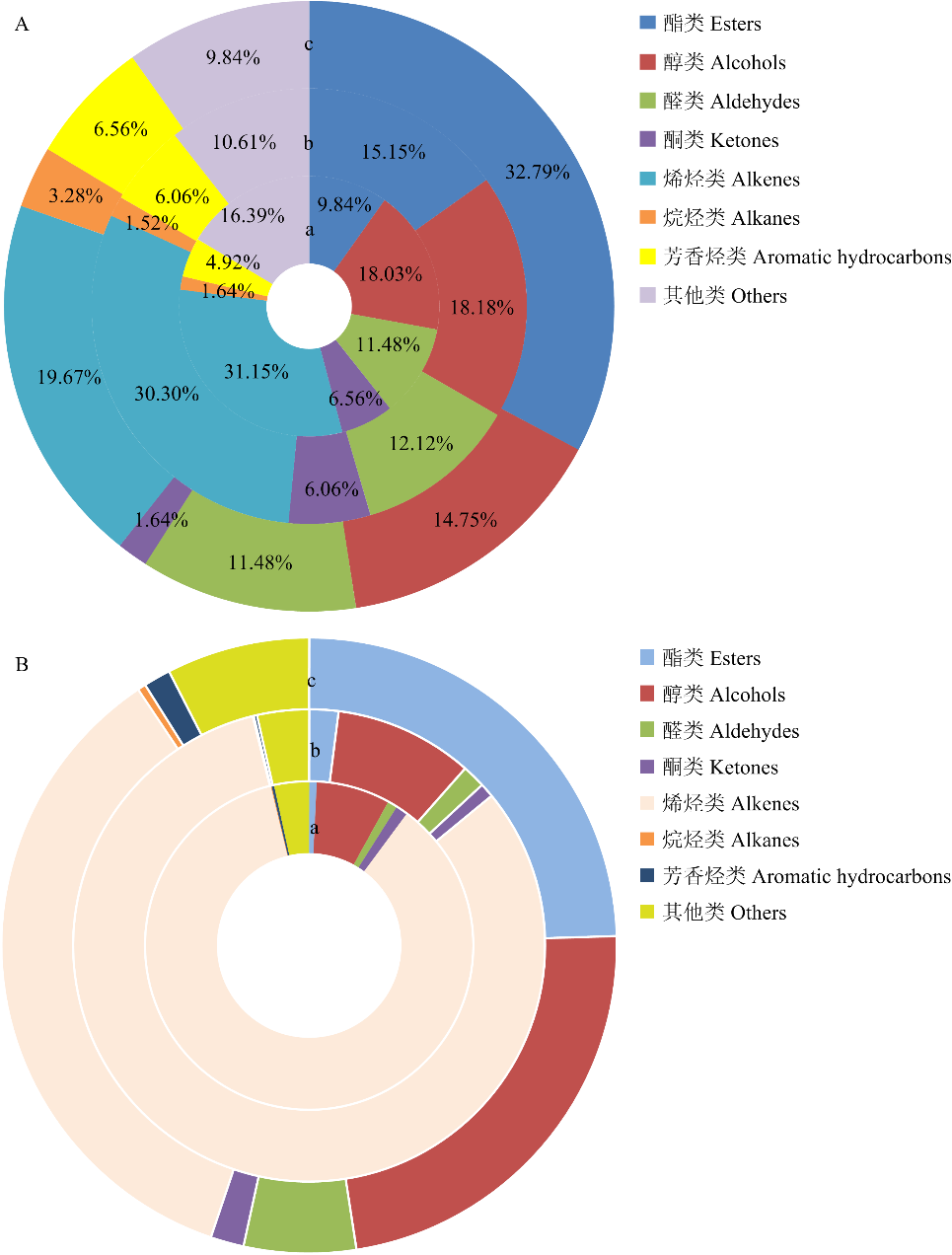
The percentage of classification and content of VACs of bayberry in three periods a: The red-turning period; b: The red-ripening period; c: The ripening period"

Table 3

The key VACs of bayberry in three periods"

VACs 香气特点[22-25]
Characteristics of the aroma
香气阈值
Odor threshold (μg·kg-1)[22,24-26]
OAV
转红期Red-turning period 红熟期Red-ripening period 成熟期
Ripening period
芳樟醇
Linalool
具有清新的铃兰花香,还略带柑橘与木质尾调
It has a fresh fragrance of jasmine, with a hint of citrus and woody notes at the end
20.00 15.41 16.35 19.58
2-己烯醛
2-Hexenal
具有清新的绿叶香、果香,呈现新鲜果蔬的自然风味
It has a fresh green leafy aroma and fruity scent, presenting the natural flavor of fresh fruits and vegetables
8.00 0.98 1.43 1.04
壬醛 Nonanal 香甜,奶油香 Sweet with a creamy flavor 5.00 — 1.22 1.96
(E)-2-癸烯醛
2-Decenal, (E)-
油香,坚果香The aromatic profiles of oil and nuts 0.01 1.66 0.97 —
1-辛烯-3-酮
1-Octen-3-one
强烈的蘑菇香、泥土香及轻微的青草香
Intense aroma of mushrooms, earth and a hint of grass
20.00 286.05 422.08 —
6-甲基-5-庚烯-2-酮 5-Hepten-2-one, 6-methyl- 具有清新的果香、青香,略带薄荷样气息
It has a fresh fruity and green aroma, with a hint of mint-like flavor
0.02 1.25 0.96 0.47
石竹烯
Caryophyllene
辛香、木香、柑橘香、樟脑香,温和的丁香
Spicy, woody, citrus, camphoraceous scents and gentle cloves
0.01 10.20 8.89 0.39

Fig. 8

The VACs PCA scatter plot of bayberry in three periods"

Fig. 9

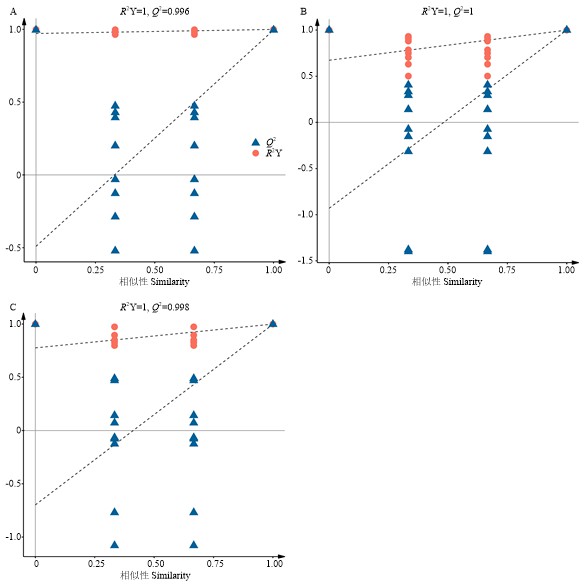
OPLS-DA permutation test plot A: The comparison between the red-turning period and red-ripening period; B: The comparison between the red-ripening period and ripening period; C: The comparison between the red-ripening period and ripening period"

Fig. 10

Volcano plot (A) and Venn diagram (B) of VACs between groups during 3 coloration stage of bayberry RTP vs. RRP: The comparison between the red-turning period and red-ripening period; RTP vs. RP: The comparison between the red-ripening period and ripening period; RRP vs. RP: The comparison between the red-ripening period and ripening period"

Fig. 11

K-means clustering analysis graph of different aroma substances during the 3 coloration stages of bayberry"

[1]
李雪, 杨丽, 王进, 陈元平, 刘世明, 樊清, 方进强, 武峥. 基于主成分分析的重庆地区杨梅果实品质综合评价[J]. 果树学报, 2026, 43(5): 1186-1199.
Li X, Yang L, Wang J, Chen Y P, Liu S M, Fan Q, Fang J Q, Wu Z. Comprehensive evaluation of the quality of different bayberry varieties in Chongqing based on principal component analysis[J]. Journal of Fruit Science, 2026, 43(5): 1186-1199. (in Chinese)
[2]
陈春霞, 张祯, 孔祥锦, 赵勇, 梁玉浩, 张煜, 李霁昕, 蒋玉梅. 转色期BTH诱抗改变霞多丽葡萄果实理化品质和香气构成[J]. 农业工程学报, 2023, 39(3): 237-247.
Chen C X, Zhang Z, Kong X J, Zhao Y, Liang Y H, Zhang Y, Li J X, Jiang Y M. Physicochemical quality and aroma composition of Chardonnay berries changed by spraying BTH during veraison[J]. Transactions of the Chinese Society of Agricultural Engineering, 2023, 39(3): 237-247. (in Chinese)
[3]
Fang X P, Shen J S, Zhang L Q, Zou X H, Jin L. Metabolomic and transcriptomic integration reveals the mechanism of aroma formation as strawberries naturally turn colors while ripening[J]. Food Chemistry, 2024, 460: 140765.
[4]
王慧玲, 张莹莹, 闫爱玲, 王晓玥, 刘振华, 任建成, 徐海英, 孙磊. 多组学联合解析红色玫瑰香型葡萄品种转色过程中单萜和花色苷积累规律[J]. 中国农业科学, 2025, 58(13): 2645-2662. DOI: 10.3864/j.issn.0578-1752.2025.13.012.
Wang H L, Zhang Y Y, Yan A L, Wang X Y, Liu Z H, Ren J C, Xu H Y, Sun L. Multi-omics analysis reveals the changes of monoterpenes and anthocyanins accumulation during veraison in red Muscat-type grape[J]. Scientia Agricultura Sinica, 2025, 58(13): 2645-2662. DOI: 10.3864/j.issn.0578-1752.2025.13.012. (in Chinese)
[5]
乔晨, 赵慧宇, 林佳琦, 刘成, 刘有春, 齐沛沛, 孙晓丽, 王新全. 蓝莓果实不同发育时期挥发性风味物质变化及差异性分析[J]. 现代食品科技, 2026, 42(4): 276-286.
Qiao C, Zhao H Y, Lin J Q, Liu C, Liu Y C, Qi P P, Sun X L, Wang X Q. Changes and differential analysis of volatile flavor compounds in blueberry fruits at different developmental stages[J]. Modern Food Science & Technology, 2026, 42(4): 276-286. (in Chinese)
[6]
谢雅婷, 严文怡, 杨艳, 李洁瑜, 杨小洪, 余爱农. 不同成熟度纽荷尔脐橙果肉中香气成分变化规律研究[J]. 食品科学技术学报, 2025, 43(3): 125-134.
Xie Y T, Yan W Y, Yang Y, Li J Y, Yang X H, Yu A N. Study on mechanism of aroma components variation in pulp of newhall navel oranges at different maturities[J]. Journal of Food Science and Technology, 2025, 43(3): 125-134. (in Chinese)
[7]
吴斌, 苏金生, 邢文婷, 宋顺, 马伏宁, 黄东梅. 不同品种百香果果实转色期糖酸品质性状评价[J]. 果树学报, 2024, 41(12): 2532-2542.
Wu B, Su J S, Xing W T, Song S, Ma F N, Huang D M. Evaluation of sugar and acid quality traits of different passionfruit variet-ies during coloration period[J]. Journal of Fruit Science, 2024, 41(12): 2532-2542. (in Chinese)
[8]
Liu J L, Liu H T, Wu T, Zhai R, Yang C Q, Wang Z G, Ma F W, Xu L F. Effects of melatonin treatment of postharvest pear fruit on aromatic volatile biosynthesis[J]. Molecules, 2019, 24(23): 4233.
[9]
刘金莹, 孔令喜, 王威浩, 秦国政, 王豫颖. 草莓果实香气物质生物合成研究进展[J]. 园艺学报, 2023, 50(9): 1959-1970.
Liu J Y, Kong L X, Wang W H, Qin G Z, Wang Y Y. Advances in aroma compounds biosynthesis of strawberry fruit[J]. Acta Horticulturae Sinica, 2023, 50(9): 1959-1970. (in Chinese)
[10]
杨鹏飞, 吴薇, 孙海峰, 刘龑章, 尚紫博, 薛晶晶, 许志杰, 宋梦坤. 基于GC-MS结合多元统计的2种工艺提取脐橙挥发性成分差异分析[J]. 轻工学报, 2025, 40(4): 1-9.
Yang P F, Wu W, Sun H F, Liu Y Z, Shang Z B, Xue J J, Xu Z J, Song M K. Analysis of the differences in volatile components of navel oranges extracted by two processes based on GC-MS combined with multivariate statistics[J]. Journal of Light Industry, 2025, 40(4): 1-9. (in Chinese)
[11]
万鹏, 梁国平, 马丽娟, 陈佰鸿, 毛娟. 19个苹果品种果实香气成分的GC-MS分析[J]. 食品工业科技, 2019, 40(14): 227-232.
Wan P, Liang G P, Ma L J, Chen B H, Mao J. GC-MS analysis of fruit aroma components in 19 apple varieties[J]. Science and Technology of Food Industry, 2019, 40(14): 227-232. (in Chinese)
[12]
魏珊珊, 李娟, 刘贵珊. 香水梨香气成分的萃取条件优化及GC-MS分析[J]. 食品研究与开发, 2023, 44(11): 194-200.
Wei S S, Li J, Liu G S. HS-SPME-GC-MS analysis of Xiangshui pear aroma components[J]. Food Research and Development, 2023, 44(11): 194-200. (in Chinese)
[13]
尹燕雷, 苑兆和, 冯立娟, 招雪晴, 王金政, 王超. 不同杏品种果实发育期间香气成分的GC-MS分析[J]. 果树学报, 2010, 27(3): 337-343.
Yin Y L, Yuan Z H, Feng L J, Zhao X Q, Wang J Z, Wang C. GC-MS analysis of aromatic components in different developmental period of apricot cultivars[J]. Journal of Fruit Science, 2010, 27(3): 337-343. (in Chinese)
[14]
郝帅棋, 郭青云, 李霖灏, 袁华宁. 青海地区6个甜樱桃品种果实发育过程中香气物质的动态变化[J]. 果树学报, 2025, 42(4): 815-827.
Hao S Q, Guo Q Y, Li L H, Yuan H N. Dynamic changes of aroma substances during fruit development of six sweet cherry varieties in Qinghai[J]. Journal of Fruit Science, 2025, 42(4): 815-827. (in Chinese)
[15]
林旗华, 张泽煌, 钟秋珍. 3个福建主栽地方杨梅品种果实香气成分分析[J]. 热带作物学报, 2015, 36(1): 115-119.
Lin Q H, Zhang Z H, Zhong Q Z. Aroma components analysis of three major local Chinese bayberry cultivars in Fujian[J]. Chinese Journal of Tropical Crops, 2015, 36(1): 115-119. (in Chinese)
[16]
张泽煌, 林旗华, 钟秋珍. 10个品种杨梅果实香气成分的GC-MS检测及聚类分析[J]. 福建农林大学学报(自然科学版), 2014, 43(3): 269-272.
Zhang Z H, Lin Q H, Zhong Q Z. GC-MS analysis of aroma components and cluster analysis of fruit of ten Chinese bayberry cultivars[J]. Journal of Fujian Agriculture and Forestry University (Natural Science Edition), 2014, 43(3): 269-272. (in Chinese)
[17]
Schwab W, Davidovich-Rikanati R, Lewinsohn E. Biosynthesis of plant-derived flavor compounds[J]. The Plant Journal, 2008, 54(4): 712-732.
[18]
Lei L, Wang Y Z, Zhou X, Zhang L, Lv M W, Wei H H, Li S S, Wang H X, Xu G H, Li Y D, Wang L S, Huo J W. Identification and characterization of key aroma chemotypes and volatile biomarkers by HS-SPME-GC-MS for precision flavor breeding in blueberries[J]. Food Chemistry, 2026, 505: 147948.
[19]
Zhou P, Zhang X D, Feng X, Guo R, Yan S B, Wei X Q, Li L, Tang Y J, Fang Z Z, Lei Y. Triphasic volatile emission dynamics and gene expression in postharvest PGF-lost non-melting peach (Prunus persica) var. RedY[J]. Postharvest Biology and Technology, 2026, 235: 114222.
[20]
Rodríguez-Aguilar F, Aparicio-Ortuño R, Bautista-Ortín A B, Gómez-Plaza E, Ramírez-Rodrígues M M, Ortega-Regules A E. Maturation of Ardisia compressa K. fruit: A comprehensive study on phenolic potential, physicochemical characterization, and volatile compounds for the determination of optimal harvest time[J]. Biochemical Systematics and Ecology, 2026, 124: 105154.
[21]
Xu Y, Zhang D H, Dong W J, Guo X F, Xiao Z J, Lao F, Wu J H. Aroma metabolic remodeling during yellow peach canning: Key aroma-active compounds, precursor conversion, and formation pathways[J]. Food Chemistry, 2025, 495: 146402.
[22]
王梦琪, 朱荫, 张悦, 施江, 林智, 吕海鹏. “清香”绿茶的挥发性成分及其关键香气成分分析[J]. 食品科学, 2019, 40(22): 219-228.
Wang M Q, Zhu Y, Zhang Y, Shi J, Lin Z, Lü H P. Analysis of volatile composition and key aroma compounds of green teas with fresh scent flavor[J]. Food Science, 2019, 40(22): 219-228. (in Chinese)
[23]
宫连瑾, 薄佳慧, 张天天, 孙红玉, 陈义琴, 裴若云, 肖力争. 黄金茶红茶加工过程中香气成分及其相关酶活性的动态变化[J]. 食品与发酵工业, 2022, 48(6): 204-209.
Gong L J, Bo J H, Zhang T T, Sun H Y, Chen Y Q, Pei R Y, Xiao L Z. Dynamic changes of aroma components and related enzyme activities during Huangjincha black tea processing[J]. Food and Fermentation Industries, 2022, 48(6): 204-209. (in Chinese)
[24]
Czerny M, Christlbauer M, Christlbauer M, Fischer A, Granvogl M, Hammer M, Hartl C, Hernandez N M, Schieberle P. Re-investigation on odour thresholds of key food aroma compounds and development of an aroma language based on odour qualities of defined aqueous odorant solutions[J]. European Food Research and Technology, 2008, 228(2): 265-273.
[25]
李霞, 高阳, 尹洁, 许利平, 牛云蔚, 朱建才, 王辉, 杨君. 天然产物香气成分相互作用及香气物质强度预测研究[J]. 中国食品添加剂, 2022, 33(9): 1-9.
Li X, Gao Y, Yin J, Xu L P, Niu Y W, Zhu J C, Wang H, Yang J. Research on the interaction of aroma components and aroma intensity prediction of natural products[J]. China Food Additives, 2022, 33(9): 1-9. (in Chinese)
[26]
范文来, 徐岩. 白酒79个风味化合物嗅觉阈值测定[J]. 酿酒, 2011, 38(4): 80-84.
Fan W L, Xu Y. Determination of odor thresholds of volatile aroma compounds in Baijiu by a forced-choice ascending concentration series method of limits[J]. Liquor Making, 2011, 38(4): 80-84. (in Chinese)
[27]
Tan F L, Wang P, Zhan P, Tian H L. Characterization of key aroma compounds in flat peach juice based on gas chromatography-mass spectrometry-olfactometry (GC-MS-O), odor activity value (OAV), aroma recombination, and omission experiments[J]. Food Chemistry, 2022, 366: 130604.
[28]
Yang M X, Zhou H N, Hu X, Liu X Y, Lei J S, Ye K Y, Zhou T, Hu J, He B J. Untargeted metabolomics based on HS- SPME-GC-MS revealing the dynamic evolution of aroma components during cigar aging[J]. Frontiers in Plant Science, 2025, 16: 1657415.
[29]
Cheng H, Chen Y, Chen Y X, Qin D, Ye X Q, Chen J C. Comparison and evaluation of aroma-active compounds for different squeezed Chinese bayberry (Myrica rubra) juices[J]. Journal of Food Processing and Preservation, 2021, 45(11): e15924.
[30]
Cui Q, Jiang L J, Wen L L, Tian X L, Yuan Q, Liu J Z. Metabolomic profiles and differential metabolites of volatile components in Citrus aurantium Changshan-Huyou pericarp during different growth and development stages[J]. Food Chemistry: X, 2024, 23: 101631.
[31]
Wang Y, Yang Q S, Zhu Y F, Zhao L, Ju P J, Wang G Y, Zhou C C, Zhu C Q, Jia H J, Jiao Y, Jia H M, Gao Z S. MrTPS3 and MrTPS20 are responsible for β-caryophyllene and α-pinene production, respectively, in red bayberry (Morella rubra)[J]. Frontiers in Plant Science, 2021, 12: 798086.
[32]
Balbontín C, Gaete-Eastman C, Fuentes L, Figueroa C R, Herrera R, Manriquez D, Latché A, Pech J C, Moya-León M A. VpAAT1, a gene encoding an alcohol acyltransferase, is involved in ester biosynthesis during ripening of mountain Papaya Fruit[J]. Journal of Agricultural and Food Chemistry, 2010, 58(8): 5114-5121.
[33]
张泽煌, 林旗华, 钟秋珍. 10个杨梅品种果实的香气成分研究[J]. 福建农业学报, 2013, 28(6): 552-556.
Zhang Z H, Lin Q H, Zhong Q Z. Aromatic compounds in Chinese bayberries (Myrica rubra)[J]. Fujian Journal of Agricultural Sciences, 2013, 28(6): 552-556. (in Chinese)
[34]
张洁, 郭金星, 张汝忠, 王星星, 张晓玲, 刘琳, 侯平, 张汝民. 东魁杨梅果实储藏期挥发性有机化合物成分的变化[J]. 浙江农林大学学报, 2012, 29(1): 143-150.
Zhang J, Guo J X, Zhang R Z, Wang X X, Zhang X L, Liu L, Hou P, Zhang R M. Changes in volatile organic compounds (VOCs) during storage for Myrica rubra ‘Dongkui’[J]. Journal of Zhejiang A & F University, 2012, 29(1): 143-150. (in Chinese)
[35]
Zhang A D, Zhang Q Y, Li J Z, Gong H S, Fan X G, Yang Y Q, Liu X F, Yin X R. Transcriptome co-expression network analysis identifies key genes and regulators of ripening kiwifruit ester biosynthesis[J]. BMC Plant Biology, 2020, 20(1): 103.
[36]
Yang Y Y, Shan W, Kuang J F, Chen J Y, Lu W J. Four HD-ZIPs are involved in banana fruit ripening by activating the transcription of ethylene biosynthetic and cell wall-modifying genes[J]. Plant Cell Reports, 2020, 39(3): 351-362.
[37]
Wei C Y, Yang H Z, Li R R, Su Y K, Li X Z, Zhang B. Functional genomics reveals functions of terpene synthases for volatile terpene formation in peach[J]. Food Quality and Safety, 2024, 8: fyae027.
[38]
周建昌, 褚剑峰, 胡桂仙, 王君虹, 白丽萍, 李雪, 张玉. 上虞二都杨梅主栽品种的品质特征分析[J]. 农产品质量与安全, 2025(4): 58-63.
Zhou J C, Chu J F, Hu G X, Wang J H, Bai L P, Li X, Zhang Y. Quality characteristics analysis of major local Chinese bayberry cultivars in Shangyu[J]. Quality and Safety of Agro-Products, 2025(4): 58-63. (in Chinese)
[1] ZHANG ZhiChun, HE XiaoYi, HE ChengJun, GU DongLin, ZHONG Lian, GOU Yan, GAO BiXing, GENG Zhao, LI XiaoHong, CHEN SiKai. Comparative Analysis of Volatile Oil Chemical Constituents from Zanthoxylum bungeanum Seeds in Yanyuan and Hanyuan Based on GC-MS Technology [J]. Scientia Agricultura Sinica, 2025, 58(23): 5057-5070.
[2] Ting ZHANG,GenPing WANG,YanJie LUO,Lin LI,Xiang GAO,RuHong CHENG,ZhiGang SHI,Li DONG,XiRui ZHANG,WeiHong YANG,LiShan XU. Color Difference Analysis in the Application of High Quality Foxtail Millet Breeding [J]. Scientia Agricultura Sinica, 2021, 54(5): 901-908.
[3] CHEN Xue-yuan, TANG Hua-jun, WU Yong-chang, ZHOU Qing-bo, CUI Jian. Analysis on Process and Difference of Cropland Dynamics in Anji County of Zhejiang Province [J]. Scientia Agricultura Sinica, 2015, 48(21): 4302-4313.
[4] . Changes of volatile flavor compounds in dry-cured goose during processing [J]. Scientia Agricultura Sinica, 2007, 40(10): 2309-2315 .
[5] ,,,,. Cloning and Sequence Analysis of Cold and Longday Induced Expressed Genes from Sugar Beet (Beta vulgaris L.) Seedlings [J]. Scientia Agricultura Sinica, 2005, 38(09): 1856-1862 .
Viewed
Full text


Abstract

Cited

  Shared   
  Discussed   
No Suggested Reading articles found!