Scientia Agricultura Sinica ›› 2026, Vol. 59 ›› Issue (15): 3328-3339.doi: 10.3864/j.issn.0578-1752.2026.15.007

• PLANT PROTECTION • Previous Articles     Next Articles

Establishment and Application of RPA-CRISPR/Cas12a-based Visual Detection of Botrytis cinerea

ZHOU YuXin(), SHEN YongJun, ZHU GuangXue, CHAI ALi, XIE XueWen, LI Lei, FAN TengFei, SUN XianHua, XIANG Sheng, LI BaoJu(), SHI YanXia()   

  1. Institute of Vegetables and Flowers, Chinese Academy of Agricultural Sciences/State Key Laboratory of Vegetable Biobreeding, Beijing 100081
  • Received:2026-03-16 Accepted:2026-04-28 Online:2026-08-01 Published:2026-08-03
  • Contact: LI BaoJu, SHI YanXia

Abstract:

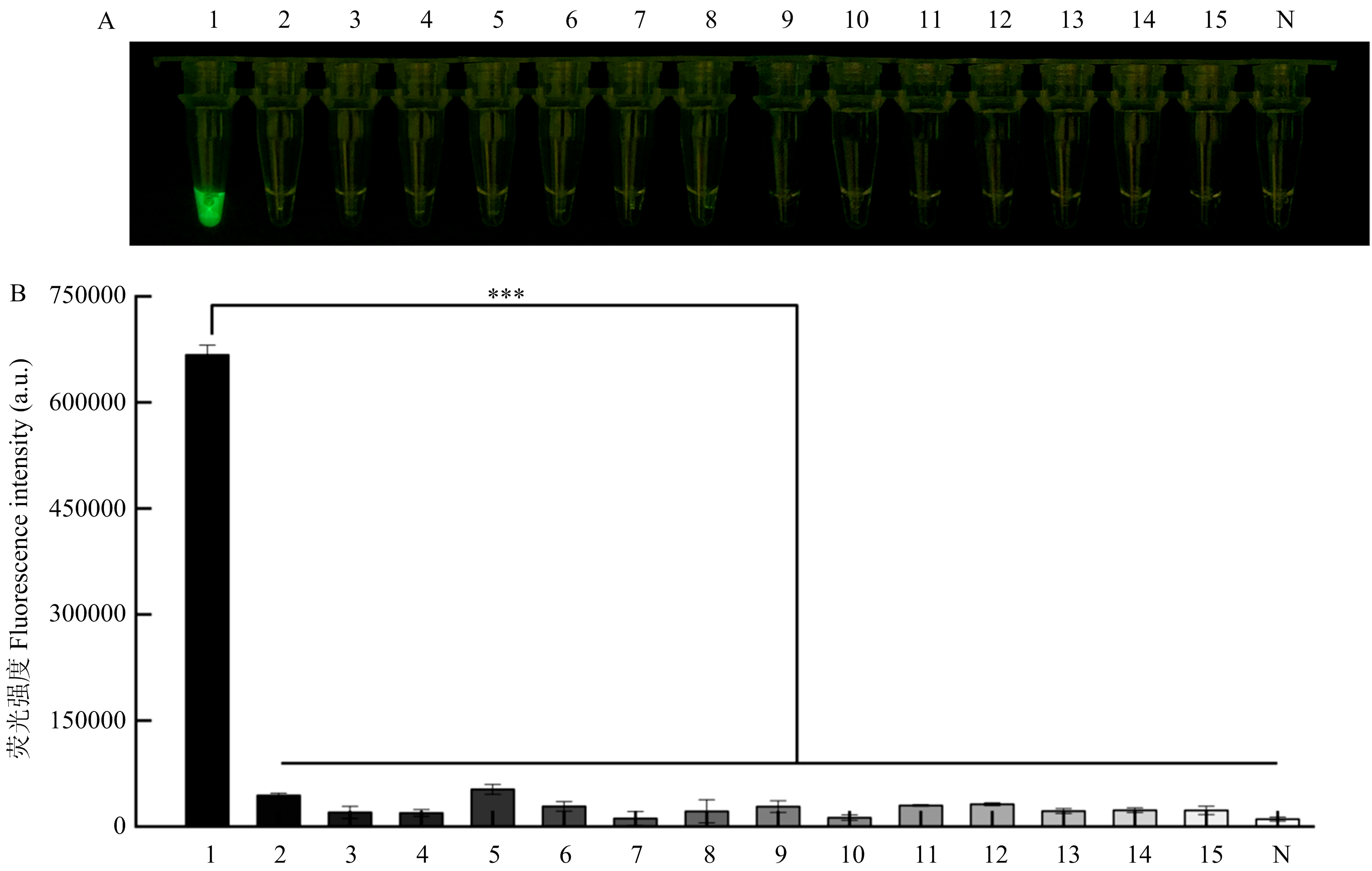
【Objective】Botrytis cinerea, the causal agent of gray mold in facility vegetables, is characterized by a wide host range and rapid post-infection spread, often leading to severe economic losses. This paper aims to establish an early and precise detection method for gray mold before its visible symptoms appear, and to provide technical support for the early monitoring and targeted control of gray mold in facility vegetable cultivation.【Method】A conserved gene sequence (BC1G_05726) from B. cinerea strain B05.10 was used as the target. Specific recombinase polymerase isothermal amplification (RPA) primers and CRISPR/Cas12a crRNAs were designed and screened. Key parameters including reaction time and the concentration ratio of Cas12a to crRNA were systematically optimized to establish a rapid visual detection method combining RPA and CRISPR/Cas12a. Fluorescence signals were visualized using a portable blue light transilluminator. The specificity, sensitivity, and applicability of the developed method were evaluated using complex environmental samples (infested soil, seeds, symptomatic plants, and air samples).【Result】The optimal crRNA (crRNA-1) and primer pair (RPA-bc-F/R) were selected. The optimized detection conditions were as follows: RPA reaction at 37 ℃ for 20 min, followed by CRISPR/Cas12a reaction with final concentrations of 200 nmol·L-1 for Cas12a and 50 nmol·L-1 for crRNA for another 20 min. The entire detection process was completed within 40 min. The sensitivity assay revealed a detection limit of 10-4 ng·μL-1 of genomic DNA of B. cinerea, which was 100-fold more sensitive than conventional PCR. Specificity testing showed that only B. cinerea produced positive fluorescence signals, while none of the other 14 tested fungal and bacterial species or the negative control generated any signal, indicating excellent specificity of the assay. In application tests, the method successfully detected B. cinerea strains from different hosts. After artificial inoculation on cucumber leaves, the pathogen was stably detected as early as 1 d post-inoculation, preceding symptom appearance. Dynamic monitoring of air samples in the facility environment demonstrated that B. cinerea could be detected in the air at 60 h post-inoculation, at which time typical disease lesions had not yet developed on the plants, validating the early warning capability of this method.【Conclusion】The RPA-CRISPR/Cas12a-based visual detection method established in this study enables rapid, sensitive, and specific detection of B. cinerea under isothermal conditions without requiring complex instrumentation, and the results can be read by the naked eye. This method is suitable for on-site detection of the pathogen in soil, seed, plant, and air samples.

Key words: Botrytis cinerea, recombinase polymerase isothermal amplification (RPA), CRISPR/Cas12a detection system, visual detection

Table 1

Information on the strains used in this study"

分类Taxon 病原菌Pathogen 菌株编号Strain ID 寄主Host 来源地Origin
真菌
Fungus
多主棒孢Corynespora cassiicola HG14102524 黄瓜Cucumber 内蒙古赤峰Chifeng, Inner Mongolia
尖孢镰孢Fusarium oxysporum HG11082202 黄瓜Cucumber 北京Beijing
茄匍柄霉Stemphylium solani FQ2104160401 番茄Tomato 河南信阳Xinyang, Henan
立枯丝核菌Rhizoctonia solani HG09110801 黄瓜Cucumber 北京Beijing
古巴假霜霉Pseudoperonospora cubensis HG23103105 黄瓜Cucumber 北京Beijing
核盘菌Sclerotinia sclerotiorum HG11101715 黄瓜Cucumber 甘肃兰州Lanzhou, Gansu
瓜果腐霉Pythium aphanidermatum TG13082203 甜瓜Melon 河北沧州Cangzhou, Hebei
葫芦科刺盘孢Colletotrichum orbiculare HG09110501 黄瓜Cucumber 北京Beijing
瓜枝孢霉Cladosporium cucumerinum HG1603071610 黄瓜Cucumber 山东寿光Shouguang, Shandong
细菌
Bacillus
密执安棒形杆菌密执安亚种
Clavibacter michiganensis subsp. michiganensis
FQ20082701 番茄Tomato 北京Beijing
丁香假单胞菌番茄致病变种
Pseudomonas syringae pv. tomato
FQ19051203 番茄Tomato 北京Beijing
野油菜黄单胞Xanthomonas campestris LJ1201090320 辣椒Chili 北京Beijing
胡萝卜软腐果胶杆菌巴西亚种
Pectobacterium carotovorum subsp. brasiliense
DJ2008300205 豆角Green bean 北京Beijing
茄科雷尔氏菌Ralstonia solanacearum FQ21052304 番茄Tomato 北京Beijing

Table 2

Sequences of RPA primers, crRNAs, and probes"

序列名称Sequence ID 序列Sequence (5′→3′) 功能Function
RPA-bc-F CGACGACATCGAATTAGGTCCTGCTCCTC 介导等温扩增起始
Isothermal amplification initiation mediation
RPA-bc-R CTTTCTCTGCCACTATTTTCTCGATATCAGTATG
crRNA-1 UAAUUUCUACUAAGUGUAGAUCCCGAAGAAUCAGGACAGAGGCC 引导核酸酶靶向切割
Nuclease-guided targeted cleavage
crRNA-2 UAAUUUCUACUAAGUGUAGAUCAAGACAUGUAUUCAAAUUCA
crRNA-3 UAAUUUCUACUAAGUGUAGAUCCCGAAGAAUCAGGACAGAG
ssDNA-FQ FAM-TTATT-BHQ1 报告靶标存在Target presence reporting

Fig. 1

Fluorescence dynamic curve plot of crRNA screening (A) and optimization of RPA amplification reaction time (B)"

Fig. 2

Optimization of the concentrations of Cas12a and crRNA"

Fig. 3

Sensitivity validation of the RPA-CRISPR/Cas12a detection system"

Fig. 4

Specificity verification of the RPA-CRISPR/Cas12a detection system"

Table 3

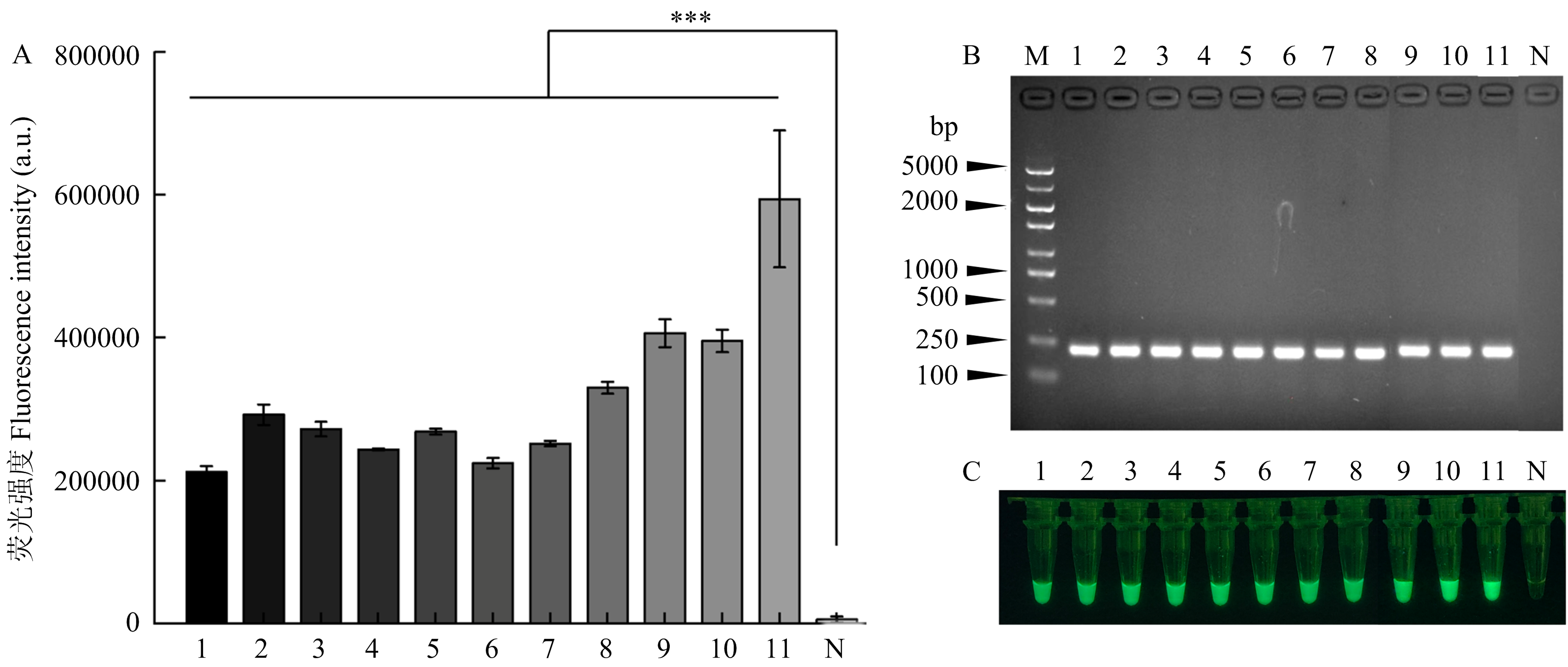
Information and detection results of B. cinerea strains from different hosts"

序号
No.
菌株编号
Strain number
寄主
Host
采集地点
Location
RPA-CRISPR/Cas12a检测结果
RPA-CRISPR/Cas12a result
PCR检测结果
PCR result
1 SC17032306 生菜Lettuce 河北唐山Tangshan, Hebei + +
2 QZ1501080206 茄子Eggplant 北京Beijing + +
3 XHL10041702 西葫芦Courgette 山东淄博Zibo, Shandong + +
4 QC1501070304 芹菜Celery 北京Beijing + +
5 FQ1501080425 番茄Tomato 北京Beijing + +
6 LJ1504147001 辣椒Chili 山东寿光Shouguang, Shandong + +
7 QK14121910 秋葵Okra 北京Beijing + +
8 CM16033104 草莓Strawberry 北京Beijing + +
9 KJ15011306 苦苣Chicory 北京Beijing + +
10 JC23021701 韭菜Garlic chives 北京Beijing + +
11 HG23021704 黄瓜Cucumber 北京Beijing + +

Fig. 5

RPA-CRISPR/Cas12a detection system validation of B. cinerea from different hosts"

Fig.6

RPA-CRISPR/Cas12a detection system validation for cucumber diseased leaves at different inoculated days"

Fig. 7

B. cinerea RPA-CRISPR/Cas12a detection system validation for spatial sampling"

[1]
Rahman M U, Liu X, Wang X, Fan B. Grapevine gray mold disease: Infection, defense and management[J]. Horticulture Research, 2024, 11(9): uhae182.
[2]
Wang K, Li C, Lei C, Jiang Y, Qiu L, Zou X, Zheng Y. β-aminobutyric acid induces priming defence against Botrytis cinerea in grapefruit by reducing intercellular redox status that modifies posttranslation of VvNPR1 and its interaction with VvTGA1[J]. Plant Physiology and Biochemistry, 2020, 156: 552-565.
[3]
赵杨, 苗则彦, 李颖, 白元俊. 番茄灰霉病防治研究进展[J]. 中国植保导刊, 2014, 34(7): 21-29.
Zhao Y, Miao Z Y, Li Y, Bai Y J. Research progress on controlling against tomato gray mold[J]. China Plant Protection, 2014, 34(7): 21-29.(in Chinese)
[4]
郑果, 杜蕙. 几种新型药剂对番茄灰霉病的防治效果[J]. 中国蔬菜, 2006(9): 22-23.
Zheng G, Du H. Control effect of several new fungicides on tomato gray mold[J]. China Vegetables, 2006(9): 22-23.(in Chinese)
[5]
Liu S, Che Z, Chen G. Multiple-fungicide resistance to carbendazim, diethofencarb, procymidone, and pyrimethanil in field isolates of Botrytis cinerea from tomato in Henan Province, China[J]. Crop Protection, 2016, 84: 56-61.
[6]
Leroux P, Fritz R, Debieu D, Albertini C, Lanen C, Bach J, Gredt M, Chapeland F. Mechanisms of resistance to fungicides in field strains of Botrytis cinerea[J]. Pest Management Science, 2002, 58(9): 876-888.
[7]
Fernández-Ortuño D, Chen F, Schnabel G. Resistance to pyraclostrobin and boscalid in Botrytis cinerea isolates from strawberry fields in the carolinas[J]. Plant Disease, 2012, 96(8): 1198-1203.
[8]
Fan X, Zhang J, Yang L, Wu M, Chen W, Li G. Development of PCR-based assays for detecting and differentiating three species of Botrytis infecting broad bean[J]. Plant Disease, 2015, 99(5): 691-698.
[9]
Kennedy R, Wakeham A J, Byrne K G, Meyer U M, Dewey F M. A new method to monitor airborne inoculum of the fungal plant pathogens Mycosphaerella brassicicola and Botrytis cinerea[J]. Applied and Environmental Microbiology, 2000, 66(7): 2996-3003.
[10]
Ammour M S, Castaldo E, Fedele G, Rossi V. Use of LAMP for assessing Botrytis cinerea colonization of bunch trash and latent infection of berries in grapevines[J]. Plants, 2020, 9(11): 1538.
[11]
Celik M, Kalpulov T, Zutahy Y, Ish-Shalom S, Lurie S, Lichter A. Quantitative and qualitative analysis of Botrytis inoculated on table grapes by qPCR and antibodies[J]. Postharvest Biology and Technology, 2009, 52(2): 235-239.
[12]
Diguta C F, Rousseaux S, Weidmann S, Bretin N, Vincent B, Guilloux-Benatier M, Alexandre H. Development of a qPCR assay for specific quantification of Botrytis cinerea on grapes[J]. FEMS Microbiology Letters, 2010, 313(1): 81-87.
[13]
Boyle D S, McNerney R, Low H T, Leader B T, Pérez-Osorio A C, Meyer J C, O’Sullivan D M, Brooks D G, Piepenburg O, Forrest M S. Rapid detection of Mycobacterium tuberculosis by recombinase polymerase amplification[J]. PLoS ONE, 2014, 9(8): e103091.
[14]
Jiang Y, Qian F, Yang J, Liu Y, Dong F, Xu C, Sun B, Chen B, Xu X, Li Y, Wang R, Yang S. CRISPR-Cpf1 assisted genome editing of Corynebacterium glutamicum[J]. Nature Communications, 2017, 8(1): 15179.
[15]
Cheng Y, Tang X, Gao C, Li Z, Chen J, Guo L, Wang T, Xu J. Molecular diagnostics and pathogenesis of fungal pathogens on bast fiber crops[J]. Pathogens, 2020, 9(3): 223.
[16]
Gootenberg J S, Abudayyeh O O, Kellner M J, Joung J, Collins J J, Zhang F. Multiplexed and portable nucleic acid detection platform with Cas13, Cas12a, and Csm6[J]. Science, 2018, 360(6387): 439-444.
[17]
Liang X, Zhang X, Xi K, Liu Y, Jijakli M H, Guo W. Development of an RPA-based CRISPR/Cas12a assay in combination with a lateral flow strip for rapid detection of toxigenic Fusarium verticillioides in maize[J]. Food Control, 2024, 157: 110172.
[18]
Guo Y, Tan J, Jiao B, Wang F, Wang H, Yang C, Dai T. Establishment of a rapid detection system for Phytophthora syringae based on RPA/CRISPR-cas12a[J]. Crop Protection, 2025, 190: 107106.
[19]
Pahlich E, Gerlitz C. A rapid DNA isolation procedure for small quantities of fresh leaf tissue[J]. Phytochemistry, 1980, 19: 11-13.
[20]
赵芊, 李文, 李西柳, 贾振华, 封晓娟, 宋水山. 基于LAMP技术的番茄灰霉病早期快速检测[J]. 河南农业科学, 2025, 54(6): 84-91.
Zhao Q, Li W, Li X L, Jia Z H, Feng X J, Song S S. Early and rapid detection of tomato gray mold based on LAMP technology[J]. Journal of Henan Agricultural Sciences, 2025, 54(6): 84-91.(in Chinese)
[21]
王莹莹, 柴阿丽, 孙阳, 李宝聚. 李宝聚博士诊病手记(九十二) 天津河北6种黄瓜叶部病害的症状诊断及防治建议[J]. 中国蔬菜, 2016(3): 78-80.
Wang Y Y, Chai A L, Sun Y, Li Baoju’s diagnostic notes (XCII): Symptom diagnosis and control suggestions of six cucumber leaf diseases in Tianjin and Hebei[J]. China Vegetables, 2016(3): 78-80.(in Chinese)
[22]
张涛. 石河子地区葡萄烂果病的研究[D]. 石河子: 石河子大学, 2010.
Zhang T. Study on grape rot disease in Shihezi area[D]. Shihezi: Shihezi University, 2010.(in Chinese)
[23]
Suarez M B, Walsh K, Boonham N, O’Neill T, Pearson S, Barker I. Development of real-time PCR (TaqMan®) assays for the detection and quantification of Botrytis cinerea in planta[J]. Plant Physiology and Biochemistry, 2005, 43(9): 890-899.
[24]
汪少丽, 曲恒华, 王英姿, 王培松, 栾炳辉, 王冠华. 苹果轮纹病菌LAMP快速检测方法的建立[J]. 植物保护学报, 2020, 47(1): 127-133.
Wang S L, Qu H H, Wang Y Z, Wang P S, Luan B H, Wang G H. Development of a loop-mediated isothermal amplification assay for rapid detection of apple ring rot pathogen Botryosphaeria dothidea[J]. Journal of Plant Protection, 2020, 47(1): 127-133.(in Chinese)
[25]
梁伊菲, 王春伟. 黄芪根腐病尖孢镰刀菌LAMP可视化快速检测方法的建立[J]. 山西农业科学, 2023, 51(4): 420-426.
Liang Y F, Wang C W. Establishment of LAMP visual rapid detection method for Fusarium oxysporum of root rot of Astragalus membranaceus[J]. Journal of Shanxi Agricultural Sciences, 2023, 51(4): 420-426.(in Chinese)
[26]
Fan F, Wu M Y, Zhang H Q, Li G, Luo C. Rapid and simple detection of anilinopyrimidine resistance in Botrytis cinerea by combining recombinase polymerase amplification with the CRISPR/Cas12a assay[J]. Plant Disease, 2025, 109(9): 1831-1838.
[27]
Hussain R, Zhao B Y, Aarti A, Yin W X, Luo C X. A single tube RPA/Cas12a-based diagnostic assay for early, rapid, and efficient detection of Botrytis cinerea in sweet cherry[J]. Plant Disease, 2025, 109(6): 1244-1253.
[28]
Zhao W C, Lin M L, He Y L, Gao J, Zhang J L, Li M J, Yang Q X. Rapid visual field detection of Pratylenchus coffeae in yam tissues via RPA-CRISPR/Cas12a[J]. Crop Protection, 2025, 197: 107341.
[29]
Li W, Tang J, Ma Z, Zhang Y, Ye Z, Fu H. Development of an RPA-CRISPR/Cas12a-based rapid diagnosis strip for the tangerine pathotype of Alternaria alternata[J]. Microorganisms, 2025, 13(4): 826.
[30]
Anbazhagan P, Parameswari B, Anitha K, Chaitra G V, Bajaru B, Rajashree A, Mangrauthia S K, Yousuf F, Chalam V C, Singh G P. Advances in plant pathogen detection: Integrating recombinase polymerase amplification with CRISPR/Cas systems[J]. 3 Biotech, 2024, 14(9): 214.
[31]
Xu T, Zhang Y, Li S, Dai C, Wei H, Chen D, Zhao Y, Liu H, Li D, Chen P, Liu B F, Tian Y. Deep learning-enhanced hand-driven microfluidic chip for multiplexed nucleic acid detection based on RPA/CRISPR[J]. Advanced Science, 2025, 12(21): e2414918.
[32]
Giakoumoglou N, Kalogeropoulou E, Klaridopoulos C, Pechlivani E M, Christakakis P, Markellou E, Frangakis N, Tzovaras D. Early detection of Botrytis cinerea symptoms using deep learning multi- spectral image segmentation[J]. Smart Agricultural Technology, 2024, 8: 100481.
[1] ZHANG DongMei, ZHOU XinXin, XIAO GuiLin, ZENG XiangGuo, WANG ChunYan, WANG ZeXian, HAN YongChao. Phenotypic Characteristics of Strawberry Floral Organs in Response to Botrytis cinerea Infection and Methods for Gray Mold Resistance Evaluation [J]. Scientia Agricultura Sinica, 2026, 59(7): 1456-1466.
[2] ZHANG TianYu, LI Bai, ZANG JinPing, CAO HongZhe, DONG JinGao, XING JiHong, ZHANG Kang. Genome-Wide Identification and Expression Analysis of HMG Family Genes in Botrytis cinerea [J]. Scientia Agricultura Sinica, 2025, 58(4): 704-718.
[3] ZHAO YuLei, XIN JiaLu, LI ChengNan, LI Shan, XIE XuFei, YIN Xiao. Screening of Target Genes Downstream of VviERF045, a Transcription Factor Associated with Gray Mold Resistance in Vitis vinifera [J]. Scientia Agricultura Sinica, 2025, 58(13): 2578-2590.
[4] ZHANG XiaoQi, SHEN JianGuo, LIAO FuRong, LI WeiMin, JIN YuJie, WUFUER Shayidan, ZHENG LuPing. Establishment and Application of RT-RAA-CRISPR/Cas12a-Based Visual Detection of Prunus Necrotic Ringspot Virus [J]. Scientia Agricultura Sinica, 2025, 58(12): 2371-2381.
[5] LI Jie, LIANG ZhiLin, SUN Yan, TAN GenJia, HUAI BaoYu. Functional Analysis of SlSnRK1.2 in Regulating Tomato Resistance to Grey Mould [J]. Scientia Agricultura Sinica, 2024, 57(21): 4238-4247.
[6] SHAO ShuJun,HU ZhangJian,SHI Kai. The Role and Mechanism of Linoleyl Ethanolamide in Plant Resistance Against Botrytis cinerea in Tomato [J]. Scientia Agricultura Sinica, 2022, 55(9): 1781-1789.
[7] GUO ZeXi,SUN DaYun,QU JunJie,PAN FengYing,LIU LuLu,YIN Ling. The Role of Chalcone Synthase Gene in Grape Resistance to Gray Mold and Downy Mildew [J]. Scientia Agricultura Sinica, 2022, 55(6): 1139-1148.
[8] GONG ChangWei,QIN YiMan,QU JinSong,WANG XueGui. Resistance Detection and Mechanism of Strawberry Botrytis cinerea to Fludioxonil in Sichuan Province [J]. Scientia Agricultura Sinica, 2018, 51(22): 4277-4287.
Viewed
Full text


Abstract

Cited

  Shared   
  Discussed   
No Suggested Reading articles found!