Scientia Agricultura Sinica ›› 2026, Vol. 59 ›› Issue (3): 687-704.doi: 10.3864/j.issn.0578-1752.2026.03.015

• AGRICULTURAL ECONOMY AND RURAL DEVELOPMENT • Previous Articles    

Regional Disparities, Spatial Agglomeration and Dynamic Evolution of Planting Industry Eco-Efficiency in China

LI Bei1,2(), ZHENG JiaXi1,2, ZHANG HuiJie3()   

  1. 1 School of Business Administration, Zhongnan University of Economics and Law, Wuhan 430073
    2 WTO and Hubei Development Research Center, Zhongnan University of Economics and Law, Wuhan 430073
    3 Agricultural Information Institute, Chinese Academy of Agricultural Sciences, Beijing 100081
  • Received:2025-07-28 Accepted:2025-09-23 Online:2026-02-01 Published:2026-01-31
  • Contact: ZHANG HuiJie

Abstract:

【Objective】Based on the current practice of the “dual carbon” strategy and the promotion of green and high-quality development of the planting industry, it needs to clarify the current situation, spatio-temporal patterns and dynamic evolution features of planting industry eco-efficiency, so as to provide references for accelerating the green and low-carbon transformation of planting industry. 【Method】Based on the scientific reconstruction of the evaluation index system, firstly, the SBM-Undesired model was employed to measure planting industry eco-efficiency in China and analyze its current characteristics. Then, the Dagum Gini coefficient was used to clarify the regional differences of planting industry and the causes, and next, the spatial autocorrelation model was used to analyze its spatial agglomeration characteristics. Finally, this paper used kernel density estimation and Markov chain method to investigate the characteristics of its dynamic evolution. 【Result】From 2005 to 2023, the overall planting industry eco-efficiency in China was significantly improved, with the average value of provincial efficiency as high as 87.95% and has gradually evolved from the initial obviously regionally differences to a new pattern of “higher level and simultaneous progress”. Specifically, among the three major functional areas, the increase of planting industry eco-efficiency from high to low was the main grain selling area, the main producing area, and the balanced production and sales area, respectively. The overall difference of planting industry eco-efficiency in China has been greatly reduced and moved towards uniformity. The sources of regional differences were mainly attributed to hypervariable density, followed by intra-group differences, and inter-group differences. Since 2009, the planting industry eco-efficiency in China has exhibited spatial agglomeration characteristics and also obviously spatial clustering characteristics. The number of high-high-agglomeration provinces has increased, while the number of low-low-agglomeration provinces has decreased, showing a good development trend of the overall spatial agglomeration pattern. With the passage of time, planting industry eco-efficiency in the whole country and in three functional areas has all been in a rising trend and has gradually changed from multipolar to unipolar. At the same time, the eco-efficiency level was relatively stable, with the characteristics of “club convergence”. In consideration of spatial factors, the stability of the ecological efficiency level of planting industry in each province was affected, but high-level provinces could usually release positive spillover effects. 【Conclusion】The overall planting industry eco-efficiency in China has significantly improved, but there were some differences in different functional areas. The overall difference has shown an obvious downward trend, and the main source of the difference was lied in the hyper-variable density. The eco-efficiency also showed certain spatial dependence and heterogeneity. There were similarities and differences in the dynamic evolution characteristics of planting industry eco-efficiency in China and in three functional areas. It needed to establish and improve the policy support system, clarify the key influencing factors, strengthen regional exchanges and mutual assistance, and build a risk prevention mechanism, so as to ensure the planting industry eco-efficiency at a high level.

Key words: agricultural carbon emissions, planting industry carbon emissions, ecological efficiency, regional differences, spatial agglomeration

Table 1

Evaluation index system of planting industry eco-efficiency in China"

一级指标
Primary index
二级指标
Secondary index
指标解释
Index interpretation
生产投入
Production input
资本Capital 农业固定资本 Agricultural fixed capital (×108 yuan)
劳动力Labour 种植业从业人员 Planting practitioners (×104 person)
土地Land 农作物种植面积Crop planting area (×103 hm2)
柴油Diesel 农用柴油使用Agricultural diesel oil use (×104 t)
化肥Fertilizer 化肥施用Fertilizer application (×104 t)
农药Pesticide 农药使用Pesticide use (×104 t)
农膜Agricultural film 农膜使用Agricultural film use (×104 t)
水资源Water resource 农业用水Agricultural water (×108 m3)
期望产出
Expected output
经济产出Economic output 种植业总产值Planting industry output value (×108 yuan)
生态产出Ecological output 种植业碳汇Planting industry carbon sink (×104 t)
非期望产出
Unexpected output
温室气体排放Greenhouse gas emissions 种植业碳排放Planting industry carbon emissions (×104 t)
面源污染Diffused pollution 种植业TN、TP、COD排放Planting industry TN, TP, and COD emissions (×108 m3)

Table 2

The planting industry eco-efficiency and its change range in 30 provinces (autonomous region, municipality) of China in 2005 and 2023"

地区
Region
2005 2023 变动率
Change rate (%)
地区
Region
2005 2023 变动率
Change rate (%)
数值
Numerical value
排名
Rank
数值
Numerical value
排名
Rank
数值
Numerical value
排名
Rank
数值
Numerical value
排名
Rank
北京Beijing 0.5949 5 1.0000 1 68.10 河南Henan 0.4649 9 1.0000 1 115.10
天津Tianjin 0.3926 17 1.0000 1 154.71 湖北Hubei 0.2828 28 0.5111 29 80.73
河北Hebei 0.3460 23 1.0000 1 189.02 湖南Hunan 0.3168 26 0.5560 27 75.51
山西Shanxi 0.3701 21 0.6299 24 70.20 广东Guangdong 0.4191 13 1.0000 1 138.61
内蒙古Inner Mongolia 0.4308 12 1.0000 1 132.13 广西Guangxi 0.7458 4 1.0000 1 34.08
辽宁Liaoning 0.4108 15 1.0000 1 143.43 海南Hainan 0.3738 20 1.0000 1 167.52
吉林Jilin 1.0000 1 1.0000 1 0.00 重庆Chongqing 0.4576 10 1.0000 1 118.53
黑龙江Heilongjiang 0.4151 14 1.0000 1 140.91 四川Sichuan 0.4435 11 1.0000 1 125.48
上海Shanghai 0.2737 30 0.3799 30 38.80 贵州Guizhou 1.0000 1 1.0000 1 0.00
江苏Jiangsu 0.3252 24 0.5306 28 63.16 云南Yunnan 0.3955 16 1.0000 1 152.84
浙江Zhejiang 0.3192 25 1.0000 1 213.28 陕西Shaanxi 0.5443 7 1.0000 1 83.72
安徽Anhui 0.3752 19 0.6449 23 71.88 甘肃Gansu 0.3497 22 1.0000 1 185.96
福建Fujian 0.2942 27 1.0000 1 239.90 青海Qinghai 0.5757 6 1.0000 1 73.70
江西Jiangxi 0.2810 29 0.5918 26 110.60 宁夏Ningxia 1.0000 1 0.5995 25 -40.05
山东Shandong 0.3881 18 1.0000 1 157.67 新疆Xinjiang 0.4824 8 1.0000 1 107.30

Table 3

The planting industry eco-efficiency in major grain producing areas, major selling areas and balanced production and marketing areas from 2005 to 2023"

年份
Year
主产区
Main producing area
主销区
Main sales area
产销平衡区
Production and marketing balance area
年份
Year
主产区
Main producing area
主销区
Main sales area
产销平衡区
Production and marketing balance area
2005 0.4216 0.3811 0.5921 2015 0.4772 0.4938 0.4971
2006 0.4218 0.4166 0.5323 2016 0.4947 0.5138 0.5119
2007 0.3996 0.4260 0.5592 2017 0.5593 0.5906 0.5420
2008 0.4457 0.4386 0.5376 2018 0.5878 0.6211 0.6349
2009 0.3967 0.5315 0.5115 2019 0.6627 0.7313 0.7498
2010 0.4112 0.4597 0.4767 2020 0.7226 0.7824 0.8369
2011 0.4361 0.4725 0.4671 2021 0.7667 0.8430 0.8848
2012 0.4433 0.4706 0.4944 2022 0.7847 0.8727 0.9160
2013 0.4541 0.4741 0.4927 2023 0.8334 0.9114 0.9229
2014 0.4596 0.4764 0.5107

Table 4

Gini coefficient and its decomposition of planting industry eco-efficiency in China"

年份
Year
全国
Whole country
区域内
Within the region
区域间
Interregional
贡献率
Contribution rate (%)
主产区
Main producing area
主销区
Main sales area
产销平衡区
Production and marketing balance area
主产区-主销区
Main producing area-Main
sales area
主产区-产销平衡区
Main producing area-Production and marketing balance area
主销区-产销平衡区
Main sales area- Production and marketing balance area
组内
In-
group
组间
Interblock
超变密度
Hypervariable density
2005 0.211 0.175 0.138 0.210 0.166 0.218 0.221 30.842 45.655 23.503
2006 0.179 0.163 0.138 0.179 0.158 0.187 0.177 32.545 31.111 36.344
2007 0.182 0.116 0.138 0.217 0.127 0.190 0.206 30.409 43.263 26.328
2008 0.182 0.167 0.139 0.197 0.159 0.191 0.187 33.525 25.070 41.405
2009 0.174 0.100 0.225 0.167 0.168 0.147 0.196 28.915 39.261 31.824
2010 0.141 0.124 0.136 0.146 0.133 0.140 0.144 33.148 25.068 41.784
2011 0.144 0.134 0.136 0.152 0.138 0.145 0.147 34.095 13.101 52.804
2012 0.142 0.133 0.129 0.148 0.135 0.144 0.143 33.960 18.091 47.949
2013 0.148 0.140 0.130 0.157 0.140 0.151 0.150 34.159 12.921 52.920
2014 0.140 0.134 0.107 0.154 0.128 0.147 0.140 34.302 17.437 48.261
2015 0.133 0.133 0.123 0.131 0.132 0.134 0.130 34.591 7.369 58.040
2016 0.133 0.136 0.131 0.121 0.137 0.131 0.129 34.391 6.775 58.834
2017 0.158 0.169 0.180 0.109 0.176 0.146 0.146 33.989 10.683 55.328
2018 0.135 0.149 0.143 0.094 0.150 0.129 0.120 33.838 13.661 52.501
2019 0.154 0.166 0.168 0.110 0.173 0.147 0.137 33.439 19.168 47.393
2020 0.136 0.160 0.144 0.075 0.159 0.131 0.106 33.030 25.467 41.503
2021 0.130 0.152 0.119 0.088 0.147 0.131 0.103 33.568 26.133 40.299
2022 0.120 0.146 0.104 0.071 0.139 0.122 0.088 33.123 30.641 36.236
2023 0.102 0.128 0.083 0.067 0.118 0.105 0.075 34.472 24.148 41.380

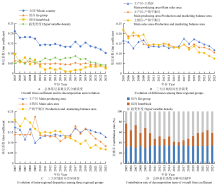
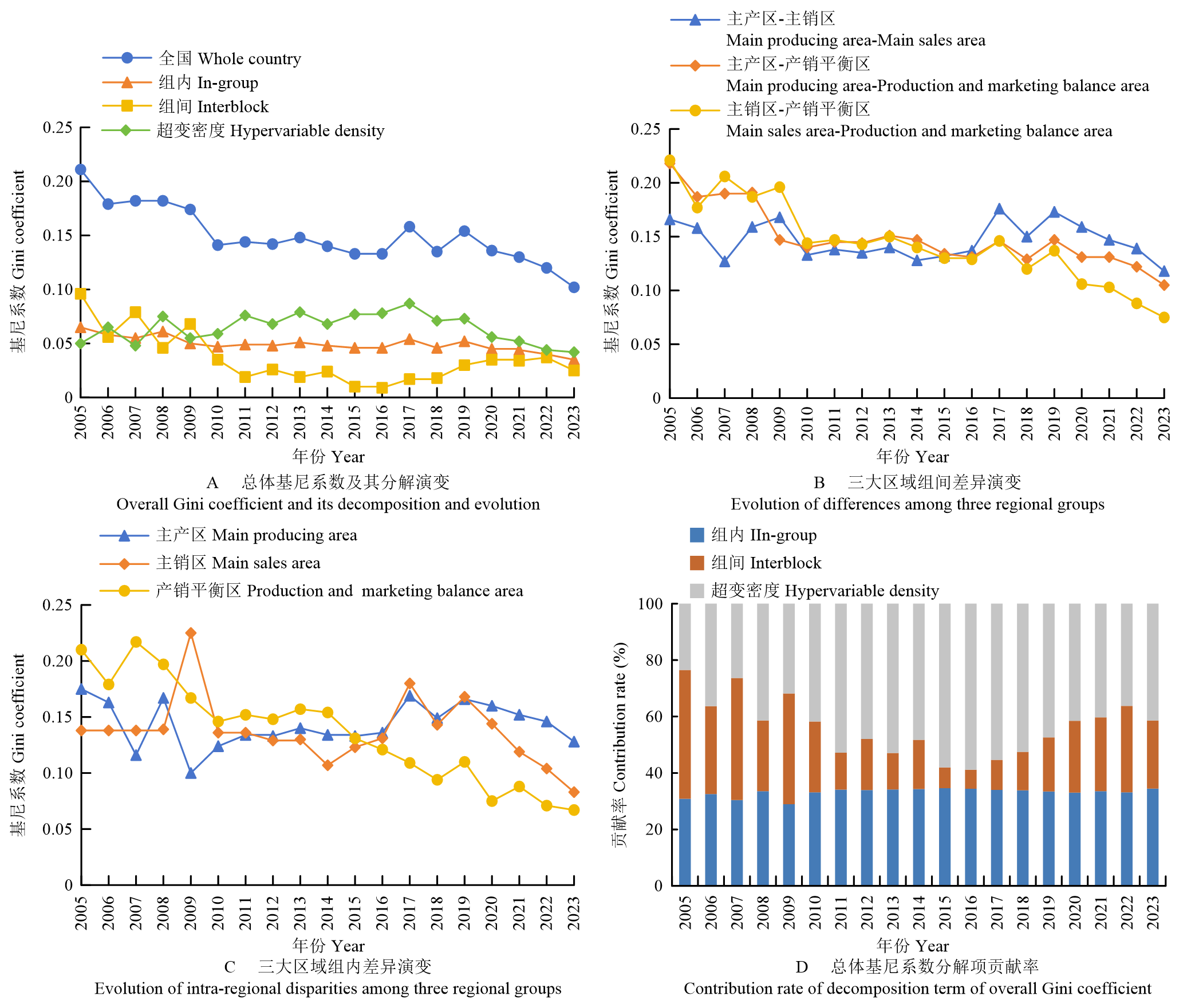
Fig. 1

Evolution of regional disparities in planting industry eco-efficiency in China"

Table 5

Analysis results of global Moran index of planting industry eco-efficiency in China"

年份
Year
Moran′s I Z
Z value
P
P value
年份
Year
Moran′s I Z
Z value
P
P value
2005 -0.000 0.997 0.159 2015 0.060 2.645 0.004
2006 -0.007 0.830 0.203 2016 0.059 2.595 0.005
2007 -0.031 0.108 0.457 2017 0.081 3.282 0.001
2008 -0.016 0.540 0.294 2018 0.107 3.888 0.000
2009 0.067 3.037 0.001 2019 0.116 4.135 0.000
2010 0.043 2.251 0.012 2020 0.112 4.036 0.000
2011 0.050 2.401 0.008 2021 0.093 3.522 0.000
2012 0.043 2.272 0.012 2022 0.091 3.457 0.000
2013 0.061 2.799 0.003 2023 0.068 2.837 0.002
2014 0.034 2.101 0.018

Table 6

Local spatial clustering of planting industry eco-efficiency in China in main years"

年份
Year
高-高集聚
High-high agglomeration
低-高集聚
Low-high agglomeration
低-低集聚
Low-low agglomeration
高-低集聚
High-low agglomeration
2005 内蒙古Inner Mongolia、四川Sichuan、重庆Chongqing、青海Qinghai、新疆Xinjiang 天津Tianjin、辽宁Liaoning、黑龙江Heilongjiang、海南Hainan、云南Yunnan、甘肃Gansu 河北Hebei、山西Shanxi、上海Shanghai、江苏Jiangsu、浙江Zhejiang、安徽Anhui、福建Fujian、江西Jiangxi、山东Shandong、湖北Hubei、湖南Hunan、广东Guangdong 北京Beijing、吉林Jilin、河南Henan、广西Guangxi、贵州Guizhou、陕西Shaanxi、宁夏Ningxia
2010 天津Tianjin、黑龙江Heilongjiang、广东Guangdong、海南Hainan、贵州Guizhou 河北Hebei、内蒙古Inner Mongolia、辽宁Liaoning、四川Sichuan、云南Yunnan 山西Shanxi、上海Shanghai、江苏Jiangsu、浙江Zhejiang、安徽Anhui、福建Fujian、江西Jiangxi、湖北Hubei、湖南Hunan、甘肃Gansu、青海Qinghai、宁夏Ningxia 北京Beijing、吉林Jilin、山东Shandong、河南Henan、广西Guangxi、重庆Chongqing、陕西Shaanxi、新疆Xinjiang
2015 天津Tianjin、辽宁Liaoning、吉林Jilin、黑龙江Heilongjiang、海南Hainan、贵州Guizhou 河北Hebei、山西Shanxi、内蒙古Inner Mongolia、四川Sichuan、云南Yunnan 上海Shanghai、江苏Jiangsu、浙江Zhejiang、安徽Anhui、福建Fujian、江西Jiangxi、湖北Hubei、湖南Hunan、甘肃Gansu、青海Qinghai、宁夏Ningxia 北京Beijing、山东Shandong、河南Henan、广东Guangdong、广西Guangxi、重庆Chongqing、陕西Shaanxi、新疆Xinjiang
2020 北京Beijing、天津Tianjin、河北Hebei、内蒙古Inner Mongolia、吉林Jilin、浙江Zhejiang、贵州Guizhou、云南Yunnan、青海Qinghai、宁夏Ningxia 山西Shanxi、辽宁Liaoning、四川Sichuan、甘肃Gansu 上海Shanghai、江苏Jiangsu、浙江Zhejiang、安徽Anhui、福建Fujian、江西Jiangxi、湖北Hubei、湖南Hunan 黑龙江Heilongjiang、山东Shandong、河南Henan、广东Guangdong、广西Guangxi、海南Hainan、重庆Chongqing、陕西Shaanxi
2023 北京Beijing、天津Tianjin、辽宁Liaoning、吉林Jilin、黑龙江Heilongjiang、广西Guangxi、海南Hainan、四川Sichuan、重庆Chongqing、贵州Guizhou、云南Yunnan、甘肃Gansu、青海Qinghai、新疆Xinjiang 山西Shanxi、宁夏Ningxia 上海Shanghai、江苏Jiangsu、安徽Anhui、江西Jiangxi、湖北Hubei、湖南Hunan 河北Hebei、内蒙古Inner Mongolia、浙江Zhejiang、福建Fujian、山东Shandong、河南Henan、广东Guangdong、陕西Shaanxi

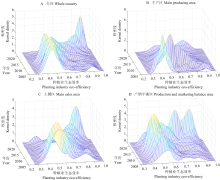
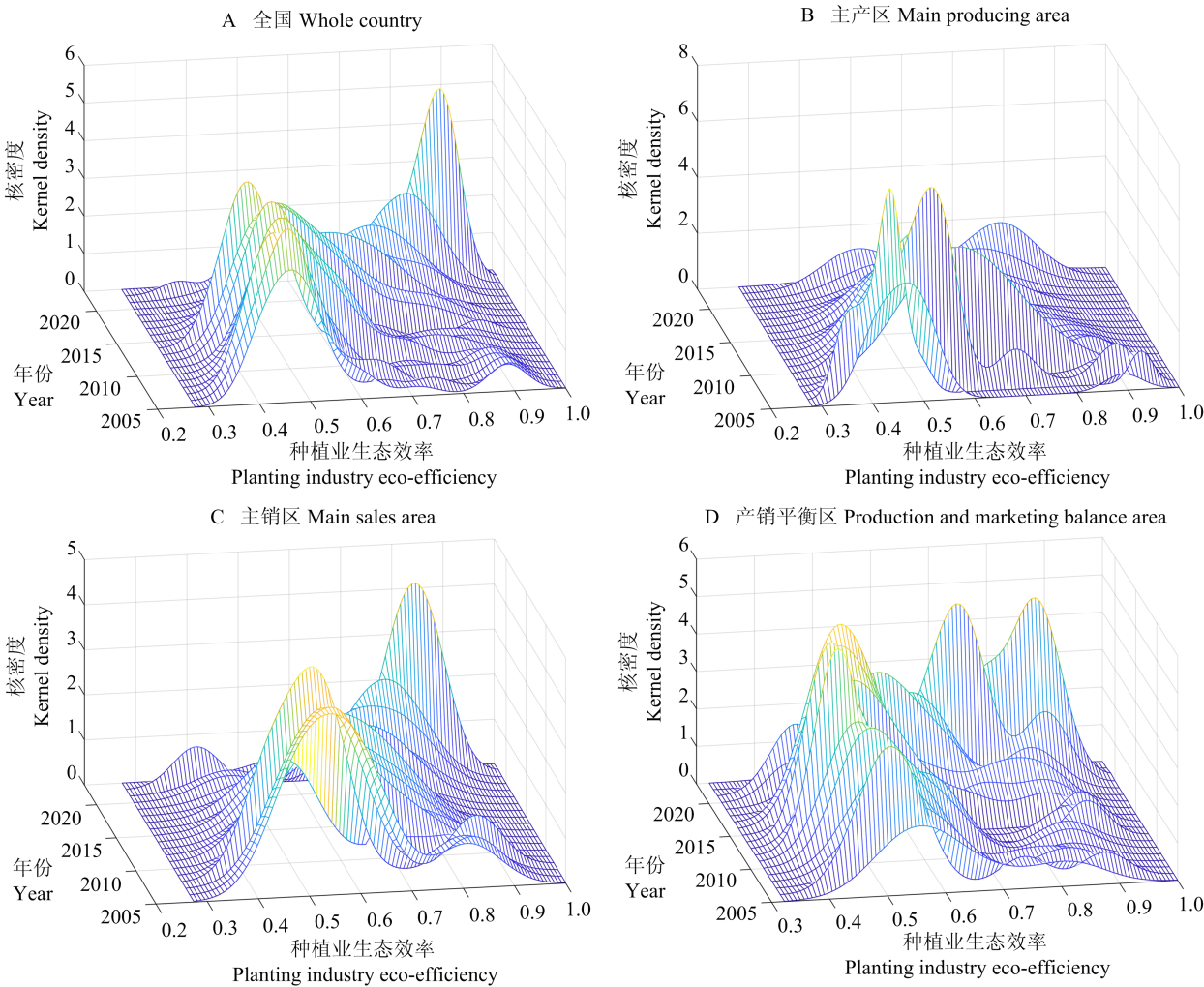
Fig. 2

Distribution results of kernel density of planting industry eco-efficiency in China and its three functional areas"

Table 7

Traditional Markov transfer probability matrix of planting industry eco-efficiency in China"

项目
Project
空间滞后类型
Spatial lag type
t/(t+1) 观测值
Observed value
传统Markov链
Traditional Markov chain
无滞后 No lag 0.8182 0.1748 0.0070 0.0000 143
0.0851 0.7021 0.1986 0.0142 141
0.0000 0.0515 0.7721 0.1765 136
0.0000 0.0167 0.0500 0.9333 120

Table 8

Spatial Markov transfer probability matrix of planting industry eco-efficiency in China"

项目
Project
空间滞后类型
Spatial lag type
t/(t+1) 观测值
Observed value
空间Markov链
Spatial Markov chain
0.9259 0.0741 0.0000 0.0000 54
0.2500 0.3750 0.3750 0.0000 8
0.0000 0.1429 0.7857 0.0714 14
0.0000 0.0000 0.0000 0.0000 0
0.7742 0.2258 0.0000 0.0000 62
0.0781 0.7500 0.1406 0.0313 64
0.0000 0.0667 0.8444 0.0889 45
0.0000 0.0800 0.2000 0.7200 25
0.7308 0.2308 0.0385 0.0000 26
0.0615 0.7231 0.2154 0.0000 65
0.0000 0.0333 0.7667 0.2000 60
0.0000 0.0000 0.0000 1.0000 29
0.0000 1.0000 0.0000 0.0000 1
0.2500 0.2500 0.5000 0.0000 4
0.0000 0.0000 0.5882 0.4118 17
0.0000 0.0000 0.0152 0.9848 66
[1]
SCHALTEGGER S, STURM A. Ökologische rationalität: Ansatzpunkte zur ausgestaltung von ökologieorientierten management instrumenten. Die Unternehmung, 1990, 44(9): 273-290.
[2]
向慧, 彭保发, 伍铁牛, 张浩哲, 付冬暇, 杨庆媛. 湖南武陵民族地区种植业生态效率的时空分异及驱动机理研究. 地理科学, 2025, 45(2): 349-363.

doi: 10.13249/j.cnki.sgs.20230470
XIANG H, PENG B F, WU T N, ZHANG H Z, FU D X, YANG Q Y. Spatio-temporal pattern and driving mechanism of agricultural ecological efficiency for planting industry in the Wuling ethnic area of Hunan. Scientia Geographica Sinica, 2025, 45(2): 349-363. (in Chinese)

doi: 10.13249/j.cnki.sgs.20230470
[3]
王宝义, 张卫国. 中国农业生态效率测度及时空差异研究. 中国人口·资源与环境, 2016, 26(6): 11-19.
WANG B Y, ZHANG W G. A research of agricultural eco-efficiency measure in China and space-time differences. China Population Resources and Environment, 2016, 26(6): 11-19. (in Chinese)
[4]
张荧楠, 张兰婷, 韩立民. 农业生态效率评价及提升路径研究——基于山东省17个地级市的实证分析. 生态经济, 2021, 37(4): 118-124, 131.
ZHANG Y N, ZHANG L T, HAN L M. Study on the evaluation and promotion path of agricultural ecological efficiency-An empirical analysis of 17 prefecture level cities in Shandong Province. Ecological Economy, 2021, 37(4): 118-124, 131. (in Chinese)
[5]
刘海龙, 王虎, 谢亚林, 李曼, 石培基. 集中连片特困区耕地生态效率的时空演变特征及影响因素分析——以吕梁山区为例. 水土保持研究, 2020, 27(2): 323-329.
LIU H L, WANG H, XIE Y L, LI M, SHI P J. Analysis for spatial and temporal evolution features and influencing factors of ecological efficiency of cultivated land in the concentrated contiguous destitute area-A case study of Lüliang mountain area. Research of Soil and Water Conservation, 2020, 27(2): 323-329. (in Chinese)
[6]
周爱群, 陈彩虹. 耕地利用生态效率的时空演变及影响因素研究. 经济问题, 2023(12): 95-101.
ZHOU A Q, CHEN C H. Temporal and spatial evolution and influencing factors of ecological efficiency of cultivated land use. On Economic Problems, 2023(12): 95-101. (in Chinese)
[7]
罗家祺, 金晓斌, 刘晶, 梁鑫源, 韩博, 周寅康. 2000—2020年苏北地区农业生态效率变化及其影响因素分析. 农业工程学报, 2023, 39(15): 239-248.
LUO J Q, JIN X B, LIU J, LIANG X Y, HAN B, ZHOU Y K. Process and influencing factors of agricultural eco-efficiency in northern Jiangsu of China from 2000 to 2020. Transactions of the Chinese Society of Agricultural Engineering, 2023, 39(15): 239-248. (in Chinese)
[8]
NGUYEN T T, DO T L, PARVATHI P, WOSSINK A, GROTE U. Farm production efficiency and natural forest extraction: Evidence from Cambodia. Land Use Policy, 2018, 71: 480-493.

doi: 10.1016/j.landusepol.2017.11.016
[9]
吴振华, 雷琳. 基于三阶段DEA模型的农业土地生态效率研究: 以河南省为例. 生态经济, 2018, 34(10): 76-80.
WU Z H, LEI L. Study on agricultural land ecological efficiency based on three-phase DEA model: Taking Henan Province as an example. Ecological Economy, 2018, 34(10): 76-80. (in Chinese)
[10]
YAO X C, CHEN W W, SONG C C, GAO S Q. Sustainability and efficiency of water-land-energy-food nexus based on emergy- ecological footprint and data envelopment analysis: Case of an important agriculture and ecological region in Northeast China. Journal of Cleaner Production, 2022, 379: 134854.

doi: 10.1016/j.jclepro.2022.134854
[11]
TONE K. A slacks-based measure of efficiency in data envelopment analysis. European Journal of Operational Research, 2001, 130(3): 498-509.

doi: 10.1016/S0377-2217(99)00407-5
[12]
LIU Y S, ZOU L L, WANG Y S. Spatial-temporal characteristics and influencing factors of agricultural eco-efficiency in China in recent 40 years. Land Use Policy, 2020, 97: 104794.

doi: 10.1016/j.landusepol.2020.104794
[13]
惠嫜, 陈晓楠, 宋健峰. 基于水足迹的作物生产生态效率评价——以陕西省为例. 生态学报, 2021, 41(8): 3078-3091.
HUI Z, CHEN X N, SONG J F. Assessing crop production eco-efficiency based on water footprints-The case of Shaanxi Province. Acta Ecologica Sinica, 2021, 41(8): 3078-3091. (in Chinese)
[14]
臧俊梅, 张思影, 唐春云. “双碳” 目标下广东省农业生态效率时空演变及影响因素研究. 中国农业资源与区划, 2023, 44(10): 135-146.
ZANG J M, ZHANG S Y, TANG C Y. Spatio-temporal evolution and influencing factors of agricultural eco-efficiency in Guangdong Province under “dual carbon” target. Chinese Journal of Agricultural Resources and Regional Planning, 2023, 44(10): 135-146. (in Chinese)
[15]
于婷, 郝信波. 粮食主产区农业生态效率时空特征及改善路径研究. 生态经济, 2018, 34(9): 104-110.
YU T, HAO X B. Evaluation and analysis on the temporal and spatial characteristics of agricultural eco-efficiency of major grain production. Ecological Economy, 2018, 34(9): 104-110. (in Chinese)
[16]
晋洪涛, 项乐乐, 陈方. 粮食主产区种植业低碳发展效率测算与差异化补偿研究. 河南农业大学学报, 2025, 59(1): 167-178.
JIN H T, XIANG L L, CHEN F. Study on the calculation of low-carbon development efficiency and differentiated compensation in the main grain-producing areas. Journal of Henan Agricultural University, 2025, 59(1): 167-178. (in Chinese)
[17]
吴小庆, 王亚平, 何丽梅, 陆根法. 基于AHP和DEA模型的农业生态效率评价——以无锡市为例. 长江流域资源与环境, 2012, 21(6): 714-719.
WU X Q, WANG Y P, HE L M, LU G F. Agricultural eco-efficiency evaluation based on ahp and dea model-A case of Wuxi city. Resources and Environment in the Yangtze Basin, 2012, 21(6): 714-719. (in Chinese)
[18]
BIDISHA S H, HOSSAIN M A, ALAM R, HASAN M M. Credit, tenancy choice and agricultural efficiency: Evidence from the northern region of Bangladesh. Economic Analysis and Policy, 2018, 57: 22-32.

doi: 10.1016/j.eap.2017.10.001
[19]
BALTAS H, SIRIN M, GÖKBAYRAK E, OZCELIK A E. A case study on pollution and a human health risk assessment of heavy metals in agricultural soils around Sinop province, Turkey. Chemosphere, 2020, 241: 125015.
[20]
汪亚琴, 姚顺波, 侯孟阳, 贾磊, 李园园, 邓元杰, 张晓. 基于地理探测器的中国农业生态效率时空分异及其影响因素. 应用生态学报, 2021, 32(11): 4039-4049.

doi: 10.13287/j.1001-9332.202111.026
WANG Y Q, YAO S B, HOU M Y, JIA L, LI Y Y, DENG Y J, ZHANG X. Spatial-temporal differentiation and its influencing factors of agricultural eco-efficiency in China based on geographic detector. Chinese Journal of Applied Ecology, 2021, 32(11): 4039-4049. (in Chinese)
[21]
侯孟阳, 姚顺波. 中国农村劳动力转移对农业生态效率影响的空间溢出效应与门槛特征. 资源科学, 2018, 40(12): 2475-2486.

doi: 10.18402/resci.2018.12.14
HOU M Y, YAO S B. Spatial spillover effects and threshold characteristics of rural labor transfer on agricultural eco-efficiency in China. Resources Science, 2018, 40(12): 2475-2486. (in Chinese)

doi: 10.18402/resci.2018.12.14
[22]
胡平波, 钟漪萍. 政府支持下的农旅融合促进农业生态效率提升机理与实证分析——以全国休闲农业与乡村旅游示范县为例. 中国农村经济, 2019(12): 85-104.
HU P B, ZHONG Y P. The mechanism of improving agricultural eco-efficiency by the integration of agriculture and tourism supported by the government: Taking the national leisure agriculture and rural tourism demonstration counties as an example. Chinese Rural Economy, 2019(12): 85-104. (in Chinese)
[23]
胡平波, 刘金. 数字乡村发展提升农业生态效率的机理与实证检验. 中国人口·资源与环境, 2025, 35(3): 162-173.
HU P B, LIU J. Mechanisms of improving agricultural ecological efficiency through digital village development and its empirical analysis. China Population, Resources and Environment, 2025, 35(3): 162-173. (in Chinese)
[24]
陈菁泉, 信猛, 马晓君, 常百舒, 张紫嫣. 中国农业生态效率测度与驱动因素. 中国环境科学, 2020, 40(7): 3216-3227.
CHEN J Q, XIN M, MA X J, CHANG B S, ZHANG Z Y. Chinese agricultural eco-efficiency measurement and driving factors. China Environmental Science, 2020, 40(7): 3216-3227. (in Chinese)
[25]
李谷成, 范丽霞, 冯中朝. 资本积累、制度变迁与农业增长: 对1978—2011年中国农业增长与资本存量的实证估计. 管理世界, 2014, 30(5): 67-79, 92.
LI G C, FAN L X, FENG Z C. Capital accumulation, institutional change and agricultural growth: an empirical estimation of agricultural growth and capital stock in China from 1978 to 2011. Journal of Management World, 2014, 30(5): 67-79, 92. (in Chinese)
[26]
田云, 王骁睿, 尹忞昊, 张蕙杰. 中国农业净碳汇再测算: 现状特征、时空格局及其影响因素. 中国农业科学, 2024, 57(22): 4507-4521. doi: 10.3864/j.issn.0578-1752.2024.22.010.
TIAN Y, WANG X R, YIN M H, ZHANG H J. Re-evaluation of China’s agricultural net carbon sink: Current situation, spatial-temporal pattern and influencing factors. Scientia Agricultura Sinica, 2024, 57(22): 4507-4521. doi: 10.3864/j.issn.0578-1752.2024.22.010. (in Chinese)
[27]
郭海红, 盖凌云. 中国农业碳效应时空分异及驱动机理研究. 宁夏社会科学, 2021(5): 74-84.
GUO H H, GAI L Y. Research on the spatio-temporal differentiation and driving mechanism of agricultural carbon effect in China. Social Sciences in Ningxia, 2021(5): 74-84. (in Chinese)
[28]
田云, 李波, 张俊飚. 我国农地利用碳排放的阶段特征及因素分解研究. 中国地质大学学报(社会科学版), 2011, 11(1): 59-63.
TIAN Y, LI B, ZHANG J B. Research on stage characteristics and factor decomposition of agricultural land carbon emission in China. Journal of China University of Geosciences (Social Sciences Edition), 2011, 11(1): 59-63. (in Chinese)
[29]
闵继胜, 胡浩. 中国农业生产温室气体排放量的测算. 中国人口·资源与环境, 2012, 22(7): 21-27.
MIN J S, HU H. Calculation of greenhouse gases emission from agricultural production in China. China Population, Resources and Environment, 2012, 22(7): 21-27. (in Chinese)
[30]
蒋金荷. 中国城镇住宅碳排放强度分析和用能政策反思. 数量经济技术经济研究, 2015, 32(6): 90-104.
JIANG J H. China’s urban residential carbon intensity decomposition and energy policy rethink. The Journal of Quantitative & Technical Economics, 2015, 32(6): 90-104. (in Chinese)
[31]
赖斯芸, 杜鹏飞, 陈吉宁. 基于单元分析的非点源污染调查评估方法. 清华大学学报(自然科学版), 2004, 44(9): 1184-1187.
LAI S Y, DU P F, CHEN J N. Evaluation of non-point source pollution based on unit analysis. Journal of Tsinghua University (Science and Technology), 2004, 44(9): 1184-1187. (in Chinese)
[32]
闫坤, 唐丹彤, 甘天琦. 中国农业减污降碳协同效应的量化评估与动态演化——基于边际减排成本的分析. 中国农村经济, 2024(9): 22-41.
YAN K, TANG D T, GAN T Q. Quantitative evaluation and dynamic evolution of the synergistic effect of agricultural pollution and carbon reduction in China: An analysis based on marginal abatement cost. Chinese Rural Economy, 2024(9): 22-41. (in Chinese)
[33]
梁流涛. 农村生态环境时空特征及其演变规律研究[D]. 南京: 南京农业大学, 2009.
LIANG L T. Study on the temporal and spatial evolution of rural ecological environment[D]. Nanjing: Nanjing Agricultural University, 2009. (in Chinese)
[34]
陶园, 王少丽, 管孝艳, 李润杰, 刘静, 吉梦喆. 青海省农业面源污染源特征分析. 农业工程学报, 2019, 35(10): 164-172.
TAO Y, WANG S L, GUAN X Y, LI R J, LIU J, JI M Z. Characteristic analysis of non-point source pollution in Qinghai Province. Transactions of the Chinese Society of Agricultural Engineering, 2019, 35(10): 164-172. (in Chinese)
[35]
葛小君, 黄斌, 袁再健, 王栋栋, 王泉泉, 陈佳村, 谢真越. 近20年来广东省农业面源污染负荷时空变化与来源分析. 环境科学, 2022, 43(6): 3118-3127.
GE X J, HUANG B, YUAN Z J, WANG D D, WANG Q Q, CHEN J C, XIE Z Y. Temporal and spatial variation characteristics and source analysis of agricultural non-point source pollution load in Guangdong during the past 20 years. Environmental Science, 2022, 43(6): 3118-3127. (in Chinese)
[36]
潘丹, 应瑞瑶. 中国农业生态效率评价方法与实证——基于非期望产出的SBM模型分析. 生态学报, 2013, 33(12): 3837-3845.
PAN D, YING R Y. Agricultural eco-efficiency evaluation in China based on SBM model. Acta Ecologica Sinica, 2013, 33(12): 3837-3845. (in Chinese)

doi: 10.5846/stxb
[37]
DAGUM C. A new approach to the decomposition of the Gini income inequality ratio. Empirical Economics, 1997, 22(4): 515-531.

doi: 10.1007/BF01205777
[38]
张卓群, 张涛, 冯冬发. 中国碳排放强度的区域差异、动态演进及收敛性研究. 数量经济技术经济研究, 2022, 39(4): 67-87.
ZHANG Z Q, ZHANG T, FENG D F. Study on regional differences, dynamic evolution and convergence of carbon emission intensity in China. The Journal of Quantitative & Technical Economics, 2022, 39(4): 67-87. (in Chinese)
[39]
田云, 夏锐, 张星琰. 中国农业面源污染强度测算: 时空分异、动态演进与空间集聚. 环境科学, 2025, 46(9): 5608-5618.
TIAN Y, XIA R, ZHANG X Y. Evaluation of China’s agricultural non- point source pollution intensity: Spatial and temporal differentiation, dynamic evolution and spatial agglomeration. Environmental Science, 2025, 46(9): 5608-5618. (in Chinese)
[40]
邓远建, 杨旭, 陈光炬, 汪凯达. 中国生态福利绩效水平的空间非均衡及动态演进. 中国地质大学学报(社会科学版), 2020, 20(4): 115-127.
DENG Y J, YANG X, CHEN G J, WANG K D. Spatial unbalanced and dynamic evolution of China’s ecological welfare performance level. Journal of China University of Geosciences (Social Sciences Edition), 2020, 20(4): 115-127. (in Chinese)
[41]
华坚, 盛晓涵. 沿黄九省水土资源对粮食生产的阻尼效应测度及时空分异特征. 中国人口·资源与环境, 2021, 31(8): 148-156.
HUA J, SHENG X H. Measurement and spatiotemporal analysis of water and soil resources' damping effect on grain production in nine provinces along the Yellow River. China Population Resources and Environment, 2021, 31(8): 148-156. (in Chinese)
[42]
马林静, 王雅鹏, 吴娟. 中国粮食生产技术效率的空间非均衡与收敛性分析. 农业技术经济, 2015(4): 4-12.
MA L J, WANG Y P, WU J. Spatial un-equilibrium and convergence of technical efficiency of food production in China. Journal of Agrotechnical Economics, 2015(4): 4-12. (in Chinese)
[1] YIN MinHao, CHEN ChiBo, LU YiHeng, TIAN Yun. China's Agricultural Carbon Emission Density: Spatiotemporal Characteristics, Dynamic Evolution, and Spatial Effect [J]. Scientia Agricultura Sinica, 2025, 58(18): 3710-3727.
[2] TIAN Yun, WANG XiaoRui, YIN MinHao, ZHANG HuiJie. Re-Evaluation of China’s Agricultural Net Carbon Sink: Current Situation, Spatial-Temporal Pattern and Influencing Factors [J]. Scientia Agricultura Sinica, 2024, 57(22): 4507-4521.
[3] DENG YuanJian,CHAO Bo. Provincial Agricultural Ecological Efficiency and Its Influencing Factors in China from the Perspective of Grey Water Footprint [J]. Scientia Agricultura Sinica, 2022, 55(24): 4879-4894.
[4] CUI Shuai,LIU ShuoRan,WANG Yin,XIA ChenZhen,YAN Li,FENG GuoZhong,GAO Qiang. Soil Available Sulfur Content in Jilin Province and Its Correlation with Soil Organic Matter and Soil Total Nitrogen [J]. Scientia Agricultura Sinica, 2022, 55(12): 2372-2383.
[5] TIAN Yun,WANG MengChen. Research on Spatial and Temporal Difference of Agricultural Carbon Emission Efficiency and Its Influencing Factors in Hubei Province [J]. Scientia Agricultura Sinica, 2020, 53(24): 5063-5072.
[6] LI Bo,DU JianGuo,LIU XueQi. Spatial-Temporal Characteristics and Economic Relevance of Agricultural Carbon Emissions in Hubei Province [J]. Scientia Agricultura Sinica, 2019, 52(23): 4309-4319.
[7] REN KeYu,DUAN YingHua,XU MingGang,ZHANG XuBo. Effect of Manure Application on Nitrogen Use Efficiency of Crops in China: A Meta-Analysis [J]. Scientia Agricultura Sinica, 2019, 52(17): 2983-2996.
[8] WU Jian-zhai, SHEN Chen, WANG Sheng-wei, ZHANG Jian-hua, KONG Fan-tao. Spatial Evolution, Mechanism, Effect and Policies of Vegetable Production Agglomeration in China [J]. Scientia Agricultura Sinica, 2015, 48(8): 1641-1649.
Viewed
Full text


Abstract

Cited

  Shared   
  Discussed   
No Suggested Reading articles found!