






中国农业科学 ›› 2026, Vol. 59 ›› Issue (11): 2484-2498.doi: 10.3864/j.issn.0578-1752.2026.11.013
侯晨梓1( ), 李小平1, 王晓龙1, 郭来春2, 任长忠2, 胡新中1()
收稿日期:2025-11-06
接受日期:2026-01-09
出版日期:2026-06-01
发布日期:2026-06-03
通信作者:
联系方式:
侯晨梓,E-mail:19829890629@163.com。
基金资助:
HOU ChenZi1(), LI XiaoPing1, WANG XiaoLong1, GUO LaiChun2, REN ChangZhong2, HU XinZhong1()
Received:2025-11-06
Accepted:2026-01-09
Published:2026-06-01
Online:2026-06-03
摘要:
【目的】划分燕麦和面阶段,分析不同和面阶段燕麦面絮调控产品品质的机制,构建判断燕麦和面阶段的识别模型,为提高燕麦面制品加工的自动化程度提供理论依据和技术支持。【方法】以燕麦粉和面过程中面絮图像为数据集,提取图像形态学信息,据此划分燕麦和面阶段。从面絮的糊化度、直链淀粉含量、分子间作用力、质构特性、流变学特性、水分分布状态揭示各阶段面絮调控产品品质的机制。利用卷积神经网络(ResNet-50)结合支持向量机(SVM),建立简易高效的燕麦和面阶段预测模型。【结果】依据面絮图像阴影面积变化结合聚类分析,将燕麦和面过程可划分为吸水粘连、团聚成体、动态平衡、破裂分散4个阶段。和面过程中,燕麦面絮的糊化度逐渐升高并在动态平衡阶段趋于稳定,直链淀粉含量逐渐下降并在动态平衡阶段保持稳定;二硫键、氢键、离子键、疏水键作用逐渐增强。质构分析表明,从吸水粘连到动态平衡阶段,燕麦面絮的硬度、耐嚼性、弹性均增加并达到最大值,在破裂分散阶段硬度开始降低。流变学特性分析中,K值在吸水粘连到动态平衡阶段呈现上升趋势,燕麦面絮的面团强度和稳定性都得到提升。低场核磁共振分析表明,水分从游离态向结合态(A22-1、A22-2)迁移,并在动态平衡阶段达到稳定状态。基于ResNet-50-SVM的燕麦面絮图像阶段预测模型识别准确率达90%。【结论】根据面絮图像阴影面积将燕麦和面过程划分为4个阶段,各阶段面絮品质变化显著,淀粉糊化可作为燕麦和面过程中面絮的重要特征,燕麦面絮在动态平衡阶段颗粒均匀程度和加工特性最优,适合作为燕麦面条加工的最佳条件,建立的深度学习模型可以满足对和面阶段的稳定识别与划分。
侯晨梓, 李小平, 王晓龙, 郭来春, 任长忠, 胡新中. 燕麦和面阶段面絮图像及理化特性分析与深度学习识别模型构建[J]. 中国农业科学, 2026, 59(11): 2484-2498.
HOU ChenZi, LI XiaoPing, WANG XiaoLong, GUO LaiChun, REN ChangZhong, HU XinZhong. Analysis of Dough Floc Images and Physicochemical Properties During Oat Dough Mixing Stage and Construction of Deep Learning Recognition Model[J]. Scientia Agricultura Sinica, 2026, 59(11): 2484-2498.
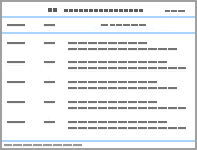
表1
6种燕麦粉的基础指标(干基)"
| 样品 Sample | 水分含量 Moisture Content (%) | 脂肪含量 Fat content (%) | 蛋白质含量 Protein content (%) | β-葡聚糖含量β-Glucan content (%) | 淀粉含量 Starch content (%) | 初始糊化度Gelatinization degree (%) |
|---|---|---|---|---|---|---|
| HN | 4.32±0.12f | 6.98±0.12b | 15.30±0.19a | 3.89±0.34b | 54.48±1.98e | 30.58±0.44f |
| LB | 8.76±0.06b | 6.49±0.16c | 12.95±0.05c | 2.19±0.18d | 58.86±1.03d | 35.56±0.28e |
| XB | 4.50±0.08e | 7.46±0.12a | 12.12±.0.02d | 2.53±0.19c | 63.30±1.81c | 38.01±0.53d |
| SZ | 8.58±0.08c | 7.23±0.12b | 13.83±0.12b | 4.23±0.22a | 62.94±1.10c | 39.36±0.36c |
| WC | 11.36±0.13a | 6.28±0.05d | 12.17±0.07d | 1.46±0.09e | 72.54±1.69a | 41.15±0.64b |
| YS | 6.62±0.17d | 5.90±0.17e | 10.68±0.13e | 1.63±0.21e | 68.19±1.72b | 42.95±0.38a |
| 平均值Average value | 7.36 | 6.72 | 12.84 | 2.66 | 63.39 | 37.94 |
| 变异系数 CV | 0.37 | 0.09 | 0.12 | 0.44 | 0.10 | 0.15 |

图1
不同和面时间燕麦面絮的图像处理及颗粒大小占比"

图2
不同和面阶段燕麦面絮划分"
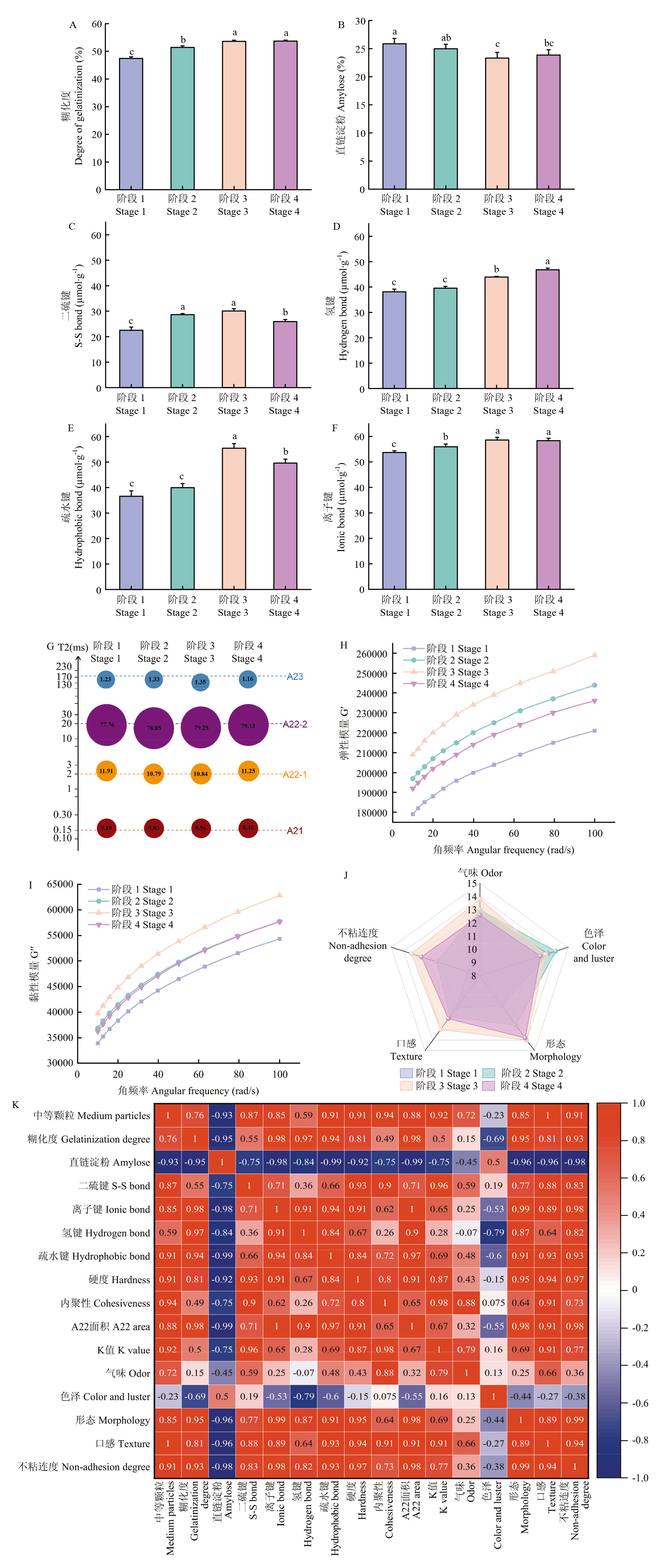
图3
不同和面阶段燕麦面絮理化品质及相关分析 不同小写字母表示差异显著(P<0.05)"
表2
不同和面阶段燕麦面絮流变学特性分析"
| 和面时间 Dough-kneading time | z | K (×105) | R2 | 硬度 Hardness (g) | 内聚性 Resilience (g.s) |
|---|---|---|---|---|---|
| 阶段 1 Stage 1 | 0.090±0.002a | 1.44±0.02c | 0.992 | 18105.29±101.74c | 0.28±0.01c |
| 阶段 2 Stage 2 | 0.094±0.001a | 1.65±0.04b | 0.993 | 21627.88±159.69b | 0.31±0.01b |
| 阶段 3 Stage 3 | 0.094±0.003a | 1.72±0.04a | 0.994 | 23201.24±231.29a | 0.35±0.03a |
| 阶段 4 Stage 4 | 0.090±0.004a | 1.55±0.01b | 0.992 | 21739.69±894.81b | 0.29±0.02c |
| 不同小写字母表示差异显著(P<0.05) Different lowercase letters indicate significant difference (P<0.05) | |||||

图4
燕麦和面阶段和自动识别模型"
| [1] |
任长忠, 闫金婷, 董锐, 胡新中. 燕麦营养成分、功能特性及其产品的研究进展. 食品工业科技, 2022, 43(12): 438-446.
|
|
|
|
| [2] |
谷玉娟. 熟化对裸燕麦加工品质特性的影响及作用机理研究[D]. 郑州: 河南工业大学, 2023.
|
|
|
|
| [3] |
doi: 10.1080/10408398.2010.504902 pmid: 22530714 |
| [4] |
彭湃, 王晓龙, 马兰, 邹晓阳, 马倩莹, 张心语, 李小平, 胡新中. 燕麦麸粉和苦荞皮粉的添加对小麦面条结构、蒸煮品质及消化特性的影响. 中国农业科学, 2023, 56(20): 4102-4114. doi: 10.3864/j.issn.0578-1752.2023.20.014.
|
|
|
|
| [5] |
刘振蓉, 赵武奇, 胡新中, 贺刘成, 陈月圆. 燕麦挂面制作过程中干燥工艺优化研究. 中国农业科学, 2022, 55(24): 4927-4942. doi: 10.3864/j.issn.0578-1752.2022.24.011.
|
|
|
|
| [6] |
何晴, 孙莹莹, 刘文秋, 高丽茵, 李丰勇, 张婵. 机器视觉技术在食品检测中的应用研究进展. 食品与发酵工业, 2026, 52(8): 411-419.
doi: 10.13995/j.cnki.11-1802/ts.043465 |
|
doi: 10.13995/j.cnki.11-1802/ts.043465 |
|
| [7] |
瞿炜, 李力, 杨洁. 破解深度学习-核心篇:模型算法与实现. 北京: 人民邮电出版社, 2024: 45-78.
|
|
|
|
| [8] |
谢家兴, 廖飞, 王卫星, 高鹏, 胡凯, 吴佩文, 邓钲奇, 刘洪山. 基于改进Faster R-CNN的荔枝病虫害检测. 华中农业大学学报, 2025, 44(1): 62-73.
|
|
|
|
| [9] |
龙满生, 欧阳春娟, 刘欢, 付青. 基于卷积神经网络与迁移学习的油茶病害图像识别. 农业工程学报, 2018, 34(18): 194-201.
|
|
|
|
| [10] |
桂江生, 吴子娴, 李凯. 基于卷积神经网络模型的大豆花叶病初期高光谱检测. 浙江大学学报(农业与生命科学版), 2019, 45(2): 256-262.
|
|
|
|
| [11] |
徐子龙, 杨柳, 肖轩, 范雨超, 罗洋, 李瑜, 裴后昌, 张永林. 基于LSP与GLCM方法的碎米识别特性研究. 中国粮油学报, 2023, 38(10): 196-203.
|
|
|
|
| [12] |
赵嘉辉. 基于卷积神经网络(CNN)的烤烟烟叶智能化分级方法应用研究[D]. 济南: 山东大学, 2023.
|
|
|
|
| [13] |
doi: 10.1016/j.foodchem.2015.04.045 pmid: 26041200 |
| [14] |
史赵建. 小麦面条和面阶段面絮图像识别与面絮特性研究[D]. 西安: 陕西师范大学, 2022.
|
|
|
|
| [15] |
doi: 10.1002/star.v25:3 |
| [16] |
doi: 10.1016/j.foodchem.2016.07.037 |
| [17] |
施建斌, 隋勇, 蔡沙, 何建军, 熊添, 范传会, 陈学玲, 家志文, 王少华, 蔡芳, 蒋修军, 梅新. 挤压处理荞麦对面团特性和面条品质的影响. 食品工业科技, 2022, 43(9): 172-177.
|
|
|
|
| [18] |
doi: 10.1016/j.foostr.2021.100248 |
| [19] |
刘玲, 马鑫鑫, 史赵建, 胡新中. 从水分迁移角度阐释压延间距对小麦鲜面品质的影响. 食品科学, 2023, 44(4): 152-161.
|
|
doi: 10.7506/spkx1002-6630-20211219-217 |
|
| [20] |
王禧恺, 张峰, 刘叶楠, 牛艳荣. 基于ResNet50+GCN的图像与位姿信息融合室内位置感知方法. 探测与控制学报, 2025. https://link.cnki.net/urlid/61.1316.tj.20250725.1543.002.
|
|
|
|
| [21] |
庞俊彪. 机器学习:慕课版. 北京: 人民邮电出版社, 2024: 89-105.
|
|
|
|
| [22] |
王晋东. 迁移学习导论. 北京: 电子工业出版社, 2021.
|
|
|
|
| [23] |
傅婕, 吴跃. 基于偏振成像技术的大米品种真实性识别. 食品工业科技, 2025, 46(7): 235-247.
|
|
|
|
| [24] |
韩晓彤, 杨保军, 李苏炫, 廖福兵, 刘淑华, 唐健, 姚青. 基于图像的水稻纹枯病智能测报方法. 中国农业科学, 2022, 55(8): 1557-1567. doi: 10.3864/j.issn.0578-1752.2022.08.007.
|
|
|
|
| [25] |
龚玉圆, 冯媛, 王晓龙, 马蓁, 任田, 李小平, 刘柳, 胡新中. 加工方式对燕麦制品营养成分及功能特性的影响. 中国粮油学报, 2020, 35(9): 21-27.
|
|
|
|
| [26] |
史赵建, 胡新中, 李亮, 刘玲, 雷洋. 小麦面条和面过程不同阶段面絮的划分与自动识别. 农业工程学报, 2022, 38(5): 279-287.
|
|
|
|
| [27] |
doi: 10.1016/j.carbpol.2006.07.017 |
| [28] |
doi: 10.1016/j.foodhyd.2019.04.018 |
| [29] |
doi: 10.1016/j.carbpol.2022.119220 |
| [30] |
doi: 10.1016/S0144-8617(00)00183-1 |
| [31] |
doi: 10.1016/j.foodhyd.2012.07.005 |
| [32] |
doi: 10.1016/j.jcs.2020.102934 |
| [33] |
doi: 10.1016/j.jfoodeng.2011.03.011 |
| [34] |
doi: 10.1016/S0144-8617(99)00170-8 |
| [35] |
doi: 10.1016/j.foodchem.2013.07.088 pmid: 24054226 |
| [36] |
郭学艺, 董桂梅, 申瑞玲, 李云龙. 高糊化度苦荞全粉对鲜湿面条品质的影响. 轻工学报, 2024, 39(4): 42-49, 88.
|
|
|
|
| [37] |
刘庆飞, 张宏立, 王艳玲. 基于深度可分离卷积的实时农业图像逐像素分类研究. 中国农业科学, 2018, 51(19): 3673-3682. doi: 10.3864/j.issn.0578-1752.2018.19.005.
|
|
|
|
| [38] |
齐星荟. 基于高光谱遥感的小麦品质监测及筋型分类研究[D]. 郑州: 河南农业大学, 2025.
|
|
|
| [1] | 王志高, 李刘滨, 许颖, 鞠澄辉, 何荣. 基于图像处理的玉米破损比例检测方法及其品质变化同步分析[J]. 中国农业科学, 2026, 59(9): 1987-2001. |
| [2] | 杨林, 段普舜, 王凤梧, 王千军, 郑成忠, 梅雪, 王希全, 赵宝平. 减灌条件下燕麦内源激素与源库流关系对籽粒产量的影响[J]. 中国农业科学, 2026, 59(11): 2358-2373. |
| [3] | 张帆, 唐湘方, 杨亮, 王辉, 陈睿鹏, 熊本海. 肉牛生产性能智能监测技术研究进展[J]. 中国农业科学, 2025, 58(23): 5081-5096. |
| [4] | 陈彩锦, 马琳, 蒋庆雪, 刘金晖, 苗童, 张志鹏, 孟翔, 马晓冉, 周昕越, 张建, 刘文辉, 王学敏. 244份饲用燕麦种质资源表型性状遗传多样性分析[J]. 中国农业科学, 2025, 58(23): 4825-4836. |
| [5] | 徐修远, 张洪志, 徐丽君, 薛玮, 聂莹莹, 郭明英, 李金霞, 赵雅茹, 史明江. 基于13C脉冲标记揭示施氮对牧草光合碳分配的影响[J]. 中国农业科学, 2025, 58(21): 4346-4356. |
| [6] | 任家辉, 孙娟娟, 郝莹璐, 王凤梧, 王靖宇, 张明伟, 李宝涵, 郑成忠, 何竹青, 王照兰. 内蒙古中部地区饲用燕麦品种筛选及青贮品质评价[J]. 中国农业科学, 2025, 58(19): 4026-4038. |
| [7] | 张建龙, 邢文文, 叶绍波, 张超, 郑德聪. 基于双输出回归卷积神经网络的燕麦株高估测研究[J]. 中国农业科学, 2024, 57(20): 3974-3985. |
| [8] | 王小军, 王金兰, 琚泽亮, 梁国玲, 贾志锋, 刘文辉, 马祥, 马金秀, 李文. 环青海湖地区不同饲用燕麦品种生产性能和营养品质综合评价[J]. 中国农业科学, 2024, 57(19): 3730-3742. |
| [9] | 王赟赟, 李毅念, 陈玉仑, 丁启朔, 何瑞银. 基于改进Mask R-CNN的小麦在穗籽粒表型参数测试方法[J]. 中国农业科学, 2024, 57(12): 2322-2335. |
| [10] | 彭湃, 王晓龙, 马兰, 邹晓阳, 马倩莹, 张心语, 李小平, 胡新中. 燕麦麸粉和苦荞皮粉的添加对小麦面条结构、蒸煮品质及消化特性的影响[J]. 中国农业科学, 2023, 56(20): 4102-4114. |
| [11] | 李棉燕, 王立贤, 赵福平. 机器学习在动物基因组选择中的研究进展[J]. 中国农业科学, 2023, 56(18): 3682-3692. |
| [12] | 刘振蓉,赵武奇,胡新中,贺刘成,陈月圆. 燕麦挂面制作过程中干燥工艺优化研究[J]. 中国农业科学, 2022, 55(24): 4927-4942. |
| [13] | 相玉婷, 王晓龙, 胡新中, 任长忠, 郭来春, 李璐. 燕麦品种间脂肪酶活性差异及低脂肪酶优质品种的预测[J]. 中国农业科学, 2022, 55(21): 4104-4117. |
| [14] | 孙擎,赵艳霞,程晋昕,曾厅余,张祎. 基于多种算法的果树果实生长模型研究—以云南昭通苹果为例[J]. 中国农业科学, 2021, 54(17): 3737-3751. |
| [15] | 魏志标,柏兆海,马林,张福锁. 中国苜蓿、黑麦草和燕麦草产量差及影响因素[J]. 中国农业科学, 2018, 51(3): 507-522. |
|
||
