






中国农业科学 ›› 2026, Vol. 59 ›› Issue (9): 1987-2001.doi: 10.3864/j.issn.0578-1752.2026.09.011
王志高1( ), 李刘滨1, 许颖1, 鞠澄辉2, 何荣1()
收稿日期:2025-06-24
接受日期:2026-04-02
出版日期:2026-05-01
发布日期:2026-05-06
通信作者:
联系方式:
王志高,E-mail:zhigaowang@nufe.edu.cn。
基金资助:
WANG ZhiGao1(), LI LiuBin1, XU Ying1, JU ChengHui2, HE Rong1()
Received:2025-06-24
Accepted:2026-04-02
Published:2026-05-01
Online:2026-05-06
摘要:
【目的】针对传统玉米破损比例检测方法(如手动挑选称重法、电动筛选器法等)耗时费力且无法满足储运过程中品质实时评估的需求,本研究提出一种基于图像处理与深度学习的玉米破损比例快速检测方法,并同步分析破损比例对玉米长距离运输储藏后品质变化的影响,旨在为玉米质量智能监测、风险预警及储运条件优化提供技术支撑与理论依据。【方法】以500张智能手机拍摄的原始玉米粒图像为数据源,利用图像处理技术(图像校正、图像预处理、图像分割以及面积提取),通过3种深度学习模型(Resnet50、Densenet121和ViT)的训练与评估,建立玉米破损比例快速预测模型;并通过模拟玉米“北粮南运”水、陆运输路线的温湿度条件,系统探究不同破损比例玉米(0—12%)储运后的品质变化规律。【结果】ViT模型在玉米破损籽粒识别中表现最优,准确率和精确率均达99%,预测值和真实值的平均绝对误差仅为0.45%,决定系数R2高达0.978。随着破损比例从0增至12%,水路和陆路玉米的理化特性指标均显著上升(P<0.05):水分含量分别增加1.384%和0.461%,脂肪酸值分别增加7.92和4.49 mg KOH/100 g,电导率分别升高6.72和4.66 μs·cm-1,丙二醛(malondialdehyde,MDA)含量分别上升38.73%和19.22%;在营养品质方面,玉米蛋白质含量降低,淀粉含量呈先升后降再升的波动趋势,直链淀粉(amylose,AM)含量与支链淀粉(amylopectin,AP)含量比例失衡,糊化特性也发生显著改变。【结论】本研究为玉米破损比例的快速检测提供了可靠的技术手段,也为优化玉米储运条件、减缓品质劣变提供了科学依据。建议在“北粮南运”等长距离高湿度储运场景中将破损比例4%作为管控阈值,对超阈值批次实施优先分拣或保质处理,以减少粮食产后损失、保障我国粮食安全。
王志高, 李刘滨, 许颖, 鞠澄辉, 何荣. 基于图像处理的玉米破损比例检测方法及其品质变化同步分析[J]. 中国农业科学, 2026, 59(9): 1987-2001.
WANG ZhiGao, LI LiuBin, XU Ying, JU ChengHui, HE Rong. Image Processing-Based Detection Method for Corn Damage Ratio and Synchronous Analysis of Quality Variation[J]. Scientia Agricultura Sinica, 2026, 59(9): 1987-2001.
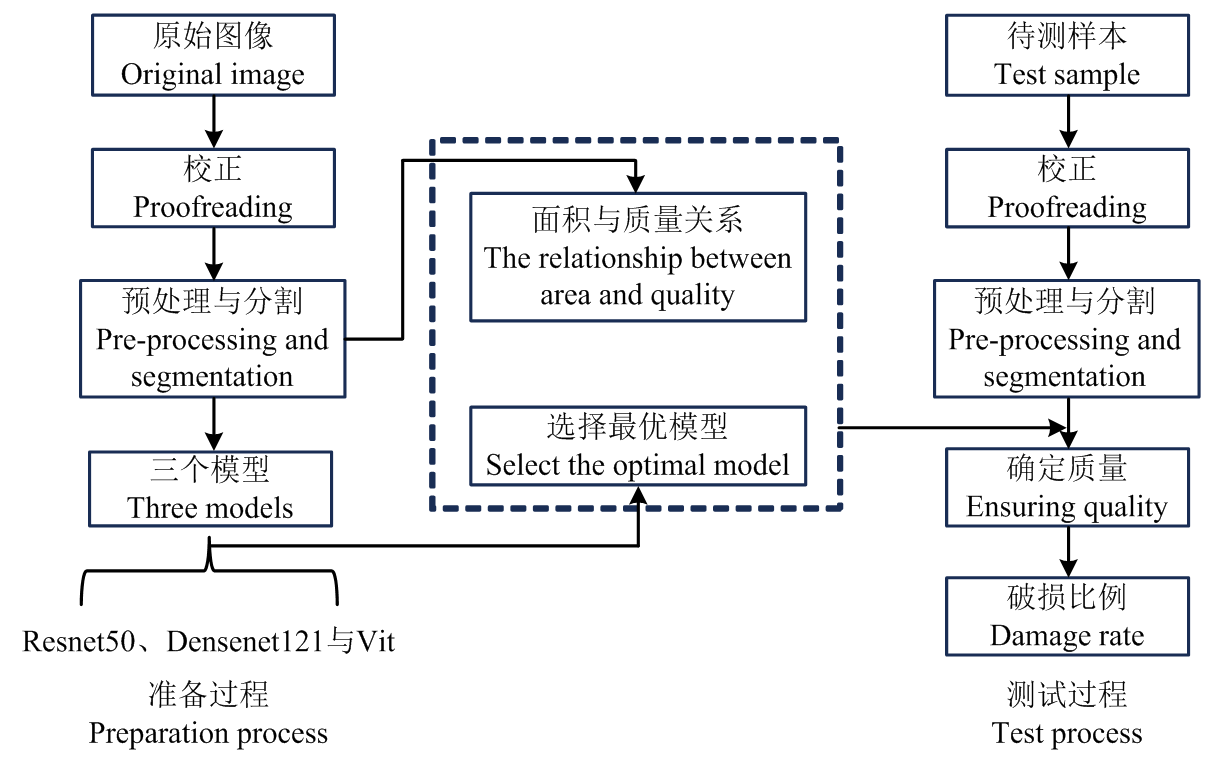
图1
玉米破损比例检测方法流程图"

图2
原始图像(A)与校正图像(B)"

图3
完整玉米粒(A)、冠部破损粒(B)、胚根破损粒(C)和碎粒(D)"
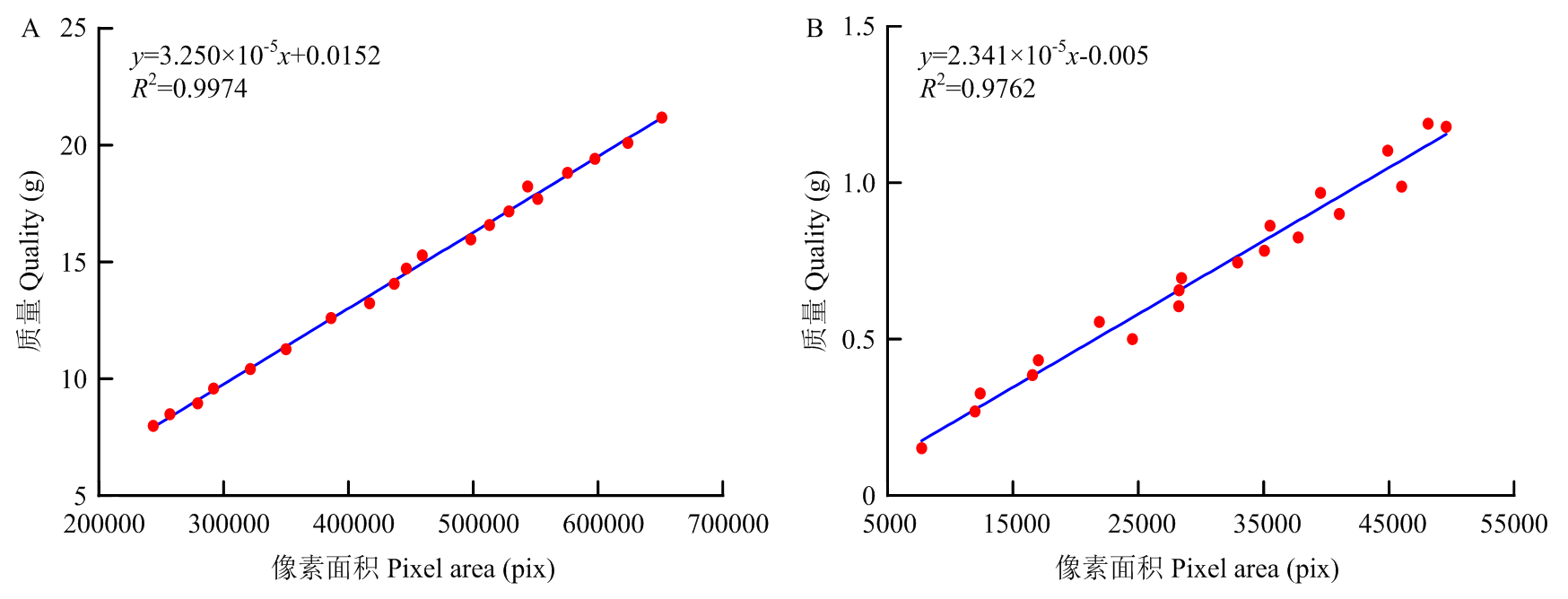
图4
完整玉米粒(A)、破损玉米粒(B)像素面积与质量关系图"
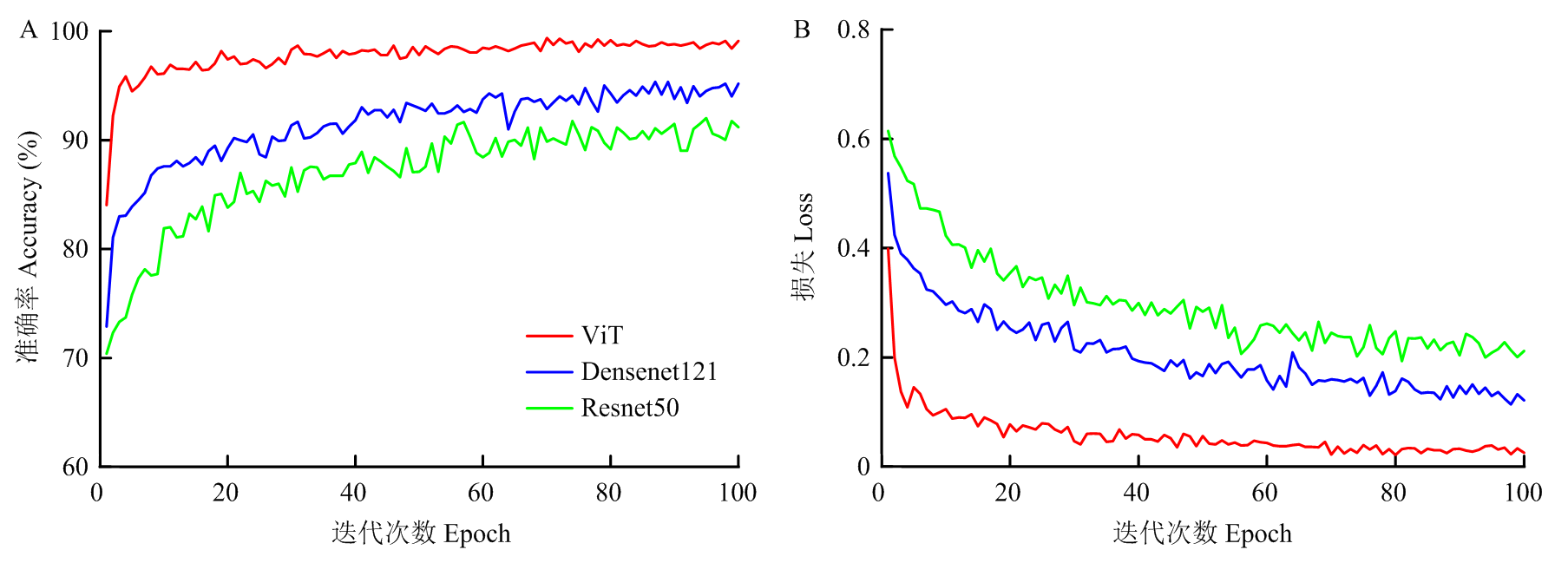
图5
三种模型的训练准确率变化曲线(A)和训练损失变化曲线(B)"
表1
模型评估结果"
| 模型 Model | 准确率 Accuracy (%) | 精确率 Precision (%) | 召回率 Recall (%) | F1值 F1-Score (%) |
|---|---|---|---|---|
| Resnet50 | 89.67 | 89.40 | 90.00 | 90.20 |
| Densenet121 | 95.33 | 94.74 | 96.00 | 95.37 |
| ViT | 99.00 | 99.33 | 98.67 | 98.99 |
表2
真实破损比例和预测破损比例误差分析"
| 编号 Number | 真实值 Actual value | 预测值 Predictive value | 绝对误差Absolute error (%) | 平均绝对误差 Mean absolute error (%) | ||||
|---|---|---|---|---|---|---|---|---|
| 完整质量 Total quality | 破损质量 Damage quality | 破损比例 Damage rate (%) | 完整质量 Total quality | 破损质量 Damage quality | 破损比例 Damage rate (%) | |||
| 1 | 20.107 | 0.446 | 2.17 | 19.978 | 0.495 | 2.42 | 0.25 | 0.45 |
| 2 | 22.485 | 1.047 | 4.45 | 22.133 | 1.104 | 4.75 | 0.30 | |
| 3 | 19.416 | 1.209 | 5.86 | 19.031 | 1.301 | 6.40 | 0.54 | |
| 4 | 21.728 | 1.838 | 7.80 | 20.969 | 1.945 | 8.49 | 0.69 | |
| 5 | 22.318 | 2.444 | 9.87 | 21.552 | 2.555 | 10.60 | 0.73 | |
| 6 | 25.714 | 3.427 | 11.76 | 25.526 | 3.333 | 11.55 | 0.21 | |
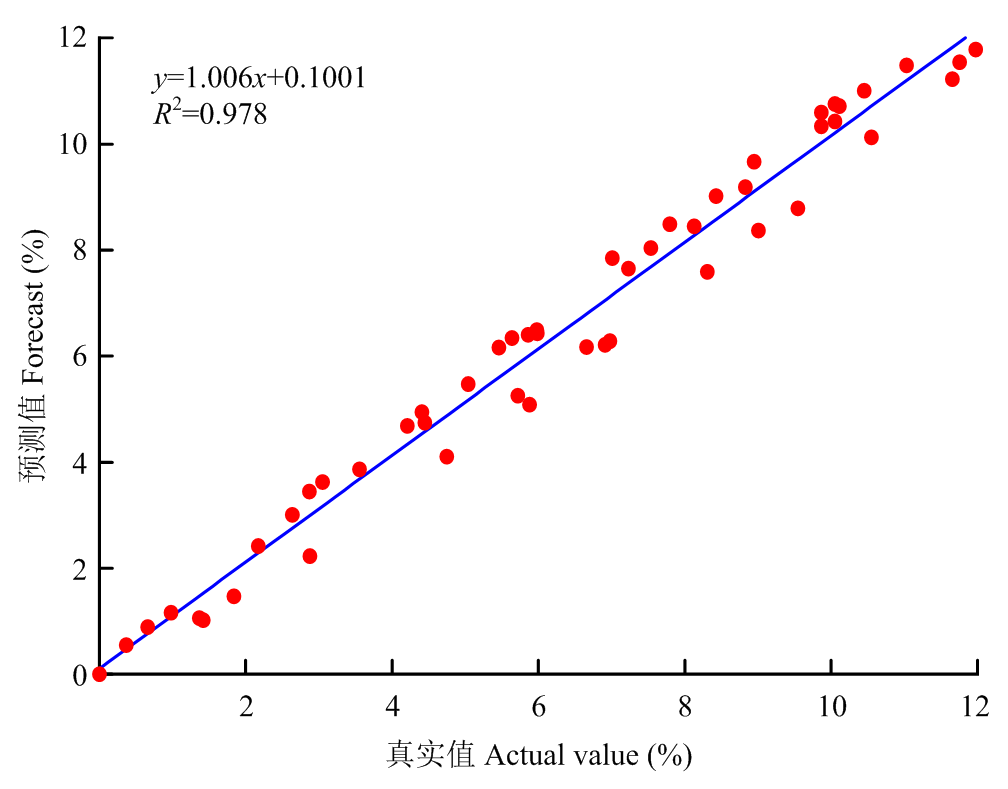
图6
玉米破损比例预测性能"
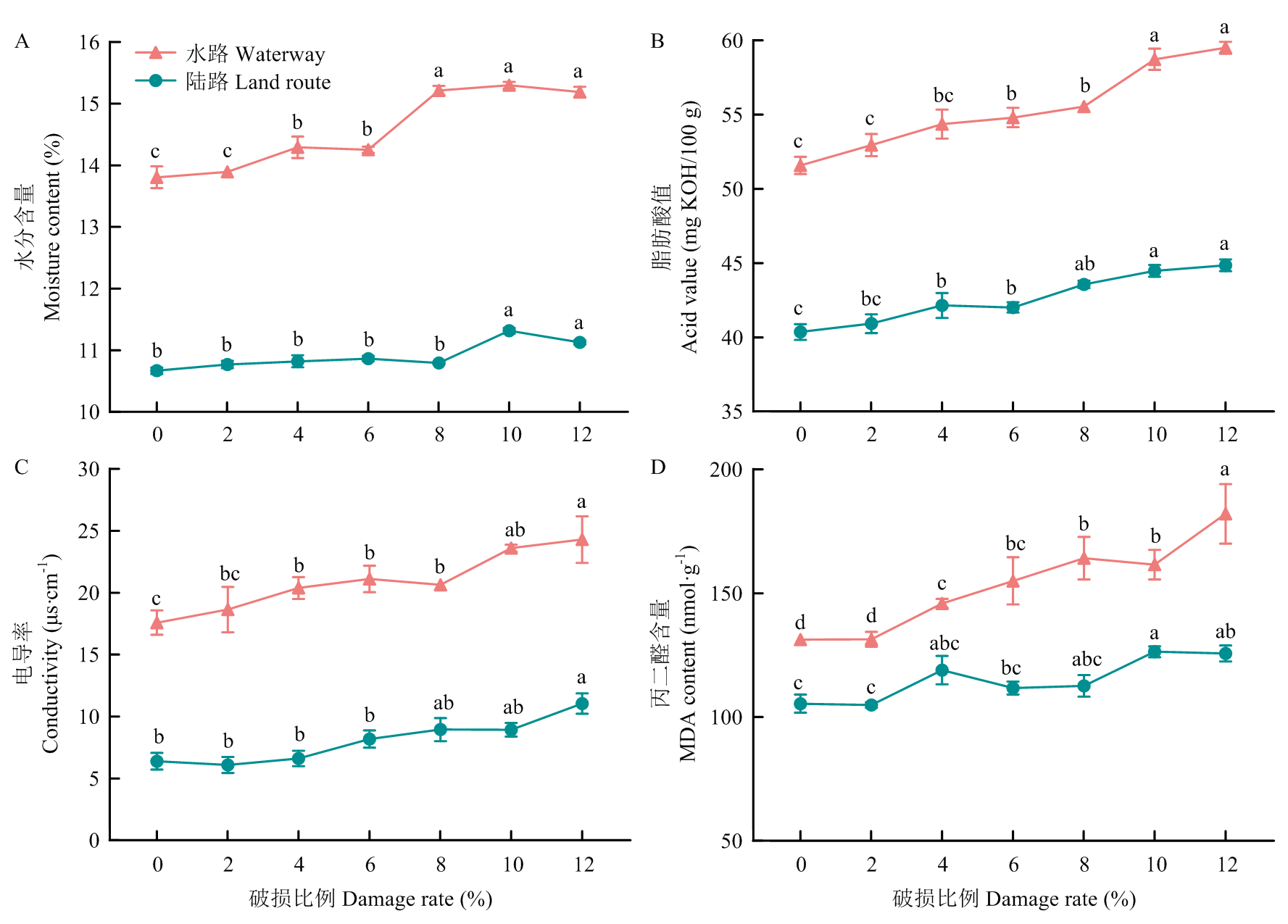
图7
不同破损比例玉米的理化特性 不同小写字母表示差异显著(P<0.05)。下同"
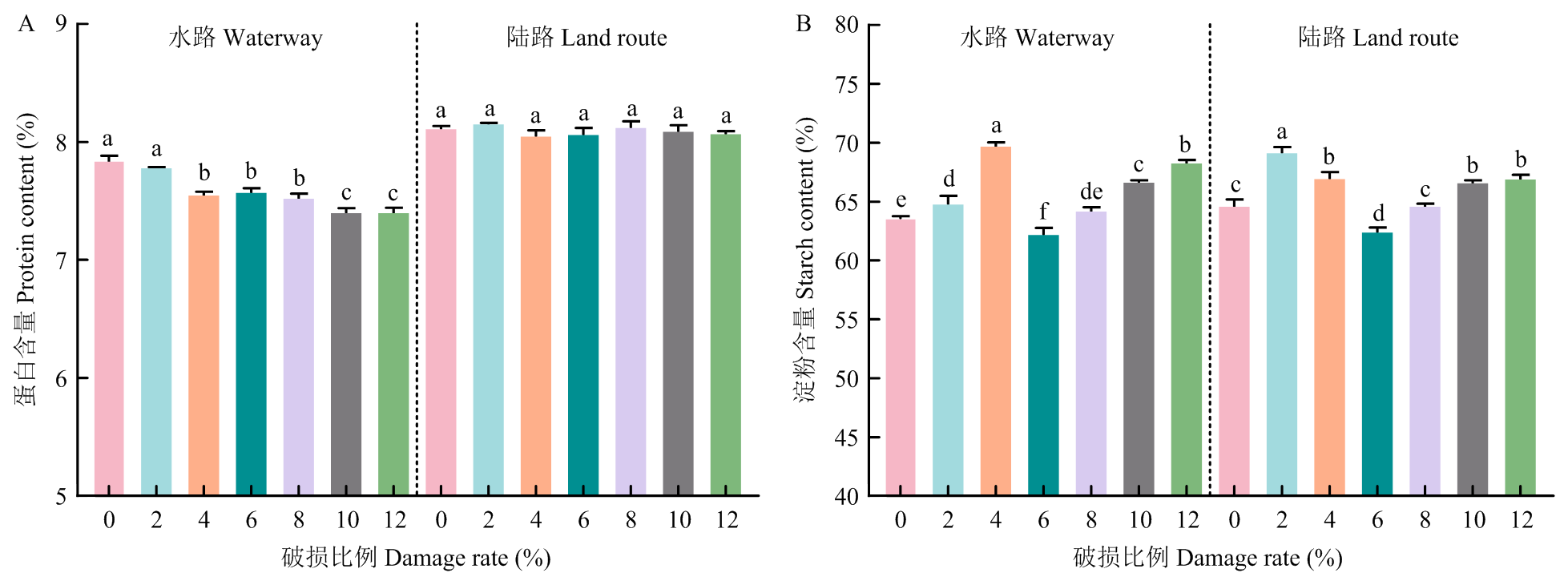
图8
不同破损比例玉米蛋白含量(A)和淀粉含量(B)变化"
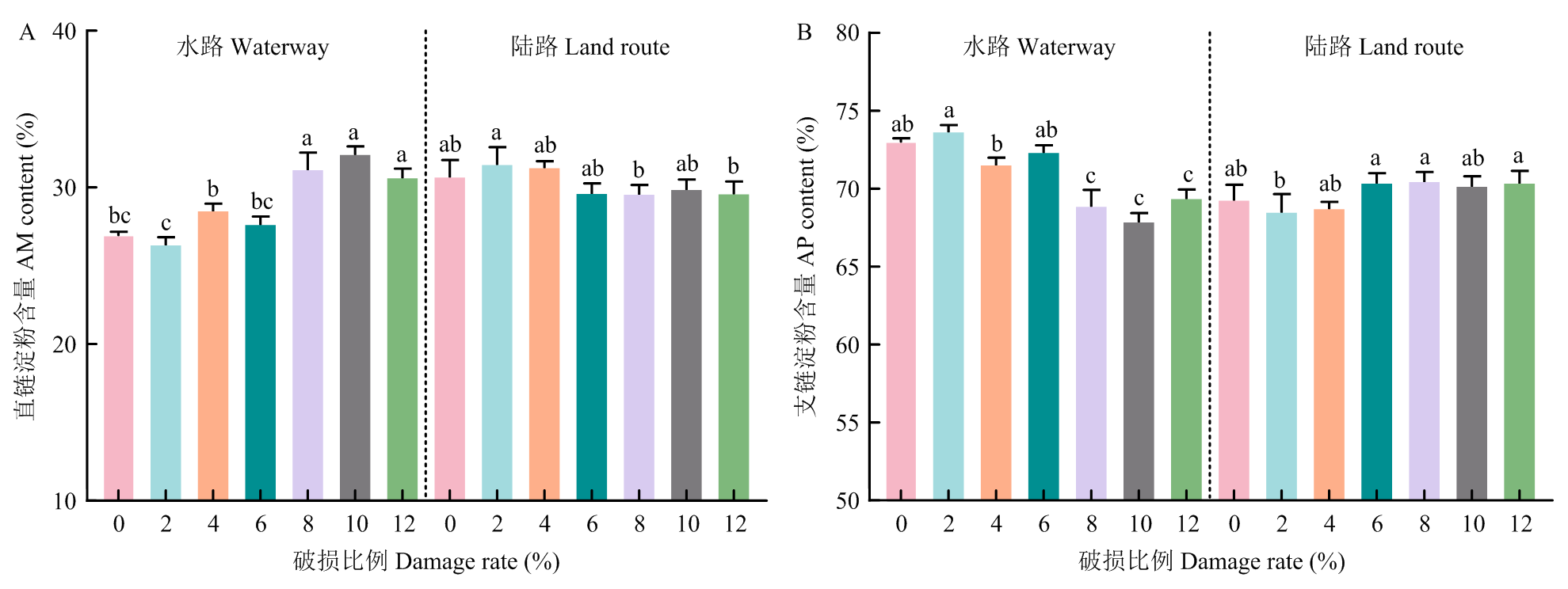
图9
不同破损比例玉米直链淀粉含量(A)和支链淀粉含量(B)变化"
表3
不同破损比例玉米糊化特性变化"
| 路线 Route | 破损比例 Damage rate (%) | 峰值黏度 Peak viscosity (cP) | 最低黏度 Minimum viscosity (cP) | 最终黏度 Final viscosity (cP) | 衰减值 Attenuation value (cP) | 回生值 Revival value (cP) |
|---|---|---|---|---|---|---|
| 水路 Waterway | 0 | 2019±42ab | 1532±30ab | 2966±65ab | 487±23ab | 1434±39a |
| 2 | 2090±21a | 1565±10a | 3055±44a | 524±12a | 1489±39a | |
| 4 | 1961±46b | 1499±34ab | 2894±47ab | 462±13b | 1395±13ab | |
| 6 | 1870±8bc | 1442±16b | 2744±15b | 427±12b | 1302±22b | |
| 8 | 1768±19c | 1389±26bc | 2594±50bc | 379±9c | 1205±26bc | |
| 10 | 1719±35c | 1338±30bc | 2569±94bc | 380±17c | 1231±64bc | |
| 12 | 1686±47c | 1307±39c | 2444±72c | 379±15c | 1137±33c | |
| 陆路 Land route | 0 | 1637±38b | 1199±38a | 2340±37a | 438±1b | 1141±31a |
| 2 | 1655±37ab | 1217±44a | 2350±82a | 438±17b | 1133±54a | |
| 4 | 1606±60b | 1229±67a | 2419±65a | 377±13c | 1190±16a | |
| 6 | 1668±15ab | 1211±10a | 2357±93a | 456±5b | 1145±84a | |
| 8 | 1737±4ab | 1250±5a | 2481±24a | 487±8ab | 1231±21a | |
| 10 | 1672±20ab | 1236±12a | 2469±10a | 436±9b | 1233±2a | |
| 12 | 1762±72a | 1234±47a | 2465±58a | 528±26a | 1231±27a |
表4
水路玉米破损比例与各品质指标之间的相关性分析"
| 指标 Indicators | 破损比例 Damage rate | 水分含量 Moisture content | 脂肪酸值 Acid value | 电导率 Conductivity | 丙二醛 MDA | 蛋白含量 Protein content | 淀粉含量 Starch content | 直链淀粉 Amylose | 支链淀粉 AP |
|---|---|---|---|---|---|---|---|---|---|
| 破损比例 Damage rate | 1 | ||||||||
| 水分含量 Moisture content | 0.933** | 1 | |||||||
| 脂肪酸值 Acid value | 0.977** | 0.897** | 1 | ||||||
| 电导率 Conductivity | 0.991** | 0.920** | 0.966** | 1 | |||||
| 丙二醛 MDA | 0.967** | 0.888** | 0.914** | 0.937** | 1 | ||||
| 蛋白含量 Protein content | -0.946** | -0.898** | -0.939** | -0.944** | -0.904** | 1 | |||
| 淀粉含量 Starch content | 0.352 | 0.337 | 0.466 | 0.406 | 0.324 | -0.498 | 1 | ||
| 直链淀粉 Amylose | 0.865* | 0.978** | 0.849* | 0.867* | 0.807* | -0.871* | 0.372 | 1 | |
| 支链淀粉 Amylopectin | -0.868* | 0.978** | -0.852* | -0.870* | -0.809* | 0.871* | -0.366 | -1** | 1 |
表5
陆路玉米破损比例与各品质指标之间的相关性分析"
| 指标 Indicator | 破损比例Damage rate | 水分含量Moisture content | 脂肪酸值Acid value | 电导率Conductivity | 丙二醛MDA | 蛋白含量Protein content | 淀粉含量Starch content | 直链淀粉Amylose | 支链淀粉Amylopectin |
|---|---|---|---|---|---|---|---|---|---|
| 破损比例 Damage rate | 1 | ||||||||
| 水分含量 Moisture content | 0.824* | 1 | |||||||
| 脂肪酸值 Acid value | 0.983** | 0.837* | 1 | ||||||
| 电导率 Conductivity | 0.948** | 0.693 | 0.908** | 1 | |||||
| 丙二醛 MDA | 0.848* | 0.886** | 0.890** | 0.73 | 1 | ||||
| 蛋白含量 Protein content | -0.391 | -0.358 | -0.371* | -0.359* | -0.904** | 1 | |||
| 淀粉含量 Starch content | -0.019 | 0.189 | 0.059 | 0.146 | 0.324 | 0.335 | 1 | ||
| 直链淀粉 Amylose | -0.756* | -0.483 | -0.690 | -0.451 | 0.807* | 0.288 | 0.612 | 1 | |
| 支链淀粉 Amylopectin | 0.765* | 0.493 | 0.703 | 0.459 | -0.809* | -0.278 | -0.602 | 0.99** | 1 |
| [1] |
doi: 10.3390/agronomy13010110 |
| [2] |
doi: 10.1016/j.jcs.2022.103463 |
| [3] |
doi: 10.3390/foods13244044 |
| [4] |
doi: 10.1016/j.biosystemseng.2022.02.015 |
| [5] |
doi: S0022-0302(18)30319-9 pmid: 29685271 |
| [6] |
师建芳, 翟晓娜, 王小萌, 邵广, 赵慧凝, 谢奇珍. 东北地区粮食产后质量问题及保质运输技术探讨. 粮油食品科技, 2021, 29(2): 200-210.
|
|
|
|
| [7] |
王昊, 祝玉华, 李智慧, 甄彤. 机器视觉在农作物种子检测中的研究进展. 计算机工程与应用, 2023, 59(22): 69-83.
doi: 10.3778/j.issn.1002-8331.2303-0166 |
|
doi: 10.3778/j.issn.1002-8331.2303-0166 |
|
| [8] |
doi: 10.1016/j.compag.2024.109884 |
| [9] |
doi: 10.1016/j.eaef.2016.12.001 |
| [10] |
金诚谦, 刘士坤, 陈满, 杨腾祥, 徐金山. 采用改进U-Net网络的机收大豆质量在线检测. 农业工程学报, 2022, 38(16): 70-80.
|
|
|
|
| [11] |
杨亮, 王卓, 白晓平, 高雷, 扈伟斌. 玉米籽粒破碎率在线采样装置设计. 农机化研究, 2019, 41(6): 121-124, 129.
|
|
|
|
| [12] |
陈进, 张帅, 李耀明, 朱林军, 夏慧, 朱亚辉. 联合收获机水稻破碎籽粒及杂质在线识别方法. 中国农机化学报, 2021, 42(6): 137-144.
doi: 10.13733/j.jcam.issn.2095-5553.2021.06.22 |
|
|
|
| [13] |
胡东红, 汪浩, 艾君, 张玲, 张胜兰. 两种图像校正算法在实际应用中的比较. 计算机工程与应用, 2009, 45(13): 191-193, 226.
|
|
|
|
| [14] |
doi: 10.3390/agronomy10040470 |
| [15] |
doi: 10.3390/sym13112012 |
| [16] |
金哲毅, 杨晓玲. 基于深度残差网络的新冠肺炎CT影像分类系统. 信息技术与信息化, 2021(10): 114-116.
|
|
|
|
| [17] |
吉训生, 江昆, 谢捷. 基于多维神经网络深度特征融合的鸟鸣识别算法. 信号处理, 2022, 38(4): 844-853.
|
|
|
|
| [18] |
涂雪滢, 张佳鹏, 钱程, 刘世晶. 融合ViT和通道注意力的水稻病害识别技术研究. 农业与技术, 2025, 45(7): 69-74.
|
|
|
|
| [19] |
向莹莹, 李浩卓, 张婷婷, 王建华, 孙群. 电导率法早期检测玉米和小麦种子活力. 中国农业大学学报, 2020, 25(6): 12-19.
|
|
|
|
| [20] |
doi: 10.3390/plants12173078 |
| [21] |
杜岳峰, 侯思余, 李国润. 基于深度学习的玉米籽粒含杂检测方法研究. 农机化研究, 2025, 47(9): 1-8.
|
|
|
|
| [22] |
doi: 10.1007/s11760-024-03693-1 |
| [23] |
doi: 10.1109/JSTARS.4609443 |
| [24] |
doi: 10.1371/journal.pone.0273057 |
| [25] |
李志杰, 胡经营, 张静, 朱晨辉, 李世龙, 刘冰杰, 张红梅. 基于改进Yolov8的玉米籽粒破碎率检测装置设计与试验. 河南农业大学学报, 2025, 59(5): 893-903.
|
|
|
|
| [26] |
doi: 10.1007/s42976-022-00328-4 |
| [27] |
doi: 10.1371/journal.pone.0311258 |
| [28] |
叶佳琳, 杜京霖, 吴光玥, 胡家涵, 王澳希, 吕昭颖, 胡浩. 温度及水分含量对二氧化碳气调储藏稻谷品质的影响. 中国稻米, 2024, 30(6): 60-65.
doi: 10.3969/j.issn.1006-8082.2024.06.010 |
|
doi: 10.3969/j.issn.1006-8082.2024.06.010 |
|
| [29] |
吴新连, 王大枚, 罗柏流, 张荣森, 李国坚. 不同破损粒含量玉米陈化试验. 粮食储藏, 2009, 38(3): 43-45.
|
|
|
|
| [30] |
陈霞, 王习政, 苏文娟, 谢荟清, 陈尚钘, 刘娟. 嫁接方法与套袋处理对山苍子生长、光合特性及叶绿素荧光特征的影响. 西北农林科技大学学报(自然科学版), 2024, 52(3): 51-61, 72.
|
|
|
|
| [31] |
张永辉, 何思雨, 王倩, 孙超, 彭亚平, 艾鹏飞. 谷外糙米含量在储藏过程中对稻谷品质的影响. 现代食品, 2022, 28(13): 153-155, 160.
|
|
|
|
| [32] |
李兴岩, 赵薇, 薛敏, 李爱光, 何宛宸, 段慧敏, 刘霞. 偏高水分玉米贮藏技术及品质控制研究进展. 农产品加工(下半月), 2022(9): 101-103, 107.
|
|
|
|
| [33] |
张明丹. 不同储藏温湿度对玉米品质特性的影响[D]. 郑州: 河南工业大学, 2021.
|
|
|
|
| [34] |
张玉荣, 马记红, 周显青, 伦利芳, 褚洪强, 付玲. 充二氧化碳气调解除后大米储藏品质变化研究. 河南工业大学学报(自然科学版), 2013, 34(2): 29-33.
|
|
|
|
| [35] |
曾德斌, 王军民, 吴向阳, 韩秀秀, 龙永红, 李旭春, 张英, 潘典进. 青贮玉米不同品种和生育时期植株体的营养品质分析. 湖北农业科学, 2019, 58(5): 85-87, 95.
|
|
|
|
| [36] |
doi: 10.3390/app12104870 |
| [37] |
林颖雪. 大米霉变过程中营养成分变化及霉变预警研究[D]. 天津: 天津科技大学, 2020.
|
|
|
|
| [38] |
詹锦玲, 贾梦, 蔡奕盛, 杨天一, 麻荣荣, 田耀旗. 细胞壁破损对马铃薯细胞胞内淀粉理化特性和消化特性的影响. 食品工业科技, 2025, 46(18): 194-200.
|
|
|
|
| [39] |
曹俊, 蒋伟鑫, 刘欣, 陈文若, 戴炳业, 董文, 陈银基. 温度动态变化对不同水分含量稻谷主要品质变化的影响. 食品科学, 2016, 37(17): 76-83.
doi: 10.7506/spkx1002-6630-201617013 |
|
doi: 10.7506/spkx1002-6630-201617013 |
|
| [40] |
罗财伟, 王茂飞, 宁冬, 王海彦, 袁建敏. 不同类型和含水量玉米储存期间理化性质及糊化特性变化研究. 中国畜牧杂志, 2023, 59(2): 207-214.
|
|
|
| [1] | 蔡巧红, 周甜, 苏明, 洪自强, 李翻过, 李彤, 汪华, 康建宏, 吴宏亮. 宁夏引黄灌区减氮增钾施肥模式对玉米光合荧光特性及光合产物积累的影响[J]. 中国农业科学, 2026, 59(9): 1869-1886. |
| [2] | 陈宣伊, 郭星星, 张向前, 路战远, 刘凌悦, 罗方, 李金龙, 张传玲, 张志青, 车曼青. 间作行比对玉米冠层光环境异质性和光合物质生产的影响[J]. 中国农业科学, 2026, 59(8): 1653-1671. |
| [3] | 侯慧芝, 尹嘉德, 马明生, 刘晓伟, 柳燕兰, 雷康宁. 耕作与增施有机肥对陇东马铃薯-玉米一年两熟制作物产量和水分利用的影响[J]. 中国农业科学, 2026, 59(8): 1672-1685. |
| [4] | 赵思捷, 任家欣, 南江磊, 王兴云, 成卫宁. 玉米叶片次生物质含量及相关基因表达与其对草地贪夜蛾抗性的关系[J]. 中国农业科学, 2026, 59(8): 1686-1696. |
| [5] | 王亚菲, 闫鹏, 薛金涛, 董学瑞, 孟凡琦, 郭丽娜, 罗艺, 张娟, 董志强, 卢霖. 乙烯利-甜菜碱-水杨酸合剂对高温胁迫下玉米根系建构、生理功能和产量的影响[J]. 中国农业科学, 2026, 59(7): 1439-1455. |
| [6] | 王佳诺, 陈桂平, 李盼, 王丽萍, 南运有, 何蔚, 樊志龙, 胡发龙, 柴强, 殷文, 赵连豪. 免耕地膜两年覆盖提高绿洲灌区玉米产量的灌浆期光合生理机制[J]. 中国农业科学, 2026, 59(6): 1189-1202. |
| [7] | 周新杰, 任昊, 陈应龙, 张吉旺, 赵斌, 任佰朝, 刘鹏, 王洪章. 过氧化钙对渍涝农田夏玉米根系形态及产量形成的影响[J]. 中国农业科学, 2026, 59(6): 1203-1216. |
| [8] | 何继航, 张擎, 吕相月, 薛吉全, 徐淑兔, 刘建超. 不同保绿型玉米杂交种氮效率评价[J]. 中国农业科学, 2026, 59(6): 1217-1230. |
| [9] | 李永娟, 张悦彤, 王艺博, 赵长江, 宋洁, 陈雪丽, 姚钦. 生物炭施用对大豆轮连作系统土壤固氮微生物nifH基因丰度及群落组成的影响[J]. 中国农业科学, 2026, 59(6): 1272-1285. |
| [10] | 李思源, 李鸿萍, 常洪庆, 张森焱, 栗思佳, 崔欣飞, 乔泼, 曾波, 刘桂珍, 刘天学, 汤继华, 李潮海. 增密对不同株高玉米品种产量和农艺性状动态变化的影响[J]. 中国农业科学, 2026, 59(5): 967-984. |
| [11] | 董金龙, 赵莹, 余海兵, 吕建晔, 秦佳琦, 梁晨, 明博, 李少昆. 多模型解析玉米籽粒容重的营养品质贡献度与区域异质性[J]. 中国农业科学, 2026, 59(5): 985-995. |
| [12] | 陈桂平, 韦金贵, 郭瑶, 李盼, 王菲儿, 仇海龙, 冯福学, 殷文. 宽窄行与增密对绿洲灌区玉米光合特性及资源利用的协同效应[J]. 中国农业科学, 2026, 59(2): 278-291. |
| [13] | 张志勇, 谭世超, 熊淑萍, 马新明, 韦一昊, 王小纯. 水氮周年优化对豫北灌区小麦玉米轮作系统产量和氮迁移的影响[J]. 中国农业科学, 2026, 59(2): 336-353. |
| [14] | 韦文华, 李盼, 邵冠贵, 樊志龙, 胡发龙, 范虹, 何蔚, 柴强, 殷文, 赵连豪. 西北灌区青贮玉米产量及品质对减量灌水与有机无机肥配施的响应[J]. 中国农业科学, 2025, 58(8): 1521-1534. |
| [15] | 薛钰琦, 赵继玉, 孙旺胜, 任佰朝, 赵斌, 刘鹏, 张吉旺. 不同氮素形态对夏玉米产量和品质的影响[J]. 中国农业科学, 2025, 58(8): 1535-1549. |
|
||
