






中国农业科学 ›› 2026, Vol. 59 ›› Issue (11): 2468-2483.doi: 10.3864/j.issn.0578-1752.2026.11.012
张悦青1( ), 张玉亭1, 薛晨飞1, 韩秦宇1, 贺一容1, 徐紫娟1, 范秀梅1, 王军娥1, 罗丹1, 冯雪2, 孙胜1()
收稿日期:2026-01-06
接受日期:2026-03-07
出版日期:2026-06-01
发布日期:2026-06-03
通信作者:
联系方式:
张悦青,E-mail:zhangyueqing2023@163.com。
基金资助:
ZHANG YueQing1(), ZHANG YuTing1, XUE ChenFei1, HAN QinYu1, HE YiRong1, XU ZiJuan1, FAN XiuMei1, WANG JunE1, LUO Dan1, FENG Xue2, SUN Sheng1()
Received:2026-01-06
Accepted:2026-03-07
Published:2026-06-01
Online:2026-06-03
摘要:
【目的】分析樱桃番茄种质资源表型性状的遗传多样性,并进行综合评价,筛选出一些优异的樱桃番茄种质材料,以期为樱桃番茄核心种质筛选、利用和品种选育提供依据。【方法】以364份国内外樱桃番茄种质资源为试验材料,对其41个表型性状进行测定;并运用遗传多样性指数、相关性分析、主成分分析、系统聚类和隶属函数法等多元统计分析手段,进行樱桃番茄种质表型的遗传多样性分析、聚类划分与综合评价。【结果】364份樱桃番茄种质资源表型性状变异系数变化范围为9.82%—45.18%,变异系数最大的为单果重;遗传多样性指数的变化范围为0.14—2.17。相关性分析结果表明,数量性状间存在显著或极显著的相关关系。主成分分析提取13个主成分的累积贡献率达70.525%,代表樱桃番茄种质的大部分性状信息,确定了23个关键性状指标。根据系统聚类结果将供试材料划分为8个类群。第Ⅰ类群共29份材料,适于作为高产育种的亲本。第Ⅱ类群包含25份材料,可作为鲜食品种加以利用。第Ⅲ类群仅含1份材料T12,特征表现独特。第Ⅳ类群有27份材料,适宜用于培育商品性状优良、耐贮运的品种。第Ⅴ类群共75份材料,是改善果实风味及选育高糖度品种的关键资源。第Ⅵ类群包含49份材料,属于糖酸比高、口感较好类型,在鲜食风味改良方面具有重要价值。第Ⅶ类群共150份材料,数量最多,表现出显著的早熟育种潜力。第Ⅷ类群仅含8份材料,其果形特殊,既可作为特色鲜食品种开发,也可用于加工制酱。利用权重和隶属函数进行综合评价,筛选表型性状综合排名前29的樱桃番茄种质。【结论】364份樱桃番茄种质资源具有广泛的表型变异与遗传多样性,被划分为8个类群,筛选出23个关键评价指标,并通过隶属函数法筛选出29份综合性状优良的种质材料。
张悦青, 张玉亭, 薛晨飞, 韩秦宇, 贺一容, 徐紫娟, 范秀梅, 王军娥, 罗丹, 冯雪, 孙胜. 364份樱桃番茄种质资源表型性状的遗传多样性分析及综合评价[J]. 中国农业科学, 2026, 59(11): 2468-2483.
ZHANG YueQing, ZHANG YuTing, XUE ChenFei, HAN QinYu, HE YiRong, XU ZiJuan, FAN XiuMei, WANG JunE, LUO Dan, FENG Xue, SUN Sheng. Genetic Diversity Analysis and Comprehensive Evaluation of Phenotypic Traits in 364 Cherry Tomato Germplasm Resources[J]. Scientia Agricultura Sinica, 2026, 59(11): 2468-2483.

表1
364份樱桃番茄种质资源数量性状的遗传多样性分析"
| 性状 Trait | 最小值 Minimum | 最大值 Maximum | 平均值 Mean | 标准差 Standard deviation | 变异系数 Coefficient of variation (%) | 多样性指数 H′ |
|---|---|---|---|---|---|---|
| 叶片长LLH (cm) | 18.80 | 42.00 | 30.82 | 4.35 | 14.11 | 2.05 |
| 叶片宽LW (cm) | 15.40 | 45.20 | 30.14 | 4.99 | 16.56 | 2.05 |
| 首花序节位NFI | 4.00 | 10.00 | 5.85 | 1.10 | 18.77 | 1.87 |
| 第二花序节位NSI | 6.80 | 18.20 | 9.23 | 1.46 | 15.84 | 1.86 |
| 单花序花数FLNPI | 6.00 | 62.80 | 12.54 | 5.10 | 40.66 | 1.66 |
| 单花序果数FRNPI | 5.20 | 36.40 | 11.26 | 3.50 | 31.11 | 1.85 |
| 坐果率FSR | 0.26 | 1.00 | 0.92 | 0.09 | 9.82 | 1.62 |
| 果柄长度PL (mm) | 6.83 | 16.91 | 10.20 | 1.59 | 15.62 | 2.02 |
| 节间长度IL (cm) | 14.40 | 42.00 | 23.83 | 4.35 | 18.27 | 1.95 |
| 株高PH (cm) | 46.40 | 178.20 | 85.24 | 17.51 | 20.54 | 1.91 |
| 单果重WPF (g) | 2.71 | 54.10 | 16.59 | 7.50 | 45.18 | 1.93 |
| 商品果横径CFW (mm) | 15.05 | 48.36 | 28.23 | 5.04 | 17.85 | 2.05 |
| 商品果纵径CFL (mm) | 15.25 | 63.37 | 32.61 | 7.65 | 23.46 | 1.97 |
| 果形指数FSI | 0.72 | 3.04 | 1.18 | 0.33 | 28.37 | 1.61 |
| 硬度FH (kg·cm-2) | 0.59 | 4.70 | 2.16 | 0.68 | 31.46 | 1.88 |
| 可溶性固形物含量SSC (%) | 3.70 | 12.27 | 7.36 | 1.58 | 21.49 | 2.05 |
| 酸含量AC (%) | 0.20 | 0.96 | 0.58 | 0.18 | 30.54 | 2.07 |
| 糖酸比BAR | 5.08 | 36.89 | 13.97 | 5.17 | 37.02 | 1.84 |
| 果肉厚FTH (mm) | 0.99 | 6.60 | 3.03 | 0.94 | 31.21 | 2.05 |
| 心室数NL | 2.00 | 3.33 | 2.10 | 0.23 | 11.03 | 0.60 |
| 平均Mean | — | — | — | — | 23.94 | 1.84 |
表2
364份樱桃番茄种质资源质量性状的遗传多样性分析"
| 质量性状Qualitytrait | 多样性指数H′ | 等级及频率Grade and frequency (%) |
|---|---|---|
| 茎叶茸毛SLF | 0.85 | 0(0.00);1(24.45);2(4.40);3(68.13);4(3.02) |
| 叶片类型LT | 0.68 | 1(14.29);2(0.27);3(26.37);4(59.07) |
| 叶片形状LS | 0.14 | 1(14.84);2(85.16) |
| 叶裂刻LLO | 0.94 | 0(0.00);1(15.66);2(63.46);3(20.88) |
| 花序类型IT | 0.77 | 1(0.00);2(69.51);3(6.59);4(23.90) |
| 花柱长度SL | 0.95 | 1(25.55);2(58.79);3(15.66) |
| 花色FLOC | 0.70 | 1(25.55);2(71.15);3(3.30) |
| 成熟前果色CBR | 1.26 | 1(43.68);2(39.56);3(2.47);4(3.57);5(4.40);6(6.04);7(0.27) |
| 成熟果色CMF | 2.17 | 1(0.27);2(0.82);3(2.47);4(10.99);5(4.40);6(5.22);7(46.15);8(1.10);9(0.55);10(3.30);11(0.55);12(1.10);13(2.47);14(0.55);15(0.82);16(2.75);17(1.10);18(0.82);19(1.92);20(1.10);21(1.10);22(7.69);23(0.27);24(0.27);25(0.82);26(0.55);27(0.55);28(0.27) |
| 果面棱沟FRG | 0.82 | 0(47.80);1(31.59);2(13.74);3(6.87) |
| 果顶形状FAS | 0.84 | 1(0.27);2(3.30);3(72.80);4(17.58);5(6.04) |
| 果肩FSO | 0.43 | 0(15.66);1(84.34) |
| 果肩形状FTS | 0.89 | 1(34.62);2(57.42);3(7.97) |
| 果肩色FSC | 1.48 | 1(48.53);2(25.08);3(13.36);4(13.03) |
| 绿果肩大小GSS | 0.86 | 1(33.52);2(44.23);3(4.12) |
| 果形FSA | 1.50 | 1(0.55);2(2.47);3(54.12);4(16.48);5(8.79);6(4.95);7(4.67);8(6.59);9(1.37) |
| 果肉色FLEC | 1.61 | 1(6.87);2(6.04);3(11.54);4(45.33);5(16.76);6(9.89);7(3.57) |
| 胎座胶状物质颜色CPGS | 1.79 | 1(7.97);2(26.92);3(11.54);4(14.29);5(23.63);6(12.64);7(3.02) |
| 肉质FT | 1.07 | 1(54.95);2(13.74);3(3.30);4(28.02) |
| 裂果性FCS | 0.97 | 0(64.29);1(20.88);2(12.09);3(2.75) |
| 风味FL | 1.35 | 1(15.11);2(31.87);3(23.08);4(29.95) |
| 平均Mean | 1.05 | — |

图1
364份樱桃番茄种质资源数量性状的相关性分析 *:P<0.05;**:P<0.01"
表3
364份樱桃番茄种质资源表型性状的主成分分析"
| 性状 Trait | 主成分Principal component | ||||||||||||
|---|---|---|---|---|---|---|---|---|---|---|---|---|---|
| PC1 | PC2 | PC3 | PC4 | PC5 | PC6 | PC7 | PC8 | PC9 | PC10 | PC11 | PC12 | PC13 | |
| 叶片长LLH | 0.729 | -0.220 | 0.089 | 0.122 | 0.230 | 0.071 | 0.010 | 0.032 | -0.260 | 0.027 | 0.006 | -0.162 | 0.016 |
| 叶片宽LW | 0.702 | -0.349 | 0.028 | 0.193 | 0.274 | 0.034 | -0.014 | 0.046 | -0.210 | -0.004 | -0.020 | -0.116 | 0.048 |
| 首花序节位NFI | 0.297 | 0.533 | -0.327 | -0.023 | -0.029 | 0.389 | 0.246 | -0.125 | 0.199 | -0.149 | -0.216 | -0.111 | -0.013 |
| 第二花序节位NSI | 0.351 | 0.492 | -0.427 | -0.049 | 0.006 | 0.401 | 0.261 | -0.045 | 0.207 | -0.093 | -0.183 | -0.149 | -0.005 |
| 单花序花数FLNPI | 0.353 | -0.086 | -0.467 | -0.558 | 0.032 | -0.119 | 0.027 | 0.074 | 0.180 | 0.322 | 0.146 | 0.114 | 0.212 |
| 单花序果数FRNPI | 0.287 | -0.179 | -0.438 | -0.438 | 0.033 | -0.107 | 0.018 | -0.059 | 0.253 | 0.255 | 0.237 | 0.077 | 0.345 |
| 坐果率FSR | -0.261 | -0.098 | 0.140 | 0.410 | 0.012 | 0.234 | 0.042 | -0.351 | 0.043 | -0.160 | 0.155 | -0.151 | 0.166 |
| 果柄长度PL | 0.450 | 0.138 | 0.441 | -0.216 | 0.077 | -0.051 | 0.068 | 0.054 | -0.315 | -0.045 | 0.016 | 0.169 | 0.020 |
| 节间长度IL | 0.676 | 0.213 | -0.268 | -0.272 | 0.034 | -0.042 | 0.221 | 0.100 | 0.050 | -0.085 | 0.109 | -0.059 | -0.130 |
| 株高PH | 0.634 | 0.329 | -0.334 | -0.263 | 0.094 | 0.083 | 0.263 | 0.006 | 0.003 | -0.131 | 0.038 | -0.049 | -0.093 |
| 单果重WPF | 0.588 | 0.323 | 0.243 | 0.477 | -0.058 | -0.304 | 0.019 | -0.141 | -0.004 | -0.061 | -0.004 | -0.005 | 0.083 |
| 商品果横径CFW | 0.529 | 0.173 | -0.047 | 0.632 | -0.111 | -0.332 | 0.077 | -0.102 | -0.041 | -0.111 | 0.046 | 0.005 | 0.120 |
| 商品果纵径CFL | 0.446 | 0.421 | 0.680 | -0.068 | 0.156 | -0.062 | -0.068 | -0.103 | 0.064 | 0.011 | -0.008 | 0.051 | 0.060 |
| 果形指数FSI | 0.055 | 0.267 | 0.670 | -0.462 | 0.220 | 0.182 | -0.114 | -0.043 | 0.108 | 0.099 | -0.053 | 0.040 | -0.016 |
| 硬度FH | 0.396 | -0.001 | 0.210 | -0.014 | -0.331 | -0.164 | -0.140 | -0.048 | 0.261 | -0.200 | 0.216 | 0.163 | 0.002 |
| 可溶性固形物含量SSC | -0.137 | -0.230 | 0.112 | -0.289 | 0.133 | 0.033 | 0.325 | 0.335 | -0.159 | -0.487 | 0.026 | 0.261 | 0.201 |
| 酸含量AC | 0.220 | 0.146 | 0.009 | -0.151 | -0.561 | 0.308 | -0.171 | 0.453 | -0.304 | -0.081 | 0.249 | -0.091 | 0.019 |
| 糖酸比BAR | -0.305 | -0.248 | -0.020 | -0.039 | 0.581 | -0.265 | 0.350 | -0.205 | 0.189 | -0.233 | -0.213 | 0.247 | 0.083 |
| 果肉厚FTH | 0.494 | 0.047 | 0.098 | 0.206 | -0.127 | -0.098 | -0.220 | 0.032 | 0.150 | -0.241 | -0.015 | 0.133 | 0.374 |
| 心室数NL | -0.055 | 0.028 | 0.111 | 0.063 | 0.035 | -0.305 | 0.088 | -0.055 | 0.035 | 0.248 | 0.271 | -0.524 | 0.203 |
| 茎叶茸毛SLF | 0.268 | -0.130 | 0.042 | 0.184 | 0.005 | -0.038 | 0.101 | 0.033 | -0.263 | 0.354 | -0.349 | 0.149 | 0.132 |
| 叶片类型LT | 0.192 | -0.399 | 0.090 | 0.349 | 0.241 | 0.606 | 0.039 | -0.084 | 0.135 | 0.196 | 0.239 | 0.104 | 0.008 |
| 叶片形状LS | 0.301 | -0.475 | 0.145 | 0.402 | 0.239 | 0.473 | 0.063 | 0.010 | 0.108 | 0.181 | 0.157 | 0.138 | -0.023 |
| 叶裂刻LLO | 0.311 | -0.202 | -0.011 | 0.267 | 0.002 | 0.070 | 0.051 | 0.248 | 0.028 | 0.241 | -0.370 | 0.146 | -0.035 |
| 花序类型IT | 0.229 | -0.068 | -0.122 | -0.384 | 0.332 | -0.213 | 0.023 | -0.257 | -0.007 | 0.122 | 0.066 | -0.042 | -0.198 |
| 花柱长度SL | 0.003 | 0.327 | -0.207 | 0.234 | -0.095 | -0.112 | -0.075 | 0.036 | 0.319 | 0.139 | 0.024 | 0.247 | 0.050 |
| 花色FLOC | -0.190 | 0.133 | 0.237 | 0.180 | -0.044 | -0.086 | -0.032 | 0.189 | 0.403 | 0.120 | 0.026 | 0.052 | 0.099 |
| 成熟前果色CBR | -0.192 | 0.733 | -0.148 | 0.189 | -0.095 | 0.058 | -0.048 | -0.096 | -0.123 | 0.135 | -0.138 | 0.110 | 0.114 |
| 成熟果色CMF | -0.279 | 0.377 | 0.119 | 0.149 | -0.002 | 0.032 | 0.346 | -0.268 | -0.073 | 0.146 | 0.199 | -0.099 | -0.123 |
| 果面棱沟FRG | 0.299 | 0.104 | 0.407 | -0.191 | 0.207 | -0.075 | -0.311 | 0.128 | 0.242 | -0.024 | -0.002 | -0.003 | -0.287 |
| 果顶形状FAS | -0.010 | 0.235 | 0.583 | -0.219 | 0.125 | 0.241 | 0.103 | -0.094 | -0.028 | 0.037 | -0.043 | -0.084 | 0.343 |
| 果肩FSO | -0.166 | 0.320 | -0.166 | 0.101 | 0.626 | 0.009 | -0.199 | 0.432 | -0.015 | -0.020 | 0.084 | -0.140 | 0.018 |
| 果肩形状FTS | 0.355 | -0.320 | -0.148 | 0.276 | 0.154 | -0.329 | -0.006 | 0.035 | 0.069 | -0.094 | 0.016 | -0.133 | -0.319 |
| 果肩色FSC | -0.201 | 0.677 | -0.230 | 0.243 | 0.348 | -0.079 | -0.109 | 0.134 | -0.211 | 0.054 | -0.020 | 0.004 | 0.052 |
| 绿果肩大小GSS | -0.219 | 0.355 | -0.202 | 0.324 | 0.524 | -0.015 | -0.134 | 0.408 | 0.062 | 0.047 | 0.184 | 0.067 | 0.055 |
| 果形FSA | 0.045 | 0.336 | 0.608 | -0.251 | 0.119 | 0.008 | -0.062 | -0.099 | 0.024 | 0.111 | 0.048 | 0.051 | -0.155 |
| 果肉色FLEC | -0.086 | 0.009 | 0.350 | 0.189 | -0.068 | -0.096 | 0.579 | 0.349 | 0.275 | -0.022 | 0.109 | -0.081 | -0.119 |
| 胎座胶状物质颜色CPGS | -0.086 | -0.061 | 0.421 | 0.097 | -0.298 | -0.072 | 0.409 | 0.387 | 0.256 | 0.160 | -0.099 | -0.115 | -0.021 |
| 肉质FT | 0.054 | 0.015 | -0.107 | 0.150 | 0.040 | 0.228 | -0.365 | -0.093 | 0.344 | -0.309 | 0.081 | 0.015 | -0.100 |
| 裂果性FCS | -0.163 | 0.212 | -0.005 | 0.098 | 0.089 | -0.025 | 0.317 | -0.096 | -0.283 | -0.060 | 0.510 | 0.315 | -0.044 |
| 风味FL | 0.147 | 0.262 | -0.132 | 0.160 | -0.246 | 0.001 | 0.046 | -0.057 | -0.062 | 0.257 | 0.102 | 0.416 | -0.289 |
| 特征值Characteristic value | 4.861 | 3.775 | 3.686 | 3.098 | 2.325 | 1.858 | 1.679 | 1.528 | 1.497 | 1.298 | 1.179 | 1.116 | 1.015 |
| 贡献率Contribution rate (%) | 11.855 | 9.208 | 8.990 | 7.555 | 5.671 | 4.531 | 4.096 | 3.727 | 3.652 | 3.167 | 2.876 | 2.722 | 2.475 |
| 累计贡献率 Accumulating contribution rate (%) | 11.855 | 21.063 | 30.053 | 37.608 | 43.279 | 47.810 | 51.907 | 55.633 | 59.285 | 62.452 | 65.328 | 68.049 | 70.525 |
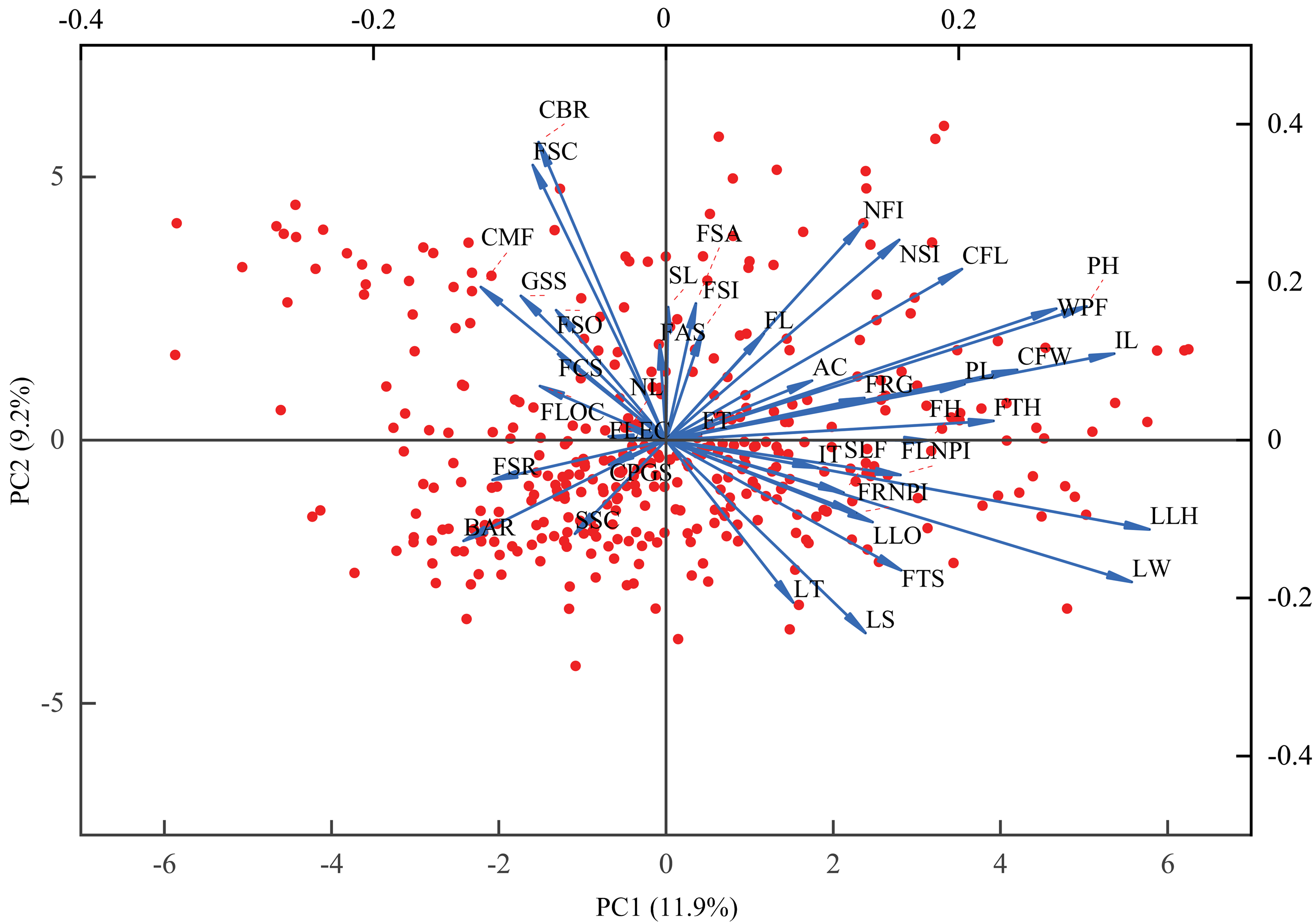
图2
364份樱桃番茄种质资源41个性状的主成分分析(PCA)双标图 红色圆点代表不同的樱桃番茄种质材料,蓝色箭头代表各性状指标的载荷向量"

图3
364份樱桃番茄种质资源表型性状聚类分析图 图上编号同附表1"
表4
表型性状综合排名前29信息表"
| 种质编号 Number | 品种名称 Variety name | F值 F value | 排名 Ranking |
|---|---|---|---|
| B-12 | 黑-2 Black-2 | 0.6781 | 1 |
| B-1 | 黑珍珠T501-1 Black Pearl T501-1 | 0.6586 | 2 |
| S30 | GT-1 | 0.6580 | 3 |
| B-3 | 黑珍珠T501-2 Black Pearl T501-2 | 0.6555 | 4 |
| S32 | GT-3 | 0.6548 | 5 |
| B-13 | 黑-3 Black-3 | 0.6523 | 6 |
| B-8 | 黑珍珠9-2 Black Pearl 9-2 | 0.6471 | 7 |
| B-11 | 黑1 Black 1 | 0.6434 | 8 |
| B-2 | 黑珍珠T501-1 Black Pearl T501-1 | 0.6397 | 9 |
| T124 | 绿洋梨Lvyangli | 0.6394 | 10 |
| B-4 | 红H2-1 Red H2-1 | 0.6382 | 11 |
| S51 | YT+P | 0.6362 | 12 |
| S87 | 191杂株191 Off-type | 0.6355 | 13 |
| S71 | R-11 | 0.6325 | 14 |
| B-5 | 红H2-2 Red H2-2 | 0.6273 | 15 |
| S40 | YG+P-2 | 0.6228 | 16 |
| T118 | 绿桃XLFF2-02 Green Peach XLFF2-02 | 0.6179 | 17 |
| T134 | 宏洋梨Hong Yangli | 0.6164 | 18 |
| T117 | 绿圣TY Green Sacred TY | 0.6159 | 19 |
| B-6 | 黑珍珠9-1 Black Pearl 9-1 | 0.6138 | 20 |
| T113 | 绿洋梨XDX-G-03 Green Pear XDX-G-03 | 0.6103 | 21 |
| B-10 | 黑珍珠1-2 Black Pearl 1-2 | 0.6073 | 22 |
| S15 | choc-2 | 0.6056 | 23 |
| S47 | GT+P-2 | 0.6040 | 24 |
| B-7 | 黑珍珠9-3 Black Pearl 9-3 | 0.6039 | 25 |
| S39 | YG+P-1 | 0.6033 | 26 |
| T313 | 72-1红小19.7.9 72-1 Red Small Fruit 19.7.9 | 0.6031 | 27 |
| Y-1 | CHERRY-1 | 0.6020 | 28 |
| T304 | 63-1红小19.7.9 63-1 Red Small Fruit 19.7.9 | 0.6009 | 29 |
| [1] |
doi: 10.1007/s13197-018-3221-z pmid: 30065393 |
| [2] |
原静云, 原让花, 李贞霞, 王晓玲. 我国番茄种质资源研究进展. 种业导刊, 2016(4): 9-14.
|
|
|
|
| [3] |
乐素菊, 刘厚诚, 翟英芬, 谢勇. 樱桃番茄果实风味分析. 中国蔬菜, 2003(3): 15-17.
|
|
|
|
| [4] |
康建坂. 两个樱桃番茄新品种选育研究[D]. 福州: 福建农林大学, 2009.
|
|
|
|
| [5] |
张琪. 樱桃番茄品种资源评价和影响樱桃番茄耐贮性因素的初探[D]. 长沙: 湖南农业大学, 2006.
|
|
|
|
| [6] |
吴丽艳, 龚亚菊, 黎志彬, 鲍锐, 钟利, 梁明泰. 樱桃番茄种质资源果实相关性状的多元统计分析. 西南农业学报, 2012, 25(5): 1818-1822.
|
|
|
|
| [7] |
李建华, 刘仲齐. 加工技术和育种技术对美国番茄生产的影响. 天津农业科学, 2010, 16(2): 97-101.
|
|
|
|
| [8] |
钱迎倩.生物多样性研究的原理与方法:生物多样性研究系列专著. 北京: 中国科学技术出版社, 1994.
|
|
|
|
| [9] |
李正为. 番茄砧木种质资源的评价与嫁接研究[D]. 南宁: 广西大学, 2012.
|
|
|
|
| [10] |
doi: 10.1007/s10681-019-2391-8 |
| [11] |
胡小荣, 陶梅, 周红立. 番茄种质资源遗传多样性研究进展. 现代农业科技, 2008(5): 6-8.
|
|
|
|
| [12] |
何伟明, 刘庞源, 孟淑春, 张宝海. 蔬菜种质资源收集评价和创新利用研究. 北方园艺, 2010(6): 87-90.
|
|
|
|
| [13] |
doi: 10.1016/S2095-3119(16)61371-0 |
| [14] |
doi: 10.3390/horticulturae9030300 |
| [15] |
doi: 10.1016/j.scienta.2024.113855 |
| [16] |
刘维侠, 曹振木, 党选民, 张秀明. 番茄种质资源生物学性状的初步观察与评价. 植物遗传资源学报, 2008, 9(1): 110-114.
|
|
|
|
| [17] |
龚亚菊, 吴丽艳, 黎志彬, 鲍锐, 钟利. 大果番茄种质资源的遗传多样性和聚类分析. 西南农业学报, 2013, 26(6): 2447-2450.
|
|
|
|
| [18] |
张静, 白瑞, 贾莹, 温仕达, 郎小平, 许小勇. 番茄种质资源的多样性和聚类分析. 中国瓜菜, 2018, 31(2): 11-14.
|
|
|
|
| [19] |
芮文婧, 王晓敏, 张倩男, 胡学义, 胡新华, 付金军, 高艳明, 李建设. 番茄353份种质资源表型性状遗传多样性分析. 园艺学报, 2018, 45(3): 561-570.
|
|
doi: 10.16420/j.issn.0513-353x.2017-0274 |
|
| [20] |
袁东升. 266份番茄种质资源遗传多样性分析及番茄杂交组合的评价[D]. 银川: 宁夏大学, 2019.
|
|
|
|
| [21] |
刘珮君, 王晓敏, 李国花, 郑福顺, 赵宇飞, 胡新华, 付金军, 高艳明, 李建设. 166份番茄种质资源的综合评价. 云南大学学报(自然科学版), 2020, 42(4): 792-803.
|
|
|
|
| [22] |
李景富, 崔亚男, 姜景彬, 杨欢欢, 赵婷婷, 许向阳. 抗旱番茄种质资源筛选及抗旱性评价. 东北农业大学学报, 2018, 49(4): 1-9.
|
|
|
|
| [23] |
李云洲, 闫见敏, 须文, 王勇, 梁燕. 番茄种质资源主要植物学性状的遗传多样性及相关性. 贵州农业科学, 2019, 47(2): 68-74.
|
|
|
|
| [24] |
李玉姗, 肖菁, 马越, 田超, 赵连佳, 王帆, 宋羽, 蒋程瑶. 169份番茄种质资源表型性状遗传多样性分析及综合评价. 中国农业科学, 2024, 57(18): 3671-3683. doi: 10.3864/j.issn.0578-1752.2024.18.012.
|
|
|
|
| [25] |
冯晶晶, 刘磊, 郑峥, 邓学斌, 刘希艳, 白金瑞, 舒金帅, 宋燕, 李君明. 醋栗番茄Solanum pimpinellifolium遗传多样性分析. 植物遗传资源学报, 2017, 18(4): 611-619, 628.
doi: 10.13430/j.cnki.jpgr.2017.04.002 |
|
|
|
| [26] |
doi: 10.1038/s41588-023-01340-y pmid: 37024581 |
| [27] |
邓学斌. 加工番茄核心种质构建与重要农艺性状关联分析[D]. 北京: 中国农业科学院, 2015.
|
|
|
|
| [28] |
|
| [29] |
doi: 10.1016/j.scienta.2020.109734 |
| [30] |
doi: 10.5958/2395-146X.2022.00144.2 |
| [31] |
|
| [32] |
doi: 10.21273/JASHS05066-21 |
| [33] |
李锡香, 杜永臣, 沈镝. 番茄种质资源描述规范和数据标准. 北京: 中国农业出版社, 2006.
|
|
|
|
| [34] |
doi: 10.1111/oik.2005.109.issue-1 |
| [35] |
姜政, 杜丽慧, 张宇, 申磊, 杨旭. 茄果类蔬菜单性结实研究进展. 中国瓜菜, 2022, 35(3): 1-8.
|
|
|
|
| [36] |
魏仕伟, 杨华, 张前荣, 陈海荣, 罗利军, 龙萍. 基于表型性状的叶用莴苣资源多样性分析. 植物遗传资源学报, 2016, 17(5): 871-876.
doi: 10.13430/j.cnki.jpgr.2016.05.012 |
|
doi: 10.13430/j.cnki.jpgr.2016.05.012 |
|
| [37] |
阚云霞, 师海林, 张丹丹, 游茜, 尤园园, 舒金帅, 王帅, 毛秀杰. 基于农艺性状和InDel标记的矮生番茄种质资源遗传多样性分析. 农业生物技术学报, 2023, 31(6): 1122-1132.
|
|
|
|
| [38] |
李冬景. 番茄果实花青素合成调控基因ATROVIOLACIUM候选基因的功能验证与分析[D]. 广州: 华南农业大学, 2020.
|
|
|
|
| [39] |
王小娟, 陈健晓, 李雪峤, 伍壮生, 吴月燕, 高芳华. 13份矮生番茄种质资源表型性状遗传多样性分析. 分子植物育种, 2022, 20(6): 1955-1964.
|
|
|
|
| [40] |
何润铭, 黎振兴, 郭汉权, 黄智文, 田永红, 沈颖, 刘洪标. 基于表型性状的番茄品种遗传多样性分析. 湖北农业科学, 2021, 60(18): 115-120.
|
|
|
|
| [41] |
韩兰兰, 刘燕, 郑于莉, 王亮明, 李凯, 郭凯, 袁鹤, 包九月. 130份番茄种质资源表型性状的综合评价. 江苏农业科学, 2023, 51(18): 148-156.
|
|
|
|
| [42] |
吕维梧, 但忠, 苏银玲, 杜康华, 木万福, 张娟. 69份大果番茄种质资源的遗传多样性和聚类分析. 中国果菜, 2022, 42(12): 73-78.
|
|
|
|
| [43] |
赵云霞, 颜秀娟, 王学梅, 杨冬艳, 苏慧. 246份番茄种质资源表型性状的遗传多样性. 江苏农业科学, 2021, 49(17): 134-140.
|
|
|
|
| [44] |
朱晓林, 魏小红, 冯悦, 赵耀东. 基于多元统计分析的番茄性状研究. 江苏农业科学, 2020, 48(7): 174-181.
|
|
|
|
| [45] |
江姚兰, 陈冠龙, 李涛, 孙保娟, 李植良, 游倩. 茄子种质资源表型遗传多样性分析及综合评价. 分子植物育种, 2024, 22(5): 1543-1558.
|
|
|
|
| [46] |
袁东升, 王晓敏, 赵宇飞, 潘兵青, 白嫆嫆, 胡新华, 付金军, 高艳明, 李建设. 100份番茄种质资源表型性状的遗传多样性分析. 西北农业学报, 2019, 28(04): 594-601.
|
|
|
|
| [47] |
孙珍珠, 李秋月, 王小柯, 赵婉彤, 薛杨, 冯锦英, 刘小丰, 刘梦雨, 江东. 宽皮柑橘种质资源表型多样性分析及综合评价. 中国农业科学, 2017, 50(22): 4362-4372. doi: 10.3864/j.issn.0578-1752.2017.22.012.
|
|
|
|
| [48] |
周福平, 史红梅, 张海燕, 杨彬, 闫凤霞. 应用模糊隶属函数法对高粱种质资源的农艺性状和品质性状进行综合评价. 种子, 2022, 41(1): 94-98.
|
|
|
|
| [49] |
王红英, 谢宏鑫, 商榆, 周利凤, 李晓, 曹明明. 利用隶属函数法综合评价4个华北型黄瓜品种. 天津农业科学, 2024, 30(10): 16-21.
|
|
|
|
| [50] |
费丹, 谢敏, 徐俊, 周瑶敏, 广业兰, 汤泳萍, 涂田华, 熊晓晖. 基于主成分分析和隶属函数法对不同品种芦笋品质的综合评价. 江西农业学报, 2024, 36(4): 33-39.
|
|
|
|
| [51] |
金杭霞, 郭丹丹, 杨清华, 郁晓敏, 傅旭军, 袁凤杰. 利用模糊隶属函数法综合评价大豆萌发期耐盐性. 分子植物育种, 2021, 19(24): 8265-8271.
|
|
|
|
| [52] |
邹成林, 黄开健, 翟瑞宁, 黄爱花, 莫润秀, 韦新兴, 杨萌, 黄艳芬, 王呤燕, 卢红雨. 基于隶属函数法和主成分分析评价玉米萌发期抗旱性. 江苏农业科学, 2022, 50(13): 7-13.
|
|
|
|
| [53] |
摆福红, 王晓敏, 胡新华, 王凯彬, 郭猛, 程国新, 付金军, 高艳明, 李建设. 基于主成分和隶属函数分析的露地大果番茄杂交组合综合评价. 中国瓜菜, 2024, 37(12): 88-95.
|
|
|
|
| [54] |
doi: 10.1186/s12870-023-04329-1 pmid: 37434130 |
| [1] | 王小玮, 杜佛力, 闫红财, 郎正东, 党志娟, 李葆春, 汪军成, 马小乐, 王化俊, 张宏, 姚立蓉. 396份春小麦灌浆期和成熟期抗旱性评价[J]. 中国农业科学, 2026, 59(8): 1608-1621. |
| [2] | 葛玉彬, 贺春贵, 王宁, 张国琴, 张正英, 吕鑫. 基于表型性状的热带高粱种质资源遗传多样性分析与创新利用[J]. 中国农业科学, 2026, 59(8): 1622-1638. |
| [3] | 姚林, 彭律文, 阳虹, 饶佳怡, 高浩然, 陶芊伊, 谢念祠, 陈莹玉, 李赛君, 刘硕谦, 黄飞毅. 茶树不同亲本及F1子代多酚类成分多样性和基因型分析[J]. 中国农业科学, 2026, 59(8): 1760-1774. |
| [4] | 崔节浩, 张萌, 王沁, 于佳妍, 林琨, 李尚泽, 兰恒, 耿艳秋, 张强, 郭丽颖, 邵玺文. 粳稻资源抗倒伏性评价与生理机制[J]. 中国农业科学, 2026, 59(7): 1420-1438. |
| [5] | 陈敏氡, 裘波音, 黄昊, 李永平, 温庆放. 松花菜种质花球质地品质的评价[J]. 中国农业科学, 2026, 59(6): 1302-1316. |
| [6] | 郝琨, 陈洪德, 张威, 钟韵, 党美荣, 朱士江, 黄志坤, 金英. 基于柑橘产量、品质及水氮利用的涌泉根灌水氮综合评价[J]. 中国农业科学, 2026, 59(4): 862-873. |
| [7] | 陈敏, 焦紫岚, 乔承彬, 许昊, 张碧, 马东花, 孔维儒, 王敬文, 宋佳伟, 罗成科, 李培富, 田蕾. 不同亚种水稻种质资源对盐胁迫的形态生理响应及适应策略[J]. 中国农业科学, 2026, 59(4): 705-722. |
| [8] | 何治霖, 孙翠霞, 岳红丽, 谈月霞, 张耀海, 王福生, 刘思涛, 江东. 基于重测序枸橼、柠檬类种质资源的遗传多样性分析和别罗勒烯的全基因组关联分析[J]. 中国农业科学, 2026, 59(2): 386-401. |
| [9] | 高亚峰, 杨嘉宁, 孙雪迪, 陈佳佳, 党志娟, 汪军成, 张宏, 马小乐, 姚立蓉, 孟亚雄, 司二静, 李葆春, 王化俊. 春小麦耐低氮种质资源的筛选与综合评价[J]. 中国农业科学, 2026, 59(11): 2299-2313. |
| [10] | 谢永祥, 潘怡敏, 黄蕊, 秦慧彬, 侯森, 贺强, 凌亮, 穆志新, 王海岗. 山西谷子种质资源耐瘠性鉴定及综合评价[J]. 中国农业科学, 2026, 59(11): 2325-2339. |
| [11] | 缪俊杰, 谢平华, 廖小华, 毛辉荣, 谢冲冲, 周婧, 谭红丽, 吴利平, 王雅楠, 欧阳婧, 晏学明, 陈浩. 全基因组数据揭示丰城麻鸭的种质资源特性与遗传多样性特征[J]. 中国农业科学, 2026, 59(11): 2513-2525. |
| [12] | 吕涛, 孙国清, 郭栋材, 陈全家, 蔡永生, 樊标星, 曲延英, 郑凯. 海岛棉纤维强度QTL紧密连锁InDel分子标记开发及效应评价[J]. 中国农业科学, 2025, 58(9): 1684-1701. |
| [13] | 许玉娟, 张捷, 王天译, 陈浩洋, 赵佳佳, 武棒棒, 郝宇琼, 李晓华, 郑兴卫, 左静静, 郑军. 山西小麦低分子量麦谷蛋白Glu-A3和Glu-B3位点多样性鉴定及其对品质的影响[J]. 中国农业科学, 2025, 58(24): 5110-5127. |
| [14] | 陈彩锦, 马琳, 蒋庆雪, 刘金晖, 苗童, 张志鹏, 孟翔, 马晓冉, 周昕越, 张建, 刘文辉, 王学敏. 244份饲用燕麦种质资源表型性状遗传多样性分析[J]. 中国农业科学, 2025, 58(23): 4825-4836. |
| [15] | 魏益民, 周美亮, 唐宇. 荞麦的起源、进化与传播[J]. 中国农业科学, 2025, 58(21): 4305-4316. |
|
||
