






中国农业科学 ›› 2025, Vol. 58 ›› Issue (23): 5081-5096.doi: 10.3864/j.issn.0578-1752.2025.23.021
• 畜牧·兽医 • 上一篇
张帆( ), 唐湘方*(), 杨亮, 王辉, 陈睿鹏, 熊本海*()
收稿日期:2024-08-14
接受日期:2025-10-28
出版日期:2025-12-01
发布日期:2025-12-09
通信作者:
联系方式:
张帆,E-mail:zhangfan07@caas.cn。
基金资助:
ZHANG Fan(), TANG XiangFang*(), YANG Liang, WANG Hui, CHEN RuiPeng, XIONG BenHai*()
Received:2024-08-14
Accepted:2025-10-28
Published:2025-12-01
Online:2025-12-09
摘要:
随着我国肉牛规模化养殖的快速发展,以物联网、大数据及人工智能为代表的现代智能肉牛养殖技术水平得到不断提高。肉牛个体的身份识别及体重、体尺和采食量等生产性能的实时监测对提高牧场饲养管理水平、降低人员工作量、加快肉牛育种选育进程具有重要意义。个体识别是肉牛个体生产性能监测的基础,当前主要依赖于RFID识别技术和基于图像的深度学习个体识别技术。RFID技术识别精度高,但面临成本高、识别距离短、佩戴工作量大的问题。而基于图像的深度学习识别技术通过分析肉牛的体表花纹、耳标文本、鼻纹、虹膜、视网膜、面部和侧面轮廓等独特生物特征实现个体识别。但其识别效果可能受光照条件和动物个体差异的影响。未来需着力研发能够适应不同环境条件并实现精准、快速、动态的肉牛机器视觉识别技术。肉牛体尺与体重的精准估测主要通过采用2D、3D相机拍摄的二维、三维图像,经过关键特征点的提取分析计算实现。2D相机具有设备获取简单、成本低的优势,但其在测定过程中需要已知尺寸的参照物,且在测量胸围、腹围等曲面特征体尺指标时存在局限性,直接影响了相关体尺测定和体重估测的精准度。相比之下,3D相机能够全方位、立体化获取肉牛体表结构及其与设备的距离信息,从而为多维度体尺体重指标的精准测量提供可能。肉牛采食量自动监测对判断饲料效率至关重要。自动计重料槽借助压力传感器精准计量采食前后食槽重量差值,实现采食量的自动精准测定,但其安装成本高、饲喂不便等问题限制了其应用范围。通过肉牛采食前后饲料的深度图像变化或通过传感器记录采食行为也可有效估测采食量。然而,在实际应用中,饲料组成的复杂性及形态变化可能对监测准确性造成干扰。基于机器视觉的肉牛生产性能测定技术在肉牛生产性能测定上取得了显著的进展,但仍面临诸多挑战,如数据处理量大、环境干扰影响结果准确性和数据深度挖掘利用不足等。未来可采取以下策略:通过边缘计算技术、优化阶段性检测等策略降低设备数据计算负担,提高系统响应速度;探索基于单视角深度相机的三维重建技术,以提高肉牛体尺和体重监测在实际生产应用的可行性;研发适用于不同品种、各生长阶段肉牛的通用预测模型,以增强技术的普适性与实用性;加强多模态数据融合,提高肉牛生产性能监测数据的综合应用价值。智能监测技术是肉牛养殖现代化的关键,通过技术创新与融合,有望实现低成本、高精度、广泛适用的智能化肉牛生产性能监测技术,从而推动肉牛产业智能化升级,提升生产效率与经济效益,满足市场需求。文章系统总结了肉牛养殖过程身份识别及体重、体尺和采食量的智能监测技术,深入分析了我国肉牛生产性能智能监测技术当前面临的挑战和未来发展趋势,旨在为相关智能化监测技术的研发和应用提供参考。
张帆, 唐湘方, 杨亮, 王辉, 陈睿鹏, 熊本海. 肉牛生产性能智能监测技术研究进展[J]. 中国农业科学, 2025, 58(23): 5081-5096.
ZHANG Fan, TANG XiangFang, YANG Liang, WANG Hui, CHEN RuiPeng, XIONG BenHai. Research Progress of Intelligent Monitoring Technology for Beef Cattle Production Performance[J]. Scientia Agricultura Sinica, 2025, 58(23): 5081-5096.
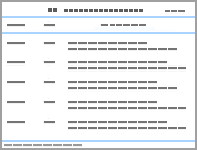
表1
肉牛个体识别技术对比"
| 监测部位 Monitoring site | 监测设备 Monitoring equipment | 主要识别算法 Main identification method | 准确率 Accuracy rate | 特点 Characteristic | 参考文献 Reference |
|---|---|---|---|---|---|
| 耳标文本 Ear tag text | 三千万像素照相机 30-megapixel camera | CRNN | 92.30% | 利用耳标进行文本识别,但对图像采集角度及摄像机的像素要求较高 Text recognition using ear tags is possible but needs specific image acquisition angles and high camera resolution | [ |
| 耳标文本 Ear tag text | SP007 Sricam IP防水 摄像机与红外夜视仪 SP007 Sricam IP waterproof camera with infrared night vision device | YOLOv3 | > 95% | 引入纠错算法,避免误读 An ad hoc error correction algorithm is presented to avoid misreading | [ |
| 鼻纹 Muzzle | X-T4相机 X-T4 camera | VGG | 98.7% | 通过加权交叉熵损失函数和数据增强处理提高结果精度 The identification accuracy is improved through the weighted cross-entropy loss function and data augmentation processing | [ |
| 虹膜 Iris | 二维图像 2D image | 2DLP-LDA | 94.07% | 优秀的泛化能力,可识别存在局部遮挡和形变等质量缺陷的图像 Good generalization ability and can identify images with quality defects such as local occlusion and deformation | [ |
| 视网膜 Retina | 二维图像 2D image | SURF | 92.25% | 利用视网膜血管识别,准确率高 The recognition by retinal blood vessels has a high accuracy rate | [ |
| 面部 Face | 索尼A6000和华为P30 SONY A6000 and Huawei P30 | MobileNetV1为主干网络,K-means++聚类 MobileNetV1 as the backbone network, and K-means++ clustering algorithm | 无遮挡时99.86%;遮挡小于30%时90%以上 99.86% with no occlusion, and over 90% when occlusion is less than 30% | 在遮挡情况下仍可识别 It can still be recognized even in occluded conditions | [ |
| 面部 Face | 二维图像 2D image | YOLO-Unet组合网络模型 YOLO-Unet combined network | 90.48% | 引入背景消去模块,提高准确率11.99% The model with background removal improve recognition accuracy of 11.99% | [ |
| 面部 Face | 二维图像 2D image | SOLOv2 | 98.06% | 添加SOLOv2实例分割模型获取牛脸轮廓信息,提高牛面部识别准确率 Add the SOLOv2 instance segmentation model to obtain the contour information of cow faces and improve the accuracy of cow face recognition | [ |
| 侧面 Body side | 华为Mate30摄像机 Huawei Mate30 camera | TLAINS-InceptionV3 | 99.74% | 解决肉牛无明显自身特征带来的识别准确率问题 Solve the problem of recognition accuracy caused by the lack of obvious self-characteristics of beef cattle | [ |
表2
肉牛体尺测定技术研究对比"
| 监测部位 Monitoring site | 测定指标 Monitoring parameters | 监测设备 Monitoring equipment | 主要识别算法 Main identification method | 准确率 Accuracy rate | 特点 Characteristic | 参考文献 Reference |
|---|---|---|---|---|---|---|
| 侧面 Body side | 体高、体斜长、胸深、蹄径 Body height, body oblique length, chest depth, hoof diameter | 单个RGB相机 Single RGB camera | YOLO v5s对肉牛目标进行定位,Lite-HRNet提取关键点 YOLO v5s detects the beef cattle target, and Lite-HRNet detects the key points | 相对误差分别6.75%、7.55%、8.00%、8.97% With average relative error of 6.75 %, 7.55 %, 8.00 % and 8.97% | 能准确测量不同距离和光照条件下的体尺,但结果易受背景和拍摄角度影响 Accurately measure the body sizes under different distances and lighting conditions, but the accuracy is affected by the background and shooting angle | [ |
| 侧面 Body side | 体高、体长 Body height, body length | 二维图像 2D image | Image 2 | 误差小于0.04 m Average prediction deviation < 0.04 m | 成本低,但胸围预测准确率低 Low cost, but low prediction accuracy of chest circumference | [ |
| 侧面 Body side | 体高、体斜长 Body height, body oblique length | 二维图像 2D image | YOLOv5 | 相对误差分别为4.49%、4.70% With relative error of 4.49% and 4.70% | 以已知尺寸的耳标为参照计算体尺 Using the ear tag of known size as reference to calculate body sizes | [ |
| 侧面 Body side | 体高,胸深、背高、体斜长、腰高 Body height, chest depth, back height, body oblique length, waist height | 单个IFM O3D303 3D激光雷达 IFM O3D303 3D LiDAR camera | GPT三维重建 Greedy Projection Triangulation reconstruction | 精度2 mm,相对误差< 2% With accuracy of 2 mm and relative error close to 2% | 精度高,但操作复杂,且动物需要保持静止 High precision, but the operation is complex and the animal needs to remain stationary | [ |
| 5个角度 Five angles | 体高、臀高、胸围、腹围、体斜长 Body height, hip height, chest circumference, abdominal circumference, body oblique length | 5个Kinect DK Five Kinect DK sensors | BTSS进行关键区域分割,基于姿态的调整模型进行结果校正 Segmentation of key regions by bidirectional tomographic slice segmentation method, along with Posture-based Measurement Adjustment model to correct result | 相对误差分别为1.84%、3.47%、1.56%、2.36%、1.14% With relative errors 1.84%, 3.47%, 1.56% 2.36% and 1.14% | 多摄像头实时三维重建,精确度高 Multi-camera real-time 3D reconstruction with high accuracy | [ |
| 侧面 Body side | 体高、胸围、背高、腰高、体斜长 Body height, chest circumference, back height, waist height, body oblique length | 单个IFM O3D303 Single IFM O3D303 | 按照动物左右对称原理合并后,经孔洞修复后计算体尺 After merging according to the principle of left-right symmetry of animals, the body sizes were calculated after hole repair | 平均相对误差5.42% With average relative error 5.42% | 基于对称原理构建真实肉牛轮廓用于体尺测量 The real beef cattle contour was constructed based on the principle of symmetry for body size measurement | [ |
表3
肉牛体重估测技术研究准确度对比"
| 监测部位 Monitoring site | 监测设备 Monitoring equipment | 主要识别算法 Main identification method | 准确率 Accuracy rate | 特点 Characteristic | 参考文献 Reference |
|---|---|---|---|---|---|
| 背部 Back | MD-1004NS MD-DVR41 | Bagging | 相对误差2.67%,误差值13.44 kg With relative error 2.67%, and average error value 13.44 kg | 采用背部二维图像估测体重 Estimate the body weight by two-dimensional images of the back | [ |
| 侧面 Body side | IFM O3D303 | PointNet++确定体尺测定 关键点 PointNet++ determines the key points for measuring the body sizes | 相对误差3.2%,误差值10.2 kg With relative error 3.2%, and average error value 10.2 kg | 依据深度相机测定的体尺估算体重 Estimate the body weight based on the body size measured by the depth camera | [ |
| 背部 Back | Intel RealSense D435i | MLP | 相对误差3.13% With relative error 3.13% | 利用体积估算体重 Estimate body weight by volume | [ |
| 侧面 Body side | LiDAR | Potree Desktop | 相对误差6.3% With relative error 6.3% | 在无人机上搭载深度相机估测体重 Estimate body weight by a depth camera installed on the unmanned aerial vehicle | [ |
| 背部 Back | Kinect® model 1473 | ANN | 体重相对误差< 5.32%,日增重误差均< 0.10 kg·d-1 With relative error of body weight < 5.32%, and the error value of average daily gain all < 0.10 kg·d-1 | 同一模型预测肉牛不同阶段体重,并计算日增重 Estimate the body weight and average daily gain of beef cattle at different stages by the same model | [ |
| [1] |
曹兵海, 曹建民, 李俊雅, 郭爱珍, 王之盛, 孙宝忠, 陈昭辉. 2023年度肉牛牦牛产业与技术发展报告. 中国畜牧杂志, 2024, 60(3): 335-338.
|
|
|
|
| [2] |
doi: 10.1071/EA02054 |
| [3] |
张帆, 周梦婷, 唐湘方, 刘民泽, 杨振刚, 熊本海. 规模化肉牛场数字化管控平台的开发与应用: 以阳信亿利源5G数字化牧场为例. 农业大数据学报, 2024, 6(1): 68-81.
doi: 10.19788/j.issn.2096-6369.000009 |
|
doi: 10.19788/j.issn.2096-6369.000009 |
|
| [4] |
罗西尔, 卢小龙, 刘庆友, 崔奎青. 肉牛智慧养殖技术研究进展. 华南农业大学学报, 2024, 45(5): 661-671.
|
|
|
|
| [5] |
杨亮, 张帆, 王辉, 熊本海. 北京地区家畜养殖数字化现状. 中国乳业, 2023(1): 35-40.
|
|
|
|
| [6] |
万彬彬, 贾建刚, 邓锐强, 何江, 高江璐, 张燕茹, 李帅, 韩建欣. 肉牛生产性能测定问题分析. 中国畜禽种业, 2023, 19(6): 38-42.
|
|
|
|
| [7] |
doi: 10.1016/j.compag.2011.02.001 |
| [8] |
doi: 10.1016/j.compag.2020.105821 |
| [9] |
刘波, 朱伟兴, 纪滨, 马长华. 基于射线轮廓点匹配的生猪红外与可见光图像自动配准. 农业工程学报, 2013, 29(2): 153-160, 297.
|
|
|
|
| [10] |
王少华. 基于视频分析和深度学习的奶牛爬跨行为检测方法研究[D]. 杨凌: 西北农林科技大学, 2021.
|
|
|
|
| [11] |
杨胜楠, 赵建敏, 杨梅, 赵宇飞. 基于去偏置项SoftMax和紧致度量损失函数的牛脸识别方法. 黑龙江畜牧兽医, 2024(4): 36-42.
|
|
|
|
| [12] |
doi: 10.1016/j.inpa.2022.10.003 |
| [13] |
张永芳, 黎亮, 董丽虹, 王海斗, 王朋, 谢向宇. RFID传感标签制备工艺研究进展. 材料导报, 2023, 37(22): 47-56.
|
|
|
|
| [14] |
黄彬, 朱立学. RFID技术在农业生产领域的应用现状与展望. 现代农业装备, 2024, 45(6): 56-62.
|
|
|
|
| [15] |
熊本海, 钱平, 罗清尧, 吕健强. 基于奶牛个体体况的精细饲养方案的设计与实现. 农业工程学报, 2005, 21(10): 118-123.
|
|
|
|
| [16] |
doi: 10.1016/j.compag.2016.03.014 |
| [17] |
许兴时, 王云飞, 邓红兴, 宋怀波. 基于跨模态共享特征学习的夜间牛脸识别方法. 华南农业大学学报, 2024, 45(5): 793-801.
|
|
|
|
| [18] |
doi: 10.1016/j.compag.2021.106133 |
| [19] |
doi: 10.1016/j.compag.2019.104944 |
| [20] |
doi: 10.1016/j.eswa.2023.120365 |
| [21] |
doi: 10.1016/j.compag.2022.106871 |
| [22] |
童慧琳, 李琦. 基于牛耳标OCR的牛身份识别研究. 计算机时代, 2023(10): 12-16.
|
|
|
|
| [23] |
doi: 10.3390/ani12111453 |
| [24] |
doi: 10.1016/j.ins.2012.09.021 |
| [25] |
盛大玮, 何孝富, 吕岳. 基于最小二乘原理的牛眼虹膜分割方法. 中国图象图形学报, 2009, 14(10): 2132-2136.
|
|
|
|
| [26] |
魏征. 基于全局和局部特征相结合的不完美牛眼虹膜识别技术研究[D]. 南京: 东南大学, 2017.
|
|
|
|
| [27] |
doi: 10.1016/j.compag.2024.108963 |
| [28] |
周意, 毛宽民. 基于YOLO-Unet组合网络的牛只个体识别方法研究. 计算机科学, 2025, 52(4): 194-201.
|
|
|
|
| [29] |
叶孟珂, 李宝山, 杨梅, 李琦. 基于深度学习的牛脸识别系统设计. 黑龙江畜牧兽医, 2024(4): 43-48.
|
|
|
|
| [30] |
李征. 局部遮挡条件下的西门塔尔肉牛面部识别算法研究[D]. 呼和浩特: 内蒙古大学, 2022.
|
|
|
|
| [31] |
胡立俊, 李旭, 李国亮. 基于改进YOLOv8n的安格斯牛面部识别. 华中农业大学学报, 2025, 44(2): 39-48.
|
|
|
|
| [32] |
张宇. 基于深度学习的肉牛体侧识别方法研究[D]. 包头: 内蒙古科技大学, 2023.
|
|
|
|
| [33] |
|
| [34] |
王苏皖, 冯小芳, 佟丽佳, 李德生, 王瑜, 封元, 蒋秋斐, 徐军, 陈亚飞, 顾亚玲, 张娟. 安格斯牛断奶阶段生长发育性状的遗传参数估计. 中国畜牧兽医, 2024, 51(6): 2517-2523.
doi: 10.16431/j.cnki.1671-7236.2024.06.026 |
|
|
|
| [35] |
马建飞, 白德日根, 金生云, 李丽杰, 包俊杰, 牛化欣. 草原放牧系统条件下华西牛0-9月龄生长、体尺和肉用指数研究. 中国畜牧杂志, 2024, 60(10): 355-358.
|
|
|
|
| [36] |
doi: 10.1007/s10015-017-0373-2 |
| [37] |
doi: 10.1016/j.biosystemseng.2022.03.014 |
| [38] |
doi: 10.1016/j.compag.2022.106738 |
| [39] |
doi: 10.1016/j.eswa.2023.123042 |
| [40] |
岳萌萌, 舒涛, 王嘉博, 刘利, 王鹏, 赵晓川, 许珊珊, 王春薇, 柴孟龙, 孙芳, 钟金城. 基于Image 2和岭回归模型估测肉牛体尺、体重. 黑龙江畜牧兽医, 2020(22): 41-43, 49.
|
|
|
|
| [41] |
张帅. 基于深度学习的晋南牛体尺及体重预测方法研究[D]. 太谷: 山西农业大学, 2022.
|
|
|
|
| [42] |
doi: 10.3390/s18093014 |
| [43] |
doi: 10.1016/j.biosystemseng.2023.04.014 |
| [44] |
doi: 10.1016/j.compag.2024.109208 |
| [45] |
doi: 10.1016/j.compag.2023.108184 |
| [46] |
doi: 10.1016/j.compag.2022.106987 |
| [47] |
doi: 10.1016/j.compag.2025.110013 |
| [48] |
doi: 10.1016/j.compag.2019.03.010 |
| [49] |
doi: 10.1016/j.compag.2019.104958 |
| [50] |
doi: 10.1016/j.compag.2020.105300 |
| [51] |
邓由飞, 代俊芳, 郭晓旭, 任丽萍, 孟庆翔. 利用体尺指标估测肉牛自然体重的准确性研究. 中国畜牧杂志, 2015, 51(S1): 141-143.
|
|
|
|
| [52] |
doi: 10.1016/j.animal.2025.101529 |
| [53] |
|
| [54] |
doi: 10.3389/fsufs.2019.00030 |
| [55] |
doi: 10.1016/j.compag.2020.105804 |
| [56] |
doi: 10.1016/j.livsci.2021.104442 |
| [57] |
doi: 10.1016/j.atech.2022.100167 |
| [58] |
doi: 10.1016/j.livsci.2019.103904 |
| [59] |
陈长博, 路平乐, 苏涛龙, 狄亚鹏, 高永权, 杨永慧, 杨雅楠, 赵生国. 早胜牛母牛体重与体尺性状相关回归分析. 黑龙江畜牧兽医, 2024(8): 31-36.
|
|
|
|
| [60] |
蓝雷斌. 基于机器视觉的牛只体尺体重估测算法研究[D]. 杭州: 杭州电子科技大学, 2024.
|
|
|
|
| [61] |
doi: 10.1080/09712119.2017.1302876 |
| [62] |
刘建明, 杨光维, 李涛, 潘国龙, 乃比江, 范守民. 应用约翰逊法估测美新杂交褐牛体重. 中国牛业科学, 2019, 45(6): 23-25.
|
|
|
|
| [63] |
doi: 10.1016/j.atech.2024.100489 |
| [64] |
赵黄青, 杜蕾, 赵家豪, 马伟东, 王武生, 张金川, 樊安平, 雷初朝, 黄永震. 秦川牛体尺和体重性状通径分析以及多元回归方程的建立. 中国畜牧杂志, 2024, 60(10): 110-113.
|
|
|
|
| [65] |
|
| [66] |
doi: 10.1590/S1516-35982009000400022 |
| [67] |
张永根. 奶牛采食行为的智能化监测方法及其应用研究进展. 饲料工业, 2020, 41(9): 1-6.
|
|
|
|
| [68] |
pmid: 18024766 |
| [69] |
张宏鸣, 武杰, 李永恒, 李书琴, 王红艳, 宋荣杰. 多目标肉牛进食行为识别方法研究. 农业机械学报, 2020, 51(10): 259-267.
|
|
|
|
| [70] |
周雅婷, 许童羽, 陈春玲, 周云成, 姜美羲. 基于神经网络算法的肉牛采食行为检测方法. 沈阳农业大学学报, 2016, 47(6): 752-757.
|
|
|
|
| [71] |
周雅婷. 肉牛采食行为识别与采食量模型研究[D]. 沈阳: 沈阳农业大学, 2018.
|
|
|
|
| [72] |
doi: 10.25165/j.ijabe.20231603.7985 |
| [73] |
doi: 10.3168/jds.2022-23177 |
| [74] |
doi: 10.1016/j.compag.2021.106143 |
| [75] |
杨亮, 高华杰, 夏阿林, 熊本海. 智能化猪场数字化管控平台创制及应用. 农业大数据学报, 2022, 4(3): 135-146.
doi: 10.19788/j.issn.2096-6369.220321 |
|
doi: 10.19788/j.issn.2096-6369.220321 |
|
| [76] |
doi: 10.1016/j.compag.2023.107667 |
| [77] |
doi: 10.1016/j.psj.2021.101072 |
| [78] |
doi: 10.1016/j.compag.2018.02.016 |
| [79] |
doi: 10.1016/j.compag.2017.04.003 |
| [80] |
曹淑泉, 王宇, 尚泽琦, 张鹏. 基于视觉三维重建的肉牛定价系统. 物联网技术, 2025, 15(10): 94-96.
|
|
|
| [1] | 李学冯, 王慧, 张宁波, 金太花, 张淑二, 郑全胜, 陶家树, 李庆珂, 吕慎金, 李永洙. 饲养密度对琅琊鸡生产性能和短链脂肪酸含量及盲肠微生物差异功能的影响[J]. 中国农业科学, 2025, 58(17): 3544-3560. |
| [2] | 李晓鹏, 刘云龙, 崔甲军, 屠焰, 蒋林树, 成述儒. 基于GreenFeed系统研究绿原酸对泌乳中后期奶牛瘤胃甲烷排放、发酵参数和生产性能的影响[J]. 中国农业科学, 2025, 58(14): 2904-2913. |
| [3] | 张建龙, 邢文文, 叶绍波, 张超, 郑德聪. 基于双输出回归卷积神经网络的燕麦株高估测研究[J]. 中国农业科学, 2024, 57(20): 3974-3985. |
| [4] | 王小军, 王金兰, 琚泽亮, 梁国玲, 贾志锋, 刘文辉, 马祥, 马金秀, 李文. 环青海湖地区不同饲用燕麦品种生产性能和营养品质综合评价[J]. 中国农业科学, 2024, 57(19): 3730-3742. |
| [5] | 张力允, 黄智荣, 杨柳, 陈俊鹏, 林祯平, 黄红艳, 伍仲平, 张续勐, 田允波, 黄运茂, 李秀金. 二代基因组测序鉴别狮头鹅拷贝数变异及其与体重体尺关联[J]. 中国农业科学, 2024, 57(14): 2889-2900. |
| [6] | 陈恒光, 裴晓蒙, 夏雨婷, 刘静, 茆达干. 围产期日粮添加姜黄素对山羊生产性能、血液指标及炎症因子基因表达的影响[J]. 中国农业科学, 2024, 57(12): 2483-2496. |
| [7] | 王赟赟, 李毅念, 陈玉仑, 丁启朔, 何瑞银. 基于改进Mask R-CNN的小麦在穗籽粒表型参数测试方法[J]. 中国农业科学, 2024, 57(12): 2322-2335. |
| [8] | 骆娜, 安炳星, 魏立民, 文杰, 赵桂苹. 全基因组关联分析筛选文昌鸡体尺性状相关分子标记[J]. 中国农业科学, 2024, 57(10): 2046-2060. |
| [9] | 崔登帅, 熊三亚, 郑浩, 李龙云, 余乃标, 黄智勇, 肖石军, 郭源梅. 里岔黑猪和巴里杂交猪母猪100kg体重日龄校正方法的比较[J]. 中国农业科学, 2023, 56(6): 1177-1188. |
| [10] | 唐振三, 袁剑龙, 康亮河, 程李香, 吕汰, 杨晨, 张峰. 基于图像特征识别的马铃薯薯皮粗糙度分级研究[J]. 中国农业科学, 2023, 56(22): 4428-4440. |
| [11] | 李棉燕, 王立贤, 赵福平. 机器学习在动物基因组选择中的研究进展[J]. 中国农业科学, 2023, 56(18): 3682-3692. |
| [12] | 房昊源, 杨亮, 王洪壮, 曹锦承, 任万平, 魏胜娟, 颜培实. 夏季横向交互送风系统对肉牛生理和生产性能的影响[J]. 中国农业科学, 2022, 55(5): 1025-1036. |
| [13] | 郭军,王克华,韩威,窦套存,王星果,胡玉萍,马猛,曲亮. 42日龄如皋黄鸡体重间接遗传效应分析[J]. 中国农业科学, 2022, 55(19): 3854-3861. |
| [14] | 刘旺景,唐德富,敖长金. 沙葱及其提取物对小尾寒羊生产性能、胴体特征、肉品质和血清生化指标的影响[J]. 中国农业科学, 2022, 55(17): 3461-3472. |
| [15] | 孙擎,赵艳霞,程晋昕,曾厅余,张祎. 基于多种算法的果树果实生长模型研究—以云南昭通苹果为例[J]. 中国农业科学, 2021, 54(17): 3737-3751. |
|
||
