






中国农业科学 ›› 2025, Vol. 58 ›› Issue (23): 4858-4871.doi: 10.3864/j.issn.0578-1752.2025.23.005
• 黄淮地区玉米大豆复合种植丰产增效技术研发 • 上一篇 下一篇
宋旭辉( ), 赵雪盈, 赵斌, 任佰朝, 张吉旺, 刘鹏, 任昊*()
收稿日期:2025-05-05
接受日期:2025-11-14
出版日期:2025-12-01
发布日期:2025-12-09
通信作者:
联系方式:
宋旭辉,E-mail:1784373158@qq.com。
基金资助:
SONG XuHui(), ZHAO XueYing, ZHAO Bin, REN BaiZhao, ZHANG JiWang, LIU Peng, REN Hao*()
Received:2025-05-05
Accepted:2025-11-14
Published:2025-12-01
Online:2025-12-09
摘要:
【目的】 探究不同行比配置对玉米大豆带状复合种植下群体冠层光分布、各冠层光合特性及产量形成的影响,为玉米大豆带状复合种植系统作物高产高光效栽培提供理论依据。【方法】 于2023—2024年,在大田试验条件下,以SM(单作玉米)和SS(单作大豆)为对照,设置4个玉米大豆带状复合种植行比配置,分别为四行玉米、六行大豆(4M6S),四行玉米、四行大豆(4M4S),三行玉米、四行大豆(3M4S),两行玉米、四行大豆(2M4S),玉米种植密度均为67 500株/hm2,SS、4M6S、4M4S、3M4S、2M4S处理大豆种植密度分别为160 000、153 144、128 351、151 068、183 556株/hm2,分析不同行比配置对复合群体冠层内部光分布及光合性能和产量的影响。【结果】 4M4S处理下,玉米具有较高的叶面积指数(LAI)和中部透光率,4M4S叶面积指数分别较4M6S、3M4S、2M4S、SM处理高4.07%、4.41%、4.71%、5.46%,玉米R1期穗位叶透光率4M4S分别较SM、2M4S、4M6S、3M4S处理高9.76%、21.11%、46.83%、48.16%。同时4M4S处理增加了玉米下部叶片的净光合速率,分别比3M4S、4M6S提高10.45%、8.58%,整体辐射能值利用率表现为4M4S分别较4M6S、3M4S、2M4S处理高1.38%、6.69%、8.01%,因此,4M4S处理具有较强的光合能力。4M4S处理下玉米和大豆产量表现最高,4M6S、4M4S、3M4S、2M4S 2年平均玉米产量分别为8.88、9.22、8.44、8.86 t·hm-2,大豆产量分别为1.44、1.44、1.37、1.29 t·hm-2,各间作模式土地当量比均>1.27。行比配置显著影响玉米大豆的种间关系,玉米相对大豆攻击力3M4S、4M6S、2M4S处理分别是4M4S的3.91、4.41和11.32倍,相对拥挤系数2023年3M4S最小,4M4S次之,2024年4M4S分别低于3M4S、4M6S、2M4S处理3.19%、10.58%、21.82%,在保证玉米产量的同时增收大豆。【结论】 4M4S处理致使玉米光拦截增加,改善了玉米群体中下层透光率,内外行各层植株叶片能保持较强的光合能力,也维持了大豆植株的光合能力,系统辐射能值利用率提升,产量和土地当量比显著增加,种间竞争力、相对拥挤系数和净效应相对最小,是本试验条件下最适宜的行比配置。
宋旭辉, 赵雪盈, 赵斌, 任佰朝, 张吉旺, 刘鹏, 任昊. 行比配置对玉米大豆带状复合种植系统冠层光合特性及产量形成的影响[J]. 中国农业科学, 2025, 58(23): 4858-4871.
SONG XuHui, ZHAO XueYing, ZHAO Bin, REN BaiZhao, ZHANG JiWang, LIU Peng, REN Hao. Effects of Row Ratio Allocation on Light Distribution and Photosynthetic Production Capacity of Maize-Soybean Strip Intercropping[J]. Scientia Agricultura Sinica, 2025, 58(23): 4858-4871.

表1
田间配置密度、行距和株距"
| 处理 Treatment | 玉米种植密度 Maize planting density (plants/hm2) | 大豆种植密度 Soybean planting density (plants/hm2) | 带宽 Band width (cm) | 玉米大豆行比 Maize- soybean row ratio | 玉米大豆间距 Maize-soybean spacing (cm) | 玉米行距 Maize row spacing (cm) | 大豆行距 Soybean line spacing (cm) | 玉米株距 Maize plant spacing (cm) | 大豆株距 Soybean plant spacing (cm) |
|---|---|---|---|---|---|---|---|---|---|
| SM | 67500 | — | — | — | — | 60 | — | 24.7 | — |
| SS | — | 160000 | — | — | — | — | 60 | — | 10 |
| 2M4S | 67500 | 153144 | 279 | 2:4 | 70 | 40 | 33 | 10.6 | 10 |
| 3M4S | 67500 | 128351 | 339 | 3:4 | 70 | 50 | 33 | 13.1 | 10 |
| 4M4S | 67500 | 151068 | 399 | 4:4 | 70 | 80/40 | 33 | 14.9 | 10 |
| 4M6S | 67500 | 183556 | 465 | 4:6 | 70 | 80/40 | 33 | 12.7 | 10 |
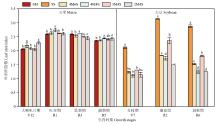
图1
行比配置对玉米和大豆叶面积指数的影响 结果由平均值±标准差表示,同一组数据中标以不同小写字母表示处理间在P<0.05水平差异显著The results were expressed by mean ± standard deviation, and values within a group followed by different lowercases indicate significantly different at P<0.05 level。下同 The same as below"
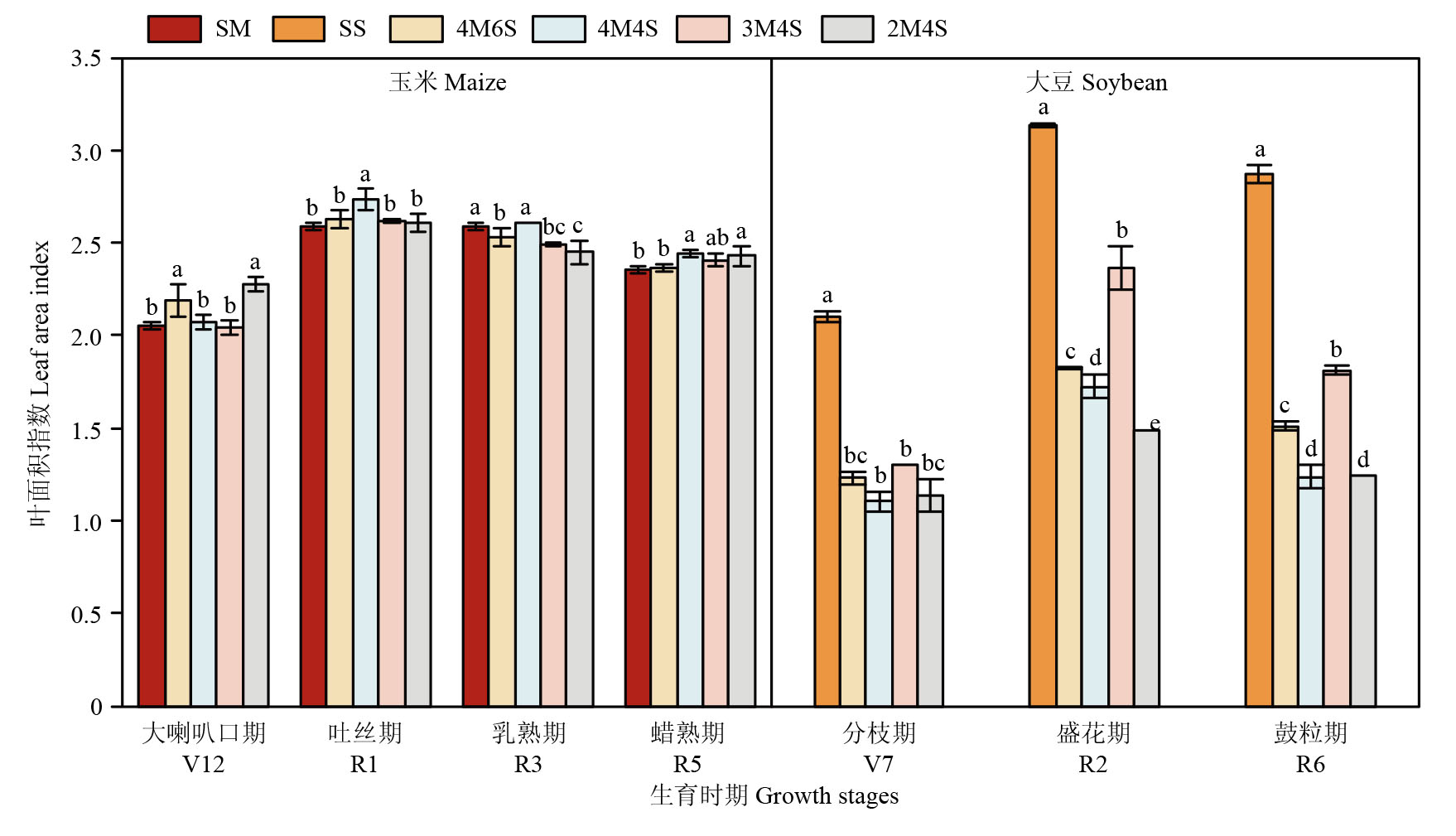
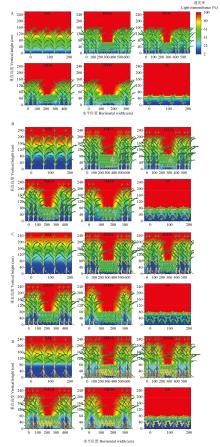
图2
不同行比配置光分布特征 A:玉米大喇叭口期、大豆分枝期 Maize trumpet stage, soybean branching stage;B:玉米吐丝期、大豆盛花期 Maize silking stage, soybean flowering stage;C:玉米乳熟期、大豆鼓粒期 Maize milk stage, soybean bulging stage;D:玉米蜡熟期、大豆成熟初期 Maize wax ripening stage, and soybean ripening stage"

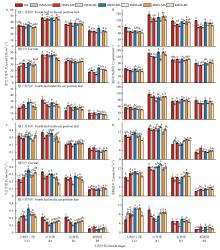
图3
不同行比配置对玉米气体交换参数的影响 SM:单作玉米 Single maize;SS:单作大豆 Single soybean;2M4S-MS:2M4S的玉米边行 Maize side row with 2M4S;3M4S-MS:3M4S的玉米边行 Maize side row with 3M4S;3M4S-MI:3M4S的玉米内行 Maize inner row with 3M4S;4M4S-MS:4M4S的玉米边行 Maize side row with 4M4S;4M4S-MI:4M4S的玉米内行 Maize inner row with 4M4S;4M6S-MS:4M6S的玉米边行 Maize side row with 4M6S;4M6S-MI:4M6S的玉米内行 Maize inner row with 4M6S;4M6S-SI1:4M6S的大豆内1行 The first inner soybean row of 4M6S;4M6S-SI2:4M6S的大豆内2行 The first inner soybean row of 4M6S;4M4S-SS:4M4S的大豆边行 Soybean side row with 4M4S;4M4S-SI:4M4S的大豆内行 Soybean inner row with 4M4S;3M4S-SS:3M4S的大豆边行 Soybean side row with 3M4S;3M4S-SI:3M4S的大豆内行 Soybean inner row with 3M4S;2M4S-SS:2M4S的大豆边行 Soybean side row with 2M4S;2M4S-SI:2M4S的大豆内行 Soybean inner row with 2M4S。下同 The same as below"
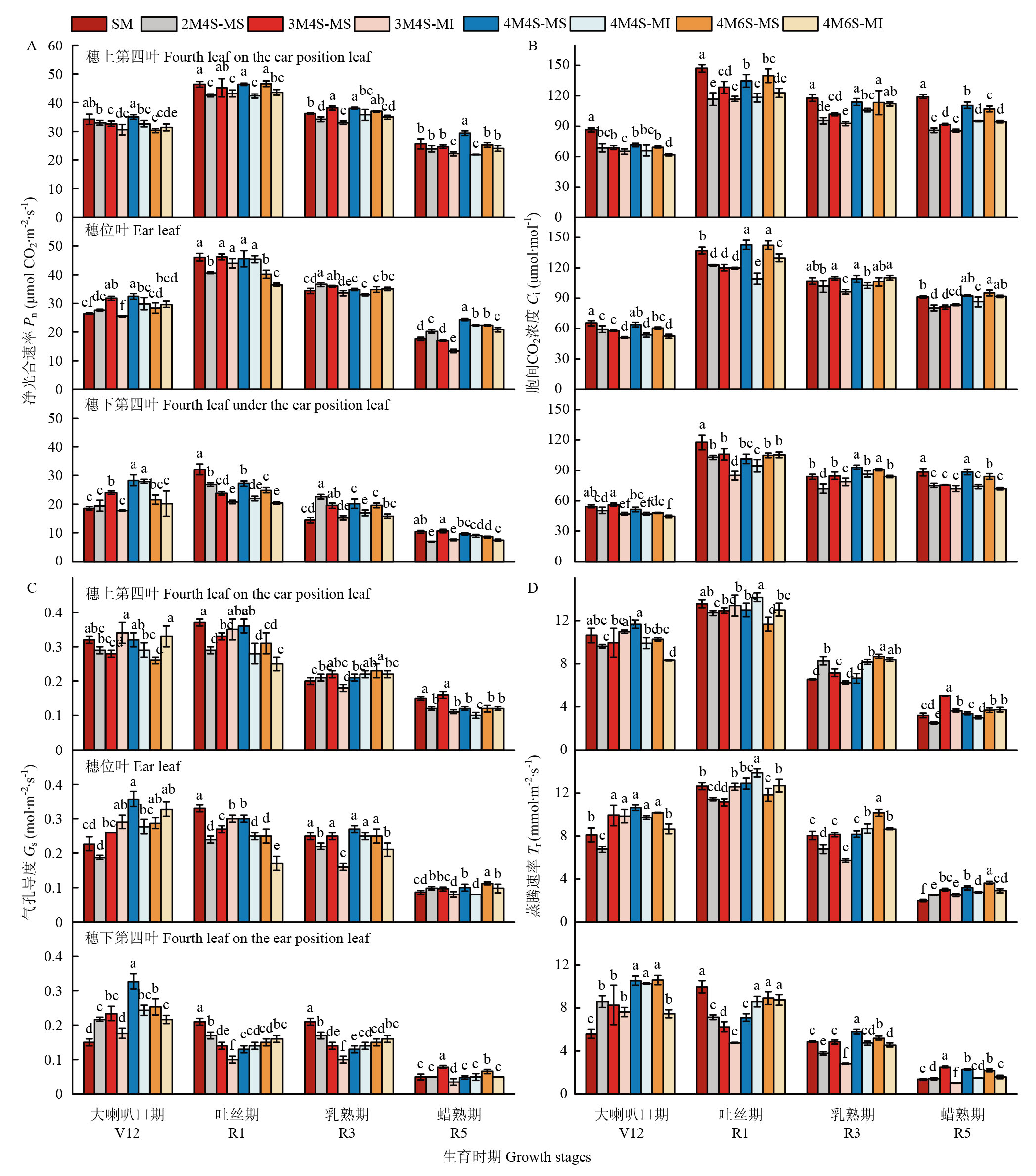
图4
不同行比配置对大豆气体交换参数的影响"
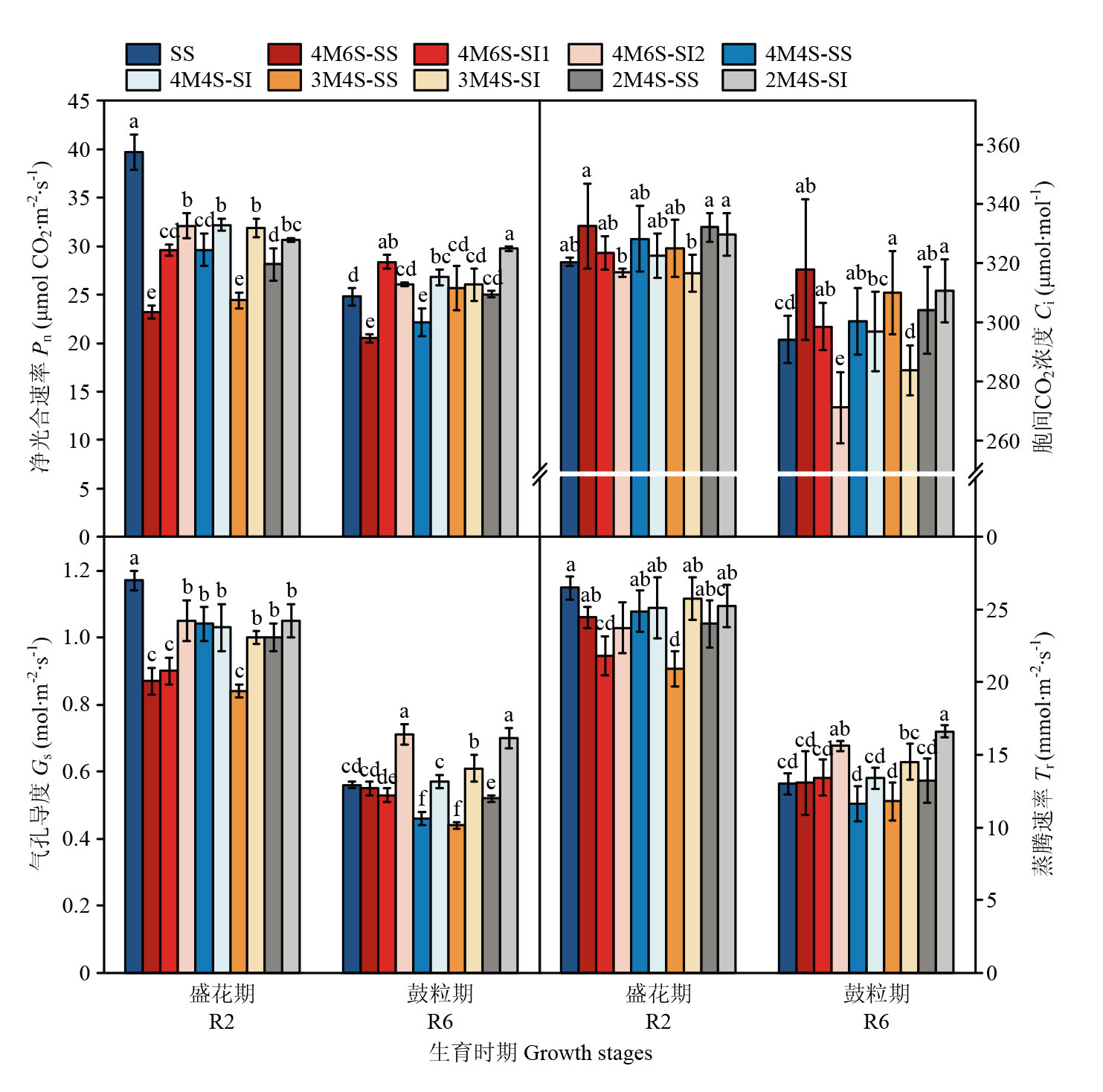
表2
不同模式下玉米产量及其构成因素"
| 年份 Year | 处理 Treatment | 边内行处理 Side-in-line treatment | 公顷穗数 Actual ear (×104·hm-2) | 穗粒数 Spike grain number | 千粒重 1000-grain weight (g) | 实际产量 Actual yield (t·hm-2) |
|---|---|---|---|---|---|---|
| 2023 | SM | 6.52±0.06A | 644.22±4.83AB | 336.35±1.17A | 12.01±0.13A | |
| 4M6S-MS | 3.21±0.02b | 564.34±2.55a | 294.01±3.47a | 4.99±0.19a | ||
| 4M6S-MI | 3.44±0.03a | 530.06±5.20b | 278.09±2.91b | 4.58±0.18b | ||
| 4M6S | 6.65±0.04A | 597.20±2.97B | 286.05±0.57C | 9.62±0.15C | ||
| 4M4S-MS | 3.21±0.05b | 565.84±2.90a | 306.60±1.61a | 5.33±0.16a | ||
| 4M4S-MI | 3.34±0.03a | 542.96±3.75b | 286.01±1.30b | 4.49±0.11b | ||
| 4M4S | 6.56±0.03A | 602.73±3.87A | 295.31±0.86B | 9.96±0.06B | ||
| 3M4S-MS | 3.35±0.03a | 545.60±2.23a | 284.57±2.03a | 4.96±0.20a | ||
| 3M4S-MI | 3.23±0.06b | 484.89±4.12b | 271.64±3.71b | 3.94±0.21b | ||
| 3M4S | 6.58±0.75A | 565.24±3.17D | 278.11±1.10E | 8.93±0.13E | ||
| 2M4S | 6.61±0.11A | 583.13±6.28C | 281.51±0.67D | 9.30±0.03D | ||
| 2024 | SM | 6.56±0.10A | 592.09±1.82A | 269.07±0.68A | 10.21±1.11A | |
| 4M6S-MS | 3.15±0.09b | 546.36±4.34a | 268.37±0.70a | 4.33±0.14a | ||
| 4M6S-MI | 3.37±0.07a | 504.36±8.41b | 257.92±1.15b | 3.81±0.06b | ||
| 4M6S | 6.53±0.05A | 525.36±4.95C | 263.10±0.82B | 8.14±0.18BC | ||
| 4M4S-MS | 3.19±0.03b | 555.24±3.87a | 265.58±3.10a | 4.43±0.30a | ||
| 4M4S-MI | 3.38±0.03a | 516.13±6.16b | 259.43±2.60ab | 4.04±0.19b | ||
| 4M4S | 6.57±0.01A | 535.69±3.47B | 262.50±2.69B | 8.47±0.13B | ||
| 3M4S-MS | 3.41±0.07a | 488.04±3.77a | 260.09±4.53a | 4.01±0.09a | ||
| 3M4S-MI | 3.20±0.06b | 474.49±6.34b | 249.56±1.19b | 3.93±0.14ab | ||
| 3M4S | 6.61±0.06A | 481.27±3.33E | 254.83±1.84C | 7.94±0.09C | ||
| 2M4S | 6.57±0.04A | 478.44±4.18D | 254.75±4.76C | 8.41±0.10BC |
表3
不同模式下大豆产量及其构成因素"
| 年份 Year | 处理 Treatment | 边内行处理 Side-in-line treatment | 公顷株数 Actual ear (×104·hm-2) | 株粒数 Number of grains per plant | 百粒重 100-grain weight (g) | 实际产量 Actual yield (t·hm-2) | |||||
|---|---|---|---|---|---|---|---|---|---|---|---|
| 2023 | SS | SS | 14.37±0.42A | 88.13±2.50A | 26.18±0.25A | 2.65±0.06A | |||||
| 4M6S-SS | 3.50±0.20b | 70.67±3.10ab | 23.96±0.49c | 0.40±0.01c | |||||||
| 4M6S-SI1 | 3.90±0.01a | 66.42±2.63b | 24.89±0.55b | 0.47±0.01b | |||||||
| 4M6S-SI2 | 3.81±0.07a | 72.27±4.35a | 25.85±0.21a | 0.58±0.03a | |||||||
| 4M6S | 11.19±0.22B | 69.79±3.11C | 24.90±0.19D | 1.47±0.02B | |||||||
| 4M4S-SS | 4.97±0.03b | 72.27±4.77b | 24.75±0.29a | 0.68±0.02b | |||||||
| 4M4S-SI | 5.13±0.14a | 79.07±3.41a | 24.71±0.32a | 0.79±0.02a | |||||||
| 4M4S | 10.80±0.19C | 75.67±2.85B | 24.73±0.10D | 1.48±0.03B | |||||||
| 3M4S-SS | 5.36±0.18ab | 68.60±1.71a | 24.79±0.25a | 0.62±0.01b | |||||||
| 3M4S-SI | 5.51±0.04a | 68.87±1.62a | 25.71±0.34a | 0.77±0.02a | |||||||
| 3M4S | 10.87±0.21C | 68.73±1.33C | 25.25±0.12C | 1.38±0.02C | |||||||
| 2M4S-SS | 4.95±0.17a | 62.27±2.04b | 25.87±0.34a | 0.57±0.02b | |||||||
| 2M4S-SI | 4.87±0.21ab | 72.47±1.40a | 25.97±0.48a | 0.78±0.03a | |||||||
| 2M4S | 10.81±0.27C | 67.37±0.59C | 25.92±0.06D | 1.33±0.03D | |||||||
| 2024 | SS | SS | 15.50±1.03A | 106.17±5.88A | 22.37±0.61BC | 2.38±0.10A | |||||
| 4M6S-SS | 2.44±0.16b | 43.67±3.20c | 22.97±0.58a | 0.32±0.01c | |||||||
| 4M6S-SI1 | 3.67±0.24a | 52.83±2.99b | 22.27±0.25b | 0.44±0.01b | |||||||
| 4M6S-SI2 | 3.63±0.24a | 63.67±3.08a | 22.13±0.13b | 0.65±0.03a | |||||||
| 4M6S | 10.59±0.20C | 63.22±5.21B | 22.54±0.15A | 1.41±0.05B | |||||||
| 4M4S-SS | 5.54±0.25b | 42.67±4.55b | 22.26±0.16b | 0.67±0.02b | |||||||
| 4M4S-SI | 5.96±0.10a | 54.33±4.59a | 22.91±0.09a | 0.72±0.01a | |||||||
| 4M4S | 11.49±0.21B | 57.83±2.93B | 22.59±0.12A | 1.39±0.03B | |||||||
| 3M4S-SS | 5.31±0.42b | 48.83±3.37ab | 22.43±0.16b | 0.57±0.01b | |||||||
| 3M4S-SI | 6.34±0.31a | 50.86±3.29a | 22.86±0.16a | 0.79±0.10a | |||||||
| 3M4S | 11.65±0.19B | 51.00±3.28B | 22.65±0.06A | 1.36±0.09B | |||||||
| 2M4S-SS | 4.90±0.17b | 48.86±5.21a | 22.23±0.34b | 0.54±0.02b | |||||||
| 2M4S-SI | 5.43±0.06a | 49.71±4.11a | 23.25±0.37a | 0.71±0.03a | |||||||
| 2M4S | 10.33±0.12C | 48.67±2.44B | 22.74±0.39A | 1.25±0.04C | |||||||
表4
间作模式对辐射能值利用率、土地当量比、净效应、种间竞争力和相对拥挤系数的影响"
| 年份 Year | 处理 Treatment | 辐射能值利用率 Solar energy utilization efficiency (%) | 土地当量比 Land equivalent ratio | 净效应 Net effect | 攻击力 Ams | 相对拥挤系数 Relative congestion factor |
|---|---|---|---|---|---|---|
| 2023 | 4M6S | 9.52±0.10b | 1.36±0.01b | 3822.09±109.10b | 0.52±0.06b | 5.20±0.19ab |
| 4M4S | 9.70±0.09a | 1.39±0.01a | 3407.32±74.11c | 0.12±0.02d | 4.56±0.28b | |
| 3M4S | 8.89±0.13c | 1.27±0.02c | 2975.63±144.48d | 0.44±0.02c | 3.18±0.27c | |
| 2M4S | 8.87±0.12c | 1.28±0.02c | 4302.84±25.89a | 1.14±0.04a | 5.39±0.37a | |
| SM | 5.23±0.01d | |||||
| SS | 9.60±0.02b | |||||
| 2024 | 4M6S | 8.57±0.26ab | 1.38±0.01b | 3275.38±146.16b | 0.45±0.07b | 5.67±0.42ab |
| 4M4S | 8.64±0.16a | 1.41±0.01a | 2920.36±152.54c | 0.10±0.02c | 4.55±0.59bc | |
| 3M4S | 8.30±0.36b | 1.34±0.02c | 2980.25±116.74c | 0.42±0.01b | 4.70±0.46c | |
| 2M4S | 8.11±0.19c | 1.27±0.03d | 4005.18±130.52a | 1.35±0.01a | 5.82±0.72a | |
| SM | 4.45±0.05d | |||||
| SS | 8.62±0.04a |
| [1] |
武晶, 陈梦, 汪直华, 杨继芝, 李燕丽, 吴雨珊, 杨文钰. 带状间作不同带间距对玉米光能利用的影响. 中国农业科学, 2023, 56(23): 4648-4659. doi: 10.3864/j.issn.0578-1752.2023.23.007.
|
|
|
|
| [2] |
doi: 10.1016/j.agrformet.2023.109527 |
| [3] |
李双伟, 朱俊奇,
|
|
doi: 10.12133/j.smartag.SA202202002 |
|
| [4] |
doi: 10.1016/j.fcr.2018.05.010 |
| [5] |
doi: 10.5814/j.issn.1674-764x.2012.02.009 |
| [6] |
doi: 10.1111/pce.v40.12 |
| [7] |
doi: 10.1007/s11099-016-0217-7 |
| [8] |
苗淑杰, 郭嫣, 杨海超, 夏可, 乔云发. 改变行向对水稻冠层光能利用效率和产量的影响. 中国农学通报, 2023, 39(36): 8-13.
doi: 10.11924/j.issn.1000-6850.casb2023-0007 |
|
doi: 10.11924/j.issn.1000-6850.casb2023-0007 |
|
| [9] |
李静, 王洪章, 许佳诣, 刘鹏, 张吉旺, 赵斌, 任佰朝. 不同栽培模式对夏玉米冠层结构及光合性能的影响. 中国农业科学, 2020, 53(22): 4550-4560. doi: 10.3864/j.issn.0578-1752.2020.22.003.
|
|
|
|
| [10] |
doi: 10.1016/j.eja.2025.127853 |
| [11] |
杨飞, 张柏, 宋开山, 王宗明, 刘焕军, 杜嘉. 玉米和大豆光合有效辐射吸收比例与植被指数和叶面积指数的关系. 作物学报, 2008, 34(11): 2046-2052.
doi: 10.3724/SP.J.1006.2008.02046 |
|
doi: 10.3724/SP.J.1006.2008.02046 |
|
| [12] |
程彬, 刘卫国, 王莉, 许梅, 覃思思, 卢俊吉, 高阳, 李淑贤,
|
|
|
|
| [13] |
doi: 10.1016/j.eja.2023.126871 |
| [14] |
doi: 10.1016/j.fcr.2023.109179 |
| [15] |
doi: 10.3390/agronomy14061216 |
| [16] |
杨蕾. 玉米/大豆带状套作模式的能流及能值分析[D]. 雅安: 四川农业大学, 2023.
|
|
|
|
| [17] |
陈俊南, 姜文洋, 昝志曼, 汪江涛, 郑宾, 刘领, 刘娟, 焦念元. 玉米和花生同垄间作对作物光合特性和间作优势的影响. 应用生态学报, 2023, 34(10): 2672-2682.
doi: 10.13287/j.1001-9332.202310.010 |
|
doi: 10.13287/j.1001-9332.202310.010 |
|
| [18] |
张东升. 风沙半干旱区玉米/花生间作光能高效捕获和利用[D]. 北京: 中国农业大学, 2018.
|
|
|
|
| [19] |
|
| [20] |
doi: 10.1016/j.eja.2023.126943 |
| [21] |
doi: 10.1016/j.cj.2019.09.009 |
| [22] |
闫尚龙, 王琦明, 柴强, 殷文, 樊志龙, 胡发龙, 刘志鹏, 韦金贵. 绿洲灌区玉米籽粒产量及品质对密植及间作豌豆的响应. 作物学报, 2025, 51(6): 1665-1675.
doi: 10.3724/SP.J.1006.2025.43051 |
|
|
|
| [23] |
李相花, 范彩英, 徐芹, 侯剑, 王慧, 刘艳艳, 王恒, 刘光亚, 韩伟. 不同玉米大豆种植模式对作物产量、经济效益与土壤养分的影响. 中国农学通报, 2025, 41(6): 22-28.
doi: 10.11924/j.issn.1000-6850.casb2024-0762 |
|
doi: 10.11924/j.issn.1000-6850.casb2024-0762 |
|
| [24] |
doi: 10.1016/j.jia.2023.12.025 |
| [25] |
doi: 10.1016/j.eja.2015.05.004 |
| [26] |
doi: 10.1016/j.fcr.2021.108239 |
| [27] |
王佳芯, 胡静一, 张巍, 魏骞, 王涛, 王小林, 张雄, 张盼盼. 覆膜方式对间作玉米光合物质生产及水分利用效率的影响. 中国农业科学, 2025, 58(3): 460-477. doi: 10.3864/j.issn.0578-1752.2025.03.005.
|
|
|
|
| [28] |
doi: 10.1016/j.fcr.2020.108054 |
| [29] |
doi: 10.1016/j.fcr.2007.12.014 |
| [30] |
doi: 10.1016/j.fcr.2021.108329 |
| [31] |
朱冠雄, 高祺, 华方静, 田艺心, 朱金英, 李春燕, 王春雨, 曹鹏鹏, 王士岭, 高凤菊. 鲁西北地区大豆玉米间作不同行比配置对大豆生长、产量及间作系统的影响. 中国油料作物学报, 2025, 47(4): 970-979.
doi: 10.19802/j.issn.1007-9084.2024056 |
|
|
|
| [32] |
杜雄, 窦铁岭, 冯丽肖, 张维宏, 张立峰. 华北农牧交错带退耕区榆树幼林-南瓜间作的农田生态效应. 中国农业科学, 2008, 41(9): 2710-2719. doi: 10.3864/j.issn.0578-1752.2008.09.019.
|
|
|
|
| [33] |
doi: 10.1016/S0378-4290(00)00083-6 |
| [34] |
蔡倩, 孙占祥, 郑家明, 王文斌, 白伟, 冯良山, 杨宁, 向午燕, 张哲, 冯晨. 辽西半干旱区玉米大豆间作模式对作物干物质积累分配、产量及土地生产力的影响. 中国农业科学, 2021, 54(5): 909-920. doi: 10.3864/j.issn.0578-1752.2021.05.004.
|
|
|
|
| [35] |
杨姝, 白伟, 蔡倩, 杜桂娟. 玉米‖紫花苜蓿间作群体光分布特征及对植物性状和产量的影响. 作物学报, 2025, 51 (9): 2514-2526.
doi: 10.3724/SP.J.1006.2025.53004 |
|
doi: 10.3724/SP.J.1006.2025.53004 |
|
| [36] |
赵德强, 李彤, 侯玉婷, 元晋川, 廖允成. 玉米大豆间作模式下干物质积累和产量的边际效应及其系统效益. 中国农业科学, 2020, 53(10): 1971-1985. doi: 10.3864/j.issn.0578-1752.2020.10.005.
|
|
|
|
| [37] |
|
| [38] |
刘涵, 丁迪, 汪江涛, 郑宾, 王笑笑, 朱晨旭, 刘娟, 刘领, 付国占, 焦念元. 玉米穗型与种植密度对玉米花生间作种间竞争的协调效应. 中国农业科学, 2024, 57(19): 3758-3769. doi: 10.3864/j.issn.0578-1752.2024.19.004.
|
|
|
| [1] | 蒲丽霞, 张佳芮, 叶建萍, 黄秀兰, 樊高琼, 杨洪坤. 二氢赤霉素与秸秆覆盖对旱地小麦分蘖成穗与产量的影响[J]. 中国农业科学, 2025, 58(9): 1735-1748. |
| [2] | 郭晨荔, 刘扬, 陈燕, 胡伟, 王友华, 周治国, 赵文青. 减氮条件下适当磷肥后移对滴灌棉花产量和磷肥利用效率的影响[J]. 中国农业科学, 2025, 58(9): 1749-1766. |
| [3] | 刘劲松, 伍龙梅, 包晓哲, 刘志霞, 张彬, 杨陶陶. 短期减施氮肥对华南地区早晚兼用型水稻产量和稻米品质的影响[J]. 中国农业科学, 2025, 58(8): 1508-1520. |
| [4] | 韦文华, 李盼, 邵冠贵, 樊志龙, 胡发龙, 范虹, 何蔚, 柴强, 殷文, 赵连豪. 西北灌区青贮玉米产量及品质对减量灌水与有机无机肥配施的响应[J]. 中国农业科学, 2025, 58(8): 1521-1534. |
| [5] | 薛钰琦, 赵继玉, 孙旺胜, 任佰朝, 赵斌, 刘鹏, 张吉旺. 不同氮素形态对夏玉米产量和品质的影响[J]. 中国农业科学, 2025, 58(8): 1535-1549. |
| [6] | 李绍兴, 宋稳锋, 魏泽煜, 周玉玲, 宋李霞, 任可, 马群, 王龙昌. 秸秆与紫云英覆盖对土壤肥力及甘薯产量的影响[J]. 中国农业科学, 2025, 58(8): 1591-1603. |
| [7] | 尹波, 于爱忠, 王鹏飞, 杨学慧, 王玉珑, 尚永盼, 张冬玲, 刘亚龙, 李悦, 王凤. 绿肥还田结合氮肥减施对干旱灌区麦田土壤水热特征及小麦产量的影响[J]. 中国农业科学, 2025, 58(7): 1366-1380. |
| [8] | 陈桂平, 李盼, 邵冠贵, 吴霞玉, 殷文, 赵连豪, 樊志龙, 胡发龙. 减量灌水与有机无机肥配施对青贮玉米吐丝期后叶片持绿特性的调控作用[J]. 中国农业科学, 2025, 58(7): 1381-1396. |
| [9] | 张洪程, 邢志鹏, 张瑞宏, 单翔, 奚小波, 程爽, 翁文安, 胡群, 崔培媛, 魏海燕. 小麦整合化无人化丰产栽培的特征与技术途径[J]. 中国农业科学, 2025, 58(5): 864-876. |
| [10] | 张涵, 张玉琪, 黎景来, 徐虹, 李维环, 李涛. LED补光对日光温室基质栽培草莓生产及叶片生理特性的影响[J]. 中国农业科学, 2025, 58(5): 975-990. |
| [11] | 陈鸽, 谷雨, 文炯, 傅岳峰, 何兮, 李薇, 周峻宇, 刘琼峰, 吴海勇. 冬闲杂草还田对水稻光合物质生产和产量的影响[J]. 中国农业科学, 2025, 58(4): 647-659. |
| [12] | 苏明, 李翻过, 洪自强, 周甜, 柳强娟, 班文慧, 吴宏亮, 康建宏. 施氮缓解旱地马铃薯花后高温早衰的抗氧化特性研究[J]. 中国农业科学, 2025, 58(4): 660-675. |
| [13] | 史帆, 李文广, 易树生, 杨娜, 陈玉萌, 郑伟, 张雪辰, 李紫燕, 翟丙年. 有机无机肥配施下旱地麦田土壤有机碳组分含量的变化特征[J]. 中国农业科学, 2025, 58(4): 719-732. |
| [14] | 罗一诺, 李艳霏, 李文虎, 张思琦, 牟文燕, 黄宁, 孙蕊卿, 丁玉兰, 佘文婷, 宋文斌, 李小涵, 石美, 王朝辉. 我国新育成小麦品种(系)籽粒不同部位铁含量及影响因素[J]. 中国农业科学, 2025, 58(3): 416-430. |
| [15] | 仇海龙, 李盼, 张殿凯, 樊志龙, 胡发龙, 陈桂平, 范虹, 何蔚, 殷文, 赵连豪. 西北绿洲灌区麦后复种绿肥对减量施氮春小麦生长及产量的补偿效应[J]. 中国农业科学, 2025, 58(3): 443-459. |
|
||
