






中国农业科学 ›› 2026, Vol. 59 ›› Issue (7): 1467-1479.doi: 10.3864/j.issn.0578-1752.2026.07.007
王晶1,2( ), 李岗2, 蔡晓雅2, 庞璐瑶2, 黄青滢2, 林宝义3, 孔海民3, 郝跃2, 任海英2()
收稿日期:2025-11-25
接受日期:2025-12-30
出版日期:2026-04-08
发布日期:2026-04-08
通信作者:
联系方式:
王晶,E-mail:994652165@qq.com。
基金资助:
WANG Jing1,2(), LI Gang2, CAI XiaoYa2, PANG LuYao2, HUANG QingYing2, LIN BaoYi3, KONG HaiMin3, HAO Yue2, REN HaiYing2()
Received:2025-11-25
Accepted:2025-12-30
Published:2026-04-08
Online:2026-04-08
摘要:
【背景】杨梅凋萎病是制约杨梅产业稳定发展的重要病害之一,严重影响果实产量和品质。当前生产中防控该病害仍以化学药剂为主,长期使用易带来抗药性风险及生态安全隐患。因此,亟需挖掘来源稳定、安全高效的生防微生物资源,构建绿色可持续的病害防控体系。【目的】从杨梅树体内筛选具有拮抗潜力的内生芽孢杆菌,构建合成菌群(synthetic community,SynCom),并系统评价其对杨梅凋萎病的防控效果及相关作用特征。【方法】采用组织分离法从健康和病株杨梅植株的茎、枝条和叶片中分离获得内生芽孢杆菌,采用平板对峙法筛选对杨梅凋萎病病原菌(Pestalotiopsis versicolor)XJ27具有拮抗活性的菌株。进一步通过离体叶片接种试验筛选获得7株具有稳定抑病能力的菌株,并据此构建SynCom。在温室条件下,对单菌株及SynCom的防病效果进行评价。同时,通过观察病原菌菌丝形态变化,并结合胞外酶活性、铁载体产生能力、生物膜形成能力及脂肽类物质粗提物的抑菌活性测定,对菌株的潜在抑菌作用进行分析。【结果】7株芽孢杆菌单独处理对杨梅凋萎病的防治效果为24.67%—50.67%,而SynCom处理的防治效果可达61.33%,较单菌株处理提高21.04%—148.60%(以单菌株防治效果为基数计算的相对提升幅度)。形态学观察显示,经生防菌处理后,病原菌菌丝出现膨大、扭曲及断裂等异常现象。进一步分析发现,各菌株均具备一定的胞外酶分泌能力和铁载体产生能力,并能够形成生物膜,其脂肽类粗提物对病原菌表现出浓度依赖性的抑制作用,表明多种拮抗因子可能协同参与抑病过程。【结论】杨梅树体内蕴藏具有应用潜力的生防芽孢杆菌资源,构建的SynCom在防控效果方面优于单一菌株处理,在病害抑制方面具有明显优势。研究结果可为基于树体内生微生物资源构建杨梅凋萎病绿色防控技术体系提供菌种资源支持。
王晶, 李岗, 蔡晓雅, 庞璐瑶, 黄青滢, 林宝义, 孔海民, 郝跃, 任海英. 杨梅凋萎病生防芽孢杆菌的筛选及其防病机制[J]. 中国农业科学, 2026, 59(7): 1467-1479.
WANG Jing, LI Gang, CAI XiaoYa, PANG LuYao, HUANG QingYing, LIN BaoYi, KONG HaiMin, HAO Yue, REN HaiYing. Screening of Biocontrol Bacillus Strains Against Bayberry Twig Blight Disease and Investigation of Their Disease-Suppressive Mechanisms[J]. Scientia Agricultura Sinica, 2026, 59(7): 1467-1479.

图1
生防菌对XJ27菌丝生长及离体叶片的病害防控效果 A:生防菌株对XJ27菌丝生长的抑制作用Mycelial growth inhibition of XJ27 by biocontrol strains;B:相应的菌丝生长抑制率The corresponding mycelial growth inhibition rate;C:不同生防菌处理下离体叶片的病害症状Detached leaf disease symptoms under biocontrol bacterial treatments;D:相应的离体叶片防治效果The corresponding disease control efficacy on detached leaves。误差线上的不同小写字母表示在P<0.05水平下经Duncan检验差异显著,图4-E同Different lowercase letters above the error bars indicate significant differences (P<0.05) according to Duncan’s test, the same as Fig. 4-E"

图2
7株细菌菌株的形态学特征及基于16S rRNA基因序列的分子鉴定 A:菌株的形态学特征Morphological characterization of the strains;B:菌株16S rRNA基因的PCR扩增产物PCR amplification products of 16S rRNA genes from the strains;C:基于菌株16S rRNA基因序列构建的系统进化树Phylogenetic tree based on 16S rRNA gene sequences of the strains"

图3
单菌株及其SynCom处理下XJ27菌丝形态的显微镜观察 白色实线框标示用于放大的典型异常区域,其对应的放大图位于每张图的右上角;白色虚线框标示观察到的其他异常结构"

图4
生防菌株的胞外酶活性、铁载体产生及生物膜形成能力 A:蛋白酶活性Protease activity; B:淀粉酶活性Amylase activity;C:纤维素酶活性Cellulase activity;D:铁载体产生能力Siderophore production capacity;E:生物膜形成能力Biofilm formation capacity"

图5
单菌株及其SynCom产生的脂肽粗提物对XJ27的抑菌活性"
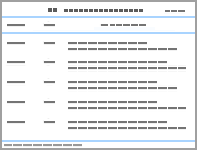
表1
单菌株及其SynCom脂肽粗提物对XJ27的抑菌率"
| 处理Treatment | 0 μg/disc | 80 μg/disc | 160 μg/disc |
|---|---|---|---|
| GJB1 | 0 | 44.12±0ab | 49.02±3.40a |
| SL5B10 | 0 | 28.95±0d | 36.80±0bc |
| SJ4B5 | 0 | 6.67±0e | 20.00±3.33d |
| GLB4 | 0 | 34.70±7.07c | 48.98±3.53a |
| A49 | 0 | 23.40±6.38d | 31.91±3.69c |
| A98 | 0 | 42.50±4.33ab | 50.00±4.33a |
| A85 | 0 | 38.64±0c | 38.64±0b |
| SynCom | 0 | 45.74±3.19a | 51.06±7.37a |

图6
温室条件下单菌株及其SynCom对杨梅凋萎病的防治效果 框线标示叶片病斑区"
表2
不同芽孢杆菌菌株及其SynCom对杨梅凋萎病的防治效果"
| 处理 Treatment | 病情指数 DI | 防治效果 Control efficacy (%) | 处理 Treatment | 病情指数 DI | 防治效果 Control efficacy (%) | |
|---|---|---|---|---|---|---|
| CK | 0e | — | GLB4 | 41.33±8.96cd | 50.33±10.12ab | |
| A85 | 57.67±2.89b | 30.67±4.04c | SL5B10 | 41.00±9.17cd | 50.67±10.69ab | |
| A49 | 62.67±8.33b | 24.67±7.46c | SynCom | 0e | — | |
| A98 | 57.33±2.31b | 31.33±2.89c | SynCom-XJ27 | 32.33±0.58d | 61.33±1.15a | |
| GJB1 | 45.00±11.53c | 46.00±13.53b | XJ27 | 83.00±2.65a | 0d | |
| SJ4B5 | 58.00±9.00b | 30.67±10.02c |
| [1] |
孔海民, 韩昊, 林宝义, 叶放, 任海英, 杨东, 聂新军, 陈钰佩, 王天宇, 李岗. 模糊综合评价法分析仙居县典型杨梅园土壤肥力特征. 中国土壤与肥料, 2025(6): 30-37.
|
|
|
|
| [2] |
doi: 10.1007/s10658-013-0255-y |
| [3] |
任海英, 徐巧, 戚行江, 俞浙萍, 郑锡良, 张淑文, 王震铄. 健康与凋萎病杨梅树体及根围菌群的差异. 应用生态学报, 2021, 32(9): 3107-3118.
doi: 10.13287/j.1001-9332.202109.005 |
|
|
|
| [4] |
林瑞, 任海英, 安笑笑, 郑锡良, 梁森苗, 张淑文, 戚行江. 生物有机肥对杨梅凋萎病防控及其树势恢复的影响. 浙江农业学报, 2019, 31(7): 1096-1104.
doi: 10.3969/j.issn.1004-1524.2019.07.09 |
|
doi: 10.3969/j.issn.1004-1524.2019.07.09 |
|
| [5] |
任海英, 戚行江, 陈安良, 郑锡良, 梁森苗, 颜丽菊, 王继灿, 李岗. 十种杀菌剂对杨梅凋萎病的药效评价. 果树学报, 2013, 30(5): 848-853.
|
|
|
|
| [6] |
龚碧涯, 李先信, 刘慧, 肖伏莲, 刘娟, 黄远龙, 刘晗. 10种药剂处理对杨梅凋萎病的防控效果评价. 中国南方果树, 2024, 53(5): 101-105.
|
|
|
|
| [7] |
doi: 10.3390/molecules28186735 |
| [8] |
doi: 10.1038/s41579-022-00819-5 |
| [9] |
doi: 10.3390/cells11172643 |
| [10] |
doi: 10.1007/s12374-023-09404-6 |
| [11] |
doi: 10.1111/mbt2.v16.12 |
| [12] |
doi: 10.31083/FBL23223 |
| [13] |
doi: 10.1038/s41564-023-01379-x pmid: 37142774 |
| [14] |
doi: 10.1094/PDIS-04-21-0858-A |
| [15] |
doi: 10.3390/jof11060416 |
| [16] |
doi: 10.1038/s42003-023-04417-w pmid: 36631600 |
| [17] |
doi: 10.1016/j.ijfoodmicro.2025.111317 |
| [18] |
doi: 10.3390/jof9080828 |
| [19] |
doi: 10.3390/agronomy9020105 |
| [20] |
doi: 10.3389/fpls.2021.756368 |
| [21] |
doi: 10.3390/microorganisms13010133 |
| [22] |
|
| [23] |
doi: 10.3390/plants14111625 |
| [24] |
|
| [25] |
doi: 10.1021/acs.jafc.4c12416 pmid: 40616790 |
| [26] |
doi: 10.3390/agronomy10111811 |
| [27] |
|
| [28] |
doi: 10.3390/plants13162246 |
| [29] |
|
| [30] |
杨然迪, 杨怡妍, 曹灏, 金京, 陈杰. 贝莱斯芽孢杆菌TCS001产脂肽类物质抑菌活性及发酵条件优化. 农药学学报, 2024, 26(3): 504-516.
|
|
|
|
| [31] |
吴静禾, 刘丽颖, 高岩, 卢顺光, 戈素芬, 梁月, 胡建忠, 夏博. 沙棘果实炭疽病病原菌鉴定及其生防菌筛选. 果树学报, 2025, 42(10): 2392-2404.
|
|
|
|
| [32] |
周嘉敏, 赵阿慧, 郑琳冉, 崔永和, 蒋春号, 李江舟, 代快, 牛冬冬. 烟草黑胫病生防菌的筛选鉴定及防治效果研究. 植物病理学报, 2025, 55(4): 898-910.
doi: 10.13926/j.cnki.apps.001712 |
|
doi: 10.13926/j.cnki.apps.001712 |
|
| [33] |
赵文娟, 付博, 徐升运, 任平. 生防菌SF1103、SF1104对黄瓜枯萎病菌的拮抗作用. 西北农业学报, 2017, 26(10): 1537-1543.
|
|
|
|
| [34] |
doi: 10.1016/j.dib.2019.104951 |
| [35] |
doi: 10.1111/j.1600-0463.2007.apm_630.x pmid: 17696944 |
| [36] |
任海英, 戚行江, 梁森苗, 郑锡良. 杨梅凋萎病综合防治技术试验. 浙江农业科学, 2014(12): 1849-1855.
|
|
|
|
| [37] |
|
| [38] |
doi: 10.3390/ijms140815838 pmid: 23903045 |
| [39] |
doi: 10.1186/s40168-021-01169-9 |
| [40] |
doi: 10.1186/s12870-024-05253-8 pmid: 38872113 |
| [41] |
doi: 10.3390/ijms25084437 |
| [42] |
|
| [43] |
doi: 10.1038/s41564-020-0719-8 pmid: 32393858 |
| [44] |
doi: 10.1016/j.colsurfb.2024.113933 |
| [45] |
doi: 10.3390/agronomy15030513 |
| [1] | 鄢文英, 张元珍, 吴洪鑫, 庞锐, 陈泽鹏, 金丰良, 许小霞. 靶向小菜蛾PxGNBP3的RNAi增效绿僵菌构建及其免疫调控机制[J]. 中国农业科学, 2026, 59(3): 556-574. |
| [2] | 从琪琪, 张静怡, 孟祥龙, 戴蓬博, 李波, 胡同乐, 王树桐, 曹克强, 王亚南. 我国苹果轮纹病弱毒菌株中病毒的鉴定及其携带情况的检测[J]. 中国农业科学, 2025, 58(3): 478-492. |
| [3] | 谢海鹏, 林俊旭, 刘勇, 麦贤俊, 罗丰, 王学武, 谢文, 李少卡, 孔祥义, 吴小燕. 施用不同有机肥对贝莱斯芽孢杆菌SD13防控豇豆枯萎病的影响[J]. 中国农业科学, 2025, 58(21): 4405-4420. |
| [4] | 胡佳燕, 沈之涵, 温丽慧, 郁嘉豪, 章雨君, 蒋冬花. 水稻细菌性条斑病菌拮抗放线菌的鉴定及其防病和促生功能[J]. 中国农业科学, 2025, 58(17): 3434-3450. |
| [5] | 赵琳琳, 贺羽茜, 彭杰丽, 王旭, 马佳, 张秀敏, 胡栋. 链霉菌TOR3209及其挥发性有机化合物提高烟草抗木贼镰孢的能力[J]. 中国农业科学, 2025, 58(11): 2162-2175. |
| [6] | 廖鑫琳, 郭鑫, 杨季学, 邵嘉朱, 袁歆瑜, 胡佳燕, 陈晓晓, 蒋冬花. 拮抗青枯雷尔氏菌的放线菌筛选及其防病作用[J]. 中国农业科学, 2024, 57(7): 1319-1334. |
| [7] | 石娜, 路杨, 隋丽, 王佳江, 赵宇, 李启云, 张正坤. 莱氏绿僵菌与异色瓢虫协同增效防治蚜虫研究[J]. 中国农业科学, 2024, 57(17): 3398-3407. |
| [8] | 罗万珍, 王丹, 齐宏玥, 王彤, 刘政, 田李, 戴小枫, 陈捷胤, 麦合木提江·米吉提. 拮抗细菌KRS022的鉴定及对大丽轮枝菌的抑制效果[J]. 中国农业科学, 2023, 56(4): 649-664. |
| [9] | 郭宁, 孙华, 马红霞, 刘树森, 张海剑, 石洁, 郑晓娟, 董跃广. 玉米腐霉茎腐病生防木霉菌株的筛选、鉴定及防治效果分析[J]. 中国农业科学, 2023, 56(22): 4453-4466. |
| [10] | 王炫栋, 宋振, 兰赫婷, 江樱姿, 齐文杰, 刘晓阳, 蒋冬花. 杨梅园土壤优势放线菌的分离及其防病促生功能[J]. 中国农业科学, 2023, 56(2): 275-286. |
| [11] | 沙月霞, 黄泽阳, 马瑞. 嗜碱假单胞菌Ej2对稻瘟病的防治效果及对水稻内源激素的影响[J]. 中国农业科学, 2022, 55(2): 320-328. |
| [12] | 陈洋,赵红怡,闫俊杰,黄剑,高玉林. 马铃薯块茎蛾性信息素化学合成研究现状[J]. 中国农业科学, 2021, 54(3): 556-572. |
| [13] | 曹钰晗,李紫腾,张静怡,张静娜,胡同乐,王树桐,王亚南,曹克强. 我国苹果斑点落叶病菌携带dsRNA分析及一种dsRNA病毒的鉴定[J]. 中国农业科学, 2021, 54(22): 4787-4799. |
| [14] | 胡昌雄,范苇,张倩,陈国华,殷红慧,徐天养,杨进波,杨航,吴道慧,张晓明. 基于两性生命表和年龄-阶段捕食率的南方小花蝽对西花蓟马的控制作用[J]. 中国农业科学, 2021, 54(13): 2769-2780. |
| [15] | 李扬凡,邵美琪,刘畅,郭庆港,王培培,陈秀叶,苏振贺,马平. 解淀粉芽孢杆菌HMB33604的抑菌物质及对马铃薯黑痣病的防治效果[J]. 中国农业科学, 2021, 54(12): 2559-2569. |
|
||
