






中国农业科学 ›› 2026, Vol. 59 ›› Issue (3): 668-686.doi: 10.3864/j.issn.0578-1752.2026.03.014
贾子成1( ), 秦冰雨2, 马彩英3, 杜勇4, 刘统高5, 薛瑞林6, 王小龙1(), 周世卫1,2()
收稿日期:2025-08-02
接受日期:2025-12-18
出版日期:2026-02-01
发布日期:2026-01-31
通信作者:
联系方式:
贾子成,Tel:17734368262;E-mail:jiazicheng1999@163.com。
基金资助:
JIA ZiCheng1(), QIN BingYu2, MA CaiYing3, DU Yong4, LIU TongGao5, XUE RuiLin6, WANG XiaoLong1(), ZHOU ShiWei1,2()
Received:2025-08-02
Accepted:2025-12-18
Published:2026-02-01
Online:2026-01-31
摘要:
【目的】通过研究不同营养水平饲粮对产双羔泌乳期陕北白绒山羊母羊生产性能、血清生化指标、乳成分、瘤胃菌群结构及功能、羔羊生长性能的影响,为建立产双羔泌乳期陕北白绒山羊母羊精准营养供给技术体系、降低养殖成本、提高陕北白绒山羊产业经济效益和可持续发展能力提供科学依据。【方法】选取32只遗传背景一致、体况体重相近((46.60±1.45)kg)的产双羔泌乳期陕北白绒山羊2—3岁母羊,随机分为4组,对照组(CON组)饲喂基础饲粮,低营养水平组(LEL组)、中营养水平组(MEL组)和高营养水平组(HEL组)分别饲喂能量和蛋白质水平为基础饲粮1.12、1.24和1.36倍的饲粮,母羊分娩当天即为试验正式开始时间,正试期90 d。试验羊于试验0、90 d晨饲前空腹称初重(IBM)、末重(FBW),试验期间记录每日给料/剩料量,计算体增重(BWG)、平均日增重(ADG)、干物质日采食量(DMI);母羊产后45 d,每日两次试情,记录母羊发情时间;配种30 d,采用直肠扫描法判断母羊是否怀孕,计算妊娠率,羔羊出生后每2周称重,记录其断奶天数,计算羔羊ADG;各组随机选5只母羊,于产后0、30、60 d晨空腹静脉采血取血清,测定甘油三酯(TG)等10项血清生化指标;同批次5只母羊产后0、30、60 d,人工挤乳100 mL,测定乳脂、乳蛋白等乳成分;试验第60 天,晨饲前每组随机选择6只母羊,采集瘤胃液,进行宏基因组分析。【结果】(1)MEL组的母羊体增重极显著高于其他3个组(P<0.01);MEL组母羊发情间隔显著低于CON组(P<0.05)。MEL组和HEL组羔羊平均日增重极显著高于CON组和LEL组(P<0.01);MEL组和HEL组羔羊断奶日龄极显著低于CON组和LEL组(P<0.01)。(2)在产后60 d时,MEL组母羊血清中GLU含量显著高于其他3个组(P<0.05);MEL组和HEL组母羊血清中TC、TG、HDL、LDL的含量显著高于CON组和LEL组(P<0.05)。(3)在产后60 d时,MEL组和HEL组母羊乳汁中乳脂和乳蛋白含量显著高于CON组和LEL组(P<0.05),HEL组母羊乳汁中乳尿素氮含量显著高于其他3个组(P<0.05)。(4)宏基因组测序结果显示,4个组的Ace、Chao 1、Shannon和Simpson指数均无显著差异(P>0.05)。PCoA结果显示4个组之间的瘤胃微生物菌结构差异显著(P<0.05)。门水平上,CON组的拟杆菌门(Bacteroidota)相对丰度显著高于HEL组,而芽孢杆菌门(Bacillota)相对丰度显著低于HEL组。属水平上,HEL组月单胞菌属(Selenomonas)的相对丰度显著高于CON和LEL组。KEGG功能注释表明,在level 3水平上,随着营养水平的提高,双组分系统(Two-component system)、鞭毛组装(Flagellar assembly)显著富集(P<0.05);而核苷酸代谢(Nucleotide metabolism)、其他碳固定途径(Other carbon fixation pathways)在低营养饲粮处理组显著富集(P<0.05)。CAZy功能分析结果表明,随着饲粮营养水平的提高GH28、GH2、CBM13基因丰度显著降低(P<0.05);而CBM43、GT9、GT41基因丰度显著富集(P<0.05)。【结论】综上所述,产双羔陕北白绒山羊泌乳期最适饲粮为MEL组,饲粮中代谢能为9.91 MJ·kg-1,粗蛋白质水平为10.64%。
贾子成, 秦冰雨, 马彩英, 杜勇, 刘统高, 薛瑞林, 王小龙, 周世卫. 饲粮营养水平对双羔陕北白绒山羊母子一体化生产性能和瘤胃微生物的影响[J]. 中国农业科学, 2026, 59(3): 668-686.
JIA ZiCheng, QIN BingYu, MA CaiYing, DU Yong, LIU TongGao, XUE RuiLin, WANG XiaoLong, ZHOU ShiWei. Effects of Diets with Different Nutritional Levels on Maternal-Infant Integrated Production Performance and Rumen Microorganisms of Double-Lamb Shanbei White Cashmere Goats[J]. Scientia Agricultura Sinica, 2026, 59(3): 668-686.

表1
试验饲粮组成及营养水平(风干基础)"
| 项目 Items | 组别 Groups | |||
|---|---|---|---|---|
| CON | LEL | MEL | HEL | |
| 原料 Ingredients | ||||
| 玉米 Corn | 27.30 | 32.30 | 38.26 | 40.00 |
| 豆粕 Soybean meal | 3.72 | 1.25 | 2.08 | |
| 红枣 Date meal | 5.00 | 5.00 | 5.00 | 5.00 |
| 麸皮 Wheat bran | 12.89 | 12.00 | 9.87 | 10.00 |
| 花生秸秆 Peanut seedling | 13.96 | 9.48 | ||
| 苜蓿 Alfalfa hay | 5.00 | 26.88 | 33.71 | |
| 玉米秸秆 Corn straw | 33.85 | 35.00 | 16.29 | 4.81 |
| 豆油 Soybean meal | 1.00 | 3.00 | ||
| 磷酸钙 Ca3(PO4)2 | 0.50 | 0.50 | 0.45 | 0.40 |
| 食盐 NaCl | 0.50 | 1.00 | ||
| 预混料 Premix1) | 1.00 | 1.00 | 1.00 | 1.00 |
| 合计 Total | 100.00 | 100.00 | 100.00 | 100.00 |
| 营养水平 Nutrient levels2) | ||||
| 干物质 DM | 90.49 | 90.28 | 90.34 | 90.78 |
| 代谢能 ME/(MJ·kg-1) | 8.00 | 8.96 | 9.91 | 10.58 |
| 粗蛋白质 CP | 8.59 | 9.51 | 10.64 | 11.68 |
| 粗脂肪 EE | 1.72 | 2.04 | 3.34 | 4.91 |
| 酸性洗涤纤维 ADF | 22.88 | 21.44 | 19.60 | 18.09 |
| 中性洗涤纤维 NDF | 43.20 | 38.90 | 34.05 | 30.22 |
| 钙 Ca | 0.64 | 0.66 | 0.67 | 0.66 |
| 磷 P | 0.35 | 0.35 | 0.36 | 0.36 |
| 钙磷比 Ca/P | 1.83 | 1.88 | 1.86 | 1.83 |
| 价格(Yuan/kg) | 1.32 | 1.48 | 1.57 | 1.67 |
表2
母羊营养物质摄入量"
| 项目 Items | 营养水平Nutrition levels | |||
|---|---|---|---|---|
| CON | LEL | MEL | HEL | |
| 粗蛋白CP | 0.120 | 0.133 | 0.149 | 0.163 |
| 粗脂肪EE | 0.024 | 0.029 | 0.047 | 0.069 |
| 中性洗涤纤维NDF | 0.605 | 0.545 | 0.477 | 0.423 |
| 非纤维性碳水化合物NFC | 0.574 | 0.617 | 0.651 | 0.667 |
表3
不同营养水平饲粮对泌乳期母羊生产性能的影响"
| 项目 Items | 营养水平 Nutrition levels | SEM | P值 P value | |||
|---|---|---|---|---|---|---|
| CON | LEL | MEL | HEL | |||
| 干物质采食 DMI/(kg·d-1) | 1.40 | 1.42 | 1.40 | 1.41 | — | — |
| 初始体重 IBM (kg) | 46.60 | 46.60 | 46.60 | 46.60 | 0.762 | 1.000 |
| 末始体重 FBW (kg) | 42.54 | 43.00 | 44.72 | 43.57 | 0.904 | 0.113 |
| 体增重 BWG (kg) | -4.07b | -3.60b | -1.87a | -3.03b | 0.495 | 0.001 |
| 发情间隔 Heat interval (d) | 86.25a | 82.00ab | 77.38b | 81.00ab | 2.531 | 0.015 |
| 产后发情率 Postpartum estrus rate (%) | 100.00 | 100.00 | 100.00 | 100.00 | — | — |
| 妊娠率 Rate of pregnancy (%) | 37.50 | 37.50 | 62.50 | 50.00 | — | — |
表4
不同营养水平饲粮对羔羊生长性能的影响"
| 项目 Items | 营养水平 Nutrition levels | SEM | P值 P value | |||
|---|---|---|---|---|---|---|
| LEL | CON | MEL | HEL | |||
| 羔羊初生重 Birth weight of lamb (kg) | 2.405 | 2.433 | 2.429 | 2.410 | 0.091 | 0.987 |
| 羔羊平均日增重 ADG (kg·d-1) | 0.136b | 0.135b | 0.145a | 0.143a | 0.003 | 0.001 |
| 羔羊断奶日龄 Weaning age of lamb (d) | 56.313a | 56.125a | 52.188b | 53.250b | 1.141 | 0.001 |
| 羔羊成活率 Lamb survival rate (%) | 100.000 | 100.000 | 100.000 | 100.000 | — | — |
表5
不同营养水平饲粮对母羊血清生化指标的影响"
| 项目 Items | 时间 Time (d) | 营养水平Nutrition levels | SEM | P值 P value | |||
|---|---|---|---|---|---|---|---|
| CON | LEL | MEL | HEL | ||||
| 葡萄糖 GLU (mg·d-1) | 0 | 3.30 | 3.35 | 3.21 | 3.10 | 0.125 | 0.230 |
| 30 | 3.45 | 3.61 | 3.72 | 3.59 | 0.142 | 0.323 | |
| 60 | 3.52b | 3.56b | 4.07a | 3.68b | 0.145 | 0.006 | |
| 总蛋白 TP (g·L-1) | 0 | 64.12 | 64.28 | 64.48 | 65.92 | 1.491 | 0.615 |
| 30 | 68.30 | 69.78 | 69.92 | 69.28 | 1.108 | 0.474 | |
| 60 | 69.12 | 69.86 | 69.22 | 68.92 | 0.990 | 0.797 | |
| 白蛋白 ALB (g·L-1) | 0 | 29.70 | 29.72 | 29.30 | 29.10 | 0.621 | 0.687 |
| 30 | 30.14 | 29.26 | 29.14 | 29.44 | 0.492 | 0.217 | |
| 60 | 29.62 | 30.08 | 28.76 | 29.68 | 0.582 | 0.184 | |
| 总胆固醇 TC (mmol·L-1) | 0 | 2.50 | 2.44 | 2.42 | 2.32 | 0.159 | 0.722 |
| 30 | 2.66 | 2.43 | 2.57 | 2.47 | 0.175 | 0.561 | |
| 60 | 2.50b | 2.53b | 2.77a | 2.74a | 0.096 | 0.018 | |
| 谷丙转氨酶 ALT (U·L-1) | 0 | 16.20 | 15.96 | 14.54 | 14.52 | 1.269 | 0.415 |
| 30 | 16.12 | 15.82 | 16.94 | 16.88 | 0.945 | 0.569 | |
| 60 | 18.52 | 18.34 | 19.80 | 18.99 | 0.808 | 0.275 | |
| 谷草转氨酶 AST (U·L-1) | 0 | 88.54 | 87.14 | 85.72 | 91.82 | 5.343 | 0.702 |
| 30 | 95.76 | 85.08 | 84.24 | 95.14 | 5.913 | 0.124 | |
| 60 | 82.26 | 85.10 | 84.46 | 93.06 | 4.806 | 0.166 | |
| 甘油三脂 TG (mmol·L-1) | 0 | 0.22 | 0.20 | 0.21 | 0.21 | 0.008 | 0.223 |
| 30 | 0.27 | 0.31 | 0.30 | 0.28 | 0.015 | 0.159 | |
| 60 | 0.24b | 0.24b | 0.28a | 0.28a | 0.016 | 0.013 | |
| 高密度脂蛋白 HDL (mmol·L-1) | 0 | 1.46 | 1.43 | 1.41 | 1.49 | 0.092 | 0.828 |
| 30 | 1.41 | 1.51 | 1.38 | 1.45 | 0.106 | 0.651 | |
| 60 | 1.38b | 1.39b | 1.50a | 1.51a | 0.050 | 0.031 | |
| 低密度脂蛋白 LDL (mmol·L-1) | 0 | 0.52 | 0.54 | 0.55 | 0.51 | 0.036 | 0.693 |
| 30 | 0.57 | 0.64 | 0.63 | 0.54 | 0.053 | 0.288 | |
| 60 | 0.53b | 0.53b | 0.58a | 0.59a | 0.021 | 0.022 | |
| 尿素氮 UN (mmol·L-1) | 0 | 6.23 | 6.17 | 6.13 | 6.42 | 0.333 | 0.824 |
| 30 | 6.07 | 5.95 | 5.99 | 6.17 | 0.197 | 0.706 | |
| 60 | 5.55 | 5.76 | 5.59 | 5.63 | 0.196 | 0.740 | |
表6
不同营养水平饲粮对母羊乳成分的影响"
| 项目 Items | 时间 Time (d) | 营养水平Nutrition levels | SEM | P值 P value | |||
|---|---|---|---|---|---|---|---|
| CON | LEL | MEL | HEL | ||||
| 乳脂含量 Milk fat content (%) | 0 | 5.66 | 6.14 | 5.40 | 5.76 | 0.475 | 0.499 |
| 30 | 6.14 | 6.05 | 6.28 | 6.22 | 0.276 | 0.857 | |
| 60 | 5.77b | 5.81b | 6.20a | 6.30a | 0.172 | 0.013 | |
| 乳蛋白含量 Milk protein content (%) | 0 | 4.86 | 5.28 | 4.95 | 5.20 | 0.418 | 0.722 |
| 30 | 4.57 | 4.53 | 4.62 | 4.70 | 0.108 | 0.439 | |
| 60 | 3.83b | 3.93b | 4.48a | 4.58a | 0.243 | 0.013 | |
| 乳糖含量 Milk lactose content (%) | 0 | 5.17 | 5.11 | 4.97 | 5.36 | 0.243 | 0.462 |
| 30 | 4.95 | 4.99 | 5.00 | 5.26 | 0.258 | 0.637 | |
| 60 | 4.90 | 4.84 | 4.84 | 5.02 | 0.201 | 0.777 | |
| 乳总固形物含 TS content (%) | 0 | 15.49 | 16.05 | 17.30 | 16.02 | 0.880 | 0.246 |
| 30 | 17.39 | 16.85 | 16.76 | 15.66 | 1.342 | 0.637 | |
| 60 | 16.66 | 16.68 | 17.08 | 18.37 | 1.842 | 0.766 | |
| 乳尿素氮含量 Milk urea nitrogen content (mg·dL-1) | 0 | 20.10 | 19.20 | 18.36 | 18.24 | 1.053 | 0.295 |
| 30 | 22.04 | 22.28 | 22.90 | 21.72 | 2.444 | 0.968 | |
| 60 | 23.40b | 23.16b | 23.08b | 25.30a | 0.778 | 0.035 | |
表7
宏基因组测序统计"
| 组别 Groups | 样品名称 Sample name | 有效序列数据量 Valid sequence data volume (M) | Q20 (%) | Q30 (%) | GC含量 GC content (%) | |
|---|---|---|---|---|---|---|
| CON | CON1 | 8.46 | 99.62 | 98.01 | 49.27 | |
| CON2 | 10.75 | 99.56 | 97.83 | 50.55 | ||
| CON3 | 10.18 | 99.63 | 98.05 | 48.62 | ||
| CON4 | 8.62 | 99.61 | 97.98 | 50.16 | ||
| CON5 | 8.32 | 99.60 | 97.99 | 48.89 | ||
| CON6 | 8.59 | 99.61 | 97.97 | 50.49 | ||
| LEL | LEL1 | 9.28 | 99.64 | 98.10 | 45.94 | |
| LEL2 | 8.70 | 99.61 | 97.97 | 50.71 | ||
| LEL3 | 9.71 | 99.61 | 97.97 | 51.75 | ||
| LEL4 | 9.49 | 99.65 | 98.11 | 44.43 | ||
| LEL5 | 10.12 | 99.62 | 98.02 | 48.27 | ||
| LEL6 | 10.28 | 99.61 | 97.97 | 50.55 | ||
| MEL | MEL1 | 9.33 | 99.62 | 98.03 | 49.02 | |
| MEL2 | 8.31 | 99.62 | 98.04 | 46.96 | ||
| MEL3 | 9.79 | 99.59 | 97.90 | 48.32 | ||
| MEL4 | 8.82 | 99.58 | 97.88 | 52.01 | ||
| MEL5 | 11.08 | 99.59 | 97.91 | 48.75 | ||
| MEL6 | 8.87 | 99.60 | 97.96 | 48.81 | ||
| HEL | HEL1 | 9.39 | 99.59 | 97.96 | 47.73 | |
| HEL2 | 8.47 | 99.61 | 97.97 | 48.00 | ||
| HEL3 | 9.09 | 99.61 | 98.00 | 48.60 | ||
| HEL4 | 9.85 | 99.62 | 98.00 | 47.61 | ||
| HEL5 | 8.86 | 99.62 | 97.98 | 48.66 | ||
| HEL6 | 9.46 | 99.60 | 97.95 | 49.59 | ||
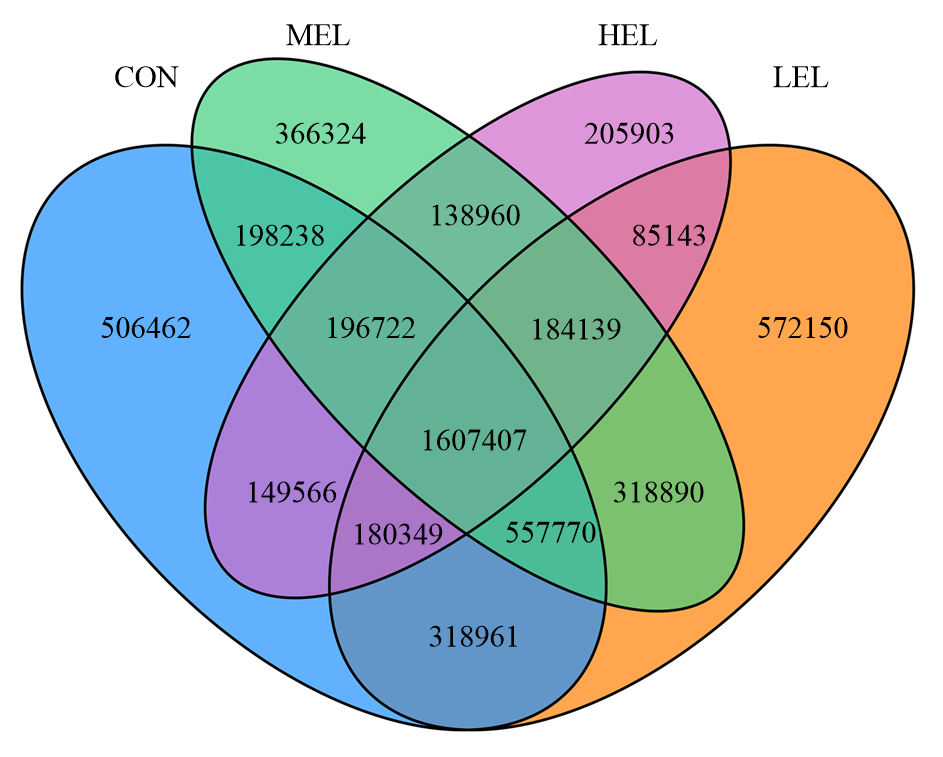
图1
瘤胃细菌物种韦恩图"
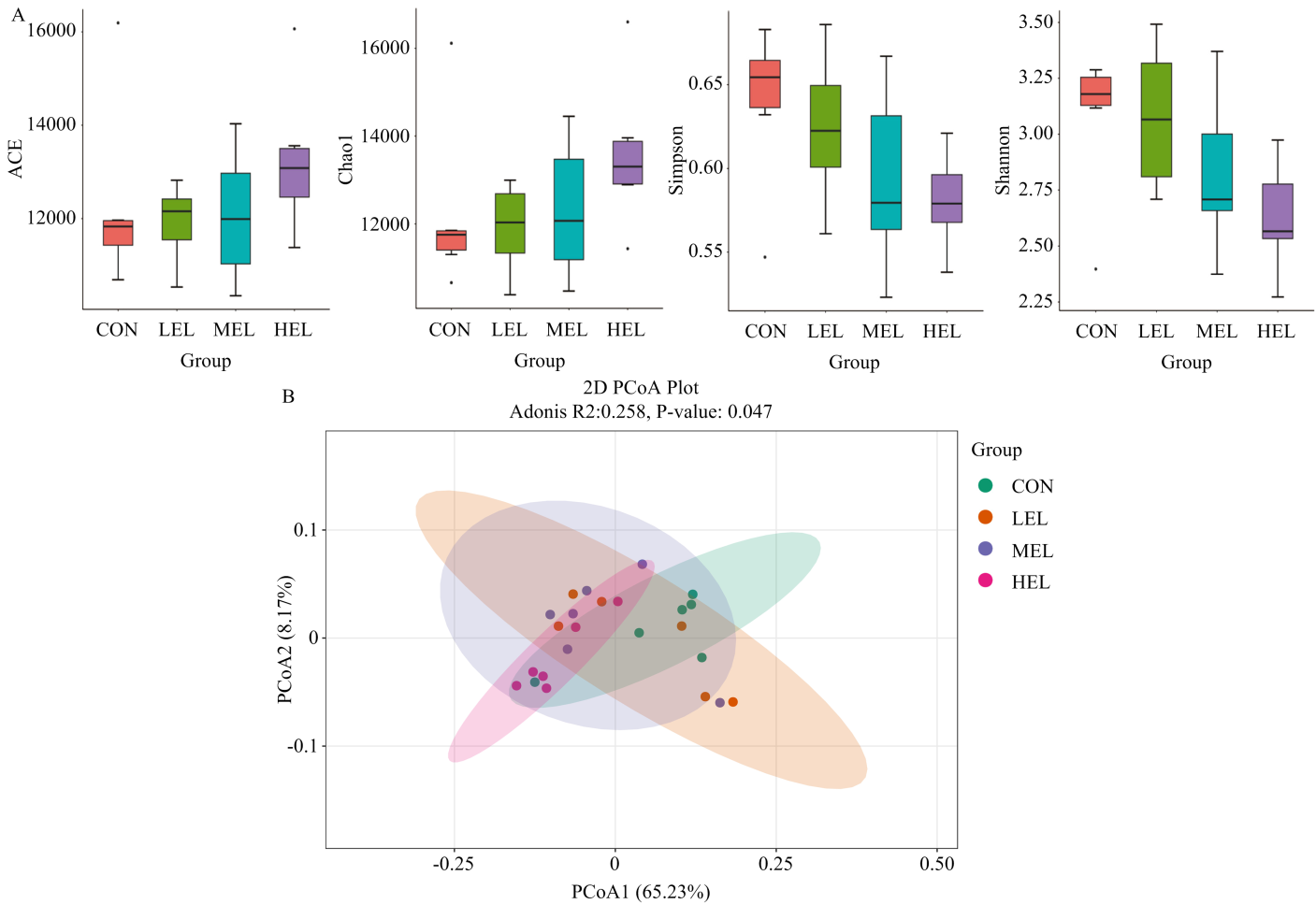
图2
不同营养水平饲粮对山羊瘤胃微生物多样性的影响 A:不同组瘤胃微生物群α-多样性比较;B:PCoA主成分分析图"
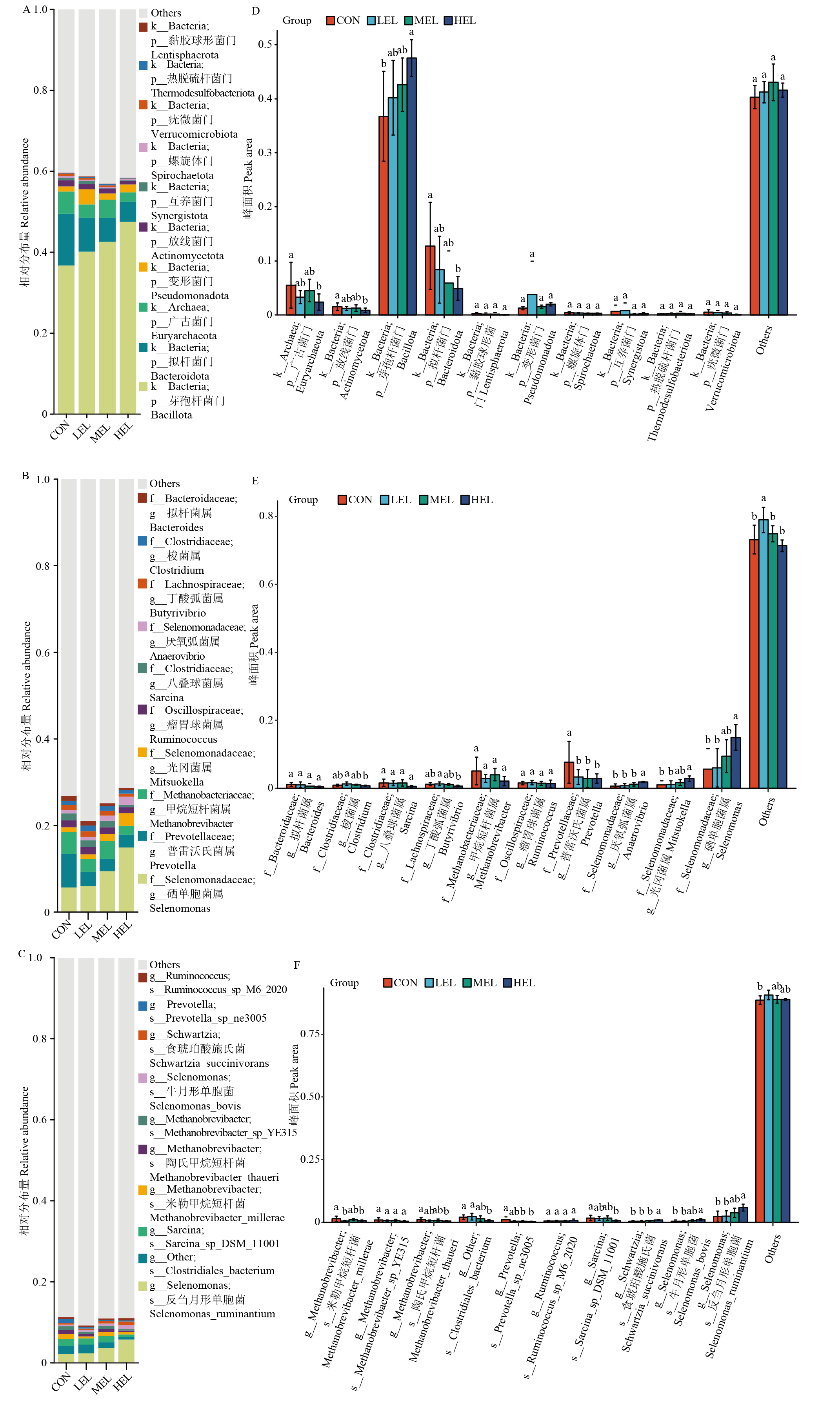
图3
不同营养水平饲粮对山羊瘤胃微生物组成的影响 A:门水平微生物群落组成条形堆叠图;B:属水平微生物群落组成条形堆叠图;C:种水平微生物群落组成条形堆叠图;D:门水平瘤胃微生物前十的差异分析;E:属水平瘤胃微生物前十的差异分析;F:种水平瘤胃微生物前十的差异分析"

图4
不同营养水平饲粮对山羊瘤胃微生物KEGG代谢通路的影响 A:Level1水平代谢通路相对丰度堆叠条形图;B:Level2水平代谢通路相对丰度堆叠条形图;C:Level3 水平代谢通路相对丰度 Top10 的差异检验分析柱形图"
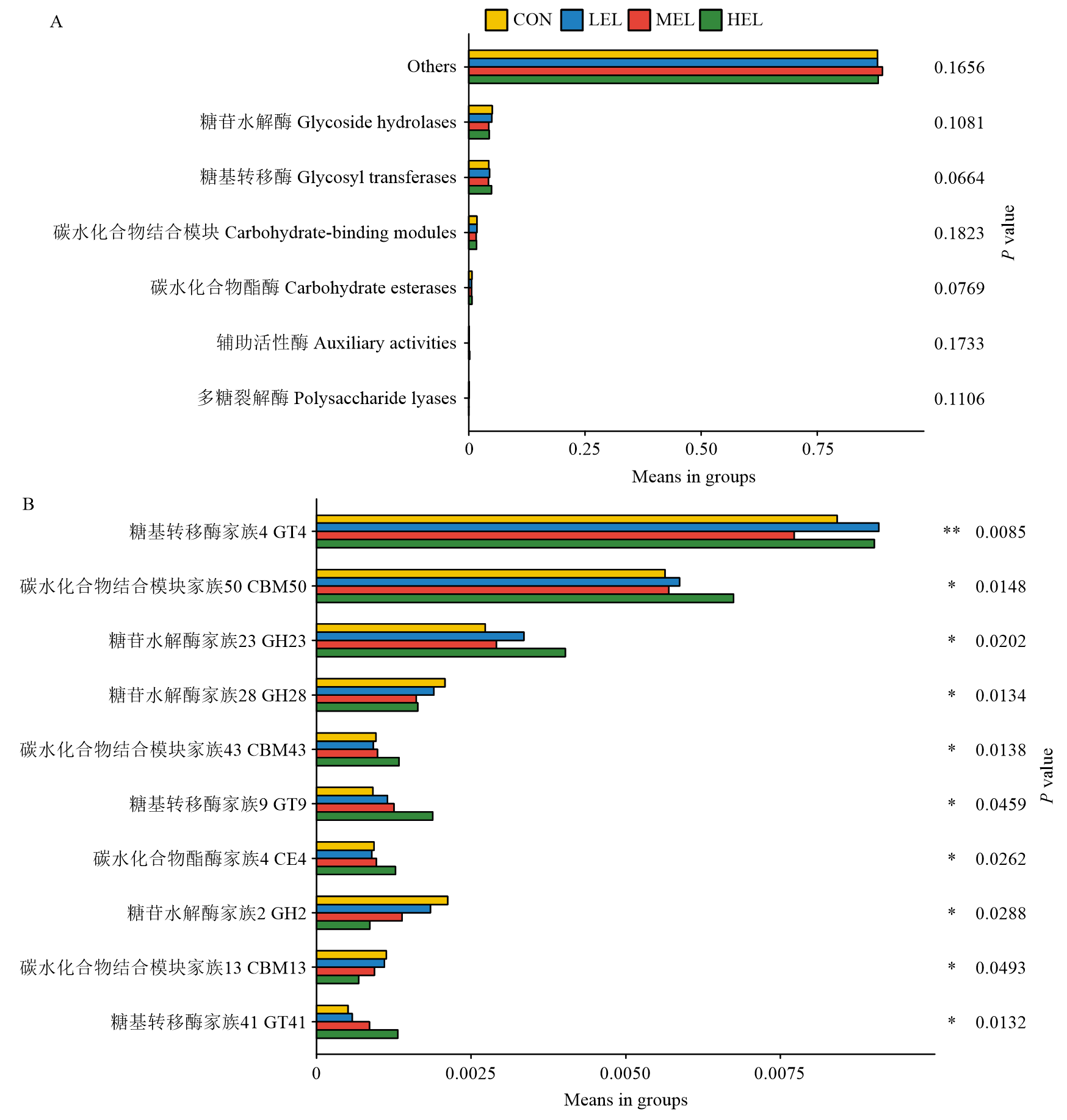
图5
不同营养水平饲粮对陕北白绒山羊瘤胃微生物CAZy基因丰度的影响 A:Level 1 水平差异检验分析柱形图;B:Level 2 水平差异检验分析柱形图"
| [1] |
高玉平, 马东, 冯波, 高瀚洋, 袁溶英. 陕西省榆林市陕北白绒山羊培育及产业发展. 畜牧兽医科学(电子版), 2020(17): 191-192.
|
|
|
|
| [2] |
李江丽, 何邦印, 贺晓龙, 李江文. 妊娠期补饲精料对陕北白绒山羊日增重及肉绒品质的影响. 黑龙江畜牧兽医, 2023(6): 65-69.
|
|
|
|
| [3] |
李陇平, 李托, 曹培文, 朱海鲸, 张小玲, 张宸, 肖普辉, 董书伟, 冯平, 屈雷, 毕台飞. 饲粮不同能量水平对陕北白绒山羊断奶公羔瘤胃发酵特性和微生物组成的影响. 畜牧兽医学报, 2024, 55(7): 3011-3023.
doi: 10.11843/j.issn.0366-6964.2024.07.020 |
|
doi: 10.11843/j.issn.0366-6964.2024.07.020 |
|
| [4] |
曲星梅, 薛复来, 黄晓瑜, 张宇, 邢晓楠, 张恩平. 断奶日龄和日粮营养水平对陕北白绒山羊小肠形态发育和消化酶活性的影响. 中国农业科学, 2019, 52(19): 3460-3470. doi: 10.3864/j.issn.0578-1752.2019.19.015.
|
|
|
|
| [5] |
doi: 10.1080/10495398.2022.2058006 |
| [6] |
牛峰, 闫素梅, 孙振华, 王立明, 武霞霞. 休牧舍饲条件下不同营养水平对泌乳期阿尔巴斯白绒山羊与羔羊体重变化的影响. 饲料工业, 2012, 33(17): 45-47.
|
|
|
|
| [7] |
中华人民共和国农业部. 肉羊饲养标准: NY/T 816—2004[S]. 北京: 中国农业出版社, 2004.
|
|
Ministry of Agriculture of the People’s Republic of China. Feeding standard of meat-producing sheep and goats: NY/T 816—2004[S]. Beijing: China Agriculture Press, 2004. (in Chinese)
|
|
| [8] |
黄帅, 朱海鲸, 史雷, 毕台飞, 高晔, 鲁院院, 陈少东, 屈雷. 能量水平对生长期陕北白绒山羊生长性能及营养物质消化代谢的影响. 动物营养学报, 2015, 27(12): 3931-3939.
doi: 10.3969/j.issn.1006-267x.2015.12.035 |
|
|
|
| [9] |
doi: 10.3390/ani10040652 |
| [10] |
pmid: 9821501 |
| [11] |
冷静, 王刚, 朱仁俊, 杨舒黎, 苟潇, 毛华明. 不同补饲水平对泌乳期努比亚母羊体重体况和羔羊生长性能的影响. 畜牧与兽医, 2011, 43(4): 47-49.
|
|
|
|
| [12] |
doi: 10.1016/S0921-4488(00)00192-9 |
| [13] |
张海涛. 不同营养水平对超早期断奶小尾寒羊母羊繁殖性能(发情时间)影响的研究[D]. 兰州: 甘肃农业大学, 2004.
|
|
|
|
| [14] |
王红梅. 断奶日龄对陕北绒山羊公羔生长和屠宰性能的影响. 中国畜禽种业, 2023, 19(2): 83-86.
|
|
|
|
| [15] |
曲星梅, 阚博文, 刘素趁, 李碧波, 张恩平.断奶日龄和日粮营养水平对4-6 月龄陕北白绒山羊消化代谢的影响. 畜牧兽医学报, 2019, 50(1): 94-104.
|
|
|
|
| [16] |
doi: 10.1186/s12864-023-09206-7 |
| [17] |
doi: 10.2527/2005.834879x pmid: 15753344 |
| [18] |
程发祥, 贾帅兵, 张浩, 托娜, 闫学慧, 邵伟, 余雄. 暖季放牧条件下羔羊15种血清生化指标与体重变化关系的研究. 中国畜牧兽医, 2009, 36(7): 56-60.
|
|
|
|
| [19] |
doi: 10.1007/s11250-008-9145-2 pmid: 18975131 |
| [20] |
张小强, 赵雷云, 黄晓瑜, 杨晨, 田林涛, 李博, 张恩平. 饲粮能量水平对白萨福克×湖羊F1羔羊生产性能和脂肪代谢相关基因表达的影响. 家畜生态学报, 2021, 42(10): 34-42.
|
|
|
|
| [21] |
刘爽. 日粮能量、蛋白水平对架子牛生产性能和血液指标的影响[D]. 哈尔滨: 东北农业大学, 2016.
|
|
|
|
| [22] |
孙国虎. 不同能量水平对绵羊血液生理生化指标的影响及肉质相关基因表达研究[D]. 兰州: 甘肃农业大学, 2014.
|
|
|
|
| [23] |
陈渲, 吴振岭, 周力, 朱凯娜, 侯生珍, 王志有, 桂林生. 饲粮蛋白质水平对藏羊生长性能、血清生化指标及肉品质的影响. 饲料工业, 2024, 45(3): 49-55.
|
|
|
|
| [24] |
柏峻, 李美发, 辛均平, 赵二龙, 许兰娇, 梁欢, 杨食堂, 杨建军, 易中华, 瞿明仁, 李艳娇. 饲粮能量水平对育肥后期锦江牛营养物质表观消化率、瘤胃发酵及血清生化指标的影响. 动物营养学报, 2020, 32(4): 1713-1720.
doi: 10.3969/j.issn.1006-267x.2020.04.030 |
|
|
|
| [25] |
姚喜喜, 刘皓栋. 日粮蛋白水平对小尾寒羊羔羊生长性能、营养物质表观消化率、氮排放和血清生化指标的影响. 草业科学, 2022, 39(2): 362-370.
|
|
|
|
| [26] |
doi: 10.2527/jas1980.504597x |
| [27] |
doi: 10.3389/fvets.2022.848452 |
| [28] |
|
| [29] |
宋晓雯, 王文丹, 程明, 戴正浩, 林英庭. 饲粮不同能量水平对崂山奶山羊泌乳性能和血清生化指标的影响. 动物营养学报, 2015, 27(8): 2423-2430.
doi: 10.3969/j.issn.1006-267x.2015.08.014 |
|
|
|
| [30] |
谷兴亮, 关诗宇, 曲磊, 谷月, 吕文发, 赵玉民, 秦立红. 饲喂不同处理方式的玉米秸秆粗饲料对肉牛甲烷排放及瘤胃功能的影响. 畜牧与饲料科学, 2024, 45(5): 35-46.
|
|
|
|
| [31] |
doi: 10.1007/s00253-023-12614-0 pmid: 37306709 |
| [32] |
doi: 10.1371/journal.pone.0033306 |
| [33] |
doi: 10.1002/glr2.v3.3 |
| [34] |
doi: 10.1186/s13568-023-01610-2 |
| [35] |
doi: 10.1017/S0021859609008429 |
| [36] |
doi: 10.1080/21505594.2022.2127196 pmid: 36128741 |
| [37] |
|
| [38] |
doi: 10.1016/j.foodres.2011.06.056 |
| [39] |
姜碧薇, 王甜, 周玉香, 李斐. 酶菌混合处理荞麦秸秆和苜蓿干草对滩羊生长性能、屠宰性能、瘤胃细菌多样性和碳水化合物活性酶类的影响. 动物营养学报, 2021, 33(4): 2335-2346.
doi: 10.3969/j.issn.1006-267x.2021.04.051 |
|
|
|
| [40] |
张慧敏, 夏海磊, 黄强, 绪欣, 毛永江, 岑宁, 杨章平. 海子水牛瘤胃微生物的宏基因组学分析. 动物营养学报, 2017, 29(11): 4151-4161.
|
|
|
|
| [41] |
doi: S1075-9964(15)30091-3 pmid: 26700882 |
| [1] | 张帆, 唐湘方, 杨亮, 王辉, 陈睿鹏, 熊本海. 肉牛生产性能智能监测技术研究进展[J]. 中国农业科学, 2025, 58(23): 5081-5096. |
| [2] | 赵剑, 任涛, 方娅婷, 杨昕, 盛倩男, 李小坤, 朱俊, 鲁剑巍. 施氮对不同轮作模式下油菜和小麦根际土壤中有机氮矿化功能基因的影响[J]. 中国农业科学, 2025, 58(19): 3919-3931. |
| [3] | 李晓鹏, 刘云龙, 崔甲军, 屠焰, 蒋林树, 成述儒. 基于GreenFeed系统研究绿原酸对泌乳中后期奶牛瘤胃甲烷排放、发酵参数和生产性能的影响[J]. 中国农业科学, 2025, 58(14): 2904-2913. |
| [4] | 王小军, 王金兰, 琚泽亮, 梁国玲, 贾志锋, 刘文辉, 马祥, 马金秀, 李文. 环青海湖地区不同饲用燕麦品种生产性能和营养品质综合评价[J]. 中国农业科学, 2024, 57(19): 3730-3742. |
| [5] | 陈恒光, 裴晓蒙, 夏雨婷, 刘静, 茆达干. 围产期日粮添加姜黄素对山羊生产性能、血液指标及炎症因子基因表达的影响[J]. 中国农业科学, 2024, 57(12): 2483-2496. |
| [6] | 房昊源, 杨亮, 王洪壮, 曹锦承, 任万平, 魏胜娟, 颜培实. 夏季横向交互送风系统对肉牛生理和生产性能的影响[J]. 中国农业科学, 2022, 55(5): 1025-1036. |
| [7] | 刘旺景,唐德富,敖长金. 沙葱及其提取物对小尾寒羊生产性能、胴体特征、肉品质和血清生化指标的影响[J]. 中国农业科学, 2022, 55(17): 3461-3472. |
| [8] | 王继卿,郝志云,沈继源,柯娜,黄兆春,梁维炜,罗玉柱,胡江,刘秀,李少斌. 小尾寒羊泌乳性状重要lncRNAs的筛选、鉴定及功能分析[J]. 中国农业科学, 2021, 54(14): 3113-3123. |
| [9] | 张美琦,李妍,李树静,高艳霞,李建国,曹玉凤,李秋凤. 饲粮能量水平对荷斯坦阉牛生产性能、血液指标、屠宰性能及肉品质的影响[J]. 中国农业科学, 2021, 54(1): 203-212. |
| [10] | 李华,方桂军,华国洪,谭淑雯,张正芬,洪煜宇,于辉. 清远麻慢羽公鸡的基因分型与生产性能研究[J]. 中国农业科学, 2020, 53(9): 1913-1920. |
| [11] | 苗建军,彭忠利,高彦华,柏雪,谢昕廷. 日粮中添加小肽对育肥牦牛生产性能和消化道PepT1 mRNA表达的影响[J]. 中国农业科学, 2020, 53(23): 4950-4960. |
| [12] | 肖知新,王洋,刘国富,巩皓,李丹丹,巩林,白珍建,崔国文. 寒地黑土区春季施肥期对紫花苜蓿生产性能及营养品质的影响[J]. 中国农业科学, 2020, 53(13): 2668-2677. |
| [13] | 曲星梅,薛复来,黄晓瑜,张宇,邢晓楠,张恩平. 断奶日龄和日粮营养水平对陕北白绒山羊小肠 形态发育和消化酶活性的影响[J]. 中国农业科学, 2019, 52(19): 3460-3470. |
| [14] | 孙艳梅,张前兵,苗晓茸,刘俊英,于磊,马春晖. 解磷细菌和丛枝菌根真菌对紫花苜蓿生产性能及地下生物量的影响[J]. 中国农业科学, 2019, 52(13): 2230-2242. |
| [15] | 孙永波,王亚,萨仁娜,张宏福. 不同湿度对肉鸡生长性能、抗氧化能力和免疫功能的影响[J]. 中国农业科学, 2018, 51(24): 4720-4728. |
|
||
