






中国农业科学 ›› 2026, Vol. 59 ›› Issue (3): 687-704.doi: 10.3864/j.issn.0578-1752.2026.03.015
• 农业经济与农村发展 • 上一篇
李贝1,2( ), 郑家喜1,2, 张蕙杰3()
收稿日期:2025-07-28
接受日期:2025-09-23
出版日期:2026-02-01
发布日期:2026-01-31
通信作者:
联系方式:
李贝,E-mail:lbei2015@163.com。
基金资助:
LI Bei1,2(), ZHENG JiaXi1,2, ZHANG HuiJie3()
Received:2025-07-28
Accepted:2025-09-23
Published:2026-02-01
Online:2026-01-31
摘要:
【目的】基于当前践行“双碳”战略、推进种植业绿色高质量发展的现实背景,厘清种植业生态效率的现状特征、时空格局以及动态演进特征,为加快推进种植业绿色低碳转型提供参考依据。【方法】在科学重构评价指标体系的基础上,首先利用SBM-Undesired模型对中国种植业生态效率进行测算并分析其现状特征;然后运用Dagum基尼系数明晰其区域差异及成因,接下来使用空间自相关模型解析其空间集聚特征;最后利用核密度估计、Markov链方法考察其动态演进特征。【结果】2005—2023年中国种植业生态效率整体得到了显著提升,其省域效率均值增幅高达87.95%,并由最初的差异明显逐步演变为“水平较高且齐头并进”的新格局;具体到3大功能区,种植业生态效率增幅由高至低依次为粮食主销区、主产区和产销平衡区。中国种植业生态效率的总体差异大幅缩小,逐步趋向同一性;区域差异来源以超变密度贡献最大、组内差异贡献其次、组间差异贡献最小。自2009年起,中国种植业生态效率持续表现出空间集聚特征,同时存在明显的空间聚类特征,且高-高型省份数量由少到多,而低-低型省份数量由多到少,空间集聚格局整体呈现出良好发展态势。随着时间的推移,全国以及3大功能区种植业生态效率均处于提升态势且由多极逐步转为单极;同时,种植业生态效率水平在各自等级较为稳定,存在“俱乐部趋同”特征;引入空间因素后,各省份种植业生态效率等级的稳定性受到影响,但高水平省份通常能够释放正向的溢出效应。【结论】中国种植业生态效率整体得到了显著提升,但具体到各功能区又表现出一定差异;中国种植业生态效率的总体差异呈明显下降趋势,其差异来源以超变密度贡献最大;中国种植业生态效率表现出一定的空间依赖性与异质性;全国以及3大功能区种植业生态效率的动态演进特征同中有异。应通过建立健全政策支持体系、厘清关键影响因素、强化区域交流与互助、构建风险防范机制等措施确保种植业生态效率处在高水平层次。
李贝, 郑家喜, 张蕙杰. 中国种植业生态效率区域差异、空间集聚与动态演进[J]. 中国农业科学, 2026, 59(3): 687-704.
LI Bei, ZHENG JiaXi, ZHANG HuiJie. Regional Disparities, Spatial Agglomeration and Dynamic Evolution of Planting Industry Eco-Efficiency in China[J]. Scientia Agricultura Sinica, 2026, 59(3): 687-704.

表1
中国种植业生态效率评价指标体系"
| 一级指标 Primary index | 二级指标 Secondary index | 指标解释 Index interpretation |
|---|---|---|
| 生产投入 Production input | 资本Capital | 农业固定资本 Agricultural fixed capital (×108 yuan) |
| 劳动力Labour | 种植业从业人员 Planting practitioners (×104 person) | |
| 土地Land | 农作物种植面积Crop planting area (×103 hm2) | |
| 柴油Diesel | 农用柴油使用Agricultural diesel oil use (×104 t) | |
| 化肥Fertilizer | 化肥施用Fertilizer application (×104 t) | |
| 农药Pesticide | 农药使用Pesticide use (×104 t) | |
| 农膜Agricultural film | 农膜使用Agricultural film use (×104 t) | |
| 水资源Water resource | 农业用水Agricultural water (×108 m3) | |
| 期望产出 Expected output | 经济产出Economic output | 种植业总产值Planting industry output value (×108 yuan) |
| 生态产出Ecological output | 种植业碳汇Planting industry carbon sink (×104 t) | |
| 非期望产出 Unexpected output | 温室气体排放Greenhouse gas emissions | 种植业碳排放Planting industry carbon emissions (×104 t) |
| 面源污染Diffused pollution | 种植业TN、TP、COD排放Planting industry TN, TP, and COD emissions (×108 m3) |
表2
2005、2023年中国30个省(自治区、直辖市)种植业生态效率及变化幅度"
| 地区 Region | 2005 | 2023 | 变动率 Change rate (%) | 地区 Region | 2005 | 2023 | 变动率 Change rate (%) | |||||
|---|---|---|---|---|---|---|---|---|---|---|---|---|
| 数值 Numerical value | 排名 Rank | 数值 Numerical value | 排名 Rank | 数值 Numerical value | 排名 Rank | 数值 Numerical value | 排名 Rank | |||||
| 北京Beijing | 0.5949 | 5 | 1.0000 | 1 | 68.10 | 河南Henan | 0.4649 | 9 | 1.0000 | 1 | 115.10 | |
| 天津Tianjin | 0.3926 | 17 | 1.0000 | 1 | 154.71 | 湖北Hubei | 0.2828 | 28 | 0.5111 | 29 | 80.73 | |
| 河北Hebei | 0.3460 | 23 | 1.0000 | 1 | 189.02 | 湖南Hunan | 0.3168 | 26 | 0.5560 | 27 | 75.51 | |
| 山西Shanxi | 0.3701 | 21 | 0.6299 | 24 | 70.20 | 广东Guangdong | 0.4191 | 13 | 1.0000 | 1 | 138.61 | |
| 内蒙古Inner Mongolia | 0.4308 | 12 | 1.0000 | 1 | 132.13 | 广西Guangxi | 0.7458 | 4 | 1.0000 | 1 | 34.08 | |
| 辽宁Liaoning | 0.4108 | 15 | 1.0000 | 1 | 143.43 | 海南Hainan | 0.3738 | 20 | 1.0000 | 1 | 167.52 | |
| 吉林Jilin | 1.0000 | 1 | 1.0000 | 1 | 0.00 | 重庆Chongqing | 0.4576 | 10 | 1.0000 | 1 | 118.53 | |
| 黑龙江Heilongjiang | 0.4151 | 14 | 1.0000 | 1 | 140.91 | 四川Sichuan | 0.4435 | 11 | 1.0000 | 1 | 125.48 | |
| 上海Shanghai | 0.2737 | 30 | 0.3799 | 30 | 38.80 | 贵州Guizhou | 1.0000 | 1 | 1.0000 | 1 | 0.00 | |
| 江苏Jiangsu | 0.3252 | 24 | 0.5306 | 28 | 63.16 | 云南Yunnan | 0.3955 | 16 | 1.0000 | 1 | 152.84 | |
| 浙江Zhejiang | 0.3192 | 25 | 1.0000 | 1 | 213.28 | 陕西Shaanxi | 0.5443 | 7 | 1.0000 | 1 | 83.72 | |
| 安徽Anhui | 0.3752 | 19 | 0.6449 | 23 | 71.88 | 甘肃Gansu | 0.3497 | 22 | 1.0000 | 1 | 185.96 | |
| 福建Fujian | 0.2942 | 27 | 1.0000 | 1 | 239.90 | 青海Qinghai | 0.5757 | 6 | 1.0000 | 1 | 73.70 | |
| 江西Jiangxi | 0.2810 | 29 | 0.5918 | 26 | 110.60 | 宁夏Ningxia | 1.0000 | 1 | 0.5995 | 25 | -40.05 | |
| 山东Shandong | 0.3881 | 18 | 1.0000 | 1 | 157.67 | 新疆Xinjiang | 0.4824 | 8 | 1.0000 | 1 | 107.30 | |
表3
2005—2023年粮食主产区、主销区、产销平衡区种植业生态效率"
| 年份 Year | 主产区 Main producing area | 主销区 Main sales area | 产销平衡区 Production and marketing balance area | 年份 Year | 主产区 Main producing area | 主销区 Main sales area | 产销平衡区 Production and marketing balance area | |
|---|---|---|---|---|---|---|---|---|
| 2005 | 0.4216 | 0.3811 | 0.5921 | 2015 | 0.4772 | 0.4938 | 0.4971 | |
| 2006 | 0.4218 | 0.4166 | 0.5323 | 2016 | 0.4947 | 0.5138 | 0.5119 | |
| 2007 | 0.3996 | 0.4260 | 0.5592 | 2017 | 0.5593 | 0.5906 | 0.5420 | |
| 2008 | 0.4457 | 0.4386 | 0.5376 | 2018 | 0.5878 | 0.6211 | 0.6349 | |
| 2009 | 0.3967 | 0.5315 | 0.5115 | 2019 | 0.6627 | 0.7313 | 0.7498 | |
| 2010 | 0.4112 | 0.4597 | 0.4767 | 2020 | 0.7226 | 0.7824 | 0.8369 | |
| 2011 | 0.4361 | 0.4725 | 0.4671 | 2021 | 0.7667 | 0.8430 | 0.8848 | |
| 2012 | 0.4433 | 0.4706 | 0.4944 | 2022 | 0.7847 | 0.8727 | 0.9160 | |
| 2013 | 0.4541 | 0.4741 | 0.4927 | 2023 | 0.8334 | 0.9114 | 0.9229 | |
| 2014 | 0.4596 | 0.4764 | 0.5107 | — | — | — | — |
表4
中国种植业生态效率地区基尼系数及其分解"
| 年份 Year | 全国 Whole country | 区域内 Within the region | 区域间 Interregional | 贡献率 Contribution rate (%) | ||||||
|---|---|---|---|---|---|---|---|---|---|---|
| 主产区 Main producing area | 主销区 Main sales area | 产销平衡区 Production and marketing balance area | 主产区-主销区 Main producing area-Main sales area | 主产区-产销平衡区 Main producing area-Production and marketing balance area | 主销区-产销平衡区 Main sales area- Production and marketing balance area | 组内 In- group | 组间 Interblock | 超变密度 Hypervariable density | ||
| 2005 | 0.211 | 0.175 | 0.138 | 0.210 | 0.166 | 0.218 | 0.221 | 30.842 | 45.655 | 23.503 |
| 2006 | 0.179 | 0.163 | 0.138 | 0.179 | 0.158 | 0.187 | 0.177 | 32.545 | 31.111 | 36.344 |
| 2007 | 0.182 | 0.116 | 0.138 | 0.217 | 0.127 | 0.190 | 0.206 | 30.409 | 43.263 | 26.328 |
| 2008 | 0.182 | 0.167 | 0.139 | 0.197 | 0.159 | 0.191 | 0.187 | 33.525 | 25.070 | 41.405 |
| 2009 | 0.174 | 0.100 | 0.225 | 0.167 | 0.168 | 0.147 | 0.196 | 28.915 | 39.261 | 31.824 |
| 2010 | 0.141 | 0.124 | 0.136 | 0.146 | 0.133 | 0.140 | 0.144 | 33.148 | 25.068 | 41.784 |
| 2011 | 0.144 | 0.134 | 0.136 | 0.152 | 0.138 | 0.145 | 0.147 | 34.095 | 13.101 | 52.804 |
| 2012 | 0.142 | 0.133 | 0.129 | 0.148 | 0.135 | 0.144 | 0.143 | 33.960 | 18.091 | 47.949 |
| 2013 | 0.148 | 0.140 | 0.130 | 0.157 | 0.140 | 0.151 | 0.150 | 34.159 | 12.921 | 52.920 |
| 2014 | 0.140 | 0.134 | 0.107 | 0.154 | 0.128 | 0.147 | 0.140 | 34.302 | 17.437 | 48.261 |
| 2015 | 0.133 | 0.133 | 0.123 | 0.131 | 0.132 | 0.134 | 0.130 | 34.591 | 7.369 | 58.040 |
| 2016 | 0.133 | 0.136 | 0.131 | 0.121 | 0.137 | 0.131 | 0.129 | 34.391 | 6.775 | 58.834 |
| 2017 | 0.158 | 0.169 | 0.180 | 0.109 | 0.176 | 0.146 | 0.146 | 33.989 | 10.683 | 55.328 |
| 2018 | 0.135 | 0.149 | 0.143 | 0.094 | 0.150 | 0.129 | 0.120 | 33.838 | 13.661 | 52.501 |
| 2019 | 0.154 | 0.166 | 0.168 | 0.110 | 0.173 | 0.147 | 0.137 | 33.439 | 19.168 | 47.393 |
| 2020 | 0.136 | 0.160 | 0.144 | 0.075 | 0.159 | 0.131 | 0.106 | 33.030 | 25.467 | 41.503 |
| 2021 | 0.130 | 0.152 | 0.119 | 0.088 | 0.147 | 0.131 | 0.103 | 33.568 | 26.133 | 40.299 |
| 2022 | 0.120 | 0.146 | 0.104 | 0.071 | 0.139 | 0.122 | 0.088 | 33.123 | 30.641 | 36.236 |
| 2023 | 0.102 | 0.128 | 0.083 | 0.067 | 0.118 | 0.105 | 0.075 | 34.472 | 24.148 | 41.380 |
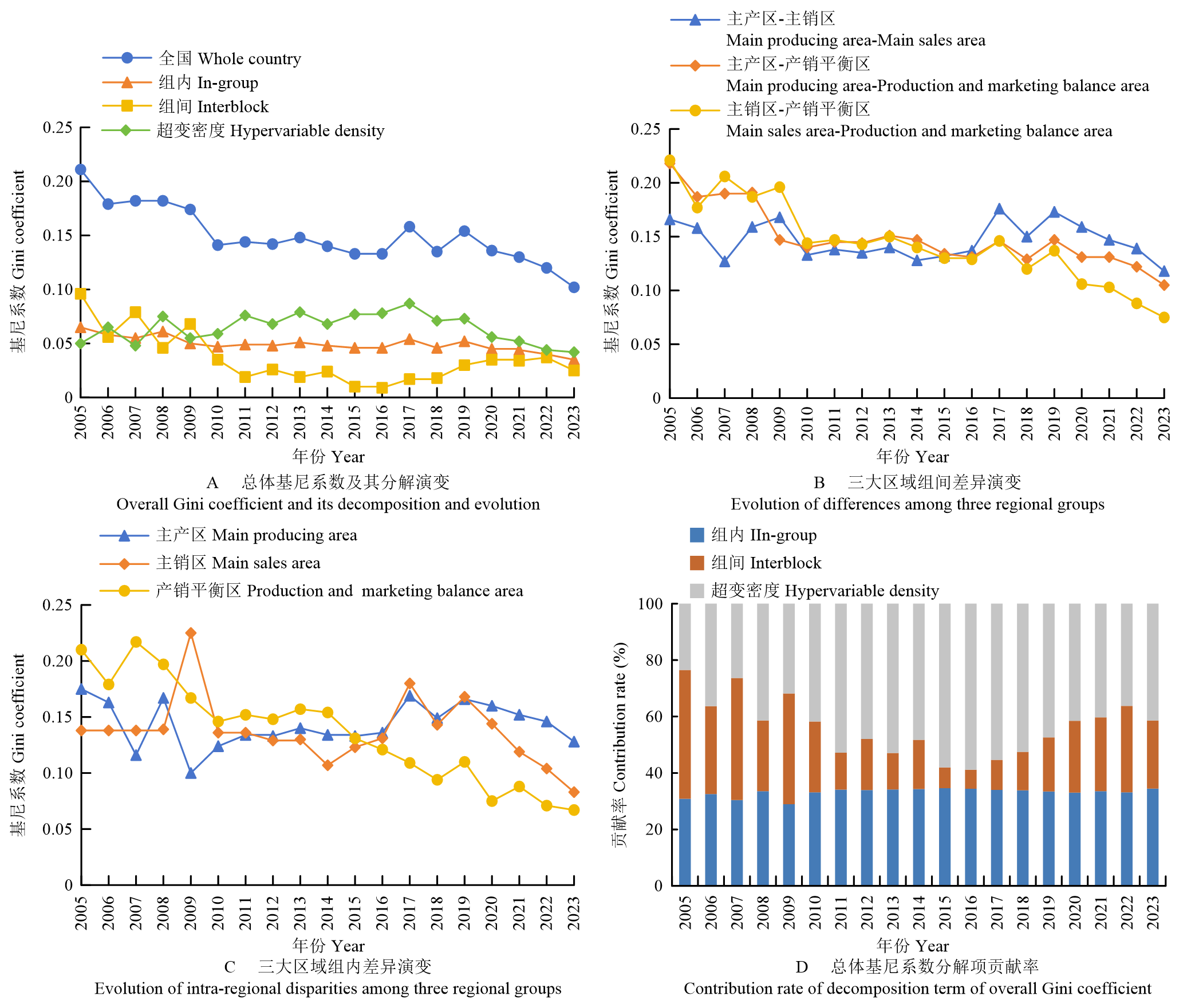
图1
中国种植业生态效率的区域差异演变"
表5
中国种植业生态效率全局莫兰指数分析结果"
| 年份 Year | Moran′s I | Z值 Z value | P值 P value | 年份 Year | Moran′s I | Z值 Z value | P值 P value | |
|---|---|---|---|---|---|---|---|---|
| 2005 | -0.000 | 0.997 | 0.159 | 2015 | 0.060 | 2.645 | 0.004 | |
| 2006 | -0.007 | 0.830 | 0.203 | 2016 | 0.059 | 2.595 | 0.005 | |
| 2007 | -0.031 | 0.108 | 0.457 | 2017 | 0.081 | 3.282 | 0.001 | |
| 2008 | -0.016 | 0.540 | 0.294 | 2018 | 0.107 | 3.888 | 0.000 | |
| 2009 | 0.067 | 3.037 | 0.001 | 2019 | 0.116 | 4.135 | 0.000 | |
| 2010 | 0.043 | 2.251 | 0.012 | 2020 | 0.112 | 4.036 | 0.000 | |
| 2011 | 0.050 | 2.401 | 0.008 | 2021 | 0.093 | 3.522 | 0.000 | |
| 2012 | 0.043 | 2.272 | 0.012 | 2022 | 0.091 | 3.457 | 0.000 | |
| 2013 | 0.061 | 2.799 | 0.003 | 2023 | 0.068 | 2.837 | 0.002 | |
| 2014 | 0.034 | 2.101 | 0.018 | — | — | — | — |
表6
主要年份中国种植业生态效率局部空间聚类情况"
| 年份 Year | 高-高集聚 High-high agglomeration | 低-高集聚 Low-high agglomeration | 低-低集聚 Low-low agglomeration | 高-低集聚 High-low agglomeration |
|---|---|---|---|---|
| 2005 | 内蒙古Inner Mongolia、四川Sichuan、重庆Chongqing、青海Qinghai、新疆Xinjiang | 天津Tianjin、辽宁Liaoning、黑龙江Heilongjiang、海南Hainan、云南Yunnan、甘肃Gansu | 河北Hebei、山西Shanxi、上海Shanghai、江苏Jiangsu、浙江Zhejiang、安徽Anhui、福建Fujian、江西Jiangxi、山东Shandong、湖北Hubei、湖南Hunan、广东Guangdong | 北京Beijing、吉林Jilin、河南Henan、广西Guangxi、贵州Guizhou、陕西Shaanxi、宁夏Ningxia |
| 2010 | 天津Tianjin、黑龙江Heilongjiang、广东Guangdong、海南Hainan、贵州Guizhou | 河北Hebei、内蒙古Inner Mongolia、辽宁Liaoning、四川Sichuan、云南Yunnan | 山西Shanxi、上海Shanghai、江苏Jiangsu、浙江Zhejiang、安徽Anhui、福建Fujian、江西Jiangxi、湖北Hubei、湖南Hunan、甘肃Gansu、青海Qinghai、宁夏Ningxia | 北京Beijing、吉林Jilin、山东Shandong、河南Henan、广西Guangxi、重庆Chongqing、陕西Shaanxi、新疆Xinjiang |
| 2015 | 天津Tianjin、辽宁Liaoning、吉林Jilin、黑龙江Heilongjiang、海南Hainan、贵州Guizhou | 河北Hebei、山西Shanxi、内蒙古Inner Mongolia、四川Sichuan、云南Yunnan | 上海Shanghai、江苏Jiangsu、浙江Zhejiang、安徽Anhui、福建Fujian、江西Jiangxi、湖北Hubei、湖南Hunan、甘肃Gansu、青海Qinghai、宁夏Ningxia | 北京Beijing、山东Shandong、河南Henan、广东Guangdong、广西Guangxi、重庆Chongqing、陕西Shaanxi、新疆Xinjiang |
| 2020 | 北京Beijing、天津Tianjin、河北Hebei、内蒙古Inner Mongolia、吉林Jilin、浙江Zhejiang、贵州Guizhou、云南Yunnan、青海Qinghai、宁夏Ningxia | 山西Shanxi、辽宁Liaoning、四川Sichuan、甘肃Gansu | 上海Shanghai、江苏Jiangsu、浙江Zhejiang、安徽Anhui、福建Fujian、江西Jiangxi、湖北Hubei、湖南Hunan | 黑龙江Heilongjiang、山东Shandong、河南Henan、广东Guangdong、广西Guangxi、海南Hainan、重庆Chongqing、陕西Shaanxi |
| 2023 | 北京Beijing、天津Tianjin、辽宁Liaoning、吉林Jilin、黑龙江Heilongjiang、广西Guangxi、海南Hainan、四川Sichuan、重庆Chongqing、贵州Guizhou、云南Yunnan、甘肃Gansu、青海Qinghai、新疆Xinjiang | 山西Shanxi、宁夏Ningxia | 上海Shanghai、江苏Jiangsu、安徽Anhui、江西Jiangxi、湖北Hubei、湖南Hunan | 河北Hebei、内蒙古Inner Mongolia、浙江Zhejiang、福建Fujian、山东Shandong、河南Henan、广东Guangdong、陕西Shaanxi |
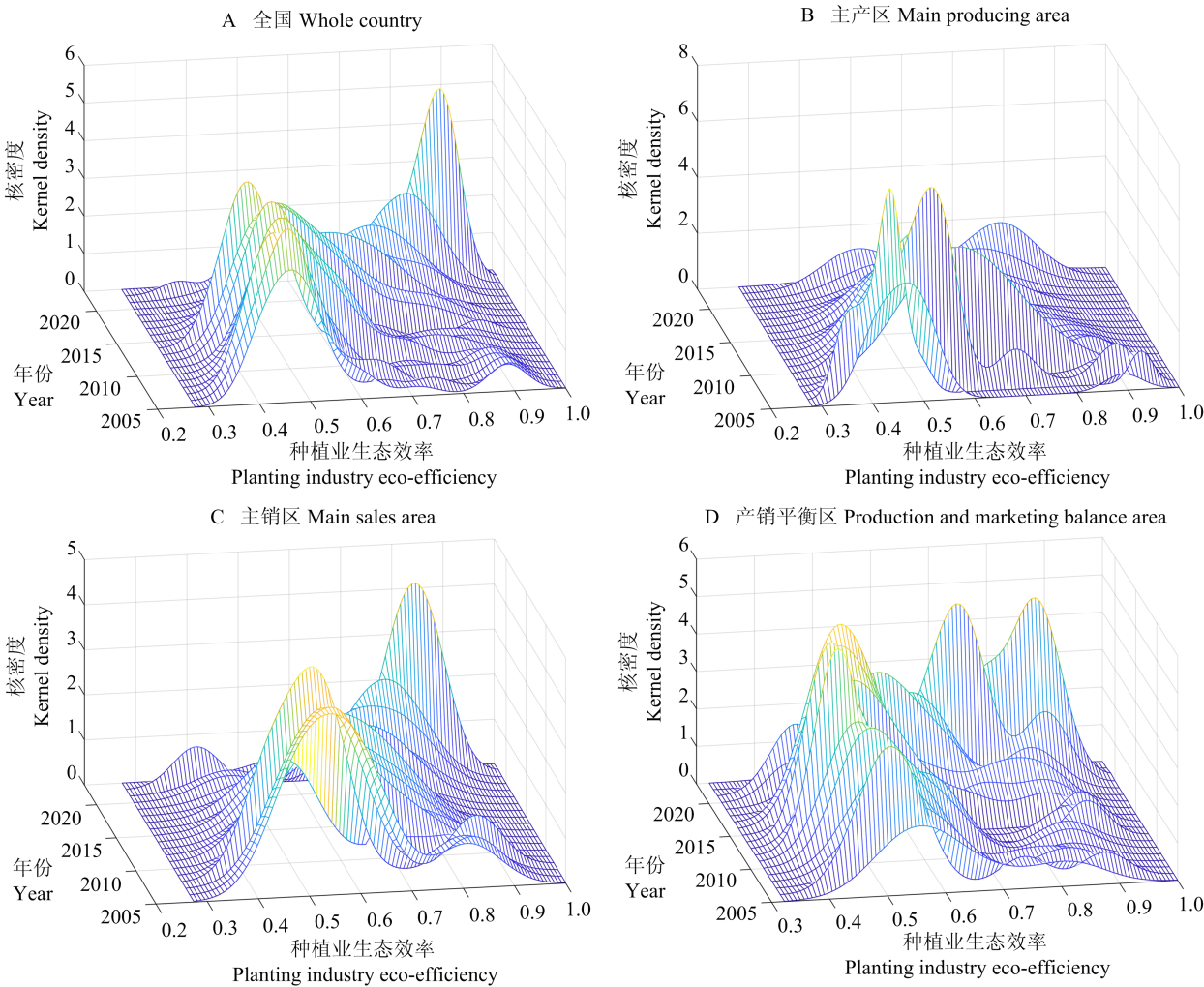
图2
全国和3大功能区种植业生态效率核密度分布结果"
表7
中国种植业生态效率传统Markov转移概率矩阵"
| 项目 Project | 空间滞后类型 Spatial lag type | t/(t+1) | Ⅰ | Ⅱ | Ⅲ | Ⅳ | 观测值 Observed value | ||
|---|---|---|---|---|---|---|---|---|---|
| 传统Markov链 Traditional Markov chain | 无滞后 No lag | Ⅰ | 0.8182 | 0.1748 | 0.0070 | 0.0000 | 143 | ||
| Ⅱ | 0.0851 | 0.7021 | 0.1986 | 0.0142 | 141 | ||||
| Ⅲ | 0.0000 | 0.0515 | 0.7721 | 0.1765 | 136 | ||||
| Ⅳ | 0.0000 | 0.0167 | 0.0500 | 0.9333 | 120 | ||||
表8
中国种植业生态效率空间Markov转移概率矩阵"
| 项目 Project | 空间滞后类型 Spatial lag type | t/(t+1) | Ⅰ | Ⅱ | Ⅲ | Ⅳ | 观测值 Observed value | |
|---|---|---|---|---|---|---|---|---|
| 空间Markov链 Spatial Markov chain | Ⅰ | Ⅰ | 0.9259 | 0.0741 | 0.0000 | 0.0000 | 54 | |
| Ⅱ | 0.2500 | 0.3750 | 0.3750 | 0.0000 | 8 | |||
| Ⅲ | 0.0000 | 0.1429 | 0.7857 | 0.0714 | 14 | |||
| Ⅳ | 0.0000 | 0.0000 | 0.0000 | 0.0000 | 0 | |||
| Ⅱ | Ⅰ | 0.7742 | 0.2258 | 0.0000 | 0.0000 | 62 | ||
| Ⅱ | 0.0781 | 0.7500 | 0.1406 | 0.0313 | 64 | |||
| Ⅲ | 0.0000 | 0.0667 | 0.8444 | 0.0889 | 45 | |||
| Ⅳ | 0.0000 | 0.0800 | 0.2000 | 0.7200 | 25 | |||
| Ⅲ | Ⅰ | 0.7308 | 0.2308 | 0.0385 | 0.0000 | 26 | ||
| Ⅱ | 0.0615 | 0.7231 | 0.2154 | 0.0000 | 65 | |||
| Ⅲ | 0.0000 | 0.0333 | 0.7667 | 0.2000 | 60 | |||
| Ⅳ | 0.0000 | 0.0000 | 0.0000 | 1.0000 | 29 | |||
| Ⅳ | Ⅰ | 0.0000 | 1.0000 | 0.0000 | 0.0000 | 1 | ||
| Ⅱ | 0.2500 | 0.2500 | 0.5000 | 0.0000 | 4 | |||
| Ⅲ | 0.0000 | 0.0000 | 0.5882 | 0.4118 | 17 | |||
| Ⅳ | 0.0000 | 0.0000 | 0.0152 | 0.9848 | 66 | |||
| [1] |
|
| [2] |
向慧, 彭保发, 伍铁牛, 张浩哲, 付冬暇, 杨庆媛. 湖南武陵民族地区种植业生态效率的时空分异及驱动机理研究. 地理科学, 2025, 45(2): 349-363.
doi: 10.13249/j.cnki.sgs.20230470 |
|
doi: 10.13249/j.cnki.sgs.20230470 |
|
| [3] |
王宝义, 张卫国. 中国农业生态效率测度及时空差异研究. 中国人口·资源与环境, 2016, 26(6): 11-19.
|
|
|
|
| [4] |
张荧楠, 张兰婷, 韩立民. 农业生态效率评价及提升路径研究——基于山东省17个地级市的实证分析. 生态经济, 2021, 37(4): 118-124, 131.
|
|
|
|
| [5] |
刘海龙, 王虎, 谢亚林, 李曼, 石培基. 集中连片特困区耕地生态效率的时空演变特征及影响因素分析——以吕梁山区为例. 水土保持研究, 2020, 27(2): 323-329.
|
|
|
|
| [6] |
周爱群, 陈彩虹. 耕地利用生态效率的时空演变及影响因素研究. 经济问题, 2023(12): 95-101.
|
|
|
|
| [7] |
罗家祺, 金晓斌, 刘晶, 梁鑫源, 韩博, 周寅康. 2000—2020年苏北地区农业生态效率变化及其影响因素分析. 农业工程学报, 2023, 39(15): 239-248.
|
|
|
|
| [8] |
doi: 10.1016/j.landusepol.2017.11.016 |
| [9] |
吴振华, 雷琳. 基于三阶段DEA模型的农业土地生态效率研究: 以河南省为例. 生态经济, 2018, 34(10): 76-80.
|
|
|
|
| [10] |
doi: 10.1016/j.jclepro.2022.134854 |
| [11] |
doi: 10.1016/S0377-2217(99)00407-5 |
| [12] |
doi: 10.1016/j.landusepol.2020.104794 |
| [13] |
惠嫜, 陈晓楠, 宋健峰. 基于水足迹的作物生产生态效率评价——以陕西省为例. 生态学报, 2021, 41(8): 3078-3091.
|
|
|
|
| [14] |
臧俊梅, 张思影, 唐春云. “双碳” 目标下广东省农业生态效率时空演变及影响因素研究. 中国农业资源与区划, 2023, 44(10): 135-146.
|
|
|
|
| [15] |
于婷, 郝信波. 粮食主产区农业生态效率时空特征及改善路径研究. 生态经济, 2018, 34(9): 104-110.
|
|
|
|
| [16] |
晋洪涛, 项乐乐, 陈方. 粮食主产区种植业低碳发展效率测算与差异化补偿研究. 河南农业大学学报, 2025, 59(1): 167-178.
|
|
|
|
| [17] |
吴小庆, 王亚平, 何丽梅, 陆根法. 基于AHP和DEA模型的农业生态效率评价——以无锡市为例. 长江流域资源与环境, 2012, 21(6): 714-719.
|
|
|
|
| [18] |
doi: 10.1016/j.eap.2017.10.001 |
| [19] |
|
| [20] |
汪亚琴, 姚顺波, 侯孟阳, 贾磊, 李园园, 邓元杰, 张晓. 基于地理探测器的中国农业生态效率时空分异及其影响因素. 应用生态学报, 2021, 32(11): 4039-4049.
doi: 10.13287/j.1001-9332.202111.026 |
|
|
|
| [21] |
侯孟阳, 姚顺波. 中国农村劳动力转移对农业生态效率影响的空间溢出效应与门槛特征. 资源科学, 2018, 40(12): 2475-2486.
doi: 10.18402/resci.2018.12.14 |
|
doi: 10.18402/resci.2018.12.14 |
|
| [22] |
胡平波, 钟漪萍. 政府支持下的农旅融合促进农业生态效率提升机理与实证分析——以全国休闲农业与乡村旅游示范县为例. 中国农村经济, 2019(12): 85-104.
|
|
|
|
| [23] |
胡平波, 刘金. 数字乡村发展提升农业生态效率的机理与实证检验. 中国人口·资源与环境, 2025, 35(3): 162-173.
|
|
|
|
| [24] |
陈菁泉, 信猛, 马晓君, 常百舒, 张紫嫣. 中国农业生态效率测度与驱动因素. 中国环境科学, 2020, 40(7): 3216-3227.
|
|
|
|
| [25] |
李谷成, 范丽霞, 冯中朝. 资本积累、制度变迁与农业增长: 对1978—2011年中国农业增长与资本存量的实证估计. 管理世界, 2014, 30(5): 67-79, 92.
|
|
|
|
| [26] |
田云, 王骁睿, 尹忞昊, 张蕙杰. 中国农业净碳汇再测算: 现状特征、时空格局及其影响因素. 中国农业科学, 2024, 57(22): 4507-4521. doi: 10.3864/j.issn.0578-1752.2024.22.010.
|
|
|
|
| [27] |
郭海红, 盖凌云. 中国农业碳效应时空分异及驱动机理研究. 宁夏社会科学, 2021(5): 74-84.
|
|
|
|
| [28] |
田云, 李波, 张俊飚. 我国农地利用碳排放的阶段特征及因素分解研究. 中国地质大学学报(社会科学版), 2011, 11(1): 59-63.
|
|
|
|
| [29] |
闵继胜, 胡浩. 中国农业生产温室气体排放量的测算. 中国人口·资源与环境, 2012, 22(7): 21-27.
|
|
|
|
| [30] |
蒋金荷. 中国城镇住宅碳排放强度分析和用能政策反思. 数量经济技术经济研究, 2015, 32(6): 90-104.
|
|
|
|
| [31] |
赖斯芸, 杜鹏飞, 陈吉宁. 基于单元分析的非点源污染调查评估方法. 清华大学学报(自然科学版), 2004, 44(9): 1184-1187.
|
|
|
|
| [32] |
闫坤, 唐丹彤, 甘天琦. 中国农业减污降碳协同效应的量化评估与动态演化——基于边际减排成本的分析. 中国农村经济, 2024(9): 22-41.
|
|
|
|
| [33] |
梁流涛. 农村生态环境时空特征及其演变规律研究[D]. 南京: 南京农业大学, 2009.
|
|
|
|
| [34] |
陶园, 王少丽, 管孝艳, 李润杰, 刘静, 吉梦喆. 青海省农业面源污染源特征分析. 农业工程学报, 2019, 35(10): 164-172.
|
|
|
|
| [35] |
葛小君, 黄斌, 袁再健, 王栋栋, 王泉泉, 陈佳村, 谢真越. 近20年来广东省农业面源污染负荷时空变化与来源分析. 环境科学, 2022, 43(6): 3118-3127.
|
|
|
|
| [36] |
潘丹, 应瑞瑶. 中国农业生态效率评价方法与实证——基于非期望产出的SBM模型分析. 生态学报, 2013, 33(12): 3837-3845.
|
|
doi: 10.5846/stxb |
|
| [37] |
doi: 10.1007/BF01205777 |
| [38] |
张卓群, 张涛, 冯冬发. 中国碳排放强度的区域差异、动态演进及收敛性研究. 数量经济技术经济研究, 2022, 39(4): 67-87.
|
|
|
|
| [39] |
田云, 夏锐, 张星琰. 中国农业面源污染强度测算: 时空分异、动态演进与空间集聚. 环境科学, 2025, 46(9): 5608-5618.
|
|
|
|
| [40] |
邓远建, 杨旭, 陈光炬, 汪凯达. 中国生态福利绩效水平的空间非均衡及动态演进. 中国地质大学学报(社会科学版), 2020, 20(4): 115-127.
|
|
|
|
| [41] |
华坚, 盛晓涵. 沿黄九省水土资源对粮食生产的阻尼效应测度及时空分异特征. 中国人口·资源与环境, 2021, 31(8): 148-156.
|
|
|
|
| [42] |
马林静, 王雅鹏, 吴娟. 中国粮食生产技术效率的空间非均衡与收敛性分析. 农业技术经济, 2015(4): 4-12.
|
|
|
| [1] | 尹忞昊, 陈池波, 卢奕亨, 田云. 中国农业碳排放密度的时空特征、动态演进与空间效应[J]. 中国农业科学, 2025, 58(18): 3710-3727. |
| [2] | 田云, 王骁睿, 尹忞昊, 张蕙杰. 中国农业净碳汇再测算:现状特征、时空格局及其影响因素[J]. 中国农业科学, 2024, 57(22): 4507-4521. |
| [3] | 孟庆雷, 殷宇翔, 王煜昊. 我国农业碳排放的时空演化、脱钩效应及绩效评估[J]. 中国农业科学, 2023, 56(20): 4049-4066. |
| [4] | 田云, 尹忞昊, 张蕙杰. 我国农村能源碳排放时空格局、影响因素及空间溢出效应[J]. 中国农业科学, 2023, 56(13): 2547-2562. |
| [5] | 邓远建,超博. 灰水足迹视角下我国省域农业生态效率及其影响因素[J]. 中国农业科学, 2022, 55(24): 4879-4894. |
| [6] | 崔帅,刘烁然,王寅,夏晨真,焉莉,冯国忠,高强. 吉林省旱地土壤有效硫含量及其与土壤有机质和全氮的关系[J]. 中国农业科学, 2022, 55(12): 2372-2383. |
| [7] | 田云,王梦晨. 湖北省农业碳排放效率时空差异及影响因素[J]. 中国农业科学, 2020, 53(24): 5063-5072. |
| [8] | 李波,杜建国,刘雪琪. 湖北省农业碳排放的时空特征及经济关联性[J]. 中国农业科学, 2019, 52(23): 4309-4319. |
| [9] | 任科宇,段英华,徐明岗,张旭博. 施用有机肥对我国作物氮肥利用率影响的整合分析[J]. 中国农业科学, 2019, 52(17): 2983-2996. |
| [10] | 吴建寨,沈辰,王盛威,张建华,孔繁涛. 中国蔬菜生产空间集聚演变、机制、效应及政策应对[J]. 中国农业科学, 2015, 48(8): 1641-1649. |
| [11] | 刘钦普. 中国化肥投入区域差异及环境风险分析[J]. 中国农业科学, 2014, 47(18): 3596-3605. |
| [12] | 许泉,芮雯奕,何航,吴峰,罗鸿,卞新民,张卫建. 不同利用方式下中国农田土壤有机碳密度特征及区域差异[J]. 中国农业科学, 2006, 39(12): 2505-2510 . |
|
||
