






中国农业科学 ›› 2026, Vol. 59 ›› Issue (8): 1686-1696.doi: 10.3864/j.issn.0578-1752.2026.08.007
赵思捷( ), 任家欣, 南江磊, 王兴云, 成卫宁()
收稿日期:2026-01-09
接受日期:2026-03-12
出版日期:2026-04-21
发布日期:2026-04-21
通信作者:
联系方式:
赵思捷,E-mail:zhaosijie20010625@163.com。
基金资助:
ZHAO SiJie(), REN JiaXin, NAN JiangLei, WANG XingYun, CHENG WeiNing()
Received:2026-01-09
Accepted:2026-03-12
Published:2026-04-21
Online:2026-04-21
摘要:
【目的】探究玉米(Zea mays)对草地贪夜蛾(Spodoptera frugiperda)抗性与叶片次生物质(阿魏酸、咖啡酸、绿原酸和丁布)含量及其合成途径关键酶基因ZmPAL和ZmBX表达的关系,为玉米抗虫新品种培育提供理论依据。【方法】采用玉米心叶期人工接虫法和叶片饲喂法,以植株受害等级和取食后的草地贪夜蛾生长发育、繁殖参数为指标,评估陕西6个主栽玉米品种对草地贪夜蛾的抗性差异;采用比色法和高效液相色谱法分别测定玉米叶片3种酚酸和丁布含量;利用RT-qPCR方法分析草地贪夜蛾危害0、6和18 h后不同品种玉米叶片ZmPAL6、ZmPAL7、ZmBX10和ZmBX11 mRNA表达水平,分析次生物质含量与玉米对草地贪夜蛾抗性指标的相关性。【结果】供试玉米品种中郑单958、秦龙14和陕科16受害较轻,草地贪夜蛾危害7—14 d平均受害等级均小于4.20;正大12、纪元1号和德单123受害较重,平均受害等级介于4.31—7.22。取食正大12和纪元1号的草地贪夜蛾幼虫和蛹发育最快且体重较大,成虫寿命和产卵期较长且单雌产卵量显著较高。相反,以郑单958为食的幼虫发育最慢,幼虫和蛹体重较轻,成虫产卵前期较长,产卵期较短且繁殖力最低,其次为秦龙14和陕科16。相关性分析表明,玉米叶片绿原酸、阿魏酸和咖啡酸含量与植株受害等级和草地贪夜蛾幼虫体重显著负相关,与幼虫发育历期显著正相关;绿原酸含量同时与蛹重极显著负相关;丁布含量与植株受害等级显著负相关。草地贪夜蛾取食可快速诱导ZmPAL6、ZmPAL7、ZmBX10和ZmBX11上调表达;危害前后,郑单958和秦龙14中4个基因的表达量均显著高于纪元1号和正大12。【结论】陕西省主栽玉米品种郑单958、秦龙14和陕科16对草地贪夜蛾危害和生长发育有一定抗性,其抗性与叶片中3种酚酸和丁布含量及ZmPAL、ZmBX的诱导和组成型高水平表达有关。
赵思捷, 任家欣, 南江磊, 王兴云, 成卫宁. 玉米叶片次生物质含量及相关基因表达与其对草地贪夜蛾抗性的关系[J]. 中国农业科学, 2026, 59(8): 1686-1696.
ZHAO SiJie, REN JiaXin, NAN JiangLei, WANG XingYun, CHENG WeiNing. Relationships Between Secondary Metabolite Contents and Related Gene Expression in Maize Leaves and Their Resistance to Spodoptera frugiperda[J]. Scientia Agricultura Sinica, 2026, 59(8): 1686-1696.
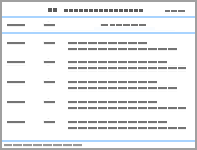
表1
本研究所用引物"
| 引物名称Primer name | 正向引物Forward primer (5°-3°) | 反向引物Reverse primer (5°-3°) |
|---|---|---|
| ZmPAL6 | GATCGGCAAGCTCATGTTCG | CCCTTGAAGCCGTAGTCCAG |
| ZmPAL7 | AGGGTCTTGCGATGGTGAA | TGGGTCAGGTGGTCAGTGTA |
| ZmBx10 | CGTAAACGCCTTGCTGAACA | ACCACCGACGTCAACCAA |
| ZmBx11 | ACCCTTCTCCAGATCCTCGC | GTCAACCTGTAGACGACGACA |
| ZmGADPH | AAACTGCCTTGCTCCCCTT | GAAGAACTTTACCAACAGCCTTG |
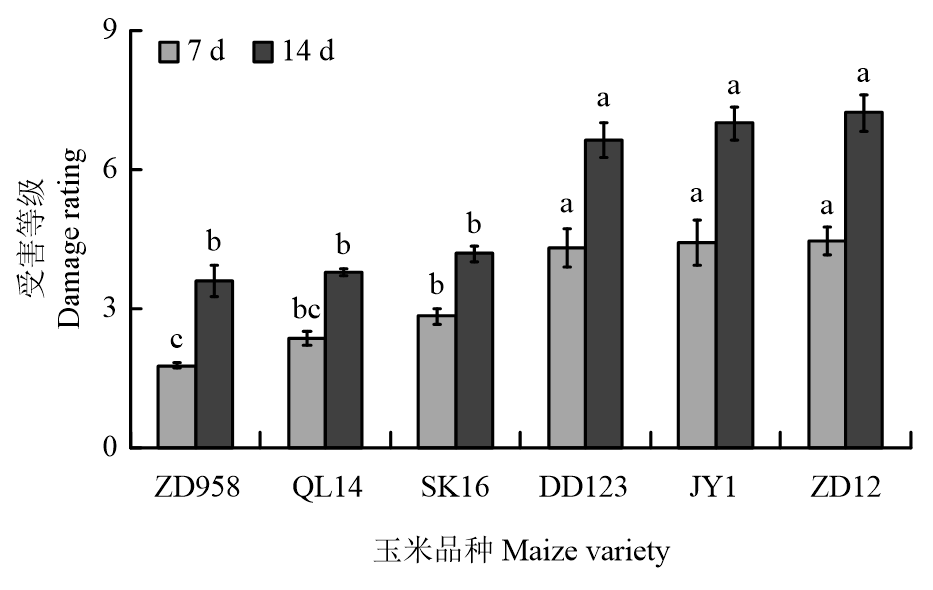
图1
草地贪夜蛾危害7和14 d后不同品种玉米的受害等级 ZD958:郑单958 Zhengdan958;QL14:秦龙14 Qinlong14;SK16:陕科16 Shanke16;DD123:德单123 Dedan123;JY1:纪元1号Jiyuan1;ZD12:正大12 Zhengda12。图中数据为3次重复的平均值±标准误;同色柱上不同字母表示经Duncan氏多重比较后差异显著(P<0.05)。下图同"
表2
取食不同玉米品种的草地贪夜蛾幼虫和蛹的发育历期及成虫寿命"
| 发育阶段 Developmental stage | 正大12 Zhengda12 | 纪元1号 Jiyuan1 | 德单123 Dedan123 | 陕科16 Shanke16 | 秦龙14 Qinlong14 | 郑单958 Zhengdan958 |
|---|---|---|---|---|---|---|
| 幼虫Larva | 13.01±0.11d | 13.22±0.09d | 14.30±0.18c | 16.68±0.30b | 17.58±0.35a | 17.60±0.06a |
| 预蛹Prepupa | 1.06±0.02c | 0.96±0.03d | 1.28±0.11a | 1.13±0.03bc | 1.16±0.06b | 1.14±0.05bc |
| 蛹Pupa | 7.93±0.16c | 7.56±0.13c | 9.08±0.20b | 11.14±0.20a | 10.95±0.14a | 9.21±0.25b |
| 雌成虫Female adult | 16.50±0.84a | 16.73±0.79a | 13.23±0.84b | 13.28±0.94b | 11.36±1.00c | 13.45±0.78b |
| 雄成虫Male adult | 16.87±0.66a | 17.26±0.81a | 11.40±0.51c | 11.46±0.44c | 11.34±0.48c | 13.36±0.45b |
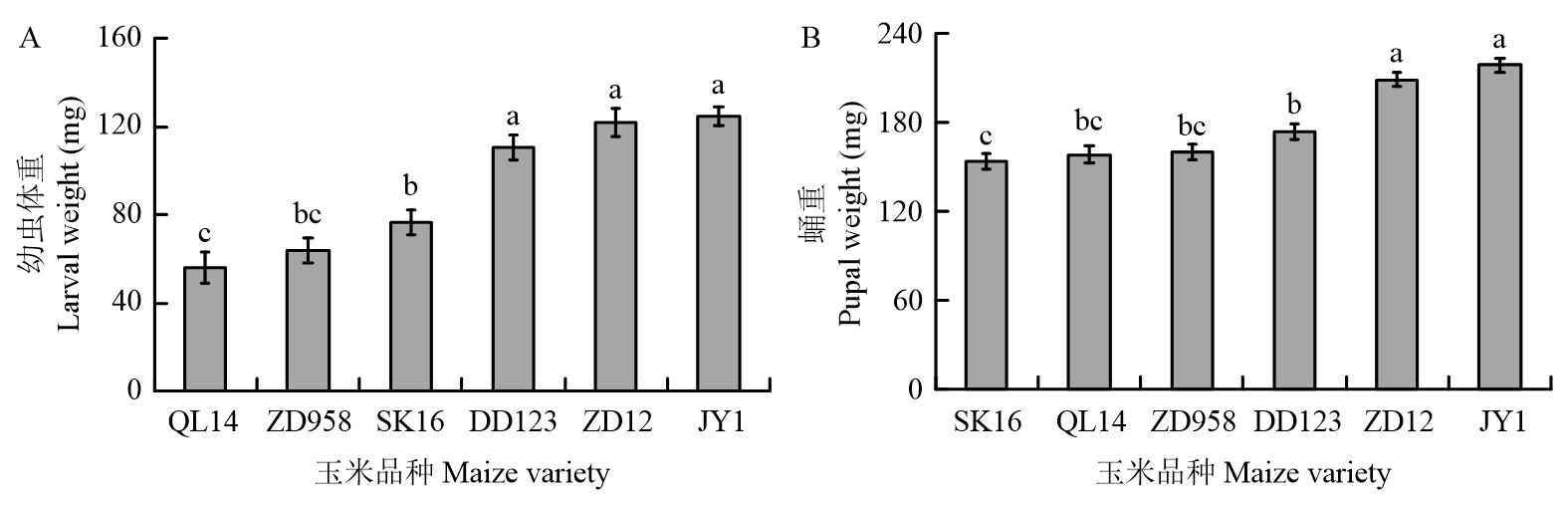
图2
取食不同玉米品种的草地贪夜蛾幼虫(A)和蛹(B)体重"
表3
不同品种玉米饲喂的草地贪夜蛾成虫产卵前期、产卵期和单雌产卵量"
| 玉米品种Maize variety | 产卵前期Preoviposition period (d) | 产卵期Oviposition duration (d) | 单雌产卵量Fecundity |
|---|---|---|---|
| 纪元1号Jiyuan1 | 1.17±0.23c | 6.33±0.57a | 1152.83±137.80a |
| 正大12 Zhengda12 | 1.22±0.18c | 6.38±0.57a | 1145.63±106.01a |
| 秦龙14 Qinlong14 | 1.50±0.23b | 5.27±0.38b | 1069.45±91.12a |
| 德单123 Dedan123 | 1.63±0.22b | 5.23±0.21b | 1009.00±89.31a |
| 陕科16 Shanke16 | 1.67±0.22b | 5.10±0.62b | 1016.00±123.94a |
| 郑单958 Zhengdan958 | 2.88±0.52a | 4.25±0.75c | 910.75±160.61b |
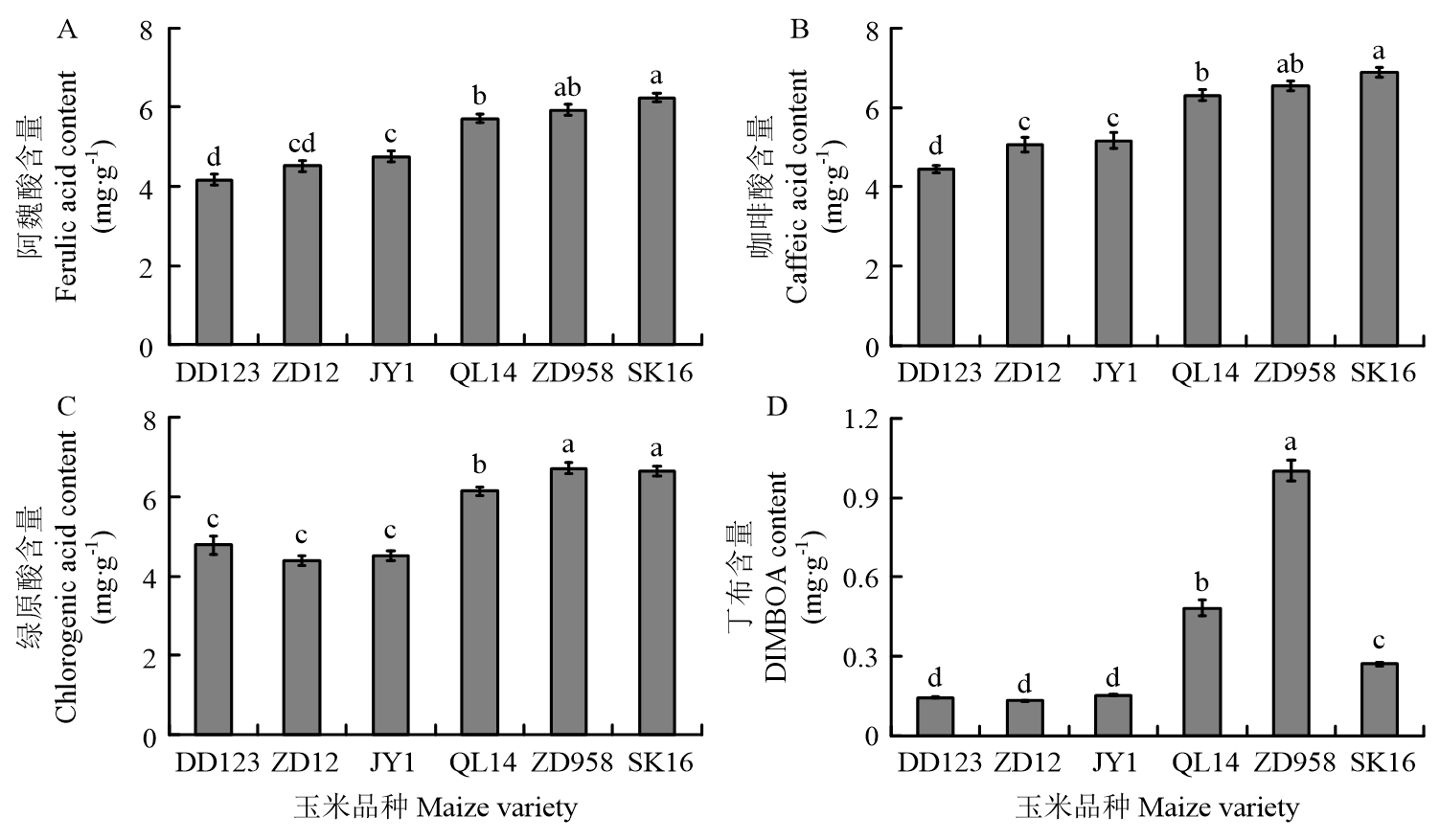
图3
不同品种玉米叶片次生物质含量"
表4
玉米叶片次生物质含量与其对草地贪夜蛾抗性指标的关系"
| 生物学指标 Biological indicator | 阿魏酸Ferulic acid | 咖啡酸Caffeic acid | 绿原酸Chlorogenic acid | 丁布DIMBOA | ||||
|---|---|---|---|---|---|---|---|---|
| r | P | r | P | r | P | r | P | |
| 7 d受害等级7 d Damage rating | -0.879* | 0.021 | -0.870* | 0.024 | -0.950** | 0.004 | -0.879* | 0.021 |
| 14 d受害等级14 d Damage rating | -0.911* | 0.012 | -0.896* | 0.016 | -0.975** | 0.002 | -0.777 | 0.069 |
| 幼虫历期Larval duration | 0.859* | 0.028 | 0.839* | 0.037 | 0.956** | 0.003 | 0.771 | 0.072 |
| 幼虫体重Larval weight | -0.840* | 0.036 | -0.827* | 0.042 | -0.918* | 0.010 | -0.706 | 0.117 |
| 蛹重Pupal weight | -0.743 | 0.056 | -0.706 | 0.076 | -0.899** | 0.007 | -0.602 | 0.153 |
| 单雌产卵量Fecundity | -0.392 | 0.493 | -0.319 | 0.538 | -0.623 | 0.187 | -0.803 | 0.054 |
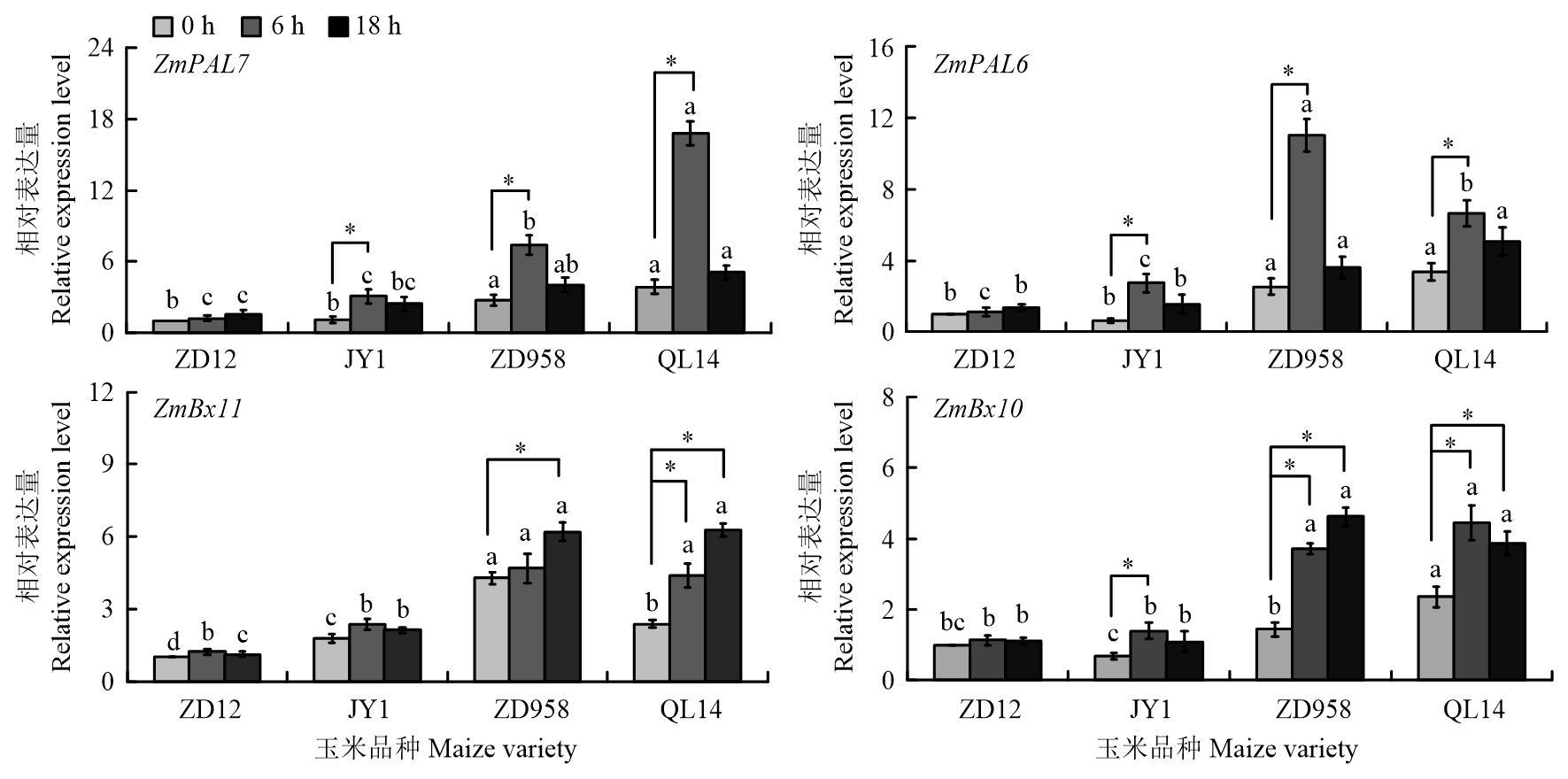
图4
草地贪夜蛾取食0—18 h后不同品种玉米ZmPAL和ZmBx相对表达量 *表示经t检验差异显著(P<0.05)"
| [1] |
陈浩梁, 林璐璐, 钟永志, 张峰, 谢明惠, 张光玲, 苏卫华. 草地贪夜蛾对不同生育期玉米产量的影响及防治指标. 植物保护学报, 2022, 49(6): 1705-1711.
|
|
|
|
| [2] |
doi: 10.3390/insects10090298 |
| [3] |
doi: 10.3390/insects13100936 |
| [4] |
doi: 10.1007/s11213-019-09489-6 |
| [5] |
doi: 10.1093/jee/toy372 |
| [6] |
doi: 10.1016/S2095-3119(20)63392-5 |
| [7] |
doi: 10.1093/jee/toy388 |
| [8] |
doi: 10.1007/s12600-024-01228-5 |
| [9] |
牛浩, 兰珍珍, 王新谱, 刘媛, 牛通. 草地贪夜蛾对7种寄主植物的选择性和适应性. 西北农林科技大学学报(自然科学版), 2024, 52(8): 112-121.
|
|
|
|
| [10] |
徐川峰, 萨日那, 何佳玥, 郭笑, 芦芳, 成玮, 胡高, 陈法军, 万贵钧, 赵婧妤. 草地贪夜蛾对不同品种玉米的适应性比较研究. 环境昆虫学报, 2021, 43(4): 891-900.
|
|
|
|
| [11] |
张楠, 陈婷, 李小凤, 李武, 肖汉祥, 李高科. 54份鲜食玉米品种草地贪夜蛾抗虫性鉴定与评价. 广东农业科学, 2021, 48(12): 25-32.
|
|
|
|
| [12] |
陈建, 漆学伟, 洪霖, 梁玉勇. 不同玉米品种对草地贪夜蛾田间抗性与室内适合度评估. 江西农业大学学报, 2024, 46(6): 1466-1477.
|
|
doi: 10.3724/aauj.2024127 |
|
| [13] |
doi: 10.1007/s12230-019-09726-7 |
| [14] |
doi: 10.1007/s00425-018-2953-3 |
| [15] |
doi: 10.1007/s10886-017-0859-3 |
| [16] |
|
| [17] |
doi: 10.1093/jxb/erx274 |
| [18] |
王世英, 朱启绽, 谭煜婷, 马千里, 王瑞飞, 张美芳, 徐汉虹, 张志祥. 草地贪夜蛾室内人工饲料群体饲养技术. 环境昆虫学报, 2019, 41(4): 742-747.
|
|
|
|
| [19] |
doi: 10.1007/s10340-021-01359-2 |
| [20] |
doi: 10.1038/s41598-024-60663-w pmid: 38714777 |
| [21] |
韩宪琪, 李雪娇, 冯淑娟, 成卫宁, 朱克岩. 小麦籽粒营养物质和次生物质含量与其对玉米象抗性的关系. 植物保护学报, 2017, 44(5): 721-728.
|
|
|
|
| [22] |
刘小春, 揭红东, 许妍, 许岳军, 揭雨成. GA3对苎麻生长和次生代谢物含量的影响. 草业科学, 2025, 42(7): 1830-1841.
|
|
|
|
| [23] |
侯笑林, 项立譞, 李明珠, 冯金晓. 响应面优化超声辅助法提取奇亚籽中咖啡酸及其抗氧化性测定. 山东农业大学学报(自然科学版), 2022, 53(6): 906-912.
|
|
|
|
| [24] |
doi: 10.1016/j.molp.2014.11.001 pmid: 25578269 |
| [25] |
doi: 10.1111/pbi.2019.17.issue-1 |
| [26] |
黄欣蒸, 单双, 张丹丹, 张天涛, 石旺鹏, 张永军. 草地贪夜蛾取食诱导玉米叶片转录组分析. 植物保护学报, 2020, 47(4): 780-788.
|
|
|
|
| [27] |
doi: 10.1006/meth.2001.1262 |
| [28] |
陈锐, 高贺, 张国军, 朱克岩, 成卫宁. 小麦籽粒次生物质对麦红吸浆虫幼虫解毒酶活性及基因表达的影响. 中国农业科学, 2020, 53(20): 4204-4214. doi: 10.3864/j.issn.0578-1752.2020.20.009.
|
|
|
|
| [29] |
doi: 10.3390/insects10070195 |
| [30] |
doi: 10.1016/j.cropro.2019.104960 |
| [31] |
doi: 10.3390/insects14050413 |
| [32] |
刘树楠, 申国境, 李京, 张翠萍,
|
|
|
|
| [33] |
张云会, 王章训, 王新谱. 二斑叶螨在5个玉米品种上的种群参数特征与分析. 玉米科学, 2016, 24(2): 155-159.
|
|
|
|
| [34] |
doi: 10.3390/metabo11110783 |
| [35] |
李会平, 王志刚, 杨敏生, 张彦广, 黄大庄, 张世红. 杨树单宁与酚类物质种类及含量与光肩星天牛危害之间关系的研究. 河北农业大学学报, 2003, 26(1): 36-39.
|
|
|
|
| [36] |
左彤彤, 迟德富, 王牧原, 宇佳, 李晓灿, 王文帆. 不同品系杨树酚酸类物质对青杨脊虎天牛的驱避作用. 植物保护学报, 2008, 35(2): 160-164.
|
|
|
|
| [37] |
doi: 10.1093/jxb/eru379 |
| [38] |
doi: 10.1111/enr.2018.48.issue-1 |
| [39] |
doi: 10.1007/BF01207432 |
| [40] |
doi: 10.14411/eje.2006.030 |
| [41] |
潘忠玉, 莫夏娜, 孟香, 陈敏. 绿原酸对美国白蛾幼虫生长发育和解毒相关蛋白活性的影响. 昆虫学报, 2020, 63(9): 1081-1090.
|
|
|
|
| [42] |
李娜, 于希森, 李琪, 李涵哲, 李洋, 徐婷婷, 孟凡立. 大豆异黄酮合成关键酶基因对蚜虫取食的防御响应分析. 大豆科学, 2016, 35(5): 800-804.
|
|
|
|
| [43] |
|
| [1] | 崔士友, 陈澎军, 缪源卿, 韩继军, 沈俊明. EMS诱变抗草甘膦小麦新种质的创制与大田评价[J]. 中国农业科学, 2026, 59(4): 723-733. |
| [2] | 廖婷璐, 石亚飞, 肖东浩, 舍杨梦斐, 郭富城, 杨九菊, 唐海江, 罗成科. 外源硝普钠对碱胁迫下水稻幼苗糖代谢的影响[J]. 中国农业科学, 2026, 59(2): 265-277. |
| [3] | 岳润清, 李文兰, 丁照华, 孟昭东. 转基因复合抗虫耐除草剂玉米LD05的分子特征及抗性评价[J]. 中国农业科学, 2025, 58(7): 1269-1283. |
| [4] | 张天雨, 李白, 藏金萍, 曹宏哲, 董金皋, 邢继红, 张康. 灰葡萄孢HMG家族基因的全基因组鉴定与表达规律分析[J]. 中国农业科学, 2025, 58(4): 704-718. |
| [5] | 张向昆, 李佳莹, 乔如梦, 何静蕾, 王莉, 师校欣, 杜国强. 不同锌水平下GFabV对‘阳光玫瑰’葡萄光合效率及光合相关基因表达的影响[J]. 中国农业科学, 2025, 58(24): 5190-5200. |
| [6] | 覃璐, 谌丹丹, 江晓丽, 谢合平, 敖义俊, 杨阳, 朱峰, 许让伟, 廖文月, 程运江. 水分状态对连阴雨天气采收柑橘果实贮藏性能的影响[J]. 中国农业科学, 2025, 58(24): 5259-5273. |
| [7] | 丁宁, 齐恩芳, 贾小霞, 黄伟, 马丽荣, 李建武, 燕汝楠. 马铃薯幼苗应答高温胁迫的miRNA筛选与鉴定[J]. 中国农业科学, 2025, 58(22): 4589-4602. |
| [8] | 张杰, 胡晨曦, 祁建波, 张永泰, 陈以博, 张永吉. 外源玉米素对低温弱光胁迫下辣椒光合参数、抗氧化系统及玉米素合成相关基因表达的影响[J]. 中国农业科学, 2025, 58(19): 3959-3969. |
| [9] | 陈娟妮, 陈品璐, 李珏, 谢蒙潇, 李欣蓓, 丁伟. 纳米氧化镁诱导烟草抗青枯病的作用机理[J]. 中国农业科学, 2025, 58(16): 3327-3344. |
| [10] | 颉晖晖, 杨秋华, 李文丽, 朱锦程, 李惠霞, 张峰. 抗南方根结线虫马铃薯野生种渐渗种质的鉴定[J]. 中国农业科学, 2025, 58(14): 2924-2932. |
| [11] | 崔梦杰, 孙子淇, 齐飞艳, 刘华, 徐静, 杜培, 黄冰艳, 董文召, 韩锁义, 张新友. 322份花生种质资源黄曲霉侵染抗性的评价[J]. 中国农业科学, 2025, 58(12): 2303-2315. |
| [12] | 陈二虎, 袁国庆, 陈艳, 陈梦秋, 孙晟源, 唐培安. 线粒体编码基因Nad5、Nad6和Atp6参与锈赤扁谷盗磷化氢抗性形成[J]. 中国农业科学, 2024, 57(9): 1722-1733. |
| [13] | 黄立强, 江如, 朱波汁, 彭焕, 许翀, 宋家雄, 陈敏, 李永青, 黄文坤, 彭德良. 马铃薯主栽品种抗马铃薯金线虫鉴定及抗性分子标记检测[J]. 中国农业科学, 2024, 57(8): 1506-1516. |
| [14] | 陈兵先, 张琪, 戴彰言, 周旭, 刘军. 水杨酸引发提高低温下水稻种子萌发活力的生理与分子效应[J]. 中国农业科学, 2024, 57(7): 1220-1236. |
| [15] | 王程泽, 张燕, 付伟, 贾京哲, 董金皋, 申珅, 郝志敏. 玉米ACO基因家族生物信息学及表达模式分析[J]. 中国农业科学, 2024, 57(7): 1308-1318. |
|
||
