






中国农业科学 ›› 2026, Vol. 59 ›› Issue (5): 1087-1100.doi: 10.3864/j.issn.0578-1752.2026.05.013
张利东1( ), 郭一聪2(), 黄洪宇1, 聂静2, 王兵2, 李梦雨2, 李加旺1, 眭晓蕾2(), 李愚鹤1()
收稿日期:2025-07-21
接受日期:2025-12-25
出版日期:2026-03-01
发布日期:2026-03-06
通信作者:
联系方式:
张利东,E-mail:zhanglidong20008@163.com。郭一聪,E-mail:gyc0224@126.com。张利东和郭一聪为同等贡献作者。
基金资助:
ZHANG LiDong1(), GUO YiCong2(), HUANG HongYu1, NIE Jing2, WANG Bing2, LI MengYu2, LI JiaWang1, SUI XiaoLei2(), LI YuHe1()
Received:2025-07-21
Accepted:2025-12-25
Published:2026-03-01
Online:2026-03-06
摘要:
【目的】 通过分析不同黄瓜种质资源的营养品质与风味物质等果实品质特征,并关联人体感官评价,为科学评判黄瓜果实品质提供依据。【方法】 以天津黄瓜研究所提供的果实感官品质存在较大差异的12个品系(种)为研究材料,通过测定不同黄瓜果实中的可溶性糖含量、可溶性固形物含量、可滴定酸含量等营养品质指标,果实风味物质总量及(E, Z)-2, 6-壬二烯醛和(E)-2-壬烯醛等风味物质含量,并对黄瓜果实甜味、水分、脆度、香气、涩味、苦味等6个维度进行人体主观感官评鉴,基于感官评价结合营养品质特征与风味物质特性综合关联分析黄瓜果实品质。【结果】 黄瓜果实感官评价中非涩味与甜味两个维度的权重赋值分别为27.12%和25.49%,其余香气、脆度、非苦味、水分4个维度的权重在10.59%—12.51%,而6个维度赋值越高,其感官品质综合评分越高。黄瓜果实感官评价中甜味、水分、脆度、香气、非苦味等与果实可溶性固形物含量、可溶性糖含量、抗坏血酸含量(极)显著相关。黄瓜风味物质(Z)-6-壬烯醛与感官评价中甜味、香气、水分、非苦味、非涩味等呈现极显著或显著相关,同时也与可溶性固形物含量、可溶性糖含量、抗坏血酸含量分别具有极显著正相关关系。黄瓜风味物质(E, Z)-2, 6-壬二烯醛与(E)-2-壬烯醛的比值与感官评价中非涩味呈显著相关,即该比值越大,果实涩味越弱。参试黄瓜品系(种)中,L2品系(种)的果实可溶性糖含量、可溶性固形物含量、抗坏血酸含量、固酸比均普遍高于其他品系(种),感官评价中甜味、脆度、香气、水分、非苦味和非涩味6个维度的总分值最高,果实品质最优。【结论】 黄瓜果实可溶性固形物含量、可溶性糖含量、抗坏血酸含量、(Z)-6-壬烯醛含量、(E, Z)-2, 6-壬二烯醛/(E)-2-壬烯醛比值可作为快速评价黄瓜感官品质与风味品质的指标。
张利东, 郭一聪, 黄洪宇, 聂静, 王兵, 李梦雨, 李加旺, 眭晓蕾, 李愚鹤. 基于感官评价结合营养品质特征与风味物质特性关联分析黄瓜果实品质[J]. 中国农业科学, 2026, 59(5): 1087-1100.
ZHANG LiDong, GUO YiCong, HUANG HongYu, NIE Jing, WANG Bing, LI MengYu, LI JiaWang, SUI XiaoLei, LI YuHe. Correlation Analysis of Cucumber Fruit Quality Integrating Sensory Evaluation with Nutritional Traits and Flavor Compound Characteristics[J]. Scientia Agricultura Sinica, 2026, 59(5): 1087-1100.

表1
天津武清田间种植黄瓜果实性状及品质初步评价"
| 品系(种) Varieties/Lines | 果刺 Trichome | 节成性 Fructifications at nodes | 果柄 Peduncle | 表皮 Epidermis | 口感 Taste |
|---|---|---|---|---|---|
| L1 | 大刺 Large spines | 高 High | 果柄短 Short | 油亮 Glossy | 口感一般 Fair |
| L2 | 小密刺 Tiny dense spines | 低 Poor | 果柄短 Short | 油亮 Glossy | 口感最好 Excellent |
| L3 | 大刺 Large spines | 中 Moderate | 果柄中等 Medium | 油亮 Glossy | 口感好 Good |
| L9 | 小密刺 Tiny dense spines | 低 Poor | 果柄中等 Medium | 较亮 Waxy bloom | 口感好 Good |
| N8 | 小密刺 Tiny dense spines | 高(全雌) High (Gynoecious line) | 果柄中等 Medimu | 一般 Matte | 口感一般 Fair |
| N12 | 小密刺 Tiny dense spines | 高(强强雌) High (Strong subgynoecious line) | 果柄长 Long | 油亮 Glossy | 口感一般 Fair |
| N18 | 大刺 Large spines | 高 High | 果柄短 Short | 较亮 Waxy bloom | 口感一般 Fair |
| N20 | 大刺 Large spines | 中 Moderate | 果柄短 Short | 灰亮 Dull | 口感一般 Fair |
| S6 | 小密刺 Tiny dense spines | 低 Poor | 果柄中等 Medium | 较亮 Waxy bloom | 口感一般 Fair |
| S10 | 小密刺 Tiny dense spines | 高(强强雌) High (Strong subgynoecious line) | 果柄中等 Medium | 较亮 Waxy bloom | 口感一般 Fair |
| S13 | 小密刺 Tiny dense spines | 高(强强雌) High (Strong subgynoecious line) | 果柄短 Short | 灰亮 Dull | 口感一般 Fair |
| S17 | 大刺 Large spines | 高 High | 果柄短 Short | 一般 Matte | 口感较差 Poor |
表2
不同黄瓜品系(种)果实商品品质统计"
| 品系(种) Varieties/ Lines | 果把长度 Fruit neck length (cm) | 果长 Fruit length (cm) | 单果重 Fruit weight (g) | 心腔直径 Placenta diameter (cm) | 果肉直径 Fruit diameter (cm) | 果把占比 Fruit neck ratio | 心腔占比 Placenta-to- fruit ratio | 外果皮叶绿素含量 Exocarp chlorophyll content (mg·g-1 FW) |
|---|---|---|---|---|---|---|---|---|
| L1 | 4.55±0.26b | 35.63±0.6cdef | 248.24±13.03bc | 1.93±0.25bc | 3.13±0.25d | 0.13 | 0.62 | 2.55 ± 0.40 cd |
| L2 | 4.43±0.4b | 33.00±0.99ef | 271.81±19.9bc | 1.57±0.06c | 3.50±0.10bc | 0.13 | 0.45 | 2.96 ± 0.07 abc |
| L3 | 5.10±0.36ab | 38.00±1.98abc | 330.27±32.08bc | 2.03±0.15abc | 3.60±0.10bc | 0.13 | 0.56 | 3.65 ± 0.57 a |
| L9 | 5.17±1.15ab | 39.20±3.3abc | 298.05±30.41bc | 1.93±0.22bc | 3.43±0.26bcd | 0.13 | 0.56 | 1.90 ± 0.36 d |
| N8 | 5.35±0.24ab | 36.57±1.48bcde | 235.18±44.38c | 1.65±0.21c | 3.13±0.22cd | 0.15 | 0.53 | 2.96 ± 0.05 abc |
| N12 | 6.50±0.22a | 37.30±0.44bcd | 277.15±31.76bc | 1.93±0.15bc | 3.38±0.15bcd | 0.17 | 0.57 | 2.70 ± 0.06 bc |
| N18 | 4.20±0.27b | 32.68±0.56ef | 231.94±21.11c | 1.60±0.08c | 3.33±0.10bcd | 0.13 | 0.48 | 2.87 ± 0.10 bc |
| N20 | 4.43±0.92b | 32.27±0.21f | 259.04±16.01bc | 1.83±0.1bc | 3.53±0.22bc | 0.14 | 0.52 | 2.87 ± 0.10 bc |
| S6 | 4.90±0.85b | 41.60±0.71a | 487.89±22.58a | 2.30±0.36a | 3.70±0.70a | 0.12 | 0.62 | 3.41 ± 0.10 ab |
| S10 | 5.13±0.48ab | 40.20±1.04ab | 282.11±34.58bc | 1.88±0.05bc | 3.15±0.29cd | 0.13 | 0.60 | 2.71 ± 0.22 bc |
| S13 | 5.25±0.65ab | 35.87±0.78cdef | 300.89±24.82bc | 1.95±0.21bc | 3.55±0.10bc | 0.15 | 0.55 | 2.92 ± 0.13 bc |
| S17 | 3.93±0.57b | 33.43±0.9def | 279.61±48.96bc | 2.30±0.14ab | 3.68±0.28ab | 0.12 | 0.63 | 2.98 ± 0.01 abc |
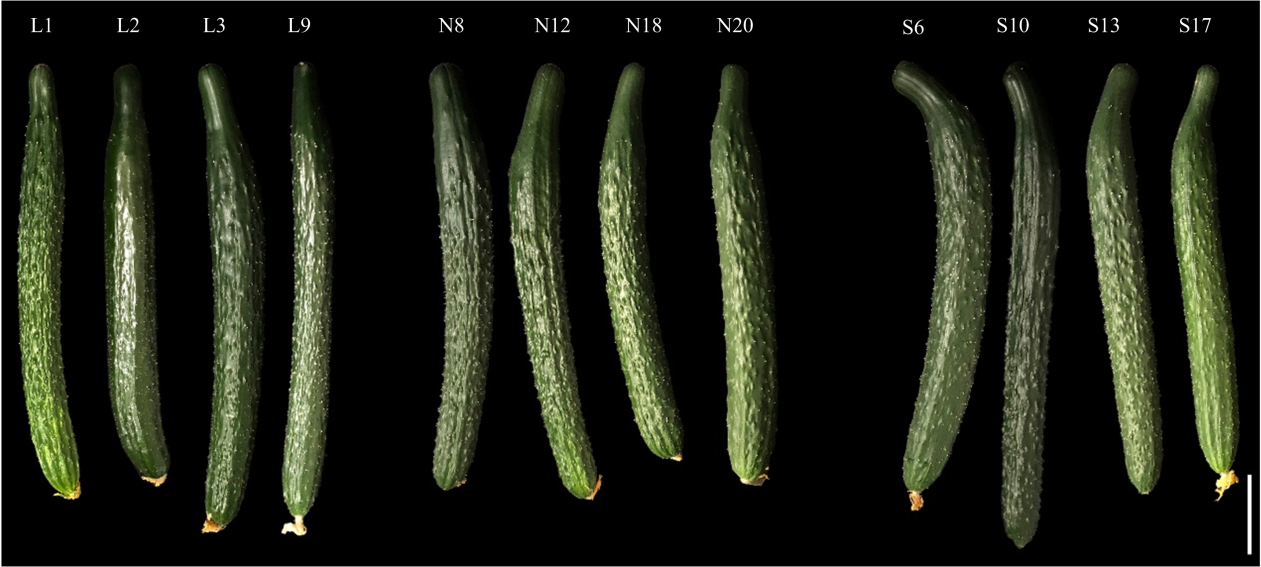
图1
不同品系(种)黄瓜果实外观图 L:优良组;N组:常规组;S:较弱组;数字代表不同品系(种)。比例尺=5 cm"
表3
黄瓜果实感官评价各项品质指标权重"
| 项目 Item | 指标变异性 Indicator variability | 指标冲突性 Conflict among indicators | 信息量 Information content | 权重 Weight (%) |
|---|---|---|---|---|
| 甜味 Sweetness | 1.531 | 4.881 | 7.474 | 25.49 |
| 水分 Juiciness | 0.883 | 4.157 | 3.669 | 12.51 |
| 脆度 Crispness | 0.786 | 4.522 | 3.556 | 12.13 |
| 香气 Aroma | 0.587 | 5.289 | 3.105 | 10.59 |
| 非涩味 Non-astringency | 1.119 | 7.107 | 7.954 | 27.12 |
| 非苦味 Non-bitterness | 0.718 | 4.964 | 3.565 | 12.16 |

图2
不同黄瓜品系(种)果实感官评价分析"

图3
不同黄瓜品系(种)果实营养品质分析 不同小写字母表示不同黄瓜品系(种)之间差异达显著水平(Tukey测试)(P<0.05)。下同"
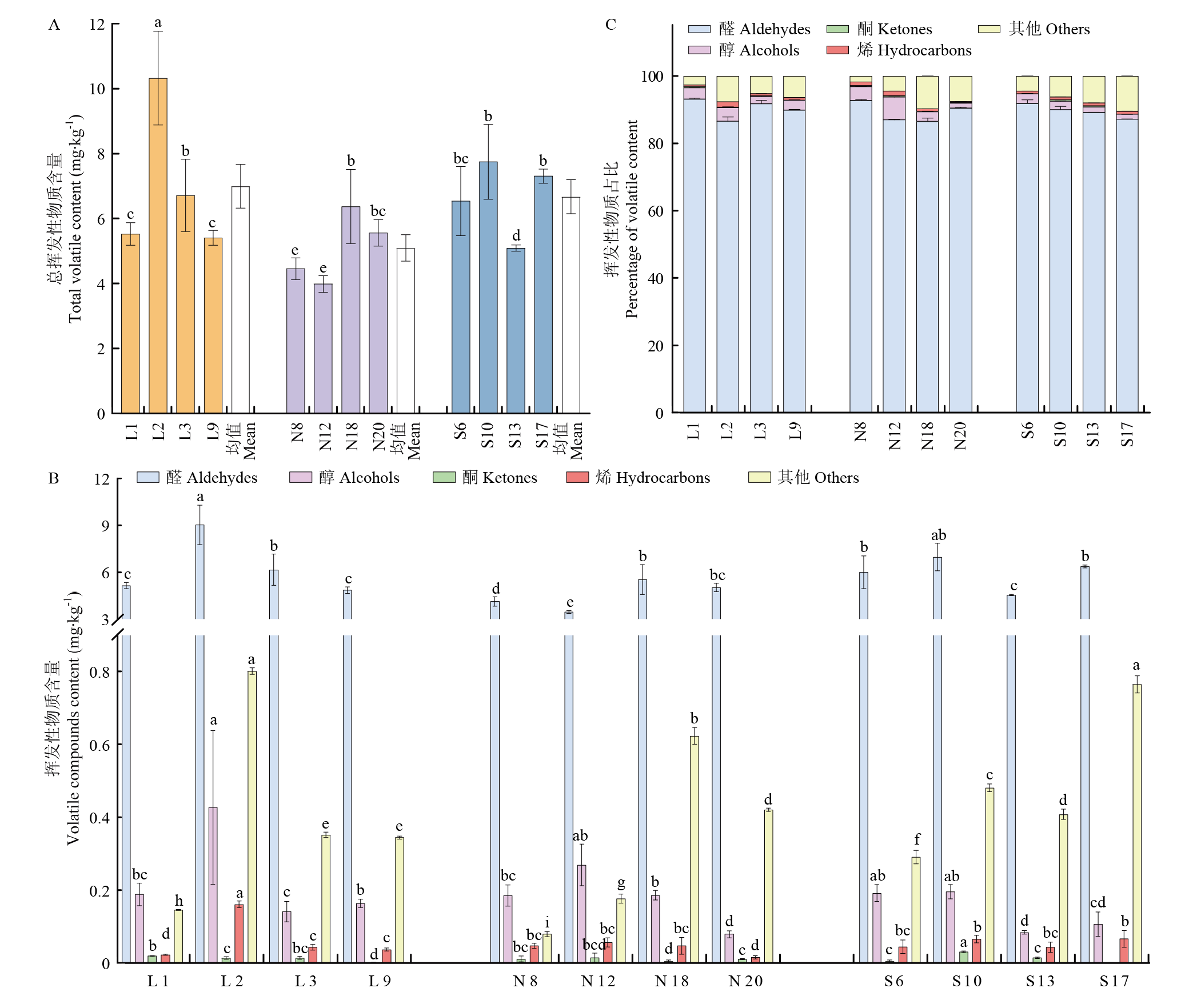
图4
不同黄瓜品系(种)果实中风味物质含量分析"
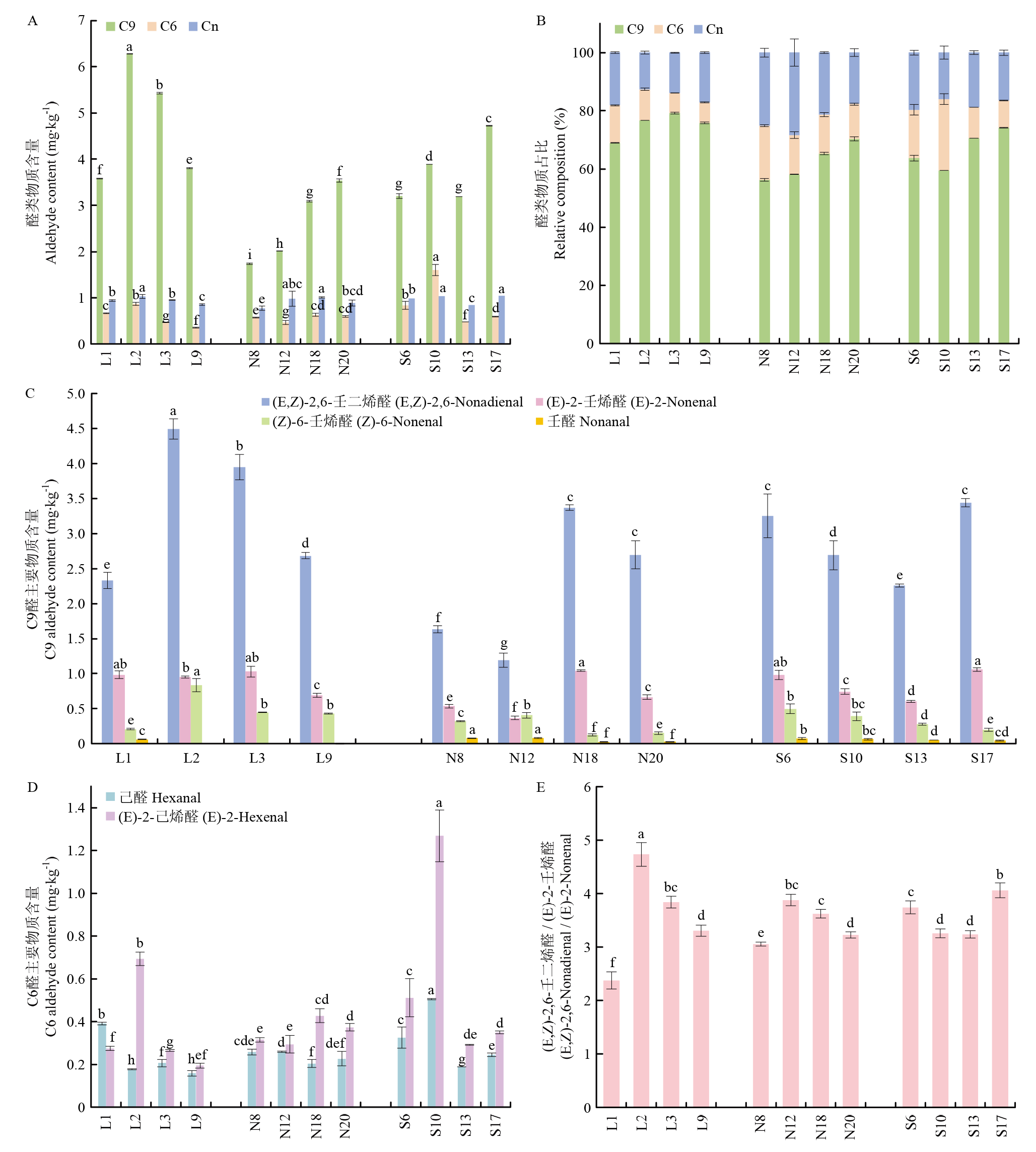
图5
不同黄瓜品系(种)果实中醛类风味特征物质含量分析 A:黄瓜果实中醛类化合物的含量和类型,根据化合物碳数将醛类分为C9、C6和其他碳数(Cn);B:黄瓜果实中各醛类化合物的占比;C:C9醛主要物质含量,包括(E, Z)-2, 6-壬二烯醛、(E)-2-壬烯醛、(Z)-6-壬烯醛和壬醛;D:C6醛主要物质含量,包括己醛和(E)-2-己烯醛;E:风味物质(E, Z)-2, 6-壬二烯醛与(E)-2-壬烯醛的比值"

图6
不同黄瓜品系(种)果实感官评价与营养品质及风味物质相关性分析 图中方块颜色和大小随不同指标之间相关性大小变化,红色表示正相关性,蓝色表示为负相关性。*:P<0.05;**:P<0.01"
| [1] |
农业农村部办公厅关于印发《农业生产“三品一标”提升行动实施方案》的通知.2021-03-18. https://jhs.moa.gov.cn/lsfz/202103/t20210318_6363985.htm.
|
|
Notice of the General Office of the Ministry of Agriculture and Rural Affairs on Printing and Distributing the Implementation Plan for the Enhancement Initiative of “Variety Improvement, Quality Upgrade, Brand Establishment and Standardized Production” in Agricultural Production. 2021-03-18. https://jhs.moa.gov.cn/lsfz/202103/t20210318_6363985.htm. (in Chinese)
|
|
| [2] |
张圣平, 苗晗, 薄凯亮, 董邵云, 顾兴芳. “十三五”我国黄瓜遗传育种研究进展. 中国蔬菜, 2021(4): 16-26.
|
|
|
|
| [3] |
黄国宋, 黄伟康, 郭静依, 刘勇, 罗丰, 符启位, 肖春雷. 19份华北型黄瓜新品种主要农艺性状主成分分析和聚类分析. 现代农业科技, 2021(5): 82-84, 91.
|
|
|
|
| [4] |
|
| [5] |
doi: 10.3390/ijms13022481 |
| [6] |
郝丽宁, 陈书霞, 王聪颖, 陈巧, 万旭花, 申晓青, 程智慧, 孟焕文. 不同基因型黄瓜果实芳香物质组成及含量差异研究. 西北农林科技大学学报(自然科学版), 2013, 41(6): 139-146.
|
|
|
|
| [7] |
doi: S0308-8146(19)30625-9 pmid: 31000051 |
| [8] |
|
| [9] |
doi: 10.1016/j.foodchem.2021.130667 |
| [10] |
高俊凤. 植物生理学实验指导. 北京: 高等教育出版社, 2006: 287.
|
|
|
|
| [11] |
刘春香, 何启伟, 孟静静. 黄瓜感官检验与主要芳香物质、可溶性糖的相关关系. 中国蔬菜, 2005(1): 8-10.
|
|
|
|
| [12] |
|
| [13] |
doi: 10.3390/s150100899 pmid: 25569761 |
| [14] |
李小嫄, 王洪伟, 童华荣. 食品感官评价技术在茶叶品质评价中的? 应用研究进展. 食品安全质量检测学报, 2015, 6(5): 1542-1547.
|
|
|
|
| [15] |
|
| [16] |
陈银根. 黄瓜果实可溶性糖含量遗传效应的初步研究[D]. 扬州: 扬州大学, 2009.
|
|
|
|
| [17] |
高珏晓, 王俊英, 梁增文, 徐蓓蓓, 郭莹, 王仁杰, 李朋, 李美芹. 5种鲜食黄瓜感官与品质评价初探. 蔬菜, 2022(5): 11-16.
|
|
|
|
| [18] |
田恒禄. 黄瓜涩味形成与儿茶素类物质代谢的关系及相关分子基础的研究[D]. 扬州: 扬州大学, 2015.
|
|
|
|
| [19] |
|
| [20] |
任思铃, 朱雪云, 闫立英, 李晓丽. 黄瓜涩味感官评价影响因素及种质资源涩味评价分析. 中国瓜菜, 2023, 36(3): 36-41.
|
|
|
|
| [21] |
孙利萍, 高敏丽, 张永民, 靳颖玲, 韩蓉. 口感型番茄品质指标分析及综合评价. 北方农业学报, 2023, 51(5): 67-74.
doi: 10.12190/j.issn.2096-1197.2023.05.07 |
|
doi: 10.12190/j.issn.2096-1197.2023.05.07 |
|
| [22] |
李跃红, 冉茂乾, 徐孟怀, 陈露, 游元丁, 赵阳, 焦彦朝. 不同品种猕猴桃果实品质比较与综合评价. 食品与发酵工业, 2020, 46(23): 162-168.
doi: 10.13995/j.cnki.11-1802/ts.024429 |
|
doi: 10.13995/j.cnki.11-1802/ts.024429 |
|
| [23] |
刘丙花, 孙锐, 王开芳, 舒秀阁, 孙蕾. 不同蓝莓品种果实品质比较与综合评价. 食品科学, 2019, 40(1): 70-76.
doi: 10.7506/spkx1002-6630-20170829-338 |
|
doi: 10.1111/jfds.1975.40.issue-1 |
|
| [24] |
徐坤范, 王明林, 艾希珍. 日光温室黄瓜发育过程中主要芳香物质和脂肪酸含量的变化. 西北植物学报, 2009, 29(2): 390-396.
|
|
|
|
| [25] |
doi: 10.1016/j.postharvbio.2013.02.006 |
| [26] |
|
| [27] |
刘春香, 何启伟, 刘拴桃. 黄瓜果实反, 顺-2, 6-壬二烯醛与反-2-壬烯醛比值的变化. 莱阳农学院学报, 2003(4): 276-278, 281.
|
|
|
|
| [28] |
王春芳, 毛明, 胡菲菲, 于勇, 和劲松, 朱松明. 超高压和热处理后黄瓜汁感官品质的主观评价和仪器检测对比. 农业工程学报, 2013, 29(10): 278-286.
|
|
|
|
| [29] |
doi: 10.3390/molecules18078200 pmid: 23852166 |
| [30] |
pmid: 11171233 |
| [31] |
doi: 10.1021/jf60194a006 |
| [32] |
doi: 10.1016/S0031-9422(00)89315-2 |
| [33] |
doi: 10.1016/S0031-9422(00)81874-9 |
| [34] |
王利斌, 李雪晖, 石珍源, 白晋和, 金昌海, 罗海波, 郁志芳. 番茄果实的芳香物质组成及其影响因素研究进展. 食品科学, 2017, 38(17): 291-300.
doi: 10.7506/spkx1002-6630-201717047 |
|
doi: 10.7506/spkx1002-6630-201717047 |
|
| [35] |
doi: 10.1016/j.foodchem.2020.127665 |
| [36] |
|
| [1] | 彭廷燊, 陆久焱, 吴美林, 严雨欣, 刘宏周, 南文斌, 秦小健, 李明, 龚俊义, 梁永书. 多年生水稻黄糯2号和长白7号产量相关性状的QTL分析[J]. 中国农业科学, 2026, 59(7): 1361-1379. |
| [2] | 曹海顺, 周东源, 王瑞, 施招婉, 吴廷全, 张长远. 弱光胁迫短下胚轴黄瓜种质鉴定及其遗传位点挖掘[J]. 中国农业科学, 2026, 59(6): 1286-1301. |
| [3] | 陈敏氡, 裘波音, 黄昊, 李永平, 温庆放. 松花菜种质花球质地品质的评价[J]. 中国农业科学, 2026, 59(6): 1302-1316. |
| [4] | 岳丽昕, 王清华, 王振宝, 尼玛琼吉, 刘泽洲, 孔素萍, 张立峰, 高莉敏. 基于广靶代谢组学分析藏葱和细香葱营养品质及黄酮类代谢产物差异[J]. 中国农业科学, 2026, 59(5): 1070-1086. |
| [5] | 董金龙, 赵莹, 余海兵, 吕建晔, 秦佳琦, 梁晨, 明博, 李少昆. 多模型解析玉米籽粒容重的营养品质贡献度与区域异质性[J]. 中国农业科学, 2026, 59(5): 985-995. |
| [6] | 付涵, 于杨, 艾妞, 张思晴, 于连伟, 孙书豪, 赵金章, 韩晓玉, 施艳, 杨雪. 光合作用系统Ⅱ相关蛋白NbPsbQ1通过促进光合效率抑制病毒侵染[J]. 中国农业科学, 2026, 59(1): 90-100. |
| [7] | 季圣阳, 陆柏益, 李培武. 关于现代农产品品质学的若干思考[J]. 中国农业科学, 2025, 58(9): 1830-1844. |
| [8] | 张亚封, 董伟进, 李启云, 路杨, 张正坤, 隋丽. 球孢白僵菌与钾元素互作对番茄果实品质的影响[J]. 中国农业科学, 2025, 58(6): 1131-1144. |
| [9] | 巨晓军, 章明, 刘一帆, 姬改革, 单艳菊, 屠云洁, 邹剑敏, 张海涛, 卞良永, 束婧婷. 整合肠道菌群与小分子代谢物分析调控肉鸡饲料转化率的影响因素[J]. 中国农业科学, 2025, 58(6): 1223-1238. |
| [10] | 褚添硕, 陈晓安, 朱瑾瑾, 王策, 娄伟. 关键生育期调亏灌溉对赣南脐橙果实生长与产量品质的影响[J]. 中国农业科学, 2025, 58(24): 5247-5258. |
| [11] | 李明丽, 温彩运, 马东豪, 李存军, 王宇文, 康璐, 陆苗. 基于土壤高光谱特征波段优选的盐分预测模型构建[J]. 中国农业科学, 2025, 58(20): 4054-4069. |
| [12] | 任家辉, 孙娟娟, 郝莹璐, 王凤梧, 王靖宇, 张明伟, 李宝涵, 郑成忠, 何竹青, 王照兰. 内蒙古中部地区饲用燕麦品种筛选及青贮品质评价[J]. 中国农业科学, 2025, 58(19): 4026-4038. |
| [13] | 王迪, 韩守安, 张雯, 王敏, 石慧东, 朱学慧, 白世践, 刘旭鹏, 田嘉, 谢辉. 不同植物生长调节剂处理对‘无核白’葡萄鲜果及制干品质的影响[J]. 中国农业科学, 2025, 58(18): 3767-3782. |
| [14] | 向爱慧, 白荣基, 郝宇琼, 赵佳佳, 武棒棒, 李晓华, 郑兴卫, 关攀锋, 郑军. 山西小麦矮秆基因的鉴定及株高遗传位点挖掘[J]. 中国农业科学, 2025, 58(17): 3372-3388. |
| [15] | 唐佳灵, 张玉林, 杨勇, 方正锋, 韩国全, 惠腾. 日粮中添加酱油残渣压榨油脂对猪肉品质的影响[J]. 中国农业科学, 2025, 58(15): 3118-3133. |
|
||
