






中国农业科学 ›› 2026, Vol. 59 ›› Issue (22): 5079-5094.doi: 10.3864/j.issn.0578-1752.2026.22.009
邢艺凡( ), 郭佩, 刘春娟, 刘畅, 史晓龙, 赵天宏(), 周宇飞()
收稿日期:2026-04-01
接受日期:2026-09-17
出版日期:2026-11-16
发布日期:2026-11-19
通信作者:
联系方式:
邢艺凡,E-mail:yfxing1996@163.com。
基金资助:
XING YiFan(), GUO Pei, LIU ChunJuan, LIU Chang, SHI XiaoLong, ZHAO TianHong(), ZHOU YuFei()
Received:2026-04-01
Accepted:2026-09-17
Published:2026-11-16
Online:2026-11-19
摘要:
【目的】研究不同施氮水平对弱光胁迫下高粱光合性能和产量形成的影响,探讨氮素对高粱光合电子传递、干物质积累及氮素分配的调控作用,旨在为弱光条件下高粱氮肥合理施用提供理论依据。【方法】于2023—2024年在沈阳农业大学科学试验基地开展田间试验,以高粱品种吉杂236为试验材料,采用二因素随机区组设计,设置正常光照与弱光胁迫(遮光50%)2种光环境,氮素水平分别为150、225和300 kg N·hm-2,系统分析高粱叶片光合特性、叶绿素荧光动力学、各器官干物质积累、氮素分配及产量形成的响应特征。【结果】弱光胁迫显著降低了高粱叶片净光合速率(Pn)、气孔导度(Gs)、叶绿素含量以及光系统II(PSII)最大光化学效率(ϕPo),并导致OJIP曲线中J相和I相荧光强度升高,单位反应中心吸收光能(ABS/RC)与耗散热能(DIo/RC)增加,而电子传递能量(ETo/RC)和PSI末端电子受体还原能量(REo/RC)下降。适量施氮素(225 kg N·hm-2,TN2处理)可有效缓解弱光胁迫的不利影响,显著提高了叶绿素a、b的含量,Pn显著上升,胞间CO2浓度(Ci)下降,同时降低J点和K点相对可变荧光,提升O-I相标准化荧光(WOI),优化能量分配,减少DIo/RC并提高ETo/RC与REo/RC。另外,TN2处理可促进茎、叶、穗干物质积累,改善氮素向穗部的分配,显著提高千粒重和单位面积产量。相关性分析表明,光化学参数(ϕPo、ETo/RC等)与产量呈显著正相关关系,而DIo/RC与产量呈显著负相关关系。【结论】适量施氮(225 kg N·hm-2)可通过提高光能捕获与电子传递效率、减少无效能量耗散、促进同化物积累及向籽粒分配,有效缓解弱光胁迫对高粱光合系统的抑制,为弱光条件下高粱氮肥优化管理提供理论依据。
邢艺凡, 郭佩, 刘春娟, 刘畅, 史晓龙, 赵天宏, 周宇飞. 氮素对弱光胁迫下高粱光合特性和产量的影响[J]. 中国农业科学, 2026, 59(22): 5079-5094.
XING YiFan, GUO Pei, LIU ChunJuan, LIU Chang, SHI XiaoLong, ZHAO TianHong, ZHOU YuFei. Effects of Nitrogen Application on Photosynthetic Characteristics and Yield of Sorghum Under Low Light Stress[J]. Scientia Agricultura Sinica, 2026, 59(22): 5079-5094.
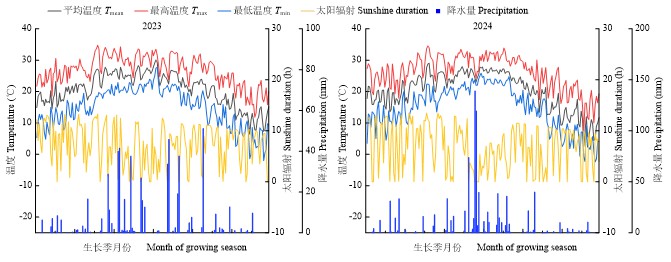
图1
2023—2024试验地高粱生长季的日气温、日照时数和降水量"
表1
试验地0—30 cm土层的土壤性状(2023—2024)"
| 年份 Year | 有机质含量 Organic matter content (g·kg-1) | 总氮含量 Total N content (mg·kg-1) | 速效氮含量 Available N content (mg·kg-1) | 速效磷含量 Available P content (mg·kg-1) | 速效钾含量 Available K content (mg·kg-1) | pH |
|---|---|---|---|---|---|---|
| 2023 | 14.75 | 450.22 | 68.45 | 17.53 | 115.47 | 6.7 |
| 2024 | 15.37 | 439.23 | 64.24 | 18.09 | 120.21 | 6.8 |
表2
高粱的播种日期、弱光胁迫开始时间和收获日期(2023—2024)"
| 年份Year | 播种日期Sowing date | 弱光胁迫开始时间Start date of low light | 收获日期Harvest date |
|---|---|---|---|
| 2023 | 05-15 | 07-11 | 09-30 |
| 2024 | 05-14 | 07-11 | 09-23 |
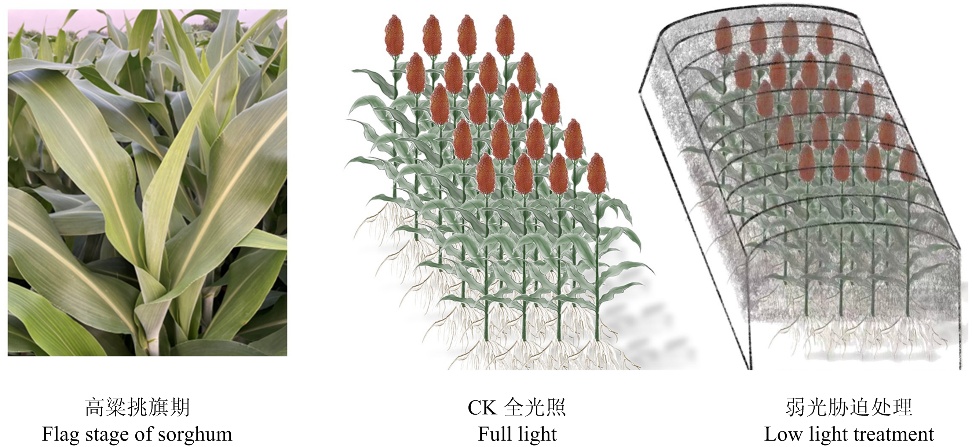
图2
试验设计示意图"
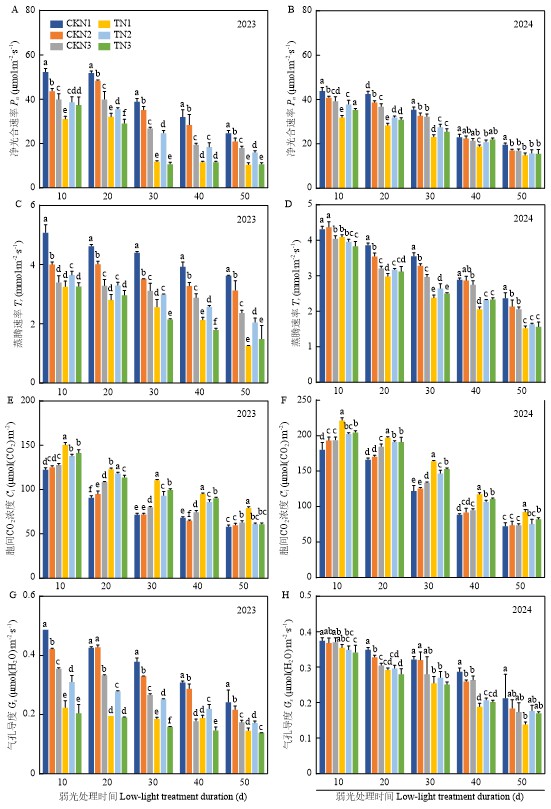
图3
氮素对弱光胁迫下高粱叶片光合参数的影响 CKN1:正常光照和150 kg N·hm-2;CKN2:正常光照和225 kg N·hm-2;CKN3:正常光照和300 kg N·hm-2;TN1:弱光胁迫和150 kg N·hm-2;TN2:弱光胁迫和225 kg N·hm-2;TN3:弱光胁迫和300 kg N·hm-2。不同小写字母表示处理间差异显著(P<0.05)。下同"
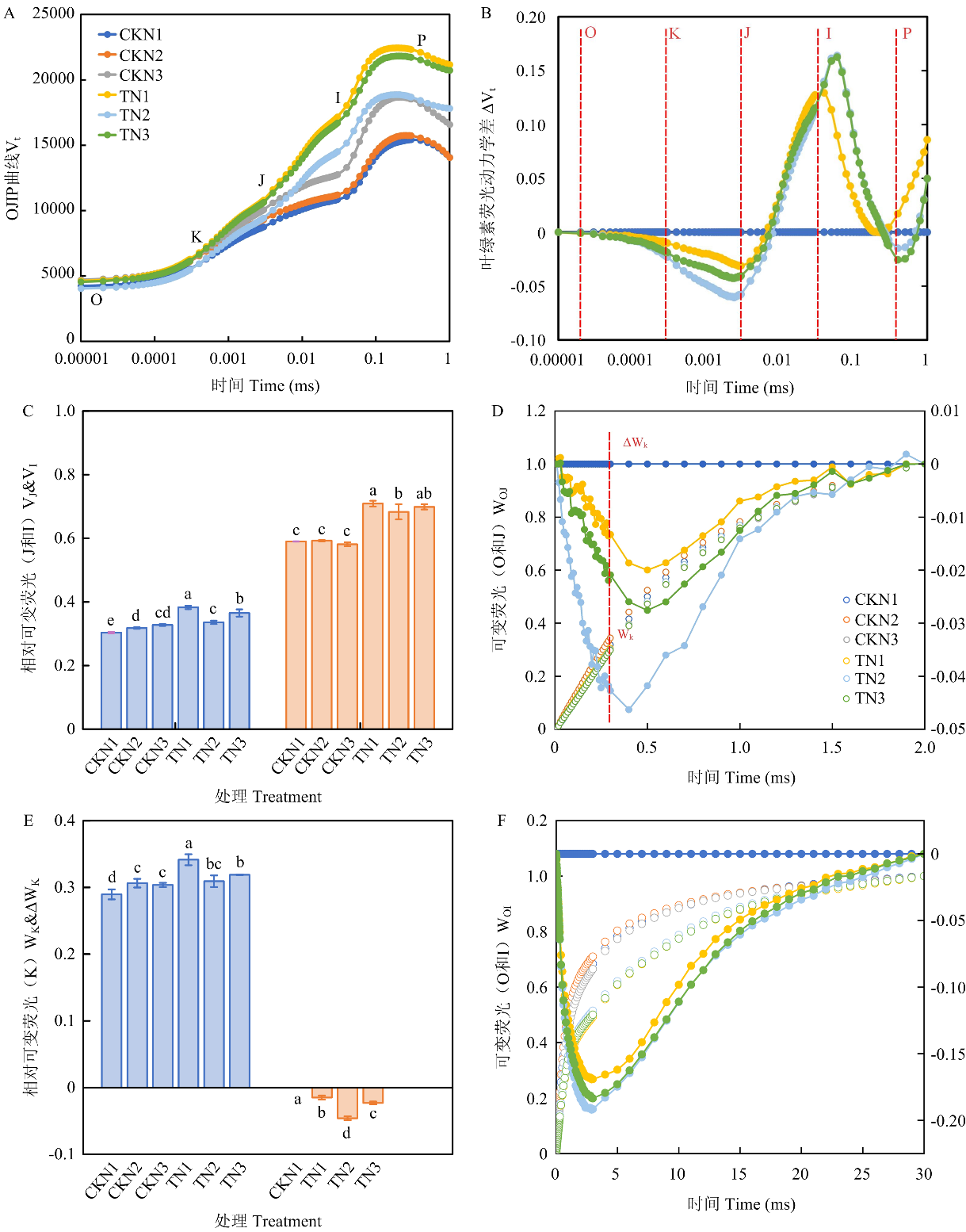
图4
氮素对弱光胁迫下高粱叶片叶绿素a荧光动力学曲线(OJIP)的影响"
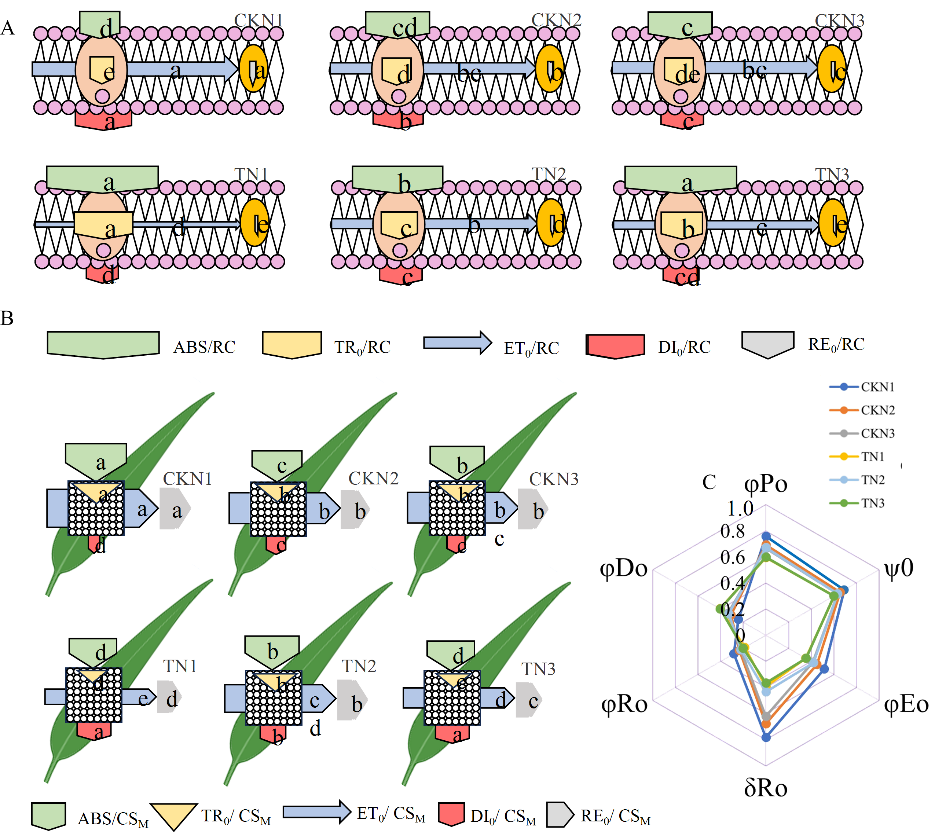
图5
氮素对弱光胁迫下高粱叶片比通量管道模型、能量通量叶片模型及量子产量的影响 A:高粱叶片PSII活性反应中心比能通量的膜/比模型;B:PSII活性反应中心比能通量的Leaf模型;C:PSII活性反应中心量子产量雷达图"
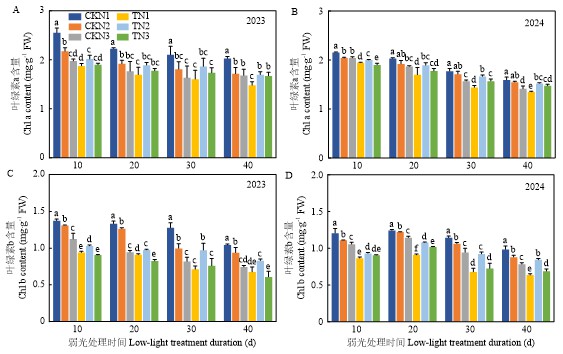
图6
氮素对弱光胁迫下高粱叶片光合色素含量的影响"
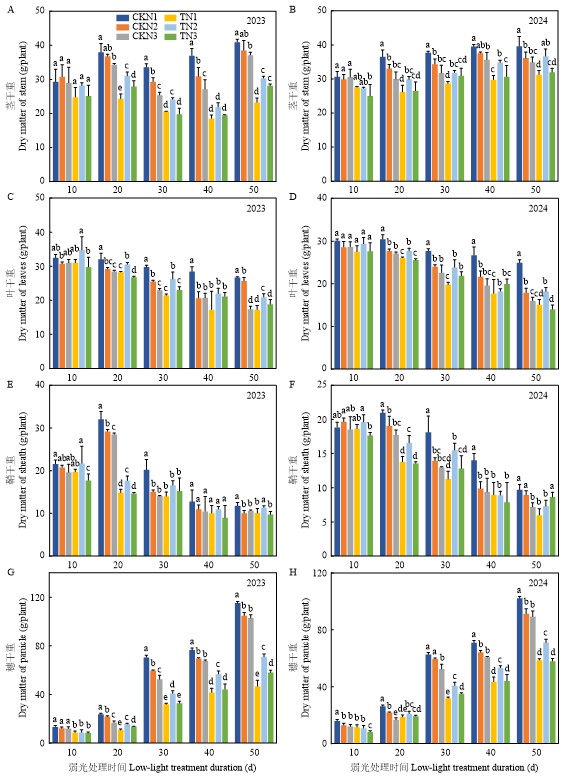
图7
氮素对弱光胁迫下高粱各器官干物质积累的影响"
表3
氮素对弱光胁迫下高粱各器官氮含量的影响"
| 年份 Year | 处理 Treatment | 各器官氮含量Nitrogen content in different organs (mg·g-1) | |||
|---|---|---|---|---|---|
| 茎Stem | 叶Leaves | 鞘Sheath | 穗Panicle | ||
| 2023 | CKN1 | 12.61±0.24f | 15.14±0.60f | 8.35±0.20f | 26.54±0.89a |
| CKN2 | 13.26±0.21e | 19.15±0.44e | 11.13±0.11e | 22.98±0.78b | |
| CKN3 | 14.50±0.28d | 21.04±0.40d | 12.16±0.18d | 21.89±0.41bc | |
| TN1 | 19.61±0.08a | 29.47±0.16a | 18.59±0.28a | 16.23±0.61e | |
| TN2 | 18.09±0.04c | 23.80±0.54c | 15.27±0.15c | 21.10±1.00c | |
| TN3 | 18.72±0.61b | 25.25±0.17b | 16.77±0.43b | 19.12±0.59c | |
| 2024 | CKN1 | 15.84±0.04f | 16.80±0.40d | 9.89±0.16f | 27.60±0.08a |
| CKN2 | 16.49±0.06e | 21.15±0.44c | 12.67±0.14e | 24.02±0.07c | |
| CKN3 | 17.73±0.27d | 21.71±0.18c | 13.70±0.18d | 24.69±0.40b | |
| TN1 | 22.84±0.18a | 32.80±0.70a | 20.13±0.28a | 15.86±0.27f | |
| TN2 | 21.32±0.04c | 27.13±0.04b | 16.80±0.05c | 19.83±0.15d | |
| TN3 | 21.95±0.16b | 27.58±0.67b | 18.30±0.23b | 16.43±0.01e | |
表4
氮素对弱光胁迫下高粱产量及产量构成因素的影响"
| 年份 Year | 处理 Treatment | 有效穗数 Effective panicle number (panicles/hm2) | 每穗粒数 Grains per panicle | 千粒重 1000-kernel weight (g) | 产量 Grain yield (kg·hm-2) |
|---|---|---|---|---|---|
| 2023 | CKN1 | 104513.89±2621.47a | 2639.71±2.78a | 33.31±0.88a | 9191.63±367.04a |
| CKN2 | 101736.11±601.41ab | 2606.45±80.83a | 30.93±0.68b | 8198.98±178.56b | |
| CKN3 | 100347.22±601.41b | 2509.09±106.72a | 30.26±0.21b | 7620.25±350.58c | |
| TN1 | 86583.33±2755.99d | 1825.01±58.78b | 25.97±0.83d | 4242.62±113.80e | |
| TN2 | 92361.11±2621.47c | 1910.24±69.20b | 28.86±0.38c | 5091.67±222.25d | |
| TN3 | 89583.33±1041.67c | 1749.53±78.97b | 26.54±0.46d | 4156.81±90.62e | |
| 2024 | CKN1 | 115277.78±10117.22a | 2522.09±59.69b | 29.20±0.09a | 8492.89±815.90a |
| CKN2 | 96527.78±6364.69bc | 2760.74±251.63a | 25.62±2.20b | 6790.43±391.65b | |
| CKN3 | 95833.33±7511.57bc | 2726.56±24.43ab | 23.83±0.50bc | 6226.90±531.55b | |
| TN1 | 88541.67±2083.33c | 1975.90±82.58dc | 20.72±0.62d | 3622.51±92.90d | |
| TN2 | 97916.67±2083.33bc | 1954.61±60.94dc | 23.86±0.50bc | 4565.19±108.43c | |
| TN3 | 97569.44±2168.40bc | 1973.97±107.88c | 21.83±1.52cd | 4194.71±133.13cd | |
| N | ** | * | ** | ** | |
| T | ** | ** | ** | ** | |
| Y | NS | ** | ** | ** | |
| N×T×Y | ** | NS | NS | NS |
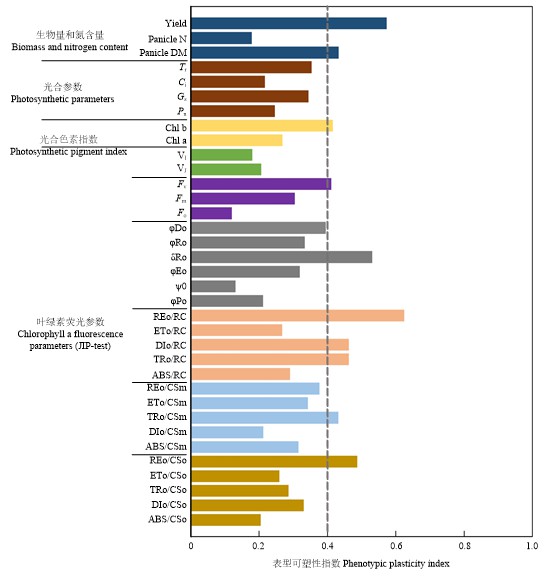
图8
氮素对弱光胁迫下高粱的表型可塑性分析 Yield:产量;Panicle N:穗部氮含量;Panicle DM:穗部干物质重;Pn:净光合速率;Gs:气孔导度;Ci:胞间CO2浓度;Tr:蒸腾速率;Chl a、Chl b:叶绿素a、叶绿素b;Fo、Fm、Fv:初始荧光、最大荧光、最大可变荧光;VJ、VI:J点、I点相对可变荧光;ϕPo、ψ0、ϕEo、δRo、ψDo、ϕDo:JIP-test各量子产额与概率;ABS/RC、TRo/RC、ETo/RC、DIo/RC、REo/RC:单位反应中心吸收、捕获、电子传递、耗散及还原PSI末端受体的能量;CSo、CSm:初始状态与最大荧光状态。下同"

图9
氮素对弱光胁迫下高粱光合生理参数与产量的相关性分析"
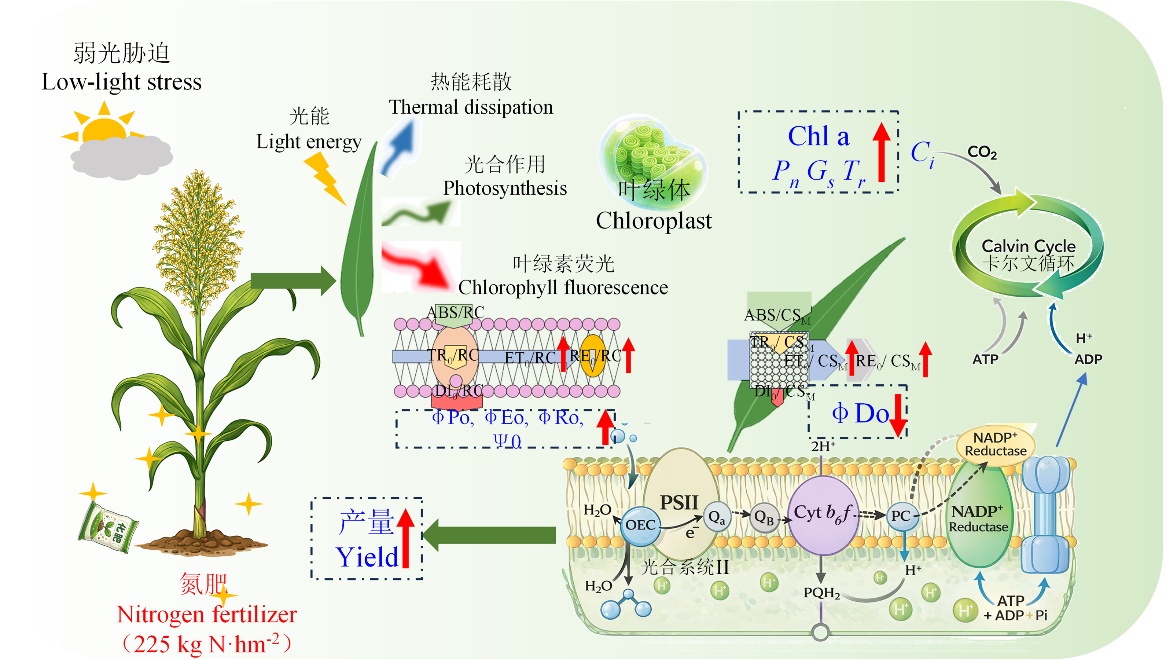
图10
氮素对弱光胁迫下高粱光合特性和产量的影响"
| [1] |
|
| [2] |
|
| [3] |
|
| [4] |
|
| [5] |
|
| [6] |
|
| [7] |
|
| [8] |
|
| [9] |
|
| [10] |
|
| [11] |
李鹏民, 高辉远, Reto J.Strasser. 快速叶绿素荧光诱导动力学分析在光合作用研究中的应用[J]. 植物生理与分子生物学学报, 2005(6): 559-566.
|
|
|
|
| [12] |
|
| [13] |
|
| [14] |
|
| [15] |
|
| [16] |
|
| [17] |
|
| [18] |
谷闻东, 刘春娟, 李邦, 刘畅, 周宇飞. 外源色氨酸对低氮胁迫下高粱苗期叶片碳氮平衡和衰老特性的影响[J]. 中国农业科学, 2023, 56(7): 1295-1310. DOI: 10.3864/j.issn.0578-1752.2023.07.008.
|
|
|
|
| [19] |
|
| [20] |
|
| [21] |
|
| [22] |
|
| [23] |
|
| [24] |
|
| [25] |
|
| [26] |
|
| [27] |
|
| [28] |
|
| [29] |
|
| [30] |
|
| [31] |
|
| [32] |
|
| [33] |
|
| [34] |
|
| [35] |
|
| [1] | 白晶晶, 章宇辰, 倪子捷, 高佳勇, 刘伟洋, 盖东升, 王雨行, 何佳庆, 张强, 邵玺文, 吴莹, 耿艳秋, 郭丽颖. 不同灌溉量对东北地区水稻抗倒伏特性及产量的影响[J]. 中国农业科学, 2026, 59(9): 1848-1868. |
| [2] | 蔡巧红, 周甜, 苏明, 洪自强, 李翻过, 李彤, 汪华, 康建宏, 吴宏亮. 宁夏引黄灌区减氮增钾施肥模式对玉米光合荧光特性及光合产物积累的影响[J]. 中国农业科学, 2026, 59(9): 1869-1886. |
| [3] | 祝培, 赵耀, 白岩, 张金盔, 李莓, 龙金佳, 杨龙, 罗丽娅, 许本波, 徐劲松, 张学昆. 氟唑菌酰羟胺对油菜的生理调控作用及其与咪鲜胺的复配效应[J]. 中国农业科学, 2026, 59(9): 1903-1915. |
| [4] | 葛玉彬, 贺春贵, 王宁, 张国琴, 张正英, 吕鑫. 基于表型性状的热带高粱种质资源遗传多样性分析与创新利用[J]. 中国农业科学, 2026, 59(8): 1622-1638. |
| [5] | 陈宣伊, 郭星星, 张向前, 路战远, 刘凌悦, 罗方, 李金龙, 张传玲, 张志青, 车曼青. 间作行比对玉米冠层光环境异质性和光合物质生产的影响[J]. 中国农业科学, 2026, 59(8): 1653-1671. |
| [6] | 侯慧芝, 尹嘉德, 马明生, 刘晓伟, 柳燕兰, 雷康宁. 耕作与增施有机肥对陇东马铃薯-玉米一年两熟制作物产量和水分利用的影响[J]. 中国农业科学, 2026, 59(8): 1672-1685. |
| [7] | 彭廷燊, 陆久焱, 吴美林, 严雨欣, 刘宏周, 南文斌, 秦小健, 李明, 龚俊义, 梁永书. 多年生水稻黄糯2号和长白7号产量相关性状的QTL分析[J]. 中国农业科学, 2026, 59(7): 1361-1379. |
| [8] | 王玉萍, 符质, 孙佳莹, 穆晓萌, 刘慧淋, 郭进云, 宋文菁, 侯雷平, 赵海亮. 苗期施用褪黑素对番茄短期低温胁迫的缓解作用与应用效果评价[J]. 中国农业科学, 2026, 59(7): 1523-1535. |
| [9] | 王佳诺, 陈桂平, 李盼, 王丽萍, 南运有, 何蔚, 樊志龙, 胡发龙, 柴强, 殷文, 赵连豪. 免耕地膜两年覆盖提高绿洲灌区玉米产量的灌浆期光合生理机制[J]. 中国农业科学, 2026, 59(6): 1189-1202. |
| [10] | 周新杰, 任昊, 陈应龙, 张吉旺, 赵斌, 任佰朝, 刘鹏, 王洪章. 过氧化钙对渍涝农田夏玉米根系形态及产量形成的影响[J]. 中国农业科学, 2026, 59(6): 1203-1216. |
| [11] | 何继航, 张擎, 吕相月, 薛吉全, 徐淑兔, 刘建超. 不同保绿型玉米杂交种氮效率评价[J]. 中国农业科学, 2026, 59(6): 1217-1230. |
| [12] | 曹海顺, 周东源, 王瑞, 施招婉, 吴廷全, 张长远. 弱光胁迫短下胚轴黄瓜种质鉴定及其遗传位点挖掘[J]. 中国农业科学, 2026, 59(6): 1286-1301. |
| [13] | 郝琨, 陈洪德, 张威, 钟韵, 党美荣, 朱士江, 黄志坤, 金英. 基于柑橘产量、品质及水氮利用的涌泉根灌水氮综合评价[J]. 中国农业科学, 2026, 59(4): 862-873. |
| [14] | 郭富城, 唐海江, 郝馨怡, 马国林, 杨九菊, 黄霖锋, 田蕾, 王彬, 罗成科. 不同灌溉方式对宁夏盐渍化土壤水盐运移、水稻产量及水分利用效率的影响[J]. 中国农业科学, 2026, 59(4): 750-764. |
| [15] | 延廷霖, 杜娅丹, 胡笑涛, 王贺, 李晓雁, 王玉明, 牛文全, 谷晓博. 加气滴灌下氮肥有机替代对亏缺灌溉棉花产量和水分利用效率的影响[J]. 中国农业科学, 2026, 59(3): 602-618. |
|
||
