






中国农业科学 ›› 2026, Vol. 59 ›› Issue (22): 4962-4975.doi: 10.3864/j.issn.0578-1752.2026.22.002
张华耀1( ), 唐阳军1, 陈建军2, 吕艳1, 徐荣3, 曾柳1, 易建平4, 罗丹1, 刘胜毅1, 程勇1, 张园园1(), 邹锡玲1()
收稿日期:2025-12-12
接受日期:2026-02-12
出版日期:2026-11-16
发布日期:2026-11-19
通信作者:
联系方式:
张华耀,E-mail:2690279439@qq.com。
基金资助:
ZHANG HuaYao1(), TANG YangJun1, CHEN JianJun2, LÜ Yan1, XU Rong3, ZENG Liu1, YI JianPing4, LUO Dan1, LIU ShengYi1, CHENG Yong1, ZHANG YuanYuan1(), ZOU XiLing1()
Received:2025-12-12
Accepted:2026-02-12
Published:2026-11-16
Online:2026-11-19
摘要:
【目的】油菜是我国第一大国产植物油源作物,其主产区集中于长江流域稻油轮作区。该区域渍害频发,严重制约油菜萌发与成苗,已成为影响油菜稳产高产的关键限制因素。建立一套高效、可靠的萌发期耐渍性鉴定体系,并筛选优异耐渍种质,为推动油菜耐渍性遗传改良、保障食用油供给安全提供理论价值。【方法】以408份甘蓝型油菜种质为试验材料,于萌发期进行12 h渍水处理,随后转入正常条件下恢复生长7 d,并设正常培养为对照。系统测定包括根长、茎长、总长、根表面积、根体积、根尖数、根分枝数、地下部鲜重、地下部干重、地上部鲜重、地上部干重、总鲜重和总干重13项表型性状,通过计算各性状耐渍指数,并运用隶属函数法进行多性状数据标准化与整合,构建综合耐渍指数。同时测定反映细胞膜受损程度的生理指标相对电导率。最终,结合综合耐渍指数与相对电导率,开展联合分析,实现对极端耐渍和极端敏感种质的精准筛选。【结果】渍水胁迫对油菜萌发期生长具有全面抑制作用,其中,对根系形态建成的抑制尤为显著,根长、根尖数、根分枝数等根系性状的耐渍指数均值均低于0.26。相关性分析表明,在胁迫条件下,各性状耐渍指数之间均呈现极显著正相关。相对电导率在群体中呈近似正态分布,变异幅度高达37.7%。通过综合耐渍指数与相对电导率的交叉验证,成功鉴定出5份在形态与生理层面均表现突出的极端耐渍种质和10份极端敏感种质,为后续研究提供了明确的表型极端材料。【结论】构建了一套整合了多维形态表型与关键生理指标的甘蓝型油菜萌发期耐渍性高效综合评价体系。鉴定出5份极端耐渍种质和10份极端敏感种质。
张华耀, 唐阳军, 陈建军, 吕艳, 徐荣, 曾柳, 易建平, 罗丹, 刘胜毅, 程勇, 张园园, 邹锡玲. 甘蓝型油菜萌发期耐渍性综合评价体系构建与优异种质筛选[J]. 中国农业科学, 2026, 59(22): 4962-4975.
ZHANG HuaYao, TANG YangJun, CHEN JianJun, LÜ Yan, XU Rong, ZENG Liu, YI JianPing, LUO Dan, LIU ShengYi, CHENG Yong, ZHANG YuanYuan, ZOU XiLing. Construction of Comprehensive Evaluation System for Waterlogging Tolerance at the Germination Stage and Screening of Elite Germplasm in Brassica napus L.[J]. Scientia Agricultura Sinica, 2026, 59(22): 4962-4975.
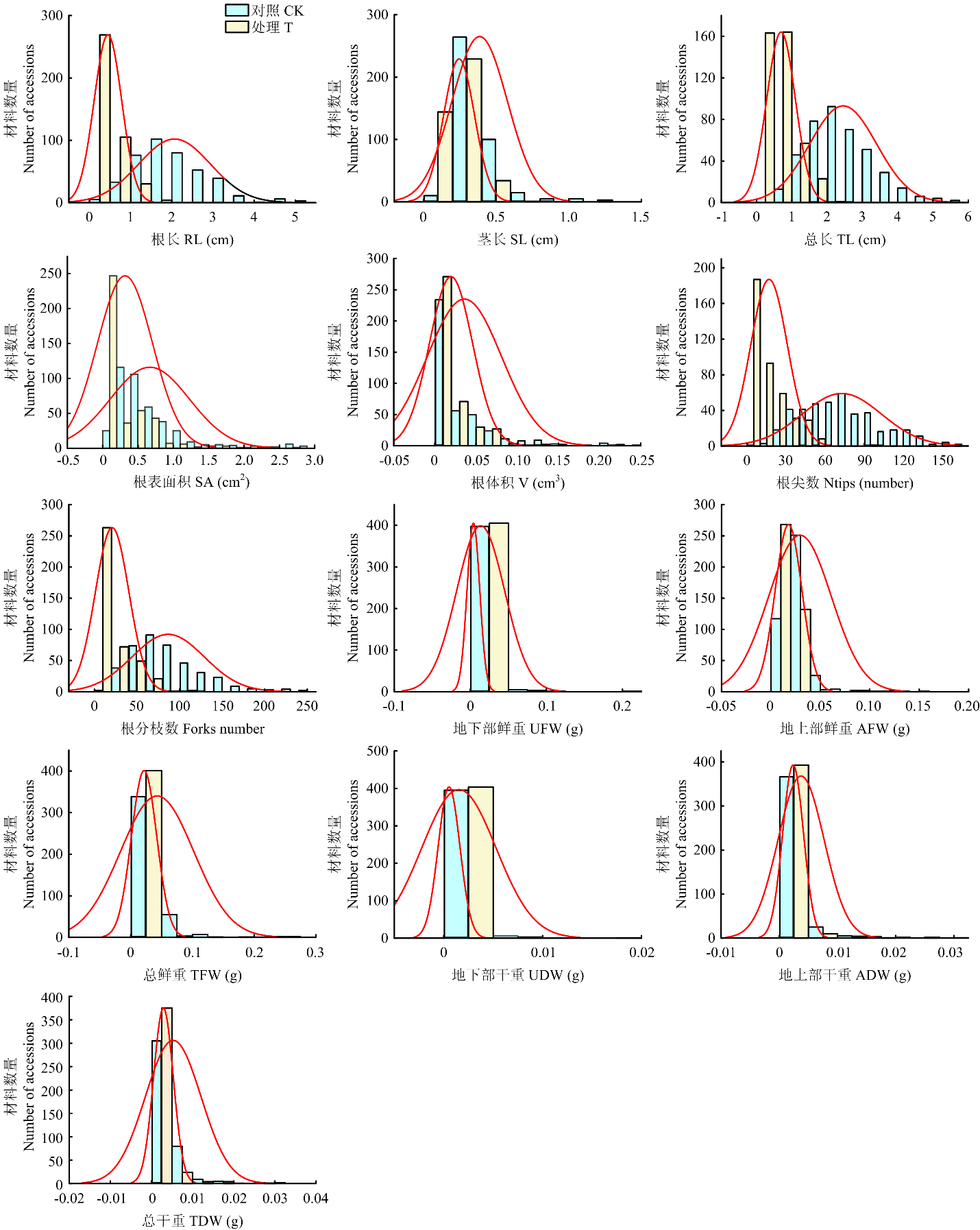
图1
渍水处理下408份甘蓝型油菜种质13个表型性状的频数分布 CK:对照组;T:渍水胁迫。RL:根长;SL:茎长;TL:总长;SA:根表面积;V:根体积;Ntips:根尖数;Forks:根分枝数;UFW:地下部鲜重;AFW:地上部鲜重;TFW:总鲜重;UDW:地下部干重;ADW:地上部干重;TDW:总干重。下同"
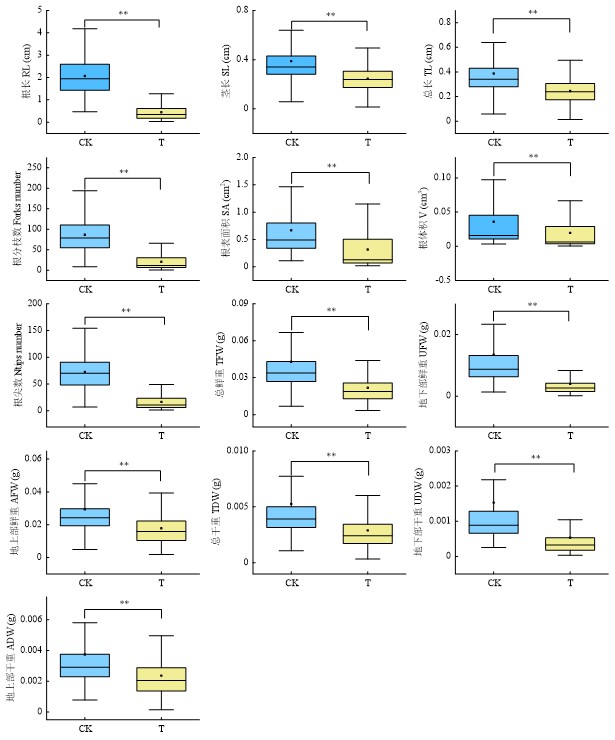
图2
渍水处理下408份甘蓝型油菜种质表型性状的箱线图"
表1
甘蓝型油菜种质各性状耐渍指数的描述性统计"
| 性状Traits | 最大值Max | 最小值Min | 平均值Mean | 标准差SE | 变异系数CV (%) | 峰度Kurtosis | 偏度Skewness |
|---|---|---|---|---|---|---|---|
| 根长RL | 0.77926 | 0.03135 | 0.22983 | 0.15441 | 67.19 | 1.365 | 1.280 |
| 茎长SL | 0.97635 | 0.04918 | 0.67103 | 0.20197 | 30.10 | -0.186 | -0.813 |
| 总长TL | 0.78636 | 0.04238 | 0.29535 | 0.14342 | 48.56 | 0.506 | 0.935 |
| 根表面积SA | 0.95179 | 0.04501 | 0.41802 | 0.24034 | 57.50 | -1.239 | 0.230 |
| 根体积V | 0.96170 | 0.02652 | 0.50346 | 0.22008 | 43.72 | -0.875 | 0.115 |
| 根尖数Ntips | 0.71082 | 0.02116 | 0.24737 | 0.16181 | 65.41 | -0.409 | 0.722 |
| 根分枝数Forks | 0.89560 | 0.01330 | 0.25154 | 0.17665 | 70.23 | 0.168 | 0.910 |
| 地下部鲜重UFW | 0.91310 | 0.04965 | 0.35811 | 0.16616 | 46.40 | -0.114 | 0.498 |
| 地上部鲜重AFW | 0.98596 | 0.14869 | 0.66141 | 0.20137 | 30.45 | -0.536 | -0.583 |
| 总鲜重TFW | 0.87746 | 0.14607 | 0.56535 | 0.16396 | 29.00 | -0.575 | -0.458 |
| 地下部干重UDW | 0.82928 | 0.06211 | 0.39966 | 0.17309 | 43.31 | -0.523 | 0.326 |
| 地上部干重ADW | 2.23391 | 0.14346 | 0.68952 | 0.20384 | 29.56 | 10.931 | 1.120 |
| 总干重TDW | 1.73534 | 0.16653 | 0.61047 | 0.16909 | 27.70 | 6.468 | 0.758 |
| 电导率REL | 0.85251 | 0.10695 | 0.35275 | 0.13283 | 37.66 | 1.066 | 0.974 |
表2
正常条件下表型性状的相关性分析"
| 性状 Traits | 根长 RL | 茎长 SL | 总长 TL | 根表面积SA | 根体积 V | 根尖数 Ntips | 根分枝数 Forks | 地下部鲜重UFW | 地上部鲜重AFW | 总鲜重TFW | 地下部干重UDW | 地上部干重ADW | 总干重TDW |
|---|---|---|---|---|---|---|---|---|---|---|---|---|---|
| 根长RL | 1 | 0.298** | 0.981** | 0.449** | 0.334** | 0.475** | 0.349** | 0.104* | 0.104* | 0.111* | 0.256** | 0.131** | 0.107* |
| 茎长SL | 1 | 0.477** | 0.079 | -0.009 | 0.202** | 0.093 | -0.017 | 0.104* | 0.047 | -0.019 | 0.078 | 0.035 | |
| 总长TL | 1 | 0.429** | 0.306** | 0.479** | 0.340** | 0.093 | 0.117* | 0.112* | 0.047 | 0.136** | 0.106* | ||
| 根表面积SA | 1 | 0.499** | 0.514** | 0.566** | 0.04 | 0.159** | 0.106* | 0.011 | 0.257** | 0.156** | |||
| 根体积V | 1 | 0.306** | 0.465** | 0.034 | 0.032 | 0.035 | -0.004 | 0.088 | 0.050 | ||||
| 根尖数Ntips | 1 | 0.815** | 0.006 | 0.084 | 0.048 | -0.035 | 0.094 | 0.035 | |||||
| 根分枝数Forks | 1 | -0.035 | 0.071 | 0.019 | -0.039 | 0.081 | 0.025 | ||||||
| 地下部鲜重UFW | 1 | 0.753** | 0.936** | 0.820** | 0.640** | 0.830** | |||||||
| 地上部鲜重AFW | 1 | 0.937** | 0.682** | 0.668** | 0.770** | ||||||||
| 总鲜重TFW | 1 | 0.802** | 0.698** | 0.854** | |||||||||
| 地下部干重UDW | 1 | 0.538** | 0.870** | ||||||||||
| 地上部干重ADW | 1 | 0.883** | |||||||||||
| 总干重TDW | 1 |
表3
渍水胁迫下表型性状的相关性分析"
| 性状 Traits | 根长RL | 茎长 SL | 总长 TL | 根表面积SA | 根体积V | 根尖数Ntips | 根分枝数Forks | 地下部鲜重UFW | 地上部鲜重AFW | 总鲜重TFW | 地下部干重UDW | 地上部干重ADW | 总干重TDW |
|---|---|---|---|---|---|---|---|---|---|---|---|---|---|
| 根长RL | 1 | 0.574** | 0.977** | 0.544** | 0.414** | 0.696** | 0.643** | 0.110* | 0.211** | 0.185** | 0.092 | 0.173** | 0.172** |
| 茎长SL | 1 | 0.737** | 0.452** | 0.407** | 0.524** | 0.465** | 0.046 | 0.293** | 0.213** | 0.031 | 0.255** | 0.205** | |
| 总长TL | 1 | 0.568** | 0.448** | 0.712** | 0.653** | 0.103* | 0.251** | 0.209** | 0.085 | 0.210** | 0.196** | ||
| 根表面积SA | 1 | 0.690** | 0.654** | 0.686** | 0.112* | 0.340** | 0.271** | 0.064 | 0.351** | 0.292** | |||
| 根体积V | 1 | 0.551** | 0.610** | 0.066 | 0.298** | 0.224** | 0.042 | 0.269** | 0.220** | ||||
| 根尖数Ntips | 1 | 0.905** | 0.086 | 0.248** | 0.200** | 0.034 | 0.188** | 0.156** | |||||
| 根分枝数Forks | 1 | 0.096 | 0.265** | 0.215** | 0.064 | 0.225** | 0.197** | ||||||
| 地下部鲜重UFW | 1 | 0.729** | 0.891** | 0.796** | 0.349** | 0.626** | |||||||
| 地上部鲜重AFW | 1 | 0.960** | 0.633** | 0.538** | 0.693** | ||||||||
| 总鲜重TFW | 1 | 0.744** | 0.499** | 0.715** | |||||||||
| 地下部干重UDW | 1 | 0.336** | 0.711** | ||||||||||
| 地上部干重ADW | 1 | 0.901** | |||||||||||
| 总干重TDW | 1 |
表4
表型性状耐渍指数的相关性分析"
| 性状 Traits | 根长RL | 茎长 SL | 总长 TL | 根表面积SA | 根体积 V | 根尖数Ntips | 根分枝数Forks | 地下部鲜重UFW | 地上部鲜重AFW | 总鲜重TFW | 地下部干重UDW | 地上部干重ADW | 总干重TDW |
|---|---|---|---|---|---|---|---|---|---|---|---|---|---|
| 根长RL | 1 | 0.288** | 0.974** | 0.485** | 0.317** | 0.465** | 0.453** | 0.446** | 0.201** | 0.301** | 0.306** | 0.162** | 0.201** |
| 茎长SL | 1 | 0.423** | 0.544** | 0.484** | 0.492** | 0.431** | 0.260** | 0.544** | 0.517** | 0.189** | 0.451** | 0.455** | |
| 总长TL | 1 | 0.511** | 0.345** | 0.481** | 0.454** | 0.460** | 0.268** | 0.365** | 0.310** | 0.233** | 0.269** | ||
| 根表面积SA | 1 | 0.761** | 0.707** | 0.696** | 0.466** | 0.495** | 0.544** | 0.332** | 0.401** | 0.428** | |||
| 根体积V | 1 | 0.531** | 0.546** | 0.317** | 0.491** | 0.498** | 0.232** | 0.394** | 0.406** | ||||
| 根尖数Ntips | 1 | 0.860** | 0.449** | 0.336** | 0.398** | 0.323** | 0.308** | 0.332** | |||||
| 根分枝数Forks | 1 | 0.457** | 0.296** | 0.366** | 0.366** | 0.279** | 0.313** | ||||||
| 地下部鲜重UFW | 1 | 0.197** | 0.482** | 0.420** | 0.182** | 0.255** | |||||||
| 地上部鲜重AFW | 1 | 0.924** | 0.101* | 0.616** | 0.594** | ||||||||
| 总鲜重TFW | 1 | 0.226** | 0.600** | 0.618** | |||||||||
| 地下部干重UDW | 1 | 0.119* | 0.377** | ||||||||||
| 地上部干重ADW | 1 | 0.931** | |||||||||||
| 总干重TDW | 1 |
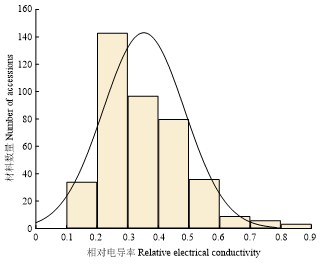
图3
渍水胁迫下相对电导率频数分布"
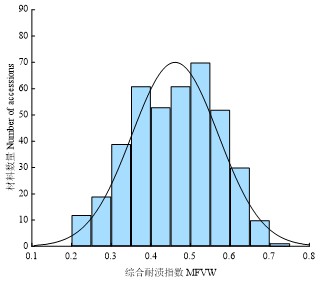
图4
综合耐渍指数的频数分布"
表5
基于综合耐渍指数(MFVW)的耐渍等级划分"
| 类别 Category | 耐渍性等级 Waterlogging tolerance level | MFVW范围 MFVW range | 种质数目 Number of accessions | 占比 Percentage (%) |
|---|---|---|---|---|
| 1 | 潜在极端耐渍型Potentially extremely waterlogging-tolerant | MFVW>0.5831 | 40 | 9.80% |
| 2 | 潜在耐渍型Potentially waterlogging-tolerant | 0.5000<MFVW≤0.5831 | 79 | 19.36% |
| 3 | 潜在中等型Potentially moderate | 0.4000<MFVW≤0.5000 | 100 | 24.51% |
| 4 | 潜在敏感型Potentially waterlogging-sensitive | 0.2800<MFVW≤0.4000 | 123 | 30.14% |
| 5 | 潜在极端敏感型Potentially extremely waterlogging-sensitive | MFVW≤0.2800 | 66 | 16.17% |
表6
基于相对电导率的细胞膜稳定性等级划分"
| 类别 Category | 细胞膜稳定性等级 Cell membrane stability level | 相对电导率范围 Relative REL range | 种质数目 Number of accessions | 占比 Percentage (%) |
|---|---|---|---|---|
| 1 | 强稳定型Strongly stable | REL≤0.2093 | 41 | 10.05 |
| 2 | 稳定型Stable | 0.2093<REL≤0.2869 | 82 | 20.10 |
| 3 | 一般稳定型Generally stable | 0.2869<REL≤0.3609 | 82 | 20.10 |
| 4 | 中等型Moderate | 0.3609<REL≤0.4865 | 122 | 29.90 |
| 5 | 敏感型Sensitive | REL>0.4865 | 81 | 19.85 |
表7
通过MFVW与REL联合筛选鉴定的极端耐渍与极端敏感种质"
| 类型Type | 编号No. | 名称Name | 相对电导率REL | 综合耐渍指数MFVW |
|---|---|---|---|---|
| 极端耐渍型 Extremely waterlogging-tolerant | 7 | Romon-1 | 0.1948±0.0074 | 0.66227256 |
| 38 | Vega | 0.2050±0.0012 | 0.65255821 | |
| 42 | 01NQ.142 | 0.2004±0.0006 | 0.68736813 | |
| 121 | D4739hlxi | 0.1742±0.0024 | 0.62032026 | |
| 129 | Westar (JIC) | 0.1925±0.0029 | 0.46084849 | |
| 极端敏感型 Extremely waterlogging-sensitive | 13 | Binera | 0.5883±0.0690 | 0.27298103 |
| 160 | Robel | 0.6909±0.0390 | 0.25548440 | |
| 282 | 78015 | 0.6222±0.0220 | 0.23724562 | |
| 308 | Chyou96Ⅱ45 | 0.5536±0.0570 | 0.25468413 | |
| 315 | GSB616 | 0.5890±0.0080 | 0.24682909 | |
| 329 | Lijinte | 0.7577±0.0201 | 0.26031722 | |
| 372 | Qingsen | 0.5884±0.0170 | 0.25299633 | |
| 378 | Fquom | 0.7699±0.0403 | 0.17541206 | |
| 379 | Yyou3 | 0.7399±0.0197 | 0.24155147 | |
| 384 | Puma-SV.8627102 | 0.8479±0.0156 | 0.26597809 |
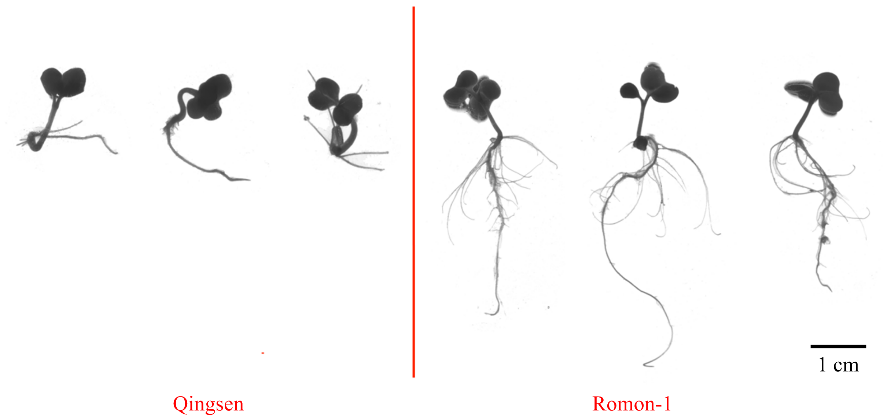
图5
渍水12 h后极端敏感和极端耐渍种质的根系 Qingsen:极端敏感种质;Romon-1:极端耐渍种质"
| [1] |
冯海棠, 王汉中. 新形势下的我国食用植物油供给安全对策[J]. 中国油料作物学报, 2024, 46(2): 221-227.
|
|
|
|
| [2] |
王汉中. 我国食用油供给安全形势分析与对策建议[J]. 中国油料作物学报, 2007, 29(3): 347-349.
|
|
|
|
| [3] |
谢伶俐, 李永铃, 许本波, 张学昆. 油菜耐渍机理解析及遗传改良研究进展[J]. 作物学报, 2025, 51(2): 287-300.
|
|
|
|
| [4] |
胡志勇, 鲜孟筑, 李俊. 我国油菜品种改良现状及发展趋势[J]. 中国农业大学学报, 2024, 29(3): 50-62.
|
|
|
|
| [5] |
|
| [6] |
范其新. 甘蓝型油菜耐湿品种资源筛选及耐湿机理研究[D]. 重庆: 西南农业大学, 2005.
|
|
|
|
| [7] |
李真, 蒲圆圆, 高长斌, 周广生, 涂金星, 傅廷栋. 甘蓝型油菜DH群体苗期耐湿性的评价[J]. 中国农业科学, 2010, 43(2): 286-292. DOI: 10.3864/j.issn.0578-1752.2010.02.008.
|
|
|
|
| [8] |
许晶, 曾柳, 徐明月, 程勇, 张学昆, 邹锡玲. 油菜耐渍性种质资源筛选与评价[J]. 中国油料作物学报, 2014, 36(6): 748-754.
|
|
|
|
| [9] |
唐章林, 王霖, 张娅茹, 朱丽, 唐钟林, 荆蓉蓉, 李阳阳. 甘蓝型油菜种质资源苗期耐湿性综合评价与筛选[J]. 西南大学学报(自然科学版), 2022, 44(12): 19-28.
|
|
|
|
| [10] |
王才权, 杨柳, 刘婷婷, 罗红森, 肖黄宇杰, 刘忠松. 油菜萌发期耐渍性综合评价和种质筛选[J]. 植物遗传资源学报, 2026, 27(2): 318-327.
|
|
|
|
| [11] |
|
| [12] |
|
| [13] |
|
| [14] |
|
| [15] |
|
| [16] |
|
| [17] |
高建芹, 陈锋, 龙卫华, 张维, 周晓婴. 长江下游甘蓝型油菜种质耐湿性鉴定[J]. 江苏农业科学, 2023, 51(6): 79-86.
|
|
|
|
| [18] |
|
| [19] |
杨海云, 艾雪莹, BatoolMaria, 刘芳, 蒯婕, 王晶, 汪波, 周广生. 油菜响应水分胁迫的生理机制及栽培调控措施研究进展[J]. 华中农业大学学报, 2021, 40(2): 6-16.
|
|
|
|
| [20] |
王琼, 张春雷, 李光明, 李玲. 渍水胁迫对油菜根系形态与生理活性的影响[J]. 中国油料作物学报, 2012, 34(2): 157-162.
|
|
|
|
| [21] |
|
| [22] |
|
| [23] |
严琼琼. 南方渍水条件下紫花苜蓿根系结构的研究[D]. 南京: 南京农业大学, 2013.
|
|
|
|
| [24] |
|
| [25] |
|
| [26] |
|
| [27] |
李文静, 朱进, 彭玉全, 黄兴学, 周国林. 淹水胁迫对油麦菜生长、生理和解剖结构的影响[J]. 植物生理学报, 2020, 56(10): 2233-2240.
|
|
|
|
| [28] |
|
| [29] |
|
| [30] |
杨小燕, 谢永刚, 韩科俊, 许耀照. 盐和干旱复合胁迫对白菜型冬油菜种子萌发生理特性的影响[J]. 农业科技通讯, 2024(9): 146-148.
|
|
|
|
| [31] |
杨学珍, 徐明霞, 董小云, 魏家萍, 赵彩霞, 刘自刚. 质膜流动性调节剂对白菜型冬油菜种子苗抗寒性的影响[J]. 分子植物育种, 2022, 20(10): 3371-3380.
|
|
|
|
| [32] |
|
| [33] |
许梦然, 代文君, 许磊,
|
|
|
|
| [34] |
|
| [35] |
李浩杰, 柴靓, 蒲晓斌, 张锦芳, 蒋俊, 崔成, 张雪花, 蒋梁材. 室内水淹和田间模拟湿害对甘蓝型油菜耐湿性鉴定[J]. 西南农业学报, 2016, 29(6): 1250-1256.
|
|
|
|
| [36] |
陈娟妮, 梁颖. 长江流域主要甘蓝型油菜品种苗期耐湿性鉴定[J]. 中国生态农业学报, 2011, 19(3): 626-630.
|
|
|
|
| [37] |
周香玉. 渍水胁迫对不同耐渍性甘蓝型油菜生理生化指标影响[D]. 荆州: 长江大学, 2023.
|
|
|
|
| [38] |
赵泽宏, 杨钢, 郭徐鹏, 陈宇红, 胡赞民, 范成明, 张新永. 甘蓝型油菜耐盐种质的筛选及评价[J]. 山西农业科学, 2025, 53(1): 22-34.
|
|
|
| [1] | 祝培, 赵耀, 白岩, 张金盔, 李莓, 龙金佳, 杨龙, 罗丽娅, 许本波, 徐劲松, 张学昆. 氟唑菌酰羟胺对油菜的生理调控作用及其与咪鲜胺的复配效应[J]. 中国农业科学, 2026, 59(9): 1903-1915. |
| [2] | 毛娟, 李雯, 曾凡荣, 覃元, 巫小建. 240份大麦种质资源耐涝性筛选[J]. 中国农业科学, 2026, 59(22): 4990-5005. |
| [3] | 汤伟华, 张志林, 颜志明, 刘同坤, 侯喜林. 二倍体、四倍体不结球白菜耐盐碱性的分阶段综合评价与四倍化效应[J]. 中国农业科学, 2026, 59(21): 4904-4923. |
| [4] | 陈彩锦, 马琳, 包明芳, 张国辉, 蒋庆雪, 杨天辉, 王川, 王晓春, 高婷, 王学敏, 刘文辉. 111份紫花苜蓿种质资源萌发期抗旱性鉴定评价[J]. 中国农业科学, 2025, 58(10): 1896-1907. |
| [5] | 关志林, 靳丰蔚, 刘婷婷, 王毅, 谭莹莹, 杨春慧, 李蕊彤, 王博, 刘克德, 董云. 甘蓝型油菜光叶性状的遗传分析及基因定位[J]. 中国农业科学, 2024, 57(4): 650-662. |
| [6] | 杨浩蓉, 贾凡, 胡徐, 穆蓉, 刘维娜, 刘昌云, 王善之, 孙现超, 马冠华, 陈国康. 油菜BnJAZ7通过调控抗氧化途径促进核盘菌侵染[J]. 中国农业科学, 2024, 57(19): 3799-3809. |
| [7] | 杨茜, 游均, 周瑢, 方圣, 张艳欣, 吴自明, 王林海. 芝麻籽粒植酸含量高通量检测方法的建立与低植酸种质的筛选[J]. 中国农业科学, 2024, 57(12): 2282-2294. |
| [8] | 范军强, 武军艳, 刘丽君, 马骊, 杨刚, 蒲媛媛, 李学才, 孙万仓. 甘蓝型冬油菜气孔特性与抗寒性的关系[J]. 中国农业科学, 2023, 56(4): 599-618. |
| [9] | 王倩, 董孔军, 薛亚鹏, 刘少雄, 王若楠, 杨佳琪, 陆平, 王瑞云, 杨天育, 刘敏轩. 糜子核心种质成株期抗旱性鉴定评价与抗旱种质筛选[J]. 中国农业科学, 2023, 56(21): 4163-4174. |
| [10] | 胡盛,李阳阳,唐章林,李加纳,曲存民,刘列钊. 干旱胁迫下甘蓝型油菜籽粒含油量和蛋白质含量变化的全基因组关联分析[J]. 中国农业科学, 2023, 56(1): 17-30. |
| [11] | 巢成生,王玉乾,沈欣杰,代晶,顾炽明,李银水,谢立华,胡小加,秦璐,廖星. 甘蓝型油菜苗期氮高效吸收转运特征研究[J]. 中国农业科学, 2022, 55(6): 1172-1188. |
| [12] | 谢伶俐,韦丁一,章子爽,徐劲松,张学昆,许本波. 甘蓝型油菜发育进程中赤霉素动态变化及其与产量的关系[J]. 中国农业科学, 2022, 55(24): 4793-4807. |
| [13] | 钟艳平,师立松,周瑢,高媛,何延庆,方圣,张秀荣,王林海,吴自明,张艳欣. 芝麻素高效提取检测技术的建立与高芝麻素种质的筛选[J]. 中国农业科学, 2022, 55(11): 2109-2120. |
| [14] | 张陇艳,程功敏,魏恒玲,王寒涛,芦建华,马峙英,喻树迅. 陆地棉种子萌发期对低温胁迫的响应及耐冷性鉴定[J]. 中国农业科学, 2021, 54(1): 19-33. |
| [15] | 王刘艳,王瑞莉,叶桑,郜欢欢,雷维,陈柳依,吴家怡,孟丽姣,袁芳,唐章林,李加纳,周清元,崔翠. 苯磺隆胁迫下甘蓝型油菜萌发期关联性状的QTL定位及候选基因筛选[J]. 中国农业科学, 2020, 53(8): 1510-1523. |
|
||
