






中国农业科学 ›› 2026, Vol. 59 ›› Issue (21): 4904-4923.doi: 10.3864/j.issn.0578-1752.2026.21.014
汤伟华1( ), 张志林2, 颜志明1, 刘同坤2, 侯喜林2()
收稿日期:2026-06-05
接受日期:2026-06-29
出版日期:2026-11-01
发布日期:2026-11-06
通信作者:
联系方式:
汤伟华,E-mail:weihuatang@jsafc.edu.cn。
基金资助:
TANG WeiHua1(), ZHANG ZhiLin2, YAN ZhiMing1, LIU TongKun2, HOU XiLin2()
Received:2026-06-05
Accepted:2026-06-29
Published:2026-11-01
Online:2026-11-06
摘要:
【目的】阐明同遗传背景二倍体、四倍体不结球白菜在不同盐型和发育阶段下的耐盐碱响应差异,明确四倍化对耐盐碱性的影响及其遗传背景依赖性,筛选兼具耐性、产量和育种利用价值的优异材料,为不结球白菜耐盐碱种质鉴定和倍性改良提供依据。【方法】以15对同遗传背景二倍体、四倍体(2X/4X)不结球白菜为材料,在萌发期和苗期分别设置NaCl、NaHCO3胁迫,在大田全生育期设置NaCl滴灌胁迫。萌发期设置NaCl和NaHCO3浓度梯度,苗期分别施加450 mmol·L-1 NaCl和80 mmol·L-1 NaHCO3,大田期采用200 mmol·L-1 NaCl滴灌并以土壤EC1:5监测盐分强度。测定萌发、形态、生理、光合和产量相关性状,计算耐盐系数(STC),采用主成分分析结合隶属函数法计算综合耐盐指数(D值),并结合MGIDI指数、Fernandez四象限法、配对t检验、相关分析和回归分析评价材料耐性、产量表现及倍性效应。【结果】不结球白菜耐盐碱性具有明显的盐型差异和发育阶段特异性。萌发期NaHCO3胁迫对材料的抑制总体强于NaCl胁迫;NaCl 250 mmol·L-1可扩大材料间差异,NaHCO3 40 mmol·L-1已能显示材料分化,60 mmol·L-1下综合离散度和D值分布范围更大,更适于萌发期综合评价。苗期材料对NaCl和NaHCO3的响应并不完全一致,部分萌发期优势材料在苗期耐性下降,说明萌发期结果不能直接替代苗期和大田全生育期评价。大田期D值与MGIDI排序基本一致(Spearman ρ=-0.775,P=4.87×10⁻⁷),表明多性状D值评价具有较好稳健性;但Fernandez产量校正显示,多数高D值材料未进入高产耐盐A组,提示综合耐性高并不等同于高产耐盐。倍性效应具有显著条件依赖性,仅萌发期NaHCO3胁迫下4X材料D值显著高于2X(ΔD=0.149±0.164,P=0.004),其余4个条件下4X与2X差异均未达显著水平;跨5个条件合并分析显示,ΔD与二倍体耐性D2X呈显著负相关关系(r=-0.601,P=1.15×10⁻⁸),提示四倍化增益总体上更易出现在二倍体耐性较弱的遗传背景中。经大田产量校正,LXRC 2X、PPQ 4X和L060 2X兼具较好的综合耐盐性、潜在产量和胁迫产量表现。【结论】不结球白菜耐盐碱性受盐型、发育阶段和遗传背景共同调控,四倍化不能稳定提高耐盐碱性。采用萌发期初筛-苗期复筛-大田全生育期验证并结合产量校正的分阶段评价策略,可兼顾筛选效率和育种利用准确性。
汤伟华, 张志林, 颜志明, 刘同坤, 侯喜林. 二倍体、四倍体不结球白菜耐盐碱性的分阶段综合评价与四倍化效应[J]. 中国农业科学, 2026, 59(21): 4904-4923.
TANG WeiHua, ZHANG ZhiLin, YAN ZhiMing, LIU TongKun, HOU XiLin. Comprehensive Stage-Specific Evaluation of Salt-Alkali Tolerance and Tetraploidization Effects in Diploid and Tetraploid Non-Heading Chinese Cabbage[J]. Scientia Agricultura Sinica, 2026, 59(21): 4904-4923.

图1
NaCl与NaHCO3胁迫对不结球白菜四倍体(4X)与二倍体(2X)萌发期指标的影响"
表1
NaCl 250 mmol·L-1处理下7项萌发指标耐盐系数的主成分分析"
| 指标Trait | PC1 | PC2 | PC3 | h2 |
|---|---|---|---|---|
| 发芽率Germination rate (GR) | 0.418 | -0.327 | -0.149 | 0.960 |
| 发芽势Germination energy (GE) | 0.418 | -0.319 | -0.165 | 0.958 |
| 发芽指数Germination index (GI) | 0.393 | -0.349 | -0.278 | 0.924 |
| 活力指数Vigor index (VI) | 0.364 | 0.379 | -0.370 | 0.893 |
| 胚根长Radicle length (RL) | 0.280 | 0.712 | -0.233 | 0.933 |
| 子叶长Cotyledon length (LL) | 0.380 | 0.126 | 0.569 | 0.971 |
| 子叶宽Cotyledon width (LW) | 0.376 | 0.059 | 0.599 | 0.973 |
| 特征值Eigenvalue | 4.769 | 1.017 | 0.827 | — |
| 贡献率Variance contribution (%) | 68.13 | 14.53 | 11.81 | — |
| 累计贡献率Cumulative contribution (%) | 68.13 | 82.66 | 94.47 | — |
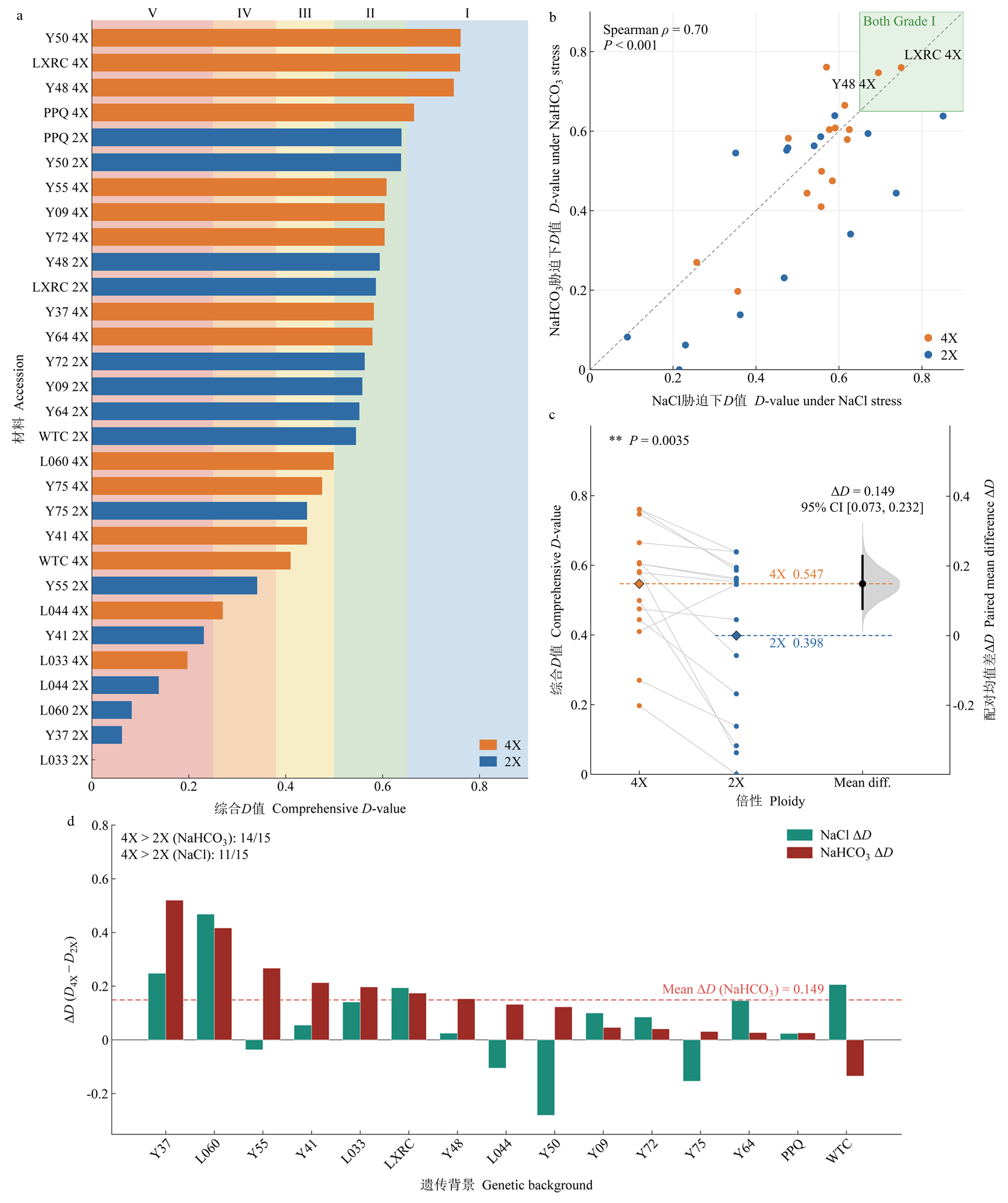
图2
萌发期耐盐碱综合评价 a:30份材料在NaHCO3胁迫下的综合D值排序及耐盐等级分布Ranking and salt-tolerance grade distribution of the comprehensive D-values of 30 accessions under NaHCO3 stress;b:NaCl与NaHCO3胁迫下综合D值的相关分布Correlation distribution of comprehensive D-values under NaCl and NaHCO3 stress;c:NaHCO3胁迫下4X与2X综合D值的配对比较Paired comparison of comprehensive D-values between 4X and 2X under NaHCO3 stress;d:不同遗传背景材料在NaCl和NaHCO3胁迫下的ΔD分布Distribution of ΔD in different genetic backgrounds under NaCl and NaHCO3 stress。ΔD=D4X-D2X,*:P<0.05;**:P<0.01;***:P<0.001;ns:差异不显著Not significant。下同The same as below"
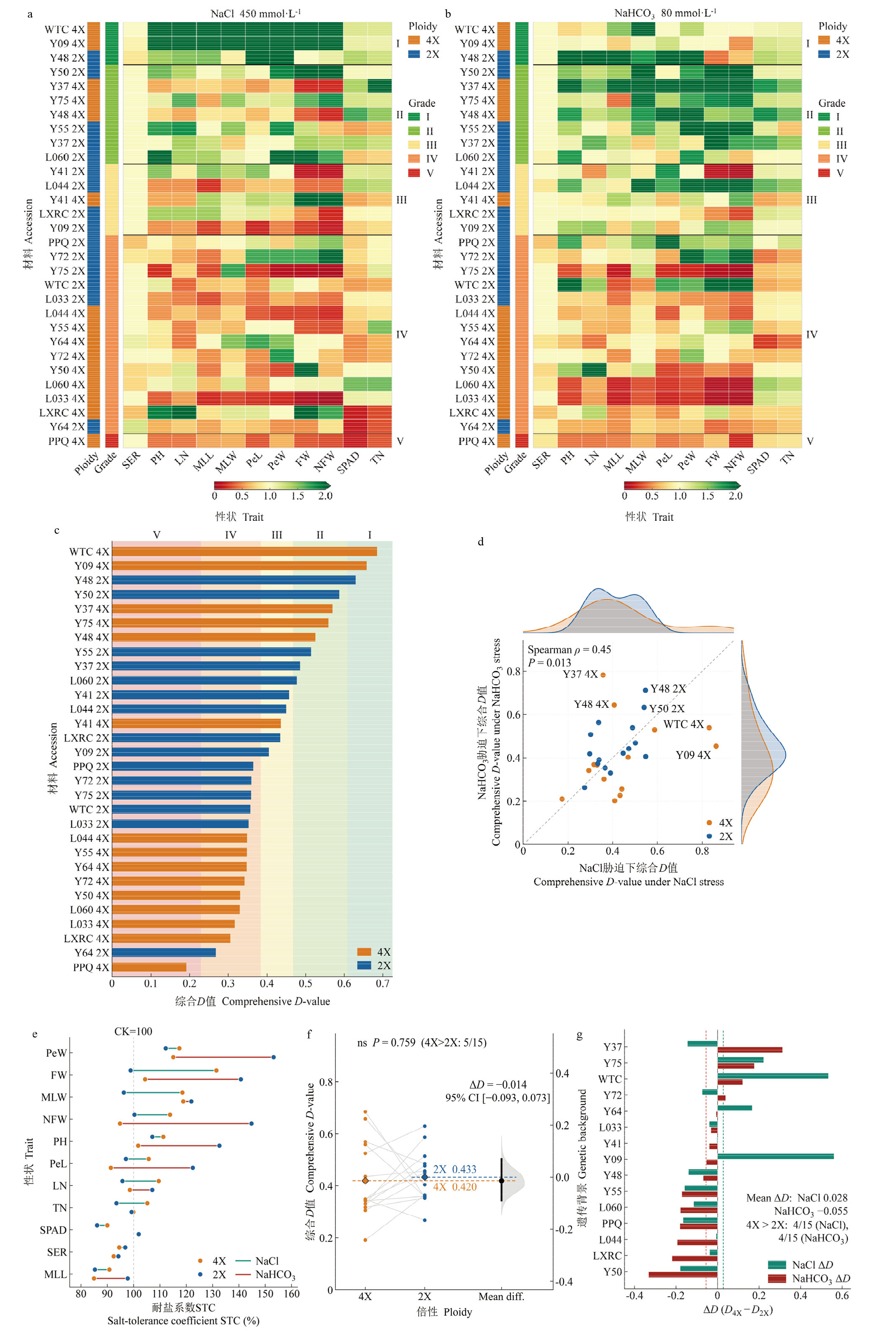
图3
苗期耐盐碱综合评价 a:NaCl 450 mmol·L-1处理下30份材料11项耐盐系数热图Heatmap of 11 STCs for 30 accessions under 450 mmol·L-1 NaCl;b:NaHCO3 80 mmol·L-1处理下30份材料11项耐盐系数热图Heatmap of 11 STCs for 30 accessions under 80 mmol·L-1 NaHCO3;c:30份材料综合D值排序及耐盐等级分布Ranking and salt-tolerance grade distribution of comprehensive D-values;d:NaCl与NaHCO3处理下D值分布关系Distribution of D-values under NaCl and NaHCO3 treatments;e:4X与2X各性状平均耐盐系数比较Comparison of mean STC between 4X and 2X;f:15对材料4X与2X综合D值配对比较Paired comparison of comprehensive D-values between 4X and 2X;g:不同遗传背景在NaCl和NaHCO3胁迫下的ΔD分布Distribution of ΔD among genetic backgrounds under NaCl and NaHCO3 stress"
表2
苗期NaCl 450 mmol·L-1处理下11项耐盐系数的主成分分析"
| 指标Trait | PC1 | PC2 | PC3 | h2 |
|---|---|---|---|---|
| 成苗率Seedling establishment rate (SER) | -0.049 | -0.147 | 0.938 | 0.972 |
| 株高Plant height (PH) | 0.366 | -0.068 | -0.073 | 0.902 |
| 叶片数Leaf number (LN) | 0.332 | -0.005 | -0.243 | 0.793 |
| 最大叶长Maximum leaf length (MLL) | 0.341 | -0.002 | 0.081 | 0.780 |
| 最大叶宽Maximum leaf width (MLW) | 0.364 | -0.054 | 0.071 | 0.891 |
| 叶柄长Petiole length (PeL) | 0.352 | 0.005 | 0.050 | 0.826 |
| 叶柄宽Petiole width (PeW) | 0.346 | -0.036 | 0.112 | 0.810 |
| 单株鲜重Fresh weight per plant (FW) | 0.351 | -0.047 | 0.018 | 0.823 |
| 净菜重Net fresh weight per plant (NFW) | 0.360 | -0.039 | 0.073 | 0.868 |
| 叶绿素含量Chlorophyll content (SPAD) | 0.085 | 0.688 | 0.076 | 0.908 |
| 全氮含量Total nitrogen content (TN) | 0.031 | 0.702 | 0.130 | 0.913 |
| 特征值Eigenvalue | 6.640 | 1.803 | 1.042 | — |
| 贡献率Variance contribution (%) | 60.36 | 16.39 | 9.47 | — |
| 累计贡献率Cumulative contribution (%) | 60.36 | 76.75 | 86.23 | — |
表3
苗期NaHCO3 80 mmol·L-1处理下11项耐盐系数的主成分分析"
| 指标Trait | PC1 | PC2 | PC3 | h2 |
|---|---|---|---|---|
| 成苗率Seedling establishment rate (SER) | 0.095 | -0.025 | 0.761 | 0.691 |
| 株高Plant height (PH) | 0.369 | 0.141 | -0.194 | 0.788 |
| 叶片数Leaf number (LN) | 0.254 | -0.043 | -0.422 | 0.537 |
| 最大叶长Maximum leaf length (MLL) | 0.342 | -0.197 | -0.180 | 0.720 |
| 最大叶宽Maximum leaf width (MLW) | 0.337 | -0.076 | -0.016 | 0.601 |
| 叶柄长Petiole length (PeL) | 0.385 | -0.094 | -0.051 | 0.787 |
| 叶柄宽Petiole width (PeW) | 0.364 | 0.159 | -0.052 | 0.742 |
| 单株鲜重Fresh weight per plant (FW) | 0.248 | 0.521 | 0.185 | 0.916 |
| 净菜重Net fresh weight per plant (NFW) | 0.260 | 0.512 | 0.162 | 0.922 |
| 叶绿素含量Chlorophyll content (SPAD) | 0.289 | -0.370 | 0.280 | 0.803 |
| 全氮含量Total nitrogen content (TN) | 0.257 | -0.478 | 0.169 | 0.846 |
| 特征值Eigenvalue | 5.170 | 2.072 | 1.111 | — |
| 贡献率Variance contribution (%) | 47.00 | 18.84 | 10.10 | — |
| 累计贡献率Cumulative contribution (%) | 47.00 | 65.84 | 75.94 | — |
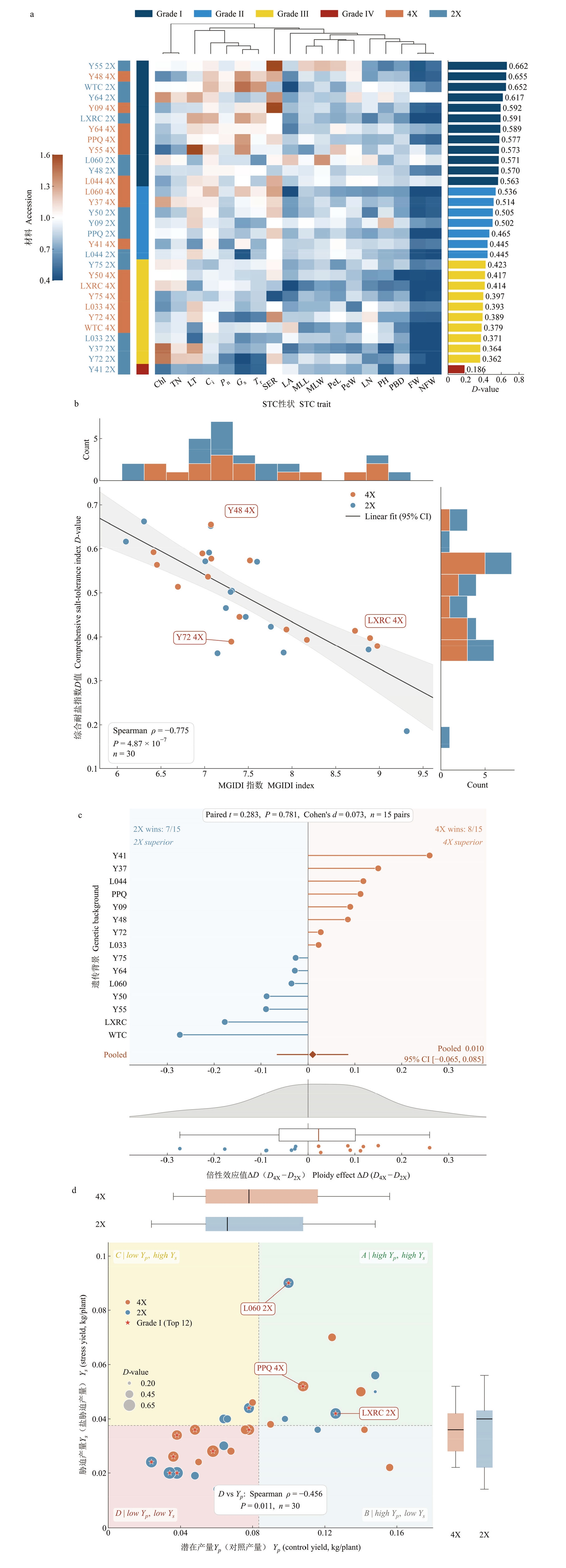
图4
大田全生育期耐盐综合评价 a:30份材料18项大田全生育期耐盐系数热图及D值排序和耐盐等级分布Heatmap of 18 STC traits, D-value ranking, and tolerance-grade distribution for 30 accessions across the whole growth period under field conditions;b:D值与多性状基因型-理想型距离指数的相关关系Correlation between D-value and MGIDI index;c:15对同遗传背景4X/2X材料的倍性效应ΔD分布Distribution of ploidy effect ΔD in 15 paired 4X/2X genetic backgrounds;d:基于潜在产量(Yp)和胁迫产量(Ys)的Fernandez四象限分组Fernandez four-quadrant classification based on potential yield (Yp) and stress yield (Ys)"
表4
I级材料(12份)的综合D值与Fernandez产量分组"
| 材料 Accession | 排名 Rank | D值 D-value | 潜在产量 Yp (kg/plant) | 胁迫产量 Ys (kg/plant) | Fernandez分组 Fernandez group |
|---|---|---|---|---|---|
| Y55 2X | 1 | 0.662 | 0.038 | 0.020 | D |
| Y48 4X | 2 | 0.655 | 0.058 | 0.028 | D |
| WTC 2X | 3 | 0.652 | 0.034 | 0.020 | D |
| Y64 2X | 4 | 0.617 | 0.024 | 0.024 | D |
| Y09 4X | 5 | 0.592 | 0.078 | 0.036 | D |
| LXRC 2X | 6 | 0.591 | 0.126 | 0.042 | A* |
| Y64 4X | 7 | 0.589 | 0.036 | 0.026 | D |
| PPQ 4X | 8 | 0.577 | 0.108 | 0.052 | A* |
| Y55 4X | 9 | 0.573 | 0.048 | 0.036 | D |
| L060 2X | 10 | 0.571 | 0.100 | 0.090 | A* |
| Y48 2X | 11 | 0.570 | 0.078 | 0.044 | C |
| L044 4X | 12 | 0.563 | 0.038 | 0.034 | D |
表5
5个条件下15对同遗传背景的配对t检验与倍性-本底回归"
| 条件Condition | Δ$\text{\bar{D}}$ | t | P | Cohen’s d | 4X wins/n | r (D2X, ΔD) |
|---|---|---|---|---|---|---|
| 萌发期NaCl Germination/NaCl | 0.074 | 1.596 | 0.133 | 0.412 | 11/15 | -0.810*** |
| 萌发期NaHCO3 Germination/NaHCO3 | 0.149 | 3.506 | 0.004** | 0.905 | 14/15 | -0.694** |
| 苗期NaCl Seedling/NaCl | 0.028 | 0.447 | 0.662 | 0.115 | 4/15 | -0.673** |
| 苗期NaHCO3 Seedling/NaHCO3 | -0.055 | -1.266 | 0.226 | -0.327 | 4/15 | -0.376ns |
| 大田期NaCl Field/NaCl | 0.010 | 0.283 | 0.781 | 0.073 | 8/15 | -0.752** |
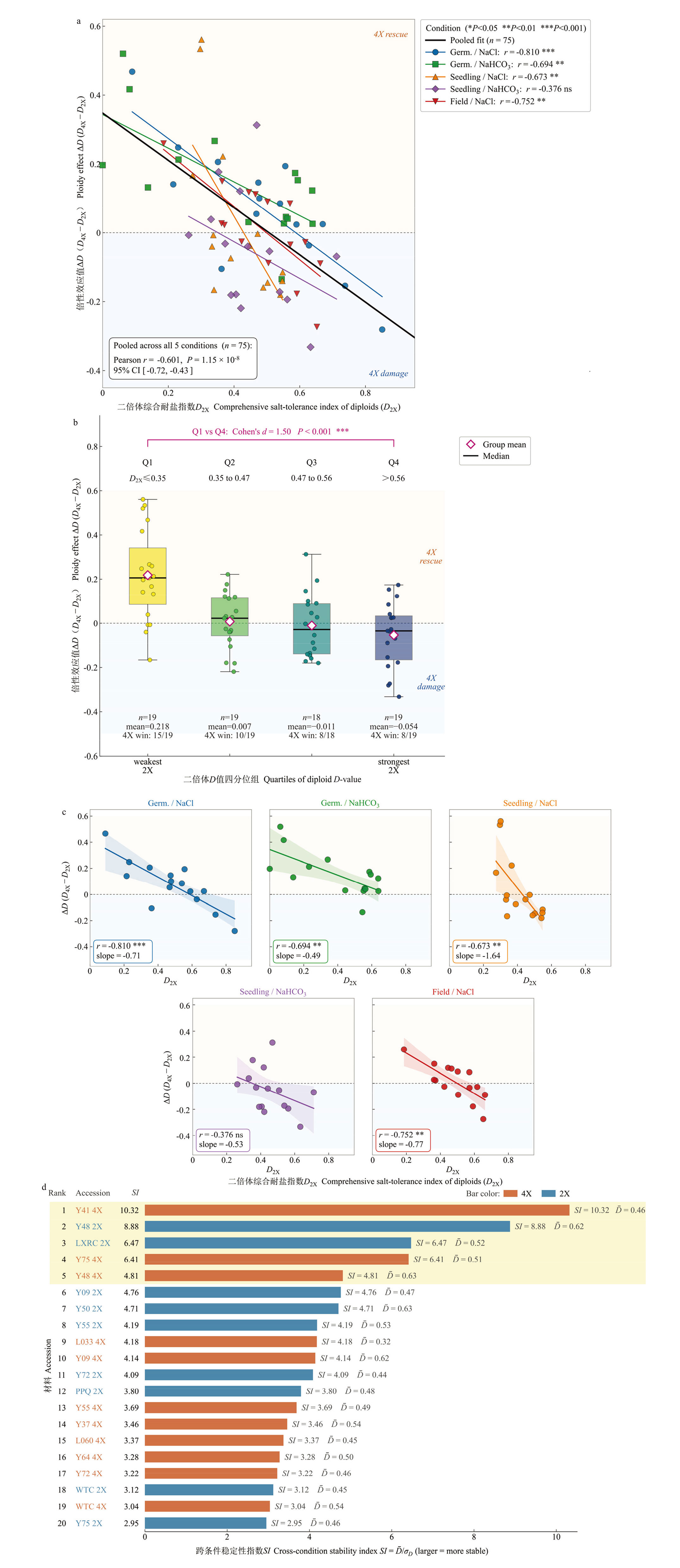
图5
四倍化耐盐效应的阶段特异性及其与二倍体本底的关系 a:75对配对观测的ΔD与D2X关系散点图,颜色和符号表示5个试验条件,黑线为合并线性回归Pooled scatterplot of ΔD versus D2X across 75 paired observations, with colours and symbols indicating the five experimental conditions and the black line representing the pooled linear regression;b:按D2X全局四分位分组的ΔD箱线图Boxplots of ΔD grouped by the global quartiles of D2X;c:5个试验条件内ΔD与D2X的线性回归,阴影表示95% Bootstrap置信区间Condition-specific linear regressions of ΔD against D2X under the five experimental conditions, with shading indicating the 95% Bootstrap confidence interval;d:前20份材料的稳定性指数排序Ranking of the top 20 accessions by stability index (SI)。D2X为对应2X材料的综合D值D2X denotes the comprehensive D-value of the corresponding 2X accession"
| [1] |
杨劲松, 姚荣江, 王相平, 谢文萍, 张新, 朱伟, 张璐, 孙瑞娟. 中国盐渍土研究: 历程、现状与展望[J]. 土壤学报, 2022, 59(1): 10-27.
|
|
|
|
| [2] |
陈佩, 王金涛, 董心亮, 田柳, 张雪佳, 刘小京, 孙宏勇. 蔬菜咸水灌溉研究进展[J]. 中国生态农业学报, 2022, 30(5): 799-808.
|
|
|
|
| [3] |
侯喜林, 李英, 黄菲艺. 不结球白菜(Brassica campestris ssp. chinensis)主要性状及育种技术的分子生物学研究新进展[J]. 园艺学报, 2020, 47(9): 1663-1677.
|
|
|
|
| [4] |
侯喜林, 李英, 刘同坤. 不结球白菜遗传育种与分子生物学研究进展[J]. 南京农业大学学报, 2022, 45(5): 864-873.
|
|
|
|
| [5] |
徐芬芬, 俞晓凤, 韩金多. 不结球白菜耐盐品种筛选[J]. 河南农业科学, 2016, 45(11): 87-91.
|
|
|
|
| [6] |
doi: 10.1186/1471-2229-13-188 pmid: 24267479 |
| [7] |
doi: 10.1007/s11033-011-1245-9 |
| [8] |
doi: 10.1007/s11033-014-3072-2 pmid: 24430300 |
| [9] |
doi: 10.1007/s11103-022-01272-x pmid: 35553313 |
| [10] |
doi: 10.3389/fpls.2022.905202 |
| [11] |
doi: 10.3389/fpls.2019.00450 pmid: 31031786 |
| [12] |
doi: 10.3390/ijms18091953 |
| [13] |
doi: 10.1007/s00425-021-03754-6 |
| [14] |
doi: 10.1016/j.envexpbot.2021.104621 |
| [15] |
doi: 10.1111/nph.v246.6 |
| [16] |
doi: 10.3390/horticulturae9111161 |
| [17] |
pmid: 11448743 |
| [18] |
doi: 10.3389/fpls.2021.772708 |
| [19] |
doi: 10.3389/fpls.2022.857149 |
| [20] |
doi: 10.1016/j.tplants.2022.12.010 pmid: 36628656 |
| [21] |
doi: 10.1016/j.compag.2025.110005 |
| [22] |
汤伟华, 刘叶琼, 张子楠, 王金鸽, 刘同坤. 高产优质同源四倍体不结球白菜新材料的创制与评价[J]. 南京农业大学学报, 2025, 48(2): 312-320.
|
|
|
|
| [23] |
doi: 10.1016/S1671-2927(11)60015-1 |
| [24] |
doi: 10.2135/cropsci1962.0011183X000200020033x |
| [25] |
doi: 10.1016/j.ecoenv.2019.109785 |
| [26] |
农业农村部. 植株全氮含量测定自动定氮仪法: NY/T 2419—2013[S]. (2013-09-10) [2026-06-05].
|
|
Ministry of Agriculture and Rural Affairs. Determination of total nitrogen in plant: Automatic Kjeldahl apparatus method: NY/T 2419—2013[S]. (2013-09-10) [2026-06-05]. (in Chinese)
|
|
| [27] |
IRRI. Standard Evaluation System for Rice[M]. 5th ed. Manila: International Rice Research Institute, 2013.
|
| [28] |
doi: 10.3389/fpls.2019.00530 |
| [29] |
doi: 10.1038/s41598-020-67210-3 |
| [30] |
doi: 10.1016/j.fcr.2012.09.008 |
| [31] |
doi: 10.4081/ija.2022.2011 |
| [32] |
doi: 10.1038/s41598-024-63693-6 pmid: 38831025 |
| [33] |
doi: 10.3390/agronomy11081569 |
| [34] |
doi: 10.1080/01621459.1963.10500845 |
| [35] |
doi: 10.1093/bioinformatics/btaa981 pmid: 33226063 |
| [36] |
doi: 10.1186/s13007-022-00952-5 pmid: 36371210 |
| [37] |
doi: 10.1111/2041-210X.13384 |
| [38] |
|
| [39] |
doi: 10.1071/AR9780897 |
| [40] |
doi: 10.2135/cropsci1984.0011183X002400050026x |
| [41] |
doi: 10.1080/01621459.1937.10503522 |
| [42] |
|
| [43] |
doi: 10.1071/AR9630742 |
| [44] |
|
| [45] |
doi: 10.3389/fpls.2023.1217193 |
| [46] |
doi: 10.1016/j.hpj.2022.09.003 |
| [47] |
|
| [48] |
doi: 10.1093/plcell/koaa015 pmid: 33751096 |
| [49] |
doi: 10.3389/fpls.2022.869423 |
| [50] |
|
| [51] |
doi: 10.1111/nph.v246.1 |
| [52] |
doi: 10.1016/j.scienta.2015.04.009 |
| [53] |
doi: 10.3390/plants9101324 |
| [1] | 王小玮, 杜佛力, 闫红财, 郎正东, 党志娟, 李葆春, 汪军成, 马小乐, 王化俊, 张宏, 姚立蓉. 396份春小麦灌浆期和成熟期抗旱性评价[J]. 中国农业科学, 2026, 59(8): 1608-1621. |
| [2] | 鲁雪莉, Syeda Wajeeha Gillani, 孟晨, 李晓彬, 宋奕汝, 柏雨, 王菊英, 冯晓菲, 刘晨晨, 李义强, 徐宗昌. 不同类型盐胁迫对狼尾草种子萌发的影响及钠调控转录组研究[J]. 中国农业科学, 2026, 59(7): 1400-1419. |
| [3] | 崔节浩, 张萌, 王沁, 于佳妍, 林琨, 李尚泽, 兰恒, 耿艳秋, 张强, 郭丽颖, 邵玺文. 粳稻资源抗倒伏性评价与生理机制[J]. 中国农业科学, 2026, 59(7): 1420-1438. |
| [4] | 张志林, 刘荣, 宗绪晓, 郝晓鹏, 杨涛. 蚕豆多时期耐盐性综合评价与衣康酸缓解萌发期盐胁迫研究[J]. 中国农业科学, 2026, 59(6): 1172-1188. |
| [5] | 陈敏, 焦紫岚, 乔承彬, 许昊, 张碧, 马东花, 孔维儒, 王敬文, 宋佳伟, 罗成科, 李培富, 田蕾. 不同亚种水稻种质资源对盐胁迫的形态生理响应及适应策略[J]. 中国农业科学, 2026, 59(4): 705-722. |
| [6] | 郝琨, 陈洪德, 张威, 钟韵, 党美荣, 朱士江, 黄志坤, 金英. 基于柑橘产量、品质及水氮利用的涌泉根灌水氮综合评价[J]. 中国农业科学, 2026, 59(4): 862-873. |
| [7] | 尹晓康, 冯佳宜, 李栩慷, 张朝旭, 马驰, 王若禹, 白佳乾, 蓝罗冰, 张良凤, 刘易科, 朱展望, 丁富功, 刘大同, 王书平, 方正武, 张迎新. 小麦耐高温优异资源鉴定及其与农艺性状的关联分析[J]. 中国农业科学, 2026, 59(21): 4710-4728. |
| [8] | 强小嫚, 刘胜星, 张现波, 王景雷, 王春婷, 朱恬恬, 王博娟, 刘浩. 灌溉水平与营养液浓度对椰糠袋培番茄产量、品质及水肥利用效率的影响[J]. 中国农业科学, 2026, 59(21): 4882-4903. |
| [9] | 刘丹丹, 丁文涛, 程起灿, 张瑜, 邢爱双, 郭祥龙, 邢邯, 郭娜, 赵晋铭. 大豆R6期籽粒氨基酸含量的遗传多样性与全基因组关联分析[J]. 中国农业科学, 2026, 59(20): 4461-4475. |
| [10] | 刘泽洋, 梁亚宁, 陈琪, 谈梦琪, 张慧贤, 袁子彧, 杨勇, 张飞, 徐强, 邓秀新, 陈嘉景, 徐娟. 药用柑橘应用研究现状与前景[J]. 中国农业科学, 2026, 59(20): 4547-4569. |
| [11] | 廖婷璐, 石亚飞, 肖东浩, 舍杨梦斐, 郭富城, 杨九菊, 唐海江, 罗成科. 外源硝普钠对碱胁迫下水稻幼苗糖代谢的影响[J]. 中国农业科学, 2026, 59(2): 265-277. |
| [12] | 苏万龙, 任海燕, 薛晓芳, 石美娟, 刘丽, 赵爱玲, 李毅, 王永康. 基于感官、质构、理化分析的枣果品质综合评价[J]. 中国农业科学, 2026, 59(18): 4135-4148. |
| [13] | 丁倩, 何丽莲, 钱禛锋, 吴期滨, 赵昌祖, 林佩霞, 农韦优, 王誉洁, 张媛媛, 阙友雄, 李富生. 不同甘蔗品种/系脱叶性综合评价及叶鞘离区细胞形态和生理差异分析[J]. 中国农业科学, 2026, 59(15): 3315-3327. |
| [14] | 马小英, 屈小玉, 李涛, 刘威帆, 刘昊, 马风兰, 万猛虎, 吴娜, 刘吉利. 盐胁迫下不同耐盐型玉米品种的生理与代谢响应机制解析[J]. 中国农业科学, 2026, 59(13): 2815-2827. |
| [15] | 高亚峰, 杨嘉宁, 孙雪迪, 陈佳佳, 党志娟, 汪军成, 张宏, 马小乐, 姚立蓉, 孟亚雄, 司二静, 李葆春, 王化俊. 春小麦耐低氮种质资源的筛选与综合评价[J]. 中国农业科学, 2026, 59(11): 2299-2313. |
|
||
