






中国农业科学 ›› 2026, Vol. 59 ›› Issue (20): 4531-4546.doi: 10.3864/j.issn.0578-1752.2026.20.008
张涵1( ), 黎景来1, 张玉琪1, 郭健2, 李星1, 李涛1()
收稿日期:2026-04-30
接受日期:2026-06-29
出版日期:2026-10-16
发布日期:2026-10-21
通信作者:
联系方式:
张涵,E-mail:1444678358@qq.com。
基金资助:
ZHANG Han1(), LI JingLai1, ZHANG YuQi1, GUO Jian2, LI Xing1, LI Tao1()
Received:2026-04-30
Accepted:2026-06-29
Published:2026-10-16
Online:2026-10-21
摘要:
【目的】探究非可见波段远红光(FR)和近紫外光(UVA),以及光周期对日光温室基质栽培草莓生长、产量和品质的影响,构建日光温室草莓高效补光策略,为我国设施草莓高效生产提供技术支撑。【方法】以‘红颜’草莓品种为试验材料,于2024年9月至2025年2月在北京市顺义区中国农业科学院科研基地日光温室内开展试验。采用高架基质栽培模式,于花芽分化前期(2024年11月18日)开始LED补光处理,补光灯距冠层顶部20 cm。试验设置不同光质(红蓝9/1、红蓝9/1+FR、白光、白光+UVA)和光周期(10和16 h)处理,所有补光处理采用120 W的LED补光灯(长240 cm,宽5 cm),冠层光子通量密度均为270—290 μmol·m-2·s-1,其中,FR和UVA的添加剂量分别为25—30和15—20 μmol·m-2·s-1。补光灯开关由传感器和智能控制系统自动决策,即温室内自然光光子通量密度低于300 μmol·m-2·s-1时补光灯开启,高于500 μmol·m-2·s-1时补光灯关闭,以不补光处理为对照,各处理设置3个重复,每个重复为1个栽培垄(长10 m)。测定指标包括:植株形态(地上部干重、叶面积、比叶面积、叶柄长度)、叶片光合特性(光响应曲线、最大净光合速率、气孔导度日变化)、叶绿素指数(SPAD值)、花芽分化(各花序花芽数量、开花时数、坐果率)、产量(单株产量、单株果数、单果重、单位面积产量)、果实品质(含水率、可溶性糖、滴定酸、可溶性蛋白、糖酸比),并计算电能利用效率。【结果】红蓝9/1+FR处理显著改善了植株形态结构,促进光截获,增加花芽分化数量,产量较对照提升45%,较红蓝9/1处理提升11.8%,其电能利用效率最高,较红蓝9/1处理提升51.5%。白光+UVA虽促进营养生长(地上部干重和叶面积较对照分别增加144%和112%),但最大净光合速率、花芽总数和坐果率较白光处理分别下降29.5%、15.0%和21.2%,产量与对照无显著差异,而较白光下降23.2%。延长光周期至16 h,植株形态呈现出避荫反应特征,群体光截获能力大幅提升,叶面积和地上部干重较对照分别增加167%和163%,花芽总数较对照提升110.7%,产量较对照提升60.2%,较10 h光周期处理提升45.6%,电能利用效率较10 h光周期处理提升142.5%。所有补光处理均提升了果实的滴定酸和可溶性蛋白含量,而红蓝9/1和红蓝9/1+FR处理的可溶性糖含量显著高于其他处理。【结论】在日光温室草莓补光生产中,应考虑应用远红光,避免使用近紫外光,并适当延长光照时间来有效提升草莓产量、品质和电能利用效率。
张涵, 黎景来, 张玉琪, 郭健, 李星, 李涛. 光质和光周期对设施草莓生长调控的影响[J]. 中国农业科学, 2026, 59(20): 4531-4546.
ZHANG Han, LI JingLai, ZHANG YuQi, GUO Jian, LI Xing, LI Tao. Effects of Light Quality and Photoperiod on Growth, Yield, and Quality of Substrate-Cultivated Strawberry in a Chinese Solar Greenhouse[J]. Scientia Agricultura Sinica, 2026, 59(20): 4531-4546.

图1
试验温室场景(A)和各补光处理的相对光子通量密度光谱分布(B)"
表1
试验设置和LED补光灯参数"
| 试验 Experiment | 处理 Treatment | 光子通量密度 Photon flux density (μmol·m-2·s-1) | 1)补光灯运行时段 Operation period of supplementary lighting |
|---|---|---|---|
| 光质 Light quality | 白光White light | 270-290 (Red/Blue=1/1) | 8:00-18:00 |
| 红蓝9/1 Red/blue 9/1 | 270-290 | ||
| 红蓝9/1+远红光Red/blue 9/1+FR | 270-290(FR=25-30) | ||
| 白光+UVA White light+UVA | 270-290(UVA=15-20) | ||
| 光周期 Photoperiod | 10 h(白光)10 h (white light) | 270-290 | 8:00-18:00 8:00-24:00 |
| 16 h(白光)16 h (white light) |

图2
试验期间温室环境参数及各处理补光实施情况 A:温室内日均温和自然光光合有效辐射日累积量;B:各补光处理中每日补光灯开启时长;C:试验期间各处理总光合有效辐射日累积量"

图3
不同光质、光周期处理对草莓植株形态的影响(补光处理后第50天)"
表2
不同光质、光周期处理对草莓生长及植株形态的影响(补光处理后第95天)"
| 试验 Experiment | 处理 Treatment | 地上部干重 Above-ground dry weight (g) | 叶片数 Leaf number | 总叶面积 Total leaf area (cm2) | 比叶面积 Specific leaf area (cm2·g-1) | 叶柄长度 Petiole length (cm) |
|---|---|---|---|---|---|---|
| 光质 Light quality | 对照CK | 8.4±0.3d | 23.3±0.5c | 662±47c | 137.4±5.4a | 14.4±0.5c |
| 白光White light | 17.7±1.1ab | 27.3±1.0b | 1284±77a | 136.9±2.2a | 18.2±1.0b | |
| 红蓝9/1 Red/blue 9/1 | 13.5±1.0c | 28.5±0.5a | 1050±106b | 137.1±2.9a | 17.1±0.5b | |
| 红蓝9/1+远红光Red/blue 9/1+FR | 16.6±0.6b | 29.3±0.6a | 1066±48b | 131.9±3.0a | 15.0±0.6c | |
| 白光+UVA White light+UVA | 20.5±1.3a | 24.5±0.6c | 1404±113a | 129.5±5.9a | 22.3±0.6a | |
| 光周期 Photoperiod | 对照CK | 8.4±0.3c | 23.3±0.5b | 662±47c | 137.4±5.4a | 14.4±0.5c |
| 10 h(白光)10 h (white light) | 17.7±1.1b | 27.3±1.0a | 1284±77b | 136.9±2.2a | 18.2±1.0b | |
| 16 h(白光)16 h (white light) | 22.1±1.4a | 21.7±0.6c | 1769±148a | 139.0±7.2a | 28.0±0.6a |

图4
不同光质、光周期处理对草莓叶片光合参数的影响 A、B:光合作用光强响应曲线;C、D:最大净光合速率;E、F:气孔导度"
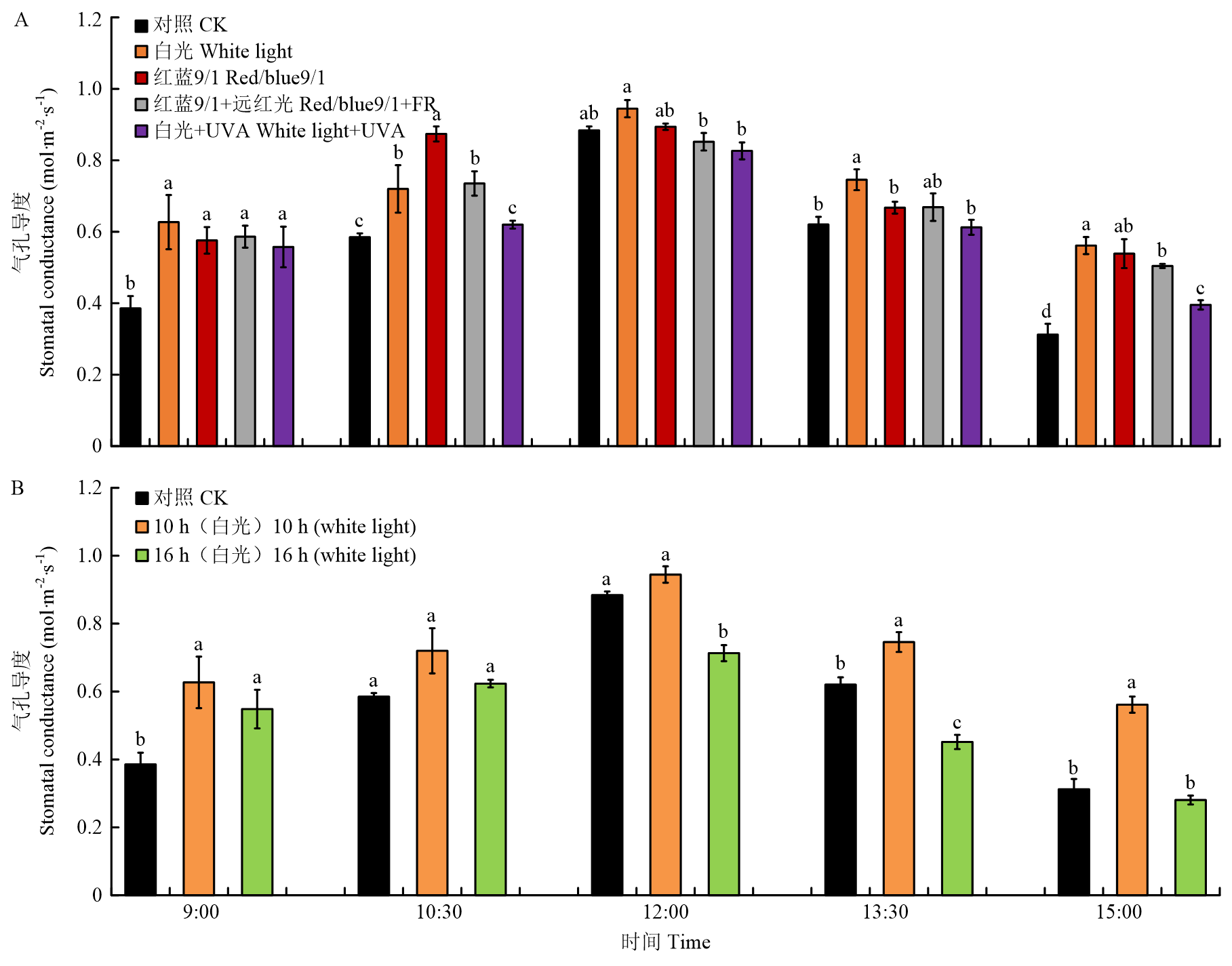
图5
不同光质(A)、光周期处理(B)对草莓叶片气孔导度日变化值的影响"
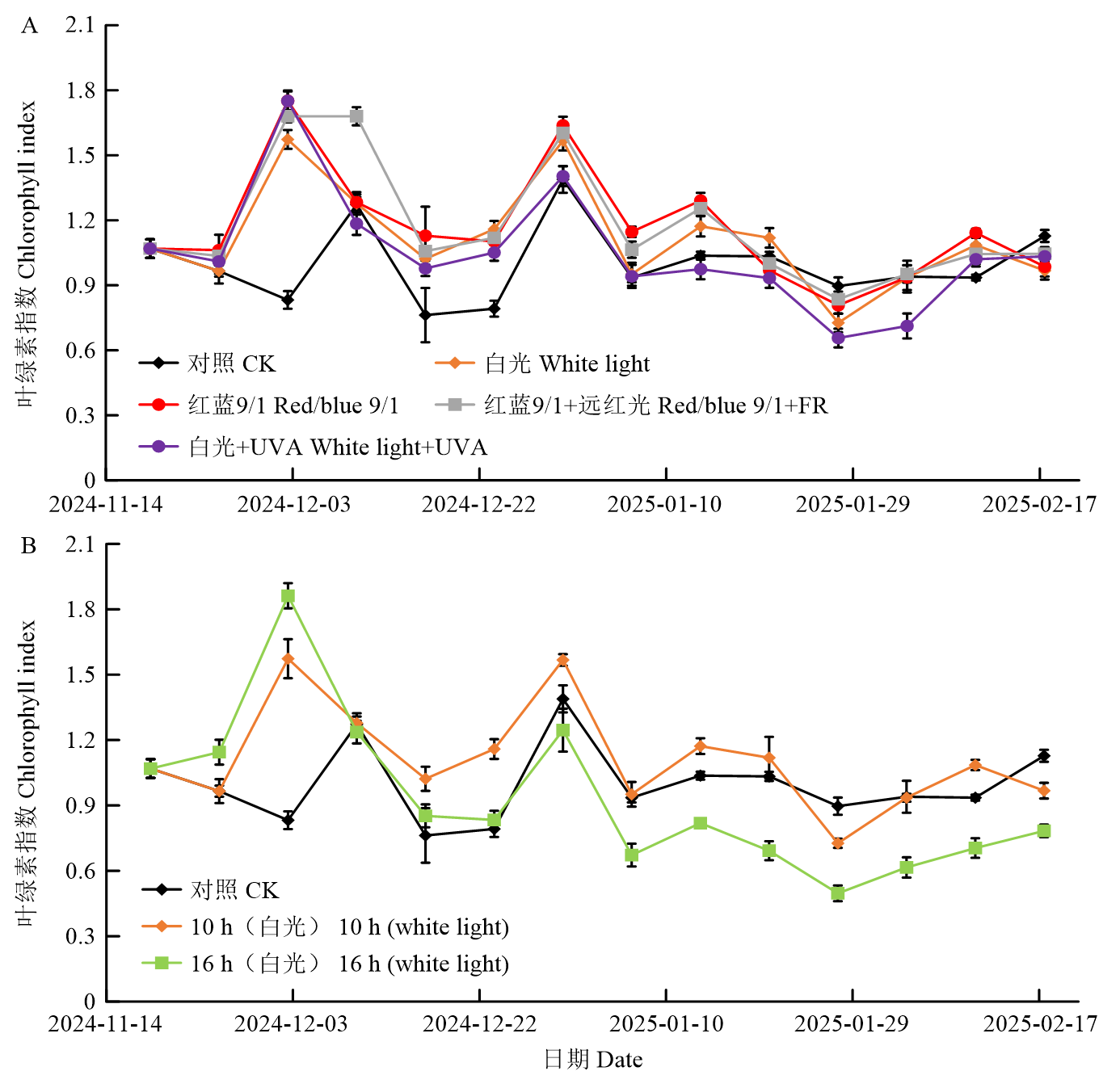
图6
不同光质(A)、光周期处理(B)对草莓叶绿素指数(SPAD值)的影响"
表3
不同光质、光周期处理对草莓花芽分化的影响"
| 试验Experiment | 处理 Treatment | 第一花序花芽数量 Flower buds of 1st inflorescence | 第二花序花芽数量 Flower buds of 2nd inflorescence | 第三花序花芽数量 Flower buds of 3rd inflorescence | 总花芽数 Total flower buds | 开花时数 Flowering hours (h) | 坐果率 Fruit set rate (%) |
|---|---|---|---|---|---|---|---|
| 光质 Light quality | 对照CK | 7.4±0.5c | 7.1±0.3d | 5.0±0.3c | 19.5±0.8c | 139.0±7.0a | 26±2c |
| 白光White light | 9.5±0.9b | 9.8±0.8ab | 6.3±0.6ab | 25.6±1.1b | 111.5±4.3b | 33±2b | |
| 红蓝9/1 Red/blue9/1 | 12.3±0.7a | 9.5±0.5b | 5.6±0.4b | 27.4±1.5ab | 119.2±4.9b | 36±1ab | |
| 红蓝9/1+远红光Red/blue9/1+FR | 11.3±0.5a | 11.1±1.0a | 7.9±0.7a | 30.3±1.4a | 111.8±4.6b | 38±1a | |
| 白光+UVA White light+UVA | 9.0±0.4b | 8.4±0.5c | 5.5±0.5b | 22.9±1.0c | 129.8±6.2a | 26±1c | |
| 光周期 Photoperiod | 对照CK | 7.4±0.5c | 7.1±0.3c | 5.0±0.3c | 19.5±0.8c | 139.0±7.0a | 26±2b |
| 10 h(白光) 10 h (white light) | 9.5±0.9b | 9.8±0.8b | 6.3±0.6b | 25.6±1.1b | 111.5±4.3b | 33±2a | |
| 16 h(白光) 16 h (white light) | 13.1±0.6a | 13.9±1.3a | 12.4±0.9a | 41.1±1.8a | 131.5±5.2a | 22±1c |

图7
不同光质(A)、光周期处理(B)对草莓单位面积产量的影响"
表4
不同光质、光周期处理对草莓单株果实数量和单果重的影响"
| 试验Experiment | 处理Treatment | 单株果数Fruit number per plant | 单果重Single fruit weight (g) |
|---|---|---|---|
| 光质 Light quality | 对照CK | 6.1±0.3c | 27.5±0.4a |
| 白光White light | 7.8±0.2b | 26.3±0.6b | |
| 红蓝9/1 Red/blue9/1 | 9.3±0.4a | 24.3±0.4c | |
| 红蓝9/1+远红光Red/blue9/1+FR | 9.9±0.5a | 26.1±0.3b | |
| 白光+UVA White light+UVA | 6.9±0.3c | 26.0±0.5b | |
| 光周期 Photoperiod | 对照CK | 6.1±0.3c | 27.5±0.4b |
| 10 h(白光)10 h (white light) | 7.8±0.2b | 26.3±0.6c | |
| 16 h(白光)16 h (white light) | 10.3±0.6a | 28.6±0.5a |
表5
不同光质、光周期处理对草莓果实品质的影响"
| 试验 Experiment | 处理 Treatment | 果实含水率 Fruit water content (%) | 果实可溶性糖含量 Fruit soluble sugar content (mg·g-1) | 果实滴定酸含量 Fruit titratable acid content (mg·g-1) | 果实糖酸比 Fruit sugar acid ratio | 果实可溶性蛋白含量 Fruit soluble protein content (mg·g-1) |
|---|---|---|---|---|---|---|
| 光质 Light quality | 对照CK | 90.8±0.7a | 56.9±1.1b | 7.9±0.1d | 7.1±0.2b | 0.5±0.0b |
| 白光White light | 89.6±0.3b | 55.6±2.7b | 9.8±0.2b | 6.0±0.2c | 0.6±0.0a | |
| 红蓝9/1 Red/blue9/1 | 91.1±1.0a | 67.6±3.0a | 9.3±0.1c | 7.6±0.3a | 0.6±0.0a | |
| 红蓝9/1+远红光Red/blue9/1+FR | 90.3±0.3ab | 66.5±1.9a | 10.9±0.1a | 6.3±0.2c | 0.6±0.0a | |
| 白光+UVA White light+UVA | 89.4±1.6ab | 56.6±5.1b | 9.5±0.1bc | 5.7±0.7c | 0.6±0.0a | |
| 光周期 Photoperiod | 对照CK | 90.8±0.7a | 56.9±1.1a | 7.9±0.1b | 7.1±0.2a | 0.5±0.0b |
| 10 h(白光)10 h (white light) | 89.6±0.3b | 55.6±2.7a | 9.8±0.2a | 6.0±0.2b | 0.6±0.0a | |
| 16 h(白光)16 h (white light) | 90.2±0.2ab | 58.1±1.8a | 9.7±0.1a | 6.2±0.1b | 0.6±0.0a |

图8
不同光质、光周期处理的电能利用效率"
| [1] |
刘畅, 王晓, 李宪松, 王俊芹. 我国草莓生产态势及国内外比较分析[J]. 中国果树, 2023(7): 136-140.
|
|
|
|
| [2] |
张玄兵, 宋希强, 钟云芳, 李昌瑞. 我国温室发展概况[J]. 北方园艺, 2001(2): 1-2.
|
|
|
|
| [3] |
柴贵贤. LED在设施栽培中的应用和前景[J]. 种子科技, 2022, 40(7): 142-144.
|
|
|
|
| [4] |
李涛, 杨其长. 设施园艺生产人工补光理论初探[J]. 农业工程技术, 2018, 38(16): 48-52.
|
|
|
|
| [5] |
doi: 10.1016/j.scienta.2015.03.022 |
| [6] |
杨肖芳, 张豫超, 苗立祥, 孙晨栋, 蒋桂华. LED补光对不同设施栽培草莓品种营养生长与果实品质的影响[J]. 浙江农业科学, 2023, 64(4): 864-869.
doi: 10.16178/j.issn.0528-9017.20221246 |
|
|
|
| [7] |
刘庆, 连海峰, 刘世琦, 孙亚丽, 于新会, 郭会平. 不同光质LED光源对草莓光合特性、产量及品质的影响[J]. 应用生态学报, 2015, 26(6): 1743-1750.
|
|
|
|
| [8] |
doi: 10.17660/eJHS.2017/82.1.2 |
| [9] |
张涵, 张玉琪, 黎景来, 李星, 郭健, 李涛. LED补光对日光温室基质栽培草莓生产及叶片生理特性的影响[J]. 中国农业科学, 2025, 58(5): 975-990. DOI: 10.3864/j.issn.0578-1752.2025.05.012.
|
|
|
|
| [10] |
李登延, 李曼曼. 温室照明动态调光控制系统设计[J]. 光源与照明, 2024(7): 17-19.
|
|
|
|
| [11] |
doi: 10.1146/arplant.1971.22.issue-1 |
| [12] |
doi: 10.1016/j.scienta.2019.108725 |
| [13] |
doi: 10.1111/pce.v40.11 |
| [14] |
doi: 10.1016/j.envexpbot.2022.104866 |
| [15] |
doi: 10.3389/fpls.2019.01563 pmid: 31867029 |
| [16] |
doi: 10.3732/ajb.1200340 pmid: 23048016 |
| [17] |
doi: 10.2525/ecb.52.63 |
| [18] |
岳高峰, 王丽萍, 韩志强. 不同补光时长对草莓开花及产量品质的影响[J]. 江苏农业科学, 2020, 48(18): 144-148.
|
|
|
|
| [19] |
林坤明, 刘文科, 刘家源, 陈杰. LED红蓝光光强及光周期对草莓匍匐茎生长和开花结果的影响[J]. 中国照明电器, 2023(7): 1-7.
|
|
|
|
| [20] |
罗刚军. 基于中国原产野生草莓果实品质评价的种质创新研究[D]. 沈阳: 沈阳农业大学, 2019.
|
|
|
|
| [21] |
孙萍, 沈建生, 林贤锐. 延长光照时间对立体种植模式下草莓植株生长的影响[J]. 浙江农业科学, 2016, 57(1): 82-83, 89.
|
|
|
|
| [22] |
卢贝. 不同光质对草莓生长发育影响及FaHY5在品质形成中的作用[D]. 扬州: 扬州大学, 2021.
|
|
|
|
| [23] |
doi: 10.1007/s11099-011-0029-8 |
| [24] |
|
| [25] |
许大全, 高伟, 阮军. 光质对植物生长发育的影响[J]. 植物生理学报, 2015, 51(8): 1217-1234.
|
|
|
|
| [26] |
doi: 10.1104/pp.112.196659 pmid: 22566495 |
| [27] |
doi: 10.1016/j.envexpbot.2015.05.010 |
| [28] |
doi: 10.1134/S1021443717010198 |
| [29] |
doi: 10.1016/j.scienta.2014.05.013 |
| [30] |
doi: 10.1016/j.scienta.2011.12.023 |
| [31] |
doi: 10.1016/j.scienta.2025.114142 |
| [32] |
doi: 10.3389/fnut.2022.1080147 |
| [33] |
doi: 10.1016/j.envexpbot.2020.104073 |
| [34] |
doi: 10.1093/aob/mcr221 pmid: 21865217 |
| [35] |
王佳淇, 何莹钰, 韦晓桐, 李永强, 杨莉, 陈文荣, 廖芳蕾, 郭卫东. LED补光组合对大棚越橘生长发育的影响[J]. 园艺学报, 2020, 47(6): 1183-1193.
doi: 10.16420/j.issn.0513-353x.2019-0707 |
|
doi: 10.16420/j.issn.0513-353x.2019-0707 |
|
| [36] |
李海涛, 董铭, 廖迎春, 卢存福, 梁涛. 模拟UVB增强胁迫对大田水稻生长及内源激素含量的影响[J]. 中国农学通报, 2007, 23(3): 392-397.
|
|
|
|
| [37] |
高美芳. UVA补光时长对芥蓝生长发育及硫苷生物合成的影响[D]. 广州: 华南农业大学, 2021.
|
|
|
|
| [38] |
王佳淇. 不同光质LED补光对大棚蓝莓生长发育的影响研究[D]. 金华: 浙江师范大学, 2020.
|
|
|
|
| [39] |
郑雪宜. 抗坏血酸在植物耐铝和UV-B辐射中的作用[D]. 广州: 华南农业大学, 2007.
|
|
|
|
| [40] |
doi: 10.1016/j.actaastro.2014.08.024 |
| [41] |
doi: 10.1080/01904160802135027 |
| [42] |
袁娟, 武天龙, 陈典. 光周期对扁豆真叶内源激素及游离氨基酸含量的影响[J]. 上海交通大学学报(农业科学版), 2004, 22(3): 215-219, 226.
|
|
|
|
| [43] |
陈杰, 李锁平, 张大乐. 植物避荫反应的分子生理学研究进展[J]. 麦类作物学报, 2016, 36(10): 1355-1361.
|
|
|
|
| [44] |
宋佳丽, 刘厚诚, 宋世威, 张轶婷, 郝彦伟, 苏蔚, 孙光闻, 陈日远. 光质调控植物开花时间和花性分化研究进展[J]. 植物生理学报, 2017, 53(11): 1938-1946.
|
|
|
| [1] | 张东梅, 周鑫鑫, 肖桂林, 曾祥国, 王春燕, 王泽先, 韩永超. 草莓花器应答灰霉病菌侵染的表现特征及抗病性评价方法[J]. 中国农业科学, 2026, 59(7): 1456-1466. |
| [2] | 罗正英, 胡嗣桢, 林秀琴, 胡鑫, 张敏, 徐超华, 刘新龙, 曾千春. 甘蔗属割手密与热带种PEBP基因家族的鉴定及其开花调控功能分析[J]. 中国农业科学, 2026, 59(4): 734-749. |
| [3] | 张涵, 张玉琪, 黎景来, 徐虹, 李维环, 李涛. LED补光对日光温室基质栽培草莓生产及叶片生理特性的影响[J]. 中国农业科学, 2025, 58(5): 975-990. |
| [4] | 王庆峰, 褚长彬, 赵峥, 吴淑杭, 周德平. 草莓连作对土壤微生物及碳氮磷功能基因丰度的影响[J]. 中国农业科学, 2025, 58(17): 3488-3502. |
| [5] | 鲁晓峰,杜国栋,邵静,张静茹,孙海龙. 草莓根系线粒体对外源酚酸胁迫的生理响应[J]. 中国农业科学, 2021, 54(5): 1029-1042. |
| [6] | 王爱华,马红叶,李荣飞,杨仕品,乔荣,钟霈霖. 凤梨草莓与黄毛草莓种间杂种果实香气成分的代谢谱分析[J]. 中国农业科学, 2021, 54(5): 1043-1054. |
| [7] | 王君杰,田翔,秦慧彬,王海岗,曹晓宁,陈凌,刘思辰,乔治军. 光周期对糜子生长发育及叶片内源激素的调控效应[J]. 中国农业科学, 2021, 54(2): 286-295. |
| [8] | 孙洪影,王岩,李伟佳,朱天姝,姜颖,许妍,吴清悦,张志宏. 森林草莓FveD27的表达特性和功能[J]. 中国农业科学, 2021, 54(10): 2179-2191. |
| [9] | 董明,降彦苗,李海权,耿玲玲,刘建烨,乔志红,刘国庆. 光周期变化对糜子形态建成及幼穗发育进程的影响[J]. 中国农业科学, 2020, 53(6): 1118-1125. |
| [10] | 王君杰,王海岗,曹晓宁,陈凌,刘思辰,田翔,秦慧彬,乔治军. 糜子不同性状光周期敏感性的综合评价[J]. 中国农业科学, 2020, 53(3): 474-485. |
| [11] | 刘志平,武雪萍,李若楠,郑凤君,张孟妮,李生平,宋霄君. 温室滴灌条件下施用鸡粪和磷肥对土壤磷素的影响[J]. 中国农业科学, 2019, 52(20): 3637-3647. |
| [12] | 韩永超,曾祥国,向发云,过聪,张庆华,陈丰滢,关伟. 草莓属植物种质资源对炭疽病抗性的离体评价[J]. 中国农业科学, 2019, 52(20): 3585-3594. |
| [13] | 李若楠,黄绍文,史建硕,王丽英,唐继伟,张怀志,袁硕,翟凤芝,任燕利,郭丽. 日光温室冬春茬黄瓜滴灌的肥水优化管理[J]. 中国农业科学, 2019, 52(20): 3648-3660. |
| [14] | 董静,钟传飞,王桂霞,常琳琳,孙健,孙瑞,张宏力,李睿,隗永青,郑书旗,张运涛. 日中性草莓不同季节果实挥发性成分差异[J]. 中国农业科学, 2019, 52(13): 2309-2327. |
| [15] | 阎依超,万春雁,古咸彬,郭成宝,陈月红,高志红. 过量表达RdreB1BI对草莓果实品质及相关基因的影响[J]. 中国农业科学, 2018, 51(7): 1353-1367. |
|
||
