






中国农业科学 ›› 2026, Vol. 59 ›› Issue (2): 305-321.doi: 10.3864/j.issn.0578-1752.2026.02.007
刘天生( ), 刘耕源, 赵安琪, 杨旭, 蔡明雪, 杨艾文, 娄铭轩, 李沐恺, 王晗, 张亚玲()
收稿日期:2025-09-18
接受日期:2025-11-08
出版日期:2026-01-16
发布日期:2026-01-22
通信作者:
联系方式:
刘天生,E-mail:1243351340@qq.com。
基金资助:
LIU TianSheng(), LIU GengYuan, ZHAO AnQi, YANG Xu, CAI MingXue, YANG AiWen, LOU MingXuan, LI MuKai, WANG Han, ZHANG YaLing()
Received:2025-09-18
Accepted:2025-11-08
Published:2026-01-16
Online:2026-01-22
摘要:
【目的】 探明黑龙江省水稻恶苗病病原种类及优势致病菌,为水稻恶苗病的精准防控提供依据。 【方法】 2023年,采集黑龙江省8市15县(区)水稻恶苗病样品,经组织分离法和稀释涂布法,共分离纯化172株单孢菌株。通过形态学鉴定,结合多基因联合系统发育分析(ITS、RPB2、TEF1-α、LSU、TUB2)及柯赫氏法则验证完成水稻恶苗病病原菌鉴定。 【结果】 172株水稻恶苗病原菌根据形态特征划分为31种类型。多基因联合系统发育分析鉴定出15种基因型,所分离的致病菌包含FFSC、FNSC、FOSC、FIESC 4个复合种。其中优势致病菌为FFSC复合种中的藤仓镰孢(Fusarium fujikuroi),分离得到148株,占分离菌株总数的86.05%,包含4种基因型,有18种菌态;复合种中还分离到9株Fusarium madaense,占5.23%,包含1种基因型3种菌态,以及1株Fusarium subglutinans,占0.58%,有1种基因型1种菌态。FIESC复合种中包含2株Fusarium wereldwijsianum,占1.16%,包含2种基因型2种菌态;7株Fusarium ipomoeae,占4.07%,包含5种基因型5种菌态。FNSC、FOSC复合种中各分离到4株Fusarium arbusti和1株Fusarium cugenangense,分别占2.33%、0.58%,各有1种基因型1种菌态。7种镰孢菌均具致病性但致病程度不同,优势致病菌藤仓镰孢导致水稻芽腐、徒长,F. arbusti仅导致水稻芽腐,F. ipomoeae、F. subglutinans、F. wereldwijsianum抑制水稻生长,F. madaense、F. cugenangense导致水稻徒长。 【结论】 黑龙江省水稻恶苗病致病菌为藤仓镰孢、F. madaense、F. ipomoeae、F. arbusti、F. wereldwijsianum、F. subglutinans、F. cugenangense 7个种,致病类型和地理分布因病原菌种类不同存在明显差异。其中藤仓镰孢和F. arbusti致病力最强;藤仓镰孢在黑龙江省各地区均有发现,为优势致病菌。
刘天生, 刘耕源, 赵安琪, 杨旭, 蔡明雪, 杨艾文, 娄铭轩, 李沐恺, 王晗, 张亚玲. 黑龙江省水稻恶苗病致病群体[J]. 中国农业科学, 2026, 59(2): 305-321.
LIU TianSheng, LIU GengYuan, ZHAO AnQi, YANG Xu, CAI MingXue, YANG AiWen, LOU MingXuan, LI MuKai, WANG Han, ZHANG YaLing. Pathogenic Population of Rice Bakanae Disease in Heilongjiang Province[J]. Scientia Agricultura Sinica, 2026, 59(2): 305-321.
表1
目标片段扩增引物序列及反应程序"
| 基因Gene | 引物Primer | 序列Sequence (5′-3′) | PCR反应程序PCR amplification procedure |
|---|---|---|---|
| ITS | ITS1 | TCCGTAGGTGAACCTGCGG | 94 ℃ 2 min; 94 ℃ 30 s, 55 ℃ 30 s, 72 ℃ 30 s, 35 cycles; 72 ℃ 10 min |
| ITS4 | TCCTCCGCTTATTGATATGC | ||
| TEF1-α | EF1 | ATGGGTAAGGAAGACAAGAC | 94 ℃ 2 min; 94 ℃ 1 min, 55 ℃ 1 min, 72 ℃ 1 min, 35 cycles; 72 ℃ 10 min |
| EF2 | GGAAGTACCAGTGATCATGTT | ||
| TUB2 | T1 | AACATGCGTGAGATTGTAAGT | 94 ℃ 2 min; 94 ℃ 35 s, 52 ℃ 55 s, 72 ℃ 2 min, 35 cycles; 72 ℃ 10 min |
| T22 | TCTGGATGTTGTTGGGAATCC | ||
| LSU | LSU1 | CTTTTGATGCGGTGCCTTCC | 94 ℃ 5 min; 94 ℃ 45 s, 55 ℃ 45 s, 72 ℃ 105 s, 35 cycles; 72 ℃ 5 min |
| LSU2 | TACGCGTAGGGGTTTGACAC | ||
| RPB2 | 5f2 | GGGGWGAYCAGAAGAAGGC | 94 ℃ 5 min; 94 ℃ 15 s, 50 ℃ 45 s, 72 ℃ 45 s, 35 cycles; 72 ℃ 5 min |
| 7cr | CCCATRGCTTGYTTRCCCAT |
表2
NCBI下载的用于多基因系统发育分析物种、菌株及基因编号"
| 菌株编号 Strain number | 复合种 Species complex | 物种 Species | GenBank编号GenBank number | ||||
|---|---|---|---|---|---|---|---|
| ITS | RPB2 | LSU | TEF1-α | TUB2 | |||
| CBS221.76 | FFSC | 藤仓镰孢Fusarium fujikuroi | AB725607 | KU604255 | KU604096 | AB725605 | AB725606 |
| CBS130308 | FOSC | Fusarium cugenangense | MW827607 | MH484920 | MH877308 | MH485011 | MH485102 |
| CBS747.97 | FFSC | Fusarium subglutinans | U34559 | JX171599 | — | HM057336 | MW402351 |
| LC13614 | FFSC | Fusarium madaense | MW016405 | MW474391 | — | MW580445 | MW533727 |
| GUCC197425.1 | FIESC | Fusarium radicigenum | OR034266 | OR043852 | — | OR043908 | OR043953 |
| CGMCC3.19493 | FIESC | Fusarium arcuatisporum | MK280802 | MK289739 | — | MK289584 | MW533837 |
| GUCC190154.1 | FNSC | Fusarium arbusti | MZ724826 | OR043837 | — | OR043893 | OR043940 |
| Indo174 | FIESC | Fusarium ipomoeae | LS479418 | LS479861 | LS479891 | — | — |
| NL19-057012 | FIESC | Fusarium wereldwijsianum | MZ890508 | MZ921719 | MZ890364 | — | — |
| CBS173.57 | — | Curvularia hawaiiensis | MH857687.1 | LT715683.1 | MH869226.1 | KT021343.1 | KT021342.1 |
表3
上传至NMDC 的用于多基因系统发育分析物种、菌株及序列"
| 菌株编号 Strain number | 各基因登录号Gene accession number | ||||
|---|---|---|---|---|---|
| ITS | TEF1-α | TUB2 | RPB2 | LSU | |
| JH04 | NMDCN00092TE | NMDCN00092UR | NMDCN00092UC | NMDCN00092TT | NMDCN00092UT |
| HL34 | NMDCN00092TD | NMDCN00092UQ | NMDCN00092UB | NMDCN00092TS | NMDCN00092UU |
| HL20 | NMDCN00092TC | NMDCN00092UP | NMDCN00092UA | NMDCN00092TR | NMDCN00092UV |
| WK01 | NMDCN00092TB | NMDCN00092UO | NMDCN00092U9 | NMDCN00092TQ | NMDCN00092V0 |
| JH03 | NMDCN00092TA | NMDCN00092UN | NMDCN00092U8 | NMDCN00092TP | NMDCN00092V1 |
| AD04 | NMDCN00092T9 | NMDCN00092UM | NMDCN00092U7 | NMDCN00092TO | NMDCN00092V2 |
| HSB04 | NMDCN00092T8 | NMDCN00092UL | NMDCN00092U6 | NMDCN00092TN | NMDCN00092V3 |
| HL18 | NMDCN00092T7 | NMDCN00092UK | NMDCN00092U5 | NMDCN00092TM | — |
| HL14 | NMDCN00092T6 | NMDCN00092UJ | NMDCN00092U4 | NMDCN00092TL | — |
| WK03 | NMDCN00092T5 | NMDCN00092UI | NMDCN00092U3 | NMDCN00092TK | — |
| LF09 | NMDCN00092T4 | NMDCN00092UH | NMDCN00092U2 | NMDCN00092TJ | — |
| MS04 | NMDCN00092T3 | NMDCN00092UG | NMDCN00092U1 | NMDCN00092TI | — |
| LJ07 | NMDCN00092T2 | NMDCN00092UF | NMDCN00092U0 | NMDCN00092TH | — |
| HL09 | NMDCN00092T1 | NMDCN00092UE | NMDCN00092TV | NMDCN00092TG | — |
| LB02 | NMDCN00092T0 | NMDCN00092UD | NMDCN00092TU | NMDCN00092TF | — |
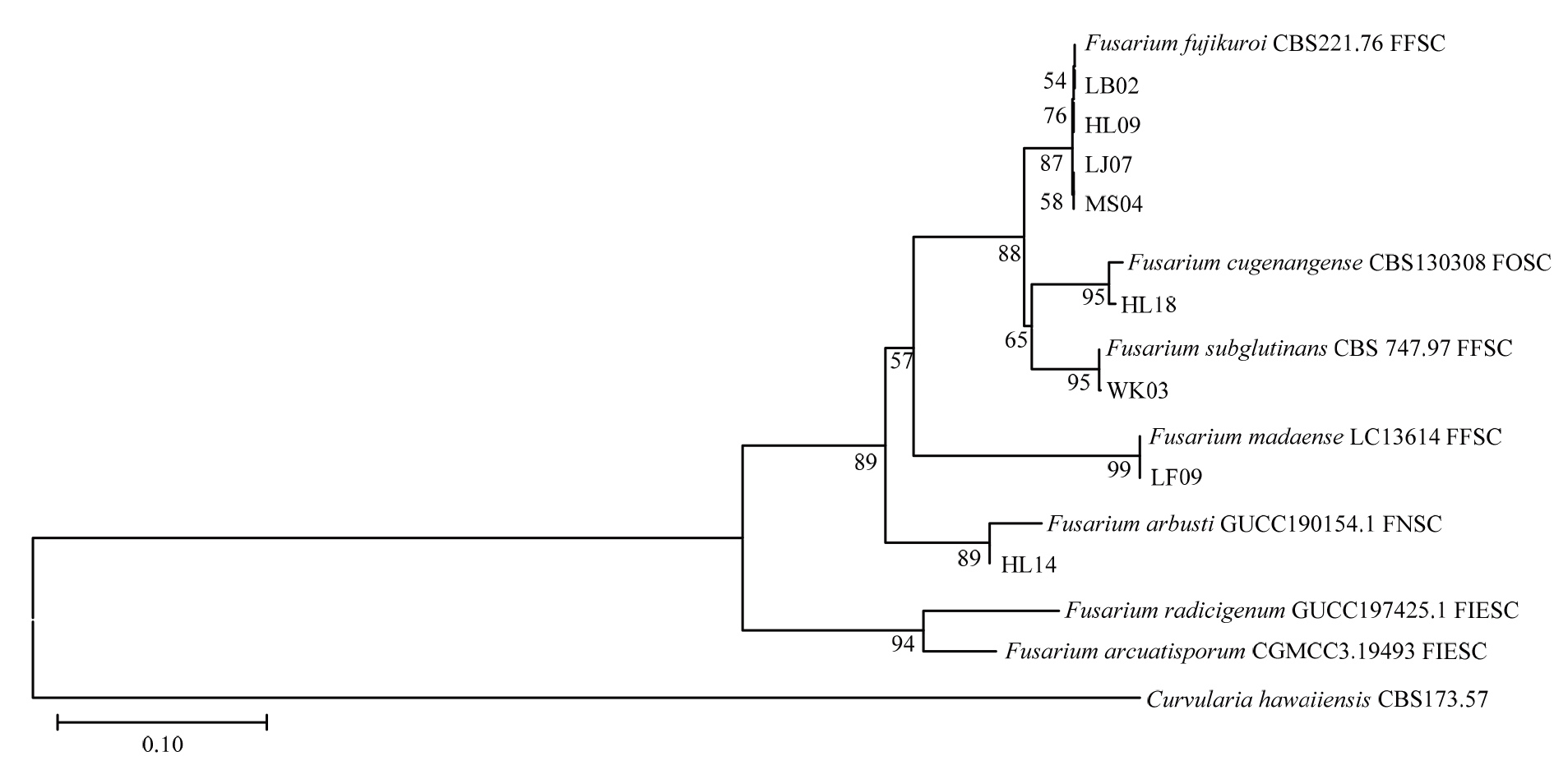
图1
基于ITS、TEF1-α、TUB2、RPB2 多基因序列以邻接法构建的系统发育树"
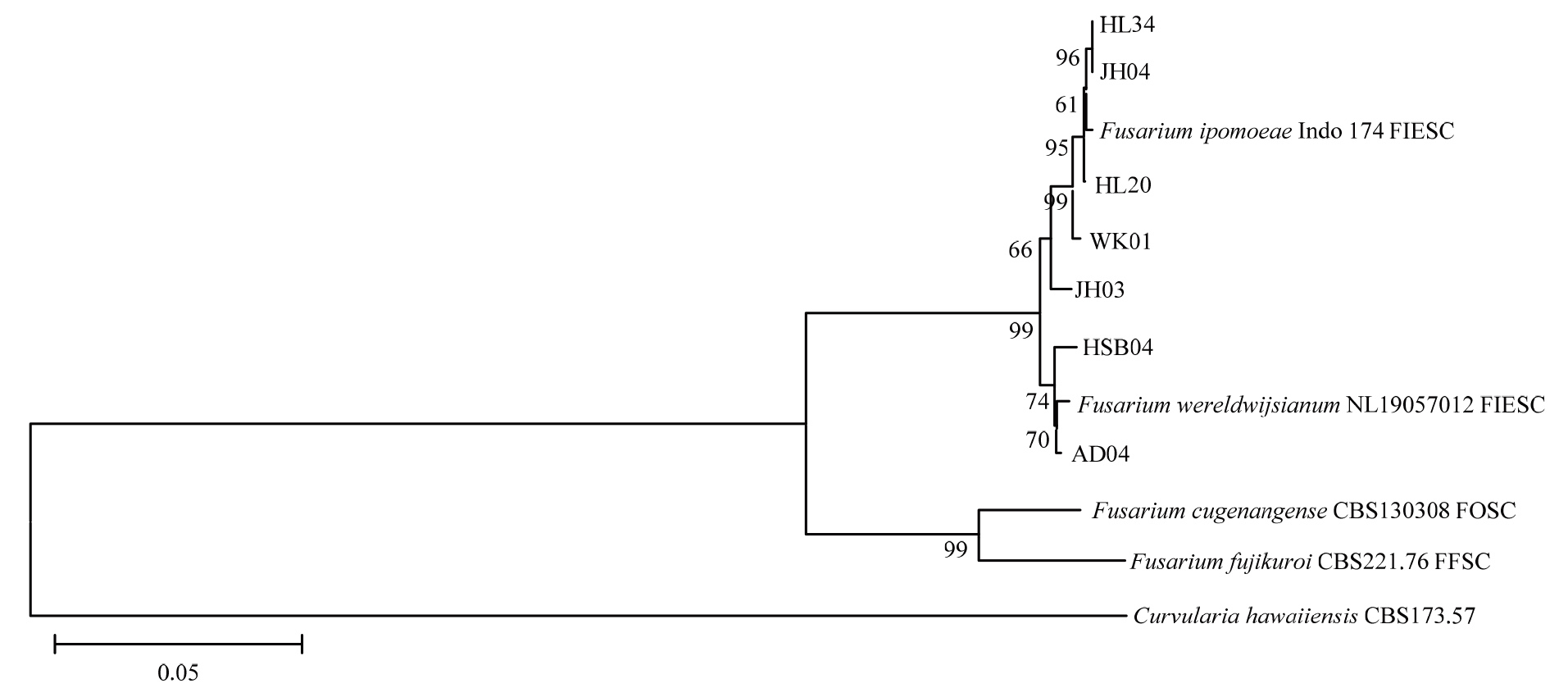
图2
基于ITS、RPB2、LSU多基因序列以邻接法构建的系统发育树"
表4
病原菌形态"
| 菌株编号 Strain number | 菌株产生色素 Pigment produced by the strain | 菌落形态 Colony morphology | 大孢子形态 Macrospore morphology | 隔膜数 Spore septum | 大孢子大小 Macrospore size |
|---|---|---|---|---|---|
| HL06 | 中心紫色逐渐变浅 The center gradually fades from purple | 气生菌丝发达蓬松,呈棉絮状,边缘整齐 Abundant aerial mycelium presents a fluffy, cottony texture and exhibits even margins | 镰刀形 Falciform | 3-5 | (21.63-34.27) μm× (2.99-4.04) μm |
| MS03 | 白色 White | 微弯,多数两端较钝 Slightly curved, mostly with blunt ends | 0-2 | (9.23-20.01) μm× (1.89-3.01) μm | |
| MS04 | 淡紫色 Pale purple | 不弯或微弯,长梭形 Straight or slightly curved, fusiform | 3-5 | (27.23-43.52) μm× (4.08-4.45) μm | |
| LB02 | 淡黄色 Pale yellow | 一端渐尖一端微钝 Acutely tapered at one end and slightly obtuse at the other | 3-5 | (14.01-19.82) μm× (2.22-2.73) μm | |
| DF12 | 橙色 Orange | 长梭形或两端微弯 Fusiform or slightly curved at both ends | 3-5 | (18.49-41.81) μm× (2.16-3.47) μm | |
| LJ07 | 中心橙色,向外黄色 The center is orange with a yellow periphery | 长梭形 Fusiform | 3-5 | (28.18-38.60) μm× (3.83-4.20) μm | |
| HL09 | 中心紫色,向外淡黄色 The center is purple with a pale yellow periphery | 微弯,两端较钝 Slightly curved with blunt ends | 3-5 | (28.94-43.43) μm× (3.14-3.93) μm | |
| LB01 | 中心橙色,向外黄色 The center is orange with a yellow periphery | 长梭形或两端微弯 Fusiform or slightly curved at both ends | 3-5 | (17.74-34.97) μm× (2.53-3.83) μm | |
| RH11 | 中心深紫色,向外逐渐变白 A deep purple core gradually transitions to white at the edges | 菌丝生长均匀,气生菌丝发达致密接近颗粒状,边缘整齐 The mycelium grows evenly, with dense, nearly granular aerial mycelia and a well- defined margin | 长梭形 Fusiform | 3-5 | (33.60-41.53) μm× (1.82-3.28) μm |
| HL15 | 淡黄色 Pale yellow | 长梭形,两端较钝 Fusiform with blunt ends | 0-1 | (23.02-27.12) μm× (2.67-3.39) μm | |
| DF10 | 中心橙色,向外黄色 The center is orange with a yellow periphery | 长梭形,两端较钝 Fusiform with blunt ends | 0-3 | (14.06-36.36) μm× (2.65-4.00) μm | |
| MS10 | 中心深紫色向外变浅 A deep purple center gradually fades toward the edges | 菌丝红色,表面有纹理,呈绒毛状 The mycelium is red, with a textured surface and a velvety appearance | 两端较钝,一端微弯 Blunt-ended, slightly curved at one end | 3-5 | (22.01-34.95) μm× (3.08-3.40) μm |
| MS01 | 紫红色 Fuchsia | 中心隆起,边缘平整 The center is raised and the margins are flat | 长梭形 Fusiform | 1-3 | (20.56-33.49) μm× (2.62-3.78) μm |
| RH07 | 中心深紫色,向外白色 The center is deep purple with a white periphery | 一端较钝,一端微弯渐尖 Blunt at one end, gradually tapered and slightly curved at the other | 3-5 | (19.70-30.29) μm× (2.80-3.53) μm | |
| DF11 | 黄色 Yellow | 菌丝细密呈绒毛状并微微隆起,边缘菌丝略稀疏但整齐 The mycelium is fine, velvety and slightly raised, with the margin mycelium being slightly sparse but neat | 饱满,一端圆润 Plump and round at one end | 1-3 | (11.06-25.20) μm× (3.18-3.99) μm |
| HL26 | 紫色 Purple | 长梭形,两端较钝 Fusiform with blunt ends | 不明显Not clear | (15.38-23.98) μm× (2.95-3.35) μm | |
| HL33 | 中心紫色,边缘大部分浅黄色 The center is purple with a mostly pale yellow margin | 菌丝浓密,呈绒毛状,边缘呈轻微波浪状 The mycelium is dense, velvety, and has a slightly undulated margin | 镰刀形 Falciform | 1-5 | (11.56-36.94) μm× (1.82-3.88) μm |
| HL03 | 中心紫色,向外黄色 The center is purple with a yellow periphery | 菌丝短且致密,边缘整齐 The mycelium is short and dense, with a neat margin | 微弯 Slightly curved | 3-5 | (19.00-30.69) μm× (3.10-4.88) μm |
| LF09 | 中心橙色向外变浅 An orange core gradually lightens toward the edges | 中间密呈毡状,有高度 The middle is dense and felt-like, with a certain height | 微弯,两端渐尖或较钝 Slightly curved, with both ends gradually pointed or relatively blunt | 1-4 | (9.26-19.77) μm× (2.04-3.82) μm |
| LF03 | 橙黄色 Orange-yellow | 菌丝稀疏蓬松,呈放射状 The mycelial growth exhibits a sparse, fluffy texture and a radial arrangement | 两端较钝 Both ends are relatively blunt | 0-2 | (17.06-24.53) μm× (2.75-3.15) μm |
| LF14 | 黄色 Yellow | 生长速度慢,菌丝细密呈毡状,中心高四周低 The growth rate is slow, the mycelium is fine and felt-like, with a higher center and lower margin | 微弯,两端渐尖 Slightly curved, with both ends gradually pointed | 1-3 | (11.02-34.42) μm× (2.75-3.15) μm |
| HSB04 | 白色 White | 菌丝稀疏 Mycelial growth is sparse | 一端微弯 Slightly curved at one end | 3-5 | (21.18-49.57) μm× (2.07-4.81) μm |
| AD04 | 棕色 Brown | 菌丝浓密呈毡状,生长速度慢 The mycelium is dense, felt-like, and exhibits a slow growth rate | 微弯,两端渐尖 Slightly curved, with both ends gradually pointed | 1-3 | (10.57-30.37) μm× (2.89-3.15) μm |
| JH04 | 橙色 Orange | 菌丝橙色,有高度 The mycelium is orange in color, forming a raised structure | 镰刀形 Falciform | 3-5 | (18.87-34.89) μm× (1.76-4.23) μm |
| JH03 | 淡黄色 Pale yellow | 菌丝较茂密,呈羊毛状 The mycelial growth exhibits a fairly dense, woolly texture | — | — | — |
| HL34 | 白色 White | 菌丝杂乱交织 The mycelium grows in a dense, tangled, and interwoven manner | 大孢子微弯,产生厚垣孢子 Macroconidia slightly curved, forming chlamydospores | 1-5 | (13.15-38.99) μm× (2.00-3.30) μm |
| HL20 | 中心棕色向外变浅 A brown core gradually lightens toward the edges | 中心棕色,菌丝茂密较长 A dense growth of elongated mycelium is noted in the brown central region | 镰刀形 Falciform | 3-5 | (25.36-45.08) μm× (3.15-4.45) μm |
| WK01 | 淡黄色 Pale yellow | 菌丝淡黄色 The mycelium appears light yellow | 微弯 Slightly curved | 2-4 | (12.67-34.94) μm× (2.80-4.59) μm |
| HL18 | 紫色 Purple | 紫红色菌丝,边缘白色 Fuchsia mycelium is observed, exhibiting a white margin | 微弯,两端渐尖 Slightly curved, with both ends gradually pointed | 1-4 | (11.67-31.65) μm× (2.23-2.93) μm |
| HL14 | 淡黄色 Pale yellow | 整体高,中间菌丝乱 It is generally elevated with tangled mycelia in the center | 微弯或不弯,两端较钝 Slightly bent or not bent at all, with both ends being relatively blunt | 0-1 | (16.11-30.58) μm× (1.75-2.41) μm |
| WK03 | 中心橙色向外变浅 The orange center gradually lightens toward the edges | 生长速度较慢,菌丝蓬松 The growth rate is slow, the mycelium is fluffy | 长梭形,较长 Elongated fusiform | 0-4 | (23.44-61.35) μm× (1.82-3.30) μm |

图3
藤仓镰孢形态特征 a:菌落正反面Front and back sides of colony;b:分生孢子Conidium;c:分生孢子梗Conidiophore"

图4
F. madaense形态特征 a:菌落正反面Front and back sides of colony;b:分生孢子Conidium;c:分生孢子梗Conidiophore"
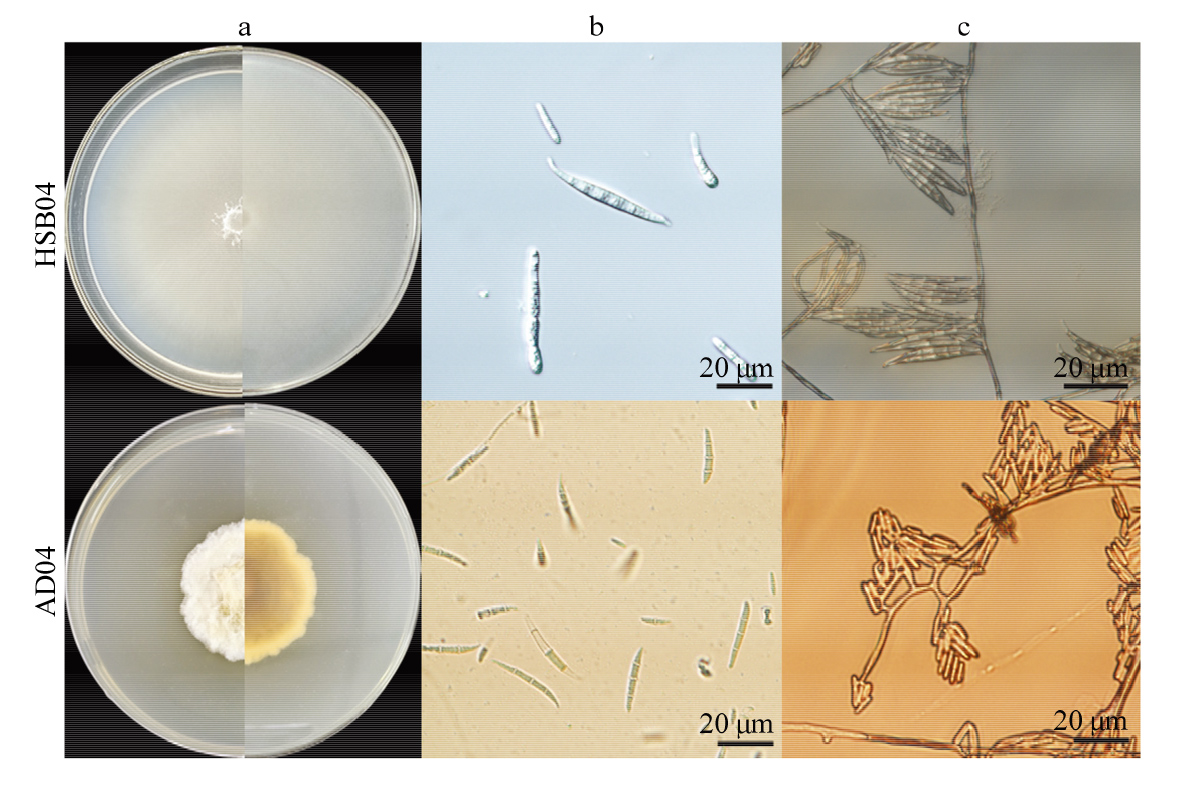
图5
F. wereldwijsianum形态特征 a:菌落正反面Front and back sides of colony;b:分生孢子Conidium;c:分生孢子梗Conidiophore"

图6
F. ipomoeae形态特征 a:菌落正反面Front and back sides of colony;b:JH04、JH03、WK01为分生孢子,HL34为厚垣孢子,HL20为分生孢子梗JH04, JH03, and WK01 are conidia, HL34 is chlamydospore, HL20 is conidiophore"
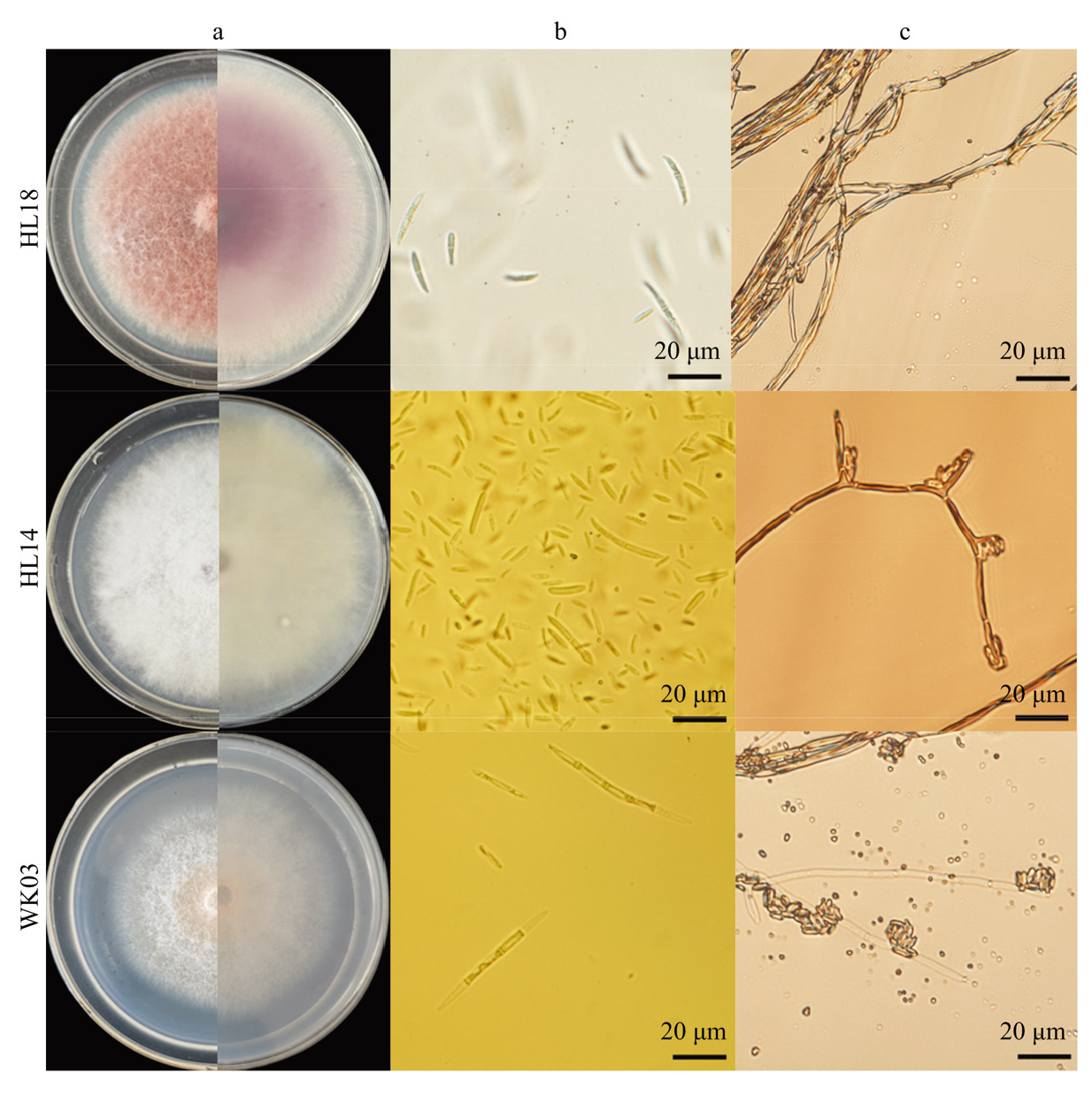
图7
F. cugenangense、F. arbusti、F. subglutinans形态特征 a:菌落正反面Front and back sides of colony;b:分生孢子Conidium;c:分生孢子梗Conidiophore。F. cugenangense:HL18;F. arbusti:HL14;F. subglutinans:WK03"

图8
不同菌株接种后21 d水稻恶苗病发病症状 左侧3株Three plants on the left:各菌株孢子悬浮液处理的水稻苗Rice seedlings treated with spore suspensions of different strains;右侧3株Three plants on the right:对照水稻苗CK rice seedlings"
表5
黑龙江省水稻恶苗病原菌种类及分布情况"
| |
| [1] |
刘瑞, 赵羽涵, 顾欣怡, 王艳霞, 靳学慧, 吴伟怀, 张亚玲. 黑龙江省和海南省稻瘟病菌中AVR-Pita家族的分布及变异分析. 中国农业科学, 2023, 56(3): 466-480. doi: 10.3864/j.issn.0578-1752.2023.03.006.
|
|
|
|
| [2] |
王瑞峰, 李爽, 孔凡娜. 粮食安全保障能力: 内涵特征、指标测度与提升路径. 四川农业大学学报, 2022, 40(3): 301-311.
|
|
|
|
| [3] |
刘宝海, 聂守军, 高世伟, 刘晴, 刘宇强, 马成, 常汇琳, 张佳柠, 薛英会, 白瑞. 基于遗传算法和熵权评价法的寒地水稻育种多目标优化设计. 中国农业大学学报, 2022, 27(1): 38-49.
|
|
|
|
| [4] |
高洪儒, 杨传铭, 赵北平, 张喜娟, 肖明纲, 杨贤莉, 张擘, 王立志, 孙中义, 姜树坤. 黑龙江省五常优质稻区2008—2022年水稻育种趋势分析. 中国稻米, 2025, 31(3): 87-94.
doi: 10.3969/j.issn.1006-8082.2025.03.0014 |
|
|
|
| [5] |
doi: 10.1094/PDIS-09-21-2105-SR |
| [6] |
doi: 10.1631/jzus.B2300085 |
| [7] |
doi: 10.1111/jph.2018.166.issue-4 |
| [8] |
doi: 10.1111/emi.2010.12.issue-3 |
| [9] |
doi: 10.5941/MYCO.2013.41.4.225 |
| [10] |
|
| [11] |
doi: 10.1094/PHYTO-09-19-0359-R |
| [12] |
李广胜, 李月娇, 孙淑琴, 李岩, 朱祥茂, 杨秀荣, 冯学良. 水稻恶苗病病菌鉴定及其对化学药剂的敏感性分析. 江苏农业科学, 2023, 51(24): 114-122.
|
|
|
|
| [13] |
doi: 10.1186/s12284-017-0197-7 |
| [14] |
|
| [15] |
陈宏州, 周晨, 庄义庆, 姚克兵, 杨红福, 徐超, 侯毅平, 朱凤. 江苏省水稻恶苗病菌种群鉴定及抗药性检测. 植物保护, 2022, 48(2): 48-62.
|
|
|
|
| [16] |
孙丹. 水稻干尖线虫病与恶苗病防治药剂的筛选[D]. 合肥: 安徽农业大学, 2023.
|
|
|
|
| [17] |
doi: 10.1128/AEM.66.3.1020-1025.2000 |
| [18] |
郑睿, 聂亚锋, 于俊杰, 黄磊, 俞咪娜, 尹小乐, 黄星, 王亚会, 郑梦婷, 刘永锋. 江苏省水稻恶苗病菌对咪鲜胺和氰烯菌酯的敏感性. 农药学学报, 2014, 16(6): 693-698.
|
|
|
|
| [19] |
赵渊, 高松, 刘连盟, 黎起秦, 黄世文. 水稻恶苗病菌对咪鲜胺的抗性初探. 浙江农业科学, 2019, 60(1): 89-91.
doi: 10.16178/j.issn.0528-9017.20190129 |
|
|
|
| [20] |
doi: 10.2478/v10045-008-0056-z |
| [21] |
于艳敏, 武洪涛, 刘海英, 徐振华, 吴立成, 杨忠良, 张书利, 高大伟, 闫平. 水稻品种恶苗病抗性评价与筛选. 农学学报, 2024, 14(7): 1-5.
doi: 10.11923/j.issn.2095-4050.cjas2022-0115 |
|
doi: 10.11923/j.issn.2095-4050.cjas2022-0115 |
|
| [22] |
冯锡君, 张颖, 梁孝莉, 朴明浩, 王立柱. 水稻恶苗病种子带菌率与田间发病率的相关分析. 延边大学农学学报, 2003, 25(4): 264-267.
|
|
|
|
| [23] |
孟凡. 芦笋茎枯病菌生物学特性及抗药性研究[D]. 南昌: 江西农业大学, 2013.
|
|
|
|
| [24] |
尹良芬. 滤纸片低温干燥法保存丝状真菌. 安徽农业科学, 2022, 50(12): 5-10.
|
|
|
|
| [25] |
庞云超, 王秋京, 房明明, 褚春燕, 石慕真, 李秀芬, 朱海霞, 姜丽霞. 东北冷涡型冷害时空特征及对黑龙江水稻产量的影响. 中国农业气象, 2025, 46(6): 827-838.
|
|
doi: 10.3969/j.issn.1000-6362.2025.06.008 |
|
| [26] |
|
| [27] |
doi: 10.1016/j.simyco.2021.100116 |
| [28] |
张国芳, 杨肖芳, 郁瑜雯, 沈岚. 浙江省草莓炭疽病病原菌鉴定、致病力分析及室内药剂筛选. 植物保护, 2025, 51(3): 206-217.
|
|
|
|
| [29] |
黄智星, 李月, 丁洁欣, 林海蔚, 程艳波, 年海, 周而勋. 一种新发大豆根腐病的病原鉴定及防治药剂筛选. 华中农业大学学报, 2024, 43(6): 229-239.
|
|
|
|
| [30] |
doi: 10.1094/PDIS-03-24-0655-SR |
| [31] |
|
| [32] |
doi: 10.1007/s12275-013-3472-3 |
| [33] |
|
| [34] |
|
| [35] |
|
| [36] |
doi: 10.11648/j.bio.20160406.14 |
| [37] |
杨艺帅, 谭琳, 牛丽, 舒坪, 史子涵, 方洁, 胡秋龙. 茶树根腐病菌生物学特征及室内药剂筛选. 中国农业科技导报, 2025, 27(7): 133-141.
|
|
|
|
| [38] |
doi: 10.1016/j.jia.2024.02.018 |
| [39] |
|
| [40] |
|
| [41] |
doi: 10.1007/s00284-024-03823-5 pmid: 39150554 |
| [42] |
|
| [43] |
doi: 10.3389/fmicb.2024.1405115 |
| [44] |
|
| [45] |
doi: 10.1007/s13353-018-0478-x |
| [46] |
孟有儒, 邢会琴, 李万苍, 王多成, 李文明. 玉米顶腐病鉴定. 植物保护, 2008, 34(4): 107-110.
|
|
|
|
| [47] |
doi: 10.1016/j.mmcr.2013.06.004 |
| [1] | 彭廷燊, 陆久焱, 吴美林, 严雨欣, 刘宏周, 南文斌, 秦小健, 李明, 龚俊义, 梁永书. 多年生水稻黄糯2号和长白7号产量相关性状的QTL分析[J]. 中国农业科学, 2026, 59(7): 1361-1379. |
| [2] | 陈敏, 焦紫岚, 乔承彬, 许昊, 张碧, 马东花, 孔维儒, 王敬文, 宋佳伟, 罗成科, 李培富, 田蕾. 不同亚种水稻种质资源对盐胁迫的形态生理响应及适应策略[J]. 中国农业科学, 2026, 59(4): 705-722. |
| [3] | 郭富城, 唐海江, 郝馨怡, 马国林, 杨九菊, 黄霖锋, 田蕾, 王彬, 罗成科. 不同灌溉方式对宁夏盐渍化土壤水盐运移、水稻产量及水分利用效率的影响[J]. 中国农业科学, 2026, 59(4): 750-764. |
| [4] | 张卫建, 严圣吉, 尚子吟, 唐志伟, 吴柳格, 李佳锐, 陈浩天, 邓艾兴, 张俊, 张鑫, 郑成岩, 宋振伟. 稻田甲烷不完全源于水稻种植的人为贡献[J]. 中国农业科学, 2026, 59(4): 824-833. |
| [5] | 朱姝, 国志鹏, 孙颖. 水稻雷帕霉素靶蛋白OsTOR调控根伸长的功能研究[J]. 中国农业科学, 2026, 59(3): 475-485. |
| [6] | 吕文彦, 程海涛, 马兆惠, 田淑华. 育种新时代水稻杂交育种技术与策略探讨[J]. 中国农业科学, 2026, 59(2): 233-238. |
| [7] | 廖婷璐, 石亚飞, 肖东浩, 舍杨梦斐, 郭富城, 杨九菊, 唐海江, 罗成科. 外源硝普钠对碱胁迫下水稻幼苗糖代谢的影响[J]. 中国农业科学, 2026, 59(2): 265-277. |
| [8] | 王忠妮, 雷月, 李佳丽, 宫彦龙, 朱速松. ABC转运蛋白OsARG1调控水稻抽穗期的功能[J]. 中国农业科学, 2026, 59(1): 1-16. |
| [9] | 费耀莹, 王迪, 唐伟杰, 郭彩丽, 张小虎, 邱小雷, 程涛, 姚霞, 江冲亚, 朱艳, 曹卫星, 郑恒彪. 基于无人机多源影像融合的水稻籽粒蛋白质含量估测[J]. 中国农业科学, 2026, 59(1): 41-56. |
| [10] | 董桂春, 王子涵, 王树深, 李杰, 霍晓晴, 杨瑞, 周娟, 舒小伟, 李妍, 曹靓婧, 王子瑞, 姚友礼, 黄建晔. 硫包衣缓释肥提升水稻产量及氮肥利用率的技术途径[J]. 中国农业科学, 2026, 59(1): 57-77. |
| [11] | 王爱冬, 李瑞杰, 冯向前, 洪卫源, 李子秋, 张晓果, 王丹英, 陈松. 基于多角度成像与机器学习的水稻叶面积精确估算[J]. 中国农业科学, 2025, 58(9): 1719-1734. |
| [12] | 韦萍, 潘炬忠, 朱德平, 邵胜雪, 陈珊珊, 韦雅倩, 高维维. OsDREB1J调控水稻籽粒大小的功能研究[J]. 中国农业科学, 2025, 58(8): 1463-1478. |
| [13] | 刘劲松, 伍龙梅, 包晓哲, 刘志霞, 张彬, 杨陶陶. 短期减施氮肥对华南地区早晚兼用型水稻产量和稻米品质的影响[J]. 中国农业科学, 2025, 58(8): 1508-1520. |
| [14] | 王彬, 吴朋浩, 鲁剑巍, 任涛, 丛日环, 陆志峰, 李小坤. 长江中游地区水稻-油菜轮作体系需水特征[J]. 中国农业科学, 2025, 58(7): 1355-1365. |
| [15] | 熊嘉妮, 李宗玥, 胡衡亮, 顾天宇, 高艳, 彭佳师. OsLCT1启动子驱动OsNRAMP5表达对镉向水稻种子迁移的影响[J]. 中国农业科学, 2025, 58(7): 1259-1268. |
|
||
