






中国农业科学 ›› 2026, Vol. 59 ›› Issue (2): 322-335.doi: 10.3864/j.issn.0578-1752.2026.02.008
侯普兴1( ), 王勇1,2, 冯俊涛1,2, 马志卿1,2, 吴华1,2()
收稿日期:2025-09-05
接受日期:2025-10-27
出版日期:2026-01-16
发布日期:2026-01-22
通信作者:
联系方式:
侯普兴,E-mail:m18735590822_1@163.com。
基金资助:
HOU PuXing1(), WANG Yong1,2, FENG JunTao1,2, MA ZhiQing1,2, WU Hua1,2()
Received:2025-09-05
Accepted:2025-10-27
Published:2026-01-16
Online:2026-01-22
摘要:
【目的】 目前农业生产上多种土传病害频发难防,现有防治药剂易造成残留和药害,鉴于植物源杀菌剂具有广谱抑菌活性、环境友好及易代谢与降解等特点,本研究以辣椒疫霉(Phytophthora capsici)和西瓜枯萎病菌(Fusarium oxysporum f. sp. niveum)两种典型的土传病原菌为研究对象,通过对供试75种植物提取物的抑菌活性测定,筛选具有较高活性的植物资源,为新型植物源杀菌剂开发打下基础。 【方法】 采用生长速率法测定75种植物乙醇提取物对辣椒疫霉和西瓜枯萎病菌的抑制活性,通过灌根法和伤根法测定筛选出的高活性植物提取物对辣椒疫病和西瓜枯萎病的盆栽防效。 【结果】 厚朴、羌活、山沉香、侧柏和冬青5种植物乙醇提取物在1 mg·mL-1浓度下对辣椒疫霉的菌丝抑制率在60%以上,茜草、乌药等11种植物乙醇提取物的抑制率在30%—60%,其余59种植物提取物无明显抑制活性,其中厚朴乙醇提取物对辣椒疫霉毒力最高,EC50为0.023 mg·mL-1;厚朴、川芎和姜黄3种植物乙醇提取物在1 mg·mL-1浓度下对西瓜枯萎病菌的菌丝抑制率在60%以上,高良姜、山沉香等12种植物乙醇提取物的抑制率在30%—60%,其余60种植物提取物无明显抑制活性,其中姜黄乙醇提取物对西瓜枯萎病菌毒力最高,EC50为0.606 mg·mL-1。盆栽防效试验结果表明,厚朴乙醇提取物在8 mg·mL-1浓度下对辣椒疫病有较高的保护和治疗作用,防治效果分别为64.74%和63.25%,山沉香乙醇提取物在8 mg·mL-1浓度下对辣椒疫病有较高的治疗作用,其防治效果为63.14%,二者均低于对照药剂申嗪霉素(保护防效81.05%,治疗防效73.72%);姜黄乙醇提取物在8 mg·mL-1浓度下对西瓜枯萎病有较高的保护作用,其防治效果为69.94%,与对照药剂多菌灵相当(66.65%),在2 mg·mL-1浓度下对西瓜枯萎病有较高的治疗作用,其防治效果为78.08%,优于对照药剂多菌灵(62.42%);而高良姜乙醇提取物在供试浓度下对西瓜枯萎病的盆栽防效均低于50%。 【结论】 山沉香、姜黄和厚朴3种植物提取物对土传病菌具有较好的抑制效果,为后续新型植物源杀菌剂的研发提供了科学依据。
侯普兴, 王勇, 冯俊涛, 马志卿, 吴华. 75种植物乙醇提取物对两种土传病原菌的抑制活性[J]. 中国农业科学, 2026, 59(2): 322-335.
HOU PuXing, WANG Yong, FENG JunTao, MA ZhiQing, WU Hua. Inhibitory Activities of Ethanol Extracts from 75 Plants Against Two Soil-Borne Pathogens[J]. Scientia Agricultura Sinica, 2026, 59(2): 322-335.
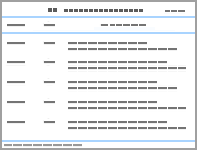
表1
75种植物乙醇提取物对西瓜枯萎病菌和辣椒疫霉的抑制活性"
| 科名 Family | 供试植物 Tested plant | 供试部位 Tested part | 抑制率Inhibition rate (%) | |
|---|---|---|---|---|
| 西瓜枯萎病菌 F. oxysporum f. sp. niveum (7 d) | 辣椒疫霉 P. capsici (5 d) | |||
| 伞形科Umbelliferae | 川芎Ligusticum chuanxiong | 根茎Rhizome | 74.69±1.22 | 58.09±1.12 |
| 羌活Notopterygium incisum | 根Root | 51.65±0.76 | 70.34±0.25 | |
| 小茴香Foeniculi fructus | 全草The whole | 4.59±0.85 | 8.82±0 | |
| 姜科Zingiberaceae | 姜黄Curcuma longa | 根茎Rhizome | 60.10±0.34 | 57.35±0 |
| 高良姜Alpinia officinarum | 根茎Rhizome | 48.51±0.75 | 57.58±0.54 | |
| 木兰科Magnoliaceae | 厚朴Magnolia officinalis | 树皮Bark | 78.26±0.13 | 95.59±0 |
| 地枫皮Illicium difengpi | 树皮Bark | 0.95±0.95 | 19.54±0.24 | |
| 木犀科Oleaceae | 山沉香Syringa pinnatifolia | 根茎Rhizome | 47.72±0.82 | 64.42±1.77 |
| 樟科Lauraceae | 乌药Lindera aggregata | 根Root | 44.69±3.61 | 58.98±2.69 |
| 冬青科Aquifoliaceae | 冬青Ilex chinensis | 叶Leaf | 47.27±0.01 | 67.50±0.68 |
| 唇形科Lamiaceae | 广藿香Pogostemon cablin | 全草The whole | 39.87±2.26 | 54.41±0 |
| 益母草Leonurus artemisia | 全草The whole | 0 | 0 | |
| 荆芥Nepeta cataria | 全草The whole | 1.43±1.43 | 1.29±0.25 | |
| 黄芩Scutellaria baicalensis | 根Root | 43.97±1.59 | 23.53±0 | |
| 豆科Leguminosae | 黄芪Astragalus membranaceus | 根Root | 4.85±0.64 | 8.82±0 |
| 腊肠果Cassia fistula | 果实Fruit | 0 | 7.86±1.91 | |
| 决明子Cassiae Semen | 种子Seed | 30.61±0.76 | 1.29±0.25 | |
| 苦马豆Sphaerophysa salsula | 果实、叶Fruit, leaf | 14.54±1.98 | 0 | |
| 大托叶云实Caesalpinia crista | 种子Seed | 0 | 0 | |
| 鸡血藤Spatholobi caulis | 根茎Rhizome | 24.06±1.75 | 9.67±1.06 | |
| 菊科Asteraceae | 漏芦Rhaponticum uniflorum | 根茎Rhizome | 0 | 5.55±0.73 |
| 墨旱莲Eclipta prostrata | 全草The whole | 1.43±1.43 | 1.29±0.25 | |
| 千里光Senecio scandens | 全草The whole | 2.95±2.65 | 6.04±1.30 | |
| 小白蒿Artemisia frigida | 全草The whole | 10.13±1.68 | 0 | |
| 柏科Cupressaceae | 侧柏PLatycladus orientalis | 叶Leaf | 35.54±0.43 | 63.24±0 |
| 堇菜科Violaceae | 紫花地丁Viola yedoensis | 全草The whole | 6.39±0.63 | 8.82±0 |
| 萝藦科Asclepiadaceae | 白前Cynanchum glaucescens | 根茎Rhizome | 3.83±0.75 | 8.82±0 |
| 徐长卿Cynanchum paniculatum | 根茎Rhizome | 26.34±0.86 | 30.64±0.24 | |
| 马鞭草科Verbenaceae | 蔓荆子Vitex trifolia | 果实Fruit | 38.16±3.10 | 45.24±2.11 |
| 马鞭草Verbena officinalis | 全草The whole | 1.81±1.81 | 0 | |
| 海州常山Clerodendron trichotomum | 叶Leaf | 2.96±2.32 | 0 | |
| 毛茛科Ranunculaceae | 升麻Cimicifuga foetida | 根茎Rhizome | 22.99±0.49 | 31.48±0.92 |
| 威灵仙Clematis chinensis | 根茎Rhizome | 14.62±1.58 | 22.84±0.81 | |
| 泽兰Eupatorium japonicum | 全草The whole | 1.43±1.43 | 1.29±0.25 | |
| 黑顺片Aconitum carmichaeli | 根Root | 3.83±0.75 | 8.82±0 | |
| 白头翁Pulsatilla chinensis | 根Root | 10.84±3.11 | 3.75±0.21 | |
| 天葵子Semiaquilegia adoxoides | 根Root | 0 | 0 | |
| 爵床科Acanthaceae | 穿心莲Andrographis paniculata | 全草The whole | 22.82±0.95 | 50.39±0.97 |
| 茜草科Rubiaceae | 茜草Rubia cordifolia | 根茎Rhizome | 35.03±1.11 | 51.93±0.22 |
| 白花蛇舌草Hedyotis diffusa | 全草The whole | 3.32±0.65 | 7.35±0 | |
| 鳞毛蕨科Dryopteridaceae | 绵马贯众Dryopteris crassirhizoma | 根茎Rhizome | 3.83±0.75 | 19.12±0 |
| 兰科Orchidaceae | 白及Bletilla striata | 块茎Tuber | 4.62±0.49 | 47.46±1.99 |
| 天南星科Araceae | 千年健Homalomena occulta | 根茎Rhizome | 3.32±0.65 | 7.35±0 |
| 姜水半夏Rhizoma typhonii flagelliformis | 根茎Rhizome | 0.72±1.31 | 0 | |
| 芸香科Rutaceae | 佛手Citrus medica | 果实Fruit | 4.08±0.99 | 8.82±0 |
| 吴茱萸Evodia rutaecarpa | 果实Fruit | 37.34±0.50 | 15.68±1.58 | |
| 龙胆科Gentianaceae | 龙胆Gentiana scabra | 根茎Rhizome | 5.37±0.42 | 7.35±0 |
| 秦艽花Gentiana straminea | 全草The whole | 0 | 2.32±0.21 | |
| 蚌壳蕨科Dicksoniaceae | 狗脊Cibotium barometz | 根茎Rhizome | 5.36±1.30 | 8.82±0 |
| 商陆科Phytolaccaceae | 商陆Phytolacca acinosa | 根Root | 4.85±0.64 | 14.71±0 |
| 川续断科Dipsacaceae | 蓝盆花Scabiosa comosa | 全草The whole | 0 | 0 |
| 藜科Chenopodiaceae | 地肤子Kochia scoparia | 果实Fruit | 1.43±1.43 | 1.29±0.25 |
| 三白草科Saururaceae | 鱼腥草Houttuynia cordata | 全草The whole | 1.43±1.43 | 16.45±0.24 |
| 百合科Liliaceae | 土茯苓Smilax glabra | 根茎Rhizome | 20.39±1.54 | 8.20±0.87 |
| 黄精Polygonatum sibiricum | 根茎Rhizome | 2.17±1.26 | 0 | |
| 蓼科Polygonaceae | 大黄Rheum palmatum | 根茎Rhizome | 8.38±1.89 | 27.49±1.33 |
| 萹蓄Polygonum aviculare | 全草The whole | 2.44±1.51 | 0 | |
| 茄科Solanaceae | 千年不烂心Solanum dulcamara | 全草The whole | 14.22±1.85 | 8.03±0.62 |
| 龙葵Solanum nigrum | 全草The whole | 4.89±2.57 | 0 | |
| 使君子科Combretaceae | 使君子Quisqualis indica | 种子Seed | 23.42±1.92 | 0 |
| 马齿苋科Portulacaceae | 马齿苋Portulaca oleracea | 全草The whole | 0 | 0 |
| 锦葵科Malvaceae | 木槿Hibiscus syriacus | 叶Leaf | 0 | 0 |
| 桑科Moraceae | 构树Broussonetia papyrifera | 叶Leaf | 5.83±0.69 | 0 |
| 葎草Humulus scandens | 全草The whole | 3.25±1.30 | 0 | |
| 漆树科Anacardiaceae | 盐肤木Rhus chinensis | 叶Leaf | 15.94±3.59 | 0 |
| 黄连木Pistacia chinensis | 叶Leaf | 16.57±3.35 | 0 | |
| 广枣Choerospondias axillaris | 果实Fruit | 0 | 0 | |
| 大戟科Euphorbiaceae | 乌桕Sapium sebiferum | 叶Leaf | 13.90±2.12 | 0 |
| 蔷薇科Rosaceae | 郁李Cerasus japonica | 种子Seed | 0 | 0 |
| 石竹科Caryophyllaceae | 瞿麦Dianthus superbus | 全草The whole | 0 | 0 |
| 罂粟科Papaveraceae | 秃疮花Dicranostigma leptopodum | 茎、花Stem, flower | 0 | 0 |
| 锁阳科Cynomoriaceae | 锁阳Cynomorium songaricum | 茎Stem | 0 | 0 |
| 玄参科Scrophulariaceae | 齿叶草Odontites serotina | 全草The whole | 0 | 0 |
| 桔梗科Campanulaceae | 半边莲Lobelia chinensis | 全草The whole | 5.36±0.74 | 5.88±0 |
| 葫芦科Cucurbitaceae | 绞股蓝Gynostemma pentaphyllum | 全草The whole | 4.85±0.64 | 10.29±0 |
表2
3种植物乙醇提取物对西瓜枯萎病菌的毒力"
| 供试植物 Tested plant | 毒力回归方程 Toxicity regression equation (y=) | 抑制中浓度 EC50 (mg·mL-1) | 95%置信区间 95% CI (mg·mL-1) | 卡方值 Chrisquare value (χ2) | 决定系数 R2 |
|---|---|---|---|---|---|
| 山沉香S. pinnatifolia | 1.107x-3.341 | 1.045 | 0.894-1.257 | 5.021 | 0.975 |
| 高良姜A. officinarum | 1.673x-4.749 | 0.690 | 0.573-0.871 | 7.780 | 0.921 |
| 姜黄C. longa | 1.607x-4.473 | 0.606 | 0.505-0.758 | 7.620 | 0.942 |
| 多菌灵(阳性对照) Carbendazim (Positive control) | 5.949x-0.475 | 0.0012 | 0.0011-0.0013 | 1.840 | 0.989 |
表3
2种植物乙醇提取物对辣椒疫霉的毒力"
| 供试植物 Tested plant | 毒力回归方程 Toxicity regression equation (y=) | 抑制中浓度 EC50 (mg·mL-1) | 95%置信区间 95% CI (mg·mL-1) | 卡方值 Chrisquare value (χ2) | 决定系数 R2 |
|---|---|---|---|---|---|
| 厚朴M. officinalis | 2.265x-3.091 | 0.023 | 0.014-0.032 | 0.696 | 0.990 |
| 山沉香S. pinnatifolia | 1.298x-3.589 | 0.582 | 0.519-0.659 | 1.232 | 0.987 |
| 申嗪霉素(阳性对照) Shenqinmycin (Positive control) | 4.570x-9.560 | 0.124 | 0.115-0.132 | 7.664 | 0.982 |
表4
2种植物乙醇提取物对辣椒疫病的盆栽防效"
| 供试植物 Tested plant | 浓度 Concentration (mg·mL-1) | 保护作用Protective effect | 治疗作用Curative effect | ||
|---|---|---|---|---|---|
| 病情指数 Disease index | 防治效果 Efficacy (%) | 病情指数 Disease index | 防治效果 Efficacy (%) | ||
| CK | — | 82.22±2.22a | — | 84.45±2.22a | — |
| 申嗪霉素Shenqinmycin | 1 | 15.55±0.22f | 81.05±0.68a | 22.22±2.22f | 73.72±2.31a |
| 厚朴 M. officinalis | 0.5 | 46.67±1.93c | 43.27±1.30d | 53.33±1.93c | 36.86±1.16d |
| 2 | 35.55±2.22de | 56.84±1.49c | 51.11±1.11c | 39.42±1.47d | |
| 8 | 28.89±2.22e | 64.74±3.29b | 31.11±2.22e | 63.25±1.71b | |
| 山沉香 S. pinnatifolia | 0.5 | 62.22±2.22b | 24.36±0.64e | 68.89±2.22b | 18.38±2.38e |
| 2 | 40.00±3.33d | 47.74±1.56d | 37.78±2.22d | 55.35±1.50c | |
| 8 | 37.78±2.22d | 54.06±2.41c | 31.11±1.11e | 63.14±1.15b | |
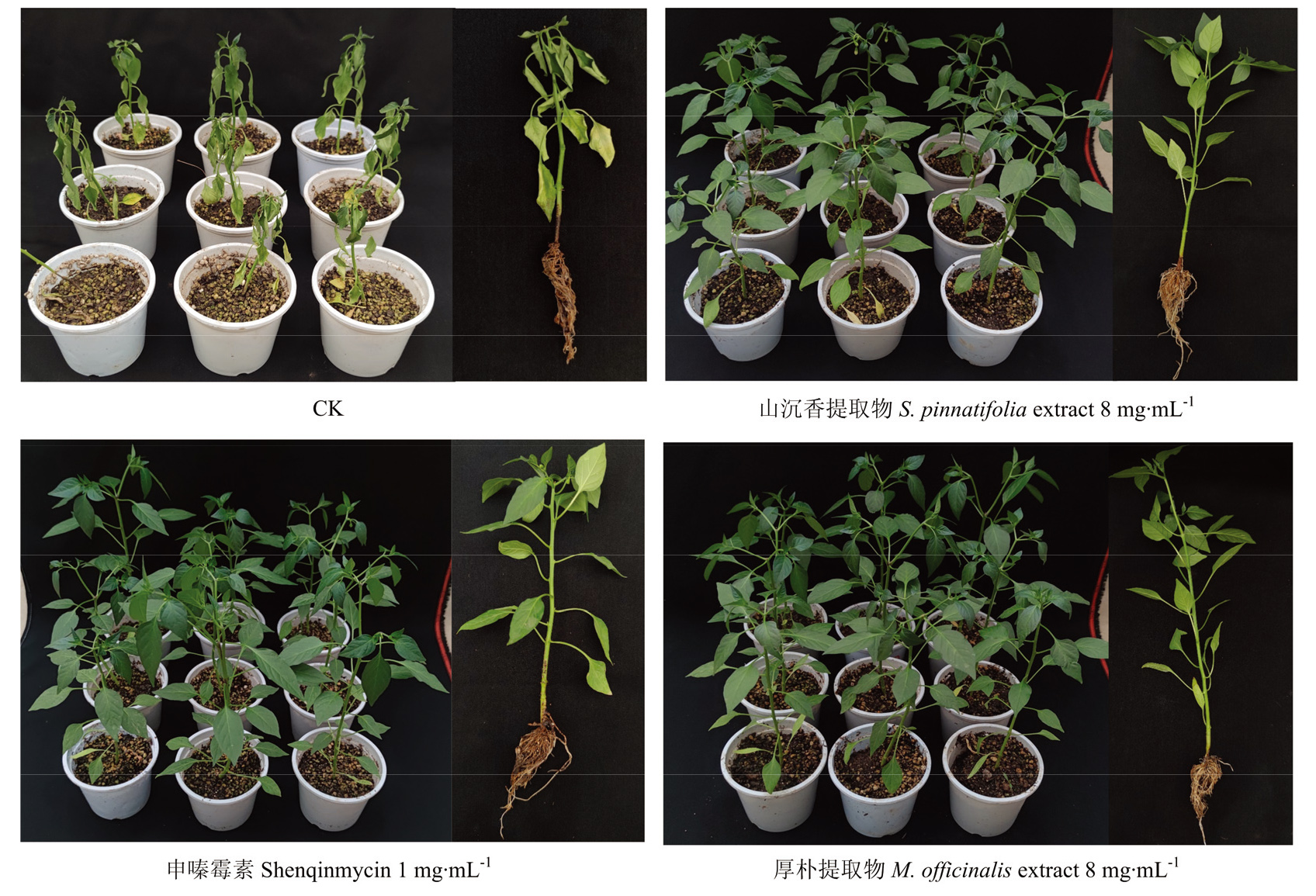
图1
2种植物提取物对辣椒疫病的盆栽防效(保护作用)"
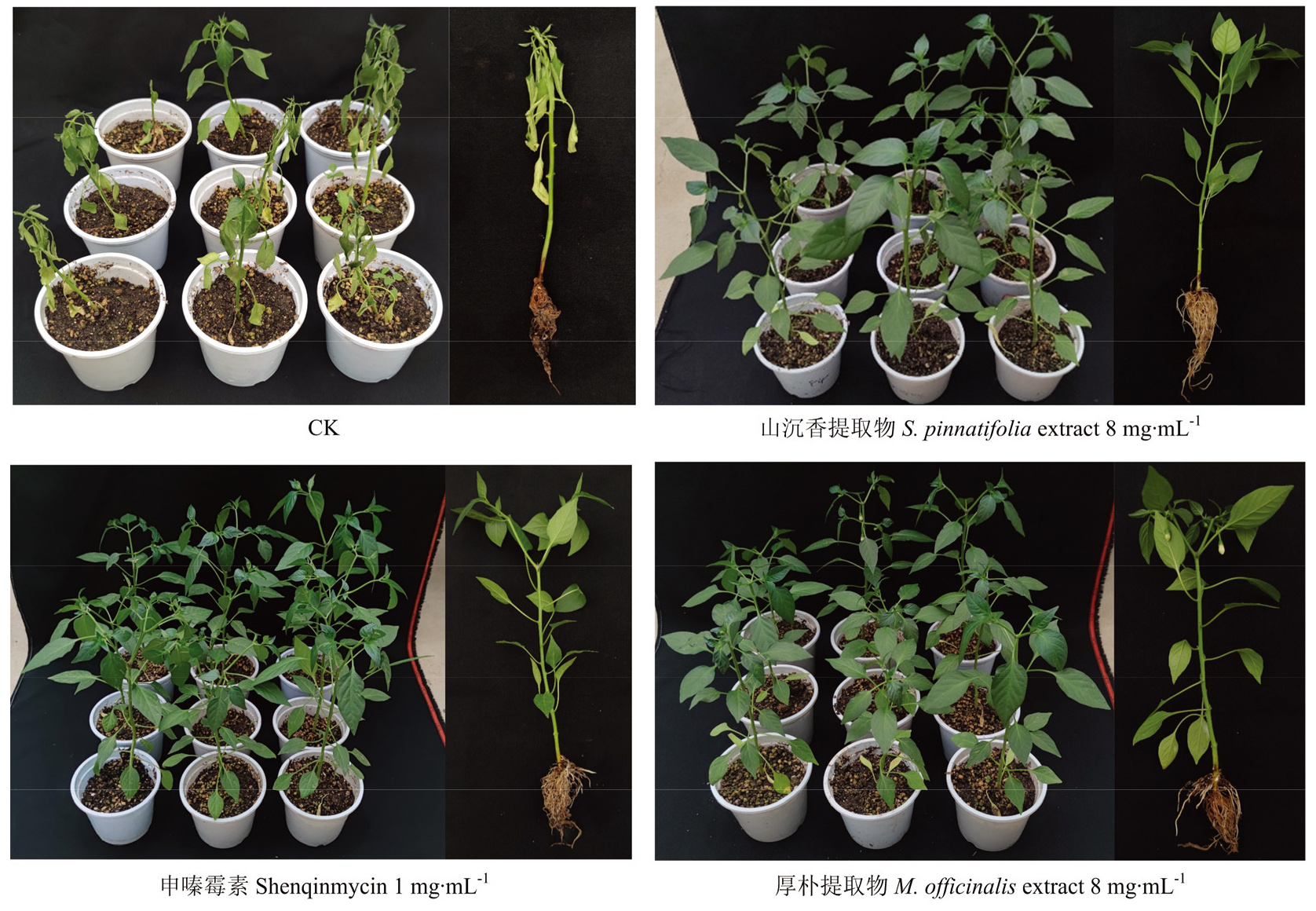
图2
2种植物提取物对辣椒疫病的盆栽防效(治疗作用)"
表5
2种植物乙醇提取物对西瓜枯萎病的盆栽防效"
| 供试植物 Tested plant | 浓度 Concentration (mg·mL-1) | 保护作用Protective effect | 治疗作用Curative effect | ||
|---|---|---|---|---|---|
| 病情指数 Disease index | 防治效果 Efficacy (%) | 病情指数 Disease index | 防治效果 Efficacy (%) | ||
| CK | — | 83.34±1.67a | — | 88.89±2.00a | — |
| 多菌灵Carbendazim | 1 | 27.78±1.55g | 66.65±0.67a | 33.33±1.96e | 62.42±1.83c |
| 姜黄 C. longa | 0.5 | 38.89±0.99e | 53.31±1.35c | 25.00±1.88f | 71.83±1.37b |
| 2 | 33.33±1.15f | 59.97±1.62b | 19.44±1.44g | 78.08±1.01a | |
| 8 | 25.00±0.96g | 69.94±1.68a | 44.45±2.22d | 50.06±1.47d | |
| 高良姜 A. officinarum | 0.5 | 44.44±2.00c | 46.72±1.37d | 55.56±2.00c | 37.53±0.86e |
| 2 | 41.66±0.88de | 49.94±1.9cd | 69.44±1.56b | 21.82±1.18f | |
| 8 | 63.89±0.59b | 23.25±2.08e | 86.11±1.56a | 3.05±1.61g | |

图3
2种植物提取物对西瓜枯萎病的盆栽防效(保护作用)"
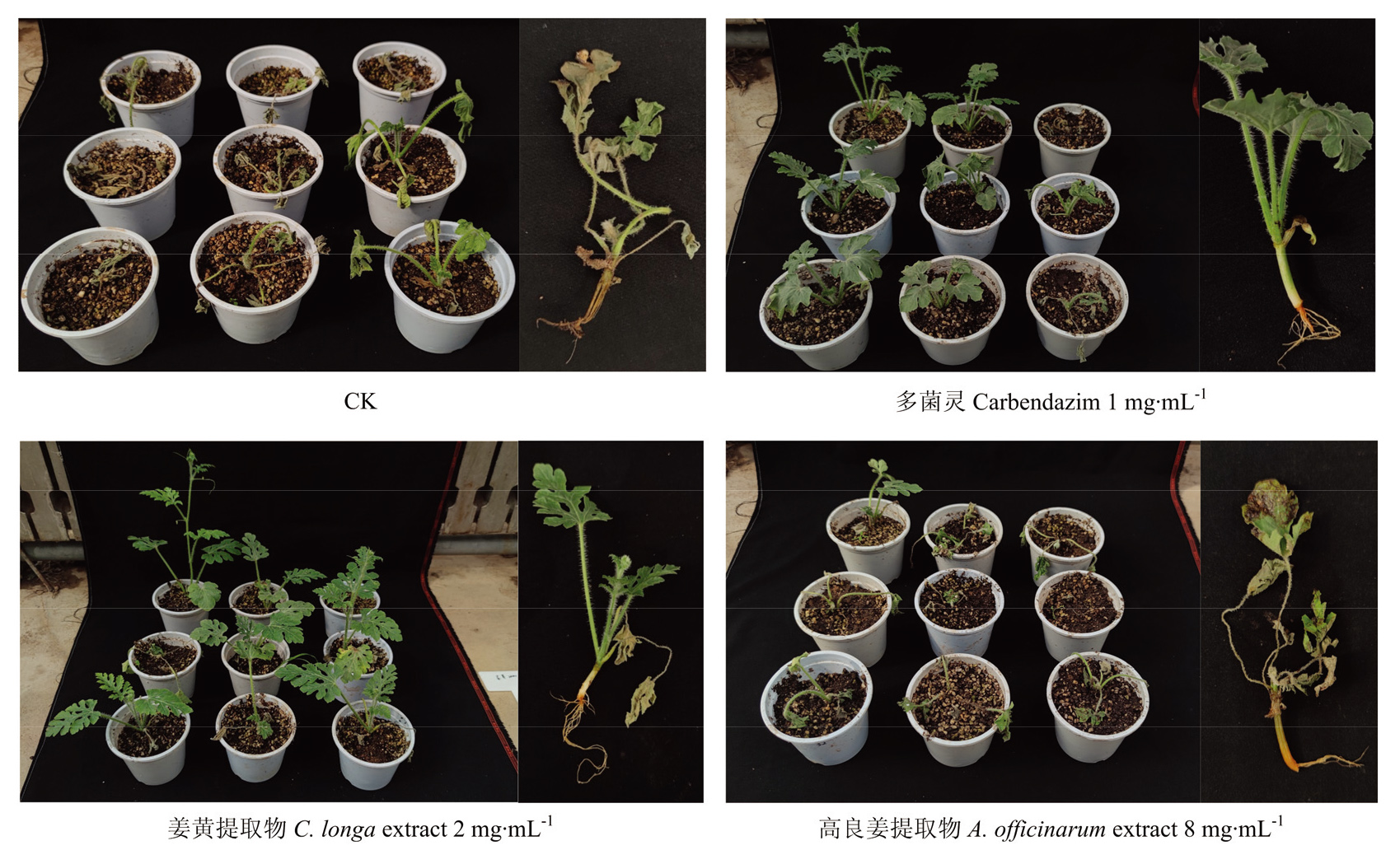
图4
2种植物提取物对西瓜枯萎病的盆栽防效(治疗作用)"
| [1] |
曹坳程, 张大琪, 方文生, 宋兆欣, 任立瑞, 李青杰, 李文静, 王秋霞, 颜冬冬, 李园, 靳茜, 郝征. 土传病害防治技术进展及面临的挑战. 植物保护, 2023, 49(5): 260-269.
|
|
|
|
| [2] |
李孝刚, 张桃林, 王兴祥. 花生连作土壤障碍机制研究进展. 土壤, 2015, 47(2): 266-271.
|
|
|
|
| [3] |
吴孔明. 中国农作物病虫害防控科技的发展方向. 农学学报, 2018, 8(1): 35-38.
|
|
doi: 10.46876/ja.1676926 |
|
| [4] |
pmid: 16842032 |
| [5] |
doi: 10.3923/jest.2016.354.378 |
| [6] |
郭宇俊, 韩俊艳, 李志强, 杨诗博. 植物源农药的研究与应用. 黑龙江农业科学, 2019(4): 131-133.
|
|
|
|
| [7] |
张兴, 吴志凤, 李威, 马志卿, 冯俊涛. 植物源农药研发与应用新进展——特殊生物活性简介. 农药科学与管理, 2013, 34(4): 24-31.
|
|
|
|
| [8] |
张兴, 杨崇珍, 王兴林. 西北地区杀虫植物的筛选. 西北农林科技大学学报, 1999, 27(2): 21-27.
|
|
|
|
| [9] |
杨欣蕊, 廖艳凤, 赵鹏飞, 覃勇梅, 欧阳霞辉. 植物源农药及其开发利用研究进展. 南方农业, 2022, 16(11): 33-36.
|
|
|
|
| [10] |
|
| [11] |
潘家新, 李林生, 粟月萍. 我国生物农药登记产品特点分析及发展建议. 农药, 2025, 64(2): 87-93, 118.
|
|
|
|
| [12] |
王佳丽, 马燕, 高倩, 路兆军, 张建梅, 王连红, 王文苹. 我国植物源杀菌剂的活性组分和应用概况. 浙江农业科学, 2025, 66(1): 138-145.
doi: 10.16178/j.issn.0528-9017.20231018 |
|
|
|
| [13] |
贾正燕, 王昌梅, 张啸, 赵兴玲, 吴凯, 尹芳, 杨斌, 梁承月, 张无敌. 8种中药水提液对尖孢镰刀菌的抑制效果. 湖南农业大学学报(自然科学版), 2022, 48(4): 454-459.
|
|
|
|
| [14] |
doi: 10.1016/j.heliyon.2018.e00973 |
| [15] |
赵晴, 张智蕊, 徐凤波, 李庆山, 李娇. 川芎、 干姜和穿心莲提取物及其组合抑菌活性研究. 植物保护, 2022, 48(5): 149-157.
|
|
|
|
| [16] |
李治伟, 陆德玲, 冯俊涛, 张秀云, 张兴. 巴东醉鱼草不同方法提取物的杀虫活性. 西北农业学报, 2009, 18(5): 109-112.
|
|
|
|
| [17] |
方中达. 植病研究方法. 北京: 中国农业出版社, 1998: 151-154.
|
|
|
|
| [18] |
马辉刚, 何烈干, 张海良, 李湘民, 蒋军喜. 江西省辣椒疫霉生理小种构成及其对烯酰吗啉的敏感性分析. 植物保护学报, 2013, 40(4): 374-378.
|
|
|
|
| [19] |
doi: 10.1016/j.biocontrol.2009.10.015 |
| [20] |
顾美玲, 白雪, 孙蕾, 崔晶, 周默, 白庆荣, 赵廷昌. 防治西瓜枯萎病药剂配方筛选及盆栽防效测定. 吉林农业大学学报, 2020, 42(3): 280-285.
|
|
|
|
| [21] |
郝凤梅, 陈禄廷, 刘晓帆, 孙刚强, 郭慧. 克萎星防治西瓜枯萎病田间药效试验. 河南农业科学, 2003(12): 43-44.
doi: 10.3969/j.issn.1004-3268.2003.12.014 |
|
|
|
| [22] |
冯俊涛, 祝木金, 于平儒, 李玉平, 韩建华, 邵红军, 丁海新, 张兴. 西北地区植物源杀菌剂初步筛选. 西北农林科技大学学报(自然科学版), 2002, 30(6): 129-133, 137.
|
|
|
|
| [23] |
于忻滢, 张国良, 范松, 黄志炜, 张叶. 植物源农药研究进展. 黑龙江农业科学, 2021(7): 123-129.
|
|
|
|
| [24] |
|
| [25] |
|
| [26] |
王静, 毛自文, 范黎明, 刘林, 叶敏, 肖春, 查友贵. 30种植物提取物抑菌活性研究. 安徽农业科学, 2012, 40(10): 5918-5919, 6185.
|
|
|
|
| [27] |
王彩霞, 兰妍彦, 孟衍朴, 王志颖, 封英建, 钟明娟, 马树杰, 张利辉, 董金皋. 87种植物提取物抑菌活性初步研究. 植物保护, 2023, 49(4): 293-301, 308.
|
|
|
|
| [28] |
李凌峰, 常晓涵, 许汝冰, 许雯慧, 周子豪, 杨勇, 向海波, 黎妍妍. 丁香酚诱导烟草抗青枯病的效果及促生作用. 中国烟草科学, 2025, 46(1): 33-39.
|
|
|
|
| [29] |
阿拉嘎, 图门乌力吉, 陈苏依勒. 贺兰山丁香(山沉香)的资源调查报告. 中国民族医药杂志, 2007(6): 41.
|
|
|
|
| [30] |
孙雨辉, 张烨, 薛培凤. 蒙药山沉香化学成分的研究进展. 中国医药导报, 2019, 16(9): 59-63.
|
|
|
|
| [31] |
高坤, 刘长鑫, 陈佳琪, 孙静静, 李晓娟, 黄志强, 张烨, 薛培凤, 陈苏依勒, 董馨, 柴兴云. 蒙古族药山沉香的化学与药理研究新进展. 中国中药杂志, 2025, 50(8): 2080-2089.
|
|
|
|
| [32] |
陈维. 山沉香抑菌活性成分分离及其乙醇提取物可溶性液剂研制[D]. 杨凌: 西北农林科技大学, 2024.
|
|
|
|
| [33] |
仉瑜, 张洪兵, 郭虹, 陈常青, 张铁军, 刘昌孝. 姜黄的研究进展及质量标志物(Q-Marker)的预测分析. 中草药, 2021, 52(15): 4700-4710.
|
|
|
|
| [34] |
牛赡光, 杜丰玉. 茜草等25种中药材对5种植物病原真菌的抑制活性. 植物保护, 2015, 41(4): 111-116.
|
|
|
|
| [35] |
郭芳, 顾哲, 贾训利, 牟燕, 李忠睿, 李瑶, 沈立荣, 张丽霞. 药用植物姜黄的研究进展. 安徽农业科学, 2022, 50(16): 14-19.
|
|
|
|
| [36] |
doi: S0021-9673(17)31368-7 pmid: 28951052 |
| [37] |
韦棪婷, 郝二伟, 杜正彩, 潘王芸, 谭德超, 陈晓璐, 谢安然, 侯小涛, 邓家刚. 基于传统性效及现代研究的姜黄质量标志物分析. 中草药, 2020, 51(14): 3830-3839.
|
|
|
|
| [38] |
|
| [39] |
doi: 10.2174/1389201020666191118121609 |
| [40] |
高富涛, 孙淑君, 游秀峰, 窦涛, 蔡玉彪, 周琳, 刘向阳. 肉桂精油和姜黄油对四种植物病原菌的抑制作用. 湖北农业科学, 2023, 62(9): 74-77.
|
|
|
|
| [41] |
董雪容. 姜黄油的抑菌机理及脂质体制备与性能研究[D]. 长沙: 中南林业科技大学, 2022.
|
|
|
|
| [42] |
宋方帅, 刘晓鹏, 姜宁. 药用植物厚朴研究进展. 中国民族民间医药, 2020, 29(1): 59-62.
|
|
|
|
| [43] |
燕银芳. 天然源和厚朴酚与异黄腐酚的抗菌活性评价及(和)厚朴酚的复配增效研究[D]. 兰州: 兰州大学, 2021.
|
|
|
|
| [44] |
陈听听. 和厚朴酚对葡萄座腔菌的抑菌机理[D]. 贵阳: 贵州大学, 2023.
|
|
|
|
| [45] |
汪娴娴. 药用植物提取物筛选及和厚朴酚对烟草疫霉的抑制作用[D]. 青岛: 青岛农业大学, 2022.
|
|
|
|
| [46] |
曹海潮, 刘庆顺, 白海秀, 韩君, 杨士玲, 薛明, 刘峰. 30%噻虫胺·吡唑醚菌酯·苯醚甲环唑悬浮种衣剂的研制及其在花生田应用的效果 中国农业科学, 2019, 52(20): 3595-3604. doi: 10.3864/j.issn.0578-1752.2019.20.010.
|
|
|
| [1] | 刘婕, 侯瑞, 周泽华, 易图永. 聚六亚甲基胍对柑橘溃疡病菌的抑菌活性[J]. 中国农业科学, 2025, 58(9): 1779-1790. |
| [2] | 史彩华, 金杰, 华登科, 胡静荣, 张友军, 黄圣琳, 吴明月, 孔祥义, 谢文. 基于豆大蓟马暴发与豇豆花发育动态耦合下的物理防控新技术研发与应用[J]. 中国农业科学, 2025, 58(21): 4382-4392. |
| [3] | 廖宏娟, 谭佳思, 张志斌, 余璟蓉, 张馨月, 江玉梅, 朱笃. 球毛壳菌小麦秸秆发酵产物抑制辣椒疫霉的稳定性及机制[J]. 中国农业科学, 2024, 57(3): 500-513. |
| [4] | 路露, 李一诺, 张修国, 高丹美, 吴凤芝. 小麦和蚕豆填闲及其腐解液对连作辣椒幼苗生长及疫病的影响[J]. 中国农业科学, 2024, 57(22): 4541-4552. |
| [5] | 路粉,孟润杰,吴杰,赵建江,李洋,毕秋艳,韩秀英,李敬华,王文桥. 马铃薯晚疫病菌对霜脲氰抗性动态监测及药效验证[J]. 中国农业科学, 2022, 55(18): 3556-3564. |
| [6] | 周京龙,冯自力,魏锋,赵丽红,张亚林,周燚,冯鸿杰,朱荷琴. 棉花内生细菌YUPP-10及其分泌蛋白CGTase对棉花枯萎病的防治作用及机理[J]. 中国农业科学, 2021, 54(17): 3691-3701. |
| [7] | 解昆仑,刘莉铭,刘美,彭斌,吴会杰,古勤生. 小西葫芦黄花叶病毒dsRNA的原核表达及其对ZYMV的防治效果[J]. 中国农业科学, 2020, 53(8): 1583-1593. |
| [8] | 周华飞,杨红福,姚克兵,庄义庆,束兆林,陈志谊. FliZ调控枯草芽孢杆菌Bs916生物膜形成 及其对水稻纹枯病的防治效果[J]. 中国农业科学, 2020, 53(1): 55-64. |
| [9] | 揣红运,石延霞,柴阿丽,杨杰,谢学文,李宝聚. 10%乙霉威·腐霉利微粉剂的研制及其 对黄瓜棒孢叶斑病的防治效果[J]. 中国农业科学, 2019, 52(6): 1009-1020. |
| [10] | 刘波,陈倩倩,王阶平,阮传清,陈燕萍,夏江平,车建美,陈峥,潘志针,文笑,朱育菁,张海峰,郑雪芳. 整合微生物组菌剂的提出、研发与应用[J]. 中国农业科学, 2019, 52(14): 2450-2467. |
| [11] | 禾丽菲,陈乐乐,肖斌,赵时峰,李秀环,慕卫,刘峰. 番茄叶霉病菌对咯菌腈敏感基线的建立及田间防治效果评价[J]. 中国农业科学, 2018, 51(8): 1475-1483. |
| [12] | 曹海潮,李秀环,王晓坤,白海秀,慕卫,刘峰. 吡唑醚菌酯及三唑类杀菌剂对番茄颈腐根腐病的防治效果[J]. 中国农业科学, 2018, 51(21): 4065-4075. |
| [13] | 黄学屏,宋昱菲,罗健,赵时峰,慕卫,刘峰. 蔬菜菌核病菌对氟吡菌酰胺的敏感性及防病应用潜力评估[J]. 中国农业科学, 2018, 51(14): 2711-2718. |
| [14] | 路粉,赵建江,刘晓芸,孟润杰,吴杰,韩秀英,王文桥. 马铃薯晚疫病菌对甲霜灵的抗性监测及替代药剂防治效果[J]. 中国农业科学, 2018, 51(14): 2700-2710. |
| [15] | 顾中言,徐德进,徐广春. 田间药液用量影响农药单位剂量防治效果的原因分析[J]. 中国农业科学, 2018, 51(13): 2513-2523. |
|
||
