






中国农业科学 ›› 2026, Vol. 59 ›› Issue (18): 4105-4120.doi: 10.3864/j.issn.0578-1752.2026.18.012
王博1( ), 陈浩1,2(), 权倍平3, 陈明川1, 景馨蕊1, 许佳豪1, 黄朝奕1, 李占斌2
收稿日期:2025-11-24
接受日期:2026-02-09
出版日期:2026-09-16
发布日期:2026-09-20
通信作者:
联系方式:
王博,E-mail:wbya5160@163.com。
基金资助:
WANG Bo1(), CHEN Hao1,2(), QUAN BeiPing3, CHEN MingChuan1, JING XinRui1, XU JiaHao1, HUANG ChaoYi1, LI ZhanBin2
Received:2025-11-24
Accepted:2026-02-09
Published:2026-09-16
Online:2026-09-20
摘要:
【目的】草被对坡面降雨径流具有显著的生态调控作用,然而草被恢复过程中植物根系与土壤性质变化对坡面径流过程的影响效应尚缺乏定量研究。【方法】通过室内人工模拟降雨试验,系统研究不同雨强(40、80和120 mm·h-1)及草被盖度(0、33%、48%、56%、69%)下黑麦草坡面小区地表径流特征、土壤理化性质与根系参数及其对坡面径流的影响。【结果】(1)与裸坡相比,草被恢复明显改善了坡面0—10 cm表层土壤理化性质,具体表现为土壤容重降低2.4%,土壤总孔隙度、团聚体平均重量直径、饱和导水率与土壤有机质含量分别提升1.4%、9.4%、227.1%和82.5%,且改善效果随盖度增加而增强;同时草被小区根系参数(根长密度、根表面积密度、根体积密度)随盖度增加明显增大。回归分析进一步表明,草被根系生长直接驱动表土性质发生相应变化,尤其对土壤饱和导水率的改善最为显著。(2)同一雨强下,草被坡面小区初始产流时间随盖度的增加显著延长,其平均径流率随盖度的增加明显降低,相应的草被减流效益随之递增(7.7%、13.3%、16.9%和27.1%)。随着雨强的增大,草被坡面小区初始产流时间显著缩短,且盖度越高其减幅越大,平均径流率随雨强增大显著增加,相应的草被减流效益则随之递减(24.7%、15.9%和8.1%)。此外,草被覆盖对坡面径流的调控效应随雨强增加而减弱的变化趋势在较高覆盖度(56%和69%)间尤为明显。(3)草被恢复过程中植物根系与土壤理化性质变化显著影响坡面径流过程。路径模型分析表明,植物根系对径流率的直接效应(标准化路径系数为-0.60)大于间接效应(标准化路径系数为-0.27),这归因于植被恢复后草被盖度的增加主要通过根系密度形成物理阻隔作用(直接作用)调控坡面径流,而其间接作用则主要通过改善表层土壤水文物理性质并最终通过提升土壤饱和导水率、进而增强水分入渗能力得以实现。【结论】草被恢复通过根系生长驱动表土性质变化进而调控坡面径流过程,并以高覆盖度草被的坡面径流调控效应最为显著。上述结果可为黄土高原地区坡面侵蚀控制及草被恢复与管理提供科学依据。
王博, 陈浩, 权倍平, 陈明川, 景馨蕊, 许佳豪, 黄朝奕, 李占斌. 陕北黄土区草被覆盖对坡面径流过程的影响[J]. 中国农业科学, 2026, 59(18): 4105-4120.
WANG Bo, CHEN Hao, QUAN BeiPing, CHEN MingChuan, JING XinRui, XU JiaHao, HUANG ChaoYi, LI ZhanBin. Effects of Grass Cover on Slope Runoff Process in Loess Areas of Northern Shaanxi, China[J]. Scientia Agricultura Sinica, 2026, 59(18): 4105-4120.

图1
试验设备示意图及黑麦草坡面小区布局图"
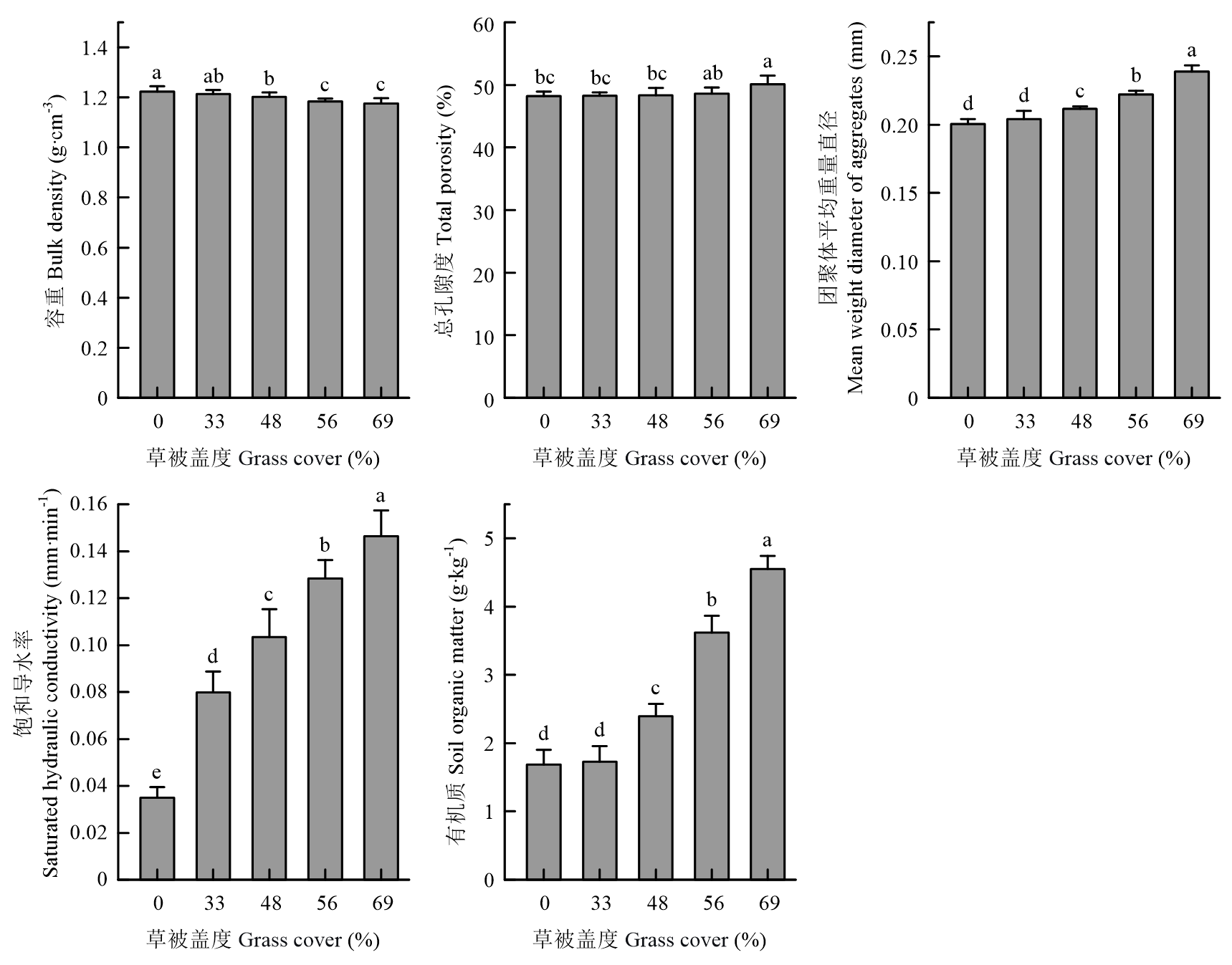
图2
黑麦草不同盖度坡面小区表层土壤理化性质(0—10 cm) 不同小写字母表示各草被盖度间差异显著(P<0.05)。下同"
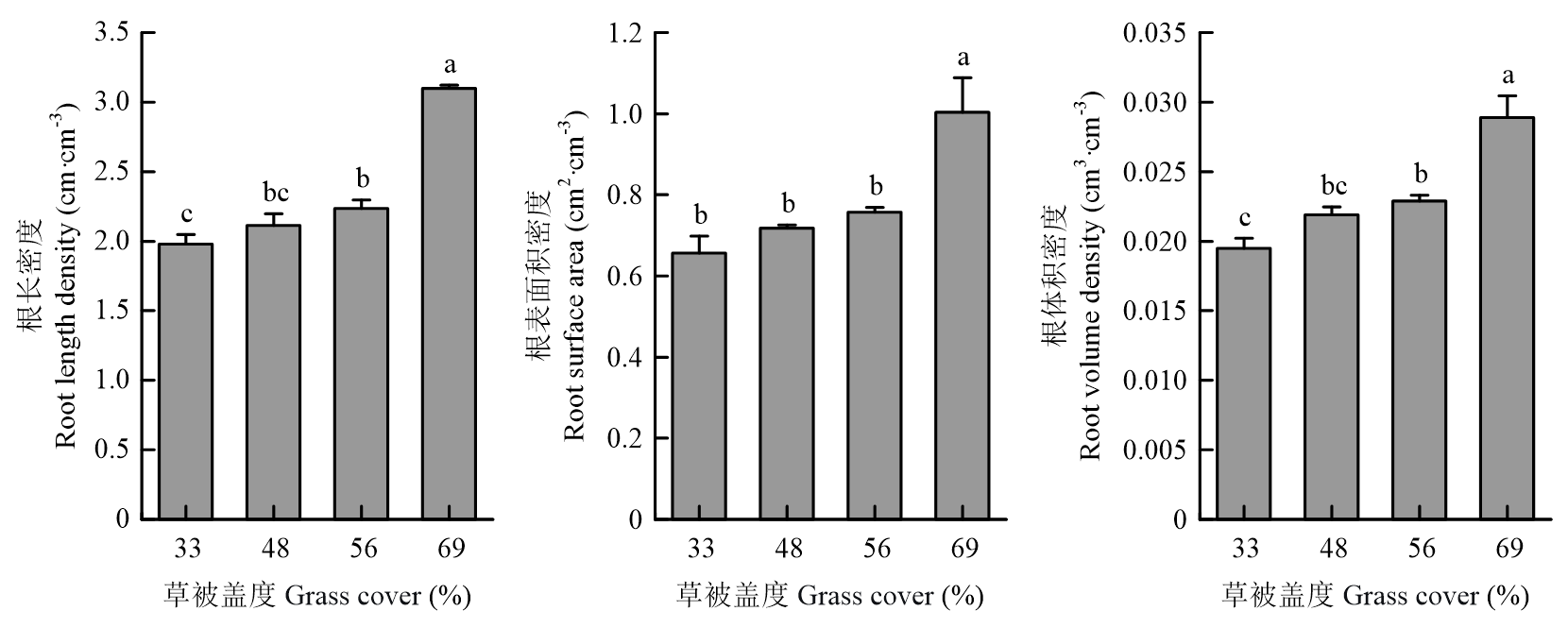
图3
黑麦草不同盖度坡面小区根系参数特征"
表1
黑麦草不同盖度坡面小区土壤理化性质对根系参数的响应方程"
| 土壤理化性质 Soil physico-chemical property | 根系参数 Root parameter | 回归方程 Regression function | R2 | P |
|---|---|---|---|---|
| 容重 Bulk density | 根长密度Root length density | y=-0.014x+1.227 | 0.64 | <0.01 |
| 根表面积密度Root surface area density | y=-0.041x+1.227 | 0.61 | <0.01 | |
| 根体积密度Root volume density | y=-1.417x+1.227 | 0.62 | <0.01 | |
| 总孔隙度 Total porosity | 根长密度Root length density | y=0.580x+47.734 | 0.35 | 0.07 |
| 根表面积密度Root surface area density | y=1.799x+47.699 | 0.36 | 0.07 | |
| 根体积密度Root volume density | y=57.779x+47.750 | 0.32 | 0.09 | |
| 有机质含量 Soil organic matter content | 根长密度Root length density | y=0.831x+1.224 | 0.56 | <0.05 |
| 根表面积密度Root surface area density | y=2.463x+1.245 | 0.53 | <0.05 | |
| 根体积密度Root volume density | y=82.701x+1.248 | 0.51 | <0.05 | |
| 团聚体平均重量直径 Mean weight diameter of aggregates | 根长密度Root length density | y=0.011x+0.196 | 0.63 | <0.01 |
| 根表面积密度Root surface area density | y=0.032x+0.196 | 0.61 | <0.01 | |
| 根体积密度Root volume density | y=1.055x+0.196 | 0.58 | <0.05 | |
| 饱和导水率 Saturated hydraulic conductivity, Ks | 根长密度Root length density | y=0.036x+0.031 | 0.88 | <0.01 |
| 根表面积密度Root surface area density | y=0.108x+0.031 | 0.88 | <0.01 | |
| 根体积密度Root volume density | y=3.685x+0.030 | 0.88 | <0.01 |
表2
不同降雨强度与草被盖度下坡面小区初始产流时间及延迟率"
| 降雨强度 Rainfall intensity (mm·h-1) | 初始产流时间Initial runoff time (min) | 延迟率Delay rate (%) | ||||||||
|---|---|---|---|---|---|---|---|---|---|---|
| 0 | 33% | 48% | 56% | 69% | 33% | 48% | 56% | 69% | ||
| 40 | 1.61eA | 2.61dA | 3.60cA | 4.22bA | 7.14aA | 62.1 | 123.6 | 162.1 | 343.5 | |
| 80 | 0.71dB | 0.96cB | 1.09cB | 1.31bB | 2.10aB | 35.2 | 53.5 | 84.5 | 195.8 | |
| 120 | 0.61dC | 0.82cB | 0.91bB | 0.94bB | 1.39aC | 34.4 | 49.2 | 54.1 | 127.9 | |

图4
不同降雨强度与草被盖度下坡面小区径流率变化过程"
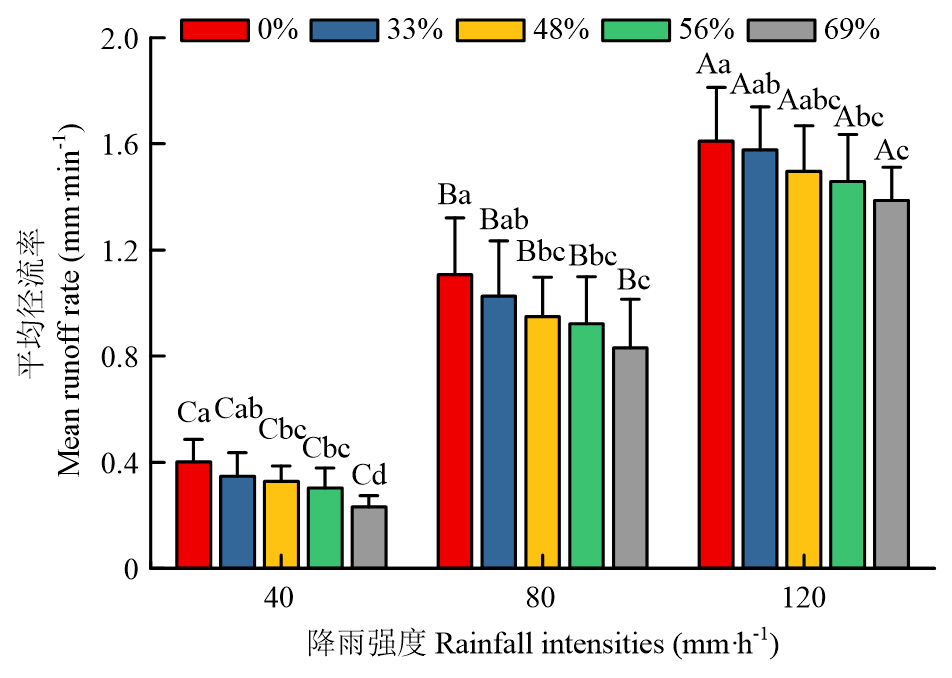
图5
不同降雨强度与草被盖度下坡面小区的平均径流率 图柱上不同小写字母表示同一雨强下不同草被盖度之间差异显著(P<0.05);不同大写字母表示同一草被盖度下不同雨强之间差异显著(P<0.05)"
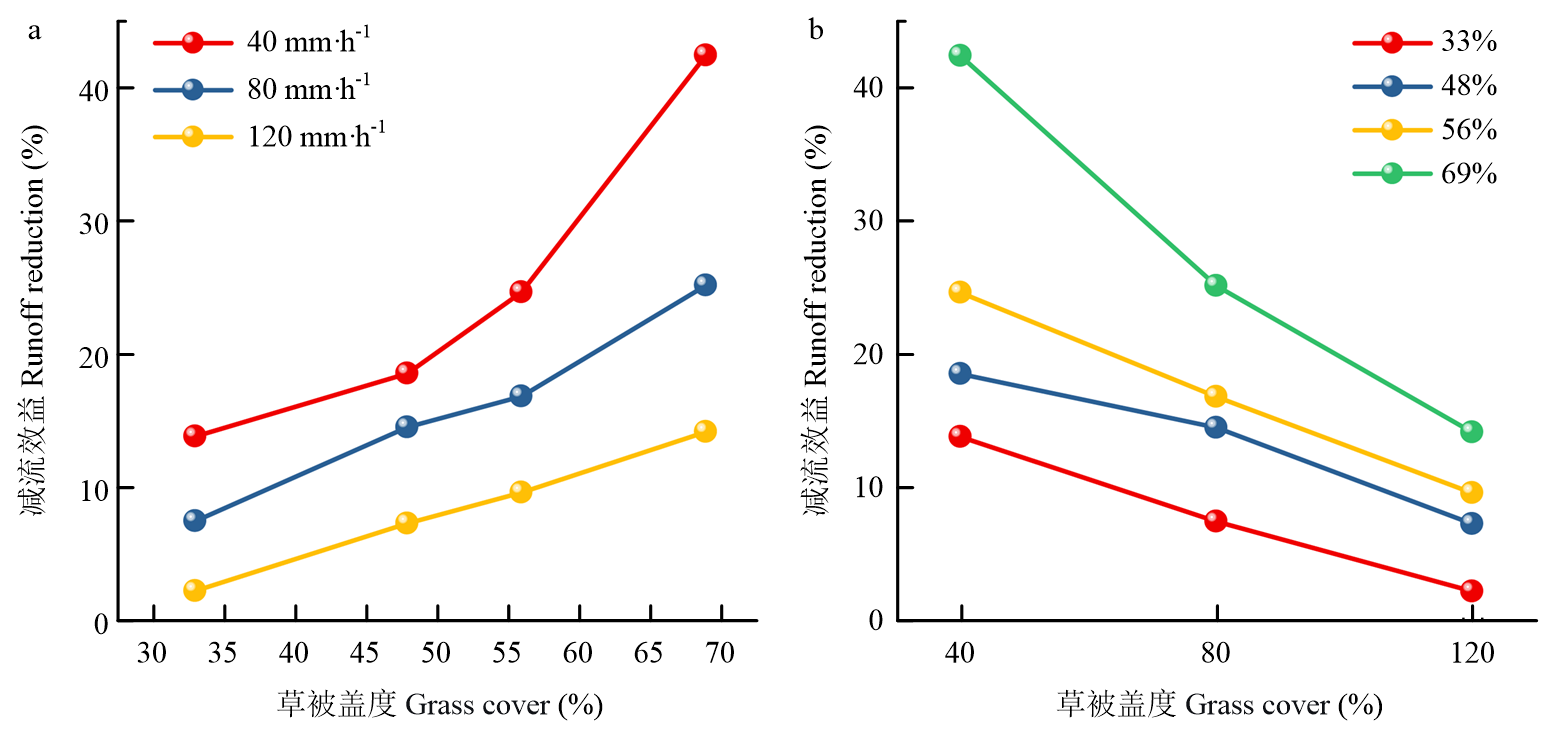
图6
黑麦草坡面小区减流效益随草被盖度和降雨强度的变化特征"
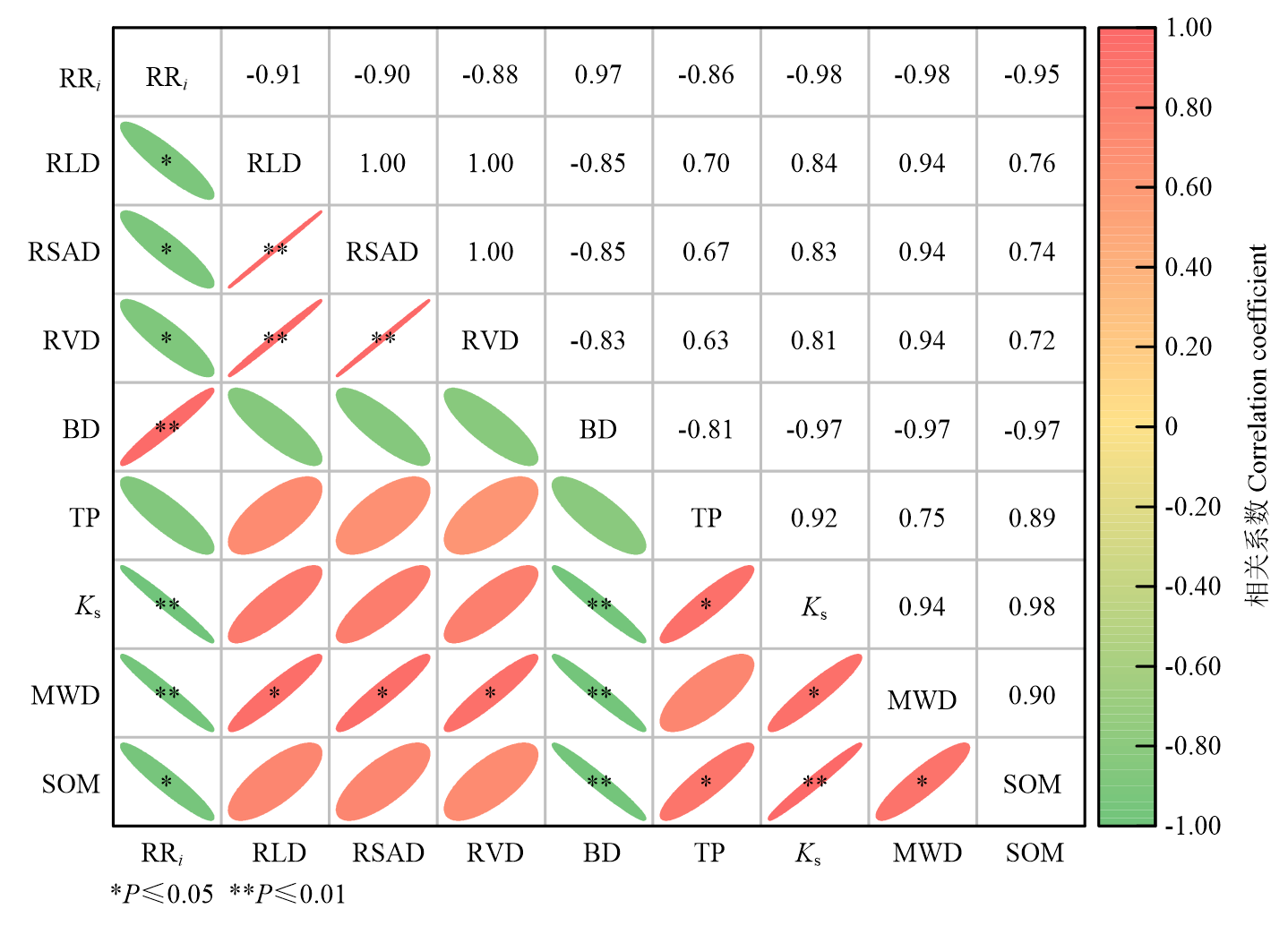
图7
坡面小区径流率与土壤理化性质和根系参数的相关性 RRi:径流率Runoff rate;RLD:根长密度Root length density;RSAD:根表面积密度Root surface area density;RVD:根体积密度Root volume density;BD:土壤容重 Soil bluck density;TP:土壤总孔隙度Total porosity;Ks:土壤饱和导水率Saturated hydraulic conductivity;MWD:土壤团聚体平均重量直径Mean weight diameter;SOM:土壤有机质 Soil organic matter。下同 The same as below"
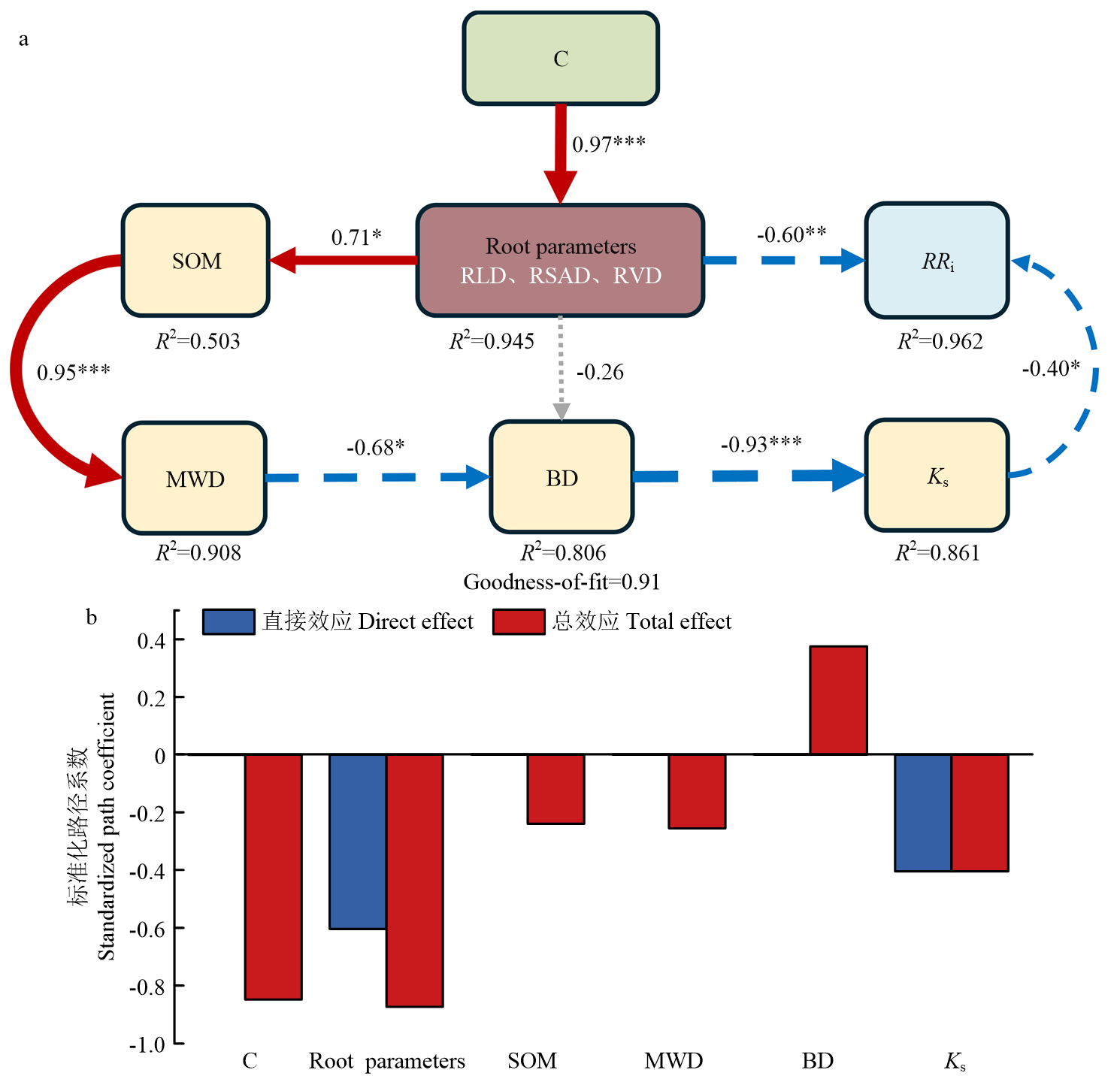
图8
草被盖度、土壤理化性质及根系参数与坡面小区径流率的路径模型 C:草被盖度 Grass cover"
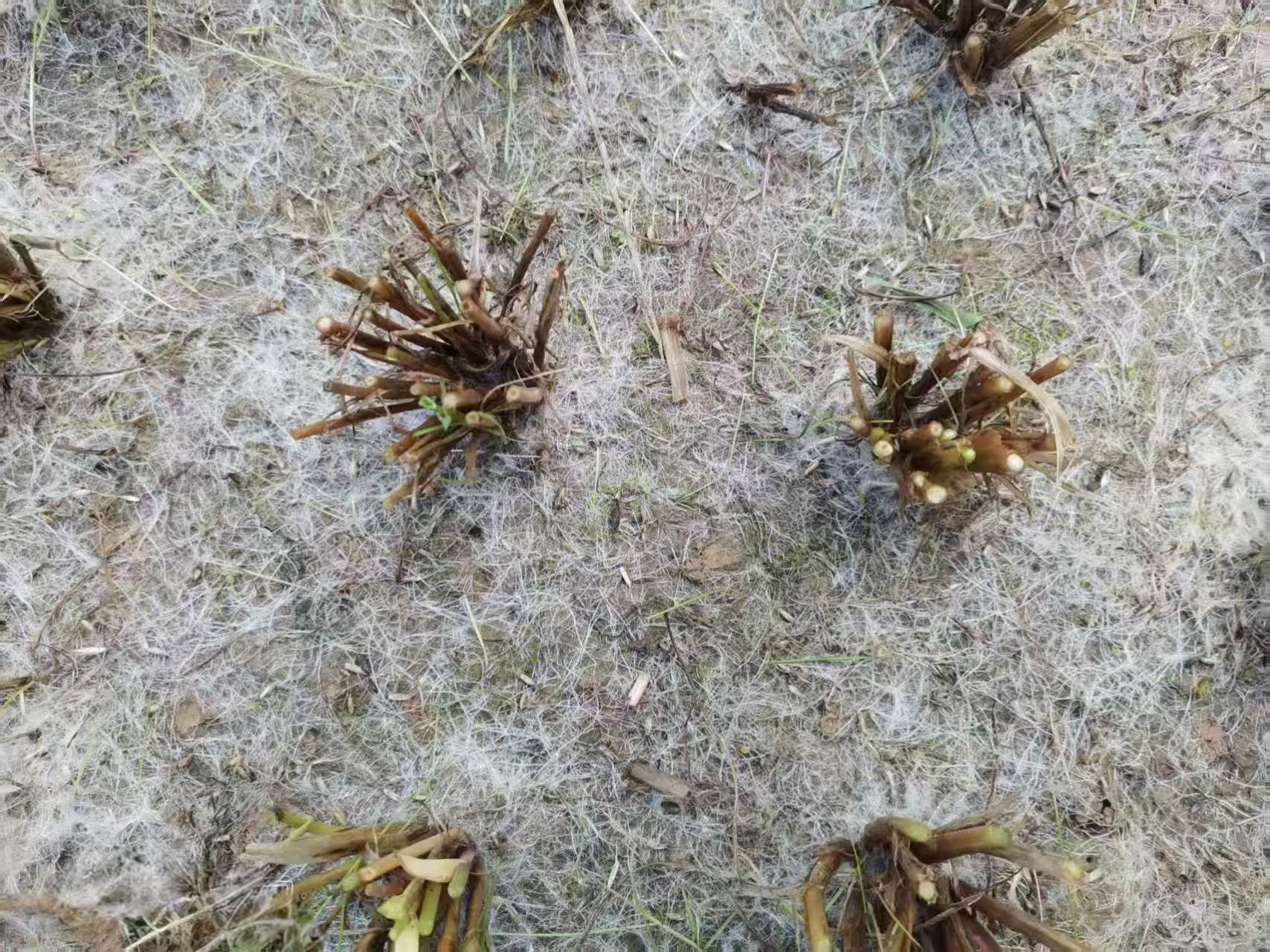
图9
降雨后黑麦草坡面小区地表形成的根系网状结构(69%草被盖度坡面小区)"
| [1] |
李宗善, 杨磊, 王国梁, 侯建, 信忠保, 刘国华, 傅伯杰. 黄土高原水土流失治理现状、问题及对策[J]. 生态学报, 2019, 39(20): 7398-7409.
|
|
|
|
| [2] |
史志华, 宋长青. 土壤水蚀过程研究回顾[J]. 水土保持学报, 2016, 30(5): 1-10.
|
|
|
|
| [3] |
王玉宽, 王占礼, 周佩华. 黄土高原坡面降雨产流过程的试验分析[J]. 水土保持学报, 1991, 5(2): 25-31.
|
|
|
|
| [4] |
马雪华. 森林水文学[M]. 北京: 中国林业出版社, 1993: 206-211.
|
|
|
|
| [5] |
吴普特, 周佩华. 坡面薄层水流流动型态与侵蚀搬运方式的研究[J]. 水土保持学报, 1992, 6(1): 19-24, 39.
|
|
|
|
| [6] |
马星, 郑江坤, 王文武, 陈鑫, 秦伟, 单志杰, 郎登潇, 廖峰. 不同雨型下紫色土区坡耕地产流产沙特征[J]. 水土保持学报, 2017, 31(2): 17-21.
|
|
|
|
| [7] |
doi: 10.1134/S0097807819040080 |
| [8] |
doi: 10.1016/j.agwat.2021.107231 |
| [9] |
肖培青, 李艳霞, 苏广旭, 吕锡芝. 植被坡面产流特征及其侵蚀动力研究进展[J]. 人民黄河, 2016, 38(10): 115-118.
|
|
|
|
| [10] |
郭雨华, 赵廷宁, 孙保平, 丁国栋, 成晨, 胡封兵. 草地坡面水动力学特性及其阻延地表径流机制研究[J]. 水土保持研究, 2006, 13(4): 264-267.
|
|
|
|
| [11] |
王晶, 赵文武, 刘月, 贾立志. 植物功能性状对土壤保持的影响研究述评[J]. 生态学报, 2019, 39(9): 3355-3364.
|
|
|
|
| [12] |
陈浩, 王博, 王豆豆, 樊浩, 李占斌. 混播草地不同部位对陕北黄土坡面侵蚀过程的调控效应[J]. 生态学报, 2025, 45(17): 8449-8464.
|
|
|
|
| [13] |
吴蕾, 穆兴民, 高鹏, 赵广举, 孙文义, 田鹏. 黄土高原地区植被盖度对产流产沙的影响[J]. 水土保持研究, 2019, 26(6): 133-138, 144.
|
|
|
|
| [14] |
焦菊英, 王万忠. 人工草地在黄土高原水土保持中的减水减沙效益与有效盖度[J]. 草地学报, 2001(3): 176-182.
doi: 10.11733/j.issn.1007-0435.2001.03.004 |
|
|
|
| [15] |
韦红波, 李锐, 杨勤科. 我国植被水土保持功能研究进展[J]. 植物生态学报, 2002, 26(4): 489-496.
|
|
|
|
| [16] |
doi: 10.1016/j.catena.2018.06.006 |
| [17] |
张光辉, 梁一民. 植被盖度对水土保持功效影响的研究综述[J]. 水土保持研究, 1996, 3(2): 104-110.
|
|
|
|
| [18] |
魏小燕, 毕华兴, 霍云梅, 肖聪颖, 杨晓琪. 高羊茅草地地表径流系数影响因素研究[J]. 北京林业大学学报, 2017, 39(5): 82-88.
|
|
|
|
| [19] |
陈戎欣, 吕锡芝, 倪用鑫, 魏义长. 人工降雨下草被对黄土丘陵沟壑区坡面径流的调控及临界阈值[J]. 生态环境学报, 2020, 29(1): 122-128.
doi: 10.16258/j.cnki.1674-5906.2020.01.014 |
|
doi: 10.16258/j.cnki.1674-5906.2020.01.014 |
|
| [20] |
董月群, 李淑芹, 原翠萍, 雷廷武. 黑麦草对黄土坡面降雨产流产沙过程的影响[J]. 中国农业大学学报, 2011, 16(4): 67-73.
|
|
|
|
| [21] |
甘卓亭, 叶佳, 周旗, 周正朝, 上官周平. 模拟降雨下草地植被调控坡面土壤侵蚀过程[J]. 生态学报, 2010, 30(9): 2387-2396.
|
|
|
|
| [22] |
陈浩, 王豆豆, 崔钦凯, 王博, 刘俊娥, 李占斌. 草地植被冠层与根系对黄土坡面侵蚀过程的影响[J]. 生态学报, 2024, 44(15): 6841-6853.
|
|
|
|
| [23] |
doi: 10.1002/esp.v43.14 |
| [24] |
周佩华, 王占礼. 黄土高原土壤侵蚀暴雨标准[J]. 水土保持通报, 1987, 7(1): 38-44.
|
|
|
|
| [25] |
doi: 10.1016/j.scitotenv.2022.160196 |
| [26] |
刘芳, 王佩佩, 曹玉莹, 刘俊娥, 周正朝. 黄土高原典型草本植物根系分布特征及其对土壤理化性质的影响研究[J]. 草业学报, 2024, 33(10): 1-13.
doi: 10.11686/cyxb2023446 |
|
doi: 10.11686/cyxb2023446 |
|
| [27] |
doi: 10.1016/j.catena.2015.08.015 |
| [28] |
张琪琳, 王占礼, 王栋栋, 刘俊娥. 黄土高原草地植被对土壤侵蚀影响研究进展[J]. 地球科学进展, 2017, 32(10): 1093-1101.
doi: 10.11867/j.issn.1001-8166.2017.10.1093 |
|
doi: 10.11867/j.issn.1001-8166.2017.10.1093 |
|
| [29] |
戴金梅, 查轩, 黄少燕, 陈世发, 翟少华, 王丽园, 刘川. 不同植被覆盖度对紫色土坡面侵蚀过程的影响[J]. 水土保持学报, 2017, 31(3): 33-38.
|
|
|
|
| [30] |
张思毅, 梁志权, 谢真越, 卓慕宁, 郭太龙, 廖义善, 韦高玲, 李定强. 白三叶不同部位减沙效应及其对径流水动力学参数的影响[J]. 生态环境学报, 2016, 25(8): 1306-1314.
doi: 10.16258/j.cnki.1674-5906.2016.08.008 |
|
|
|
| [31] |
李建明, 陈兰, 任洪玉, 孙蓓, 杨贺菲, 熊怡, 孙宝洋. 工程堆积体产流产沙及水沙效益对植被近地表特征的响应[J]. 农业工程学报, 2024, 40(7): 142-151.
|
|
|
|
| [32] |
常松涛, 黄少燕, 查轩, 姚冲, 陈世发, 白永会, 王丽园, 孙丽丽. 雨强和植被覆盖度对红壤坡面产流产沙的影响[J]. 水土保持学报, 2019, 33(3): 58-63.
|
|
|
|
| [33] |
doi: 10.1016/j.jclepro.2019.118771 |
| [34] |
doi: 10.3390/su15097582 |
| [35] |
朱冰冰, 李占斌, 李鹏, 游珍. 草本植被覆盖对坡面降雨径流侵蚀影响的试验研究[J]. 土壤学报, 2010, 47(3): 401-407.
|
|
|
|
| [36] |
李毅, 邵明安. 人工草地覆盖条件下降雨入渗影响因素的实验研究[J]. 农业工程学报, 2007, 23(3): 18-23.
|
|
|
|
| [37] |
doi: 10.1002/ldr.v31.14 |
| [38] |
孙佳美, 余新晓, 樊登星. 模拟降雨条件下黑麦草对土壤水分入渗的影响[J]. 土壤, 2014, 46(6): 1115-1120.
|
|
|
|
| [39] |
熊燕梅, 夏汉平, 李志安, 蔡锡安. 植物根系固坡抗蚀的效应与机理研究进展[J]. 应用生态学报, 2007, 18(4): 895-904.
|
|
|
|
| [40] |
doi: 10.1016/j.catena.2025.109189 |
| [41] |
王文鑫, 王文龙, 郭明明, 王天超, 康宏亮, 杨波, 赵满, 陈卓鑫. 黄土高塬沟壑区植被恢复对沟头土壤团聚体特征及土壤可蚀性的影响[J]. 中国农业科学, 2019, 52(16): 2845-2857. DOI: 10.3864/j.issn.0578-1752.2019.16.010.
|
|
|
|
| [42] |
娄义宝, 康宏亮, 王文龙, 沙小燕, 冯兰茜, 聂慧莹, 史倩华. 黄土高原沟壑区沟头植被根系垂直分布及其对土壤抗侵蚀性的影响[J]. 中国农业科学, 2023, 56(1): 90-103. DOI: 10.3864/j.issn.0578-1752.2023.01.007.
|
|
|
|
| [43] |
马雪燕, 穆兴民, 王双银, 白云岗, 牛芳鹏. 黄土高塬沟壑区植被恢复对土壤入渗及产流的影响[J]. 水土保持学报, 2024, 38(6): 89-96, 104.
|
|
|
|
| [44] |
doi: 10.1016/j.jhydrol.2021.127003 |
| [1] | 许杨浩峻, 陈丽明, 杨世奇, 唐奕凡, 谭雪明, 曾勇军, 潘晓华, 曾研华. 长期秸秆还田对双季稻田不同土层有机碳、养分和团聚体的影响[J]. 中国农业科学, 2026, 59(7): 1492-1506. |
| [2] | 韩哲群, 苏莹, 高奇奇, 刘美英, 贾昂元, 张海睿, 南珊珊, 徐勤政, 王强, 王利军, 武雪萍. 智能滴灌水肥耦合模式实现土壤节水控盐与向日葵产量品质协同提升[J]. 中国农业科学, 2025, 58(20): 4158-4177. |
| [3] | 张海睿, 贾昂元, 高奇奇, 韩哲群, 南珊珊, 段碧华, 武雪萍. 生物炭配施黄腐酸对滨海盐碱地土壤理化性质、酶活性和多功能性的影响[J]. 中国农业科学, 2025, 58(20): 4178-4188. |
| [4] | 陈会鲜, 何文, 阮丽霞, 黄小娟, 兰秀, 蔡兆琴, 李恒锐, 黄珍玲, 韦婉羚, 梁振华, 李天元, 曹升, 李喜弟, 韦均参. 间作大豆对木薯生长及连作土壤特性的影响[J]. 中国农业科学, 2025, 58(11): 2176-2189. |
| [5] | 仲金平, 郑子成, 李廷轩, 何晓玲. 磷肥不同施用量对紫色土坡面胶体态磷流失的影响[J]. 中国农业科学, 2024, 57(8): 1547-1559. |
| [6] | 周浩露, 申朝阳, 罗新宇, 黄英惠, 王可心, 王云浩, 高小丽. 氮肥对垄沟集雨种植谷子氮素利用效率及产量的影响[J]. 中国农业科学, 2024, 57(5): 885-899. |
| [7] | 黄婷苗, 陆乃昆, 解秉强, 曹寒冰, 乔月静, 杨珍平, 高志强, 李廷亮. 不同供锌水平麦田小麦锌营养对土施锌肥的响应[J]. 中国农业科学, 2024, 57(14): 2815-2826. |
| [8] | 郭鑫虎, 马静, 李仲峰, 初金鹏, 徐海成, 贾殿勇, 代兴龙, 贺明荣. 长期定位条件下栽培模式对麦田土壤理化性质和氮素平衡的影响[J]. 中国农业科学, 2023, 56(12): 2262-2273. |
| [9] | 娄义宝,康宏亮,王文龙,沙小燕,冯兰茜,聂慧莹,史倩华. 黄土高原沟壑区沟头植被根系垂直分布及其对土壤抗侵蚀性的影响[J]. 中国农业科学, 2023, 56(1): 90-103. |
| [10] | 徐芳蕾,张杰,李阳,张伟伟,薄其飞,李世清,岳善超. 施肥方式对黄土高原旱作春玉米农田土壤氨挥发的影响[J]. 中国农业科学, 2022, 55(12): 2360-2371. |
| [11] | 冯俊杰,赵文达,张新全,刘英杰,袁帅,董志晓,熊毅,熊艳丽,凌瑶,马啸. 引种日本多花黑麦草标准品种DUS性状变异分析及应用[J]. 中国农业科学, 2022, 55(12): 2447-2460. |
| [12] | 赵卫松,郭庆港,李社增,王培培,鹿秀云,苏振贺,张晓云,马平. 花铃期棉花黄萎病抗病与感病品种对 土壤细菌群落结构的影响[J]. 中国农业科学, 2020, 53(5): 942-954. |
| [13] | 邓浩亮,张恒嘉,肖让,张永玲,田建良,李福强,王玉才,周宏,李煊. 陇中半干旱区不同覆盖种植方式对土壤水热效应和玉米产量的影响[J]. 中国农业科学, 2020, 53(2): 273-287. |
| [14] | 张方方,马宁博,岳善超,李世清. 基于不同方法的汉中盆地稻麦轮作土壤供氮能力评价[J]. 中国农业科学, 2020, 53(19): 3996-4009. |
| [15] | 王丽,王朝辉,郭子糠,陶振魁,郑洺钧,黄宁,高志源,张欣欣,黄婷苗. 黄土高原不同地点小麦籽粒矿质元素的含量差异[J]. 中国农业科学, 2020, 53(17): 3527-3540. |
|
||
