






中国农业科学 ›› 2026, Vol. 59 ›› Issue (18): 4121-4134.doi: 10.3864/j.issn.0578-1752.2026.18.013
岳静雯( ), 郭鑫鑫, 周佳, 史天乐, 杨雨璋, 张军科, 李兴亮()
收稿日期:2026-01-27
接受日期:2026-06-08
出版日期:2026-09-16
发布日期:2026-09-20
通信作者:
联系方式:
岳静雯,E-mail:17863604478@163.com。
基金资助:
YUE JingWen(), GUO XinXin, ZHOU Jia, SHI TianLe, YANG YuZhang, ZHANG JunKe, LI XingLiang()
Received:2026-01-27
Accepted:2026-06-08
Published:2026-09-16
Online:2026-09-20
摘要:
【目的】苹果果实品质的形成与生态因素密切相关,明确关键品质形成与生态因子的关系,为功能果品的特色栽培提供参考。【方法】以新疆伊犁、喀什,陕西洛川和山东烟台4个代表地区的主栽品种‘嘎啦’和‘富士’苹果果实为试材,采用广泛靶向代谢组学技术进行苹果果实的代谢物检测,取各样本中鉴定结果可信度最高的代谢物,结合多元统计分析筛选伊犁、喀什两地相较于洛川和烟台均显著上调的差异代谢物,再通过叠加分析获得共同高含量营养成分。进一步针对共同高含量成分建立液相色谱串联质谱(LC-MS/MS)检测方法,对代谢组检测结果进行定量验证。开展干旱、温差、紫外线等生态因子模拟处理苹果果实,分析目标成分的积累及其合成关键基因的响应情况,明确促进目标成分积累的主要生态因子。【结果】基于代谢组学分析,从4个产地的‘嘎啦’和‘富士’苹果果实中分别检测到1 653和2 052种代谢物。伊犁和喀什地区的‘嘎啦’‘富士’果实中分别共同含有18种和19种代谢物含量显著高于洛川和烟台地区2个品种的苹果样本。其中,木脂素类代谢物松脂醇(pinoresinol)与表松脂醇(epipinoresinol)在伊犁和喀什地区两种果实中的含量均显著高于其他地区,为共同高含量营养成分。进一步建立了基于LC-MS/MS技术的松脂醇测定方法,检测显示伊犁与喀什地区的‘嘎啦’苹果松脂醇含量分别达110.2和80.4 mg·kg-1,‘富士’果实的松脂醇含量分别为73.4和64.5 mg·kg-1,均为烟台、洛川果实中含量的2倍以上。此外,检测显示松脂醇含量随果实发育逐渐累积,于成熟期达到最高;干旱、高昼夜温差和紫外线可促进松脂醇的积累,而高盐胁迫无显著促进作用。在苹果基因组中,共筛选获得了35个松脂醇合成关键酶指导蛋白(DIR)基因,其中,MdDIR-a1与MdDIR-a2在苹果果实中表达,且均受干旱胁迫显著正调控。【结论】干旱、高昼夜温差和强紫外的生态环境有利于苹果果实营养成分松脂醇含量的积累,其中干旱胁迫是促进其积累的主要生态因子。
岳静雯, 郭鑫鑫, 周佳, 史天乐, 杨雨璋, 张军科, 李兴亮. 苹果果实营养成分松脂醇的鉴定与生态影响因子分析[J]. 中国农业科学, 2026, 59(18): 4121-4134.
YUE JingWen, GUO XinXin, ZHOU Jia, SHI TianLe, YANG YuZhang, ZHANG JunKe, LI XingLiang. Identification and Ecological Impact Factor Analysis of Nutritional Component Pinoresinol in Apple Fruits[J]. Scientia Agricultura Sinica, 2026, 59(18): 4121-4134.
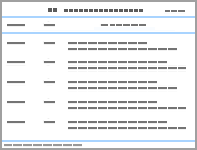
表1
RT-qPCR引物列表"
| 序号No. | 基因Gene | 引物序列Primer sequence (5′-3′) | 基因号Accession No. |
|---|---|---|---|
| 1 | MdDIR-a1 | F: ATCACCACCATGACCGCCACC R: CCCATCTAAGCTGGATGTGACAGA | MD02G1118100 |
| 2 | MdDIR-a2 | F: CCATGACCGTCGCCACCACCATAAC R: TCCATCTAAGCTGGATGAGACGGT | MD02G1118400 |
| 3 | MdDIR-a3 | F: GACTGATGAGGACGGTCACGTCG R: TCATCCCAGAACAGTCTGAGACTGA | MD03G1292000 |
| 4 | MdDIR-a4 | F: CTAATGCAACATCTGCTGCAAC R: CTGAGTAGGTGTCTTTCCTGTCG | MD06G1096600 |
| 5 | MdDIR-a5 | F: ATACATTCAACAACCACCCAACAAC R: TGTCCGGTTGCGGTTGTTTTCCG | MD11G1306400 |
| 6 | β-Actin | F: GAATTAAGTGTTGTTCGATATCGCTC R: GTAGTTGCTTTTGATCCCCTGTTCTA | XM008356922 |
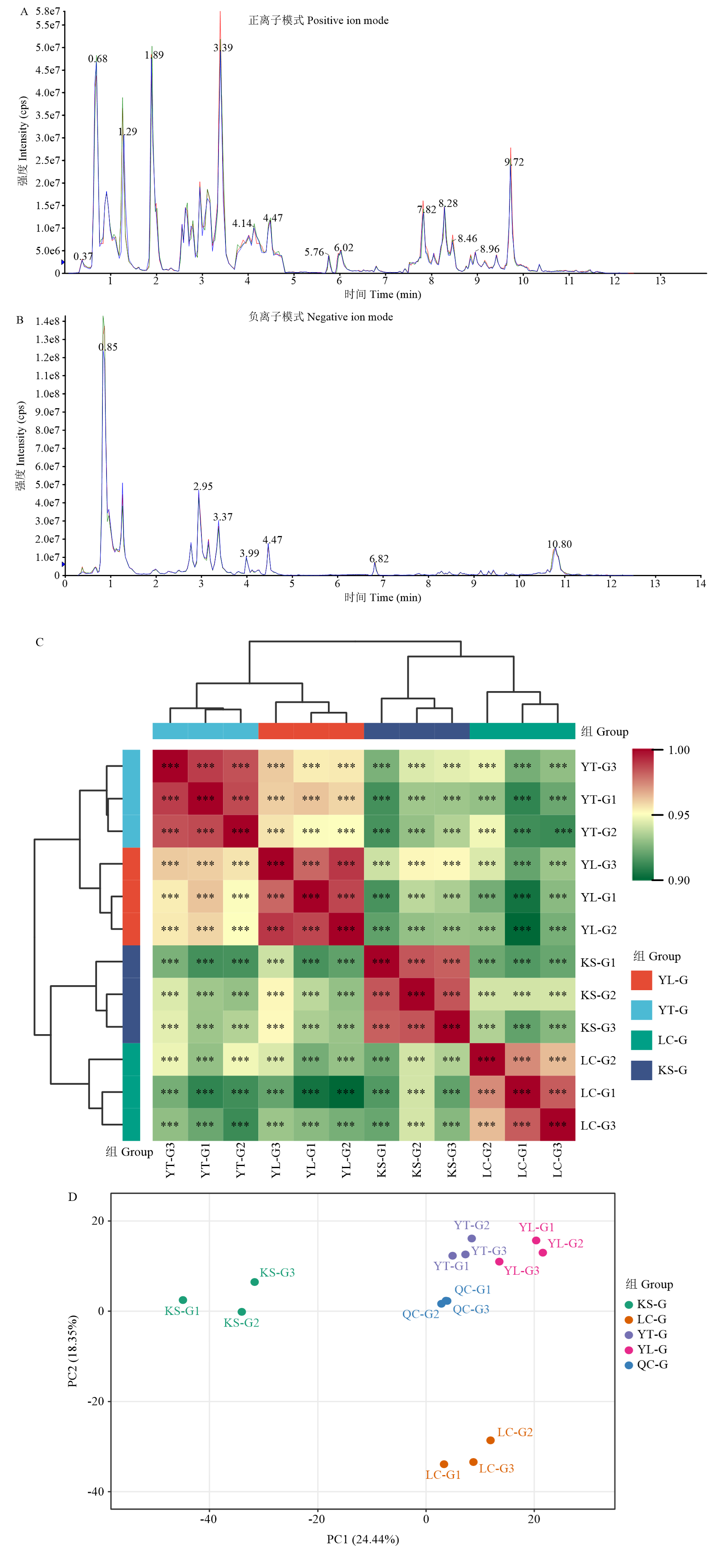
图1
质谱检测总离子流重叠图(TIC)与样本间相关性分析 A:TIC正离子模式;B:TIC负离子模式;C:样本间相关性分析;D:主成分分析。YT:烟台;YL:伊犁;KS:喀什;LC:洛川;G:‘嘎啦’苹果。***:P<0.001。下同"
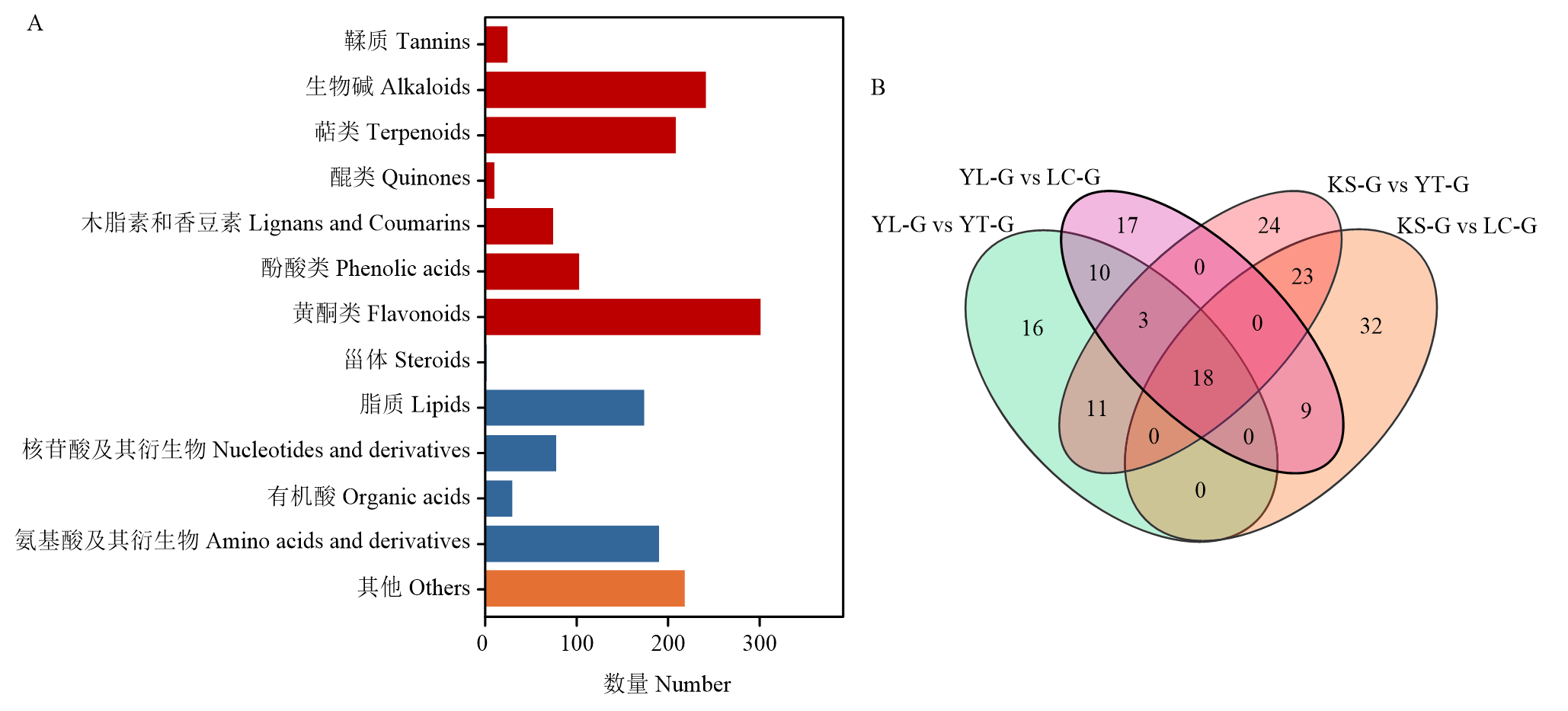
图2
‘嘎啦’苹果果实共同高含量代谢物分析 A:1 653种代谢物的分类,红色为初级代谢产物,蓝色为次级代谢产物;B:伊犁、喀什样本上调代谢物韦恩图"
表2
‘嘎啦’苹果高含量差异代谢物"
| 序号No. | 编号ID | 物质Compound | 类别Category | CAS |
|---|---|---|---|---|
| 1 | mws0097 | 松脂醇 (+)-Pinoresinol | 木脂素 Lignans | 487-36-5 |
| 2 | MWSHC20189 | 表松脂醇 Epipinoresinol | 24404-50-0 | |
| 3 | mws1587 | L-正亮氨酸 L-Norleucine | 氨基酸及其衍生物 Amino acids and derivatives | 327-57-1 |
| 4 | MWS04555 | 别异亮氨酸 D-Allo-Isoleucine | 1509-34-8 | |
| 5 | mws0227 | 亮氨酸 L-Leucine | 328-39-2 | |
| 6 | mws0258 | L-异亮氨酸 L-Isoleucine | 73-32-5 | |
| 7 | pme0274 | 6-氨基己酸 6-Aminohexanote | 有机酸 Organic acids | 60-32-2 |
| 8 | Walbn08556 | 二甲基磷脂-OA DMAP-OA | 脂质 Lipids | - |
| 9 | WaYn011395 | 二甲基磷脂-甘油-肉蔻酸酯 DMAEP-GMo | - | |
| 10 | Walbn08698 | 二甲磷-OA (异构体) DMAEP-OA | - | |
| 11 | Lcfn066903 | 3-羟基辛二酸3-Hydroxyoctanedioicacid | 73141-47-6 | |
| 12 | Zken00392 | 油酰溶血磷脂酰胆碱 18:1-9z LPC | - | |
| 13 | pmp001281 | 溶血磷脂酰胆碱 LysoPC 18:1 | - | |
| 14 | Safp021800 | 溶血卵磷脂 (18:1) LPC (18:1/0:0) | 3542-29-8 | |
| 15 | Lmhp10190 | 溶血磷脂酰胆碱 LysoPC 18:1 2n isomer | - | |
| 16 | Walbn011704 | 1位甘油-二甲磷-肉蔻酸酯 sn-1-DMAEP-Mo | - | |
| 17 | pmp001198 | 6-脱氧荞麦碱 6-Deoxyfagomine | 生物碱 Alkaloids | 197449-09-5 |
| 18 | Wabn006607 | 双羟甲氧色满二聚体 3, 3′-Bi-HMC | 其他类 Others | - |

图3
两种苹果果实共同高含量代谢物的筛选 A:‘富士’果实代谢物的分类;B:伊犁、喀什‘富士’果实的上调代谢物韦恩图;C:两个品种共同上调代谢物的筛选与含量比较;D:木脂素的生物合成路径。图A—C中的“F”表示‘富士’苹果"
表3
‘富士’苹果高含量差异代谢物"
| 序号No. | 编号ID | 物质Compound | 类别Category | CAS |
|---|---|---|---|---|
| 1 | mws0097 | 松脂醇 (+)-Pinoresinol | 木脂素 Lignans | 487-36-5 |
| 2 | MWSHC20189 | 表松脂醇 Epipinoresinol | 24404-50-0 | |
| 3 | MWStz451 | Clemaphenol A | 362606-60-8 | |
| 4 | Yxxp005044 | 蛇菰宁; 蛇菰脂醛素 Balanophonin | 118916-57-7 | |
| 5 | pme1086 | 谷胱甘肽还原型 Glutathione | 氨基酸及其衍生物 Amino acids and derivatives | 70-18-8 |
| 6 | Sasn003250 | Valinopine | - | |
| 7 | Zbqn003748 | N-丙二酰亮氨酸 N-malonylleucine | - | |
| 8 | WaXYp00973 | 谷胱甘肽 Glutathione | - | |
| 9 | pmb2826 | 2-甲基苹果酸(S)-2-Methylmalate | 有机酸 Organic acids | - |
| 10 | Zmyn000247 | 2-羟基戊二酸 2-Hydroxyglutaric acid | 13095-48-2 | |
| 11 | Lmbn000216 | 3-甲基苹果酸 D-erythro-3-methylmalate | 152204-30-3 | |
| 12 | mws0091 | 槲皮素-3-O-葡萄糖苷(异槲皮苷) Isoquercitrin | 黄酮 Flavonoids | 482-35-9 |
| 13 | PD0485458 | 6-羟基木犀草素-6-葡萄糖苷 6-Hydroxyluteolin 6-glucoside | - | |
| 14 | Lcfn086739 | 野黄岑素-7-O-葡萄糖苷 Plantaginin | 26046-94-6 | |
| 15 | PDN020315 | 红景天金丝桃苷 Rhodiolatuntoside | 萜类 Terpenoids | - |
| 16 | Hmcn001884 | 6-羟基木犀草素-5-葡萄糖苷 6-Hydroxyluteolin 5-glucoside | - | |
| 17 | mws0856 | 槲皮素-4'-O-葡萄糖苷 (绣线菊苷) Quercetin-4'-O-glucoside (Spiraeoside) | 20229-56-5 | |
| 18 | Safn005826 | 还阳参酸苷 Napiferoside | - | |
| 19 | Zmyn000230 | 2-脱氢-3-脱氧-L-阿拉伯糖2-Dehydro-3-deoxy-L-arabinonate | 其他类Others | - |
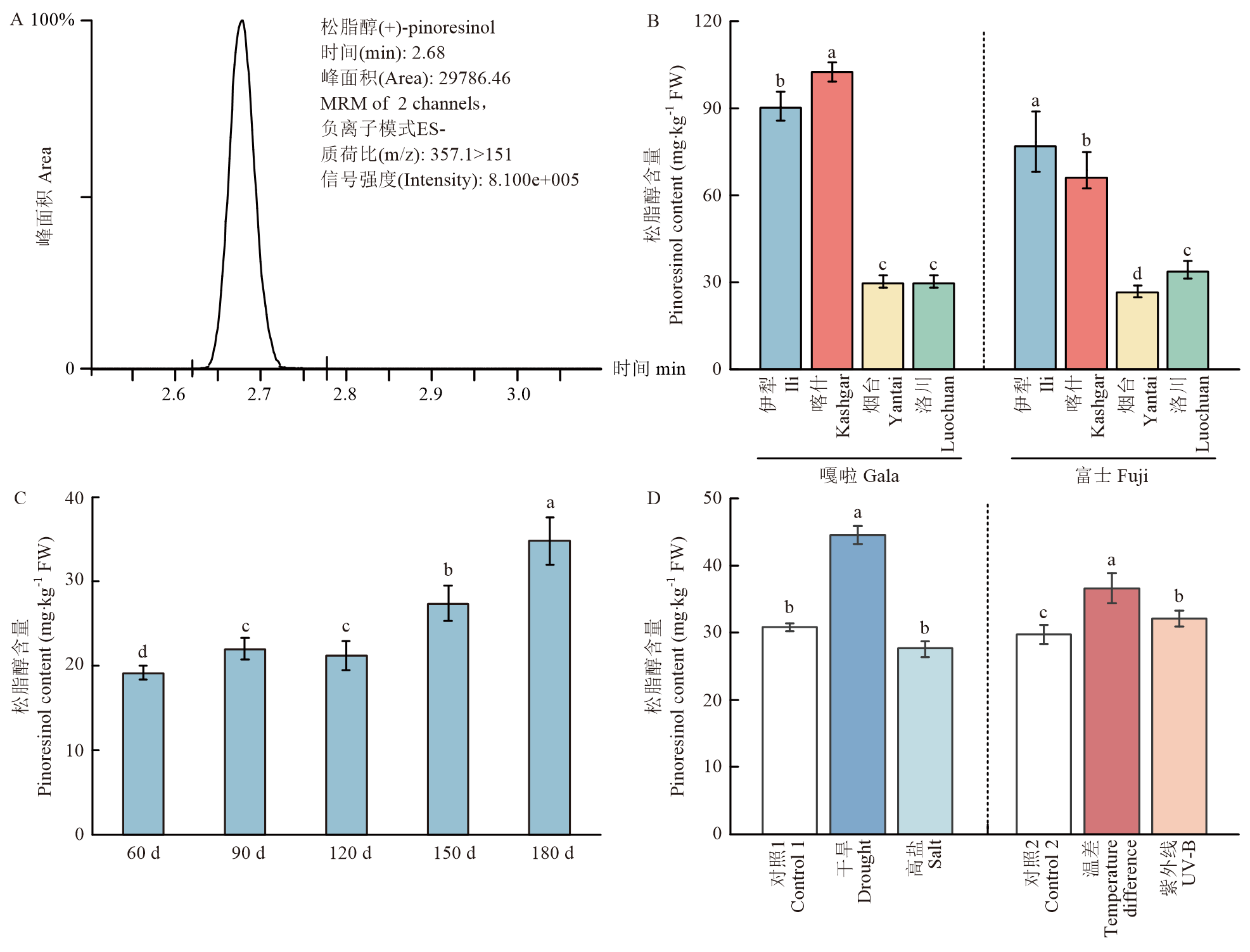
图4
松脂醇含量测定与生态影响因子分析 A:LC-MS/MS法松脂醇含量测定技术的建立;B:不同地区苹果果实松脂醇含量的测定;C:‘富士’果实发育进程中松脂醇含量变化;D:不同生态因子对松脂醇积累的影响。不同小写字母表示差异显著(P<0.05)。下同"
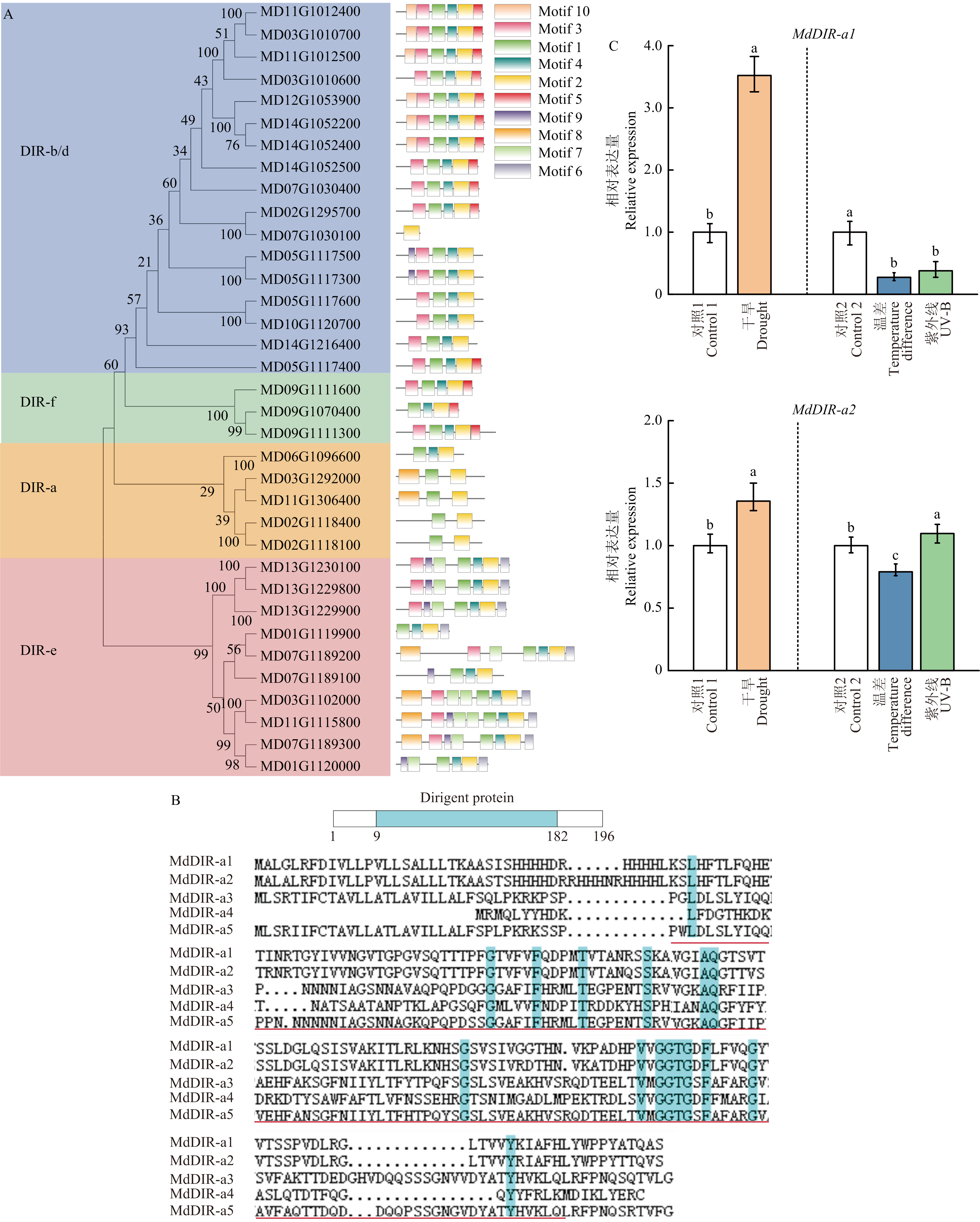
图5
不同生态因子对MdDIR-a表达的影响 A:苹果DIR蛋白进化与保守域分析;B:MdDIR-a蛋白功能域分析;C:不同生态因子处理下MdDIR-a的表达检测"
| [1] |
中国苹果产业协会. 2025年度中国苹果产业发展报告[R]. 北京: 中国苹果产业协会, 2025.
|
|
China Apple Industry Association. China apple industry development report 2025[R]. Beijing: China Apple Industry Association, 2025. (in Chinese)
|
|
| [2] |
doi: 10.3390/nu7063959 |
| [3] |
doi: 10.1111/jfds.v87.6 |
| [4] |
姚佳, 王佳傲, 刁饶, 李驰. 苹果类黄酮物质及其代谢调控研究进展[J]. 食品安全质量检测学报, 2024, 15(5): 189-196.
|
|
|
|
| [5] |
田永涛, 刘焰, 滕宇, 王歆然, 洪利亚, 王文蜀. 比较代谢组学解析3种中国东北苹果代谢物特征[J]. 食品科学, 2025, 46(5): 194-207.
|
|
|
|
| [6] |
冯娟. 不同产地富士苹果果实品质分析与比较[D]. 银川: 宁夏大学, 2013.
|
|
|
|
| [7] |
刘毓超, 王辉, 贾一鸣, 张晓, 朱丽霞. 中国红富士苹果糖、酸、多酚分析及产区溯源模型构建[J]. 食品工业科技, 2023, 44(22): 285-293.
|
|
|
|
| [8] |
虞昕磊, 何结望, 林国平, 李金海, 王大爱, 袁跃斌, 刘圣高, 李志豪, 陶德欣. 夏冬两季发酵雪茄烟叶的代谢组差异分析[J]. 生物技术通报, 2024, 40(6): 260-270.
doi: 10.13560/j.cnki.biotech.bull.1985.2023-1101 |
|
|
|
| [9] |
生弘杰, 卢素文, 郑暄昂, 贾海锋, 房经贵. 基于广泛靶向代谢组学的葡萄种子代谢物鉴定与比较分析[J]. 中国农业科学, 2023, 56(7): 1359-1376. DOI: 10.3864/j.issn.0578-1752.2023.07.013.
|
|
|
|
| [10] |
doi: 10.1016/j.foodcont.2017.03.041 |
| [11] |
doi: 10.1016/j.scienta.2017.12.057 |
| [12] |
曾厅余, 鲁兴凯, 周永生, 马勉娣, 高应鸣. 气候因子对中国‘华硕’苹果果实品质的影响[J]. 云南大学学报(自然科学版), 2025, 47(1): 113-123.
|
|
|
|
| [13] |
匡立学, 聂继云, 李银萍, 程杨, 沈友明. 中国不同地区‘富士’苹果品质评价[J]. 中国农业科学, 2020, 53(11): 2253-2263. DOI: 10.3864/j.issn.0578-1752.2020.11.011.
|
|
|
|
| [14] |
杨祺鑫, 刘伯斌. 芝麻素生物合成途径及关键酶的研究进展[J/OL]. 分子植物育种. https://link.cnki.net/urlid/46.1068.s.20251010.1706.002.
|
|
|
|
| [15] |
doi: 10.1126/science.275.5298.362 pmid: 8994027 |
| [16] |
doi: 10.1074/jbc.M112.387423 |
| [17] |
doi: 10.1023/A:1014940930703 |
| [18] |
doi: 10.1002/anie.v49:1 |
| [19] |
doi: 10.1016/j.molstruc.2022.134425 |
| [20] |
doi: 10.1104/pp.123.2.453 pmid: 10859176 |
| [21] |
doi: 10.1016/j.phytochem.2024.114053 |
| [22] |
doi: 10.1016/j.jff.2018.04.009 |
| [23] |
doi: 10.1016/j.numecd.2009.02.003 |
| [24] |
doi: 10.1016/j.taap.2024.116884 |
| [25] |
doi: 10.1016/j.plaphy.2025.110074 |
| [26] |
doi: 10.1016/j.foodchem.2025.144306 |
| [27] |
doi: 10.1016/j.indcrop.2025.122322 |
| [28] |
刘金栋, 王雅美, 王一村, 于海霞, 田纪春. 功能农业的概念、内容及研究进展[J]. 中国农业科学, 2025, 58(23): 4813-4824. DOI: 10.3864/j.issn.0578-1752.2025.23.001.
|
|
|
|
| [29] |
王灿, 张唯. 黄金大米或于2020年前大规模种植[J]. 黑龙江粮食, 2017(8): 48.
|
|
|
|
| [30] |
黄帮超, 任纬, 严康, 秦家友, 邹刚, 陈莉, 张晋锐. 西南玉米赖氨酸遗传特性及育种策略初探[J/OL]. 玉米科学. https://link.cnki.net/urlid/22.1201.S.20251223.1438.002.
|
|
|
|
| [31] |
韩娟英, 何曦, 蒋宙蕾, 梅沙, 张宁, 吴殿星. 富含叶酸水稻研究进展[J]. 中国稻米, 2017, 23(6): 7-12.
doi: 10.3969/j.issn.1006-8082.2017.06.002 |
|
doi: 10.3969/j.issn.1006-8082.2017.06.002 |
|
| [32] |
何一哲, 雷小刚, 张成东, 贾振江, 王怡, 宁军芬. 富铁锌彩粒小麦营养品质与开发利用研究[J]. 植物遗传资源学报, 2012, 13(4): 672-677.
doi: 10.13430/j.cnki.jpgr.2012.04.029 |
|
|
|
| [33] |
doi: 10.1016/j.fcr.2013.11.011 |
| [34] |
郝元峰, 张勇, 何中虎. 作物锌生物强化研究进展[J]. 生命科学, 2015, 27(8): 1047-1054.
|
|
|
|
| [35] |
王嘉炜, 阚绪甜, 袁铭, 刘果, 陈立平, 周勇, 曹庸, 何泽琪, 肖苏尧. 黄金菇生物强化B族维生素的生物合成及其提取方法优化[J]. 现代食品科技, 2026, 42(5): 305-312.
|
|
|
| [1] | 管书萍, 李可, 解凯东, 段耀园, 王婷婷, 周志虎, 伍小萌, 郭文武. ‘温州蜜柑+桃叶橙’胞质杂种果实增大的生理基础及相关基因发掘[J]. 中国农业科学, 2026, 59(8): 1748-1759. |
| [2] | 岳楠栋, 蒋丙婷, 聂景贵, 方越, 唐军荣, 乐振声, 周莹, 李能波, 何霞红, 张雪春. 紫皮石斛茎、叶、花的成分和功能活性分析及代谢组学研究[J]. 中国农业科学, 2026, 59(8): 1775-1796. |
| [3] | 苏一帆, 杨瞻旭, 王迪, 冒俊呈, 魏萌萌, 陈泽, 白欣冉, 楚天歌, 马昌宁, 乔明菲, 孙权, 胡大刚. 2, 4-表油菜素内酯对苹果果实采后贮藏性能的影响[J]. 中国农业科学, 2026, 59(7): 1536-1551. |
| [4] | 岳丽昕, 王清华, 王振宝, 尼玛琼吉, 刘泽洲, 孔素萍, 张立峰, 高莉敏. 基于广靶代谢组学分析藏葱和细香葱营养品质及黄酮类代谢产物差异[J]. 中国农业科学, 2026, 59(5): 1070-1086. |
| [5] | 张利东, 郭一聪, 黄洪宇, 聂静, 王兵, 李梦雨, 李加旺, 眭晓蕾, 李愚鹤. 基于感官评价结合营养品质特征与风味物质特性关联分析黄瓜果实品质[J]. 中国农业科学, 2026, 59(5): 1087-1100. |
| [6] | 苏万龙, 任海燕, 薛晓芳, 石美娟, 刘丽, 赵爱玲, 李毅, 王永康. 基于感官、质构、理化分析的枣果品质综合评价[J]. 中国农业科学, 2026, 59(18): 4135-4148. |
| [7] | 姚振豫, 段文宜, 孟君仁, 李昂, 陈明, 岳宗省, 孙世航, 潘磊, 牛良, 崔国朝, 曾文芳. 溶质型与硬质型桃果实香气代谢分化规律及关键调控基因挖掘[J]. 中国农业科学, 2026, 59(16): 3640-3654. |
| [8] | 吴培景, 苏玲, 陈迎春, 孟冬, 杨清, 张曼, 周小苗, 陶建敏, 郑焕, 李勃, 宫磊. 基于转录组与代谢组解析红肉葡萄及其自交后代果肉类黄酮积累特征[J]. 中国农业科学, 2026, 59(16): 3655-3672. |
| [9] | 鲁晓峰, 郝硕杰, 王阳, 高娜, 佟伟, 田瑞冬, 孙海龙, 刘硕. 气调和1-MCP处理对‘御皇李’冷藏期间品质的影响[J]. 中国农业科学, 2026, 59(15): 3424-3439. |
| [10] | 翟浩, 余贤美, 王涛, 王来平, 王丹, 薛晓敏. 牵引速度与作业距离对苹果园风送式喷雾机喷雾性能的交互作用[J]. 中国农业科学, 2026, 59(14): 3082-3093. |
| [11] | 马小英, 屈小玉, 李涛, 刘威帆, 刘昊, 马风兰, 万猛虎, 吴娜, 刘吉利. 盐胁迫下不同耐盐型玉米品种的生理与代谢响应机制解析[J]. 中国农业科学, 2026, 59(13): 2815-2827. |
| [12] | 王慧玲, 王晓玥, 闫爱玲, 刘振华, 任建成, 卢浩成, 孙磊. 葡萄果实品质性状遗传特性与基因位点解析研究进展[J]. 中国农业科学, 2026, 59(11): 2447-2467. |
| [13] | 董雪, 刘佳乐, 邵晋, 陈梦秋, 吴学友, 唐培安. 多组学揭示粳稻脂质在长期低温储藏中的稳定机制[J]. 中国农业科学, 2026, 59(10): 2249-2264. |
| [14] | 谭西北, 兰徐颖, 刘崇怀, 樊秀彩, 姜建福, 孙磊, 李鹏, 余书鑫, 张颖. 不同抗性葡萄响应白腐病侵染的次生代谢物变化[J]. 中国农业科学, 2025, 58(9): 1767-1778. |
| [15] | 吴郁, 曲翔汝, 杨丹, 伍芩, 陈国跃, 江千涛, 魏育明, 许强. 广泛非靶向代谢组学解析小麦抗条锈病反应中叶绿体代谢产物[J]. 中国农业科学, 2025, 58(7): 1333-1343. |
|
||
