






中国农业科学 ›› 2026, Vol. 59 ›› Issue (16): 3621-3639.doi: 10.3864/j.issn.0578-1752.2026.16.011
李津津1,2( ), 赵宇晴1,2, 刘芮怡1,2, 吉艳芝1,2,3, 谢建治1,2, 郭艳杰1,2,3(), 张丽娟1,2,3()
收稿日期:2025-10-25
接受日期:2025-12-19
出版日期:2026-08-16
发布日期:2026-08-17
通信作者:
联系方式:
李津津,E-mail:1248876501@qq.com。
基金资助:
LI JinJin1,2(), ZHAO YuQing1,2, LIU RuiYi1,2, JI YanZhi1,2,3, XIE JianZhi1,2, GUO YanJie1,2,3(), ZHANG LiJuan1,2,3()
Received:2025-10-25
Accepted:2025-12-19
Published:2026-08-16
Online:2026-08-17
摘要:
【目的】 揭示减氮控水条件下配施生物炭与硝化抑制剂双氰胺(DCD)对设施土壤-番茄体系氮素损失的调控效应,为设施蔬菜氮肥高效利用与绿色发展提供依据。【方法】 以设施番茄为研究对象,设置常规滴灌(TD)与控水滴灌(CD)2种灌水方式,在此基础上设不施氮(TDN0、CDN0)、常规施氮(TDN1、CDN1)、减氮(TDN2、CDN2)及减氮配施生物炭与DCD(TDN2+BD、CDN2+BD)共8个处理。采用田间小区试验法,系统监测追肥期内土壤N2O排放与NH3挥发、剖面NO3--N累积分布及番茄氮素吸收利用、产量与品质指标,定量评估生物炭与双氰胺在减氮控水条件下的协同调控效应。【结果】 施氮显著提高了土壤N2O排放和NH3挥发,且排放高峰主要出现在追肥后2—3 d。减氮措施可有效抑制气态氮损失,在此基础上配施生物炭与DCD进一步强化了N2O的减排效应。在NH3挥发方面,生物炭和DCD施用存在一定升高风险,但控水滴灌能够显著缓解这一不利效应。与常规施氮相比,减氮措施可显著降低气态氮总损失量45.7%—56.6%,土壤0—100 cm剖面硝态氮累积减少13.7%—16.2%。在此基础上配施生物炭与硝化抑制剂DCD,气态氮总损失量进一步降低至49.4%—59.0%,硝态氮累积降幅则扩大至27.4%—30.0%,并有效抑制其深层淋溶。2种灌水方式均能增强水氮协同减损效应,但控水滴灌整体优于常规滴灌。CDN2+BD处理的N2O排放和NH3挥发总损失量较CDN1降低30.0%,净损失率由3.3%降至2.5%;同时显著减少硝态氮深层累积,并提高20—40 cm土层NO3--N保持能力(增加27.1%)。此外,生物炭与DCD能将控水滴灌下的氮肥表观利用率提升至28.9%,TDN2+BD和CDN2+BD处理较对应的单一减氮处理(TDN2和CDN2)分别显著提高53.0%和30.2%(P<0.05)。控水滴灌配施生物炭与DCD处理(CDN2+BD)在获得最高产量(115.93 t·hm-2)的同时,还显著提升了果实维生素C(Vc)含量,并促进了可溶性蛋白、可溶性糖及可溶性固形物的积累。【结论】 减氮控水配施生物炭与硝化抑制剂双氰胺可显著协同抑制氮素气态损失与淋溶,改善土壤氮分布,提高氮肥利用效率和番茄品质,是设施蔬菜氮素减量增效的优选技术模式。
李津津, 赵宇晴, 刘芮怡, 吉艳芝, 谢建治, 郭艳杰, 张丽娟. 减氮控水配施生物炭与硝化抑制剂对设施土壤-番茄体系氮素损失的影响[J]. 中国农业科学, 2026, 59(16): 3621-3639.
LI JinJin, ZHAO YuQing, LIU RuiYi, JI YanZhi, XIE JianZhi, GUO YanJie, ZHANG LiJuan. Effects of Reduced Nitrogen and Controlled Water Combined with Biochar and Nitrification Inhibitor on Nitrogen Losses in a Facility Soil-Tomato System[J]. Scientia Agricultura Sinica, 2026, 59(16): 3621-3639.

表1
试验地土壤基本理化性质"
| 土壤层次 Soil layer (cm) | 全氮 Total N (g·kg-1) | 有机质 SOM (g·kg-1) | 硝态氮 NO3--N (mg·kg-1) | 铵态氮 NH4+-N (mg·kg-1) | 有效磷 Olsen-P (mg·kg-1) | 速效钾 NH4OAc-K (mg·kg-1) | pH (水:土=2.5:1) | 粒径组成 Particle size composition (%) | 容重 Bulk density (g·cm-3) | ||
|---|---|---|---|---|---|---|---|---|---|---|---|
| 砂粒 Sand | 粉粒 Silt | 黏粒 Clay | |||||||||
| 0-20 | 1.07 | 17.49 | 150.67 | 27.71 | 113.65 | 172.72 | 7.92 | 59.99 | 16.66 | 23.35 | 1.21 |
| 20-40 | 0.75 | 11.78 | 123.86 | 29.38 | 78.16 | 115.51 | 8.02 | 67.91 | 15.32 | 16.77 | 1.25 |
| 40-60 | 0.54 | 8.79 | 106.71 | 25.28 | 52.05 | 191.33 | 8.13 | 73.89 | 12.93 | 13.18 | 1.35 |
| 60-80 | 0.50 | 8.91 | 84.07 | 20.87 | 57.44 | 184.89 | 8.16 | 77.57 | 11.05 | 11.38 | 1.46 |
| 80-100 | 0.57 | 11.70 | 82.29 | 13.01 | 59.61 | 285.99 | 8.18 | 72.03 | 13.41 | 14.56 | 1.45 |
表2
不同处理施肥方式、施肥量及施用时间"
| 处理 Treatment | 基肥 (2022-10-5) Basal fertilizer (October 5, 2022) | 追肥Topdressing | 总计 Total (kg·hm-2) | 灌水 Irrigation | 总计 Total (m3·hm-2) | ||||||||||||||||||
|---|---|---|---|---|---|---|---|---|---|---|---|---|---|---|---|---|---|---|---|---|---|---|---|
| 第1次 (2023-1-16) First (January 16, 2023) | 第2次 (2023-3-14) Second (March 14, 2023) | 第3次 (2023-4-15) Third (April 15, 2023) | 第1次 (2022-10-12) First (October 12, 2022) | 第2次 (2022-10-17) Second (October 17, 2023) | 第3次 (2023-1-16) Third (January 16, 2023) | 第4次 (2023-3-14) Forth (March 14, 2023) | 第5次 (2023-4-15) Fifth (April 15, 2023) | 第6次 (2023-5-5) Sixth (May 5, 2023) | 第7次 (2023-6-1) Seventh (June 1, 2023) | ||||||||||||||
| N | P2O5 | K2O | N | P2O5 | K2O | N | P2O5 | K2O | N | P2O5 | K2O | N | P2O5 | K2O | |||||||||
| TDN0 | 0 | 194 | 205 | 0 | 30 | 32 | 0 | 52 | 70 | 0 | 52 | 70 | 0 | 328 | 377 | 225 | 360 | 540 | 810 | 900 | 990 | 675 | 4500 |
| TDN1 | 207 | 194 | 205 | 45 | 30 | 32 | 100 | 52 | 70 | 100 | 52 | 70 | 452 | 328 | 377 | 225 | 360 | 540 | 810 | 900 | 990 | 675 | 4500 |
| TDN2 | 145 | 194 | 205 | 32 | 30 | 32 | 70 | 52 | 70 | 70 | 52 | 70 | 317 | 328 | 377 | 225 | 360 | 540 | 810 | 900 | 990 | 675 | 4500 |
| TDN2+BD | 145 | 194 | 205 | 32 | 30 | 32 | 70 | 52 | 70 | 70 | 52 | 70 | 317 | 328 | 377 | 225 | 360 | 540 | 810 | 900 | 990 | 675 | 4500 |
| CDN0 | 0 | 194 | 205 | 0 | 30 | 32 | 0 | 52 | 70 | 0 | 52 | 70 | 0 | 328 | 377 | 169 | 270 | 405 | 608 | 675 | 743 | 506 | 3375 |
| CDN1 | 207 | 194 | 205 | 45 | 30 | 32 | 100 | 52 | 70 | 100 | 52 | 70 | 452 | 328 | 377 | 169 | 270 | 405 | 608 | 675 | 743 | 506 | 3375 |
| CDN2 | 145 | 194 | 205 | 32 | 30 | 32 | 70 | 52 | 70 | 70 | 52 | 70 | 317 | 328 | 377 | 169 | 270 | 405 | 608 | 675 | 743 | 506 | 3375 |
| CDN2+BD | 145 | 194 | 205 | 32 | 30 | 32 | 70 | 52 | 70 | 70 | 52 | 70 | 317 | 328 | 377 | 169 | 270 | 405 | 608 | 675 | 743 | 506 | 3375 |

图1
追肥期间不同处理土壤N2O排放通量动态变化"
表3
不同处理土壤N2O排放通量重复测量方差分析(ANOVA)"
| 指标 Index | 因素 Factor | 自由度 df | 标准差 MS | F检验 F test | P值 P value |
|---|---|---|---|---|---|
| N2O排放通量 N2O emission flux | 处理 Treatment | 7 | 28456.892 | 18.73 | <0.001 |
| 时间 Time | 24 | 8923.417 | 35.62 | <0.001 | |
| 处理×时间Treatment×Time | 168 | 1876.539 | 7.49 | <0.001 |
表4
不同处理土壤N2O排放通量双因素方差分析(ANOVA)"
| 指标 Index | 因素 Factor | 自由度 df | 标准差 MS | F检验 F test | P值 P value |
|---|---|---|---|---|---|
| N2O排放通量 N2O emission flux | 灌水 Irrigation | 1 | 519.059 | 13.579 | 0.002 |
| 氮素调控Nitrogen regulation | 3 | 7079.078 | 185.199 | <0.001 | |
| 灌水×氮素调控 Irrigation×Nitrogen regulation | 3 | 51.432 | 1.346 | 0.295 |

图2
追肥期间不同处理土壤NH3挥发速率动态变化"
表5
不同处理土壤NH3挥发速率重复测量方差分析"
| 指标 Index | 因素 Factor | 自由度 df | 标准差 MS | F值 F value | P值 P value |
|---|---|---|---|---|---|
| NH3挥发速率 NH3 volatilization rate | 处理 Treatment | 7 | 45.327 | 22.156 | <0.001 |
| 时间 Time | 41 | 28.641 | 48.773 | <0.001 | |
| 处理×时间Treatment×Time | 287 | 6.892 | 11.734 | <0.001 |
表6
不同处理土壤NH3挥发速率双因素方差分析"
| 指标 Index | 因素 Factor | 自由度 df | 标准差 MS | F检验 F test | P值 P value |
|---|---|---|---|---|---|
| NH3挥发速率 NH3 volatilization rate | 灌水 Irrigation | 1 | 16.609 | 52.123 | <0.001 |
| 氮素调控Nitrogen regulation | 3 | 281.212 | 882.511 | <0.001 | |
| 灌水×氮素调控 Irrigation×Nitrogen regulation | 3 | 1.687 | 5.295 | 0.010 |
表7
追肥期间不同处理土壤N2O累积排放量与NH3累积挥发量及净损失率"
| 处理 Treatment | N2O | NH3 | N2O+NH3 | |||
|---|---|---|---|---|---|---|
| 累积排放量 Accumulated emission amount (kg·hm-2) | 损失率 Loss rate (%) | 累积排放量 Accumulated emission amount (kg·hm-2) | 损失率 Loss rate (%) | 总损失量 Total losses (kg·hm-2) | 净损失率 Net loss rate (%) | |
| TDN0 | 0.25±0.05 e | — | 4.47±0.47 d | — | 4.72+0.53 e | — |
| TDN1 | 2.18±0.14 a | 0.79±0.43 a | 18.44±1.55 a | 5.70±0.79 a | 20.62±1.59 a | 6.49±0.65 a |
| TDN2 | 1.30+0.18 b | 0.61±0.33 b | 9.90±0.79 b | 3.16±0.33 b | 11.20±0.63 b | 3.77±0.16 b |
| TDN2+BD | 0.96±0.10 c | 0.41±0.22 c | 9.47±0.33 bc | 2.91±0.35b | 10.43±0.31 bc | 3.32±0.46 bc |
| CDN0 | 0.22+0.05 e | — | 3.91±0.35 d | — | 4.13+0.30 e | — |
| CDN1 | 0.97±0.11 c | 0.31±0.17 c | 11.12±1.57 b | 2.94±0.57 b | 12.09±1.68 b | 3.25±0.73 bc |
| CDN2 | 0.80+0.08 c | 0.33±0.18 c | 8.15±0.73 c | 2.46±0.73 b | 8.95+0.66 cd | 2.79±0.27 bc |
| CDN2+BD | 0.51±0.03 d | 0.17±0.09 d | 7.95±0.62 c | 2.35±0.62 b | 8.46±0.65 d | 2.52±0.55 d |
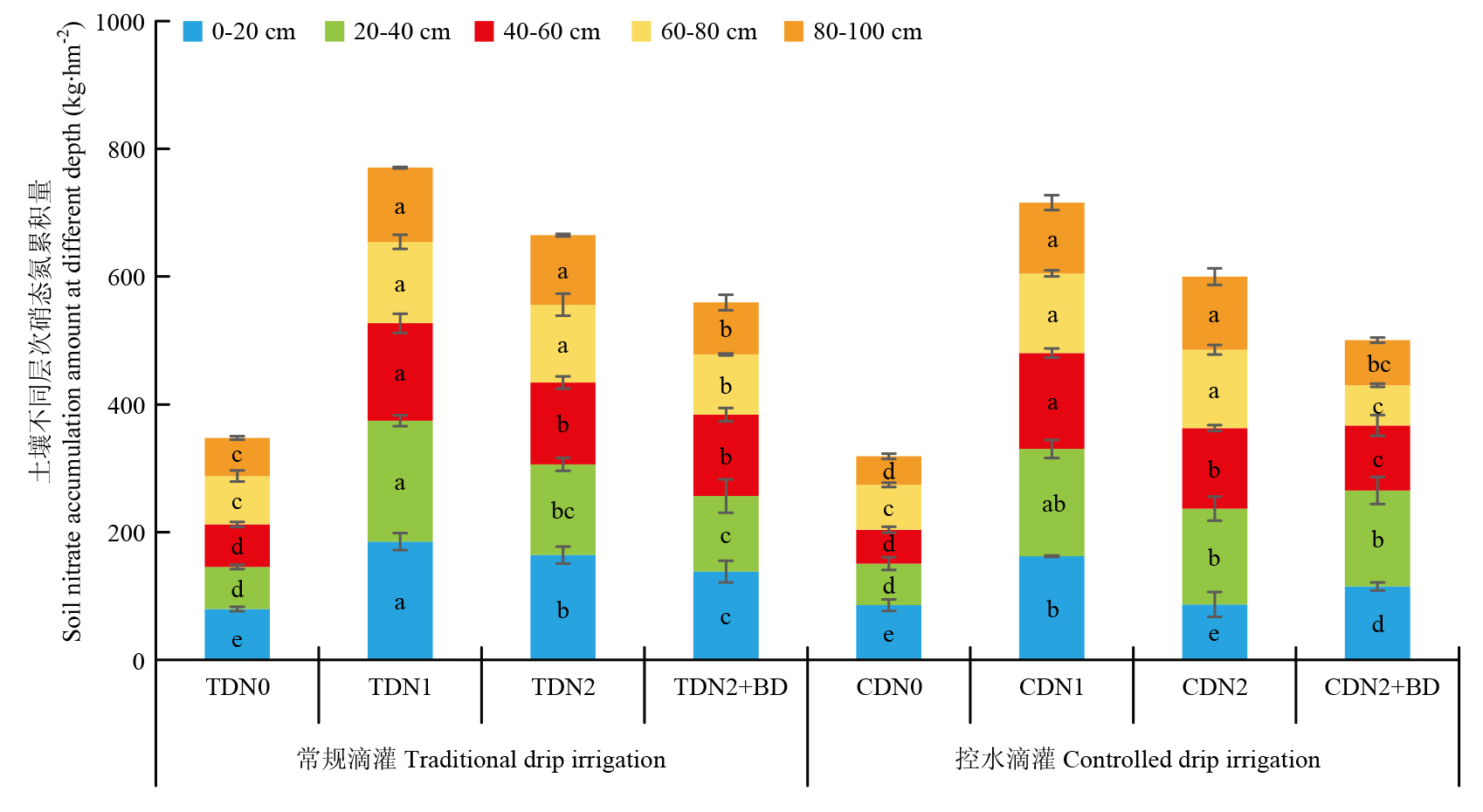
图3
收获后不同处理土壤0—100 cm剖面硝态氮累积量 同一土层不同小写字母表示不同处理间在0.05水平上差异显著。下同"
表8
不同处理土壤剖面NO3--N累积双因素方差分析(ANOVA)"
| 指标 Index | 因素 Factor | 自由度 df | 标准差 MS | F检验 F test | P值 P value |
|---|---|---|---|---|---|
| 0-20 cm土层硝态氮累积 Nitrate accumulation in 0-20 cm soil layer | 灌水 Irrigation | 1 | 4378.937 | 31.271 | 0.000 |
| 氮素调控Nitrogen regulation | 3 | 6572.520 | 46.936 | 0.000 | |
| 灌水×氮素调控 Irrigation×Nitrogen regulation | 3 | 1348.067 | 9.627 | 0.001 | |
| 20-40 cm土层硝态氮累积 Nitrate accumulation in 20-40 cm soil layer | 灌水 Irrigation | 1 | 59.143 | 0.233 | 0.636 |
| 氮素调控Nitrogen regulation | 3 | 10214.254 | 40.263 | 0.000 | |
| 灌水×氮素调控 Irrigation×Nitrogen regulation | 3 | 723.765 | 2.853 | 0.072 | |
| 40-60 cm土层硝态氮累积 Nitrate accumulation in 40-60 cm soil layer | 灌水 Irrigation | 1 | 583.208 | 5.595 | 0.032 |
| 氮素调控Nitrogen regulation | 3 | 6778.893 | 65.039 | 0.000 | |
| 灌水×氮素调控 Irrigation×Nitrogen regulation | 3 | 197.226 | 1.892 | 0.174 | |
| 60-80 cm土层硝态氮累积 Nitrate accumulation in 60-80 cm soil layer | 灌水 Irrigation | 1 | 515.565 | 6.455 | 0.023 |
| 氮素调控Nitrogen regulation | 3 | 3586.607 | 44.908 | 0.000 | |
| 灌水×氮素调控 Irrigation×Nitrogen regulation | 3 | 326.159 | 4.084 | 0.026 | |
| 80-100 cm土层硝态氮累积 Nitrate accumulation in 80-100 cm soil layer | 灌水 Irrigation | 1 | 163.375 | 2.795 | 0.115 |
| 氮素调控Nitrogen regulation | 3 | 4002.020 | 68.474 | 0.000 | |
| 灌水×氮素调控 Irrigation×Nitrogen regulation | 3 | 147.159 | 2.518 | 0.097 |
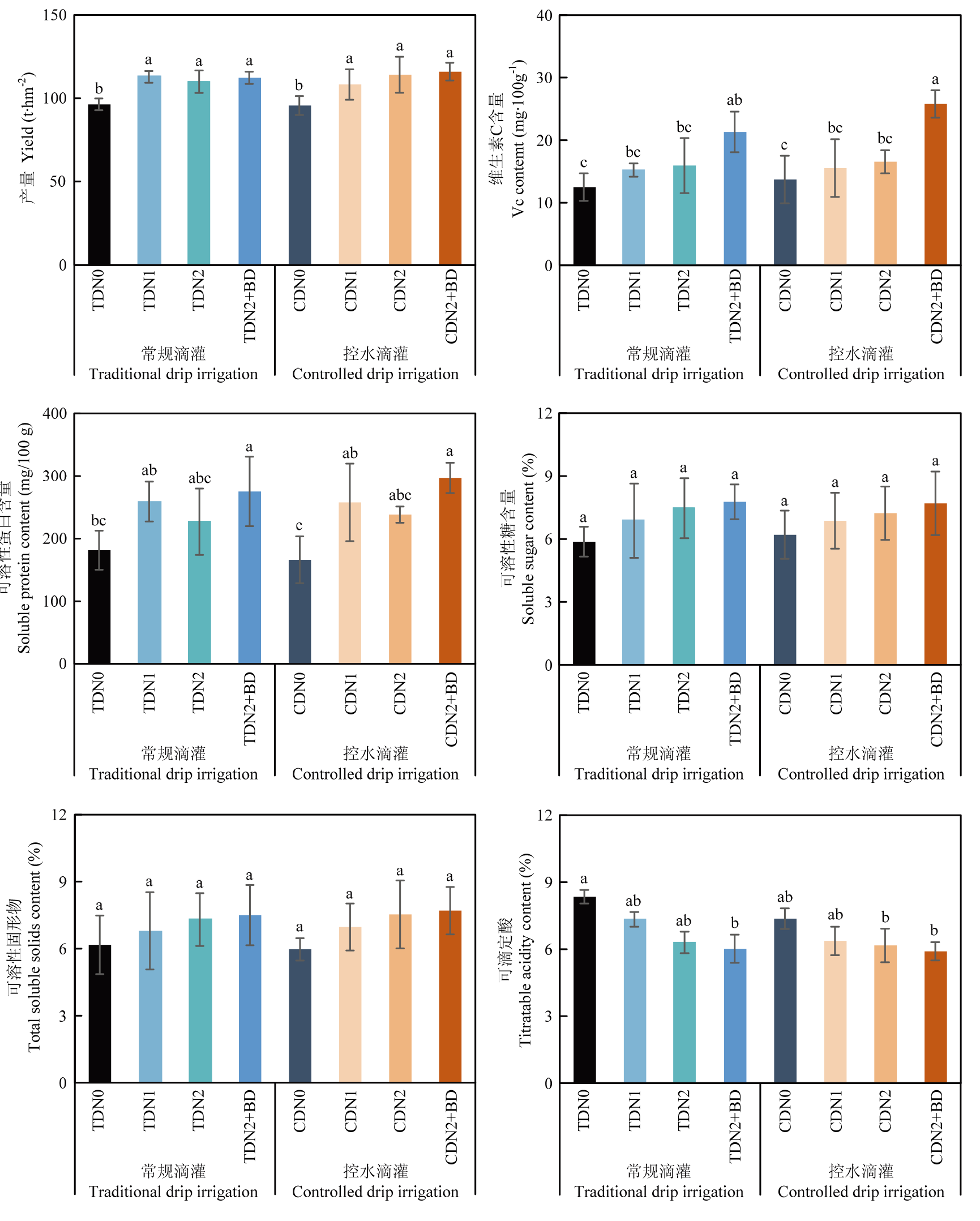
图4
不同处理番茄产量与果实品质指标"
表9
各处理番茄产量和果实品质双因素方差分析"
| 指标 Index | 因素 Factor | 自由度 df | 标准差 MS | F检验 F test | P值 P value |
|---|---|---|---|---|---|
| 番茄产量 Tomato yield | 灌水 Irrigation | 1 | 27.290 | 0.896 | 0.359 |
| 氮素调控Nitrogen regulation | 3 | 354.798 | 11.644 | 0.000 | |
| 灌水×氮素调控 Irrigation×Nitrogen regulation | 3 | 55.133 | 1.809 | 0.189 | |
| 维生素C含量 Vc content | 灌水 Irrigation | 1 | 12.627 | 1.128 | 0.305 |
| 氮素调控Nitrogen regulation | 3 | 92.285 | 8.241 | 0.001 | |
| 灌水×氮素调控 Irrigation×Nitrogen regulation | 3 | 6.027 | 0.538 | 0.663 | |
| 可溶性糖含量 Soluble sugar content | 灌水 Irrigation | 1 | 0.127 | 0.077 | 0.785 |
| 氮素调控Nitrogen regulation | 3 | 2.929 | 1.774 | 0.187 | |
| 灌水×氮素调控 Irrigation×Nitrogen regulation | 3 | 0.065 | 0.039 | 0.989 | |
| 可溶性蛋白含量 Soluble protein content | 灌水 Irrigation | 1 | 28.769 | 0.016 | 0.902 |
| 氮素调控Nitrogen regulation | 3 | 10434.447 | 5.710 | 0.005 | |
| 灌水×氮素调控 Irrigation×Nitrogen regulation | 3 | 350.094 | 0.192 | 0.900 | |
| 可溶性固形物含量 Soluble solid content | 灌水 Irrigation | 1 | 0.025 | 0.015 | 0.905 |
| 氮素调控Nitrogen regulation | 3 | 2.161 | 1.278 | 0.322 | |
| 灌水×氮素调控 Irrigation×Nitrogen regulation | 3 | 0.050 | 0.030 | 0.993 | |
| 可滴定酸含量 Titratable acid content | 灌水 Irrigation | 1 | 1.734 | 1.306 | 0.271 |
| 氮素调控Nitrogen regulation | 3 | 3.149 | 2.371 | 0.099 | |
| 灌水×氮素调控 Irrigation×Nitrogen regulation | 3 | 0.337 | 0.254 | 0.857 |
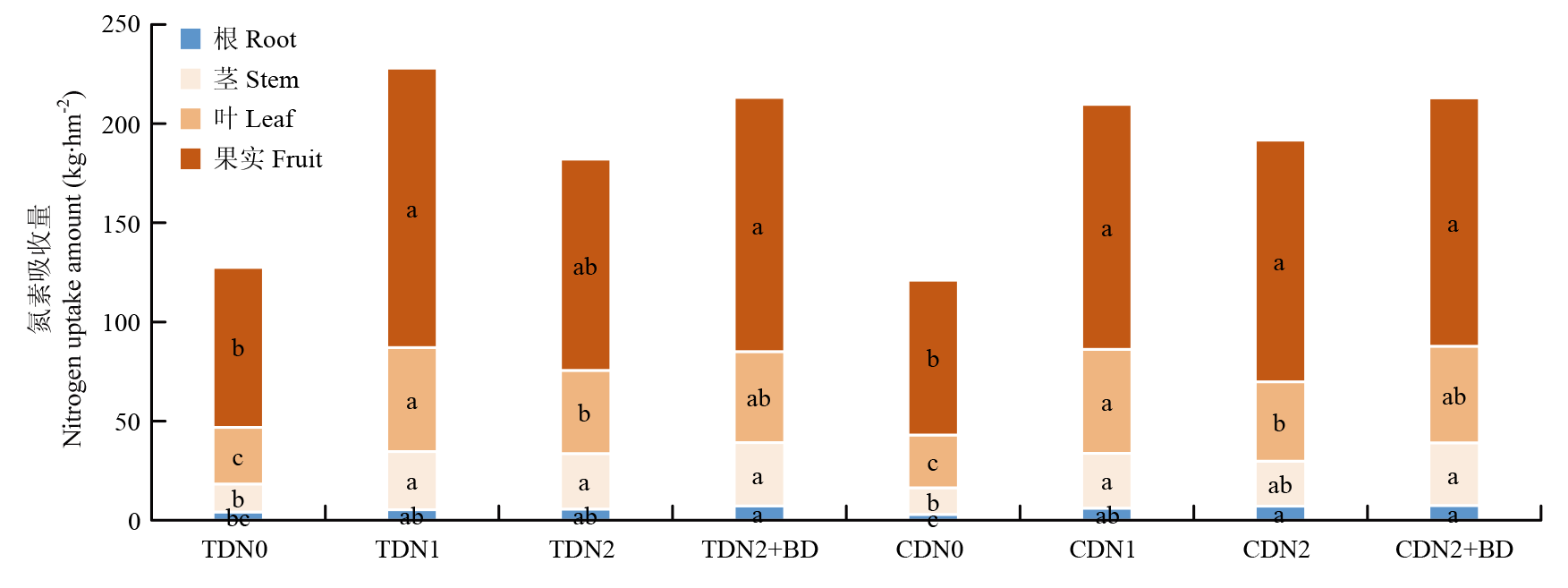
图5
不同处理下番茄植株各器官的氮素积累"
表10
不同处理番茄植株各器官氮素累积双因素方差分析(ANOVA)"
| 指标 Index | 因素 Factor | 自由度 df | 标准差 MS | F检验 F test | P值 P value |
|---|---|---|---|---|---|
| 根氮素累积 Root N accumulation | 灌水 Irrigation | 1 | 0.235 | 0.162 | 0.693 |
| 氮素调控Nitrogen regulation | 3 | 12.728 | 8.801 | 0.001 | |
| 灌水×氮素调控 Irrigation×Nitrogen regulation | 3 | 1.311 | 0.907 | 0.461 | |
| 茎氮素累积 Stem N accumulation | 灌水 Irrigation | 1 | 15.079 | 0.533 | 0.477 |
| 氮素调控Nitrogen regulation | 3 | 278.588 | 9.839 | 0.000 | |
| 灌水×氮素调控 Irrigation×Nitrogen regulation | 3 | 3.146 | 0.111 | 0.952 | |
| 叶氮素累积 Leaf N accumulation | 灌水 Irrigation | 1 | 0.243 | 0.010 | 0.923 |
| 氮素调控Nitrogen regulation | 3 | 521.503 | 20.897 | 0.000 | |
| 灌水×氮素调控 Irrigation×Nitrogen regulation | 3 | 7.411 | 0.297 | 0.827 | |
| 果实氮素累积 Fruit N accumulation | 灌水 Irrigation | 1 | 0.086 | 0.000 | 0.989 |
| 氮素调控Nitrogen regulation | 3 | 2567.785 | 5.393 | 0.007 | |
| 灌水×氮素调控 Irrigation×Nitrogen regulation | 3 | 375.604 | 0.789 | 0.519 |
表11
不同处理番茄植株总吸收氮量、氮肥表观利用率和氮肥农学效率"
| 处理 Treatment | 总吸收氮量 Total N uptake (kg·hm-2) | 氮肥表观利用率 RE (%) | 氮肥农学效率 AE (kg·kg-1) |
|---|---|---|---|
| TDN0 | 127.4±3.9c | — | — |
| TDN1 | 228.0±7.0a | 23.1±1.6ab | 33.5±7.8b |
| TDN2 | 182.1±4.4b | 18.5±2.5b | 37.0±8.3ab |
| TDN2+BD | 213.2±9.5ab | 28.3±2.5a | 49.7±8.5ab |
| CDN0 | 121.1±6.3c | — | — |
| CDN1 | 209.7±5.8ab | 19.6±3.3b | 36.4±9.7ab |
| CDN2 | 191.6±8.1ab | 22.2±4.6ab | 43.3±7.1ab |
| CDN2+BD | 212.9±10.1ab | 28.9±3.7a | 60.7±6.1a |
| [1] |
李天来. 设施蔬菜产业发展(一) 我国设施蔬菜产业发展现状及展望[J]. 中国蔬菜, 2023(9): 1-6.
|
|
|
|
| [2] |
张怀志, 唐继伟, 袁硕, 黄绍文. 津冀设施蔬菜施肥调查分析[J]. 中国土壤与肥料, 2018(2): 54-60.
|
|
|
|
| [3] |
石生伟, 刘衎, 郭利娜, 任天婧, 李彤, 刘云, 段碧华, 李玉娥. 天津市设施菜地施肥现状及减施潜力和对策[J]. 植物营养与肥料学报, 2020, 26(6): 1091-1105.
|
|
|
|
| [4] |
仲子文, 邵鹏, 井永苹, 徐建玲, 刘兆东, 曹学东, 李彦, 张英鹏. 沂南县典型设施蔬菜施肥现状调查与分析[J]. 中国蔬菜, 2023(8): 103-110.
|
|
|
|
| [5] |
黄梓翀, 刘善江, 孙昊, 侯立柱, 吴荣, 薛文涛. 我国蔬菜肥料利用率现状与提高对策[J]. 蔬菜, 2021(7): 43-50.
|
|
|
|
| [6] |
张福锁, 王激清, 张卫峰, 崔振岭, 马文奇, 陈新平, 江荣风. 中国主要粮食作物肥料利用率现状与提高途径[J]. 土壤学报, 2008, 45(5): 915-924.
|
|
|
|
| [7] |
doi: 10.1073/pnas.0813417106 |
| [8] |
王丽英, 赵小翠, 曲明山, 袁会敏, 陈清, 赵永志, 王克武. 京郊设施果类蔬菜土肥水管理现状及技术需求[J]. 华北农学报, 2012, 27(S1): 298-303.
doi: 10.3969/j.issn.1000-7091.2012.z1.059 |
|
|
|
| [9] |
郑育锁. 天津市设施蔬菜灌溉施肥情况调查[J]. 中国农技推广, 2012, 28(7): 44-46, 50.
|
|
|
|
| [10] |
张余良, 单晓政, 牛国保, 郭锐, 王坤, 张远芳, 孙德岭, 任华中, 张振贤, 高丽红. 设施蔬菜耗水时空特征及水敏感期研究[J]. 湖北农业科学, 2016, 55(3): 595-598, 611.
|
|
|
|
| [11] |
doi: S0269-7491(18)34040-5 pmid: 30500748 |
| [12] |
doi: 10.1016/j.agwat.2018.08.028 |
| [13] |
|
| [14] |
doi: 10.1016/j.agwat.2012.05.003 |
| [15] |
张琳, 孙卓玲, 马理, 吉艳芝, 巨晓棠, 张丽娟. 不同水氮条件下双氰胺(DCD)对温室黄瓜土壤氮素损失的影响[J]. 植物营养与肥料学报, 2015, 21(1): 128-137.
|
|
|
|
| [16] |
薄录吉, 李彦, 王艳芹, 仲子文, 井永苹. 设施番茄土壤氮素淋失控制技术措施比较[J]. 中国生态农业学报(中英文), 2025, 33(2): 278-285.
|
|
|
|
| [17] |
doi: 10.3389/fmicb.2019.01931 pmid: 31543867 |
| [18] |
doi: 10.1007/s42729-020-00378-9 |
| [19] |
doi: 10.1016/j.envpol.2020.116365 |
| [20] |
宋博影, 郭艳杰, 王文赞, 吕泽楠, 赵宇晴, 柳鹭, 张丽娟. 生物炭和双氰胺对设施蔬菜土壤温室气体排放的影响[J]. 中国农业科学, 2023, 56(10): 1935-1948. doi: 10.3864/j.issn.0578-1752.2023.10.010.
|
|
|
|
| [21] |
doi: 10.1007/s003740100380 |
| [22] |
doi: 10.1111/gcbb.2016.8.issue-3 |
| [23] |
doi: 10.1016/j.chemosphere.2015.04.086 pmid: 25959224 |
| [24] |
doi: 10.3390/agronomy9060331 |
| [25] |
doi: 10.1016/j.envpol.2008.05.008 |
| [26] |
doi: 10.3390/su15076100 |
| [27] |
邹琦. 植物生理学实验指导[M]. 北京: 中国农业出版社, 2000.
|
|
|
|
| [28] |
程晓楠, 田晓楠, 郭艳杰, 李瑞娟, 张丽娟, 吉艳芝, 李博文. 硝化抑制剂/菌剂对设施土壤-蔬菜体系中氮素去向的影响[J]. 植物营养与肥料学报, 2022, 28(8): 1466-1477.
|
|
|
|
| [29] |
巨晓棠, 张福锁. 中国北方土壤硝态氮的累积及其对环境的影响[J]. 生态环境, 2003, 12(1): 24-28.
|
|
|
|
| [30] |
doi: 10.1038/srep25088 pmid: 27114032 |
| [31] |
doi: 10.1073/pnas.1322434111 pmid: 24927583 |
| [32] |
doi: 10.1111/gcb.15636 pmid: 33931928 |
| [33] |
doi: 10.3389/fmicb.2022.962146 |
| [34] |
doi: 10.1038/srep22075 |
| [35] |
doi: 10.15244/pjoes/173114 |
| [36] |
|
| [37] |
doi: 10.1007/s11356-018-3900-3 |
| [38] |
doi: 10.1016/j.scitotenv.2019.133658 |
| [39] |
何莉莉, 黄佳佳, 王梦洁, 刘玉学, 吕豪豪, 汪玉瑛, 杨生茂. 生物炭配施硝化抑制剂降低稻田土壤NH3和N2O排放的微生物机制[J]. 植物营养与肥料学报, 2023, 29(11): 2030-2041.
|
|
|
|
| [40] |
doi: 10.1016/j.agwat.2024.108843 |
| [41] |
doi: 10.1080/00288233.2016.1161651 |
| [42] |
doi: 10.1016/j.scitotenv.2022.158339 |
| [43] |
doi: 10.1016/S1161-0301(01)00112-5 |
| [44] |
屈田华, 李永夫, 张少博, 郦琳琳, 李永春, 刘娟. 生物质炭输入影响土壤氮素转化与氧化亚氮排放的研究进展[J]. 浙江农林大学学报, 2021, 38(5): 926-936.
|
|
|
|
| [45] |
|
| [46] |
王翰琨, 吴永波, 刘俊萍, 薛建辉. 生物炭对土壤氮循环及其功能微生物的影响研究进展[J]. 生态与农村环境学报, 2022, 38(6): 689-701.
|
|
|
|
| [47] |
doi: 10.1016/j.scitotenv.2018.11.316 |
| [48] |
doi: 10.1016/j.agwat.2009.03.019 |
| [49] |
doi: 10.1016/j.agwat.2012.11.015 |
| [50] |
doi: 10.1016/j.chemosphere.2012.06.002 pmid: 22763330 |
| [51] |
doi: 10.3390/agronomy3020275 |
| [52] |
doi: 10.1007/s00374-022-01688-z |
| [53] |
doi: 10.3390/w14111827 |
| [54] |
doi: 10.3390/agronomy12123154 |
| [55] |
doi: 10.1080/00380768.2012.726921 |
| [56] |
doi: 10.1016/j.agwat.2023.108605 |
| [57] |
doi: 10.1016/j.agee.2021.107379 |
| [58] |
doi: 10.21273/HORTSCI15177-20 |
| [1] | 李永娟, 张悦彤, 王艺博, 赵长江, 宋洁, 陈雪丽, 姚钦. 生物炭施用对大豆轮连作系统土壤固氮微生物nifH基因丰度及群落组成的影响[J]. 中国农业科学, 2026, 59(6): 1272-1285. |
| [2] | 吴佳佳, 刘蕊, 李鑫艳, 张久东, 常单娜, 曹卫东. 间作绿肥下减氮并配施生物炭降低玉米生产氮足迹[J]. 中国农业科学, 2026, 59(16): 3605-3620. |
| [3] | 王珅, 李盼, 梁淼, 王丽萍, 张殿凯, 赵连豪, 樊志龙, 胡发龙, 南运有, 殷文, 柴强. 生物炭配施缓释肥对绿洲灌区土壤水分利用的调控效应[J]. 中国农业科学, 2026, 59(15): 3374-3386. |
| [4] | 王晓丽, 樊志龙, 南运有, 陈桂平, 江龙秀, 殷文, 胡发龙, 柴强. 减氮下间作玉米干物质积累及产量稳定性对施用生物炭的响应[J]. 中国农业科学, 2026, 59(15): 3302-3314. |
| [5] | 周胜一, 李超, 于鑫冉, 吴凤芝, 潘凯. 菊芋秸秆生物炭对连作西瓜生长、枯萎病及土壤细菌群落的影响[J]. 中国农业科学, 2026, 59(14): 3132-3146. |
| [6] | 张海睿, 贾昂元, 高奇奇, 韩哲群, 南珊珊, 段碧华, 武雪萍. 生物炭配施黄腐酸对滨海盐碱地土壤理化性质、酶活性和多功能性的影响[J]. 中国农业科学, 2025, 58(20): 4178-4188. |
| [7] | 王安心, 方娅婷, 顿谦, 伍永清, 廖世鹏, 李小坤, 任涛, 陆志峰, 丛日环, 鲁剑巍. 秸秆直接还田与炭化还田对稻油轮作作物产量和氮素利用的影响[J]. 中国农业科学, 2025, 58(16): 3280-3292. |
| [8] | 高尚洁, 刘杏认, 李迎春, 柳晓婉. 施用生物炭和秸秆还田对农田温室气体排放及增温潜势的影响[J]. 中国农业科学, 2024, 57(5): 935-949. |
| [9] | 鲁科丹, 路远, 王蕊, 党廷辉. 不同氮素管理模式对黄土旱塬春玉米产量及N2O排放的影响[J]. 中国农业科学, 2024, 57(18): 3642-3653. |
| [10] | 王庆阳, 曹殿云, 王迪, 詹增意, 贺婉莹, 孙强, 陈温福, 兰宇. 长期施用生物炭对棕壤养分及腐殖质组分的影响[J]. 中国农业科学, 2024, 57(13): 2612-2622. |
| [11] | 庞津雯, 王钰皓, 陶宏扬, 卫婷, 高飞, 刘恩科, 贾志宽, 张鹏. 生物炭不同添加量对旱作覆膜农田土壤团聚体特性及有机碳含量的影响[J]. 中国农业科学, 2023, 56(9): 1729-1743. |
| [12] | 刘蕾, 史建硕, 张国印, 郜静, 李玭, 任燕利, 王丽英. 长期施有机肥对设施番茄土壤稀有和丰富细菌亚群落的影响[J]. 中国农业科学, 2023, 56(18): 3615-3628. |
| [13] | 宋博影, 郭艳杰, 王文赞, 吕泽楠, 赵宇晴, 柳鹭, 张丽娟. 生物炭和双氰胺对设施蔬菜土壤温室气体排放的影响[J]. 中国农业科学, 2023, 56(10): 1935-1948. |
| [14] | 顾博文, 杨劲峰, 鲁晓玲, 吴怡慧, 李娜, 刘宁, 安宁, 韩晓日. 连续施用生物炭对花生不同生育时期叶绿素荧光特性的影响[J]. 中国农业科学, 2021, 54(21): 4552-4561. |
| [15] | 向伟,王雷,刘天奇,李诗豪,翟中兵,李成芳. 生物炭与无机氮配施对稻田温室气体排放及氮肥利用率的影响[J]. 中国农业科学, 2020, 53(22): 4634-4645. |
|
||
