






中国农业科学 ›› 2026, Vol. 59 ›› Issue (14): 3132-3146.doi: 10.3864/j.issn.0578-1752.2026.14.011
周胜一1( ), 李超1, 于鑫冉2, 吴凤芝1(), 潘凯1,2()
收稿日期:2026-02-25
接受日期:2026-04-29
出版日期:2026-07-16
发布日期:2026-07-21
通信作者:
联系方式:
周胜一,E-mail:321601661@qq.com。
基金资助:
ZHOU ShengYi1(), LI Chao1, YU XinRan2, WU FengZhi1(), PAN Kai1,2()
Received:2026-02-25
Accepted:2026-04-29
Published:2026-07-16
Online:2026-07-21
摘要:
【目的】针对西瓜连作障碍导致的植株生长受抑、枯萎病频发及微生物群落失衡问题,探究施用菊芋秸秆生物炭的促生、抑病效果及微生物学机理。【方法】以两种菊芋秸秆生物炭为试材,设1%(w/w)生物炭-连作土混合处理(分别记为J04、J13)、多菌灵药剂对照(Y)及空白对照(CK)共4个处理,通过盆栽试验探究其对西瓜幼苗生长及枯萎病发生的影响;并利用Miseq高通量测序技术,分析施用菊芋秸秆生物炭对土壤细菌群落结构及多样性的影响。【结果】与CK相比,两种生物炭处理均显著促进了西瓜幼苗生物量的积累并降低了枯萎病病情指数。移栽后35 d,与CK相比,J04和J13处理的全株干重显著提高10.8%和27.6%,发病率显著降低28.8%和48.5%,病情指数显著下降21.1和30.8;而多菌灵处理(Y)发病率较CK显著降低59.1%,病情指数显著下降38.1,全株干重显著提高4.3%(P<0.05)。与CK相比,J04和J13处理的土壤细菌群落α多样性显著降低,其中Shannon指数和Invsimpson指数均显著低于CK。菊芋生物炭处理显著改变了土壤细菌群落结构(R2=0.690,P=0.009)。在门水平上,J13处理显著提高了放线菌门(Actinobacteriota)和厚壁菌门(Firmicutes)的相对丰度,同时抑制了酸杆菌门(Acidobacteriota)和黏球菌门(Myxococcota);在属水平上,J13处理显著富集了芽单胞菌属(Gemmatimonas)和德沃斯氏菌属(Devosia)等潜在有益菌。FAPROTAX功能预测进一步表明,J13处理显著提升了与化能异养和尿素分解等功能相关的微生物类群丰度,可能促进了根际养分循环。【结论】添加菊芋秸秆生物炭(J13)能有效缓解西瓜连作障碍,其促生、抑病作用与改善根际细菌群落结构、富集特定功能潜在有益菌群密切相关。
周胜一, 李超, 于鑫冉, 吴凤芝, 潘凯. 菊芋秸秆生物炭对连作西瓜生长、枯萎病及土壤细菌群落的影响[J]. 中国农业科学, 2026, 59(14): 3132-3146.
ZHOU ShengYi, LI Chao, YU XinRan, WU FengZhi, PAN Kai. Effects of Helianthus tuberosus Straw Biochar on Watermelon Growth, Fusarium Wilt and Soil Bacterial Communities Under Continuous Cropping[J]. Scientia Agricultura Sinica, 2026, 59(14): 3132-3146.

表1
菊芋秸秆生物炭的基本理化性质"
| 种类 Type | 比表面积 Surface area (m2·g-1) | 孔径 Pore size (nm) | 孔体积 Pore volume (mm3·g-1) | 碳氮比 C/N | pH | EC值 EC value (mS·cm-1) |
|---|---|---|---|---|---|---|
| J04 | 1.8 | 11.8 | 3.5 | 126.1 | 10.8 | 0.18 |
| J13 | 3.2 | 7.5 | 5.2 | 197.8 | 10.4 | 0.14 |

图1
不同菊芋秸秆生物炭对连作西瓜幼苗生长的影响 B、C分别为西瓜移栽后25、35 d幼苗的生长情况The growth of watermelon seedlings at 25, 35 d after transplanting, respectively J13:促生抑病效果好的菊芋秸秆生物炭Biochar from H. tuberosus straw with excellent growth-promoting and disease-suppressing effects;J04:促生抑病效果差的菊芋秸秆生物炭Biochar from H. tuberosus straw with poor growth-promoting and disease-suppressing effects;Y:多菌灵药剂处理Treatment with carbendazim。柱上不同小写字母表示差异显著(P<0.05)。下同Different lowercases on the bars mean significant difference at 0.05 level. The same as below"

图2
不同菊芋秸秆生物炭对连作西瓜幼苗枯萎病的影响 C、D分别为西瓜移栽后25、35 d幼苗的生长情况"

图3
接种不同处理土壤微生物对西瓜幼苗生长的影响 CK+:灭菌土壤接种6%对照西瓜根际土Sterilised soil inoculated with 6% control watermelon rhizosphere soil;J04+:灭菌土壤接种6% J04处理的西瓜根际土Sterilised soil inoculated with 6% J04-treated watermelon rhizosphere soil;J13+:灭菌土壤接种6% J13处理的西瓜根际土Sterilised soil inoculated with 6% J13-treated watermelon rhizosphere soil。图4同The same as Fig. 4"

图4
接种不同处理土壤微生物对西瓜幼苗枯萎病发生的影响"
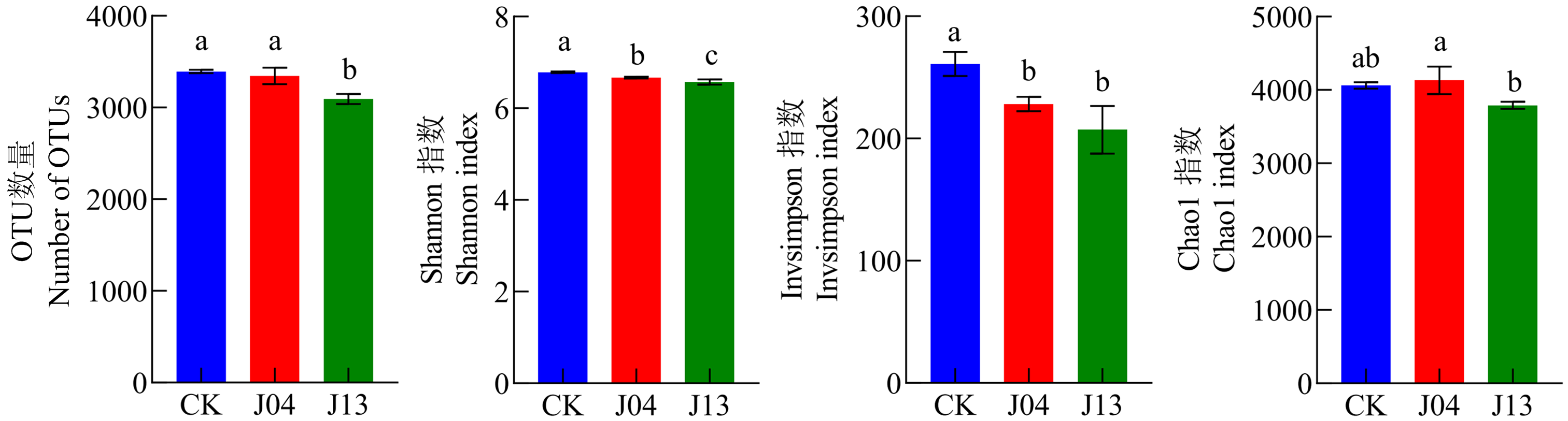
图5
不同菊芋秸秆生物炭对西瓜根际细菌群落α多样性指数的影响"
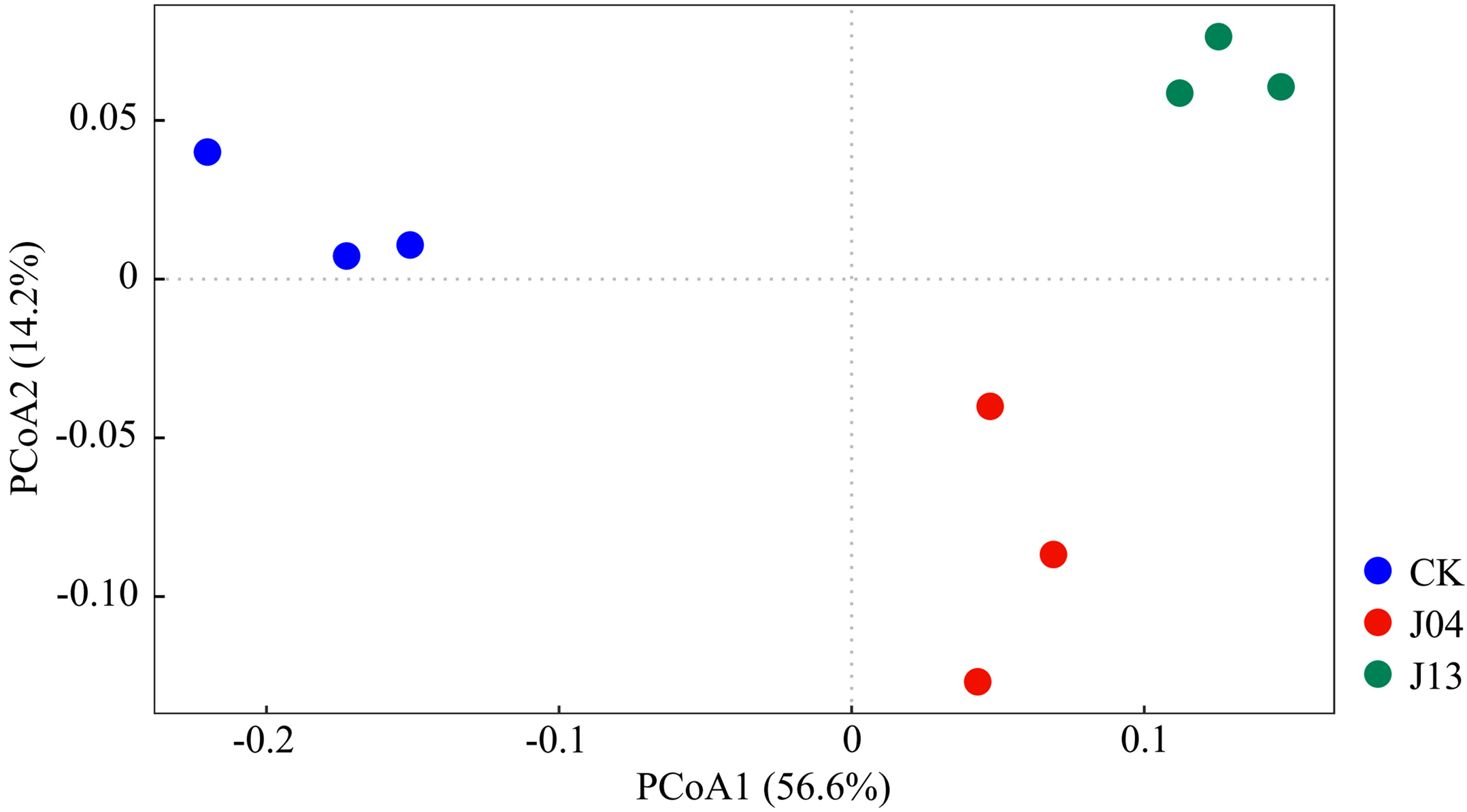
图6
不同菊芋秸秆生物炭处理下西瓜根际细菌PCoA分析"

图7
不同菊芋秸秆生物炭对西瓜根际细菌OTU水平的影响"
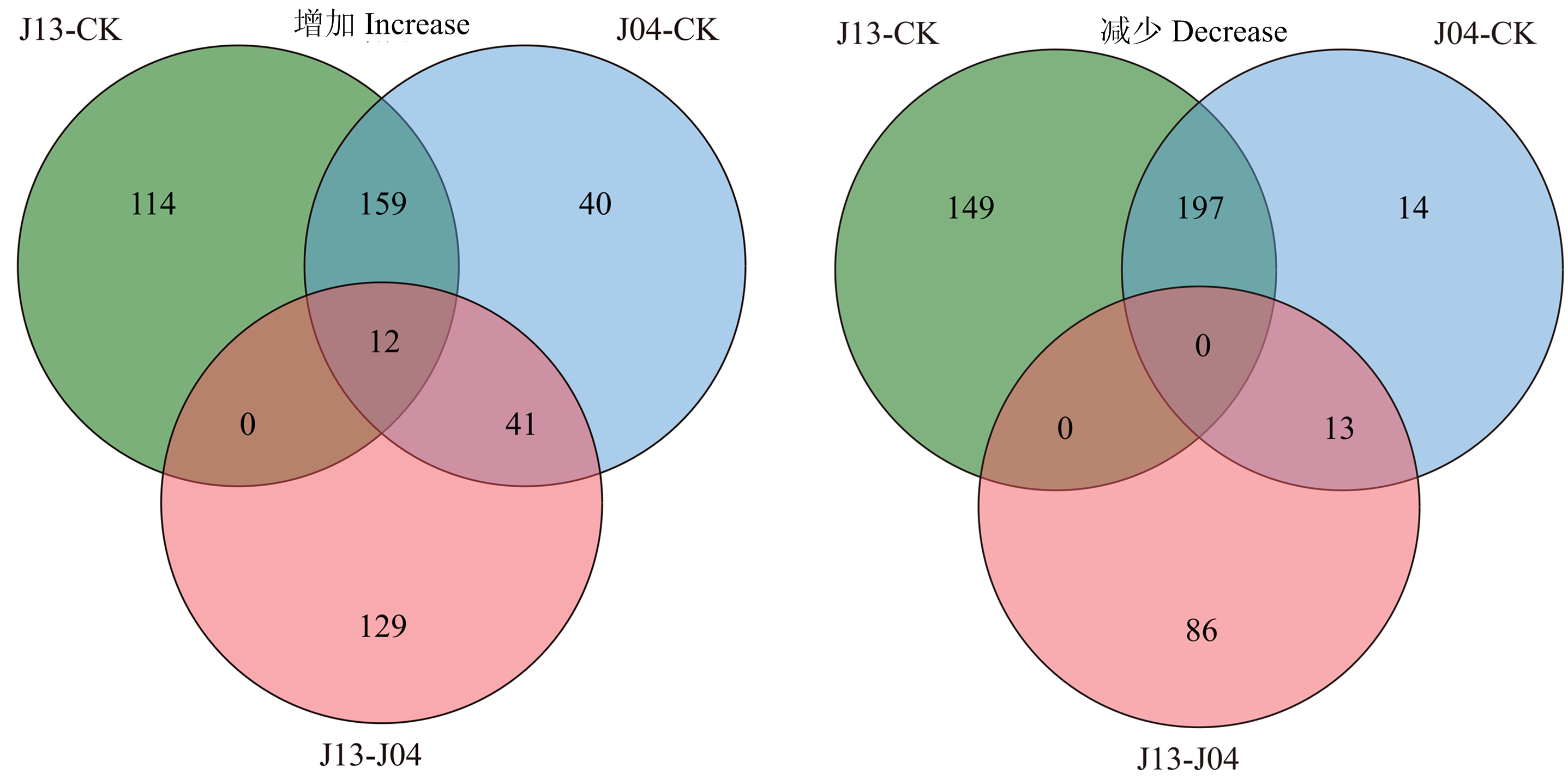
图8
不同菊芋秸秆生物炭处理下西瓜根际细菌差异OTU水平分析"
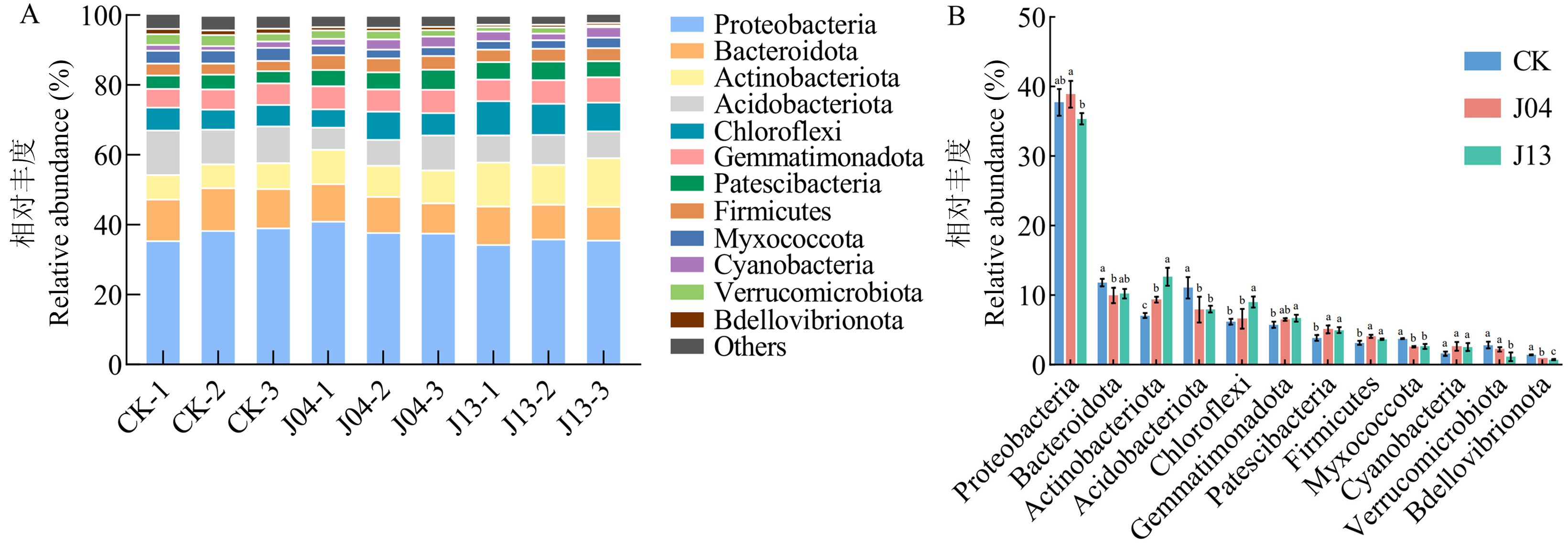
图9
不同菊芋秸秆生物炭对西瓜根际细菌门水平相对丰度的影响"
表2
不同菊芋秸秆生物炭对西瓜根际细菌Top50属水平相对丰度的影响"
| 属Genus | CK | J04 | J13 |
|---|---|---|---|
| 鞘氨醇单胞菌属Sphingomonas | 4.166±0.351b | 5.357±0.445a | 5.553±0.054a |
| norank_o__SBR1031 | 1.768±0.306b | 1.845±0.714b | 3.572±0.669a |
| 黄土杆菌属Flavisolibacter | 1.776±0.070b | 2.492±0.484a | 2.547±0.087a |
| 假双斧状菌属Pseudolabrys | 1.753±0.245b | 2.029±0.204ab | 2.351±0.129a |
| 芽单胞菌属Gemmatimonas | 1.687±0.186b | 2.056±0.163ab | 2.379±0.208a |
| norank_o__Vicinamibacterales | 2.525±0.444a | 1.759±0.483a | 1.799±0.052a |
| norank_f__Microscillaceae | 2.558±0.191a | 1.549±0.302b | 1.715±0.154b |
| norank_f__Gemmatimonadaceae | 2.074±0.097a | 1.854±0.076b | 1.777±0.025b |
| norank_o__Chloroplast | 0.659±0.068b | 2.045±0.527a | 2.072±0.399a |
| norank_f__Vicinamibacteraceae | 1.940±0.333a | 1.295±0.419a | 1.310±0.060a |
| 假单胞菌属Pseudomonas | 2.605±0.374a | 1.565±0.094b | 0.278±0.011c |
| norank_f__LWQ8 | 0.536±0.095c | 1.707±0.198b | 2.132±0.151a |
| 芽孢杆菌属Bacillus | 1.331±0.023a | 1.279±0.066a | 1.278±0.056a |
| MND1 | 1.529±0.117a | 1.132±0.095b | 0.880±0.036c |
| norank_o__Gaiellales | 0.975±0.110b | 1.121±0.112ab | 1.336±0.141a |
| Allorhizobium-Neorhizobium-Pararhizobium-Rhizobium | 1.177±0.076a | 1.109±0.182a | 0.962±0.154a |
| 沙壤土杆菌属Ramlibacter | 0.867±0.011b | 1.242±0.050a | 1.112±0.100a |
| 链霉菌属Streptomyces | 0.910±0.013a | 1.118±0.242a | 1.094±0.092a |
| 海无柄孢囊黏细菌属Haliangium | 1.193±0.068a | 0.854±0.019b | 0.914±0.105b |
| 拟无枝酸菌属Amycolatopsis | 0.143±0.008c | 0.954±0.168b | 1.799±0.259a |
| 德沃斯氏菌属Devosia | 0.848±0.035b | 0.887±0.067ab | 1.027±0.081a |
| Ellin6067 | 0.825±0.066a | 0.899±0.078a | 0.975±0.073a |
| norank_c__S0134_terrestrial_group | 0.764±0.041a | 0.901±0.124a | 0.813±0.054a |
| 韩农科技所菌属Niastella | 1.531±0.139a | 0.627±0.236b | 0.299±0.046b |
| 类固醇杆菌属Steroidobacter | 1.096±0.139a | 0.609±0.198b | 0.740±0.075ab |
| norank_o__Saccharimonadales | 0.568±0.076a | 0.932±0.336a | 0.933±0.060a |
| norank_f__SC-I-84 | 0.719±0.100a | 0.781±0.121a | 0.856±0.020a |
| 新草小螺菌属Noviherbaspirillum | 0.551±0.024b | 1.097±0.254a | 0.636±0.031b |
| unclassified_f__Comamonadaceae | 0.913±0.122a | 0.794±0.104ab | 0.562±0.065b |
| 苯基小杆菌属Phenylobacterium | 0.516±0.038b | 0.789±0.088a | 0.861±0.034a |
| norank_o__Acidobacteriales | 0.787±0.060a | 0.644±0.299a | 0.622±0.118a |
| Polyangium_brachysporum_group | 0.802±0.068a | 0.575±0.033b | 0.608±0.042b |
| 硝化螺菌属Nitrospira | 0.733±0.016a | 0.670±0.105ab | 0.562±0.030b |
| norank_f__Longimicrobiaceae | 0.432±0.022b | 0.737±0.023a | 0.793±0.047a |
| 苔藓杆菌属Bryobacter | 0.718±0.060a | 0.642±0.052ab | 0.575±0.042b |
| norank_f__67-14 | 0.353±0.025b | 0.676±0.104a | 0.817±0.097a |
| norank_f__Pedosphaeraceae | 0.809±0.171a | 0.636±0.042ab | 0.392±0.169b |
| norank_f__A4b | 0.802±0.084a | 0.424±0.027b | 0.582±0.071b |
| norank_f__Chitinophagaceae | 0.489±0.035b | 0.577±0.054ab | 0.707±0.087a |
| norank_o__Candidatus_Kaiserbacteria | 1.122±0.340a | 0.510±0.077b | 0.124±0.034b |
| norank_f__Xanthobacteraceae | 0.511±0.091b | 0.569±0.028ab | 0.662±0.032a |
| norank_c__KD4-96 | 0.475±0.096a | 0.625±0.208a | 0.639±0.014a |
| norank_o__Subgroup_7 | 0.626±0.017a | 0.544±0.005a | 0.539±0.060a |
| norank_f__TRA3-20 | 0.629±0.035a | 0.489±0.025b | 0.496±0.071b |
| 鹰嘴豆杆菌属Ciceribacter | 0.121±0.015b | 0.784±0.035a | 0.701±0.123a |
| unclassified_f__Gemmatimonadaceae | 0.437±0.050a | 0.589±0.018a | 0.570±0.092a |
| 金黄线菌属Chryseolinea | 0.306±0.091b | 0.360±0.192b | 0.821±0.181a |
| 溶杆菌属Lysobacter | 0.400±0.103a | 0.492±0.116a | 0.548±0.019a |
| 鞘氨醇菌属Sphingobium | 0.374±0.027b | 0.454±0.065ab | 0.581±0.078a |
| RB41 | 0.624±0.078a | 0.383±0.043b | 0.337±0.096b |
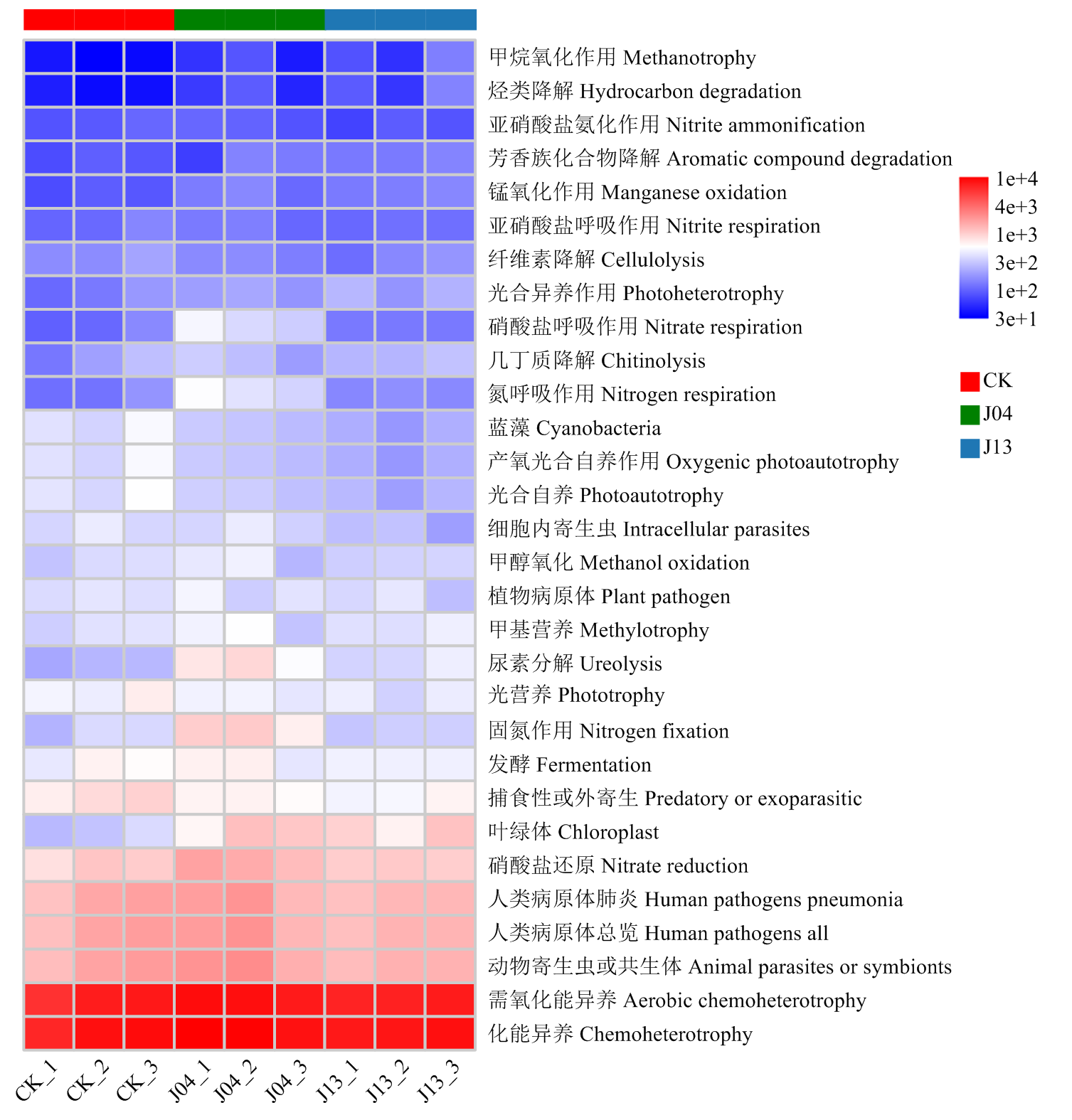
图10
不同菊芋秸秆生物炭处理下西瓜根际细菌FAPROTAX功能多样性热图"
| [1] |
姚丽娟, 田春丽, 王立河, 杜君, 校彦赟, 远兵强. 设施西瓜连作土壤生化性质及微生物群落变化[J]. 中国土壤与肥料, 2024(3): 70-78.
|
|
|
|
| [2] |
张冬明, 郑道君, 曾建华, 吉清妹, 符传良, 谢良商. 西瓜连作对土壤主要微生物数量、酶活性及果实品质的影响[J]. 北方园艺, 2017(4): 155-158.
|
|
|
|
| [3] |
doi: 10.5154/r.rchsh |
| [4] |
doi: 10.1038/s41467-023-40810-z |
| [5] |
侯嘉玮, 马荣, 谷医林, 王星, 张晓霞, 马毅楠. 西瓜枯萎病对根际细菌多样性的影响[J]. 中国土壤与肥料, 2024(2): 97-104.
|
|
|
|
| [6] |
贾云鹤, 王喜庆, 闫闻, 付永凯, 尤海波, 王丽冬, 刘晓飞, 刘超. 放线菌秸秆降解液对西瓜连作土壤生态结构的影响[J]. 中国瓜菜, 2025, 38(8): 101-110.
|
|
|
|
| [7] |
魏晓强, 孙雪梅, 张海旺, 王丽慧, 杨世鹏, 司诚, 钟启文, 芦光新. 高寒地区菊芋青贮物料耐低温乳酸菌的筛选与鉴定[J]. 草业科学, 2024, 41(2): 480-490.
|
|
|
|
| [8] |
宁冰玉, 刘海林, 朱德锐, 韩睿. 铁屑对菊芋秸秆与猪粪共消化的强化效果及机制分析[J]. 环境科学研究, 2025, 38(3): 642-652.
|
|
|
|
| [9] |
赵宣. 西瓜枯萎病的研究进展[J]. 农村经济与科技, 2018, 29(2): 26-27, 29.
|
|
|
|
| [10] |
刘阳, 谢露露, 张思远, 高建昌. 西瓜主要病害抗病育种研究进展[J]. 中国蔬菜, 2022(3): 17-28.
|
|
|
|
| [11] |
吴学宏, 卢志军, 王品品, 杨腊英. 西瓜枯萎病综合防治研究进展[J]. 植物保护, 2011, 37(4): 27-32.
|
|
|
|
| [12] |
陈莹, 严丹侃, 章东方, 汪涛, 顾江涛. 设施栽培西甜瓜土壤消毒技术[J]. 现代农业科技, 2020(23): 76-78.
|
|
|
|
| [13] |
潘四普. 基于脉动燃烧技术的设施园艺土壤蒸汽消毒装置设计与试验研究[D]. 南京: 南京林业大学, 2018.
|
|
|
|
| [14] |
吴晓梅, 叶美锋, 吴飞龙, 徐庆贤, 李章汀, 林代炎. 农林废弃物生物炭的制备及其吸附性能[J]. 生物质化学工程, 2023, 57(4): 27-33.
doi: 10.3969/j.issn.1673-5854.2023.04.003 |
|
|
|
| [15] |
林少颖, 曾瑜, 杨文文, 陈斌, 阮敏敏, 尹晓雷, 阳祥, 王维奇. 添加秸秆及其生物炭对茉莉植株与土壤碳氮磷生态化学计量特征的影响[J]. 植物生态学报, 2023, 47(4): 530-545.
doi: 10.17521/cjpe.2021.0398 |
|
doi: 10.17521/cjpe.2021.0398 |
|
| [16] |
郭晗玥, 王东升, 阮杨, 乔亦铸, 张芸滔, 李玲, 黄启为, 郭世伟, 凌宁, 沈其荣. 西瓜连作根际土壤微生物群落演替特征[J]. 中国农业科学, 2023, 56(21): 4245-4258. DOI: 10.3864/j.issn.0578-1752.2023.21.009.
|
|
|
|
| [17] |
曾青, 刘四义, 向吉方, 梁志怀, 翟常春, 姚保民, 韩丽丽, 葛安辉, 张丽梅. 西瓜枯萎病抗感品种根际微生物群落特征差异及其与病害发生的关系[J]. 微生物学报, 2024, 64(8): 2882-2900.
|
|
|
|
| [18] |
李兰若, 马飞, 王露璐, 和苗苗. 生物炭协同生物措施防治土传病害的研究进展[J]. 中国土壤与肥料, 2024(10): 249-259.
|
|
|
|
| [19] |
李超, 王嘉敏, 卜慧琳, 潘凯. 菊芋生物炭对连作西瓜生长及枯萎病的影响[J]. 北方园艺, 2025(23): 83-93.
|
|
|
|
| [20] |
卜慧琳. 不同菊芋秸秆生物炭对连作西瓜幼苗生长及枯萎病发生的影响[D]. 哈尔滨: 东北农业大学, 2023.
|
|
|
|
| [21] |
徐敬华, 黄丹枫, 支月娥. PAL活性与嫁接西瓜枯萎病抗性传递的相关性[J]. 上海交通大学学报(农业科学版), 2004, 22(1): 12-16.
|
|
|
|
| [22] |
doi: 10.1016/j.ejsobi.2016.02.004 |
| [23] |
|
| [24] |
金雪. 菊芋秸秆生物炭抑制番茄枯萎病发生的根际微生物学机理[D]. 哈尔滨: 东北农业大学, 2021.
|
|
|
|
| [25] |
doi: 10.1016/j.biombioe.2026.109308 |
| [26] |
周之栋, 卜晓莉, 吴永波, 薛建辉. 生物炭对土壤微生物特性影响的研究进展[J]. 南京林业大学学报(自然科学版), 2016, 40(6): 1-8.
doi: 10.3969/j.issn.1000-2006.2016.06.001 |
|
|
|
| [27] |
doi: 10.1139/w11-015 |
| [28] |
doi: 10.3389/fmicb.2022.1015038 |
| [29] |
陈坤, 徐晓楠, 彭靖, 冯小杰, 李亚朋, 战秀梅, 韩晓日. 生物炭及炭基肥对土壤微生物群落结构的影响[J]. 中国农业科学, 2018, 51(10): 1920-1930. DOI: 10.3864/j.issn.0578-1752.2018.10.011.
|
|
|
|
| [30] |
doi: 10.1007/s11104-011-1067-5 |
| [31] |
崔熙雯, 林小锐, 李家兵, 张虹, 韩永和. 抗逆放线菌的多样性、功能特性及其在环境修复中的应用[J]. 微生物学报, 2023, 63(5): 1930-1943.
|
|
|
|
| [32] |
|
| [33] |
doi: 10.1016/j.apsoil.2017.01.007 |
| [34] |
陈懿, 吴春, 李彩斌, 林叶春, 程建中, 潘文杰. 炭基肥对植烟黄壤细菌、真菌群落结构和多样性的影响[J]. 微生物学报, 2020, 60(4): 653-666.
|
|
|
|
| [35] |
冯慧琳, 徐辰生, 何欢辉, 曾强, 陈楠, 李小龙, 任天宝, 姬小明, 刘国顺. 生物炭对土壤酶活和细菌群落的影响及其作用机制[J]. 环境科学, 2021, 42(1): 422-432.
|
|
doi: 10.1021/es071467d |
|
| [36] |
doi: 10.1016/j.agwat.2025.109687 |
| [37] |
doi: 10.1038/s41467-024-46254-3 |
| [38] |
doi: 10.1007/s00248-016-0748-2 pmid: 26961712 |
| [39] |
doi: 10.1186/s40168-019-0757-8 pmid: 31672173 |
| [40] |
吴绍军, 孟佳丽, 沈虹, 张黎杰, 周玲玲, 田福发, 余翔. 连作西瓜抗逆系统及土壤微生态对大蒜伴生的响应[J]. 西北植物学报, 2021, 41(4): 635-642.
|
|
|
|
| [41] |
doi: 10.1016/S2095-3119(17)61740-4 |
| [1] | 李永娟, 张悦彤, 王艺博, 赵长江, 宋洁, 陈雪丽, 姚钦. 生物炭施用对大豆轮连作系统土壤固氮微生物nifH基因丰度及群落组成的影响[J]. 中国农业科学, 2026, 59(6): 1272-1285. |
| [2] | 王峰, 常云妮, 吴志丹, 孙君, 江福英, 陈玉真, 余文权. 长期施氮对茶园土壤真菌多样性、功能类群及群落构建的影响[J]. 中国农业科学, 2026, 59(2): 368-385. |
| [3] | 侯普兴, 王勇, 冯俊涛, 马志卿, 吴华. 75种植物乙醇提取物对两种土传病原菌的抑制活性[J]. 中国农业科学, 2026, 59(2): 322-335. |
| [4] | 张海睿, 贾昂元, 高奇奇, 韩哲群, 南珊珊, 段碧华, 武雪萍. 生物炭配施黄腐酸对滨海盐碱地土壤理化性质、酶活性和多功能性的影响[J]. 中国农业科学, 2025, 58(20): 4178-4188. |
| [5] | 王安心, 方娅婷, 顿谦, 伍永清, 廖世鹏, 李小坤, 任涛, 陆志峰, 丛日环, 鲁剑巍. 秸秆直接还田与炭化还田对稻油轮作作物产量和氮素利用的影响[J]. 中国农业科学, 2025, 58(16): 3280-3292. |
| [6] | 宣泽鹏, 冯慧瑶, 陈美淇, 徐基胜, 刘梦璇, 赵炳梓, 张佳宝. 秸秆还田配施化肥对土壤生态系统多功能性的影响[J]. 中国农业科学, 2025, 58(14): 2821-2837. |
| [7] | 高尚洁, 刘杏认, 李迎春, 柳晓婉. 施用生物炭和秸秆还田对农田温室气体排放及增温潜势的影响[J]. 中国农业科学, 2024, 57(5): 935-949. |
| [8] | 栗海鹏, 杜武焰, 吴涵茜, 张杰, 孟会生, 洪坚平, 徐明岗, 郝鲜俊, 高文俊. 不同有机肥对煤矿复垦区土壤养分及细菌群落结构的影响[J]. 中国农业科学, 2024, 57(16): 3207-3219. |
| [9] | 王庆阳, 曹殿云, 王迪, 詹增意, 贺婉莹, 孙强, 陈温福, 兰宇. 长期施用生物炭对棕壤养分及腐殖质组分的影响[J]. 中国农业科学, 2024, 57(13): 2612-2622. |
| [10] | 庞津雯, 王钰皓, 陶宏扬, 卫婷, 高飞, 刘恩科, 贾志宽, 张鹏. 生物炭不同添加量对旱作覆膜农田土壤团聚体特性及有机碳含量的影响[J]. 中国农业科学, 2023, 56(9): 1729-1743. |
| [11] | 郭晗玥, 王东升, 阮杨, 乔亦铸, 张芸滔, 李玲, 黄启为, 郭世伟, 凌宁, 沈其荣. 西瓜连作根际土壤微生物群落演替特征[J]. 中国农业科学, 2023, 56(21): 4245-4258. |
| [12] | 宋博影, 郭艳杰, 王文赞, 吕泽楠, 赵宇晴, 柳鹭, 张丽娟. 生物炭和双氰胺对设施蔬菜土壤温室气体排放的影响[J]. 中国农业科学, 2023, 56(10): 1935-1948. |
| [13] | 顾博文, 杨劲峰, 鲁晓玲, 吴怡慧, 李娜, 刘宁, 安宁, 韩晓日. 连续施用生物炭对花生不同生育时期叶绿素荧光特性的影响[J]. 中国农业科学, 2021, 54(21): 4552-4561. |
| [14] | 黄子粤,刘文君,覃仁柳,庞师婵,肖健,杨尚东. 不同品种南瓜内生细菌多样性及PICRUSt基因功能预测分析[J]. 中国农业科学, 2021, 54(18): 4018-4032. |
| [15] | 向伟,王雷,刘天奇,李诗豪,翟中兵,李成芳. 生物炭与无机氮配施对稻田温室气体排放及氮肥利用率的影响[J]. 中国农业科学, 2020, 53(22): 4634-4645. |
|
||
