






中国农业科学 ›› 2026, Vol. 59 ›› Issue (12): 2671-2685.doi: 10.3864/j.issn.0578-1752.2026.12.010
张琰1( ), 徐大伟1, 付鹏鸿2, 秦张杰1,3, 兰帅1,3, 廖建武4, 何庆港5, 何小林6(), 梁丰1,3()
收稿日期:2025-07-10
接受日期:2025-09-20
出版日期:2026-06-16
发布日期:2026-06-16
通信作者:
联系方式:
张琰,E-mail:18056282627@163.com。
基金资助:
ZHANG Yan1(), XU DaWei1, FU PengHong2, QIN ZhangJie1,3, LAN Shuai1,3, LIAO JianWu4, HE QingGang5, HE XiaoLin6(), LIANG Feng1,3()
Received:2025-07-10
Accepted:2025-09-20
Published:2026-06-16
Online:2026-06-16
摘要:
【目的】以江西省水田为例,明确2010s(2007—2014年)至2023年水田酸度变化特征,定量解析酸化的驱动因素及其相对贡献,探讨各驱动因素的贡献率随时间变化的原因,以期为江西省耕地酸化改良与作物产量提升提供理论依据。【方法】基于2010s—2023年的《中国统计年鉴》《江西省统计年鉴》《江西省生态环境统计公报》《江西省耕地质量长期定位监测报告》等公开数据及相关文献,明确2010s—2023年水田pH变化特征;分别计算氮循环、作物收获、酸沉降H+产生量,量化三者对土壤酸度变化的贡献率。【结果】2010s—2023年水田pH从5.20上升至5.37,提升了0.17个单位;强酸性土壤(pH<4.5)水田面积占比从0.02%降至0.0;酸性土壤(pH 4.5—5.5)水田面积占比从84.4%下降至70.7%;弱酸性土壤(pH 5.5—6.5)水田面积占比从14.9%增加至26.7%;中性及碱性土壤(pH>6.5)水田面积占比从0.7%上升至2.6%。约有26.8% 的水田出现酸化(∆pH<0),pH变化-0.50—0.00范围内的水田面积约占25.0%,pH变化小于-0.5的水田面积约占1.8%;约 73.2% 的水田pH稳定或上升(∆pH≥0)。江西省水田土壤酸度变化主要由人为活动驱动,氮循环过程平均贡献率达72.3%,其中包括铵态氮硝化、硝态氮淋失及植物吸收铵态氮释放H⁺等过程;作物收获带走盐基离子平均贡献率为27.7%;酸沉降影响较小(平均贡献率0.04%)。氮循环产H+整体呈下降趋势,从21.92 kmol·hm-2·a-1下降至13.93 kmol·hm-2·a-1;盐基离子产H+量在6.02—7.60 kmol·hm-2·a-1间波动;酸沉降产H+量缓慢降低,从0.04 kmol·hm-2·a-1下降至0.00 kmol·hm-2·a-1。降低氮循环过程产H+量是遏制土壤酸化的关键因素。【结论】2010s—2023年间pH上升的水田面积占73.2%,表明江西省土壤酸化问题有所缓解。氮循环是水田酸度变化的主要因素,氮肥用量减少是氮循环产H⁺量下降的主要原因。因此,优化施肥技术、增施有机肥可有效遏制酸化进程,提升耕地质量及作物产量。
张琰, 徐大伟, 付鹏鸿, 秦张杰, 兰帅, 廖建武, 何庆港, 何小林, 梁丰. 江西省水田土壤pH变化的时空差异特征及驱动因素[J]. 中国农业科学, 2026, 59(12): 2671-2685.
ZHANG Yan, XU DaWei, FU PengHong, QIN ZhangJie, LAN Shuai, LIAO JianWu, HE QingGang, HE XiaoLin, LIANG Feng. Spatio-Temporal Variation Characteristics and Driving Factors of Paddy Soil pH Changes in Jiangxi Province[J]. Scientia Agricultura Sinica, 2026, 59(12): 2671-2685.
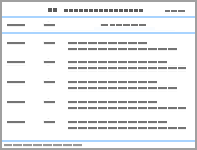
表1
作物籽粒、秸秆的养分含量[38-42]"
| 养分含量Nutrient content | 草谷比 Grass-to-grain ratio | ||||
|---|---|---|---|---|---|
| P (%) | K (%) | Ca (%) | Mg (%) | ||
| 水稻籽粒 Rice grain | 0.350 | 0.19 | 0.03 | 0.120 | 0.952 |
| 水稻秸秆 Rice straw | 0.176 | 1.90 | 0.54 | 0.212 | |
| 油菜籽粒 Rape seed | 1.470 | 7.77 | — | 0.940 | 2.212 |
| 油菜秸秆 Rape straw | 0.144 | 1.94 | 1.52 | 0.250 | |
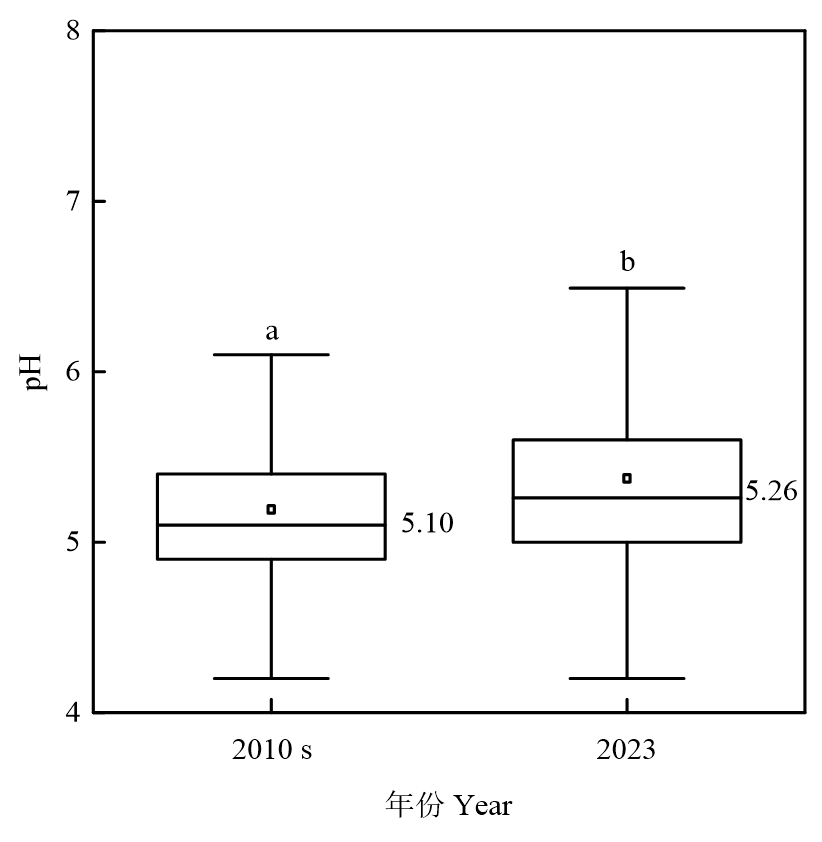
图1
江西省水田pH变化箱线图"

图2
江西省2010s(A)及2023年(B)水田土壤pH分布图"
表2
江西省2010s与2023年的pH分级及其面积占比"
| 分级Classification | 2010s (%) | 2023 (%) |
|---|---|---|
| <4.5 | 0.0 | 0.0 |
| 4.5—5.0 | 27.0 | 6.5 |
| 5.0—5.5 | 57.4 | 64.2 |
| 5.5—6.0 | 12.1 | 21.7 |
| 6.0—6.5 | 2.8 | 5.0 |
| 6.5—7.0 | 0.5 | 2.4 |
| 7.0—7.5 | 0.2 | 0.2 |
| >7.5 | 0.0 | 0.0 |
| 合计 Total | 100.0 | 100.0 |

图3
江西省水田土壤∆pH分布图(pH2023-pH2010s)"
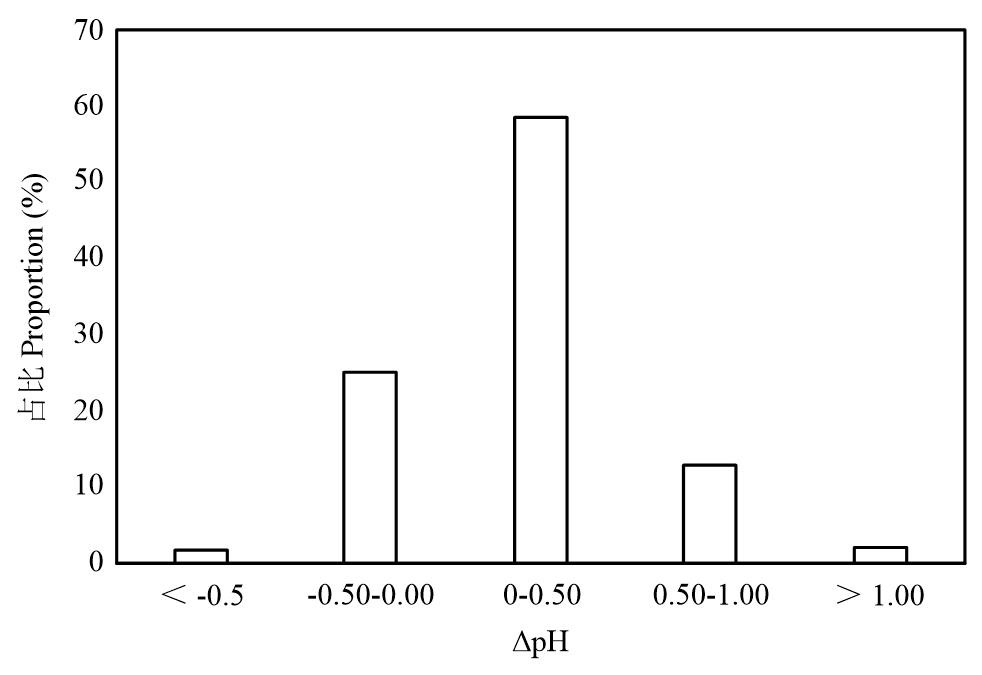
图4
江西2010s—2023年水田土壤∆pH变化及其面积占比"
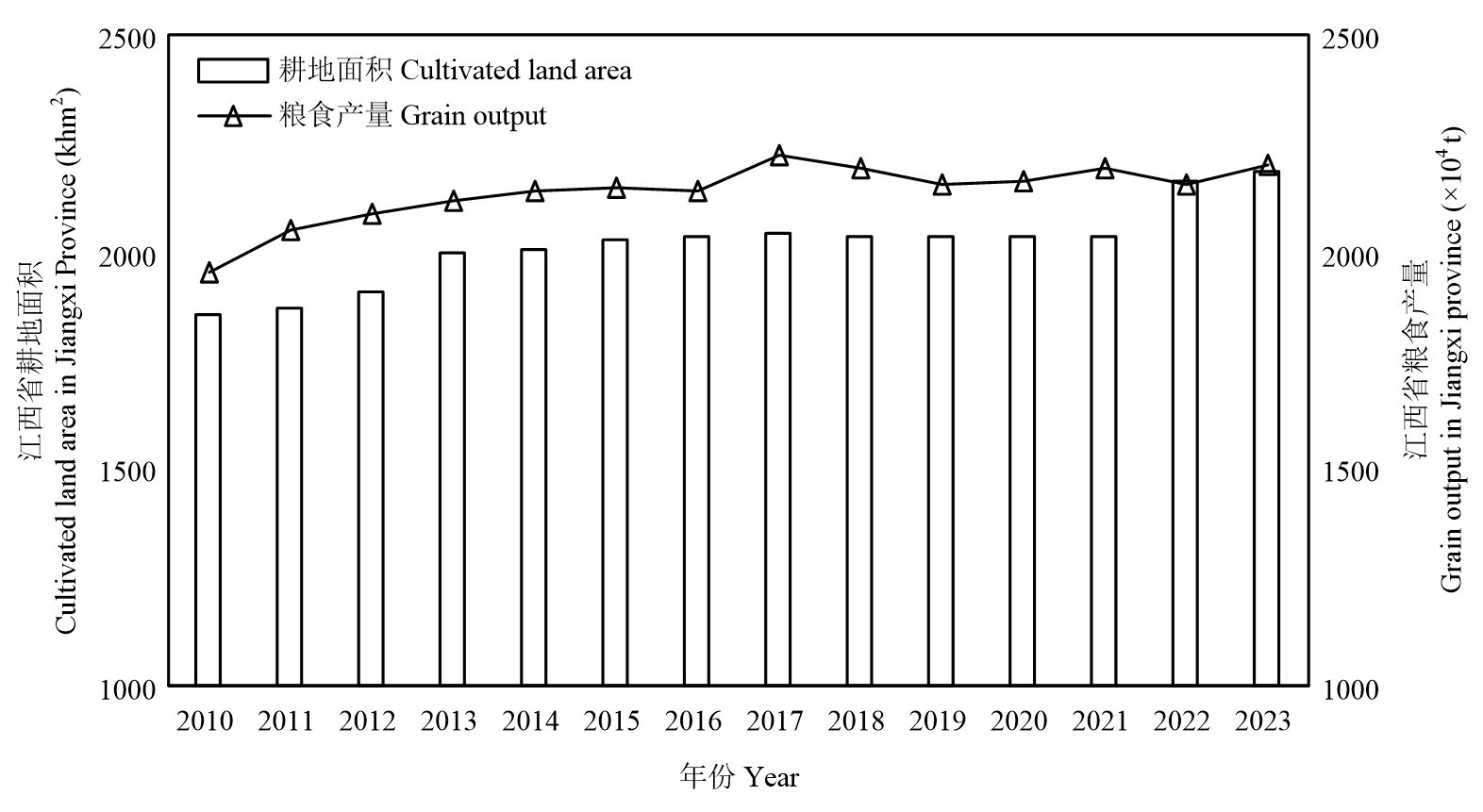
图5
江西省历年耕地面积及粮食产量"
表3
江西省历年氮肥、氮沉降量及氮循环中各过程的占比"
| 年份Year | 施氮量 N rate (kg·hm-2·a-1) | 氮沉降 N deposition (kg·hm-2·a-1) | NO3--N 淋洗 NO3--N leaching (%) | 秸秆含氮量 Straw N content (%) | 籽粒含氮量 Grain N content (%) | N2O (%) | 氨挥发 NH3 volatilization (%) | |||||
|---|---|---|---|---|---|---|---|---|---|---|---|---|
| 水稻 Rice | 油菜 Rape | 水稻 Rice | 油菜 Rape | 水稻 Rice | 油菜 Rape | 水稻 Rice | 油菜 Rape | 水稻 Rice | 油菜 Rape | |||
| 2010 | 275.51 | 39.18 | 3.03 | — | 1.20 | 0.87 | 1.21 | 8.67 | 0.72 | — | 17.08 | — |
| 2011 | 277.38 | 42.26 | 3.03 | — | 1.20 | 0.87 | 1.21 | 8.67 | 0.72 | — | 17.07 | — |
| 2012 | 267.78 | 41.89 | 3.00 | — | 1.20 | 0.87 | 1.21 | 8.67 | 0.71 | — | 17.11 | — |
| 2013 | 255.99 | 41.61 | 2.96 | — | 1.20 | 0.87 | 1.21 | 8.67 | 0.69 | — | 17.16 | — |
| 2014 | 253.75 | 38.72 | 2.96 | — | 1.20 | 0.87 | 1.21 | 8.67 | 0.69 | — | 17.17 | — |
| 2015 | 251.00 | 37.60 | 2.95 | — | 1.20 | 0.87 | 1.21 | 8.67 | 0.68 | — | 17.18 | — |
| 2016 | 244.75 | 37.32 | 2.94 | — | 1.20 | 0.87 | 1.21 | 8.67 | 0.67 | — | 17.21 | — |
| 2017 | 228.02 | 35.64 | 2.91 | 16.68 | 1.20 | 0.87 | 1.21 | 8.67 | 0.65 | 0.79 | 17.30 | 24.57 |
| 2018 | 206.47 | 35.83 | 2.90 | 15.04 | 1.20 | 0.87 | 1.21 | 8.67 | 0.63 | 0.77 | 17.44 | 24.63 |
| 2019 | 189.18 | 34.90 | 2.91 | 13.96 | 1.20 | 0.87 | 1.21 | 8.67 | 0.62 | 0.76 | 17.57 | 24.69 |
| 2020 | 177.76 | 33.40 | 2.93 | 13.34 | 1.20 | 0.87 | 1.21 | 8.67 | 0.62 | 0.76 | 17.67 | 24.73 |
| 2021 | 176.00 | 33.40 | 2.94 | 13.25 | 1.20 | 0.87 | 1.21 | 8.67 | 0.62 | 0.76 | 17.69 | 24.74 |
| 2022 | 163.63 | 33.40 | 2.98 | 12.69 | 1.20 | 0.87 | 1.21 | 8.67 | 0.61 | 0.76 | 17.82 | 24.79 |
| 2023 | 160.67 | 33.40 | 2.99 | 12.57 | 1.20 | 0.87 | 1.21 | 8.67 | 0.61 | 0.76 | 17.85 | 24.81 |
表4
水田中各作物致酸过程产H+量"
| 年份 Year | 氮循环 N cycling process | 盐基离子 BC uptake | 磷吸收 P uptake | |||
|---|---|---|---|---|---|---|
| 水稻Rice | 油菜Rape | 水稻Rice | 油菜Rape | 水稻Rice | 油菜Rape | |
| 2010 | 21.92 | — | 6.02 | — | -0.93 | — |
| 2011 | 22.08 | — | 6.32 | — | -0.98 | — |
| 2012 | 21.31 | — | 6.38 | —— | -0.99 | — |
| 2013 | 20.36 | — | 6.45 | — | -1.00 | — |
| 2014 | 20.17 | — | 6.52 | — | -1.01 | — |
| 2015 | 19.94 | — | 6.52 | — | -1.01 | — |
| 2016 | 19.44 | — | 6.52 | — | -1.01 | — |
| 2017 | 18.09 | 15.87 | 6.52 | 8.32 | -1.01 | -0.80 |
| 2018 | 16.37 | 14.06 | 6.54 | 8.61 | -1.02 | -0.83 |
| 2019 | 14.98 | 12.69 | 6.58 | 8.59 | -1.02 | -0.82 |
| 2020 | 14.06 | 11.82 | 6.40 | 8.58 | -0.99 | -0.82 |
| 2021 | 13.92 | 11.68 | 6.52 | 8.75 | -1.01 | -0.84 |
| 2022 | 12.94 | 10.76 | 6.43 | 9.07 | -1.00 | -0.87 |
| 2023 | 12.70 | 10.54 | 6.58 | 8.76 | -1.02 | -0.84 |
表5
江西省历年致酸因子产H+量及其贡献率"
| 年份 Year | H+产量H+ production (kmol·hm-2·a-1) | 贡献率Contribution rate (%) | H+产量H+ production (kmol·hm-2·a-1) | ||||||
|---|---|---|---|---|---|---|---|---|---|
| 氮循环 N cycling process | 盐基离子 BC uptake | 酸沉降 Acid deposition | 总H+产量 Total H+ | 氮循环 N cycling process | 盐基离子 BC uptake | 酸沉降 Acid deposition | 磷吸收 P uptake | 净H+产量 H+net | |
| 2010 | 21.92 | 6.02 | 0.04 | 27.98 | 78.3 | 21.5 | 0.1 | -0.93 | 27.04 |
| 2011 | 22.08 | 6.32 | 0.01 | 28.41 | 77.7 | 22.2 | 0.0 | -0.98 | 27.43 |
| 2012 | 21.31 | 6.38 | 0.03 | 27.72 | 76.9 | 23.0 | 0.1 | -0.99 | 26.73 |
| 2013 | 20.36 | 6.45 | 0.05 | 26.86 | 75.8 | 24.0 | 0.2 | -1.00 | 25.86 |
| 2014 | 20.17 | 6.52 | 0.01 | 26.69 | 75.6 | 24.4 | 0.0 | -1.01 | 25.68 |
| 2015 | 19.94 | 6.52 | 0.01 | 26.47 | 75.3 | 24.6 | 0.0 | -1.01 | 25.45 |
| 2016 | 19.44 | 6.52 | 0.00 | 25.97 | 74.9 | 25.1 | 0.0 | -1.01 | 24.95 |
| 2017 | 19.56 | 7.29 | 0.00 | 26.85 | 72.8 | 27.2 | 0.0 | -1.09 | 25.76 |
| 2018 | 17.69 | 7.35 | 0.00 | 25.04 | 70.6 | 29.4 | 0.0 | -1.09 | 23.94 |
| 2019 | 16.20 | 7.40 | 0.00 | 23.61 | 68.6 | 31.4 | 0.0 | -1.10 | 22.51 |
| 2020 | 15.15 | 7.20 | 0.00 | 22.35 | 67.8 | 32.2 | 0.0 | -1.07 | 21.28 |
| 2021 | 15.07 | 7.38 | 0.00 | 22.45 | 67.1 | 32.9 | 0.0 | -1.10 | 21.36 |
| 2022 | 14.04 | 7.36 | 0.00 | 21.41 | 65.6 | 34.4 | 0.0 | -1.09 | 20.32 |
| 2023 | 13.93 | 7.60 | 0.00 | 21.53 | 64.7 | 35.3 | 0.0 | -1.12 | 20.41 |
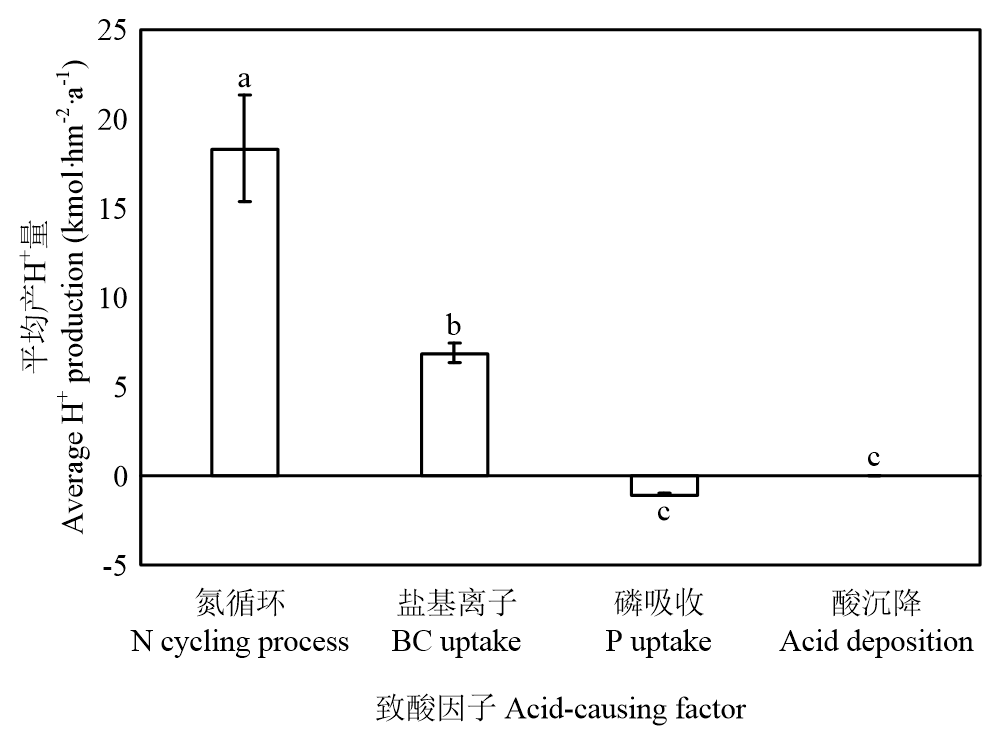
图6
各致酸因子的平均产H+量 图中不同小写字母表示各处理间存在显著差异(P<0.05),误差棒表示标准差。下同"
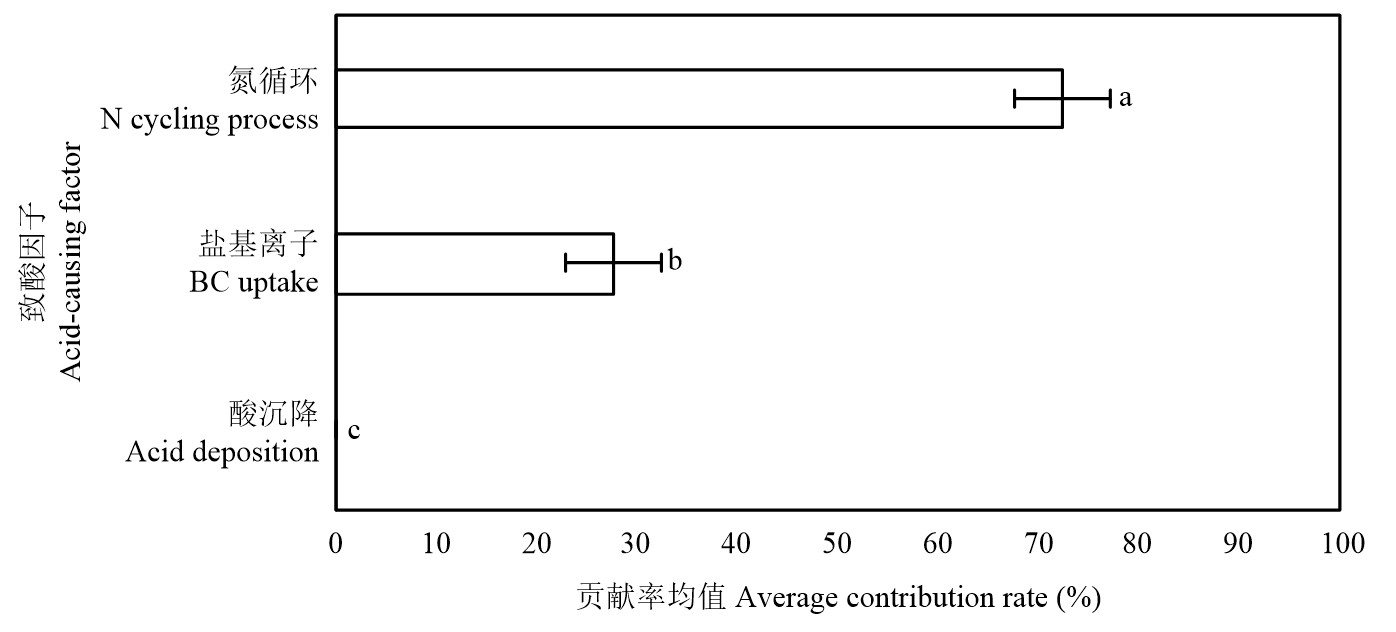
图7
致酸因子贡献率年均值"
| [1] |
徐仁扣. 土壤酸化及其调控研究进展. 土壤, 2015, 47(2): 238-244.
|
|
|
|
| [2] |
doi: 10.1186/s13568-018-0549-8 pmid: 29442257 |
| [3] |
|
| [4] |
周晓阳, 周世伟, 徐明岗, Colinet Gilles. 中国南方水稻土酸化演变特征及影响因素. 中国农业科学, 2015, 48(23): 4811-4817. doi: 10.3864/j.issn.0578-1752.2015.23.022.
|
|
|
|
| [5] |
苏亚飞, 包文彬, 李彦生, 于镇华, 刘晓冰. 农田土壤酸化: 原理、危害及缓解措施. 土壤与作物, 2025, 14(1): 1-14.
|
|
|
|
| [6] |
doi: 10.1007/s11368-013-0695-1 |
| [7] |
李梦妮, 吴鲁洁, 赵觅漾, 陈翰, 卢升高. 土壤调理剂阻控土壤酸化提高磷素养分有效性的田间对比试验. 浙江农业科学, 2024, 65(12): 2899-2905.
doi: 10.16178/j.issn.0528-9017.20230836 |
|
doi: 10.16178/j.issn.0528-9017.20230836 |
|
| [8] |
doi: 10.1038/ismej.2010.58 |
| [9] |
doi: 10.1088/1748-9326/ab239c |
| [10] |
杨歆歆, 赵庚星, 李涛, 万广华, 李萍. 山东省土壤酸化特征及其影响因素分析. 农业工程学报, 2016, 32(S2): 155-160.
|
|
|
|
| [11] |
doi: 10.1016/S0167-1987(98)00097-X |
| [12] |
doi: 10.1007/s11104-006-0027-y |
| [13] |
单彭义, 唐珍琦, 唐湘文, 杜辉辉, 朱捍华, 刘高翔, 周文博, 吴远帆, 周清. 湖南省耕地土壤酸化现状与综合治理对策研究. 中国农业综合开发, 2025(3): 19-24.
|
|
|
|
| [14] |
徐仁扣, 李九玉, 周世伟, 徐明岗, 沈仁芳. 我国农田土壤酸化调控的科学问题与技术措施. 中国科学院院刊, 2018, 33(2): 160-167.
|
|
|
|
| [15] |
姜冠杰, 何小林, 刘敏, 张嵚, 谢军, 张小玲, 黄琳翔, 梁丰. 江西省主要土地利用方式下土壤酸化现状探究. 江西农业学报, 2021, 33(5): 46-55.
|
|
|
|
| [16] |
蔡祥. 农田建设管理处. 江西省农业农村厅公告(第9号). (2024-12-30) [2025-05-04]. https://nync.jiangxi.gov.cn/jxsnynct/tzgg/content/content_1888855768969814016.html.
|
|
|
|
| [17] |
陈正, 杨翠翠, 李轶男, 沐青, 胡克林, 张超. 我国耕地酸化的成因及治理措施分析. 农村工作通讯, 2024(22): 28-30.
|
|
|
|
| [18] |
杨帆, 贾伟, 杨宁, 李文西, 段英华, 胡炎, 崔勇. 近30年我国不同地区农田耕层土壤的pH变化特征. 植物营养与肥料学报, 2023, 29(7): 1213-1227.
|
|
|
|
| [19] |
|
| [20] |
洪国胜. 土壤酸化原因、阻控技术及改良策略分析. 安徽农学通报, 2025, 31(3): 80-84.
doi: 10.16377/j.cnki.issn1007-7731.2025.03.018 |
|
doi: 10.16377/j.cnki.issn1007-7731.2025.03.018 |
|
| [21] |
doi: 10.1016/j.soilbio.2012.06.011 |
| [22] |
高建峰, 徐明芳, 丁瑞芬, 韩国新, 陈雪民, 莫美英. 土壤酸化的原因、危害与治理对策分析. 上海农业科技, 2015(2): 102-104.
|
|
|
|
| [23] |
孟红旗, 刘景, 徐明岗, 吕家珑, 周宝库, 彭畅, 石孝均, 黄庆海, 王伯仁. 长期施肥下我国典型农田耕层土壤的pH演变. 土壤学报, 2013, 50(6): 1109-1116.
|
|
|
|
| [24] |
汪吉东, 许仙菊, 宁运旺, 张辉, 马洪波, 张永春. 土壤加速酸化的主要农业驱动因素研究进展. 土壤, 2015, 47(4): 627-633.
|
|
|
|
| [25] |
doi: 10.1007/BF00290937 |
| [26] |
doi: 10.1007/s11356-015-5673-2 |
| [27] |
doi: 10.1016/j.scitotenv.2004.03.035 |
| [28] |
徐影, 于镇华, 李彦生, 包文彬, 张春雨, 刘晓冰. 土壤酸化成因及其对农田土壤-微生物-作物系统影响的研究进展. 土壤通报, 2024, 55(2): 562-572.
|
|
|
|
| [29] |
doi: 10.1016/j.atmosenv.2016.07.018 |
| [30] |
doi: S0269-7491(17)30111-2 pmid: 28800487 |
| [31] |
潘根兴, 冉炜. 中国大气酸沉降与土壤酸化问题. 热带亚热带土壤科学, 1994, 3(4): 243-252.
|
|
|
|
| [32] |
杨金玲, 董岳, 冯文澜, 张昊哲, 张甘霖. 红壤关键带质子产生和消耗及其环境效应综述. 地学前缘, 2025, 32(3): 231-247.
doi: 10.13745/j.esf.sf.2025.3.27 |
|
doi: 10.13745/j.esf.sf.2025.3.27 |
|
| [33] |
doi: 10.1007/s11368-012-0514-0 |
| [34] |
江西省统计局, 国家统计局江西调查总队. 江西统计年鉴(2011-2024). 北京: 中国统计出版社有限公司, 2025.
|
|
Jiangxi Provincial Bureau of Statistics, National Bureau of Statistics Jiangxi Investigation Team. Jiangxi Statistical Yearbook (2011-2024). Beijing: China Statistics Press Co, Ltd, 2025. (in Chinese)
|
|
| [35] |
吴仪, 谢云霄, 王婧伊, 吴志昆, 侯志洁, 蓝海林, 刘声琦, 蔡琳琳, 杨鑫, 阙正扬, 等. 2010—2023年江西省审定晚稻品种及其性状分析. 江西农业大学学报, 2025, 47(1): 10-20.
|
|
doi: 10.3724/aauj.2025002 |
|
| [36] |
中华人民共和国国家统计局. 中国统计年鉴. 北京: 中国统计出版社, 2024.
|
|
National Bureau of Statistics of the People's Republic of China. China Statistical Yearbook. Beijing: China Statistics Press, 2024. (in Chinese)
|
|
| [37] |
江西省稻油轮作高效栽培技术. (2023-04-26) [2025-08-01]. https://nync.jiangxi.gov.cn/jxsnynct/tgfw/content/content_1869622027362689024.html.
|
|
Efficient Cultivation Techniques for Rice-Wheat Rotation in Jiangxi Province.(2023-04-26) [2025-08-01]. https://nync.jiangxi.gov.cn/jxsnynct/tgfw/content/content_1869622027362689024.html. in Chinese)
|
|
| [38] |
石金明, 范敏, 席细平, 王贺礼, 万斌. 江西省秸秆资源量分析. 能源研究与管理, 2012(1): 1-4, 23.
|
|
|
|
| [39] |
全国农业技术推广服务中心. 中国有机肥料养分志. 北京: 中国农业出版社, 1999.
|
|
National Agro-tech Extension and
|
|
| [40] |
李小坤. 水稻营养特性及科学施肥. 北京: 中国农业出版社, 2016.
|
|
|
|
| [41] |
鲁如坤, 谢建昌, 蔡贵信, 朱其清, 宣家祥, 范晓辉, 施维明, 时正元, 苏彦华. 土壤-植物营养学原理和施肥. 北京: 化学工业出版社, 1998.
|
|
|
|
| [42] |
周海燕, 徐明岗, 蔡泽江, 文石林, 吴红慧. 湖南祁阳县土壤酸化主要驱动因素贡献解析. 中国农业科学, 2019, 52(8): 1400-1412. doi: 10.3864/j.issn.0578-1752.2019.08.010.
|
|
|
|
| [43] |
江西省生态环境厅. 江西省生态环境状况公报. (2024-05-29). [2025-05-04]. https://sthjt.jiangxi.gov.cn/col/col42073/index.html.
|
|
Department of Ecology and Environment of Jiangxi Province. The ecological environment in Jiangxi province bulletin. (2024-05-29). [2025-05-04]. https://sthjt.jiangxi.gov.cn/col/col42073/index.html. in Chinese)
|
|
| [44] |
doi: 10.1038/s41561-024-01484-4 |
| [45] |
赵小敏, 梁丰, 邵华. 江西省耕地质量长期定位监测报告 2023年度. 南昌: 中国农业科学技术出版社, 2024.
|
|
|
|
| [46] |
doi: 10.1021/es5007127 |
| [47] |
doi: 10.1016/j.eja.2025.127783 |
| [48] |
张福锁. 我国农田土壤酸化现状及影响. 民主与科学, 2016(6): 26-27.
|
|
|
|
| [49] |
刘增兵, 束爱萍, 刘光荣, 李祖章, 袁福生, 胡启锋. 江西省双季稻氮肥用量研究. 江西农业学报, 2015, 27(6): 102-105.
|
|
|
|
| [50] |
doi: 10.1038/s41598-018-20873-5 pmid: 29426950 |
| [51] |
武菲, 赵彦锋, 张水清, 柳开楼, 韩天富. 农田土壤酸化成因及防治措施分析与展望. 环境科学. 2025. https://link.cnki.net/doi/10.13227/j.hjkx.202412155.
|
|
|
|
| [52] |
王玲玲. 《江西省贯彻落实加强耕地保护意见工作方案》解读. 当代农机, 2024(2): 87-89.
|
|
|
|
| [53] |
省农业农村厅种植业管理处. 关于印发《江西省到2025年化肥减量化行动实施方案》和《江西省到2025年化学农药减量化行动实施方案》的通知. (2023-04-03) [2025-05-04]. https://nync.jiangxi.gov.cn/jxsnynct/zcwj1181/pc/content/content_1875388615604510732.html.
|
|
Planting Management Office, Provincial Department of Agriculture and Rural Affairs. About printing and distributing "in Jiangxi province to 2025 fertilizer reduction action plan" and "in Jiangxi province in 2025 to chemical pesticide reduction action plan for the notification. (2023-04-03) [2025-05-04]. https://nync.jiangxi.gov.cn/jxsnynct/zcwj1181/pc/content/content_1875388615604510732.html. in Chinese)
|
|
| [54] |
李松兴, 陈聪聪. 氮肥对环境的影响及防治. 科技资讯, 2013, 11(16): 130.
|
|
|
|
| [55] |
国家粮食和物资储备局. 粮食安全省长责任制考核工作简报第105期. (2019-07-11) [2025-05-04]. https://www.lswz.gov.cn/html/ywpd/zfdc/2019-07/11/content_245457.shtml.
|
|
National Food and Strategic Reserves Administration. Brief Report on the Assessment of the Provincial Governor's Responsibility System for Food Security 105. (2019-07-11) [2025-05-04]. https://www.lswz.gov.cn/html/ywpd/zfdc/2019-07/11/content_245457.shtml in Chinese)
|
|
| [56] |
范利. 绿色种养循环技术. (2024-03-05) [2025-05-04]. https://nync.jiangxi.gov.cn/jxsnynct/tgfw/content/content_1878760087557996544.html.
|
|
|
|
| [57] |
pmid: 12146650 |
| [58] |
doi: 10.1016/0038-0717(95)00180-8 |
| [59] |
韩天富, 柳开楼, 黄晶, 马常宝, 郑磊, 王慧颖, 曲潇林, 任意, 于子坤, 张会民. 近30年中国主要农田土壤pH时空演变及其驱动因素. 植物营养与肥料学报, 2020, 26(12): 2137-2149.
|
|
|
|
| [60] |
吴玉川. 保护地有机肥料的科学施用. 现代园艺, 2014(9): 36-38, 44.
|
|
|
|
| [61] |
农田建设管理司. 农业农村部办公厅关于开展酸化耕地治理重点县建设的通知. (2023-05-08) [2025-05-04]. http://www.ntjss.moa.gov.cn/tzgg/202305/t20230508_6427010.htm.
|
|
Department of Farmland Construction Management. Agricultural office notice about to carry out the acidification of the cultivated land management of the construction of the key. (2023-05-08) [2025- 05-04]. http://www.ntjss.moa.gov.cn/tzgg/202305/t20230508_6427010.htm. in Chinese)
|
|
| [62] |
江西省农业技术推广中心. 统筹联动技术支撑强化监管江西省扎实开展酸化耕地治理工作. 中国农业综合开发, 2024(8): 6-7.
|
|
Jiangxi Provincial Agricultural Technology Promotion Center. Overall planning, linkage and technical support, strengthening supervision, and solidly carrying out the treatment of acidified cultivated land in Jiangxi Province. Agricultural Comprehensive Development in China, 2024(8): 6-7. (in Chinese)
|
|
| [63] |
doi: 10.1021/je200062j |
| [64] |
doi: 10.1007/s12665-013-2410-3 |
| [65] |
doi: 10.1016/j.still.2019.104382 |
| [66] |
胡晓军, 李玉兰, 王洋, 饶黎黎. 江西峡江: 治理酸化土壤实现藏粮于地. 中国农业综合开发, 2025(4): 17-18.
|
|
|
|
| [67] |
宋文峰, 王超, 陈荣府, 文石林, 王伯仁, 沈仁芳. 长期不同施肥下小麦离子吸收对土壤酸化贡献能力的比较. 土壤, 2017, 49(1): 7-12.
|
|
|
|
| [68] |
doi: 10.1071/SR12099 |
| [69] |
赵学强, 潘贤章, 马海艺, 董晓英, 车景, 王超, 时玉, 柳开楼, 沈仁芳. 中国酸性土壤利用的科学问题与策略. 土壤学报, 2023, 60(5): 1248-1263.
|
|
|
| [1] | 温玉斌, 白珊珊, 蔡泽江, 孙楠, 徐明岗. 有机物料对土壤微生物量的影响及其酸度调节机理[J]. 中国农业科学, 2026, 59(4): 834-849. |
| [2] | 王胜楠, 高茂盛, 韩婉瑞, 冯浩伟, 林祥, 王东. 气候变暖对农业气候分界线时空变化的影响[J]. 中国农业科学, 2026, 59(10): 2138-2153. |
| [3] | 佘文婷, 孙蕊卿, 党海燕, 李文虎, 张丰, 田怡, 徐隽峰, 丁玉兰, 王朝辉. 我国主要麦区农户小麦籽粒硫的含量、分布及影响因素[J]. 中国农业科学, 2025, 58(5): 956-974. |
| [4] | 孙蕊卿, 党海燕, 佘文婷, 王星舒, 褚宏欣, 王涛, 丁玉兰, 罗一诺, 徐隽峰, 李小涵, 王朝辉. 影响我国主要麦区小麦籽粒和面粉锌含量的产量构成要素与土壤肥力因素[J]. 中国农业科学, 2025, 58(2): 291-306. |
| [5] | 李艾雯, 成金礼, 陈丹, 陈鑫怡, 毛雅若, 李启权. 基于数据填补的四川盆地耕地表层土壤无机碳时空变化特征[J]. 中国农业科学, 2025, 58(14): 2838-2853. |
| [6] | 张俊峰, 丁建成, 翁煜炜, 张雄. 基于地貌分区的湖北省粮食生产格局与耕地资源匹配关系研究[J]. 中国农业科学, 2024, 57(9): 1748-1765. |
| [7] | 朱瑞明, 赵荣钦, 焦士兴, 李小建, 肖连刚, 谢志祥, 杨青林, 王帅, 张慧芳. 河南省乡镇尺度冬小麦灌溉碳排放强度空间格局及影响因素分析[J]. 中国农业科学, 2024, 57(5): 950-964. |
| [8] | 邱海华, 蒯磊鑫, 张璐, 刘立生, 文石林, 蔡泽江. 水田改旱地和菜地后红壤酸度和养分变化特征[J]. 中国农业科学, 2024, 57(3): 525-538. |
| [9] | 冀建华, 吕真真, 刘淑珍, 侯红乾, 刘益仁, 刘秀梅, 李絮花, 蓝贤瑾. 长期施用化肥对南方稻田土壤酸化和盐基离子损失的影响[J]. 中国农业科学, 2024, 57(13): 2599-2611. |
| [10] | 李亚贞, 韩天富, 曲潇琳, 马常宝, 都江雪, 柳开楼, 黄晶, 刘淑军, 刘立生, 申哲, 张会民. 我国水稻的肥料贡献率时空变化及影响因素[J]. 中国农业科学, 2023, 56(4): 674-685. |
| [11] | 刘淑军, 李冬初, 黄晶, 曲潇林, 马常宝, 王慧颖, 于子坤, 张璐, 韩天富, 柳开楼, 申哲, 张会民. 近30年来我国小麦和玉米秸秆资源时空变化特征及还田减肥潜力[J]. 中国农业科学, 2023, 56(16): 3140-3155. |
| [12] | 陈杨,徐孟泽,王玉红,白由路,卢艳丽,王磊. 有效积温与不同供氮水平夏玉米干物质和氮素积累定量化研究[J]. 中国农业科学, 2022, 55(15): 2973-2987. |
| [13] | 李方杰,任建强,吴尚蓉,陈仲新,张宁丹. 河南省冬小麦种植频率时空变化及影响因素分析[J]. 中国农业科学, 2020, 53(9): 1773-1794. |
| [14] | 李亚林,张旭博,任凤玲,孙楠,徐梦,徐明岗. 长期施肥对中国农田土壤溶解性有机碳氮含量影响的整合分析[J]. 中国农业科学, 2020, 53(6): 1224-1233. |
| [15] | 王鸣雷,史文娇. 中国北方新增耕地的时空变化及驱动因素分区[J]. 中国农业科学, 2020, 53(12): 2435-2449. |
|
||
