






中国农业科学 ›› 2026, Vol. 59 ›› Issue (1): 147-160.doi: 10.3864/j.issn.0578-1752.2026.01.011
陆浩1( ), 张明龙1, 韩梅2, 严清彪2, 李正鹏2, 殷文1, 樊志龙1, 胡发龙1(), 柴强1()
收稿日期:2025-01-24
接受日期:2025-05-07
出版日期:2026-01-07
发布日期:2026-01-07
通信作者:
联系方式:
陆浩,E-mail:lh3033346785@163.com。
基金资助:
LU Hao1(), ZHANG MingLong1, HAN Mei2, YAN QingBiao2, LI ZhengPeng2, YIN Wen1, FAN ZhiLong1, HU FaLong1(), CHAI Qiang1()
Received:2025-01-24
Accepted:2025-05-07
Published:2026-01-07
Online:2026-01-07
摘要:
【目的】针对青海高原小麦生产中有机质投入匮乏、氮肥依赖程度高等问题,探究麦后复种绿肥不同还田方式及氮肥减施对小麦产量和土壤质量的影响,以期为该区小麦高效可持续生产提供理论依据和实践指导。【方法】研究于2022—2023年在青海大学农林科学院试验地进行,采用裂区试验设计,主区设小麦季3个施氮水平:常规施氮(225 kg·hm-2,N2)、减施氮肥30%(158 kg·hm-2,N1)和不施氮(N0);副区为上一年度绿肥3种还田方式:地上部移除仅根茬还田(RR)、地上部过腹联合根茬还田(SDRR)、全量还田(OSRR)。【结果】氮肥减施30%+绿肥地上部过腹联合根茬还田处理(N1SDRR)的土壤有机质、全氮、铵态氮、速效磷、速效钾含量与常规施氮+绿肥地上部过腹联合根茬还田(N2SDRR)无显著差异,较氮肥减施30%+绿肥全量还田(N1OSRR)各指标提高10.3%、8.6%、23.8%、9.1%、8.4%;N1SDRR处理土壤硝态氮含量较N2SDRR和N1OSRR处理降低4.4%和11.3%;N1SDRR处理的土壤碱性磷酸酶、蔗糖酶、脲酶活性与N2SDRR无显著差异,较N1OSRR各指标提高8.5%、10.2%、3.7%,但土壤过氧化氢酶活性较N2SDRR和N1OSRR处理降低7.1%和10.0%。N1SDRR处理的土壤质量指数最高(0.79),与N2SDRR处理无显著差异,较N1OSRR显著提高72.0%。此外,SDRR显著提高小麦籽粒产量,较RR和OSRR分别提高28.1%和7.3%,且氮肥减施30%后未出现减产。线性回归分析表明,土壤质量指数与产量之间表现为显著正相关。随机森林模型表明,影响土壤质量指数的主要因子是土壤有机质、速效磷、铵态氮和全氮,影响小麦籽粒产量的主要因子是土壤有机质、全氮、铵态氮、速效磷和脲酶活性。【结论】氮肥减施30%条件下,绿肥地上部过腹联合根茬还田通过降低土壤容重,提高土壤有机质、全氮、铵态氮、速效磷、速效钾含量及碱性磷酸酶、脲酶、蔗糖酶活性,有效提升土壤质量,进而提高小麦籽粒产量,是该区小麦可持续生产的适宜管理措施。
陆浩, 张明龙, 韩梅, 严清彪, 李正鹏, 殷文, 樊志龙, 胡发龙, 柴强. 绿肥过腹还田协同氮肥减施提高小麦产量和土壤质量[J]. 中国农业科学, 2026, 59(1): 147-160.
LU Hao, ZHANG MingLong, HAN Mei, YAN QingBiao, LI ZhengPeng, YIN Wen, FAN ZhiLong, HU FaLong, CHAI Qiang. Green Manure Returning via Sheep Digest with Nitrogen Fertilizer Reduction are Beneficial to Improve Wheat Yield and Soil Quality at Qinghai-Tibet Plateau[J]. Scientia Agricultura Sinica, 2026, 59(1): 147-160.
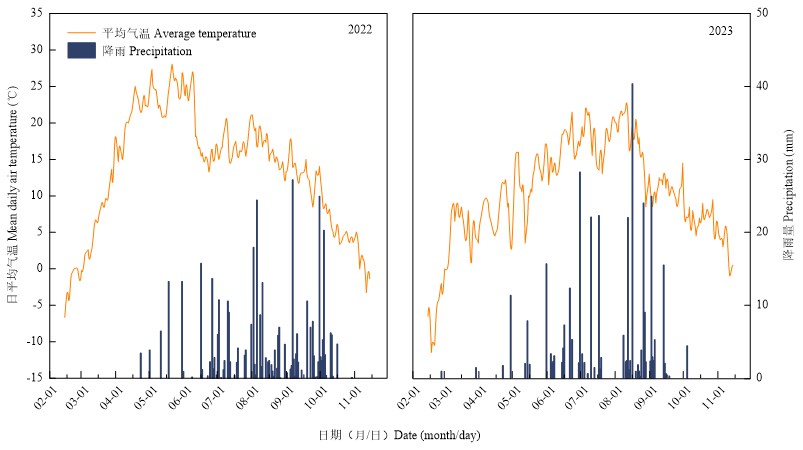
图1
试区2022—2023年逐日平均气温及降水量"
表1
不同处理绿肥干鲜重"
| 处理 Treatment | 2022 | 2023 | |||
|---|---|---|---|---|---|
| 鲜重 Fresh weight | 干重 Dry weight | 鲜重 Fresh weight | 干重 Dry weight | ||
| N2 | RR | 14933 d | 5988 c | 15218 c | 6391 b |
| SDRR | 16288 a | 6924 a | 16806 a | 7450 a | |
| OSRR | 15803 b | 6972 a | 16470 ab | 7237 a | |
| N1 | RR | 13466 f | 5575 d | 13752 e | 5817 c |
| SDRR | 16022 a | 6651 ab | 16138 b | 6780 b | |
| OSRR | 15355 c | 6284 b | 15425 c | 6301 b | |
| N0 | RR | 12933 g | 5432 d | 13120 e | 5420 d |
| SDRR | 13911 e | 5842 c | 14025 d | 5974 c | |
| OSRR | 13266 f | 5585 d | 13436 e | 5490 d | |
表2
绿肥干草基本养分含量"
| 年份 Year | 全碳Total C (%) | 全氮 Total N (%) | 全磷 Total P (%) | 全钾Total K (%) |
|---|---|---|---|---|
| 2022 | 47.36 | 3.31 | 0.27 | 3.20 |
| 2023 | 48.37 | 3.37 | 0.25 | 3.34 |
表3
供试腐熟羊粪基本养分含量"
| 年份 Year | 有机质 Organic matter (%) | 全氮 Total N (%) | 全磷 Total P (%) | 全钾 Total K (%) |
|---|---|---|---|---|
| 2022 | 50.82 | 1.46 | 0.44 | 0.32 |
| 2023 | 51.33 | 1.44 | 0.43 | 0.31 |
表4
年份、施氮水平及绿肥还田方式对土壤理化特性的交互分析"
| 容重 BD | 酸碱度 pH | 有机质 SOM | 全氮 TN | 铵态氮 NH4+-N | 硝态氮 NO3--N | 速效磷 AP | 速效钾 AK | |
|---|---|---|---|---|---|---|---|---|
| 年份Year, Y | ns | * | ** | ** | ** | ** | ** | ** |
| 施氮水平 N fertilizer application rates, N | ns | * | ** | ** | ** | ** | ** | ** |
| 绿肥还田方式 Green manure returning method, G | * | * | ** | ** | * | ** | ** | ** |
| 年份×施氮水平 Y×N | ns | ns | ns | ns | ns | ns | ns | ns |
| 年份×绿肥还田方式 Y×G | ns | ns | ns | ns | ns | ns | ns | ns |
| 施氮水平×绿肥还田方式 N×G | ns | ns | ** | * | * | ** | ** | * |
| 年份×施氮水平×绿肥还田方式 Y×N×G | ns | ns | ns | ns | ns | ns | ns | ns |
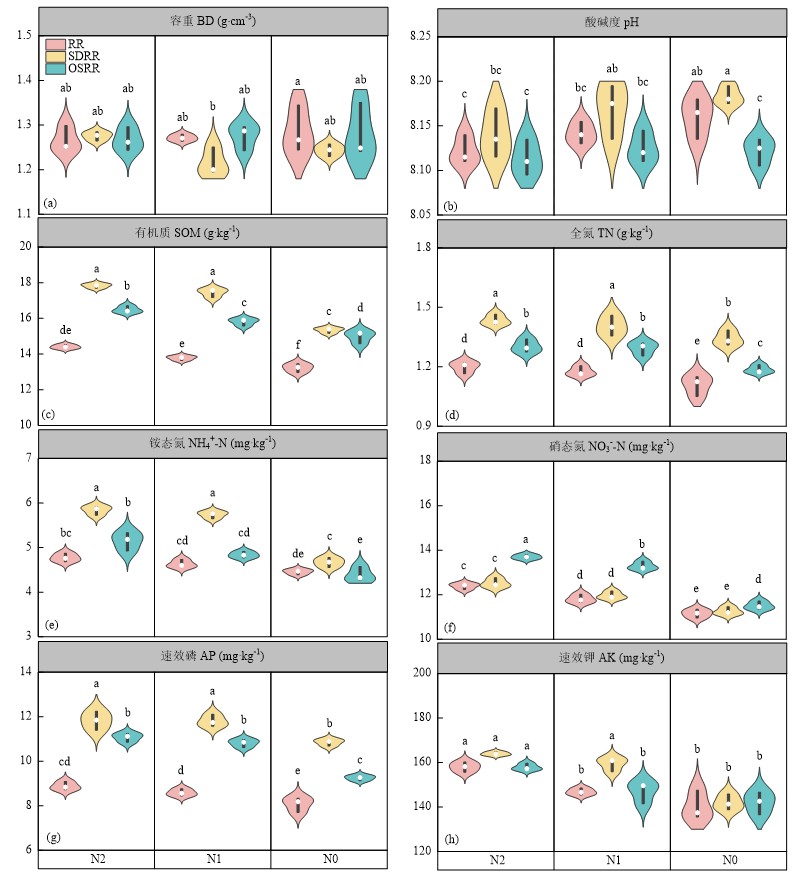
图2
施氮水平及不同还田方式对土壤理化指标的影响 不同小写字母代表处理间具有显著差异(P<0.05)。下同"
表5
年份、施氮水平及绿肥还田方式对土壤生物指标的交互分析"
| ALP | URE | SUC | CAT | |
|---|---|---|---|---|
| 年份 Year, Y | * | ** | ** | ** |
| 施氮水平N fertilizer application rates, N | ** | ** | ** | ** |
| 绿肥还田方式Green manure returning method, G | ** | ** | ** | ** |
| 年份×施氮水平Y×N | ns | ** | ns | ** |
| 年份×绿肥还田方式Y×G | ns | ns | ns | ns |
| 施氮水平×绿肥还田方式 N×G | ns | ** | ns | ** |
| 年份×施氮水平×绿肥还田方式 Y×N×G | ns | ns | ns | ns |
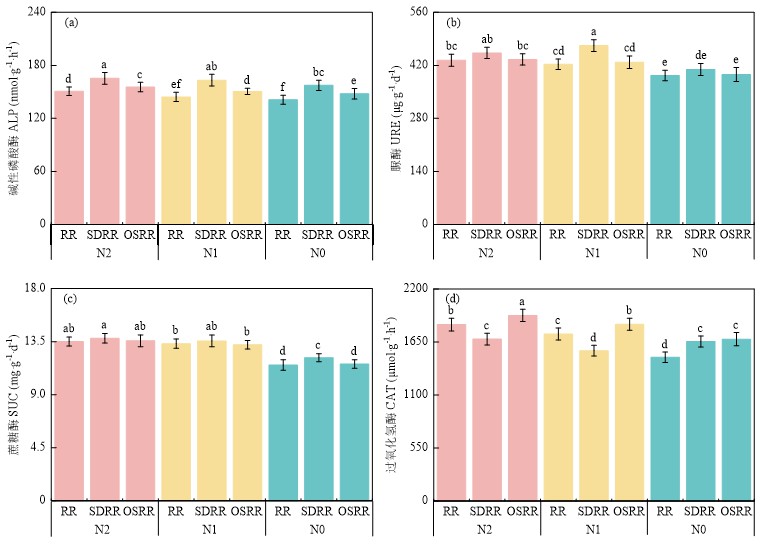
图3
施氮水平及不同还田方式对土壤生物学指标的影响"
表6
各指标公因子方差、权重及指标得分"
| BD | pH | SOM | TN | NH4+-N | NO3--N | AP | AK | ALP | SUC | URE | CAT | |
|---|---|---|---|---|---|---|---|---|---|---|---|---|
| 公因子方差Communality | 0.18 | 0.52 | 0.89 | 0.83 | 0.83 | 0.87 | 0.81 | 0.73 | 0.85 | 0.79 | 0.79 | 0.76 |
| 权重Weight | 0.02 | 0.06 | 0.10 | 0.09 | 0.09 | 0.10 | 0.09 | 0.08 | 0.10 | 0.09 | 0.09 | 0.09 |
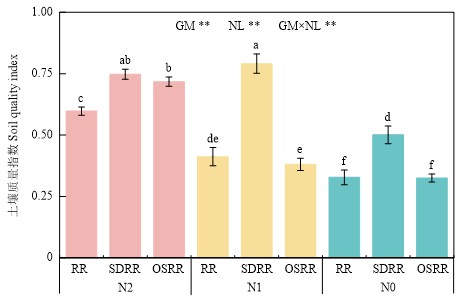
图4
施氮水平及不同还田方式对土壤质量指数的影响 GM代表绿肥还田方式;NL代表施氮水平。下同"
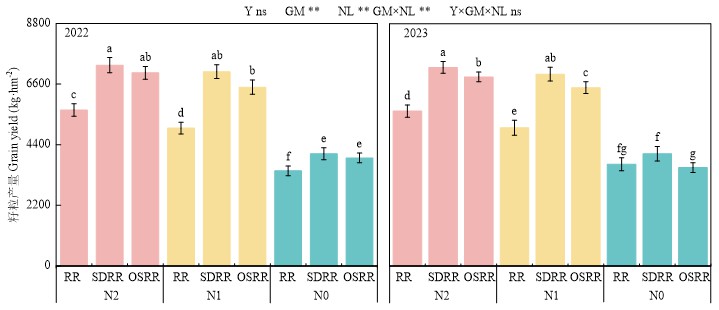
图5
施氮水平及不同还田方式对小麦产量的影响"
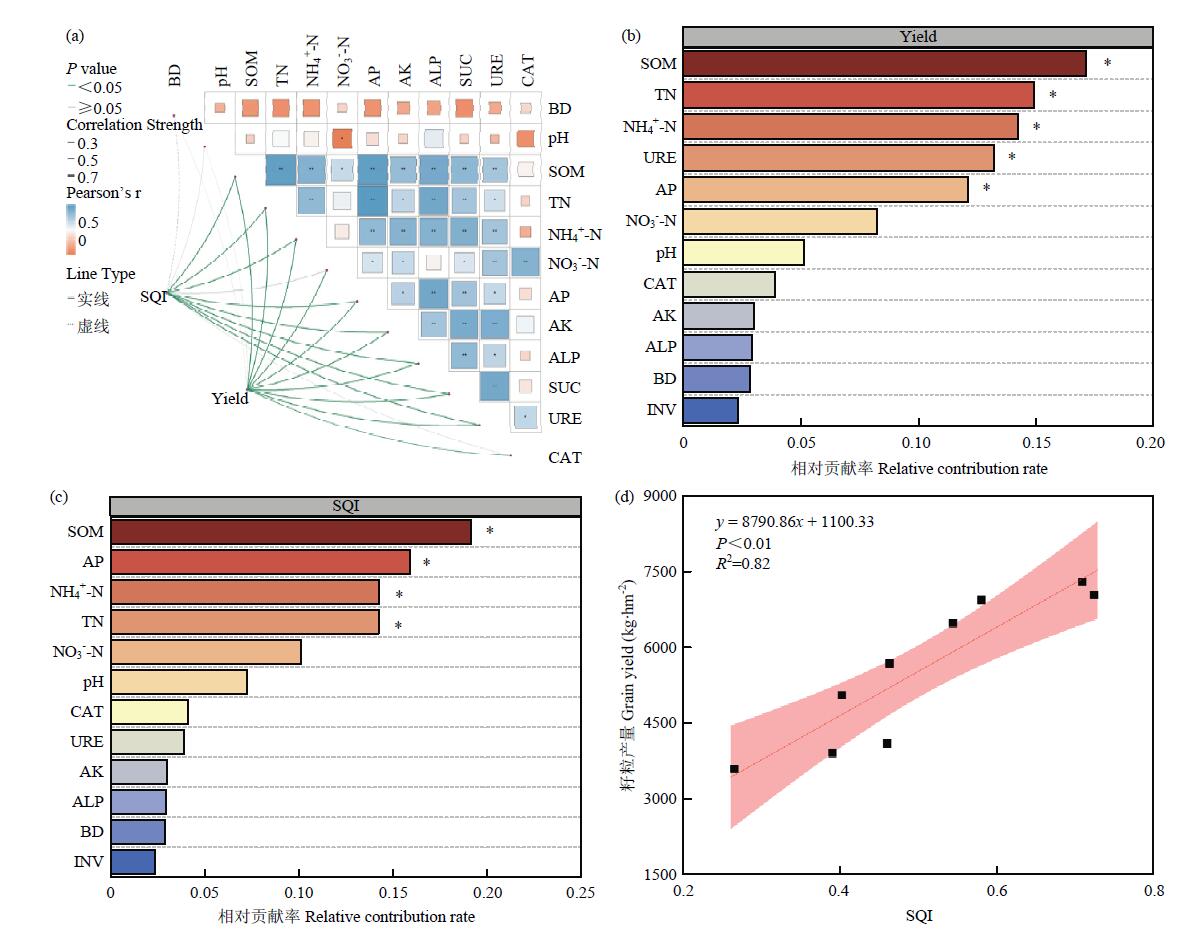
图6
减氮及不同还田方式下土壤质量与小麦产量相关性及随机森林分析 图(a)为籽粒产量和土壤质量指数与土壤指标的曼特尔检验,线条的宽度和细度表明了产量及土壤质量指数与土壤因子之间关系的强弱;实线代表正相关,虚线代表负相关;方格的颜色表示土壤因子之间的相关性;图(b)为产量的随机森林分析;图(c)为土壤质量指数的随机森林分析;图(d)为小麦籽粒产量与土壤质量指数的一元线性回归,通过2年籽粒平均产量与土壤质量指数进行一元线性回归分析"
| [1] |
肖倩, 武升, 刘莹, 曹迟, 廖霞, 马友华. 不同有机养分替代化肥对小麦产量、氮肥利用率及土壤肥力的影响. 农业环境科学学报, 2023, 42(10): 2291-2300.
|
|
|
|
| [2] |
秦文利, 智健飞, 谢楠, 张立锋, 刘忠宽, 刘振宇, 冯伟, 潘璇, 代云霞. 绿肥部分替代化肥对玉米干物质积累与产量形成的影响. 中国农业科学, 2024, 57(13): 2549-2567. doi: 10.3864/j.issn.0578-1752.2024.13.005.
|
|
|
|
| [3] |
赵娜, 王小利, 何进, 杨胜美, 郑钦文, 李明瑞. 有机肥替代化学氮肥对黄壤活性有机碳组分、酶活性及作物产量的影响. 环境科学, 2024, 45(7): 4196-4205.
|
|
|
|
| [4] |
尚永盼, 于爱忠, 王玉珑, 王鹏飞, 李悦, 柴健, 吕汉强, 杨学慧, 王凤. 绿洲灌区绿肥还田利用方式对玉米干物质积累、分配及产量的影响. 作物学报, 2024, 50(3): 686-694.
doi: 10.3724/SP.J.1006.2024.33031 |
|
doi: 10.3724/SP.J.1006.2024.33031 |
|
| [5] |
doi: 10.1016/j.ecolind.2013.04.011 |
| [6] |
doi: 10.1016/j.still.2017.03.005 |
| [7] |
吕奕彤, 于爱忠, 吕汉强, 王玉珑, 苏向向, 柴强. 绿洲灌区玉米农田土壤团聚体组成及其稳定性对绿肥还田方式的响应. 中国生态农业学报(中英文), 2021, 29(7): 1194-1204.
|
|
|
|
| [8] |
邢锦城, 洪立洲, 朱小梅, 刘冲, 董静, 王建红, 韩建均, 张振华. 施氮对田菁翻压还田滩涂盐渍土碳氮及细菌群落结构的影响. 土壤, 2024, 56(1): 82-89.
|
|
|
|
| [9] |
张少宏, 王俊, 方震文, 付鑫. 冬季绿肥对黄土高原旱作春玉米农田土壤温室气体排放的影响. 环境科学, 2022, 43(9): 4848-4857.
|
|
|
|
| [10] |
刘瑞, 张宇亭, 王志超, 张学良, 谢军, 张建伟, 徐文静, 石孝均. 绿肥覆盖对紫色土坡耕地柑橘园氮磷流失的阻控效应研究. 水土保持学报, 2021, 35(2): 68-74.
|
|
|
|
| [11] |
张学良, 张宇亭, 刘瑞, 谢军, 张建伟, 徐文静, 石孝均. 绿肥不同还田方式对土壤温室气体排放的影响. 草业学报, 2021, 30(5): 25-33.
doi: 10.11686/cyxb2020431 |
|
|
|
| [12] |
张浪, 周玲红, 魏甲彬, 成小琳, 徐华勤, 肖志祥, 唐启源, 唐剑武. 冬季种养结合对双季稻生长与土壤肥力的影响. 中国水稻科学, 2018, 32(3): 226-236.
doi: 10.16819/j.1001-7216.2018.7149 |
|
doi: 10.16819/j.1001-7216.2018.7149 |
|
| [13] |
张东旭, 胡丹珠, 闫金龙, 冯丽云, 邬志远, 李岩华, 闫海丽, 程永明, 张俊灵. 有机肥替代化肥对小麦生长及土壤养分的影. 生态学杂志, 2024, 43(11): 3383-3393.
|
|
doi: 10.13292/j.1000-4890.202411.004 |
|
| [14] |
doi: 10.1016/j.soilbio.2021.108198 |
| [15] |
doi: 10.1016/j.soilbio.2019.04.016 |
| [16] |
doi: 10.1016/j.anifeedsci.2023.115863 |
| [17] |
文雪, 温艳茹, 刘宝, 周统, 高睿璐, 刘艳辉, 尧水红. 黑土区不同耕作措施对土壤水分和玉米产量的影响. 植物营养与肥料学报, 2024, 30(8): 1447-1460.
|
|
|
|
| [18] |
鲁如坤. 土壤农业化学分析方法. 北京: 中国农业科学技术出版社, 2000.
|
|
|
|
| [19] |
王相宜, 黄红心, 鞠鲤懋, 汤耀中, 朱秀妹, 李季, 乔玉辉. 不同肥料投入对有机菜田土壤质量的影响. 中国农业大学学报, 2024, 29(6): 197-205.
|
|
|
|
| [20] |
王艺霖, 梁尧, 蔡红光, 徐康宁, 张水梅, 张畅, 范围, 袁静超, 刘剑钊, 任军. 基于最小数据集的不同有机物料还田黑土土壤质量评价. 土壤通报, 2024, 55(1): 68-75.
|
|
|
|
| [21] |
苟国花, 樊军, 王茜, 周明星, 杨学亭. 基于最小数据集的青藏高原南北部不同土地利用方式土壤质量评价. 应用生态学报, 2023, 34(5): 1360-1366.
doi: 10.13287/j.1001-9332.202305.020 |
|
doi: 10.13287/j.1001-9332.202305.020 |
|
| [22] |
刘童, 王德好, 杨兵, 卢茂昂, 彭小爱, 张玲, 曹磊, 何贤芳, 朱玉磊. 氮肥运筹对稻茬麦群体库容及产量的影响. 华北农学报, 2024, 39(S1): 203-211.
doi: 10.7668/hbnxb.20194801 |
|
|
|
| [23] |
苟志文, 殷文, 徐龙龙, 何小七, 王琦明, 柴强. 绿洲灌区复种豆科绿肥条件下小麦稳产的减氮潜力. 植物营养与肥料学报, 2020, 26(12): 2195-2203.
|
|
|
|
| [24] |
王兴龙, 朱敏, 杨帆, 豆攀, 张嘉莉, 马晓君, 袁继超, 孔凡磊. 配施有机肥减氮对川中丘区土壤微生物量与酶活性的影响. 水土保持学报, 2017, 31(3): 271-276.
|
|
|
|
| [25] |
doi: 10.1016/j.soilbio.2017.11.011 |
| [26] |
doi: 10.1016/j.geoderma.2004.04.009 |
| [27] |
doi: 10.1016/j.geoderma.2010.07.010 |
| [28] |
doi: 10.1016/j.agee.2011.07.005 |
| [29] |
梁路, 马臣, 张然, 翟丙年, 李紫燕, 王朝辉. 有机无机肥配施提高旱地麦田土壤养分有效性及酶活性. 植物营养与肥料学报, 2019, 25(4): 544-554.
|
|
|
|
| [30] |
doi: 10.1016/j.soilbio.2020.107867 |
| [31] |
梁志英. 培肥措施对黄土高原旱地土壤团聚化作用和有机碳固持的影响及机制[D]. 杨凌: 西北农林科技大学, 2022.
|
|
|
|
| [32] |
doi: 10.1007/s00374-016-1088-6 |
| [33] |
张明发, 田峰, 王兴祥, 巢进, 蔡云帆, 张黎明, 朱三荣, 吕启松. 翻压不同绿肥品种对植烟土壤肥力及酶活性的影响. 土壤, 2017, 49(5): 903-908.
|
|
|
|
| [34] |
doi: 10.1016/j.apsoil.2022.104518 |
| [35] |
金春娥, 姬强, 王亚麒, 王锐, 何进勤, 雷金银. 不同培肥措施对宁南旱地土壤酶活性和微生物多样性的影响. 中国土壤与肥料, 2023(12): 40-49.
|
|
|
|
| [36] |
doi: 10.1016/j.geoderma.2016.09.012 |
| [37] |
李鑫, 张文菊, 邬磊, 任意, 张骏达, 徐明岗. 土壤质量评价指标体系的构建及评价方法. 中国农业科学, 2021, 54(14): 3043-3056. doi: 10.3864/j.issn.0578-1752.2021.14.010.
|
|
|
|
| [38] |
刘敏, 纪立东, 王锐, 司海丽, 柳骁桐. 施用生物质炭条件下减施氮肥对玉米生长和土壤的影响. 江苏农业科学, 2021, 49(19): 216-222.
|
|
|
|
| [39] |
王海琪, 王荣荣, 蒋桂英, 尹豪杰, 晏世杰, 车子强. 施氮量对滴灌春小麦叶片光合生理性状的影响. 作物学报, 2023, 49(1): 211-224.
doi: 10.3724/SP.J.1006.2023.11100 |
|
|
|
| [40] |
张刁亮, 杨昭, 胡发龙, 殷文, 柴强, 樊志龙. 复种绿肥在不同灌水水平下对小麦籽粒品质和产量的影响. 作物学报, 2023, 49(9): 2572-2581.
doi: 10.3724/SP.J.1006.2023.21067 |
|
|
|
| [41] |
樊志龙, 柴强, 曹卫东, 于爱忠, 赵财, 谢军红, 殷文, 胡发龙. 绿肥在我国旱地农业生态系统中的服务功能及其应用. 应用生态学报, 2020, 31(4): 1389-1402.
doi: 10.13287/j.1001-9332.202004.023 |
|
|
|
| [42] |
裴雪霞, 党建友, 张定一, 张晶, 高璐, 程麦凤, 王姣爱. 化肥减量配施有机肥对旱地小麦产量、品质和水分利用率的影响. 水土保持学报, 2021, 35(4): 250-258.
|
|
|
|
| [43] |
熊静, 王改兰, 曹卫东, 白金顺, 杨璐, 高嵩涓, 志水胜, 曾闹华. 冬绿肥二月兰-春玉米体系中施肥后的土壤氨挥发特征. 华北农学报, 2013, 28(2): 150-154.
doi: 10.3969/j.issn.1000-7091.2013.02.027 |
|
doi: 10.3969/j.issn.1000-7091.2013.02.027 |
|
| [44] |
王书停, 李文广, 蔡慧芳, 马龙, 王锴, 李紫燕, 翟丙年. 有机无机肥配施对旱地冬小麦产量和氮素吸收利用的影响. 农业资源与环境学报, 2023, 40(2): 393-402.
|
|
|
| [1] | 王小玮, 杜佛力, 闫红财, 郎正东, 党志娟, 李葆春, 汪军成, 马小乐, 王化俊, 张宏, 姚立蓉. 396份春小麦灌浆期和成熟期抗旱性评价[J]. 中国农业科学, 2026, 59(8): 1608-1621. |
| [2] | 陈宣伊, 郭星星, 张向前, 路战远, 刘凌悦, 罗方, 李金龙, 张传玲, 张志青, 车曼青. 间作行比对玉米冠层光环境异质性和光合物质生产的影响[J]. 中国农业科学, 2026, 59(8): 1653-1671. |
| [3] | 侯慧芝, 尹嘉德, 马明生, 刘晓伟, 柳燕兰, 雷康宁. 耕作与增施有机肥对陇东马铃薯-玉米一年两熟制作物产量和水分利用的影响[J]. 中国农业科学, 2026, 59(8): 1672-1685. |
| [4] | 王彩玉, 刘小丽, 李文广, 杨文平, 杨珍平, 高志强. 有机肥不同替代比例对土壤多功能性的影响及微生物驱动机制[J]. 中国农业科学, 2026, 59(8): 1712-1726. |
| [5] | 彭廷燊, 陆久焱, 吴美林, 严雨欣, 刘宏周, 南文斌, 秦小健, 李明, 龚俊义, 梁永书. 多年生水稻黄糯2号和长白7号产量相关性状的QTL分析[J]. 中国农业科学, 2026, 59(7): 1361-1379. |
| [6] | 朱琦, 贾振鹏, Tahir SHAH, 徐晨晟, 李芷琦, 吕会帅, 朱鹏超, 韦小敏, 黄冬琳, 孙艳妮, 曹卫东, 高亚军, 王朝辉, 张达斌. 绿肥配施增效产品降低旱地麦田温室气体排放及碳足迹[J]. 中国农业科学, 2026, 59(7): 1507-1522. |
| [7] | 王玉萍, 符质, 孙佳莹, 穆晓萌, 刘慧淋, 郭进云, 宋文菁, 侯雷平, 赵海亮. 苗期施用褪黑素对番茄短期低温胁迫的缓解作用与应用效果评价[J]. 中国农业科学, 2026, 59(7): 1523-1535. |
| [8] | 叶美金, 吴雷, Lohani Md Nahibuzzaman, 尹丽, 胡欣荣, 刘亚西, 蒋云峰, 陈国跃, 蒲至恩, 李阳, 李婷, 邹亚亚, 吴佳怡, 马建. 基于GWAS的中国地方小麦成熟胚大小位点的鉴定及其遗传效应解析[J]. 中国农业科学, 2026, 59(6): 1157-1171. |
| [9] | 王佳诺, 陈桂平, 李盼, 王丽萍, 南运有, 何蔚, 樊志龙, 胡发龙, 柴强, 殷文, 赵连豪. 免耕地膜两年覆盖提高绿洲灌区玉米产量的灌浆期光合生理机制[J]. 中国农业科学, 2026, 59(6): 1189-1202. |
| [10] | 周新杰, 任昊, 陈应龙, 张吉旺, 赵斌, 任佰朝, 刘鹏, 王洪章. 过氧化钙对渍涝农田夏玉米根系形态及产量形成的影响[J]. 中国农业科学, 2026, 59(6): 1203-1216. |
| [11] | 何继航, 张擎, 吕相月, 薛吉全, 徐淑兔, 刘建超. 不同保绿型玉米杂交种氮效率评价[J]. 中国农业科学, 2026, 59(6): 1217-1230. |
| [12] | 李文虎, 礼海风, 杜宇鹏, 丁玉兰, 罗一诺, 李宇珂, 佘文婷, 张丰, 滕宇, 张思琦, 黄翠, 李小涵, 刘金山, 王朝辉. 小麦锌吸收转移对土施锌肥响应的区域差异[J]. 中国农业科学, 2026, 59(5): 1034-1047. |
| [13] | 焦文娟, 何万龙, 耿洪伟, 白斌, 李剑峰, 程宇坤. 155份春小麦品种(系)条锈病抗性评价与抗病基因分子检测[J]. 中国农业科学, 2026, 59(5): 937-950. |
| [14] | 郝琨, 陈洪德, 张威, 钟韵, 党美荣, 朱士江, 黄志坤, 金英. 基于柑橘产量、品质及水氮利用的涌泉根灌水氮综合评价[J]. 中国农业科学, 2026, 59(4): 862-873. |
| [15] | 崔士友, 陈澎军, 缪源卿, 韩继军, 沈俊明. EMS诱变抗草甘膦小麦新种质的创制与大田评价[J]. 中国农业科学, 2026, 59(4): 723-733. |
|
||
