






中国农业科学 ›› 2026, Vol. 59 ›› Issue (1): 161-178.doi: 10.3864/j.issn.0578-1752.2026.01.012
冯伟晴( ), 倪媛蒨(), 费腾, 李有梅, 谢兆森()
收稿日期:2025-06-04
接受日期:2025-08-02
出版日期:2026-01-07
发布日期:2026-01-07
通信作者:
联系方式:
冯伟晴,E-mail:13952724025@163.com。倪媛蒨,E-mail:13770018651@163.com。冯伟晴和倪媛蒨为同等贡献作者。
基金资助:
FENG WeiQing(), NI YuanQian(), FEI Teng, LI YouMei, XIE ZhaoSen()
Received:2025-06-04
Accepted:2025-08-02
Published:2026-01-07
Online:2026-01-07
摘要:
【目的】通过研究5种果形葡萄品种的果实生长发育规律、维管束形态结构、分布特征和水分运输功能差异,明确不同果形对维管束分布的影响以及与水分运输的关系,为生产上加强对不同果形葡萄的管理提供理论依据。【方法】在栽培管理一致的情况下,以4年生‘小辣椒’葡萄(弯形果)、‘甜蜜蓝宝石’葡萄(长圆柱形果)、‘玫瑰香’葡萄(圆形果)、‘阳光玫瑰’葡萄(椭圆形果)以及激素处理(GA3+CPPU)的‘阳光玫瑰’葡萄(倒卵圆形果)为试验材料,采用徒手切片、石蜡切片、染料示踪等方法观察不同果形葡萄果实的维管束形态结构与分布特征,基于Image J测量木质部导管数量和直径,通过Hagen-Poiseuille公式计算导水率,分析不同果形葡萄果实维管束水分运输效率。【结果】不同果形葡萄果实维管束分布存在差异,果柄维管束进入果实后朝不同方向延伸为周缘维管束、中央维管束、胚维管束(有核品种)。‘小辣椒’葡萄一级周缘维管束数量最多,沿果皮向果顶延伸时形成大量分支,致使果实上部维管束数量与密度最高;‘甜蜜蓝宝石’葡萄果实中部和底部周缘维管束数量多且密度高;激素处理后的‘阳光玫瑰’葡萄维管束数量和密度显著增加,表明外源激素可促进周缘维管束分布。从维管束结构与水分运输关系看,‘甜蜜蓝宝石’葡萄周缘维管束横截面积最大,‘小辣椒’葡萄中央维管束横截面积最大,长果形葡萄果实维管束导管直径较大,维管束中水分运输速率较高;激素处理后‘阳光玫瑰’葡萄周缘维管束面积和导管横径增加,促进水分运输速率。不同果形葡萄各发育时期果实水分运输速率变化显示,硬核期各品种果实维管束水分运输速率最高,其中‘小辣椒’葡萄水分运输速率最高,为16.67 cm·h-1,‘玫瑰香’葡萄水分运输速率最低,为5.67 cm·h-1;转色期(软化期)果实水分运输速率均下降,此时‘甜蜜蓝宝石’葡萄水分运输速率最大,为4.34 cm·h-1;成熟期水分运输速率进一步下降,‘小辣椒’葡萄仍保持最高水分运输速率,为0.69 cm·h-1,且激素处理后的‘阳光玫瑰’葡萄在所有时期水分运输速率均提高,说明水分运输速率与维管束面积和导管直径密切相关。【结论】不同果形葡萄果实的维管束结构与分布存在差异,进而影响葡萄果实水分运输功能。
冯伟晴, 倪媛蒨, 费腾, 李有梅, 谢兆森. 不同果形葡萄果实维管束形态结构、分布特征及其水分运输功能差异[J]. 中国农业科学, 2026, 59(1): 161-178.
FENG WeiQing, NI YuanQian, FEI Teng, LI YouMei, XIE ZhaoSen. Differences in Vascular Bundle Morphological Structure, Distribution, and Water Transport Function in Grape Fruits of Different Shapes[J]. Scientia Agricultura Sinica, 2026, 59(1): 161-178.

图1
不同果形的葡萄果实 A:‘小辣椒’葡萄‘Xiao Lajiao’ grape;B:‘甜蜜蓝宝石’葡萄‘Sweet Sapphire’ grape;C:‘玫瑰香’葡萄‘Muscat Hamburg’ grape;D:无激素处理‘阳光玫瑰’葡萄Hormone-free treated ‘Shine Muscat’ grape;E:激素处理‘阳光玫瑰’葡萄Hormone-treated ‘Shine Muscat’ grape。标尺Scale bar=20 mm"

图2
葡萄果实维管束分布示意图 I、II、III:分别为一级周缘维管束、二级周缘维管束、三级周缘维管束"

图3
葡萄果实染料示踪水分运输观察 A:‘小辣椒’葡萄‘Xiao Lajiao’ grape;B:‘甜蜜蓝宝石’葡萄‘Sweet Sapphire’ grape;C:‘玫瑰香’葡萄‘Muscat Hamburg’ grape;D:无激素处理‘阳光玫瑰’葡萄Hormone-free treated ‘Shine Muscat’ grape;E:激素处理‘阳光玫瑰’葡萄Hormone-treated ‘Shine Muscat’ grape"
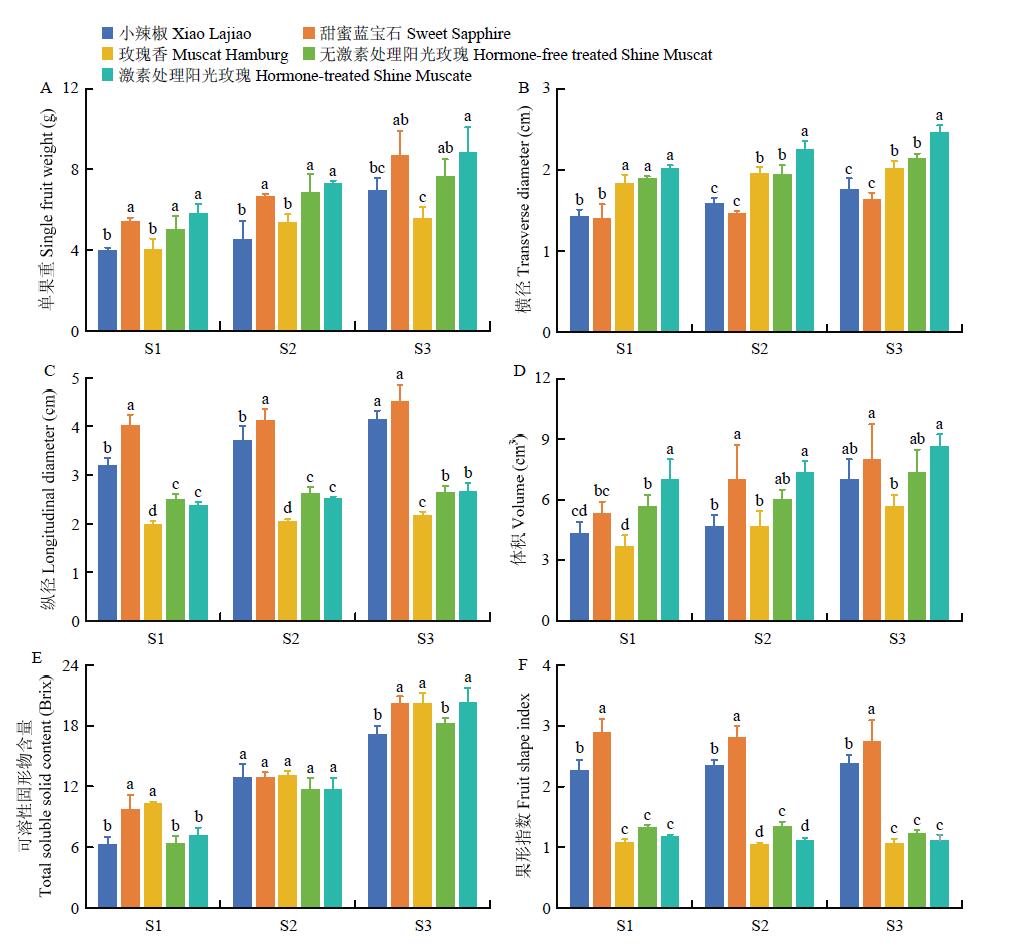
图4
不同果形葡萄果实生长发育指标 柱上不同小写字母表示差异显著Different lowercase letters on the bars indicate significant differences (P<0.05)。S1:硬核期Green-hard stage;S2:转色期(软化期)Veraison;S3:成熟期Mature stage。下同The same as below"

图5
不同果形葡萄周缘维管束分布 A:‘小辣椒’葡萄‘Xiao Lajiao’ grape;B:‘甜蜜蓝宝石’葡萄‘Sweet Sapphire’ grape;C:‘玫瑰香’葡萄‘Muscat Hamburg’ grape;D:无激素处理‘阳光玫瑰’葡萄Hormone-free treated ‘Shine Muscat’ grape;E:激素处理‘阳光玫瑰’葡萄Hormone-treated ‘Shine Muscat’ grape"
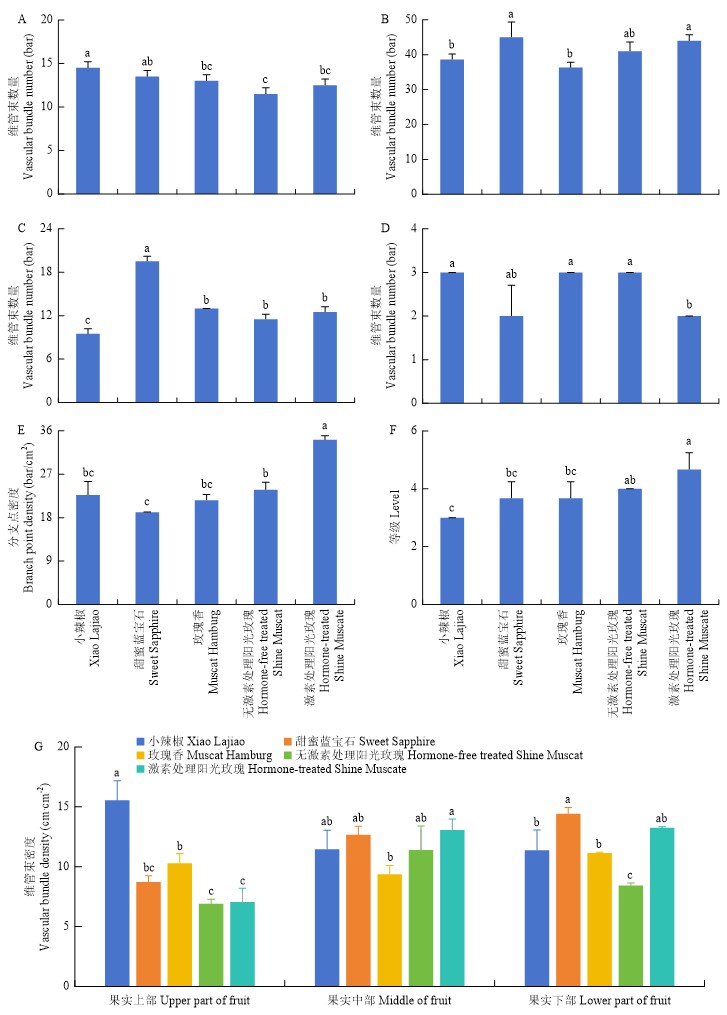
图6
不同果形的葡萄对维管束类型和分布的影响 A:果实一级周缘维管束Primary peripheral vascular bundle at the top of the fruit;B:果实中部周缘维管束Peripheral vascular bundle at the middle of the fruit;C:果实底部周缘维管束Peripheral vascular bundle at the bottom of the fruit;D:中央维管束Central vascular bundle;E:维管束分支点密度Density of vascular bundle branching points;F:维管束的发育等级Developmental level of vascular bundles;G:维管束密度Vascular bundle density"

图7
不同果形葡萄的周缘维管束解剖结构 Ph:韧皮部Phloem;Xy:木质部Xylem;Ve:导管Vessel。标尺Scale bar=50 µm,图8同The same as Fig. 8"

图8
不同果形葡萄的中央维管束解剖结构"

图9
不同果形葡萄对维管束解剖结构的影响 A—D:周缘维管束Peripheral vascular bundle;E—H:中央维管束Central vascular bundle"

图10
不同果形葡萄的染料分布 A:‘小辣椒’葡萄‘Xiao Lajiao’ grape;B:‘甜蜜蓝宝石’葡萄‘Sweet Sapphire’ grape;C:‘玫瑰香’葡萄‘Muscat Hamburg’ grape;D:无激素处理‘阳光玫瑰’葡萄Hormone-free treated ‘Shine Muscat’ grape;E:激素处理‘阳光玫瑰’葡萄Hormone-treated ‘Shine Muscat’ grape。1:果实顶部The top of the fruit;2:果实中部横切The fruit is crosscut in the middle;3:果实底部The bottom of the fruit"

图11
不同果形葡萄对染料运输的影响 A:周缘维管束染料运输长度Peripheral vascular bundle dye transport length;B:中央维管束染料运输长度Central vascular bundle dye transport length;C:维管束染料运输速率Vascular bundle dye transport rate"
表1
不同果形葡萄的果实维管束导水率"
| 时期 Stage | 小辣椒 Xiao Lajiao | 甜蜜蓝宝石 Sapphire | 玫瑰香 Muscat Hamburg | 无激素处理阳光玫瑰 Hormone-free treated Shine Muscat | 激素处理阳光玫瑰 Hormone-treated Shine Muscat | |
|---|---|---|---|---|---|---|
| 周缘维管束 Peripheral vascular bundle | 硬核期Green-hard stage | 10.94±0.04a | 10.32±1.10a | 3.95±0.35b | 1.05±0.27c | 1.51±0.02c |
| 转色期Veraison | 7.04±1.46b | 10.72±1.66a | 4.78±0.32bc | 1.28±0.10d | 2.22±0.14cd | |
| 成熟期Mature stage | 9.59±0.47a | 4.95±0.47b | 5.70±0.70b | 2.72±0.34c | 2.93±0.10c | |
| 中央维管束 Central vascular bundle | 硬核期Green-hard stage | 18.04±0.82a | 13.55±1.42b | 10.71±0.23c | 5.98±0.81d | 5.02±0.34d |
| 转色期Veraison | 11.08±0.22a | 8.36±0.83b | 10.24±0.16a | 7.05±0.80bc | 5.94±0.26c | |
| 成熟期Mature stage | 15.36±1.69a | 10.09±0.32b | 6.93±0.67c | 7.45±0.02c | 8.28±0.97bc |
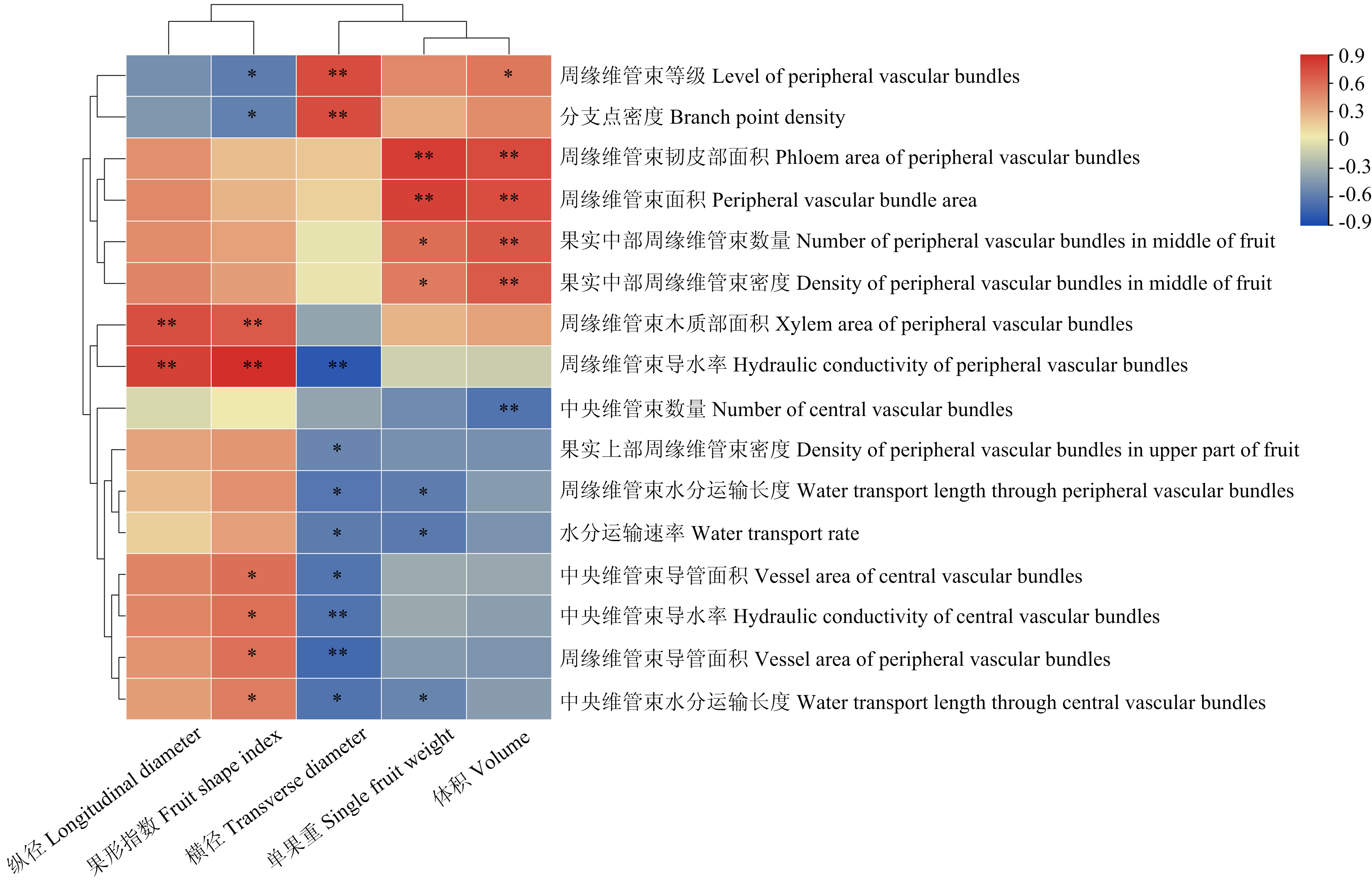
图12
葡萄果实特性与维管束结构参数相关性分析 图中数据为双尾的皮尔逊相关系数The data in the figure are two-tailed Pearson’s correlation coefficient。*:P<0.05;**:P<0.01"
| [1] |
房经贵, 刘崇怀. 葡萄分子生物学. 北京: 科学出版社, 2014: 1-2.
|
|
|
|
| [2] |
李小红, 李运景, 马晓青, 郭军, 刘海礁, 郑国清, 陶建敏. 我国葡萄产业发展现状与展望. 中国南方果树, 2021, 50(5): 161-166.
|
|
|
|
| [3] |
doi: 10.3389/fpls.2014.00227 pmid: 24904622 |
| [4] |
乔军, 刘富中, 陈钰辉, 连勇. 园艺作物果形遗传研究进展. 园艺学报, 2011, 38(7): 1385-1396.
|
|
|
|
| [5] |
张长运, 王境杨, 樊秀彩, 张颖, 姜建福, 刘崇怀, 孙磊. 葡萄种质资源果实形状的鉴定评价. 植物遗传资源学报, 2024, 25(11): 1815-1829.
|
|
|
|
| [6] |
陈珂, 房以凌, 吴伟民, 张克坤, 王晨, 房经贵. 多种果形葡萄品种果实品质分析与比较. 中外葡萄与葡萄酒, 2019(2): 7-13.
|
|
|
|
| [7] |
张培安, 樊秀彩, 刘众杰, 吴伟民, 刘崇怀, 房经贵. 葡萄种质资源果形性状的分析. 园艺学报, 2018, 45(8): 1456-1466.
doi: 10.16420/j.issn.0513-353x.2017-0709 |
|
doi: 10.16420/j.issn.0513-353x.2017-0709 |
|
| [8] |
doi: 10.21273/JASHS.132.1.80 |
| [9] |
伍涛. 丰水、鸭梨果实发育过程中糖积累特性及其与果实大小关系研究[D]. 南京: 南京农业大学, 2011.
|
|
|
|
| [10] |
doi: 10.1104/pp.111.181065 pmid: 21921117 |
| [11] |
|
| [12] |
doi: 10.1007/s10681-014-1179-0 |
| [13] |
|
| [14] |
pmid: 27917187 |
| [15] |
|
| [16] |
doi: 10.3390/horticulturae10111151 |
| [17] |
doi: 10.1007/s11103-008-9374-9 pmid: 18654740 |
| [18] |
doi: 10.1093/aob/mcf059 |
| [19] |
doi: 10.32604/phyton.2023.028208 |
| [20] |
doi: 10.1104/pp.109.141044 pmid: 19710234 |
| [21] |
doi: 10.5344/ajev.2015.15038 |
| [22] |
唐玄嗣. 赤霉素和氯吡脲处理对葡萄果实维管束结构及功能的影响[D]. 扬州: 扬州大学, 2024.
|
|
|
|
| [23] |
田敏, 夏琼梅, 李纪元. 植物的次生生长及其分子调控. 遗传, 2007, 29(11): 1324-1330.
|
|
|
|
| [24] |
王丰, 程方民. 生长素对植物维管分化的信号诱导作用. 江苏林业科技, 2004(1): 40-44.
|
|
|
|
| [25] |
|
| [26] |
doi: 10.3390/plants9060772 |
| [27] |
姜卫兵. 植物生长调节剂对果实形状发育的影响. 果树科学, 1992(2): 117-122.
|
|
|
|
| [28] |
陶建敏, 庄智敏, 章镇, 韩传光, 耿其芳. GA3与GA4+7对诱导巨峰葡萄产生无核及果实发育的影响. 中外葡萄与葡萄酒, 2005(2): 15-18.
|
|
|
|
| [29] |
吴俊, 钟家煌, 徐凯, 魏钦平, 魏振林. 外源GA3对藤稔葡萄果实生长发育及内源激素水平的影响. 果树学报, 2001, 18(4): 209-212.
|
|
|
|
| [30] |
李婉雪. ‘阳光玫瑰’葡萄优质栽培技术研究[D]. 南京: 南京农业大学, 2016.
|
|
|
|
| [31] |
孙肖瑞, 谢兆森, 尤佳玲, 李有梅. 葡萄果实中糖转运、代谢与调控研究进展. 植物生理学报, 2021, 57(3): 542-550.
|
|
doi: 10.1104/pp.57.4.542 |
|
| [32] |
王乐乐, 刘春燕, 陈鹏飞, 李志慧, 王灵哲, 周龙. 葡萄大小浆果发育前期细胞学、糖积累和库强比较. 中外葡萄与葡萄酒, 2023(6): 1-9.
|
|
|
|
| [33] |
doi: 10.1016/j.postharvbio.2021.111522 |
| [34] |
doi: 10.21273/JASHS.134.1.77 |
| [35] |
|
| [36] |
doi: 10.1111/nph.1991.119.issue-3 |
| [37] |
doi: 10.1093/jxb/eri291 pmid: 16207748 |
| [38] |
doi: 10.1007/s00438-001-0612-y |
| [39] |
doi: 10.1105/tpc.5.10.1439 pmid: 12271039 |
| [40] |
周驰燕, 李国辉, 许轲, 张晨晖, 杨子君, 张芬芳, 霍中洋, 戴其根, 张洪程. 不同类型水稻品种茎叶维管束与同化物运转特征. 作物学报, 2022, 48(8): 2053-2065.
doi: 10.3724/SP.J.1006.2022.12038 |
|
doi: 10.3724/SP.J.1006.2022.12038 |
|
| [41] |
王娜. 不同耐密性玉米品种维管束特性及源库系统特点研究[D]. 沈阳: 沈阳农业大学, 2011.
|
|
|
|
| [42] |
杜玉梁, 陈叶, 刘彩虹, 尹增芳. 植物维管组织形态建成的分子调控机制. 北京林业大学学报, 2014, 36(3): 142-150.
|
|
|
|
| [43] |
doi: 10.1016/j.scienta.2024.113582 |
| [44] |
doi: 10.1186/s12870-015-0679-y |
| [45] |
蔡仲慧. 不同赤霉素处理方式下葡萄果实品质与维管组织结构及功能机理关系探究[D]. 扬州: 扬州大学, 2023.
|
|
|
|
| [46] |
doi: 10.3389/fpls.2022.815283 |
| [47] |
边媛, 狄龙, 李定红, 李新岗. 枣果实维管束解剖结构研究. 果树学报, 2015, 32(3): 448-452, 523.
|
|
|
|
| [48] |
张红霞, 袁凤辉, 关德新, 王安志, 吴家兵, 金昌杰. 维管植物木质部水分传输过程的影响因素及研究进展. 生态学杂志, 2017, 36(11): 3281-3288.
|
|
|
|
| [49] |
|
| [50] |
doi: 10.1111/j.1755-0238.2004.tb00020.x |
| [51] |
doi: 10.1071/AR9800499 |
| [52] |
doi: 10.1111/j.1755-0238.2000.tb00171.x |
| [53] |
谢兆森, 曹红梅, 李勃, 李为福, 许文平, 王世平. 巨峰葡萄果实不同发育期维管束水分运输变化. 中国农业科学, 2012, 45(1): 111-117. doi: 10.3864/j.issn.0578-1752.2012.01.013.
|
|
|
|
| [54] |
|
| [55] |
doi: 10.1111/pce.2015.38.issue-6 |
| [56] |
doi: 10.1093/jxb/ern060 |
| [57] |
|
| [58] |
doi: 10.1071/FP09019 pmid: 32688668 |
| [59] |
doi: 10.1104/pp.15.00031 pmid: 26077763 |
| [60] |
doi: 10.3390/genes12060932 |
| [61] |
doi: 10.1016/j.scienta.2017.05.009 |
| [1] | 岳楠栋, 蒋丙婷, 聂景贵, 方越, 唐军荣, 乐振声, 周莹, 李能波, 何霞红, 张雪春. 紫皮石斛茎、叶、花的成分和功能活性分析及代谢组学研究[J]. 中国农业科学, 2026, 59(8): 1775-1796. |
| [2] | 李元晶, 袁瑞祥, 李永泰, 孙天歌, 刘峰, 李艳军, 张新宇. 棉花黄萎病菌β-葡萄糖苷酶基因的鉴定及其在致病中的功能[J]. 中国农业科学, 2026, 59(7): 1380-1399. |
| [3] | 张东梅, 周鑫鑫, 肖桂林, 曾祥国, 王春燕, 王泽先, 韩永超. 草莓花器应答灰霉病菌侵染的表现特征及抗病性评价方法[J]. 中国农业科学, 2026, 59(7): 1456-1466. |
| [4] | 朱嘉伟, 关璇, 饶博涵, 刘秀海, 范国元, 武运, 陶永胜. 短乳杆菌LB-21介导的酒精-苹乳三菌共发酵对干红葡萄酒色泽的影响[J]. 中国农业科学, 2026, 59(5): 1101-1110. |
| [5] | 马桂兰, 张旭阳, 李武. 鸟苷酸结合蛋白2在金黄色葡萄球菌诱导巨噬细胞凋亡中的调控作用[J]. 中国农业科学, 2026, 59(4): 912-926. |
| [6] | 张梦博, 谭鸿冰, 沈甜, 徐美隆, 周新明, 房玉林, 鞠延仑. 不同灌溉量与抗蒸腾剂处理对葡萄酒品质的影响[J]. 中国农业科学, 2026, 59(2): 413-426. |
| [7] | 王思琪, 邹利人, 白瑞雯, 闫可, 王思洋, 齐晓光, 申海林, 温景辉. 赤霉素调控‘蜜汁’葡萄穗轴硬化关键基因的挖掘[J]. 中国农业科学, 2026, 59(1): 179-189. |
| [8] | 谭西北, 兰徐颖, 刘崇怀, 樊秀彩, 姜建福, 孙磊, 李鹏, 余书鑫, 张颖. 不同抗性葡萄响应白腐病侵染的次生代谢物变化[J]. 中国农业科学, 2025, 58(9): 1767-1778. |
| [9] | 陈龙云, 胡俊强, 何灿, 史建荣, 徐剑宏, 王刚. 利用大孔吸附树脂与高速逆流色谱纯化脱氧雪腐镰刀菌烯醇-3-葡萄糖苷[J]. 中国农业科学, 2025, 58(8): 1627-1637. |
| [10] | 汤学燊, 党仕卓, 周娟, 李佳豪, 李梅花, 胡豪, 张亚红. 基于红蓝光调控分析VvBES1-1参与‘红地球’葡萄花芽的分化[J]. 中国农业科学, 2025, 58(8): 1650-1662. |
| [11] | 杨彩丽, 李永洲, 贺亮亮, 宋银花, 章鹏, 刘肇先, 李鹏慧, 刘三军. 葡萄TPS基因家族全基因组鉴定及VvTPS4在单萜形成中的功能验证[J]. 中国农业科学, 2025, 58(7): 1397-1417. |
| [12] | 张天雨, 李白, 藏金萍, 曹宏哲, 董金皋, 邢继红, 张康. 灰葡萄孢HMG家族基因的全基因组鉴定与表达规律分析[J]. 中国农业科学, 2025, 58(4): 704-718. |
| [13] | 郭奥琳, 林俊璇, 赖恭梯, 贺丽媛, 车建美, 潘若, 杨方学, 黄玉吉, 陈桂信, 赖呈纯. 过表达VdF3′5′H2对刺葡萄细胞花青素组分积累的影响[J]. 中国农业科学, 2025, 58(4): 802-818. |
| [14] | 从琪琪, 张静怡, 孟祥龙, 戴蓬博, 李波, 胡同乐, 王树桐, 曹克强, 王亚南. 我国苹果轮纹病弱毒菌株中病毒的鉴定及其携带情况的检测[J]. 中国农业科学, 2025, 58(3): 478-492. |
| [15] | 张向昆, 李佳莹, 乔如梦, 何静蕾, 王莉, 师校欣, 杜国强. 不同锌水平下GFabV对‘阳光玫瑰’葡萄光合效率及光合相关基因表达的影响[J]. 中国农业科学, 2025, 58(24): 5190-5200. |
|
||
