






中国农业科学 ›› 2025, Vol. 58 ›› Issue (24): 5143-5155.doi: 10.3864/j.issn.0578-1752.2025.24.004
田磊1( ), 邵鑫2, 周一民1, 苗秀珍1, 纪楠3, 王浩4, 石明帅2, 张悦忠1,*()
收稿日期:2025-04-10
接受日期:2025-10-21
出版日期:2025-12-22
发布日期:2025-12-22
通信作者:
联系方式:
田磊,E-mail:18847170956@163.com。
基金资助:
TIAN Lei1(), SHAO Xin2, ZHOU YiMin1, MIAO XiuZhen1, JI Nan3, WANG Hao4, SHI MingShuai2, ZHANG YueZhong1,*()
Received:2025-04-10
Accepted:2025-10-21
Published:2025-12-22
Online:2025-12-22
摘要:
【目的】探究多因素管理下大兴安岭南麓玉米适宜的种植密度,挖掘其产量潜力,为在玉米密植条件下合理选种提供理论依据。【方法】依托扎赉特旗农业科技示范园区,于2022—2024年开展的玉米品种筛选及密度梯度试验,选用7.2、8.3、9.2、10.4万株/hm2共4个种植密度,划分为低密度(7.2万株/hm2)、中等密度(8.3、9.2万株/hm2)、高密度(10.4万株/hm2)3个密度梯度,选用138个玉米品种,共252份样本,对各样本株高、穗位、倒伏指数、成穗率、产量及构成因素进行数据分析。【结果】玉米产量构成因素与种植密度间均呈极显著相关关系(P<0.01),收获穗数与种植密度间呈线性回归关系,其回归方程为y=0.765x+0.8577,且R2为0.4986,因此可以预测在7.2—10.4万株/hm2,玉米种植密度每增加2.00万株/hm2,收获穗数增加2.39万穗/hm2;产量与种植密度间呈极显著相关关系(P<0.01),产量随着种植密度的增加呈上升趋势,与低密度平均产量相比,高、中密度玉米产量分别显著提高16.85%和8.68%(P<0.05);成穗率与种植密度间呈显著负相关关系(P<0.05),成穗率变化范围为85.53%—90.46%,平均成穗率为87.08%;收获穗数在8.62万穗/hm2之后产量增加减慢,根据高种植密度下的成穗率平均值86.01%计算,大兴安岭南麓玉米最大种植密度不应超过10.02万株/hm2。种植密度与株高之间呈极显著负相关关系(P<0.01),与穗位高及穗位高系数之间无相关关系。当株高≥314 cm时,玉米开始发生倒伏,株高为314—404 cm时,株高每增加15 cm,玉米倒伏程度增加3.88%;低种植密度下,穗粒数和百粒重与产量间呈显著正相关关系(P<0.05);中等密度下,收获穗数和百粒重与产量间均为极显著正相关关系(P<0.01);高密度下产量与各因素间均无显著相关关系。种植密度对产量的影响高于倒伏程度,种植密度变化导致玉米倒伏主要通过影响收获穗数从而影响产量,而株高的增加导致玉米倒伏主要通过影响穗粒数进而影响产量。【结论】在大兴安岭南麓地区玉米种植密度较低时,应选择穗粒数及百粒重较高的品种,以保证玉米产量;当种植密度增密至8.3—9.2万株/hm2时,应尽可能地提高成穗率,保证收获穗数;当种植密度进一步提高时,应在选择紧凑型密植品种、保证收获穗数的基础上,做到精准管理,确保各产量构成因素均衡发展,从而获得理想产量,但最大种植密度不应超过10.02万株/hm2。同时,当选择种植的玉米品种株高≥314 cm时,应及时进行化控处理,防止玉米倒伏。
田磊, 邵鑫, 周一民, 苗秀珍, 纪楠, 王浩, 石明帅, 张悦忠. 多因素管理下大兴安岭南麓玉米种植密度及耐密抗倒品种选择[J]. 中国农业科学, 2025, 58(24): 5143-5155.
TIAN Lei, SHAO Xin, ZHOU YiMin, MIAO XiuZhen, JI Nan, WANG Hao, SHI MingShuai, ZHANG YueZhong. Selection of Maize Planting Density and Dense-Planting Tolerant and Lodging-Resistant Varieties in the Southern Foothills of the Greater Khingan Mountains under Multi-Factor Management[J]. Scientia Agricultura Sinica, 2025, 58(24): 5143-5155.
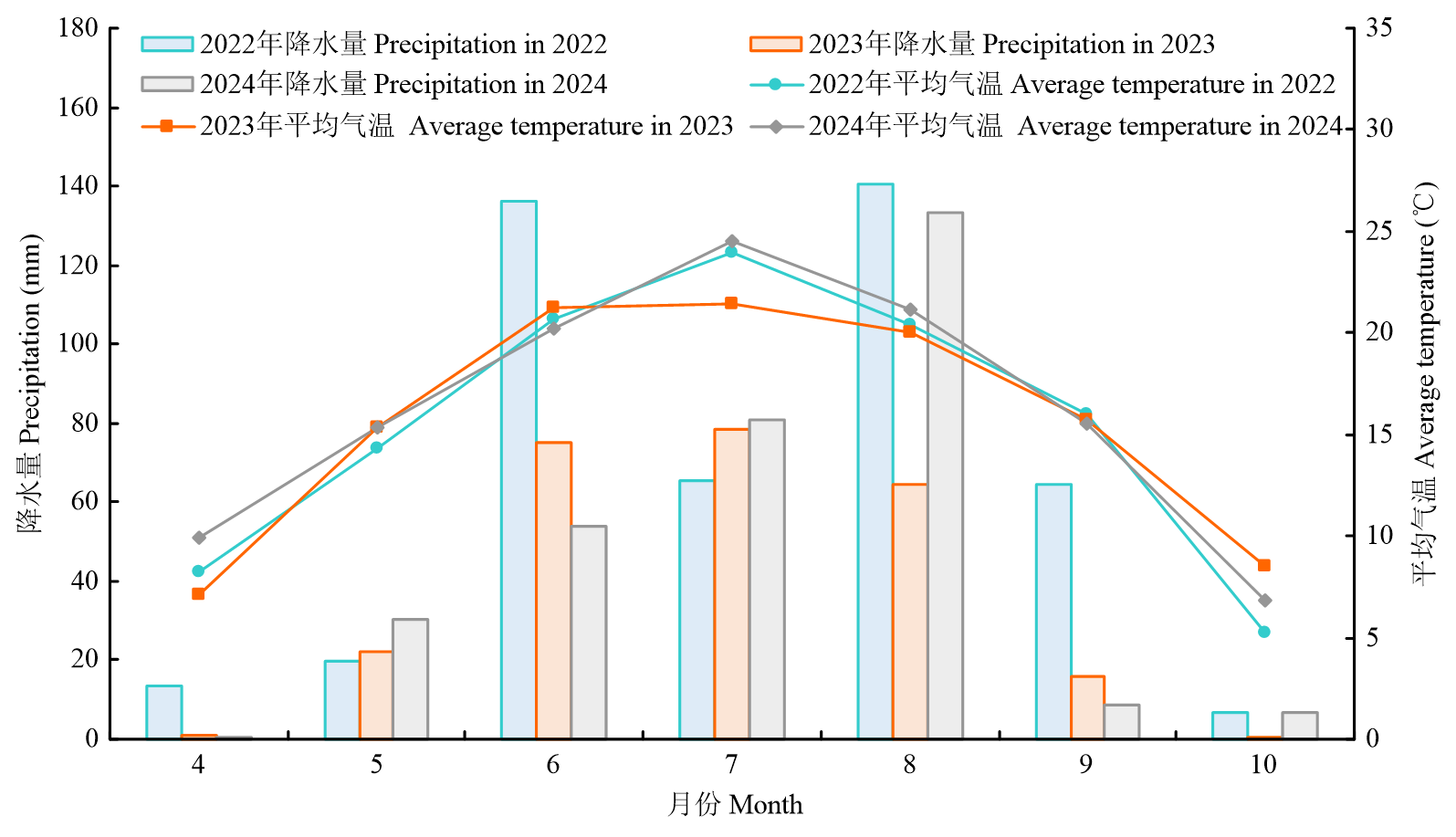
图1
2022—2024年试验地降水量及日平均气温"
表1
2022—2024年试验布置情况"
| 年份 Year | 品种数量 Number of varieties | 种植密度 Planting density (×104 plants/hm2) | 样本数量 Number of samples |
|---|---|---|---|
| 2022 | 30 | 7.2 | 30 |
| 2023 | 32 | 9.2 | 32 |
| 2024 | 96 | 8.3、9.2、10.4 | 190 |
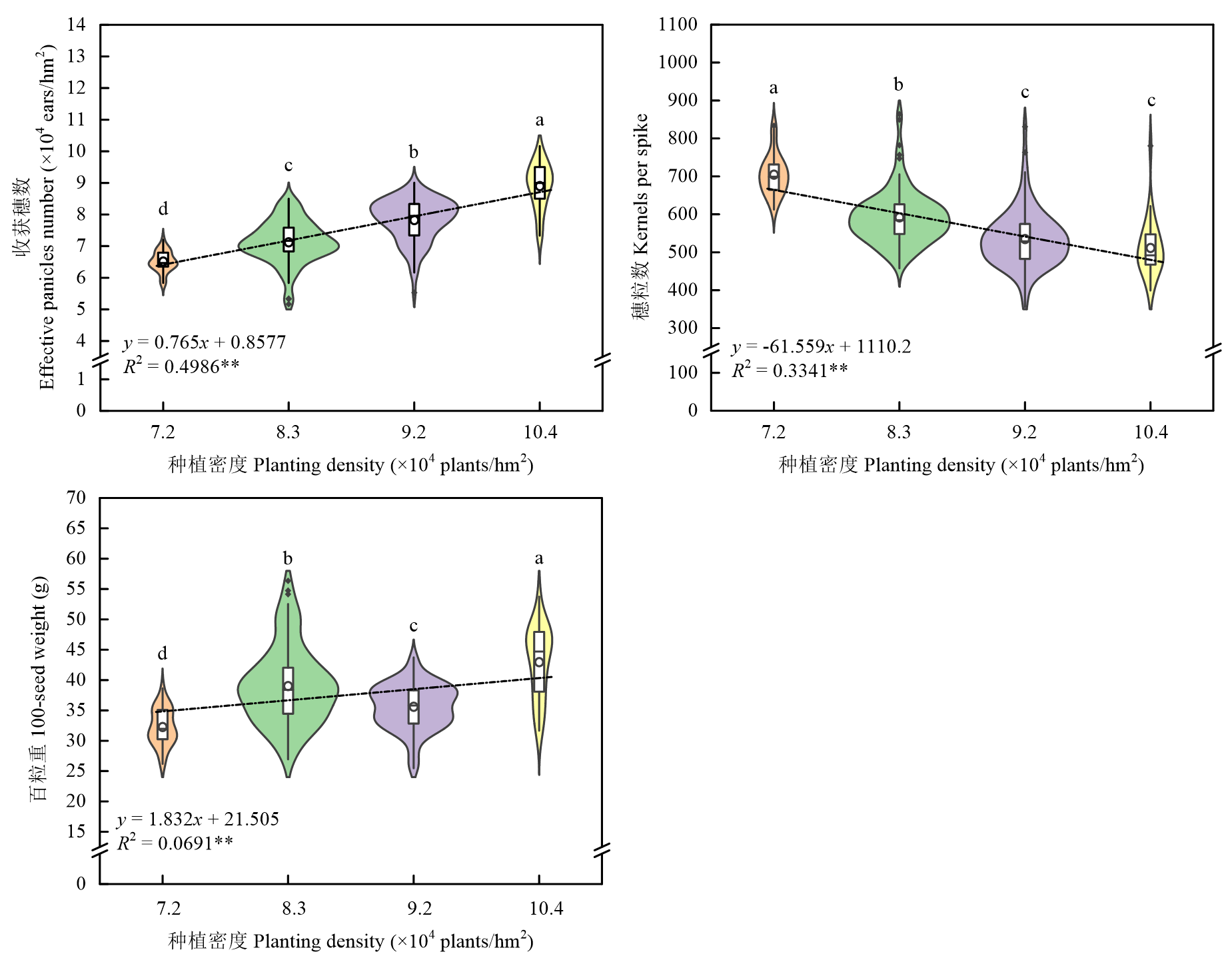
图2
种植密度对玉米产量构成因素的影响 不同小写字母表示不同种植密度间差异显著(P<0.05);*表示显著相关关系(P<0.05),**表示极显著相关关系(P<0.01)。下同"
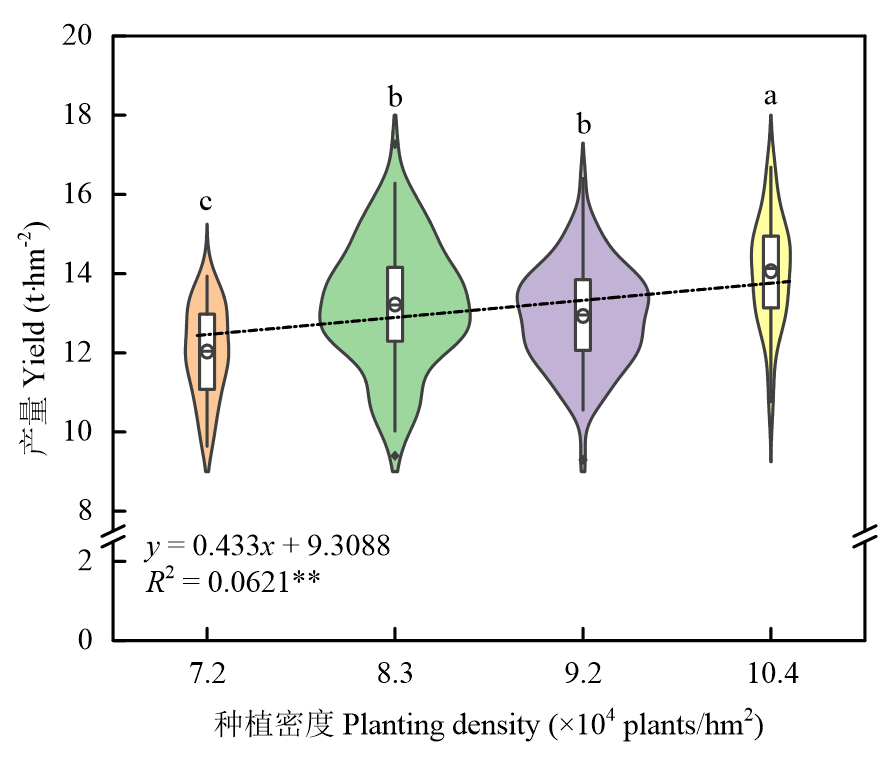
图3
种植密度对玉米产量的影响"
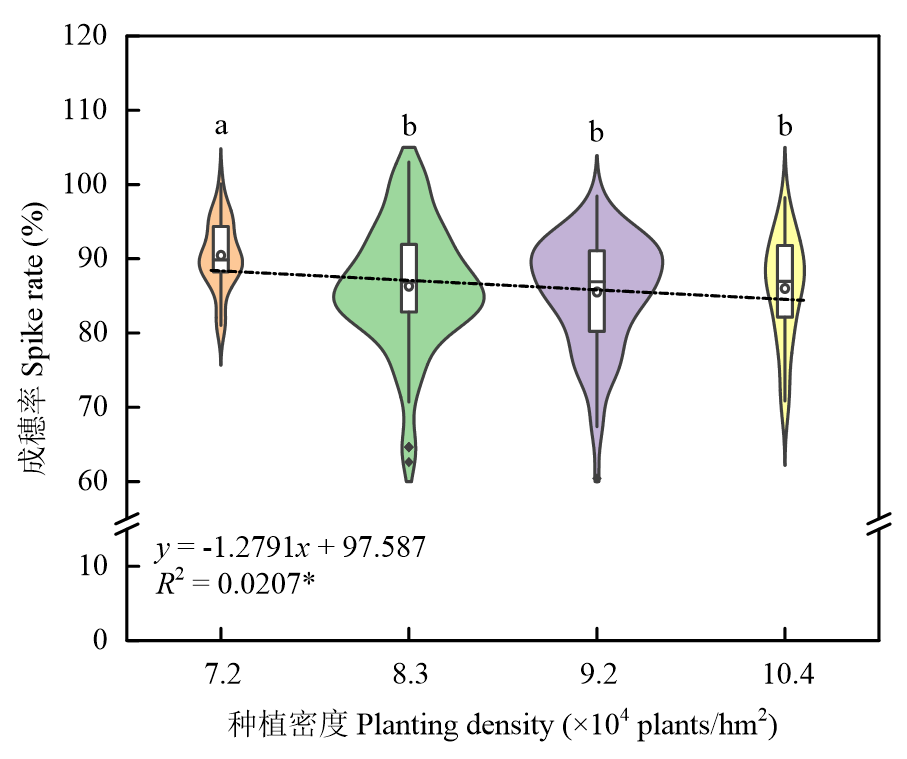
图4
种植密度对玉米成穗率的影响"
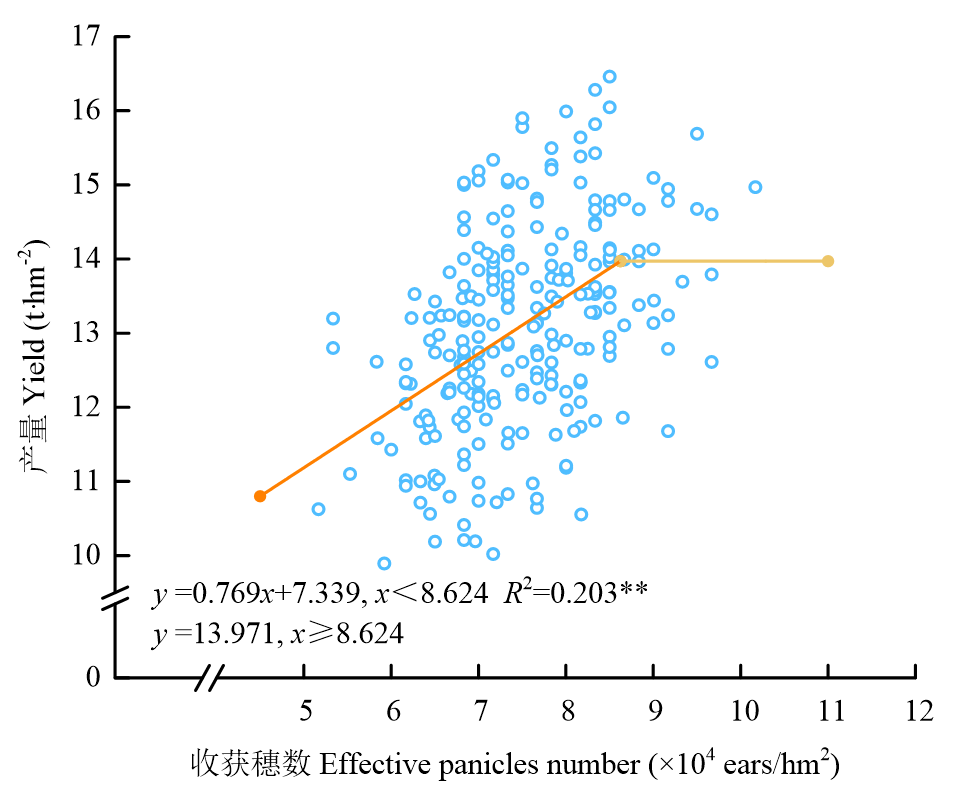
图5
收获穗数与玉米产量间的线性加平台分析"
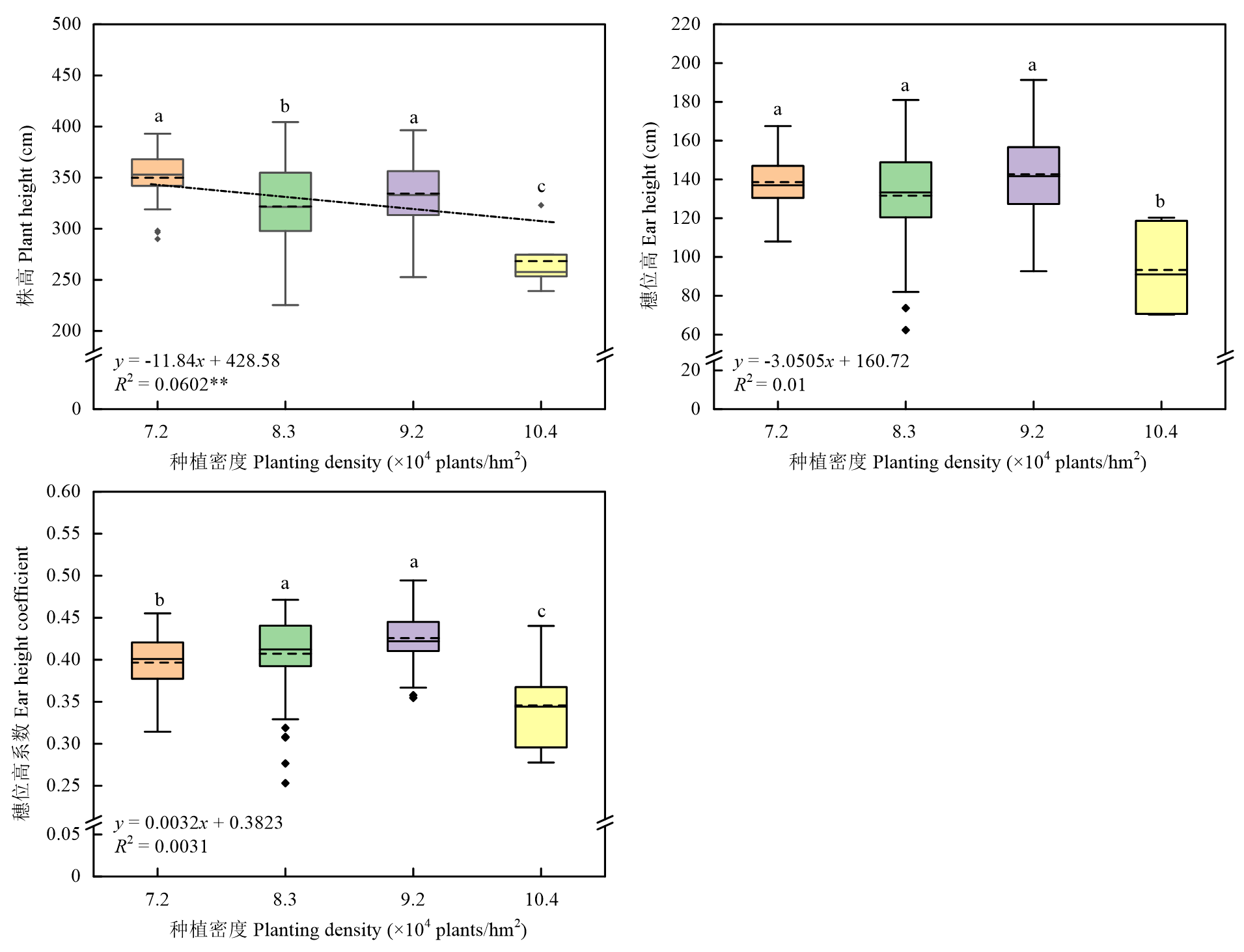
图6
种植密度对玉米株高、穗位高的影响 不同小写字母表示不同种植密度间玉米株高、穗位高、穗位高系数差异显著(P<0.05) Different uppercase letters indicate significant differences (P<0.05) in plant height, ear height, and ear height coefficient of maize among different planting densities。下同 The same as below"
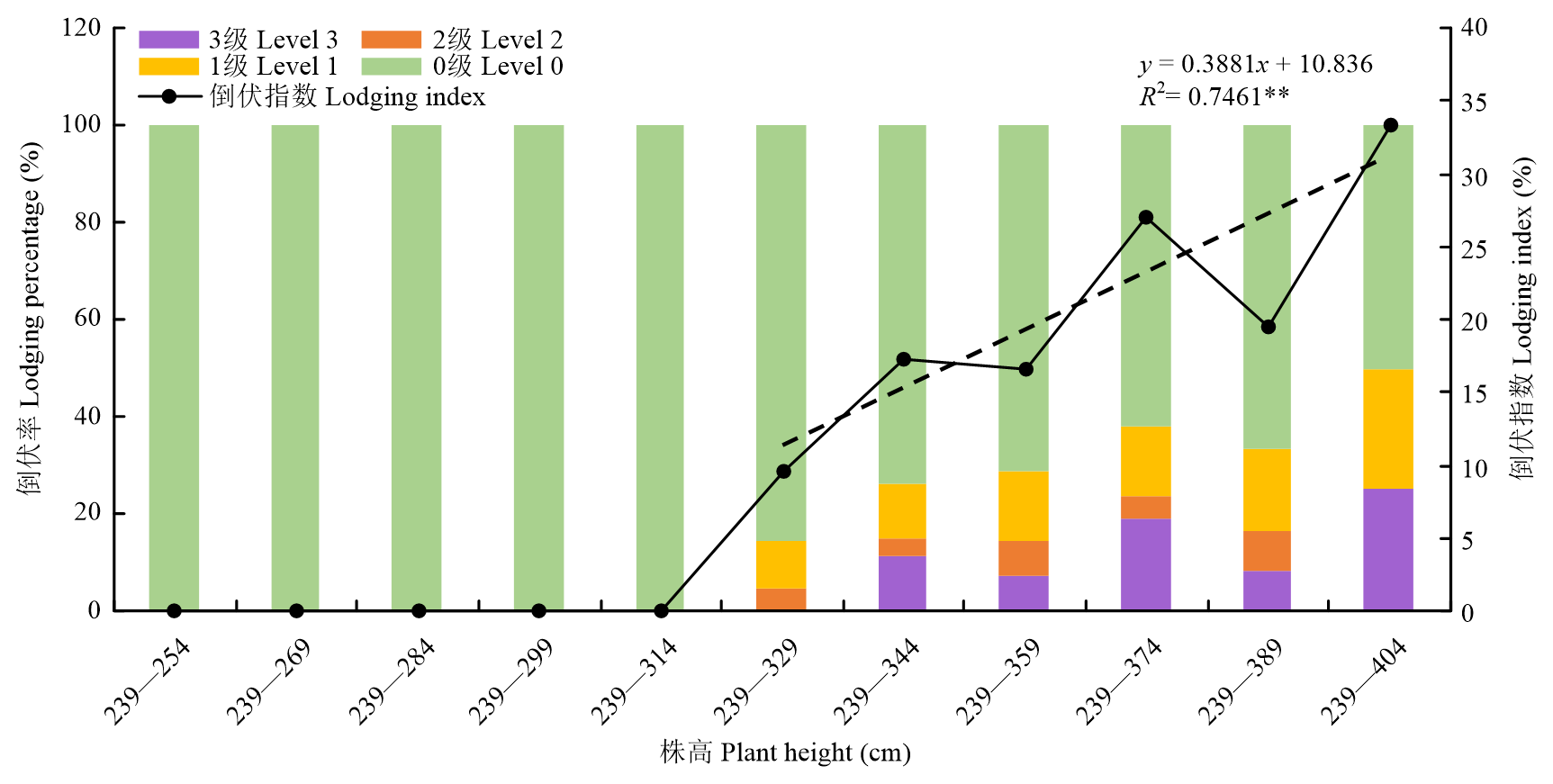
图7
玉米株高对倒伏程度的影响 图中虚线为玉米株高314—404 cm间的线性回归方程趋势线"
表2
玉米产量构成因素、品种特性与产量间的相关关系"
| 种植密度 Planting density (×104 plants/hm2) | 收获穗数 Effective panicles number | 穗粒数 Kernels per spike | 百粒重 100-seed weight | 株高 Plant height | 穗位高 Ear height | 穗位高系数 Ear height coefficient |
|---|---|---|---|---|---|---|
| 7.2 | 0.200 | 0.373* | 0.622** | -0.060 | 0.350 | 0.120 |
| 8.3 | 0.555** | 0.040 | 0.468** | -0.090 | -0.150 | -0.150 |
| 9.2 | 0.497** | 0.090 | 0.358** | -0.030 | 0.150 | 0.040 |
| 10.4 | 0.210 | 0.300 | 0.370 | 0.470 | 0.460 | 0.550 |
| 7.2-10.4 | 0.472** | -0.020 | 0.409** | 0.004 | -0.057 | -0.011 |
表3
种植密度、倒伏程度和品种特性对玉米产量的影响系数"
| 影响路径 Influence path | 直接影响系数 Direct influence coefficient | 直接影响系数 Direct influence coefficient | 直接影响系数 Direct influence coefficient | 间接影响系数 Indirect influence coefficient | 总影响系数 Total influence coefficient |
|---|---|---|---|---|---|
| 种植密度→百粒重→产量 Planting density→100-seed weight→yield | 0.181** | 0.786** | - | 0.142 | 0.265 |
| 种植密度→穗粒数→产量 Planting density→kernels per spike→yield | -0.499** | 0.863 | - | -0.431 | |
| 种植密度→收获穗数→产量 Planting density→effective panicles number→yield | 0.571** | 0.970** | - | 0.554 | |
| 倒伏程度→百粒重→产量 Degree of lodging→100-seed weight→yield | -0.149* | 0.786** | - | -0.117 | -0.027 |
| 倒伏程度→穗粒数→产量 Degree of lodging→kernels per spike→yield | 0.247** | 0.863 | - | 0.213 | |
| 倒伏程度→收获穗数→产量 Degree of lodging→effective panicles number→yield | -0.127** | 0.970** | - | -0.123 | |
| 株型→百粒重→产量 Plant type→100-seed weight→yield | -0.221* | 0.786** | - | -0.174 | -0.174 |
| 株型→穗粒数→产量 Plant type→kernels per spike→yield | 0.168 | 0.863 | - | 0.146 | |
| 株型→收获穗数→产量 Plant type→effective panicles number→yield | -0.008 | 0.970** | - | -0.010 | |
| 株高→百粒重→产量 Plant height→100-seed weight→yield | 0.188 | 0.786** | - | 0.148 | -0.130 |
| 株高→穗粒数→产量 Plant height→kernels per spike→yield | 0.011 | 0.863 | - | 0.010 | |
| 株高→收获穗数→产量 Plant height→effective panicles number→yield | -0.134** | 0.970** | - | -0.130 | |
| 种植密度→倒伏程度→百粒重→产量 Planting density→degree of lodging→100-seed weight→yield | -0.221** | -0.149 | 0.786** | 0.026 | 0.006 |
| 种植密度→倒伏程度→穗粒数→产量 Planting density→degree of lodging→kernels per spike→yield | -0.221** | 0.247 | 0.863 | -0.047 | |
| 种植密度→倒伏程度→收获穗数→产量 Planting density→degree of lodging→effective panicles number→yield | -0.221** | -0.127 | 0.970** | 0.027 | |
| 株型→倒伏程度→百粒重→产量 Plant type→degree of lodging→100-seed weight→yield | -0.094 | -0.149 | 0.786** | 0.011 | 0.000 |
| 株型→倒伏程度→穗粒数→产量 Plant type→degree of lodging→kernels per spike→yield | -0.094 | 0.247 | 0.863 | -0.020 | |
| 株型→倒伏程度→收获穗数→产量 Plant type→degree of lodging→effective panicles number→yield | -0.094 | -0.127 | 0.970** | 0.012 | |
| 株高→倒伏程度→百粒重→产量 Plant height→degree of lodging→100-seed weight→yield | 0.292** | -0.149 | 0.786** | -0.034 | -0.008 |
| 株高→倒伏程度→穗粒数→产量 Plant height→degree of lodging→kernels per spike→yield | 0.292** | 0.247 | 0.863 | 0.062 | |
| 株高→倒伏程度→收获穗数→产量 Plant height→degree of lodging→effective panicles number→yield | 0.292** | -0.127 | 0.970** | -0.036 |
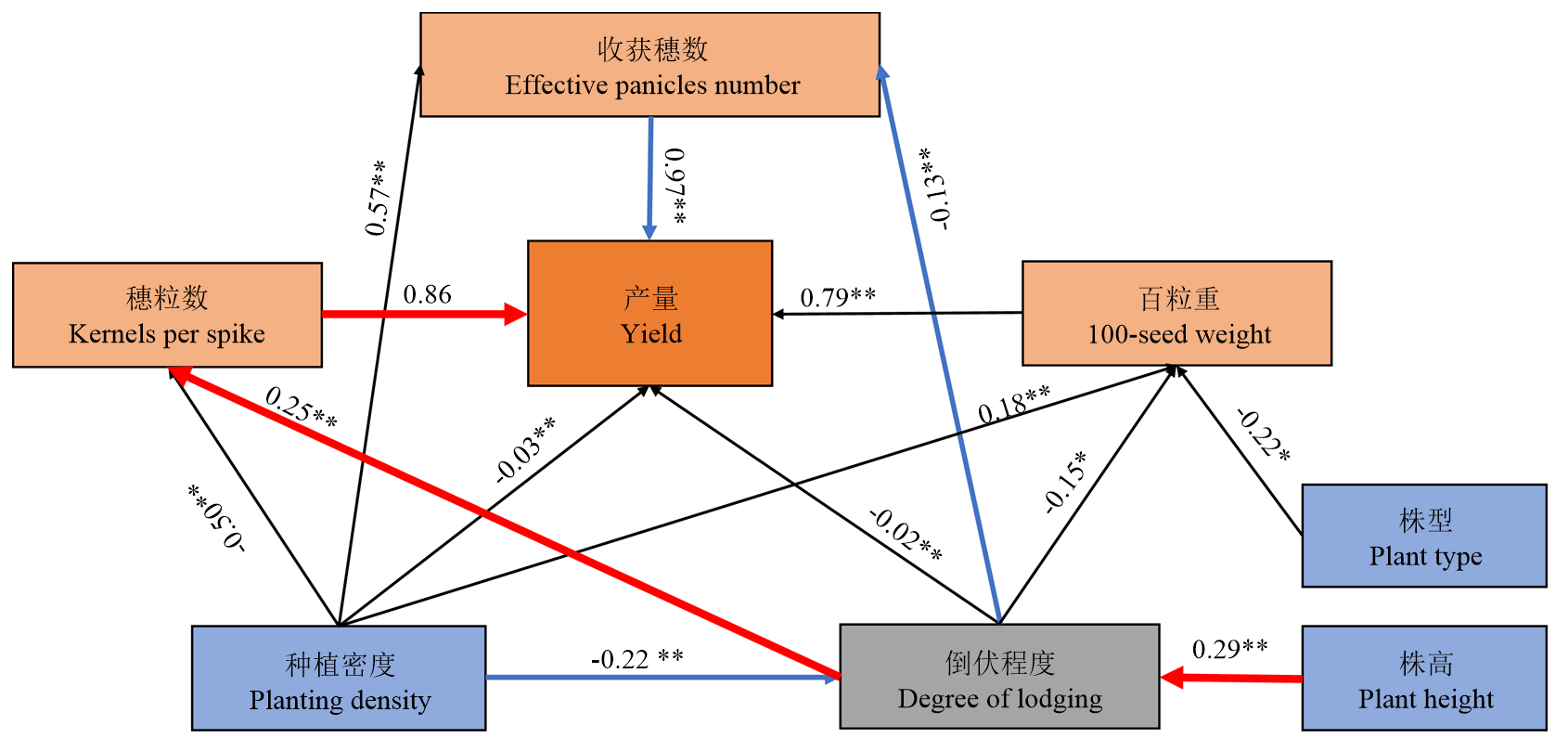
图8
种植密度、倒伏程度和品种特性对玉米产量的影响路径分析"
| [1] |
赵久然, 王荣焕. 中国玉米生产发展历程、存在问题及对策. 中国农业科技导报, 2013, 15(3): 1-6.
|
|
doi: 10.3969/j.issn.1008-0864.2013.03.01 |
|
| [2] |
|
| [3] |
doi: 10.1007/s10681-006-9312-3 |
| [4] |
|
| [5] |
李国恒, 李绍伟, 吴欣, 赵国建, 李文仓, 刘素玲. 玉米倒伏的原因分析及防治措施. 中国农技推广, 2010, 26(3): 42-43.
|
|
|
|
| [6] |
韩欣澳, 郑迎霞, 陈杜, 魏鹏程, 程乙, 刘代铃, 宋碧. 种植密度对贵州春玉米冠层特性和产量的影响. 玉米科学, 2024, 32(9): 78-86.
|
|
|
|
| [7] |
石德杨, 李艳红, 王飞飞, 夏德君, 矫岩林, 孙妮娜, 赵健. 高密度下扩行缩株对夏玉米干物质与养分积累、转运的调控效应. 中国农业科学, 2024, 57(23): 4658-4672. doi:10.3864/j.issn.0578-1752.2024.23.007.
|
|
|
|
| [8] |
李晓红, 王克如, 张国强, 明博, 薛军, 方梁, 张婷婷, 叶建全, 李少昆. 增密和株行距优化提高西辽河平原沙地滴灌玉米的产量与水氮利用效率. 中国农业科学, 2025, 58(14): 2766-2781. doi:10.3864/j.issn.0578-1752.2025.14.005.
|
|
|
|
| [9] |
杨泽宇, 吕慎强, 李嘉, 李惠通, 王筱斐, 王林权. 氮肥和品种及种植密度对春玉米机械化收获性状及产量的影响. 农业工程学报, 2023, 39(18): 41-50.
|
|
|
|
| [10] |
张冬梅, 杨柯, 姜春霞, 张伟, 黄明镜, 刘化涛, 闫六英, 刘恩科, 翟广谦, 王娟玲. 密度对春玉米生理成熟后倒伏变化的影响. 中国生态农业学报(中英文), 2021, 29(5): 855-869.
|
|
|
|
| [11] |
田龙兵, 沈兆崟, 赵孝天, 张放, 侯文峰, 高强, 王寅. 种植密度与施氮量互作对不同玉米品种产量和水分利用效率的影响. 中国农业科学, 2024, 57(21): 4221-4237. doi:10.3864/j.issn.0578-1752.2024.21.005.
|
|
|
|
| [12] |
谷利敏, 乔江方, 张美微, 朱卫红, 黄璐, 代书桃, 董树亭, 刘京宝. 种植密度对不同耐密夏玉米品种茎秆性状与抗倒伏能力的影响. 玉米科学, 2017, 25(5): 91-97.
|
|
|
|
| [13] |
任佰朝, 李利利, 董树亭, 刘鹏, 赵斌, 杨今胜, 王丁波, 张吉旺. 种植密度对不同株高夏玉米品种茎秆性状与抗倒伏能力的影响. 作物学报, 2016, 42(12): 1864-1872.
doi: 10.3724/SP.J.1006.2016.01864 |
|
doi: 10.3724/SP.J.1006.2016.01864 |
|
| [14] |
李翔宇, 刘健茁, 胡丹丹, 刘耕瑜, 陈良宇, 李冰, 杜万里, 宋波. 玉米种质资源对瘤黑粉病的抗性评价及生理差异分析. 中国农业科学, 2025, 58(13): 2504-2521. doi:10.3864/j.issn.0578-1752.2025.13.002.
|
|
|
|
| [15] |
张洪生, 赵明, 吴沛波, 翟延举, 姜雯. 种植密度对玉米茎秆和穗部性状的影响. 玉米科学, 2009, 17(5): 130-133.
|
|
|
|
| [16] |
doi: 10.1016/S2095-3119(17)61877-X |
| [17] |
欧阳西荣, 涂先德, 吴玉林, 刘山. 玉米品种穗部性状与高产稳产性的关系. 湖南农业大学学报(自然科学版), 2007 (5): 525-529.
|
|
|
|
| [18] |
陈尚洪, 陈红琳, 沈学善, 王昌桃, 张玉兰, 刘定辉. 密度和施氮量对丘陵区机播夏玉米产量及倒伏影响研究. 西南农业学报, 2012, 25(3): 805-808.
|
|
|
|
| [19] |
李长红, 许海涛, 孙联合. 夏玉米形态指标、氮肥利用及抗倒特性对密度与氮肥耦合效应的响应. 江苏农业科学, 2022, 50(11): 63-70.
|
|
|
|
| [20] |
赵耀, 程前, 徐田军, 刘正, 王荣焕, 赵久然, 陆大雷, 李从锋. 高密度条件下株型改良对春玉米根-冠特征及籽粒产量的影响. 中国农业科学, 2025, 58(7): 1296-1310. doi: 10.3864/j.issn.0578-1752.2025.07.003.
|
|
|
|
| [21] |
刘月, 明博, 李姚姚, 王克如, 侯鹏, 薛军, 李少昆, 谢瑞芝. 基于根冠协调发展的东北春玉米高产种植密度分析. 作物学报, 2023, 49(3): 795-807.
doi: 10.3724/SP.J.1006.2023.23026 |
|
doi: 10.3724/SP.J.1006.2023.23026 |
|
| [22] |
程云, 王枟刘, 杨静, 张子学, 刘正, 李文阳. 种植密度对夏玉米基部节间性状与倒伏的影响. 玉米科学, 2015, 23(5): 112-116.
|
|
|
|
| [23] |
刘晓林, 马晓君, 豆攀, 黄科程, 王兴龙, 张頔, 孔凡磊, 袁继超. 种植密度对川中丘陵夏玉米茎秆性状及产量的影响. 中国生态农业学报, 2017, 25(3): 356-364.
|
|
|
|
| [24] |
张世煌. 中美两国玉米育种思路和技术水平的比较. 北京农业, 2007(14): 13-16.
|
|
|
|
| [25] |
刘战东, 肖俊夫, 南纪琴, 冯跃华. 倒伏对夏玉米叶面积、产量及其构成因素的影响. 中国农学通报, 2010, 26(18): 107-110.
|
|
doi: 10.11924/j.issn.1000-6850.2010-0515 |
|
| [26] |
张桂萍,
doi: 10.7668/hbnxb.20194489 |
|
doi: 10.7668/hbnxb.20194489 |
|
| [27] |
吴琼, 杨克军, 张翼飞, 王玉凤, 张文超, 陈天宇, 张鹏飞, 庞晨, 尹雪巍, 王怀鹏, 等. 不同基因型玉米耐密植抗倒性分析及其鉴定指标的筛选. 玉米科学, 2017, 25(6): 79-86.
|
|
|
|
| [28] |
doi: 10.2135/cropsci1988.0011183X002800010003x |
| [29] |
程富丽, 杜雄, 刘梦星, 靳小利, 崔彦宏. 玉米倒伏及其对产量的影响. 玉米科学, 2011, 19(1): 105-108.
|
|
|
|
| [30] |
郭书磊, 陈娜娜, 齐建双, 岳润清, 韩小花, 燕树锋, 卢彩霞, 傅晓雷, 郭新海, 铁双贵. 不同密度下玉米倒伏相关性状与产量的研究. 玉米科学, 2018, 26(5): 71-77.
|
|
|
|
| [31] |
贾志森, 白永新. 玉米自交系抗倒伏鉴定研究. 作物品种资源, 1992 (3): 30-32.
|
|
|
|
| [32] |
doi: 10.1016/S0378-4290(02)00124-7 |
| [33] |
顾明琪, 刘晓丽, 吕悬龙, 黄收兵, 王璞, 廖树华. 穗位高系数对玉米产量及产量构成的影响. 中国农业大学学报, 2023, 28(3): 1-10.
|
|
|
|
| [34] |
杨利华, 张丽华, 杨世丽, 马瑞昆, 张全国. 不同株高玉米品种部分群体质量指标对种植密度的反应. 华北农学报, 2007, 22(6): 139-146.
doi: 10.7668/hbnxb.2007.06.029 |
|
|
| [1] | 彭廷燊, 陆久焱, 吴美林, 严雨欣, 刘宏周, 南文斌, 秦小健, 李明, 龚俊义, 梁永书. 多年生水稻黄糯2号和长白7号产量相关性状的QTL分析[J]. 中国农业科学, 2026, 59(7): 1361-1379. |
| [2] | 崔节浩, 张萌, 王沁, 于佳妍, 林琨, 李尚泽, 兰恒, 耿艳秋, 张强, 郭丽颖, 邵玺文. 粳稻资源抗倒伏性评价与生理机制[J]. 中国农业科学, 2026, 59(7): 1420-1438. |
| [3] | 王玉萍, 符质, 孙佳莹, 穆晓萌, 刘慧淋, 郭进云, 宋文菁, 侯雷平, 赵海亮. 苗期施用褪黑素对番茄短期低温胁迫的缓解作用与应用效果评价[J]. 中国农业科学, 2026, 59(7): 1523-1535. |
| [4] | 王佳诺, 陈桂平, 李盼, 王丽萍, 南运有, 何蔚, 樊志龙, 胡发龙, 柴强, 殷文, 赵连豪. 免耕地膜两年覆盖提高绿洲灌区玉米产量的灌浆期光合生理机制[J]. 中国农业科学, 2026, 59(6): 1189-1202. |
| [5] | 周新杰, 任昊, 陈应龙, 张吉旺, 赵斌, 任佰朝, 刘鹏, 王洪章. 过氧化钙对渍涝农田夏玉米根系形态及产量形成的影响[J]. 中国农业科学, 2026, 59(6): 1203-1216. |
| [6] | 何继航, 张擎, 吕相月, 薛吉全, 徐淑兔, 刘建超. 不同保绿型玉米杂交种氮效率评价[J]. 中国农业科学, 2026, 59(6): 1217-1230. |
| [7] | 李思源, 李鸿萍, 常洪庆, 张森焱, 栗思佳, 崔欣飞, 乔泼, 曾波, 刘桂珍, 刘天学, 汤继华, 李潮海. 增密对不同株高玉米品种产量和农艺性状动态变化的影响[J]. 中国农业科学, 2026, 59(5): 967-984. |
| [8] | 郝琨, 陈洪德, 张威, 钟韵, 党美荣, 朱士江, 黄志坤, 金英. 基于柑橘产量、品质及水氮利用的涌泉根灌水氮综合评价[J]. 中国农业科学, 2026, 59(4): 862-873. |
| [9] | 郭富城, 唐海江, 郝馨怡, 马国林, 杨九菊, 黄霖锋, 田蕾, 王彬, 罗成科. 不同灌溉方式对宁夏盐渍化土壤水盐运移、水稻产量及水分利用效率的影响[J]. 中国农业科学, 2026, 59(4): 750-764. |
| [10] | 延廷霖, 杜娅丹, 胡笑涛, 王贺, 李晓雁, 王玉明, 牛文全, 谷晓博. 加气滴灌下氮肥有机替代对亏缺灌溉棉花产量和水分利用效率的影响[J]. 中国农业科学, 2026, 59(3): 602-618. |
| [11] | 陈桂平, 韦金贵, 郭瑶, 李盼, 王菲儿, 仇海龙, 冯福学, 殷文. 宽窄行与增密对绿洲灌区玉米光合特性及资源利用的协同效应[J]. 中国农业科学, 2026, 59(2): 278-291. |
| [12] | 蔡廷阳, 朱玉鹏, 李瑞东, 吴宗声, 徐一帆, 宋雯雯, 徐彩龙, 吴存祥. 苗期叶损伤对黄淮海夏大豆光合特性、荚果分布及产量形成的影响[J]. 中国农业科学, 2026, 59(2): 292-304. |
| [13] | 张志勇, 谭世超, 熊淑萍, 马新明, 韦一昊, 王小纯. 水氮周年优化对豫北灌区小麦玉米轮作系统产量和氮迁移的影响[J]. 中国农业科学, 2026, 59(2): 336-353. |
| [14] | 吕旭东, 孙世媛, 李亚楠, 刘玉龙, 王艳群, 付鑫, 张佳英, 宁鹏, 彭正萍. 智能机械化分层施肥对麦田根-土养分分布和小麦产量的影响[J]. 中国农业科学, 2026, 59(1): 129-146. |
| [15] | 陆浩, 张明龙, 韩梅, 严清彪, 李正鹏, 殷文, 樊志龙, 胡发龙, 柴强. 绿肥过腹还田协同氮肥减施提高小麦产量和土壤质量[J]. 中国农业科学, 2026, 59(1): 147-160. |
|
||
