






中国农业科学 ›› 2026, Vol. 59 ›› Issue (22): 5156-5173.doi: 10.3864/j.issn.0578-1752.2026.22.014
王欣雅1,2( ), 郑莉3, 吴旭1, 刘国成1, 张晴雯2()
收稿日期:2025-12-27
接受日期:2026-02-13
出版日期:2026-11-16
发布日期:2026-11-19
通信作者:
联系方式:
王欣雅,E-mail:xbai251226@163.com。
基金资助:
WANG XinYa1,2(), ZHENG Li3, WU Xu1, LIU GuoCheng1, ZHANG QingWen2()
Received:2025-12-27
Accepted:2026-02-13
Published:2026-11-16
Online:2026-11-19
摘要:
【目的】为明确西北地区畜禽粪便土地承载力空间格局及驱动机制,助力区域粪便资源化利用与农业面源污染防控。【方法】以2023年西北七省区(山西、内蒙古、陕西、甘肃、青海、宁夏、新疆)500余个市(县)为研究区,结合农作物产量与畜禽养殖存栏量数据,在有机替代50%化肥的条件下,系统测算畜禽粪便氮、磷养分供需量及土地承载力指数,分析养分供需匹配特征与承载力空间分异,并采用因子探测法识别承载力指数的核心驱动因子。【结果】2023年西北七省区畜禽粪便氮、磷养分总供给量分别为194.04万t和33.26万t,供给高值区集中于内蒙古中东部、甘肃省东南部等区域,省域养殖结构差异是供给分异的核心诱因;农作物粪肥氮、磷养分总需求量达305.83万t和72.88万t,供给量仅占需求量的63.4%和45.6%,磷养分供需缺口更显著,需求高值区集中在内蒙古东北部、新疆中西部等区域,供需空间匹配性较差。西北七省区畜禽粪便土地承载力呈显著省域分异,青海省IN、IP指数分别达4.90、3.11,为全区唯一超载的省份;甘肃省IN指数0.88,处于基本平衡状态;其余五省区IN、IP指数均低于0.8,呈养分盈余特征,县域尺度部分牧区、城区及矿区存在高污染风险。因子探测显示,耕地面积(q=0.276)是承载力指数空间分异的首要主导因子,化肥施用总量次之,养殖规模与主要作物播种面积占比解释力较弱;耕地面积与养殖规模的双因子交互作用对氮、磷指数的解释力分别达0.756和0.730,为核心驱动机制。【结论】本研究明确耕地资源禀赋不足与种养空间错配是区域承载力失衡的关键诱因,证实耕地面积、化肥施用总量及二者与养殖规模的交互作用主导其空间分异,研究结果可为西北地区养殖规模调控、种养布局优化及畜禽粪便资源化利用提供实践参考。
王欣雅, 郑莉, 吴旭, 刘国成, 张晴雯. 西北地区县域视角下畜禽粪便土地承载力分析[J]. 中国农业科学, 2026, 59(22): 5156-5173.
WANG XinYa, ZHENG Li, WU Xu, LIU GuoCheng, ZHANG QingWen. Analysis of Land Carrying Capacity of Livestock and Poultry Manure in Northwest China from the County-Level Perspective[J]. Scientia Agricultura Sinica, 2026, 59(22): 5156-5173.
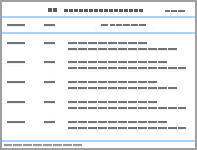
表1
西北七省区主要作物的100 kg收获物需氮、磷养分量"
| 作物种类 Crop types | 100 kg收获物需氮量 Nitrogen requirement per 100 kg of harvested product (kg) | 100 kg收获物需磷量 Phosphorus requirement per 100 kg of harvested product (kg) | |
|---|---|---|---|
| 粮食作物Grain crops | 小麦Wheat | 3.00 | 1.00 |
| 玉米Maize | 2.30 | 0.30 | |
| 水稻Rice | 2.20 | 0.80 | |
| 谷子Foxtail millet | 3.80 | 0.44 | |
| 高粱Sorghum | 2.29 | 0.61 | |
| 大麦Barley | 2.23 | 1.00 | |
| 青稞Hulless barley | 2.14 | 0.65 | |
| 燕麦Oat | 3.00 | 1.00 | |
| 荞麦Buckwheat | 3.30 | 1.50 | |
| 大豆Soybean | 7.20 | 0.75 | |
| 薯类Tubers | 0.50 | 0.09 | |
| 油料作物Oil crops | 花生Peanut | 7.19 | 0.89 |
| 棉花Cotton | 11.70 | 3.04 | |
| 麻类Fiber crops | 3.50 | 0.37 | |
| 甜菜Sugar beet | 0.48 | 0.06 | |
| 烟叶Tobacco leaves | 3.85 | 0.53 | |
| 蔬菜Vegetables | 0.432 | 0.14 | |
| 水果Fruits | 苹果Apple | 0.30 | 0.08 |
| 桃Peach | 0.21 | 0.03 | |
| 梨Pear | 0.47 | 0.23 | |
| 葡萄Grape | 0.74 | 0.51 | |
| 猕猴桃Kiwifruit | 0.72 | 0.10 | |
| 杏Apricot | 1.42 | 0.71 |
表2
土壤不同氮、磷养分水平下施肥供给养分占比推荐值"
| 土壤氮、磷养分分级 Soil nitrogen and phosphorus nutrient classification | ||||
|---|---|---|---|---|
| Ⅰ | Ⅱ | Ⅲ | ||
| 土壤全氮含量 Total soil nitrogen content (g·kg-1) | 旱地(大田作物)Dryland (field crops) | >1.0 | 0.8-1.0 | <0.8 |
| 水田Paddy field | >1.2 | 1.0-1.2 | <1.0 | |
| 菜地Vegetable field | >1.2 | 1.0-1.2 | <1.0 | |
| 果园Orchard | >1.0 | 0.8-1.0 | <0.8 | |
| 土壤有效磷含量 Soil available phosphorus content (mg·kg-1) | >40 | 20-40 | <20 | |
| 施肥供给占比Proportion of fertilizer supply (%) | 35 | 45 | 55 | |
表3
自变量(x1,x2)对应变量交互作用的类型"
| 类型Type | 判断依据Basis for judgment |
|---|---|
| 非线性增强Nonlinear enhancement | q(x1∩x2) > q(x1) + q(x2) |
| 双因子增强Double-factor enhancement | q(x1∩x2) > max[q(x1 ), q(x2)] |
| 单因子非线性减弱Single-factor nonlinear weakening | Min[q(x1), q(x2)]< q(x1∩x2) < max[q(x1), q(x2)] |
| 非线性减弱Nonlinear weakening | q(x1∩x2) < min[q(x1), q(x2)] |
| 独立Independent | q(x1∩x2) = q(x1) + q(x2) |
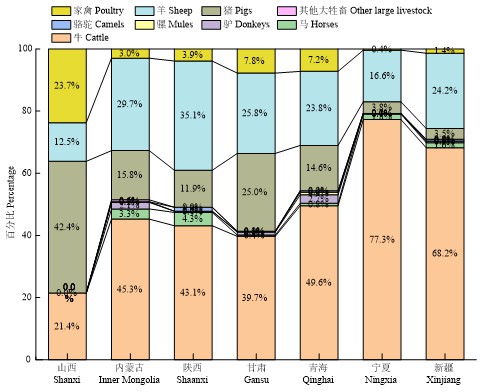
图1
西北七省区不同种类畜禽养殖规模"
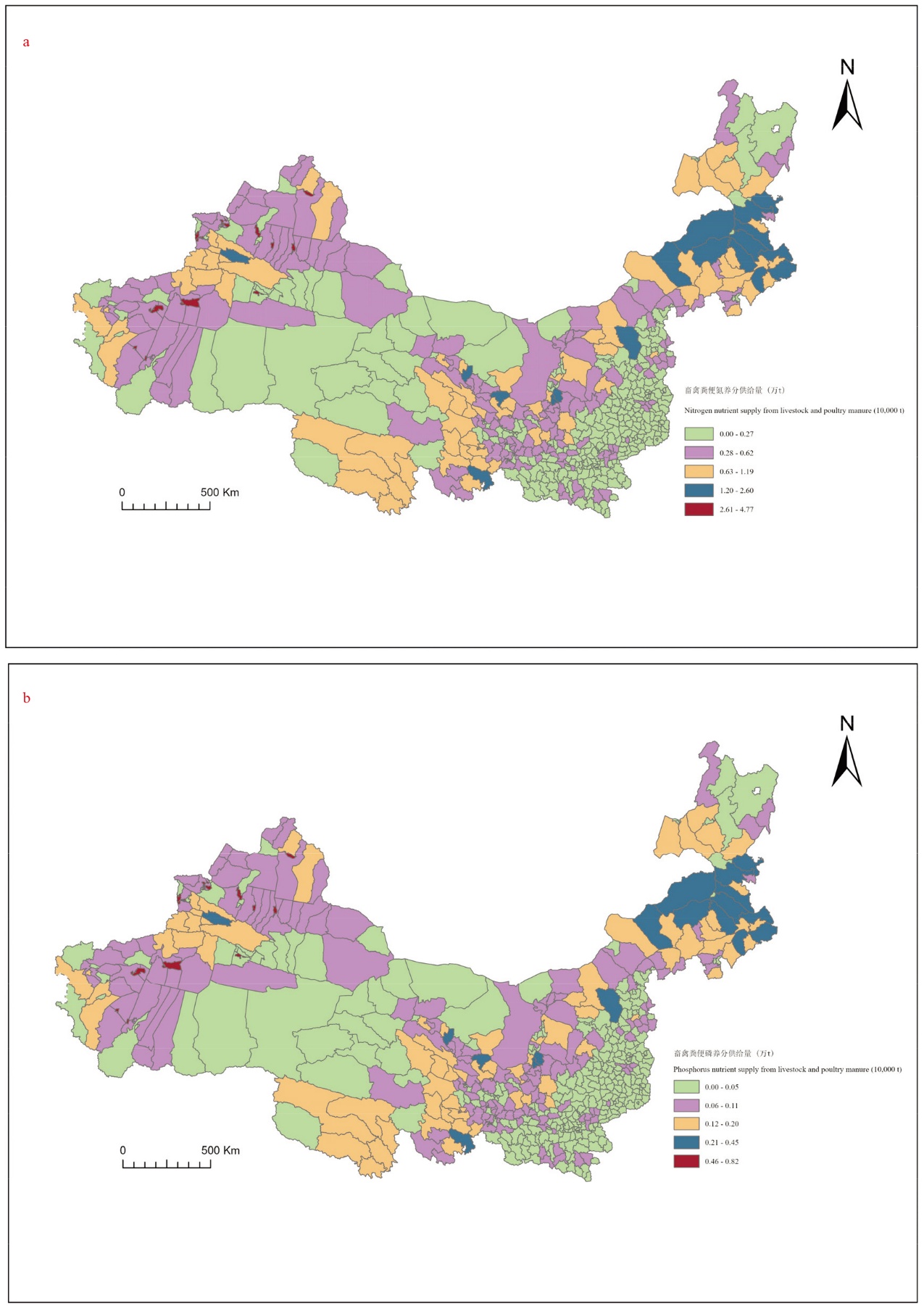
图2
西北七省区县域畜禽粪便氮(a)、磷(b)养分供给量空间分布 审图号:GS京(2026)2687号"
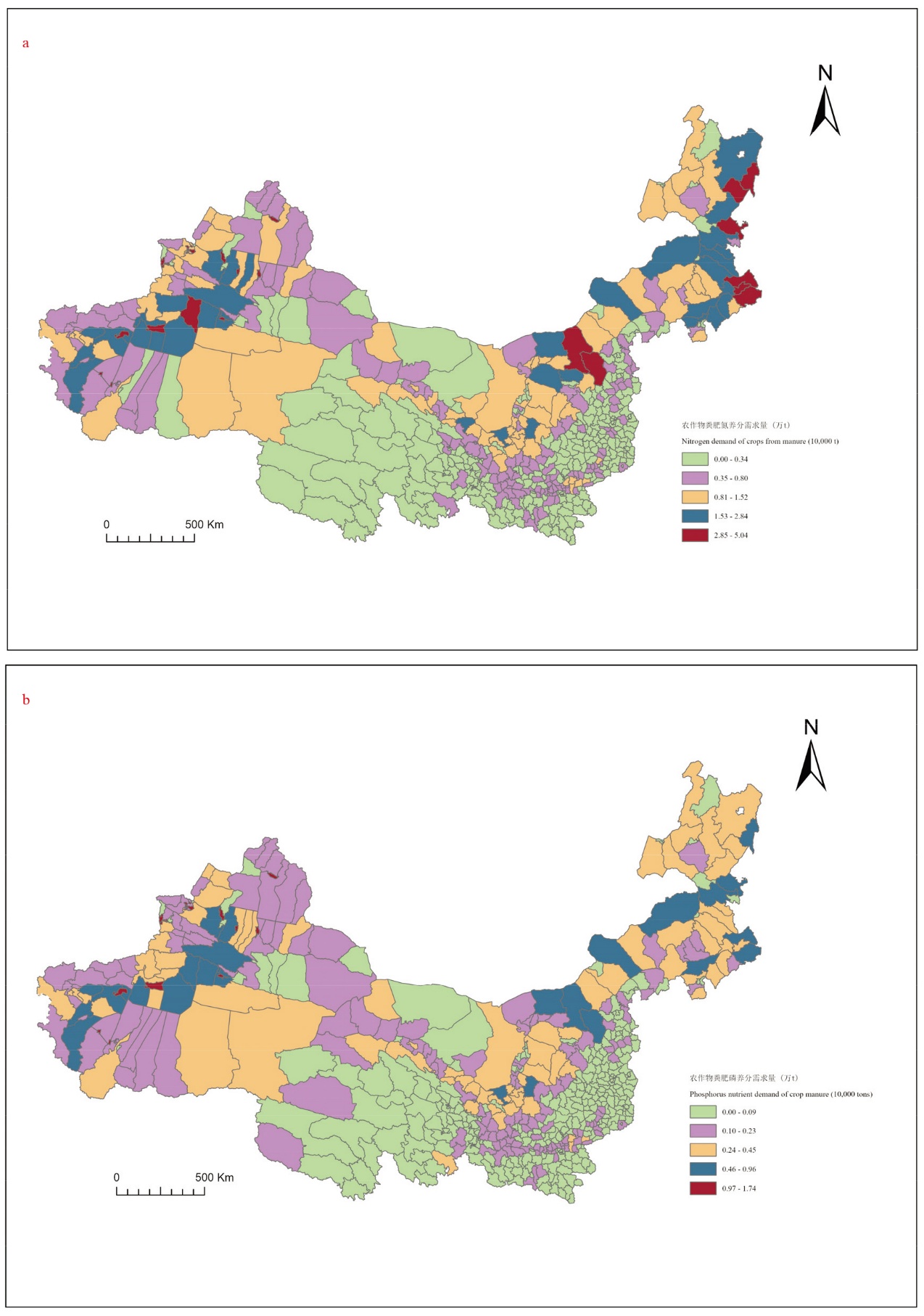
图3
西北地区县域农作物粪便氮(a)、磷(b)养分需求量分布 审图号:GS京(2026)2687号"
表4
西北七省区省域畜禽粪便土地承载力"
| 省/区 Province | 氮养分承载力指数 Nitrogen nutrient carrying capacity index, IN | 磷养分承载力指数 Phosphorus nutrient carrying capacity index, IP |
|---|---|---|
| 山西Shanxi | 0.65 | 0.58 |
| 内蒙古Inner Mongolia | 0.49 | 0.43 |
| 陕西Shaanxi | 0.48 | 0.34 |
| 甘肃Gansu | 0.88 | 0.54 |
| 青海Qinghai | 4.90 | 3.11 |
| 宁夏Ningxia | 0.68 | 0.44 |
| 新疆Xinjiang | 0.50 | 0.30 |
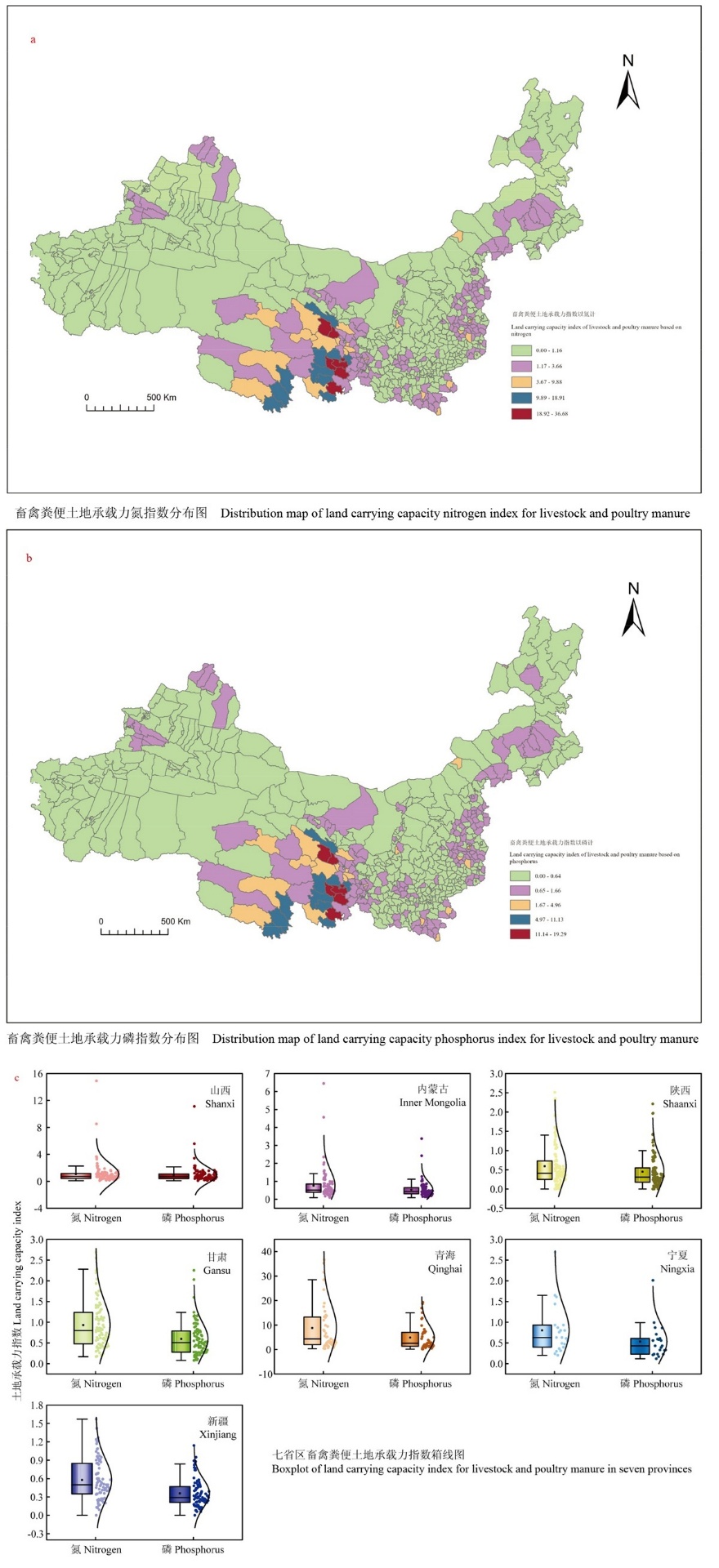
图4
西北七省区县域畜禽粪便土地承载力指数空间分布及七省区氮磷土地承载力指数箱线图 审图号:GS京(2026)2687号"
表5
各驱动因子的单因子效应(q值)及交互探测结果"
| 因变量 Dependent variable | 影响因子 Impact factor | 耕地面积 Arable land area | 主要作物播种面积占比 Proportion of main crop sown area | 养殖规模 Farming scale | 化肥施用总量 Total fertilizer application |
|---|---|---|---|---|---|
| IN | 耕地面积Arable land area | 0.276 | |||
| 主要作物播种面积Proportion of main crop sown area | 0.261ф | 0.040 | |||
| 养殖规模Farming scale | 0.756※ | 0.322※ | 0.094 | ||
| 化肥施用总量Total fertilizer application | 0.222ф | 0.237# | 0.691※ | 0.208 | |
| IP | 耕地面积Arable land area | 0.284 | |||
| 主要作物播种面积Proportion of main crop sown area | 0.256ф | 0.032 | |||
| 养殖规模Farming scale | 0.730※ | 0.304※ | 0.092 | ||
| 化肥施用总量Total fertilizer application | 0.231ф | 0.226# | 0.673※ | 0.215 |
| [1] |
陆桂萍. 农户畜禽养殖废弃物资源化利用技术采纳意愿影响因素研究[D]. 长沙: 湖南农业大学, 2022.
|
|
|
|
| [2] |
农业农村部. 农业农村部关于印发《到2025年化肥减量化行动方案》和《到2025年化学农药减量化行动方案》的通知: 农农发[2022]8号[R]. 中华人民共和国农业农村部公报, 2022(12): 11-19.
|
|
Ministry of Agriculture and Rural Affairs of the People's Republic of China. Circular on Issuing the Action Plan for Chemical Fertilizer Reduction by 2025 and the Action Plan for Chemical Pesticide Reduction by 2025: Nongnongfa〔2022〕No.8[R]. Gazette of the Ministry of Agriculture and Rural Affairs of the People's Republic of China, 2022(12):11-19. (in Chinese)
|
|
| [3] |
韩叙, 王英, 刘文婷, 余万林, 夏显力. 县域视角下黄河流域农业绿色发展时空分异特征及驱动因素研究[J]. 中国生态农业学报(中英文), 2024, 32(7): 1251-1263.
|
|
|
|
| [4] |
马林, 柏兆海, 王选, 曹玉博, 马文奇, 张福锁. 中国农牧系统养分管理研究的意义与重点[J]. 中国农业科学, 2018, 51(3): 406-416. DOI: 10.3864/j.issn.0578-1752.2018.03.002.
|
|
|
|
| [5] |
侯志康. 中国西北地区不同相态的降水时空变化研究[D]. 兰州: 兰州交通大学, 2024.
|
|
|
|
| [6] |
|
| [7] |
|
| [8] |
|
| [9] |
|
| [10] |
|
| [11] |
龚世飞, 肖能武, 丁武汉, 居学海, 吴平华, 余永松, 李虎. 基于耕地承载力的十堰市畜禽养殖环境风险评价[J]. 中国农业科学, 2023, 56(5): 920-934. DOI: 10.3864/j.issn.0578-1752.2023.05.009.
|
|
|
|
| [12] |
高慧珊, 李根明, 张进财, 姬广兴, 李青松. 河南省畜禽粪便同效当量替代化肥供需平衡分析[J]. 中国农业科学, 2024, 57(23): 4746-4760. DOI: 10.3864/j.issn.0578-1752.2024.23.013.
|
|
|
|
| [13] |
丁尚, 付阳, 郭浩浩, 宋晨阳, 李博玲, 赵洪伟. 海南岛 1988-2018年畜禽粪尿氮磷负荷量及环境效应[J]. 中国农业科学, 2020, 53(18): 3752-3763. DOI: 10.3864/j.issn.0578-1752.2020.18.011.
|
|
|
|
| [14] |
张晓莉, 夏衣热·肖开提. 新疆畜禽粪污排放时空演变特征及预警分析: 基于85个县市数据[J]. 中国农业资源与区划, 2022, 43(2): 240-249.
|
|
|
|
| [15] |
胡璇, 常子璇, 梁伊菲, 杨彬, 段成娇, 栗丽, 马红梅, 李廷亮. 山西省 2012-2021年畜禽养殖粪尿资源变化及土地承载力分析[J]. 土壤通报, 2025, 56(5): 1222-1231.
|
|
|
|
| [16] |
温亚利, 侯一蕾. 治理现代化背景下县域经济高质量发展的战略选择[J]. 国家治理, 2024(2): 70-73.
|
|
|
|
| [17] |
全国畜牧总站, 中国饲料工业协会, 国家畜禽养殖废弃物资源化利用科技创新联盟. 土地承载力测算技术指南[M]. 北京: 中国农业出版社, 2017.
|
|
National Animal Husbandry Station, China Feed Industry Association, National Sci-Tech Innovation Alliance for Resource Utilization of Livestock and Poultry Waste. Technical Guide for Calculating Land Carrying Capacity[M]. Beijing: China Agriculture Press, 2017. (in Chinese)
|
|
| [18] |
李艳梅, 李玉红, 陈广凤, 李洋洋, 戴忠民. 畜禽粪污土地承载力的时空分布特征研究[J]. 农学学报, 2024, 14(10): 33-41.
|
|
|
|
| [19] |
|
| [20] |
闫熠峰, 刘子勇, 成锦霞. 山西省主要粮食作物耕地的畜禽粪污土地承载力分析[J]. 山西农业科学, 2019, 47(12): 2168-2171, 2218.
|
|
|
|
| [21] |
郑莉, 张晴雯, 张爱平, 刘杏认, 刘士清, 韩聪. 山东省畜禽粪污土地承载力时空分异特征分析[J]. 农业环境科学学报, 2019, 38(4): 882-891.
|
|
|
|
| [22] |
林宁, 查向浩, 蔡吉祥, 韦良焕. 喀什地区畜禽养殖粪污土地承载力时空分布[J]. 四川农业大学学报, 2023, 41(5): 935-944, 960.
|
|
|
|
| [23] |
耿维, 胡林, 崔建宇, 卜美东, 张蓓蓓. 中国区域畜禽粪便能源潜力及总量控制研究[J]. 农业工程学报, 2013, 29(1): 171-179.
|
|
|
|
| [24] |
王劲峰, 徐成东. 地理探测器: 原理与展望[J]. 地理学报, 2017, 72(1): 116-134.
|
|
|
|
| [25] |
|
| [26] |
豆志杰, 钟明艳, 孟飒. 区域畜禽养殖环境承载力评价及预警研究[J]. 中国农机化学报, 2021, 42(12): 214-221.
|
|
|
|
| [27] |
彭紫微, 吴根义, 黄杰, 戴诗琴. 区域畜禽环境承载力核算方法研究与应用[J]. 农业环境科学学报, 2023, 42(4): 769-777.
|
|
|
|
| [28] |
王孟茹, 李廷梅, 郝子垚, 鲁浩天, 于鲁冀. 河南省典型区域畜禽粪污土地承载力及其影响因素研究[J]. 生态与农村环境学报, 2024, 40(11): 1428-1437.
|
|
|
|
| [29] |
李蕊超, 金藏玉, 林慧龙. 传统牧区草地农业替代战略: 基于6大牧区的研究[J]. 草地学报, 2014, 22(4): 685-690.
|
|
|
|
| [30] |
王一莹. 黑土区典型县域种养系统养分流动特征与政策实证分析[D]. 长春: 吉林农业大学, 2023.
|
|
|
|
| [31] |
张帅, 陆鹏, 陈硕, 吴建繁, 任康, 史文清, 陈清. 京郊畜禽粪污氮磷含量特征及影响因素分析[J]. 农业工程学报, 2018, 34(8): 244-251.
|
|
|
|
| [32] |
|
| [33] |
姜佳昌, 刘兴明, 孙斌, 李霞, 吴丹丹. 甘南玛曲高寒草甸植物群落碳、氮、磷含量的高光谱反演[J]. 草业科学, 2025, 42(8): 1911-1921.
|
|
|
|
| [34] |
王巧红, 杨艳, 李袁泽. 三江源区土壤酶活性与微生物养分限制对高寒草地退化与恢复的响应[J]. 草业科学, 2025, 42(8): 1922-1933.
|
|
|
|
| [35] |
叶红敏, 景鹏成, 鲁为华, 董忠民, 张凡凡. 新疆生产建设兵团苜蓿产业现状分析[J]. 中国畜禽种业, 2017, 13(9): 13-15.
|
|
|
|
| [36] |
|
| [37] |
冯起, 尹鑫卫, 朱猛, 张举涛, 刘蔚, 席海洋, 鱼腾飞, 杨林山, 刘文, 陆志翔. 统筹推进西北地区盐碱地综合治理利用: 现状、挑战与对策建议[J]. 中国科学院院刊, 2024, 39(12): 2060-2073.
|
|
|
|
| [38] |
李晓婷. 阴山北麓土壤有机碳对不同农作措施的响应机制[D]. 呼和浩特: 内蒙古农业大学, 2017.
|
|
|
|
| [39] |
李瑞, 樊明寿, 郑海春, 郜翻身, 高娃, 王伟妮, 赵晓梅. 基于产量水平的内蒙古阴山地区马铃薯施肥评价. 中国土壤与肥料, 2020(6): 181-188.
|
|
|
|
| [40] |
鲁伟丹, 李俊华, 罗彤, 陈丽丽, 张磊, 刘硕康. 连续三年不同有机肥替代率对小麦产量及土壤养分的影响. 植物营养与肥料学报, 2021, 27(8): 1330-1338.
|
|
|
|
| [41] |
|
| [42] |
|
| [1] | 邓春秀, 姚莉, 武鸿剑, 李杰, 沈悦, 赖明, 喻龙, 郭伟, 李瑾萌, 林超文, 李源洪. 基于近40年土地利用变化的川中丘陵区碳储量时空演变与驱动因素分析[J]. 中国农业科学, 2026, 59(9): 1916-1936. |
| [2] | 丁晓颖, 蔡艳蓉, 宋敏, 金大卫, 曹春霞. 湖南省耕地禀赋对作物种植结构的影响[J]. 中国农业科学, 2026, 59(10): 2194-2213. |
| [3] | 王楚凡, 牛俊. 西北地区主要粮食作物种植的水、碳足迹及布局优化[J]. 中国农业科学, 2024, 57(6): 1137-1152. |
| [4] | 高慧珊, 李根明, 张进财, 姬广兴, 李青松. 河南省畜禽粪便同效当量替代化肥供需平衡分析[J]. 中国农业科学, 2024, 57(23): 4746-4760. |
| [5] | 陈实, 黄银兰, 金云翔, 徐成林, 邹金秋. 中国北部冬小麦安全种植的农业气候因子及其阈值[J]. 中国农业科学, 2024, 57(16): 3142-3153. |
| [6] | 龚世飞, 肖能武, 丁武汉, 居学海, 吴平华, 余永松, 李虎. 基于耕地承载力的十堰市畜禽养殖环境风险评价[J]. 中国农业科学, 2023, 56(5): 920-934. |
| [7] | 刘高远, 和爱玲, 杜君, 吕金岭, 聂胜委, 潘秀燕, 许纪东, 李珏, 杨占平. 有机肥替代化肥对砂姜黑土区小麦-玉米轮作系统N2O排放的影响[J]. 中国农业科学, 2023, 56(16): 3156-3167. |
| [8] | 赵海璇,张亦涛,李文超,马文奇,翟丽梅,居学海,陈涵婷,康锐,孙志梅,习斌,刘宏斌. 白洋淀流域核心区农牧系统未利用氮量及空间分布[J]. 中国农业科学, 2023, 56(1): 118-128. |
| [9] | 乔远,杨欢,雒金麟,汪思娴,梁蓝月,陈新平,张务帅. 西北地区玉米生产投入及生态环境风险评价[J]. 中国农业科学, 2022, 55(5): 962-976. |
| [10] | 吴秋琳,姜玉英,刘媛,刘杰,马景,胡高,杨明进,吴孔明. 草地贪夜蛾在中国西北地区的迁飞路径[J]. 中国农业科学, 2022, 55(10): 1949-1960. |
| [11] | 徐久凯,袁亮,温延臣,张水勤,林治安,李燕婷,李海燕,赵秉强. 畜禽有机肥磷素在冬小麦上替代化肥磷当量研究[J]. 中国农业科学, 2021, 54(22): 4826-4839. |
| [12] | 邱孟龙,曹小曙,周建,冯小龙,高兴川. 基于GWR模型的渭北黄土旱塬粮食单产空间分异 及其影响因子分析——以陕西彬县为例[J]. 中国农业科学, 2019, 52(2): 273-284. |
| [13] | 刘杰安, 王小慧, 吴尧, 贾浩, 尹小刚, 史磊刚, 褚庆全, 陈阜. 近30年我国谷子生产时空变化与区域优势研究[J]. 中国农业科学, 2019, 52(11): 1883-1894. |
| [14] | 成登苗,李兆君,张雪莲,冯瑶,张树清. 畜禽粪便中兽用抗生素削减方法的研究进展[J]. 中国农业科学, 2018, 51(17): 3335-3352. |
| [15] | 李雨,韩平,任东,罗娜,王纪华. 基于地理探测器的农田土壤重金属影响因子分析[J]. 中国农业科学, 2017, 50(21): 4138-4148. |
|
||
