






中国农业科学 ›› 2026, Vol. 59 ›› Issue (22): 5039-5062.doi: 10.3864/j.issn.0578-1752.2026.22.007
丁硕秋1,2( ), 杨田1,2, 段玉鹏1,2, 梁超1,2, 高春瑞1,2, 陈柏青1,2, 冯浩2,3, 于强3,4, 何建强1,2,4()
收稿日期:2026-03-04
接受日期:2026-06-01
出版日期:2026-11-16
发布日期:2026-11-19
通信作者:
联系方式:
丁硕秋,E-mail:dingshuoqiu_2023@nwafu.edu.cn。
基金资助:
DING ShuoQiu1,2(), YANG Tian1,2, DUAN YuPeng1,2, LIANG Chao1,2, GAO ChunRui1,2, CHEN BaiQing1,2, FENG Hao2,3, YU Qiang3,4, HE JianQiang1,2,4()
Received:2026-03-04
Accepted:2026-06-01
Published:2026-11-16
Online:2026-11-19
摘要:
【目的】从周年生产视角,量化分析未来气候变化背景下黄淮海平原冬小麦-夏玉米轮作(简称麦玉轮作)系统生产潜力及产量差的时空分布情况,并解析其驱动机制,揭示气候变化对麦玉轮作系统生产潜力的影响,拟为当地优化种植布局、稳产增产及应对气候风险提供科学指导。【方法】首先将研究区域划分为6个不同的二熟农业生态区,包括环渤海二熟区(Zone1)、太行山前二熟区(Zone2)、海河平原二熟区(Zone3)、鲁西平原二熟区(Zone4)、黄淮平原二熟区(Zone5),以及江淮平原二熟区(Zone6);其次采用作物模型(APSIM与DSSAT)集成模拟历史基准时期(1980—2020年)和未来时期(2040s和2080s)SSP245与SSP585,2种排放情景下的麦玉轮作系统周年潜在产量、实际产量、产量差演变及作物物候动态,并识别影响作物潜在产量的主导限制因子。【结果】(1)冬小麦和夏玉米物候期在未来时期普遍缩短,2080s时期SSP585情景下缩短最为明显;未来时期冬小麦、夏玉米生育期内积温与平均温度显著上升,累积太阳辐射在高排放背景下显著下降。(2)历史基准时期的麦玉轮作系统周年产量差约为11.35—15.45 t·hm-2,其中Zone1区最高(15.45 t·hm-2);未来时期周年产量差水平普遍缩小,但Zone1-Zone3区仍维持较高水平(4.93—8.27 t·hm-2),而Zone4、Zone5、Zone6区急剧收缩至3.68 t·hm-2及以下,其中Zone4区的产量差水平与基准期相比下降最为严重(-10.92 t·hm-2)。(3)历史基准期内,累积太阳辐射是夏玉米潜在产量的绝对主导因子(% IncMSE > 200);冬小麦潜在产量则受多因子共同调控,不存在单一主导因子。未来情景时期,累积太阳辐射对夏玉米潜在产量的相对重要性逐步降低,物候因子的重要性持续上升;对冬小麦而言,累积太阳辐射与累积降水量的相对重要性逐渐上升。【结论】(1)黄淮海平原麦玉轮作系统未来产量差呈现显著缩小趋势,且该趋势具有较强的空间异质性,其中环渤海二熟区(Zone1)、太行山前二熟区(Zone2)、海河平原二熟区(Zone3)仍保持较大增产潜力;黄淮平原二熟区(Zone5)次之;江淮平原二熟区(Zone6)及鲁西平原二熟区(Zone4)增产潜力最弱。(2)相较于基准期,未来时期黄淮海平原麦玉轮作系统周年生产潜力呈现出波动或者缓慢下降的趋势,其中鲁西平原二熟区(Zone4)的周年潜在产量水平最低,且在高排放背景(SSP585)下,该区域的下降趋势更明显。(3)从历史基准时期到未来时期,夏玉米潜在产量的限制因子逐渐由累积太阳辐射转为物候因子,而冬小麦潜在产量在历史基准期由多因子共同调控,未来时期,生长季内累积太阳辐射和累积降水量的重要性增加,成为相对重要的2个因子。
丁硕秋, 杨田, 段玉鹏, 梁超, 高春瑞, 陈柏青, 冯浩, 于强, 何建强. 基于作物模型的黄淮海平原冬小麦-夏玉米轮作系统周年生产潜力预测分析[J]. 中国农业科学, 2026, 59(22): 5039-5062.
DING ShuoQiu, YANG Tian, DUAN YuPeng, LIANG Chao, GAO ChunRui, CHEN BaiQing, FENG Hao, YU Qiang, HE JianQiang. Prediction and Analysis of the Annual Production Potential of the Winter Wheat-Summer Maize Rotation System in the Huang-Huai- Hai Plain Based on Crop Model Ensemble Simulations[J]. Scientia Agricultura Sinica, 2026, 59(22): 5039-5062.
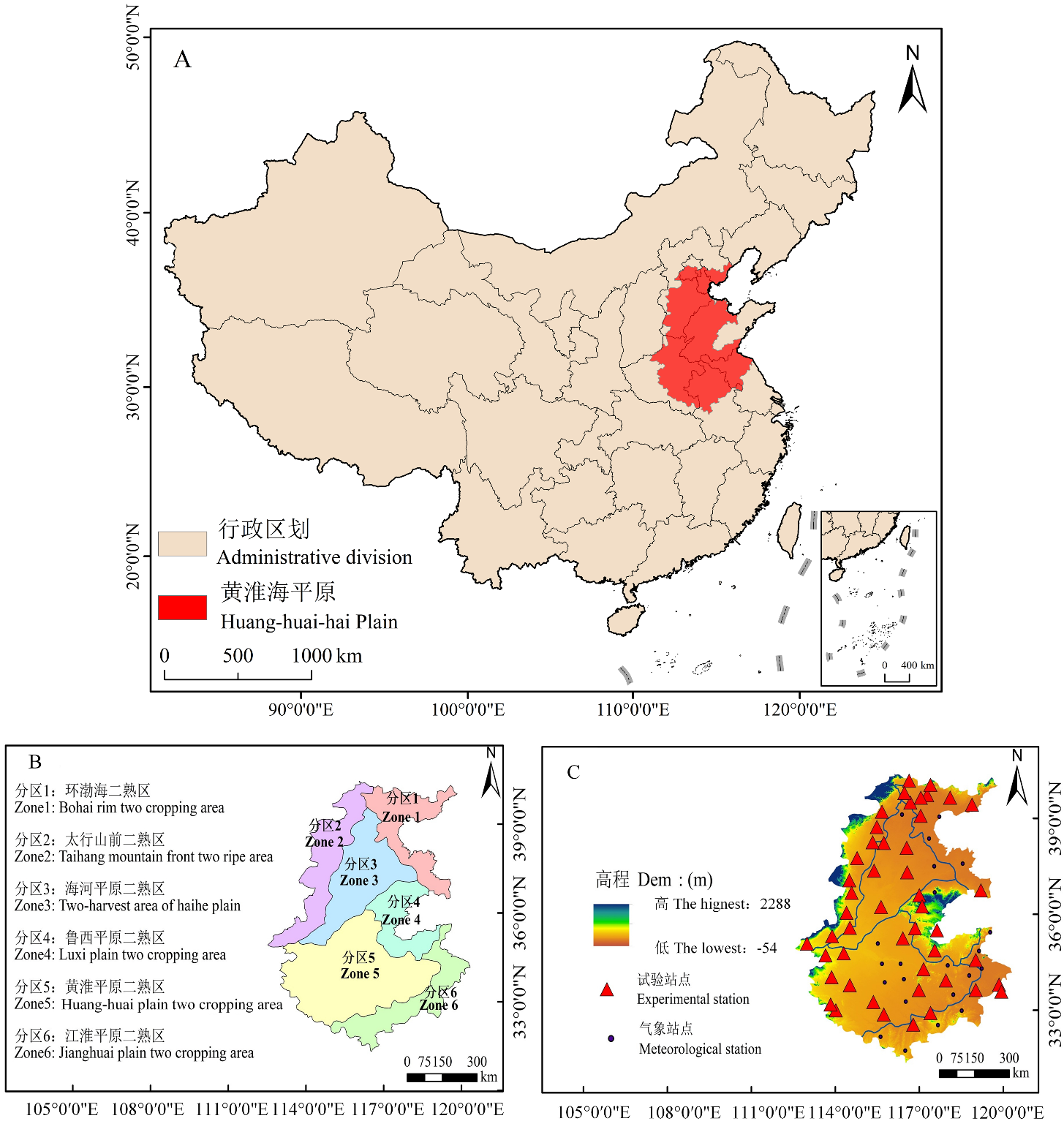
图1
黄淮海平原(A)和内部6个农业生态区(B)以及区域内试验站和气象站分布(C) 审图号:GS京(2026)2687号"
表1
APSIM模型作物品种参数设置"
| 作物品种 Crop cultivar | 参数 Parameter | 分区 Zone | |||||
|---|---|---|---|---|---|---|---|
| 分区1 Zone1 | 分区2 Zone2 | 分区3 Zone3 | 分区4 Zone4 | 分区5 Zone5 | 分区6 Zone6 | ||
| 冬小麦 Winter wheat | tt_floral_initiation (始花期积温 Accumulated temperature at floral initiation,(℃·d)) | 475 | 496 | 331 | 176 | 500 | 427 |
| tt_end_grain_fill (终止灌浆积温 Accumulated temperature at the end of grain filling,(℃·d)) | 624 | 559 | 588 | 372 | 658 | 672 | |
| tt_end_of_juvenile (拔节期积温 Accumulated temperature at jointing stage,(℃·d)) | 575 | 591 | 545 | 278 | 548 | 572 | |
| tt_start_grain_fill (灌浆起始积温 Accumulated temperature at the start of grain filling,(℃·d)) | 104 | 141 | 175 | 139 | 117 | 152 | |
| startgf_to_mat (灌浆结束积温 Accumulated temperature from grain filling initiation to maturity,(℃·d)) | 728 | 700 | 763 | 510 | 775 | 825 | |
| potential_grain_filling_rate (籽粒潜在灌浆速率 Potential grain filling rate,(mg·d-1)) | 0.0067 | 0.0075 | 0.0065 | 0.0070 | 0.0090 | 0.0090 | |
| grains_per_gram_stem (茎秆籽粒数量 Grain number per unit stem mass) | 70 | 80 | 75 | 55 | 65 | 80 | |
| 夏玉米 Summer maize | tt_emerg_to_endjuv (出苗至三叶期积温 Accumulated temperature from emergence to the end of juvenile stage,(℃·d)) | 171 | 255 | 220 | 122 | 166 | 167 |
| tt_flower_to_maturity (开花至成熟期积温 Accumulated temperature from flowering to maturity,(℃·d)) | 740 | 780 | 796 | 933 | 789 | 511 | |
| tt_endjuv_to_init (三叶期至拔节期积温 Accumulated temperature from juvenile end to jointing stage,(℃·d)) | 50 | 0 | 0 | 38 | 106 | 170 | |
| tt_flag_to_flower (旗叶期至开花期积温 Accumulated temperature from flag leaf stage to flowering stage,(℃·d)) | 116 | 93 | 143 | 110 | 69 | 109 | |
| tt_flower_to_start_grain (开花期至灌浆期积温 Accumulated temperature from flowering to early grain filling stage,(℃·d)) | 321 | 309 | 327 | 233 | 90 | 90 | |
| potKernelWt (潜在籽粒重 Potential kernel weight,(mg)) | 500 | 528 | 300 | 350 | 300 | 528 | |
| photoperiod_crit1 (光周期下限 Lower limit of photoperiod,(h)) | 12.5 | 12.5 | 12.5 | 12.5 | 12.5 | 12.5 | |
| photoperiod_crit2 (光周期上限 Upper limit of photoperiod,(h)) | 20.0 | 20.0 | 20.0 | 20.0 | 20.0 | 20.0 | |
| photoperiod_slope (光周期斜率 Photoperiod sensitivity slope,(%)) | 0 | 0 | 0 | 0 | 0 | 0 | |
表2
DSSAT模型作物品种参数设置"
| 作物品种 Crop cultivar | 参数 Parameter | 分区(Zone) | ||||||
|---|---|---|---|---|---|---|---|---|
| 分区1 Zone1 | 分区2 Zone2 | 分区3 Zone3 | 分区4 Zone4 | 分区5 Zone5 | 分区6 Zone6 | |||
| 冬小麦 Winter wheat | P1V (最适温度条件下通过春化阶段所需天数 Days required for vernalization under optimal temperature conditions,(d)) | 99.20 | 50.20 | 50.20 | 40.20 | 50.20 | 60.20 | |
| P1D (光周期参数 Photoperiod parameter,(%)) | 122.00 | 112.00 | 95.00 | 55.00 | 110.00 | 100.00 | ||
| P5 (籽粒灌浆期积温 Accumulated temperature during grain filling period,(℃·d)) | 725.00 | 735.00 | 799.00 | 700.00 | 729.00 | 799.00 | ||
| G1 (开花期单位株冠质量的籽粒数 Grain number per unit canopy weight at anthesis,(grains/g)) | 30.00 | 30.00 | 35.00 | 40.00 | 40.00 | 40.00 | ||
| G2 (最佳条件下标准籽粒质量 Standard kernel weight under optimal conditions,(mg)) | 31.00 | 21.00 | 30.00 | 35.00 | 25.00 | 25.00 | ||
| G3 (成熟期非胁迫下单株茎穂标准干质量 Standard dry weight of single plant stem and spike under non-stressed conditions at maturity,(g)) | 1.08 | 1.00 | 1.65 | 1.00 | 1.00 | 1.00 | ||
| PHINT (完成一片叶生长所需积温,Accumulated temperature required for the growth of one leaf(℃·d)) | 140.00 | 80.00 | 90.00 | 140.00 | 190.00 | 160.00 | ||
| 夏玉米 Summer maize | P1 (完成非感光幼苗期的积温(基础温度为8℃) Thermal time from seedling emergence to the end of the juvenile (base temperature is 8 ℃),(℃·d)) | 105.00 | 200.00 | 190.00 | 90.00 | 200.00 | 280.00 | |
| P2 (光周期敏感系数 Photoperiod sensitivity coefficient,(%)) | 0.60 | 0.95 | 0.90 | 0.50 | 0.95 | 1.90 | ||
| P5 (灌浆特性参数 Grain filling characteristic parameter,(℃·d)) | 715.00 | 780.00 | 860.00 | 980.00 | 860.00 | 500.00 | ||
| G2 (单株最大穗粒数 Maximum kernel number per plant) | 850.00 | 820.40 | 840.00 | 880.00 | 820.40 | 745.00 | ||
| G3 (最大灌浆速率参数 Maximum grain filling rate parameter,(mg/(grains·d)) | 13.00 | 6.60 | 7.00 | 7.00 | 6.60 | 19.00 | ||
| PHINT (完成一片叶生长所需积温 Accumulated temperature required for the growth of a single leaf,(℃·d)) | 65.00 | 38.90 | 30.00 | 38.90 | 38.90 | 40.00 | ||
表3
APSIM模型和DSSAT模型参数校准结果及权重设置"
| 作物品种Crop cultivar | 作物模型Crop model | 指标Index | 开花期Anthesis date | 成熟期Maturity date | 产量Yield |
|---|---|---|---|---|---|
| 冬小麦 Winter wheat | APSIM | R2 | 0.97 | 0.96 | 0.76 |
| RMSE | 3.18 | 2.88 | 1106.51 | ||
| RRMSE | 0.016 | 0.012 | 0.160 | ||
| 权重设置Weight setting | 0.54 | 0.49 | 0.48 | ||
| DSSAT | R2 | 0.95 | 0.96 | 0.86 | |
| RMSE | 4.03 | 2.87 | 1065.76 | ||
| RRMSE | 0.020 | 0.011 | 0.160 | ||
| 权重设置Weight setting | 0.46 | 0.51 | 0.52 | ||
| 夏玉米 Summer maize | APSIM | R2 | 0.93 | 0.78 | 0.55 |
| RMSE | 1.52 | 2.46 | 1279.03 | ||
| RRMSE | 0.029 | 0.025 | 0.156 | ||
| 权重设置Weight setting | 0.73 | 0.44 | 0.50 | ||
| DSSAT | R2 | 0.42 | 0.97 | 0.60 | |
| RMSE | 4.53 | 2.88 | 1358.52 | ||
| RRMSE | 0.087 | 0.012 | 0.164 | ||
| 权重设置Weight setting | 0.27 | 0.56 | 0.50 |
表4
APSIM模型、DSSAT模型及集成模型校准验证结果"
| 作物品种 Crop cultivar | 作物模型 Crop model | 指标 Index | 开花期Anthesis date | 成熟期Maturity date | 产量Yield | ||||||||
|---|---|---|---|---|---|---|---|---|---|---|---|---|---|
| 校准值 Calibration | 验证值 Validration | 校准值 Calibration | 验证值 Validration | 校准值 Calibration | 验证值 Validration | ||||||||
| 冬小麦 Winter wheat | APSIM | R2 | 0.97 | 0.94 | 0.96 | 0.97 | 0.76 | 0.78 | |||||
| RMSE | 3.18 | 4.33 | 2.88 | 2.76 | 1106.51 | 901.89 | |||||||
| RRMSE | 0.016 | 0.022 | 0.012 | 0.011 | 0.160 | 0.138 | |||||||
| DSSAT | R2 | 0.95 | 0.93 | 0.96 | 0.98 | 0.86 | 0.81 | ||||||
| RMSE | 4.03 | 4.12 | 2.87 | 2.23 | 1065.76 | 905.57 | |||||||
| RRMSE | 0.020 | 0.021 | 0.011 | 0.009 | 0.160 | 0.138 | |||||||
| 模型集成 Integration | R2 | 0.95 | 0.96 | 0.97 | 0.98 | 0.94 | 0.94 | ||||||
| RMSE | 3.74 | 3.47 | 2.58 | 2.16 | 498.96 | 472.80 | |||||||
| RRMSE | 0.019 | 0.018 | 0.011 | 0.009 | 0.074 | 0.073 | |||||||
| 夏玉米 Summer maize | APSIM | R2 | 0.93 | 0.93 | 0.78 | 0.82 | 0.55 | 0.32 | |||||
| RMSE | 1.52 | 1.39 | 2.46 | 2.11 | 1279.03 | 1189.96 | |||||||
| RRMSE | 0.029 | 0.027 | 0.025 | 0.021 | 0.156 | 0.140 | |||||||
| DSSAT | R2 | 0.42 | 0.48 | 0.97 | 0.33 | 0.60 | 0.67 | ||||||
| RMSE | 4.53 | 4.14 | 2.88 | 3.73 | 1358.52 | 1101.19 | |||||||
| RRMSE | 0.087 | 0.080 | 0.012 | 0.037 | 0.164 | 0.130 | |||||||
| 模型集成 Integration | R2 | 0.89 | 0.96 | 0.79 | 0.98 | 0.86 | 0.94 | ||||||
| RMSE | 1.81 | 3.47 | 2.37 | 2.16 | 589.36 | 472.80 | |||||||
| RRMSE | 0.035 | 0.018 | 0.024 | 0.009 | 0.070 | 0.073 | |||||||
表5
本研究中用于未来气候预测的10种全球气候模式(GCM)"
| GCM名称 GCM name | 缩写 Abbreviation | 国家 Country |
|---|---|---|
| ACCESS1.0 | AC1 | 澳大利亚 Australia |
| BCC-CSM1.1 | BC1 | 中国 China |
| CanESM5 | Can1 | 加拿大 Canada |
| CMCC-CM2-SR5 | CMCS | 意大利 Italy |
| CNRM-CM6-2 | CNR2 | 法国 France |
| CIESM | CIES | 中国 China |
| ACCESS-CM2 | AC2 | 澳大利亚 Australia |
| CanESM5-CanOE | Can2 | 加拿大 Canada |
| CNRM-ESM2-1 | CNR3 | 法国 France |
| CNRM-CM6-1 | CNR1 | 法国 France |
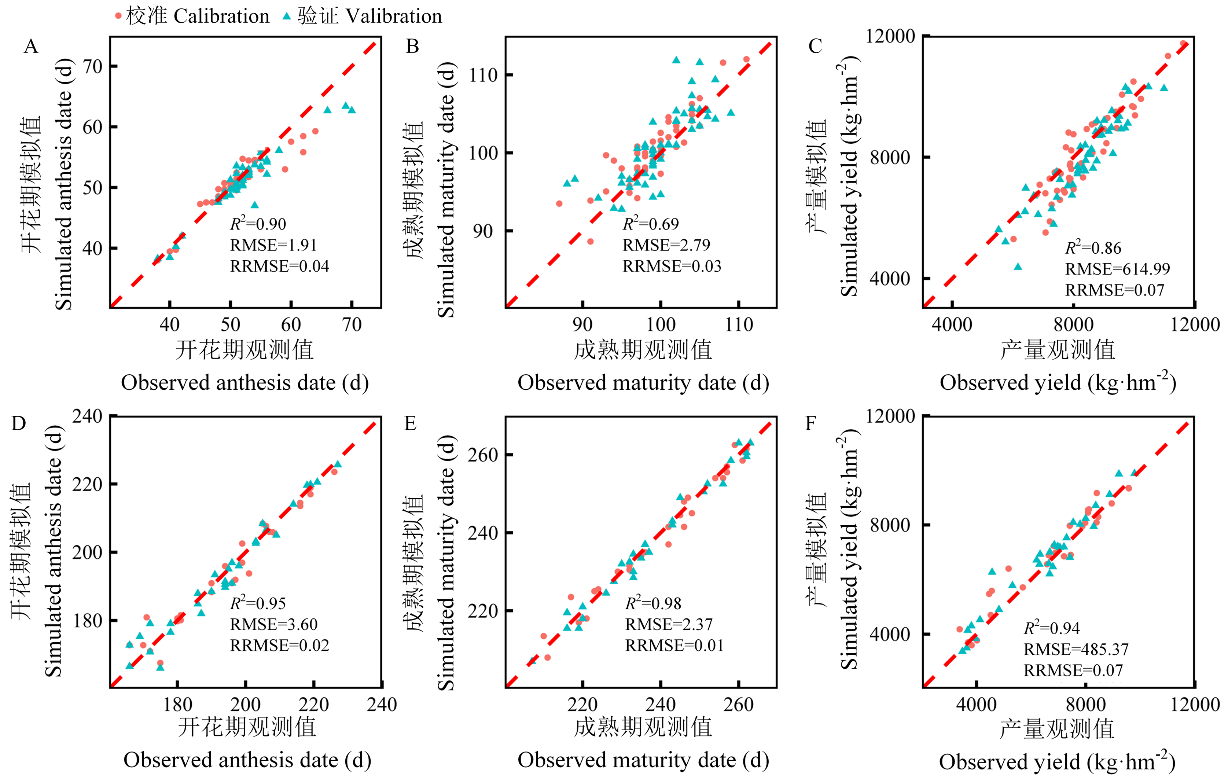
图2
集成模型夏玉米(A—C)和冬小麦(D—F)开花期、成熟期和产量的模拟结果 图中不同物候期的单位为播种后天数。下同"
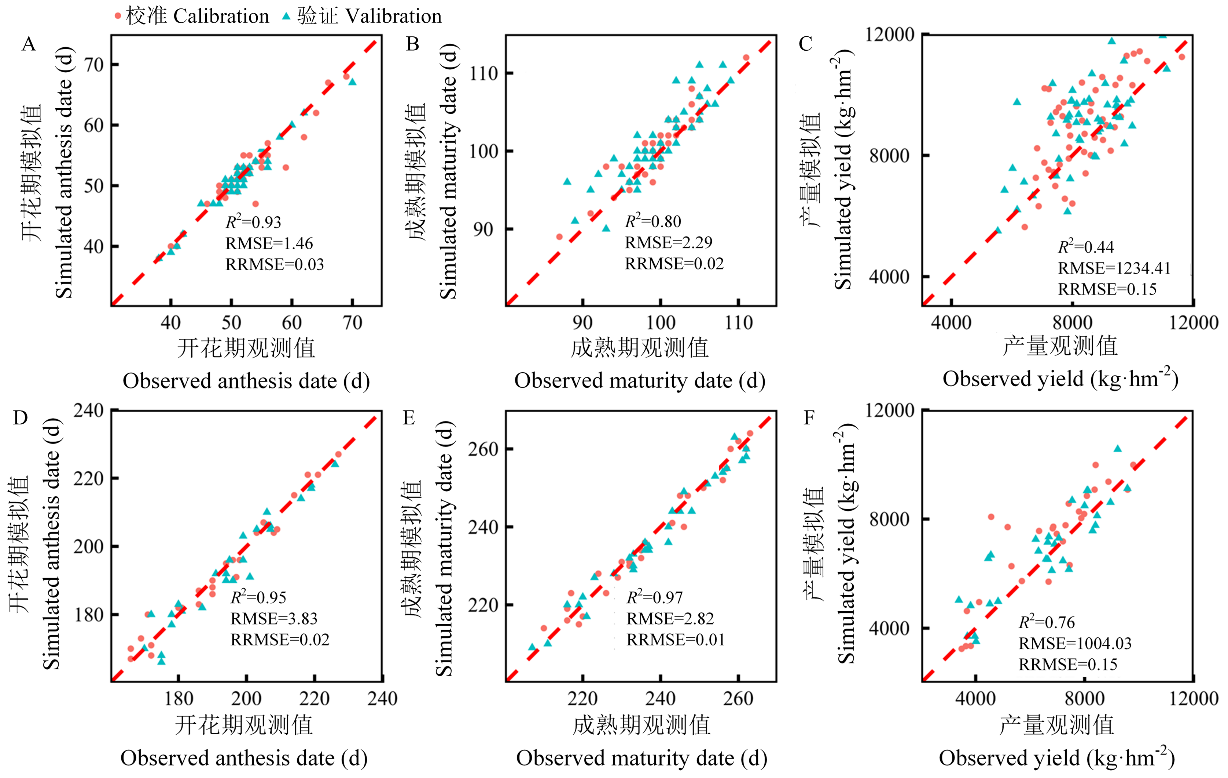
图3
APSIM模型夏玉米(A—C)和冬小麦(D—F)开花期、成熟期和产量的模拟结果"
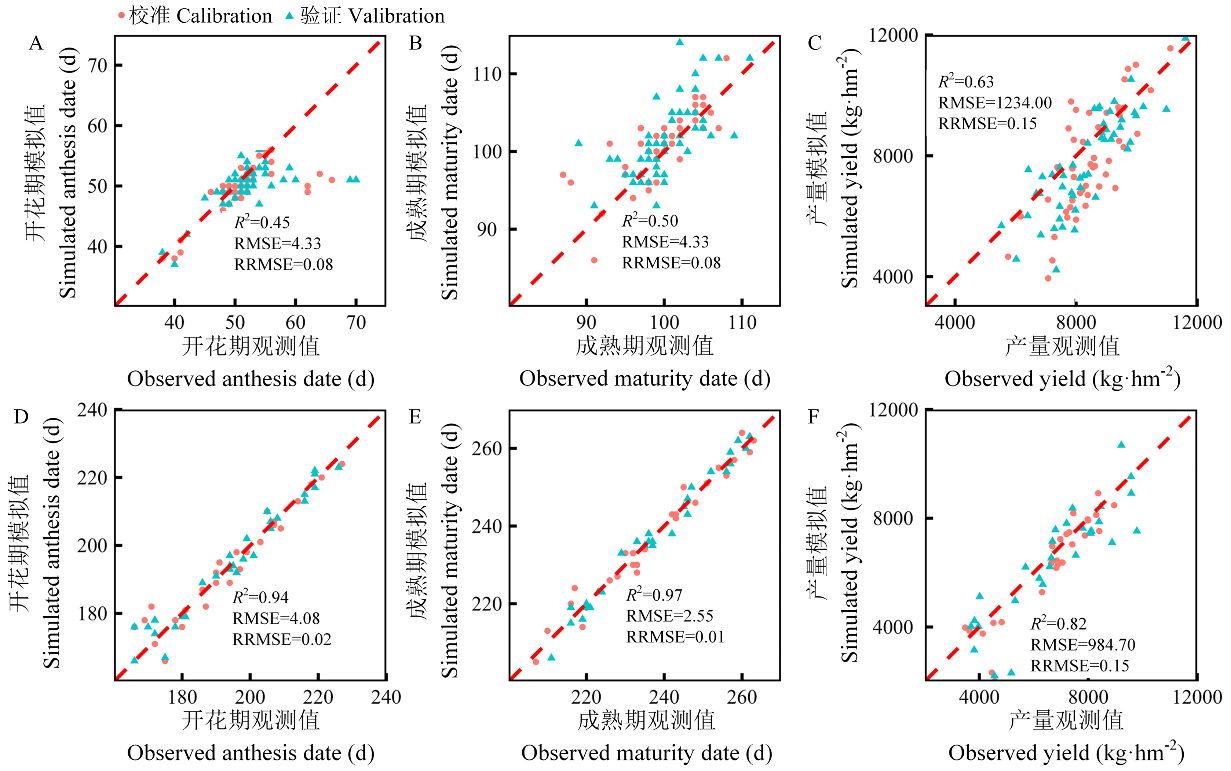
图4
DSSAT模型夏玉米(A—C)和冬小麦(D—F)开花期、成熟期和产量的模拟结果"
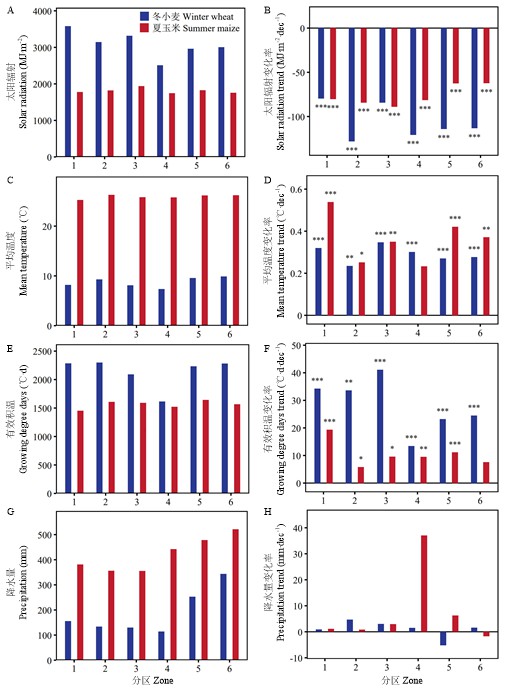
图5
历史基准期(1980—2020年)黄淮海平原不同分区冬小麦和夏玉米生育期内气候因子及变化率"
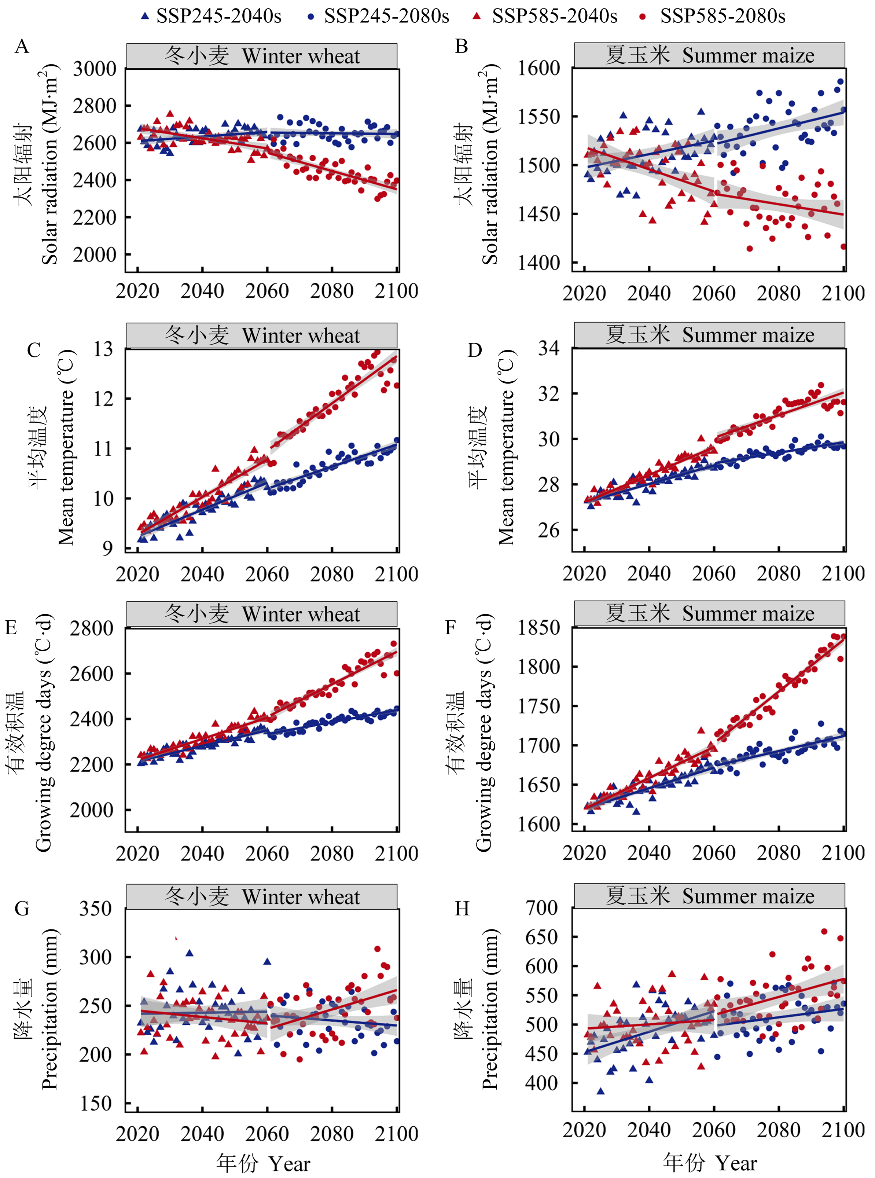
图6
未来时期(2040s和2080s)不同排放情景(SSP245和SSP585)下黄淮海平原冬小麦和夏玉米生育期内不同气候因子的变化趋势"
表6
历史基准期(1980—2020年)及未来时期(2040s和2080s)两种排放情景(SSP245和SSP585)下黄淮海平原不同分区冬小麦和夏玉米的开花期和成熟期"
| 时期 Period | 生育时期 Growth period | 作物品种 Crop cultivar | 播种后天数 Days after sowing (d) | ||||||||||
|---|---|---|---|---|---|---|---|---|---|---|---|---|---|
| 分区1 Zone1 | 分区2 Zone2 | 分区3 Zone3 | 分区4 Zone4 | 分区5 Zone5 | 分区6 Zone6 | ||||||||
| 基准期 Baseline period | 开花期 Anthesis | 冬小麦Winter wheat | 217 | 197 | 197 | 151 | 186 | 181 | |||||
| 夏玉米Summer maize | 49 | 53 | 51 | 39 | 52 | 65 | |||||||
| 成熟期 Maturity | 冬小麦Winter wheat | 256 | 235 | 240 | 208 | 229 | 229 | ||||||
| 夏玉米Summer maize | 95 | 99 | 100 | 96 | 101 | 96 | |||||||
| SSP245_2040s | 开花期 Anthesis | 冬小麦Winter wheat | 211 | 193 | 189 | 118 | 179 | 173 | |||||
| 夏玉米Summer maize | 47 | 52 | 49 | 36 | 50 | 61 | |||||||
| 成熟期 Maturity | 冬小麦Winter wheat | 251 | 232 | 233 | 198 | 223 | 221 | ||||||
| 夏玉米Summer maize | 87 | 93 | 93 | 86 | 92 | 88 | |||||||
| SSP245_2080s | 开花期 Anthesis | 冬小麦Winter wheat | 204 | 186 | 180 | 94 | 171 | 163 | |||||
| 夏玉米Summer maize | 45 | 50 | 47 | 35 | 49 | 60 | |||||||
| 成熟期 Maturity | 冬小麦Winter wheat | 245 | 226 | 226 | 186 | 216 | 213 | ||||||
| 夏玉米Summer maize | 82 | 89 | 89 | 82 | 88 | 84 | |||||||
| SSP585_2040s | 开花期 Anthesis | 冬小麦Winter wheat | 209 | 191 | 186 | 111 | 177 | 170 | |||||
| 夏玉米Summer maize | 46 | 52 | 49 | 36 | 50 | 61 | |||||||
| 成熟期 Maturity | 冬小麦Winter wheat | 249 | 230 | 231 | 194 | 221 | 219 | ||||||
| 夏玉米Summer maize | 85 | 92 | 92 | 85 | 91 | 87 | |||||||
| SSP585_2080s | 开花期 Anthesis | 冬小麦Winter wheat | 194 | 175 | 165 | 72 | 161 | 150 | |||||
| 夏玉米Summer maize | 44 | 49 | 47 | 35 | 49 | 61 | |||||||
| 成熟期 Maturity | 冬小麦Winter wheat | 236 | 217 | 215 | 168 | 208 | 206 | ||||||
| 夏玉米Summer maize | 78 | 86 | 86 | 78 | 85 | 83 | |||||||
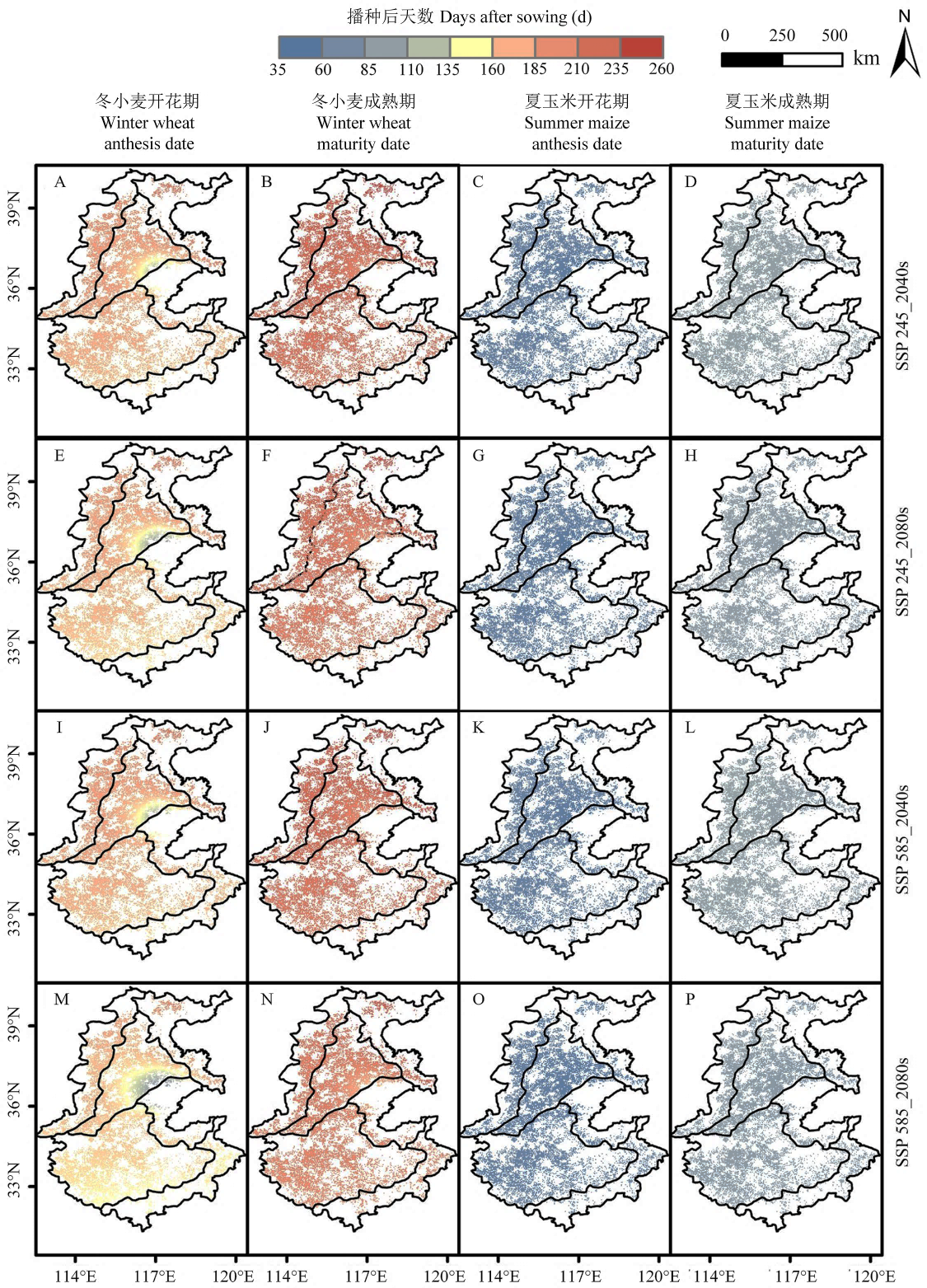
图7
未来时期(2040s和2080s)两种不同排放情景(SSP245和SSP585)下黄淮海平原冬小麦的开花期(A、E、I、M)和成熟期(B、F、J、N)以及夏玉米的开花期(C、G、K、O)和成熟期(D、H、L、P) 审图号:GS京(2026)2687号"
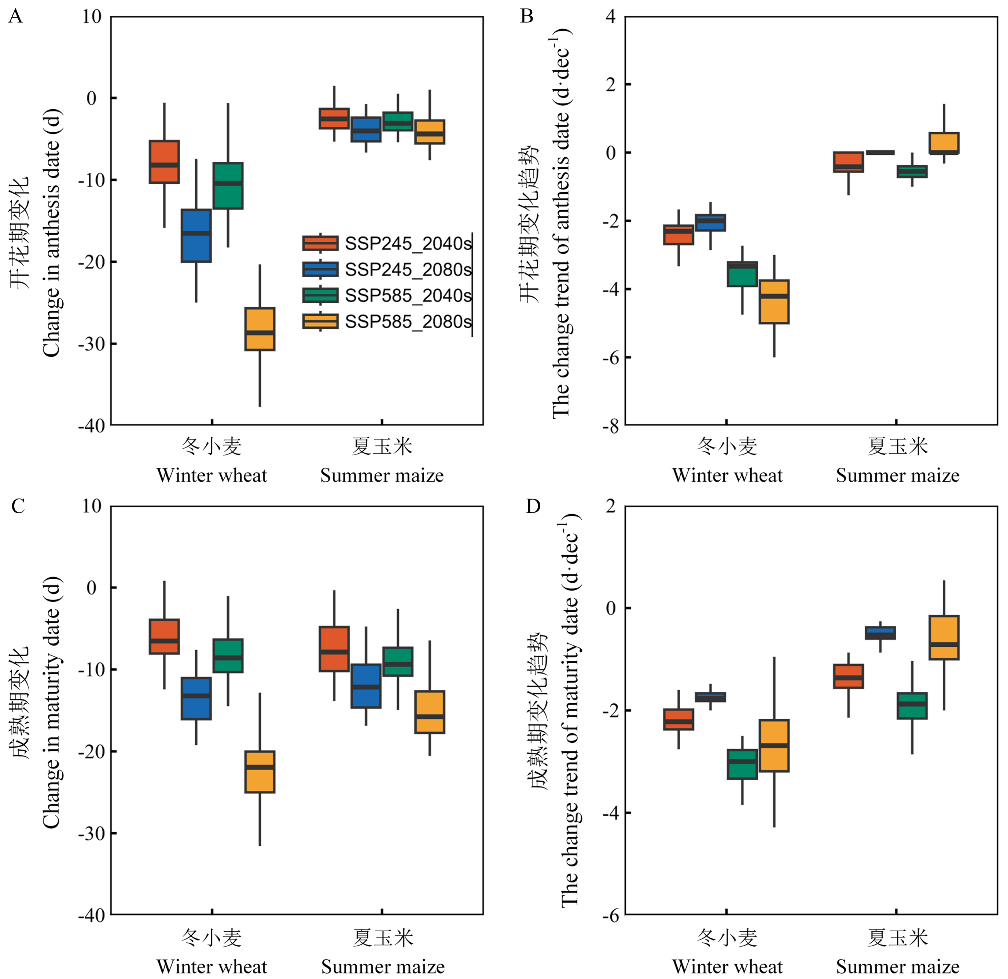
图8
未来时期(2040s和2080s)两种不同排放情景(SSP245和SSP585)下黄淮海平原冬小麦和夏玉米开花期和成熟期天数相较于历史基准时期(1980—2020年)的变化趋势与变化率"
表7
历史基准期(1980-2020年)黄淮海平原不同分区(Zone1—Zone6)的实际产量、潜在产量及产量差"
| 作物品种 Crop cultivar | 产量Yield (t·hm-2) | ||||||
|---|---|---|---|---|---|---|---|
| 分区1 Zone1 | 分区2 Zone2 | 分区3 Zone3 | 分区4 Zone4 | 分区5 Zone5 | 分区6 Zone6 | ||
| 冬小麦 Winter wheat | 潜在产量Potential yield | 12.54 | 11.44 | 12.22 | 11.18 | 11.34 | 11.97 |
| 实际产量Actual yield | 4.90 | 5.56 | 5.31 | 5.33 | 5.12 | 4.62 | |
| 产量差Yield gap | 7.64 | 5.88 | 6.91 | 5.85 | 6.22 | 7.35 | |
| 夏玉米 Summer maize | 潜在产量Potential yield | 12.12 | 10.30 | 10.59 | 11.05 | 9.62 | 9.63 |
| 实际产量Actual yield | 4.31 | 4.73 | 4.50 | 4.24 | 4.49 | 5.03 | |
| 产量差Yield gap | 7.81 | 5.57 | 6.09 | 6.81 | 5.13 | 4.60 | |
| 周年产量 Annual yield | 潜在产量Potential yield | 24.66 | 21.74 | 22.81 | 22.23 | 20.96 | 21.60 |
| 实际产量Actual yield | 9.21 | 10.29 | 9.81 | 9.57 | 9.61 | 9.65 | |
| 产量差Yield gap | 15.45 | 11.45 | 13.00 | 12.66 | 11.35 | 11.95 | |
表8
历史基准期(1980-2020年)黄淮海平原不同分区(Zone1—Zone6)冬小麦、夏玉米及轮作系统周年的实际产量、潜在产量及产量差变化速率"
| 作物品种 Crop cultivar | 产量变化速率 Yield change rate (kg·hm-2·dec-1) | |||||||||||||
|---|---|---|---|---|---|---|---|---|---|---|---|---|---|---|
| 分区1 Zone1 | 分区2 Zone2 | 分区3 Zone3 | 分区4 Zone4 | 分区5 Zone5 | 分区6 Zone6 | |||||||||
| 冬小麦 Winter wheat | 实际产量Actual yield | 873.75 | 891.21 | 997.76 | 822.09 | 943.76 | 589.40 | |||||||
| 潜在产量Potential yield | 107.06 | -97.29 | 16.85 | 145.89 | 88.70 | 135.74 | ||||||||
| 产量差Yield gap | -814.65 | -1013.09 | -998.56 | -704.06 | -852.31 | -454.58 | ||||||||
| 夏玉米 Summer maize | 实际产量Actual yield | 553.35 | 530.36 | 642.78 | 561.30 | 665.25 | 582.10 | |||||||
| 潜在产量Potential yield | -735.77 | -808.87 | -899.57 | -772.87 | -606.73 | -606.67 | ||||||||
| 产量差Yield gap | -1277.45 | -1406.76 | -1561.17 | -1317.22 | -1342.03 | -1322.12 | ||||||||
| 周年产量 Annual yield | 实际产量Actual yield | 1495.14 | 1459.29 | 1697.55 | 1452.13 | 1674.64 | 1261.02 | |||||||
| 潜在产量Potential yield | -629.39 | -844.81 | -774.83 | -571.29 | -493.77 | -409.86 | ||||||||
| 产量差Yield gap | -2200.30 | -2477.52 | -2627.07 | -2074.58 | -2291.34 | -1855.13 | ||||||||
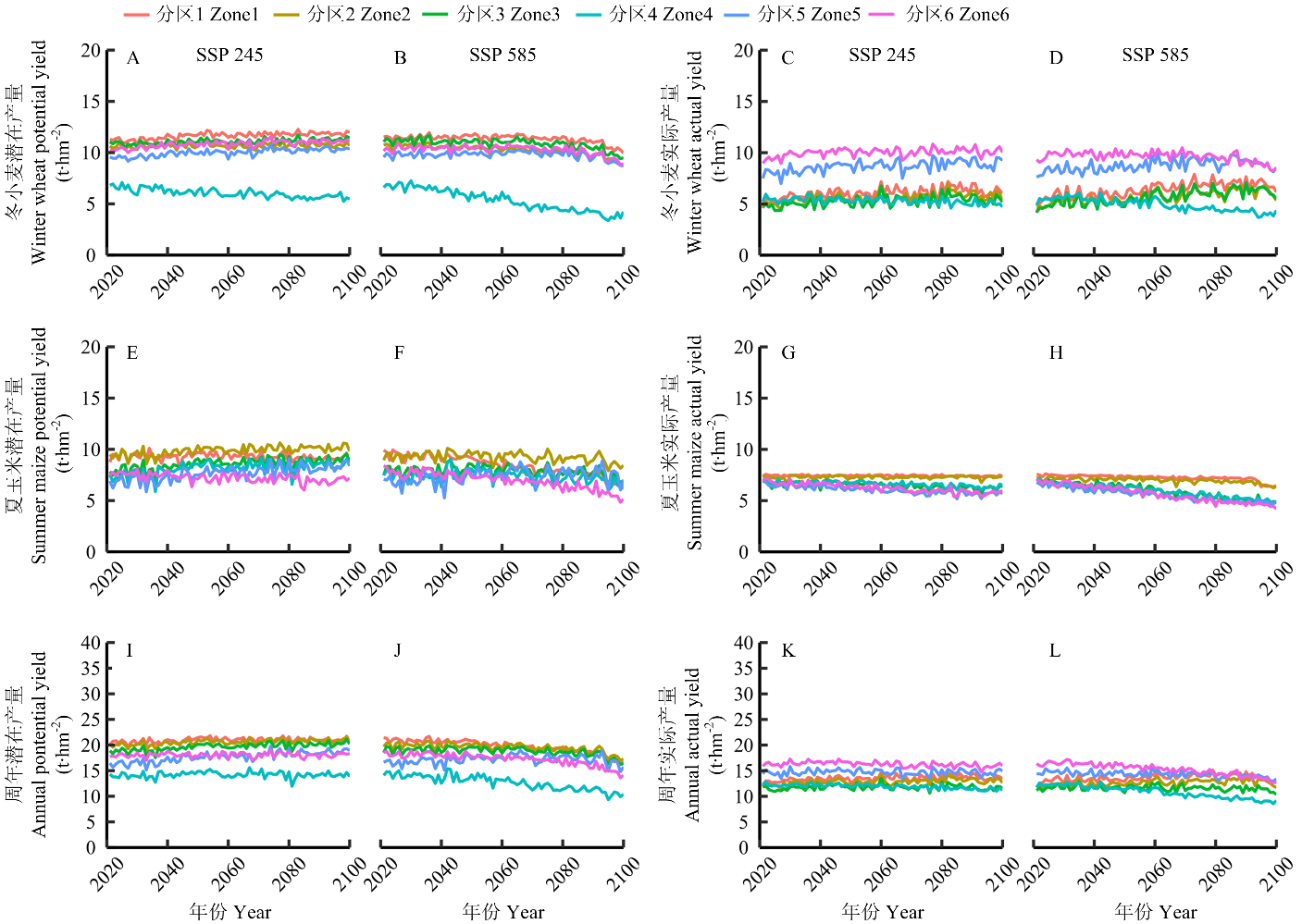
图9
未来时期(2021-2100年)两种排放情景(SSP245和SSP585)下黄淮海平原不同分区冬小麦、夏玉米以及轮作系统周年的潜在产量和实际产量变化趋势 图A、E、I和B、F、J分别为未来时期SSP245和SSP585排放情景下不同分区的冬小麦、夏玉米及轮作系统周年潜在产量;图C、G、K和图D、H、L分别为未来时期SSP245和SSP585排放情景下不同分区的冬小麦、夏玉米及轮作系统周年实际产量"
表9
未来时期(2040s和2080s)两种排放情景(SSP245和SSP585)下黄淮海平原不同分区的冬小麦、夏玉米及轮作系统周年产量差相较于基准期(1980—2020)的变化情况"
| 未来情景 Future scenario | 作物品种 Crop cultivar | 产量差 Yield gap (t·hm-2) | ||||||
|---|---|---|---|---|---|---|---|---|
| 分区1 Zone1 | 分区2 Zone2 | 分区3 Zone3 | 分区4 Zone4 | 分区5 Zone5 | 分区6 Zone6 | |||
| SSP245_2040s | 冬小麦Winter wheat | -1.98 | -0.68 | -1.01 | -4.96 | -4.90 | -6.63 | |
| 夏玉米Summer maize | -5.92 | -3.19 | -4.46 | -5.70 | -4.19 | -3.78 | ||
| 周年产量Annual yield | -7.90 | -3.87 | -5.47 | -10.66 | -9.09 | -10.41 | ||
| SSP245_2080s | 冬小麦Winter wheat | -2.11 | -0.94 | -1.17 | -5.22 | -4.89 | -6.43 | |
| 夏玉米Summer maize | -6.00 | -2.76 | -3.56 | -4.88 | -2.78 | -3.46 | ||
| 周年产量Annual yield | -8.11 | -3.70 | -4.73 | -10.10 | -7.67 | -9.89 | ||
| SSP585_2040s | 冬小麦Winter wheat | -2.01 | -0.62 | -0.98 | -4.99 | -4.84 | -6.71 | |
| 夏玉米Summer maize | -6.05 | -3.31 | -4.58 | -5.73 | -4.06 | -3.38 | ||
| 周年产量Annual yield | -8.06 | -3.93 | -5.56 | -10.72 | -8.90 | -10.09 | ||
| SSP585_2080s | 冬小麦Winter wheat | -3.36 | -1.98 | -2.41 | -5.84 | -5.54 | -6.69 | |
| 夏玉米Summer maize | -7.16 | -3.28 | -3.71 | -5.08 | -2.54 | -3.21 | ||
| 周年产量Annual yield | -10.52 | -5.26 | -6.12 | -10.92 | -8.08 | -9.90 | ||
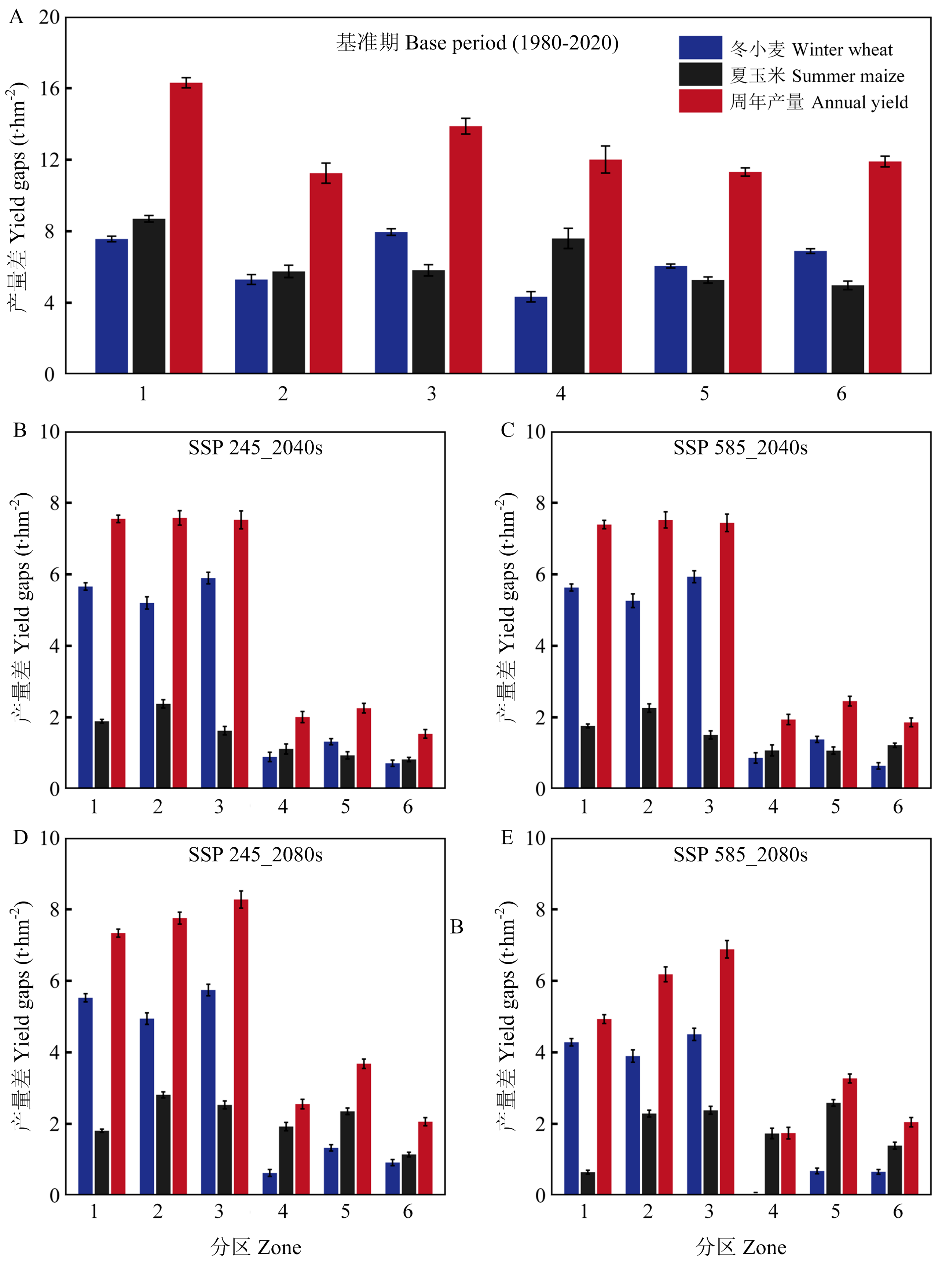
图10
历史基准时期(1980—2020年)和未来时期(2040s,2080s)2种排放情景(SSP245,SSP585)下黄淮海平原不同分区冬小麦、夏玉米及轮作系统周年产量的产量差"
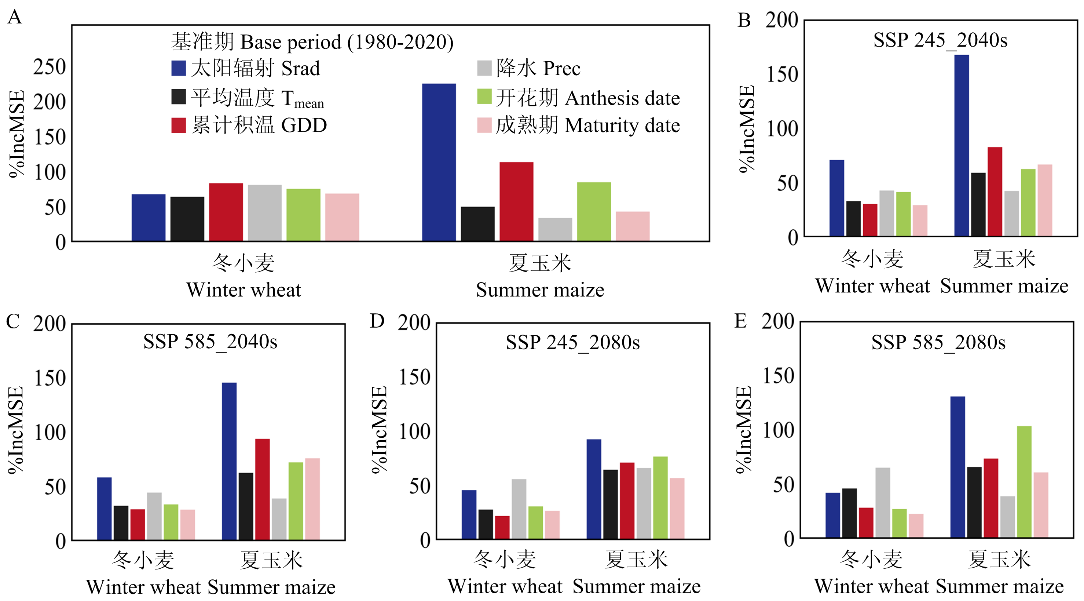
图11
历史基准时期(1980—2020年,A)和未来时期(2040s(B,C)和2080s(D,E))两种不同排放情景(SSP245(B,D)和SSP585(C,E))下不同气候因子和物候因子对黄淮海平原冬小麦、夏玉米潜在产量贡献的重要性(%IncMSE)排序"
| [1] |
|
| [2] |
李裕瑞, 杨忆, 刘路路, 潘玮. 中国粮食生产的新空间格局及其气候灾害风险[J]. 农业工程学报, 2026, 42(2): 1-13.
|
|
|
|
| [3] |
|
| [4] |
刘水苗, 关小康, 赵志恒, 王景辉, 刘世龙, 高培萌, 王艳丽, 吴鹏年, 高晨凯, 李煜铭, 邵京, 于昊琳, 王同朝, 温鹏飞. 冬麦播前耕作方式对麦玉轮作体系中玉米季土壤水分、籽粒灌浆特征及产量的影响[J]. 中国农业科学, 2024, 57(18): 3568-3585. DOI: 10.3864/j.issn.0578-1752.2024.18.005.
|
|
|
|
| [5] |
de la Cruz V Y V, Tantriani,
|
| [6] |
赖奕晨, 任梦, 周袁希, 龚敏, 关浩杰. 黄淮海平原农户粮食生产行为调查分析[J]. 粮食科技与经济, 2021, 46(2): 12-15.
|
|
|
|
| [7] |
|
| [8] |
|
| [9] |
|
| [10] |
|
| [11] |
|
| [12] |
|
| [13] |
|
| [14] |
|
| [15] |
|
| [16] |
|
| [17] |
|
| [18] |
|
| [19] |
刘巽浩. 农作制与中国农作制区划[J]. 中国农业资源与区划, 2002, 23(5): 11-15.
|
|
|
|
| [20] |
曹宏鑫, 赵锁劳, 葛道阔, 刘永霞, 刘岩, 孙金英, 岳延滨, 张智优, 陈煜利. 作物模型发展探讨[J]. 中国农业科学, 2011, 44(17): 3520-3528. DOI: 10.3864/j.issn.0578-1752.2011.17.004.
|
|
|
|
| [21] |
|
| [22] |
|
| [23] |
|
| [24] |
|
| [25] |
|
| [26] |
任思洋, 张青松, 李婷玉, 张福锁. 华北平原五省冬小麦产量和氮素管理的时空变异[J]. 中国农业科学, 2019, 52(24): 4527-4539. DOI: 10.3864/j.issn.0578-1752.2019.24.008.
|
|
|
|
| [27] |
|
| [28] |
|
| [29] |
|
| [30] |
王亚莉, 贺立源. 作物生长模拟模型研究和应用综述[J]. 华中农业大学学报, 2005(5): 529-535.
|
|
|
|
| [31] |
|
| [32] |
|
| [33] |
|
| [34] |
|
| [35] |
|
| [36] |
|
| [37] |
|
| [38] |
|
| [39] |
|
| [40] |
|
| [41] |
卢必慧, 邱琳, 李卫国, 王志明, 田苗, 王晶, 单捷. 基于遥感的作物产量和产量差估算研究进展[J]. 江苏农业学报, 2023, 39(3): 881-894.
|
|
|
|
| [42] |
|
| [43] |
|
| [44] |
徐建文, 居辉, 梅旭荣, 刘勤, 杨建莹. 近30年黄淮海平原干旱对冬小麦产量的潜在影响模拟[J]. 农业工程学报, 2015, 31(6): 150-158.
|
|
|
|
| [45] |
|
| [46] |
|
| [47] |
|
| [48] |
|
| [49] |
赵红. 基于Meta分析和CERES-maize模型的玉米施氮增密的产量缩差研究[D]. 北京: 中国农业科学院, 2022.
|
|
|
|
| [50] |
|
| [51] |
范兰, 吕昌河, 于伯华, 王涛. 华北平原小麦-玉米两作生产潜力与产量差[J]. 中国农学通报, 2016, 32(9): 33-40.
|
|
|
|
| [52] |
|
| [53] |
|
| [54] |
|
| [55] |
|
| [56] |
|
| [57] |
陈佳义. 气候变化对江苏省冬小麦气候适宜性的影响[D]. 南京: 南京信息工程大学, 2023.
|
|
|
|
| [58] |
|
| [59] |
韩守威, 司纪升, 余维宝, 孔令安, 张宾, 王法宏, 张海林, 赵鑫, 李华伟, 孟鈺. 山东省冬小麦产量差与氮肥利用效率差形成机理解析[J]. 中国农业科学, 2022, 55(16): 3110-3122. DOI: 10.3864/j.issn.0578-1752.2022.16.004.
|
|
|
| [1] | 罗伟, 余洪, 袁立新, 王玲玲, 赵金鹏, 殷伟, 王明田, 王茹琳. 全球气候变化背景下川渝地区再生稻地理分布格局变迁[J]. 中国农业科学, 2026, 59(4): 765-780. |
| [2] | 郭世博, 张镇涛, 郭尔静, 赵锦, 刘志娟, 赵闯, 杨晓光. 全球气候变暖对中国种植制度的可能影响XV.适应未来气候变化的我国油料作物种植布局调整[J]. 中国农业科学, 2025, 58(11): 2118-2144. |
| [3] | 杨王华, 刘志娟, 巩敬锦, 付真真, 张太林, 张晓龙, 沈彦军, 杨晓光. 东北地区未来春玉米干旱风险时空分布及对气候变化的响应[J]. 中国农业科学, 2024, 57(12): 2336-2349. |
| [4] | 张卫建, 尚子吟, 张俊, 严圣吉, 邓艾兴, 张鑫, 郑成岩, 宋振伟. 农业温室气体排放统计核算体系的规范化建设[J]. 中国农业科学, 2023, 56(22): 4467-4477. |
| [5] | 史鑫蕊, 韩百书, 王紫芊, 张媛铃, 李萍, 宗毓铮, 张东升, 高志强, 郝兴宇. 基于APSIM模型模拟分析气候变化对不同熟性北方冬小麦生长和产量的影响[J]. 中国农业科学, 2023, 56(19): 3772-3787. |
| [6] | 张志良, 和志豪, 茹晓雅, 蒋腾聪, 何英彬, 冯浩, 于强, 何建强. 未来气候变化对中国马铃薯种植气候适宜性的影响[J]. 中国农业科学, 2023, 56(18): 3530-3542. |
| [7] | 申哲, 韩天富, 曲潇林, 马常宝, 王慧颖, 柳开楼, 黄晶, 都江雪, 张璐, 刘立生, 李继文, 张会民. 我国小麦和玉米相对产量差时空变异及其对氮肥的响应[J]. 中国农业科学, 2023, 56(14): 2724-2737. |
| [8] | 张文婧, 赵锦, 崔文倩, 黎满耀, 李娥, 弓晓雅, 杨晓光. 气候平均态和极端态变化对东北玉米气象产量的影响[J]. 中国农业科学, 2023, 56(10): 1859-1870. |
| [9] | 赵政鑫,王晓云,田雅洁,王锐,彭青,蔡焕杰. 未来气候条件下秸秆还田和氮肥种类对夏玉米产量及土壤氨挥发的影响[J]. 中国农业科学, 2023, 56(1): 104-117. |
| [10] | 郭世博, 张方亮, 张镇涛, 周丽涛, 赵锦, 杨晓光. 全球气候变暖对中国种植制度的可能影响XIV.东北大豆高产稳产区及农业气象灾害分析[J]. 中国农业科学, 2022, 55(9): 1763-1780. |
| [11] | 任义方,杨章平,零丰华,肖良文. 江苏奶牛热应激风险区划及其受气候变化的影响[J]. 中国农业科学, 2022, 55(22): 4513-4525. |
| [12] | 韩守威,司纪升,余维宝,孔令安,张宾,王法宏,张海林,赵鑫,李华伟,孟鈺. 山东省冬小麦产量差与氮肥利用效率差形成机理解析[J]. 中国农业科学, 2022, 55(16): 3110-3122. |
| [13] | 唐建昭,王靖,肖登攀,潘学标. 马铃薯生长模型的研究进展及发展前景[J]. 中国农业科学, 2021, 54(5): 921-932. |
| [14] | 张卫建, 严圣吉, 张俊, 江瑜, 邓艾兴. 国家粮食安全与农业双碳目标的双赢策略[J]. 中国农业科学, 2021, 54(18): 3892-3902. |
| [15] | 房蕊,于镇华,李彦生,谢志煌,刘俊杰,王光华,刘晓冰,陈渊,刘居东,张少庆,吴俊江,Stephen J HERBERT,金剑. 大气CO2浓度和温度升高对农田土壤碳库及微生物群落结构的影响[J]. 中国农业科学, 2021, 54(17): 3666-3679. |
|
||
