






中国农业科学 ›› 2026, Vol. 59 ›› Issue (21): 4924-4936.doi: 10.3864/j.issn.0578-1752.2026.21.015
朱银潇1,2( ), 张碧蓉1, 闫素云1, 史文斌1, 刘伟杰1,2, 段敏仙1, 程运江2(), 周先艳1()
收稿日期:2026-04-29
接受日期:2026-08-19
出版日期:2026-11-01
发布日期:2026-11-06
通信作者:
联系方式:
朱银潇,E-mail:2771392115@qq.com。
基金资助:
ZHU YinXiao1,2(), ZHANG BiRong1, YAN SuYun1, SHI WenBin1, LIU WeiJie1,2, DUAN MinXian1, CHENG YunJiang2(), ZHOU XianYan1()
Received:2026-04-29
Accepted:2026-08-19
Published:2026-11-01
Online:2026-11-06
摘要:
【目的】系统探究云南干/湿热区香水柠檬不同组织生物活性成分差异特征,明确干湿热区香水柠檬(Citrus medica)不同组织(黄皮层、白皮层、果肉、中心柱及囊衣)的活性成分分布规律,为香水柠檬生物活性成分进一步开发利用提供理论参考。【方法】分别选取云南巍山干热区和瑞丽湿热区的香水柠檬果实为试材,采用超高效液相色谱-四极杆-飞行时间高分辨质谱(UPLC-Q-TOF)技术对样品进行检测分析,通过单因素方差分析(ANOVA)、主成分分析(PCA)和正交偏最小二乘法判别分析(OPLS-DA)进行综合评价,筛选能够区分产区和组织的特征性生物活性成分。【结果】两个产区香水柠檬果实中共鉴定出31种生物活性成分,包括12种酚酸、18种类黄酮和1种柠檬苦素。巍山干热区香水柠檬中生物活性成分的含量大于瑞丽湿热区香水柠檬。果实不同组织中酚酸类物质含量为黄皮层>白皮层>果肉>中心柱及囊衣;而类黄酮含量为黄皮层>果肉>中心柱及囊衣>白皮层;柠檬苦素含量为中心柱及囊衣>果肉>白皮层>黄皮层。多元统计分析结果显示,PCA模型可有效区分两个产区的样品,进一步采用OPLS-DA分析两个产区不同组织代谢数据,以VIP≥2筛选两个产区不同组织的特征差异代谢物,在黄皮层、白皮层、果肉和中心柱及囊衣中分别筛选出4种、3种、2种和2种差异代谢物。两产区以VIP≥2筛选出巍山干热区4个组织的特征差异物质是圣草次甙和芹菜素-C-五碳糖苷-C-阿拉伯糖苷异构体,这2个物质分别在中心柱及囊衣和黄皮层中积累;瑞丽湿热区4个组织特征差异代谢物为圣草次甙。【结论】巍山干热区因独特的干热河谷气候条件,果实中生物活性成分总含量显著高于瑞丽湿热区,香草酸仅存在于巍山干热区果实中。果实不同组织中活性成分分布具有特异性,黄皮层是酚酸和类黄酮的主要富集部位,中心柱及囊衣是柠檬苦素的主要富集部位。
朱银潇, 张碧蓉, 闫素云, 史文斌, 刘伟杰, 段敏仙, 程运江, 周先艳. 云南干/湿热区香水柠檬果实不同组织生物活性成分分析[J]. 中国农业科学, 2026, 59(21): 4924-4936.
ZHU YinXiao, ZHANG BiRong, YAN SuYun, SHI WenBin, LIU WeiJie, DUAN MinXian, CHENG YunJiang, ZHOU XianYan. Bioactive Components in Different Tissues of Xiangshui Lemon Fruits in Dry and Humid Tropical Areas of Yunnan[J]. Scientia Agricultura Sinica, 2026, 59(21): 4924-4936.
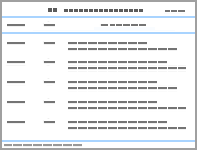
表1
巍山(WS)与瑞丽(RL)产区香水柠檬不同组织酚酸、类黄酮和柠檬苦素的含量"
| 组织 Tissue | 瑞丽湿热区Ruili humid-hot region (RL) | 巍山干热区Weishan dry-hot region (WS) | ||||
|---|---|---|---|---|---|---|
| 酚酸 Phenolic acids | 类黄酮 Flavonoids | 柠檬苦素 Limonoids | 酚酸 Phenolic acids | 类黄酮 Flavonoids | 柠檬苦素 Limonoids | |
| 黄皮层Flavedo (HPC) | 2620.61±177.16aA | 9569.34±772.72aB | 8.18±1.06cB | 2604.74±284.46aA | 10542.53±994.58aA | 10.44±8.72cA |
| 白皮层Albedo (BPC) | 1749.87±202.02bA | 5512.04±220.34cB | 11.03±1.22cB | 1738.74±146.13bA | 5793.92±147.97cA | 17.3±0.68cA |
| 果肉Pulp (GR) | 1291.71±44.87cA | 6340.37±166.51bB | 23.91±7.26bB | 1301.85±134.94cA | 7557.06±556.46bA | 35.61±1.71bA |
| 中心柱及囊衣 Central axis and segment membrane (ZXZ) | 736.37±64.16dA | 6809.37±410.86bB | 78.43±10.76aB | 896.79±55.54dA | 7556.44±567.49bA | 107.96±4.25aA |
| 总含量Total content | 6398.57±100.99A | 28231.13±1005.91B | 121.55±9.11B | 6542.12±133.17A | 31449.95±100.99A | 171.15±6.77A |
表2
巍山(WS)与瑞丽(RL)产区香水柠檬不同组织生物活性成分的种类与含量"
| 化合物 Compound | 瑞丽湿热区 RL | 巍山干热区 WS | ||||||
|---|---|---|---|---|---|---|---|---|
| 黄皮层 Flavedo | 白皮层 Albedo | 果肉 Pulp | 中心柱及囊衣 Central axis and segment membrane | 黄皮层 Flavedo | 白皮层 Albedo | 果肉 Pulp | 中心柱及囊衣 Central axis and segment membrane | |
| 酚酸Phenolic acids | ||||||||
| 二氢阿魏酸-O-葡萄糖苷 Dihydro-feruloyl-O-glucoside | 1582.06±48.87aA | 918.79±135.22bA | 3.88±2.63cA | 17.01±9.63cA | 1547.76±97.92aA | 832.34±103.35bA | 2.06±0.57cA | 18.62±8.65cA |
| 阿魏酸Ferulic acid | 4.25±2.10aA | — | 1.71±0.39bcA | — | 1.5±1.32bcA | 1.08±0.43bcA | 1.97±0.31bA | 1.88±0.83bA |
| 阿魏酸-O-葡萄糖苷 Feruloyl-O-glucose | 199.90±37.05bcA | 195.16±23.62bcA | 726.51±22.67aA | 119.76±33.12cA | 198.71±58.77bcA | 218.29±45.06bA | 787.44±77.97aA | 125.01±16.06cA |
| 阿魏酸-衍生物Ferulic acid derivative | 213.27±53.52aA | 1.10±0.08dA | 64.16±5.51bA | 24.19±4.53cdA | 84.56±11.81bB | 1.40±0.33dA | 50.65±6.93bcA | 21.1±3.06bdA |
| 咖啡酸Caffeic acid | 0.06±0.03bA | — | 0.10±0bA | 0.11±0.02bA | 0.02±0.02bA | — | 0.16±0.04bA | 0.56±0.3aA |
| 咖啡酸-O-葡萄糖苷异构体 Caffeic acid-O-glucoside isomer | 9.62±1.70dA | 15.32±3.16dA | 95.88±2.96bA | 60.19±7.25cA | 13.89±4.27dA | 14.33±2.48dA | 106.44±12.27aA | 67.58±1.85cA |
| 对香豆酸p-coumaric acid | 0.62±0.06aA | 0.03±0.03cA | 0.12±0.06bcA | 0.18±0.26bcA | 0.39±0.29abA | 0.15±0.13bcA | 0.16±0.06bcA | 0.36±0.16abA |
| 对香豆酸-O-六碳糖苷 p-Coumaric acid hexoside | 45.60±10.16cA | 5.29±1.60dB | 79.25±4.55cA | 13.99±3.71dA | 36.43±7.57cA | 12.55±2.97dA | 94.7±18.78aA | 16.76±2.19bA |
| 绿原酸-O-葡萄糖苷异构体 Chlorogenic acid-O-glucoside isomer | 25.44±6.83dB | 341.15±8.61cA | 4.77±2.32dA | 433.12±60.27bB | 50.15±11.01dA | 365.76±26.06cA | 5.34±0.72dA | 606.82±60.06aA |
| 香草酸Vanillic acid | — | — | — | — | 2.00±1.66a | — | 2.13±0.34a | — |
| 香草酸-β-D-葡萄糖苷异构体 Vanillic acid-β-D-glucopyranose isomer | 102.68±12.25bB | 152.83±14.22aA | 67.19±4.65cA | 33.34±3.42dA | 143.49±21.23aA | 142.76±22.41aA | 84.78±14.46bcA | 37.92±2.55dA |
| 阿魏酰奎宁酸 Feruloyl quinic acid | 437.12±16.55bA | 120.20±38.83dA | 248.15±17.87cA | 34.49±12.00eA | 525.83±79.38aA | 150.09±32.28dA | 166.03±46.2dB | 0.18±0.14eB |
| 类黄酮Flavonoids | ||||||||
| 原花青素Proanthocyanidin | 1382.50±398.12aA | — | 148.91±10.40bA | — | 880.59±872aA | — | 110.4±42.28bA | — |
| 表儿茶素Epicatechin | 6.51±0.83aA | — | — | 2.24±1.95bB | — | — | — | |
| 橙皮苷异构体 Hesperidin isomer | 352.09±139.06fA | 2418.05±98.46bA | 1310.32±185.92dA | 2823.88±179.43abA | 823.97±406.28eA | 2571.18±69.25abA | 1736.56±286.58cA | 2982.22±293.55aA |
| 圣草次甙Eriocitrin | 101.63±15.17dB | 286.23±28.82cA | 383.28±33.08bA | 844.39±106.94aA | 142.87±17.97dA | 263.37±15.33cA | 412.53±27.1bA | 893.26±35.08aA |
| 荭草苷Orientin | 2.95±0.35cA | 3.20±0.74cA | 6.13±0.49baA | 9.07±0.25bB | 5.64±5.03bcA | 4.37±0.21cA | 8.21±0.13bA | 15.40±2.06aA |
| 4'-甲基-异荭草苷 Isoorientin-4'-methyl ether | 254.26±70.50cB | 741.84±75.49aA | 332.06±28.18cB | 775.96±19.77aA | 591.17±158.54bA | 878.33±2.79aA | 509.71±82.38bA | 884.80±98.45aA |
| 芹菜素-C-五碳糖苷-C-阿拉伯糖苷异构体 Apigenin-C-pentoside-C-glucoside isomer | 1265.48±244.41bA | 28.55±8.27cB | 19.10±1.50cA | 73.72±10.62cA | 1728.11±511.08aA | 48.17±3.79cA | 39.38±12.71cA | 144.71±46.33cA |
| 木犀草素-7-O-芸香糖苷 Luteolin-7-O-rutinoside | 419.14±31.52bB | 85.21±22.82eA | 179.41±7.98dB | 98.82±9.13eB | 499.82±34.88aA | 97.73±0.82eA | 238.69±24.11aA | 148.23±11.36dA |
| 香叶木苷Diosmin | 1083.23±61.60aA | 711.67±61.32bcA | 1083.86±29.38aB | 685.88±185.82bcA | 1133.38±84.14aA | 581.58±58.8cA | 1216.87±44.40aA | 788.32±47.33bA |
| 卢塞宁-2, 4'-甲醚 Lucenin-2, 4'-methyl ether | 1529.86±71.25bB | 1057.41±133.64cdA | 986.90±22.58dB | 1097.59±55.76cdA | 1796.52±43.45aA | 1117.92±47.04cdA | 1177.10±74.31cA | 1147.40±65.61cA |
| 二氢异鼠李素-3-O-芸香糖苷 Dihydro-isorhamnetin-3-rutinoside | 21.23±3.75bA | 8.58±1.44cA | 32.56±1.41aA | 22.52±2.40bA | 23.37±7.31bA | 8.09±0.49cA | 31.63±3.66aA | 8.19±3.83cB |
| 异鼠李素-3-O-芸香糖苷 Isorhamnetin-3-rutinoside | 345.82±61.93bA | 15.25±1.99dA | 410.34±23.25abA | 63.67±8.08cdA | 399.36±88.19abA | 18.74±0.96dA | 467.19±34.02aA | 101.62±33.08cA |
| 芦丁Rutin | 1322.07±222.08aA | 9.15±2.69cA | 675.37±53.92bA | 90.97±28.42cA | 855.68±745.57abA | 8.65±0.35cA | 722.78±103.41dA | 121.05±11.16cA |
| 金丝桃苷Hyperoside | 0.17±0.09bA | — | 0.75±0.17bA | 0.09±0.07bA | 0.06±0.03bA | — | 3.31±1.91aA | 1.20±0.66bA |
| 槲皮素-3-O-葡萄糖苷 Quercetin-3-O-glucoside | 25.30±8.13aA | 28.76±24.83aA | — | — | 2.51±0.51bB | 6.39±2.40bA | 2.05±0.58bA | 6.27±0.76bA |
| 山柰酚-3-O-芸香糖苷 Kaempfeol-3-O-rutinoside | 2.11±0.33abA | 0.53±0.12bcA | 0.39±0.18cA | 0.95±0.17bcB | 2.69±2.35aA | 0.60±0.02bcA | 1.02±0.43bcA | 2.04±0.25abcA |
| 木犀草素-C-五碳糖苷-O-五碳糖苷 Luteolin-C-pentoside-O-pentoside | 1449.98±229.26bA | 109.59±18.71dB | 770.17±53.22cA | 216.90±28.65dB | 1643.80±179.87aA | 173.64±11.04dA | 878.28±88.41cA | 301.83±50.00dA |
| 刺槐黄素-7-糖醛酸异构体 Acacetin-7-glucuronide isomer | 5.02±0.16dB | 8.01±0.22cB | 0.83±0.15eA | 4.96±0.39dB | 10.75±0.81bA | 15.15±2.34aA | 1.34±0.21eA | 9.89±1.52bA |
| 柠檬苦素Limonin | 8.18±1.06eA | 10.44±8.72eB | 23.91±7.26dA | 35.61±1.71bB | 11.03±1.22eA | 17.13±0.68deA | 78.43±10.76cA | 107.96±4.25aA |
| 同行 | ||||||||
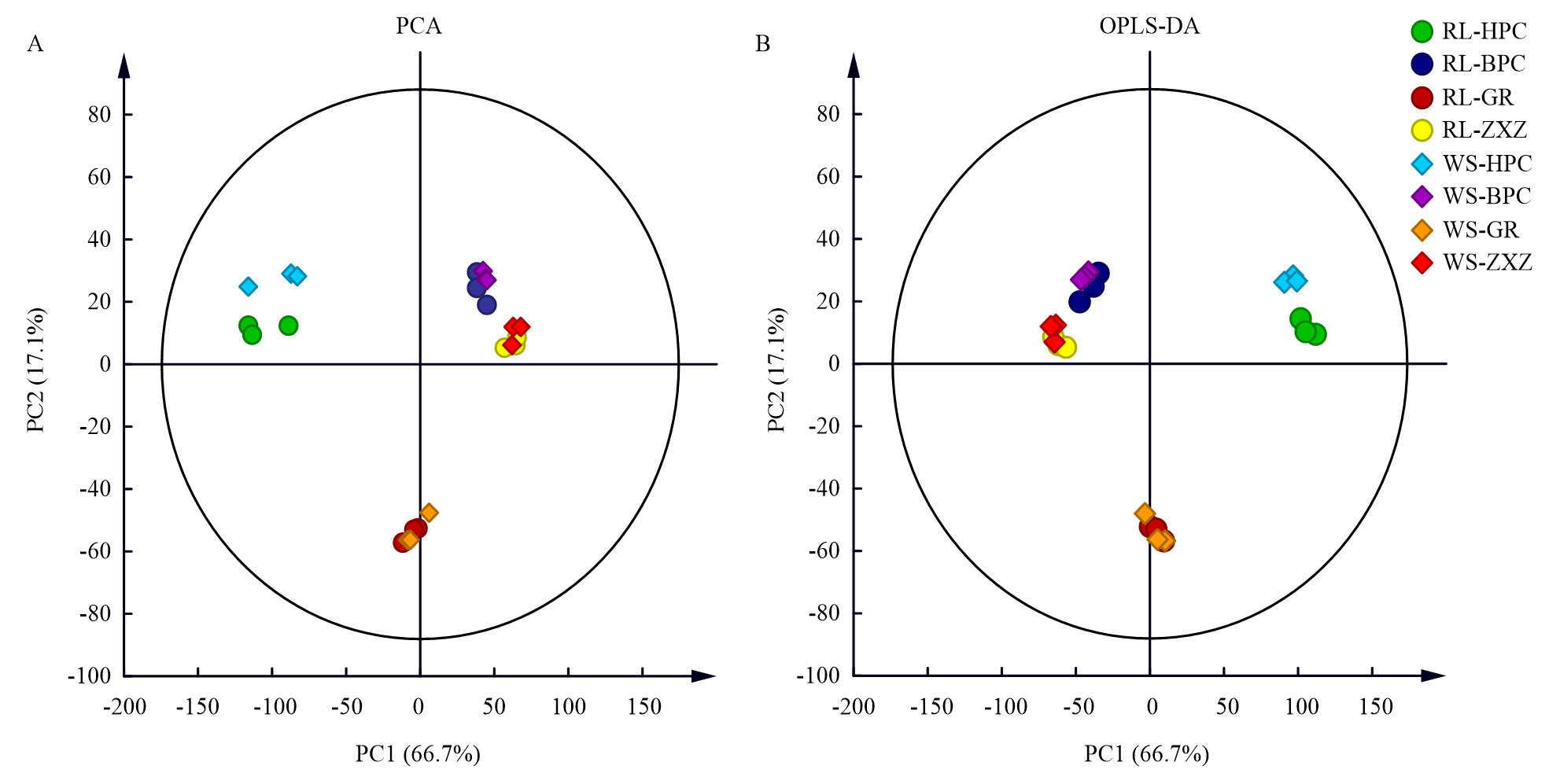
图1
瑞丽(RL)与巍山(WS)产区香水柠檬不同组织生物活性物质PCA(A)与OPLS-DA(B)得分图 RL:瑞丽湿热区;WS:巍山干热区;ZXZ:中心柱及囊衣;GR:果肉;BPC:白皮层;HPC:黄皮层。下同"
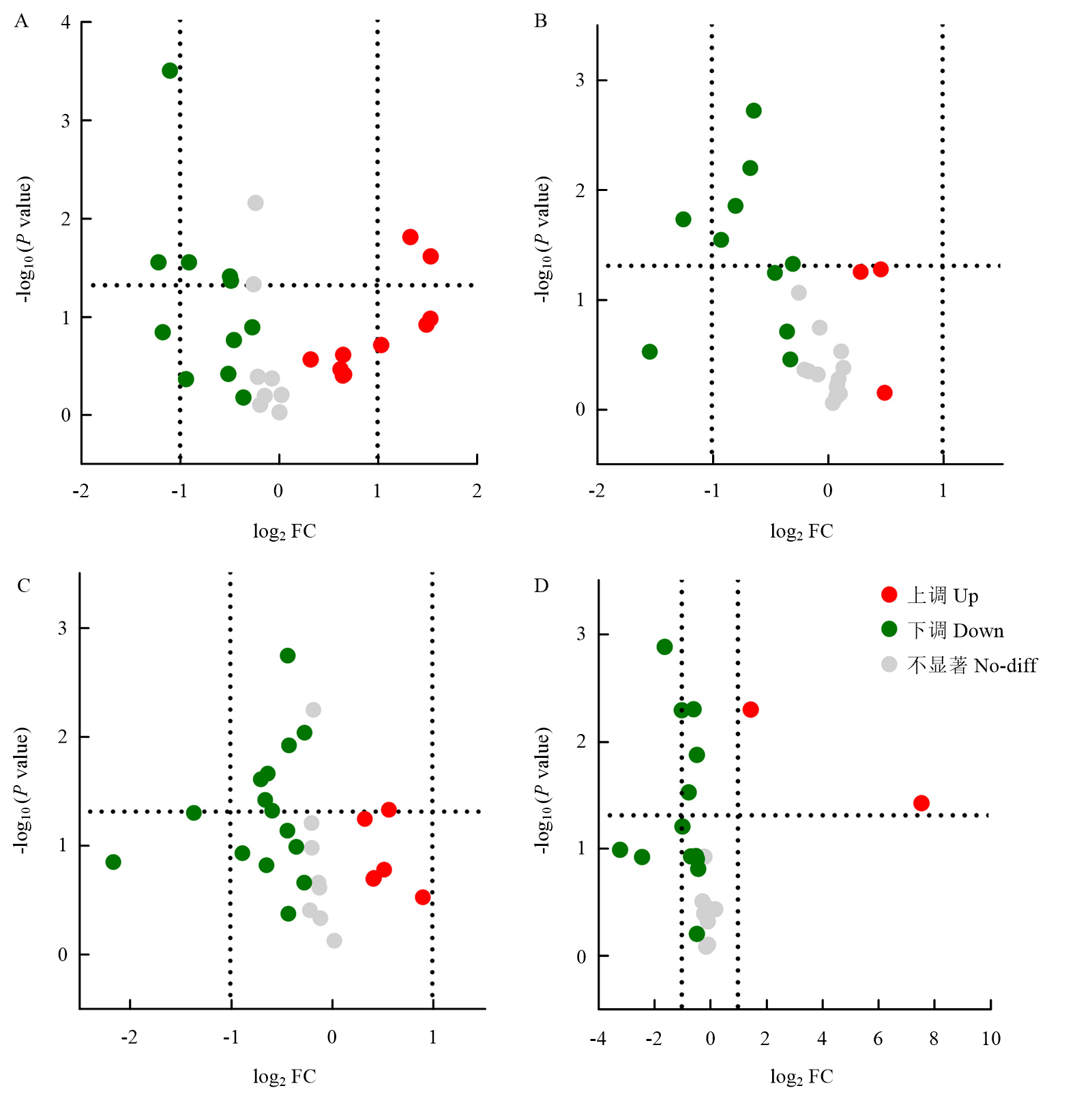
图2
巍山(WS)与瑞丽(RL)产区香水柠檬不同组织代谢物的差异表达火山图 A:瑞丽与巍山产区香水柠檬黄皮层代谢物的差异表达火山图;B:瑞丽与巍山产区香水柠檬白皮层代谢物的差异表达火山图;C:瑞丽与巍山产区香水柠檬果肉代谢物的差异表达火山图;D:瑞丽与巍山产区香水柠檬中心柱及囊衣代谢物的差异表达火山图"
表3
巍山(WS)与瑞丽(RL)产区香水柠檬不同组织差异代谢物(VIP≥1)"
| 黄皮层 Flavedo | 白皮层 Albedo | 果肉 Pulp | 中心柱及囊衣 Central axis and segment membrane | ||||
|---|---|---|---|---|---|---|---|
| 物质 Metabolites | VIP | 物质 Metabolites | VIP | 物质 Metabolites | VIP | 物质 Metabolites | VIP |
| 原花青素 Proanthocyanidin | 2.25 | 橙皮苷异构体 Hesperidin isomer | 2.22 | 橙皮苷异构体 Hesperidin isomer | 3.00 | 绿原酸-O-葡萄糖苷异构体 Chlorogenic acid-O-glucoside isomer | 2.22 |
| 芦丁 Rutin | 2.13 | 4'-甲基-异荭草苷 Isoorientin-4'-methyl ether | 2.12 | 卢塞宁-2, 4'-甲醚 Lucenin-2, 4'-methyl ether | 2.00 | 橙皮苷异构体 Hesperidin isomer | 2.19 |
| 橙皮苷异构体 Hesperidin isomer | 2.12 | 香叶木苷 Diosmin | 2.06 | 4'-甲基-异荭草苷 Isoorientin-4'-methyl ether | 1.93 | 香叶木苷 Diosmin | 1.71 |
| 芹菜素-C-五碳糖苷-C-阿拉伯糖苷异构体 Apigenin-C-pentoside-C-glucoside isomer | 2.09 | 二氢阿魏酸-O-葡萄糖苷 Dihydro-feruloyl-O-glucoside | 1.75 | 香叶木苷 Diosmin | 1.68 | 4'-甲基-异荭草苷 Isoorientin -4'-methyl ether | 1.71 |
| 4'-甲基-异荭草苷 Isoorientin-4'-methyl ether | 1.84 | 卢塞宁-2 4'-甲醚 Lucenin-2 4'-methyl ether | 1.52 | 木犀草素-C-五碳糖苷-O-五碳糖苷 Luteolin-C-pentoside-O- pentoside | 1.5 | 木犀草素-C-五碳糖苷-O-五碳糖苷 Luteolin-C-pentoside-O-pentoside | 1.53 |
| 卢塞宁-2, 4'-甲醚 Lucenin-2, 4'-methyl ether | 1.67 | 木犀草素-C-五碳糖苷 -O-五碳糖苷 Luteolin-C-pentoside-O- pentoside | 1.48 | 阿魏酰奎宁酸 Feruloyl quinic acid | 1.29 | 芹菜素-C-五碳糖苷-C-阿拉伯糖苷异构体 Apigenin-C-pentoside-C-glucoside isomer | 1.40 |
| 木犀草素-C-五碳糖苷-O-五碳糖苷 Luteolin-C-pentoside-O- pentoside | 1.36 | 阿魏酰奎宁酸 Feruloyl quinic acid | 1.00 | 芦丁 Rutin | 1.17 | 圣草次甙 Eriocitrin | 1.23 |
| 阿魏酸-衍生物 Ferulic acid derivative | 1.15 | — | — | 阿魏酸-O-葡萄糖苷 Feruloyl-O-glucose | 1.16 | 木犀草素-7-O-芸香糖苷 Luteolin-7-O-rutinoside | 1.20 |
| — | — | — | 木犀草素-7-O-芸香糖苷 Luteolin-7-O-rutinoside | 1.12 | 卢塞宁-2, 4'-甲醚 Lucenin-2, 4'-methyl ether | 1.18 | |
| — | — | — | 异鼠李素-3-O-芸香糖苷 Isorhamnetin-3-rutinoside | 1.02 | 异鼠李素-3-O-芸香糖苷 Isorhamnetin-3-rutinoside | 1.00 | |
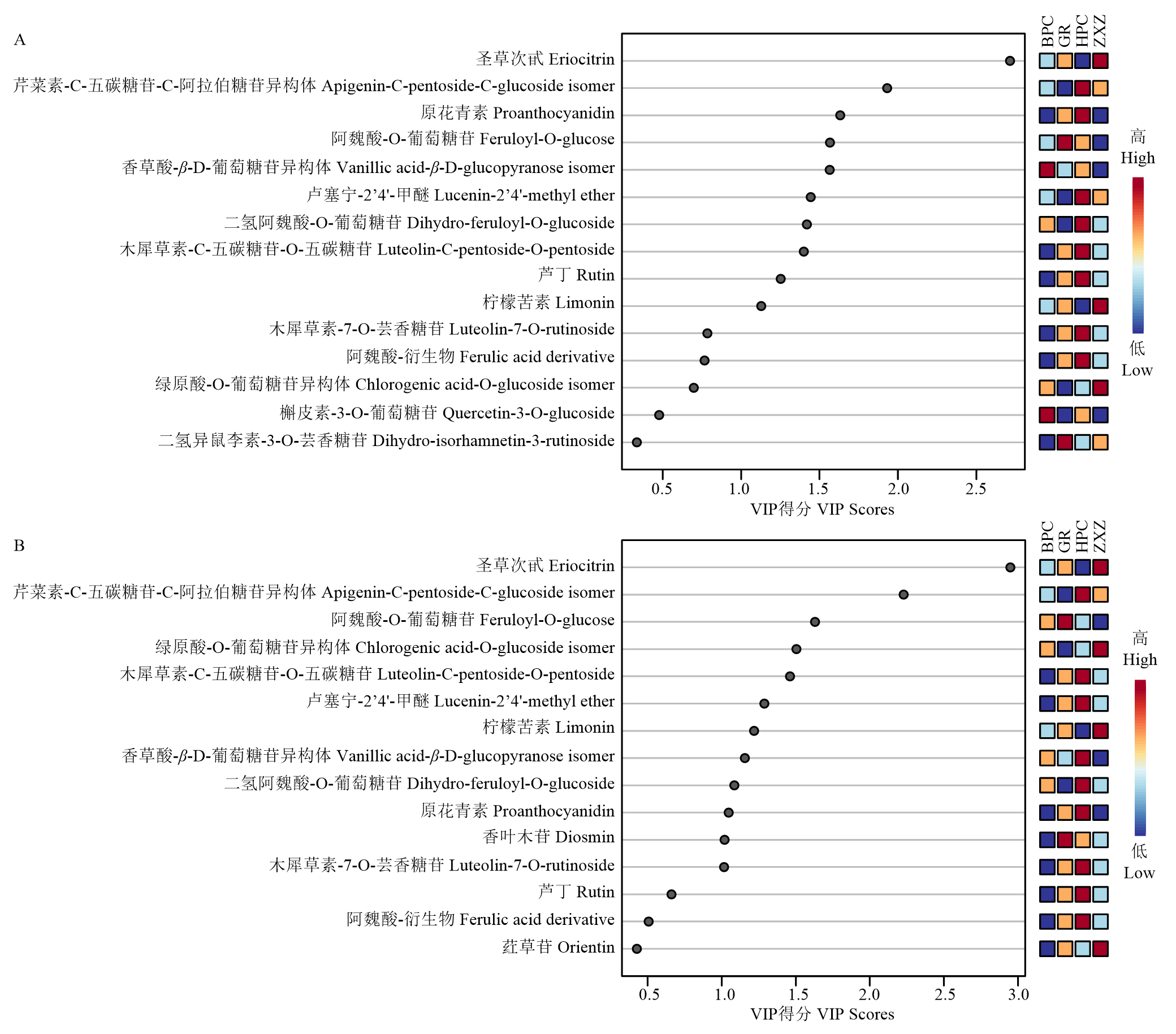
图3
巍山(WS)与瑞丽(RL)产区香水柠檬差异代谢物的VIP得分及含量热图 A:巍山干热区香水柠檬果实不同部位差异代谢物的VIP得分及含量热图;B:瑞丽湿热区香水柠檬果实不同部位差异代谢物的VIP得分及含量热图"
| [1] |
白昕晨, 董建梅, 李晶, 付小猛, 刘红明, 胡承孝, 杜玉霞. 缺镁胁迫对不同砧木柠檬幼树养分吸收利用的影响[J]. 华中农业大学学报, 2026, 45(2): 165-172.
|
|
|
|
| [2] |
张思凝, 张兴蕊, 吴东轩, 康婧博, 陈晓琳, 耿丽君, 殷光敏, 陈嘉景, 高俊燕, 蔡中虎, 刘园, 徐娟. 基于分子感官技术解析‘广东香水’柠檬香气品质[J]. 中国农业科学, 2025, 58(1): 141-155. DOI: 10.3864/j.issn.0578-1752.2025.01.011.
|
|
|
|
| [3] |
郭雁君, 郭丽英, 刘婕, 蒋惠, 杨凤梅, 吉前华. 广东香水柠檬由来浅析[J]. 中国果业信息, 2024, 41(2): 70-72.
|
|
|
|
| [4] |
周开隆, 叶荫民. 中国果树志-柑橘卷[M]. 北京: 中国林业出版社, 2010: 85-97.
|
|
|
|
| [5] |
doi: 10.1080/14786419.2015.1012166 pmid: 25702767 |
| [6] |
doi: 10.1080/14786419.2015.1115999 pmid: 26649795 |
| [7] |
doi: 10.1016/j.lwt.2017.05.059 |
| [8] |
doi: 10.1016/j.jfca.2013.11.004 |
| [9] |
doi: 10.1016/j.foodchem.2014.04.042 pmid: 24874375 |
| [10] |
庞雯辉, 赵希娟, 陈西, 张耀海, 王成秋, 赵其阳, 焦必宁. 超高效液相色谱-四极杆-飞行时间高分辨质谱法快速筛查柠檬果实中的生物活性成分[J]. 食品与发酵工业, 2021, 47(4): 222-230.
doi: 10.13995/j.cnki.11-1802/ts.025855 |
|
|
|
| [11] |
doi: 10.1016/j.scienta.2010.06.010 |
| [12] |
doi: 10.1016/j.foodchem.2012.04.010 pmid: 23442660 |
| [13] |
赵希娟, 庞雯辉, 谭涛, 张耀海, 焦必宁. UPLC-Q-TOF-HRMS技术结合SWATH采集方法同时测定柠檬果实中26种生物活性成分的含量[J]. 食品与发酵工业, 2022, 48(23): 306-314.
doi: 10.13995/j.cnki.11-1802/ts.030869 |
|
|
|
| [14] |
庞雯辉. 基于UPLC-Q-TOF-HRMS技术的柠檬生物活性成分筛查定量方法的建立与应用[D]. 重庆: 西南大学, 2021.
|
|
|
|
| [15] |
doi: 10.1007/s13197-017-2544-5 |
| [16] |
范丹华, 杨弘伟, 邵晨扬, 王鹏云, 朱勇. 未来气候变化对云南柠檬气候适宜性的影响[J]. 气象科技, 2021, 49(6): 968-974.
|
|
|
|
| [17] |
秦芸桦, 钟世欢, 陈青俊, 王京, 王岳, 叶佳明, 陈云义, 孙崇德. 分散固相萃取-液相色谱-串联质谱法测定不同品种柑橘果实不同部位中3种柠檬苦素类似物的含量[J]. 理化检验-化学分册, 2024, 60(2): 171-179.
|
|
|
|
| [18] |
doi: 10.1016/j.lwt.2014.08.033 |
| [19] |
doi: 10.1021/jf60229a021 |
| [20] |
张才喜, 殷纯金, 王云祥, 谢凤琦, 李化, 应建华, 王磊, 马超, 李树锋. 云南省大理州甜樱桃引种栽培研究初报[J]. 中国南方果树, 2018, 47(4): 117-122, 125.
|
|
|
|
| [21] |
刘存宏, 徐玉芳, 贾志军, 乔云萍, 李太祥. 18个葡萄品种的光合特性比较[J]. 中国农学通报, 2006, 22(7): 404-406.
|
|
|
|
| [22] |
郭春芳, 孙云, 陈常颂, 陈荣冰, 张木清. 茶树品种光合与水分利用特性比较及聚类分析[J]. 作物学报, 2008, 34(10): 1797-1804.
doi: 10.3724/SP.J.1006.2008.01797 |
|
|
|
| [23] |
李亦君, 夏琳, 杨小贝, 谢小东, 李锋, 杨军, 宁黔冀, 武明珠. 光照调控植物多酚类物质合成的研究进展[J]. 生物技术进展, 2024, 14(4): 509-518.
doi: 10.19586/j.2095-2341.2024.0015 |
|
doi: 10.19586/j.2095-2341.2024.0015 |
|
| [24] |
刘红明, 龙春瑞, 李进学, 付小猛, 周东果, 高俊燕, 董美超, 岳建强. 3个柠檬品种在云南干热河谷区的光合特性及结果性能分析[J]. 果树学报, 2017, 34(1): 59-68.
|
|
|
|
| [25] |
李鸾翔, 唐小霄, 李美莹, 谭海, 黄桂香. 气象因子驱动的红宝石青柚综合品质评价模型构建[J]. 果树学报, 2025, 42(12): 3018-3032.
|
|
|
|
| [26] |
龙春瑞, 王绍华, 李进学, 刘红明, 付小猛, 毛加梅, 周先艳, 岳建强, 高俊燕. “英特多纳托”柠檬在云南干热河谷地区的表现及栽培技术[J]. 中国南方果树, 2017, 46(6): 128-130.
|
|
|
|
| [27] |
胡江, 谭礼鸿, 孙志龙, 董建梅, 李晶, 杨笛, 赖新朴, 杜玉霞, 刘永忠. 云南瑞丽春季不同月份露骨修剪对柠檬生长结果及果实品质的影响[J]. 中国南方果树, 2025, 54(1): 16-20.
|
|
|
|
| [28] |
朱丽莎, 张静, 张耀海, 焦必宁. 不同品种甜橙类酚类物质检测及含量差异性研究[J]. 食品与发酵工业, 2019, 45(10): 216-224.
doi: 10.13995/j.cnki.11-1802/ts.019215 |
|
doi: 10.13995/j.cnki.11-1802/ts.019215 |
|
| [29] |
范七君, 陈传武, 刘萍, 牛英, 唐艳, 邓崇岭. 树冠覆膜对沙糖橘光合作用及果实品质的影响[J]. 中国农学通报, 2021, 37(22): 57-62.
doi: 10.11924/j.issn.1000-6850.casb2020-0478 |
|
|
|
| [30] |
敖艳. 宽皮柑桔中活性成分的检测及差异性研究[D]. 重庆: 西南大学, 2018.
|
|
|
|
| [31] |
杨华夏, 曹雪丹, 林玉丹, 叶丽姿, 汤莹琪, 李佳. 4种柑橘籽油脂肪酸组成及生物活性成分[J]. 食品研究与开发, 2024, 45(2): 80-86.
|
|
|
|
| [32] |
白玫, 吴鸿. 柑橘属植物分泌囊形态建成的研究进展[J]. 华南农业大学学报, 2022, 43(6): 130-135.
|
|
|
|
| [33] |
秦艳, 赵希娟, 郭鹏妹, 庞雯辉, 董超, 张耀海, 王成秋, 赵其阳, 焦必宁. 基于超高效液相色谱-四极杆-飞行时间高分辨质谱分析酸橙果实中的生物活性成分[J]. 食品与发酵工业, 2022, 48(5): 268-274.
doi: 10.13995/j.cnki.11-1802/ts.028237 |
|
doi: 10.13995/j.cnki.11-1802/ts.028237 |
|
| [34] |
张静, 朱丽莎, 张耀海, 赵静, 董超, 焦必宁. 不同晚熟柑橘中酚类物质的含量检测及分析[J]. 食品与机械, 2018, 34(12): 27-33, 69.
|
|
|
|
| [35] |
吴桂苹. 柑桔果实主要类黄酮成分检测及含量分析[D]. 重庆: 西南大学, 2007.
|
|
|
|
| [36] |
郑洁, 赵其阳, 张耀海, 焦必宁. 超高效液相色谱法同时测定柑橘中主要酚酸和类黄酮物质[J]. 中国农业科学, 2014, 47(23): 4676-4687. DOI: 10.3864/j.issn.0578-1752.2014.23.015.
|
|
|
|
| [37] |
王夜梅, 李江南, 尹会平, 张耀海, 陈爱华, 苏学素, 焦必宁. 柑橘中类柠檬苦素的提取、分离纯化及检测技术研究进展[J]. 食品工业科技, 2023, 44(12): 470-479.
|
|
|
|
| [38] |
张娜威, 潘思轶, 范刚, 任婧楠. 柑橘果汁中的苦味物质及脱苦技术研究进展[J]. 华中农业大学学报, 2021, 40(1): 40-48.
|
|
|
| [1] | 岳楠栋, 蒋丙婷, 聂景贵, 方越, 唐军荣, 乐振声, 周莹, 李能波, 何霞红, 张雪春. 紫皮石斛茎、叶、花的成分和功能活性分析及代谢组学研究[J]. 中国农业科学, 2026, 59(8): 1775-1796. |
| [2] | 岳丽昕, 王清华, 王振宝, 尼玛琼吉, 刘泽洲, 孔素萍, 张立峰, 高莉敏. 基于广靶代谢组学分析藏葱和细香葱营养品质及黄酮类代谢产物差异[J]. 中国农业科学, 2026, 59(5): 1070-1086. |
| [3] | 翁颖, 王豪, 刘泽昊, 郭一婷, 唐雅婷, 刘柳, 郑宝强, 李金才, 陈翔. 药隔期倒春寒对小麦强、弱势籽粒形态与代谢组学的影响[J]. 中国农业科学, 2026, 59(21): 4746-4764. |
| [4] | 岳静雯, 郭鑫鑫, 周佳, 史天乐, 杨雨璋, 张军科, 李兴亮. 苹果果实营养成分松脂醇的鉴定与生态影响因子分析[J]. 中国农业科学, 2026, 59(18): 4121-4134. |
| [5] | 吴培景, 苏玲, 陈迎春, 孟冬, 杨清, 张曼, 周小苗, 陶建敏, 郑焕, 李勃, 宫磊. 基于转录组与代谢组解析红肉葡萄及其自交后代果肉类黄酮积累特征[J]. 中国农业科学, 2026, 59(16): 3655-3672. |
| [6] | 马小英, 屈小玉, 李涛, 刘威帆, 刘昊, 马风兰, 万猛虎, 吴娜, 刘吉利. 盐胁迫下不同耐盐型玉米品种的生理与代谢响应机制解析[J]. 中国农业科学, 2026, 59(13): 2815-2827. |
| [7] | 董雪, 刘佳乐, 邵晋, 陈梦秋, 吴学友, 唐培安. 多组学揭示粳稻脂质在长期低温储藏中的稳定机制[J]. 中国农业科学, 2026, 59(10): 2249-2264. |
| [8] | 谭西北, 兰徐颖, 刘崇怀, 樊秀彩, 姜建福, 孙磊, 李鹏, 余书鑫, 张颖. 不同抗性葡萄响应白腐病侵染的次生代谢物变化[J]. 中国农业科学, 2025, 58(9): 1767-1778. |
| [9] | 吴郁, 曲翔汝, 杨丹, 伍芩, 陈国跃, 江千涛, 魏育明, 许强. 广泛非靶向代谢组学解析小麦抗条锈病反应中叶绿体代谢产物[J]. 中国农业科学, 2025, 58(7): 1333-1343. |
| [10] | 杨彩丽, 李永洲, 贺亮亮, 宋银花, 章鹏, 刘肇先, 李鹏慧, 刘三军. 葡萄TPS基因家族全基因组鉴定及VvTPS4在单萜形成中的功能验证[J]. 中国农业科学, 2025, 58(7): 1397-1417. |
| [11] | 孙萍, 朱文灿, 林贤锐, 吴嘉颀, 曹译文, 陈辰斐, 王轶, 朱建锡, 贾惠娟, 钱敏杰, 沈建生. 基于代谢组和转录组解析多雨寡照对桃果皮着色和类黄酮积累的影响[J]. 中国农业科学, 2025, 58(6): 1173-1194. |
| [12] | 郭奥琳, 林俊璇, 赖恭梯, 贺丽媛, 车建美, 潘若, 杨方学, 黄玉吉, 陈桂信, 赖呈纯. 过表达VdF3′5′H2对刺葡萄细胞花青素组分积累的影响[J]. 中国农业科学, 2025, 58(4): 802-818. |
| [13] | 罗朝丹, 冯春梅, 李建强, 黎新荣, 韦勇, 杨李益, 刘筱瑾, 谭和, 任二芳, 罗小杰. 基于GC-MS非靶向代谢组学分析不同成熟度‘台农一号’芒果香气物质[J]. 中国农业科学, 2025, 58(3): 564-581. |
| [14] | 詹丽, 梁宗锁, 于靖, 卢俊, 梁倩. 油茶壳杀黏虫活性成分鉴定及其作用机制[J]. 中国农业科学, 2025, 58(13): 2591-2603. |
| [15] | 曹言勇, 程泽强, 马娟, 杨文博, 朱卫红, 孙新艳, 李慧敏, 夏来坤, 段灿星. 整合转录组和代谢组学分析揭示玉米对层出镰孢茎腐病的响应机制[J]. 中国农业科学, 2025, 58(1): 75-90. |
|
||
