






中国农业科学 ›› 2026, Vol. 59 ›› Issue (21): 4746-4764.doi: 10.3864/j.issn.0578-1752.2026.21.004
翁颖( ), 王豪, 刘泽昊, 郭一婷, 唐雅婷, 刘柳, 郑宝强, 李金才(), 陈翔()
收稿日期:2026-01-05
接受日期:2026-09-20
出版日期:2026-11-01
发布日期:2026-11-06
通信作者:
联系方式:
翁颖,E-mail:wengying0918@163.com。
基金资助:
WENG Ying(), WANG Hao, LIU ZeHao, GUO YiTing, TANG YaTing, LIU Liu, ZHENG BaoQiang, LI JinCai(), CHEN Xiang()
Received:2026-01-05
Accepted:2026-09-20
Published:2026-11-01
Online:2026-11-06
摘要:
【目的】倒春寒是制约中国黄淮麦区小麦大面积单产提升的重要农业气象灾害,不仅影响着小麦的穗花发育,还影响其粒重大小。结合籽粒表型测定和非靶向代谢组学分析,系统探究药隔期不同程度倒春寒下强、弱势籽粒的形态、粒重及代谢响应,旨在从籽粒库容形成和代谢调控层面揭示不同抗倒春寒性小麦强、弱势籽粒灌浆差异的内在机制。【方法】以抗倒春寒性强的烟农19(YN19)和抗倒春寒性弱的新麦26(XM26)为试验材料,于幼穗分化的药隔期在人工气候室中进行低温处理以模拟田间倒春寒情况,设置3个温度梯度(CK:10 ℃;T1:2 ℃;T2:-2 ℃)。于成熟期调查小麦主要农艺性状;花后7、14、21、28和35 d动态测定籽粒形态和粒重,分析不同温度处理下籽粒库容和粒重变化。分别于花后14和21 d采集小麦强、弱势籽粒,采用液相色谱-质谱联用技术(LC-MS)进行非靶向代谢组学分析,结合多变量统计分析筛选差异代谢物,比较不同品种、胁迫强度、灌浆时期和粒位间代谢物的共有与特异响应,并通过KEGG进行代谢通路富集分析。【结果】倒春寒显著抑制籽粒库容增加并降低了成熟期籽粒体积,两小麦品种强、弱势粒千粒重均随胁迫强度的增加而显著下降,且弱势粒降幅更大。通过代谢组学分析,共鉴定出了2 474种代谢物,其中已知物1 118种。差异代谢物数量随倒春寒胁迫强度的增强而显著增多,且XM26的差异代谢物多于YN19。不同处理与品种间共有差异代谢物数量较少,花后21 d强势粒中L-苯丙氨酸在多个比较组中表现为共同显著差异代谢物。KEGG通路富集结果显示,倒春寒下小麦强势粒差异代谢物主要富集于柠檬酸循环、糖酵解/糖异生等能量代谢通路,而弱势粒则更多富集于淀粉和蔗糖代谢、氧化磷酸化及谷胱甘肽代谢等与能量补偿和抗氧化相关的代谢通路。【结论】倒春寒通过影响籽粒灌浆期能量代谢与物质同化过程,加剧了强、弱势粒的灌浆差异。研究结果可为阐明小麦倒春寒致灾机理及抗逆品种选育提供代谢组学依据。
翁颖, 王豪, 刘泽昊, 郭一婷, 唐雅婷, 刘柳, 郑宝强, 李金才, 陈翔. 药隔期倒春寒对小麦强、弱势籽粒形态与代谢组学的影响[J]. 中国农业科学, 2026, 59(21): 4746-4764.
WENG Ying, WANG Hao, LIU ZeHao, GUO YiTing, TANG YaTing, LIU Liu, ZHENG BaoQiang, LI JinCai, CHEN Xiang. Effects of Late Spring Coldness at the Anther Connective Stage on the Morphology and Metabolomics of Superior and Inferior Grains in Wheat[J]. Scientia Agricultura Sinica, 2026, 59(21): 4746-4764.
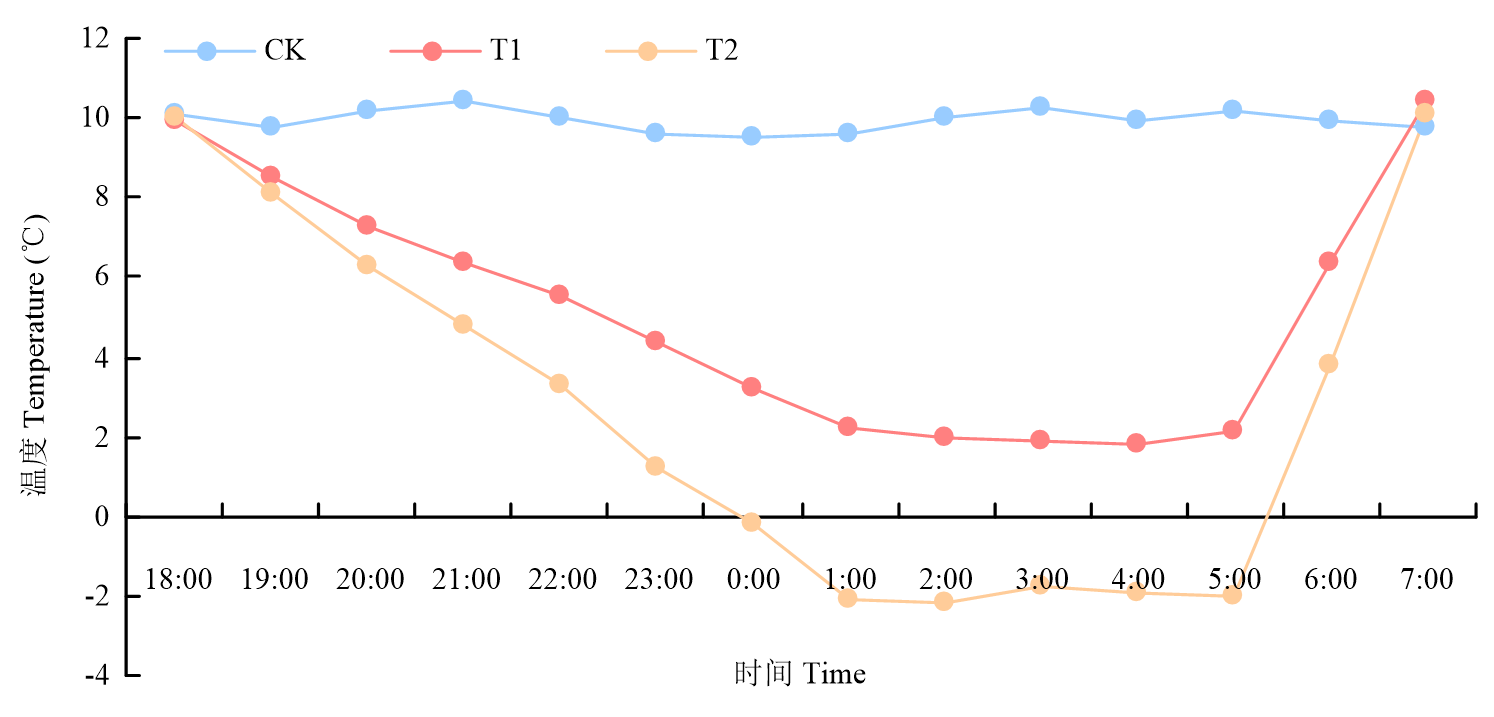
图1
试验期间人工气候室内温度变化 CK:对照温度10 ℃;T1:低温处理2 ℃;T2:低温处理-2 ℃。下同"
表1
倒春寒对两小麦品种农艺性状的影响"
| 品种 Variety | 处理 Treatment | 株高 PH (cm) | 重心高度 CGH (cm) | 穗下节间长 SIL (cm) | 穗长 SL (cm) | 穗宽 SW (mm) | 总小穗数 TS | 结实小穗数 FS | 小穗结实率 SSR (%) | 产量 YP (g/pot) |
|---|---|---|---|---|---|---|---|---|---|---|
| YN19 | CK | 74.36±0.43a | 49.70±0.70a | 21.92±0.17a | 9.98±0.08b | 11.76±0.40b | 21.80±0.37ab | 19.80±0.37a | 90.82±0.15a | 32.86±0.39b |
| T1 | 71.44±1.45b | 46.70±0.75b | 20.22±0.66b | 9.72±0.09c | 11.47±0.26b | 21.60±0.51ab | 19.40±0.40ab | 89.85±0.74a | 30.72±0.59cd | |
| T2 | 68.50±1.27c | 44.40±1.03c | 18.94±0.71c | 9.48±0.08d | 10.26±0.16c | 21.00±0.45ab | 18.60±0.40bc | 88.60±1.06ab | 29.29±0.42d | |
| XM26 | CK | 66.22±0.88d | 42.54±0.76d | 15.90±0.38d | 10.46±0.17a | 13.43±0.33a | 22.00±0.32a | 20.00±0.32a | 90.90±0.13a | 39.71±1.66a |
| T1 | 62.44±0.85e | 38.06±1.35e | 14.30±0.39e | 10.00±0.04b | 11.40±0.41b | 21.20±0.20ab | 18.40±0.24c | 86.79±0.93bc | 32.35±0.94bc | |
| T2 | 60.80±0.54f | 37.22±0.29e | 12.56±0.55f | 9.72±0.20c | 10.44±0.12c | 20.60±0.40b | 17.40±0.24d | 84.55±1.59c | 30.26±1.32d | |
| F值 F-value | F-Variety | 412.36** | 432.41** | 894.33** | 32.34** | 6.01* | 0.38 | 7.09* | 12.27** | 40.15** |
| F-Treatment | 64.53** | 73.12** | 79.88** | 37.62** | 28.93** | 3.82* | 19.22** | 13.89** | 61.06** | |
| F-V×T | 0.88 | 1.77 | 0.47 | 1.6 | 5.05* | 0.38 | 3.05 | 3.48 | 13.99** |

图2
花后不同天数小麦强、弱势籽粒大小变化 G1、G2和G3分别为小穗内第1、2和3粒位"
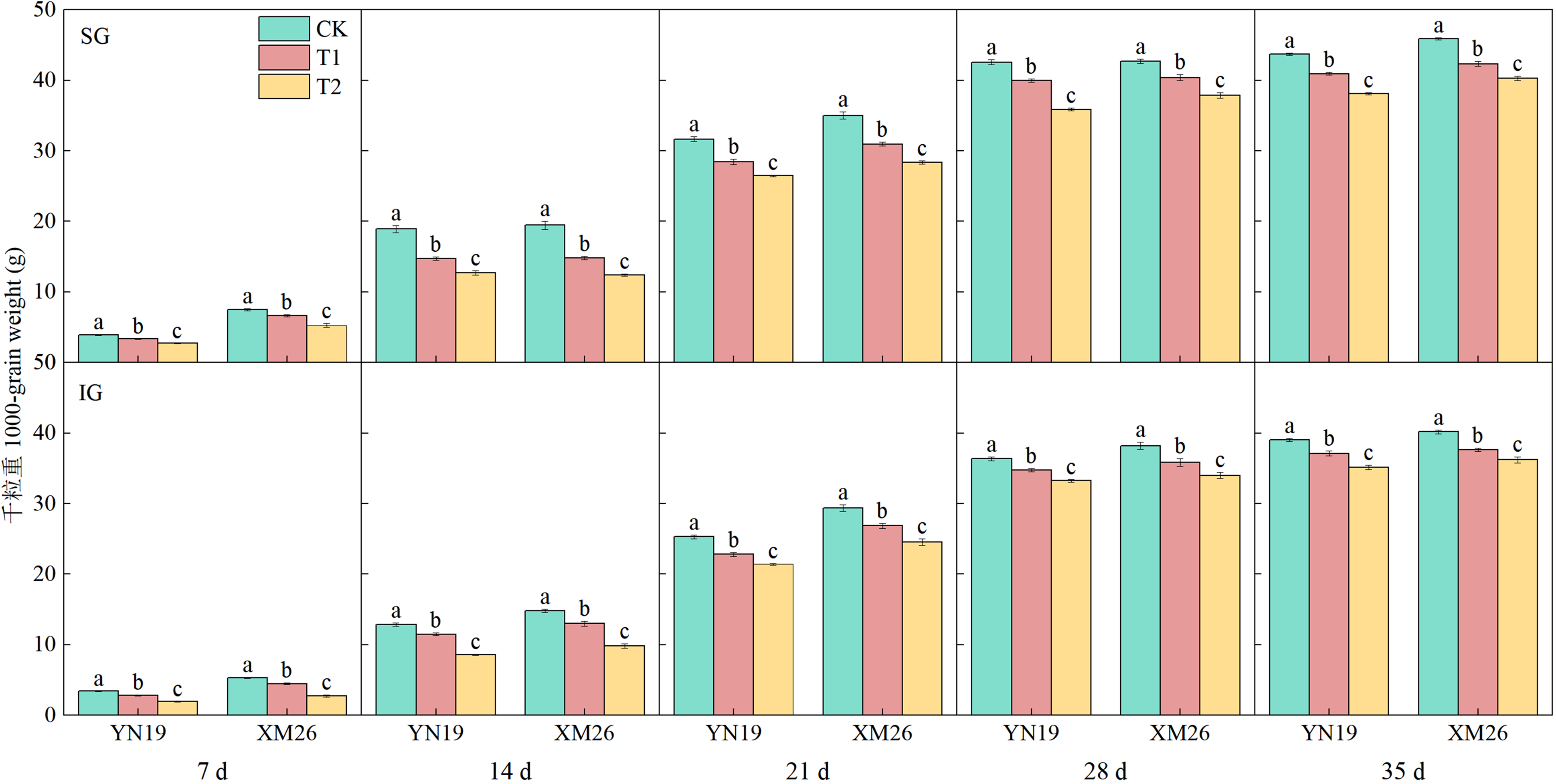
图3
倒春寒对两小麦品种花后不同时期强、弱势籽粒千粒重的影响 SG:强势粒;IG:弱势粒。图中不同小写字母表示不同处理间存在显著差异(P<0.05)"

图4
代谢物主成分分析和相关性分析 A:PC1表示第一主成分,PC2表示第二主成分,百分比表示该主成分对数据集的解释率;B:纵向和对角线上分别代表不同样品的样品名称,皮尔逊相关系数>0,颜色深浅代表正相关性强度,颜色越深表示正相关性越强"
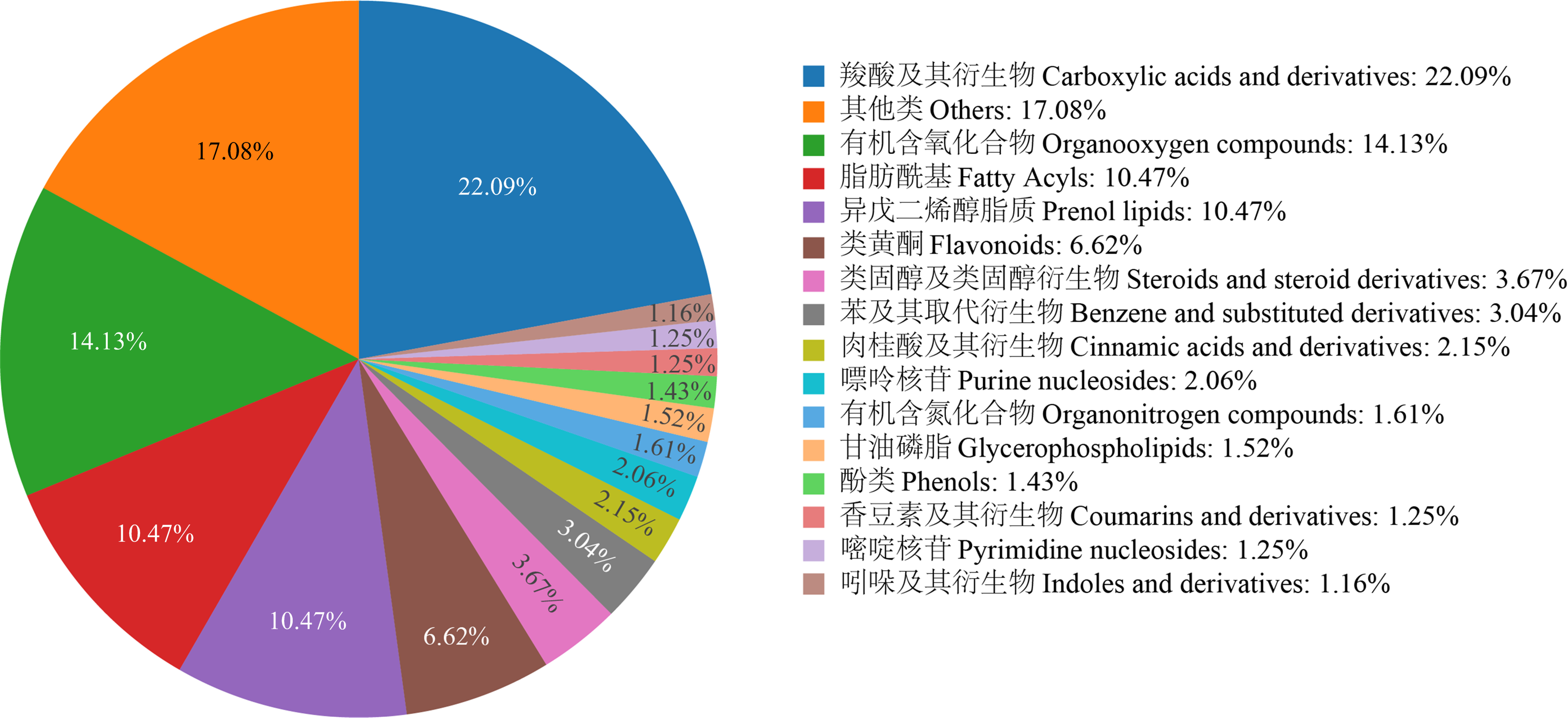
图5
代谢物分类统计分析"
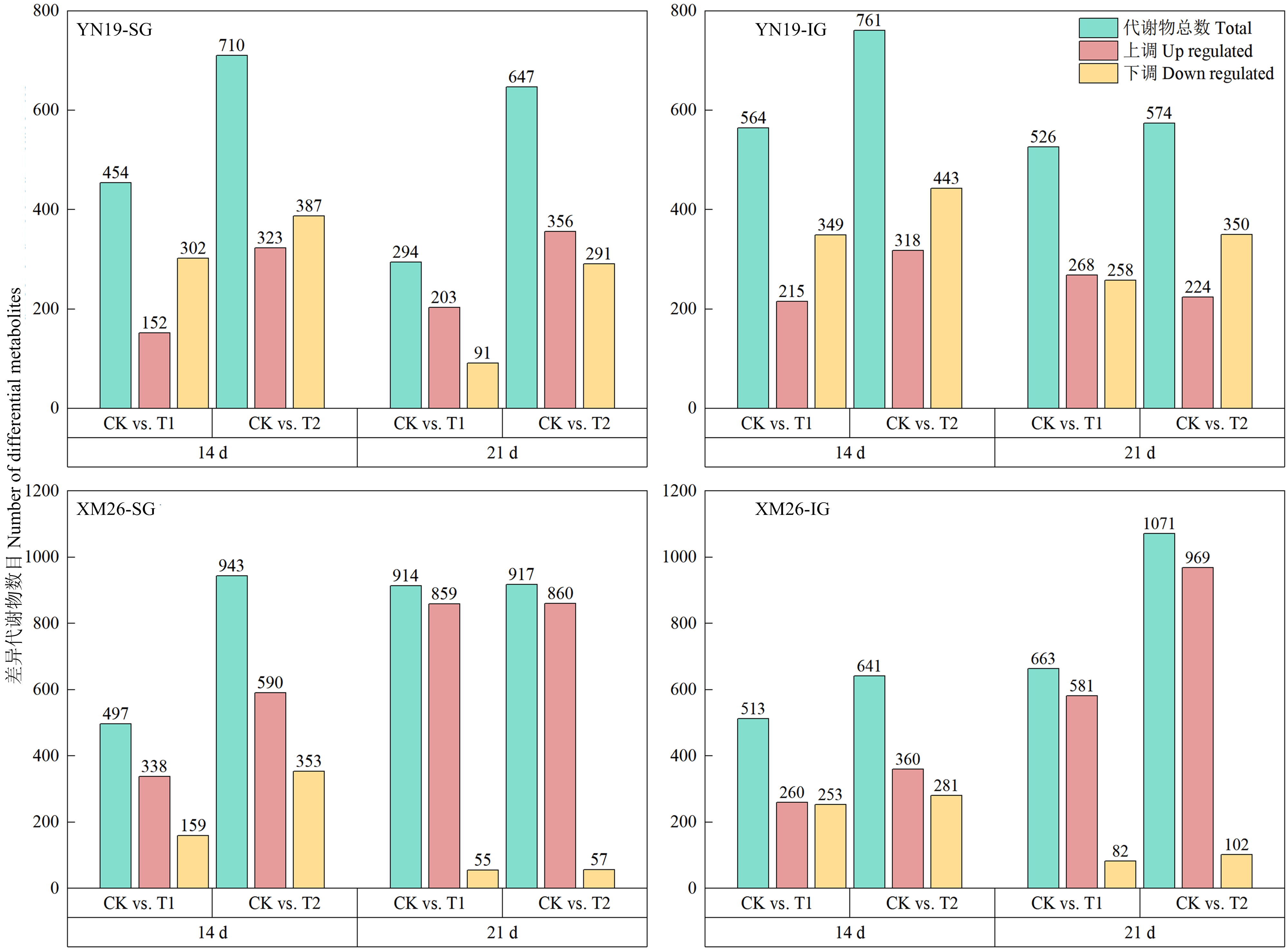
图6
差异代谢物数目分析"

图7
花后14和21 d差异代谢物韦恩图"

图8
两小麦品种花后14 d强弱势粒差异代谢物差异倍数图 横坐标为差异代谢物表达差异的倍数变化值,纵坐标为代谢物名称。下同"

图9
两小麦品种花后21 d强弱势粒差异代谢物差异倍数图"

图10
两小麦品种花后14 d强弱势粒差异代谢物富集图 图中每个气泡代表一个通路,横坐标代表富集因子,纵坐标代表代谢通路名称。气泡的颜色代表富集的显著性即P值,颜色越红代表该通路越显著富集,气泡大小表示富集到该通路上差异代谢物的数目。选择P值最小的前20条通路进行展示。下同"

图11
两小麦品种花后21 d强弱势粒差异代谢物富集图"
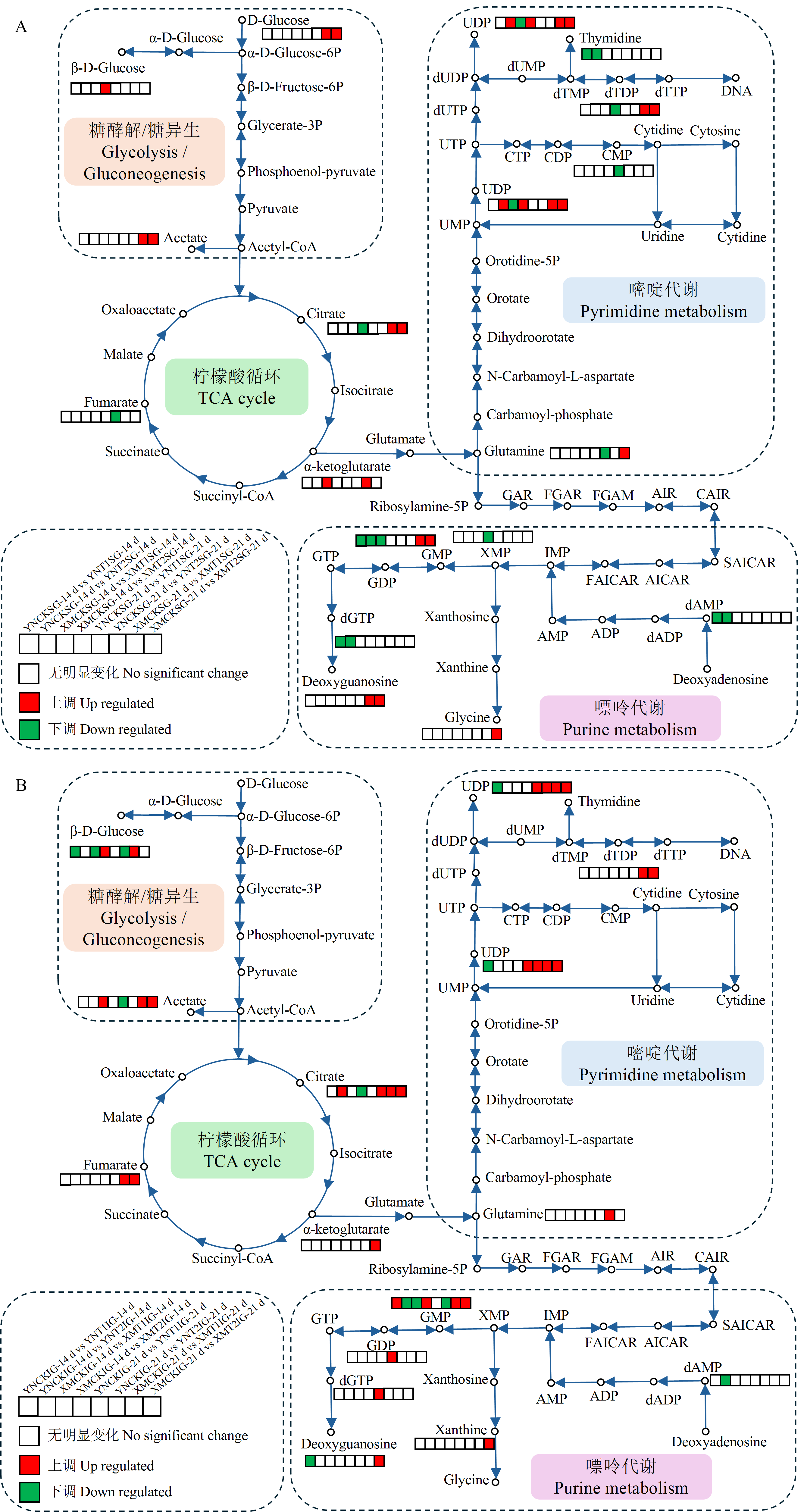
图12
倒春寒胁迫下强、弱势籽粒代谢途径网络变化图 A:强势粒;B:弱势粒"
| [1] |
doi: 10.3389/fsufs.2020.617009 |
| [2] |
IPCC. Climate change 2023: Synthesis report. contribution of working groups I, II and III to the sixth assessment report of the intergovernmental panel on climate change [core writing team, H. Lee and J. Romero (eds.)]. IPCC, Geneva, Switzerland, 2023. https://api.semanticscholar.org/CorpusID:260074696.
|
| [3] |
doi: 10.1016/j.agrformet.2018.06.006 |
| [4] |
|
| [5] |
|
| [6] |
doi: 10.1016/j.agrformet.2025.110484 |
| [7] |
doi: 10.1038/nclimate2242 |
| [8] |
刘慧, 崔奇峰, 周琳, 钟钰. 黄淮冬小麦大面积单产提升的制约因素与支撑条件-来自豫苏四县(市)的调查[J/OL]. 中国农业资源与区划, 2025-09-08. https://link.cnki.net/urlid/11.3513.S.20250908.1538.029.
|
|
|
|
| [9] |
doi: 10.1016/j.scitotenv.2024.173531 |
| [10] |
doi: 10.1016/j.ecolind.2024.112679 |
| [11] |
陈翔, 于敏, 蔡洪梅, 吴宇, 张乐乐, 柯媛媛, 许辉, 李金才. 小麦倒春寒研究现状与进展[J]. 应用生态学报, 2021, 32(8): 2999-3009.
doi: 10.13287/j.1001-9332.202108.021 |
|
doi: 10.13287/j.1001-9332.202108.021 |
|
| [12] |
王娟, 刘翼, 姚丹妤, 邹景伟, 肖世和, 孙果忠. 小麦生殖发育阶段对低温的敏感性鉴定[J]. 作物学报, 2022, 48(7): 1721-1729.
doi: 10.3724/SP.J.1006.2022.11045 |
|
doi: 10.3724/SP.J.1006.2022.11045 |
|
| [13] |
doi: 10.1016/j.agrformet.2018.05.011 |
| [14] |
刘绿洲, 张妍, 张林, 蔡洪梅, 于敏, 魏凤珍, 陈翔, 李金才. 药隔期低温胁迫对小麦功能叶超微结构及光合特性的影响[J]. 中国农业气象, 2023, 44(1): 58-70.
|
|
|
|
| [15] |
柯媛媛, 陈翔, 张乐乐, 张妍, 许辉,
|
|
|
|
| [16] |
doi: 10.1016/j.cj.2025.06.007 |
| [17] |
doi: 10.17221/313/2023-PSE |
| [18] |
高芸, 张玉雪, 马泉, 苏盛楠, 李春燕, 丁锦峰, 朱敏, 朱新开, 郭文善. 春季低温对小麦花粉育性及粒数形成的影响[J]. 作物学报, 2021, 47(1): 104-115.
doi: 10.3724/SP.J.1006.2021.01031 |
|
doi: 10.3724/SP.J.1006.2021.01031 |
|
| [19] |
doi: 10.1111/jac.v211.4 |
| [20] |
doi: 10.1021/jf9009137 pmid: 19639992 |
| [21] |
doi: 10.3390/agronomy13123011 |
| [22] |
doi: 10.1016/j.jia.2023.02.002 |
| [23] |
doi: 10.1016/j.cj.2020.12.012 |
| [24] |
doi: 10.1016/j.jspr.2023.102229 |
| [25] |
doi: 10.1007/s10725-024-01189-z |
| [26] |
doi: 10.3390/cells9051309 |
| [27] |
doi: 10.1093/plphys/kiad298 pmid: 37220420 |
| [28] |
doi: 10.3390/agronomy15040761 |
| [29] |
|
| [30] |
doi: 10.1186/s12870-022-03718-2 pmid: 35820806 |
| [31] |
doi: 10.1021/acs.jafc.1c06915 pmid: 34989558 |
| [32] |
doi: 10.3390/ijms26031157 |
| [33] |
doi: 10.3389/fpls.2024.1334913 |
| [34] |
doi: 10.3389/fpls.2022.886541 |
| [35] |
doi: 10.1016/j.fcr.2012.09.006 |
| [36] |
doi: 10.3390/metabo11090641 |
| [37] |
doi: 10.1038/s41598-022-16440-8 |
| [38] |
doi: 10.1007/s00344-024-11587-2 |
| [39] |
|
| [40] |
doi: 10.3389/fpls.2025.1594676 |
| [41] |
doi: 10.1016/j.cj.2019.09.002 |
| [42] |
doi: 10.3390/ijms23105716 |
| [1] | 魏家萍, 李世昌, 任小凡, 赵国栋, 崔俊美, 武泽峰, 刘自刚, 王爽. 植物响应倒春寒分子机制的研究进展[J]. 中国农业科学, 2026, 59(9): 1825-1835. |
| [2] | 王小玮, 杜佛力, 闫红财, 郎正东, 党志娟, 李葆春, 汪军成, 马小乐, 王化俊, 张宏, 姚立蓉. 396份春小麦灌浆期和成熟期抗旱性评价[J]. 中国农业科学, 2026, 59(8): 1608-1621. |
| [3] | 王彩玉, 刘小丽, 李文广, 杨文平, 杨珍平, 高志强. 有机肥不同替代比例对土壤多功能性的影响及微生物驱动机制[J]. 中国农业科学, 2026, 59(8): 1712-1726. |
| [4] | 岳楠栋, 蒋丙婷, 聂景贵, 方越, 唐军荣, 乐振声, 周莹, 李能波, 何霞红, 张雪春. 紫皮石斛茎、叶、花的成分和功能活性分析及代谢组学研究[J]. 中国农业科学, 2026, 59(8): 1775-1796. |
| [5] | 朱琦, 贾振鹏, Tahir SHAH, 徐晨晟, 李芷琦, 吕会帅, 朱鹏超, 韦小敏, 黄冬琳, 孙艳妮, 曹卫东, 高亚军, 王朝辉, 张达斌. 绿肥配施增效产品降低旱地麦田温室气体排放及碳足迹[J]. 中国农业科学, 2026, 59(7): 1507-1522. |
| [6] | 叶美金, 吴雷, Lohani Md Nahibuzzaman, 尹丽, 胡欣荣, 刘亚西, 蒋云峰, 陈国跃, 蒲至恩, 李阳, 李婷, 邹亚亚, 吴佳怡, 马建. 基于GWAS的中国地方小麦成熟胚大小位点的鉴定及其遗传效应解析[J]. 中国农业科学, 2026, 59(6): 1157-1171. |
| [7] | 李文虎, 礼海风, 杜宇鹏, 丁玉兰, 罗一诺, 李宇珂, 佘文婷, 张丰, 滕宇, 张思琦, 黄翠, 李小涵, 刘金山, 王朝辉. 小麦锌吸收转移对土施锌肥响应的区域差异[J]. 中国农业科学, 2026, 59(5): 1034-1047. |
| [8] | 岳丽昕, 王清华, 王振宝, 尼玛琼吉, 刘泽洲, 孔素萍, 张立峰, 高莉敏. 基于广靶代谢组学分析藏葱和细香葱营养品质及黄酮类代谢产物差异[J]. 中国农业科学, 2026, 59(5): 1070-1086. |
| [9] | 焦文娟, 何万龙, 耿洪伟, 白斌, 李剑峰, 程宇坤. 155份春小麦品种(系)条锈病抗性评价与抗病基因分子检测[J]. 中国农业科学, 2026, 59(5): 937-950. |
| [10] | 崔士友, 陈澎军, 缪源卿, 韩继军, 沈俊明. EMS诱变抗草甘膦小麦新种质的创制与大田评价[J]. 中国农业科学, 2026, 59(4): 723-733. |
| [11] | 钱瑾, 李映雪, 吴芳, 邹晓晨. 集成光谱降维的冬小麦叶片磷含量估算[J]. 中国农业科学, 2026, 59(4): 781-792. |
| [12] | 孔媛, 崔沙沙, 李美, 李健, 杨思雨, 房锋, 刘帅帅, 刘明平, 曾艳, 高兴祥, 柏连阳. 黄淮海冬小麦田多花黑麦草等5种禾本科杂草时空分布变化规律[J]. 中国农业科学, 2026, 59(4): 807-823. |
| [13] | 王勇胜, 牛丽, 王长杰, 马立花, 廉潇潇, 孟亚雄, 马小乐, 姚立蓉, 张宏, 杨轲, 李葆春, 王化俊, 司二静, 汪军成. 冬小麦千粒重的全基因组关联分析及候选基因预测[J]. 中国农业科学, 2026, 59(3): 499-514. |
| [14] | 李心怡, 李嘉宁, 杨文平, 夏清, 霍滢睿, 郝世航, 黄婷苗, 任永康, 陈杰, 高志强, 杨珍平. 彩粒小麦锌营养对花后叶面喷锌的响应[J]. 中国农业科学, 2026, 59(3): 515-527. |
| [15] | 咸青林, 肖鉴珂, 高阿庆, 郜利闯, 刘杨. 种植方式结合测墒补灌下冬小麦产量及水分利用效率[J]. 中国农业科学, 2026, 59(3): 589-601. |
|
||
