






中国农业科学 ›› 2026, Vol. 59 ›› Issue (16): 3655-3672.doi: 10.3864/j.issn.0578-1752.2026.16.013
吴培景2( ), 苏玲1(), 陈迎春1, 孟冬2, 杨清2, 张曼2, 周小苗2, 陶建敏3, 郑焕3, 李勃1, 宫磊1,3()
收稿日期:2026-04-25
接受日期:2026-06-26
出版日期:2026-08-16
发布日期:2026-08-17
通信作者:
联系方式:
吴培景,E-mail:wu15318838869@163.com。苏玲,E-mail:susulingzi@126.com。吴培景和苏玲为同等贡献作者。
基金资助:
WU PeiJing2(), SU Ling1(), CHEN YingChun1, MENG Dong2, YANG Qing2, ZHANG Man2, ZHOU XiaoMiao2, TAO JianMin3, ZHENG Huan3, LI Bo1, GONG Lei1,3()
Received:2026-04-25
Accepted:2026-06-26
Published:2026-08-16
Online:2026-08-17
摘要:
【目的】 研究红肉葡萄及其自交后代果肉类黄酮的基因表达及代谢组分差异,解析类黄酮生物合成的代谢积累特征并提供转录调控线索,为提高葡萄果实类黄酮含量及培育葡萄新品种提供理论基础。【方法】 以红肉葡萄新种质‘钟山红玉’(ZSHY)和自交后代‘南19’(N19)、‘南30’(N30),以及‘玫瑰香’(MGX)为试验材料,设置ZSHY_vs_MGX、N30_vs_ZSHY、N19_vs_MGX和N30_vs_N19四个组别,进行果肉类黄酮靶向代谢组学和转录组学(RNA-seq)检测,通过富集分析鉴定类黄酮代谢物积累、合成关键基因以及转录调控的网络。【结果】 基于类黄酮靶向代谢组学技术,检测出104种表达差异的类黄酮代谢物,并鉴定出62种显著差异的核心类黄酮代谢物,其中‘ZSHY’和‘N19’中黄酮醇、黄烷醇等多数代谢物积累量显著高于‘N30’和‘MGX’。KEGG通路富集分析显示差异代谢物显著富集于类黄酮生物合成相关通路,特别是花青素苷、黄酮与黄酮醇生物合成途径。转录组学分析共筛选到758个差异表达基因(DEGs),显著富集于类黄酮、苯丙烷类生物合成等通路。进一步鉴定出30个核心差异表达的类黄酮合成关键结构基因,其表达模式与类黄酮代谢物积累趋势基本一致,即在‘ZSHY’和‘N19’中表达量高,在‘N30’和‘MGX’中表达量低。此外,筛选出22个与类黄酮合成结构基因显著相关的转录因子,主要包括WRKY、MYB、ERF等家族。【结论】 红肉葡萄与其自交后代间存在显著的类黄酮代谢差异,‘ZSHY’和‘N19’果肉中类黄酮的较高积累与其合成通路关键结构基因的高表达密切相关,且转录因子可能对类黄酮合成基因具有调控作用。
吴培景, 苏玲, 陈迎春, 孟冬, 杨清, 张曼, 周小苗, 陶建敏, 郑焕, 李勃, 宫磊. 基于转录组与代谢组解析红肉葡萄及其自交后代果肉类黄酮积累特征[J]. 中国农业科学, 2026, 59(16): 3655-3672.
WU PeiJing, SU Ling, CHEN YingChun, MENG Dong, YANG Qing, ZHANG Man, ZHOU XiaoMiao, TAO JianMin, ZHENG Huan, LI Bo, GONG Lei. Integrative Transcriptomic and Metabolomic Analyses Reveal Flavonoid Accumulation Characteristics in the Flesh of Red-Fleshed Grape and Self-Pollinated Progenies[J]. Scientia Agricultura Sinica, 2026, 59(16): 3655-3672.
表1
引物序列"
| 基因Gene | 基因ID Gene ID | 引物序列Primers sequence (5′-3′) |
|---|---|---|
| Actin | — | F: CTTGGCTGATAGGCTGGCGAAG R: TCCACATCTGCTCAAAGGTGCTTAG |
| PAL | VIT_13s0019g04460 | F: ATGAGGTGAAGCGGATGGTG R: GCCTTTACTCCCTCTCTCGC |
| CYP73A4 | VIT_06s0004g08150 | F: AATCCTGGTGAACGCATGGT R: TTGGCCTCAACCTTGGACTC |
| 4CL2 | VIT_11s0052g01090 | F: CCAGATCATCTTCCGCTGCA R: GCCTTGCTTGATCCCCATCT |
| CHS | VIT_14s0068g00920 | F: CCAAAATCGAACGCCCACTC R: TGGAAATCAACCCTGGGACG |
| CHIL2 | VIT_13s0067g02870 | F: CAAGGGTTCACAGTACGGGG R: TCCAAAGCTTCCTCCTCCTCT |
| CHI | VIT_13s0067g03820 | F: TGGAGTCCATCATCGGCAAG R: TTCTCATCCCCAGCCTCCTT |
| HCT | VIT_11s0037g00440 | F: GCCTCTCCCATGATCAACCC R: GCGTTGCGAATCCTCTGAAC |
| CYP75B2 | VIT_17s0000g07210 | F: CCTCTACCACTTCCTCACGC R: GCCCATACGGAGATGCATGA |
| CYP75A1 | VIT_06s0009g02970 | F: TTATGGGGCAAGGTGGAAGC R: TTAACATCTCCGGCACCACC |
| DFR | VIT_18s0001g12800 | F: AATGAAATCGTGTGCTGCCG R: ACTCCAGCAGCTTTCATCGT |
| LDOX | VIT_02s0025g04720 | F: ATGGTGACTTCAGTGGCTCC R: GAACCTGAGGCCCTTCATCC |
| UFGT | VIT_16s0039g02230 | F: AATGGGAGGATGGTGGAGGA R: TAGGACCAACTGCCCTGTCT |

图1
不同葡萄种质果肉中类黄酮含量测定"
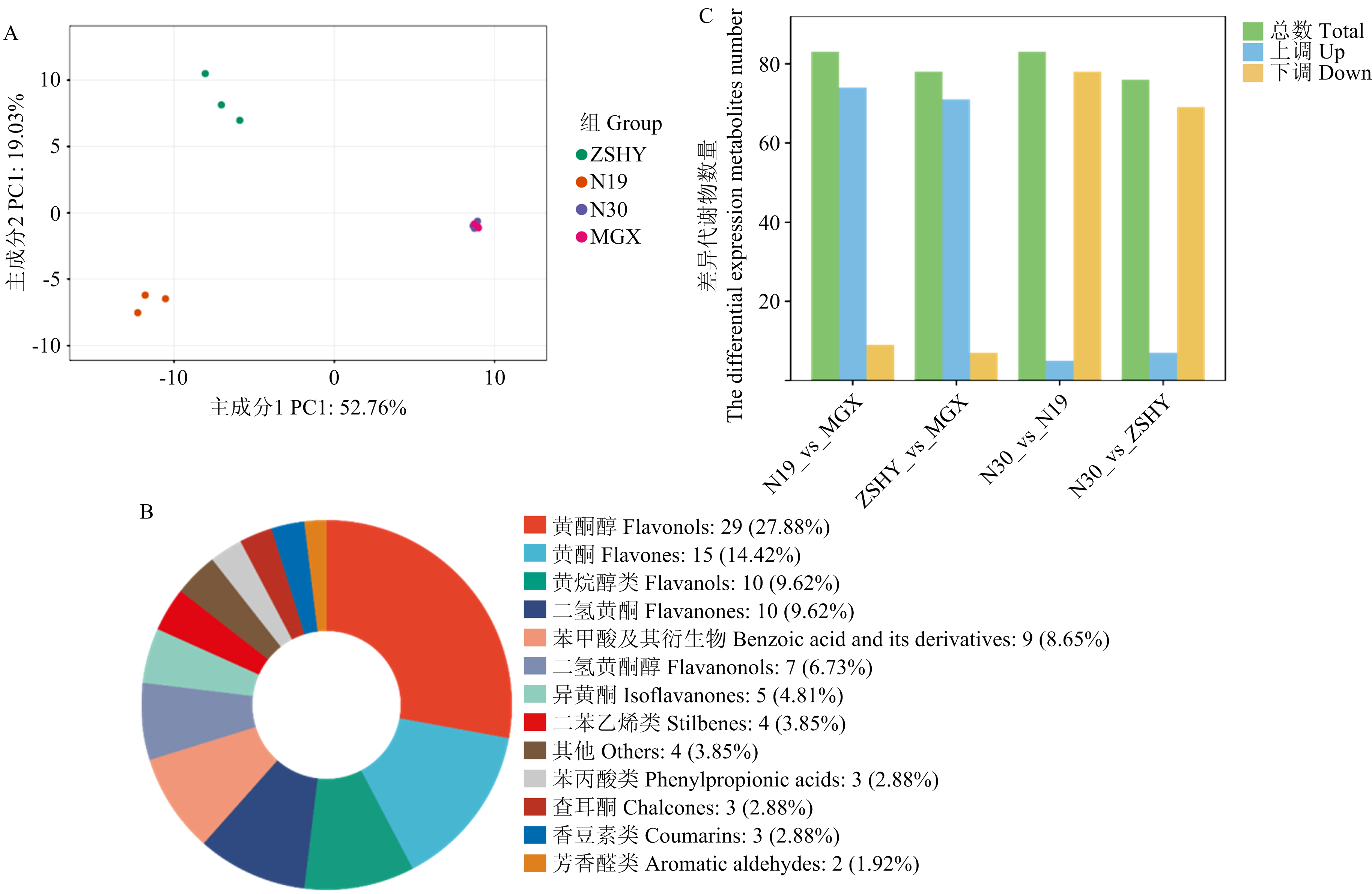
图2
代谢组学分析 A:代谢组主成分分析图;B:类黄酮组分占比;C:组间对比筛选到的DAMs数目统计"
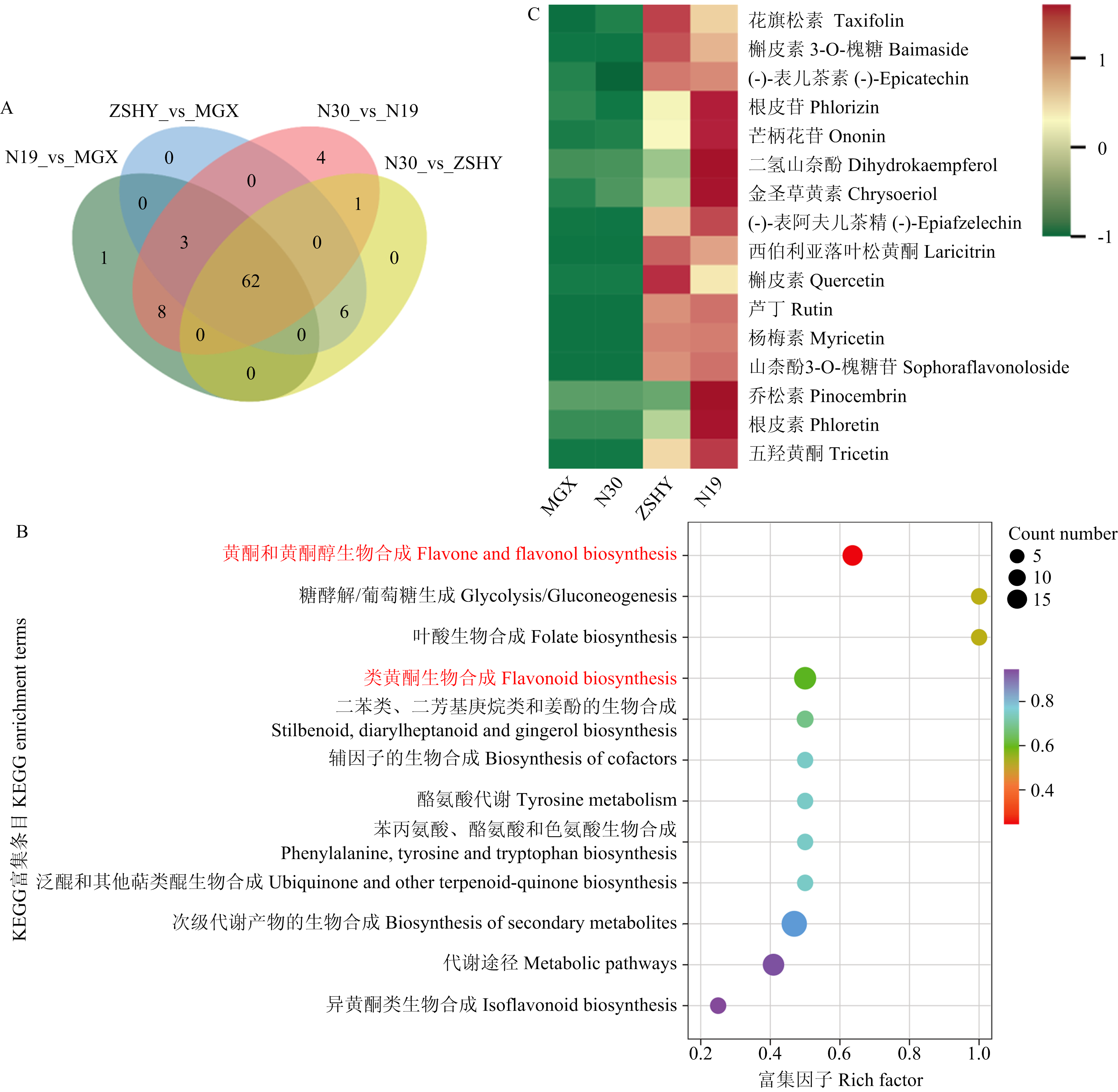
图3
核心DAMs Venn分析(A)、KEGG富集分析(B)及类黄酮核心差异代谢物聚类热图(C)"
表2
RNA-Seq文库的质量和产量统计"
| 样品 Sample | 原始数据 Raw reads (M) | 过滤后数据 Clean reads (M) | 过滤后碱基总数 Clean bases (G) | 有效碱基百分比 Valid bases (%) | 碱基质量值 Q30 (%) | GC含量 GC content (%) | 特异比对率 Unique map (%) |
|---|---|---|---|---|---|---|---|
| MGX-1 | 44.82 | 44.71 | 6.70 | 99.77 | 97.94 | 46.24 | 86.00 |
| MGX-2 | 46.83 | 46.74 | 7.00 | 99.80 | 97.89 | 45.98 | 88.42 |
| MGX-3 | 45.39 | 45.27 | 6.78 | 99.73 | 97.95 | 46.56 | 86.93 |
| N30-1 | 46.26 | 46.12 | 6.90 | 99.71 | 97.99 | 46.26 | 86.66 |
| N30-2 | 46.78 | 46.68 | 6.99 | 99.79 | 97.86 | 46.32 | 85.48 |
| N30-3 | 46.69 | 46.56 | 6.97 | 99.72 | 97.96 | 46.35 | 86.81 |
| ZSHY-1 | 46.35 | 46.22 | 6.92 | 99.72 | 98.00 | 47.08 | 83.65 |
| ZSHY-2 | 46.29 | 46.14 | 6.91 | 99.68 | 98.02 | 46.56 | 86.76 |
| ZSHY-3 | 46.15 | 46.05 | 6.90 | 99.77 | 98.01 | 46.80 | 86.10 |
| N19-1 | 46.91 | 46.67 | 6.97 | 99.47 | 97.94 | 46.17 | 85.52 |
| N19-2 | 46.70 | 46.50 | 6.95 | 99.55 | 97.92 | 46.33 | 85.43 |
| N19-3 | 47.25 | 47.11 | 7.05 | 99.70 | 97.89 | 46.30 | 85.44 |

图4
RNA-seq结果分析 A:RNA-seq主成分分析图;B:组间对比筛选到的DEG数目统计;C:各组别Venn分析;D:DEGs层次聚类分析热图,绿色到红色代表基因表达水平从低到高;E:核心DEGs Venn分析"
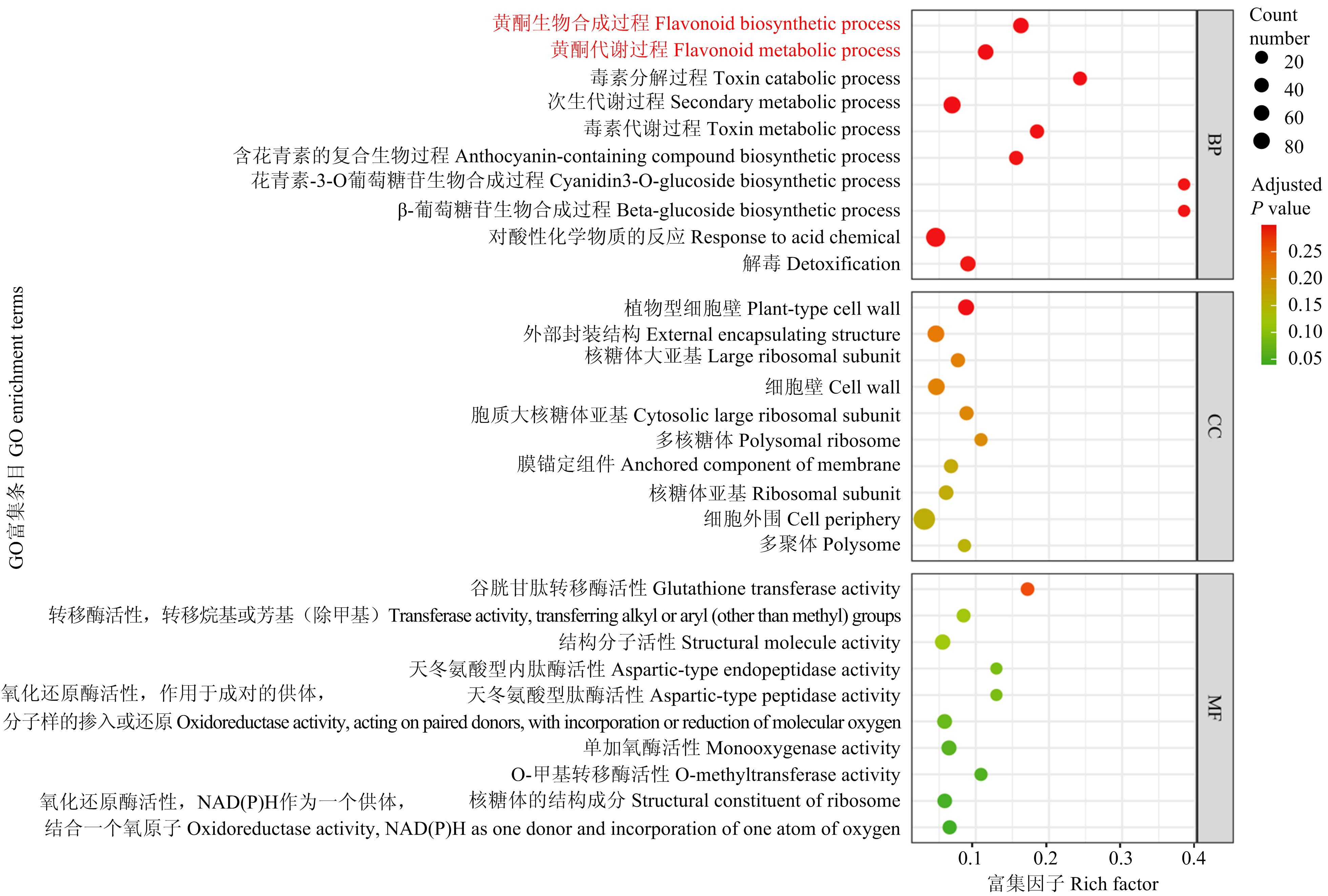
图5
GO富集分析"
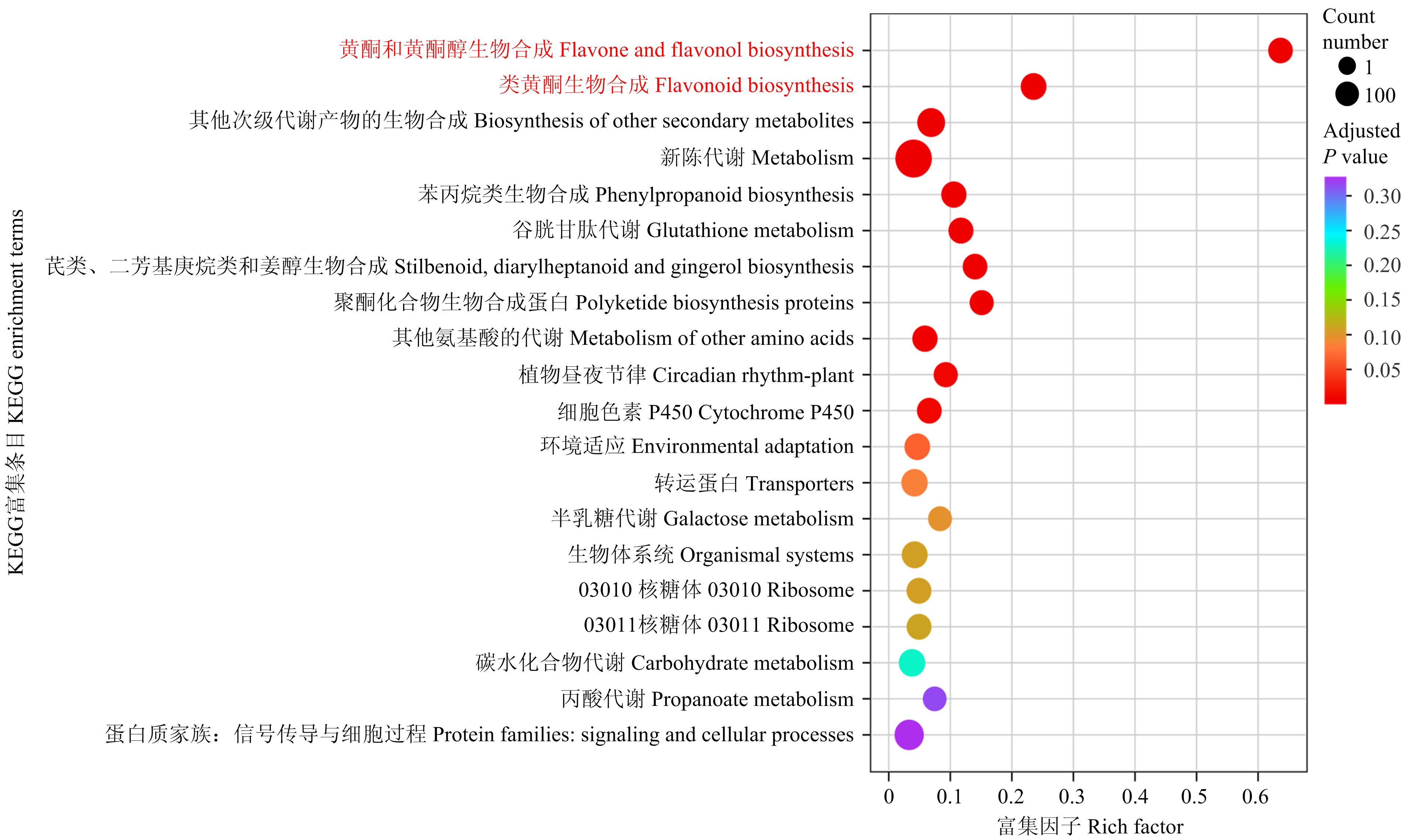
图6
KEGG富集分析"
表3
类黄酮合成相关的差异表达基因"
| 基因名称 Gene name | 基因 Gene | 基因ID Gene ID | 数量 Count | 编号 KO ID |
|---|---|---|---|---|
| 苯丙氨酸解氨酶 Phenylalanine ammonia-lyase | PAL | VIT_13s0019g04460 | 1 | K10775 |
| 肉桂酸-4-羟化酶 Cinnamate-4-hydroxylase | CYP73A | VIT_06s0004g08150 | 1 | K00487 |
| 4-香豆酸辅酶A连接酶 4-coumarate coenzyme A ligase | 4CL2 | VIT_11s0052g01090; VIT_16s0039g02040 | 2 | K01904 |
| 查尔酮合成酶 Chalcone synthase | CHS | VIT_16s0022g01020; VIT_05s0136g00260; VIT_14s0068g00920; VIT_16s0022g01140; VIT_16s0022g01190; VIT_00s1492g00010; VIT_16s0022g01000 | 7 | K00660 |
| 查尔酮异构酶样蛋白 Chalcone-flavanone isomerase-related | CHIL2 | VIT_13s0067g02870 | 1 | K01859 |
| 查尔酮异构酶Chalcone isomerase | CHI | VIT_13s0067g03820 | 1 | K01859 |
| 莽草酸O-羟基肉桂酰转移酶 Shikimate O-hydroxycinnamoyltransferase | HCT | VIT_11s0037g00440 | 1 | K13065 |
| 黄烷酮3'羟化酶Flavonoid 3'- hydroxylase | CYP75B2 | VIT_17s0000g07200; VIT_17s0000g07210 | 2 | K05280 |
| 类黄酮3', 5'羟基化酶 Flavonoid 3', 5'-hydroxylase | CYP75A1 | VIT_06s0009g02970; VIT_06s0009g02840; VIT_06s0009g02860 | 3 | K13083 |
| CYP75A2 | VIT_06s0009g02830 | 1 | K13083 | |
| CYP75A3 | VIT_06s0009g02920; VIT_06s0009g02880; VIT_06s0009g02810 | 3 | K13083 | |
| 类黄酮 O-甲基转移酶 Flavonoid O-methyltransferase | FAOMT | VIT_01s0010g03510; VIT_01s0010g03470; IT_01s0010g03490; VIT_01s0010g03460 | 4 | K13272 |
| 二氢黄酮醇-4-还原酶 Dihydroflavonol 4-reductase | DFR | VIT_18s0001g12800 | 1 | K13802 |
| 无色花青素双加氧酶 Leucoanthocyanin dioxygenase | LDOX | VIT_02s0025g04720 | 1 | K05277 |
| UDP类黄酮-3-O-葡萄糖基转移酶 UDP flavonoid-3-O-glucosyltransferase | UFGT | VIT_16s0039g02230 | 1 | K12930 |
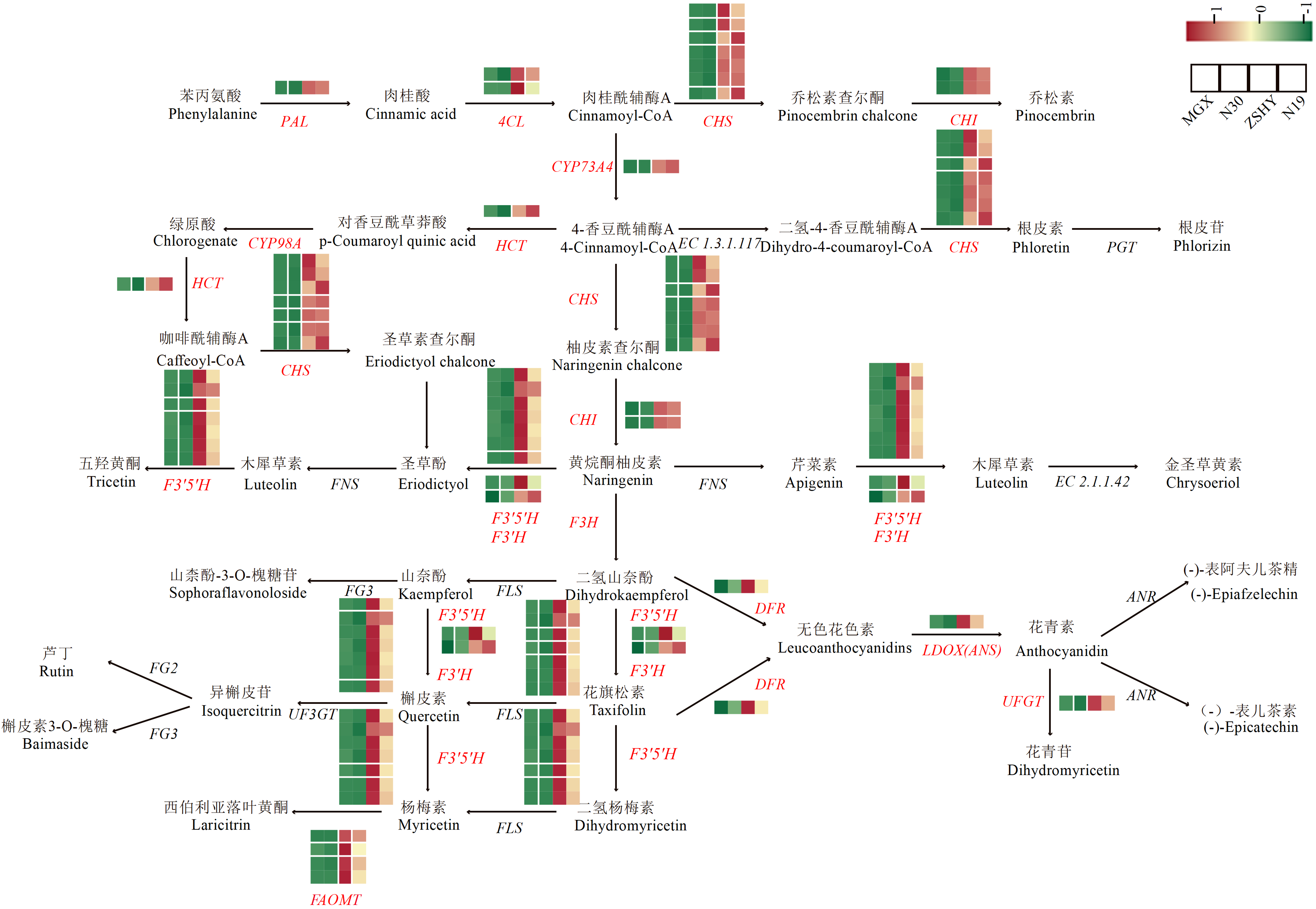
图7
类黄酮生物合成途径图"

图8
转录因子与类黄酮合成途径基因表达相关性分析(A)及类黄酮合成途径基因启动子顺式作用元件分析(B) 1:60K蛋白结合位点;2:生长素响应元件;3:参与水杨酸响应性的顺式作用元件;4:参与脱落酸响应性的顺式作用元件;5:厌氧诱导所必需的顺式作用调控元件;6:参与昼夜节律调控的顺式作用调控元件;7:参与光响应性的顺式作用调控元件;8:参与胚乳表达的顺式调控元件;9:光响应元件;10:参与干旱诱导性的MYB结合位点;11:参与光响应性的保守DNA模块的组成部分;12:光响应元件的组成部分;13:光响应模块的组成部分;14:光响应模块的组成部分;15:参与光响应性的顺式作用元件;16:激发子介导的最大激活效应元件(2拷贝);17:MYBHv1结合位点;18:参与防御和胁迫响应性的顺式作用元件;19:参与生长素响应性的顺式作用调控元件;20:参与缺氧特异性诱导性的增强子样元件;21:赤霉素响应元件;22:参与细胞周期调控的顺式作用元件;23:参与低温响应性的顺式作用元件;24:参与茉莉酸甲酯响应性的顺式作用调控元件;25:与分生组织表达相关的顺式作用调控元件;26:创伤响应元件;27:参与赤霉素响应性的顺式作用元件;28:参与胚乳特异性负表达调控;29:参与光敏色素下调表达的顺式作用元件;30:参与光响应性的MYB结合位点;31:参与栅栏组织叶肉细胞分化的元件;32:参与类黄酮生物合成基因调控的MYB结合位点;33:参与玉米醇溶蛋白代谢调控的顺式作用调控元件;34:参与种子特异性调控的顺式作用调控元件。*:P<0.05;**:P<0.01;***:P<0.001"
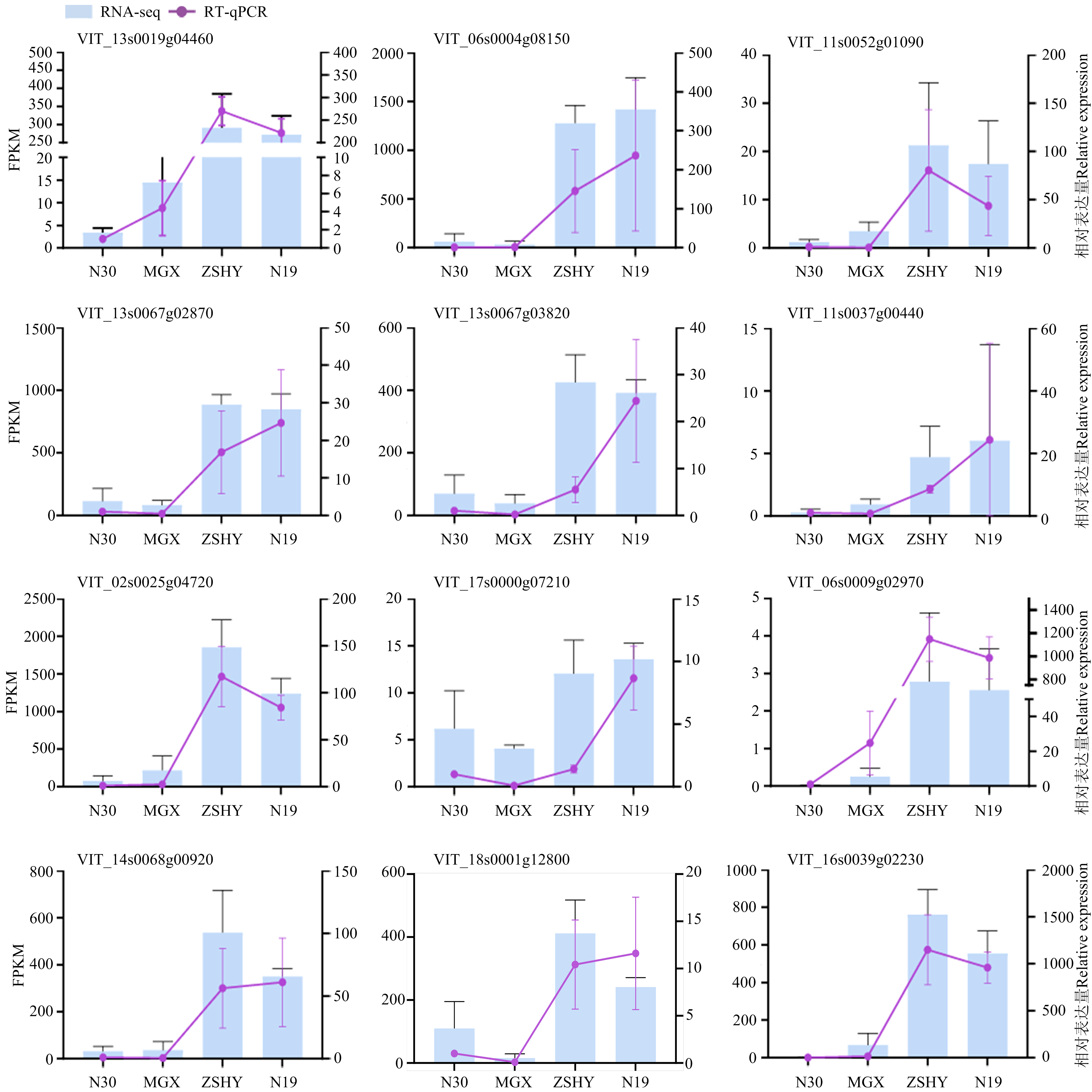
图9
类黄酮生物合成途径基因相对表达量"
| [1] |
doi: 10.1016/j.scienta.2025.113989 |
| [2] |
生弘杰, 卢素文, 郑暄昂, 贾海锋, 房经贵. 基于广泛靶向代谢组学的葡萄种子代谢物鉴定与比较分析[J]. 中国农业科学, 2023, 56(7): 1359-1376. DOI: 10.3864/j.issn.0578-1752.2023.07.013.
|
|
|
|
| [3] |
doi: 10.3390/ijms141019651 pmid: 24084717 |
| [4] |
doi: 10.3390/plants14121847 |
| [5] |
doi: 10.1016/j.foodchem.2022.132531 |
| [6] |
卢素文, 郑暄昂, 王佳洋, 房经贵. 葡萄类黄酮代谢研究进展[J]. 园艺学报, 2021, 48(12): 2506-2524.
doi: 10.16420/j.issn.0513-353x.2021-0558 |
|
doi: 10.16420/j.issn.0513-353x.2021-0558 |
|
| [7] |
doi: 10.1111/tpj.2013.76.issue-6 |
| [8] |
doi: 10.1007/s44372-025-00450-7 |
| [9] |
葛诗蓓, 张学宁, 韩文炎, 李青云, 李鑫. 植物类黄酮的生物合成及其抗逆作用机制研究进展[J]. 园艺学报, 2023, 50(1): 209-224.
doi: 10.16420/j.issn.0513-353x.2021-1186 |
|
doi: 10.16420/j.issn.0513-353x.2021-1186 |
|
| [10] |
邹凤莲, 寿森炎, 叶纨芝, 卢钢. 类黄酮化合物在植物胁迫反应中作用的研究进展[J]. 细胞生物学杂志, 2004, 26(1): 39-44.
|
|
|
|
| [11] |
doi: 10.3390/antiox13080922 |
| [12] |
doi: 10.3390/ijms222312824 |
| [13] |
doi: 10.3390/ijms21031011 |
| [14] |
孙萍, 朱文灿, 林贤锐, 吴嘉颀, 曹译文, 陈辰斐, 王轶, 朱建锡, 贾惠娟, 钱敏杰, 沈建生. 基于代谢组和转录组解析多雨寡照对桃果皮着色和类黄酮积累的影响[J]. 中国农业科学, 2025, 58(6): 1173-1194. DOI: 10.3864/j.issn.0578-1752.2025.06.010.
|
|
|
|
| [15] |
王慧玲, 张莹莹, 闫爱玲, 王晓玥, 刘振华, 任建成, 徐海英, 孙磊. 多组学联合解析红色玫瑰香型葡萄品种转色过程中单萜和花色苷积累规律[J]. 中国农业科学, 2025, 58(13): 2645-2662. DOI: 10.3864/j.issn.0578-1752.2025.13.012.
|
|
|
|
| [16] |
doi: 10.3390/plants14132025 |
| [17] |
doi: 10.3390/ijms19051471 |
| [18] |
doi: 10.3390/molecules15129057 pmid: 21150825 |
| [19] |
|
| [20] |
doi: 10.1016/j.hpj.2024.03.011 |
| [21] |
doi: 10.5344/ajev.2006.57.3.257 |
| [22] |
doi: 10.1007/s13197-017-2724-3 pmid: 28928526 |
| [23] |
doi: 10.1016/j.fochx.2025.102301 |
| [24] |
pmid: 17263504 |
| [25] |
doi: 10.1021/acs.jafc.1c02703 pmid: 34632763 |
| [26] |
赵一凡, 彭文婷, 李惠清, 郭玉婷, 王军. 五个欧亚种酿酒葡萄果实类黄酮及香气物质差异分析[J]. 中外葡萄与葡萄酒, 2021(6): 1-12.
|
|
|
|
| [27] |
doi: S0981-9428(14)00339-8 pmid: 25461697 |
| [28] |
doi: 10.1016/j.fbio.2024.105452 |
| [29] |
高磊. ‘钟山红’与‘钟山红玉’及其杂交后代葡萄果肉花色苷合成机制的研究[D]. 南京: 南京农业大学, 2023: 58-59, 62-63.
|
|
|
|
| [30] |
韩梅梅, 杨晓帆, 王军, 潘秋红. 基因型与微环境差异对葡萄果实黄烷-3-醇含量的影响[J]. 果树学报, 2014, 31(2): 221-230.
|
|
|
|
| [31] |
doi: 10.1016/j.tplants.2013.06.003 pmid: 23870661 |
| [32] |
|
| [33] |
doi: 10.3390/genes16040451 |
| [34] |
邵雪花, 赖多, 肖维强, 刘传和, 贺涵, 匡石滋. 番石榴果实品质评价及黄酮类化合物合成相关基因挖掘[J]. 华南农业大学学报, 2023, 44(2): 245-253.
|
|
|
|
| [35] |
doi: 10.1371/journal.pone.0313580 |
| [36] |
doi: 10.1093/jxb/erq442 pmid: 21278228 |
| [37] |
doi: 10.1111/tpj.2004.39.issue-3 |
| [38] |
doi: 10.1016/j.tplants.2014.12.001 pmid: 25577424 |
| [39] |
doi: 10.1111/tpj.2017.92.issue-3 |
| [40] |
doi: 10.1007/s11103-018-0802-1 |
| [1] | 管书萍, 李可, 解凯东, 段耀园, 王婷婷, 周志虎, 伍小萌, 郭文武. ‘温州蜜柑+桃叶橙’胞质杂种果实增大的生理基础及相关基因发掘[J]. 中国农业科学, 2026, 59(8): 1748-1759. |
| [2] | 岳楠栋, 蒋丙婷, 聂景贵, 方越, 唐军荣, 乐振声, 周莹, 李能波, 何霞红, 张雪春. 紫皮石斛茎、叶、花的成分和功能活性分析及代谢组学研究[J]. 中国农业科学, 2026, 59(8): 1775-1796. |
| [3] | 岳丽昕, 王清华, 王振宝, 尼玛琼吉, 刘泽洲, 孔素萍, 张立峰, 高莉敏. 基于广靶代谢组学分析藏葱和细香葱营养品质及黄酮类代谢产物差异[J]. 中国农业科学, 2026, 59(5): 1070-1086. |
| [4] | 任敏鹏, 张夕霏, 葛华梁, 耿立英, 李祥龙, 禹保军, 王坤杨, 张传生. 基于多组学解析B380鸡黑尾与白尾羽色性状的相关候选基因[J]. 中国农业科学, 2026, 59(16): 3673-3686. |
| [5] | 马小英, 屈小玉, 李涛, 刘威帆, 刘昊, 马风兰, 万猛虎, 吴娜, 刘吉利. 盐胁迫下不同耐盐型玉米品种的生理与代谢响应机制解析[J]. 中国农业科学, 2026, 59(13): 2815-2827. |
| [6] | 郭富强, 彭治鑫, 李得瑞, 林木森, 许立峰, 张成省. 2-辛基-3-异噻唑啉酮抗烟草赤星病菌的生物活性及作用机制[J]. 中国农业科学, 2026, 59(13): 2841-2852. |
| [7] | 赵薇, 田进理, 陈丝雨, 杨丽娟, 马丽娜, 张国俊, 张虎, 胡伟龙, 余海荣, 张海波, 张娟. 基于加权基因共表达网络分析挖掘影响静原鸡肉品质相关候选基因[J]. 中国农业科学, 2026, 59(13): 2975-2992. |
| [8] | 杨菁华, 孙娥, 刘小欢, 张盼, 戴莹葆, 王文辉, 董涵, 左存武. 类受体激酶基因PbeCRLK2正调控梨腐烂病抗性[J]. 中国农业科学, 2026, 59(10): 2165-2180. |
| [9] | 董雪, 刘佳乐, 邵晋, 陈梦秋, 吴学友, 唐培安. 多组学揭示粳稻脂质在长期低温储藏中的稳定机制[J]. 中国农业科学, 2026, 59(10): 2249-2264. |
| [10] | 王忠妮, 雷月, 李佳丽, 宫彦龙, 朱速松. ABC转运蛋白OsARG1调控水稻抽穗期的功能[J]. 中国农业科学, 2026, 59(1): 1-16. |
| [11] | 王思琪, 邹利人, 白瑞雯, 闫可, 王思洋, 齐晓光, 申海林, 温景辉. 赤霉素调控‘蜜汁’葡萄穗轴硬化关键基因的挖掘[J]. 中国农业科学, 2026, 59(1): 179-189. |
| [12] | 张义茹, 韩雪, 姚鑫杰, 冯军, 魏爱丽, 李文超, 张彬, 韩渊怀, 李红英. 基于多组学解析谷子后熟米色变化的分子机制[J]. 中国农业科学, 2025, 58(9): 1702-1718. |
| [13] | 谭西北, 兰徐颖, 刘崇怀, 樊秀彩, 姜建福, 孙磊, 李鹏, 余书鑫, 张颖. 不同抗性葡萄响应白腐病侵染的次生代谢物变化[J]. 中国农业科学, 2025, 58(9): 1767-1778. |
| [14] | 吴郁, 曲翔汝, 杨丹, 伍芩, 陈国跃, 江千涛, 魏育明, 许强. 广泛非靶向代谢组学解析小麦抗条锈病反应中叶绿体代谢产物[J]. 中国农业科学, 2025, 58(7): 1333-1343. |
| [15] | 杨彩丽, 李永洲, 贺亮亮, 宋银花, 章鹏, 刘肇先, 李鹏慧, 刘三军. 葡萄TPS基因家族全基因组鉴定及VvTPS4在单萜形成中的功能验证[J]. 中国农业科学, 2025, 58(7): 1397-1417. |
|
||
