






中国农业科学 ›› 2026, Vol. 59 ›› Issue (21): 4765-4783.doi: 10.3864/j.issn.0578-1752.2026.21.005
彭记永1,2( ), 商东耀1,2, 李军玲1,2, 薛昌颖1,2, 胡莉婷1,2, 余卫东1,2()
收稿日期:2026-02-06
接受日期:2026-09-21
出版日期:2026-11-01
发布日期:2026-11-06
通信作者:
联系方式:
彭记永,E-mail:ppeng345@163.com。
基金资助:
PENG JiYong1,2(), SHANG DongYao1,2, LI JunLing1,2, XUE ChangYing1,2, HU LiTing1,2, YU WeiDong1,2()
Received:2026-02-06
Accepted:2026-09-21
Published:2026-11-01
Online:2026-11-06
摘要:
【目的】冬小麦成熟期-收获期是保障籽粒品质稳定和产量收获的关键阶段,此时发生连阴雨灾害,易造成冬小麦穗发芽(Pre-harvest sprouting,PHS)和霉变,对产量、品质和种源产生不可逆转的影响。通过定量评估成熟期-收获期连阴雨灾害对冬小麦穗发芽的影响,为穗发芽风险区划、灾害预警、定量评价、趋势预估及田间管理措施的制定提供理论与科学依据。【方法】于2024—2025年选择河南省主栽的3个冬小麦品种(新麦26、矮抗58、扬麦15),开展大田和室内穗发芽试验;利用室内穗发芽试验数据明确冬小麦穗发芽率随天数的变化规律;结合2023年河南省冬小麦穗发芽大田调查数据,进行相关分析和层次分析(analytic hierarchy process, AHP),确定影响冬小麦穗发芽率的主要气象因子;在此基础上,构建冬小麦穗发芽的评估模型(pre-harvest sprouting rate,PHSR),并对模型进行误差分析。【结果】穗发芽试验表明,冬小麦穗发芽率随天数变化符合Logistic增长规律;穗发芽率与累计降水量、日平均气温和日平均日照时数显著相关,相关系数分别为0.416(P<0.01)、0.318(P<0.05)、-0.303(P<0.05);PHSR模型模拟值与实测值相关系数为0.85(P<0.01),平均绝对误差为1.91%,平均相对误差为4.98%,典型灾害年份模拟穗发芽率与文献记载吻合度高。总体上,受连阴雨灾害影响,河南省冬小麦成熟期-收获期穗发芽率呈现南高北低的空间分布特征;1991年为穗发芽率最高年份,其次为2023年。【结论】耦合穗发芽试验规律和关键气象影响因子两部分构建的PHSR模型,建立了一种连阴雨灾害下冬小麦穗发芽率定量评价和预估方法,可支撑河南省冬小麦成熟期-收获期连阴雨灾害导致的穗发芽风险区划、灾前预警与灾后定量评价。
彭记永, 商东耀, 李军玲, 薛昌颖, 胡莉婷, 余卫东. 河南省冬小麦成熟期-收获期连阴雨灾害穗发芽率评估模型[J]. 中国农业科学, 2026, 59(21): 4765-4783.
PENG JiYong, SHANG DongYao, LI JunLing, XUE ChangYing, HU LiTing, YU WeiDong. Assessment Model for Pre-Harvest Sprouting of Winter Wheat Due to Persistent Rainfall Disasters During Maturity-Harvest Period in Henan Province[J]. Scientia Agricultura Sinica, 2026, 59(21): 4765-4783.

图1
河南省冬小麦不同种植生态区、气象观测站点和农业气象观测站点分布"
表1
2023—2024和2024—2025年田间试验冬小麦品种特性和主要生长情况"
| 试验品种 Experimental variety | 品质特性 Variety quality characteristic | 冬春性 Winter-spring characteristic | 2023—2024 | 2024—2025 | ||
|---|---|---|---|---|---|---|
| 播种日期(月-日) Sowing date (Month-day) | 成熟日期(月-日) Maturity date (Month-day) | 播种日期(月-日) Sowing date (Month-day) | 成熟日期(月-日) Maturity date (Month-day) | |||
| 新麦26 Xinmai26 | 强筋 Strong-gluten wheat | 半冬性 Semi-winter wheat | 10-16 | 05-23 | 10-22 | 05-20 |
| 矮抗58 Aikang58 | 强筋 Strong-gluten wheat | 半冬性 Semi-winter wheat | 10-16 | 05-22 | 10-22 | 05-19 |
| 扬麦15 Yangmai15 | 弱筋 Weak-gluten wheat | 春性 Spring wheat | 10-16 | 05-20 | 10-22 | 05-20 |
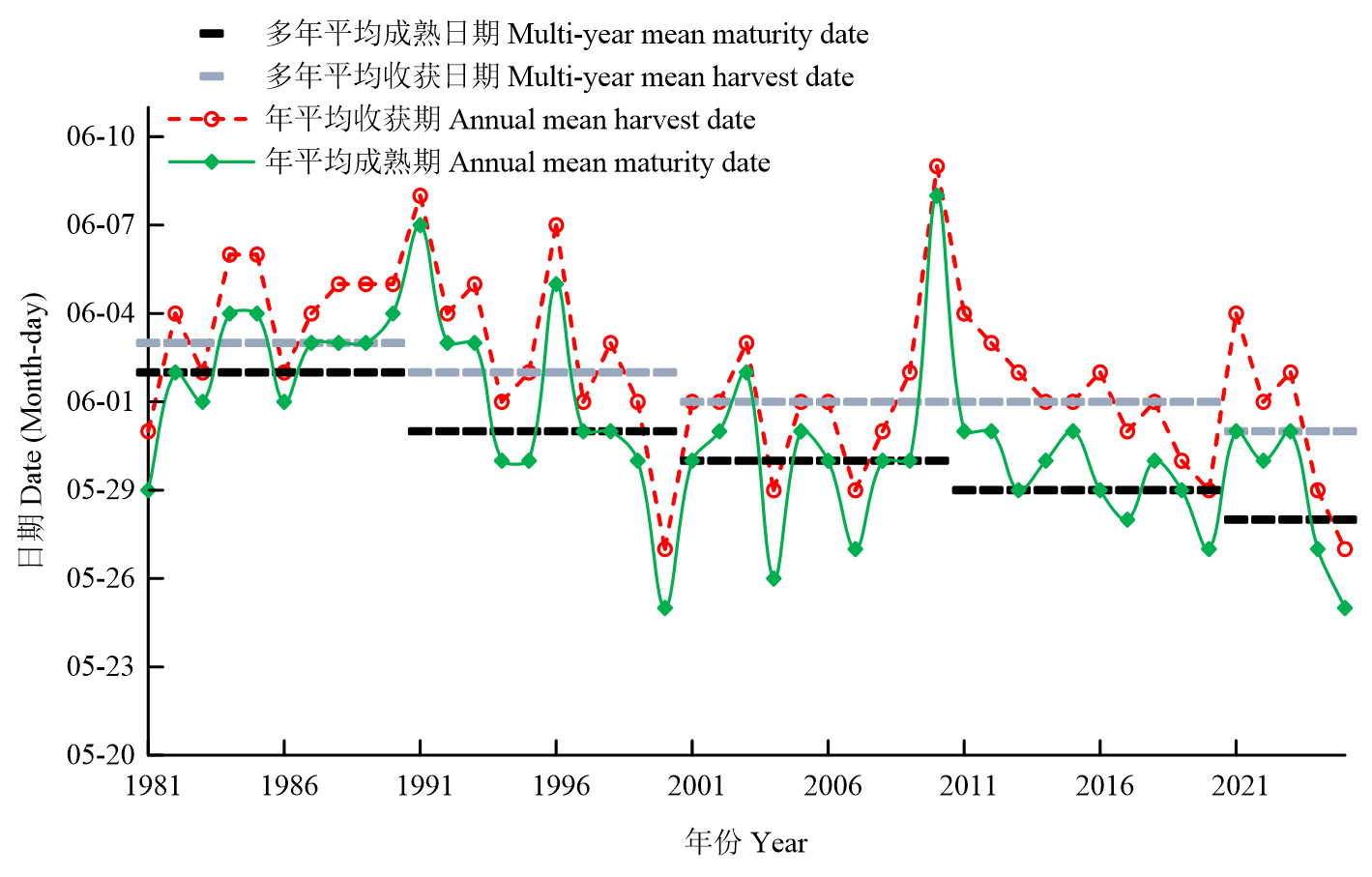
图2
1961—2025年河南省冬小麦成熟期和收获期平均日期的年际变化"
表2
1961—2025年河南省冬小麦成熟期-收获期连阴雨灾害气象要素极值"
| 极值 Extreme value | 气象要素 Meteorological element | |||||
|---|---|---|---|---|---|---|
| 连阴雨天数 Number of persistent rainfalls (t,d) | 过程降水量 Process precipitation (P,mm) | 日平均日照时数 Mean sunshine duration (S,h) | 日平均气温 Mean temperature (T,℃) | 日平均空气相对湿度 Mean relative air humidity (RH,%) | 日平均风速 Mean wind speed (U,m·s-1) | |
| 平均值Mean value | 4.3 | 62.2 | 1.8 | 20.1 | 85.0 | 2.4 |
| 最大值Maximum value | 15.0 | 372.9 | 10.8 | 27.7 | 98.0 | 7.5 |
| 最小值Minimum value | 3.0 | 30.0 | 0 | 13.1 | 56.3 | 0 |
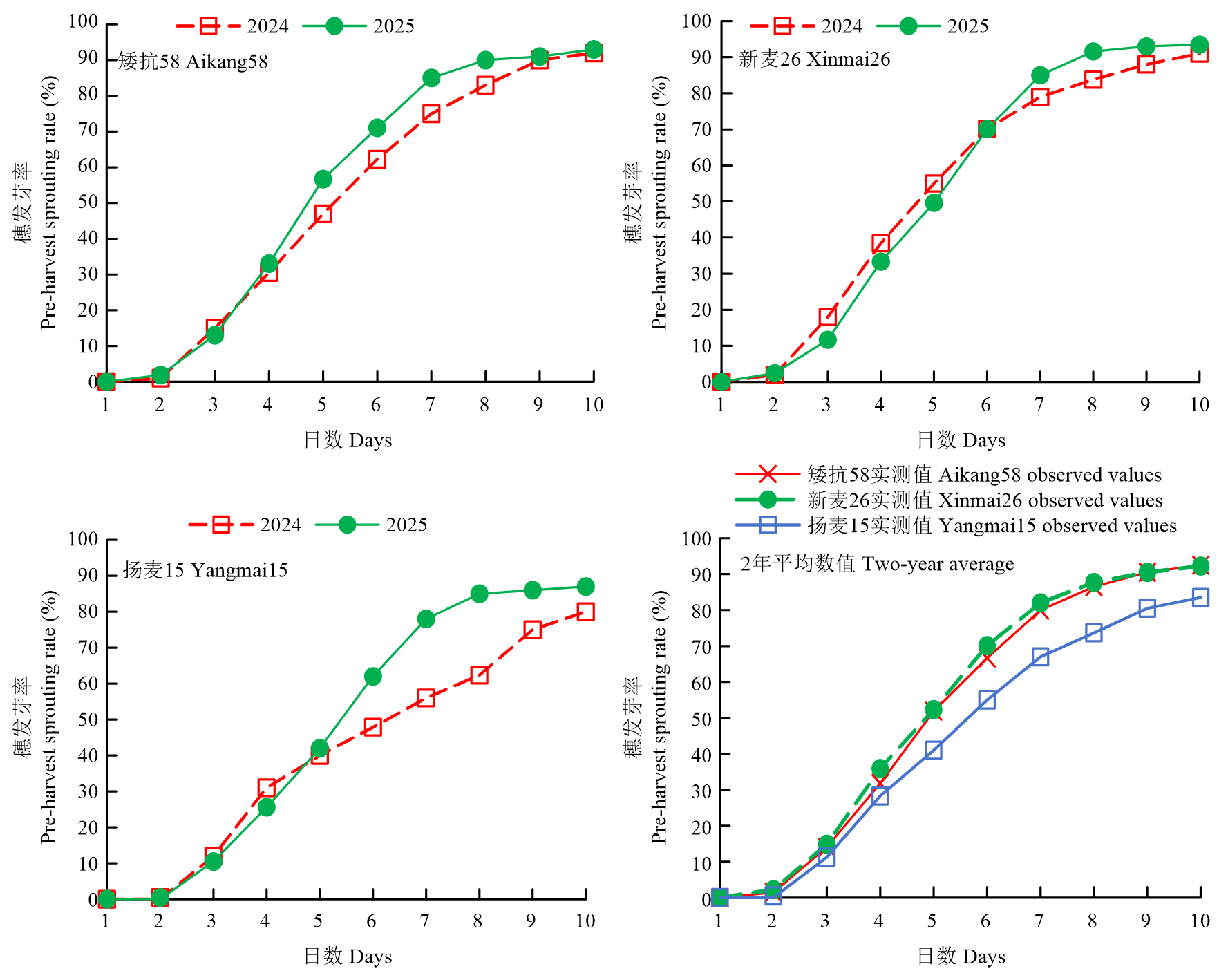
图3
不同冬小麦品种穗发芽率随试验天数的变化特征"
表3
不同品种冬小麦穗发芽率Logistic方程拟合参数"
| 作物品种 Crop variety | 模型参数Model parameter | ||||
|---|---|---|---|---|---|
| α | β | γ | R2 | RMSE (%) | |
| 矮抗58 Aikang58 | 1.088 | 0.953 | -4.656 | 0.995 | 2.539 |
| 扬麦15 Yangmai15 | 1.091 | 0.971 | -4.609 | 0.995 | 2.655 |
| 新麦26 Xinmai26 | 1.194 | 0.785 | -4.259 | 0.988 | 3.580 |
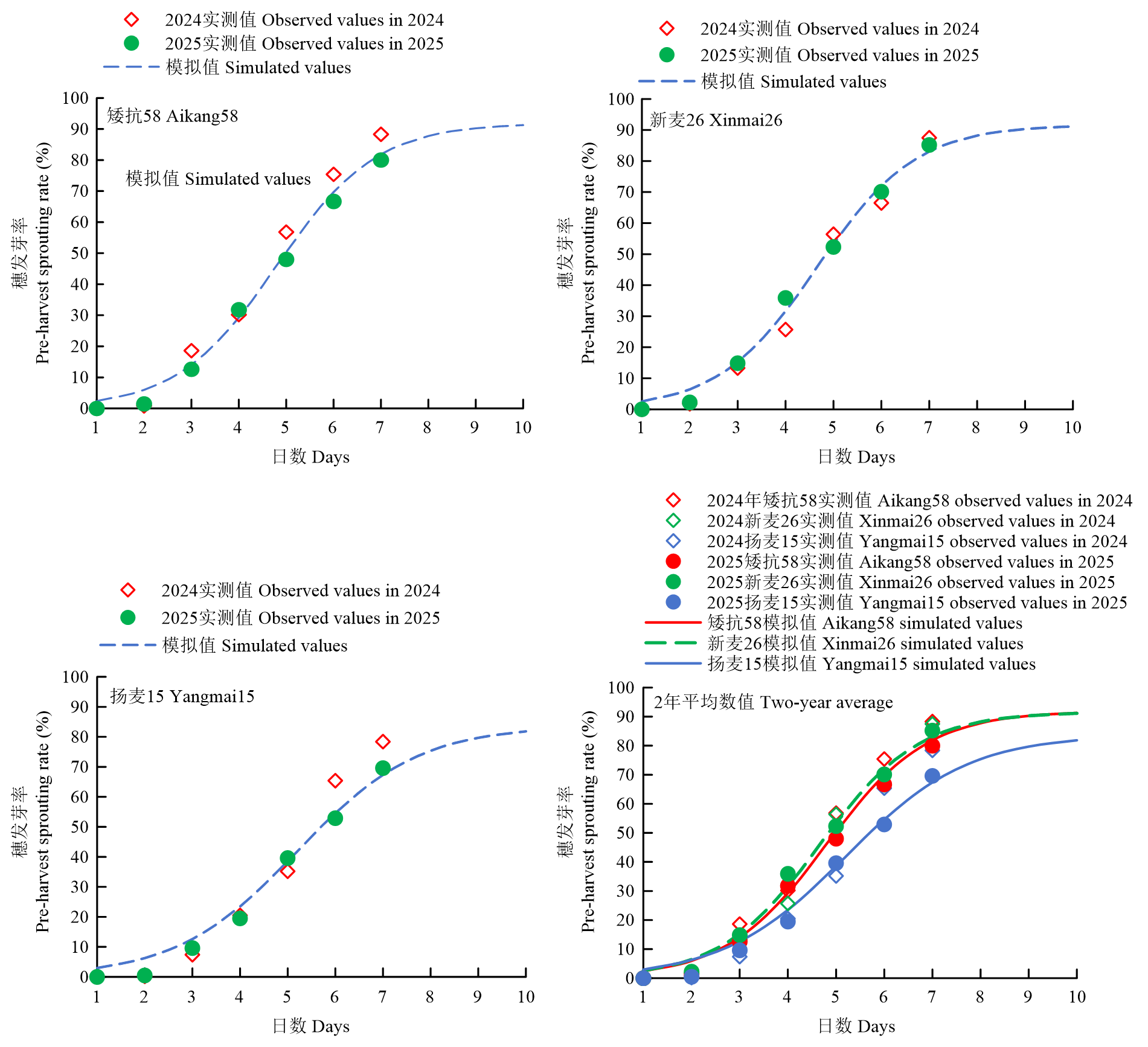
图4
各冬小麦品种穗发芽率模拟值与实测值"
表4
冬小麦穗发芽率与标准化气象影响因子相关性"
| 气象因子Meteorological factor | PN | SN | TN | UN | RHN |
|---|---|---|---|---|---|
| 相关系数Correlation coefficient | 0.416** | -0.303* | 0.318* | -0.130 | 0.095 |
表5
冬小麦成熟期-收获期连阴雨灾害穗发芽单站点评价指标"
| 穗发芽率等级 Grade of pre-harvest sprouting rate | PHSRt百分位数 Percentile of PHSRt | 赋值 Assignment | 危害表现 Hazard manifestation |
|---|---|---|---|
| 无None | [0.0%, 1.0%) | 0 | 无连阴雨过程发生,或者仅少部分籽粒萌动,发芽率<1.0% No persistent rainfall disasters occur, or only a small portion of the kernels sprout, with a germination rate of less than 1.0% |
| 轻度Minor | [1.0%, 30.0%) | 1 | 大部分籽粒萌动,1.0%—8.0%籽粒发芽 Most of the kernels are germinating, with 1.0% to 8.0% of the kernels sprouting |
| 中度Moderate | [30.0%, 60.0%) | 2 | 8.0%—19.0%籽粒发芽 8.0%—19.0% of the kernels have sprouted |
| 重度Severe | [60.0%, 90.0%) | 3 | 19.0%—40.0%籽粒发芽 19.0%—40.0% of the kernels have sprouted |
| 严重Extreme | ≥90.0% | 4 | 40.0%及以上籽粒发芽 40.0% or more of the kernels have sprouted |
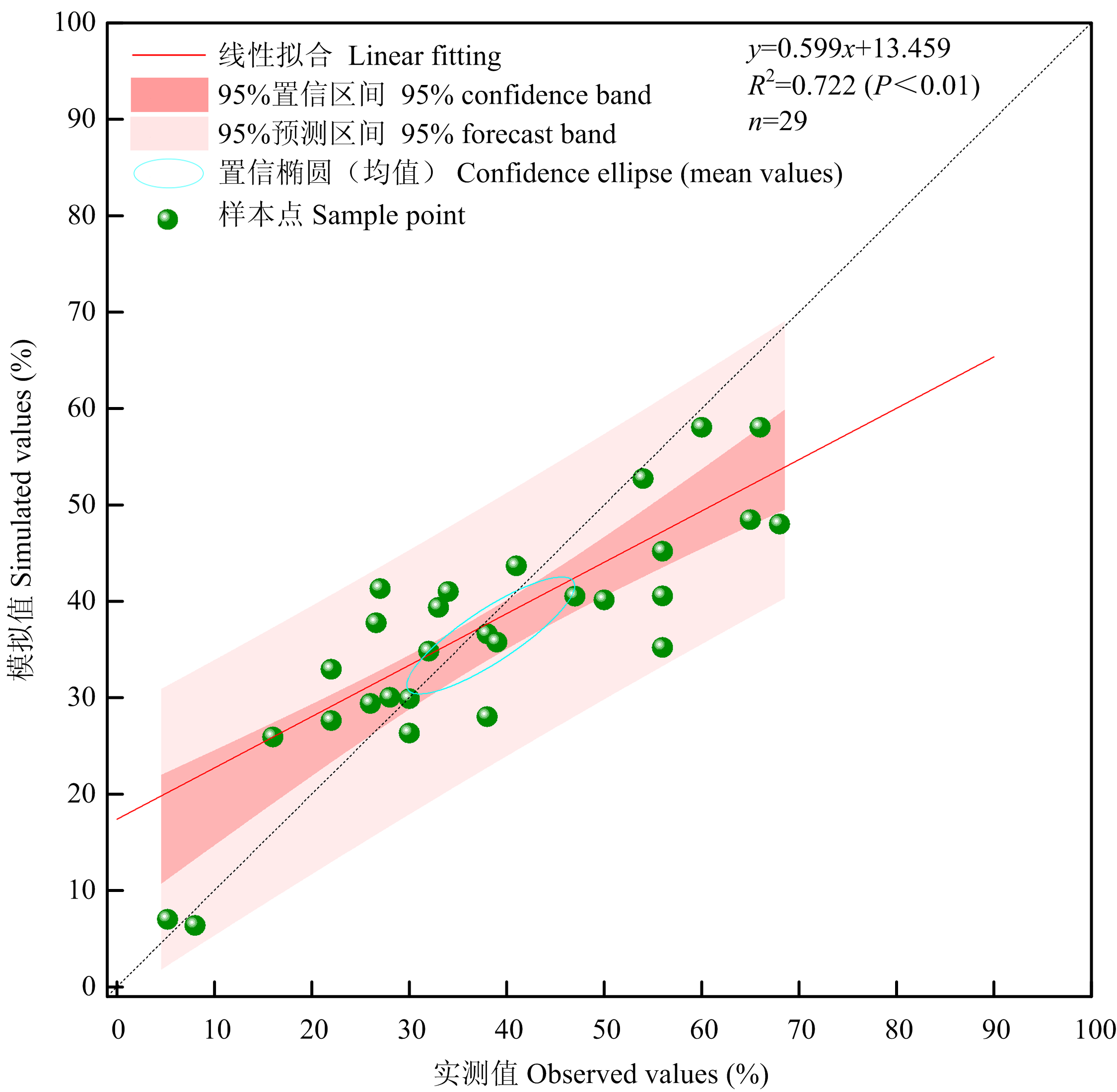
图5
2023年调查站点穗发芽率实测值与模拟值线性拟合关系"
表6
河南省典型年份穗发芽率历史文献数据和模拟数据对比"
| 年份 Year | 模拟数据 Simulated value | 河南省历史典型年份连阴雨灾害冬小麦穗发芽情况 Historical records of pre-harvest sprouting rate in typical years of Henan Province |
|---|---|---|
| 2009 | 南阳、驻马店、信阳三市平均穗发芽率为34.8%,南阳为41.4% The average pre-harvest sprouting rate in Nanyang, Zhumadian, and Xinyang is 34.8%, with Nanyang recording a rate of 41.4% | 南阳、驻马店、信阳等受灾面积高达1500多亩(1×10⁶ hm2),占5地小麦总面积的53%,占全省小麦总面积的20%,其中受灾最严重的南阳,90%的小麦质量达不到国家规定的收购标准。南阳芽麦情况较为严重,面积约占85%,大面积萌动,但出芽情况并不多,平均发芽小麦占全部小麦的50%左右[ The affected areas in Nanyang, Zhumadian, and Xinyang cover more than 1,500 mu, accounting for 53% of the total wheat area in the five regions and 20% of the total wheat area in the province. Among them, Nanyang, which suffered the most severe damage, has 90% of its wheat quality failing to meet the national purchase standards. The situation of sprouted wheat in Nanyang is more serious, with an area accounting for about 85%. A large area of wheat has sprouted, but the sprouting situation is not extensive, with an average of about 50% of the total wheat sprouting |
| 2013 | 驻马店、南阳、信阳、平顶山、周口、漯河平均21.0% The average is 21.0% in Zhumadian, Nanyang, Xinyang, Pingdingshan, Zhoukou, and Luohe | 2013年麦收期间,我国北方地区遭遇强降雨,各小麦主产区均出现不同程度的小麦萌动、发芽迹象。监测显示,河南南部受灾较为严重,局部地区芽麦比例高达30%—40%[ During the wheat harvest period in 2013, northern China experienced heavy rainfall, leading to varying degrees of sprouting and germination of wheat in major wheat-producing areas. Monitoring showed that southern Henan was severely affected, with the proportion of sprouted wheat reaching as high as 30% to 40% in some areas |
| 2015 | 信阳平均穗发芽率为23.1% The average pre-harvest sprouting rate in Xinyang and Nanyang is 23.1% | 南阳、信阳、驻马店、周口、许昌、漯河、平顶山等7市因新麦在收获期遭遇连阴雨天气,部分小麦不完善粒超过国家规定标准,特别是信阳、南阳地区超七成小麦不完善粒超标[ Due to continuous rainy weather during the harvest period, the defected kernels of wheat in some parts of Nanyang, Xinyang, Zhumadian, Zhoukou, Xuchang, Luohe, and Pingdingshan exceeded the national standard. Especially in Xinyang and Nanyang, over 70% of the wheat had defected kernels exceeding the standard |
| 2016 | 豫北、豫中、豫东、豫南穗发芽率分别为18.3%、5.9%、6.8%、9.3% The preharvest sprouting rates in northern, central, eastern, and southern Henan are 21.9%, 4.0%, 5.9%, and 14.8%, respectively | 根据河南省粮食局检测统计,豫中、豫东、豫北大部分地区出现小麦萌动甚至出芽现象,河南省有14个省辖市、7个直管县小麦不完善粒占比超过20%[ According to the inspection and statistics from the Henan Provincial Grain Bureau, sprouting or even budding of wheat has occurred in most areas of central, eastern, and northern Henan. In 14 provincial cities and 7 directly administered counties in Henan Province, the proportion of defected kernels in wheat exceeds 20% |
| 2018 | 新野、唐河、驻马店平均穗发芽率分别为6.7%、3.2%、15.2% The average pre-harvest sprouting rates of Xinye, Tanghe, and Zhumadian are 6.7%, 3.2%, and 15.2%, respectively | 新野县、唐河县约20%小麦出芽;驻马店穗发芽的约10%[ About 20% of the wheat in Xinye County and Tanghe County has sprouted; about 10% of the wheat in Zhumadian has sprouted |
| 2023 | 全省平均穗发芽率33.0%,漯河市42.0% The average pre-harvest sprouting rate across the province is 32.6%, with Luohe City recording a rate of 47.7% | 天气原因导致2023年河南省不完善粒均值高达34.6%[ Due to weather reasons, the average value of defected kernels in Henan Province in 2023 reached 34.6%, and the average sprouting rate in Luohe City was 48.5% |

图6
1961—2025年河南省冬小麦成熟期-收获期连阴雨灾害穗发芽风险空间分布"
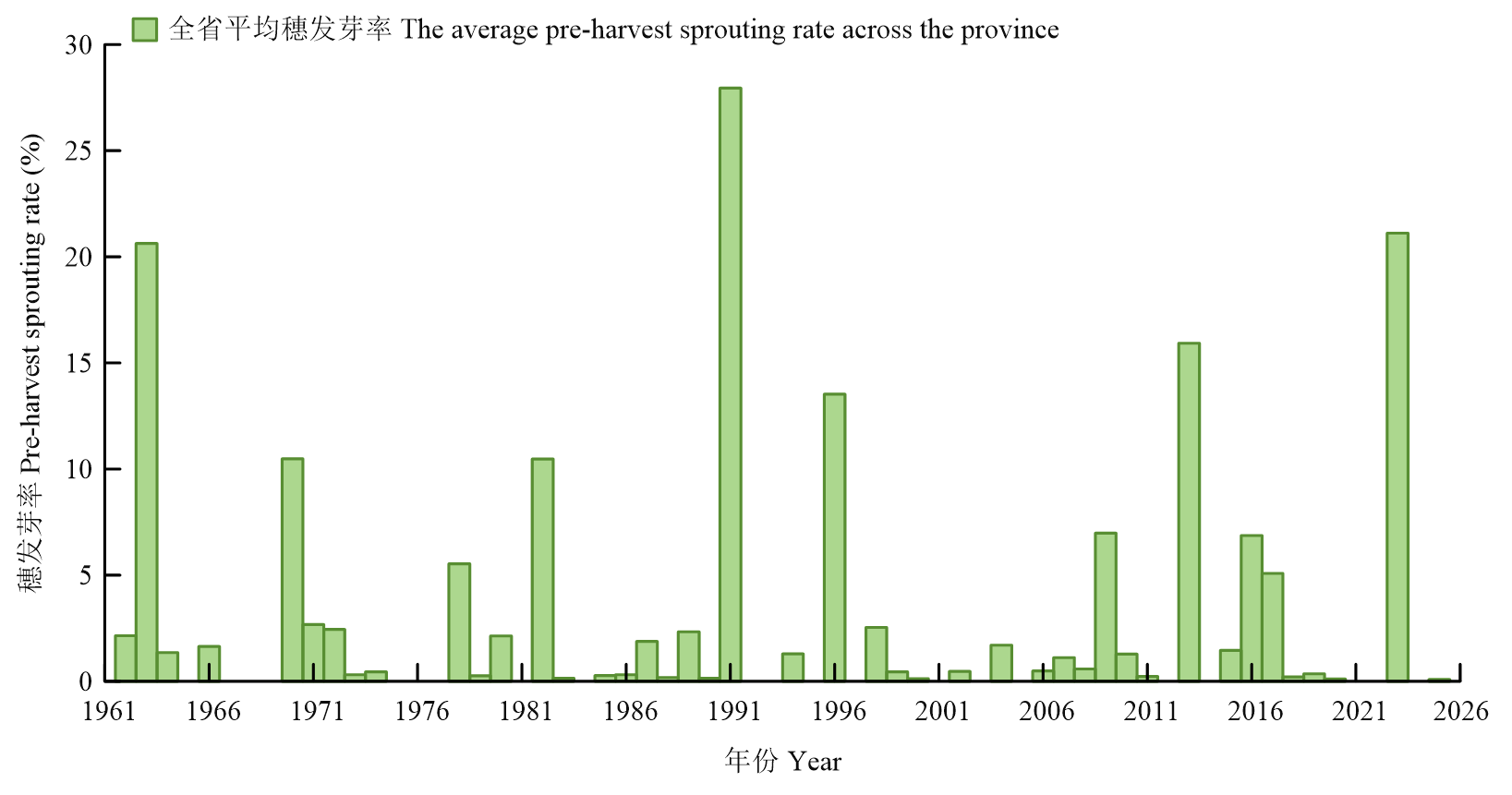
图7
1961—2025年河南省冬小麦成熟期-收获期穗发芽率年际变化"

图8
河南省典型年份冬小麦成熟—收获期穗发芽率等级空间分布"
表7
2024、2025年不同品种冬小麦穗发芽率Logistic方程拟合参数"
| 作物品种 Crop variety | 模型参数Model parameter | |||||
|---|---|---|---|---|---|---|
| 年份 Year | α | β | γ | R2 | RMSE | |
| 矮抗58 Aikang58 | 2024 | 1.088 | 0.829 | -4.253 | 0.994 | 3.150 |
| 2025 | 1.087 | 1.061 | -4.995 | 0.997 | 2.303 | |
| 扬麦15 Yangmai15 | 2024 | 1.254 | 0.652 | -3.693 | 0.971 | 5.621 |
| 2025 | 1.134 | 0.995 | -5.154 | 0.998 | 2.010 | |
| 新麦26 Xinmai26 | 2024 | 1.133 | 0.959 | -4.404 | 0.993 | 3.336 |
| 2025 | 1.058 | 0.986 | -4.826 | 0.997 | 2.471 | |
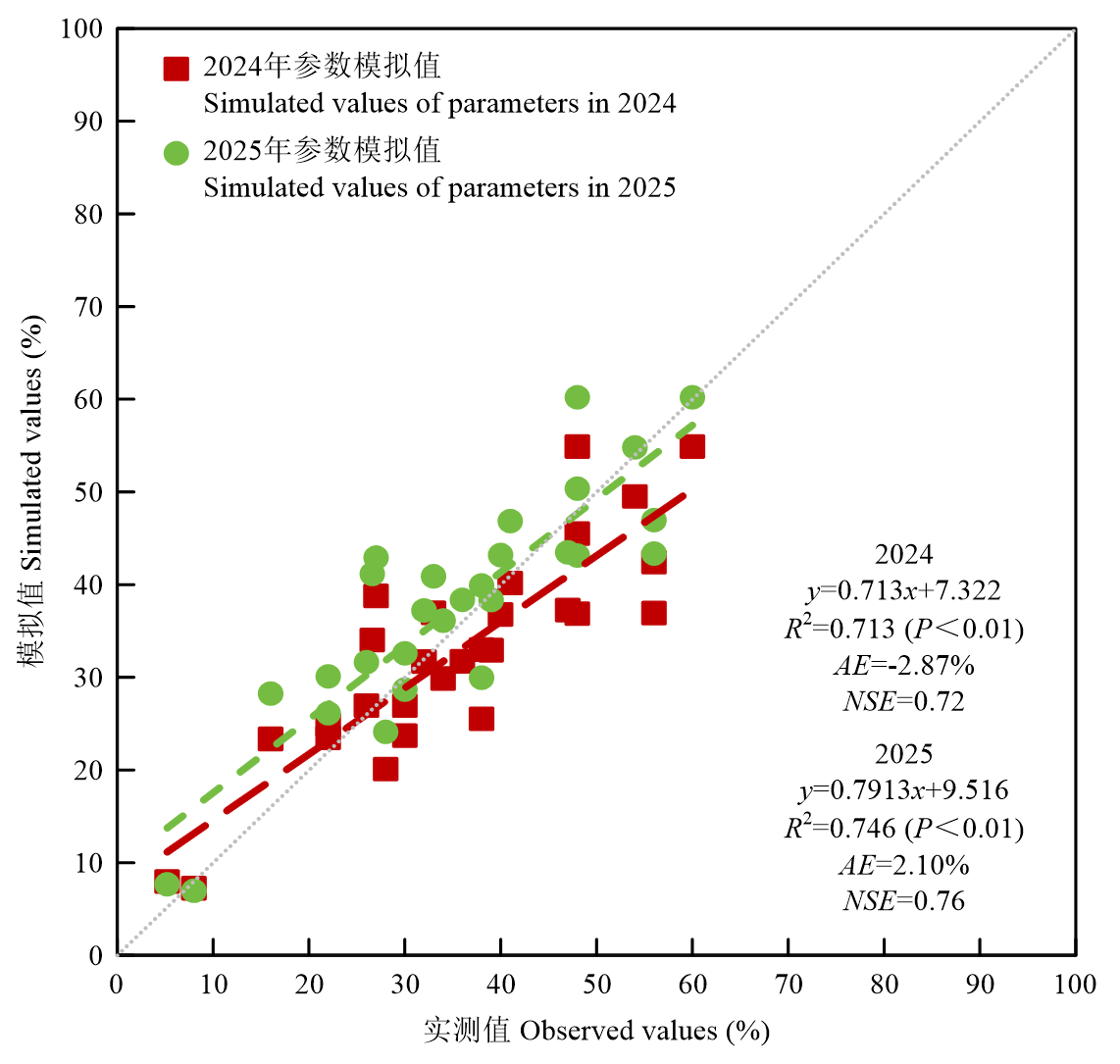
图9
不同年份Logistic 拟合参数稳定性分析"
| [1] |
doi: 10.1016/j.plantsci.2019.01.004 |
| [2] |
doi: 10.3389/fpls.2018.00063 pmid: 29449853 |
| [3] |
doi: 10.1111/crf3.2018.17.issue-3 |
| [4] |
朱美荣, 张如标, 王蓓蓓, 李春燕, 朱新开. 小麦穗发芽生理及调控途径研究进展[J]. 金陵科技学院学报, 2010, 26(2): 49-54.
|
|
|
|
| [5] |
doi: 10.1002/jsfa.6229 pmid: 23674491 |
| [6] |
李亚男, 秦耀辰, 谢志祥, 宁晓菊, 张丽君. 中国冬小麦麦收期连阴雨灾害风险评价[J]. 自然资源学报, 2018, 33(11): 1926-1939.
doi: 10.31497/zrzyxb.20171263 |
|
doi: 10.31497/zrzyxb.20171263 |
|
| [7] |
肖世和, 闫长生, 张海萍, 孙果忠. 小麦穗发芽研究[M]. 北京: 中国农业科学技术出版社, 2004.
|
|
|
|
| [8] |
doi: 10.1023/A:1019679924173 |
| [9] |
郭天财, 王永华. 小麦高产与防灾减灾技术[M]. 郑州: 中原农民出版社, 2016.
|
|
|
|
| [10] |
夏先清, 杨子佩. 河南全力抢收夏粮[N]. 经济日报, 2023-06- 01(12).
|
|
|
|
| [11] |
成林, 郭康军, 申晓晴, 商东耀. 冬小麦不完善粒气象条件危险性指数研究[J]. 气象与环境科学, 2024, 47(1): 28-36.
|
|
|
|
| [12] |
doi: 10.1111/jac.v211.2 |
| [13] |
董慧雪, 陈倩, 郭晓江, 王际睿. 小麦穗发芽抗性机制及抗性育种研究[J]. 中国农业科学, 2024, 57(7): 1237-1254. DOI:10.3864/j.issn.0578-1752.2024.07.003.
|
|
|
|
| [14] |
doi: 10.1016/j.xplc.2023.100739 |
| [15] |
郭康军, 邹春辉, 余卫东, 胡丽婷, 房稳静, 檀艳静, 张丽梅, 成林. 2023年河南冬小麦成熟期连阴雨强度综合评估[J]. 气象与环境科学, 2024, 47(1): 97-104.
|
|
|
|
| [16] |
檀艳静, 成林, 郭康军. 河南省冬小麦灌浆期连阴雨灾害风险评估[J]. 气象与环境科学, 2024, 47(1): 105-111.
|
|
|
|
| [17] |
郭其乐, 郭鹏, 师丽魁, 邹春辉, 郭康军, 檀艳静. 连阴雨胁迫下成熟期麦穗发芽霉变估测[J]. 农业工程学报, 2024, 40(22): 124-135.
|
|
|
|
| [18] |
余卫东, 杨君健. 河南省优质小麦适宜种植区及未来变化趋势[J]. 中国农业大学学报, 2021, 26(9): 42-51.
|
|
|
|
| [19] |
檀艳静, 杨慧洁, 李辉. 1981—2019年气候变化对河南省冬小麦生育期的影响分析[J]. 山东农业科学, 2020, 52(12): 30-38.
|
|
|
|
| [20] |
温克刚, 庞天荷. 中国气象灾害大典·河南卷[M]. 北京: 气象出版社, 2005.
|
|
|
|
| [21] |
NY/T 1739—2009 小麦抗穗发芽性检测方法[S].
|
|
NY/T 1739—2009 Determination of pre-harvest sprouting in wheat[S]. (in Chinese)
|
|
| [22] |
GB/T 5520—2011 粮油检验籽粒发芽试验[S].
|
|
GB/T 5520—2011 Inspection of grain and oils—Germination test of seeds[S]. (in Chinese)
|
|
| [23] |
高威, 徐康乐, 刘雪, 徐冬梅, 高畅, 严胜男, 姚辉, 尚姚姚, 潘旭, 曹佳佳, 程欣然, 刘明利, 卢杰, 常成, 张海萍, 马传喜. 小麦穗发芽抗性鉴定标准的改进与优化[J]. 安徽农业大学学报, 2021, 48(2): 179-184.
|
|
|
|
| [24] |
DB34/T 2316—2015 冬小麦灌浆期连阴雨等级[S].
|
|
DB34/T 2316—2015 Grades of continuous rain during winter wheat filling Period[S]. (in Chinese)
|
|
| [25] |
DB41/T 2071—2020 连阴雨预警信号等级划分[S].
|
|
DB41/T 2071—2020 Classification of continuous rain warning signal levels[S]. (in Chinese)
|
|
| [26] |
DB41/T 2157—2021 冬小麦农业气象服务规程[S].
|
|
DB41/T 2157—2021 Agricultural meteorological service specifications for winter wheat[S]. (in Chinese)
|
|
| [27] |
卢元磊, 何佳洲, 安瑾. 目标预测中的野值剔除方法研究[J]. 计算机与数字工程, 2013, 41(5): 722-725.
|
|
|
|
| [28] |
王朔楠, 孙静, 郭嘉莹, 韩丽童, 邱念伟, 周峰. 种子发芽指标及其测算方法[J]. 麦类作物学报, 2023, 43(2): 190-196.
|
|
|
|
| [29] |
四郎措姆, 熊亚军, 洛桑卓嘎, 洛松桑邓, 边巴江村, 旦增克珠. 基于层次分析法和模糊评判法的西藏国家气象公园评价研究[J]. 气象与环境学报, 2022, 38(3): 162-168.
|
|
|
|
| [30] |
王立志, 王连敏, 张国民, 刘功, 石峰. 不同温度条件下玉米种子发芽的量化模型[J]. 中国农业气象, 2000, 21(3): 36-38.
|
|
|
|
| [31] |
刘春香, 刘军禄, 黄明杰, 孙建福, 刘长林. 萌发后回干对种子耐贮藏性和再萌发的影响研究[J]. 植物学研究, 2018, 7(3): 294-304.
|
|
doi: 10.12677/BR.2018.73038 |
|
| [32] |
申双和, 景元书. 农业气象学原理[M]. 北京: 气象出版社, 2017: 100-111.
|
|
|
|
| [33] |
余锐, 侯灵, 云翔, 邓若钊, 孙丽颖. 基于百分位数法的广东气温变化特征研究[J]. 广东气象, 2023, 45(5): 17-21, 28.
|
|
|
|
| [34] |
|
| [35] |
陈岩鹏, 姚芳, 宋丽. 芽麦成灾总理心忧[EB/OL]. 华夏时报. (2009-07-31). https://www.chinatimes.net.cn/article/6648.html.
|
|
|
|
| [36] |
焦善伟, 张智先, 徐彦. 局部芽麦问题突出收购进度呈现差异: 2009年豫鄂皖鲁四省小麦收购市场调查报告[J]. 黑龙江粮食, 2009(4): 29-31.
|
|
|
|
| [37] |
张广凯. 小麦发芽导致今年产量损失8% 加大美国进口[EB/OL]. (2013-07-04) [2013-07-04]. 观察者网, https://www.guancha.cn/economy/2013_07_04_155933.shtml.
|
|
|
|
| [38] |
宋晓东, 史林静. 河南补贴不完善粒超标小麦收购缓解卖粮难[N]. 驻马店日报, 2015-08-21( 7).
|
|
|
|
| [39] |
冯彦平, 魏萍. 2015年小麦市场回顾与展望[J]. 河南农业, 2016(4): 10-11.
|
|
|
|
| [40] |
冯彦平, 魏萍. 河南省稻谷收购市场调研报告[J]. 河南农业, 2016(1): 11-12.
|
|
|
|
| [41] |
唐豪, 周勇, 谭志, 杨力生, 郭晓江, 王际睿. 部分小麦产区穗发芽危害状况调查及应对建议[J]. 农家科技(下旬刊), 2018(7): 36-37.
|
|
|
|
| [42] |
符锋, 戴冠苹, 张梓豪. 2020—2024年河南省小麦质量品质对比分析[J]. 食品安全质量检测学报, 2025, 16(10): 285-291.
|
|
|
|
| [43] |
邢美双, 原媛, 李丹, 郭鸣, 刘迪. 漯河市2023年夏收小麦质量状况分析调查[J]. 粮油科学与工程, 2024, 38(1): 48-51.
|
|
|
|
| [44] |
龚承儒, 袁雨豪, 刘振, 郑继周, 田志成, 刘胜利, 沈庆花, 黄振朴, 董纯豪, 高艳, 李巧云, 唐建卫, 焦竹青, 殷贵鸿. 小麦种质资源穗发芽抗性鉴定和分子标记分析[J]. 植物遗传资源学报, 2024, 25(9): 1493-1503.
doi: 10.13430/j.cnki.jpgr.20231113002 |
|
doi: 10.13430/j.cnki.jpgr.20231113002 |
|
| [45] |
GB 1351—2023 小麦 [S].
|
|
GB 1351—2023 Wheat[S]. (in Chinese)
|
|
| [46] |
娄秀荣, 王石立. 1991年全国农业气象条件概述[J]. 中国农业气象, 1992, 13(4): 58-61.
|
|
|
|
| [47] |
河南省种业中心. 河南省农业农村厅公告第323号[EB/OL]. (2025-07-08) [2025-07-08]. https://nynct.henan.gov.cn/2025/07-08/3178580.html.
|
|
Henan Provincial Seed Industry Center.
|
|
| [48] |
赵楠, 王树星, 张乐, 党润海. 102份小麦材料穗发芽调查研究[J]. 陕西农业科学, 2024, 70(12): 32-36.
|
|
|
|
| [49] |
朱利广, 张玉坤, 马庆, 王勖, 晁漫宁. 安徽省冬小麦品种大田条件下穗发芽抗性研究[J]. 中国种业, 2023(9): 66-69.
|
|
|
|
| [50] |
现代农业农村科技科. 科技服务助力小麦丰产丰收[EB/OL]. (2023-06-05) [2023-06-05]. http://kjj.smx.gov.cn/4/616467168/1137835.html.
|
|
Modern agriculture, rural science and technology section. Scientific and technological services support high and stable yields of wheat[EB/OL]. (2023-06-05) [2023-06-05]. http://kjj.smx.gov.cn/4/616467168/1137835.html. (in Chinese)
|
|
| [51] |
doi: 10.2135/cropsci2016.02.0138 |
| [52] |
doi: 10.1105/tpc.111.088492 pmid: 21896881 |
| [53] |
doi: 10.1626/jcs.82.183 |
| [54] |
车京玉, 王岩, 李长辉, 马勇, 高凤梅, 张起昌, 刘宁涛, 邹东月, 田超, 邵立刚. 春小麦穗发芽影响因素及特性研究[J]. 大麦与谷类科学, 2015, 32(3): 11-13, 18.
|
|
|
|
| [55] |
张红生, 王州飞. 种子学[M]. 3版. 北京: 科学出版社, 2021.
|
|
|
|
| [56] |
杜世超, 薛盈文, 郭伟, 于立河. 不同温湿度环境对黑龙江省春小麦穗发芽的影响[J]. 湖北农业科学, 2022, 61(3): 26-31.
|
|
|
|
| [57] |
doi: 10.1016/j.cell.2004.12.019 pmid: 15707897 |
| [58] |
doi: 10.1071/AR06101 |
| [59] |
高剑波, 潘建梅, 陆钦武, 潘久发, 许美刚. 小麦田间穗发芽的影响因素及防止对策[J]. 种子, 2006, 25(6): 75-77.
|
|
|
|
| [60] |
刘莉, 王海庆, 陈志国. 小麦抗穗发芽研究进展[J]. 作物杂志, 2013(4): 6-11.
|
|
|
| [1] | 王彩玉, 刘小丽, 李文广, 杨文平, 杨珍平, 高志强. 有机肥不同替代比例对土壤多功能性的影响及微生物驱动机制[J]. 中国农业科学, 2026, 59(8): 1712-1726. |
| [2] | 朱琦, 贾振鹏, Tahir SHAH, 徐晨晟, 李芷琦, 吕会帅, 朱鹏超, 韦小敏, 黄冬琳, 孙艳妮, 曹卫东, 高亚军, 王朝辉, 张达斌. 绿肥配施增效产品降低旱地麦田温室气体排放及碳足迹[J]. 中国农业科学, 2026, 59(7): 1507-1522. |
| [3] | 钱瑾, 李映雪, 吴芳, 邹晓晨. 集成光谱降维的冬小麦叶片磷含量估算[J]. 中国农业科学, 2026, 59(4): 781-792. |
| [4] | 孔媛, 崔沙沙, 李美, 李健, 杨思雨, 房锋, 刘帅帅, 刘明平, 曾艳, 高兴祥, 柏连阳. 黄淮海冬小麦田多花黑麦草等5种禾本科杂草时空分布变化规律[J]. 中国农业科学, 2026, 59(4): 807-823. |
| [5] | 咸青林, 肖鉴珂, 高阿庆, 郜利闯, 刘杨. 种植方式结合测墒补灌下冬小麦产量及水分利用效率[J]. 中国农业科学, 2026, 59(3): 589-601. |
| [6] | 于立强, 姚东泽, 费帅鹏, 李辉利, 郭宪瑞, 姚丹妤, 张宏军, 周阳, 肖永贵. 基于多时相冠层光谱的小麦适应性评价与高产稳产品种鉴选[J]. 中国农业科学, 2026, 59(18): 3989-4003. |
| [7] | 王媛媛, 王琦, 母俊毅, 米东明, 谢晓婷, 哈琦琦, 周鹏, 任爱霞, 孙敏, 高志强. 春季追氮对冬小麦产量构成及光合资源利用的调控机制[J]. 中国农业科学, 2026, 59(10): 2123-2137. |
| [8] | 吕旭东, 孙世媛, 李亚楠, 刘玉龙, 王艳群, 付鑫, 张佳英, 宁鹏, 彭正萍. 智能机械化分层施肥对麦田根-土养分分布和小麦产量的影响[J]. 中国农业科学, 2026, 59(1): 129-146. |
| [9] | 蒲丽霞, 张佳芮, 叶建萍, 黄秀兰, 樊高琼, 杨洪坤. 二氢赤霉素与秸秆覆盖对旱地小麦分蘖成穗与产量的影响[J]. 中国农业科学, 2025, 58(9): 1735-1748. |
| [10] | 肖长春, 韦新宇, 曾跃辉, 黄建鸿, 许旭明. 不同播期下黑米籽粒花色苷的积累特性及其与气象因子的关系[J]. 中国农业科学, 2025, 58(5): 890-906. |
| [11] | 史帆, 李文广, 易树生, 杨娜, 陈玉萌, 郑伟, 张雪辰, 李紫燕, 翟丙年. 有机无机肥配施下旱地麦田土壤有机碳组分含量的变化特征[J]. 中国农业科学, 2025, 58(4): 719-732. |
| [12] | 房康睿, 丁世杰, 陈雨珊, 杨秉庚, 郭腾飞, 徐新朋, 赵士诚, 王秀斌, 黄绍敏, 仇少君, 何萍, 周卫. 有机无机肥配施下典型潮土小麦季有机肥氮磷的当季释放率[J]. 中国农业科学, 2025, 58(24): 5234-5246. |
| [13] | 佘映军, 周子哲, 伍明, 郭魏, 师昌健, 胡超, 李平. 地下水埋深和施氮对土壤水盐分布及冬小麦养分吸收利用的影响[J]. 中国农业科学, 2025, 58(20): 4285-4304. |
| [14] | 王荣荣, 徐宁璐, 黄修利, 赵凯男, 黄明, 王贺正, 付国占, 吴金芝, 李友军. 一次灌溉和氮肥运筹对旱地小麦籽粒产量和品质的影响[J]. 中国农业科学, 2025, 58(1): 43-57. |
| [15] | 高兴祥, 孔媛, 张耀中, 李美, 李健, 金岩, 张国福, 刘帅帅, 刘明平, 曾艳, 柏连阳. 河南省冬小麦田杂草群落分布现状及其变化原因分析[J]. 中国农业科学, 2025, 58(1): 91-100. |
|
||
